Improving the Performance of Time Invariant
Maximum Power Point Tracking Methods
H. Galligan, S.Lyden
School of Engineering and ICTUniversity of Tasmania Hobart, Australia [email protected]
Abstract— This paper presents an improved reinitialisation condition for time invariant maximum power point tracking (MPPT) methods used in photovoltaic (PV) systems experiencing partial shading conditions (PSC). Time invariant (MPPT) methods, such as Particle Swarm Optimisation (PSO), overcome the limitations of existing MPPT by tracking the global maximum power point (GMPP) of a PV system operating under PSC. However, due to the time invariant structure of these MPPT methods, they also require a reinitialisation condition to be defined for when a change in irradiance or temperature occurs. Testing was performed using simulations of a model built in Matlab/ Simulink, where the performance of existing and developed conditions was evaluated using test cases with changes in solar irradiance. Limitations of existing conditions were identified and a more robust reinitialisation condition developed. The developed reinitialisation condition used sentry particles to monitor the PV voltage range for changes in the measured power of any sentry. The developed condition had a 96 % rate of successful detection, as compared to as low as 68 % successful detection for existing methods, demonstrating improved performance and robustness.
Index Terms—maximum power point tracking, Particle Swarm Optimisation, partial shading conditions, reinitialisation condition
I. INTRODUCTION
With rising carbon dioxide emissions and the growing threat of global warming, power generation has required a shift away from the existing dependence on fossil fuels and a move towards more sustainable practices. Photovoltaic (PV) based power generation has seen rapid growth, development [1] and implementation due to its advantages of renewable generation, no fuel reliance (or costs) and low maintenance requirements [2].
PV cells can only convert sunlight into electricity with limited efficiency. Additionally, cells have non-linear
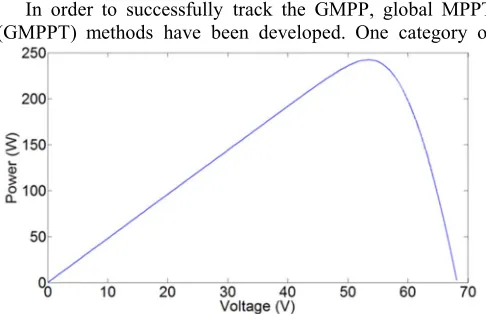
Current-Voltage (I-V) and Power-Current-Voltage (P-V) characteristics, resulting in a single optimal point of operation that corresponds to a maximum power and efficiency value, as shown in Fig. 1 [3].
Due to this non-linear P-V characteristic, maximum power point tracking (MPPT) methods are required to maintain the system operation at (or very close to) the maximum power point (MPP). The location and value of this MPP varies with temperature and solar irradiance [4]. Conventional MPPT are capable of tracking the MPP under uniform conditions with good efficiency, however these conditions are not representative of ‘real’ operating environments [5][6][7].
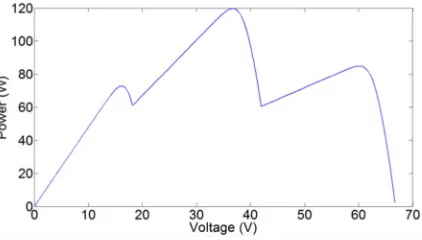
Partial shading conditions (PSC) result in non uniform conditions across a PV system, with some sections receiving lower irradiance than others. This can occur due to shading from clouds or shadows from trees and buildings [8]. A PV system operating under PSC has a more complex P-V curve that exhibits multiple peaks as shown in Fig. 2.
Conventional MPPT methods are not as effective at tracking the global maximum power point (GMPP) under PSC and can often become trapped at a local MPP rather than the GMPP [9].
[image:1.612.314.557.495.652.2]In order to successfully track the GMPP, global MPPT (GMPPT) methods have been developed. One category of
GMPPT techniques is time invariant optimisation methods such as Particle Swarm Optimisation (PSO). PSO is an iterative optimisation algorithm based on the flocking behaviour of birds and schooling of fish [10]. The algorithm generates a swarm of individuals in the search space and each individual (particle) represents a solution to the proposed problem. If the algorithm is successful, the particles will all converge or “swarm” to the optimal solution similar to the case shown in Fig. 3 [11].
In being time invariant, these optimisation methods have no explicit time dependence in their search algorithms and additionally, are normally applied to optimisation problems where the solution (and function being optimised) does not change with time [12]. For MPPT however, the optimised value sought is the maximum power available, where the location and value of the GMPP of a PV system continually varies with environmental conditions (temperature, solar irradiance and shading). As such, the time invariance of these MPPT methods indicates that once the optimal point has been found, they cannot provide continuous tracking of the GMPP [12], [13].
In order to provide continuous tracking of the GMPP, time invariant optimisation techniques require a reinitialisation condition to be defined such that, when a change in environmental conditions occur (solar irradiance and/or temperature), the tracking algorithm is restarted and a search for the new GMPP is initiated. In particular, changes in shading that will lead to a change in the relative location of the GMPP need to be accurately determined. This phenomenon is likely to arise at a slower rate than instantaneous changes in irradiance such that continual application of global tracking is not necessary [14].
It is critical that reinitialisation conditions are sufficiently able to identify a significant change in environmental conditions, but are robust enough that a new search is not preemptively started. With a suitable reintialisation condition, the GMPPT method is capable of locating the GMPP for a PV system that has experienced a change in PSC.
[image:2.612.327.551.67.194.2]The objective of this paper was to explore and identify the limitations of existing reinitialisation conditions, and in turn develop a more robust reinitialisation condition for time invariant MPPT methods in order to improve their performance.
[image:2.612.66.277.587.707.2]Figure 2. P-V Characteristics for Partial Shading Conditions
Figure 3. Search Behaviour of the PSO Algorithm
Section II presents both existing reinitialisation conditions with their limitations as well as the proposed condition. The Matlab model used for simulations is outlined in Section III and Sections IV and V present the results and conclusions respectively.
II. REINTIALISATION CONDITIONS
The desirable qualities of a reintialisation condition are, a) To be simple in structure and implementation b) To be system independent and applicable to any PV
system
c) To be capable of detecting significant changes in environmental condition without being oversensitive to small changes that do not alter the overall P-V characteristics
In this section, three existing reinitialisation conditions are presented and for each condition their limitations are identified.
A. Existing Conditions and Their Limitations 1. PV Total Output Power Change
This reinitialisation condition, as specified in [12], will reset the GMPPT algorithm whenever the relative difference between successive measurements of the total PV system output power exceeds a predefined level. This condition is evaluated only after the GMPP has been located and has the advantages of being system independent and simple to evaluate. For a change in PSC where the operating point becomes a local MPP with a similar value to the previous GMPP, the predefined ∆P threshold will determine whether the change is detected and cannot guarantee successful detection.
2. Irradiance and Temperature sensors
The reinitialisation condition used in [11] will reset the GMPPT algorithm when a sudden change in irradiance or temperature occurs for the PV system. This approach has immediate limitations in terms of how the irradiance and temperature inputs are measured and computed, where sensors are used in this application and testing is conducted for one PV module only.
conditions and a step change in irradiance (across the whole module). This condition is not analysed for cases where the module experiences non uniform irradiance across the module and does not present threshold irradiance and temperature change values that would trigger a reset of the search.
This reinitialisation condition is not system independent, as the number of sensors required is dependent on the size of the PV system. Additionally, the use of single sensors for each module could limit the ability to detect PSC changes within each module, such as shading from a tree partially covering a module. Increasing the number of sensors could also increase the cost and complexity of the MPPT algorithm.
3. Periodic Check of the Value at Adjacent MPPs The authors of [13] utilize previously defined reinitialisation conditions and also evaluate the use of a periodic check of the value at adjacent MPPs once the GMPP has been found.
Sampling adjacent MPP values to check whether their values have changed, due to a change in shading conditions, is drawn from an experimental observation found in [3]. From extensive studies of P-V characteristics for PV systems experiencing PSC, the authors of [3] concluded that peaks on the P-V curves occur at multiples of approximately 80% of the module open circuit voltage, .
Once the GMPP has been located the adjacent MPPs on either side of the GMPP, at 80% of above and below the GMPP voltage, can be periodically sampled. If the measured power differs from the last measured value at the adjacent MPPs, this can be used to indicate a change in shading conditions.
Depending on the size of the PV system, this may or may not provide sufficient monitoring of the P-V search space (operating PV voltage range). Additionally, the effectiveness of this reinitialisation condition to detect change may be reduced when the GMPP is located near the limits of the PV voltage range. In this case, only the adjacent MPP located within the search space may be able to be checked.
This reinitialisation condition also requires that the GMPP is first located, limiting its potential ability to function in rapidly changing PSC.
B. Proposed Condition
By analysing current conditions, as outlined in Section II.A, a more robust condition can be developed and is presented in this Section.
It is important that the developed reinitialisation condition is independent of the system within which it is used (both the MPPT algorithm and PV system), as any system dependency immediately requires modification of the condition when applied to other PV systems.
The creation of the developed reinitialisation condition came from [15], which presented an empirical study of PSO in dynamically changing environments. A proposed detection of
change strategy was to use sentry points in the search space. The sentry points are evenly spaced across the search space and store a corresponding fitness value at that point. While the main algorithm runs, and the particles converge to the optimal solution, the sentry points are kept stationary. If one or more of the sentry particles record a change in the fitness value, this indicates a potential change and can be used to trigger a new search.
As highlighted in the study, larger numbers of sentry points and/or evaluation at every iteration requires longer computational time, in addition to the main algorithm computation, and so a compromise in number of sentry points or periodic evaluation is normally adopted [15].
For application to a PV system, the search space becomes the duty cycle range [Dmin, Dmax] of the DC-DC converter while the fitness is the PV output power. This reinitialisation condition records irradiance and temperature changes through the sentry points, which may or may not indicate PSC. In this project, three sentry particles were considered.
This reinitialisation condition is advantageous in that it a) Is very simple in its implementation
b) Does not require knowledge of the location of the GMPP or local MPPs, while maintaining coverage over the entire search space
c) Can be used during the search algorithm to detect any further PSC changes after the initial search was initiated. This search can then be stopped, and a new one begun
d) Can be applied prior to the GMPP search and immediately after
III. MATLAB MODEL
The main form of testing, and validation, of the existing and proposed reinitialisation conditions was conducted using Matlab/Simulink simulations. Simulations were chosen over experimental (practical) implementation for primary testing due to simulation advantages such as:
a) Standard base model conditions for all test cases b) Direct control over test variables (temperature and
irradiance levels across the PV array)
c) Bulk testing can be performed without needing to wait for given weather conditions. With these advantages, analysis and comparison of the reinitialisation conditions can be performed with greater accuracy
Figure 4. Simplified Flowchart of the Matlab Model
The proposed condition will ultimately be able to be applied to any given time invariant MPPT algorithm and so the specific (time invariant) optimisation method used in testing is not the major focus. As such, PSO was used as the GMPPT algorithm.
The PV array used in the simulation was sized to mimic an installation for an average household, approximately 3 kW [16][17], as residential PV systems commonly experience PSC through neighbouring buildings and trees [18].
Testing involved, for each reinitialisation condition, simulating the MPPT algorithm under varying irradiance profiles across the PV array that represented PSC. To reduce the complexity of the Simulink model, an assumption was made that each module received equal irradiance and PSC was simulated by different modules receiving varying irradiance levels. 25 test cases were created, including uniform conditions, to produce a variable range of potential PSC.
Each reinitialisation condition was first simulated to ensure it was capable of recognising the change from uniform to PSC. With this shown, all further tests were conducted by simulating the PV system beginning with one PSC and then having a change to another PSC at a preset time. The same initial PSC was used and the change in conditions occurred at a constant time for all test cases. Simulating a change between two PSC cases was deemed to be a more accurate measure of how each reintialisation condition performed in detecting a change.
Performance was evaluated by recording the number of successful detections of each condition when a change in shading occurred. The average tracking efficiency was also monitored [12]. Tracking efficiency is defined as the ratio of the steady state output power to the maximum available power for a given shading pattern. It can be noted that this performance measure is not specifically focused on the
reinitialisation condition, however a high value of η indicates successful detection of the change in shading conditions.
IV. RESULTS
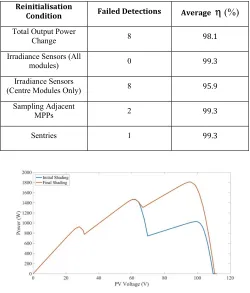
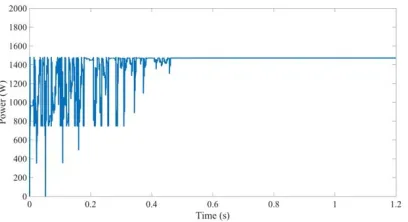
The performance of each reinitialisation condition for the 25 cases are illustrated in Table I. Figure 5, shows a sample change in shading pattern going from the P-V curve in the blue line to the orange line at some point in time. Clearly in moving from one shading condition to the next, successful detection of a change in shading pattern that initializes a new global search is essential. Figures 6 – 8 demonstrate the performance of the various reinitalisation conditions on the change shown in Fig. 5. The total output power change method (Fig. 6) and irradiance sensors (centre module only, Fig. 7) are both shown to fail to detect this change in shading condition. The proposed sentry method successfully detects the change as shown in Fig. 8. A visual representation of how the sentry particles detect the change is shown in Fig. 9.
[image:4.612.312.561.388.686.2]From the 25 cases considered, the reinitialisation condition using the total output power change recorded the equal highest number of failed cases. As mentioned in Section II 1, this occurred due to the P-V characteristics of the final PSC producing a local MPP in the vicinity of the GMPP of the initial shading pattern. This demonstrated the inability of this condition to deal these with cases.
TABLE I. SIMULATION RESULTS FOR THE REINITIALISATION CONDITIONS
Figure 5. Example Test Case Initial and Final Shading P-V characteristics
Reinitialisation
Condition Failed Detections Average η(%)
Total Output Power
Change 8 98.1
Irradiance Sensors (All
modules) 0 99.3
Irradiance Sensors
(Centre Modules Only) 8 95.9
Sampling Adjacent
MPPs 2 99.3
[image:4.612.312.562.389.682.2]Figure 6. Failure of Total Output Power Change Reinitialisation to Detect the Change
Figure 7. Failure of Irradiance Sensore (Centre Modules) to Detect the Change
[image:5.612.67.282.351.634.2]Figure 8. Success of Developed Sentry Particles in Detecting the Change
Figure 9. Visual Representation of the Sentry Particles Detecting the Change
As expected, no failed detections were recorded for the condition using irradiance sensors on every module, however the condition with a limited amount of sensors recorded the same number of failed cases (8) as for the total output power change. This indicates the limitations of irradiance sensors in
their ability to detect changes across the PV array. System independency had been consistently referenced as an important feature of the developed reinitialisation condition. As such, the accuracy of this condition (irradiance sensors) should be considered carefully in that the requirement of a sensor on every module places a limitation on its success.
Simulation results for the adjacent MPP sampling reinitialisation condition recorded only one extra failed detection as compared to the developed condition. It is expected that the identified limitations of this condition would be expected to become apparent when further extensive testing is carried out.
The developed reintialisation condition using sentry particles has been shown to perform well in detecting PSC changes, with only one failed detection. This verified the advantages of Section II.B and demonstrated that the developed condition is more robust than its existing counterparts.
V. CONCLUSIONS
The developed reinitialisation condition was shown to be more robust, improving the performance of the GMPPT method, and should be considered in use for real life systems. However, further testing is required to verify its performance under real life PSC through experimental implementation. The developed condition is simple and system independent, however for individual systems there is still the freedom in real life implementation to vary the parameters such as the number of sentries and threshold values.
The developed condition used sentry particles to monitor the PV voltage range and trigger a new search when one of the sentries registered a change in its power value. The developed condition had a 96% rate of successful detection, as compared to as low as 68% successful detection for existing methods.
REFERENCES
[1] A. R. E. Agency, “ARENA supports another solar world record,” Australian Government, 2016. .
[2] Mukund R. Patel, Wind and solar power systems: design, analysis and operation. CRC Press, 2006.
[3] H. Patel and V. Agarwal, “Maximum power point tracking scheme for PV systems operating under partially shaded conditions,” IEEE Trans. Ind. Electron., vol. 55, no. 4, pp. 1689–1698, 2008.
[4] M. Suthar, G. K. Singh, and R. P. Saini, “Comparison of
mathematical models of photo-voltaic (PV) module and effect of various parameters on its performance,” in 2013 International Conference on Energy Efficient Technologies for Sustainability, 2013, pp. 1354–1359.
[5] A. M. Bazzi and P. T. Krein, “Concerning maximum power point tracking for photovoltaic optimization using ripple-based extremum seeking control,” IEEE Trans. Power Electron., vol. 26, no. 6, pp. 1611–1612, 2011.
[7] N. Femia, G. Petrone, G. Spagnuolo, and M. Vitelli, “Optimization of perturb and observe maximum power point tracking method,” IEEE Trans. Power Electron., vol. 20, no. 4, pp. 963–973, 2005.
[8] S. Vemuru, P. Singh, and M. Niamat, “Modeling impact of bypass diodes on photovoltaic cell performance under partial shading,” IEEE Int. Conf. Electro Inf. Technol., vol. 1, no. 4, pp. 1–5, 2012.
[9] A. Fezzani, I. H. Mahammed, and S. Said, “MATLAB-based
modeling of shading effects in photovoltaic arrays,” STA 2014 - 15th Int. Conf. Sci. Tech. Autom. Control Comput. Eng., pp. 781–787, 2014.
[10] R. Eberhart and J. Kennedy, “A new optimizer using particle swarm theory,” MHS’95. Proc. Sixth Int. Symp. Micro Mach. Hum. Sci., pp. 39–43, 1995.
[11] Vysakh M., M. Azharuddin, H. Vilas, Muralidhar K., D. Paul, B. Jacob, Sudhakar Babu T., and N. Rajasekar, “Maximum power point tracking using modified PSO with CUK Converter,” 2014.
[12] Y. H. Liu, S. C. Huang, J. W. Huang, and W. C. Liang, “A particle swarm optimization-based maximum power point tracking algorithm for PV systems operating under partially shaded conditions,” IEEE Trans. Energy Convers., vol. 27, no. 4, pp. 1027– 1035, 2012.
[13] S. Lyden and E. Haque, “A Simulated Annealing Global Maximum Power Point Tracking Approach for PV Modules under Partial Shading Conditions,” IEEE Trans. Power Electron., vol. 31, no. 6, pp. 4171–4181, 2015.
[14] S. Lyden, “A Simulated Annealing Global Maximum Power Point Tracking Method for Photovoltaic Systems Experiencing Non-Uniform Environmental Conditions,” University of Tasmania, 2015.
[15] J. G. O. . Duhain, “Particle Swarm Optimization in Dynamically Changing Environments - An Empirical Study,” University of Pretoria, 2011.
[16] Clean Energy Council, “Solar PV,” 2016. .
[17] Solar Choice, “Residential Solar Power Installations FAQ.” .
[18] J. Martin II, “Why even partial shading is bad for solar power
systems,” INSTALLATION DEVICE,POSITIONING SOLAR PV