A Generic Approach to
Coalition Formation
Krzysztof R. Apt and Andreas Witzel
Abstract
We propose an abstract approach to coalition formation by focusing on partial preference relations between partitions of a grand coalition. Coali-tion formaCoali-tion is modelled by means of simple merge and split rules that transform partitions. We identify conditions under which every iteration of these rules yields a unique partition. The main conceptual tool is the notion of a stable partition. The results naturally apply to coalitional TU-games and to some classes of hedonic games.
1
Introduction
1.1
Background
Coalition formation has been a research topic of continuing interest in the area of coalitional games. It has been analyzed from several points of view, starting with [2], where the static situation of cooperative games in the presence of a given coalition structure (i.e., a partition) was considered. Early research on the subject is discussed in [10].
More recently, the problem of formation of stable coalition structures was considered in [15] in the presence of externalities and in [13] in the presence of binding agreements. In both papers two-stage games are analyzed. In the first stage coalitions form and in the second stage the players engage in a non-cooperative game given the emerged coalition structure. In this context the question of stability of the coalition structure is then analyzed.
Much research on stable coalition structures focused on hedonic games. These are games in which the payoff of a player depends exclusively on the members of the coalition he belongs to. In other words, a payoff of a player is a preference relation on the sets of players that include him. [5] considered four forms of stability in such games: core, Nash, individual and contractually indi-vidual stability. Each alternative captures the idea that no player, respectively, no group of players has an incentive to change the existing coalition structure. The problem of existence of (core, Nash, individually and contractually individ-ually) stable coalitions was considered in this and other references, for example [14] and [6]. A potentially infinitely long coalition formation process in the context of hedonic games was studied in [3]. This leads to another notion of stability analogous to subgame perfect equilibrium.
which players can form were considered in [8], in which formation of hierarchies was studied, and [11] in which only bilateral agreements that follow a specific protocol were allowed. Various aspects of coalition formation are also discussed in the recent collection of articles [9].
In [1] we introduced the concept of a stable partition for coalitional TU-games and investigated whether and how so defined stable partitions can be reached from any initial partition by means of simple transformations. The underlying concept of ‘quality’ of a partition was defined there by means of social welfare, which is simply the summed value of the partition.
Finally, the computer science perspective is illustrated by [7] in which an approach to coalition formation based on Bayesian reinforcement was considered and tested empirically.
1.2
Approach
In this paper we generalize the approach of [1] and investigate the idea of coalition formation in an abstract setting. To this end we introduce an abstract preference relation between partitions of any subset of players. We then
model coalition formation by means of simple transformations of partitions of the grand coalition through merges and splits that yield a ‘local’ improvement w.r.t. thepreference relation.
We then turn to the question of identifying conditions to ensure that arbi-trary sequences of merges and splits yield the same outcome. We provide an answer to this question by imposing natural conditions on thepreference
rela-tion (namely transitivity and monotonicity) and by considering a parametrized concept of a stable partition.
The introduced notion of a stable partition focuses only on the way a group of players is partitioned. Intuitively, a partitionPof the grand coalition is stable w.r.t. a class of partioned groups iff no such group gains advantage (modelled by an improvement w.r.t.) by changing the way it is partitioned byP to its
own partition.
This way we obtain a generic presentation that allows us to study the idea of coalition formation by focusing only on an abstract concept of the ‘quality’ of a partition. In particular this analysis does not take into account any allo-cations to individual players. Also, in our results no specific coalitional game is assumed.
In the setting of coalitional TU-games we obtain results for concrete pref-erence relations induced by specific orders, some of which are discussed in [12], viz. the utilitarian, Nash, egalitarian and leximin orders. We also discuss ap-plications to hedonic games.
In our future work we plan to incorporate into this analysis the concept of a network structure. In this context anetwork is an undirected graph on the set of players that makes explicit the direct links between players. In the presence of a network only coalitions formed by connected players are allowed.
introducing an abstract comparison relation between partitions of a group of players and the corresponding merge and split rules that act on such partitions. Then in Section 3 we discuss a number of natural comparison relations on partitions within the context of coalitional TU-games. Next, in Section 4, we introduce and study a parametrized concept of a stable partition and in Section 5 relate it to the merge and split rules. Finally, in Section 6 we explain how to apply the obtained results to the coalitional TU-games and some classes of hedonic games.
2
Comparing and transforming collections
LetN ={1,2, . . . , n}be a fixed set of players called thegrand coalition. Non-empty subsets ofN are calledcoalitions. Acollection (in the grand coalitionN) is any familyC :={C1, . . . , Cl}of mutually disjoint coalitions, and l is called
its size. If additionally Sl
j=1Cj =N, the collectionC is called apartition of
N. ForC={C1, . . . , Ck}, we defineSC:=Ski=1Ci.
In this article we are interested in comparing collections. In what follows we only compare collections A andB that are partitions of the same set, i.e., such that SA =SB. Intuitively, assuming a comparison relation, AB
means that the wayA partitionsK, where K =SA =SB, is preferable to
the wayB partitionsK.
In specific examples we shall deal both with reflexive and non-reflexive tran-sitive relations. So, to keep the presentation uniform we only assume that the relationis transitive, i.e. for all collectionsA, B, C withSA=SB =SC,
ABC implyAC, (tr)
and thatis monotonic in the following two senses: for all collectionsA, B, C, D
withSA=SB,SC=SD, andSA∩SC=∅,
AB andCD implyA∪CB∪D, (m1)
and for all collectionsA, B, C with S A=S
B andS A∩S
C=∅,
AB impliesA∪CB∪C. (m2)
Of course, ifis reflexive (m2) follows from (m1).
The role of monotonicity will become clear in Section 4. If is reflexive,
we may denote it byand ifis irreflexive, we may denote it by.
Definition 2.1. By a comparison relation we mean a relation on collections that satisfies the conditions (tr), (m1) and (m2). 2
In what follows we study coalition formation by focusing on the following two rules that allow us to transform partitions of the grand coalition:
split: {Sk
j=1Tj} ∪P → {T1, . . . , Tk} ∪P, where{T1, . . . , Tk}{Skj=1Tj}
Note that both rules use the comparison relation ‘locally’, by focusing
on the coalitions that take part and result from the merge resp. split. In this paper we are interested in finding conditions that guarantee that arbitrary sequences of these two rules yield the same outcome. So, once these conditions hold, a specificpreferred partition exists such that any initial partition can be transformed into it by applying the merge and split rules in an arbitrary order. To start with, the following observation isolates the condition that guaran-tees the termination of the iterations of these two rules.
Note 2.2. Suppose that is an irreflexive comparison relation. Then every
iteration of the merge and split rules terminates.
Proof. Every iteration of these two rules produces by (m2) a sequence of par-titions P1, P2, . . . with Pi+1Pi for all i ≥ 1. But the number of different
partitions is finite. So by transitivity and irreflexivity ofsuch a sequence has
to be finite.
The analysis of the conditions guaranteeing the unique outcome of the iter-ations is now deferred to Section 5.
3
TU-games
To properly motivate the subsequent considerations and to clarify the status of the monotonicity conditions we now introduce some natural comparison rela-tions on collecrela-tions for coalitional TU-games. Recall that acoalitional TU-game is a pair (v, N), whereN ={1, . . ., n}andvis a function from the powerset of
N to the set of non-negative reals.1 In what follows we assume thatv(∅) = 0.
For a coalitional TU-game (v, N) the comparison relations on collections are induced in a canonic way from the corresponding relations on the multisets of reals, by stipulating that for the collectionsAandB
AB iffv(A)v(B),
where for a collectionA:={A1, . . ., Am},v(A) := ˙{v(A1), . . ., v(Am) ˙}, denoting
the multisets using dotted braces.
To take into account payoffs to individual players we need to use the concept of avalue function φthat given a coalitionAassigns to each playeri∈Aa real
φA(i) such thatP
i∈AφA(i) =v(A). Then for a collectionA:={A1, . . ., Am}
we putv(A) := ˙{φAj(i)|i∈A
j, j∈ {1, . . ., m}}˙.
So first we introduce the appropriate relations on the multisets of non-negative reals. The corresponding definition of monotonicity for such a relation
1The assumption that the values ofvare non-negative is non-standard and is needed only
is that for all multisetsa, b, c, dof reals
abandcdimplya∪˙cb∪˙d
and
abimpliesa∪˙ cb∪˙ c,
where ˙∪denotes the multiset union.
Given two sequences (a1, . . ., am) and (b1, . . ., bn) of real numbers we define
the (extended)lexicographic order on them by putting
(a1, . . ., am)>lex(b1, . . ., bn)
iff
∃i≤min(m, n) (ai > bi ∧ ∀j < i aj =bj)
or
∀i≤min(m, n)ai=bi ∧m > n.
Note that in this order we compare sequences of possibly different length. We have for example (1,1,1,0) >lex (1,1,0) and (1,1,0) >lex (1,1). It is
straightforward to check that it is a linear order.
We assume below thata= ˙{a1, . . ., am}˙ andb= ˙{b1, . . ., bn}˙ and thata∗ is
a sequence of the elements ofain decreasing order, and define
• theutilitarian order:
autbiffPmi=1ai>Pnj=1bj,
• theNash order:
aN ashbiff Πmi=1ai>Πnj=1bj,
• theelitist order:
ael biffmax(a)> max(b),
• theegalitarian order:
aeg biffmin(a)> min(b),
• theleximin order:
alexb iffa∗>lexb∗.
In [12] these orders were considered for the sequences of the same length. The intuition behind the Nash order is that when the sumPm
i=1aiis fixed, the
product Πm
i=1ai is largest when allais are equal. So in a sense the Nash order
favours an equal distribution.
For the first four relations, the corresponding reflexive counterparts are ob-tained by replacing > by ≥. In turn, lex, the reflexive version of lex, is
Note 3.1. The above relations are all monotonic both in sense (m1)and (m2).
Proof. The only relations for which the claim is not immediate are lex and
lex. We will only prove (m1) forlex; the remaining proofs are analogous.
Let arbitrary multisets of non-negative realsa, b, c, d be given. We define, withedenoting any sequence or multiset of non-negative reals,
len(e) := the number of elements ine,
µ:= (a∪˙b∪˙c∪˙ d)∗ with all duplicates removed,
ν(x, e) := the number of occurrences of xin e,
β:= 1 +lenmax(µ)
k=1 {ν(µk, a∪˙ b∪˙c∪˙ d)},
#(e) :=
len(µ) X
k=1
ν(µk, e)·β−k.
So µ is the sequence of all distinct reals used in a∪˙ b∪˙c∪˙ d, arranged in a decreasing order. The function #(·) injectively maps a multisete to a real numbery in such a way that in the floating point representation ofywith base
β, the kth digit after the point equals the number of occurrences of the kth biggest numberµk ine. The baseβis chosen in such a way that even ifeis the
union of some of the given multisets, the numberν(x, e) of occurrences ofxin
enever exceedsβ−1. Therefore, the following sequence of implications holds:
a∗
>lexb∗ andc∗>lexd∗⇒#(a)>#(b) and #(c)>#(d)
⇒#(a) + #(c)>#(b) + #(d)
⇒#(a∪˙ c)>#(b∪˙ d)
⇒(a∪˙ c)∗
>lex(b∪˙ d)∗
As a natural example of a transitive relation that is not monotonic consider
av defined by
aav biff (Pmi=1ai)/m≥(Pnj=1bj)/n.
Note that for
a:= ˙{3 ˙}, b:= ˙{2,2,2,2 ˙}, c:= ˙{1,1,1,1 ˙}, d:= ˙{0 ˙}
we have bothaav bandcavdbut nota∪˙cav b∪˙dsince ˙{3,1,1,1,1 ˙} av
˙
4
Stable partitions
We now return to our study of collections. One way to identify conditions guaranteeing the unique outcome of the iterations of the merge and split rules is through focusing on the properties of such a unique outcome. This brings us to a concept of a stable partition.
We follow here the approach of [1], although now no notion of a game is present. The introduced notion is parametrized by means of adefection function
Dthat assigns to each partition some partitioned subsets of the grand coalition. Intuitively, given a partition P the family D(P) consists of all the collections
C :={C1, . . . , Cl}whose players can leave the partitionP by forming a new,
separate, group of players ∪l
j=1Cj divided according to the collectionC. Two
most natural defection functions areDp, which allows formation of all partitions
of the grand coalition, and Dc, which allows formation of all collections in the
grand coalition.
Next, given a collectionC and a partitionP :={P1, . . . , Pk}we define
C[P] :={P1∩[C, . . . , Pk∩
[
C} \ {∅}
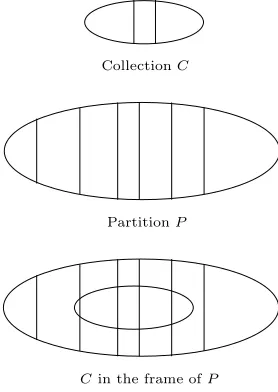
and callC[P] thecollection C in the frame of P. (By removing the empty set we ensure thatC[P] is a collection.) To clarify this concept consider Figure 1. We depict in it a collectionC, a partitionP andCin the frame ofP (together withP). HereCconsists of three coalitions, whileCin the frame ofP consists of five coalitions.
Cin the frame ofP
CollectionC
[image:7.595.225.364.414.610.2]PartitionP
Figure 1: A collectionC in the frame of a partitionP
Intuitively, given a subsetSofN and a partitionC:={C1, . . . , Cl}ofS, the
ofS byC. However, if a partitionP ofN is ‘in force’, then the players fromS
enjoy instead the benefits resulting from the partition of S byC[P], i.e.,C in the frame ofP.
To get familiar with theC[P] notation note that
• ifCis a singleton, sayC={T}, then{T}[P] ={P1∩T, . . ., Pk∩T} \ {∅},
whereP ={P1, . . ., Pk},
• ifC is a partition ofN, then C[P] =P,
• ifC⊆P, that isC consists of some coalitions ofP, thenC[P] =C.
In general the following simple observation holds.
Note 4.1. For a collection C and a partition P,C[P] =C iff each element of
C is a subset of a different element ofP. 2
This brings us to the following notion.
Definition 4.2. Assume a defection functionDand a comparison relation.
We call a partitionP D-stable ifC[P]Cfor allC∈D(P) such thatC[P]6=C.
The last qualification, that isC[P] 6=C, requires some explanation. First note that ifCis a partition ofN, thenC[P]6=Cis equivalent to the statement
P 6=C, since then C[P] = P. So in the case of theDp defection function we
have the following simpler definition.
Theorem 4.3. A partitionP isDp-stable iff for all partitionsP06=P, PP0
holds. 2
Corollary 4.4. Suppose that is an irreflexive linear comparison relation.
Then a Dp-stable partition exists. 2
Next, if we deal with a reflexive comparison relation, then the qualification
C[P]6=C can be dropped, as then C[P] = C implies C[P] C. However, if we deal with an irreflexive comparison relation, then this qualification is of course necessary. So using it we can deal with the irreflexive and reflexive case in a uniform way.
Intuitively, the condition C[P] 6= C indicates that the players only care about the way they are partitioned. Indeed, if C[P] =C, then the partitions of SC by means ofP and by means of C coincide and are viewed as equally
satisfactory for the players in SC. By disregarding the situations in which C[P] = C we therefore adopt a limited viewpoint of cooperation according to which the players in C do not care about the presence of the players from outside of S
Cin their coalitions.
The definition ofD-stability calls for checks involving (almost) all collections fromD(P). In the case of theDcdefection function, we can considerably simplify
these checks as the following characterization results shows. Given a partition
P := {P1, . . . , Pk} we call here a coalition T P-compatible if for some i ∈
Theorem 4.5. A partitionP={P1, . . . , Pk}ofN isDc-stable iff the following
two conditions are satisfied:
(i) for each i∈ {1, . . . , k}and each pair of disjoint coalitionsA andB such thatA∪B⊆Pi
{A∪B}{A, B}, (1)
(ii) for eachP-incompatible coalition T ⊆N
{T}[P]{T}. (2)
Proof. (⇒) Immediate.
(⇐) Transitivity (tr), monotonicity (m2) and (1) imply by induction that for eachi∈ {1, . . . , k}and each collectionC={C1, . . . , Cl}withl >1 andSC⊆
Pi,
n[
CoC. (3)
Let nowC be an arbitrary collection in N such that C[P]6=C. We prove that C[P]C. Define
Di:={T ∈C|T⊆P i},
E:=C\Sk
i=1Di, Ei:={P
i∩T |T ∈E} \ {∅}.
Note thatDi is the set of P-compatible elements of C contained in P i, E
is the set of P-incompatible elements of C and Ei consists of the non-empty
intersections ofP-incompatible elements ofCwithPi.
Suppose now thatSk
i=1Ei6=∅. ThenE6=∅and consequently
k
[
i=1 Ei=
k
[
i=1
({Pi∩T |T ∈E} \ {∅}) =
[
T∈E
{T}[P](m1),(2)E. (4)
Consider now the following property:
|Di∪Ei|>1. (5)
Fixi∈ {1, . . . , k}. If (5) holds, then
n Pi∩
[
Co=n[(Di∪Ei)o(3)Di∪Ei
and otherwise n
Pi∩
[
Co=
Di∪Ei .
Recall now that
C[P] =
k
[
i=1 n
Pi∩
[
We distinguish two cases.
Case 1. (5) holds for some i∈ {1, . . . , k}. Then by (m1) and (m2)
C[P]
k
[
i=1
(Di∪Ei) = (C\E)∪
k
[
i=1 Ei.
IfSk
i=1Ei =∅, then also E =∅and we get C[P]C. Otherwise by (4),
(tr) and (m2)
C[P](C\E)∪E=C.
Case 2. (5) does not hold for any i∈ {1, . . . , k}. Then
C[P] =
k
[
i=1
(Di∪Ei) = (C\E)∪ k
[
i=1 Ei.
Moreover, becauseC[P]6=C, by Note 4.1 aP-incompatible element inCexists. SoSk
i=1Ei6=∅and by (4) and (m2) we get as before C[P](C\E)∪E=C.
In [1] this theorem was proved for the coalitional TU-games and both the irreflexive and the reflexive utilitarian orders. The above result isolates the relevant conditions that the comparison relation, here, needs to satisfy.
In contrast to the case of theDp-stable partitions, as shown in [1], aDc-stable
partition does not need to exist, even ifis irreflexive. In that paper a natural
class of TU-games is defined for which Dc-stable partitions are guaranteed to
exist. In Section 6 we introduce a natural class of hedonic games for which
Dc-stable partitions exist.
5
Stable partitions and merge/split rules
We now resume our investigation of the conditions under which every iteration of the merge and split rules yields the same outcome. With this in mind we establish the following results concerned with the Dc defection function.
Note 5.1. Ifis an irreflexive comparison relation, then everyDc-stable
par-tition P is closed under the applications of the merge and split rules.
Proof. To prove the closure under merge rule assume that for some
{T1, . . . , Tk} ⊆ P we have {Skj=1Tj}{T1, . . . , Tk}. Dc-stability of P with
C:={Sk
j=1Tj}yields
{T1, . . . , Tk}={ k
[
j=1
Tj}[P]{ k
[
which is a contradiction by virtue of the transitivity and irreflexivity of.
The closure under the split rule is shown analogously.
Lemma 5.2. Assume that is an irreflexive comparison relation and P is
Dc-stable. Let P0 be closed under applications of merge and split rules. Then
P0=P.
Proof. SupposeP ={P1, . . . , Pk}, P0 ={T1, . . . , Tm}. AssumeP 6=P0. Then
there isi0 ∈ {1, . . . , k}such that for allj ∈ {1, . . . , m}we havePi0 6=Tj. Let
Tj1, . . . , Tjl be the minimum cover ofPi0. In the following case distinction we use Theorem 4.5.
Case 1. Pi0 =
Sl
h=1Tjh.
Then{Tj1, . . . , Tjl}is a proper partition ofPi0. But (1) (through its gener-alization to (3)) yieldsPi0{Tj1, . . . , Tjl}, thus the merge rule is applicable to
P0.
Case 2. Pi0 (
Sl
h=1Tjh.
Then for somejh we have∅ 6=Pi0 ∩Tjh (Tjh, soTjh is P-incompatible. By (2) we have{Tjh}[P]{Tjh}, thus the split rule is applicable toP
0.
This allows us to conclude the following result that answers our initial ques-tion and clarifies the importance of theDc-stable partitions.
Theorem 5.3. Suppose that is an irreflexive comparison relation and P is
aDc-stable partition. Then
(i) P is the outcome of every iteration of the merge and split rules.
(ii) P is a uniqueDp-stable partition.
(iii) P is a uniqueDc-stable partition.
Proof. (i) By Note 2.2 every iteration of the merge and split rules terminates, so the claim follows by Lemma 5.2.
(ii) SinceP isDc-stable, it is in particularDp-stable. Uniqueness follows from
the transitivity and irreflexivity ofby virtue of Theorem 4.3.
(iii) Suppose thatP0 is a
Dc-stable partition. By Note 5.1P0 is closed under
the applications of the merge and split rules, so by Lemma 5.2P0
=P.
6
Hedonic games
Note that the results of the last two sections do not involve any notion of a game. Only by choosing the monotonic comparison relations introduced in Section 3 we obtain specific results that deal with coalitional TU-games.
These considerations also readily apply to NTU-games. However, one needs to be careful since the resulting notion of a stable coalition can be in some situations counterintuitive. To clarify the limitation of this approach we now focus on the hedonic games (see, e.g., [5]) that form a specific class of NTU-games. Recall that ahedonic game (N,1, . . .,n) consists of a set of players
N ={1, . . ., n}and a sequence of linear preorders1, . . .,n, where eachi is
the preference of playeri over the subsets ofN containingi. In what follows we shall not need the assumption that thei relations are linear.
Again, we letidenote the associated irreflexive relation. Given a partition
A of N and player i we denote by A(i) the element of A to which i belongs and call it the set offriends of iinA. Given a hedonic game (N,1, . . .,n) a
natural preference relation on the collections is given by:
AB iff¬∃C∈B∀i∈C.CiA(i), (6)
whereS A=S
B.
It states thatAis preferred overBunlessBcontains a coalitionCsuch that each player inCstrictly prefersCto his coalition inA. Clearlyis monotonic. The notion ofDp-stability then coincides with the notion of core stability in [5].
However, the resulting notion of a Dc-stable partition can contradict the
intuition. To see this consider the following example.
Example 6.1. SupposeN ={1,2,3,4}. Consider a hedonic game in which
{2} 2{2,3} 2{1,2}
and
{3} 3{2,3} 3{3,4}.
Now takeP ={{1,2},{3,4}}and C={{2,3}}. ThenC[P] ={{2},{3}}. So both players 2 and 3 strictly prefer their coalition inC[P] to the one inC and consequentlyP is ‘stable’ w.r.t. collection C. In fact, it is straightforward to extend the above ordering in such a way thatP isDc-stable.
However, both players 2 and 3 favour the coalition{2,3}higher than their coalition withinP, so intuitivelyP should not be stable. 2
The difficulty in the above example arises from the fact that in players’ preferences smaller coalitions can be preferred over the larger ones. Natural hedonic games in which this is not the case can be derived from arbitrary partitions of the set of players. Given a partition P := {P1, . . ., Pk}of N we
assume that each player
• only ‘cares’ about the sets of his friends inP.
We formalize this order by putting for all sets of players that includei
SiT iffS∩P(i)⊇T ∩P(i).
With this definition, all partitions which result from arbitrary (including no) applications of the merge rule toP areDc-stable w.r.t. the reflexive comparison
relationdefined in (6).
Next, we provide an example of a hedonic game in which a Dc-stable
par-tition w.r.t. to a natural irreflexive comparison relation exists. To this end given a partitionP :={P1, . . ., Pk}ofN we now assume that each player
• prefers a larger set of his friends inP over a smaller one,
• ‘dislikes’ coalitions that include a player who is not his friend inP.
We formalize this by putting for all sets of players that includei
SiT iffS∪T⊆P(i) andS⊇T,
and by extending this order to the coalitions that include player i and also a player from outside ofP(i) by assuming that they are the minimal elements in
i. SoSiT iff eitherS∪T⊆P(i) andS ⊃T orS⊆P(i) and¬T⊆P(i).
We then define an irreflexive comparison relation on collections by
AB iff fori∈ {1, . . ., n}A(i)i B(i) with at least onei being strict.
It is straightforward to check that for this comparison relation the partition
{P1, . . ., Pk}satisfies the conditions (1) and (2) of Theorem 4.5. So by virtue
of this theorem {P1, . . ., Pk}is Dc-stable. Further, by virtue of Theorem 5.3,
{P1, . . ., Pk} can be reached from any initial partition through an arbitrary
sequence of the applications of the split and merge rules.
Acknowledgement
We thank Tadeusz Radzik for helpful comments.
References
[1] K. R. Apt and T. Radzik. Stable partitions in coalitional games, 2006. Available fromhttp://arxiv.org/abs/cs.GT/0605132.
[2] R.J. Aumann and J.H. Dr`eze. Cooperative games with coalition structures. International Journal of Game Theory, 3:217–237, 1974.
[4] F. Bloch and M. Jackson. Definitions of equilibrium in network formation, 2005. Working paper.
[5] A. Bogomolnaia and M. Jackson. The stability of hedonic coalition struc-tures. Games and Economic Behavior, 38(2):201–230, 2002.
[6] N. Burani and W.S. Zwicker. Coalition formation games with separable preferences. Mathematical Social Sciences, 45(1):27–52, 2003.
[7] G. Chalkiadakis and C. Boutilier. Bayesian reinforcement learning for coalition formation under uncertainty. InProceedings of the Second Inter-national Joint Conference on Autonomous Agents and Multiagent Systems (AAMAS-04), pages 1090–1097, 2004.
[8] G. Demange. On group stability in hierarchies and networks. Journal of Political Economy, 112(4):754–778, 2004.
[9] G. Demange and M. Wooders, editors. Group Formation in Economics. Cambridge University Press, 2006.
[10] J. Greenberg. Coalition structures. In R.J. Aumann and S. Hart, edi-tors,Handbook of Game Theory with Economic Applications, volume 2 of Handbook of Game Theory with Economic Applications, chapter 37, pages 1305–1337. Elsevier, 1994.
[11] I. Macho-Stadler, D. Prez-Castrillo, and N. Porteiro. Sequential formation of coalitions through bilateral agreements, 2005. Working paper.
[12] H. Moulin.Axioms of Cooperative Decision Making. Cambridge University Press, 1998.
[13] D. Ray and R. Vohra. Equilibrium binding agreements. Journal of Eco-nomic Theory, (73):30–78, 1997.
[14] T. S¨onmez, S. Banerjee, and H. Konishi. Core in a simple coalition forma-tion game. Social Choice and Welfare, 18(1):135–153, 2001.
[15] S.S. Yi. Stable coalition structures with externalities.Games and Economic Behavior, 20:201–237, 1997.
Krzysztof R. Apt CWI
1098 SJ Amsterdam, The Netherlands Email:[email protected]
Andreas Witzel