White Rose Research Online URL for this paper: http://eprints.whiterose.ac.uk/100410/
Version: Accepted Version
Article:
Kane, JS, Sood, R orcid.org/0000-0003-1011-8910, Law, GR
orcid.org/0000-0001-7904-0264 et al. (4 more authors) (2016) Validation and modification of a diagnostic scoring system to predict microscopic colitis. Scandinavian Journal of Gastroenterology, 51 (10). pp. 1206-1212. ISSN 0036-5521
https://doi.org/10.1080/00365521.2016.1186221
© 2016, Taylor & Francis. This is an Accepted Manuscript of an article published by Taylor & Francis in Scandinavian Journal of Gastroenterology on 31 May 2016, available online: http://www.tandfonline.com/10.1080/00365521.2016.1186221
[email protected] https://eprints.whiterose.ac.uk/ Reuse
Unless indicated otherwise, fulltext items are protected by copyright with all rights reserved. The copyright exception in section 29 of the Copyright, Designs and Patents Act 1988 allows the making of a single copy solely for the purpose of non-commercial research or private study within the limits of fair dealing. The publisher or other rights-holder may allow further reproduction and re-use of this version - refer to the White Rose Research Online record for this item. Where records identify the publisher as the copyright holder, users can verify any specific terms of use on the publisher’s website.
Takedown
If you consider content in White Rose Research Online to be in breach of UK law, please notify us by
TITLE PAGE
Title: Validation and Modification of a Diagnostic Scoring System to Predict
Microscopic Colitis.
Short title: Validating and Modifying a Scoring System for Microscopic Colitis.
Authors: John S. Kane1,2, Ruchit Sood1,2, Graham R. Law3, David J Gracie1,2, Natalie
To1,2, Matthew J. Gold4, Alexander C. Ford1, 2.
1Leeds Gastroenterology Institute, St. James’s University Hospital, Leeds, UK.
2 Leeds Institute of Biomedical and Clinical Sciences, University of Leeds, Leeds, UK.
4Division of Biostatistics, Leeds Institute of Cardiovascular and Metabolic Medicine,
University of Leeds, UK.
4School of Medicine, University of Leeds, Leeds, UK.
Abbreviations: CC collagenous colitis CI confidence interval
GI gastrointestinal
IBS irritable bowel syndrome LC lymphocytic colitis
MC microscopic colitis NPV negative predictive value
OR odds ratio
PPI proton pump inhibitor PPV positive predictive value
ROC receiver operating characteristics SD standard deviation
SSRI selective serotonin re-uptake inhibitor
Correspondence: Dr. Jack Kane
Leeds Gastroenterology Institute 4th Floor
Bexley Wing
St. James’s University Hospital
Beckett Street
Leeds
United Kingdom LS9 7TF
Email: [email protected] Telephone: +44113268536
Facsimile: +441132429722
ABSTRACT
Objective: Many patients with diarrhoea undergo colonoscopy. If this is
macroscopically normal, random biopsies are obtained to rule out microscopic colitis
(MC), but most patients have functional disease. Accurate predictors of MC could avoid the need to take biopsies in a substantial proportion of patients, saving money for the
health service. We validated a previously described diagnostic scoring system for MC, and incorporated further variables to assess whether this improved performance. Material and Methods: Consecutive adults with loose stools undergoing colonoscopy
in Leeds, UK were included. Demographic and symptom data were collected prospectively. The diagnostic scoring system described previously was applied. In
addition, the incorporation of further variables, including drugs associated with MC, number of stools, nocturnal passage of stools, and duration of loose stools, into the scoring system was assessed. Sensitivities, specificities, and positive and negative
predictive values were calculated.
Results: Among 242 patients (mean age 51.0 years, 163 (67.4%) female), 26 (10.7%)
of whom had MC, a cut off of ≥4 on the original scoring system had a sensitivity of
92.3% and specificity of 35.2%. Nocturnal passage of stools and duration of loose stools <6 months were significant predictors of MC. Incorporating these variables in a
new scoring system with a cut off of ≥6 identified MC with 95.7% sensitivity and 46.0% specificity.
Conclusions: Incorporating nocturnal passage of stools and duration of loose stools into
INTRODUCTION
Microscopic colitis (MC) is a condition characterised by a clinical history of chronic, watery diarrhoea, normal or near normal macroscopic appearance of the colon
during endoscopy, and a distinct histologic pattern (1). Two main histologic subtypes have been described, with collagenous colitis (CC) associated with a characteristic thick
band of collagen beneath the surface epithelium, and lymphocytic colitis (LC) with a diffuse proliferation of intra-epithelial lymphocytes. A recent meta-analysis reported a pooled incidence rate of CC of 4.14 per 100,000 person-years, and of LC of 4.85 per
100,000 person-years (2), suggesting that both conditions are relatively common.
Chronic diarrhoea is a common complaint in the general population in
community-based surveys (3, 4). More than one-in-four individuals with chronic diarrhoea will consult a physician (5), and a proportion of these individuals will be referred on for further investigation. In the context of a macroscopically normal or near
normal colonoscopy in a patient with chronic diarrhoea, most endoscopists would obtain random colonic biopsies to look for MC, but the yield of this approach is low (6).
This is because many individuals undergoing colonoscopy with diarrhoea as an indication will meet diagnostic criteria for irritable bowel syndrome (IBS) (7), the symptoms of which may overlap with those of MC (8), and others will have no organic
explanation for their symptoms, and will be labelled as suffering from functional
diarrhoea. Given the relatively low prevalence of MC in patients with chronic diarrhoea,
there is therefore likely to be a high cost for obtaining and analysing these biopsy specimens.
In a previous retrospective study we demonstrated that applying a diagnostic
predicted patients with the disorder after interpretation of random colonic biopsy specimens (9). In this study variables significantly associated with presence of MC in a derivation cohort included age ≥50 years, female gender, use of proton pump inhibitors
(PPIs) or non-steroidal anti-inflammatory drugs (NSAIDs), the presence of weight loss, and the absence of abdominal pain. When applied in a validation cohort the scoring
system had high sensitivity in identifying patients with MC, but avoided the need for random colonic biopsies in a substantial proportion of patients with chronic diarrhoea. This scoring system has since been validated independently in two other cohorts (10,
11), and performed similarly.
Using a retrospective cohort had certain limitations. In particular, there was
reliance on documentation by the consulting physician of both clinical symptoms and medication use. As a result, data on the use of medications such as selective serotonin re-uptake inhibitors (SSRIs) and statins, and symptoms such as duration of diarrhoea,
nocturnal passage of stools, or number of stools passed, which have all been shown previously to be associated with MC (12, 13), were either not available, or may have
been compromised by the retrospective nature of the study. We therefore aimed to validate the use of this diagnostic scoring system in a prospective cohort of patients presenting with chronic diarrhoea, as well as to assess whether the inclusion of the
METHODS
Participants and Setting
All individuals newly referred from primary care to secondary care for consideration of investigation of gastrointestinal (GI) symptoms were potentially
eligible for this study. Unselected consecutive new patients aged ≥18 years were
approached in the GI outpatient clinics of Leeds Teaching Hospitals Trust, West
Yorkshire. The hospitals provide secondary care services to a local population of almost
800,000 people in the North of England. There were no exclusion criteria, other than an inability to understand written English, as the questionnaires we used were
self-administered. Potentially eligible subjects were provided with a study information sheet at their initial clinic visit, prior to consultation with a Gastroenterologist. Those who agreed to participate were asked to provide written informed consent at that visit. The
local research ethics committee approved the study, with recruitment commencing in January 2014, and continuing until December 2015.
Data Collection and Synthesis
Demographic and Symptom Data
All demographic and symptom data were collected prospectively at the initial clinic visit, and hence prior to referral for colonoscopy. Demographic data of interest
included the age of the patient at the time of recruitment, gender, and the current use of any medications that could be of potential relevance in the aetiology of MC (NSAIDs,
diagnostic questionnaire for the adult functional GI disorders (14). All questionnaire data were entered into a database by trained researchers who were not involved in the clinical care of the patient, thus ensuring assessors were blinded to symptom status.
Definition of the Symptoms of Interest
Only individuals with loose, mushy, or watery stools according to the Rome III diagnostic questionnaire were included in this study. Duration of loose, mushy, or watery stools was recorded as ≥6 months, or <6 months, again according to this
questionnaire. The presence of abdominal pain or discomfort was recorded, using the Rome III questionnaire, with a symptom frequency of abdominal pain or discomfort
occurring once a week or more used to define its presence. Four or more stools per day, and nocturnal passage of stool, were recorded as occurring never or rarely, sometimes, often, most of the time, or always, with a symptom frequency of sometimes or greater
used to define their presence. Finally, all patients were asked to report whether or not they had lost weight, as a dichotomous yes/no response.
Colonoscopic and Histopathological Data
All included patients underwent complete colonoscopy to the caecum or
terminal ileum. The endoscopy units in Leeds Teaching Hospitals Trust employ colonoscopes from both Olympus and Fujinon. Bowel preparation was either a combination of polyethylene glycol and sodium picosulfate, or polyethylene glycol
alone, depending on renal function. The responsible physician performing colonoscopic examinations remained blinded to the questionnaire data of the patient. Only patients
study. Random colonic biopsies were taken in all patients, the number of which was at the discretion of the individual endoscopist, although standard departmental policy is to take two from the right colon, two from the left colon, and two from the rectum. These
specimens were interpreted by experienced GI histopathologists, who remained blinded to the questionnaire data of the patient.
Reference Standard
The diagnosis of MC was according to the following criteria: CC was defined as
the presence of a subepithelial collagen band of ≥10µm in thickness, in association with
diffuse chronic inflammation; LC was defined using a threshold of >20 intra-epithelial
lymphocytes per 100 epithelial cells, with associated diffuse chronic inflammation, but no thickening of the subepithelial collagen band. Other investigators have demonstrated that there is little inter-observer variability in the diagnosis of MC (15).
Statistical Analysis
The associations between the demographic and symptom data described above
and the presence of MC were explored using univariate analysis in our previous study (9), and expressed as odds ratios (OR) with a 95% confidence interval (CI). Those
variables that demonstrated statistically significant univariate ORs were included in a diagnostic scoring system to predict the presence of MC. The methodology used has been reported elsewhere (9). Briefly, the regression coefficients of any statistically
significant predictors on univariate analysis were changed into item assigned scores by dividing with the smallest coefficient (0.155), and rounding up to the nearest integer.
from a possible total of -8 to +38, and signified the summary measure of risk for MC. This methodology is similar to that used to create other predictive scores in
gastroenterology, including scores to predict peptic ulcer perforation, mortality after GI
haemorrhage, and need for endoscopic intervention in patients with GI haemorrhage (16-18).
The optimal cut off using this scoring system was ≥+8, which demonstrated a
sensitivity and specificity of 94.1% and 48.6%, respectively, in the derivation cohort of the original study, and 90.5% and 45.3% in the validation cohort (9). However, given
that a missed diagnosis of MC may be problematic for patients, we also assessed the
performance of a lower threshold of ≥+4 to predict MC, in order to increase sensitivity.
At this cut-off the diagnostic scoring system performed with a sensitivity of 98.8% and specificity of 37.1% in the derivation cohort, and 94.6% and 32.6% in the validation cohort (9).
The primary aims of the present study were two-fold. Firstly, to validate the
diagnostic system using a cut off of either ≥+8 or ≥+4, but this time in a cohort of
patients with prospective, rather than retrospective, data collection. Secondly, to assess
the effect of the incorporation of other variables, including use of statins or SSRIs, and symptom data such as duration of loose, mushy, or watery stools, passage of four or
more stools per day, and nocturnal passage of stool on the performance of the score, as these data were either unavailable in the previous study, or their accuracy and
completeness may have been hampered by the retrospective nature of the data
collection.
We therefore performed new univariate analyses for statin use, SSRI use,
loose, mushy, or watery stools in this prospective cohort of patients. Again, the regression coefficients of any statistically significant predictors among these five variables after univariate analysis were changed into item assigned scores by dividing
with the smallest coefficient from the derivation study (0.155), and rounded up to the nearest integer (9). These individual item scores were then summed to create a total
score, which varied from a possible total of -14 to +42.
We assessed the performance of the original and the modified diagnostic scoring systems in predicting the presence of MC, using a receiver operating characteristics
(ROC) curve, and the total area under the curve was calculated. We calculated sensitivity, specificity, positive predictive value (PPV), and negative predictive value
(NPV), and their 95% CIs. All analyses were performed using StatsDirect version 2.7.2 (StatsDirect Ltd, Sale, Cheshire, England), and a Microsoft Excel spreadsheet (XP professional edition; Microsoft Corp, Redmond, WA, USA). These calculations were
RESULTS
In total, 242 patients with loose, mushy, or watery stools undergoing complete colonoscopy with macroscopically normal colonic mucosa and random colonic biopsies
obtained were included. The mean age of these individuals was 50.5 years (range 18 to 81 years) and 163 (67.4%) were female. Of the included subjects, 26 (10.7%) patients
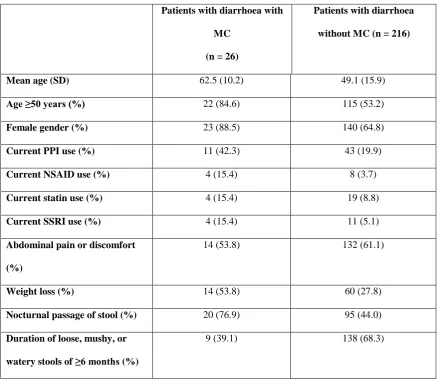
were diagnosed with MC on histological grounds: 14 with CC, and 12 with LC. The remaining 216 patients had a macroscopically normal colonoscopy and normal random colonic biopsies. None of the 242 included patients had coeliac disease. Demographic
and symptom data for the 242 patients are provided in Table 1.
Performance of the Original Scoring System
The ROC curve for the original diagnostic scoring system in predicting the presence of MC demonstrated an area under the curve of 0.81 (Figure 1). Using a cut off
≥+8, the scoring system correctly identified 23 (88.5%) of 26 MC patients, and would
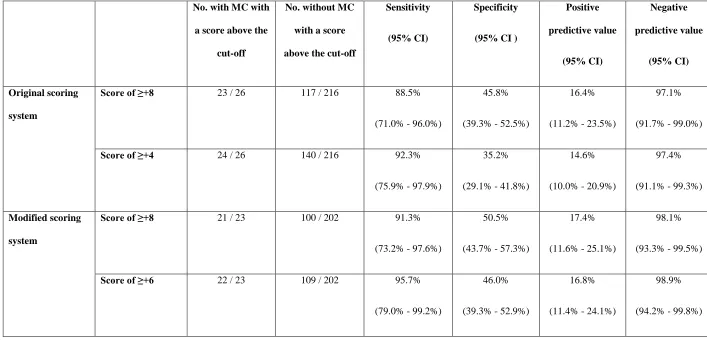
have avoided unnecessary random colonic biopsies in 99 (45.8%) of 216 patients without MC. Sensitivity, specificity, PPV, and NPV, along with 95% CIs, at this
threshold are provided in Table 2. Of the three patients with MC the score failed to identify, two were female (mean age 46.7 years, range 44 to 49 years), all had LC, and
one met the Rome III criteria for IBS with diarrhoea.
When we assessed the performance of the lower threshold of ≥+4 to predict MC,
the diagnostic scoring system correctly identified 24 (92.3%) of 26 patients with MC,
and would have avoided unnecessary biopsies in 76 (35.2%) of 216 patients without MC. The sensitivity, specificity, PPV, and NPV and their 95% CIs at this threshold are
Performance of the Modified Scoring System
Odds ratios for the association of each of the four additional items assessed for the modified diagnostic scoring system with the presence of MC, along with 95% CIs,
are presented in Table 3. There was no significant association between use of statins or SSRIs, or the passage of four or more stools per day, and MC, and these items therefore
did not contribute to the total score. Each of the remaining item scores ranged from -6 to +10. These were summed to obtain the total score for each patient, which ranged from -14 to +42. The ROC curve for this diagnostic scoring system in predicting the presence
of MC is shown in Figure 2, with an area under the curve of 0.82.
Using a cut off of ≥8 to predict the presence of MC correctly identified 21
(91.3%) of 23 MC patients, and would have avoided unnecessary random colonic biopsies in 102 (50.5%) of 202 patients without MC. Sensitivity, specificity, PPV, and NPV, along with 95% CIs, at this threshold are provided in Table 2. Using a cut off of
≥6 to predict the presence of MC, in order to maximise sensitivity, meant that 22
(95.7%) of 23 patients with MC would have been correctly identified, while random colonic biopsies would still have been avoided in 93 (46.0%) of 202 patients without
DISCUSSION
This study was designed to validate a diagnostic scoring system based on clinical data alone (9), which could distinguish between patients with MC and those
with likely functional bowel disease, in a prospective cohort, as well as to incorporate other potentially key variables to assess whether this improved its performance. Using a
cut off of ≥+8, the scoring system described previously had a sensitivity of 88.5% and
would have avoided random colonic biopsies in almost 46% of patients. Using a cut off
of ≥+4, sensitivity was 92.3%, and biopsies would have been avoided in >35%.
Incorporating the additional clinical features such as nocturnal passage of stool, and the duration of loose, mushy or watery stools of <6 months into a modified scoring system,
and using a cut off of ≥+6 improved sensitivity to almost 96%, and would have avoided biopsies in 46% of patients, which is a similar performance to the original scoring system in the derivation cohort. Given that the costs of analysis of colonic biopsy
specimens were £80 per case in the UK in 2014-2015 (19), applying the modified scoring system using this cut off in this cohort would have saved >£5500, or >£450 per case of MC diagnosed. These savings do not take into account the reduction in
procedure time by negating the need for colonic biopsies.
Strengths of this study include the validation of the scoring system in a
prospective cohort, the use of a validated questionnaire to capture symptom data, and the rigorous data collection for medication use. These features of the study design are an
improvement over our previous study (9), with methodology similar to that of the validation cohort reported by Cotter et al., in which the authors were able to incorporate information available from a standardised form completed by the patient at the time of
STARD guidelines for the reporting of studies of diagnostic accuracy, with consecutive patients recruited, assessors blinded to questionnaire data, a standardised departmental policy for obtaining random colonic biopsies, and an accepted reference standard used.
Finally, the fact that the majority of patients recruited were unselected referrals to secondary care means that the results are likely to be generalisable to
Gastroenterologists consulting with individuals with suspected MC in usual clinical practice.
In terms of limitations, our study population included a relatively small number
of cases of MC compared with the previous derivation and validation cohorts (9). However, in our previous study we included all cases of MC diagnosed within a 1-year
period, but only a random selection of patients with chronic diarrhoea without MC, colonoscoped during the same time period, as controls. This may have led to an
overestimation of the performance of the scoring system in the previous study, because
the arbitrary size of the control group could theoretically result in an artificially lower false positive rate, leading to a higher specificity and positive predictive value. In addition, despite the smaller number of cases in the current study the characteristics of
patients with MC, including mean age, gender, and PPI and NSAID use were remarkably similar to those in the previous study. Other weaknesses include the fact
that we could not include other features from the clinical history, such as whether a particular drug had been introduced recently, any history of autoimmune disease, or abnormal blood results, which may be associated with a diagnosis of MC, as the
questionnaire we used did not capture these data. In a study by Macaigne et al. recently introduced drugs were strongly associated with an increased risk of MC (13), although
the degree of weight loss reported by the patient could improve the performance of the score, which may have been a more objective approach than the dichotomous variable we used.
As in the previously reported derivation and validation cohorts (9), patients with MC were older, predominantly female, had increased PPI and NSAID usage, were more
likely to have experienced weight loss, and also less likely to report abdominal pain. Some of these associations have been noted in other prospective and retrospective cohorts (13, 21, 22), and in a recent meta-analysis (2), although these findings are not
consistent across all studies. Both Cotter et al. and Macaigne et al. reported that female gender was not an independent predictor for MC (10, 13). However, in the larger of
these studies 70% of the control group met diagnostic criteria IBS, which is commoner in women (23).
In the modified scoring system, our prospective study design also allowed us to
record more comprehensive information on medication use. Statins and SSRIs have both been implicated in the development of MC (12), but neither were shown to be
significantly associated with MC in our analysis. There was a trend towards SSRI use being more likely in those with MC, so it may be that our study was not adequately powered to examine this, although the lack of an association with either of these drugs
is in line with a previous meta-analysis (2). We were also able to include nocturnal diarrhoea, number of stools, and duration of symptoms, with more complete data
collection for the former variable in the current study. The presence of nocturnal
passage of stools and a duration of diarrhoea <6 months were both associated with MC. The latter is in keeping with the findings of Macaigne et al., who demonstrated that
Although the cut offs we used on the original and modified scoring systems were chosen to maximise sensitivity, as a missed diagnosis of MC may be unacceptable
to both patients and physicians, a score of ≥6 on the modified scoring system appeared
to perform better than a score of ≥4 on the original scoring system in the previous
validation cohort (9), with slightly higher sensitivity and much higher specificity. This
was despite the fact that the prevalence of MC was lower in the present study (10.7% versus >16% in the derivation and validation cohorts in the original study). Other investigators have demonstrated a similar sensitivity of the original scoring system.
Cotter et al. reported a sensitivity of 95%, but a specificity of 25% using a cut off of ≥4 in 617 patients (10), while Regner and Gerich reported that sensitivity was 89% and
specificity was 40% in 119 patients, although it should be noted that 30.3% of patients had MC in the latter study (11).
The modified scoring system therefore appears to have the potential to avoid a
greater number of random colonic biopsies, without an increased miss rate for MC, in patients with chronic diarrhoea. Its performance needs to be assessed in other centres,
also using a prospective study design, and with patients recruited as part of routine clinical practice. In the interim, however, these data suggest that nocturnal passage of stools and a duration of diarrhoea <6 months are also associated with a diagnosis of
MC, as well as providing further confirmation of previously reported associations between increasing age, female gender, PPI or NSAID use, presence of weight loss, and
absence of abdominal pain and MC.
In summary, the original scoring system performed with a high sensitivity of 92.3%, but a low specificity of 35.2% and a low positive predictive value of 14.6%,
passage of stool, and the duration of loose, mushy or watery stools of <6 months into a
modified scoring system, and using a cut off of ≥+6 improved sensitivity to 95.7%, and
specificity to 46.0%, although positive predictive value remained low at 16.8%. Both
the original and the modified diagnostic scoring system have potential clinical utility, as they are based only on features that are obtained through a verbal conversation with
patients, without the need for laboratory investigations, the results of which may not be available immediately. They could be applied either in the clinic setting or immediately prior to colonoscopy, allowing real-time use. While the study was not designed to
evaluate the economic implications of these scoring systems, we suggest that they have the potential to reduce both endoscopic time and overall costs associated with
diagnosing MC. However it remains unclear whether a negative score should be used to avoid taking random colonic biopsies from patients with chronic diarrhoea with a macroscopically normal colonoscopy, or to avoid colonoscopy altogether in younger
patients without clear risk factors for MC or other organic pathology. Further research is therefore required to determine the optimal role of the scoring systems within overall management pathways for chronic diarrhoea, especially as part of systems to deliver
ACKNOWLEDGEMENTS
We are grateful to Dr. Olorunda Rotimi and Dr. Simon M. Everett for their assistance
with the original derivation and validation of this diagnostic scoring system.
FUNDING
None.
DISCLOSURES
JSK: none. RS: none. GRL: none. DJG: none. NT: none. MJG: none. ACF: none.
STATEMENTS OF INTEREST
Guarantor of the article: JSK is guarantor.
Specific author contributions: JSK, RS, GRL, DJG, NT, MJG, and ACF conceived
and drafted the study. NT, MJG, DJG, and RS collected all data. ACF, RS, DJG, MJG, GRL, NT, and JSK analysed and interpreted the data. JSK and ACF drafted the
REFERENCES
1 Magro F, Langner C, Driessen A, Ensari A, Geboes K, Mantzaris GJ et al. European consensus on the histopathology of inflammatory bowel disease. J Crohns
Colitis. 2013; 7: 827-51.
2 Tong J, Zheng Q, Zhang C, Lo R, Shen J, Ran Z. Incidence, prevalence, and
temporal trends of microscopic colitis: A systematic review and meta-analysis. Am J Gastroenterol. 2015; 110: 265-76.
3 Chen LY, Ho KY, Phua KH. Normal bowel habits and prevalence of functional
bowel disorders in Singaporean adults - findings from a community based study in Bishan. Singapore Med J. 2000; 41: 255-8.
4 Basaranoglu M, Celebi S, Ataseven H, Rahman S, Deveci SE, Acik Y. Prevalence and consultation behavior of self-reported rectal bleeding by face-to-face interview in an Asian community. Digestion. 2008; 77: 10-5.
5 Drossman DA, Li Z, Andruzzi E, Temple RD, Talley NJ, Thompson WG et al. U.S. householder survey of functional gastrointestinal disorders. Prevalence,
sociodemography, and health impact. Dig Dis Sci. 1993; 38: 1569-80.
7 Patel P, Bercik P, Morgan DG, Bolino C, Pintos-Sanchez MI, Moayyedi P et al. Prevalence of organic disease at colonoscopy in patients with symptoms compatible with irritable bowel syndrome: cross-sectional survey. Scand J Gastroenterol. 2015; 50:
816-23.
8 Kamp EJ, Kane JS, Ford AC. Irritable bowel syndrome and microscopic colitis:
A systematic review and meta-analysis. Clin Gastroenterol Hepatol. 2016; 14: 659-68.
9 Kane JS, Rotimi O, Everett SM, Samji S, Michelotti F, Ford AC. Development and validation of a scoring system to identify patients with microscopic colitis. Clin
Gastroenterol Hepatol. 2015; 13: 1125-31.
10 Cotter TG, Binder M, Pardi DS. Validation of a scoring system to predict
microscopic colitis in a cohort of patients with chronic diarrhea. Clin Gastroenterol Hepatol. 2016; 14: 777-8.
11 Regner EH, Gerich ME. Validation of a proposed scoring system to identify
patients with microscopic colitis prior to colonoscopy. Am J Gastroenterol. 2015; 110 (Supplement 1s): S573.
12 Beaugerie L, Pardi DS. Review article: drug-induced microscopic colitis -
13 Macaigne G, Lahmek P, Locher C, Lesgourgues B, Costes L, Nicolas MP et al. Microscopic colitis or functional bowel disease with diarrhea: a French prospective multicenter study. Am J Gastroenterol. 2014; 109: 1461-70.
14 Whitehead WE, and the Validation Working Team Committee in association with the Rome Questionnaire C. Development and validation of the Rome III diagnostic
questionnaire. In: Drossman DA, editorRome III: The functional gastrointestinal disorders, 3rd editionVirginia: Degnon Associates Inc. 2006: 835-53.
15 Limsui D, Pardi DS, Smyrk TC, Abraham SC, Lewis JT, Sanderson SO et al.
Observer variability in the histologic diagnosis of microscopic colitis. Inflamm Bowel Dis. 2009; 15: 35-8.
16 Suriya C, Kasatpibal N, Kunaviktikul W, Kayee T. Development of a simplified diagnostic indicators scoring system and validation for peptic ulcer perforation in a developing country. Clin Exp Gastroenterol. 2012; 5: 187-94.
17 Rockall TA, Logan RF, Devlin HB, Northfield TC. Risk assessment after acute upper gastrointestinal haemorrhage. Gut. 1996; 38: 316-21.
18 Blatchford O, Murray WR, Blatchford M. A risk score to predict need for
treatment for upper-gastrointestinal haemorrhage. Lancet. 2000; 356: 1318-21.
19 National schedule of reference costs: spell costs.
20 Fernandez-Banares F, de Sousa MR, Salas A, Beltran B, Piqueras M, Iglesias E et al. Epidemiological risk factors in microscopic colitis: a prospective case-control study. Inflamm Bowel Dis. 2013; 19: 411-7.
21 Larsson JK, Sjoberg K, Vigren L, Benoni C, Toth E, Olesen M. Chronic non-bloody diarrhoea: a prospective study in Malmo, Sweden, with focus on microscopic
colitis. BMC Res Notes. 2014; 7: 236.
22 O'Toole A, Coss A, Holleran G, Keegan D, Doherty G, Sheahan K et al. Microscopic colitis: clinical characteristics, treatment and outcomes in an Irish
population. Int J Colorectal Dis. 2014; 29: 799-803.
23 Lovell RM, Ford AC. Effect of gender on prevalence of irritable bowel
Table 1: Demographic Characteristics and Symptom Data of Patients with
Diarrhoea with MC, and Patients with Diarrhoea without MC.
Patients with diarrhoea with
MC
(n = 26)
Patients with diarrhoea
without MC (n = 216)
Mean age (SD) 62.5 (10.2) 49.1 (15.9)
Age ≥50 years (%) 22 (84.6) 115 (53.2)
Female gender (%) 23 (88.5) 140 (64.8)
Current PPI use (%) 11 (42.3) 43 (19.9)
Current NSAID use (%) 4 (15.4) 8 (3.7)
Current statin use (%) 4 (15.4) 19 (8.8)
Current SSRI use (%) 4 (15.4) 11 (5.1)
Abdominal pain or discomfort
(%)
14 (53.8) 132 (61.1)
Weight loss (%) 14 (53.8) 60 (27.8)
Nocturnal passage of stool (%) 20 (76.9) 95 (44.0)
Duration of loose, mushy, or
watery stools of ≥6 months (%)
Table 2: Sensitivity, Specificity, Positive, and Negative Predictive Values of the Original and Modified Diagnostic Scoring Systems in
Patients with Diarrhoea.
No. with MC with
a score above the
cut-off
No. without MC
with a score
above the cut-off
Sensitivity
(95% CI)
Specificity
(95% CI )
Positive predictive value (95% CI) Negative predictive value (95% CI) Original scoring system
Score of ≥+8 23 / 26 117 / 216 88.5%
(71.0% - 96.0%)
45.8%
(39.3% - 52.5%)
16.4%
(11.2% - 23.5%)
97.1%
(91.7% - 99.0%)
Score of ≥+4 24 / 26 140 / 216 92.3%
(75.9% - 97.9%)
35.2%
(29.1% - 41.8%)
14.6%
(10.0% - 20.9%)
97.4%
(91.1% - 99.3%)
Modified scoring
system
Score of ≥+8 21 / 23 100 / 202 91.3%
(73.2% - 97.6%)
50.5%
(43.7% - 57.3%)
17.4%
(11.6% - 25.1%)
98.1%
(93.3% - 99.5%)
Score of ≥+6 22 / 23 109 / 202 95.7%
(79.0% - 99.2%)
46.0%
(39.3% - 52.9%)
16.8%
(11.4% - 24.1%)
98.9%
Table 3: Item Scores within the Modified Diagnostic Scoring System.
Item Odds
ratio
95% CI Regression
coefficient
Used within the
Scoring System
Item
score*
Nocturnal passage of stool
present
4.47 1.74 – 11.4 1.496 Yes +10
≥4 stools per day 1.38 0.63 – 3.03 0.322 No N/A†
Duration of loose, mushy, or
watery stools ≥6 months present
0.38 0.17 – 0.89 -0.956 Yes -6
Statin use 1.62 0.51 – 5.11 0.482 No N/A†
SSRI use 3.24 0.96 – 11.0 1.176 No N/A†
*Derived by dividing the regression coefficient for each item by the regression coefficient for
the item from the derivation study with the lowest value (0.155)
FIGURE LEGENDS
Figure 1. ROC curve for the Original Diagnostic Scoring System in Predicting MC.