AAEE2016CONFERENCE
Coffs Harbour, Australia
Teacher Perspectives of Constructing Remote Experiments
for Collaboration and Sharing in STEM Education
Ananda Maiti, Andrew Maxwell, Ting Wu and Alexander A. Kist University of Southern Queensland
Corresponding Author Email: [email protected]
CONTEXT
Remote Access Laboratories (RAL) allow remote access to instruments for educational purposes and have been widely used in engineering education. A conceptual Peer-to-Peer (P2P) RAL is an architecture where participant(s) can be: makers who create an experiment on a STEM topic and publish them on the Internet; or learners who simply runs experiments published by others for learning purposes. The process of integrating these technologies can give STEM students hands-on experience on how to build and run experiment setups which are integral parts of STEM subjects them to collaborate with people with similar interest from large distances. This approach requires active participation from the teachers as well for guiding the STEM student participants.
PURPOSE
The purpose of this study was to establish whether it is feasible to deploy a conceptual P2P RAL environment for STEM education where the students make their own experiment and publish it in an online environment. The focus of this trial was to abilities, perceptions and efficacy of teachers.
APPROACH
A trial of the P2P RAL system was held with participants who were Bachelor degree students (pre-service teachers) in the course EDP4130 Technology Curriculum and Pedagogy. The following sequence of activities was conducted: The users’ proficiency with procedural programming in SNAP was established and the users’ ability to use procedural programming to create an activity for this purpose was evaluated. Participants were as to integrate a constructed hardware robot including a controller and three actuators into one activity. As part of the activity, the pre-service teachers collaborate with each other to setup an activity and used the built activity remotely. Changes in the participants’ mood as a result of engaging in this activity was evaluate using PANAS (Watson, D.1988).
RESULTS
The participant’s feedback has shown that the kind of hands-on-experience done in the trials is essential and suitable for school children. All participants successfully created programs. All groups were able to create their own robot with various designs. All the participants understood that they could use this approach to demonstrate someone else’s rig first, to understand the capabilities of the system before building their own. Participants indicated that a bank of example activities would considerably help their understanding of the concepts. Additionally, it was indicated that sharing of the activities with other participants was the most memorable aspect of the trial. All participants indicated that this type of activity could be done at schools but may not be suitable for homes.
CONCLUSIONS
The proposed RAL approach involves using modern network and consumer robotics technology to construct scientific experiments for sharing over the Internet. Teachers in STEM education must be well prepared and trained in order to adapt this new medium of education. The chosen cohort of pre-service teachers demonstrated with reported limitations that they were able to undertake these tasks and use similar activities in the classroom.
KEYWORDS
Introduction
Remote Access Laboratories (RAL) are online environments (Hardison J L et. al, 2008, Tawfik et. al, 2013) that allow students to control semi-autonomous equipment through the Internet. Students enter input values to the user interface which is then passed to the remote equipment servers. The remote servers run the experiment as set by the creators of the experiment. When the experiment run is complete, the resultant data is sent back to the user interface where it is displayed to the student.
Pedagogies of RAL experiments and their management tend to follow the pedagogies of on-site laboratories. However, RALs offer longer duration access from anywhere in the world. Some of the disadvantages of RAL are difficulty in scaffolding the learning materials and ensuring additional safety and automation issues. RALs have been widely used in undergraduate and tertiary education throughout the world.
Experiments are traditionally built by experts in their respective fields with fail-safe mechanisms and automations. Recently, federated RAL (Orduna P., 2014) has been implemented which is a form of distributed RAL that allows sharing of resources and experiments across multiple institution. The respective institutions are responsible for authenticating their students for accessing any shared resources. However even in this case, the experiments are created by experts and placed in centralized locations dedicated for such services.
Peer-to-Peer Remote Laboratories
Conceptual P2P RAL is a new approach that implements a distributed version of RAL (Maiti A., 2014). In this case, there is no particular dedicated group of providers who make experiments. Participants, designated as Makers, create the experiments in home or school environments. They are individuals and do not necessarily have the expertise to build professional experimental setups. The aim of this RAL is to provide making capabilities to the participants as well enabling remote control of experiments for learning scientific concepts. P2P RAL is most suitable for STEM education. The hardware required is not complex or expensive. The majority of learning activities in STEM experiments are through audio-visual methods and do not require sophisticated measurements to understand the result. Also the experiments do not have to be durable i.e. they can be set up and shared for limited period of time. If required, they can be rebuilt at a later time.
P2P RAL is based on the concept of making a small robotic apparatus for measurements using low cost sensors, actuators and microcontrollers. Makers can use commercially available microcontrollers such as Arduinos, Raspberry Pis and BeagleBones to create experiments. This involves connecting actuators and sensors to the microcontrollers and than create a physical frame for the experiments based on the actual aim of the experiment. This frame can be composed of simple everyday objects, e.g. cardboard box or Lego Mindstorms parts etc. Once the experiment is set up, the makers can connect it to the P2P RAL network using an Internet port and a router called the RALfieBox (Kist A. A. et. al, 2014). As part of the P2P RAL system the communication mechanism between the rig and the end user interface is hidden from makers. Makers use an online environment - a modified version of SNAP (Maiti A. et. al, 2015), a web based version of SCRATCH (Resnick M. et. al., 2009), to create the program for the experiments. RALfieBoxes are programed so that can connect to the P2P RAL system and communicate, but the makers do not have to know these mechanisms.
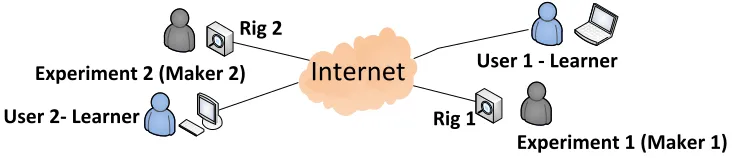
Apart from makers, there can be large number of other users i.e. the learner who do not make experiments but simply use the experiments for educational purposes only. The role of these users remains the same as that of the traditional RAL - login to the system and run the experiment to obtain the result data from a selected experiment. Figure 1 depicts an example of this architecture. Markers are sharing their experiments via the Internet.
Using the System - Competency Levels
A conceptual P2P RAL allows incorporating new pedagogies regarding creation of rigs and gaining hand on experience. A maker based P2P RAL involves several makers with various expertise of technology and engineering. This means that learning objectives with regards to the creation of rigs can follow a broad set of guidelines that can be used for multiple experiments. This makes it easy to become part of a regular curriculum across a large group of diverse participants.
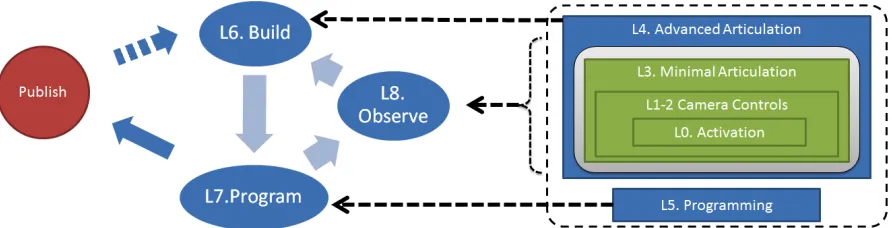
In order to prepare the users to become makers and be able to create and share rigs, the following competency levels can be used to guide the development of learning activities. Each is a subset of the next. These are depicted in Figure 2 and include nine levels.
• Level 0. Construction/assembly/activation of the RALfieBox and camera hardware environment.
This is the first step of building a rig. The RALfieBox establishes the connection and this step is required to be in active in all other step (it does not need to be repeatedly done, but the connection must be held).
• Level 1. Observation only (makers can control the camera Pan Zoom Tilt - also known as PZT).
• Level 2. Observation with basic in camper on/off switch/relay control (maker can control the camera, as well as a simple device connected to the relay of the camera without requiring any programming)
These two steps teach the methods to use the IP Cameras. The video stream is vital for STEM experiments as typically the audio-visual output of the experiments conveys the learning concepts in such experiments. Once again these steps must be setup before and be active during all other subsequent steps.
• Level 3. Observation with articulation and environment change (maker can control the camera, as well as the environment in which the camera is viewing, e.g. turning on light or to cause animal reaction, for instance Shrimp and lighting)
• Level 4. Control with basic on/off control (Controlling a hardware experiment using articulation only)
• Level 5. Control with advanced control (Controlling a hardware experiment using articulation and sensors)
Internet
User 1 -‐ LearnerUser 2-‐ Learner
Rig 2
Experiment 2 (Maker 2)
Experiment 1 (Maker 1) Rig 1
[image:3.595.118.485.71.150.2]
Fig. 2. The Maker Design Competency Levels
The step 3-5 covers the fundamental binary control concepts of on and off as well as possible special predefined functions associated with any particular hardware. These steps 0-5 enable the makers to obtain the most basic concepts of the rig's construction and programming. It also enables the makers to place the peripheral devices such as the cameras in correct place and position and associate them with the UI.
• Level 6. Programming online (Programming using an online interactive Integrated Development Environment requiring simple programming concepts - e.g. scratch, or networking)
• Level 7. Programming embedded remote hardware device (Programming both
Input/Output, but without any articulation.)
• Level 8. Control with basic on/off control (Controlling and programming a hardware experiment using articulation only)
The level 6 to 8 are repetitive in cycles. The makers use their Articulation skills from Level 0-4 to build or reconfigure the experimental rigs. Then it is programmed (or re-programmed) accordingly to match the new functionalities required. Then the makers observe the experiments as if they were the learners. Once the experiment is satisfactory level of quality, it is published to the system, and becomes publicly available.
Even after an experiment is made available publicly, the maker might receive feedback about any issues regarding the stability, mobility or user-interface. This may prompt some changes to be made to the rig and the maker once again enters the cycle of Level 6-8.
The primary aim of these levels is to enable the makers to create a rig and put it online. These levels were created specifically for the P2P RAL system, however will still have relevance and can be adapted for other systems.”
Teacher Perspectives of the Maker Process
When designing systems, careful consideration of the target users’ abilities and needs is required. As such, considering how teachers of varying technical background interact with the P2P RAL is of importance (Green, S. L, 2013). STEM teachers are generally not expected to have experience in building scientific experiments. However, they ensure they need to ensure, instructions and guidelines are available to their students while making and running experiments. In order to do achieve teacher must feel comfortable with the maker process.
Main concerns from a teaching perspective using the P2P RAL include the following questions:
• Is the experiment producing the correct result and in the correct manner? Even if the experiments programs are correct, the results data may not be accurate due to the materials used for the rig. The teachers must be able to verify the output of the experiments.
• How long the experiments can be kept online? While the experiments can be shared, there needs to be a time limit for how long the experiments can be shared. Also the teachers have to decide which groups of the students may access it remotely.
Teacher roles include:
i. Select STEM topics that is appropriate based on the relevant topics that has been already covered. For example, an experiment using a complicated mechanism of cogs/gears to lift a platform requires that the students perform a lower level of experiment which explains the mechanisms of simple gears.
ii. They have to guide the students in according to the competence levels. The number of times the steps are repeated could vary with the complexity of the experiment and the level of prior knowledge of the students.
iii. Teachers as adults must make sure that the mechanism as described earlier are properly addressed in the rigs.
The advantage for teachers include:
• Sharing ideas: The teachers can share ideas among themselves on how to build the experiments. They can even run the experiments themselves remotely.
• Sharing the experiment with students: A teacher can setup and experiments in a remote location and then let the students use it from their locations. Alternative the teachers along with their students from different locations can share experiments among themselves.
Trials
A trial was held with students from the Education department. They were pre-service teachers in an undergraduate education program doing a subject called EDP4130 Technology Curriculum and Pedagogy. The trial had ten participants. All had classrooms experience with children. The aim of the trial was to establish whether the conceptual P2P approach is feasible and practical from a teacher perspective. The trial was setup to address the following objectives:
1. Establish whether hand on experience is essential. 2. Find out if the programming interface is suitable.
3. Determine the capabilities of teacher to make a physical experiment rig.
4. Establish whether teacher understand the overarching architecture of publishing and sharing experiments.
5. Finally, determine whether teachers would be interested in using these tools. The following the guidelines discussed above, a sequence of activities was conducted. Participants were guided through the basics of the SNAP language and completed two sample example programs designed to familiarize participants with the development environment, as well as the custom component to talk to the MCU in this case the LEGO Mindstorms EV3.
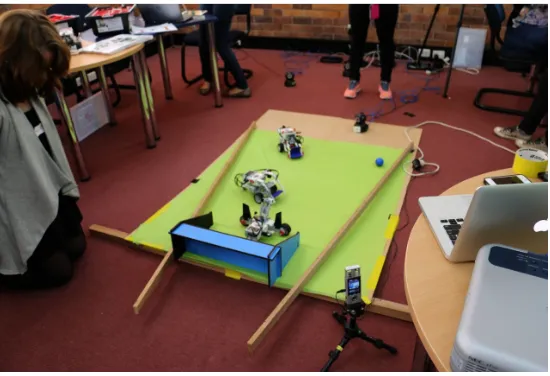
Participants then constructed three wheel-based robots. An activity was developed for this trial in which one of the groups robot was a goalkeeper and the other two were competing robots trying to score a goal. This setup is shown in Figure 3.
The participants were asked to create the corresponding SNAP programs in RALfie website and save them. Figure 4 shows an example of a program. Once the robots were tested to run locally, the participants were taken to another room to run the activity remotely by viewing through the camera only on the RALfie website.
In addition to the skills, abilities and perception of the participants, the trials also looked at mood changes as a result of engaging with the activity. The Positive Affect and Negative Affect Schedule (PANAS) was used to measure those changed.
PANAs is a self-report measure assessing adult experiences of positive and negative affect (Watson, D.1988). There is a Likert-type scale from one to five to rate about their mood. There are 10 items for Positive Affect, namely interested, excited, strong, enthusiastic, proud, inspired, determined, attention, active, and alert. Positive Affect (PA) is important as the hands-on experience is playful and contribute to fun, enjoyment and emotional engagement.
Observations
Participants were observed during the trial while building the experimental. A focus group
Figure3. The trail of the RALfie system with three EV3 robots
[image:6.595.156.431.330.518.2]
participants. In this section, the general outcomes are summarized and the PANAs data is discussed.
With respect to the aims of the trial, their feedback is summarized as follows:
1. The kind of hands-on-experience done in the trials is essential and suitable for school children.
2. All participants had successfully created the program. 3. All groups could create their own robot with various designs.
4. All the participants understood that they could use RALfie to demonstrate someone else’s rig first, to understand the capabilities of the system before building their own. Participants indicated that a bank of example activities would considerably help their understanding of the concepts. Additionally, it was indicated that sharing of the activities with other participants was the most memorable aspect of the trial.
5. All participants indicated that this type of activity could be done at schools but may not be suitable for homes.
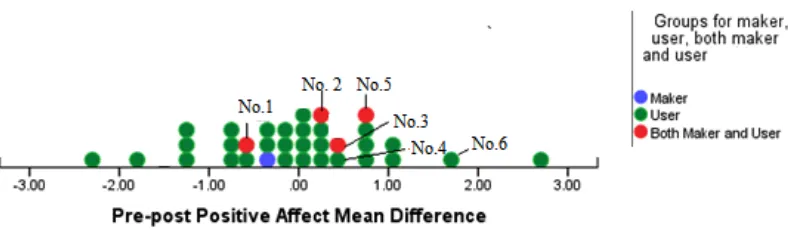
Completing the activity was generally perceived as a positive experience by the participants. The PANAS results provide a formal measure of the impact the trail had on the participants. Figure 5 shows the “mean difference”, which measures the absolute difference between the mean value. “Pre-post PA/NA difference” describes the difference between the pre-test and post-test mean differences for PA/NA. Thirty-four participants conducted pre-post PANAS survey (with 5 having been removed, as they did not participate in the RALfie activity). From Figure 5, it is identified that participants experienced a range of pre-post PA mean difference. For example, Participant 6’s pre-post PA score increased by 1.7, indicating he/she was emotionally engaged in RALfie activities. Conversely, Participant 1’s pre-post PA score decreased by 0.6, indicating potential frustration and low emotional engagement in the activity.
There are two considerations to be made here. The first is providing a skill level articulation path, and the second is to provide a positive experience.
Firstly, it is inferred that the structured nature of the experimental design process helped maintain the focus of the participants and increased the pre-post PA result. Elevating the complexity of the activities only once competence had been reached at the current level is seen as a core process allowing novice participants to upskill throughout the process. Properly designed activities need to be designed to build upon previously reached competency levels, for example once participants learned how to command a motor for the robots (Level 4), this can then be used in successive activities (Levels 5-9).
[image:7.595.102.496.70.187.2]
Secondly, activities need to be designed to allow for soft failure, in that an inability to complete a particular stage can be resolved quickly to minimise frustration, and allow continued learning of the participant.
Conclusions
This article has described the procedure of integrating the maker concept of making ad-hoc experimental setups with a remote laboratory environment. Competency levels have been introduced as a tool to enabled makers and their teachers to effectively use the P2P RAL tools for creating the experiment and programming them. Initial results from the trials are indicative that the P2P approach and the design guidelines can be effectively used in schools. The trial has also demonstrated that teacher will require example activities, training and support to use an approach like this. The PANAS results have shown that the Maker process is successful in enabling the teachers to create and run experiments.
REFERENCES
Green, S. L., & Anid, N. M. (2013, 9-9 March 2013). Training K-12 teachers in STEM education: A multi-disciplinary approach. Paper presented at the Integrated STEM Education Conference (ISEC), 2013 IEEE.
Hardison J L, DeLong K, Bailey P. H., and Harward V. J., (2008). "Deploying Interactive Remote Labs Using the iLab Shared Architecture," Fie: 2008 IEEE Frontiers in Education Conference, Vols 1-3, 1246-1251.
Kist A. A., Maiti A, Maxwell A. D., et al., (2014) "Overlay network architectures for peer-to-peer Remote Access Laboratories," in Remote Engineering and Virtual Instrumentation (REV), 2014 11th International Conference on, 274-280.
Maiti A, Maxwell A. D., and Kist A. A., (2014). "Features, Trends and Characteristics of Remote Access Laboratory Management Systems," International Journal of Online Engineering, vol. 10, 31-37.
Maiti A, Maxwell A. D., Kist A. A., and Orwin L., (2015). "Joining the Game and the Experiment in Peer-to-Peer Remote Laboratories for STEM Education," presented at the 2015 3rd Experiment@ International Conference (exp.at'15), University of the Azores, Ponta Delgada, Portugal.
Orduna P., Almeida A., Lopez-de-Ipina, D. and Garcia-Zubia J., (2014). "Learning Analytics on federated remote laboratories: Tips and techniques," in Global Engineering Education Conference (EDUCON), 2014 IEEE, 299-305.
Resnick M, Maloney J, Monroy-Hernandez A, et al., (2009) "Scratch: programming for all," Commun. ACM, vol. 52, 60-67.
Tawfik, M., Sancristobal, et. al. (2013). Virtual Instrument Systems in Reality (VISIR) for Remote Wiring and Measurement of Electronic Circuits on Breadboard. Ieee Transactions on Learning Technologies, 6(1), 60-72. doi: Doi 10.1109/Tlt.2012.20
Watson, D., Clark, L. A., & Tellegen, A. (1988). Development and validation of brief measures of positive and negative affect: the PANAS scales. Journal of personality and social psychology, 54(6), 1063.