
Priority effects and the dynamics of coral reef fish assemblages
119
0
0
Full text
(2) Priority effects and the dynamics of coral reef fish assemblages. Thesis submitted by. Davina Elise Poulos, BSc (Hons) April 2016. For the degree of Doctor of Philosophy College of Marine & Environmental Sciences James Cook University.
(3)
(4) Statement on the Contribution of Others. This thesis includes collaborative work with my supervisor, Prof. Mark McCormick. As part of this collaboration I was responsible for project concept and design, data collection, and analysis and interpretation of data. My co-author provided technical assistance, intellectual guidance, editorial assistance and financial support.. Financial support was provided by the Australian Research Council (Discovery Grant, M. McCormick), the ARC Centre of Excellence for Coral Reef Studies (M. McCormick), the Ian Potter Foundation Doctoral Fellowship at Lizard Island (D. Poulos), and the James Cook University Graduate Research Scheme (D. Poulos). A stipend was provided by the Australian Postgraduate Award.. Chapter 2. 3. 4. 5. Details of publications on which the chapter is based Poulos DE*, McCormick MI (Submitted) Prior residents drive density-mediated intraspecific interactions during the sequential colonisation of individuals. Behavioural Ecology Poulos DE*, McCormick MI (2014) Who wins in the battle for space? The importance of priority, behavioural history and size. Animal Behaviour 90: 305-314 Poulos DE*, McCormick MI (2015) Asymmetries in body condition and order of arrival influence competitive ability and survival in a coral reef fish. Oecologia 179: 719-728 Poulos DE*, McCormick MI (Submitted) Prior residency improves the performance of a resource specialist in a degrading environment. Journal of Animal Ecology. Input from each author. DEP conceived and designed the experiments with input from MIM. DEP performed the experiments. DEP analysed the data. DEP wrote the papers. MIM edited the papers. i.
(5) Acknowledgements I am extremely grateful to Mark McCormick for his invaluable supervision. Thank you for teaching and training me in various research techniques, for sharing your knowledge and offering advice. Thank you for the independence you gave me - you always supported my research ideas and helped to mould them into achievable studies. I am thankful for the guidance you have given me and the generous support you showed me. I would like to thank my fellow lab mates who have made my PhD experience enjoyable. Thank you to Bridie Allan, Lauren Nadler, James White, Matt Mitchell, Govinda-das Lienart, Maria Palacios, Meg Welch, Donny Warren, Ryan Ramasamy, Katy Corkill, and Lucy Holmes. You were always there to help on field trips, discuss ideas with and offer support. Thank you also to Rhondda Jones at JCU who guided me through new statistical techniques. I am so thankful for my dedicated and hard-working volunteers in the field who made this research possible. Thank you for your passion, commitment, and initiative during long and exhausting trips. Luke Pedini, a massive thank you for your assistance on two separate trips (a total of 15 weeks!), and thank you also to Steph Gardner, Charlotte Taplin and Katy Corkill for your willingness to assist me for a several weeks. Thank you also to Anne Hoggett and Lyle Vail, the directors at the Lizard Island Research Station, for allowing me to conduct my research there - you played a big role in its success. You run a world-class facility, and I feel extremely lucky to have been able to spend months doing research there – it’s a special place! Thank you also to the past and present maintenance staff at Lizard Island (Stu, Kim, Bruce, Cassy, John and Marianne), you were a big support and help with the logistics. Thank you to the Ian Potter Foundation who funded my Doctoral Fellowship at Lizard Island. Shane Geange and Adrian Stier, I am grateful for your earlier work on priority effects in coral reef fishes which gave me the inspiration and vision for my own research. Thank you for the discussions we had which gave me a deeper understanding of my own work and raised interesting new ideas.. ii.
(6) Finally, I am so very thankful to James, my husband, for always supporting me and encouraging me in my endeavours. Thank you for the many sacrifices you made to enable me to undertake this PhD, particularly relocating interstate and allowing me to disappear for months at a time each year for fieldwork. For that and much more, I am eternally grateful, and incredibly blessed to have you in my life. Thank you also to my wonderful family who supported my research, visited me in Townsville, and accepted my absence at many important events. Mum and Dad, you gave me a love for the ocean from a young age, so thank you for encouraging me to explore it.. iii.
(7) General Abstract Understanding the processes and mechanisms by which organisms form and maintain structured assemblages is a central goal of ecology and a key component in being able to predict how environmental or ecological disruption will affect them. Individuals entering an existing population must successfully integrate to increase chances of survival, yet when resources are limited, competition for food and shelter can influence their persistence. In demographically open populations, recruits arrive somewhat stochastically from outside of local populations, meaning that the outcomes of deterministic processes at play upon arrival will be critical to securing future success. However, sequence and timing of arrival play an important role in the magnitude of these deterministic processes, suggesting that ‘priority effects’ play an essential part in the fate of arriving individuals, and subsequently the structure and dynamics of the assemblage. The recruitment of coral reef fishes is a perfect model in which to study these priority effects, since in many species, new settlers arrive in ‘pulses’ throughout the recruitment season, with sporadic inputs of fishes closely tied to lunar phases, and these settlers must rapidly integrate into the resident population or face immediate mortality. With variation in the order and abundance of individuals arriving to habitats occupied by varying numbers of existing individuals (‘prior residents’), understanding the complex behavioural mechanisms involved in who succeeds enables identification of the factors driving population structure. Chapter 2 explored, for a juvenile damselfish, the influence of prior residents on the success of newly arriving individuals and how this changed over time as subsequent ‘pulses’ of intruders (new settlers) were experimentally added at varying conspecific densities. Aggressive interactions occurred most strongly between individuals closest in the social hierarchy and partly explained mortality trajectories. The direction of aggression changed over time as the occupants of the habitat changed, through arrival of intruders and mortality of residents. This evidence stresses the importance of priority effects in influencing the development and composition of fish assemblages.. iv.
(8) However, the unique set of interaction experiences possessed by an individual can also affect how they behave and their likelihood of winning future encounters, which influences their position in the social hierarchy. Chapter 3 used a field experiment to investigate the circumstances under which residency (resident or intruder), behavioural history (prior dominance or subordinance) and body size determined the direction and strength of intraspecific interactions. Results showed the hierarchical importance of body size, priority, and prior behavioural history, suggesting the latter had the least influence on the outcome of future confrontations. Aggression affected space use on a habitat patch and was itself affected by relative size difference between combatants. These findings demonstrate how an individual’s physical and behavioural characteristics, and those of its competitors, interact to influence dominance status and subsequently the structure and dynamics of assemblages. The effects of body size on the outcome of competitive interactions were pronounced in Chapter 3, thus Chapter 4 explored whether body condition also had a significant impact on post-settlement success. Body condition varies substantially in settling reef fish, as a result of their larval history and experiences. A 2 x 2 factorial field experiment was conducted that manipulated body condition (high or low, manipulated through a feeding regime), and residency (resident or intruder, where the resident arrived at the habitat three hours before the intruder) to evaluate effects on competitive ability and survival. Prior residency alleviated the disadvantage of a low body condition with respect to aggression, which was similar between low condition residents and high condition intruders. Mortality trajectories suggested that body condition modified the effect of prior residency, and intruders were more likely to suffer mortality if they had a low body condition because residents pushed them away from shelter. These results highlight that the negative effects of some traits may be compensated for by the positive effects of other traits, and that the specific ecological context an individual faces (such as the characteristics of its competitors) can have a major influence on successful establishment and persistence. To put the role of priority effects into the context of our changing environment, Chapter 5 was designed to investigate: 1) how sequence and timing of arrival affects interactions between a habitat generalist and a specialist in healthy and v.
(9) degrading environments, and 2) how prior residency interacts with habitat quality and resource specialisation to affect propensity to migrate. We used the damselfishes Pomacentrus amboinensis, a habitat generalist, and Pomacentrus moluccensis, a live coral specialist. Results demonstrated that the strength of priority effects (i.e., aggression intensity) increased with increasing timing of arrival when the specialist arrived after the generalist, suggesting that as the value of the habitat increased (owing to a temporal increase in ownership duration), the motivation to defend it also increased. Propensity to migrate from dead to live coral was greater for the specialist, however arriving late (after the generalist) significantly reduced willingness to migrate to its preferred live coral habitats, indicating evidence of an inhibitory priority effect, directly affecting future persistence. The degree to which ecological versatility and priority effects combine to modify competitive outcomes in coral reef fishes has important consequences for the persistence of specialist species in the face of environmental degradation, and has substantial implications for predicting how our changing environment will affect fish community dynamics. This study demonstrates the important role that priority effects have on individual success, and the repercussions this has on the structure and functioning of assemblages, by influencing the outcome of competitive interactions. The fate of late arrivers is not a foregone conclusion, but in fact such a disadvantage may be modified or alleviated by a series of other advantageous traits. Furthermore, evidence from this study reveals the underlying behavioural mechanisms that contribute to and are affected by priority of access to resources, suggesting that the strength and direction of competition is directly influenced by temporal variation in arrival. The effects of sequence and timing of arrival should be considered when examining the factors affecting the assembly of organisms.. vi.
(10) Table of Contents. Statement on the Contribution of Others .......................................................................i Acknowledgements ........................................................................................................ii General Abstract ............................................................................................................iv Table of Contents ..........................................................................................................vii List of Tables ..................................................................................................................ix List of Figures ..................................................................................................................x. Chapter 1: General Introduction ..............................................................................1. Chapter 2: Prior residents drive density-mediated intraspecific interactions during the sequential colonisation of individuals..................................................................6 2.1 Summary .......................................................................................................6 2.2 Introduction ..................................................................................................7 2.3 Materials & Methods ....................................................................................9 2.4 Results .........................................................................................................11 2.5 Discussion ....................................................................................................16. Chapter 3: Who wins in the battle for space? The importance of priority, behavioural history and size .......................................................................................................21 3.1 Summary .....................................................................................................21 3.2 Introduction ................................................................................................22 3.3 Materials & Methods ..................................................................................24 3.4 Results .........................................................................................................28 3.5 Discussion ....................................................................................................36. Chapter 4: Asymmetries in body condition and order of arrival influence competitive ability and survival in a coral reef fish .....................................................................41 4.1 Summary .....................................................................................................41 vii.
(11) 4.2 Introduction ................................................................................................42 4.3 Materials & Methods ..................................................................................45 4.4 Results .........................................................................................................48 4.5 Discussion ....................................................................................................55. Chapter 5: Prior residency improves the performance of a resource specialist in a degrading environment ..........................................................................................59 5.1 Summary .....................................................................................................59 5.2 Introduction ................................................................................................60 5.3 Materials & Methods ..................................................................................62 5.4 Results .........................................................................................................66 5.5 Discussion ....................................................................................................72. Chapter 6: General Discussion ................................................................................77 References .............................................................................................................83 Appendix ..............................................................................................................101. viii.
(12) List of Tables. Table 3.1 – Outcome for resident Pomacentrus amboinensis of winning or losing an encounter at a settlement site. The residents and intruders had similar or different behavioural experience (recent history of being dominant or subordinant) and the resident was either larger than the intruder or of a similar size (R=Resident, I=Intruder). Table 3.2 – Logistic regression model examining the contribution of each predictor variable (and their interactions) to the probability of winning a paired encounter. The interaction between residency and behavioural history, and the interaction between all three predictors were removed from the model since they did not significantly contribute to the outcome; (*significant <0.05). Table 4.1 - Mean body condition (Fulton’s condition factor, K) for residents and intruders in each of the four treatments: HR-LI (high-condition resident vs. lowcondition intruder), LR-HI (low-condition resident vs. high-condition intruder), HR-HI (high-condition resident vs. high-condition intruder), LR-LI (low-condition resident vs. low condition intruder), and results from paired t-tests (significant differences between the body condition of residents and intruders (adjusted alpha = 0.0125) are represented by *). Table 4.2 - Logistic regression model examining the effects of residency (residents vs. intruders who arrive 3 hours later) and body condition (high and low condition individuals) on the probability of gaining dominance, in pairs of the Ambon damselfish. *P<0.05.. ix.
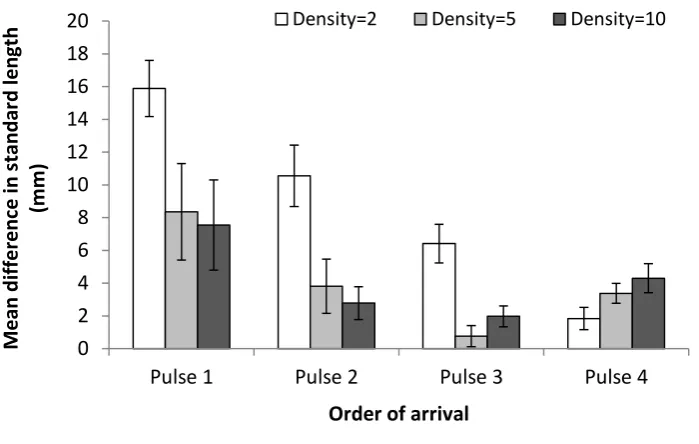
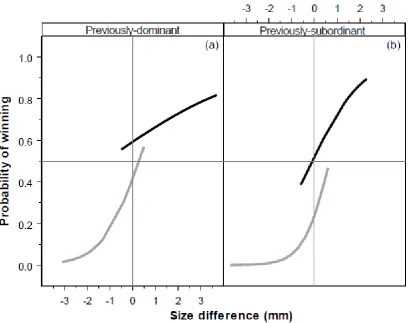
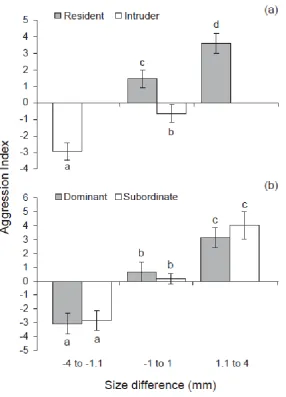
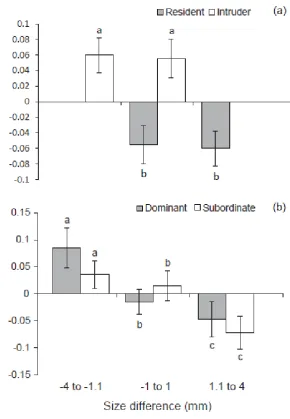
(13) List of Figures. Figure 2.1 – Mean difference in standard length (mm) of Pomacentrus amboinensis individuals from pulses 1, 2, 3, or 4, arriving in densities of 2 (white bars), 5 (light grey bars), or 10 (dark grey bars), from time of arrival to patch reefs until collection at the conclusion of the study. Figure 2.2 – Kaplan-Meier survival trajectories for each pulse of recruits at densities of (a) 2, (b) 5, and (c) 10 conspecifics, over the duration of the study (44 days). Figure 2.3 – Mean (±SE) relative distance from habitat for each pulse (Pulse 1 (P1): white bars, Pulse 2 (P2): light grey bars, Pulse 3 (P3): dark grey bars, and Pulse 4 (P4): black bars 4) at each density (2, 5, and 10) over the four time periods when each pulse was added (i.e. time 1 is when pulse 1 arrived, time 2 is when pulse 2 arrived, etc). A score of 0 represents 100% of the time spent within the coral and a score of 1 represents 100% of the time spent 10cm away from the coral. (Bars are stacked). Figure 2.4 – Frequency of chases per individual per minute for each pulse (Pulse 1 (P1): white bars, Pulse 2 (P2): light grey bars, Pulse 3 (P3): dark grey bars, and Pulse 4 (P4): black bars) at (a) density of 2 individuals per pulse, (b) density of 5 individuals per pulse, and (c) density of 10 individuals per pulse, over the four time periods when each pulse was added. (Bars are stacked). Figure 3.1 – Logistic regression showing probability of winning a paired encounter as a function of size difference, residency and behavioural history. The black lines represent residents and the grey lines represent intruders. Behavioural history is shown for previously-dominant (a) and previously-subordinant (b) individuals. Figure 3.2 - Mean (±SE) level of aggression with size difference for (a) residents and intruders and (b) fish that had been dominants and subordinates in previous encounters. A positive value means the individual ‘won’ the competitive interaction and a negative value means they lost. Letters above or below bars represent Tukey’s HSD post-hoc groupings of means. x.
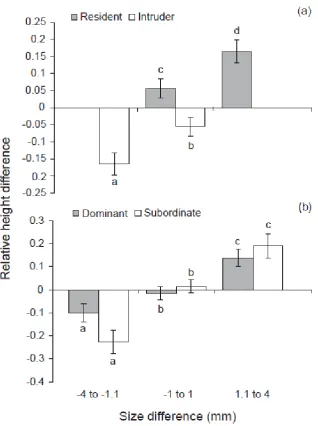
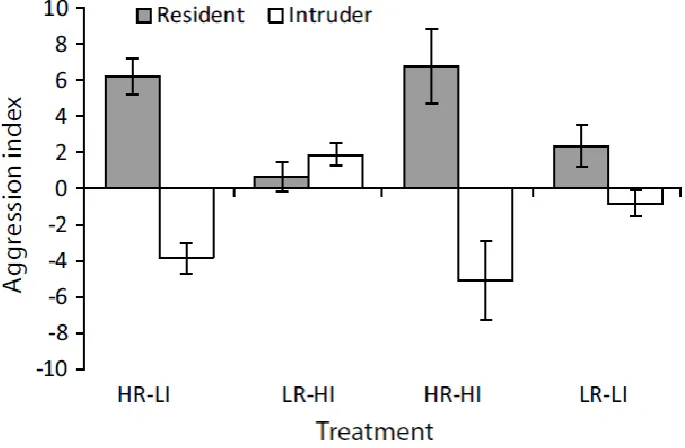
(14) Figure 3.3 – Mean (±SE) relative difference in height on habitat patch with size difference for (a) residents and intruders and (b) dominants and subordinates. A positive value means the individual was on average higher on the patch than their competitor and a negative value means they were lower on the patch. Letters above or below bars represent Tukey’s HSD post-hoc groupings of means. Figure 3.4 - Mean (±SE) relative difference in distance ventured away from the habitat patch with size difference for (a) residents and intruders and (b) dominants and subordinates. A positive value means the individual was on average further away from the patch than their competitor and a negative value means they were closer to the patch. Letters above or below bars represent Tukey’s HSD post-hoc groupings of means. Figure 4.1 - Mean level of aggression (represented as the aggression index) (±SE) for residents (grey bars) and intruders (white bars) in each of the four treatments: high condition resident vs. low condition intruder (HR-LI; n=14), low condition resident vs. high condition intruder (LR-HI; n=17), high condition resident vs. high condition intruder (HR-HI; n=18), low condition resident vs. low condition intruder (LR-LI; n=17). Figure 4.2 - Logistic regression showing the predicted probability of gaining dominance as a function of body condition and residency in the coral reef damselfish Pomacentrus amboinensis. The black line represents residents and the grey line represents intruders. Reference line at K=0 indicates equal body condition. At K=0, for example, the resident has approximately an 83% chance of being dominant and the intruder a 17%% chance; at K=-1.0 for the resident and K=+1.0 for the intruder, the resident and intruder both have an approximately 50% chance of dominating. Figure 4.3 - Mean relative distance from habitat (±SE) for residents (grey bars) and intruders (white bars) in each of the four treatments: high conditioned resident vs. low conditioned intruder (HR-LI; n=14), low conditioned resident vs. high conditioned intruder (LR-HI; n=17), high conditioned resident vs. high conditioned intruder (HR-HI; n=18), low conditioned resident vs. low conditioned intruder (LR-LI; n=17). Relative distance from habitat is a weighted mean ranging from 0 to 1, where 0 is 100% of the. xi.
(15) time spent within the shelter, and 1 is 100% of the time spent 10cm away from the shelter. Figure 4.4 - Kaplan-Meier survival trajectories for residents (solid line) and intruders (dashed line) in four different body condition treatments (n=20 pairs per treatment): (A) high condition resident vs. low condition intruder, (B) low condition resident vs. high condition intruder, (C) high condition resident vs. high condition intruder, (D) low condition resident vs. low condition intruder. Figure 5.1 – Mean number of chases per minute (±SE) on live and dead coral with timing of late arrivers being 1, 3 or 24 hours, when (a) Pomacentrus moluccensis (white bars) arrives early and Pomacentrus amboinensis (grey bars) arrives late, and (b) when Pomacentrus amboinensis (grey bars) arrives early and Pomacentrus moluccensis (white bars) arrives late. Letters above bars represent Tukey’s HSD groupings. Figure 5.2 – Difference in relative height on the patch reef (±SE) between early and late arriving P. moluccensis and P. amboinensis on live and dead coral, when timing of arrival for late individuals is 1, 3 or 24 hours. White bars represent differences in height between early P. moluccensis and late P. amboinensis and grey bars represent differences in height between early P. amboinensis and late P. moluccensis. Differences are calculated from the perspective of the early arriver, i.e., relative height of early individual minus relative height of late individual. Therefore a positive value indicates the early arriver was higher on the patch reef than the late arriver, and vice versa. Figure 5.3 – Percentage migration from dead to live coral for Pomacentrus amboinensis (habitat generalist) and Pomacentrus moluccensis (live coral specialist) arriving early or late. Timing of arrival = 3 hours. Figure 5.4 – Kaplan-Meier survival trajectories for Pomacentrus amboinensis arriving early or late (timing of arrival = 24 hours) to live or dead coral, with some individuals migrating from dead to live coral. (For example, ‘Early-Live’ is an individual that arrived. xii.
(16) early to live coral and did not migrate; ‘Early-Dead-Live’ is an individual that arrived early to dead coral and migrated to live coral).. xiii.
(17)
(18) Chapter 1. Chapter 1: General Introduction Understanding the processes influencing the development and maintenance of assemblages of organisms is a central goal of ecology. In demographically open systems, the arrival of new individuals is spatially and temporally unpredictable, and not directly related to reproductive output of the local population (Bence & Nisbet 1989; Hixon et al. 2002). Therefore the deterministic processes in operation at the time of arrival to an assemblage play a crucial role in the subsequent success and persistence of colonists as well as the resulting composition of the community that is formed. Once propagules have found appropriate habitat, the ecological processes that may influence assemblage composition include competitive interactions between residents and newcomers for limited resources, position in the dominance hierarchy for organisms living in highly structured social groups, and successful integration into the assemblage. Many animal communities are size or age structured where individuals usually achieve their dominant status through mortality of higher-ranked individuals (Werner & Gilliam 1984; Buston & Cant 2006; Wong et al. 2007). Thus, time of arrival into a community can influence an individual’s social rank (Figler et al. 1975; Koivula et al. 1993), and early-arriving individuals gain a prior residency advantage with respect to experience of the habitat, predators and resources (Geange & Stier 2009; Miller-Pierce & Preisser 2012). These ‘priority effects’, described by Almany (2003) as ‘the effects that established individuals have on those arriving later’, are central to ecology, influencing the persistence of many organisms during various life history transitions, and ultimately determining the structure of assemblages through inter- and intraspecific interactions. The magnitude of priority effects may be related to timing of arrival (i.e. the time between the arrival of the early and late arrivers), and can have significant effects on the form, direction and intensity of competitive interactions (Blaustein & Margalit 1996; Hodge et al. 1996). Previous studies have indicated a correlation between timing of arrival and the strength of competitive interactions: an increase in the length of time between arrival times results in an increase in the strength of. 1.
(19) Chapter 1. priority effects (Lawler & Morin 1993; Geange & Stier 2009). Shorrocks & Bingley (1994) used two Drosophila species to show that late-arriving flies have decreased survival, decreased body size and an increased developmental time. These characteristics in turn led to the production of fewer offspring and a reduction in competitive ability. However, when both species arrived at the same time, there was no significant effect on coexistence, and even a one day priority given to the inferior species resulted in it gaining a dominant status over the superior species (Shorrocks & Bingley 1994). This fitness advantage of prior residents can result from a number of factors during their prior establishment, such as priority of access to limited resources and knowledge of the local habitat and its occupants. However, the outcome of interactions between residents and intruders is not a fore-gone conclusion. The life history and performance attributes of species and individuals will influence who the competitive dominant is; individuals vary greatly in their phenotypic and behavioural traits and these characteristics are expected to greatly affect individual success (Beaugrand et al. 1996; McCormick 2009; Pruitt 2012). There are also specific traits that individuals bring with them which may enhance or reduce the competitive advantages of prior residency. For example, paired interactions between resident and intruder green swordtail fish (Xiphophorus helleri) revealed body size to be a key determinant for winning a contest if size differences were large, whereas a history of recently winning or losing an interaction determined outcomes when individuals were closely matched in size (Beaugrand et al. 1996). Similarly, encounters between prior residents and intruders of different sized prawns (Palaemon elegans) showed that success was generally determined by body size rather than prior residency (Evans & Shehadi-Moacdieh 1988), and in territorial dragonflies (Perithemis tenera) prior residents only won if the contest was not escalated (aggressive) (Switzer 2004). However, asymmetrical residency-size interactions between freshwater angelfish (Pterophyllum scalare) revealed that prior residents won the encounter regardless of relative size (Chellappa et al. 1999). The analysis of conflict and cooperation in animal interactions is addressed by evolutionary game theory, which originated from asymmetric pair-wise contests and predicts that the asymmetry (be it residency, size, behavioural history, etc) will be used to settle the contest (Maynard Smith 1984). Body 2.
(20) Chapter 1. condition can potentially be dependent or independent of body length, but has received little attention as a factor directly contributing to contest outcomes (but see Kodric-Brown & Nicoletto (1993) for a positive association between physical condition and social status). The spatial and temporal effects of inter- and intra-specific interactions are important in understanding demographically open systems where resources are limited. In these systems, deterministic mechanisms involving many ecological factors contribute to the structure of fish communities, facilitating or inhibiting successful recruitment of new arrivals or ontogenetic habitat shifts of adults. Coral reef fishes are ideal models for studying these competitive interactions and priority effects since many reef fish populations are open systems with new settlers arriving in ‘pulses’ throughout the recruitment season (closely tied to the lunar phases; Dufour & Galzin 1993). These settlers must rapidly integrate into the resident population or face immediate mortality. This transition of coral reef fish from pelagic larvae to a benthic or demersal life-style involves a complex process whereby the larvae select their initial habitat, which is influenced by the detection of a number of complex cues. These cues may originate from the physical habitat but also from the assemblage already present, such as the smell of conspecifics, competitors or predators (Sweatman 1988; Lecchini et al. 2005; Vail & McCormick 2011). Many settlement-stage fish recruit to habitats over several hours at night, each night for about 7-10 days around the new moon. This temporal variation in arrival means that prior residents may gain a significant competitive advantage over late settlers (see Holbrook & Schmitt 1997), within and between cohorts. It is at this time that priority effects play a crucial role in structuring assemblages, and an understanding of the underlying behavioural mechanisms will significantly assist in predicting how individuals integrate into the social hierarchy. Several studies have identified the important role of priority effects in the persistence of settling coral reef fish (Shulman et al. 1983; Munday et al. 2001; Almany 2003; Geange & Stier 2009), but few have explored the relative importance of prior residency in combination with a suite of other factors influencing post-settlement success. Marine habitats experience stress from both natural and anthropogenic factors that contribute to changes in habitat type, habitat availability, quality and structure, 3.
(21) Chapter 1. and these changes alter resource characteristics for the organisms that live in these habitats. The changing nature of habitats is predicted to disrupt the established fish assemblages, whereby many individuals will relocate in search of higher quality resources, and as a result the structure of existing fish communities will change. Although this has been well documented (Munday 2004b; Feary 2007; McCormick 2009), the underlying mechanisms are not well understood. To understand what determines the successful entry and establishment of immigrating individuals into existing communities, it is necessary to frame the question in the context of the factors that affect the successful establishment of individuals in undisturbed assemblages. Some species have evolved to efficiently use one type of habitat (specialists), while others thrive in a broad range of habitat types (generalists) (MacNally 1995; Wilson et al. 2008). How, and the extent to which, a habitat patch meets the individuals’ requirements will depend on the nature of the habitat and the occupants of the patch. The outcome of interactions between two resource competitors is closely tied to their preferred habitat. As habitat degradation and environmental change alters the composition and function of these reef ecosystems, understanding the processes influencing the structure of fish assemblages is vital if we are to predict how these assemblages will shift spatially and temporally in response to changing environments. This study explores the role of priority effects in the dynamics of coral reef fish assemblages. Chapter 2 establishes the role of prior residency in the recruitment of coral reef fishes by exploring the mechanisms involved in the integration of new settlers to existing assemblages and whether natural variation in densities affects these processes. Chapter 3 investigates the specific factors important to the postsettlement success of reef fish by examining the relative importance of body size and a previous behavioural history of winning or losing competitive interactions, with order of arrival to the habitat. Acknowledging the importance of body size in competitive success from Chapter three, I explored whether the effects of body condition were also strong given that their potential effects are independent of body length. Body condition has previously been shown to be an important factor in postsettlement success (Booth & Beretta 2004; Grorud-Colvert & Sponaugle 2006), with considerable variation coming from parental and environmental influences in the 4.
(22) Chapter 1. larval phase. Thus, Chapter 4 explores the influence of variation in body condition at settlement on the relative importance of prior residency. Finally, Chapter 5 examines the role of priority effects in the context of the degradation of coral reefs (De’ath et al. 2012) by examining how prior residency affects the competitive performance and propensity to migrate of a live coral specialist reef fish and a habitat generalist reef fish on live and degraded coral habitats. Overall, this research contributes to the growing literature exploring the mechanisms underlying the assembly of organisms and the complex interplay of deterministic factors influencing individual success.. 5.
(23) Chapter 2. Chapter 2: Prior residents drive density-mediated intraspecific interactions during the sequential colonisation of individuals. This chapter has been submitted to Behavioural Ecology Authors: D. E. Poulos, M. I. McCormick. 2.1 Summary Many populations of organisms experience periodic inputs or ‘pulses’ of individuals, with varying numbers of individuals arriving to habitats occupied by varying numbers of existing individuals (prior residents). Identifying the complex behavioural mechanisms that determine who succeeds is central to understanding the factors that drive population structure. The pulsed settlement of coral reef fishes to benthic habitats at the end of their larval phase is a perfect model in which to study this question. We explored, for a juvenile damselfish, the influence of prior residents (early arrivers) on the success of newly arriving individuals (late arrivers) and how this changed over time as subsequent ‘pulses’ of intruders were experimentally added at varying conspecific densities. Using a manipulative field experiment we examined the behaviours and mortality trajectories of individuals, with a two-factor crossed design: time of arrival (first, second, third and fourth pulses, where arrival of each pulse was staggered at approximately 10-12 day intervals to mimic natural settlement patterns), and conspecific density (two, five or ten individuals arriving in each pulse). Our results demonstrated growth to be density-dependent such that it decreased with increasing conspecific density and was more variable at higher densities. In addition, habitat use was found to be a function of space limitations (due to density) or dominance status (due to priority of arrival). Aggressive interactions occurred most strongly between individuals closest in the social hierarchy, and between individuals in low density assemblages, and partly explained mortality trajectories. Results stress the key role that priority effects play in influencing the development and size- or age-composition of fish assemblages. 6.
(24) Chapter 2. 2.2 Introduction Understanding the factors that shape assemblages of organisms and the dynamics by which individuals integrate into established populations is a central goal of ecology. The arrival of these individuals is usually associated with reproduction, migration or periodic environmental change (Patterson & McLachlan 1989; Bergenius et al. 2005). Many populations of organisms with complex life cycles (e.g. insects, amphibians and fishes) experience periodic inputs of new individuals, and assemblages are repeatedly replenished by the new arrival of young-of-the-year. Additionally, juveniles and adults also immigrate as a result of ontogenetic migration or habitat destruction. Periods of input can be separated by extended periods, which allow the new individuals to grow and integrate into the resident population before the next input of new individuals occurs. It is the pulsed and unpredictable nature of arrival of new individuals into existing populations that impacts the way organisms interact and the resulting dynamics of communities (Milicich and Doherty 1994; Blaustein & Margalit 1996). This staggered arrival can lead to the creation of dominance hierarchies in age- or sizestructured populations, with competitively superior individuals gaining access to optimal food availability and shelter space. Order of arrival has previously been linked to competitive advantages (Figler et al. 1975; Lawler & Morin 1993), a ‘priority effect’, and can intensify under lengthy prior residencies (Sandell & Smith 1991; Hodge et al. 1996; Geange & Stier 2009). The characteristics of the assemblage that a newcomer enters will also influence that individual’s future success. While the coloniser will likely be entering the established assemblage as an inferior competitor, the strength of competition will depend on the identity and characteristics of the residents and the structure of their social hierarchy. The transition of coral reef fishes from larvae in the open ocean to settlement on the reef is an ideal model in which to study the behavioural processes that underlie the pulsed arrival of colonists to an assemblage and the drivers of individual success. Within a recruitment season, new individuals often enter a juvenile habitat in a series of ‘pulses’ that mirror the breeding periodicity of the adults. Individuals arriving at the start of the recruitment season will effectively have a number of advantages over conspecific individuals entering the same habitat patch at a later date. These 7.
(25) Chapter 2. advantages of early residence, i.e., priority effects, are manyfold and include advantages associated with growth, and experience of the habitat (both its layout and assemblage). Priority effects have a major influence on the dynamics of populations because many organisms live in age- or size-structured populations. The pulsed nature of inputs (Milicich et al. 1992; Meekan et al. 1993) means that juvenile populations consist of different aged members competing for resources, so prior residents can have a major influence on the establishment, success and survival of individuals entering a local population. Dynamics are complicated by the temporally and spatially stochastic nature of new arrivals where the number of colonists in a pulse varies greatly, as does the density and age-structure of existing residents. These differences in the density of colonists can influence which individuals will grow the fastest or survive the longest (Warner et al. 1991; Forrester 1995; Goldberg et al. 2001). The abundance of organisms sharing any given habitat space has fitness and survival consequences for its occupants, and the effects of high density on the fitness of organisms has been widely studied. At high densities, individuals may experience limited access to resources, potentially influencing the timing of metamorphosis (Newman 1998; Eitam et al. 2005), increasing competition and heightening susceptibility to predators (Massot et al. 1992). There is a trade-off involved, where individuals are faced with the risk of reduced fitness and performance, or the risks involved with migration (the possibility of unsuccessful integration into a new assemblage); individuals must decide whether it is riskier to stay where they first settle or to migrate. While densitydependent processes are well studied (Hanski 1990), there is still a poor understanding of the behavioural mechanisms that underlie density dependence, as most empirical data comes from sporadic surveys of fixed areas over time or experimental treatments that document survival. It is likely that the process directly influencing recruit survival is interference competition, and the intensity of this competition is expected to be influenced by both the number of existing residents and the number of recruits entering in a single pulse. The present study examines the extent to which the combined effects of prior residency and conspecific density interact to affect the persistence of late-arriving individuals. Specifically, we ask: 1) how do residents affect the success of later arriving 8.
(26) Chapter 2. individuals and how does this change over time as multiple pulses of fish enter the habitat at varying conspecific densities, and 2) is the advantage of residency of settlers at the start of the recruitment season maintained as multiple pulses of fish enter the reef, and how do the early arriving residents balance their efforts to maintain dominance?. 2.3 Materials & Methods Study site This study was undertaken at Lizard Island, on the northern Great Barrier Reef, Australia. Patch reefs were constructed from the hard bushy coral Pocillopora damicornis in 5.5 metres of water, on bare sand at least 50 metres away from the nearest reef. All patches were 5 metres apart and of similar size (approximately 0.125 cubic metres) and structure (pyramidal in shape, consisting of 3-5 heads of healthy P. damicornis collected from a nearby reef).. Collection and tagging of study species Pomacentrus amboinensis is an abundant damselfish on coral reefs in the Indo-Pacific, found in high densities on shallow reefs, and is site attached following settlement (Holmes & McCormick 2006), which makes it well-suited to this study. Individuals were caught in light traps deployed at dusk and collected at dawn, at the back-reef of Lizard Island. Immediately after collection captured P. amboinensis were transported to the laboratory and held in 25 litre flow-through aquaria systems for 2-7 days and fed Artemia sp. nauplii ad libitum. Holding time varied depending on daily natural availability, so some were kept until a sufficient number of individuals were collected for use in the experiment. One day prior to transplantation of fish to patch reefs, individuals were measured for standard length (±0.1mm) and tagged with a subcutaneous fluorescent elastomer tattoo, as per Poulos & McCormick (2014). This methodology has been demonstrated to not influence growth or mortality of the study species (Hoey and McCormick 2006). Tag colours were alternated between. 9.
(27) Chapter 2. patch reefs to avoid biasing results in case of selective mortality by predators, and different tag colours were used for each pulse.. Experimental protocol Light trap caught P. amboinensis individuals were experimentally ‘pulsed’ onto patch reefs to mimic natural recruitment which occurs over the summer months in pulses around the new moon (Dixon et al. 1999). Densities of two, five and ten individuals were placed on replicate patch reefs (n = 12), for each of four pulses over a six-week period as follows: the second pulse of fish were placed on patches 14 days after the first, the third was added after another 12 days, and the fourth after another 11 days. (These approximate two week intervals represent the possible timing between peaks of settlement either side of the new moon, from one month to the next). Following the first pulse, any missing individuals were replaced up to 48 hours afterwards, but from there on and for subsequent pulses, mortality was simply recorded every 3-4 days (all missing individuals were assumed to have been eaten since extensive searches found there was no evidence of migration to adjacent patch reefs or the natural reef). All fishes that naturally recruited to the patch reefs were frequently removed using a hand net, although this was minimal. At the conclusion of the study all remaining individuals were collected and re-measured for standard length. Behavioural surveys were conducted every 3-4 days, and involved observing both inter- and intra-pulse interactions. On each patch, two individuals from each pulse were selected at random and a three-minute observation was conducted to record the following: (a) distance ventured from the coral (recorded as the percentage of time spent at 0, 2, 5 and 10 cm away), and (b) the number of chases towards other fish (and which pulse those fish were from). Divers were situated approximately 1.5m away from the patch during observations and used a hand-held magnifying glass (2x magnification) to see individuals clearly. Previous studies have found a high degree of consistency in the behaviour of individuals on scales of up to 5 days, and that 3 minutes is sufficient to quantify the individuality of behaviour of juvenile damselfishes (McCormick and Meekan 2010; White et al. 2015).. 10.
(28) Chapter 2. Statistical analyses To compare the difference in mean standard length of survivors between densities, one-way analysis of variances (ANOVAs) with Tukey’s HSD post-hoc tests were conducted for each pulse. Survival among pulses and densities were compared with survival analysis that uses a Cox’s proportional hazard model (STATISTICA v. 12.0). Survival trajectories for each pulse were plotted using the Kaplan-Meier product-limit method and compared using a Chi-square statistic. Where significant differences existed, two-sample analyses were conducted between sets of two pulses and compared using Cox’s F statistic. Mean relative distance from the habitat was compared between pulse, density and time with a three-factor ANOVA and Tukey’s HSD post-hoc tests. Significant differences were further explored using two-factor ANOVAs (density and time) with Tukey’s HSD post-hoc tests, for each pulse (except pulse 4 for which time was irrelevant since pulse 4 was only present during the final time period, thus a onefactor ANOVA was used to compare distance from the habitat between densities only). A Bonferroni correction was applied to the two- and one-factor ANOVAs (adjusted alpha = 0.0125). Cumulative frequency of chases per individual per minute was compared between density, pulse, and time with a generalised linear model (GLM), with the direction of chases as a covariate.. 2.4 Results Growth & survival Initial mean standard length of individuals in each pulse prior to transplantation on patch reefs were, 12.09 ±0.12 mm SE for pulse one, 11.82 ±0.047 mm SE for pulse two, 12.50 ±0.042 mm SE for pulse three, and 12.33 ±0.079 mm SE for pulse four. Means significantly differed between pulses one and three (t = -2.465, p = 0.020), pulses two and three (t = -10.354, p < 0.001), and pulses two and four (t = -4.868, p < 0.001). The difference in mean standard length (a proxy for growth rate) from the time individuals were added to patch reefs until the conclusion of the study, was significantly higher for individuals at the lowest density (two conspecifics) compared 11.
(29) Chapter 2. to fish from densities of five and ten conspecifics per pulse, for all four pulses (pulse 1: F2,23=15.021, both P<0.001; pulse 2: F2,23=42.963, both P<0.001; pulse 3: F2,34=74.969, both P<0.001; pulse 4: F2,33=16.132, both P<0.001; Figure 2.1). Variation in the difference in standard length for individuals in pulse one was greater for fish at higher. Mean difference in standard length (mm). densities (five and ten individuals, compared to two individuals; Figure 2.1).. Density=2. 20 18 16 14 12 10 8 6 4 2 0 Pulse 1. Pulse 2. Density=5. Density=10. Pulse 3. Pulse 4. Order of arrival. Figure 2.1 – Mean difference in standard length (mm) (±SE) of Pomacentrus amboinensis individuals from pulses 1, 2, 3, or 4, arriving in densities of 2 (white bars), 5 (light grey bars), or 10 (dark grey bars), from time of arrival to patch reefs until collection at the conclusion of the study.. Survival trajectories were similar between pulses at a density of two conspecifics (Chi-square=3.882, d.f.=3, P=0.275), with level of mortality ranging from 37.5-62.5% (Figure 2.2a). At densities of five and ten, survival trajectories significantly differed between pulses (Chi-square=8.246, d.f.=3, P=0.041; Figure 2.2b, and Chisquare=18.705, d.f.=3, P<0.001; Figure 2.2c, respectively). Two-sample tests revealed that at a density of five, level of mortality experienced by pulse 2 (65%) was significantly higher than pulse 1 (30%; Cox’s F-Test, F(12,26)=2.532, P=0.023), pulse 3 (40%; Cox’s F-Test, F(16,26)=2.592, P=0.015), and pulse 4 (50%; Cox’s F-Test, F(18,26)=2.345, P=0.023) (Figure 2.2b). At a density of ten, levels of mortality were 12.
(30) Chapter 2. significantly higher for pulse 1 (60%) and 2 (65%) than pulse 3 (52.5%) and pulse 4 (52.5%) (Cox’s F-Test: pulses 1 and 3, F(42,48)=1.722, P=0.035; pulses 1 and 4, F(42,48)=1.822, P=0.023; pulses 2 and 3, F(42,50)=1.702, P=0.036; pulses 2 and 4, F(42,50)=1.930, P=0.013; Figure 2.2c). Level of mortality did not significantly differ among densities for any pulse (pulse 1: Chi-square=4.453, d.f.=2, P=0.108; pulse 2: Chi-square=0.216, d.f.=2, P=0.898; pulse 3: Chi-square=1.113, d.f.=2, P=0.573; pulse 4: Chi-square=0.211, d.f.=2, P=0.900).. Figure 2.2 – Kaplan-Meier survival trajectories for each pulse of recruits at densities of (a) 2, (b) 5, and (c) 10 conspecifics, over the duration of the study (44 days).. Habitat use & aggression The distance individuals ventured from the habitat significantly differed with the density of conspecifics (F2,562 = 10.584, p<0.001; Figure 2.3). Overall, individuals at densities of ten generally moved significantly further away from the habitat than 13.
(31) Chapter 2. individuals at densities of two (Tukey’s HSD, p<0.001), however upon comparing pulses separately, this only applied to individuals in pulse two (Figure 2.3). There was an overall significant interaction between pulse and time (F3,562 = 7.335, p<0.001) indicating that use of the habitat over time depended on the order individuals arrived to the habitat (Figure 2.3). Individuals in pulses 1 and 3 generally ventured further away from shelter than individuals in pulse 2 (p=0.004 and p<0.001, respectively), and individuals in pulse 3 ventured further than those in pulse 4 (p=0.021) (Figure 2.3). Overall changes in habitat use significantly differed between time 1 and time 4 (p=0.013) as well as time 2 and time 3 (p<0.001) and time 2 and time 4 (p<0.001) (Figure 2.3). Further analyses revealed that only individuals in pulse 1 significantly changed their behaviour over time (F3,202 = 17.183, p<0.001), venturing further away from the habitat at time 2 than time 1 (Tukey’s HSD, p=0.001), time 3 (p<0.001) and time 4 (p<0.001), as well as venturing further away at time 1 compared to time 3. P1. P2. Density 10. Density 2. P3. P4. 0.4 0.3 0.2 0.1. Time 1. Time 2. Time 3. Density 10. Density 5. Density 5. Density 2. Density 10. Density 5. Density 2. Density 10. Density 5. 0 Density 2. Relative distance from habitat. (p=0.008) (Figure 2.3).. Time 4. Figure 2.3 – Mean (±SE) relative distance from habitat for each pulse (Pulse 1 (P1): white bars, Pulse 2 (P2): light grey bars, Pulse 3 (P3): dark grey bars, and Pulse 4 (P4): black bars 4) at each density (2, 5, and 10) over the four time periods when each pulse was added (i.e. time 1 is when pulse 1 arrived, time 2 is when pulse 2 arrived, etc). A. 14.
(32) Chapter 2. score of 0 represents 100% of the time spent within the coral and a score of 1 represents 100% of the time spent 10cm away from the coral. (Bars are stacked).. The frequency of chases per individual per minute significantly differed between densities, and depended on the time of arrival of each new pulse (Density*Time: χ26 = 20.858, p = 0.002; Figure 2.4). The overall frequency of chases decreased with increasing density, and individuals never chased those that arrived in an earlier pulse (Figure 2.4). At the lowest density, the majority of aggression was directed towards individuals within the same pulse or next arriving pulse (Figure 2.4a), whereas aggression was more evenly directed towards fish from multiple later arriving. Frequency of chases/individual/min. pulses at higher densities (Figure 2.4b,c).. P1. P3. P4. (a) Density=2. 1.4 1.2 1 0.8 0.6 0.4 0.2 0 P1 T1. Frequency of chases/individual/min. P2. 1.6. P1. P2. P1. Time 2. P2. P3. P1. Time 3. P2. P3. P4. Time 4. 1.6. (b) Density=5. 1.4 1.2 1 0.8 0.6 0.4 0.2 0 P1 T1. P1. P2. Time 2. P1. P2 Time 3. P3. P1. P2. P3. P4. Time 4. 15.
(33) Frequency of chases/individual/min. Chapter 2. 1.6. (c) Density=10. 1.4 1.2 1 0.8 0.6 0.4 0.2 0 P1 T1. P1. P2. P1. Time 2. P2 Time 3. P3. P1. P2. P3. P4. Time 4. Figure 2.4 – Frequency of chases per individual per minute for each pulse (Pulse 1 (P1): white bars, Pulse 2 (P2): light grey bars, Pulse 3 (P3): dark grey bars, and Pulse 4 (P4): black bars) at (a) density of 2 individuals per pulse, (b) density of 5 individuals per pulse, and (c) density of 10 individuals per pulse, over the four time periods when each pulse was added. (Bars are stacked).. 2.5 Discussion Populations of organisms are often composed of mixed age- and size-class cohorts of individuals, who have entered the habitat at different times due to pulsed seasonal transitions of individuals between life stages (e.g., amphibians; Werner 1986), or pulsed entry of cohorts as they shift from nursery to juvenile habitats (e.g., French grunts (Haemulon flavolineatum); Grol et al. 2014). The present study provides insight into the behavioural mechanisms by which multiple pulses of arriving individuals integrate into existing populations, and highlights the subsequent development of the assemblage’s social structure and the performance of its occupants. Prior residents played an important role in driving the competitive interactions between colonists, and the new arrivers faced similar levels of mortality regardless of the number of individuals they enter the habitat with or the number of residents occupying the habitat. However our findings suggest that mortality was not influenced by order of 16.
(34) Chapter 2. arrival when arriving in low densities to a low density assemblage. Similarly, at the lowest density, individual growth was the highest and had the lowest variability for the first arriving pulse compared to the higher densities. Previous studies have also found individuals living in high densities to have slower growth (Booth 1995; Grant & Imre 2005), possibly a result of the effects of density-dependent competition, which has been well documented (Hixon & Jones 2005). Our study demonstrated a decrease in the strength of aggression (reduced frequency of chases) at higher densities. Aggressive interactions were driven by prior residents, in that no individual chased an individual that arrived before it did. The direction of aggressive interactions was also density-dependent, particularly for individuals in pulse one; at higher densities, individuals in the first arriving pulse primarily chased others within the same pulse even after the arrival of pulse two, compared to the lowest density, where pulse one directed half of its chases towards pulse two as soon as it arrived. Density-dependent aggression is prevalent throughout the animal kingdom (e.g., Mansour & Lipcius 1991; Cubaynes et al. 2014), regardless of how new colonists arrive. In our study, low numbers of individuals arriving in each pulse means that subsequent pulses become direct competitors, posing a threat to the dominant position of earlier arriving residents, compared to high densities, where within-pulse competition is stronger than between-pulse competition. Individuals did not waste energy chasing those who did not pose a threat, i.e. those who were not immediately subordinate to themselves in the social hierarchy. At the high densities there were more individuals within the same pulse, so these fish represented the greatest competition for resources, whereas at the lowest density, mortality resulted in few pulses with multiple individuals remaining, meaning that individuals in the next arriving pulse posed the greatest competitive threat. However, at high densities the dominance hierarchy may not have been as strong because individuals (specifically the first arriving pulse) directed their chases as evenly to others in the same pulse as they did to those in the subsequent two pulses. This could be a result of high densities of new arrivers swamping the habitat (e.g., ‘mass effects’; Leibold et al. 2004), such that individuals from all pulses were seen as direct competitors. The social structure may be more difficult to maintain at high densities, giving all new colonists the potential to grow fast and become direct competitors for resources. The earlier arriving residents 17.
(35) Chapter 2. may therefore have been exhausting their energy in competitive activities directed across a wide range of newcomers, which possibly slowed their growth. This can have carry-over effects into populations by affecting the manifestation of individual fitness. For example, in a sex-changing fish (Halichoeres miniatus) McCormick et al. (2010b) demonstrates a strong relationship between larval characteristics (size of the larval hatch mark) and the individuals who turn into males at high densities (when there is a breakdown of the social structure) compared to no relationship at low densities (when there is strong social control). Our findings reveal that mean growth was significantly higher for individuals at the lowest density (two individuals per pulse) in the first three pulses compared to individuals at higher densities (five and ten conspecifics per pulse). This negatively density-dependent growth is consistent with many empirical studies (e.g., Booth 1995; Tupper & Boutilier 1995; Grant & Imre 2005; Samhouri et al. 2009). Growth was more variable for individuals in pulse one at higher densities, but perhaps was not detectable in subsequent pulses because those individuals did not have as long to grow prior to sampling. Similarly to other studies, increased density may result in more variable access to food by individuals as a result of asymmetric competition between more individuals (Weiner & Thomas 1986). In a study where dominance hierarchies were established among new cunner (Tautogolabrus adspersus) recruits, both growth and survival were linked to body size, suggesting that for species subject to size-selective mortality, the processes affecting growth may be key to postsettlement success (Tupper & Boutilier 1995; see also Gagliano et al. 2007). Individuals at higher densities generally ventured further away from shelter than those at lower densities, potentially because space inside the coral was limited at such high densities. Similarly to the findings of Webster (2004), as the density of adult fairy basslets increased, so did mortality of juveniles. However, increased mortality was not a result of increased aggression or decreased growth rates, but rather due to increased intra-specific competition with adults for shelter space, forcing juveniles into sub-optimal feeding positions closer to predators (Webster 2004). In the present study, individuals in pulses one and three generally ventured further away than individuals in pulse two, and individuals in pulse three ventured further than those in pulse four. This is likely representative of the dominance hierarchy, with pulse two 18.
(36) Chapter 2. being subordinate to pulse one and not acting as boldly, similarly with pulse four being subordinate to pulse three. Individuals in pulse one significantly changed their behaviour over time, venturing further away from the habitat when pulse two arrived than when other pulses arrived. It is possible that as more fish arrived, pulse one stayed closer to the habitat to maintain optimal shelter space, and/or chased new colonists out of the habitat. Holbrook & Schmitt (2002) also suggest that individuals most susceptible to predation were those located towards the outer edges of the habitat, and as density increased so did the proportion of individuals situated in these risky areas, as a direct result of competition for safe shelter space. Therefore subordinate or less aggressive fish were more susceptible to predation (Holbrook & Schmitt 2002; see also McCormick & Weaver 2012). However, larger food items have been shown to be consumed by dominant individuals who fed furthest upstream into the current (Forrester 1991), but the costs versus benefits of maintaining optimal feeding position may change with the density of the assemblage (e.g., BeukersStewart et al. 2011), as a higher density of prey attracts a greater aggregation of predators, thereby altering the risk-scape. Although not significant at all densities, individuals from pulse two experienced the highest mortality, and we note that these individuals were on average the smallest in standard length out of all the pulses when placed on the reefs. Therefore they could have been more susceptible to gape-limited predators (e.g. Brunton and Booth 2003), such as those known to feed on this species during this vulnerable transition onto the reef (Holmes & McCormick 2010). At the highest density the first and second arriving pulses suffered higher mortality than the third and fourth arriving pulses, however the survival trajectories show mortality of pulses three and four to increase more rapidly than the earlier arriving pulses. Had the study continued for longer, we may have seen the level of mortality from the later arriving pulses equal that of the earlier arriving pulses. Therefore we suggest the higher mortality levels in pulses one and two to be a result of their longer exposure to predators on the reefs. There was no difference in survival between densities for individuals in any pulse, contrary to previous studies which have found both positive (e.g. Booth 1995) and negative (e.g. Forrester 1995; Shima 2001; Webster 2004) density-dependent survival. It is possible that space. 19.
(37) Chapter 2. limitation in our study was not pronounced therefore density-dependent survival did not come into effect. Here, we have highlighted the underlying mechanisms by which populations of conspecifics are regulated, and how the direction and strength of competition can be determined by sequence of arrival and density of conspecifics. Although not specifically studied, size-selective predation is an equal force in the regulation of such populations, and we suggest it could be directly driven by interference competition. Priority effects are seldom addressed in studies exploring the assembly of organisms and subsequent functioning of populations, particularly in marine fishes, and we suggest they should be considered in these circumstances since earlier residency comes with a significant competitive advantage. Future studies should address the role of prior residency and density at the community level, by examining the carryover effects of interspecific competition and predation. In line with this, further investigation should explore the effects of resident adults on juvenile success, particularly in light of habitat degradation and the changing environment.. 20.
(38) Chapter 3. Chapter 3: Who wins in the battle for space? The importance of priority, behavioural history and size. This chapter was published in Animal Behaviour (2014) 90: 305-314 Authors: D. E. Poulos, M. I. McCormick. 3.1 Summary The pulsed nature of inputs of new individuals into existing communities means that prior residents can have a major influence on the establishment and persistence of individuals arriving later. The unique set of interaction experiences possessed by an individual can also affect how they behave and their likelihood of winning future encounters. This study used field experiments to investigate the circumstances under which residency (resident or intruder), behavioural history (prior dominance or subordinance) and body size determined the direction and strength of intraspecific interactions. Recently metamorphosed individuals of a coral reef damselfish (Pomacentrus amboinensis) with different suites of these traits were paired to observe how each behaved in a competitive interaction. Results show the importance of priority and size advantages, and suggest prior behavioural history had the least influence on the outcome of future confrontations. Prior history was only important when combatants were of similar size, with previously-subordinate residents losing against similarly sized previously-dominant intruders. Aggression affected space use on a habitat patch and was itself affected by relative size difference between combatants. Aggressive residents were larger than their competitor, occupied higher areas of the patch and chased intruders lower and further away from the patch. Space use was not affected by behavioural history. These results demonstrate the importance of priority effects in structuring fish communities, and how an individual’s physical and behavioural characteristics interact to predict community dynamics. This has important implications for predicting fish community structure under certain environmental or ecological scenarios. 21.
(39) Chapter 3. 3.2 Introduction Identifying the factors that affect the outcomes of competitive interactions is important in understanding community dynamics and predicting the composition of organisms (Schoener 1983; Denno et al. 1995). Many communities of organisms experience strong competition for space, food and other resources (Connell 1983). Young of the year are most affected by resource limitation because even small changes in key resources can significantly reduce growth and survival (McCormick & Molony 1992; Newman 1998). In this way, competitive interactions can impact the numbers of individuals in the next life stage and their distribution patterns, ultimately determining the structure of communities (Wilbur 1980; Jones & McCormick 2002). Repeated periods of colonisation are common in many populations, with many new juveniles arriving in pulses during a recruitment season (Lawler & Morin 1993; Milicich & Doherty 1994; Blaustein & Margalit 1996), or because individuals migrate to a new habitat as resources or resource requirements change (Werner and Gilliam 1984). As these individuals move into an area they bring with them a unique set of interaction experiences that will affect how they behave in future encounters with competitors (Frost et al. 2007). The intensity of interactions and the likelihood of winning are often related to size differences because size correlates naturally with strength, aggression (Sauer & Slade 1987; Semlitsch et al. 1988; Buston & Cant 2006) and ultimately survival (Haramis et al. 1986; Perez-Dominguez & Munch 2010). Since many animal communities are size or age structured (Werner and Gilliam 1984; Alatalo & Moreno 1987) individuals need to compete against larger, smaller, or similarly sized opponents. For example, in Paragobiodon xanthosomus (Gobiidae) communities, body size determined social rank, and subordinates were faced with a ‘cooperation by regulation of body size’ or ‘punishment by eviction’ dilemma as they awaited inheritance of dominant status (Wong et al. 2007). Under these circumstances the larger individuals in a particular habitat are usually the more dominant individuals who have a superiority and strength advantage over others. But size is not always the principal determinant of success. A history of winning or losing can significantly impact future success because previous experience can play an important role in the outcome 22.
(40) Chapter 3. of interactions (Beaugrand et al. 1996; Dugatkin & Druen 2004). However, the overall effect of history is dependent on the other circumstances present, such as familiarity with the immediate environment and identity of the competitor (Geange & Stier 2009). Individuals may enter a habitat patch at different times and those who arrive first (‘prior residents’) gain a competitive advantage (Tupper & Boutilier 1995). These priority effects, where prior residents affect the establishment and persistence of individuals arriving later (‘intruders’), have been shown to influence survival (positively or negatively) in a range of organisms, including insects (Shorrocks & Bingley 1994; Palmer et al. 2002), amphibians (Alford & Wilbur 1985), plants (Kardol et al. 2013), fungi (Kennedy et al. 2009) and fishes (Beaugrand et al. 1996; Almany 2004). The importance of priority effects have been demonstrated in several studies, such that a reversal in order of arrival can reverse who has the competitive advantage and ultimately the outcome of competitive interactions (Sandell & Smith 1991; Blaustein & Margalit 1996; Geange & Stier 2009). Prior residents benefit from information gained during their prior establishment such as knowledge of the local habitat (Geange & Stier 2009), or may benefit through the exploitation and subsequent depletion of a limited resource (Amarasekare 2002). While some studies have found prior residency (Chellappa et al. 1999; Switzer 2004) or a prior history of winning (Beaugrand et al. 1996) to be important in paired encounters such that it overrode size differences, other studies have shown size to be of primary importance (Evans & ShehadiMoacdieh 1988; Beaugrand et al. 1996; Munday et al. 2001; McCormick & Weaver 2012). Comparing the relative contributions of these contest asymmetries gives insight into the deterministic factors driving local community structures. Coral reef fish communities are an ideal model system with which to explore the relative importance of size, behavioural history and priority effects in influencing community development. Marine fishes typically have complex life cycles (McCormick et al. 2002) and adult populations are replenished episodically by pulses of larvae that metamorphose and settle to juvenile habitats (Milicich & Doherty 1994). Fish that settle first in an extended recruitment season involving multiple pulses of recruits, will face a distinctly different social environment than those that settle at the end of the season. For these and other animals that have pulsed entry of offspring into nursery areas, prior residency and behavioural history may play a crucial role in structuring 23.
(41) Chapter 3. local communities. The present study aimed to investigate the role and relative importance of residency, behavioural history and size in determining the direction, strength and outcome of intraspecific interactions between juvenile damselfish. To achieve this goal we used a field experiment that involved a factorial manipulation of prior residency, size and behavioural history (i.e., a history of winning or losing interactions) in paired interactions of the ambon damselfish, Pomacentrus amboinensis.. 3.3 Materials & Methods. Study site and species Pomacentrus amboinensis is a common damselfish, found in high densities on shallow coral reefs in the Indo-Pacific. At the study location the reproductive season extends from October through to February. Pulses of newly metamorphosed fish settle into adult habitat (McCormick and Meekan 2007) after a 15-23 day larval period (Kerrigan 1996), with greatest abundances occurring around the new moon (Milicich and Doherty 1994). Fish are aggressive at settlement and intra- and inter-specific interactions greatly affect their distribution and survival in the hours and days following settlement (McCormick 2009, 2012; McCormick & Weaver 2012). P. amboinensis is a protogynous hermaphrodite (Jones 1987) and matures at 1-2years old (~ 45mm standard length) at Lizard Island, depending on whether they settled at the start or end of the summer recruitment period (McCormick unpublished data). This study was undertaken at Lizard Island (14° 38’ S, 145° 28’ E) on the northern Great Barrier Reef, Australia, during November and December 2012. Small patch reefs were constructed from Pocillopora damicornis in 3.5 metres of water depth; on sand and at least 50 metres away from the nearest natural reef. All patches were 3 metres apart and of similar size (approximately 0.3 cubic metres) and structure (pyramidal in shape, consisting of two heads of healthy P. damicornis collected from a nearby reef). A terracotta paving stone was placed underneath each patch reef to prevent the coral from sinking and being smothered by sand.. 24.
Figure



+7

Related documents
(i) an amount of coral reef fin fish recorded in the relevant logbook information for a prescribed period for the criteria, other than an amount of disregarded fish, was not used by
causes attributed to the shift from coral to macroalgae on Jamaican coral reefs included overfishing of herbivorous fish, hurricane Allen and disease mediated collapse of urchin
In this project we examine the targeting behaviour, vessel dynamics and resultant effort distribution in the Queensland Coral Reef Fin Fish Fishery (CRFFF) and evaluate
We compared fish assemblages associated with 2 coral species, Pocillopora damicornis and Seriatopora hystrix , among 3 coral health categories: (1) live, (2) degraded and (3)
To examine the role of coral disturbance in structuring diverse coral reef fish communities, I surveyed and compared assemblages associated with 2 coral species Seriatopora hystrix
A microarray approach to understanding stress in a coral reef fish Thesis submitted by Karin Sonja KASSAHN B.Sc.Hons, The University of Adelaide in November 2006 for the degree
v ABSTRACT This study assessed the distribution of coral assemblages on coral reefs fringing continental islands between 20"5 and 23"5 on the Great Barrier Reef, Australia..
Reef fish and benthic assemblages of the Trindade and Martin Vaz Island group, southwestern Atlantic
Descriptors: Oceanic islands, Brazil, Reef fish, Benthic assemblages, Habitat characteristics, Mesophotic reefs.. Descritores: Ilhas oceânicas, Brasil, Peixes recifais,
