0022-538X/89/125166-09$02.00/0
Copyright © 1989,American Society for Microbiology
La
Crosse
Virus
Nucleocapsid
Protein Controls
Its
Own
Synthesis
in
Mosquito Cells by
Encapsidating
Its
mRNA
DAVIDHACKER, RAMASWAMY RAJU,tAND DANIEL KOLAKOFSKY*
DepartmentofMicrobiology, University ofGeneva Schoolof Medicine, CMU, 9 Avenue de Champel, CH-1211 Geneva, Switzerland
Received 12 July1989/Accepted 24 August 1989
Within 24to48hof LaCrosse virus infection ofmosquito cells, >75% of the S mRNAwasfoundtoband in CsCl density gradients attheposition of genomeorantigenome nucleocapsids. Theencapsidation of the S mRNA correlates with therepression ofNproteinsynthesisinvivo,and theencapsidated SmRNA cannotbe translated in vitro. Unlike genome and antigenome assembly, S mRNA assembly isarelatively slow process, which is not coupled toits synthesis. Within the encapsidated S mRNApopulation, three forms could be distinguished, thosewith intact primers whichwere or were not also assembledwith Nprotein and those in which the primer and up to 3 template bases had been lost. We suggest that genome replication, but not transcription, is down regulated with time in mosquito cells for reasons that are unclear. The pool of unassembled Nprotein then increasedtothepoint atwhichitbeganto interact with its own mRNA, as this mRNAalsocontains what is considered to be the assembly site, i.e., the conserved sequencesatthe 5' ends of all genome andantigenome chains. This leadtotheassembly oftheentiremRNA, except forthenontemplate primer. Some of the primerswere then also assembledwithNprotein,whereasothersweredigestedtoproduce truncated mRNAs.
La Crosse virus (LAC) is a member of the California
encephalitisserogroupof theBunyaviridae(19). The genome
ofthese virusesconsists of three RNA segments of negative
polarity called L(large), M(medium), and S (small),which
encode the viralpolymerase (L), the surface glycoproteins
(Gland G2), and thenucleocapsidprotein (N), respectively
(16). The viral genomes (and antigenomes) are found as
helical nucleocapsids (NCs), assembled with the N protein,
in a structure which is sufficiently stable to survive CsCl
density gradient centrifugation. The minus-strand genomes
are templates for two kinds of RNA synthesis, that of mRNAs and antigenomes. mRNAs are initiated on capped
primers derived fromhost mRNAsbyacap-snatching
mech-anism (2, 17), whereas antigenomes (and genomes) initiate
withATP at theprecise 3' end of the template.
These viruses productively infect both mammalian and
insectcells, but the infection in these twocelltypesis quite
different (15). The infection of mammalian cells is highly
cytopathicandleadsinevitablytocelldeath,whereas thatof
mosquitocells is asymptomatic and becomes persistent. To
investigate the reasons forthe very different fates of these
infections,wehavecomparedBHKandC6/36cell infections
underotherwise identical conditions of cell growth (24). In
BHKcells,theinfection is relativelyrapid,and thelevels of
viral mRNAs and genomes reach a maximum around 6 h
postinfection (p.i.). At this point, the infection induces a
general mRNAinstability, to the extent that both host and
viral protein synthesis are severely reduced (22). New ge-nomesynthesis is also reduced at this time, and cytopathic effectbecomes visible by 14 h. Intheinfection of mosquito
cells,ontheotherhand, replication takes place more slowly
andtheintracellularlevels of viral RNAs and proteins reach
amaximumaround24h. However, the levels of viral RNAs
andproteinsinmosquito cellsatthis time often exceed those
*Correspondingauthor.
tPresent address: DepartmentofMicrobiology, Schoolof Med-icine, Washington University, St. Louis,MO 63110.
in mammalian cells.Thissuggeststhatcytopathic effectsare
not simply related to the accumulation ofviral
macromol-ecules (24).
All models for RNA virus replication are exponential
ones. Inthesemodels, primarytranscriptionandtranslation
allowafirst round ofgenomereplication,and theseamplified
genomesleadto anincreasedrateof viral mRNAandprotein
synthesis,which leadstofurthergenomereplication, andso
on.However,apointmustbereachedatwhichone or more
cellularcomponents become limiting, leadingto
cytopathic
effects.Yetthisclearlydoesnot occurduring LAC infection
of mosquito cells. Instead, LAC appears to limit its own
replicationingoing fromanacute(upto24h)to apersistent
phase(after24h) oftheinfection. Thesynthesis ofNprotein
andgenome replicationwerefoundto bemarkedly reduced
around24 h(24). Sinceacontinuoussupply ofunassembled
Nprotein is thoughttoberequired forgenomesynthesis,the
LACinfectionmaybecome self-limitingthrough the
unavail-abilityof Nprotein for assembly. Themechanismby which
N protein synthesis is repressed would then appear to be
central to our understanding of how the
mosquito
cellinfection becomes self-limiting.
The decline in N protein synthesis ataround 24 h is not
due to a reduction in the S mRNAs present, since their
steady-statelevels remainhighuntil72h. Infact,N
synthe-sisbeginstodeclineat atime when the maximum levelsofS
mRNAarejustbeing reached (24). Itthereforeappearsthat
translational control of S mRNA takes place in mosquito
cells. This reportsets out to examine this controlby
moni-toring the fate ofthe S mRNA during infection. We have
found that N protein controls the translation of its own message by assembling it into a NC. In addition, we have
investigatedthisassemblyasaway tobetterunderstand the
encapsidation of viral RNA.
MATERIALS ANDMETHODS
Analysis of cytoplasmic RNAs. LAC infections of C6/36
Aedes albopictus (8) and BHK-21 cells were carriedout at 5166
on November 10, 2019 by guest
http://jvi.asm.org/
33°C
(24). Theisolation
of NC RNA and unencapsidatedRNA
from
infected cells has also been describedpreviously(20). For the isolation of intact NCs, the visible NC band
from a CsClgradient was removed through the side of the
centrifuge tube with a syringe. Recovered, NCs were
dia-lyzed for 3h inthepresenceof50 ,ug of tRNA per ml against
10 mM Tris hydrochloride (pH
7.5)-100
mM NaCl-1 mMEDTA. TheNCs werepreservedin
10o
glycerol at -20°C.ForNorthern(RNA) blot analysis,25
pRg
ofRNA that hadbeen pelleted through CsCl (CsCl-pelleted RNA) or the
cell-equivalent
amountof NCRNA washeated for2min at90°C in a solution containing 80% formamide, 0.1% xylene
cyanol FF, and
0.1%
bromophenol blue and then cooledquickly
onice.Electrophoresison2.8% polyacrylamide-8Mureagels (1.5mmthick) inTBE(89mMTris-borate,89 mM
boric
acid)
was followed by electroblotting to Hybond-N(Amersham)
in TAE (40 mM Tris-acetate [pH 7.8], 2 mMEDTA).
Forslot blot
analysis,
1, 5,or25 ,ugofCsCl-pelletedRNAorthe
cell-equivalent
amount of NCRNA wasmade 1 Minammonium acetate and then blotted to Hybond-N, using a
Schleicher and Schuell Minifold II.
Hybridizationswerecarriedoutin asolutionconsistingof
50%
formamide,
Sx SSC(lx SSC is0.15 MNaClplus0.015Msodium
citrate),
and lx Denhardt solution with 5 x 10⁶cpmofprobe. Hybridizationswere conductedat50°Cwhen
the Sminus-strandriboprobewasused and at42°Cwhen the
cDNA
probe
was used.Preparation of cDNA probe. C6/36 cells from 20
100-mm-diameter culture disheswere
lysed
in4mlofasolutionconsisting
of10 mM Trishydrochloride
(pH 7.5), 100 mMNaCl,
1 mM EDTA, and 0.5% Nonidet P-40. Nuclei andcellular debriswereremoved
by centrifugation
at4,000 x gfor5 min. Total
cytoplasmic
RNAwasisolatedby
centrifu-gation through
a20to40% CsClgradient.
Aftersuspension
in TE (10 mM Tris hydrochloride [pH
7.5],
1 mM EDTA),poly(A)+
RNA was isolatedby chromatography
onoli-go(dT)-cellulose
aspreviously
described(14).For the
synthesis
ofacDNAprobe,
1,ugofpoly(A)+RNAwasmixed with 6 ,ugof randomdeoxynucleotides
(6-mers),
denatured at
90°C
for 2min, andprecipitated
with ethanol.The
following
reagents were used in the reversetranscrip-tion reactranscrip-tion: 25 mM Tris
hydrochloride
(pH8.3),
10 mMMgCl2;
75 mMKCI,
30 mMP-mercaptoethanol,
500 ,uM ofdGTP, dATP,
and TTP; 10uCi
[ot-32P]dCTP
(Amersham;
3,000
Ci/mmol;
10mCi/ml);
and 10 U ofMoloney
murineleukemia virusreverse
transcriptase.
Thereaction mixwasincubated for30minat
37°C.
After the addition of cold dCTPto aconcentration of250 ,uM, the reactionwas allowed to
proceed for another 30 min. RNA was thenhydrolyzed
by
heating
at 65°C for 1 h in the presence of50 mM NaOH.After neutralization, the reaction mix was extracted with
phenol,
andunincorporated
nucleotides were removedby
gel
filtration.Immunoselectionof RNA. For each
sample
tobeanalyzed,
40
RI
ofa50%slurry
ofprotein A-Sepharose
wasincubatedwith 10
,ul
of either anti-NC serum or acontrol serumfor2 hat4°C. After three washes with coldNET(150mMNaCl,
50mMTris
hydrochloride [pH 8.0],
0.1%NonidetP-40),
the beads were incubated with 100RI
ofcytoplasmic
extract(equivalent
to half of one 100-mm-diameter dish of C6/36cells)
for1hat4°C.
After three washes withNET,
thebeadswere suspended in 0.3 M ammonium acetate (pH 5.4) and
0.5% sodium
dodecyl
sulfate. Afterphenol
andchloroformextractions,
the RNAwasprecipitated
with ethanol. North-ernanalysis
was carriedout as describedabove.Invitro translation. Invitrotranslation was performed in
rabbit reticulocyte lysates (Promega) as recommended by
the supplier. The reaction products were analyzed by
so-diumdodecyl sulfate-polyacrylamide gel electrophoresis and
viewedby fluorography.
Primer extension. A gel-purified oligonucleotide comple-mentarytopositions44to57of the Santigenomewas5'end
labeled with [-y-32P]ATP (Amersham; 5,000 Ci/mmol; 10
mCi/ml) by using T4 polynucleotide kinase (Genofit). The
labeledprimerwasextractedoncewith phenol-chloroform, and 5to10pmol of labeled primerwasmixed with either20
,ugofCsCl-pelleted RNA or the cell-equivalent amount of
NC bandRNA,
precipitated
withethanol,suspendedin 6 ,lIofTE, heated for 2 minat 90°C, and brought to 0.2 M in
NaCl. Annealing was carried out at 29°C for 5 min, and
reverse transcriptase buffer was added to the following
reagents: 50 mMNaCl, 50 mMTrishydrochloride (pH 8.3),
8mMMgCl2,35 mM ,-mercaptoethanol, 500,uM
deoxynu-cleosidetriphosphates, and 100 U ofMoloney murine leu-kemia virusreversetranscriptaseperml inafinal volume of 30 pLI. The reaction was carried out at 43°C for 1 h and
stopped bythe addition of EDTA to10 mM. After ethanol
precipitation, the reaction products were suspended in a
solutioncontaining80%formamide,0.1%xylene cyanol FF,
and 0.1%
bromophenol blue,
heated at90°C
for 2 min,cooled on ice, and analyzed by electrophoresis on a 10%
polyacrylamide-8Mureagel (0.3mmthick).
RESULTS
Translational control of S mRNA by N protein.
Transla-tional control can be exerted at almost any level of the
translationprocess. For LAC S mRNA, it is
unlikely
toberibosomal
loading
on the mRNA, since the 5' ends oftheviral mRNAs are derived from host mRNAs (2, 17). The
control mechanism also appears to be
specific
for viralmRNA, sincecellular
protein synthesis
remainsunchanged
during
theperiod
in whichNsynthesis
declines(24).
Onepossible
mechanism for thisspecific
controlisthat Nprotein
interacts with itsownmRNAtopreventitstranslation. The S genome segment is 983 nucleotides (nt) long. Its mRNAstarts on a
primer
of around15 ntand terminates atposition
886 and is therefore around 900ntlong.
In infected BHKcells,
a minortranscript
which starts atposition
+1and terminates at 886
(hereafter
referred to as the 1-886transcript)
hasalso been detected(20). However,
unlikethe SmRNA,
the 1-886transcript
is foundonly
intheform ofa assembled NC and must therefore contain the site for theinitiationof NC
assembly.
As the S mRNAcontainsall thesequencesofthe 1-886
transcript,
it should alsocontainthis site.This situation isunique
tothesegmented
minus-strand RNAviruses,
since theirnonsegmented
counterparts have thesiteofNCassembly
on aleader sequencewhichis absent from the viral mRNAs(3).TodeterminewhetherSmRNAisassembledinto NCsin
mosquito cells,
weseparated
NCs fromunencapsidated
RNAby sedimentation in CsCl density
gradients.
The dis-tribution of S mRNA between these two fractions wasdeterminedbyNorthern (RNA)
blotting (Fig. 1A).
Remark-ably, by
24h, 75%or moreof the intracellular S mRNAwasfound toband in CsCl at the
density
of NCs. The ratio ofunencapsidatedto
encapsidated
mRNAthenremainedcon-stant to at least 72 h. In contrast, less than 10% of the S mRNAwas
encapsidated
at12h.Inaseparateexperiment
inwhichshorter time intervalswere
used,
themajority
ofthe SmRNA became
encapsidated
in arelatively
shorttime,
on November 10, 2019 by guest
http://jvi.asm.org/
A
hpi 12 24 72 B P B P B
*
*e
&w _ _(D
CL
c
D
L
B
hpi
m BHK
2 3 C
probe S(-) T - +
12
~
24 _ , Mg
48 __ mD
72 _
BHK
12
24
48
72
ant,genome-:
-mRNA-+ l
IX 5X 25X
FIG. 1. AnalysisofencapsidatedRNA from C6/36 cells. (A)CsCl-pelleted (P)and band(B)RNAs fromLAC-infectedC6/36 cellswere
isolatedatthetimesindicated(hours p.i. [hpi]). Either 25 jig ofpelletRNAorthecell-equivalent amountof band RNAwasanalyzed by
electrophoresison adenaturing2.8%polyacrylamide gel.An S minus-strandriboprobewasused forhybridization. Thepositionsof theS antigenomeand mRNAareindicated. (B)Either 1, 5,or25,ugofCsCl-pelletedRNA(lanes 1, 2,and3)orthecell-equivalentamountofCsCl bandRNA(of thesamesamples usedabove)wereblottedontoaHybondNmembrane andhybridizedwithacDNAprobetouninfectedC6/36 poly(A)+RNA. BHKreferstoRNA fromLAC-infectedBHKcells whichwasisolatedat18hp.i.;mreferstoRNA from mock-infectedBHK
cells.(C) Immunoprecipitations ofNprotein-RNA complexesfromcytoplasmicextracts(18hp.i.)werecarriedoutasdescribed in Materials andMethods, usingantiserumtotheLACNprotein (+)or acontrolserum(-).Immunoselected RNAwasanalyzedon adenaturing2.8% polyacrylamide gel alongwith totalcytoplasmicRNA(T)fromanequivalent volume of theextractused forimmunoselection. RNAwas
blottedontoHybondN,andhybridizationwascarriedoutwith eitheranS minus-strand[S(-)] riboprobeorcDNAtoC6/36poly(A)+RNA. between 20 and 24 h (results not shown). The timing of S
mRNAencapsidation thus correlateswith theinhibition of N protein synthesis seenearlier(24).
To determine whether, in fact, encapsidation ofS mRNA preventsitstranslation, wecomparedthe levelof Nprotein
synthesis in a reticulocyte lysate programmed with the encapsidated RNA beforeorafterdeproteinization (Fig. 2). The deproteinized RNA was capable of synthesizing N
protein, whereasthe assembledRNAcouldnotbe translated at all. The N protein therefore appears to regulateits own
synthesisinmosquito cells, byencapsidating its mRNA and preventing its translation.
Specific encapsidationof viral mRNA. Hostprotein synthe-sis is notaffected byLAC infection ofC6/36cells(24).The assembly of mRNA into NCs would then presumably be specific for viral mRNA. To determine whether cellular mRNAs were encapsidated, 32P-cDNA was made from
uninfectedmosquito cell poly(A)+ RNAandusedas aprobe
against CsCl-pelleted and band RNA from infected cells. The cDNAprobe hybridized only to CsCl-pelleted RNA in slotblots (Fig. 1B), and identical results were obtained by
Northernblotting (results not shown).
From theabove experiment, however, it could be argued that Nprotein might have interacted with host mRNA but that the assembly was incomplete. Partially assembled
mRNAswouldnothavebandedatthe position ofNCs (and mightevenhave pelleted) and wouldnothave beendetected in the experiment shown in Fig. 1B. We therefore usedan
alternative approach which did not depend on complete
encapsidation. N protein-RNA complexes were
immunose-lected from infected cell lysates with anti-NC antibodies
(Materials and Methods). As a control, immunoselection
wasalso carriedoutby usinganantiserumtoaSendaivirus
protein. Northernblots of immunoselected and totalcellular RNAwereprobed with eitheranS minus-strand riboprobe orthemosquitocDNAprobe (Fig. 1C).Asexpected,viralS
antigenomes and mRNA were selected by the anti-NC serum, butnotby the control serum. Immunoselection was
not complete, however, as can be seen by comparing the
level ofantigenome in the total fraction with that of the immunoselected RNA. Incontrast toSmRNA,littlecellular RNAwasfound in the immunoselected fraction(Fig. 1G). A very small amount of RNA was immunoselected by both antisera, which probably represents interactions with the protein A-Sepharose. As our cDNA probe may only have been able todetect the more abundant mRNAs, wecannot rule out the encapsidation of some rare mosquito cell mRNAs. Within this limitation, however, the above results demonstrate that mostly viralmRNAs interact with N
pro-teinor areassembled intoNCs.
Asignificant poolof unassembled NproteininC6/36cells.
Since <10% of the S mRNAs are encapsidated at 12 h whereas the majority are encapsidated at later times, we
investigatedwhether thisdifferencewasassociated with the
intracellular level of unassembled N protein. If genome
synthesis andassembly are coupled, this level canbe esti-matedby measuringthefraction ofgenomesynthesiswhich continues after the inhibition of further protein synthesis. DuringBHKcellinfection,this levelappearstobeverylow,
inthat nogenome synthesiscanbedetectedby [3H]uridine
labeling after inhibition of protein synthesis (18). When similar experiments are carriedoutduring C6/36 cell
infec-p
- 4 mRNA
cDNA T - +
C1
on November 10, 2019 by guest
http://jvi.asm.org/
[image:3.612.62.567.71.315.2]A B
N-
_FIG. 2. In vitro translation ofencapsidated RNA. NCs were isolated frominfected C6/36 cellsat24handdialyzedto remove the CsCl. Rabbit reticulocyte lysatewasprogrammedwith either250 ng of the encapsidated RNA (B) or 250 ng of the same RNA after deproteinization(A).The[35S]methionine-labeledtranslation prod-uctswereseparated by15%polyacrylamide gel electrophoresis. The position ofNprotein,asdeterminedbyCoomassie blue stainingof aparallel nucleocapsidsample, is indicated.
Sample:
L L L L M M BDrug: - a c P -P
M.,L
genomes_-S
genomes,,
-.
S
-MRNA-'"w
I
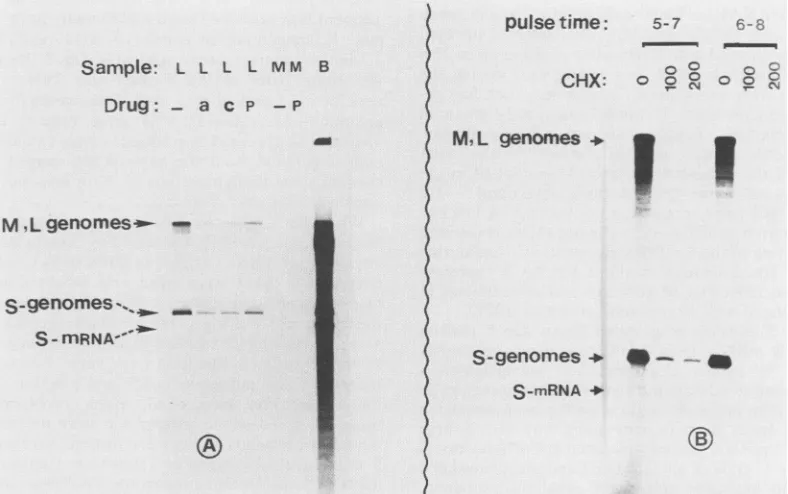
tion, the results are quite different. At 16 to 17 h, in cells
pretreated for 10 min with either anisomycin, cyclohexi-mide, orpactamycin, and in which [35S]methionine incorpo-rationwasreduced by >97% foreither 15or60min(results not shown), S genome synthesis continued at22to40% of the untreated controllevel (Fig. 3A). In these experiments, all of thepulse-labeled S mRNA pelleted through the CsCl
gradient, whereas all thegenomes werefound asassembled
NCs (resultsnotshown). Whenlabelingwascarriedout at20 to24h, 33to51% of S genomesynthesis continued (results notshown). However,when the experimentwascarriedout at5to7hp.i., genome synthesiswasnowstrongly reduced (3to6%of control [Fig. 3B]) but still clearly detectable. This experiment appears to measure the preexisting pool of unassembled N protein. When the [3H]uridine was addedat 1 h and 10min after drug addition rather than 10 min later and the cellswerelabeledat6to8 h(Fig. 3B),newgenome synthesis was undetectable. The ability of C6/36 cells to synthesize S genomes in the absence of on-going protein synthesis thus appears tobe duetotheir levelsof unassem-bled Nprotein, which increase with time. We note that these experiments donotestimateabsolute levels of N protein, but ratherthe levels required to support a given rate of genome synthesis, and that this rateis muchhigher in BHK than in
C6/36cells(24).
We also note that synthesis of the M and L genomes, which are respectively 4.6 and 7 times longer than S, is slightlymoresensitivetothetranslational block than that of S (Fig. 3). This suggests that the larger genome segments may replicate more slowly than S when the level of unas-sembled N has been reduced. It also offers a possible explanation for the curious finding that only the S segment
pulse
time:
5-7 6 E0 0 oC
C-CHX:
o o o o cIIcv
7
M,
L genomes *I
I
|
~~~S-genomes
-o4--S-mRNA 4m
FIG. 3. Asignificantpoolof unassembled N protein in C6/36 cells. (A) Infected C6/36 cultures were either not drug treated (-) or were pretreated for10 minwithaconcentration of100,ug/mlof cycloheximide (c) or anisomycin (a), or with 5 ,g ofpactamycin(p) per ml and thenlabeledwith 300,uC of[3H]uridine(26Ci/mmol)for 1 h. Thevisible NC band was isolated, and its RNA wasseparatedon adenaturing 4%polyacrylamide gel. Samples markedM arefrommock-infectedcultures;thosemarked LareLACinfected.Thesample markedBis total cytoplasmicRNAfrom infected BHK cellslabeled4to 5hp.i., run as markers. (B) Infected C6/36 cultures wereeithernottreated or treated with 100 or 200 ,ugof cycloheximide(CHX) per ml at 4 h and 50min. [3H]uridinewas then added at either5to 7 or 6 to 8 h, as indicated.
on November 10, 2019 by guest
http://jvi.asm.org/
[image:4.612.116.236.73.313.2] [image:4.612.104.498.421.668.2]hpi
MockB P
10-12 B P
22 -24 22 -26
B P B P
(J-ant
igenome
-mRNA
FIG. 4. Pulse-labeling of LAC RNAinC6/36 cells. LAC-infectedC6/36 cellswerelabeledwith 300,uCi/mlof[3H]uridine (26 Ci/mmol)at the times(hoursp.i. [hpi]) indicated.CsCl-pelleted(P) and band (B) RNAswere prepared and analyzed on adenaturing 2.8%polyacrylamide gel. After fluorography,the gel wasvisualizedby autoradiography. Thepositions of S antigenomes (andgenomes)andSmRNA areindicated. The bandsat the top presumably representthe M and L genomes andantigenomes.
canbe detected inlong-term persistently infectedmosquito
cellsortheparticles they shed (7, 24).
Synthesis and assembly of S mRNA are not coupled.
As-semblyof viral antigenomes and genomes into NCs occurs
either concurrently with their synthesis or shortly
after-wards, as these RNAs are found only in NCs. To determine ifthe same is true for the assembly of S mRNA, infected
cellswerepulse-labeledwith [3H]uridineateither10 or 22 h
p.i. (Fig. 4). If mRNA which was synthesized during the
labeling period wereconcurrently assembled, then like
ge-nomeandantigenome RNA, it shouldimmediatelyappearin
the CsClbandfraction.Ifassemblyoccurred after synthesis,
the mRNA should appear, at least partially, in the pellet
fraction. All of the pulse-labeled mRNA was found in the
pellet, whereas all of the genomes and antigenomes were
found in the CsCl band, regardless ofthe time oflabeling
(Fig. 4).Northern blotanalysis (resultsnotshown) indicated
thatencapsidationofthe S mRNAdidoccurasusualduring
this infection. Encapsidation of the S mRNA is therefore
clearly different from that ofgenomes and antigenomes in
that it is completed wellafter synthesis ofthe mRNA.
Mappingthe5' ends of encapsidatedRNAs.The 5' ends of
encapsidated S mRNA from BHK cells have previously
been mapped by primer extension. The encapsidated S mRNAwasfound to contain the same range of nontemplate primers (10 to 18 nt in length) as those on the unencapsidated S mRNA (20). In aneffort to understand why such a large fraction of the S mRNA was encapsidated in C6/36 but not in BHKcells, the 5' ends of encapsidated and unencapsidated S mRNA from mosquito cells were similarly examined,
along with RNA from BHK cells (Fig. 5). The results from
the BHK cellRNAweresimilar to those found previously.
TheCsCl-pelletedfraction (lane 8) contained predominantly
RNAswhose 5' ends were mapped to position -10 to -18,
witha minoramountof RNA whose ends were at position
-1to +4. TheCsCl bandRNA(lane 5),onthe otherhand,
contained onlyaminoramountofmRNAwithnontemplate
primers as well as antigenomes. However, two bands
ap-peared at the position corresponding to the 5' end of the
antigenome. To determine which extension product
termi-natedatposition +1, asequenceladderofthis endof theS
segmentwasproducedfromafull-lengthclone(4). Atits 5'
end,theantigenomesequenceis5'AGTAGTGTACTCCAC
3',and itscomplementis marked inFig. 5.By comparison,
the upper band of the doublet was found to represent
position +1 (marked bya dot). Thereasonfor the band at
position +2 is unclear. The same reverse transcriptase
yieldeda single band atposition +1 onextensionto the 5'
end of genome from the same RNA sample (results not shown), eventhough the last 27 nt of genomes and antige-nomes are virtuallyidentical.
When the C6/36 cell RNA was examined, the
pelleted
fraction(Fig. 5, lane7)wasfoundtocontainRNAwhose 5'
ends wereidenticaltothose in BHKcells (-10to -18nt),
except that there were even less RNAs whose 5' ends
mappedtoposition-1to+4.However,primer extensionon
theencapsidatedS RNAsproduced unexpectedresults(lane
4). Products which extended10 to18ntbeyondposition +1, as in the pelleted fraction, were very abundant here, but therewerealsonumerousbandsnearposition +1insteadof thedoublet. Fivemajorbands whichcorrespondedto
posi-tions -1 to +4 of the antigenome were present. To deter-mine if these bandsrepresentedfurtherheterogeneityatthe 5'endof theantigenomeoriftheyweretruncatedspeciesof mRNA, S mRNA andantigenomeRNAfrom theCsClband were isolated froma 2.8% polyacrylamide gel(cf. Fig. 1A)
and analyzed separately. Extension on the
antigenome-length RNA (lane 1)producedthesame twobands (+1 and
+2) as observed for antigenome RNA from BHK cells.
Extension onthe isolated mRNA (lane 2) revealedthat the
heterogeneityaroundposition+1resulted from the presence
on November 10, 2019 by guest
http://jvi.asm.org/
[image:5.612.149.476.72.318.2]LAC S mRNA ENCAPSIDATION 5171
A T C G
_ _
__
_ w __ _ _
--2
s..b....
_ _ _
_ _
_ _
_ _
_ _
_ _
_ _
_
_
-__
_
_ _-_ _
-.
o-..
,} _: .. *
t.X...-.
__
e_. e
-..
:
-J
\
=:r
T
C\
A
A T
G
A
G
E , Uz- '
E
0
XE
o
D z o(ocn cn
E
0 ccE
u CO_/'JE_DO
U.
1 2 3 4 5 6 78
FIG. 5. Mapping the 5' ends of encapsidated S RNAs. CsCl-pelleted and band RNAs from LAC infections of BHK(8 h p.i.) (lanes 5 and 8) and C6/36 cells (24 h p.i.) (lanes 4 and 7) were
examinedby primer extension (see Materials and Methods). The reaction products were analyzed on a 10o sequencing gel. CsCl band RNA from C6/36 cellswasalsoseparatedon adenaturing2.8% polyacrylamide gel. After ethidium bromidestaining,Santigenome (and genome) RNA and S mRNA were isolated separately and analyzed byprimerextension(lanes1 and2).On the left is shown the sequence produced by the dideoxynucleotide triphosphate
method fromafull-lengthSclone, usingthesameoligonucleotide.
Thesequencecomplementarytothe5'end of the Santigenomeis indicated, with the first virally encoded nucleotide (position +1) marked with a solid circle. The poly(C) tail used in the original cloning is visiblejust above. The positions of the 5' ends of the nontemplateprimersfrom S mRNA(-10to-18)and thepositionof the5'end of the Santigenome(+ 1)areindicated. Position+1of the Santigenome is also indicatedbyasolidcircle in lanes 1 and 5.
of truncated mRNAspecieswithin theencapsidatedmRNA population.
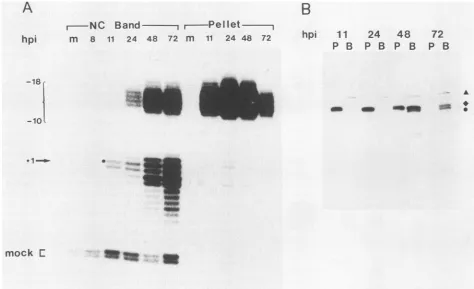
Truncated mRNAs. We nextinvestigated when the trun-cated mRNAs appeared during the infection, by primer extensiononRNAsfrom various timepoints (Fig. 6A). For theCsCl bandRNA,the doublet band from theantigenome (position +1 is marked by a solid circle) was the major species present at the earliest time when viral RNA was
visible(11 h).Averylow level of intact mRNAwasalsojust visible,butwe wereunabletodetect bandsatpositions -1,
+3, and +4,
i.e.,
evidence of the truncated mRNAs. Withtime,
the levels ofencapsidated mRNA,
both intact andtruncated,
increased. However, the level of the truncatedmRNAcontinued toincrease upto 72
h,
whilethat oftheintactmRNA remained constant after 48 h. For the
CsCl-pelleted RNA,
thelevel of S mRNA reachedamaximumat 24 handthenfellsharply by
72h.Asbefore,
the truncatedmRNAswereveryminor constituents of this fraction.
Thus,
not
only
arethe truncated mRNAs found almostexclusively
in
NCs,
but thetimecourseoftheir appearance suggests thatthey
are derived from theencapsidated
mRNAs whoseprimers
areintact.When thesesameRNA
samples
wereanalyzed by
North-ernblotting,
it could also be seen that the RNAspecies
presentintheCsCl bandhad
changed
with time(Fig. 6B).
At 11h, only
antigenomes (marked by
a solidtriangle)
werevisible,
andby
24h,
averysmallamountofmRNA(marked
by
asoliddiamond)
alsoappeared
in the CsCl band.How-ever, at 48 and 72
h,
besides a considerable amount ofmRNA,
athirdspecies (marked by
asolidcircle) just
belowthat of the intact mRNA
appeared.
Thisspecies,
whosemigration
is consistent with an RNA that is 15 to 20 nt shorter than intact SmRNA,
ispresumably
the truncatedmRNA observed
by
primer
extension(Fig. 6A).
A similarRNA
species
has also been seenrelatively
late in BHKinfections,
but its5' endwasmapped
toposition
+1 withoutheterogeneity,
and itwasreferredtoasthe 1-886 RNA(20).
Wealsonotethat the
encapsidation
ofthemajority
ofthe SmRNAin this infection occurred
slightly
later(between
24and 48
h)
thanthat shown inFig. 1, possibly
becausealowermultiplicity
ofinfectionwasused.The
primer
onviralmRNAcanalso becomeencapsidated.
The
finding
thatonly
viral RNAs are assembled into NCs suggests that aspecific
RNA sequence or structure isre-quired.
Ifonly
alimited sequence wereinvolved,
themostlikely assembly
site would be thehighly
conserved 11 nt(AGTAGTGTACT)
atthe 5' ends ofall three genomes andantigenomes (20).
Asthere isalsoclearly
anassembly
siteon the SmRNA,
thequestion
then arises whether the 5'nontemplate
primer
can also becomeencapsidated.
The interest here concerns whetherencapsidation
canbebidirec-tional,
or whether it occursonly
in the 5'-to-3'direction,
having
initiatedatthe conserved 5'ends ofthechains.If the
primer region
of themRNAwerealsoencapsidated,
then it would bemoreresistanttonuclease
digestion
thanthesamesequenceson
unencapsidated
mRNA.NCswerethere-fore isolated from
mosquito
cellsby
CsClbanding, dialyzed,
and treated with
increasing
concentrations of eithermicro-coccal nuclease
(MNase)
orRNase A inthepresence of400,ug of
pelleted
RNA from uninfected cells per ml. Similarresults were obtained with both
nucleases,
andonly
those with MNaseareshown inFig.
7. On theright
areshown theextension
products
from untreated BHK cellCsCl-pelleted
and band RNAs for reference. MNase treatment of the
mosquito
cellpelleted
RNA showed that >90% of thismRNAwas
digested
with 5 ,ug of MNase per ml. Athigher
concentrations,
all the mRNAwasdigested.
Incontrast, 25to35% ofthe
nontemplate
primers
onthecapsidated
mRNAwereinsensitiveto asmuchas25,ug ofMNaseper ml. There also
appeared
to be apopulation
ofencapsidated
mRNA whichwas sensitivetoMNaseandwas cleavedby
concen-trations of 5
,ug/ml
or more. Also present in the CsClbandfractionwerethetruncated mRNAs
(positions
-1to+4)
andantigenomes (+1
and2).
None of these bandsdecreased inintensity
throughout
the range ofMNase orRNase Acon-centrationsbutinstead increased
slightly.
This increasemayVOL.63, 1989
on November 10, 2019 by guest
http://jvi.asm.org/
B
-NC
Band
-
r
-
Pel-let
m 8 11 24 48 72 m tt 24 48 72
hpi
1
1
24
4
8
P B
P
B
P B
as o
ve
0
[image:7.612.74.548.79.368.2]to IN
FIG. 6. Timecourseofappearanceofthe truncated SmRNA.(A) CsCl-pelletedandbandRNAswereisolated from LAC-infectedC6/36 cells atthe times (inhours p.i. [hpi]) indicated (m refersto mock-infected cells) and analyzed by primer extension (see Materials and Methods).Thepositions ofthenontemplate primerontheSmRNA (-10to-18)andthe 5' end oftheS antigenome(+ 1)areindicated. (B)
TheCsCl-pelleted(P)and band(B) RNA fromthesameexperimentwereseparatedon adenaturing2.8%polyacrylamide gel usingeither 25 p.gofpelletRNAorthecell-equivalentamountofbandRNA. The RNAwasblottedontoHybondNandhybridizedwithanS minus-strand
riboprobe. The positions of the S antigenome (A), S mRNA(*), andtruncatedSmRNA(0)areindicated.Anunderexposure of thisblotis shownsothatthedifferenceinmobilitybetween the S mRNA andthe truncatedmRNAisvisible.
haveresulted fromsomeof the intact mRNAswhich specif-ically lost their primers.
Insummary, wefoundthat inasizeableproportion ofthe mRNAs which band atthedensity ofgenomeNCs inCsCl
(30to50%asjudged byMNaseand RNase Aresistance),the
nontemplate primerswereasresistanttonuclease attackas
the first55ntof the templatesequence. On these SmRNAs,
NCassembly musthaveoccurred bidirectionally. DISCUSSION
During LAC infection ofmosquito cells, an initial acute phase of virus replication evolves into a noncytopathic
persistent infection, asthe virusdown regulates its
replica-tion (24). One aspect of this control is the inhibition ofN protein synthesis, by the binding of N protein to its own
mRNA. The N protein-mRNA interaction was found to be highlyspecific forviralmRNAs, and assembly occurredon
performed mRNAs, rather than concurrently with their synthesis. Theencapsidated mRNA was comprised oftwo populations, those whose primers were intact and those whose 5'endswerelocatedatpositions -1 to +4. Examin-ing mRNAs with intactprimers, we were surprised to find
some in which these sequences were also encapsidated. Theseresultsarediscussedbelowintermsof the persistent infectionand their relevancetothe NC assemblyprocess.
Translational controlofNsynthesis. Several examples of translational controlby mRNA-binding proteinshave been
described. Ribosome scanningof ferritin mRNAs is attenu-atedby thespecific bindingofacytosolic proteintoa35-nt
sequence in the 5' untranslated region (13, 25). Stored mRNA in Xenopus oocytes are silent due to interactions with oocyte-specific mRNA binding proteins (9, 23). In procaryotes, the T4 gene 32 protein (12, 26)and severalof the ribosomal proteins of Escherichia coli (5) are part of
self-regulatory systemsinwhich theproteinbinds withhigh affinityto its primarytarget(single-strandedDNAforgene
32proteinand rRNA for ribosomalproteins)and with lower affinitytoitsownmRNA. For theribosomalprotein S4,the site in the 5' untranslatedregion ofthe mRNAmay have a
similarstructure tothebinding siteon therRNA(6), while the siteongene32 mRNA isanunstructuredregionnearthe startcodon (11).
The control of LAC N protein synthesis is somewhat similar to the latter twoexamples. N protein recognizesa
specific bindingsiteonits own mRNA,andoncethe initial interactions have taken place, further N binding would presumably become cooperative due to N-N interactions, andassemblywouldensue. Ribosomes, asexpected, could
not translate this complex in vitro. Because the N binding site ishighly specific,thiscontrol is limited eitherentirelyor
mostly to viral mRNAs. One otherexample ofa viral NC protein interacting with viral mRNA has been reported recently (27). The leader RNA of mouse hepatitis virus, whichacts as aprimerfor mRNA synthesis, is specifically
A
hpi
-18
-10
72
P
B
A.
mock E
on November 10, 2019 by guest
http://jvi.asm.org/
LAC S mRNA ENCAPSIDATION 5173
Pellet i-NC Band-- BHK
pg/ml
0 1 5 1025 0 1 5 10 25 B P) -18
Noit.
= _ w _ S~~~~~~~~~~,_s~- -+1
__
.*r
._ .. .. .. _ _FIG. 7. Micrococcal nuclease sensitivity of encapsidated S
RNA. NCs(NC band)andCsCl-pelletedRNA wereisolated from
LAC-infected C6/36cellsat24 hp.i. Before nucleasetreatment,0.4
mg of mock-infected C6/36pellet RNA per ml was added to the
NCs.When infectedpelleted RNAwasanalyzed, itwasalsopresent at 0.4 mg/ml. The RNA samples were treated with increasing
concentrationsof micrococcalnucleaseasindicated in thepresence
of 2 mMCaCl2.After the reactionwasstoppedwith 10 mMethylene
glycol-bis(P-aminoethyl
ether)-N,N,N',N',-tetraacetic acid(EGTA),the RNAswereextracted and analyzed by primer extension. On the rightareshown inprimer extension products from untreated CsCl-pelleted (P)andband(B)RNAs fromLAC-infectedBHK cells. The
positionsof the5'ends of S mRNA(-10to -18)and the 5' end of theSantigenome (+ 1) areindicated.
bound by the NC protein. It has not been determined, however,ifthis interaction affects translation.
mRNA encapsidation. The encapsidation of viral mRNA hasprovidedanunexpectedwayinwhich NCassemblycan
be examined. Previously, it was inferred that N protein
interactedspecificallywith viralRNAs,asonlygenomesand antigenomesarefoundinNCs. The basis for thisspecificity, however, was unclear. It couldnot be ruledout, for
exam-ple,that N simply recognized RNAswitha5' triphosphate,
there being no other triphosphorylated RNAs in the cyto-plasm with which to compete. We have shown here that underconditions in which >75% of the viral S mRNA was
encapsidated, little or no cellular mRNA was found to be
even partially assembled. In this case at least, N protein must recognizeaspecificviral sequenceorstructure.
ItseemslikelythattheNprotein assemblysiteonmRNA is the same as that ongenomes and antigenomes, which is thoughttobe the conservedsequencesatthe 5' ends of these chains. Ifso,thissequencedoesnothavetobe locatedatthe precise 5' end of the RNA to be recongized. However, recognition of the assembly site is much less efficient for mRNAthanforgenomesandantigenomes,since encapsida-tion ofmRNA occurs at least 4 h after its synthesis. This suggeststhat N proteinbinds with a much loweraffinityto mRNAthan toantigenomes. The difference is presumably due to thenontemplate primer on the mRNA. This primer separatesthe conserved 5' endsequencesfrom the
triphos-phate group, and this 5' end group is now also blocked with am7G.
Among the encapsidated S mRNA, defined by their gel
migration (900 nt as opposed to 983 nt), we find two
populations: those whose primersareintact and thosewhose primers and upto3template bases appear to have been lost. The timecourseof the appearance of the truncatedmRNAs and their relative absence among the unencapsidated mRNAssuggeststhattheyarisefromencapsidatedmRNAs
which are intact. Nuclease treatment of the encapsidated
RNA eliminatesonlysomeof the intact mRNAs andslightly increases the population whose 5' ends mapatposition -1to
+4. The simplest explanation for the truncated mRNAs is
thatthemRNA is firstassembledcompletely except forits 5'
primer. Insomeof thesemRNAs,theprimerwould then be
encapsidated by assembly in the 3'-to-5' direction, and so
become resistanttonuclease attack.Assemblyin this direc-tionwould be less efficient than in the 5'-to-3' direction. In
the others, nuclease would attack the unassembled primer
anddigestthe 5' endtopositions -1to +4. This scheme is
consistent with the assembly site being the conserved 5' endsof the genome andantigenomechains.
Establishingapersistent infectioninmosquito cells. mRNA
encapsidationis highly cell-type dependent, since it occurs
to very different extents in BHK and C6/36 cells, and the reasons for this difference appear important for the
self-limiting infection of mosquito cells. During replication of
nonsegmented minus-strand RNAviruses suchasvesicular
stomatitis virus and Sendai virus, the level of genome
replicationiscontrolledbythatof unassembled Nprotein,as
genome replication and assembly are coupled (for recent
reviews, see references 1 and 10). This also appears tobe
truefor LAC in BHK cells(18, 21)andatearlytimes(5to8
hp.i.)in mosquitocells (Fig. 3B). By 16 hp.i. inmosquito
cells, however, 22 to 40% of genome replication still
oc-curred in the absence of new protein synthesis, yet the genomes which were made here were all encapsidated.
Theseresultsindicate thatapool ofunassembledNprotein
exists in C6/36 cells and that this
pool
increases with time.When this pool increases, several dramatic changes take
placewithin theinfectedcells. These include therepression
of genome replication and N protein synthesis and the
encapsidation
ofmostof the S mRNA.It is
paradoxical
that the rate of genome replication is maximalearlyinthe infection when thepoolof unassembled Nprotein
is low andbeginsto decline at atime when thispool
hasincreased. Onepossible explanation
for this is that the S mRNAbecomes thepreferred
targetfor NCassembly
overgenomes and
antigenomes
with time.However,
newly
synthesized
mRNAremainsunencapsidated
upto4h after itssynthesis,
even at times when the level of mRNAencapsidation is high. If its affinity for N protein had
changed,
we would haveexpected
that thenewly
synthe-sized mRNA would have been more
quickly
encapsidated. We also know that S mRNAsynthesis
remainsrelatively
constantupto5
days p.i.,
andduring
thisperiod
alowlevelofN protein
synthesis
is observed(24).Given these
findings,
it is difficult to accept a model in which the encapsidation of S mRNA and asubsequent
depletion of unassembled N
protein
areresponsible
for theshutoff of genome
replication. Instead,
it would appear that genomereplication
is downregulated
as a result of theabsenceofafactor other than unassembled N
protein.
In thismodel, it is the lack ofnewgenome
synthesis
which allowsthe
pool
of unassembled Nprotein
togrow, sothat it nowinteracts with its lower
affinity
target,theviral mRNA. This VOL. 63,1989on November 10, 2019 by guest
http://jvi.asm.org/
[image:8.612.55.298.75.308.2]leadsto adecline in N synthesis, whichcanbe viewedas a subsequent level of control in the persistent infection. If this secondary targetfor encapsidation didnotexist, onewould expect that the unassembled N would eventually interact with host mRNAs to a greater extent or become insoluble, leadingto cytopathiceffects.
The arrestof genome replication in mosquito cellsoccurs in the presence of both functional N and Lproteins. Enough N protein is available to encapsidate a large fraction of mRNA, and L protein is active, as demonstrated by the continued synthesis of viral mRNA. From these observa-tions, another factor may be required for genome replica-tion, and it is the absence of this factorwhich limitsgenome replication in mosquito cells. Such a factor would presum-ably be required for theinitiation of genome replication (i.e., initiation with ATP, rather than a primer) and could interact with the L protein to modify its activity from a transcriptase to areplicase.
ACKNOWLEDGMENTS
We thankCatherineStouderfor experttechnical assistance and RichardCompans for helpful discussions.
Thiswork was supported in part by the Swiss NationalScience Fund. D.H. was supported by a fellowship from the Fogarty International Center.
LITERATURE CITED
1. Banerjee, A.K. 1987. Transcription andreplication of rhabdo-viruses. Microbiol. Rev. 51:66-87.
2. Bishop, D. H. L., M. E. Gay, and Y. Matsuoko. 1983. Nonviral heterogeneous sequences are present at the 5' ends of one species ofsnowshoehare bunyavirus S complementary RNA. NucleicAcids Res. 11:6409-6418.
3. Blumberg, B. M., C. Giorgi, and D. Kolakofsky. 1983. Nprotein of vesicular stomatitis virus selectively encapsidates leader RNAinvitro. Cell 32:559-567.
4. Cabradilia, C., B. Holloway, and J. ObUeski. 1983. The
se-quenceofthesmall genomeof LaCrosse virus. Virology 128: 463-468.
5. Dean, D., and M. Nomura. 1980. Feedback regulation of ribo-somalproteingeneexpression inEscherichia coli. Proc. Natl. Acad. Sci. USA77:3590-3594.
6. Deckman,I.C., and D. E. Draper.1987. S4-amRNAtranslation regulation complexII. Secondarystructures of theRNA regu-latory site in the presence and absence of S4. J. Mol. Biol. 196:323-332.
7. Elliott, R. M., and M. L. Wilkie. 1986. Persistent infection of Aedes albopictus cells by Bunyamwera virus. Virology 150: 21-32.
8. Igarashi, A. 1978. Isolation ofa Singh'sAedes aldopictus cell clone sensitive to dengue and Chikun-gunya virus. J. Gen. Virol.40:531-544.
9. Kick, D., P. Barrett, A. Cummings, and J. Somerville. 1987. Phosphorylation ofa60kDapolypeptidefromXenopusoocytes blocks messenger RNA translation. Nucleic Acids Res. 15: 4099-4109.
10. Kolakofsky, D., and L. Roux. 1987. The molecularbiology of paramyxoviruses, p. 277-297. In R. P. Bercoff (ed.), The molecularbasis of viral replication. PlenumPublishing Corp., New York.
11. Krisch, H. M., and B. Allet. 1982. Nucleotide sequences in-volved inbacteriophageT4gene32translationalself-regulation. Proc.Natl. Acad. Sci. USA 79:4937-4941.
12. Krisch, H.M.,A.Bolle,and R. H.Epstein.1974.Regulationof thesynthesis ofbacteriophageT4 gene32protein.J.Mol.Biol. 88:89-104.
13. Leibold, E. A., and H. N. Munro. 1988. Cytoplasmic protein binds in vitrotoahighly conservedsequencein the 5' untrans-latedregionof ferritinheavy-andlight-subunit mRNAs. Proc. Natl. Acad. Sci. USA 85:2171-2175.
14. Maniatis, T., E. F. Fritsch, and J.Sambrook. 1982. Molecular cloning:alaboratorymanual. ColdSpringHarborLaboratory, ColdSpring Harbor, N.Y.
15. Newton, S. E., N. J.Short, and L.Dalgarno. 1981. Bunyamwera virus replication in cultured Aedesalbopictus(mosquito) cells: establishment ofapersistent infection.J. Virol.38:1015-1024. 16. ObiJeski,J. F., and F. A.Murphy. 1977.Bunyaviridae: recent
biochemical developments. J. Gen. Virol.37:1-14.
17. Patterson, J. L., B. Holloway, and D. Kolakofsky. 1984. La Crosse virions contain a primer-stimulated RNA polymerase and a methylated cap-dependent endonuclease. J. Virol. 52: 215-222.
18. Patterson, J. L., and D. Kolakofsky. 1984. Characterization of La Crosse virus S genometranscripts J. Virol. 49:680-685. 19. Porterfield, J. S., J. Casals, M. P. Chumakov, S. Y.
Gaidamo-vich, C. Hannoun, I.Holmes, M. C. Horzinek, M. Mussgay, N. Oker-Blom, and P. K. Russell. 1975. Bunyaviruses and bunya-viridae. Intervirology6:13-14.
20. Raju, R., and D. Kolakofsky. 1987. Unusualtranscripts in La Crossevirus-infected cells and the site fornucleocapsid assem-bly. J. Virol. 61:667-672.
21. Raju, R., and D. Kolakofsky. 1987.Translationalrequirementof La Crosse virus S-mRNA synthesis: in vivo studies.J. Virol. 61:96-103.
22. Raju, R., andD.Kolakofsky. 1988. La Crosse virus infection of mammalian cellsinduces mRNAinstability.J.Virol.62:27-32. 23. Richter,J. D., and L. D. Smith. 1984. Reversible inhibitionof translationby Xenopusoocyte-specific proteins. Nature (Lon-don)309:378-380.
24. Rossier,C., R. Raju, and D.Kolakofsky. 1988. La Crosse virus gene expression in mammalian and mosquito cells. Virology 165:539-548.
25. Rouault, T.A., M. W.Hentze,S. W.Caughman,J. B.Harford, and R. D. Klausner. 1988.Bindingof acytosolic proteintothe iron-responsive element of human ferritin messenger RNA. Science 241:1207-1210.
26. Russel, M., L. Gold, H. Morrissett, and P. O'Farrel. 1976. Translational, autogenous regulation of gene 32 expression during bacteriophage T4 infection. J. Biol. Chem. 251:7263-7270.
27. Stohlman,S. A., R. S. Baric, G. N. Nelson, L. N. Soe, L. M. Welter, and R. J. Dean. 1988. Specific interaction between coronavirus leader RNA and nucleocapsid protein. J. Virol. 62:4288-4295.

![FIG. 4.gel.theThe Pulse-labeling of LAC RNA in C6/36 cells. LAC-infected C6/36 cells were labeled with 300 ,uCi/ml of [3H]uridine (26 Ci/mmol) at times (hours p.i](https://thumb-us.123doks.com/thumbv2/123dok_us/1323109.86073/5.612.149.476.72.318/thethe-pulse-labeling-infected-cells-labeled-uridine-hours.webp)