City, University of London Institutional Repository
Citation
: Zaidi, S. (2016). Detecting Rogue Nodes In Vehicular Ad-hoc Networks
(DETER). (Unpublished Doctoral thesis, City, University of London)This is the accepted version of the paper.
This version of the publication may differ from the final published
version.
Permanent repository link:
http://openaccess.city.ac.uk/17029/Link to published version
:
Copyright and reuse:
City Research Online aims to make research
outputs of City, University of London available to a wider audience.
Copyright and Moral Rights remain with the author(s) and/or copyright
holders. URLs from City Research Online may be freely distributed and
linked to.
City Research Online: http://openaccess.city.ac.uk/ [email protected]
DETECTING ROGUE NODES IN VEHICULAR
AD-HOC NETWORKS (DETER)
A Thesis Submitted to
City, University of London, School of Mathematics, Computer Science and Engineering.
In Fulfilment of the Requirements for the Degree Doctor of Philosophy in
Information Engineering
By
ii
In the name of Allah, the most beneficent, the most merciful.
I would like to thank Prof. Muttukrishnan Rajarajan for his able guidance, support and help that enabled me to complete the PhD. His help in both academic and non-academic matters has been highly beneficial. His insight and experience has enabled me to understand and pursue research and then get good quality publications. Working with him has made me a better researcher and professional.
I would also like to thank Dr. Veselin Rakocevic for his very useful comments and guidance to improve the research results.
iii
No portion of the work referred to in this thesis has been submitted in support of an
application for another degree or qualification of this or any other university or other
institute of learning. I hereby grant powers of discretion to the University Librarian to
allow this thesis to be copied in whole or in part without further reference to the author.
This permission covers only single copies made for study purposes, subject to normal
iv
Vehicular ad hoc Networks (VANETs) are self-organizing networks of vehicles
equipped with radios and processors. VANETs are very promising as they can make
driving safer by improving road awareness through sharing of information from
sensors. Vehicles communicate with each other wirelessly to exchange information and
this exchange of information is susceptible to attacks of different kinds. There are some
very important issues that need to be resolved before VANETs can be deployed on
large scale. Security and privacy issues are undoubtedly the most important factors that
need to be resolved.
Amongst various problems to be solved in VANETs is the issue of rogue nodes
and their impact on the network. This thesis discusses the problems associated with the
security and privacy of vehicular networks in the presence of rogue nodes. The rogue
nodes can share / inject false data in the network which can cause serious harm. The
techniques proposed make VANETs secure and prevent them from the harmful impact
of rogue nodes. The proposed work makes the network safer by making it fault tolerant
and resilient in the presence of rogue nodes that can be detected and reported. As
VANETs are highly dynamic and fast moving so, a data centric scheme is proposed
that can determine if a node is rogue or not just by analysing its data. The work then
enhances the developed mechanism by applying hypothesis testing and other statistical
techniques to detect intrusions in the network by rogue nodes. The technique is
simulated using OMNET++, SUMO and VACAMobil and the results obtained have
v
networks. This framework authenticates the user and the vehicle separately from two
authorities and allows him to communicate securely with the infrastructure using IBE
(Identity Based Encryption). The proposed technique also preserves the privacy of the
user. The proposed scheme allows traceability and revocation so that users can be held
accountable and penalised. The results have been compared to previous works of
similar nature. The thesis also discusses the Sybil attack and how to detect them using
vi
1. Kamran Zaidi, Yogachandran Rahulamathavan and Muttukrishnan Rajarajan.
"DIVA-Digital Identity in VANETs: A multi-authority framework for VANETs," in Networks (ICON), 2013 19th IEEE International Conference on, pp. 1-6. IEEE, 2013.
2. Kamran Zaidi, Milos Milojevic, Veselin Rakocevic and Muttukrishnan
Rajarajan. “Data Centric Rogue Node Detection in VANETs,” in IEEE 13th International Conference on Trust, Security and Privacy in Computing and Communications (TrustCom), TrustCom 2014, Beijing, China.
3. Kamran Zaidi, Milos Milojevic, Veselin Rakocevic, Arumugum Nallanathan and Muttukrishnan Rajarajan. "Host Based Intrusion Detection for VANETs: A Statistical Approach to Rogue Node Detection," in IEEE Transactions on Vehicular Technology. 2015
4. Kamran Zaidi and Muttukrishnan Rajarajan, "Vehicular Internet: Security & Privacy Challenges and Opportunities," in Future Internet, pp. 257-275, vol. 7, 2015.
Submitted:
vii
List of FIGURES ... xii
List of TABLES ... xiv
Chapter 1 : Introduction ... 1
1.1 Background ... 1
1.2 Problem Statement ... 3
1.3 Research Objectives ... 4
1.4 Research Method ... 6
1.5 Contributions ... 6
1.6 Assumptions and Scope ... 9
1.7 Thesis Outline ... 12
Chapter 2 : Background ...14
2.1 Wireless Ad hoc Networks ... 14
2.2 Mobile Ad hoc Networks (MANETs) ... 15
2.3 Vehicular Ad hoc Networks (VANETs) ... 15
2.3.1 VANET Applications: ... 16
2.3.2 Differences between VANETs and MANETs ... 17
2.3.3 VANET Architecture ... 17
2.4 Communication Technologies for VANETs ... 20
2.4.1 Dedicated Short Range Communication (DSRC) ... 20
2.5 VANET Characteristics ... 24
2.5.1 High mobility ... 24
2.5.2 Communication Range ... 25
2.5.3 Storage and Computing Power ... 25
Chapter 3 : Security and Privacy ...26
3.1 Cryptographic Techniques ... 26
3.1.1 Symmetric Key Cryptography ... 26
3.1.2 Asymmetric Key Cryptography ... 27
3.1.3 Elliptic Curve Cryptography ... 28
3.1.4 Identity Based Encryption ... 29
viii
... 35
3.3.3 Non-Repudiation: ... 35
3.4 Attacks in VANETs ... 36
3.4.1 Sybil Attack ... 36
3.4.2 False Information Injection Attack ... 36
3.4.3 Wormhole Attack ... 37
3.4.4 Denial of Service (DoS) Attack ... 37
3.5 Security and Privacy Preserving Schemes in VANETs... 38
3.5.1 Pseudonym coupled with PKI Based Schemes ... 39
3.5.2 Trust Based Schemes ... 41
3.5.3 Group Signatures ... 43
3.5.4 Identity Based Encryption Using Pseudonyms ... 44
3.5.5 k-Anonymity Schemes ... 45
3.6 Performance Comparison ... 46
3.6.1 Scalability ... 47
3.6.2 Computing cost ... 47
3.6.3 Privacy ... 48
3.6.4 Latency ... 48
3.6.5 Cost of deployment ... 49
3.7 Intrusion Detection System (IDS) ... 52
3.7.1 Types of IDS based on Detection Mechanism ... 53
3.7.2 Types of IDS based on Position of Deployment ... 54
3.7.3 Response Types ... 56
3.7.4 Evasion Methods for IDS ... 57
Chapter 4 : Data Centric Rogue Node Detection ...58
4.1 Introduction... 58
4.2 Greenshields’s Traffic Model ... 60
4.2.1 Explanation of the Greenshield’s Fundamental Diagrams: ... 63
4.3 Scheme Overview ... 64
ix
... 73
4.5.1 Actual Accident Scenario - No Rogue Nodes ... 73
Comparison of Simulations: ... 80
4.5.2 No Accident - Rogue Node Scenario ... 80
4.5.3 Normal Traffic - No Accident - No Rogue Nodes... 83
4.6 Performance Analysis ... 85
4.6.1 Fault Tolerance ... 85
4.6.2 Self Detection and Correction ... 86
4.6.3 Congestion Avoidance ... 87
4.6.4 Resilience to Sybil Attacks ... 88
4.6.5 Scalability ... 88
4.6.6 Comparison ... 89
4.7 Related Work ... 90
4.8 Summary & Research Methodology ... 91
Chapter 5 : A Host Based Intrusion Detection System (IDS) for VANETs ...93
5.1 Introduction... 93
5.2 IDS Overview ... 95
5.2.1 Cooperative Data Collection ... 96
5.2.2 Normality Test... 97
5.2.3 Hypothesis Testing for Data Correctness ... 101
5.3 Simulation under Different Conditions ... 105
5.3.1 Simulation Setup ... 105
5.3.2 Simulation Parameters and Assumptions ... 106
5.3.3 No Accident - Rogue Nodes Scenario ... 107
5.3.4 Accident Scenario - Rogue Nodes Scenario ... 109
5.4 Performance Evaluation ... 110
5.4.1 Evaluation Metrics ... 110
5.4.2 Comparison with Existing Schemes ... 112
5.4.3 False Information Attack Detection ... 112
x
... 116
5.4.8 Effective Information Dissemination ... 116
5.4.9 Limitations of proposed IDS ... 117
5.5 Summary & Research Methodology ... 117
Chapter 6 : Identity Management and Sybil Attack Detection in VANETs ... 119
6.1 Introduction... 119
6.2 Security and Privacy Goals in VANETs ... 120
6.2.1 Reliability ... 120
6.2.2 Location Privacy ... 121
6.2.3 Non-Repudiation ... 121
6.3 Identity in VANETs ... 122
6.3.1 Digital Identity in VANETs ... 123
6.3.2 Assumptions ... 125
6.3.3 Registration and Key Management ... 126
6.3.4 Scheme Details ... 127
6.3.5 Authentication & Non-Repudiation ... 130
6.3.6 Location Privacy ... 131
6.3.7 Traceability and Revocation ... 131
6.4 Performance Analysis of DIVA ... 132
6.4.1 RSU Latency ... 132
6.4.2 OBU Computation & Storage Cost ... 133
6.4.3 Comparison in terms of desirable properties ... 134
6.5 Security Analysis of DIVA ... 134
6.5.1 Privacy Preservation ... 134
6.5.2 Unforgeability ... 135
6.5.3 De-Anonymizing and Revocation ... 135
6.6 Impact of DIVA in VANETs ... 136
6.7 Sybil Attack in VANETs... 136
6.7.1 Response to Sybil Attack ... 138
xi
6.8.1 Game Model ... 143
6.8.2 Finding Nash Equilibrium ... 146
6.8.3 Attack Model ... 147
6.8.4 Sybil Attack Detection ... 148
6.8.5 Strategic Physical Separation ... 149
6.8.6 Revocation and Reporting ... 150
6.8.7 Detecting Sybil Nodes with only two physical nodes ... 151
6.8.8 Detecting Malicious and Sybil Nodes when number of honest nodes are greater than Malicious Nodes ... 152
6.9 Performance Evaluation of Proposed Game Theoretic Model ... 153
6.9.1 Comparison of Proposed Game Theoretic Model with previous schemes 154 6.9.2 Effectiveness of Game Theory ... 155
6.10 Summary & Research Methodology ... 155
Chapter 7 : Conclusion and Future Work ... 158
7.1 Contributions ... 159
7.1.1 Establishing Security and Privacy Requirements for VANETs ... 159
7.1.2 Implementing a Data Traffic model for VANETs ... 159
7.1.3 Developing a Host Based IDS for VANETs ... 160
7.1.4 Proposing a new ID Management Technique in VANETs... 160
7.1.5 Developing a Game Theoretic model for VANETs to detect Sybil Attacks 161 7.2 Future Work ... 161
7.2.1 Reporting / Revoking Rogue Nodes ... 162
7.2.2 Securing Autonomous Vehicles against Remote Hacking ... 162
7.2.3 Using RSUs to improve the performance of Data Centric Schemes ... 162 7.2.4 Extending the developed Intrusion Detection System to detect other attacks 163
xii
Figure 2-1: VANET Architecture ... 19
Figure 2-2: Latency Comparison of Communication Technologies [15] ... 21
Figure 2-3: Frequency Allocation in IEEE 802.11p [16] ... 22
Figure 2-4: OSI vs WAVE Protocol Stack [17] ... 23
Figure 3-1: Identity Based Encryption (IBE) Working ... 31
Figure 3-2: Security and Privacy Requirements in VANETs ... 34
Figure 3-3: Classification of trust establishment approaches ... 43
Figure 4-1: Greenshield’s Fundamental Diagrams: (a) Flow vs Density, (b) Speed vs Density, (c) Speed vs Flow ... 62
Figure 4-2: Estimating density of vehicles in VANETs ... 65
Figure 4-3: Varying value of flow in an Accident scenario ... 66
Figure 4-4: Overview of Cooperative Detection and Correction scheme (C-DAC) ... 68
Figure 4-5: Decision for Data Correctness ... 70
Figure 4-6: Decreasing speed in real accident scenario ... 74
Figure 4-7: Increasing density in real accident scenario ... 75
Figure 4-8: Decreasing flow in real accident scenario ... 76
Figure 4-9: Accident Scenario: Inter-Arrival time = 1 sec: All Vehicles starting at approx t = 80sec ... 77
Figure 4-10: Accident Scenario: Inter-Arrival time = 2 sec: All vehicles starting at approx t = 80sec ... 78
Figure 4-11: Accident Scenario: Inter-Arrival time = 3 sec: All vehicles starting at approx t = 80sec ... 79
Figure 4-12: Constant density in case of No Accident ... 81
Figure 4-13: Speed in No Accident Scenario ... 82
Figure 4-14: 2 Rogue Nodes reporting low value of flow ... 83
Figure 4-15: Distribution of FlowAVG, FlowOWN & FlowRCVD in case of Normal Traffic / No-Accident and all Honest Nodes ... 84
Figure 4-16: Average Flow in case of No-Accident with rogue nodes ... 86
Figure 4-17: Percentage of vehicles within the distance 3000m that received the emergency information successfully ... 89
Figure 5-1: Proposed Intrusion Detection System for VANETs ... 96
Figure 5-2: Normal Distribution of FlowAVG for Node 90 from t=203s to t=325s ... 98
Figure 5-3: Flow Chart of proposed IDS ... 101
Figure 5-4: Distribution of to for FlowAVG ... 103
Figure 5-5: No Accident Scenario - 20% Rogue Nodes start transmitting false values at t=160sec Without IDS ... 108
Figure 5-6: No Accident Scenario - 20% Rogue Nodes start transmitting false values at t=160sec With IDS ... 108
xiii
Figure 5-10: False Positive Rate Comparison in case of False ... 114
Figure 5-11: Overhead Comparison in case of False Information... 115
Figure 6-1: Security and Privacy Goals in VANETs ... 120
Figure 6-2: Proposed VANET Architecture ... 123
Figure 6-3: Digital ID (DID) in VANETs ... 124
Figure 6-4: OBU Capabilities ... 125
Figure 6-5: Sequence Diagram for Proposed Scheme ... 127
Figure 6-6: Comparison of Protocol Latency at RSU ... 133
Figure 6-7: Extensive Form Game Representation and Game Solution using Backward Induction ... 147
Figure 6-8: Sybil Attack Detection in VANETs ... 149
Figure 6-9: Sybil Attack in VANETs ... 150
xiv
Table 2.1: DSRC Spectrum Allocation Worldwide 21 Table 3.1: Comparison Based on Performance Metrics 50 Table 3.2: Qualitative Comparison of Security and Privacy Schemes
in VANETs 51
Table 4.1: Simulation Parameters 72
Table 5.1: Decisions in Hypothesis Testing 104
Table 5.2: Simulation Parameters 106
Table 6.1: Comparison of Proposed Scheme with others in terms of
desired properties 134
Table 6.2: Game Pay Off / Utility Matrix for Stage - 1 144 Table 6.3: Example Utility Matrix for Stage - 1: 144 Table 6.4: Game Pay Off / Utility Matrix for Stage - 2 145 Table 6.5: Example Utility Matrix for Stage - 2 145
1
Chapter 1
: Introduction
1.1
Background
Vehicular Ad-hoc Network (VANET) is an interconnection of vehicles with
on-board Units (OBUs) that communicate with one another to form a wireless network.
VANETs are considered imminent due to their huge potential in terms of road safety
and other convenience applications. Vehicular networks are considered imminent due
to the advancement and ease in wireless connectivity. It is just a matter of time before
they become a reality. Vehicular networks are considered important due to their
tremendous potential both in terms of safety and commercial applications.
Over the last three decades there have been a lot of innovation in vehicles in
terms of fuel efficiency, navigation, comfort and making the general feel of driving
more pleasant and enjoyable but there hasn’t been much change in terms of road safety.
Road travel is still considered to be quite hazardous as the mistake of a single person
can have catastrophic results especially at high speeds. Although, there has been a lot
of automation in vehicles by incorporating sensors, cameras and radars but the full
2
and allowed to communicate with each other. This will lead to the deployment of
VANETs.
The developments in the automotive industry in the last few decades have been
impressive. Cars today are much more fuel-efficient than ever before. However, the
advancements in automotive technology did not have the same impact on the safety of
the roads. Vehicles today are still as vulnerable to accidents due to fog, ice, and other
hazards on the road, but above all, they are vulnerable to human error. However, this is
all set to change: the automotive industry has been working actively for years to put
different sensors in cars and connect them to an on-board computer. With advancement
in telecommunications, it is now possible to connect vehicles to each other through
wireless technologies to enable them to communicate and cooperate. Now, not only is
the automotive industry pursuing autonomous vehicles—they are being encouraged by
the governments as well. The UK government announced in March 2015 that a £100 m
funding for research into driver-less cars will bring in companies from not only the
automotive industry but also from Information Technology (IT), telecommunications,
and infrastructure [1]. In the US, car manufacturers like General Motors (GM) are
already selling 4G Long Term Evolution (LTE)-connected cars in their 2015 fleet and
they predict having fully connected cars by the end of this decade [2]. Moreover, IEEE
believes that the need to get a driver’s license might be eliminated by 2040 as
autonomous cars would be ubiquitous [3].
Car manufacturers such as GM and Ford have opened up application
development for their platforms by making their Application Program Interface (API)
available to developers [4], [5]. They plan to follow the conventional business model,
3
them available for download. This LTE connectivity alone will serve to improve the
in-vehicle infotainment services by providing access to high-speed internet, streaming
movies, navigation, music, and live television, etc. The other aspect is commercial, i.e.,
offering location-based services and advertisements to the vehicle passengers. The LTE
connectivity will not only bring internet to the vehicle but also make the vehicle a part
of the internet, easing the way for the Vehicular Ad hoc NETworks (VANETs).
The true potential of the connected vehicle will be realized only when vehicles
are interconnected to each other. This network, formed by the interconnection of
vehicles, is referred to as VANET. This paradigm shift in vehicular technology will
usher in a new era of innovation and will open a huge range of application areas that
can help in improving road safety and reducing accidents on roads.
1.2 Problem Statement
The biggest challenge in the deployment of VANETs is that of Security and
Privacy. The vehicles will share some messages with each other to make them aware of
the traffic and road conditions. These messages are referred to as Cooperative
Awareness Messages (CAMs) and will be shared at regular intervals. These messages
consist of parameters like the position, speed etc. of the transmitting vehicle which are
broadcasted to all vehicles in range. Therefore, security is crucial as drivers might make
life critical decisions based on the information provided by other vehicles. Similarly,
privacy of users is important as users don’t want to be tracked or identified all the time
4
responsibly. The privacy and accountability of the user might look contradictory
requirements but they are important and necessary in vehicular networks.
The OBUs possess reasonable computing power and memory but as the
vehicles are travelling at high speeds, it is necessary that vehicles are able to
authenticate the messages quickly. At the same time the messages have to be accurate
(recent, relevant) and reliable (true) so that they can be acted upon by the recipient.
This accuracy and reliability is provided by securing the communication in VANETs.
Security can be achieved by using cryptographic techniques once the user has been
authenticated. However, these cryptographic techniques should be suitable for the fast
moving and quickly changing nature of VANETs.
Privacy is the ability to keep the identity of the user secret while allowing them
to communicate and interact with other users while ensuring that the security of the
communications is not violated.
1.3 Research Objectives
VANETs are dynamic and very fast moving and therefore, have special
requirements. The most important requirement is for the vehicles to exchange credible,
useful and accurate information about the traffic. However, as vehicles that come in
contact with each other are mostly meeting for the first time, therefore, there is a need
for some mechanisms to establish the identity of the vehicle and the credibility of the
information being shared. VANETs can expand rapidly and may consist of thousands
of nodes all communicating with one another. This raises the problem of the
5
used to take life saving decisions, it is imperative that the accuracy of the information is
quickly ascertained and then auctioned upon. One answer to these issues is
Cryptography albeit with some caveats. This means that only those vehicles are
allowed to become part of VANETs that have been authenticated and then get the
necessary keys. The ephemeral and fast changing nature of VANETs requires that the
cryptographic techniques used should be scalable and efficient as otherwise there can
be a bottleneck of messages. Also, the techniques used should preserve the privacy of
the users.
However, a vehicle that has been authenticated and becomes part of the
VANET can then inject false messages in the network and is very difficult to detect. It
is therefore, essential that the information exchange in vehicular networks is secured
against false data injection. Even if false data is injected in the network, the network
should be resilient to such attacks and should have the ability to detect and correct the
information to some extent. Therefore, the research question is:
How to detect rogue (malicious) nodes in VANETs?
The sub questions formulated are:
1. How to keep illegitimate / rogue nodes out of VANETs?
2. How to create and manage Identities in VANETs?
3. How to make VANETs resilient to false data injection attacks from nodes that
turn rogue?
4. How to detect rogue nodes that are part of VANETs?
5. How to create a VANET model that can be used to determine normal or
6
1.4 Research Method
In order to solve the above mentioned problem first, the literature review is carried out
to identify the security and privacy requirements of vehicular networks. This set of
requirements then help us determine as to how these can be achieved. Also, we identify
the different types of attacks that can be launched in VANETs and how these attacks
can be detected and prevented. We then develop a VANET model that can be used to
predict their behaviour in normal or special conditions. This enables us to automate the
detection of anomalies in VANETs using various techniques. The model is then
validated with the help of simulations under different conditions. Different techniques
are tested and the best method is selected to detect malicious behaviour in VANETs.
1.5 Contributions
Securing VANETs is a difficult task as the nodes are fast moving, connections
are short lived and the topology of the network changes very quickly. There is a
requirement for nodes to establish connections and trust each other for information
exchange. This thesis also proposes and presents some solutions and techniques to help
solve these issues. The research presented in this thesis has been published in [6], [7],
[8] and [9]. This thesis makes the following original contributions:
i. Application of a traffic model to VANETs to help detect rogue nodes and
7
This thesis presents and implements a VANET model through which vehicles share
their own calculated parameters about the traffic which help others to determine the
highway conditions. The vehicles which are close together will measure similar
parameters and share them to develop a consensus about the road conditions. Each
vehicle can compare the values being received from other vehicles and averages them
to form a generalized picture of the road conditions ahead. Moreover, each vehicle will
compare the values received with the VANET model and only accept them if they
conform to it. In this way, inconsistent values can be detected and reported. If the
parameters don’t conform to the VANET model and inconsistent values are being
received from only one or few vehicles then they are flagged as rogue.
This thesis proposes that vehicles do not accept and re-broadcast an emergency
message as soon as it is received but only do so if the parameters validate the
emergency message. This means that the system works better as only vehicles that are
in (or very close to) the incident region will send out the emergency message and other
vehicles that are far away will only prompt other vehicles to slow down. Thus, the
system will allow the information to be carried at large distances and at the same time a
gradual reduction in speed is allowed.
ii. Propose an Intrusion Detection System (IDS) for Vehicular Ad hoc Networks
to detect and identify rogue nodes.
This thesis proposes a host based IDS for VANETs that resides on each node
(vehicle) that can detect intrusions in the network. The IDS uses statistical techniques
to detect intrusions in the network and then identify the rogue nodes. The IDS is tested
8
proposed IDS works very well even in the presence of a high number (up to 40%) of
rogue or malicious nodes.
iii. Evaluating our proposed false data rejection and rogue node detection
technique using OMNET++, SUMO and VACaMobil:
We evaluate our proposed technique that detects and rejects false data and detects
rogue node sending the data using OMNET++, SUMO and VACAMOBIL. OMNET++
is a modular, component based C++ library and framework for the simulation of
networks (wired and wireless). OMNET++ offers an eclipse based IDE and many
useful data analysis tools. Simulation of Urban Mobility (SUMO) is a tool used to
generate vehicular traffic and VACaMobil is a VANET Car Mobility manager for
OMNET++ that uses SUMO to offer a comprehensive range of VANET simulations.
iv. Propose a new method to create and use the Digital Identity in VANETs:
In order to keep the rogue nodes out of VANETs in the first place, it is necessary to
devise a mechanism that properly authenticates the user before allowing him to become
a part of the system. The thesis proposes a new way to form digital identities in
VANETs so that the actual user of a vehicle can be held accountable for their actions
and not the vehicle. As the vehicle usually has a one to many relationships with drivers,
therefore, if the vehicle is identified and revoked then the driver can later on deny using
the vehicle. Therefore, it is the driver who needs to be identified and penalised and not
9
changed frequently but still be authenticated by the Trusted Authorities or Road Side
Units. This will ensure that once the driver has been identified, he can be penalized for
their actions.
Also, we propose a new multi-authority framework which splits the power to disclose
the identity of a user to two authorities that have to work together to de-anonymize a
user. This is done to provide an additional layer of security for the user as the existing
works give this ability to either the RSU or a single TA which if compromised can
completely reveal a user’s identity.
v. Propose a Game Theoretic model to detect Sybil nodes in VANETs:
Sybil attack is a serious threat to the working of VANETs. Sybil attack is directly
related to the unfair use of the identity or identities in VANETs. Sybil attacks are
difficult to detect in any network but increasingly so in the case of VANETs due to
their inherent nature. In this thesis, a game theoretic framework for Sybil attack
detection is proposed that models such a situation in VANETs as a game and is able to
detect the malicious node and the Sybil nodes in most cases.
1.6 Assumptions and Scope
There are certain assumptions that have been made while formulating the research
questions, proposing solutions for problems and while setting up and running
simulations. These assumptions are discussed here:
10
This research does not depend on and does not assume Tamper Proof Devices (TPD) or
Trusted Platform Module (TPM) installed in vehicles. The primary reason for this is to
keep the research and solutions as wide as possible and also because dependence on
such hardware raises the cost of the vehicles and also limits the solutions. Moreover, it
raises some other questions as well such as; what if a vehicle has not one but multiple
devices connected to radios (thereby claiming multiple identities).
ii. Interference in Communication:
Interference in Vehicle to Vehicle (V2V) communication and Vehicle to Infrastructure
(V2I) has been ignored in this research. The reason for this is that this research work
focuses on the security and privacy aspects of the communication and doesn’t directly
deal with the channel characteristics.
iii. Bootstrapping Problem:
The proposed Intrusion Detection System (IDS) has the ability to get up and running
quickly i.e. it has the ability to load up and start taking decisions quickly. The IDS can
start taking correct decisions after just a few (seven) communication exchanges with
other vehicles. This is acceptable as this can be done in as little as 700 ms (0.7 sec).
iv. Rogue Nodes / Users:
The rogue node / user in this thesis is assumed to be either a malicious user who has the
intention to disturb the network by sending out false information or a node with faulty
sensors. The malicious user sends false information to other nodes in order to paint a
11
congestion up ahead so as to cause other vehicles behind it to change route or to claim a
false identity such as that of an emergency vehicle in order to free up the road for
themselves. Similarly, a node with faulty sensors can do similar damage without
knowing and therefore, they are also considered rogue nodes in this thesis. The
Greenshield’s traffic model applied to VANETs and the averaging of the data received
from all nodes in the vicinity enables the proposed IDS to be able to detect anomalies.
Moreover, we are proposing that vehicles do not broadcast a received emergency
message as is proposed in other works as this raises many problems for the bandwidth
limited channel.
Consider as an example a vehicle that tries to send a false ‘Emergency Braking’
message to all vehicles behind it in order to cause chaos. Now, this rogue vehicle has to
be a certain distance away from the targeted vehicles in order for them to fall for it as
otherwise the vehicles would experience or not experience the braking event
themselves as well. When the rogue node sends the false emergency message, then
there can be other vehicles in its vicinity that should have also experienced the
emergency event and would send similar emergency message. If such an emergency
message is only coming from one vehicle then it will be suspicious. Also, if the rogue
vehicle is sending such a false message from quite further up ahead the road then other
vehicles in between should have experienced the effects of a real braking event and
their parameter values should have gone down as well. If this is not the case then again
the emergence message is false.
12
This thesis does not deal with the security of vehicle control systems i.e. doesn’t
address the security issues associated with the hacking of autonomous vehicles and is
out of scope of this thesis. This thesis deals with security and privacy of the users and
their communications only.
1.7 Thesis Outline
The thesis is structured as follows:
Chapter 2 presents the introduction to VANETs, its applications, the possibilities and
its architecture. The standards and proposed protocols are discussed in detail.
Chapter 3 discusses the security and privacy issues in wireless ad hoc networks in
general and VANETs in particular. It discusses different types of attacks and possible
precautions. It also discusses the roles and responsibilities of different entities and the
security and privacy requirements from different perspectives. The current and past
work done in security and privacy for VANETs is also reviewed.
Chapter 4 presents the proposed technique to make VANETs resilient against false
data injection with the help of a data centric scheme. The chapter provides details on
the applied VANET model and the data aggregation and dissemination techniques
proposed. The details on the simulation parameters and the result obtained are
presented and discussed in detail.
Chapter 5 presents the proposed Intrusion Detection System (IDS) for VANETs. The
IDS uses statistical techniques to detect rogue node in the network. The IDS is tested
by simulations under different conditions and parameters and compared to other recent
13
Chapter 6 presents the proposed framework for creating and managing digital
identities in VANETs. It uses the Identity Based Encryption technique using the
proposed digital identity to encrypt the Vehicle to Infrastructure communication (V2I).
Also, Sybil attacks in VANETs which are linked to the identity management in
VANETs are discussed and a game theoretic framework for their detection is presented.
Chapter 7 summarizes the work done in this thesis, gives the conclusion and
14
Chapter 2
: Background
2.1 Wireless Ad hoc Networks
Wireless ad hoc networks have been the subject of research for the last two
decades now. They are decentralized networks that are connected wirelessly. They have
been immensely popular both in the industry and military applications because of their
ease of deployment, robustness, scalability, low cost and data acquisition capabilities.
They do not require any infrastructure like routers in wired networks. Instead of
routers, the network functions by allowing nodes to forward data to / for other nodes.
Therefore, the nodes form a route dynamically based on the availability of the nodes.
This means that efficient and dynamic routing protocols are very important for wireless
ad hoc networks. In such a case, flooding can also be used to forward the data but this
obviously results in congestion in the network. Ad hoc networks often refer to the IEEE
802.11 mode of wireless networks. Wireless ad hoc networks are limited in their
15
2.2 Mobile Ad hoc Networks (MANETs)
Mobile Ad hoc network (MANET) is a type of wireless ad hoc network in
which the nodes are allowed to move freely and independently in any direction. As all
the nodes are moving, therefore, the topology of the network changes quickly and
frequently. Similar to wireless ad hoc networks, MANETs are self-configuring and
form dynamic links to other nodes to convey information in the network. The nodes can
communicate with each other via multiple hops. The nodes are usually slow moving
and have a range of a few meters.
2.3 Vehicular Ad hoc Networks (VANETs)
Vehicular Ad hoc networks (VANETs) are a type of MANETs in which vehicles
form a network to communicate with each other via radios and sometimes with the help
of road side infrastructure. VANETs have the potential to make our roads safer by
allowing vehicles to communicate with other vehicles on the road and therefore, allow
them to share any safety related information amongst themselves. Road safety is just
one aspect of VANETs; there are numerous other applications which have been
proposed by researchers and some have already started taking shape.
Vehicular Ad hoc Networks (VANETs) have received a lot of attention from
the research community in the last few years primarily because they are being seen as
not only necessary but imminent. The advancements in sensors and wireless technology
in the last decade have been remarkable but they have not done much to improve the
16
with sensors and allowing them to communicate with each other can help in many
hazardous situations like fog, slippery roads and accidents ahead on highways.
It is only a matter of time before vehicular networks become a reality. Recently,
AT&T and GM have signed a deal to work on connected together. The vehicles will
have 4G / LTE connectivity providing super-fast telematics services. AT&T believes it
can be worth one billion dollars in revenue eventually [10]. This will provide the
enabling technology for the interconnection of vehicles to form VANETs. With this
imminent arrival of VANETs, it becomes necessary to ensure that the implementation
of VANET is practical and provides some immediate benefit to all the stakeholders
namely the users, service providers (i.e. insurance companies etc.) and the authorities.
2.3.1
VANET Applications:
Many different convenience and commercial applications have been proposed for
VANETs by researchers in [11], [12], [13] and safety applications proposed by the
Vehicle Safety Communications Consortium (VSC) of the Department of
Transportation in [14]. Some of the applications that have been recommended and
considered for VANETs are:
i. Safety Applications: Notifications for crashes, hazards on the roads
(slippery or wet road conditions), traffic violation warning, curve speed
warning, emergency electronics brake light, pre-crash sensing, co-operative
forward collision warning etc.
ii. Convenience Applications: Navigation, Personal routing etc., Congestion
17
iii. Commercial Applications: includes entertainment and information
exchange applications such as location based services.
2.3.2
Differences between VANETs and MANETs
VANETs can be classified as a sub class of Mobile ad hoc Networks
(MANETs) but differ from them in the following ways:
i. In VANETs, nodes are fast moving and the topology of the network is
changing very quickly.
ii. The nodes in VANETs are not constrained in terms of memory or
processing power i.e. the OBUs have reasonable processing power.
iii. The nodes are equipped with on board batteries and therefore, are not
constrained in terms of power.
2.3.3
VANET Architecture
The general architecture of a VANET is pretty much accepted as standard and
consists of Road Side Units (RSUs) as part of the infrastructure, On Board Units
(OBUs) which reside on the vehicles and a Trusted Authority (TA) which is
responsible for Authentication. The OBUs are basically processors with reasonable
amount of memory available. There is no problem of power for the OBU and the
computing power available in OBU is assumed to be reasonable. The OBU and RSU
enable the Vehicle to Infrastructure (V2I) or Vehicle to Roadside (V2R)
18
2.3.3.1 Road Side Unit (RSU):
The RSUs are part of the infrastructure that communicate with the vehicles and are able
to perform many supporting functions like authentication, information dissemination,
revocation etc. The RSUs are at regular distance apart from each other and cover the
whole length of the highway. The RSUs are connected to the TAs with the help of high
speed links such as fibre optic cables. The RSUs have sufficient computing and storing
capacity and power is also not an issue as they can be powered by solar cells.
2.3.3.2 On Board Unit (OBU):
The OBUs consist of a processor with reasonable computing power, sufficient memory
and a radio to communicate with other OBUs and RSUs. Wireless Access in Vehicular
Environment (WAVE) is based on IEEE 802.11p standard and provides the basic radio
standard for Dedicated Short Range Communication (DSRC) in VANETs. DSRC is
19
Figure 2-1: VANET Architecture
2.3.3.3 Trusted Authority (TA):
The TA is the central authority that authenticates all vehicles. It keeps a record of all
vehicles, drivers etc. and issues keys and certificates. There are no power, processing or
20
2.4 Communication Technologies for VANETs
There are various wireless communication technologies that are available to be
used in VANETs. These include Wi-Fi, WiMAX, 3G / 4G mobile technologies and
Dedicated Short Range Communication (DSRC). We will look at DSRC in detail as it
is specific to VANETs.
2.4.1 Dedicated Short Range Communication (DSRC)
Dedicated short range communication refers to
two-way wireless communication channels specifically designed for automotive use based
on the IEEE 802.11p standard. The 802.11p is the approved amended version of IEEE
802.11 for providing Wireless Access in Vehicular Environment (WAVE) to support
Intelligent Transportation Systems (ITS). DSRC was designed specifically for the
vehicular environment keeping in mind the stringent latency requirements of the safety
applications. According to [15], DSRC is the only short range wireless technology that
provides:
• Fast Network acquisition, low latency, high reliability communication
link
• Can work with vehicles travelling at high speeds
• Prioritizing safety messages
• Tolerance to multipath interference
• Better performance in extreme weather conditions
21
The latency requirement of different warning messages and the performance of
[image:36.595.145.478.176.377.2]DSRC in comparison with other communication technologies is shown below:
Figure 2-2: Latency Comparison of Communication Technologies [15]
DSRC has been allocated 75 MHz in the 5.9 GHz band by the FCC in the US
and a 30 MHz band has been allocated in the same band in Europe as well as shown in
Table 2.1.
Table 2.1: DSRC Spectrum Allocation Worldwide
S/No. Region Frequency (GHz)
1. North America 5.85 - 5.925
2. Europe 5.795 - 5.815
22
Vehicles use DSRC radios to communicate with each other i.e. vehicle to
vehicle (V2V) and with the infrastructure i.e. vehicle to infrastructure (V2I)
communication. The communication range of DSRC is between 300 and 1000 meters.
The DSRC spectrum is split into 7 channels of 10MHz each as shown in Figure 2-3 below.
Figure 2-3: Frequency Allocation in IEEE 802.11p[16]
2.4.1.2 Wireless Access in Vehicular Environment (WAVE)
WAVE refers to the complete protocol stack of IEEE 802.11 and IEEE 1609 protocol
family for vehicular environment as shown in Figure 2-4. A brief description of these
standards is given below:
IEEE 1609.1 is the resource manager and describes the key components of WAVE
23
IEEE 1609.2 provides the security services for applications and management messages
anddefines secure messages formats and the circumstances in which they are used.
IEEE 1609.3 defines network and transport layer services including addressing and
routing. It also defines Wave Short Messages (WSM) that is an efficient alternative to
IPv6.
IEEE 1609.4 defines the enhancements to the 802.11 Medium Access Control (MAC)
[image:38.595.127.489.440.723.2]and Physical (PHY) layers to support multi-channel wireless communications.
24
2.5 VANET Characteristics
VANETs have some unique characteristics that distinguish them from other wireless
networks. These include:
2.5.1
High mobility
The vehicles in VANETs are highly mobile and moving at very high speeds. This
mobility has serious implications for the working of VANETs. Some of the factors that
must be taken into consideration due to high mobility are as follows:
2.5.1.1 Low Latency
VANETs are dynamic and high speed networks where nodes rely on the information
being exchanged to make suitable decisions. Due to the inherent nature of VANETs, it
is necessary that the information being shared is acted upon quickly. Therefore, it is
essential that processing times / latency is kept in mind in all aspects of planning so that
it can be kept small so as to be effective in VANETs. The latency requirements in
VANETs are in milliseconds which only DSRC can provide.
2.5.1.2 Trust
In VANETs, vehicles come into contact for short periods of time and these interactions
are short lived. Therefore, it is important that the data being shared is being received
from trustworthy nodes. However, trust in VANETs can't be managed in the same way
as it is done for other networks. The primary reason for this is that it is difficult to have
an online central authority that keeps and manages the trust scores for all vehicles.
25
2.5.1.3 Reliability
Due to the short latency requirements in VANETs, it is important that the information
being received is reliable, relevant and actionable.
2.5.2
Communication Range
The communication range in VANETs can be between 300m to 1000m depending on
the transmission power selected. This range is quite big as compared to the other
wireless networks and has some unique advantages and disadvantages associated with
it that will be addressed in detail in the next chapter.
2.5.3
Storage and Computing Power
The storage and computing power are both abundant in OBUs in the vehicles. This
abundance makes it possible to install applications of different types and enables a
range of services in VANETs. However, these enhanced services also create security
and privacy issues as each application has to follow a strict set of rules and procedures
26
Chapter 3
: Security and Privacy
There has been a lot of research in the security and privacy of wireless networks
and many different methods have been proposed. Most of the techniques presented are
based on Public Key Infrastructure (PKI) i.e. the entity identifies and authenticates
itself with a Certificate Authority (CA) / Trusted Authority (TA) and obtains keys
which it uses to encrypt and decrypt messages.
3.1 Cryptographic Techniques
3.1.1 Symmetric Key Cryptography
The basic idea behind these algorithms is that there is a common shared secret
between the sender and the receiver that is used to encrypt and decrypt the data. The
shared key has to be transferred between the users via a secure channel and has to be
27
Symmetric key algorithms can be classified into stream ciphers and block
ciphers. In stream cipher, a byte of data is encrypted at a time whereas in block ciphers
a block (chunk) of data is encrypted in one go. The Advanced Encryption Standard
(AES) currently uses 128 bit blocks.
Some of the popular Symmetric algorithms include Advanced Encryption
Standard (AES), Rivest Cipher 4 (RC4) and 3DES (Data Encryption Standard or Triple
DES). AES replaced Data Encryption Standard (DES) in 2001 by National Institute of
Standards and Technology (NIST) and approved by the National Security Agency
(NSA) for top secret information. RC4 is a stream cipher that was fast and simple but
various vulnerabilities lead to its prohibited use. The 3DES is a symmetric key block
cipher that applies the DES three times to each cipher.
Symmetric algorithms are much faster than asymmetric algorithms but the
shared secret keys need to be updated / changed regularly as the whole system is
compromised if the key is leaked. Symmetric ciphers have in the past been susceptible
to known-plaintext attacks, chosen plaintext attacks and cryptanalysis.
3.1.2 Asymmetric Key Cryptography
Asymmetric key cryptography, also referred to as Public key cryptography, uses
two different keys (public and private keys) to encrypt and decrypt data. The two keys
are mathematically related and form a pair. The idea is that the public key for each user
is distributed to all other users with the help of which they can encrypt the data for the
owner of the key and only the owner can decrypt it using his private key. The private
28
digitally sign messages which can be verified with the help of the public key of the user
by the recipient. The asymmetric key cryptography relies on the difficulty of solving
the mathematical problems that are inherent in elliptic curves, integer factorization and
discrete logarithm relationships which are used to setup the shared key between the two
users.
As mentioned before, the asymmetric key algorithms are slower than the
symmetric key algorithms. The idea of asymmetric key cryptography was first
published by Diffie and Hellman in 1976 [18].
RSA (Rivest, Shamir and Adleman) key exchange proposed in 1978 in [19] and
DH (Diffie - Hellman) key exchange mechanisms solved the problem of exchanging
symmetric keys securely i.e. they do not need a secure channel for the initial exchange
of secret keys between the two parties. DH provides key distribution and secrecy,
Digital Signature Algorithm (DSA) provides digital signatures and RSA provides both
key distribution and secrecy. RSA is typically used in practice primarily because
Verisign was a spin-off of RSA security which is the largest online Certificate
Authority (CA). Verisign was acquired by Symantec in 2010.
3.1.3 Elliptic Curve Cryptography
Elliptic Curve Cryptography (ECC) [20] is another approach to implement PKI
using the algebraic properties of elliptic curves. The main advantage of ECC, as
compared to non-ECC schemes, is that it is able to provide the same level of security
with a smaller key size. ECC algorithms can be used for encryption and digital
29
Public Key Cryptography is based on the infeasibility of solving certain
mathematical problems such as factorization of large prime numbers into its large
prime factors. Similarly, in ECC it is assumed that finding the discrete logarithm of an
elliptic curve given a publicly known base point is infeasible. This is known as the
Elliptic Curve Discrete Logarithm Problem (ECDLP) [21].
The security of ECC depends on the feasibility of computing a point
multiplication and the inability to find the multiplicand given the product points and
original. This Point multiplication is defined as the operation of successively adding a
point to itself repeatedly on an elliptic curve. E.g.
Given a curve A = x3 + cx + d, point multiplication is defined as adding a point such as P to itself repeatedly i.e. nP = P + P + P + ……… + P
where Q = nP
and ECDLP is defined as the infeasibility to find n given Q and P.
The ECC has the ability to provide same level of security as RSA with a smaller key
size. This reduces storage and transmission size and is also the main advantage to using
ECC.
3.1.4 Identity Based Encryption
Identity Based Encryption (IBE) was first proposed by Shamir [22] in 1984
when he showed how a name or any identifier could be used as a public key. However,
he was not able to give a practical demonstration of this. The first mathematical proof
30
maps [23]. Cocks, a mathematician in UK at GCHQ, had devised a similar scheme
around the same time based on quadratic residues but it was kept classified. The
working of IBE is explained below.
There are three entities in an IBE based system namely User1, User2 and a
trusted third party known as the Private Key Generator (PKG). The PKG sets up the
system parameters and the master public key but retains the private keys for the
individual users. User1 (or anyone) can generate a public key for any identifier such as
a name, telephone number, email id (belonging to User2) etc. using the published
master key and encrypt the message using this key for User2. User2 can then
authenticate itself to the PKG and obtain its private key to decrypt the message over a
secure channel. This mechanism is shown in Figure 2.
IBE is a very useful crypto technique that is highly suitable for dynamic
networks i.e. networks that are changing rapidly. It is also useful for forming dynamic
coalitions i.e. networks that have to be setup quickly e.g. in an emergency where
pre-distribution of keys is not possible. Other benefits of IBE include ease of use and
management as public keys are derived from identifiers; there is no need of a public
key infrastructure or distribution. Also, there is a possibility of sending an encrypted
message with an expiry timestamp. This enables the sender to define a lifetime of the
31
Figure 3-1: Identity Based Encryption (IBE) Working
There are some drawbacks of IBE as well. First, if the PKG is compromised
then all messages encrypted over the lifetime of the public / private key pair are also
compromised. Also, a secure channel is required between the user and the PKG for
transmitting the private key.
3.2 Security and Privacy in VANETs
Vehicles are exchanging information with each other so that they are informed
of the road traffic conditions. In the applications discussed above, the vehicles are
sharing information in V2V & V2I communications. This information includes their
position as well as information about road conditions. Furthermore, in VANETS a
driver may need to take lifesaving decisions based on the information received (e.g.
emergency brake light, forward collision warning). It is therefore, necessary that the
Private Key
Generator
(PKG)
USER 2
USER 1
2. User 1 encrypts a msg for User 2 using his public identity & master key
3. User 2 obtains Private Key after authentication with PKG and decrypts the msg
Secure Channel
32
reliability, integrity and most importantly the timeliness of the messages are ensured so
that action can be taken on the received information in a split second due to the speeds
involved in case of vehicles.
The area of security and privacy in VANETs has received significant attention
from researchers as it is considered to be the weakest link in the architecture. The
VANET architecture consists of RSUs as part of the infrastructure and OBUs which
reside on the vehicles and a Trusted Authority (TA) which is responsible for
authentication.
There are many different convenience and commercial applications that have
been proposed for VANETs by researchers in [11], [12] and [13] and safety
applications proposed by the Vehicle Safety Communications Consortium (VSC) of the
Department of Transportation USA in [14]. Some of the applications that have been
recommended for VANETs include traffic violation warning, emergency electronics
brake light, forward collision warning, road conditions, traffic updates, navigation,
parking availability, vehicle diagnostics and different location based services.
Authentication and non-repudiation is achieved by digital signatures as
described in [24], [25], and [26]. Many different schemes have been proposed including
Public Key Infrastructure (PKI) in [27] , [28] and elliptic curve crypto system (ECC)
based PKI in [29]. ECC is considered computationally efficient as compared to RSA
and has a smaller key size [30]. Privacy is achieved by using Pseudonyms (PN) or
anonymous public and private key pairs to sign messages or by using group signatures
[31]. In group signatures only one member of a group communicates at a time on
33
group signatures are considered to be quite expensive in terms of computation [26] and
infeasible for OBU [32].
The PNs or public and private key pairs can only be used once which means the
OBU has to store them in large numbers. This raises the question of how to replenish
them in the OBU once they have been used up. Furthermore, revocation is a serious
issue in using PNs and public / private key pairs e.g. if a vehicle is revoked then all the
PNs or public and private key pairs have to be revoked [25], [26] and added to a
Revocation List (RL). Therefore, if a single vehicle is revoked then there might be
several thousand entries added to the list [33]. This growing RL can cause serious
problems at the RSU when verifying hundreds or thousands of messages every 300ms
(as dictated by VSC [14]).
3.3 Security and Privacy Requirements in VANETs
Security and privacy are serious issues in vehicular communications. A lot of
research has gone into debating the requirements of security and privacy in VANETs.
In [32], [25], [34]. [35], [36], [37] and [38] authors have identified various security and
privacy requirements for VANETs. We further categorize and group the main security
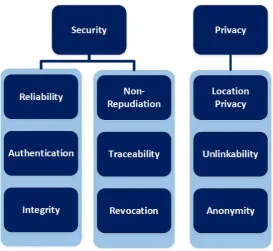
and privacy requirements and how they are achieved in VANET as shown in Figure 3-2
34
Figure 3-2: Security and Privacy Requirements in VANETs
3.3.1 Reliability:
Reliability is achieved through authentication by confirming the identity of the
user and issuing them keys when they are authenticated. Authentication ensures that
user is who he says he is and the message has not been tampered while in transit i.e. it
ensures integrity of messages. Therefore, authentication ensures reliability. This means
that if a user is authenticated as an emergency services vehicle e.g. ambulance, fire
brigade, police etc. then they are indeed valid official vehicles and no one else can pose
as such (an impersonation attack [28], [31]). Similarly, no private vehicle should be
able to pose as anybody else. Furthermore, the contents of messages being sent out by
35
3.3.2 Location Privacy:
In [32], authors define linkability as the continuous or long term tracking of any
user in a VANET by monitoring the transmissions or the information being exchanged
in VANETs. This is undesirable in VANETs and is defined as breach of privacy.
Nobody wants to be tracked or monitored so that their personal information or
knowledge of their whereabouts could not be used for the wrong reasons. Therefore,
preserving the location privacy of users is of fundamental importance in VANETs. This
implies that the consecutive messages being sent by a user should not be linked to the
same user. This is defined as unlinkability that helps achieve anonymity as shown in
Figure 3-2. This means that a user should be able to send multiple messages
anonymously. This anonymity is usually achieved by using PNs that are changed with
every message or after some time. The anonymity is conditional rather than absolute
meaning it can be revoked if the user is involved in a violation.
3.3.3 Non-Repudiation:
Non-repudiation means the sender of a message should not be able to deny
sending it. Non-repudiation leads to traceability i.e. the ability of the authorities to trace
a user involved in a violation. This traceability usually leads to revocation which means
de-anonymizing the user and taking some action against the user. The violation may
invoke revocation if it is a serious violation e.g. a vehicle sends out a malicious
message to the vehicles on the same highway that there is a traffic jam on the road
36
3.4 Attacks in VANETs
3.4.1 Sybil Attack
A Sybil attack is the ability of a single entity to claim multiple false or valid
identities in a network without being detected. The attacker is then able to control a
significant part of the network and can perform various malicious activities including
out voting a valid / legitimate user and injecting false information in the network. Sybil
attacks in VANETs have been discussed in [40], [41], [42], [43], [41] and [44]. The
concept of valid identity in a network refers to distinct identities, which mean that one
entity can be differentiated from the other. However, researchers have argued that it is
impossible to present convincingly distinct identities for initially unknown elements in
a distributed computing environment without the presence of a central certification
authority [45]. Therefore, one approach to preventing such attacks is to have a trusted
agency that certifies identities. However, having an online trusted authority that is
accessible everywhere is not an easy task.
3.4.2 False Information Injection Attack
In VANETs, once nodes have been authenticated, they can share information
with other nodes. However, once nodes are allowed to share information and a node
becomes rogue then there is no quick way to detect or stop this node from injecting
false information in the network. This kind of attack is the most serious and easiest to
launch in VANETs and have been discussed in [46], [47], [48], [49] and [8]. In
37
braking, traffic light violation etc. that can cause other users to take drastic actions and
may put lives in danger. Once the information is determined to be false then the sender
can be penalised but a procedure is needed that allows the receivers to find out if false
information has indeed been injected in the network and by whom.
3.4.3 Wormhole Attack
The wormhole attacks in VANETs have been discussed in [50] and [38]. In
wormhole attack an attacker records a message that was received at one location, and
retransmits it to another location. This makes other nodes believe that the original
sender of the message is within their communication range and they might try to route
their message through this node which will fail. This attack thus prevents discovery of
other routes other than the wormhole as the nodes try to select the route with the fewest
hops. Moreover, this can result in wrong information being shared in VANETs causing
chaos.
3.4.4 Denial of Service (DoS) Attack
The DoS attack is considered very serious in any kind of network i.e. wired or
wireless. However, it can have life threatening consequences in VANETs. DoS attack
in VANETs are discussed in [51], [52], [53] and [54]. A DoS attack basically makes a
network unavailable for legitimate users by broadcasting continuously and thus using
up all the bandwidth. The main aim of the attacker is to consume the network resource
38
attacker can launch such an attack by continuously broadcasting using single or
multiple radios so that access to the network can be denied in a particular area. As
bandwidth is already limited in VANETs, such an attack can be devastating as vehicles
keep themselves aware of their surroundings by exchanging Cooperative Awareness
Messages (CAM).
3.5 Security and Privacy Preserving Schemes in
VANETs
In order to cater for the transmission of location information: confidentiality of
location of a user (Location Privacy) is essential for VANET security. This location
information can be used by adversaries in tracking vehicles or routes. Different security
schemes have been used to protect privacy or achieve anonymity and based on the
underlying security mechanisms they use, these schemes can be classified as:
• Pseudonyms coupled with Public Key Infrastructure (PKI)
• Trust Based schemes
• Group signatures
• Identity based signature schemes.
• K-anonymity schemes.
There are various issues associated with each of these schemes which we will discuss
39
3.5.1 Pseudonym coupled with PKI Based Schemes
In VANETs, the vehicles are transmitting their location info e.g. to warn other
users of accidents. Researchers in [24] & [26] propose using pseudonyms to preserve
privacy. The use of Pseudonyms (PNs) hides the real identity of the user and prevents
the linking of real-ID of the user with the pseudonyms thereby providing Unlinkability.
However, Trusted Authority (TA) which issues pseudonyms can reveal the real ID of
the user if user commits an illegal act hence providing Traceability.
In all cases, the On Board Unit (OBU) is assumed to be a tamper-proof device
which contains the unique Vehicle Identification Number or VIN. This VIN is tied to
an identity certificate at the time of registration. From here on, the Trusted Authority
(TA) (e.g., transport authority) is tasked with issuing new blocks of pseudonyms /
certificates to the vehicles, to be used while communicating with the Road Side Units
(RSUs). These certificates have a validity period and the vehicle switches its
pseudonyms to ensure privacy. The authors in [32] suggest that short-term linkability
should be allowed so that the receiver is able to verify that two or more messages in a
short time frame have come from the same sender, as this might be required by
applications. The recommended time after which the pseudonyms are switched also
varies, e.g., every minute or every few minutes, with every message or every second
[53]. However, the frequency of PN changes is directly proportional to the computation
overhead at the RSU, which can slow down packet delivery. Also, the OBU is also
supposed to store the public keys of all CA (Certificate Authority) / TA. Furthermore,
different PKI-based techniques that use a CA/TA connected with the RSU have been

![Figure 2-2: Latency Comparison of Communication Technologies [15]](https://thumb-us.123doks.com/thumbv2/123dok_us/1466388.99282/36.595.145.478.176.377/figure-latency-comparison-communication-technologies.webp)
![Figure 2-4: OSI vs WAVE Protocol Stack [17]](https://thumb-us.123doks.com/thumbv2/123dok_us/1466388.99282/38.595.127.489.440.723/figure-osi-vs-wave-protocol-stack.webp)