Encrypting More Information in Visual Cryptography Scheme
Feng Liu1, Peng Li2 and ChuanKun Wu1 1State Key Laboratory Of Information Security,
Institute of Information Engineering,
Chinese Academy of Sciences, Beijing 100190, China 2Department of Computer Science and Technology, Harbin Institute of Technology, Harbin 150001, China
Email: [email protected], [email protected] Homepage: http://iscas.ac.cn/∼liufeng/
Abstract
The visual cryptography scheme (VCS) is a scheme which encodes a secret image into several shares, and only qualified sets of shares can recover the secret image visually, other sets of shares cannot get any information about the content of the secret image. From the point of view of encrypting (carrying) the secret information, the traditional VCS is not an efficient method. The amount of the information that a VCS encrypts depends on the amount of secret pixels. And because of the restrictions of the human eyes and the pixel expansion and the alignment problem of the VCS, a VCS perhaps can only be used to encrypt a small secret image. VCS requires a random number generator to guide the generation of the shares. As we will show in this paper, the random input of VCS can ba seen as a subchannel which helps carrying more secret information. We propose a general method to increase the amount of secret information that a threshold VCS can encrypt by treating the pseudo-random inputs of the VCS as a subchannel, i.e. the Encrypting More Information Visual Cryptography Scheme (EMIVCS). We also study the bandwidth of the proposed EMIVCS. The disadvantage of the proposed scheme is that, the decoding process is computer aided. However, compared with other computer aided VCS, the proposed scheme is more efficient.
Keywords: Secret Sharing; Visual Cryptography; Covert data; Sub-channel
1
Introduction
(a big transparency is inconvenient for the participant). And second, the human eyes can only identify the patterns in the secret image when the patterns are clear enough, i.e. the lines and dots in the patterns should be a block of pixels rather than a single pixel. Third, because of the alignment problem [7], the pixels in the shares cannot be too small. So, for the traditional VCS, it perhaps can only be used to encrypt a small secret image. Many studies try to increase the amount of the information that the VCS encrypts, such as to encrypt a plural number of secret images in one VCS [8, 9] and the method that uses rotate shares [10], and the color VCS [11, 12]. However, these methods do not increase the amount of secret bits encrypted if we consider the ratioR= mt, wheretis the number of secret bits that are encrypted by every m sub-pixels, and for the color VCS, it usually degrades the recovered secret image severely. In this paper, we measure the amount of secret information of a VCS by the amount of the secret bits it encrypts.
The VCS requires a random number generator to guide the generation of the shares. In the real application, we make use of pseudo-random number generator for the random inputs. The main idea of our scheme is that, the pseudo-random inputs of the VCS can be used to carry covert data, and the outputs (ciphertext) of the symmetric encryption algorithms (in practical we can choose the AES, Twofish etc.) can be considered as the pseudo-random inputs of the VCS, hence increase the amount of the secret information encrypted by the VCS. By using Shamir’s [13] secret sharing scheme, the encryption key is shared into nsub-keys, which are concatenated with the corresponding shares. We call such scheme the Encrypting More Information Visual Cryptography Scheme (EMIVCS). The secret information encrypted by the EMIVCS contains two parts: the secret image and the covert data encrypted in the random input. For example, for the EMIVCS in Example 1 with share size 129×128, we can encrypt additional 213 bits covert data besides the secret image SI.
However, to decrypt the covert data, we need to employ computational devices, i.e. EMIVCS is computer aided. By a (k, t, n)-EMIVCS (k ≤t), we mean a VCS that carries additional covert data where any k out of n participants can visually recover the secret image by stacking their shares, and anytout ofnparticipants can get the additional covert data by computation. There are two other computer aided VCS’s [14, 15], called two-in-one image secret sharing scheme (TiOISSS), which can reveal a vague image by stacking the shares and reveal a much finer gray image by computation. The comparisons between the EMIVCS and two TiOISSS’s will be given in Section 4. Yang et al. [5, 16] also tried to make use of the pseudo-random inputs to carry confidential data. Unfortunately, their scheme is only for (2,2) access structure and is also computer aided when decoding the confidential data.
The proposed (k, t, n)-EMIVCS is a multi-threshold secret sharing scheme. A minority participants with at leastkmembers can share one secret image, whereas a majority partic-ipants with at least t members can access an additional secret information. The EMIVCS can be applied to many scenarios. We give two examples.
First, consider the scenario of the cheating problem [17], i.e. the cheaters show false shares during recovering the secret image. So, in order to verify the validity of the shares, one will require additional authentication information. The covert data of the EMIVCS can be used to take the authentication information. In such a case, if the participants doubt the authenticity of the recovered secret image, they can convene t(≥ k) participants to verify the shares.
each one holds a share, the recovered secret image of the shares is the secret order from the commander, and there also is covert data which is the detailed plan of action. Because that in the battle field their decryption device may be destroyed, in such cases, the soldiers can at least get the secret order from their commander. And if their decryption device is available, then they can get the detailed plan of action.
There are other message delivering method requiring some decoding devices, such as some standard 2D encoding methods. By comparing the EMIVCS and the 2D encoding methods [18], we have that, for the 2D encoding method, the decoding of the secret information totally relies on the decoding device. Hence, if the participants are in a scenario where there is no decoding device, they cannot extract any information. But with our method, the participants can stack the shares and get part of the secret information. Hence from this point of view, the EMIVCS can have wider application scenarios.
In this paper, we propose a specific construction of general (k, t, n)-EMIVCS by taking the VCS proposed in [9] and secret sharing scheme in [13] as the building block. We also studied some related problems about EMIVCS such as the pseudo-randomness that the input of VCS requires, and the sufficient conditions to uniquely determine a share matrix, and the bandwidth of the proposed EMIVCS, and we also proposed an efficient decoding method to decode the EMIVCS. At last, comparisons with other computer aided VCS’s are given such as TiOISSS in [14, 15].
This paper is organized as follows. In the next section, we give some preliminary results. And in Section 3, we propose a general construction of the EMIVCS based on the con-struction of VCS in [9] and study some related problems about EMIVCS. In Section 4, we compare the proposed scheme with TiOISSS. At last we give a short conclusion in Section 5.
2
Preliminaries
In this section, we give some definitions about VCS, and introduce the Droste’s [9] construction of (k, n)-VCS and Shamir’s [13] secret sharing scheme (i.e. polynomial-based secret sharing scheme, PSSS), which are building blocks of our scheme.
2.1 VCS
We restrict ourselves to images only consisting of black and white pixels, where we denote by 1 for a black pixel and 0 for a white pixel. In this paper, we consider only the threshold (k, n)-VCS. For a vectorv∈GFm(2), we denote byw(v) the Hamming weight of the vector v. A (k, n)-VCS, denoted by (C0, C1), consists of two sets (pairwise different collection) of n×m Boolean matrices C0 and C1. To encrypt a white (resp. black) pixel, a dealer (the one who sets up the system) randomly chooses one of the share matrices (in the practical sense, the dealer can only choose the share matrices pseudo-randomly), in C0 (resp. C1) and distributes its rows (shares) to the n participants of the scheme. More precisely, we give a formal definition of the (k, n) VCS as follows:
Definition 1 Let k, n, m, l and h be nonnegative integers satisfying 2 ≤ k ≤ n and 0 ≤l < h≤m. The two sets of n×m Boolean matrices (C0, C1) constitute a (k, n)-VCS if the following properties are satisfied:
satisfies w(v)≤l.
2. (Contrast) For anys∈C1, the OR of anyk out of thenrows ofs, is a vectorv that, satisfies w(v)≥h.
3. (Security) For any i1 < i2 <· · ·< it in {1,2,· · ·, n} with t < k, the two collections
of t×m matrices Fj for j ∈ {0,1}, obtained by restricting each n×m matrix in
Cj to rows i1, i2,· · ·it, are indistinguishable in the sense that they contain the same
matrices with the same frequencies.
In the above definition, m is called the pixel expansion of the shares. A pixel of the original secret image is represented by m sub-pixels in the recovered secret image. In general, we are interested in schemes with mbeing as small as possible.
In Definition 1, the first two properties ensure that any k participants will be able to distinguish the black and white pixels, and the third property ensures the security of the scheme that any k−1 or fewer participants can gain no information about the content of the secret image.
In order to share a complete image, the pixel scheme has to be applied to all the pixels in the image. In the traditional VCS models, the encryption is applied to the secret pixels one at a time. However, we extend this method to encryptqsecret pixels at a time, and call this model the q-pixel encryption model. The traditional model is the 1-pixel encryption model. The difference between the 1-pixel encryption model and the q-pixel encryption model is that: in the 1-pixel encryption model, the dealer generates one pseudo-random number which guides the choice of a share matrix at a time. However, in the q-pixel encryption model, the dealer generates one pseudo-random number which guides the choice ofq share matrices at a time.
We consider VCS whereC0,C1 are constructed from a pair of n×m matrices M0,M1, which are called basis matrices. The set Ci (i = 0,1) consists of the matrices obtained
by permuting all the columns of Mi. This approach of VCS construction will have small
memory requirements (it only keeps the basis matrices) and high efficiency (to choose a matrix inC0 (resp. C1) as it only needs to generate a permutation of the basis matrix). We will use the basis matrices to simplify the discussions in this paper. And when the set of a VCS C0 (resp. C1) can be generated by the basis matrix, we call such VCS as the basis matrix VCS. Many studies in the literatures proposed the construction of thebasis matrix VCS, such as [9, 19, 20].
Recall that, by definition, the share matrices in C0 (resp. C1) are pairwise different. Denote the different columns in the basis matrix Mi as c1, c2,· · ·, ce and the multiplicities
of these columns are a1, a2,· · · , ae, we have that the number of share matrices in Ci is
|Ci| = (
Pe i=1ai)!
Qe
i=1ai! , for i
∈ {0,1} (these share matrices are pairwise different). In order to choose a share matrix in Ci pseudo-randomly, the length of the pseudo-random input for
one secret pixel should be at least log2|Ci|bits.
2.2 Droste’s construction of (k, n)-VCS
In this paper, we take the construction of Droste [9] as the building block, and we recall his construction as follows:
Setup Let M0 and M1 be two empty matrices, where the basis matrices M0 and M1 are considered as the collections of their columns;
step 1 For all evenp∈ {0,1, . . . , k}, callADD(p,M0);
step 2 For all oddp∈ {0,1, . . . , k}, callADD(p,M1);
step 3 DefineP0(resp. P1) be the collection consisting of all columns of every restriction of krows ofM0 (resp. M1), and defineS0 (resp. S1) be the set consisting of allk-length boolean columns with an even (resp. odd) number of 1’s. Define the remaining of M0 (resp. M1) beP0\S0 (resp. P1\S1), and define the rest ofM0 (resp. M1) be the columns in the remaining of M0 (resp. M1), but not in the remaining of M1 (resp. M0), i.e. therest ofM0 is{P0\S0}\{P1\S1}and therest ofM1 is{P1\S1}\{P0\S0}. If the rests are not empty:
(a) Ifp is an even number, add toM0 all columns adjusting therest ofM1 by calling
ADD(p,M0), where pis the number of 1’s in column l, and l∈ {P1\S1}\{P0\S0}. (b) If pis an odd number, add toM1 all columns adjusting the rest of M0 by calling
ADD(p,M1), where pis the number of 1’s in column l, and l∈ {P0\S0}\{P1\S1}. where the subroutine ADD is: ADD(p,M)
1 Ifp≤k−p, add every column withq =p 1’s toM.
2 Ifp > k−p, add every column withq =p+n−k1’s to M.
2.3 PSSS
Shamir[13] introduced the (t, n)-PSSS (t ≤ n) to share the secret data into n shares. Any t shares can be used to reconstruct the secret, but any t−1 or less shares get no information about the secret. To divide the secret data into shares, it randomly generates a (t−1)-degree polynomial using modular arithmetic:
f(x) = (a0+a1x1+. . .+at−1xt−1) mod p
in which a0 is replaced by the secret data, p is a prime number larger than a0 and n. The coefficients a1, a2, . . . , at−1 are randomly chosen from a uniformly distribution over the integers in [1, p). Then we could generate n shares (xi, f(xi)), i = 1,2, . . . , n. Later, with
any t out of the n shares, one can evaluate all the coefficients, particularly the coefficient a0, of the polynomial f(x) by Lagrange’s interpolation. However, anyt−1 or fewer shares cannot get any information about the secret.
3
EMIVCS
In this section, we first propose a construction of EMIVCS by taking the pseudo-random inputs as a subchannel, and then study some related problems about the EMIVCS: first, the pseudo-randomness that the input of VCS requires; second, the sufficient conditions to uniquely determine a share matrix in the set Ci for i = 0,1; third, the bandwidth of the
3.1 Construction of EMIVCS
The main idea of the proposed scheme is to treat the symmetric encryption algorithm as the pseudo-random generator of VCS. Thus the VCS can, naturally, carry the additional covert data encrypted by the symmetric encryption algorithm. In this paper, we take the VCS proposed in [9] as the building block. And in practical application, the symmetric encryption algorithm can be the AES, Twofish etc. The cipher block chaining (CBC) [21] encryption mode is employed. The encryption key SKey in EMIVCS is shared by (t, n
)-PSSS into n sub-keysSK1, SK2, . . . , SKn. Therefore, any t or more sub-keys can be used
to reveal the secret key, while any t−1 or less sub-keys cannot get any information about the secret key.
Before showing the construction, we need to give an assumption that: the participants all know the access structure they belong to, i.e. thei-th participant knows by himself that he is the i-th participant. Usually, the access structure of a VCS is not secret information, so this assumption is reasonable.
Construction 1
Encryption process:
Input: The secret imageSI, covert dataSplaintext and the secret key SKey.
Output: n shares.
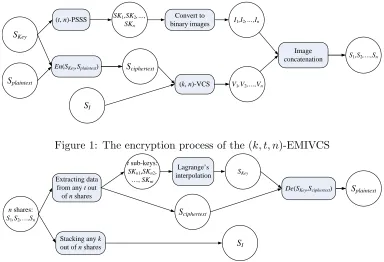
Step 1: Encrypt the covert dataSplaintextby using the keySKey,Sciphertext=En(SKey, Splaintext);
Step 2: Encrypt the secret image SI into n shares V1, V2, . . . , Vn by using the (k, n)-VCS,
where the encrypted data from the Step 1 is employed as the pseudo-random input of the (k, n)-VCS;
Step 3: ShareSKey intonsub-keysSK1, SK2, . . . , SKnby using(t, n)-PSSS, then convert
these sub-keys into binary images I1, I2, . . . , In, and concatenate Ii (i = 1,2, . . . , n)
with share Vi to get the final share Si.
Decryption process:
Input: Anyt shares where k≤t.
Output: The secret image SI and the covert dataSplaintext.
Step 1: Stack any kshares to get the recovered secret image SI;
Step 2: Determine the share matrices which are used to encrypt the secret image for each pixel by t shares, and hence get the ciphertextSciphertext;
Step 3: Extracttsub-keys fromtshares, then reconstruct the secret keySKey by Lagrange’s
interpolation.
Figure 1 and Figure 2 illustrate the procedures of Construction 1.
Remarks: In the practical application, the key length of the AES and Twofish, usually, is 128 bits. Therefore, each sub-key is generated and converted into a 128 bits binary image which only takes a small area in the share.
SKey
Splaintext
Sciphertext
SI
V1,V2,…,Vn SK1,SK2,…,
SKn I1,I2,…,In
S1,S2,…,Sn
En(SKey,Splaintext)
(t, n)-PSSS Convert to binary images
(k, n)-VCS
Image concatenation
Figure 1: The encryption process of the (k, t, n)-EMIVCS t sub-keys:
SKn1,SKn2,
…, SKnt
Splaintext
Sciphertext
SI n shares:
S1,S2,…,Sn
Stacking any k
out of n shares Extracting data from any t out of n shares
De(SKey,Sciphertext) Lagrange’s
interpolation SKey
Figure 2: The decryption process of the (k, t, n)-EMIVCS
For the (k, t, n)-EMIVCS, by stacking k shares we can reconstruct the secret image SI.
And if one obtains trows, he can uniquely determine a share matrix and hence obtain the ciphertext, where “can uniquely determine a share matrix” means that there only exists one share matrix in Ci (i= 0,1) that contains these t rows (and “cannot uniquely determine”
means there exist more than one share matrices that contain these trows, hence we cannot determine which one is chosen by the dealer when encrypting the secret pixel). In another word, in order to get the ciphertext one needs tshares.
The security of the (k, t, n)-EMIVCS are based on the security of the symmetric encryp-tion algorithm, the security of VCS and the security of PSSS. Particularly, if an attacker wants to know the secret image, he needs at least kshares; if he wants to know the covert data encrypted by the symmetric encryption algorithm, he needs at leasttshares to extract the ciphertext and the secret key.
The VCS requires inputting pseudo-random numbers to guide the choice of the share matrices. Denote the share matrices in Ci asS0i,· · ·, S|iCi|−1, and denote P(S
i
j) for i= 0,1
and j = 0,1,· · · ,|Ci| −1 as the probability that choosing the share matrix Sji. Hence the
inputted of the pseudo-random numbers should guarantee that P(S0i) =P(S1i) =· · ·=P(S|iC
i|−1) · · · (1)
log2|Ci| bits pseudo-random numbers (we will consider the case that log2|Ci| is not an
integer in a later time). Denote B(j) as the binary representation of integer j with length log2|Ci|, i.e. B(j) is the binary string that represents j. Without loss of generality, we
assume that when the inputted pseudo-random number is B(j), the dealer chooses the share matrix Sji to encrypt the secret pixel i. And denote P(B(j)) as the probability of generating the binary string B(j) by the pseudo-random generator. According to the equation (1), we have
P(B(0)) =P(B(1)) =· · ·=P(B(|Ci| −1)) · · · (2)
In fact the ciphertexts of the AES and Twofish satisfy the equation (2), because they have passed the serial test in [22]. Hence, we can take the AES and Twofish as the pseudo-random generator. (This also is the very reason that we do not use the covert data directly to guide the generation of shares.)
To make things clearer, we give the following example for (2,2,2)-EMIVCS:
Example 1 The sets of share matrices of(2,2,2)-EMIVCS are as follows:
C0 =
10 10
,
01 01
and C1=
10 01
,
01 10
The principle of choosing share matrix is that: if the pseudo-random input is 0, we choose the first share matrix in C0 or C1, and if the pseudo-random input is 1, we choose the second.
Figure 3 gives an illustration for the (2,2,2)-EMIVCS.
… …
⎥⎦ ⎤ ⎢⎣ ⎡
01 01 S
ciphertext:1……
… …
SK1:01100…… SK2:10100……
Share 1 Share 2 Share 1+Share 2 Secret image
Figure 3: The procedure of the (2,2,2)-EMIVCS
A secret image with64×128pixels is encoded into Share 1 and Share 2. The size of the shares and the recovered secret image is 129×128. Since the length of each sub-key is 128 bits, it only takes one line at the bottom of each share to attach the sub-key. The length of the ciphertext Sciphertext encrypted in the shares is 213 bits, i.e. the subchannel can be
used to carry extra213 bits of covert data. In the first step of the reconstruction process, the secret image can be visually decoded by stacking two shares. In the second step, two sub-keys are extracted from the last row of two shares, and then we can reveal the secret key SKey
example, the first block of share 1 is constituted by two sub-pixels ‘0’ and ‘1’, and the first block of share2is also constituted by two sub-pixels ‘0’ and ‘1’. Therefore, we can determine the share matrix, which is the second share matrix C0, and the recovered ciphertext is ‘1’. Finally, we get the covert data Splaintext by decrypting the ciphertext Sciphertext. 2
3.2 Uniquely determine a share matrix
For the (n, n)-VCS, if one has all the n shares, he can uniquely determine the share matrices used when encrypting the secret image SI, and hence get to know the ciphertext.
We then focus our discussion on the (k, n)-VCS with k < n: we find that, for the VCS in Section 2, n−1 rows can uniquely determine a share matrix in the set C0 (resp. C1). The following theorem shows this result:
Theorem 1 Denote M0 and M1 be the basis matrices constructed by (k, n)-VCS in [9], and denoteC0 andC1 be the sets of share matrices generated fromM0 andM1, respectively. If every t rows of a share matrix in Ci (i= 0,1) can uniquely determine a share matrix in
Ci, then t≥n−1.
Proof: First, for the case of t =n, it obviously can uniquely determine an n-row matrix from its all nrows.
Second, we show anyn−1 rows can uniquely determine a share matrix. According to the construction in [9], the number of the 1’s of each column in the basis matrixM0 is from the set T0 ={a|0≤a≤ bk2c, a mod 2 = 0}S{a+n−k|bk2c < a≤k, a mod 2 = 0}, and the number of 1’s of each column in the basis matrixM1 is from the setT1={a|0≤a≤ bk2c, a mod 2 = 1}S
{a+n−k|bk
2c< a≤k, a mod 2 = 1}. (here and hereafter,bxcis the largest integer that is no larger than x, and dxeis the smallest integer no smaller thanx.)
Becausek < n, when one hasn−1 rows of a share matrixM, he can stackkshares and hence knows the secret pixel. Without loss of generality, suppose the secret pixel is black. We determine the last row of the share matrixM as follows: for the columnpi ofM, where
i∈ {1,· · ·m}, denote the number of 1’s of then−1 rows in columnpi as h, then we have
the entry of the last rows of column pi be 0 if h ∈T1 and be 1 if h+ 1 ∈T1. Hence, the last row can be uniquely determined by then−1 rows, and because the participants know the access structure they belong to, then the share matrix can be uniquely determined.
Third, we prove any n−2 rows cannot uniquely determine a share matrix. Consider the construction in [9], we have that the basis matrix M1 contains all the columns with hamming weight equaled to 1. Let A be a share matrix in C1. Without loss of generality, there exist two different columnsc1 and c2 inA, whose hamming weights are equaled to 1. Denote the position of 1 in column c1 (resp. c2) be p1 (resp. p2), we have p1 6= p2. Let X ={1,2, . . . , n}\{p1, p2}. Then, by restricting all the rows of columnsc1 and c2 inX, we get two same sub-columns. Suppose B is a matrix generated by exchanging the positions of columns c1 andc2 inA, then B is also a share matrix inC1. Therefore, by restricting all the rows ofA and B inX, we get two same sub-matrices. In another word, then−2 rows of share matrix A (the rows restricted in X) cannot uniquely determine a share matrix. Obviously, it also cannot uniquely determine a share matrix from less than n−2 rows. 2
Theorem 1 gives an explicit method to uniquely determine a share matrix inCi(i= 0,1),
Theorem 2 Let t=n−1, then Construction 1 generates a (k, n−1, n)-EMIVCS. 2
For general basis matrix visual cryptography (C0, C1), denote CiAll as the set of all
the possible columns that appear in the share matrices of Ci (i = 0,1). For any set of
participants X ⊆ P, denote M0 as a sub-matrix which is generated by restricting to the rows inX of a share matrix inCi. First we have the following lemma:
Lemma 1 For every column c0 of M0, if there exists only one column c ∈CiAll such that c[X] =c0, then the sub-matrix M0 can uniquely determine a share matrix inCi, wherec[X]
is the sub-column generated by restricting to the rows in X of c.
Proof: Reduction to absurdity: Suppose M0 cannot uniquely determine a share matrix in Ci, i.e. there exist two different share matrices, denoted by Ma and Mb, such that
Ma[X] =Mb[X] =M0, where Ma[X] is the sub-matrix generated by restricting to the rows
inX ofMa. SinceMaand Mb are different share matrices, there exists at least one column
that is different for Ma and Mb. Denote this column inMa is ca and that inMb is cb, i.e.
ca 6=cb. And becauseMa[X] =Mb[X], we have ca[X] =cb[X], which is contradict to the
assumption that there exists only one column c∈CiAll such that c[X] =c0. Hence,M0 can
uniquely determine a share matrix in Ci. 2
According to Lemma 1, we give a general discussion for basis matrix (k, n)-VCS, denote cp, cq ∈CiAll as two different columns, and denote Xpqi (⊂P) as the set of the participants
such that for eachx∈Xpqi satisfying cp[x] =cq[x], wherecp[x] is thex-th entry ofcp. Then
we have the following theorem:
Lemma 2 Let t=max{|Xpqi |+ 1} for p6=q,1≤p, q≤m andi= 0,1, then a sub-matrix of trows of a share matrix in Ci can uniquely determine a share matrix inCi.
Proof: Let c0 be a column of the sub-matrix M0 which is generated by restricting t rows of a share matrix in Ci (i= 0,1). Denote the set of the participants of these trows as X,
i.e. |X|=t, where t=max{|Xpq|+ 1}. We prove that, there only exists one column c of
M such that c[X] =c0.
Reduction to absurdity: Suppose there exist two columns ca and cb such thatca[X] =
cb[X] =c0. We have thatca and cb havet entries that have the same values, i.e. t=|Xab|,
which is impossible because t=max{|Xpq|+ 1} which impliest >|Xab|.
According to Lemma 1, we have that a sub-matrixM0withtrows can uniquely determine
a share matrix in Ci. 2
For a (k, n)-VCS, anyk−1 or less shares cannot get any information of the secret image. In another word, any t(t < k) shares cannot decide the t-row sub-matrix is from C0 or C1, and hence can not uniquely determine the share matrix. Therefore, it is reasonable to assume t≥k. Further with Lemma 2, we get the following theorem immediately:
Theorem 3 For a basis matrix (k, n)-VCS, there exists a (k, t, n)-EMIVCS where t = max{k,|Xpqi |+ 1}, p=6 q, 1≤p, q≤m andi= 0,1. 2
results in Theorem 1). Because they both take the canonical matrices as building block, where the canonical matrices means the matrices that all the columns of a given weight occur with the same frequency. And for the canonical matrices which has a columnci with
x 1’s and n−x 0’s where 0 < x < n, there exists a column cj such that have only two
entries are different fromci, which implies |Xij|=n−2, and hencet=n−1.
3.3 Bandwidth of EMIVCS
We define the bandwidth of EMIVCS as the maximum amount of covert data it carries through its subchannel. In this section, we show the bandwidth of the EMIVCS.
Denote the columns in the basis matrixMi as c1,· · · , ce and the multiplicities of these
columns area1,· · · , ae, recall that, we have the number of share matrix inCi being|Ci|=
(Pe i=1ai)!
Qe
i=1ai! , fori
∈ {0,1}. To choose a share matrix inCi, one needs at least log2|Ci|
pseudo-random bits theoretically. And by determining the share matrix which is chosen when encrypting the secret image in Ci, one can determine at most log2|Ci| bits information
theoretically. Hence, the amount of the additional covert data that can be carried by the secret pixeliis at most log2|Ci|bits theoretically. We list the number of the share matrices
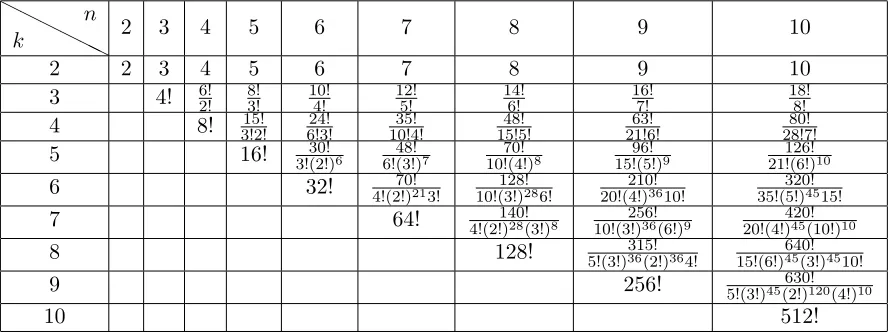
|Ci|of the VCS constructed in [9] in the Table 1 and 2 as follows:
H H
H H
HH
k
n
2 3 4 5 6 7 8 9 10
2 2 3 4 5 6 7 8 9 10
3 4! 6!2! 8!3! 10!4! 12!5! 14!6! 16!7! 18!8! 4 8! 3!2!15! 6!3!24! 10!4!35! 15!5!48! 21!6!63! 28!7!80! 5 16! 3!(2!)30!6 6!(3!)48!7 10!(4!)70! 8 15!(5!)96! 9 21!(6!)126!10
6 32! 4!(2!)70!213!
128! 10!(3!)286!
210! 20!(4!)3610!
320! 35!(5!)4515!
7 64! 4!(2!)140!28(3!)8 10!(3!)256!36(6!)9 20!(4!)420!45(10!)10
8 128! 5!(3!)36315!(2!)364! 15!(6!)45640!(3!)4510!
9 256! 5!(3!)45(2!)630!120(4!)10
10 512!
Table 1: The number of share matrices inC0
Actually, in the practical sense, a pseudo-random number generator can only generate integer number of pseudo-random bits, and the ciphertexts are also represented by integer number of bits. However, the values of log2|Ci|are rarely integers, which means that some
share matrices cannot be chosen by integer number of the pseudo-random bits, and it is hard to determine all the log2|Ci|ciphertext bits, hence results in the waste of the
pseudo-random bit resources. So in the practical sense, the amount of the covert data carried by the EMIVCS cannot reach the theoretical value.
In fact, if one encrypts the secret pixels one at a time, in order to choose a share matrix pseudo-randomly in Ci, one needs at least dlog2|Ci|e pseudo-random bits, and the length
of the ciphertext can be at most blog2|Ci|c bits. To fully make use of the pseudo-random
than 1-pixel encryption model is as follows: H H H H HH k n
2 3 4 5 6 7 8 9 10
2 2! 3! 4! 5! 6! 7! 8! 9! 10!
3 4! 6!2! 8!3! 10!4! 12!5! 14!6! 16!7! 18!8! 4 8! (2!)15!5
24! (3!)6 35! (4!)7 48! (5!)8 63! (6!)9 80! (7!)10
5 16! 3!(2!)30!6 6!(3!)48!7 10!(4!)70! 8 15!(5!)96! 9 21!(6!)126!10
6 32! (3!)70!7(2!)7 (6!)128!8(3!)8 (10!)210!9(4!)9 (15!)320!10(5!)10
7 64! 4!(2!)140!28(3!)8 10!(3!)256!36(6!)9 20!(4!)420!45(10!)10
8 128! (4!)9(2!)315!84(3!)9 (10!)10(3!)640!120(6!)10
9 256! 5!(3!)45(2!)630!120(4!)10
10 512!
Table 2: The number of share matrices inC1
First: the number of pseudo-random bits required to choose the share matrices when use theq-pixel encryption model is da0log2|C0|+a1log2|C1|e, and satisfies
da0log2|C0|+a1log2|C1|e ≤a0dlog2|C0|e+a1dlog2|C1|e
which implies less pseudo-random bits are required by using the q-pixel encryption model than the 1-pixel encryption model.
Second: the number of pseudo-random bits determined by the share matrices when encrypt q secret pixels at one time isba0log2|C0|+a1log2|C1|c, and satisfies
ba0log2|C0|+a1log2|C1|c ≥a0blog2|C0|c+a1blog2|C1|c
which implies more pseudo-random bits can be determined by using the q-pixel encryption model than the 1-pixel encryption model.
An problem for theq-pixel encryption model is that, when encrypt more secret pixels at a time, the encryption scheme becomes more complex. So there exists a trade-off for the value of theq.
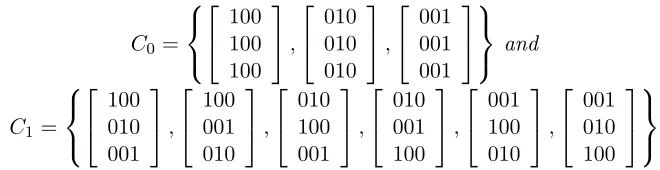
To make things clearer, we give the following example for a (2,2,3)-EMIVCS:
Example 2 For the sets
C0 =
100 100 100 , 010 010 010 , 001 001 001 and
C1 =
100 010 001 , 100 001 010 , 010 100 001 , 010 001 100 , 001 100 010 , 001 010 100
However, in the practical sense, the 10-pixel encryption model, where take a0 = 5 and a1 = 5 as example, we have the amount of information that can be carried is blog235 + log265c = 20, which is more than the 1-pixel encryption model, where the corresponding
value is 5blog23c+ 5blog26c= 15. 2
At this point, we can calculate the bandwidth of the EMIVCS as follows:
Theorem 4 For a secret image SI which consists of nw white pixels and nb black pixels,
the bandwidth, denoted by W, of the EMIVCS is W = bnwlog2|C0|+nblog2|C1|c, and it is achieved when using the qa-pixel encryption model where qa=nw+nb.
Proof: For the qa-pixel encryption model where qa =nw+nb, which implies encrypt all
the secret pixels in the secret image at a time. And it is clear that the amount of covert data carried by such EMIVCS is W =bnwlog2|C0|+nblog2|C1|c. We only need to prove that W reaches its maximum when using theqa-pixel encryption model, i.e. if one divides
all the pixels in the secret image into several parts, and encrypts these parts separately, the amount of covert data carried is less than the qa-pixel encryption model.
Without loss of generality, letqa=q1+q2 (i.e. divide into two parts), and suppose the encryption of the secret imageSI is realized by usingq1-pixel encryption model andq2-pixel encryption model, and let q1 =a0+a1,q2 =b0+b1, wherea0,b0 are the number of white pixels anda1,b1 are the number of black pixels. We have that the total number of pseudo-random bits can be determined is ba0log2|C0|+a1log2|C1|c+bb0log2|C0|+b1log2|C1|c, which is no larger thanb(a0+b0) log2|C0|+ (a1+b1) log2|C1|c=bnwlog2|C0|+nblog2|C1|c.
Hence, the theorem follows. 2
3.4 On decoding the ciphertext
For EMIVCS, in order to encrypt the secret pixels and decode the ciphertext one needs to set a bijection between the set of pseudo-random numbers (ciphertext) and the set of share matrices. A simple way to realize that is to generate a table which contains all the share matrices and their corresponding numbers. When the dealer generates the shares, he needs to generate a pseudo-random number and find the corresponding share matrix by table-lookup, then he can encrypt the shares by using the share matrix. And when decoding the ciphertext, the participants get the share matrices according to Theorem 1, and find the corresponding numbers by table-lookup, hence, they get the ciphertext. The disadvantage of this decoding method is that, the table requires to store all the share matrices in sets C0 and C1, and hence has large memory requirements. In this subsection, we propose a decoding method which is more efficient than the above method.
The proposed decoding method contains two subroutines, the first is M T N(S), which takes a share matrix in Ci (i = 0,1) as its input and outputs a number between 1 and
m!. And the second is N T M(N), which takes a number between 1 and m! as its input and outputs a share matrix S. The subroutines M T N(S) andN T M(N) form a bijection between the set of the share matrices and the set of numbers between 1 andm!.
using the share matrix. And when the participants decode the ciphertext, they first generate the share matrix according to the Theorem 1, and consult to the subroutine M T N(S) to get the ciphertext.
Denote the columns of the basis matrix as c1,· · ·, cm, first we consider the case that
c1,· · ·, cm are pairwise different. In this part, we treat a matrix as a set of columns. The
subroutineM T N(S) which outputs a number between 1 andm! given a share matrixS as its input is as follows:
Subroutine: MTN(S)
Fori= 1 to m−1
Find ci in S, assume thatci is the Ji-th column ofS
Delete ci from S
OutputN = 1 +
m−1
P
i=1
((m−i)!)(Ji−1)
The subroutine N T M(N) which outputs a share matrix S given a number between 1 and m! as its input is as follows:
Subroutine: NTM(N)
InitialS as an empty matrix N0←N −1
Fori= 1 to m−1 Ji ← b(Nmi−−i1)!c+ 1
Ni ←Ni−1−(Ji−1)((m−i)!)
Insert cm toS as its 1-st column
Fori=m−1 to 1
Insert columnci intoS as its Ji-th column
OutputS
According to the subroutines M T N(S) and N T M(N) above, we have the following theorem:
Theorem 5 The subroutines M T N(S) and N T M(N) form a bijection between the set of share matrices in Ci (i= 0,1) and the set of numbers between 1 andm!.
Proof: Because in subroutinesM T N(S) andN T M(N), we represent the share matrices by the positions of its columns (J1, J2,· · ·, Jm−1) where 1≤Ji≤m+1−ifori= 1,2,· · ·, m−1,
we only need to prove that M T N(S) and N T M(N) form a bijection between the sets X ={(J1, J2,· · · , Jm−1)|1≤Ji ≤m+ 1−i f or i= 1,2,· · · , m−1}andY ={1,2,· · ·, m!}.
Denotef :X→Y as a map from X toY, we prove that f is a bijection.
Second, for any two different elements inX,J = (J1, J2,· · ·, Jm−1) andJ0= (J10, J20,· · ·, Jm0 −1) such that J 6=J0, we prove that their corresponding numbersf(J) andf(J0) are different.
According to M T N(S), we have f(J) = 1 +
m−1
P
i=1
((m−i)!)(Ji −1) and f(J0) = 1 + m−1
P
i=1
((m−i)!)(Ji0 −1). Denote i∗ as the smallest number that Ji∗ 6= J0
i∗, without loss of
generality, we suppose Ji∗ > J0
i∗, i.e. Ji∗−J0
i∗ ≥1. We have:
f(J)−f(J0) =
m−1
P
i=1
((m−i)!)(Ji−Ji0)
=(m−i∗)!(Ji∗−J0
i∗) +
m−1
P
i=i∗+1
((m−i)!)(Ji−Ji0)
≥(m−i∗)! +
m−1
P
i=i∗+1
((m−i)!)(Ji−Ji0)
Because 1≤Ji, Ji0 ≤m+ 1−i, we have −(m−i)≤Ji−Ji0 ≤m−i, hence
f(J)−f(J0) ≥(m−i∗)!−
m−1
P
i=i∗+1
((m−i)!)(m−i) =(m−i∗)!−((m−i∗)!−1)
=1
Hence,f(J)−f(J0)6= 0, we havef is an injection. Hence,f is a bijection and the theorem
follows. 2
For the case that there are identical columns in the basis matrix, which means that there are identical share matrices in them! permutations of the basis matrix. And suppose there are e different columns in the basis matrix, and the multiplicities of these columns are a1, a2,· · ·, ae. Denote Nd as the number of the different share matrices in Ci, then we
have Nd = (
Pe i=1ai)!
Qe
i=1ai! , for i
∈ {0,1}. And each share matrix appears Nm!
d times in the m! permutations.
Furthermore, according to the subroutine M T N(S), each permutation corresponds to a number between 1 and m!, we can divide thesem! numbers into Nd groups, where each
group contains Nm!
d numbers, and the numbers in one group correspond to an identical share matrix. We hence can form an array of lengthNd by choosing the smallest number of each
group. Denote this array asA, and denoteS1i, S2i· · ·, SiN
d as all the different share matrices in the set Ci, the following subroutine generatesA:
Subroutine: MC
Initial an empty arrayA Forj= 1 to Nd
Forq = 1 to m
Find the first cq inSji from left to right, assume thatcq is the Jq-th column
Delete cq from Sji
A[j]←1 +
m−1
P
q=1
((m−q)!)(Jq−1)
To differentiate the two cases that there exist and do not exist identical columns, we denote M T N-d(S) and N T M-d(N) as the corresponding subroutines for the case that there exist identical columns:
Subroutine: MTN-d(S)
A←M C
Forq= 1 to m
Find the first cq inSji from left to the right, assume that cq is the Jq-th column
of Sji
Delete cq from Sji
N0←1 +
m−1
P
q=1
((m−q)!)(Jq−1)
Forr= 1 to Nd
ifA[r] =N0 Outputr
Subroutine: NTM-d(N)
A←M C
N0←A[N] S←N T M(N0) OutputS
According to Theorem 5, we have that, each group only has one smallest number. Hence the array A is a bijection from the set {1,2,· · ·, Nd} and the set of smallest numbers in
each group. Furthermore, because each group corresponds to a different share matrix we have that theM T N-d(S) andN T M-d(N) form a bijection between the set {1,2,· · ·, Nd}
and the set of share matrices {Si
1, S2i· · · , SNid}. We summarize this result as the following theorem:
The above subroutines are more efficient than the simple table-lookup method. Partic-ularly, for the case that the columns c1, c2,· · · , cm are pairwise different, the subroutines
M T N(S) andN T M(N) are efficient, because they only needs fixed memory requirements. And for the case that there are identical columns in c1, c2,· · ·, cm, the memory
require-ment of the subroutines MTN-d(S) and NTM-d(N) relates to the value ofm. And because they only need to store the indexes of the share matrices A[1], A[2],· · ·, A[Nd], they are
more efficient than the simple table-lookup method. Furthermore, the table (the array A in Subroutine M C) can be previously generated and reusable.
4
Comparison of EMIVCS and TiOISSS
From the point of view of carrying the secret information, both the EMIVCS and the TiOISSS are computer aided and carry two types of secrets, one is a secret image which can be revealed by stacking the shares, and the other is covert data which is revealed by computation. The two TiOISSSs [14, 15] can be also treated as (k, k, n)-TiOISSS, which means a vague secret image is revealed by stacking any k out of n shares, and further a much finer gray-scale secret image (i.e. the covert data) is revealed by computation with these k shares.
Considering the information carrying capability, we compare the amount of covert data carried by the EMIVCS and two TiOISSSs [14, 15].
First, the covert data carried by the EMIVCS is larger than that in Lin et al.’s TiOISSS [14]. The bandwidth of the proposed EMIVCS has been discussed in Theorem 4, and can be eval-uated from Table 1 and Table 2. Lin et al.’s TiOISSS [14] divides the share matrices into different types to carry covert data according to the first row. Let m be the pixel expan-sion of the basis matrix, which each row contains b ‘1’ andw ‘0’ andm=b+w. There are
m w
different types of share matrix, and each secret pixel in VCS can carry log2
m w
bits. We list the number of share matrices generated by Droste [9] with different types in Table 3. Note that in order to satisfy the security, we can only choose the type of one row and the remaining (n−1) rows are then determined according to the type of share matrix. Therefore, only 1/npart of each share can be used to carry log2
m w
bits. Since the covert data of each share is taken from a shadow image generated by polynomial-based secret sharing scheme, the total secret information carried by VCS is k|SI|log2
m w
/n
bits, where SI is the binary secret image of VCS.
Second, there is no fix relationship between the amount of covert data carried by the EMIVCS and that of Yang et al.’s TiOISSS [15]. The TiOISSS [15] replaces the black pixels in the shares with gray pixels generated by polynomial-based secret sharing scheme. Therefore, each row of share matrix carries 8b bits, and the total amount of covert data is 8kb|SI| bits, where b is the number of ‘1’ in each row of share matrix. In most cases,
H H
H H
HH
k
n
2 3 4 5 6 7 8 9 10
2 2 3 4 5 6 7 8 9 10
3 2!2!4! 3!3!6! 4!4!8! 5!5!10! 6!6!12! 7!7!14! 8!8!16! 9!9!18! 4 4!4!8! 9!6!15! 16!8!24! 25!10!35! 36!12!48! 49!14!63! 64!16!80! 5 8!8!16! 15!15!30! 24!24!48! 35!35!70! 48!48!96! 63!63!126! 6 16!16!32! 40!30!70! 80!48!128! 140!70!210! 224!96!320! 7 32!32!64! 70!70!140! 128!128!256! 210!210!420! 8 64!64!128! 175!140!315! 384!256!640!
9 128!128!256! 315!315!630!
10 256!256!512!
Table 3: The number of share matrices with different types in Lin et al.’s TiOISSS
white secret pixels to black secret pixels, the EMIVCS can carry more covert data than Yang et al.’s TiOISSS [15].
From the point of view of the visual quality, both the EMIVCS and the TiOISSS can visu-ally recover the secret image by stacking shares. The EMIVCS and Lin et al.’s TiOISSS [14] use traditional VCS as the building block, hence the recovered secret image is the same as that of the traditional VCS. In Yang et al.’s TiOISSS [15], the black pixels in shares are replaced by gray pixels, and the contrast of VCS is diminished. Therefore, the visual quality of the recovered secret image by stacking shares is deteriorated in Yang et al.’s TiOISSS [15], which is a disadvantage of their scheme.
Besides, another disadvantage of Yang et al.’s TiOISSS [15] is that, to reconstruct the covert data the participants have to obtain the greyness of each subpixel precisely, which is impractical if the shares are printed on the transparencies. Occasional scrub may change the greyness of the subpixels in the transparencies, which will be impossible to reconstruct the covert data.
Both the EMIVCS and Lin et al.’s TiOISSS [14] carry covert data by choosing different share matrices, hence there is a bijection between the set of pseudo-random numbers (ci-phertext) and the set of share matrices. In Lin et al.’s TiOISSS [14], it employs a lookup table to map the different types of share matrices to the set of pseudo-random numbers. The disadvantage of their scheme is that, the table needs to store all the types of share matrices, which has large memory requirements. However, in the EMIVCS, an efficient algorithm is introduced to make the mapping more convenient and memory efficient.
5
Conclusion
In this paper, we propose a construction of the (k, t, n)-EMIVCS, which can carry addi-tional covert data compared with the tradiaddi-tional (k, n)-VCS by treating the pseudo-random inputs as a subchannel. And we analyze some related problems about EMIVCS such as the pseudo-randomness that the input of VCS requires, and the sufficient conditions to uniquely determine a share matrix in the set Ci fori= 0,1, and the bandwidth of the
The proposed (k, t, n)-EMIVCS is especially useful for the (n−1, n−1, n)-EMIVCS and (n, n, n)-EMIVCS, because in such cases, the qualified participants can get the secret image and the covert data at the same time. The constructions of (k, n−1, n)-EMIVCS and (k, n, n)-EMIVCS can be easily implemented by the proposed scheme. For general value of k < t < n−1, we leave it as an open problem for further research.
6
Acknowledgement
This work was supported by NSFC grant No. 60903210. The paper was first submitted in 2007, and has been reviewed for several times. During the reviewing procedure, many anonymous reviewers provided many valuable constructive comments. We thank a lot to these anonymous reviewers.
References
[1] M. Naor and A. Shamir. Visual cryptography. In EUROCRYPT ’94, Springer-Verlag Berlin, volume LNCS 950, pages 1–12, 1995.
[2] B. Surekha, G. Swamy, and K.S. Rao. A multiple watermarking technique for images based on visual cryptography. InComputer Applications, volume 1, pages 77–81, 2010. [3] T. Monoth and B. Anto P. Tamperproof transmission of fingerprints using visual cryptography schemes. InProcedia Computer Science, volume 2, pages 143–148, 2010. [4] J. Weir and W. Yan. Resolution variant visual cryptography for street view of google
maps. In Proceedings of the ISCAS, pages 1695–1698, 2010.
[5] C.N. Yang, T.S. Chen, and M.H. Ching. Embed additional private information into two-dimensional bar codes by the visual secret sharing scheme. InIntegrated Computer-Aided Engineering, volume 13, Number 2, pages 189–199, 2006.
[6] S. Cimato and C.N. Yang. Visual cryptography and secret image sharing. CRC Press, Taylor & Francis, 2011.
[7] F. Liu, C.K. Wu, and X.J. Lin. The alignment problem of visual cryptography schemes. InDesigns, Codes and Cryptography, volume 50, pages 215–227, 2009.
[8] M. Iwamoto and H. Yamamoto. A construction method of visual secret sharing schemes for plural secret images. In IEICE Transactions on Fundamentals, volume E86-A.NO.10, pages 2577–2588, 2003.
[9] S. Droste. New results on visual cryptography. In CRYPTO ’96, Springer-Verlag Berlin LNCS, volume 1109, pages 401–415, 1996.
[10] M. Iwamoto, W. Lei, K. Yoneyama, N. Kunihiro, and K. Ohta. Visual secret sharing schemes for multiple secret images allowing the rotation of shares. In IEICE Transac-tions on Fundamentals, volume E89-A. NO.5, pages 1382–1395, 2006.
[12] S.J. Shyu. Efficient visual secret sharing scheme for color images. In Pattern Recogni-tion, volume 39, pages 866–880, 2006.
[13] A. Shamir. How to share a secret. In Communications of the ACM, volume 22 (11), pages 612–613, 1979.
[14] S.J. Lin and J.C. Lin. VCPSSa two in one two decoding options image sharing method combining visual cryptography (VC) and polynomial style sharing PSS approaches. InPattern Recognition, volume 40, pages 3652–3666, 2007.
[15] C.N. Yang and C.B. Ciou. Image secret sharing method with two-decoding-options: Lossless recovery and previewing capability. In Image and Vision Computing, vol-ume 28, pages 1600–1610, 2010.
[16] W.P. Fang and J.C. Lin. Visual cryptography with extra ability of hiding confidential data. InJournal of Electronic Imaging, volume 15(2), page 023020, 2006.
[17] G.B. Horng, T.H. Chen, and D.S. Tsai. Cheating in visual cryptography. In Designs, Codes and Cryptography, volume 38, pages 219–236, 2006.
[18] Patent with US Application No.: 5243655. System for encoding and decoding data in machine readable graphic form. 1993.
[19] C. Blundo, A. De Santis, and D.R. Stinson. On the contrast in visual cryptography schemes. InJournal of Cryptology, volume 12(4), pages 261–289, 1999.
[20] H. Koga. A general formula of the (t,n)-threshold visual secret sharing scheme. In ASIACRYPT ’2002, Springer-Verlag LNCS, volume 2501, pages 328–345, 2002. [21] W.F. Ehrsam, C.H.W. Meyer, J.L. Smith, and W.L. Tuchman. Message verification
and transmission error detection by block chaining. 1976.
[22] J. Soto and L. Bassham. Randomness testing of the advanced en-cryption standard finalist candidates. In Proceedings AES3, New York, http://csrc.nist.gov/publications/nistir/ir6483.pdf, 2001.