International Journal of Innovative Technology and Exploring Engineering (IJITEE) ISSN: 2278-3075, Volume-8, Issue-9S, July 2019
Abstract: Emotions play important role in human sentiments so broad studies are carried out to explore the relation between human sentiments and machine interactions. This paper deals with an automatic system which spontaneously identifies the facial emotion. Gradient filtering and component analysis is used to extract feature vector and feature optimization is taken place using swarm intelligence approach. Thus emotion recognition with optimized feature extraction process is carried out with high accuracy rate and less error probabilities. Finally the testing process is obtained for the classification of emotions and then performance is measured in terms of false acceptance rate, false rejection rate, and accuracy.
Index Terms: Facial emotion Detection, Feature Extraction, Feature Optimization, Gradient Filtering.
I. INTRODUCTION
Facial expression recognition is the study in which computers and machines identify and express sentimentsin related way as humans interpret. Facial expression recognition (FER) is an evolving technique predominantly used in the extents of artificial intelligence, psychology, and computer vision and pattern recognition. The procedure of FER consists of face recognition, feature mining and cataloging,where feature extraction is the essence of FER. In recent years, recognition of emotions is one of the main tasks in machine learning. It is very difficult for any individual to recognize the emotion with deceits. So this topic is having an advantage in terms of security for the biometric systems because fraud, in the real time situation is growing day by day and it is a serious matter of concern now days. Automated emotion recognition plays significant role in the field of
identification of human emotion and the
communicationamong human and computer for some real time application like surveillance, healthcare, video-broadcasting, image retrieval systems etc. Psychologists have established different schemes to describe and enumerate facial performances visually. Facial emotions are key mechanism which is helpful in describing emotion of humans. Humans change emotions in his/her daily routines; it can be because of psychological orphysical environments. Humans can distinguish emotions without any substantial delay and determination, but facial expression identification by machine is an enormous task.
Revised Manuscript Received on June 15, 2019.
. MrSachinMajithia,Assistant Professor, Chandigarh Engineering College, Landran Mohali, India.
Dr. Harjeet Singh, Associate Professor in the P.G. Department of Computer Science, Mata Gujri College, Fatehgarh Sahib, Punjab, India.
Ms.Astha Gupta, Assistant Professor in Chandigarh group of colleges, Landran, India.
Mr. Neeraj Sharma, Assistant Professor in Chandigarh group of
A. Stages of facial emotion detection system (FES)
This paper deals with the certain important components without which the acknowledgments are not possible. The whole scenario is distributed into two corestages i.e. the normalization, extraction of features, occurrencechoices and the classifications. The features are extracted to extract the feature vector, the features are optimized in terms of selecting relevant features and the classification will be done to classify the individual.
B. Feature Extraction Using Gradient Filter
First stage isconsidered to extract features at dissimilaralignments. The output reactionof the planned linear filter is computed as
Z1,i = Di * I G * I , (1)
Where I stand for 2-D input face configuration, Z1,i stands for output response of the ith filter, Di and G deals with the filter coefficients, *signifies 2-D convolution, and the split-up is done pixel to pixel. The Filter which responds to edge, not noise and is represented as below:
G(s,t)= 1/(2πσ^2 ) e^(-(s^2+t^2│2πσ^2 ) ) (2)
To extract basic facial features at different information, the kernel Di is framed as the Mth order derivative.
C. Feature Classification
Expressionsbeing comparable in generalformation will not be arbitrarilyspread in the enormouscosmos and can be dispersed by relativelysmall dimensional area. The foremostgoalofprimaryelement,survey is to catch the paths which havebest description for the dispersal of face imageries within the completeappearance. These vectors explain the subspace of facialportrayals, which we call "face space". Each vector comprise of size N square which showsN*N matrix, and has a linear grouping of unique face descriptions whichare denoted as Eigen faces
1. Let consider the training set of M facialdescriptions Γ1, Γ2,….,ΓM. The meantraining vector is defined by regular face.
2. Each face is having variance from the normal face with trajectory flow.
3. We shall reorganize these waysinasurroundingwhich is of dimensions in terms of N by M, which will be exposed to Principal Component Analysis (PCA).
4. The next objective is to discover a set of M-1 matrix which is orthogonal, which best pronounces the dissemination of input data in least-squares. For examplethe Euclidian prediction error is reduced. We flinch by obtaining the
covariance matrix and
determining the
An Efficient Machine Learning Method for
Facial Expression Recognition
headstrong task forcharacteristic image sizes.
D. Feature Optimization
In the simpleparticle swarm optimization (PSO), every swarmelement is measured as a possibleanswer to the mathematical optimization problem in 3 dimensional space. Every element has a location in this examinationcosmos and a velocity allocated to it. The location of the element is denoted by Xi= x1, x2, …….,xn . The velocity of aelement is given as Vi= v1, v2…vn. Also, everyelement has a native memory (pBest) which retains the best location that is experienced by the element so far [10, 11, 12]. A universallymutual memory (gBest) keeps the best global position established so far. This infoadds to the flying
velocity of everyelement, by means of the
succeedingcalculation:
(3)
Where, , are coefficientsdefining the comparativeeffects of the private and communalpractices. Describinganhigher bound for the velocity constituentupsurges the performance of the methodology. Equationgives the elementlocation update.
In [10], it has been revealed that the outline of atorporinfluence to Eq.3increases performance, because itcorrects the velocity over time and increases the search accuracy of the particles. Eq.3can be revised as:
(4)
Where is the inertia factor and rand is a regularlydispersedarbitrary number in [0,1]. Then Eq.3 was modified as:
(5)
Here K can be communicated as:
(6)
Where .The value ,inhibits the burst of
the system, which can ensue when element velocities increase without control.
II. LITERATURE SURVEY
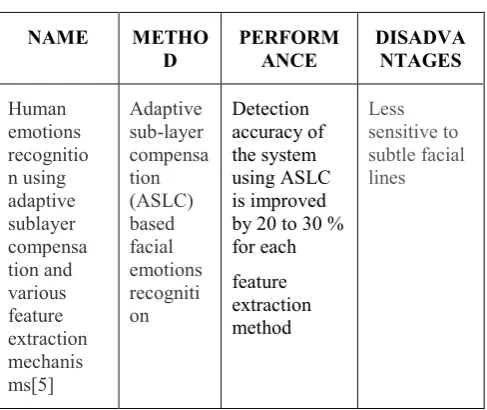
PoojaUmeshKulkarni et al., 2016 [5] described that the adaptive sub-layer compensation (ASLC) based facial emotions recognition method for human emotions recognition with various features extraction mechanism. They altered Marr-Hildreth algorithm by expending Adaptive sub-layer recompense and hysteresis analysis to minimize negative effects of Laplacian of Gaussian (LoG), such as image degradation, high reply to unwanted details in image, and detached edge details from given image. They calculated four different techniques for extraction of features for the identification of emotions. These four feature recognition mechanisms are Principal Component Examination, Local Tetra Pattern, Magnitude Pattern and Wavelet features. The emotion class was identified by using the extracted features and K nearest neighbour algorithm and was classified into five different emotion categories i.e. Happy, Sad, Neutral, Surprise and Fear.
Dayana Mathew et al., 2015 [6] proposed that the edge feature extraction method using neuronal threshold logic models to repeatedly determine the facial expressions. System was simulated at digital system level consisting of reading an image followed up with edge extraction theme which will be applied with crossbreed CMOS (complementary metal-oxide semiconductor)memristive digital circuits. The result shows robust edges of the facial features and use in development of real-time emotion recognizing digital chip.
Salwa Said, OlfaJemai et al., 2015 [7] proposed a new technique for facial expression identification based on wavelet network classifier. Technique allows us the detection of six basic emotions other than the neutral one: (Joy, surprise, anger, sadness, fear and disgust). The technique is composed of three principle steps such as face detection, features extraction and classification. The effectiveness of planned algorithm is through an experiment established by using well-known experiment database: the extended cohen-kanade database.
MouniraHmayda, RidhaEjbali et al., 2015 [8] presented feeling recognition theme based on Beta wavelet network by the Fast Wavelet Transform in instruction to enhance the performance of this network. The proposed system can be summarized in two main steps: training stage & classification stage. Comparing with existing algorithms which suffer from the low classification rates and the long executing time, the rates given by planned system show the effectiveness of the Fast Wavelet Transform (FWT).
NattawatChanthaphan et al.,2015, [9] discussed that the Facial Emotion Recognition Based on Facial Motion Stream generated by kinect employing the two kinds of facial expressions. The primary one was just a simple space value of each pair-wise organizes packed into 153-dimensional feature vector per frame. The other one was derived from the primary one based on Organized Streaming Skeleton method and it developed 765-dimensional feature vector per frame. Moore, S., & Bowden, R. et al., 2011[10] presented an investigation into head cause and multi-view facial expression recognition. Experiments were carried out on two databases to research how pose affects facial expression recognition. This paper investigated the effects of pose on facial expression recognition using variations of LBPs at totally different resolutions and different grid sampling sizes. Results in this paper have shown that Local Gabor Binary Pattern (LGBPs) outperform other features. LGBPs utilize multiresolution spatial histograms combined with local intensity distributions and spatial information. LGBPs perform particularly well at large yaw angles compared with different other features. Results show the strong performance of LBPms and when combined with LGBP, a recognition rate of 71.1% is achieved.
Barbu, T, Gabor Barbu, T. (2010) et al., 2010 [11] proposed a unique supervised facial recognition system.Authors proposed 2D Gabor filter-based feature extraction that produces robust three-dimensional face feature vectors. Another contribution of this paper is the supervised classifier used for facial feature vector classification. It uses
International Journal of Innovative Technology and Exploring Engineering (IJITEE) ISSN: 2278-3075, Volume-8, Issue-9S, July 2019
metric. The proposed threshold based verification technique, containing an automatic threshold detection procedure, represents an important component of this paper, too. A high recognition rate has been achieved by this technique, as it results from the performed experiments. The obtained results prove the effectiveness of the method. This technique provides a higher recognition rate than many other facial recognition approaches. It was compared with Eigen image based recognition technique, and found they produce similar results for identical face datasets.
Chen, S., Sun, Y., & Yin, B. et, al, 2009 [12] described that for face recognition, several researchers proposed a
completely unique method called Extended
Two-Dimensional PCA (E2DPCA) which is an extension to the original 2DPCA for gray face recognition. In this approach only considers the global information of face images and only is used for gray face recognition. Local and color information may be ignored. Therefore, in this paper, the sub-pattern technique was combined with E2DPCA supported quaternion matrix for color face recognition. New sub-pattern (which is called SpE2DPCA) was performed and compared with PCA, 2DPCA, E2DPCA, Sub-pattern PCA (SpPCA) and Sub-pattern 2DPCA (Sp2DPCA) for face recognition. Results show that the proposed novel approach SpE2DPCA based quaternion matrix has better recognition performance than different ancient PCA-based methods for face recognition.
Thomas, M., Kambhamettu, C., & Kumar, S et al 2008[13] discussed problem of face recognition using color as an important cue in improving the accuracy of recognition. To perform recognition of color images, author used the characteristics of a 3D color tensor to generate a color Linear Discriminant Analysis (LDA) subspace, which in turn can be used to recognize a new probe image. To test the accuracy of methodology, they computed the recognition rate across two color face databases and observed that the use of the LDA color subspace significantly improves recognition accuracy over the standard gray scale approach withoust sacrificing computational efficiency.
[image:3.595.48.292.546.751.2]Summary of Literatures Review
Table 1: Comparison of various face recognition methods
NAME METHO
D PERFORMANCE DISADVANTAGES Human emotions recognitio n using adaptive sublayer compensa tion and various feature extraction mechanis ms[5] Adaptive sub-layer compensa tion (ASLC) based facial emotions recogniti on Detection accuracy of the system using ASLC is improved by 20 to 30 % for each feature extraction method Less sensitive to subtle facial lines Facial Emotion Recognizi ng Memristiv e Threshold Logic System[6] Edge detection using hybrid CMOSm emristive digital circuits Extracting emotion specific features from human face in real time environments Emotion recognition can be implemented using its hardware equivalent circuits Wavelet networks for facial emotion recognition. [7] Wavelet network classifier High Accuracy in analysis of visual data Slow Speed Local binary patterns for multi-view facial expression recognition [10] Local Gabor Binary Pattern Gabor filtering reduces distortion High error probabilities Gabor Filter Based Face Recognition Technique [11] 2-Dimens ional Gabor Filter Bank High characteristic features increases recognition rates Truncated and high frequency elements makes the system complex A novel hybrid approach based on sub-pattern technique and E2DPCA for color face recognition [12] Sub-patte rn Extended 2-Dimens ional Principal Compone nt Analysis High tolerance Discrepancy in illumination, pose increases complexity Face Recognition using a Color Subspace LDA approach [13] Color Subspace Linear Discrimin ant Analysis Recognition degree is higher than LDA classification process Variation of presentation in hue spaces is not estimated
There are also some various theoretical techniques used for the classification and extraction which are discussed below.
the computer vision to sense and define the local characteristics in the images. Scale invariant key points of the object are extracted first from the reference images which are then stored in the database system. An object is acknowledged in some new image by comparing each feature vector from the image to the stored database and gets matching characteristics which are based on Euclidean distance for the classification.
2. Linear Binary Patterns:Local binary patterns (LBP) is a part of visual descriptor which are done for the classification in computer vision. It is the specific case of Texture Spectrum approach proposed in processing of the image. In previous years, it is found to be the influential characteristics for texture classification arrangement. It is determined that using Linear Binary Patterns is combined using Histogram of oriented gradients (in short HOG descriptor), it enhanced the performance in terms of detections considerably on various large datasets.
3. Principal Component Analysis
PCA is an arithmetical arrangement that deals with an orthogonal conversion to change a set of opinions of conceivably correlated variables which deals with the set of standards of uncorrelated variables linearly called as
principal components. If there exists n opinions with p variables, then amount of distinct principal components is min (n − 1, p). This arrangement is well-defined in such a manner that the very first component has the high variance and each following component has the highest deviation under the restriction which is the orthogonal arrangement to the earlier principal components.
III. PROCEDURE AND METHODOLOGY The whole simulation is tested in the MATLAB environment MATLAB is a strong computing tool which is having various toolboxes of the current emerging fields. MATLAB is helpful in analyzing great dimension datasets in an appropriate manner which reduces the time complexities and redundancies of the system. MATLAB is having high
numerical computing atmosphere and exclusive
[image:4.595.67.535.338.448.2]programming established by MatWork.Simulation is divided into training and testing phase in which the images are uploaded and pre-processed and the extraction of feature vector is taken place in training phase and the training data is loaded in the testing phase to detect the right sample with high accuracy rate and less error probability.
[image:4.595.313.525.481.648.2]Figure 1: Simulation Steps to detect facial emotions
Figure 2: Processing on Categories
Figure 2 shows the uploaded category samples in which first figure shows the uploaded sample of the sad category. The second sample shows edge detection using shrewd edge detector which makes out the number of edges from the uploaded sample. The other edge detection techniques can also be used like pewit, log, Sobeldetectionmethods.At that point the last sample shows the gradient filtration which is used to extract the information from the images by changing the intensity or color of the image.
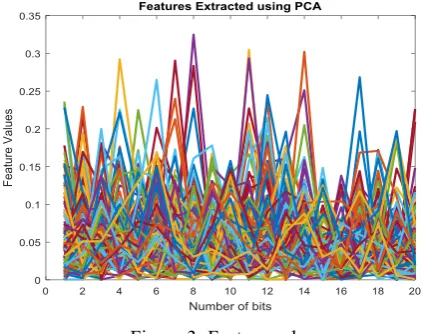
Figure 3: Feature values
[image:4.595.67.276.484.611.2]International Journal of Innovative Technology and Exploring Engineering (IJITEE) ISSN: 2278-3075, Volume-8, Issue-9S, July 2019
[image:5.595.336.509.145.308.2]Figure 4: Optimize feature vector
Figure 4 shows optimized feature vector which is done using particle swarm optimization. The optimization is done in terms of feature reduction and is evaluated to obtain optimize feature vector. The size of the feature vector is reduced which will decrease the complexity of the system
Figure 5: Processing on uploaded test example The figure 5 shows the uploading and processing of the test sample which is uploaded. The first sub-plot shows the original image on which the edge detection of the image is done which is shown in the second sub-plot. The third sub-plot shows the normalization of the image and extraction of the region of interest is done using independent component analysis which is having high impact on facial expressions.
Figure 6: Test features extracted for the test sample Figure 6:shows the total number of test features extracted from test samples. These are the characteristic values used for the classification of the individual which will be used to
perform the performance evaluations of the system in terms of high true negative rates and true positive rates.
IV. RESULTSANDDISCUSSIONS
By running the above simulation following results are drawn which shows better accuracy and less error probabilities while emotion detection of humanoid face.
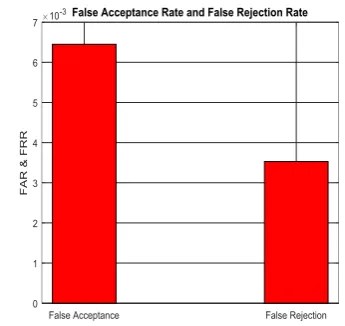
Figure 7: False acceptance rate and false rejection rate Figure 7 shows the performance measure in relations of wrongreceptiondegree and wrongrefusaldegree and shows
that error probabilities are very less to
attaingreatcorrectnessdegrees. In the above figure it can be observed that the wrongreception and wrongdenialdegrees are coming very less which indicates that the proposed system is getting false positive and false negative rates which are low error rate probabilities.
Figure 8: Recognition Accuracy
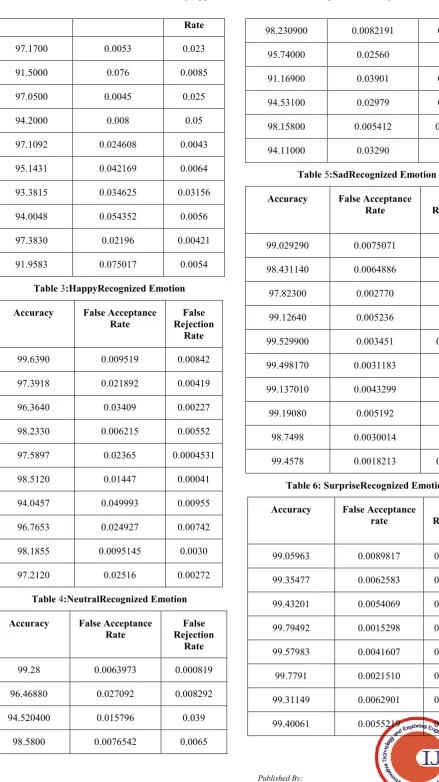
Figure 8 shows the system performance in terms of greatcorrectness rate and is achieving the average correctness of 90 above for the specificverified sample. So in the below mentioned tables we can see the performance comparison in terms of accuracies, False Acceptance Rate (FAR) and False Recognition Rate (FRR) for the different test samples. The recognition rate indicates that the proposed system is able to achieve high true positive rates and high negative rates.
Table2:AggressiveRecognized Emotion
Accuracy False Acceptance
[image:5.595.56.288.292.437.2] [image:5.595.323.525.439.606.2] [image:5.595.60.270.548.717.2]Rate
97.1700 0.0053 0.023
91.5000 0.076 0.0085
97.0500 0.0045 0.025
94.2000 0.008 0.05
97.1092 0.024608 0.0043
95.1431 0.042169 0.0064
93.3815 0.034625 0.03156
94.0048 0.054352 0.0056
97.3830 0.02196 0.00421
91.9583 0.075017 0.0054
Table 3:HappyRecognized Emotion Accuracy False Acceptance
Rate Rejection False Rate
99.6390 0.009519 0.00842
97.3918 0.021892 0.00419
96.3640 0.03409 0.00227
98.2330 0.006215 0.00552
97.5897 0.02365 0.0004531
98.5120 0.01447 0.00041
94.0457 0.049993 0.00955
96.7653 0.024927 0.00742
98.1855 0.0095145 0.0030
97.2120 0.02516 0.00272
Table 4:NeutralRecognized Emotion
Accuracy False Acceptance
Rate Rejection False Rate
99.28 0.0063973 0.000819
96.46880 0.027092 0.008292
94.520400 0.015796 0.039
98.5800 0.0076542 0.0065
98.230900 0.0082191 0.0095
95.74000 0.02560 0.017
91.16900 0.03901 0.0493
94.53100 0.02979 0.0249
98.15800 0.005412 0.00945
94.11000 0.03290 0.026
Table 5:SadRecognized Emotion Accuracy False Acceptance
Rate Rejection False Rate
99.029290 0.0075071 0.0022
98.431140 0.0064886 0.0092
97.82300 0.002770 0.0190
99.12640 0.005236 0.0035
99.529900 0.003451 0.00125
99.498170 0.0031183 0.0019
99.137010 0.0043299 0.0043
99.19080 0.005192 0.0029
98.7498 0.0030014 0.0095
[image:6.595.61.501.32.815.2]99.4578 0.0018213 0.00360
Table 6: SurpriseRecognized Emotion Accuracy False Acceptance
rate Rejection False Rate
99.05963 0.0089817 0.000422
99.35477 0.0062583 0.000194
99.43201 0.0054069 0.000273
99.79492 0.0015298 0.000521
99.57983 0.0041607 0.000041
99.7791 0.0021510 0.000058
99.31149 0.0062901 0.000595
[image:6.595.303.548.45.517.2]International Journal of Innovative Technology and Exploring Engineering (IJITEE) ISSN: 2278-3075, Volume-8, Issue-9S, July 2019
99.01935 0.0095165 0.000290
99.1311 0.008417 0.000272
From Table 2 to Table 6 the performance evaluation for the emotions are given in terms of accuracy and error rate values for different emotions. This is one of the important and beneficial results through which it can be noticed that our proposed system is able to achieve high acknowledgments in terms of high correct positive and true negative rates. Accuracy and error rate standards for different emotions have been shown. Both metrics values are proportional to each other and system has good efficiency. Values of accuracies for different emotions has been shown and the average accuracy has been found to be 95% to 98% which shows that out projected system is well efficient to detect the right emotion with high accuracy and less error rate probabilities.
V.CONCLUSIONANDFUTURESCOPE
In this research work, a facial expression recognition based on component analysis is developed. The system comprises of three major phases, which are feature extraction, feature optimization and classification. Recognition tests were achieved on the Japanese database which consists of different emotions. We have presented that feature extraction and feature optimization of facial images pooled with component analysis and gradient filtering yields an improved gratitude rate compared with traditional methods. In the experimental results obtained, technique offers better performance on different emotions.
Future work is to advance the system so that it can be acquaint with diversity of datasets and also the hybridization processes can be evolved in the feature optimization. Moreover, the presentation of the structure to real-life engineering complications will be considered.
VI. REFERENCES
1. Dixit, B. A., &Gaikwad, A. N. (2015, June). Statistical moments based facial expression analysis. In Advance Computing Conference (IACC), 2015 IEEE International (pp. 552-557). IEEE.
2. Chiranjeevi, P., Gopalakrishnan, V., &Moogi, P. (2015). Neutral face classification using personalized appearance models for fast and robust emotion detection. IEEE Transactions on Image Processing, 24(9), 2701-2711.
3. Saeed, A., Al-Hamadi, A., Niese, R., &Elzobi, M. (2014). Frame-based facial expression recognition using geometrical features. Advances in Human-Computer Interaction, 2014, 4.
4. Liu, P., Han, S., Meng, Z., & Tong, Y. (2014). Facial expression recognition via a boosted deep belief network. In Proceedings of the IEEE Conference on Computer Vision and Pattern Recognition (pp. 1805-1812).
5. Kulkarni, P. U., Bharate, V. D., &Chaudhari, D. S. (2016, March). Human emotions recognition using adaptive sublayer compensation and various feature extraction mechanisms. In Wireless Communications, Signal Processing and Networking (WiSPNET), International Conference on (pp. 515-519). IEEE.Sirovich, L., & Kirby, M. (1987). Low-dimensional procedure for the characterization of human faces. Josa a, 4(3), 519-524.
6. Mathew, D., Kumar, D. S., & James, A. P. (2015, December). Facial emotion recognisingmemristive threshold logic system. In Intelligent Computational Systems (RAICS), 2015 IEEE Recent Advances in (pp. 39-44). IEEE.
7. Said, S., Jemai, O., Zaied, M., & Amar, C. B. (2015, December). Wavelet networks for facial emotion recognition. In Intelligent Systems Design and Applications (ISDA), 2015 15th International Conference on (pp. 295-300). IEEE.
8. Hmayda, M., Ejbali, R., &Zaied, M. (2015, December). Facial emotions recognition based on wavelet network. In Intelligent Systems Design and Applications (ISDA), 2015 15th International Conference on (pp. 249-253). IEEE.
9. Chanthaphan, N., Uchimura, K., Satonaka, T., &Makioka, T. (2015, November). Facial emotion recognition based on facial motion stream generated by Kinect. In Signal-Image Technology & Internet-Based Systems (SITIS), 2015 11th International Conference on (pp. 117-124). IEEE.
10. Moore, S., & Bowden, R. (2011). Local binary patterns for multi-view facial expression recognition. Computer Vision and Image Understanding, 115(4), 541-558.
11. Barbu, T, Gabor Barbu, T. (2010). Gabor filter-based face recognition technique. Proceedings of the Romanian Academy, 11(3), 277-283.. 12. Chen, S., Sun, Y., & Yin, B. (2009, December). A novel hybrid
approach based on sub-pattern technique and extended 2dpca for color face recognition. In Multimedia, 2009. ISM'09. 11th IEEE International Symposium on (pp. 630-634). IEEE.
13. Thomas, M., Kambhamettu, C., & Kumar, S. (2008, November). Face recognition using a color subspace LDA approach. In Tools with Artificial Intelligence, 2008. ICTAI'08. 20th IEEE International Conference on (Vol. 1, pp. 231-235). IEEE.
14. Belhumeur, P. N., Hespanha, J. P., &Kriegman, D. J. (1997). Eigenfaces vs. fisherfaces: Recognition using class specific linear projection. Yale University New Haven United States.
15. Draper, B. A., Baek, K., Bartlett, M. S., &Beveridge, J. R. (2003). Recognizing faces with PCA and ICA. Computer vision and image understanding, 91(1-2), 115-137.
16. Yang, J., Zhang, D., Frangi, A. F., & Yang, J. Y. (2004). Two-dimensional PCA: a new approach to appearance-based face representation and recognition. IEEE transactions on pattern analysis and machine intelligence, 26(1), 131-137.
17. Torres, L., Reutter, J. Y., &Lorente, L. (1999). The importance of the color information in face recognition. In Image Processing, 1999. ICIP 99. Proceedings. 1999 International Conference on (Vol. 3, pp. 627-631). IEEE.
18. Vasilescu, M. A. O., &Terzopoulos, D. (2002). Multilinear image analysis for facial recognition. In Pattern Recognition, 2002. Proceedings. 16th International Conference on (Vol. 2, pp. 511-514). IEEE..
19. Dixit, B. A., &Gaikwad, A. N. (2015, June). Statistical moments based facial expression analysis. In Advance Computing Conference (IACC), 2015 IEEE International (pp. 552-557). IEEE.
20. Chiranjeevi, P., Gopalakrishnan, V., &Moogi, P. (2015). Neutral face classification using personalized appearance models for fast and robust emotion detection. IEEE Transactions on Image Processing, 24(9), 2701-2711.
21. Saeed, A., Al-Hamadi, A., Niese, R., &Elzobi, M. (2014). Frame-based facial expression recognition using geometrical features. Advances in Human-Computer Interaction, 2014, 4.
22. Liu, P., Han, S., Meng, Z., & Tong, Y. (2014). Facial expression recognition via a boosted deep belief network. In Proceedings of the IEEE Conference on Computer Vision and Pattern Recognition (pp. 1805-1812).
23. Sánchez, A., Ruiz, J. V., Moreno, A. B., Montemayor, A. S., Hernández, J., &Pantrigo, J. J. (2011). Differential optical flow applied to automatic facial expression recognition. Neurocomputing, 74(8), 1272-1282. 24. Chaudhar, M. B., &Deshmukh, R. R. (2016). Facial Expression
Recognition and Analysis. Imperial Journal of Interdisciplinary Research, 2(3).
AUTHORS PROFILE
Dr. Harjeet Singh is presently working as an Associate Professor in the P.G. Department of Computer Science, Mata Gujri College, Fatehgarh Sahib, Punjab, India. The author has published many papers in rated journals and presented papers in National and International Conferences. He is presently guiding six students for Ph.D research work .
Ms. Astha Gupta is serving as an Assistant Professor in Chandigarh group of colleges, Landran and is having 2 years of teaching experience. She has done her Masters of Technology in Information technology form Punjab Technical University. She has done her research work in key areas of Visualization of Big data using Nanocubes. She has five research papers in international journals.