International Journal of Innovative Technology and Exploring Engineering (IJITEE) ISSN: 2278-3075, Volume-8 Issue-12, October, 2019
Abstract—In real-time multimedia usage the resource allocation for the modern communication is very much needed in-order to overcome certain problems or degradation happening in the communication channels. The quality of the communication is reduced due to the TVWS (Television White Space), variable BER signal requires variable channel allocation procedures and Qos depends on the various applications. These problems in the OFDM should be corrected continuously by keeping track of channel situation so that to provide a long term video streaming in good QoS. The energy distribution for the video is high the application requirement is higher also the occurrence of multiple BER will leads to the challenging environment to control. The main objective of this paper is to enhance a Game theory based algorithm incorporated with demand optimization algorithm and scheduling algorithm for machine learning to take decision in nonlinear space, which results in a system with good channel awareness and an adaptive resource allocation process. The effect of interference due to this procedure is checked and accordingly allocations are done.
Keywords: Game theory, OFDM, Resources Allocation, Scheduling, Energy Consumption
I. INTRODUCTION
In modern structural design, optimum methods are emerged with a new design of paradigm which aims to increase the scarce radio spectrum utilization and play an important role in optimization process.For better optimization of structure genetic algorithms are used for efficient process.It is designed and developed for finding a solution among contradictory objectives. It became an important tool for strategic decision making and to review the interactions between cognitive radios for operating communication system. Cognitive radio is intended in enhance the radio frequency spectrumutilization.
It has the capability to operate the adapted contextthrough rate control, channel selection and possible power control. The best possible strategies are chosen for the techniques and the mathematical expressions are performed by using game theory [1].To achieve similar metrics or connection rate are estimated or evaluated by the utility functions. It provides a decision making process to guide the optimum process with multiple objectives and the results in optimal compliance [15].
In cooperative communication system, the bandwidth and same power of legacy wireless communication systems can
Revised Manuscript Received on August 05, 2019.
Dr. P. Shyamala Bharathi, Professor - Department of Electronics and Communication Engineering, Saveetha School of Engineering, SIMATS ,Chennai, Tamilnadu, India
Dr. M. Sujatha, Professor - Department of Electronics and Communication Engineering, Saveetha School of Engineering, SIMATS ,Chennai, Tamilnadu, India.
Dr. S. Shanthi,Professor - Department of Electronics and Communication Engineering, Saveetha School of Engineering, SIMATS ,Chennai, Tamilnadu, India.
increase the future wireless communication system data rate. The combination of cognitive radio and cooperative communication system will improve the performance of the wireless network. For efficient access of resource allocation in cooperative cognitive radio network (CRN) is vital to meet the wireless networks challenges [2], [4].
In multiple carrier frequencies the digital data are encoding using the extensive method of OFDM and for application and wideband digital communication purposes the methods are developed.At low symbol rate the conventional modulation scheme is modulated for each sub-carrier. It maintains the total data rates in same bandwidth similar to schemes. In order to achieve signal-to-noise ratio improvement the inter symbol interference, time spreading and utilize echoes are eliminated by using the interval between symbols affordable. The work process of the OFDM is shown in Fig [1].
Themeasurement spaces are obtained in a multidimensional modelwith sparse data in order to provide smooth transitions between observed values. The linearity is not defensible so this algorithm is used for the assumption issues of any regression. It generates prediction for accurate probability score of the target and required more space for model storage. In application inherent requirements are needed for considering all the conflicting design by the efficient methods of multi-objective optimization [16].
Fig.1: OFDM Work Flow
Generally orthogonal frequency – division multiplexing (OFDM) is used for resources allocation to the sub channels and it also pre-allocate the resources based on the request [6]. So it can’t take decision based on situation. Due to this bit error rate will be increased and quality of the services will be reduced by television weight noise in resource allocation. In order to overcome the issues and limitation of the existing system in this paper as new optimization and
Resource Allocation by Demand Based
Optimization and Machine
nonlinear algorithm is proposed. By this proposed work the resources are allocated as per the adaptive situation of the system. It collaborate the game theory with the scheduling algorithm to provide efficient allocation and avoid interference between channels.
The research paper is organized as follow: In Section II the survey related to the allocation of resources and the game theory process with scheduling algorithm are discussed. Section III is presented with the proposed algorithm and methods with its implementation. In Section IV, the evaluated results analysis of the performances and comparison of various algorithms are presented. Finally, conclude of the research work with its performances is in Section V.
II. RELATED WORK
In this section the related survey of controlling and resource allocation decisions is discussed for the analysis of the work to propose an algorithm to improve the performances and to overcome the limits of existing work. OFDM-Based Cognitive Radio (CR) Networks consider the methodology for a distributed resource allocation mechanism. This method allows management of resources between CR devices [15]. It takes the best problem formulation from cooperative and competitive, and provides control balances between spectral efficiency (SE) of resource allocation. The results are confirming the efficient resource utilization and practically may be used in wireless cognitive networks [7], [11].
For utilizing radio resources the cognitive radio and cooperative communication methods are capable. The system process with the same bandwidth [2] and power, in order to increases the performances of the wireless system cooperative communication system and cognitive radio are blending for performances improvement. It evolves the use of network parameters in cooperative cognitive radio network (CRN) [6], [15].
The design formulations aim is to optimizing the performance of an OFDMA ad hoc cognitive radio network through allocation of power and joint subcarrier [10]. Aside the tolerable interference made to primary networks for implementing spectrum-sharing control. A dual decomposition framework is then developed for power through put which raise the realization of distributed solutions. It requires limited cooperation among the network elements [10].
The resource allocation scheme is based on the development of the stable matching to takes the preferences of users into account [6], [13]. To improve robustness ϵ-stable resource allocation scheme is proposed. The results show the robust of the channel state information variation [3].
Orthogonal Frequency Division Multiplexing (OFDM)-based CR networks defines a mixed integer programming problem. The Signal-to-Noise Ratios (SNRs) of OFDM sub channels and the interferences are optimized with the sub channel assignment scheme. This algorithm distributes power among sub channels for optimal power allocation with a complexity of the structure exploiting problems [5], [15].
An automated planning and optimization method is proposed for throughput maximization. The non-linear multi-objective optimization is minimum the interference. It defines each cell of the resource constraints in heterogeneous traffic environment. The objective is to maximize throughput without deteriorating and equilibrium maximization. Optimal solution is subject to size, traffic and complexity constraints of the network [7].
It influences the geo location of users and idle bands to dynamic spectrum access of the users. It adapt their power transmit using game theoretic approach which is based on the condition of network it estimate the average packet error rate to satisfying the signal-to-interference-plus-noise ratio.The optimization process scheduling the energy consumption is proposed by implementing the game-theoretic energy schedule (GTES) model. The objective is to provide less peak-to-average power ratio by enhancing schedule process. The performance is evaluated based on parameters in computer-based simulations [9].
In MIMO cognitive radio network, it shares the spectrum channels with unavoidable users. Each transmitter increases its information rate while generating interference to the receivers. The each user strategy is transmitting with covariance matrix and information rate utility. Users negotiate the allocation based on the interference budget and reach the network utility with negotiating solution to maximize the optimization process [8], [12].
The bandwidth-aware localized-routing algorithm is capable of choosing the routes from the available spectrum bands [13]. A mixed-integer linear programming (MILP) is formulates the problem of the utilized process. It determines the possible pairs of the bandwidth to select the router and offers a better solution of closed optimal for performances of router. It achieve 50% utilized throughput of network.
In this paper, for better performance a new model structure is proposed by combing the Game theory using genetic algorithm andscheduling algorithm. Both are collaborate in order to show the performance of resource allocation and the efficiency of avoiding interferences and error occurrences during the communications between the users.
III. PROPOSED WORK
In this section, the process of design and development of the traffic analysis and resources allocation are presented. Based on co-operative game theory a new optimization approach algorithm is proposed in this research work. For decision making of allocation as per adaptive situation a new algorithm is proposed by collaboration of the game theory of generic algorithm with scheduling algorithm. Information loss may occur during scheduling, if it based on game theory the losses will reduce in allocating bandwidth. By this video quality is improved.
International Journal of Innovative Technology and Exploring Engineering (IJITEE) ISSN: 2278-3075, Volume-8 Issue-12, October, 2019
algorithm.In process of decision taking it is based on previous experience. In the sense of it has to be trained before collaborating it with game theory. By this it provides channel awareness so that adaptive resource allocation is made efficiently and the interference between the channels is also avoided when allocating resources. Game theory will keep tracking and give information about current status of channel. Then the decision is take place as per the proposed algorithm. It avoids the television white noise which occurs between the allocation processes.
Normally wireless system suffers from insufficient bandwidth utilization; to overcome this issue a strategic decision making of game theory is implemented using genetic algorithm. In this the users can use their spectrum any time and it enhances the efficiency of the bandwidth usage. It Share the dynamic bandwidth strategy between users and detecting the spectrum holes in PU band. The optimization problem enforces the bounds of upper and lower on available bandwidth for secondary user.
During the transmission of video the band will not be allocated correctly. As per the video frequency the allocation of band is occur with error or television white noise. These noises will losses the side carrier information. By using the proposed algorithm the losses of video is avoided by proper band allocation as per the video frequency. In training the optimization process based on the previous experimental. The components of the theory are: A Set of Players, Strategy Function and Utility Function. The implementation process of game theory considered the users as players, bandwidth channel allocation as a Strategy Function and the minimum cost for bandwidth allocation as a Utility Function.A set of Players Consider a matrix of any size and represent the primary user as row player and secondary user as column player. Strategy Function will allocated the bandwidth for each row and column players and each elements of the matrix represents the bandwidth allocation of secondary user for every combination of primary user.
In Utility Function each elements are represented and determine the minimum cost for bandwidth allocation.A utility function is formulated based on the interference under wireless networks channels.Statistical results have improved the performances by implementing the proposed OFDM algorithm. The procedure of the proposed work (Game theory withscheduling algorithm):
Step1:Consider an input matrix of the row and column players of first five columns.
Step2: Calculate power spectral density using periodogram
Step3: The threshold value are considered as 5, 10,15,20,25
Step4: Then it checkswith primary users for knowing free channels in primary users.
Step5:Save the output from each threshold values and the values are taken as target data’s.
Step6:Target data’s are trained and allocated as per the scheduling algorithm and optimization process.
Step7:The same procedure is repeated for finding insufficient bandwidth channels in secondary users.
Step8:Taking decisions (which channel is free in primary users & which channel is allocated for secondary users) and
performs actions (Allocating free channels in primary to secondary users).
Step9:In cognitive radio network, resourcechannel allocation is very complicated to find free channels in primary users in large matrix and also to allocate bandwidth for secondary users.
A. Strategy of User’s
In consumption of energy is optimized more than once in schedule users. Instead, as per the user requirement the optimization of smart meter is processed. The objective of optimizing is users’ payoff.More indeed, aims are to consume energy for maximize the users’ benefit.The objective function is to represent scheduled users’ payoffs by electricity consumption from the allocation model. The general utility function to optimize the schedule process of users for maximizes pay-off.
Wi (e1,.., e24) = Energy Value –Energy Cost (1)
B. Energy value - V(Ei)
V (Ei) represents the energy specification for users’. To normalize the value of domain between [0, 1] the function of exponential (1−𝑒−𝜔𝑋𝑖) is used. Exponential function gives a better user’s preference model. In the system each user have separate pattern of consumption, also based on its own parameter the consumption of energy schedule will changes. There will be different in value even if it has same energy value because of its habits and features. Therefore, in finding demand and response is difficult. Finally, the energy value function is defined as follows.
𝑬𝒊 = 𝒆𝒇 𝟐𝟒
𝒇=𝟏
(𝟐)
(E𝑖) = 𝑝E𝑚𝑎𝑥 (1 − 𝑒−𝜔E𝑖) (3) Where, Emax is the energy maximum to consume user. 𝜔is a parameter of energy consumption kerbing of user’s lenience. The user normally have larger value of 𝜔also have the utility with same consumption of energy.𝑝denotes the energy unit average price. The measurement of energy unit is acquiring values in monetary gain, irrespective of factors like day time, additional peak hours cost, delivery cost and so forth.
In the function of utility maximum value of one is chosen, it means that the average money to pay is not less than the consumed user value to satisfy the demand in monetary units. The utility measurement of “usefulness” from the resource availability is obtained than the agent occurs. The approach has a best agent values for different resources and the plotted functions are illustrated in Fig [2]. As per the theory of utility the functions have to satisfy characteristics as follow.
1. The function of utility should be in upper bounded: u (e) ≤ N, N>0.
2. The function should increase the values of resources and money: du (e)/dx>0.
3. The function should decrease the concave or marginal: du2 (e)/dx2 <0.
C. Energy Cost
Based on the function of energy price the energy cost is estimated. As per the real time the price will be vary at that hour of the system. During the peak hours of power using the results of the load of lower are obtained. The cost function indicates the electricity distribution at each hour by the source of energy. The load costs are differing for the same load at different times in a day. The linear functions are defined with the energy price have expressively large in difference between peak hours (on and off). For instance, the value of PAR (Peak to Average Ratio) indicates load of peak and average for entire day. Nine time differences are occur in it and the large differ provide inconvenience in tight schedules (especially in peak hours).Therefore, the energy cost of the total load is vital to inspire users’ in balancing PAR.
By the change of functions in value emphasizing of first peep might reduce the PAR for better performance of it. The function of the energy price is defined as follow:
𝐶f(𝐿f) = 𝛼 𝒆𝒇 𝑳𝒇 𝑳𝒐𝒈 𝑳𝒇+ 𝟏
𝟐𝟒
𝒇=𝟏
(4)
Where, α is denoted as price parameter. To control the consumption the parameter are manipulated to change the prices of whole day energy. As well as the differences are remain same in peak hours (on and off). By substituting the energy cost and value in the energy price the function is rewritten as
Wi(e1,..,e24)=𝑝E𝑚𝑎𝑥 (1 − 𝑒−𝜔E𝑖)–
𝛼 𝒆𝒇 𝑳𝒇 𝑳𝒐𝒈 𝑳𝒇+ 𝟏
𝟐𝟒
𝒇=𝟏
(𝟓)
D. Power allocationStrategy
Usually, for energy unit the price are fixed for day or total system consumption of energy. Based on the scheme the prices charges are differ in various companies. Therefore, average price (𝑝 – parameter)of energy is assume by the allocation model for selling it to the customers. If dynamic prices are used by the model of allocation of resources, then the total cost for the system are charged, which is equal to fixed price with same load.Generally the dynamic prices are changing according to the various factors in the function of energy price.
In proposed model, the energy prices are changes based on the total load. The price is related to (Lflog (Lf+ 1)) and define the function process as in equation 4.
Where Lfis denoted the function of load at hour and hours of the function is represented as f. Then the vector of price is denoted as C (L).
C (L) =α. (L1 log (L1+1) +…+L24 log (L24+1)) (6)
The strategy of proposed power allocation scheme is enabling to calculate the parameter of energy price, denoted by 𝛼. Finally, per day the power generates the price for different hours.The average price in the function was denoted as parameter p as in equation 3. The whole system is evaluated the functions with the same load and the dynamic prices are equal to fixed prices. The function is done as in equation 7 and 8.
𝑃 𝑳𝒇 =
24
𝑓=1
𝑳𝒇 𝑪𝒇 𝑳𝒇 𝟐𝟒
𝒇=𝟏
= 𝛼 𝒆𝒇 𝐿𝑓2 𝑳𝒐𝒈 𝑳𝒇+ 𝟏 𝟐𝟒
𝒇=𝟏
(𝟕)
Therefore the α is denoted as
𝛂 = 𝑷 𝑳𝒇
𝟐𝟒 𝒇=𝟏
𝒆𝒇 𝑳𝒇𝟐 𝑳𝒐𝒈 𝑳𝒇+ 𝟏 𝟐𝟒
𝒇=𝟏
(𝟖)
Let the number of users are denoted as N≜ N , for each
user n ∈N the total load are represented as 𝑳𝒏 𝒇
and the hours are denoted as f ∈ F ≜ {1, …, F}, where F=24 (Hours). The daily loads are indicated as 𝑳𝒇 ≜ [𝑳𝒏𝟏, …..,𝑳𝒏𝑭]. As given
below the total load is calculated.
𝑳𝒇 ≜ 𝑳𝒏
𝒇 𝐧 ∈ 𝐍 (9)
The daily peak load value level and the average load value level are evaluated across the users at each hour as follow and in order to obtain the demand of PAR better performance of the load function is performed as in equation 12.
𝑳𝒑𝒆𝒂𝒌 = 𝐦𝐚𝐱
f ∈ F 𝑳𝒇 (𝟏𝟎)
𝑳𝒂𝒗𝒈 = 𝟏
𝑭 𝑳𝒇
f ∈ F
(𝟏𝟏)
PAR = 𝑳𝒑𝒆𝒂𝒌
𝑳𝒂𝒗𝒈 =
𝐦𝐚𝐱𝐟 ∈ 𝐅𝑳𝒇 𝟏 𝑭 𝐟 ∈ 𝐅𝑳𝒇
(12)
E. Demand Game TheoreticEnergy Schedule optimization - DGTES
Based on the theory function the allocation of resources to the channel according to bandwidth availability is done. It is a statically process of allocation and evaluates the performances with the proposed method.It is a mathematical method for analyzing the evaluated process of the results circumstances and it is more accurate process in allocation process. Demand function is in quantitative terms of relationship between the price and quantity demandedand produces a linear depending process.
International Journal of Innovative Technology and Exploring Engineering (IJITEE) ISSN: 2278-3075, Volume-8 Issue-12, October, 2019
game theory, also to satisfy the demand of allocation for user request. It process to regulate the energy price and optimisation of the system by the proposed algorithm with IPM using. As well as to schedule the process as per the energy consumption of user request in allocation model.
Dx = f (Px, Py, M, T, A, U) (13)
where,Dx is a demanded Quantity X, functional relation as f, price as Px, proxies and balancing goods as Py, Mas money income of the consumer,T as taste,Aas effects of advertisement and Uasinfluences or variables of Unknown.The optimization processes are determining the vector of the function and expressed as follow:
Minimize V (E) = {V1 (E), …, V24(E)} (14)
Subject to g (e) ≤ 0
Where, V (E) represent the function and the g (e) represent the constraint vector. Generally in the optimisation process the exchange and scheduling phase are indicated. In exchange phase, the transmission process and optimizing the demand scheduling over the network with all users and it schedule with time slot of previous process (μij (t −
1)) 𝑁
𝑗 = 1, transmission vectors are (pij (t )) 𝑁 𝑗 = 1. In
scheduling phase, the optimization condition and process of the functions are performance to satisfy the demand request of users.
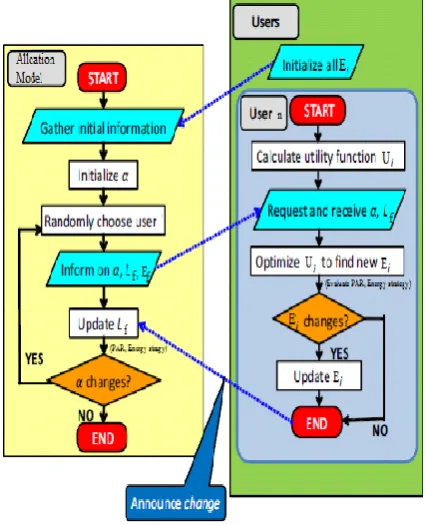
Algorithm 1: Each user Execution𝑛 ∈ 𝑁.
Step 1: Randomly initialize en and e-n. Step 2: Repeat
Step 3: At random time instances, solve issues using interior point method(IPM) and by equation 8 and 12.
Step 4: Power strategy process (Algorithm 2) Step 5: If changes in process then compare with current schedule
Step 6: Update the new solution according to en. Step 7: Broadcast the message of control function en to Energy Consumption Schedule (ECS) units across the system.
Step 8: End
Step 9: If message is received thenupdate e-n accordingly.
Step 10: End
Step 11: Until no announces of ECS unit for any new schedule.
Algorithm 2: Power control strategy
Step 1: Gather all users original schedule initialized from feasible sets
Step 2: Calculate parameter α of initial energy price, according to (8)
Step 3: Repeat
Step 4: Randomly choose user n ∈ N; User n to run,
Step 5: Begin: Receive signal from allocation model
Step 6: Request α, vector L
Step 7: User n optimizes schedule by solving the problem in (5) by using IPM
Step 8: If current schedule is compared with the enchanges Then
Step 9: Inform the new schedule vector en and Lf Step 10: End If
Step 11: End
Step 12: Update the new vector Lf from user n Step 13: Update energy price parameter α according to (8)
Step 14: Until No changes in schedule by user
IV. PERFORMANCE ANALYSIS& RESULTS In this section, the proposed algorithm is analyzed the performance and compared with various algorithm to show the improvements of the performances with efficient resource allocation and avoiding interferences between channels. Based on the ultra-high frequency the performance of the various algorithms is analyzed with the parameter PSNR. The flow of the proposed DGTES algorithm is shown in Fig [2]. The statistical results show that the proposedsystem increase the efficiency of CR system when comparetoexisting system. For evaluating PSNR for different types of bandwidth considered the carrier frequency of 12000 Hz.
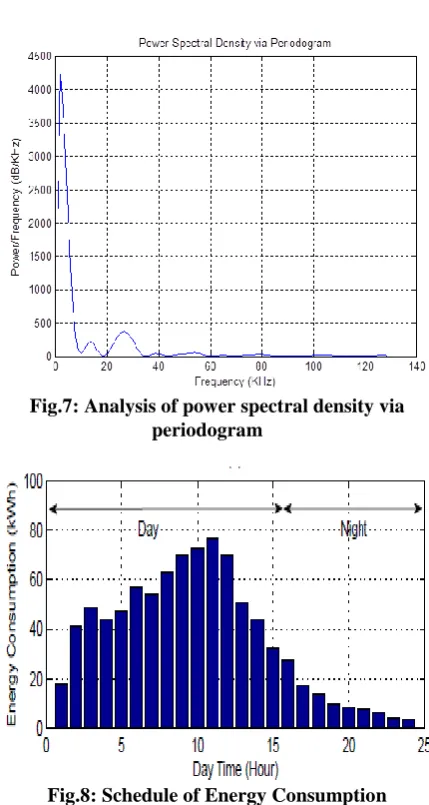
[image:5.595.325.539.409.672.2]Fig [3] shows the proposed DGTESscheme optimization; illustrate the proposed process smooth of the consumption of total energy. As per the proposed algorithm the performance is obtained as shown in Fig [4]. Fig [5] shows the PSNR values obtained from the proposed work. In Fig [6] the analysis of power spectral density and the power / frequency (dB/Hz) are measured for the frequency. The analysis of power spectral density via periodogram is shown in Fig [7].
Fig.3: Load shapes with and without scheduling
[image:6.595.61.290.207.574.2]Fig.4: Comparison analysis of OFDM algorithm
Fig.5: Analysis of PSNR values for various bandwidth
Fig.6: Analysis of power spectral density
Fig.7: Analysis of power spectral density via periodogram
Fig.8: Schedule of Energy Consumption
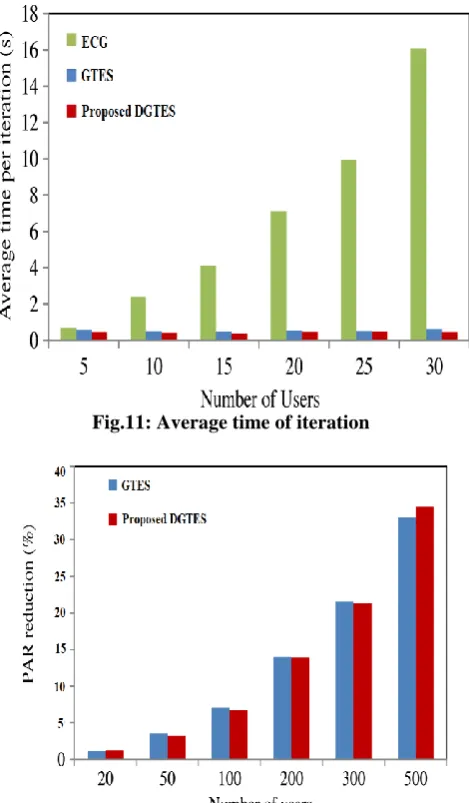
[image:6.595.314.551.559.713.2]Fig [8] shows the consumption of the energy for each hour in a day and Fig [9] shows the number of iteration for different users with comparison of various scheduling algorithm. Fig [10 and 11] shows the comparisons of various schemes running time and the average time for different users. The reduction of PAR percentage of the various schemes and the performance of proposed smooth process of PAR ratio is shown in Fig [12].
[image:6.595.62.298.610.765.2]International Journal of Innovative Technology and Exploring Engineering (IJITEE) ISSN: 2278-3075, Volume-8 Issue-12, October, 2019
[image:7.595.312.540.112.376.2]Fig.10: Running time comparison for different users
Fig.11: Average time of iteration
Fig. 12: PAR Reduction for different users
The cost functions are calculated with the common function as follow, which process in cost functions of constraints to evaluate the functions of constrains of schedule.Fig [13] shows the results of overlays of cost functions in a day for each hour. The previous hours areindicated with blue lines later the red lines. The purple lines indicate the usage of electrical in peak hours(15-20). Theload difference of average and peak are analyzed and the
schedule of energy consumption predicts the prices for estimation and consume of power to satisfy the users request.
αf = (For hour the total Load – Average Load) /(Hourly Load)
βf= (For hour the total Load– Average Load)/ (Hourly Load)
af = [1.9 + 0.75αf] *10-5 bf = [1 + 100βf] * 10-5
y = af*x^2 + bf*x (each hour f)
Fig.13: Over lays of cost function for each Hours
V. CONCLUSION AND FUTURE WORK In current communication system the flexible resource allocation with fast process and avoiding the interferences between channels is a complex process. In order to overcome the limits of the existing system and to avoid noise in communication process, a new collaborating system is proposed to improve the performance than the existing system. The proposed system provides a better quality of services, reduce the error occurrence in transmit and receiving of bandwidth allocation, avoid interferences between channels. Finally provide better resource allocation of bandwidth for the users.Numerical results show the improvement in the performance when compare with other OFDM algorithm. The evaluation of energy consumption demand schedule process provide with less noise and better performance than the existing scheme.
[image:7.595.58.293.250.652.2]VI. REFERENCES
1. Al Rawi, A.F.; Aissa, S.; Tsimenidis, C.C.; Sharif, B.S., "Game Theoretic Framework for Future Generation Networks Modelling and Optimization," Wireless Communications, IEEE Transactions on , vol.13, no.3,
pp.1153,1163, March 2014 doi:
10.1109/TWC.2014.012314.120977
2. Li Yu, Cong Liu, Wenwu Zhu, ShaHua and Wei Wang, “Bandwidth Efficient and Rate-Adaptive Video Delivery in TV White Space”, IEEE Transactions on Circuits and Systems For Video Technology, Vol. 24, No. 9, September 2014, DOI 10.1109/TCSVT.2014.2310135 3. Lu Lu; Dawei He; Xingxing Yu; Li, G.Y., "Graph-based
robust resource allocation for cognitive radio networks," Acoustics, Speech and Signal Processing (ICASSP), 2014 IEEE International Conference on , vol., no.,
pp.7298,7302, 4-9 May 2014 doi:
10.1109/ICASSP.2014.6855017
4. Naeem, M.; Anpalagan, A.; Jaseemuddin, M.; Lee, D.C., "Resource Allocation Techniques in Cooperative Cognitive Radio Networks," Communications Surveys & Tutorials, IEEE , vol.16, no.2, pp.729,744, Second Quarter 2014 doi: 10.1109/SURV.2013.102313.00272 5. Parzy, M.; Bogucka, H., "Coopetition Methodology for
Resource Sharing in Distributed OFDM-Based Cognitive Radio Networks," Communications, IEEE Transactions on , vol.62, no.5, pp.1518,1529, May 2014 doi: 10.1109/TCOMM.2014.031214.130451
6. Rawat, D.B.; Shetty, S.; Raza, K., "Game Theoretic Dynamic Spectrum Access in Cloud-Based Cognitive Radio Networks," Cloud Engineering (IC2E), 2014 IEEE International Conference on , vol., no., pp.586,591, 11-14 March 2014 doi: 10.1109/IC2E.2014.16
7. Tung Thanh Le; Dong-Seong Kim, "An efficient throughput improvement through bandwidth awareness in cognitive radio networks," Communications and Networks, Journal of, vol.16, no.2, pp.146,154, April 2014 doi: 10.1109/JCN.2014.000025
8. Yanqing Liu; Liang Dong, "Spectrum Sharing in MIMO Cognitive Radio Networks Based on Cooperative Game Theory," Wireless Communications, IEEE Transactions on , vol.13, no.9, pp.4807,4820, Sept. 2014 doi: 10.1109/TWC.2014.2331287
9. Fadlullah, Z.M.; Minh Quan Duong; Kato, N.;
Stojmenovic, I., "A novel game-based demand side management scheme for smart grid," Wireless Communications and Networking Conference (WCNC), 2013 IEEE , vol., no., pp.4677,4682, 7-10 April 2013. doi: 10.1109/WCNC.2013.6555332.
10. Shaowei Wang, MengyaoGe and Chonggang Wang,
“Efficient Resource Allocation for Cognitive Radio Networks with Cooperative Relays”, IEEE JOURNAL ON SELECTED AREAS IN COMMUNICATIONS, VOL. 31, NO. 11, NOVEMBER 2013. Doi: 10.1109/JSAC.2013.131128
11. DuyTrong Ngo; Le-Ngoc, Tho, "Distributed Resource Allocation for Cognitive Radio Networks With Spectrum-Sharing Constraints," Vehicular Technology, IEEE Transactions on , vol.60, no.7, pp.3436,3449, Sept. 2011 doi: 10.1109/TVT.2011.2157845
12. KaramaHamdi, Wei Zhang and Khaled Ben Letaief, “Opportunistic Spectrum Sharing in Cognitive MIMO Wireless Networks”, IEEE TRANSACTIONS ON WIRELESS COMMUNICATIONS, VOL. 8, NO. 8, AUGUST 2009 doi: 10.1109/TWC.2009.080528 13. Niyato, D.; Hossain, E., "Cognitive radio for
next-generation wireless networks: an approach to
opportunistic channel selection in ieee 802.11-based wireless mesh," Wireless Communications, IEEE ,
vol.16, no.1, pp.,, February 2009 doi:
10.1109/MWC.2009.4804368
14. I.A.Ismail ,N.A.El_Ramly , M.M.El_Kafrawy , and M.M.Nasef, “Game Theory Using Genetic Algorithms”, Proceedings of the World Congress on Engineering 2007 Vol I WCE 2007, July 2 - 4, 2007, London, U.K. 15. Khaled Ben Letaiefm and Wei Zhang, “Cooperative
Communications for Cognitive Radio Networks” Proceedings of the IEEE | Vol. 97, No. 5, May 2009 doi: 10.1109/SURV.2014.021414.00066