DETERMINANTS OF EFFECTIVE SUPPLY CHAIN MANAGEMENT PERFOMANCE
IN ROAD CONSTRUCTION PROJECTS IN KENYA
,:"
BACKSTONE OTIENO ANG' ANA
Reg No.
D53/CTYIPT/20914/2010)
A Research Project report Submitted in Partial Fulfillment of the requirements for the
award of Degree in Masters of Business Administration (Project Management Option) in
the School of Business, Department
ofManagement Science, Kenyatta University.
Ang'ana, Backstone Determillants of effective supply
1111111~IIIIIIIIIIIII:~ \I ~III!I ~IIIII\IIII! 11111I~I~II 2011/410405 rvovemner, 2U12
DECLARATION
This research report is my original work and it has not been presented in any university for examination or anyother credit.
SIGN:.~ .
Backstone O. Ang'ana
~~} )1
lJi..
DATE: .
This research report has been submitted for examination with our approval as the University Supervisors.
aL ,
SIGN: ~ . DATE
.
3D)
,,1aJ>//l-
.Gladys Kimutai
Lecturer
Management Science Department School of Business
Kenyatta University
SIGN: . DATE: .
This research project has been submitted for examination with my approval as the Chairperson,
~:~~~~.~~~.
~.~~~~.~~.
~~~.
~~
~:
.Ms. Gladys Kimutai
Chairperson
Management Science Department
School of Business
Kenyatta University
ab/" f~/'\,
DATE: .
DEDICATION
ACKNOWLEDGEMENT
I wish to express my thanks and gratitude to my supervisor Gladys Kimutai for the guidance and advice through the proposal preparation period. I am truly indebted.
Further, I wish to acknowledge my appreciation to the other teaching staff Dr. Muathe S.M.A, Ms Lucy Kamau, Dr. Kihato Wamburu, Mr. 1.Mungai among others for their tireless help and guidance during the entire course.
I also feel indebted to my colleagues Robin Mbae among others for giving me moral support during the research, and the whole course.
Ialso wish to thank my employer for allowing me to use the office and giving me sufficient time to concentrate on these studies. Above all, I thank God for giving me the strength to sail through the study.
T ABLE OF CONTENTS
DECLARATION ii
ACKNOWLEDGEMENT iv
OPERATIONAL DEFINITION OF TERMS x
CHAPTER ONE:INTRODUCTION
l
1.1 Background to the Study 1
1.2 Statement of the Problem 5
1.3 Research Objective 6
1.4 Research Questions 7
1.5 Significance of the Study 7
1.6 Scope of the Study 8
1.7 Limitation and Assumptions ofthe Study 8
CHAPTER TWO: LITERATURE REVIEW 9
2.1 Introduction 14
2.2 The Concept of Supply Chain Management 9
2.3 Project Management : 14
2.4 The Role of Supply Chain Management.. 22
2.4.1 'Long term relationships 23
2.4.2 Concurrent engineering 23
2.4.3 Strategic purchasing 23
2.4.4 Supply Chain Management Performance 24
2.5 Determinants of Supply Chain Management Performance 24
2.5.1 Information and Communication Technology 25
2.5.2 Materials Flows Management 26
2.5.3 Supplier and Customers Relationships 27
2.5.4 Strategic Alliances 28
2.6 Conceptual frame work 29
CHAPTER THREE: RESEARCH METHODOLOGY 29
3.1 Introduction 30
3.2 Research Design 30
3.3 Study Population 30
3.4 Sampling Technique and Sample Size 30
3.5 Data collection and procedure 32
3.6 Data Analysis and Presentation 32
CHAPTER FOUR: DATA ANALYSIS AND RESEARCH FINDINGS 33
CHAPTER FIVE: SUMMARY, CONCLUSIONS AND RECOMMENDATIONS 33
5.1Summary 47
5.2 Conclusion 50
REFERENCES 56
Appendix I RESEARCH QUESTIONNAIRE 56
Appendix 11RESEARCH BUDGET 56
Appendix IIIRESEARCH WORKPLAN 56
Appendix.IV LIST OF COMPANIES 56
List of figures
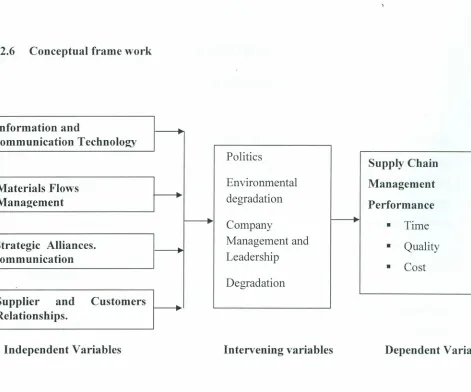
Figue 2.2; Conceptual Framework --- 29
Figure 4.1: Proportion of gender... 34
Figure 4.2: Position of respondents... . 35
Figure 4.3 Education level of respondents 37
Figure 4.4 Respondents' opinion on whether project implementation time 39
Figure 4.5 Status of costs incurred 41
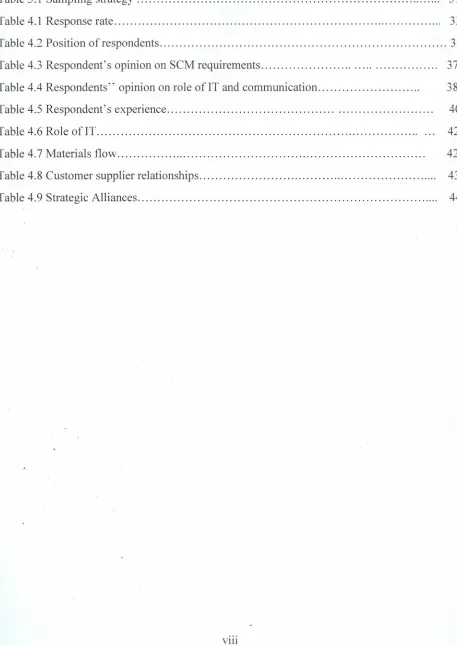
List of Tables
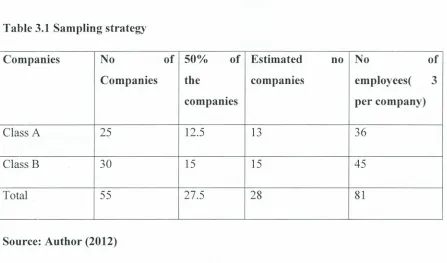
Table 3.1 Sampling strategy.... .. . .. ... . ... . .. . .... . ... .... ... . . . .. . . 31
Table 4.1 Response rate... 33
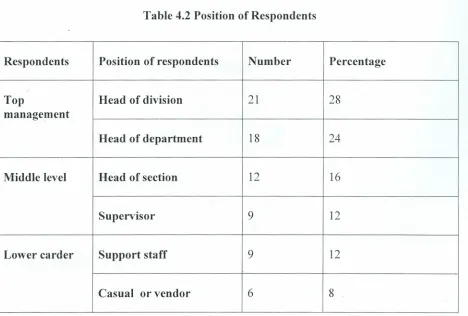
Table 4.2 Position ofrespondents 35
Table 4.3 Respondent's opinion on SCM requirements... .. 37
Table 4.4 Respondents" opinion on role of IT and communication... 38
Table 4.5 Respondent's experience... 40
Table 4.6 Role of IT. 42
.Table 4.7 Materials flow... 42
Table 4.8 Customer supplier relationships... 43
Table 4.9 Strategic Alliances... 44
SCM
JIT
SCEM
SRM
CRM
CSM
CDM
CSCMP
PM
WBS
PRiSM
LIST OF ABBREVIATIONS
Supply chain management
Just in time management
Supply chain event management
Suppliers relations management
Customer relations management
Customer service management
Customer demand management
Council of supply chain management professionals
Project Management
Work Breakdown Structure
OPERA TIONAL DEFINITION OF TERMS
A Project is a temporary endeavor undertaken to create a unique product, service or result
according to Project Management Institution, (2004) or a value creation undertaking based on a
specific mission, which is completed in a given or agreed timeframe and under constraints,
including resources and external circumstances according to Project Management Association of
Japan, (2005)
Project Management IS a dynamic process that utilizes the appropriate resources of the
organization in a controlled and structured manner to achieve some clearly defined objectives
identified as strategic needs. It is always conducted within a defined set of constraints (Trevor,
2008)
Project Life Cycle is the fundamental processes undertaken to complete a project which include
initiation/conception, definition, planning, launch/execution, closure and post-project evaluation
(Trevor, 2008).
Project implementation is an application, execution of an idea, plan, design, and policy. It is a
process where all the proper planned activities are put into action (Rosario, J.G., 2000).
ABSTRACT
This study aimed at assessing the determinants of supply chain management performance in road
construction projects in Kenya. For the purpose of this study the researcher aimed at establishing
a conceptual model linking the relationships with customers and suppliers, information and
communication technology, materials flows management, strategic alliances and SCM
Performance. There were many elements that determine project success, but the focus of this
study was on three critical project parameters or performance i.e. time, cost and quality. The
main objective of the study was to determine factors that affect Supply Management
performance in the road construction projects in Kenya. The scope of the research was road
construction contractors and other agencies in the road construction industry in Kenya. The
populations were staff of the road contractors. This research study adapted a descriptive survey
design and employed simple and stratified random sampling. The research was conducted using
data that is both qualitative and quantitative data. Structured and unstructured questionnaires
were used to collect data from the road construction companies. 81 questionnaires were
distributed and 75 were returned. A bigger percentage ofthe companies identified materials flow
and information technology as the key driver in supply chain management of road construction
companies. Other indicators that influenced implementation included strategic alliances, training
and adoption of appropriate technologies for the road projects. The road construction was also
found to be male dominated and characterized by excess costs and exceeded time limits. Based
on these findings, road project implementers need to find ways to adjust road construction with
modem supply chain requirements in order to reduce on duration, quality and costs arising from
SCM logistics. The researcher recommends that companies should utilize web based
technologies and enter into a price commitment contract with their suppliers to guarantee a
certain long-term prices. Further integration of IT and communication into road projects is also
CHAPTER ONE
INTRODUCTION
1.1 Background to the Study
Themanagement of Road construction projects requires knowledge of modern management
as well as an understanding of the design and construction process. Brent Williams, Wesley
S. Randall, Rodney Thomas, (2010) in their research paper "An inventory of theory in
logistics and SCM research", observed that Construction projects have a specific set of
objectives and constraints such as a required time frame for completion. While the relevant
technology, institutional arrangements or processes will differ, the management of such
projects has much in common with the management of similar types of projects in other
specialty or technology domains such as aerospace, pharmaceutical and energy
developments.
Generally, project management IS distinguished from the general management of
corporations by the mission-oriented nature of a project. A project organization will generally be terminated when the mission is accomplished (Womack et al. 1990). Project management is the art of directing and coordinating human and material resources
throughout the life of a project by using modern management techniques to achieve
predetermined objectives of scope, cost, time, and quality and participation satisfaction.
By contrast, the general management of business and industrial corporations assumes a
broader outlook with greater continuity of operations (Scannel & Monczka, 2000).
Nevertheless, there are sufficient similarities as well as differences between the two so that
modern. management techniques developed for general management may be adapted for
project management. Specifically, project management in construction encompasses a set of
objectives which may be accomplished by implementing a series of operations subject to
resource constraints. There are potential conflicts between the stated objectives with regard
to scope, cost, time and quality, and the constraints imposed on human material and financial
resources. These conflicts should be resolved at the onset of a project by making the
necessary tradeoffs or creating new alternatives.
Subsequently, the functions of project management for construction generally include , Specification of project objectives and plans including delineation of scope, budgeting, scheduling, setting performance requirements, and selecting project participants, Maximization of efficient resource utilization through procurement of labor, materials and equipment according to the prescribed schedule and plan, implementation of various operations through proper coordination and control of planning, design, estimating, contracting and construction in the entire process and development of effective communications and mechanisms for resolving conflicts among the various participants.
Supply chain management (SCM) is the management of a network of interconnected business involved in the ultimate provision of product and service packages by end customers; Harland, (1996).Supply chain management spans all movement and storage of .raw materials, work in progress inventory, and finished goods from point of origin to point of consumption. Supply chain management (SCM) is a concept originating from the supply system by which Toyota was seen to coordinate its supplies, and manage its suppliers (Womack et al. 1990).In terms of lean production, SCM is closely related to lean supply (Lamming 1996).
Supply chain has been defined as 'the network of organizations that are involved, through upstream and downstream linkages, in the different processes and activities that produce value in the form of products and services in the hands of the ultimate customer'(Christopher 1992).SCM looks across the entire supply chain, rather than just at the next entity or level, 'and aims to increase transparency and alignment of the supply chain's coordination and
configuration, regardless of functional or corporate boundaries (Cooper and Ellram 1993).
relationship with suppliers is inflexible as suppliers impose restricted conditions to the
company such as conditions of non-cancelable, non- rescheduling and non-returnable.
There is also lack of integrated software and system, both inside and outside the company.
Some of the suppliers are unable ta access the companies supplier portal because they have
incompetent technology. Key supply chain management operations like customer
satisfaction, product quality, delivery precision, capacity constraint and manpower issue are
not being measured on timely basis, likewise the flow of material in the company may be
jeopardized by the high inventory and unreliable delivery of materials and goods.
The generic methodology offered by SCM contributes to better understanding and Resolution
of basic problems in construction supply chains, and gives directions for Construction supply
chain development. The practical solutions offered by SCM, however, have to be developed
in construction practice itself, taking into account the specific characteristics and local
conditions of construction supply chains
Supply Chain Management in Road Construction Industry in Kenya
Supply chain management (SCM) approach is progressively recognized by many
organizations as a strategy to attain their business goals today (chin, et al., 2004). It has
become one of the new era manufacturing padagrims for organizational sustainability and
competitiveness. Many companies in the road construction industry in Kenya have truly been
striving hard to achieve superior supply chain performance in order to outperform its
competitors. Enhancing supply chain performance is critical approach for achieving
competitive advantages for companies (Womack et al. 1990).
Statistical figures show that main contractors are purchasing more labor and material than
previously, According to 2004 statistics by the Ministry of Planning, in the Kenyan
construction industry, the main contractors share in the total national turnover had increased
by 24%. Thus suppliers and sub contractors represented 75% of turnover. Currently this is
expected to be more. Consequently, the main contractors become more and more reliant on
other actors in the construction supply chain (suppliers and subcontractors). Therefore, they
need to revise their supply chain strategies and trading relations with suppliers and
subcontractors.
According to the Central Bureau of Statistics, the construction industry in Kenya contributes
7 %,of the gross domestic product (GDP). Kenya's current Road Network inventory is
estimated at 177,500km comprising 63,000km classified roads and 114,500km of
unclassified roads administered by various government departments. Roads have long been
considered as the prime communication link between all economic sectors and the citizenry
in Kenya. Indeed, roads account for over 80% of Kenya's total passenger and freight
transportation, as well as value of output. K'Akumu, Owiti A. (2007) Construction statistics
review for Kenya.
The Road construction industry in Kenya is very important for the Kenyan economy;
contributing 5 per cent of the country's gross domestic product (GDP) and employing more
than one million people. According to report by Kenya National Bureau of Statistics
(KNBS), the economy of Kenya grew by 4.9 per cent in the first quarter of 2011 due to the
improved productivity in the construction industry. KNBS reported that the Road
construction industry added Sh12.6 billion to the country's GDP in Q1 2011 supported by the
massive road infrastructure projects currently under way across the county.
The construction boom was also reflected in cement consumption which rose to 779.3
million tones up from 667.1 million tones consumed in Ql 20l0.Thanks to the rapidly
expanding population, the construction industry in Kenya is expected to expand further as
investors rush to meet increasing demand for decent housing. Opportunities for investment
are immense particularly in the manufacture and supply of construction materials and
comporients, construction of middle and lower income housing as well as in the area of
upgrading informal settlements.
Construction supply chains are still full of waste and problems caused by myopic control.
Comparison of case studies with prior research justifies that waste and problems in
construction supply chains are extensively present and persistent, and due to interdependency
largely interrelated with causes in other stages of the supply chain. The characteristics of the
well hinder the application of SCM to construction. Previous initiatives to advance the construction supply chain have been somewhat partial.
1.2 Statement of the Problem
Studies carried out by the World Bank report on infrastructural projects in Kenya indicate that serious concern has been expressed about public projects that have been abandoned in various parts of the country, after huge financial mobilizations. Most of the projects are in the Road construction industry and sometimes funded by the foreign agencies. Various factors have been adduced for this unhealthy scenario, the most notable being poor project analysis and management. Another problem facing the sector include phenomenal increase in prices .of the inputs 'occasioned by dearth of building material locally, and difficulties in importation
of foreign alternatives.
An efficient supply chain management m an organization contributes immensely on the performance of the organization. Road construction projects are one of the industries that require supply chain management (SCM) to optimize its operations. Road construction projects entails carrying out feasibility studies, preparing designs for the roads, procurering the contractors to execute the works, and monitoring and supervision of the projects. The researcher aims at establishing a conceptual model linking the relationships with customers and suppliers, information and communication technology, materials flows management, strategic alliances and SCM Performance.
This will provide important implications for the management of the road construction companies to understand determinants that contribute to the supply chain success. The organizations can then enhance the SCM performance by improving. . current practices/strategies through focusing on the determinants that significantly influence supply chain performance. Statistical figures show that main contractors are purchasing more labor and material than previously. For instance, in 1994, in Kenya's construction industry (i.e. residential, commercial, roads and industrial building), the main contractors' share in the total national turnover had decreased to 24% (the contactor, 2010). Thus, suppliers and subcontractors represented about 75% of turnover. Currently, this is expected to be more.
Construction Kenya, a premier source for Kenya building and construction information, is
predicting the growth rates based on projects to increase during the next decade, fueled by
the rise in population and government spending on major infrastructure projects around the
country. Despite the slowdown in the world economy in 2009, the Kenyan construction
sector remained buoyant as reflected in the increased investment in both infrastructures,
residential and commercial buildings during the year. Consequently, main contractors
become more and more reliant on other actors in the Construction supply chain (e.g.,
suppliers and subcontractors). Therefore, they need to revise their supply strategies and
trading relations with subcontractors and suppliers.
The road construction industry has a very low absorption capacity added to shortage of well
.trained indigenous manpower required to plan, manage, and to execute contracts awarded to
them. As the firms resort to improvise, they experience frequent incidences of wastage and
pilfering. Reports indicate on the average, wastefulness, pilfering and other factors accounted
for about 2.5 %of 15% in Kenya. The sector has not been accorded meaningful research and
development (R&D) attention, despite the crucial place it occupies in the economy. It is this
light that the study is considered timely and appropriate. The researcher aims at presenting
how Information and communication Technology, Materials Flows Management,
Relationships with Customers and Suppliers, and Strategic Alliances determines the
effectiveness of supply chain management in road construction projects in Kenya. Thus, the
goal of this study was to establish key SCM enablers all of which must be leveraged for
supply chain management to be effective in the road construction projects industry in Kenya.
1.3 Research Objective
General objective
The research objective was to establish the determinants of effective supply chain
management performance in the road construction projects in Kenya.
Specific objective
The specific objectives of the study were;
1. Determine how Information and communication Technology affects Supply chain
2. Establish to what extend does Materials Flows Management affects Supply
Management performance in the road construction projects in Kenya.
3. Determine how supplier and customer relationships affect Supply chain performance
in the road construction projects in Kenya.
4. Determine the effects of Strategic Alliances on Supply chain performance in road
construction projects.
1.4 Research Questions
The research was guided by the following research questions;
1. What is the influence of Information and communication Technology on SCM
performance in road construction projects in Kenya?
, 2. How does Materials Flows Management affect SCM performance ill road
construction projects?
3. How do suppliers and customer relationships affect SCM performance ill road
projects?
4. What is the effect of Strategic Alliances on SCM performance
in
road constructionprojects?
.1.5 Significance of the Study.
The results of the study will act as a source of information for consultants, contractors &
construction companies and the Government agencies that are involved in the road
construction sector in making better use of its content either to improve on the internal their
performance of or institute measures and build capacity that would be able to influence their
actions in different ways. The study is of paramount importance to academicians and
practitioners as the proposed framework is expected to uncover many neglected relationships
that are ~f interest to managers.
In
addition, specific patterns of SCM practices would also berevealed which would further encourage managers to implement this technique and possibly
improve both SCM and organization performance. The study can also be seen as an answer
to the call for research seeking more investigation into the relationship of strategic
purchasing with supply management concept.
The research would be handy in helping to determine measures that may be taken to improve
on the performance of the staff of construction companies especially with regard to the
management of the supply chain. The study has provided researchers with literature to be
reviewed and form a basis upon which further studies on Supply Chain Management
practices could be done.
1.6 Scope of the Study
The researcher restricted himself to road construction companies (organizations), consulting
firms involved in the road construction sector and the government agencies concerned with
the road construction industry in Kenya. The study focused on departments of purchasing,
planning, logistics and operations of the selected organizations. These departments are
directly involved in supply chain activities of any given organizations.
1.7 Limitation and Assumptions of the Study '.. ,
Perhaps the most serious limitation of the study will be its focus on the road construction
sector, thus precluding the generalization of findings to other construction sectors of the
industry and other sectors that may benefit from the benefit of a sound supply chain
management strategy. Its also assumed that the questionnaire will be responded to
appropriately .An assumption is also made that difficulties will not be encountered III
reaching some staff as majority of them move from one station to another more frequently
and that there will be cordial cooperation and that suspicion by some of employees during
CHAPTER TWO
LITERA TURE REVIEW
2.1 Introduction
In this chapter, the researcher reviews literature that has been found useful in investigating on
the determinants of effective supply chain management performance in the road construction
projects and how to integrate the supply chain management practices adopted by an
organization .This chapter will also review literature on how supply chain management
affects performance both directly and also indirectly.
, 2.2 Concept of Supply Chain Management
SCM is a concept that has originated and flourished in the manufacturing industry. The first
signs of SCM were perceptible in the JIT delivery system as part of the Toyota Production
System (Shingo 1988). This system aimed to regulate supplies to the Toyota motor factory
just in the right - small - amount, just on the right time. The main goal was to decrease
inventory drastically, and to regulate the suppliers' interaction with the production line more
effectively.
After its emergence in the Japanese automotive industry as part of aproduction system, the
conceptual evolution of SCM has resulted in an autonomous status of the concept in
industrial management theory, and a distinct subject of scientific research, as discussed in
literature on SCM Along with original SCM approaches, other management concepts (e.g.,
value chain, extended enterprise) have been influencing the conceptual evolution towards the
present' understanding of Scamming a way, the concept of SCM represents a logical
continuation of previous management developments (Van deer Veen and Robben 1997).
Although largely dominated by logistics, the contemporary concept of SCM encompasses
more than just logistics (Cooper et al. 1997). Actually, SCM is combining particular features
from concepts including Total Quality Management (TQM), Business Process Redesign
(BPR) and JIT (Van derVeen and Robben1997). SCM offers a methodology to relieve the
myopic control in the supply chain that has been reinforcing waste and problems.
iB
RA'R\J
,
'
Supply chain management performance is defined as the multiple measures of performance
developed by the organization to gauge the ability of a supply chain to meet an
organization's long-term and short-term objectives (Wade et al., 1996). The basic concept of SCM includes tools like Just-In-Time delivery (JIT) and logistics management.
The current concept of SCM is somewhat broader but still largely dominated by logistics.
Until now, in construction, initiatives belonging to the domain of SCM have been rather
partial covering a subset of issues that include transportation costs in a limited part of the
construction supply chain and the construction site. In most cases, the issues are regarded
from a main contractor's point of view. According to some authors, Cooper and Ellram,
1993, the shift from traditional ways of managing the supply chain towards SCM includes
various elements The traditional way of managing is essentially based on a conversion (or
Transformation) view on production, whereas SCM is based on a flow view of production.
The conversion view suggests that each stage of production is controlled independently,
whereas the flow view focuses on the control of the total flow of production (Koskela 1992).
The definition put forward by the American professional of supply chain is that supply chain
encompasses the planning and management of all activities involved in sourcing,
procurement, conversion and logistics management activities. It also includes the crucial
elements of coordination and collaboration with channel partners, which can be suppliers,
intermediaries, third party service providers and customers. In essence, supply chain
integrates supply and demand management within and across companies. An integrated
supply chain has a clear advantage on the competitiveness of an organization.
The importance of better tracking of products, logistics, improved efficiency, fast tracked
quotation and ordering, improved customer relations; better control of suppliers, adequate
resource scheduling and aggregate planning of activities has been repeatedly reported as
major milestones in supply chain management. In all of those efforts, strategic planning for
organizations has an integrate role. Most organizations purchase materials and parts through
purchase orders .regularly required items are frequently purchased in advance and stocked in
the organizations warehouses, while other less frequently used items are not stocked and
Many organizations also use blanket orders and annual pre negotiated contracts for recurring
material and services requirements, large organizations generally have a centralized
purchasing function. Supply chain event management (SCHEM) is a consideration of all
possible occurring events and folders that can cause a disruption in supply chain .with
SCHEM possible sceneries can be created and solutions can be planned .some experts
distinguish SCM and logistics whole others consider the terms changeable. According to
hurricane scholar Douglas.T, (2000) SCM encompasses the planning and management
activities involved in sourcing, procurement, conversion and logistics management activities.
Importantly it also includes coordination and collaboration with channel partners,
intermediaries, third party service providers and customers. In essence SCM Integrates
supply and demand management within and across organizations. Supply chain management
has crossed over from being a narrow management function to being a key differentiating
function. The success of an organization hinges on a different set of criteria, where every
organization is racing to get the right product to the right place at the right time and at the
right cost. The methods of pipeline mapping (Scott and Westbrook 1991), supply chain
modeling (Davis 1993) and logistics performance measurement (Lehtonen 1995) analyze
stock levels across the supply chain.
The LOGI method (Luhtala et a1. 1994, Jahnukainen et a1.1995) studies time buffers and
controllability problems of the delivery process. Supply chain costing (La Londe and Pohlen
1996) focuses on cost buildup along the supply chain. Integral Methods like value stream
mapping (Hines and Rich 1997, Jones et a1. 1997) and process performance measurement
(De Toni and Tonchia 1996) offer a "toolbox" to analyze various issues including lead-time
and quality defects. In order to achieve a competitive advantage, supply chains need to be
managed appropriately (Bode, Wagner,Petersen & Ellram, 2011; Francois & Gilles, 2005;
Salvador, Forza, Rungtusanatham & Choi, 2001; Scannel,Vickery &Droge, 2000).
The set of practices developed by an organization to effectively manage the functioning of a
supply chain are known as supply chain management practices (Li, Nathan,B., Nathan,T., &
Rao, 2006). An extensive literature review was carried out to identify different dimensions of
the supply chain management practices. The rationale used in the study followed the
selection of supply chain management practices whichcover both the upstream and
downstream sides of the supply chain (Celtek & Kaynak, 1999; Li et al., 2005).Despite the
increasing amount of attention paid to Supply chain management (SCM) practices by
practitioners and academicians (Donlon, 1996; Malik, Niemeyer & Ruwadi, 2011;
Tracey, Lim & Vonderembse, 2005) failures in effectively implementing SCM practices still
exist (Handfield, Krause, Scannel & Monczka, 2000; Handfield & Nichols, 1998; Moberg,
Speh, & Freese, 2003). One of the main reasons for the failure to successfully implement SCM can be attributed to the fact that there is lack of agreement between researchers as to
what constitutes the critical dimensions of SCM (Chen & Paulraj, 2004a, 2004b; Donlon,
1996; Lambert, Dastugue, & Croxton, 2005; Li, B.Nathan, R.Nathan & Rao, 2005; Min &
Mentzer, 2004; Tan, Lyman &Wisner2002). Secondly, studies at some point in their analysis
clearly mention the need to interlink the SCM dimensions and the firm performance (Donlon
1996; Lambert, Chen & Paulraj, 2004a, 2004b; Li, B.Nathan,R.Nathan & Rao, 2005; Tan et
al., 2002).
Researchers have typically not addressed this issue. Third, supply chain is complex entity
which consists of various echelons, for instance, suppliers, manufacturers, distributors and
consumers (Beamon, 1999). Challenges exist in terms of identifying appropriate performance
measures for the analysis of supply chain (Arzu Akyuz, & Erman Erkan, 2010; Beamon,
1999). Researchers have thus far been content in limiting their choice of performance
measures. For instance, Cohen and Lee (1988) consider cost as an important measure of
supply chain management performance. Customer responsiveness has also been recognized
as an important dimension of SCM performance (Christy & Grout, 1994). In addition, Lee
and Burlington (1993) identify supply chain flexibility as an important measure of SCM
performance.
Studies have generally ignored the complexity in levels of supply chain and fail to
completely characterize the supply chain system (Beamon, 1999). In order to capture the
construct of performance measure, all the different dimensions of SCM performance need to
be considered simultaneously. In addition, it is recognized that since SCM has firm level
implications and it becomes imperative to measure effects of SCM performance on
question about which dimensions of SCM are distinctly related to supply chain performance and finally to firm performance has largely gone unnoticed (Ansoff & Sullivan, 1993;
Bechtel & Jayaram, 1997; Chopra & Meindl, 2001;
Harrison & Hoeck, www.ccsenet.org/ijbm International Journal of Business and
Management Vol. 7, No.8; April 2012 Published by Canadian Center of Science and Education 3 2002; Mentzer, Dewitt, Keebler, Min, Nix & Smith, 2001; Mentzer, Min &
Zacharia, 2004).The major challenge faced by researchers in Supply Chain (SC) literature is
to analyze the SC system's performance (Arzu Akyuz, & Erman Erkan, 2010; Beamon,
1999). Often vague terms, such as "adequate" or"inadequate" are commonly used to quantify performance measures (Beamon, 1999). The analysis of supply chain performance becomes complex because of different entities involved such as suppliers, manufacturers, wholesalers,
and customers.Organizations implementing SCM have obtained improved performance. Cost
savings, increased revenues, and the reduction of defects in products are some of the chief advantages of introducing supply chain management (Shin, Collier & Wilson, 2000).
It has been demonstrated that business profitability is closely associated with market and
business shares (Buzzed, Gale & Sultan, 1975). Based on the long- term and short-term goals
of the SCM, the organizational performance measures identified were and financial and market performance and customer satisfaction. In context of SCM, the financial and market performance is operationalized in terms of market share, return of total assets, annuals sales growth (Tan et al., 1999; Venkatraman & Ramanujan, 1987). The customer satisfaction dimension is measured by total product value to the customer; meeting quality standards set by the customer, understanding customer needs, retention of loyal customers and alignment of orga:uzations goal in terms of customer needs (Fecikova, 2004; Jamal &Naser, 2002).
The benefits of strategic purchasing involve the formation of effective communication
channels and developing a long-term strategic orientation with the supply network for achieving mutual goals (Carr & Pearson, 2002; Harland, Lamming & Cousins, 1999). The role of purchasing evolved over the years as firms started recognizing the importance of aligning long-term organizational goals with that of suppliers and effectively communicating
strategic goals to all components of the supply chain. Strategic purchasing involves the
formation of a flexible supply base (Giunipero & Eltantawy, 2004); this helps enhance long
term relationships. Communicating a fixed strategy and exclusively involving the suppliers
who meet the strategic requirements of the firm improves communication and understanding
between members ofthe supply chain, thereby assisting in cultivation of mutually beneficial
long term relationships (Olkkonen, Tikkanen & Alajoutsijarvi, 2000).
2.3 Project Management
Until 1900 civil engineering projects were generally managed by creative architects,
engineers, and master builders themselves, for example Vitruvius (first century BC),
Christopher Wren (1632-1723), Thomas Telford (1757-1834) and Isambard Kingdom
Brun~l (1806-1859). It was in the 1950s that organizations started to systematically apply
project management tools and techniques to complex engineering projects. As a discipline,
project management developed from several fields of application including civil
construction, engineering, and heavy defense activity.
Two forefathers of project management are Henry Gantt, called the father of planning and
control techniques, who is famous for his use of the Gantt chart as aproject management tool
(alternatively Harmonogram first proposed by Karol Adamiecki; and Henri Fayol for his
creation of the five management functions that form the foundation of the body ofknowledge
associated with project and program management. Both Gantt and Fayol were students of
Frederick Winslow Taylor's theories of scientific management. His work is the forerunner to
modem project management tools including work breakdown structure (WBS) and resource
allocation.
The 1950s marked the beginning of the modem project management era where core
engineering fields come together to work as one. Project management became recognized as
a distinct discipline arising from the management discipline with engineering model. In the United States, prior to the 1950s, projects were managed on an ad-hoc basis, using mostly
Gantt charts and informal techniques and tools. At that time, two mathematical project
-scheduling models were developed. The "Critical Path Method" (CPM) was developed as a
joint venture between DuPont Corporation and Remington Rand Corporation for managing
was developed by Booz Allen Hamilton as part of the United States Navy's (in conjunction with the Lockheed Corporation) Polaris missile submarine program; These mathematical techniques quickly spread into many private enterprises.
At the same time, as project-scheduling models were being developed, technology for project cost estimating, cost management, and engineering economics was evolving, with pioneering work by Hans Lang and others. In 1956, the American Association of Cost Engineers (now AACE International; the Association for the Advancement of Cost Engineering) was formed by early practitioners of project management and the associated specialties of planning and scheduling, cost estimating, and cost/schedule control (project control). AACE continued its pioneering work and in 2006 released the first integrated process for portfolio, program and project management (Total Cost Management Framework).The International Project Management Association (IPMA) was founded in Europe in 1967, as a federation of several national project management associations. IPMA maintains its federal structure today and now includes member associations on every continent except Antarctica. IPMA offers a Four Level Certification program based on the IPMA Competence Baseline (ICB). The ICB covers technical, contextual, and behavioral competencies.
There are a number of approaches to managing project activities including lean, iterative,
incremental, and phased approaches. Regardless of the methodology employed, careful consideration must be given to the overall project objectives, timeline, and cost, as well as the roles and responsibilities of all participants and stakeholders (Krause, Hadfield & Tyler,
2007) ..The traditional phased approach identifies a sequence of steps to be completed. In the "traditional approach", five developmental components of a project can be distinguished ,four stages plus control, (Krause, Hadfield & Tyler, 2007).: Typical development phases of an engineering. project include initiation, planning and design execution and construction monitoring and controlling systems completion Not all projects will have every stage, as
projects can be terminated before they reach completion. Some projects do not follow a
structured planning and/or monitoring process. And some projects will go through steps 2, 3
and 4 multiple times.
Many industries use variations of these project stages. For example, when working on a
brick-and-mortar design and construction, projects will typically progress through stages like
pre-planning, conceptual design, schematic design, design development, construction
drawings (or contract documents), and construction administration. In software development,
this approach is often known as the waterfall model i.e., one series of tasks after another in
linear sequence.
In software development many organizations have adapted the Rational Unified Process
(RUP) to fit this methodology, although RUP does not require or explicitly recommend this
practice. Waterfall development works well for small, well defined projects, but often fails in
larger projects of undefined and ambiguous nature. The Cone of Uncertainty explains some
of this as the planning made on the initial phase of the project suffers from a high degree of
uncertainty. This becomes especially true as software development is often the realization of
a new or novel product. In projects where requirements have not been finalized and can change, requirements management is used to develop an accurate and complete definition of
the behavior of software that can serve as the basis for software development. [18] While the
terms may differ from industry to industry, the actual stages typically follow common steps
to problem solving-" defining the problem, weighing options, choosing a path,
implementation andevaluation. II
PRINCE2 is a structured approach to project management, released in 1996 as a generic
project management method.It combined the original PROMPT methodology (which evolved
into the PRINCE methodology) with IBM's MITP (managing the implementation of the total
project) methodology. PRINCE2 provides a method for managing projects within a clearly
defined framework. PRINCE2 describes procedures to coordinate people and activities in a
project, how to design and supervise the project, and what to do if the project has to be
adjusted if it does not develop as planned. In the method, each process is specified with its
key inputs and outputs and with specific goals and activities to be carried out. This allows for
automatic control of any deviations from the plan. Divided into manageable stages, the
method enables an efficient control of resources. On the basis of close monitoring, the project
can be carried out in acontrolled and organized way.PRINCE2 provides a common language
in a project are fully described and are.adaptable to suit the complexity of the project and
skills of the organization.
PRiSM (Projects integrating Sustainable Methods) is a structured project management
method developed to align organizational sustainability initiatives with project delivery. By
design, PRiSM is a repeatable, practical and proactive methodology that ensures project
success while decreasing an organization's negative environmental impact.The methodology
encompasses the management, control and organization of a project with consideration and
emphasis beyond the project life-cycle and on the five aspects of sustainability. PRiSM is
also used to refer to the training and accreditation of authorized practitioners of the
methodology who must undertake accredited qualifications based on competency to obtain
the GPM certification.
Critical chain project management is a method of planning and managing project execution
designed to deal with uncertainties inherent in managing projects, while taking into
consideration-limited availability of resources (physical, human skills, as well as
management & support capacity) needed to execute projects.CCPM is an application of the
Theory of Constraints (TOC) to projects. The goal is to increase the flow of projects in an
organization (throughput). Applying the first three of the five focusing steps of TOC, the
system constraint for all projects is identified as are the resources. To exploit the constraint,
tasks on the critical chain are given priority over all other activities. Finally, projects are
planned and managed to ensure that the resources are ready when the critical chain tasks
must start, subordinating all other resources to the critical chain.
The project plan should typically undergo resource leveling, and the longest sequence of
resource-constrained tasks should be identified as the critical chain. In some cases, such as
managing contracted sub-projects, it is advisable to use a simplified approach without
resource leveling. In multi-project environments, resource leveling should be performed
across projects. However, it is often enough to identify (or simply select) a single "drum".
The drum can be a resource that acts as a constraint across projects, which are staggered
based on the availability of that single resource. One can also use a "virtual drum" by
selecting a task or group of tasks (typically integration points) and limiting the number of
projects in execution at that stage.
Event chain methodology is another method that complements critical path method and
critical chain project management methodologies. Event chain methodology is an uncertainty
modeling and schedule network analysis technique that is focused on identifying and
managing events and event chains that affect project schedules. Event chain methodology
helps to mitigate the negative impact of psychological heuristics and biases, as well as to
allow for easy modeling of uncertainties in the project schedules. Traditionally, project
management includes a number of elements: four to five process groups, and a control
system. Regardless of the methodology or terminology used, the same basic project
management processes will be used. Major process groups generally include; initiation,
planning or development, production or execution, monitoring and controlling and closing
The initiating processes determine the nature and scope of the project. If this stage is not
performed well, it is unlikely that the project will be successful in meeting the business'
needs. The key project controls needed here are an understanding of the business
environment and making sure that all necessary controls are incorporated into the project.
Any deficiencies should be reported and a recommendation should be made to fix them. The
initiating stage should include a plan that encompasses analyzing the business
needs/requirements in measurable goals, reviewing of the current operations, financial of the
costs and benefits including a budget, stakeholder, including users, and support personnel for
the project, project including costs, tasks, deliverables, and schedule After the initiation
stage, the project is planned to an appropriate level of detail (see example of a flow-chart).
The main purpose is to plan time, cost and resources adequately to estimate the work needed
and to effectively manage risk during project execution. As with the Initiation process group,
a failure to adequately plan greatly reduces the project's chances of successfully
accomplishing its goals.
Project planning generally consists of determining how to plan (e.g. by level of detail or
rolling wave ),developing the scope statement, selecting the planning team, identifying
complete those deliverables and networking the activities in their logical sequence,
estimating the resource requirements for the activities, estimating time and cost for activities,
developing the schedule, developing the budget, risk planning and gaining formal approval to
begin work. Additional processes, such as planning for communications and for scope
management, identifying roles and responsibilities, determining what to purchase for the
project and holding a kick-off meeting are also generally advisable. For new product
development projects, conceptual design of the operation of the final product may be
performed concurrent with the project planning activities, and may help to inform the
planning team when identifying deliverables and planning activities.
Executing consists of the processes used to complete the work defined in the project plan to
accomplish the project's requirements. Execution process involves coordinating people and
resources, as well as integrating and performing the activities of the project in accordance
with the project management plan. The deliverables are produced as outputs from the
processes performed as defined in the project management plan and other frameworks that
might be applicable to the type of project at hand.
Monitoring and controlling consists of those processes performed to observe project
execution so that potential problems can be identified in a timely manner and corrective
action can be taken, when necessary, to control the execution of the project. The key benefit
is that project performance is observed and measured regularly to identify variances from the
project management plan. Monitoring and controlling includes; Measuring the ongoing
project activities ('where we are'),Monitoring the project variables (cost, effort, scope, etc.)
against the project management plan and the project performance baseline (where we should
be);Identify corrective actions to address issues and risks properly (How can we get on track
again),Influencing the factors that could circumvent integrated change control so only
approved changes are implemented. In multi-phase projects, the monitoring and control
process also provides feedback between project phases, in order to implement corrective or
preventive actions to bring the project into compliance with the project management plan.
Project maintenance is an ongoing process, and it includes; Continuing support of end-users,
Correction of errors, Updates of the software over time (Krause, Handfield & Tyler,
2007) ..Over the course of any construction project, the work scope may change. Change is a
normal and expected part of the construction process. Changes can be the result of necessary
design modifications, differing site conditions, material availability, contractor-requested
changes, value engineering and impacts from third parties, to name a few. Beyond executing
the change in the field, the change normally needs to be documented to show what was
actually constructed. This is referred to as change management. Hence, the owner usually
requires a final record to show all changes or, more specifically, any change that modifies the
tangible portions of the finished work. The record is made on the contract documents
-usually, but not necessarily limited to, the design drawings. The end product of this effort is
what the industry terms as-built drawings, or more simply, "as built." The requirement for
providing them is a norm in construction contracts.
Krishna Kumar, 1987, observed that when changes are introduced to the project, the viability
of the project has to be re-assessed. It is important not to lose sight of the initial goals and
targets of the projects. When the changes accumulate, the forecasted result may not justify
the original proposed investment in the project. Closing includes the formal acceptance of the
project and the ending thereof. Administrative activities include the archiving of the files and
documenting lessons learned. This phase consists of, Project close- Finalize all activities
across all of the process groups to formally close the project or a project phase and Contract
closure- Complete and settle each contract (including the resolution of any open items) and
close each contract applicable to the project or project phase.
Project controlling should be established as an independent function in project management.
It implements verification and controlling function during the processing of a project in order
to reinforce the defined performance and formal goals. Project control is that element of a
project that keeps it on-track, on-time and within budget (Appleton, S, 1997). Project control
begins early in the project with planning and ends late in the project with
post-implementation review, having a thorough involvement of each step in the process. Each
project should be assessed for the appropriate level of control needed: too much control is too
time consuming, too little control is very risky. If project control is not implemented
correctly, the cost to the business should be clarified in terms of errors, fixes, and additional
Control systems are needed for cost, risk, quality, communication, time, change,
procurement, and human resources. In addition, auditors should consider how important the
projects are to the financial statements, how reliant the stakeholders are on controls, and how
many controls exist. Auditors should review the development process and procedures for
how they are implemented (David,F.R 2006) .. The process of development and the quality of
the final product may also be assessed if needed or requested. A business may want the
auditing firm to be involved throughout the process to catch problems earlier on so that they
can be fixed more easily. An auditor can serve as a controls consultant as part of the
development team or as an independent auditor as part of an audit.
Businesses sometimes use formal systems development processes. These help assure that
systems are developed successfully. A formal process is more effective in creating strong
controls, and auditors should review this process to confirm that it is well designed and is
followed in practice. A good formal systems development plan outlines a strategy to align
development with the organization's broader objectives, Standards for new systems, Project
management policies for timing and budgeting, Procedures describing the process,
Evaluation of quality of change
Like any human undertaking, projects need to be performed and delivered under certain
constraints. Traditionally, these constraints have been listed as "scope," "time," and "cost".
These are also referred to as the "project management triangle", where each side represents a
constraint. One side of the triangle cannot be changed without affecting the others. A further
refinement of the constraints separates product "quality" or "performance" from scope, and
turns quality into a fourth constraint.The time constraint refers to the amount of time
available to complete a project.
The cost constraint refers to the budgeted amount available for the project. The scope
constraint refers to what must be done to produce the project's end result. These three
constraints are often competing constraints: increased scope typically means increased time
and increased cost, a tight time constraint could mean increased costs and reduced scope, and
a tight budget could mean increased time and rreduced scop.e.The di ci .
r
KENY
ATIA
U
~IVERSITV
'J
Ult
NI
A
tl
c
Ar
i
p',~
~qf project
management is about providing the tools and techniques that enable the project team (notjust
the project manager) to organize their work tomeet these constraints.
The work breakdown structure (WBS) is a tree structure that shows a subdivision of effort
required to achieve an objective-for example a program, project, and contract (Passia,M
2001). The WBS may be hardware-, product-, service-, or process-oriented A WBS can be
developed by starting with the end objective and successively subdividing it into manageable
components in terms of size, duration, and responsibility (e.g., systems, subsystems,
components, tasks, subtasks, and work packages), which include all steps necessary to
achieve the objective. The work breakdown structure provides a common framework for the
natural development of the overall planning and control of a contract and is the basis for
dividing work into definable increments from which the statement of work can be developed
and technical, schedule, cost, and labor hour reporting can
2.4 The Role of Supply Chain Management
In order to achieve a competitive advantage, supply chains need to be managed appropriately
(Bode, Wagner,Petersen & Ellram, 2011; Francois & Gilles, 2005; Salvador, Forza,
Rungtusanatham & Choi, 2001; Scannel,Vickery & Droge, 2000). The set of practices
developed by an organization to effectively manage the functioning of a supply chain are
known as supply chain management practices (Li, Nathan,B., Nathan,T., & Rao, 2006). An extensive literature review will be carried out to identify different dimensions of the supply
chain management practices. This will identify supply chain management practices which
cover both the upstream and downstream sides of the supply chain (Celtek & Kaynak, 1999;
Li et al., 2005).
In order to capture the holistic perspective of supply chain management, an extensive
analysis of different SCM practices is required, three important supply chain management
dimensions can be identified. These dimensions include long term relationships, concurrent
engineering and strategic purchasing. All the above-mentioned dimensions attempt to explore
the supply chain management construct in aholistic manner rather than being limited only to
certain practices covering one particular aspect of the SCM domain. A brief introduction of
2.4.1 Long term relationships
The central tenet of long-term relationships is the ability to maintain a cooperative relationship between two or more entities in lieu of mutual economic gains (Krause,
Handfield & Tyler, 2007). Organizations engaged in SCM should constantly monitor the long term relationships dimension of the supply chain. Some of the key advantages of
maintaining long-term relationships include ease of important information sharing between
involved partners, sharing a certain level of trust and improvements in knowledge
management and overall firm level benefits (Griffith, Harvey & Lusch, 2006).
2.4.2 Concurrent engineering
Concurrence engineering deals with the early involvement of suppliers, customers, and
buyers during the product/service design stage (Celtek & Kaynak, 1999). Concurrent
engineering also involves simultaneous working together of different member constituents.
This is important in supply chain context. For instance, the importance of the involvement of customers during the early stages is stressed in many studies (Divett, Crittenden &
Henderson, 2003; Li et al., 2005; Li et al., 2006; Tan et al., 2002; Uncles, Dowling, & Hammond, 2003; Vickery, Jayaram, Droge, & Calantone, 2003). The critical element in concurrent engineering practice is the simultaneous inclusion of all phases of the related
divisions (Jarvis, 1999). This essentially means that during the product design stage, the customers who are part of the concurrent engineering crossfunctional teams can voice their
opinions along with other functional area members such as marketing, production, and finance and help in reduction oflead time.
2.4.3 Strategic purchasing
Purchasing has been viewed asan essential component of a firm's strategic planning process (Castaldi, Ten Kate,& Den Braber, 2011; Cousins, 2005; Wade, Hartley, Turner & Pierce, 1996). As recognized by Carr and Peterson(2002), strategic purchasing is an upstream
component of supply chain management (SCM). This dimension involves strategically
selecting the suppliers. The construct of strategic purchasing is operationalized in terms of
dimensions such as whether purchasing is aligned with the firm's strategic orientation,
whether purchasing is carried out while keeping the long-term issues of the firm in mind, and
whether the suppliers have adequate knowledge of the firm's strategic goals (Chen & Paulraj,
2004a, 2004b). Purchasing is often linked to an organization's achieving competitive
advantage (Wade et aI., 1996).
2.4.4 Supply Chain Management Performance
The major challenge faced by researchers in Supply Chain (SC) literature is to analyze the
SC system's performance (Arzu Akyuz, & Erman Erkan, 2010; Beamon, 1999). Often vague
terms, such as "adequate" or "inadequate" are commonly used to quantify performance
measures (Beamon, 1999). The analysis of supply chain performance becomes complex
because of different entities involved such as suppliers, manufacturers, wholesalers, and
customers. For the purpose of this study, supply chain management performance is defined
as
The multiple measures of performance developed by the organization to gauge the ability of
a supply chain to meet an organization's long-term and short-term objectives. three major
SCM performance measures such as SC delivery flexibility, inventory cost, and customer
responsiveness time were identified. The measurement of SC delivery flexibility is essential
to estimate the responsiveness of a supply chain. Delivery flexibility deals with delivering
products which are desired by the customer to the market as quickly as possible. The higher
the flexibility, the better is the responsiveness of a supply chain. For instance, if the supply
2.5 Determinants of Supply Chain Management Performance
Firms have certain guiding philosophies and business requirements that are the foundation of
all supply chain activities. These may relate to areas such as capable human resources, proper
organization design, real-time and shared information technology capabilities, proper
planning and adequate strategic alliances with proper customer and supplier relationships.
Research by Marien (2009) identified four key supply chain enablers, all of which must be
fully leveraged if SCM is to be successful. Marien also observed that these four enablers
its own set of attributes. The four key enablers are organizational infrastructure, technology,
strategic alliances, planning and human resource management.
Four essential supply chain requirements are connectivity, integration, visibility and
responsiveness. connectivity is the ability to exchange information which external supply
chain partners in a timely, responsible and usable format that facilitates inter organizational
collaboration.intergration is the process of combining or coordinating separate functions,
processors or producers and enabling them to interact in a seamless manner. Visibility is the
ability to access or view pertinent data or information as it relates to logistics and the supply
chain. Responsiveness is the ability to react quickly to customer's needs or specifications by
delivering a product of the right quality, at the right time, in the right placemat the lowest
possible cost.
2.5.1 Information and Communication Technology
Information is said to be the glue that holds supply chains together. As a key infrastructure,
web-based technologies continue to have significant impact on supply chain strategies. On
the coordination side, the web provides a virtually free platform for enhancing transparency,
eliminating information delays and distortions, and significantly reducing transaction costs.
One should note, however, that, while information flow has accelerated considerably,
material flow has not gained much speed. This phenomenon makes the coordination of
material, and information and cash flows even more crucial for effective supply chain
coordination. On the design side, current technology does not yet permit dynamic supply
chain design in response to changing business environment.
The adoption of web services represents a significant step in that direction. Technology is an
enabler in SCM for helping supply chain members to establish partnerships for better supply
chain system performance .Yu, Yen and Cheng explored that information technology is the
essential ingredient for business survival and improves competitiveness of any organization.
Efficient SCM can offer substantial improvements in productivity and in customer
satisfaction. Information and communication technology enhances the service level of SCM ,
improves operational efficiency and information quality.
2.5.2 Materials Flows Management
The material requirement planning system uses information from the master schedule and the
inventory system. It breaks down the master schedule items into sub- assembly and raw
materials requirements, matches these against what is already on hand)or in order) and
computes specific requirements ( item by item) of everything needed. It also dictates when
orders should be released (to purchasing or shop) so that the components will be available as
specified I the proposed master schedule. If procurement or production time is inadequate,
the master schedule may have to be revised.
After a preliminary MRP is established, the time required to produce those materials is
compared with the capacity if they work centers to determine whether sufficient labour and
machines hours exist. This is the Capacity Requirements planning (CRP) function this
capacity. If demands cannot be met, the master schedule must again be raised and process
repeated until acceptable schedule is achieved.
Material requirement planning starts in the sales department with drawing up a sales planthis
plan provides an estimate of the volume that the management thinks can be sold or bought.in
the master plan the manufacturing plans at level of product groups are produced in
conjunction with the sales, product development, manufacturing, finance and administration
and logistics. In the master plan the customer orders, sales plan, planned stocks of finished
products and the production and purchasing plans are linked together.
Manufacturing resource planning(MRP-II) is where the resources are needed to realize the
master plan are recorded in the manufacturing resource plan, fro which the required
composition of manufacturing resources is derived. In the process it may become clear that
particular production series are not feasible because production capacity is insufficient. This
necessitates adjustment in the master planning and lor adjustment of the manufacturing
capacity, in the later case an investment plan needs to be prepared for adding production
capacity. Another element is the master resource scheduling; the master resource schedule
translates the master plan into specific materials requirements. The MPS is also the basis for