Abstract: Image Encryption has a significant role to play in different fields like information security.Images are encryptedfor various purposes. Compression refers to the process that is carried out once the encryption is completed. In this review work, a hybrid technique has been followed for image encryption and decryption. First, input images are sent for preprocessing employing the median filter with the aim of removing the noise that is regarded to be unnecessary. This elimination process aids in improving the quality of the particular image. So the denoised image can be divided into different segments with the goal of encrypting the various blocks of images. This way, the required and unwanted blocks can be found during this above mentioned process. Encryption technique would follow Hybrid Chaos along with Discrete Cosine Transform shortly known as DCT. The encrypted image is then compressed with the help of Discrete Wavelet Transform (DWT) With Adaptive Network-Based Fuzzy Inference System (ANFIS). The experimental results indicate that the newly introduced DWT-ANFIS based compression attains a better performance in comparison with the availablecompression approaches in terms of Compression Ratio (CR) and Peak-Signal-Noise-Ratio (PSNR).
Index Terms: Encryption, compression, adaptive median filtering, segmentation, encryption, Discrete Wavelet Transform (DWT), Adaptive Network-Based Fuzzy Inference System (ANFIS).
I. INTRODUCTION
Images are extensivelyutilized for any kind of communication or for transmission. These kind of images follow compression methods for getting anefficient storage and information, as the images consists of massive amount of information thatrequirehuge space with respect to storage, greater transmission bandwidth [1] and higher transmission time. Reconstruction of images is performed through the compression of the image by sorting for the adequate information. An image can take the form of matrix of pixel or intensity in values. During the process Compression [2], the compression of information achieves high potential in few coefficients. It could be observed that it is better compared to transform. Keeping this in mind Discrete Wavelet Transform shortly DWT and Discrete Cosine Transform has been performed to tackle with these challenges. Discrete Cosine Transform [3] is one among the most popular transform coding scheme. It consists of the 2-D Discrete Cosine Transform, which is regarded to be separable transform that comprises of FDCT and IDCT,
Revised Manuscript Received on July 05, 2019.
N.Mahendiran, As Assistant Professor In The Department Of Computer Science In Sri Ramakrishna College Of Arts & Science (Formerly Snr Sons College), Coimbatore, Tamilnadu, India.
Dr. C. Deepa, Associate Professor in Information Technology in Sri Ramakrishna College of Arts & Science (Formerly SNR Sons College), Coimbatore, Tamilnadu, India.
While FDCT is the short form of Forward Discrete Cosine Transform and IDCT is the short form of Inverse Discrete Cosine Transform. Discrete Wavelet Transform known as DWT is a transform coding method that targets to reduce the image size [4]. Therefore it results in the reduction with no resolution loss. The value achieved over DWT is less in comparison with the pre-determined threshold. Image sent through DWT is called be as wavelets which is found in another location and in scale. Decomposition has been adopted to disintegrate the input in the form of approximation and detail coefficients. Afterwards, it is divided into HH, LH, LL and HL coefficients. Coefficients are useful in obtaining a compression ratio according to the researcher demands.Adaptive network based fuzzy inference system has employed in this review work that is a hybrid approach. ANFIS is a simple term for Adaptive Network based fuzzy inference system [5]. By means of ANFIS, fusion could be performed between the fuzzy inference system and the neural network. The approach followed by ANFIS comprises of the hybrid approach of neural network and fuzzy logic method. The remaining portion of this research is organized as below. Section 2 discusses the associated works of image compression approaches. The third section elaborates the details of the newly introduced system. Section 4 studies the experimental results. The last section yields the conclusion.
II. LITERATURESURVEY
Manel Dridi et al [6],introduced a mechanism by integrating the encryption and compression that is an improvedtechnique. The encryption procedure is dependent on the chaotic system (Arnold cat map and Henon map) and Advanced Encryption Standard (AES). The encryption of DC co-efficient is carried out with the help of Advance Encryption Standard and shuffling is carried out with the help of Arnold cat. The experimental results of the techniques NPCR, PSNR and UACI are studied in order to demonstrate the efficacy of the system. This prototype helps the data to be compressed and encrypted with efficiency.
K.Sakthidasan et al [7], designed a novel encryption approach for image that makes use of one among the three dynamic chaotic systems such as, LU or Chen or Lorenz (that are dependent on keys of 16-byte) using which the image pixels are shuffled and for confusing the association among the plain image and cipher image, another one from the chaotic maps are utilizedfor increasing the reliability of the model considerably.
N. Mahendiran , C. Deepa
Discrete Wavelet Transform with Adaptive
Network-Based Fuzzy Inference System for
Lesser iteration times, sensitivity analysis, greater key space, sensitivity analysis and high security analysis such as key space analysis are the benefits achieved from the newly introduced system. It is shown that the system is highly effective and reliable as observed from the result.
Sodeif Ahadpour et al [8], suggested an approach that is based on coupled map lattices known as chaos-based image encryption approach on studying the coupled map lattices and chaotic trigonometric maps. In chaos-based image encryption, the periodic effect is decreased by the mechanism on ergodic dynamical systems. The differential attack, correlation of two neighboring pixels and key space analysis has been carried out for evaluating security. The issue concerned with failure of encryption such as level of security and small key space are improved by this mechanism. Somaya Al-Maadeed et al [9], have suggested an effective and novel scheme for designing the methods on secured image-encryption. The hybrid technique that combines compression and encryption has been designed. With the aim of de-correlation of the pixels of image into detail and approximation component and for partitioning the images, wavelet transform is used. With the help of chaos-based encryption algorithm, the more essential component known as approximation component is encrypted. The wavelet component performs the compression of the rest of the component (detail component). High level security is rendered through this model and an overall specification is given for the novel algorithm. The validity of the newly introduced algorithm is verified with the help of different test images. The secured and effective scheme is used for the real time image transmission and encryption in this system. Ali Soleymani et al[11], have demonstrated a mechanism that depends on Henon chaotic and Arnold cat maps for protecting the images. The particular parameters for permutation and secret images are generated by Henon map whereas the scheme makes use of the Arnold cat amp on secret and plain images for pixel and bit level permutations. The graphical representation, formulation and description of both the encryption and decryption procedure are clearly specified in this approach. The robustness against the differential, brute force and statistical attacks by the novel cryptosystem is depicted by five different images of security analysis. The real time functioning of the cryptosystem is ensured with the help of running time for decryption and encryption process that is assessed. Ali Shakir Mahmood et at[12],focused on different techniques for the encryption. It is chiefly aimed at defining the operational model of the encryption on digital colour images inclusive of the different approaches for working with this model. This model also reveals the present challenges on image encryption and the comparative analysis has been carried out. The efficacy of the system is clearly specified with the help of the comparative analysis and the security measures have been hugely improved by the development model.
Srinivas Koppu et al [13], have studied about a cryptosystem of secured image chaotic that is based on hybrid CMT-Lanczos algorithm. The security of images along with the rapid encryption and decryption has been achieved by this model. For the generation of the eigen vectors and root characteristics, pseudo random generator in addition to the Lanczos algorithm has been used. For achieving the efficient randomness, pixels are shuffled using the hybrid CMT image. This model reveals the tolerance against the following attacks
such as, chosen plaintext attack, information entropy and correlation attack, known cipher plaintext, brute-force attack, key space, security key space and other different attacks. The low time complexity along with the protecting the images is shown by the results of simulation. Mirza Abdur Razzaq et al[14],introduced with the help of watermarking, stenography and encryption, a security approach. The three stepssuch as, Encryption has been carried out on the actual images by rotating the pixel bits to the right applying Large secret key through XOR operation. The second step is that the stego images for stenography are acquired by changing the encrypted image to get the least significant bit of cover image. The third step is that the frequency domain and time domain watermarking is carried out for the stego images to decide the ownership. This way, the attacks and threats are prevented through security. Yu-Guang Yang et al [15],have examined the strength of quantum computational model in the image encryption. Due to the intrinsic non-linear chaotic dynamic behaviour, quantum walk acts as an efficient key generator. This model is observed to yield more security for image algorithm by performance comparison and simulations. It aids to improve the convergence among image processing and quantum computation and also renders a means for bringing in quantum computation into image encryption technique.
III. PROPOSEDSYSTEM
Fig.1 Work flow of proposed system
A. Pre processing
The DICOM brain images are considered to be the input. Pre-processing refers to a process that helps in improving the image data or removing the unnecessary contortions in images. The standard median filter at times eliminates both the noise and the fine detail as it can't differentiate between the two. Hence, the adaptive median filtering has been used extensively in the form of an advanced technique is compared with standard median filtering. The Adaptive Median Filter carries out spatial processing to decide the pixels in an image that have been corrupted by impulse noise. The Adaptive Median Filter categorizes the pixels as noise by comparing every pixel in the image with its enclosing neighborhood pixels. The size of the neighborhood can be adjusted, and so is the threshold used for the comparison. A pixel, which is dissimilar from a major segment of its neighbors, in addition to being not structurally in alignment with those pixels to which it is identical, is marked as impulse noise. Then these noise pixels are substituted by the median pixel value of the pixels in the neighborhood, which have passed through the noise labeling test.Adaptive median filter modifies the size of Sxy (the size of the neighborhood) during operation.
Zmin = minimum gray level value in Sxy Zmax = maximum gray level value in Sxy Zmed = median of gray levels in Sxy Zxy = gray level at coordinates (x, y)
Smax = maximum permitted size of Sxy Algorithm
1. Level A: A1 = Zmed – Zmin 2. A2 = Zmed – Zmax
3. if A1> 0 AND A2< 0, go to level B 4. else increase the window size 5. if window size < Smax, repeat level A 6. else output Zxy
7. Level B: B1 = Zxy – Zmin 8. B2 = Zxy – Zmax
9. if B1> 0 AND B2< 0, output Zxy 10. else output Zmed
The adaptive median filter maintains the detail and smooth non-impulsive noise; where as the standard median filter does not do so.
B. Segmentation
The denoised image is either segmented or divided into 4 blocks that uses vertical and horizontal segmentation. If the size of the input image is N × N, then the input image is divided into 4 blocks, block 1, block 2, and block 3 and block 4 where every block is of the size of N/4 as the size of the image is 256 × 256 employing vertical and horizontal segmentation. Every block consists of 64 vertical and horizontal lines.
C. Edge detection
Edge detection is carried out by employing prewitt’s edge detector operator. This operator is used for detecting vertical and horizontal edges present in an image. Prewitt operator is a technique of edge detection in image processing that computes the maximum response of a set of convolution kernels to get the local edge orientation for every pixel. The Prewitt edge detector is a suitable means of estimating the magnitude and orientation of an edge. Even though differential gradient edge detection requires a rather time-consuming computation for estimating the orientation from the magnitudes in the x- and y-directions. In the case of Prewitt operator, one kernel that is sensitive to edges in the vertical direction and one towards the horizontal direction. The prewitt operator makes use of the same equations like the Sobel operator, except that the constant c = 1. Hence it is to be noted that not like the Sobel operator, this operator does not emphasize on pixels, which are near to the center of the masks. The Prewitt operator provides the measure of two components. The vertical edge component is computed with kernel Gx and the horizontal edge component is computed with kernel Gy. |Gx| + |Gy| indicates the intensity of the gradient in the present pixel.
Fig.2 Prewitt operator Preprocessing using adaptive
median filter
Segmentation
Encryption using Hybrid Chaos with DCT
Lossless compression using DWT with ANFIS
Decompressed image Edge detection
D. Encryption Using Hybrid Chaos with Discrete Cosine Transform (DCT) Approach
The discrete cosine transform (DCT) aids in separating the image into segments (or spectral sub-bands) of varying significance (corresponding to the visual quality of the image). The DCT is identical to the discrete Fourier transform: it provides the transformation of a signal or image from the spatial to the frequency domain.
Every block is transformed by making use of two-dimensional DCT to generate de-correlated coefficients. Every NN frequency domain comprises of: DC- coefficients and AC coefficients. The coefficient in the top left corner is known as DC component of the DCT coefficient matrix and the other DCT coefficients are known as AC components. The 2D DCT for an N × N input order can be specified with Equation 1.
D(i,j) =( ) C(i)C(j) cos
cos (1) P(x, y) refers to the input matrix image N × N, (x, y) stands for the coordinate of the matrix elements and (i, j) indicates the coordinate of the coefficients. The steps of the algorithm are shown as below (as depicted in Figure 3):
A variety of frequency coefficient matrices Im , Im ℎ, Im V, and Im are acquired by the decomposition. The image size of × , ( , ) refers the two-dimensional scale function for the respective positions. The initial encryption image is achieved by the recombination ofevery layer coefficient matrix:
SM= (2)
The the multichaos operation is performed for the initial encryption matrix . The multichaos encryption matrix is obtained from subchaos matrices. The chaos mapping forms the key behind producing the subchaos matrices, a one dimensional logistics mapping with the features of initial value sensitivity, parameter sensitivity, state ergodic property, and hybrid similarity stochastic:
) (3)
indicates the logistics chaotic mapping value in the pixel (, ) by means of iteration. When the parameter = [3.5699456, 4], 0 ∈ (0, 1), and ∈ , is present in chaotic state. Provided various initial values of 0 and , three chaotic matrices SCM0, SCM1, and SCM2 can be obtained that are generated by traversing every pixel to compute the three diverse chaotic sequences { }. It is to be noted that the number of subchaotic matrices decides the algorithm’s time complexity. Making use of more subchaotic matrices may result in greater encryption performance but the improvement is very less by evaluation, therefore here only three subchaotic matrices are chosen to create the multichaotic matrix, which is a good trade off taking complexity and performance into consideration.
The multichaos encryption matrix MCM is computed using the regulation parameters and three chaotic matrices:
MCM(i,j)=
(i,j)+ (i,j)+
(i,j) (4) Here 0, 1, 2, refers to matrix regulation parameters and everyone belongs to the range (0, 1). It is worth to be noticed that they only take part in generating the
multi chaos matrix and therefore have very less impact on the key space. At last, the encrypted image is expressed by
E=MCM#SM (5) Here the symbol “#” indicates the BitXOR operation. The decomposition and reconstruction can help in efficient scrambling of the actual image and hugely result in change of pixel. The newly introduced system makes use of three logistic chaotic mapping with diverse initial conditions to create three independent pseudorandom sequences resulting in subchaotic matrices, and therefore the generated multichaotic matrix can combat against the iterative attack made from chaotic systems and have apparent benefits in comparison with conventional chaos.
Integrating a number of chaotic systems can achieve more sophisticated dynamic characteristics and tend to be hard to be predicted as the application of the MultiChaos Matrix (MCM) improves the average varying intensity and sensitivity of the initial parameter values. By combining the cosine transform and multichaos, the proposed technique offers more excellent resistance against different attacks that can meet the safety standards of digital images and in addition, the time complexity is permissible.
Algorithm:
Step 1:Get the actual image.
Step 2: Use DCT for transforming every block into DCT coefficient matrices Im , Imℎ, ImV, and Im.
Step 3: Recombine the four matrices to geet the scrambling matrix SM.
Step 4: Set initial parameter values of 0, 1, 2, 0, 1, 2 to produce three subchaotic matrices SCM0, SCM1, and SCM2. Step 5: Set parameter values of 0, 1, 2, and mixing the above three subchaotic matrices to produce the multichaos matrix MCM.
Fig.3 Encryption process
E. Lossless Image Compression Using DWT with ANFIS
In this research work, the lossless image compression is carried out on the encrypted image. The important objective of image compression is to largelydecrease the number of the image pixel components with the important goal of not affecting the actual quality of the original image, which needs compression. The compression is carried out with the help ofDiscrete Wavelet Transform (DWT) with Adaptive Neuro-Fuzzy Inference System (ANFIS).
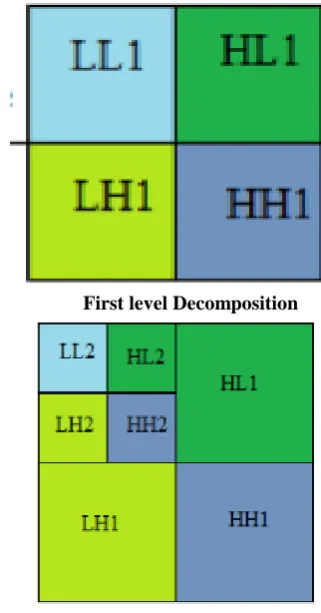
[image:5.595.322.531.108.190.2]Each pixels in the 2D image consists of its own x-axis and y-axis, therefore the image pixels will take ahistogram representation. Then, the image will be sent to a filter bank, and the filter bank consists of Low-pass and High pass filters, after passing through which, the image signal will be isolated into high band signal and low band signal. At each level of decomposition, the four sub-images are acquired, the approximation (LL), the vertical detail(LH), the horizontal detail (HL), and the diagonal detail (HH). The LL band is hailed to be most important band since it has more information of the actual image, and therefore it is most significant segment of the algorithm process. The LL band is again sub partitioned to lower band until to the necessary output is obtained; this process is illustrated below in the figure 4. As per the figure, there are four blocks, and the first half upper block exhibits the approximation and the second upper half block exhibits the horizontal detail. The first lower level block reveals the vertical detail and the second lower level block depicts the diagonal detail. In this algorithm, one level discrete wavelet transform is shown. By repeating this
[image:5.595.340.501.314.621.2]process one more time it can lead to an increase in the level of DWT. The second and the third level DWT provides the better compression ratio of the image
Fig.4 Diagram of compression level 1
The steps of the newly introduced compression algorithm that is based on DWT are explained as follows: I. Decompose Select a wavelet; select a level N. Compute the wavelet. Divide the signals at level N. 2. Threshold detail coefficients For every level from 1 to N, a threshold is chosen and hard thresholding is used for the detail coefficients.
Reconstruct Compute wavelet reconstruction making use of the actual approximation coefficients of level N and the improved detail coefficients of levels from 1 to N.
First level Decomposition
Third level Decomposition
In the proposed technique, both the combinations of DWT and ANFIS are hybridised. The important benefit of neural network can be predicted since it can adjust itself from the training data. [6] For getting a better Compressed Image with no deterioration of the quality of Image, the Compression Ratio (CR) should be less and the Peak Signal to Noise Ratio (PSNR) should be high. Therefore in this research work, these two algorithms viz., DWT and ANFIS provides better CR and PSNR.
Adaptive Network-Based Fuzzy Inference System (ANFIS)
In the case of ANFIS the compressed codes are considered to be an input. It processes the input and then gives the compressed codes as output. ANFIS is a mix of ANN and fuzzy inference system (FIS). In order to get a better modeling system, ANN can be integrated with FIS to boost the speed, fault tolerance, and adaptability. The ANFIS network is basically a neuro fuzzy network in which the segments of its nodes are adaptive, indicating that their outputs are dependent on the parameters that belong to these nodes.
Two types of learning algorithms have been introduced for tuning these parameters for optimizing the nearing performance during the training period. The architecture of ANFIS is illustrated in Figure 6, and the node function in every layer is explained below. Layer 1. This layer forms the layer of membership functions, which consists of adaptive nodes with node functions explained as
Fig.6 Architecture of Adaptive Neuro Fuzzy Inference System (ANFIS)
Layer 1: Every node in this layer is basically an adaptive node with a node function,
(6) Or
where and refer to the input nodes, and stand for the linguistic labels, ( ) and ( ) refer to the membership functions thatgenerallyfollows a bell shape with themaximumand minimum values equal to 1 and 0, correspondingly:
= (7) Where , , and refers to the parameters set. Parameters in this layer are called as premise parameters.
Layer 2: This layer consists of the nodes marked that multiply incoming signals and provides the product as output. For instance,
(8)
The output indicates the firing strength of a rule. The output of every node indicates the firing strength of a rule.
Layer 3: In this layer, the nodes marked compute the ratio of the th rule’s firing power to the sum of the firing strengths of all the rules,
(9)
The outputs of this layer are known as the normalized firing strengths.
Layer 4: This layer’s nodes are adaptive with the node functions given below,
Where indicates the output of layer 3, and stands for the parameter set. Parameters of this layer are called as resultant parameters
Layer 5: This layer’s single predefined node, marked , provides the final output to be the summation of the whole incoming signals given as below,
(11) Consequently, an adaptive network, which functionally corresponds to a Sugeno first-order fuzzy inference system is produced.Compressed images form the output of the ANFIS algorithm. It increases the compression accuracy. For getting theactual images, decryption and decompression process are carried out.
IV. RESULTS AND DISCUSSION
The newly introduced image compression is assessed with the help of the DICOM brain images, where 760 images are used. Digital Imaging and Communications in Medicine (DICOM) acts as a standard for management, storage, printing, and transmission of information in medical imaging. Each one of the image with size 256 x 256 and entirely 65536-pixel size with a resolution of 96dpi. Few Samples are illustrated in figure 7. The performance of the newly introduced Hybrid Chaos with DCT and Hybrid DWT with ANFIS based compression algorithm has been tested for different DICOM images
ALZW, ILZW and LZW approaches. The newly introduced image compression and encryption method has been realized in MATLAB’s working platform.
[image:7.595.358.494.135.251.2]Fig.7 Input DICOM image
Fig.8 Preprocessed image
[image:7.595.107.231.262.380.2]The DICOM image is considered as an input illustrated in figure 6. For eliminating the noise from input image, Adaptive median filtering is used. The pre-processed image is illustrated in figure 8.
Fig.9 Segmented image
[image:7.595.375.487.353.455.2]As shown in figure 9, the pre-processed images are decomposed into 4 blocks making use of vertical and horizontal segmentation.
Fig.11 Encryption process
As shown in figure 11, Hybrid Chaos along with Discrete Cosine Transform based image encryption is carried out. This chaotic transformation renders the data to be more secured from the threats of the intruders. The DCT is the algorithm used for encryption.
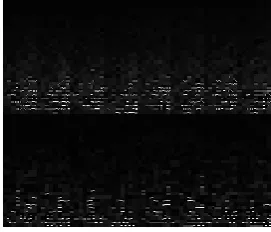
Fig.12 Compressed Format
[image:7.595.112.241.471.577.2]In the case of image compression, Hybrid Discrete Wavelet Transform (DWT) with Modified Adaptive Network-Based Fuzzy Inference System (MANFIS) is usedfor achieving an effective image compression (lossless compression) . The compressed image is illustrated in figure 12.
Fig.13 Decompressed image
[image:7.595.360.494.533.648.2]The compression processes shown above are inversed in order to attain a decompressed image as depicted in figure 13.
Fig.13 Decrypted image
Figure 13illustrates the decrypted image that offers greater image quality in comparison with the available techniques.
[image:7.595.104.234.654.754.2]Performance measure
The performance of the newly introduced Hybrid Chaos with DCT and Hybrid DWT with ANFIS based compression algorithm is then compared with the available hybrid CMT with ALZW, ILZW and LZW based compression algorithms in terms of PSNR, compression ratio, MSE and execution time.
1.Compression Ratio (CR)
The compression ratio is computed with the equation below:
(14)
The equation above specifies the ratio between the size of the actual image and the size of the encrypted image.
Fig.14 CR comparison among all ETC schemes As seen from the Figure 14, it can be noticed that the comparison of CR is made for every ETC approach. The methods are plotted along the x-axis and CR is plotted along the y-axis. The newly introduced Hybrid Chaos with DCT and Hybrid DWT with ANFIS and existing techniques are assessed. In this novel research work, the performance of the DWT based compression approach is optimized with ANFIS. It increases the compression ratio. As observed from the results, the novel hybrid Chaos with DCT and hybrid DWT with ANFIS achieves 93% of CR that is 9.67% and 19.35% more than hybrid CMT with ALZW and ILZW schemes correspondingly.
2.Peak signal to Noise Ratio (PSNR)
PSNR is represented as Peak signal to Noise Ratio. PSNR isin contrast to MSE, which is the small value of PSNR indicates that the elimination of noise in the image doesn’t yield better result.
(15)
Fig.15 PSNR comparison among all ETC schemes
It can be observed from the Figure 15 that the comparison of PSNR for all ETC approaches is carried out. The methods are plotted along the x-axis and PSNR is plotted along the y-axis. The novel Hybrid Chaos with DCT and Hybrid DWT with ANFIS and the available techniques are assessed. It can be concluded from the results that the novel hybrid Chaos with DCT and hybrid DWT with ANFIS achieves 44dB of PSNR that is 4.54% and 15.90% more than hybrid CMT with ALZW and ILZW scheme correspondingly.
3.Mean Square Error (MSE)
It is called as the cumulative squared error amidst the trampled and the actual image. The formula is as below
MSE=
(16)
Where I(x,y) is referred to as the real image, I'(x,y) is known as the estimated version (i.e. the decompressed image) and M,N are called as the magnitudes of the images. A lower value for MSE indicates less error, and as considered from the inverse relationship amid the MSE.
Fig.16 MSE comparison among all ETC schemes The MSE performance of the novel and existing techniques is illustrated in figure 16. The experimental results reveal that the newly introduced system attains 0.02% of MSE that is 50% and 66.66% lesser compared to hybrid CMT with ALZW and ILZW schemescorrespondingly.
4.Execution time
Fig.17 Execution time among all ETC schemes The performance of the proposed and available techniques is compared in terms of the execution time. The experimental results reveals that the newly introduced system attains 9 sec of execution time that is
schemes correspondingly
V. CONCLUSION
In this newly introduced system, image encryption is carried out with Hybrid Chaos with Discrete Cosine Transform (DCT) and image compression is performed using Discrete Wavelet Transform (DWT) with Adaptive Network-Based Fuzzy Inference System (ANFIS). Preprocessing is carried out with the aid of adaptive median filter to eliminate theunnecessary noises for boosting the image quality. The denoised image is partitioned into variousblocksfor the image encryption. The segmentation process is performed with prewitt edge operator detector, which are encrypted using the transform domains. The process of encryption, decompression and decryption has been performed using few of the algorithms. The discrete cosine and wavelet transforms are also brought into use. ANFIS is widely famous in other kinds of FISs, since it is convenient to interpret, simple, and adaptable. But, if the number of inputs increases, exponential rise in the number of rules also leads to an increase in its complexity and computational expense. The Hybrid Chaos with DCT and DWT with ANFIS approach also develops an algorithm with considerable time, and it’s benefitis most obvious for images that arehuge in size. As the reconstructed image and the actual image are the same; the proposed approach is a lossless compression mechanism
REFERENCES
1. G. Buela Divya1, M. Krupa Swaroopa Rani., Implementation of Image Compression Using Hybrid DWT - DCT Algorithms, International Journal of Modern Trends in Engineering Research, Vol 02, July 2015. 2. Muslim Mohsin Khudhair, An Efficient System for Encrypted Image by Using Hybrid DWT-DCT Compression Algorithm, International Journal of Computer Science and Mobile Computing, Vol. 5, September 2016.
3. Mrinal Buragohan, Adaptive Network based Fuzzy Inference System (ANFIS) as a Tool for System Identification with Special Emphasis on Training Data Minimization.
4. Punam N. Kamble, C. J. Awati, Decompression of JPEG Document Images: A Survey Paper, International Journal on Recent and Innovation Trends in Computing and Communication, Vol 4, November 2016.
5. Pia Singh, Prof. Karamjeet Singh, Image Encryption And Decryption Using Blowfish Algorithm In Matlab , International Journal of Scientific & Engineering Research, Volume 4, July-2013.
6. Manel Dridi, Belgacem Bouallegue, Mohamed Ali Hajjaji, Abdellatif Mtibaa, “An enhancement crypto-compression scheme for image based on chaotic system”, International Journal of Applied Engineering Research, Vol.11, No.7, 2016.
7. K.Sakthidasan, B.V.Santhosh Krishna, “A new chaotic algorithm for image encryption and decryption of digital color images”, International Journal of Information and Education Technology, Vol.1, No.2, June 2011.
8. Sodeif Ahadpour, Yaser Sadra, “A chaos-based image encryption scheme using chaotic coupled map lattices”.
9. Somaya Al-Maadeed, Afnan Al-Ali, Turki Abdalla, “A new chaos-based image-encryption and compression algorithm”, Journal of Electrical and Computer Engineering, 2012.
10. Xiaoling Huang, Guodong Ye, Kwok-Wo Wong, “Chaotic Image Encryption Algorithm Based on Circulant Operation”, Abstract and Applied Analysis, 2013.
11. Ali Soleymani, Md Jan Nordin, Elankovan Sundararajan, “A chaotic cryptosystem for images based on Henon and Arnold Cat Map”, The Scientific World Journal, 2014.
12. Ali Shakir Mahmood, Mohd Shafry Mohd Rahim, “State of the Art of Image Ciphering:A Review”, International Journal of Computer Science Issues, Vol.11, No.1, March 2014.
13. Srinivas Koppu, V. Madhu Viswanatham, “A fast enhanced secure image chaotic cryptosystem based on hybrid chaotic magic transform”, Modelling and Simulation in Engineering, 2017.
14. Mirza Abdur Razzaq, Mirza Adnam Baig, Riaz Ahmed Shaikh, Ashfaque Ahmed Memon, “Digital Image Security: Fusion of Encryption, Stenography and Watermarking”, International Journal of Advance Computer and Application, Vol.8, No.5, 2017.
15. Yu-Guang Yang, Qing-Xiang Pan, Si-Jia Sun, Peng Xu, “Novel Image Encryption based on Quantum Walks”, Computer Science Information Technology, 14 January 2015.
AUTHORS PROFILE
N.Mahendiran is working as Assistant Professor in the Department of Computer Science in Sri Ramakrishna College of Arts & Science (Formerly SNR Sons College), Coimbatore, Tamilnadu, India. He had an experience of 10 years and currently pursuing Ph.D in Digital Image Processing. He has published more than 5 papers National and International journals