International Journal of Innovative Technology and Exploring Engineering (IJITEE) ISSN: 2278-3075, Volume-8 Issue-9, July, 2019
Abstract: The industrial growth has escalated the use of induction motors as prime movers in modern industry. This is due to its low cost, simple construction and ruggedness. Although rugged, these may fail earlier than expected life due to, excessive mechanical, electrical and environmental stresses. Automatic Artificial Intelligence (AI)-based systems are nowadays widely employed in the domain of induction motor fault identification with high success rate. Artificial neural network are utilized extensively for the detection and diagnosis of various induction motor faults. These systems generally use supervised learning, where the models are pre-trained such that these are skilled enough to classify the absence or presence of faults in motor under investigation. In this paper, a highly effective approach for detection of different motor fault conditions, based on pattern recognition technique is presented. In the proposed method the statistical time domain features are computed from three phase motor current and used as inputs of ANN. Seven different classes of motor conditions: healthy, broken rotor bar, broken rotor bar with stator winding short circuit and inner and outer race bearing defects were considered. The results indicates that the proposed methodology is highly effective for diagnosis of various induction motor faults with high success rate.
Index Terms: Artificial neural networks (ANN), Condition monitoring, Fault diagnosis, Induction motor. About four key words or phrases in alphabetical order, separated by commas.
I. INTRODUCTION
Induction motors are frequently integrated in different types of industrial equipment such as those used in manufacturing and processes industries. Being a vital part of many industrial equipment viz. blowers, conveyers, drills, elevators, vacuum cleaners, vacuum pumps and other machine tools, it is subjected to research in the field of sophisticated control, reliable operation and timely maintenance. Although being rugged and reliable induction motor are subjected to different types of faults such as those related to stator winding [1-2], broken rotor bars [3-4], bearing faults [5] and eccentricity [6]. These faults start as a minute defects and propagates to larger faults overtime. These defects if not checked in time could results into catastrophically failures.
These days, conventional maintenance strategies such as scheduled maintenance and run-to-failure maintenance is being replaced by Condition Based
Revised Manuscript Received on July 09, 2019.
Shaina Grover, Electrical Engineering Department, NITTTR Chandigarh, Chandigarh, India.
Amandeep Sharma, Electrical Engineering Department, NITTTR Chandigarh, Chandigarh, India.
Lini Mathew, Electrical Engineering Department, NITTTR Chandigarh, Chandigarh, India.
Shantnu Chaterji, Electrical Engineering Department, NITTTR Chandigarh, Chandigarh, India.
Maintenance (CBM) [7]. The CBM involves the placement of sensors on motor for regular monitoring of motor operating parameters such as drawn current, frame vibration and winding temperature, etc. to estimate the condition of motor. This helps in appropriate scheduling of maintenance activities beforehand, depending on the motor health. This not only reduces the costly maintenance but also helps in minimizing the unwanted downtime and catastrophic failure [8].Condition Monitoring (CM) and fault diagnosis of induction motor has gained attention of various researcher in the past few decades. A number of fault detection techniques such as vibration, current, acoustic and magnetic flux have been developed [9]. A practical automatic condition monitoring method requires the monitoring of aforementioned parameters along with a computer based intelligent algorithms for detection and diagnosis of motor conditions. Recently, Artificial Intelligence (AI) based approaches like Artificial Neural Network (ANN), Support Vector Machine (SVM), Adaptive Neuro-Fuzzy Inference System (ANFIS), k-Nearest Neighbour (k-NN), Fuzzy Logic and Deep learning etc. have been successfully applied in the domain of CM and fault diagnosis [10-13]. ANN’s has gained considerable attention in the field of CM and fault diagnosis of machines in the last few decades. The artificial neural network (ANN) is a statistical supervised learning approach, where faults can be detected by training the network to classify and detect faults. ANN has been prevalently used for detection of motor faults such as bearings [14], 5roken rotor bar [13] and stator winding short circuit [11, 16]. In [17] authors used motor vibration data for extracting frequency domain features and classified the motor bearing defects with the help of ANN. In [18], the authors used pattern-recognition methodology to study the progression and orientation of outer race bearing scratches.
This paper describes the application of Feed-forward Back Propagation Neural Network (FFBPNN) for detection and diagnosis of different motor fault conditions. The Pattern-recognition Neural network (PatternNet), a special type of FFBPNN, used for pattern recognition and classification problems was used for detection and classification of induction motor faults. The Pattern recognition NN (PatternNet) is a type of ANN that can be used for pattern recognition problems, where the objective is to recognize the input data sets belonging to different classes.
Basically, it is a FFBPNN trained using supervised learning, where the target data comprises of binary values representing 1’s signifying the inherited class and 0’s otherwise.
Shaina Grover, Amandeep Sharma, Lini Mathew, Shantanu Chatterji
Different time domain features were extracted from motor current signal and used as input for the neural network. The ANN was trained using several concealed layer of neurons with two different training functions namely ‘trainlm’ and ‘trainscg’.
The results for each case is presented and compared in terms their performance.
II. ARTIFICIAL NEURAL NETWORK (ANN)
[image:2.595.75.264.294.451.2]ANN is considered as an imitation of human brain, consisting of a group of interconnected nodes called as neurons. The most popular form of ANN comprises of three layers, where each layer consists of a number of processing nodes. Fig. 1 shows the basic diagram of an ANN, consisting of neurons, connection weights and biases. Here the neuron are represented by circular nodes, connection weights are represented by arrows connecting different nodes between input, hidden and output layers.
Fig. 1. Artificial Neural Network
FFBPNN is the most popularly used multi-layered feed forward ANN which employ backpropagation algorithm for training. The ANN performs best with backpropagation learning when the number of hidden layer neurons is optimal. Usually, a smaller network is unable to learn, whereas a much larger network will have poor generalization [19]. The performance of ANN improves with larger training dataset; however, this requires more training time. Thus, a number of backpropagation training algorithms are devised to improve the performance and reduce training time [20].
Training backpropagation algorithm adjusts network weights toward the steepest descent (i.e. adverse gradient).Although this is the path where magnitude of performance function degrades most rapidly however, it does not ensure the quickest convergence. In case of conjugate gradient-based training methods, search is carried out along conjugate directions, generally resulting in faster convergence than steepest descent path. For conjugate gradient algorithms, the step-size is altered for every single iteration. Here, search is performed in the conjugate gradient direction to calculate the step size for which the performance function is minimized for particular search path.
The trainscg is a backpropagation training method that updates network weights and biases according to the Scaled
Conjugate Gradient (SCG) algorithm. It was introduced by Moller [21] to prevent the time-inefficient line search, integrating the model-trust region method (used in trainlm) along with scaled conjugate gradient approach.
The trainlm is the speediest algorithm for training networks with moderate size. Although it requires more memory than other training algorithms, trainlm is the most widely recommended and used training method for obtaining higher classification accuracies. It is based on Levenberg-Marquardt (LM) backpropagation algorithm, which is considered as one of the fastest backpropagation algorithm for training the neural network.
III. EXPERIMENTAL SETUP AND DATA COLLECTION
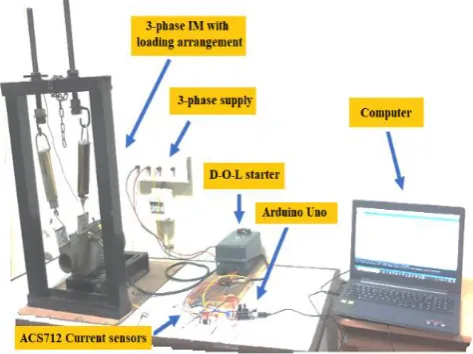
[image:2.595.306.543.343.520.2]The experimental configuration consisted of a three-phase, 4-pole, 0.5-hp induction motor linked to mechanical load using belt pulley system. The motor terminals were connected to a 3-phase power source through a Direct-On-Line (D-O-L) starter. Fig. 2 shows the experimental setup for data acquisition and condition monitoring of three-phase induction motor.
Fig. 2. Experimental setup for fault detection of induction motor
International Journal of Innovative Technology and Exploring Engineering (IJITEE) ISSN: 2278-3075, Volume-8 Issue-9, July, 2019
Table I. Specifications of induction motor
Parameters Value
Motor type 3-phase, 4-pole ac induction motor Power 0.37Kw
Frequency 50Hz±5% Current 1.1A Voltage 415V (Y)±10% Power Factor 0.74
Speed 1400rpm
[image:3.595.59.280.64.156.2]
Data was acquired repetitively for 20 runs with 200 samples acquired for each phase at a sampling rate of 3.33 kHz. Recorded data was transferred to personal computer via USB serial-port at a rate of 9600 baud.
Table II. Specifications of hardware components
Component Specifications
Current sensor
ACS712 current sensor Range - 20 Amperes AC/ DC Sensitivity – 100mV/A Supply voltage - 5 Volts Output – Voltage (ratio-metric) Arduino Uno
Microcontroller: ATmega328 Operating voltage: 5V
Digital I/Os: 14 (with 6 PWM output) Analog inputs: 6
Input voltage range: 7 to 12V
Personal computer
Processor – i5 Intel processor @ 2.4 GHz RAM - 4 GB
Hard drive – 1Tera Byte @5400 RPM. Operating System - Windows 10 Home
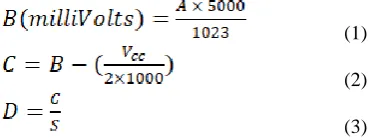
A data pre-processing stage was used which included milli-volt conversion, equation (1) and zero-compensation, equation (2) and scaling, equation (3) to convert the measured values read using Arduino command analogRead() to actual current values in amperes.
(1)
(2)
(3)
Where, A = values obtained from analogRead() command, B is the value in milli-Volts, C is the value obtained after zero compensation, while D is the final sensor reading. Here, S is the sensitivity of different sensors in millivolts/ ampere (i.e. 100mV/A) and Vcc is the supply voltage of current sensors.
IV. PROPOSED WORK
The Fig. 3 shows the ANN based fault detection and diagnosis methodology.
Fig. 3. Proposed methodology for fault detection
The motor under investigation is operated near full load conditions (industrial conditions) and three-phase current is acquired using especially made data acquisition system. Different faults are created in the motor artificially and data is acquired for each fault condition successively. The different motor conditions considered are:
1) Healthy motor (HEALTHY)
2) Bearing with outer race defect (OUR) 3) Bearing with inner race defect (INR)
4) Broken rotor bar with 20 stator turns shorted (BRB20T) 5) Broken rotor bar with 10 stator turns shorted (BRB10T) 6) Broken rotor bar with 3 stator turns shorted (BRB3T) 7) Broken rotor bar fault (BRB)
[image:3.595.51.289.247.398.2]The data acquisition is followed by pre-processing and feature extraction stages, where the acquired data is converted into meaningful values and time-domain features are extracted respectively. Feature extraction stage comprised of computing the following 9-time domain statistical features from three-phase current data, Table 3.
Table III. Time domain statistical features computed from motor data
Sr. No. Feature
[image:3.595.81.271.486.556.2]Computed features were normalized (scaled) between bounds [0 1], before feeding as input to ANN for training and testing stages. This step ensures that all the features (inputs to ANN) gets equal weightage. It is done to improve the classification results and eliminate the undue bias to any particular feature, as all features are considered equally significant. The feature matrix consisted of 420 rows (feature vectors) and 9 columns (features), corresponding to 20 runs for 7 motor condition, obtained by acquiring 3-phase motor current, i.e. generating a 20 X 3 X 7 = 420 feature vectors in all. The output feature matrix for pattern recognition neural network was selected in the following manner:
Healthy: [0 0 0 0 0 0 1]T OUR: [0 0 0 0 0 1 0]T INR: [0 0 0 0 1 0 0]T BRB20T: [0 0 0 1 0 0 0]T BRB10T: [0 0 1 0 0 0 0]T BRB3T: [0 1 0 0 0 0 0]T BRB: [1 0 0 0 0 0 0]T
The whole feature matrix was split into training (315) and testing (105) dataset i.e. 45 training samples and 15 testing samples for each motor condition. The PatternNet was trained using training data set with two different training algorithms (trainlm and trainscg) for different number of hidden layer neurons to test their performance and suitability for the given classification problem. Each network was trained and tested 10 times using the same dataset and the best result (classification accuracy) is reported. Total number of epochs for obtaining best validation performance, classification accuracy for testing dataset and Mean Square Error (MSE) were selected for comparing the performance for different network configurations.
V. RESULTS AND DISCUSSION
[image:4.595.308.549.62.201.2]The Table 4 and Table 5 shows the results obtained using scaled conjugate gradient and Levenberg-Marquardt training algorithms for several concealed layer of neurons. It is observed that the number of epochs for training phase of network decreases for moderate network size, i.e. network with 10 to 14 hidden layer neurons. Also, it is observed that the highest testing accuracy, 77.1% and 91.4% is obtained in case of network with 12 hidden layer neurons for trainscg and trainlm training algorithms. Thus, it can be clearly perceived that both the training algorithms perform best for moderate number of hidden layer neurons, viz.12 neurons, which is the optimum for given classification problem.
Table IV. Results with trainscg training function
No. of hidden layer
neurons
Training Testing
Validation performance
(MSE)
Epochs
Testing Performance
(MSE)
Classification Accuracy (%)
2 0.1096 30 0.0993 40.0
4 0.0731 37 0.0841 59.0
6 0.0501 36 0.0685 67.6
8 0.0570 35 0.0518 73.3
10 0.0505 37 0.0731 66.7
12 0.0391 35 0.0558 77.1
14 0.0924 43 0.0564 72.4
[image:4.595.310.539.410.671.2]16 0.0602 51 0.0506 76.2
Table V. Results with trainlm training function
No. of hidden layer neurons
Training Testing Validation
performance (MSE)
Epoch s
Testing Performance
(MSE)
Classificatio n Accuracy
(%) 2 0.0603 29 0.0591 72.4 4 0.0411 19 0.0388 85.7 6 0.0439 18 0.0405 84.8 8 0.0398 14 0.0256 89.5 10 0.0492 10 0.0322 87.6
12 0.0415 11 0.0204 91.4
14 0.0433 10 0.0404 84.8 16 0.0299 13 0.0253 88.6
From results, it is evident that for different number of hidden layer neurons the number of epochs required for achieving lowest validation error is smaller (11 and 35 for 12 hidden layer neurons) for trainlm as compared to trainscg respectively. This verifies that the trainlm provides faster training and more accurate results as compared to trainscg (default training function for PatternNet) for pattern recognition neural network.
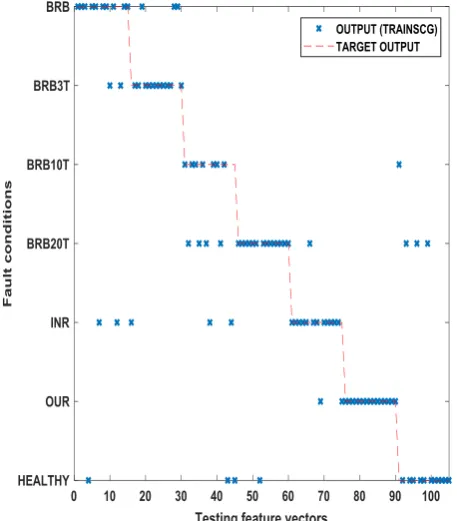
Fig. 4(a) and (b), shows the target outputs and classification outputs of PatternNet for 12 hidden layer neurons for different motor conditions using trainscg and trainlm respectively. The points overlapping with target outputs are correctly classified testing samples. It can be clearly seen that the
trainlm outperforms in terms of lesser number of
miss-classifications.
[image:4.595.52.287.663.786.2]International Journal of Innovative Technology and Exploring Engineering (IJITEE) ISSN: 2278-3075, Volume-8 Issue-9, July, 2019
Fig. 4(b) Actual and target outputs for PatternNet using trainlm backpropagation algorithm
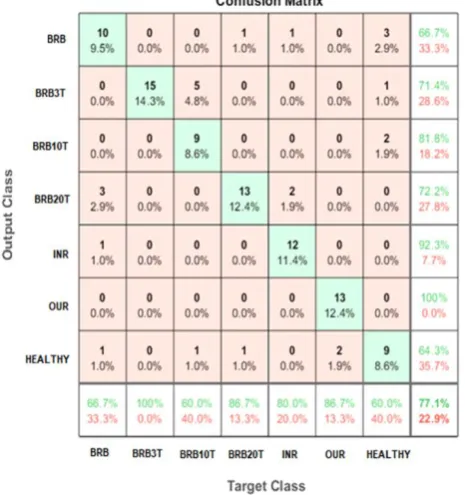
In Fig. 5 (a), it was observed that 5 out of 15 training samples of class BRB20T were mis-classified as BRB3T, (i.e. 33.3% inter-class misclassification). However, no such phenomenon was observed for trainlm. Also, it was observed that BRB3T, BRB20T, OUR and HEALTHY conditions are accurately classified by trainlm with 100% classification rate, whereas only BRB3T was detected with 100% accuracy in case of trainscg based network training for 12 neurons in hidden layer. Overall classification accuracy (both inter-class and intra-class) obtained is better for trainlm as compared to trainscg.
Fig.5 (a) Confusion matrix for classification using trainscg with 12 hidden layers
Fig.5 (b) Confusion matrix for classification using trainlm with 12 hidden layers
VI. CONCLUSION AND FUTURE SCOPE
In this paper, the experimental work is carried out for classification of different induction motor fault conditions. Using two distinct training algorithms the PatternNet neural network was trained with variable number of hidden layer neurons for classification of motor faults. The overall classification results produced by trainlm are much better than trainscg. The analysis results for trainlm method effectively classifies the motor conditions with high accuracy (91.4%). This shows that the proposed method can successfully detect induction motor faults.
This work can be further extended in terms of integrating IoT with the data acquisition stage and sending the data on cloud platform for remote processing and monitoring. Different machine learning classification algorithms as k-NN, SVM, decision trees etc. can be considered for improving the efficiency of classification performance of present work. Also, a greater number of motor faults such as eccentricity, single-phasing, rotor imbalance etc. can be considered for classification purpose.
REFERENCES
1. A. M. Cardoso, S. Cruz, and D. Fonseca, “Inter-turn stator winding fault diagnosis in three-phase induction motors, by Park's vector approach,”
IEEE Transactions on Energy Conversion, vol. 14, 1999, pp. 595-598. 2. A. Sharma, S. Chatterji, and L. Mathew, “A Novel Park’s Vector Approach for Investigation of Incipient Stator Fault Using MCSA in Three-Phase Induction Motors,” in 2017 International Conference on Innovations in Control, Communication and Information Systems
(ICICCI), 2017, pp. 1-5.
3. M. Abd-el-Malek, A. K. Abdelsalam, and O. E. Hassan, “Induction motor broken rotor bar fault location detection through envelope analysis of start-up current using Hilbert transform,” Mechanical Systems and Signal Processing, vol. 93, 2017, pp. 332-350.
[image:5.595.314.541.52.282.2] [image:5.595.49.282.57.317.2] [image:5.595.56.289.505.753.2]5. P. Konar and P. Chattopadhyay, “Bearing fault detection of induction motor using wavelet and Support Vector Machines (SVMs),” Applied Soft Computing, vol. 11, 2011, pp. 4203-4211.
6. J. Faiz and H. N. Koti, “Eccentricity fault diagnosis indices for permanent magnet machines–state of the art,” IET Electric Power Applications, 2019.
7. S. Grover, A. Sharma, L. Mathew, and S. Chatterji, “Fault Diagnosing and Condition Monitoring Techniques for Induction Motors – A Review,” in 2019 International Conference on Intelligent Computing and Control Systems (ICICCS), 2019, pp. 1628-1634.
8. A. K. Jardine, D. Lin, and D. Banjevic, “A review on machinery diagnostics and prognostics implementing condition-based maintenance,” Mechanical systems and signal processing, vol. 20, pp. 1483-1510, 2006.
9. R. Jigyasu, A. Sharma, L. Mathew, and S. Chatterji, “A Review of Condition Monitoring and Fault Diagnosis Methods for Induction Motor,” in 2018 Second International Conference on Intelligent Computing and Control Systems(ICICCS),2018,pp. 1713-1721. 10. A. C. McCormick and A. K. Nandi, “Real-time classification of
rotating shaft loading conditions using artificial neural networks,”
IEEE Transactions on Neural Networks, vol. 8, 1997 pp. 748-757. 11. A. Siddique, G. Yadava, and B. Singh, “Applications of artificial
intelligence techniques for induction machine stator fault diagnostics,” in 4th IEEE International Symposium on Diagnostics for Electric Machines, Power Electronics and Drives, 2003. SDEMPED 2003., 2003, pp. 29-34.
12. R. Liu, B. Yang, E. Zio, and X. Chen, “Artificial intelligence for fault diagnosis of rotating machinery: A review,” Mechanical Systems and Signal Processing, vol. 108,2018, pp. 33-47
13. A. Sharma, R. Jigyasu, L. Mathew, and S. Chatterji, “Bearing Fault Diagnosis Using Weighted K-Nearest Neighbor,” in 2018 2nd International Conference on Trends in Electronics and Informatics (ICOEI), 2018, pp. 1132-1137.
14. J. Zarei, J. Poshtan, and M. Poshtan, “Bearing fault detection in induction motor using pattern recognition techniques,” in 2008 IEEE 2nd International Power and Energy Conference, 2008, pp. 749-753. 15. S. Hamdani, O. Touhami, R. Ibtiouen, and M. Fadel, “Neural network technique for induction motor rotor faults classification-dynamic eccentricity and broken bar faults,” in 8th IEEE Symposium on Diagnostics for Electrical Machines, Power Electronics & Drives, 2011, pp. 626-631.
16. H. Nejjari and M. E. H. Benbouzid, “Monitoring and diagnosis of induction motors electrical faults using a current Park's vector pattern learning approach,” in IEEE International Electric Machines and Drives Conference. IEMDC'99. Proceedings (Cat. No. 99EX272), 1999, pp. 275-277.
17. A. Sharma, R. Jigyasu, L. Mathew, and S. Chatterji, “Bearing Fault Diagnosis Using Frequency Domain Features and Artificial Neural Networks,” in Information and Communication Technology for Intelligent Systems, ed: Springer, 2019, pp. 539-547.
18. S. E. Pandarakone, Y. Mizuno, and H. Nakamura, “Evaluating the progression and orientation of scratches on outer-raceway bearing using a pattern recognition method,” IEEE Transactions on Industrial Electronics, vol. 66, 2018, pp. 1307-1314.
19. H. Beigy and M. R. Meybodi, “A learning automata-based algorithm for determination of the number of hidden units for three-layer neural networks,” International Journal of Systems Science, vol. 40, 2009, pp. 101-118.
20. M. Hudson Beale, M. Hagan, and H. Demuth, “Neural Network Toolbox–User’s guide. R2012a,” ed.
21. M. F. Møller, “A scaled conjugate gradient algorithm for fast supervised learning,” Neural networks, vol. 6, 1993, pp. 525-533.
AUTHORSPROFILE
Shaina Grover was born in Ferozepur, India on 07 December 1991. She received her B.Tech. in Electrical Engineering from S.B.S College of Engineering & Technology, Ferozepur, Punjab in 2014. She served for about two years as Lecturer in Government College Shaheed Bhagat Singh State Technical Campus, Ferozepur and FCET, Ferozepur Punjab. Presently she is pursuing M.E. in Instrumentation & Control Engineering from Electrical Engineering Department, National Institute of Technical Teachers Training and Research (NITTTR) affiliated to Punjab
University, Chandigarh. Her research topic is related to condition monitoring and fault detection in induction motors using IoT platform. Her research orientation is towards electrical machines, power system analysis and artificial intelligence and machine learning algorithms.
Amandeep Sharma was born in Chandigarh, India on 19 August 1984. He received his B.E. in Electronics and Communication Engineering from University Institute of Engineering and Technology (UIET), Panjab University, Chandigarh in 2007 and M.Tech. degree in Instrumentation from University Centre for Instrumentation and Microelectronics (UCIM), Panjab University, Chandigarh, India in 2009.
He worked as Junior Research Fellow (JRF) in Central Scientific Instruments Organization (CSIO), Chandigarh working under DST funded project from September 2009 to May 2011. He served for about two years as Assistant Professor, Instrumentation and Control Engineering (ICE) Department of Dr. B. R. Ambedkar National Institute of Engineering and Technology Jalandhar, Punjab, India from August 2011 to October 2013. Presently, he is pursuing his Ph.D. from Electrical Engineering Department, National Institute of Technical Teachers Training and Research (NITTTR), Panjab University, Chandigarh in the area of condition monitoring of electrical motors. His research interests include condition monitoring of electrical machines using statistical methods and machine learning algorithms, artificial intelligence based computation and multi-agent classifier systems. He is particularly interested in analysis of non-stationary signals and model-based fault diagnosis. Mr. Amandeep Sharma is a Life Member of Indian Micro-electronics Society, IMS (India).
Lini Mathew was born in Kerala, India, in 1961. She received the B.E. degree in Electrical Engineering from Kerala University, Trivandrum, India, in 1983, and the M.E. and Ph.D. degrees in Electrical Engineering from Panjab University, Chandigarh, India, in 1993 and 2013, respectively.
In 1988, she joined the Department of Electrical Engineering, National Institute of Technical Teachers Training and Research, Chandigarh as a Lecturer, and became an Associate Professor and consequently Professor in 2018. She has published several research articles in reputed journals and authored a number of Technical books. Her current research interests include electrical machines and drives, hybrid renewable energy systems, flexible ac transmission systems, and power system stability. She is particularly interested in the research area related to applications of signal processing, virtual instrumentation, soft-computing, artificial intelligence and machine learning. Dr. Mathew is a Member of several scientific and professional bodies such as the ISTE and IEEE.
Shantanu Chatterji was born in Allahabad, in 1949. He holds a B.E. degrees in Electrical Engineering from MANIT Bhopal and M.E. degree in Electrical Engineering from MNNIT Allahabad, and has obtained his Ph.D. in Electrical Engineering from Panjab University, Chandigarh, India in 2005. In 1984, he joined and served as faculty in Electrical Engineering department of National Institute of Technical Teachers Training and Research (NITTTR), Chandigarh, India and retired as Professor and Head in 2014. He was Vice-Chancellor, Desh Bhagat University, Mandi Gobindgarh, and Punjab from January 2015 to September 2015. He has also served as Director, United College of Engineering and Research (UCER), Greater Noida, Uttar Pradesh, India for period, September 2016 to October 2017. He has two years of industrial experience apart from 40 years of immense teaching experience and has guided a number of Ph.D. and Master’s thesis. He has authored a number of technical books and has prepared a number of educational videos for various graduate and postgraduate courses related. His current research interests include electrical machines and drives, power electronics, flexible ac transmission systems, smart-grid and soft-computing. Dr. Chatterji is a Life Member of the prestigious ISTE (India), IE (India) and IEEE (USA).