Abstract: Nowadays, Wireless Sensor Networks (WSN) play a key role in data transmission depends on the locations of nodes. WSN contains Base Station (BS) with several Sensor Nodes (SNs) and these nodes are randomly arranged inside the region. The BS used to give the commands and direction to the sensor node. Energy is a major issue in WSN as after some transmissions the nodes drain their energy when the information is passed inside the region of interest. According to the distance between the sensor nodes, the energy can be used during the Cluster Head (CH). The energy consumption (EC) is abridged by implementing the protocols of clustering and routing which is used to augment the Network Lifetime (NL). The optimal CH selection for finding the shortest path among the CHs is improved by developing the hybrid K-means with Particle Swarm Optimization (PSO) based hybrid Ad-hoc On-demand Distance Vector (AODV) channeling algorithms. The alive nodes, total packet sending time, throughput and NL are increased by using this hybrid technique, whereas dead nodes and EC are minimized in a network.
Index Terms: Ad-hoc On-demand Distance Vector (AODV), Base Station, Energy Consumption (EC), K-means, Nodes, Particle Swarm Optimization (PSO), and Wireless Sensor Networks (WSN).
I. INTRODUCTION
The ecological situations like sound, temperature and motion are monitored by WSN which consists of an amount of SNs those are interlocked through wireless links [1]. The benefits of sensor technology are improving the consistency and accurateness of data by making low motorized sensing plans which are equipped with designable
stemming and small structure with multiple parameter sensing [2]. But the major limitation of the WSN’s are imperfect Battery Power (BP), restricted storage and computation abilities, prone to the safety occurrences and have limited bandwidth to communicate [3-4]. To overcome those limitations, the energy efficiency are increased and reduced the network EC by implementing the Cluster based WSN (CWSN). Clustering in WS Network is performed to minimize the EC and also to decrease the data communication
Revised Manuscript Received on July 05, 2019.
R.J.Kavitha, Assistant Professor, Department of ECE, University College of Engineering, Panruti.
N.Thamaraikannan, Assistant Professor, Department of CSE, Saveetha School of Engineering, Chennai.
Dr.R.Arunprakash, Assistant Professor, Department of CSE, University College of Engineering, Ariyalur.
Dr.Kamalraj Subramaniam, Associate Professor, Department of ECE, Karpagam Academy of Higher Education, Coimbatore.
over the system that is required to transfer the message to the BS, as the CH becomes accountable for communication, which results into prolonged NL [5]. In a CWS network every cluster has a leader sensor node, called as CH. LEACH protocol provides advanced security (existing systems do not consist security systems), high throughput, less EC (while data arranging) and less delay [6].The groups are maded dynamically and occasionally, security is required for hierarchical (cluster-based) SNs [7-8]. The sensors are operate autonomously and expected to deploy remotely in large numbers. The scalability are supported by nodes which are often grouped into non-overlapping clusters [9]. The data aggregation are utilized by using GRASS to reduce the NL in network processing techniques [10]. The data packets are summarized and combined from several SNs to reduce the EC and communication bandwidth which is the main aim of data aggregation [11 -12].
The centralized grouping algorithm has been implemented for WSNs to categorize the SNs into groups using the Memetic Algorithm (MA). The results conclude that MA gives the significantly advanced scheme lifetime and shorter procedure performance time, but the packet delivery ratio and packet losses were not discussed [13]. The primary LEACH protocol is an encouraging protocol and provides a chance to enhance several areas of the communication protocol [14]. The SN are created into clusters, then CH are selected as one node in Self-Organized Head Selection (SOHS), which is a simple and efficient head selection phase when compared to LEACH and XLEACH [15]. The grouping of Energy Efficient (EE) of SNs is the amount of CH, which is considered as a major issue. This can be resolved by optimizing the CHs by using Fuzzy logic approach [16]. To resolve the drawbacks of existing algorithms, an efficient routing and clustering algorithm for WSN using Hybrid AODV algorithm is introduced. In that clustering optimization based on the K-means with PSO algorithm and ACO used for routing optimization. This research paper is composed as follows, Section-2 offerings an extensive survey of recent papers on routing and Clustering techniques. In
section-3, briefly described an effective
Hybrid-K-means-PSO-AODV technique. Section-5
experimental setup. Section-6 shows the comparative
experimental result for the existing and
Energy Efficient Hybrid Optimization based
K-means Clustering and Load balancing using
Optimized Ad-hoc on-demand Distance Vector
Routing for WSN
Hybrid-K-means-PSO-AODV technique. The conclusion is made in Section -7.
II. RELATEDWORK
Muyiwa Olakanmi Oladimeji et al. [17] introduced a Heuristic Algorithm for Clustering Hierarchy (HACH). The HACH algorithm has two main operations such as sleep scheduling and CH selection operations. The HACH algorithm balances and minimizes energy utilization by choosing distributed nodes with high energy as CH’s to increase network lifetime, but fails to explain the heterogeneity levels of WSN settings.
Padmalayanayaket al. [18] introduced the Routing and Clustering algorithm for wsn’s using Genetic Algorithm. Generally, LEACH algorithm is the best one for the grouping of sensor nodes, but it does not support the random election of the chs. GA is a natural bio inspired algorithm to solve several optimization issues by updating the CH in each round. With this network, lifetime is improved but not discussed the end to end delay of the network.
Yongjun Sun et al. [19] implemented the Ant Colony Optimization (ACO) by improving the channelling algorithm for wsn’s. Here the concert of the obtainable algorithm has compared with the EEABR and Leach-Ant algorithms and conclude that the presented algorithm has minimized the energy utilization of the sns but not discussed the packet delivery ratio.
Wenbozhanget al. [20] presented the Routing Protocol (RP) for wsn’s by implementing an energy-efficient heterogeneous ring grouping (E2HRC). When compared with original ipv6, this algorithm provided better average EC for lossy network and low-power, but NL was not discussed.
Wenbo Zhang et al. [21] has introduced the improved RPL (IRPL) RP to satisfy the energy balance necessities of WSNs. The rings of equal area were segmented by using routing topology control model. When compared with RPL, the IRPL balanced the energy utilization of WSNs in an effective way. Here author did not discuss the delay.
III. HYBRID-K-MEANS-PSO-AODV METHODOLOGY
The objective of energy-efficient routing protocols finds the energy stable way from the source node to the BS for maintaining the NL and functionality for a reasonable duration. In order to extend the functionality and NL, the major aim of the network is to balance the EC by using different techniques and approaches. In this paper PSO Optimized K-means clustering and ACO optimized AODV
(PSO-K-means-ACO-AODV) routing technique is
introduced. In this Hybrid-K-means-PSO-AODV technique, PSO algorithm is used to optimize the K-means algorithm, whereas AODV algorithm is optimized by using ACO. This PSO-K-means-ACO-AODV method consists of eight major steps, such as: 1) Mobile node development, 2) Clustering using PSO, 3) CH selection based on node weight, 4) router estimation using AODV-PSO, 5) data received to CH, and 7) Successfully receiving the data. The flow chart of the Hybrid-K-means-PSO-AODV technique is shown in the below Fig. 1.
Fig.1. Flow chart of the overall Hybrid-K-means-PSO-AODV Process.
A. Clustering based on PSO with K-means
The particles are initialized, fitness function are calculated and finally the velocity and position are updated in PSO based clustering algorithm. PSO is are iteration based optimal procedure and the structure is initialized with a population of random resolutions and searches for optima by modernizing the generations. According to its own historical and related information of neighboring particles, a particle adjusts its current location and discoveries the best result through reiteration, which combines the local and global information in search process of PSO. Individually element is updated by using two finest values in every reiteration, in which the first finest rate is obtained by qualification function and second finest values is gained by using PSO in the population. The local best value are identified by using the particles obtained by topological neighbors. Subsequently discovering the double finest morals, the particle modernizes its velocity and positions with following formulas:
2 (1)
1
id X gd P Rand C id X id P rand C id WV id V
) 2 (
id V id X id
Where
V
idthe velocity of the particle is,X
id is the particleposition,
P
idand Pgdis the best location between all particlesin the population. Two irregular functions with a range [0, 1].
1
C And
2
C are positive constant parameters called acceleration coefficients. The inertia weigh, W is a user-specified parameter that controls, with
1
C and
C
2, the impact of previous actual amount of fragment velocities on its actual one. Enormous inactivity gauge weights toward worldwide investigation while a littler latency weight weights toward calibrating the ebb and flow search region.Fig.2. (a)
Fig. 2. (b)
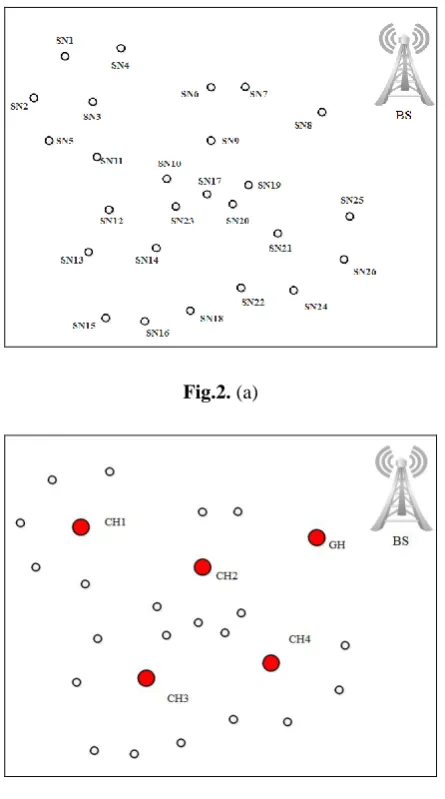
Fig.2. (a). Unplanned sensor placement, 2. (b). CH and GH detection, BS, SN- Sensor Node, CH- Cluster Head, GH-
Gateway Head
Molecule instatement: the bunches are made by applying the K-implies grouping calculation to get centroids which are advanced by PSO, when the particles are sent arbitrarily in the underlying advance. The separation between the streamlined centroid with its everything neighborhood hubs are the best particles that is gotten for CH. Relating to the base d_est, the bunches are chosen and this procedure will be rehashed for a lot of molecule 20xNp, at that point the d_best esteem is
accumulated for acquiring the situation of the molecule. The d_gbst esteem is acquired by rehashing this procedure with certain cycles when comparing position of the molecule is refreshed. The separation between the area particles and centroid of the bunch are determined as wellness work, when d_est is as much as least [23].
B. EE clustering-Load balancing using PSO
PSO enhance the grouping, which yields inspiration from the attributes of ants in nature and from the associated field of PSO to fathom the issue in conveying systems for picking briefest directing procedure. PSO is a streamlining calculation, which mimics the development and running of winged creatures. A molecule swarm is a populace of moving article, which can travel through the pursuit space and can be pulled in to the better positions. Each winged creature is alludes to as a "molecule", which fly with a specific speed and move to locate the worldwide best position. PSO is a worldwide pursuit calculation, which has a solid capacity to identify worldwide hopeful outcomes. The gathering is finished utilizing PSO in WSN. Fundamental Clustering techniques for SNs is given in Fig.3. Burden adjusting intends to amplify throughput, limit reaction time and steering overhead in the system. The gathering in sensor hubs has been broadly sought after by the examination network so as to explain the adaptability, vitality and life-time issues of SNs.
Fig.3. Basic Grouping methods of Sensor Nodes. In Fig.3. The SNs are grouped to-gather to form different cluster networks. The CH is elected for each cluster networks based on the minimum value of degree. The job of the cluster-head is to assemble information from their neighboring nodes and pass it on to another CH in different Networks. The CHs broadcast a confirmation message that includes a time slot schedule to be used by their cluster members for communication during the steady-state phase. Given that the CHs' transmitters and beneficiaries are adjusted, adjusted and topographically conveyed, groups are made. Every hub knows when the ball is in its court to transmit, as per the availability plan. The CHs gather messages from all their group individuals, total these information, and send the
[image:3.595.58.281.187.587.2] [image:3.595.330.532.384.527.2]Cluster Head – A head node, which coordinate between same cluster member and another CHs is known as CH.
Cluster Members– The cluster members share information from same CH in the same cluster networks.
C. AODV-Routing Protocol
[image:4.595.311.543.49.261.2]The routing protocol is intended for use by mobile nodes in WSN. The control traffic and dissemination of overhead is decreased by designing the AODV which deals with two functions such as Route maintenance and Route discovery. The repair of an existing route and finding the links breaks is done by maintenance function, whereas the fresh route are identified by discovery function. AODV is used to analyses the network topology changes quickly when the reactive protocol does not maintain the permanent route table. The Data transfer of AODV routing protocols are given in Fig.4.
Fig.4. AODV Routing Protocols-Data Transfer D. Ant Colony Optimization
The optimal solutions are provided to the hard combinatorial optimization (CO) problems by using ACO which is a nature-inspired meta-heuristic algorithms. The shortest path are determined by moving a pheromone ant that can act as base for other ants to follow for getting the probability. To make the pheromone stable and finds the best path, a positive feedback loop system are formed through which other ants can follows the path which leads to emergence of collective behaviour by transferring the food back to nest [22 -27].
IV. EXPERIMENTAL SETUP
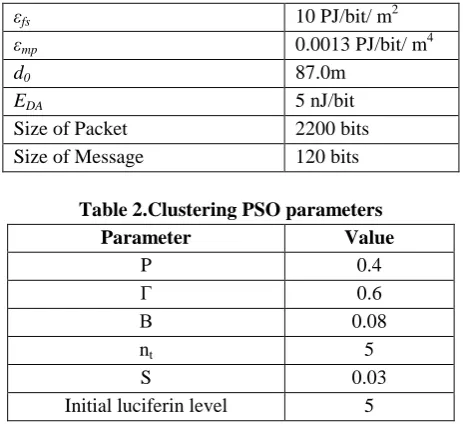
To accomplish better performance of Routing and Clustering in WSNs, the PSO-K-means-ACO-AODV method was applied in MATLAB R2017b through the i7 laptop with 4 GB RAM memory capacity. The two major algorithms are used in this work for clustering and routing such as PSO Optimized K-means and ACO-AODV which are providing better results those are mentioned in the below section. Tabulation 1 contains proposed Implementation parameters.
Table 1. Implementation parameters
Parameter Value
Area 135*135 m2
Numsensor nodes 280
Gateways 30
Initial energy 0.6 J
Num of iterations 350
Range of Communication 150 nm
Eelec 50 PJ/bit
εfs 10 PJ/bit/ m2
εmp 0.0013 PJ/bit/ m4
d0 87.0m
EDA 5 nJ/bit
Size of Packet 2200 bits
[image:4.595.50.280.257.350.2]Size of Message 120 bits
Table 2.Clustering PSO parameters
Parameter Value
P 0.4
Γ 0.6
Β 0.08
nt 5
S 0.03
Initial luciferin level 5
Table 3.Routing ACO parameters
Parameter Value
NP 20
C1 2.4962
C2 2.4962
W 0.7238
Vmax 0.6
Vmin -0.6
V. RESULTS AND DISCUSSION
The proposed PSO-K-means-ACO-AODVwas
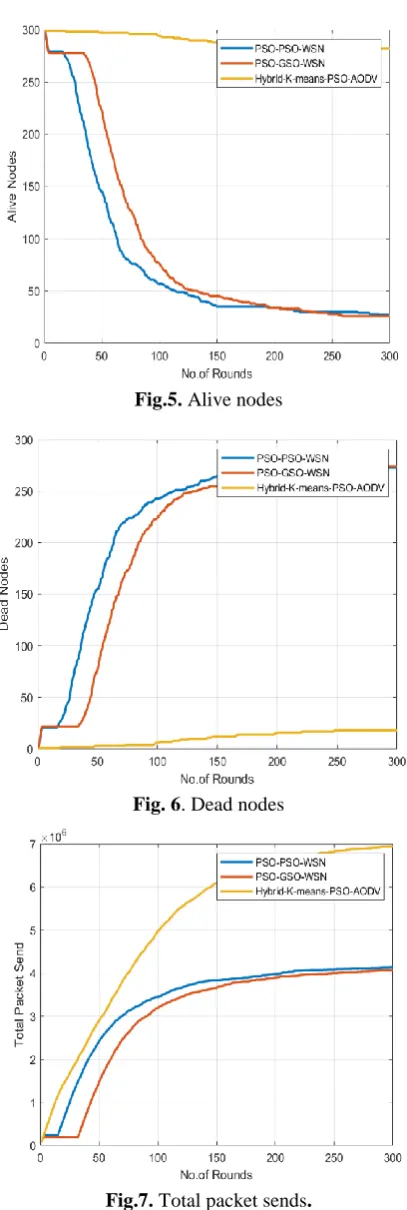
[image:4.595.311.542.295.423.2] [image:4.595.53.285.669.785.2]Fig.5. Alive nodes
Fig. 6. Dead nodes
Fig.7. Total packet sends.
Fig.7. the results of the total packet send, compared to an existing method the PSO-K-means-ACO-AODV method transmits the high amount of information at the same time. The PSO-GA-WSN and GA-GSO-WSN algorithms have high end-to-end delay so that the amount of transmission becomes small. Fig.8. shows the results of the EC, by comparing thePSO-K-means-ACO-AODV to two techniques such as PSO-GA-WSN and GA-GSO-WSN, the EC is too small. By executing therouting in each iteration causes the minimum utilization of energy, because it avoids the
redundant transmissions Fig.9. Displays the result of the throughput, it has more throughput value compared to existing methods. By improving the throughput, the broadcast rate of conveying the successful messages becomes more compared to PSO-GA-WSN and GA-GSO-WSN methods.
Fig.8. Energy consumption.
Fig. 9. Throughput.
Fig. 5,6,7,8 and 9. Presents that the comparison of PSO-K-means-ACO-AODV with two existing methodologies i) PSO-GA-WSN, ii) PSO-GSO-WSN. Fig. 5. Displays the alive nodes are greatly increased compared to two
methodologies such as i) PSO-GA-WSN, ii)
PSO-GSO-WSN. The NL and the number of transmissions are increased by the maximization of alive nodes. Fig.6. shows the results of dead nodes, compared to two
methodologies such as i) PSO-GA-WSN, ii)
[image:5.595.69.273.50.656.2] [image:5.595.321.530.129.527.2]Table 4.Comparison between PSO-GA-WSN and
GA-GSO-WSN to the PSO-K-means-ACO-AODV.
Paramete r PSO-G A-WSN GA-GS O-WSN PSO-K-means-A CO-AODV
Lifetime 140 200 250
Alive nodes
20 35 290
Dead nodes
215 250 10
Packet Send
3.9 e6 3.6 e6 6.1 e6
Energy 195 185 13
Table 4. Express the evaluation of proposed PSO-K-means-ACO-AODV with two existing methodologies i) PSO-GA-WSN, ii) GA-GSO-WSN. The comparison shows that the proposed PSO-K-means-ACO-AODV system provides better performance compared to other existing systems.
Table 5.Comparison between three network scenarios
Parameter 100 200 300
Life Time 130 190 220
Alive Nodes 90 180 285
Dead Nodes 8 8 7
Packet Send 5.8e6 6.4e6 6.9e6
Energy 12.7 14.5 15
Table 5, shows the comparison between three network scenarios i) 100, ii) 200 and iii) 300. The comparison is made in terms of amount of rounds Vs alive nodes, amount of rounds Vs dead nodes, amount of rounds Vs total packet sends, amount of rounds Vs EC and amount of rounds Vs throughput. The alive nodes are increased and respectively dead nodes are decreased by increasing the amount of SNs at each level. The total amount of packets deliver through the BS is increased. EC of a network is decreased and also the NL is increased. The throughput of a network is maximized when the amount of hops is decreased in each level.
VI. CONCLUSION
In this paper, a new algorithm is introduced with PSO with K-means and AODV with PSO, which enhance the clustering and routing algorithm of the WSNs with limited movement after an initial random deployment. The algorithm has been analyzed various particles sets to get best esteemed grouping and with various glowworm sets for routing of the WSNs.
From obtained results, conclude that the
PSO-K-means-ACO-AODV method has achieved the best Routing and Clustering of WSN compared to the PSO-GA-WSN algorithms. This GA-GSO-WSN method used to improve the NL, alive nodes, and throughput, then minimize the EC of the node.
.
REFERENCES
1. Lu, H., Li, J. and Guizani, M., 2014. Secure and efficient data transmission for cluster-based wireless sensor networks. IEEE transactions on parallel and distributed systems, 25(3), pp.750-761. 2. Shine, A.V. and Venkadesh, P., 2016. Secure and Efficient Data
Transmission for Cluster-Based Wireless Sensor Networks: A Study. International Journal of Engineering and Future Technology™, 5(5), pp.36-42.
3. Bhattacharyya, D., Kim, T.H. and Pal, S., 2010. A comparative study of wireless sensor networks and their routing protocols. Sensors, 10(12), pp.10506-10523.
4. E.Vishnupriya, .Jayasankar T, 2015. Performance Analysis of Optimum Routing Protocols in Wireless Sensor Networks,” IJISET - International Journal of Innovative Science, Engineering & Technology, Vol. 2 Issue 2, pp 520-528.
5. AnupPawar, DivyaK , Secure and Efficient Data Transmission in Cluster based Wireless Sensor Network. International Journal of Computer Science and Mobile Computing, IJCSMC, Vol. 4, Issue. 8, August 2015, pg.132 – 142
6. W. Heinzelman, A. Chandrakasan, and H. Balakrishnan, “An application-specific protocol architecture for wireless micro-sensor networks,” IEEE Trans. Wireless Commun., vol. 1, no. 4, 2002. 7. L. B. Oliveira, A. Ferreira, M. A. Vilaca et al.,“SecLEACH-On the
security of clustered sensor networks,” Signal Process., vol. 87, pp. 2882–2895, 2007.
8. Ehsan, Samina, and BechirHamdaoui. "A survey on energy-efficient routing techniques with QoS assurances for wireless multimedia sensor networks." IEEE Communications Surveys & Tutorials 14, no. 2 (2012): 265-278.
9. A. A. Abbasi and M. Younis, “A survey on clustering algorithms for wireless sensor networks,” Comput. Commun., vol. 30, no. 14-15, pp. 2826–2841, 2007.
10.Al-Karaki, Jamal N., Raza Ul-Mustafa, and Ahmed E. Kamal. "Data aggregation and routing in wireless sensor networks: Optimal and heuristic algorithms." Computer networks 53, no. 7 (2009): 945-960. 11.Ozdemir, Suat, and Yang Xiao. "Secure data aggregation in wireless
sensor networks: A comprehensive overview." Computer Networks 53, no. 12 (2009): 2022-2037.
12.E.Vishnupriya, T. Jayasankar and P. Maheswara Venkatesh, “ SDAOR: Secure Data Transmission of Optimum Routing Protocol in Wireless Sensor Networks For Surveillance Applications, ARPN Journal of Engineering and Applied Sciences, Vol. 10,Issue. 16, Sep 2015,pp 6917-6931
13.Salehpour, Ali-Asghar, Ali Afzali-Kusha, and SiamakMohammadi. "Efficient clustering of wireless sensor networks based on memetic algorithm." Innovations in Information Technology, 2008. IIT 2008. International Conference on. IEEE, 2008.
14. Nayak, Padmalaya, and Bhavani. "Energy Efficient Clustering Algorithm for Multi Hop Wireless Sensor Network Using Type-2 Fuzzy Logic." IEEE Sensors Journal (2017).
15. Lee, Heesang, Kyuhong Lee, and YounHo Lee. "A Self-Organized Head Selection for Hierarchical Routing in Wireless Sensor Networks." Self-Organizing Systems (2008): 206-217.
16.K.VinothKumar, T.Jayasankar, M.Prabhakaran and V. Srinivasan,
“Fuzzy Logic based Efficient Multipath Routing for Mobile Adhoc
Networks”, Appl. Math. Inf. Sci. vol.11, no.2, March 2017,
pp.449–455.
17.Oladimeji, MuyiwaOlakanmi, Mikdam Turkey, and Sandra Dudley. "HACH: Heuristic Algorithm for Clustering Hierarchy protocol in wireless sensor networks." Applied Soft Computing 55 (2017): 452-461.
18. Nayak, Padmalaya, and BhavaniVathasavai. "Genetic algorithm based clustering approach for wireless sensor network to optimize routing techniques." Cloud Computing, Data Science & Engineering-Confluence, 2017 7th International Conference on. IEEE, 2017.
19.Sun, Yongjun, Wenxin Dong, and Yahuan Chen. "An Improved Routing Algorithm Based on Ant Colony Optimization in Wireless Sensor Networks." IEEE Communications Letters (2017).
21.K.Vinoth Kumar, Dr.S.Bhavani, “An Effective Localization based Optimized Energy Routing for MANET” Journal of Theoretical and Applied Information Technology (JATIT) ISSN: 1992-8645, E-ISSN: 1817-3195, Vol.77. No.2, July 2015.
22.Wenbo Zhang, GuangjieHan ,Yongxin Feng , Jaime Lloret. "IRPL: An energy efficient routing protocol for wireless sensor networks." Journal of Systems Architecture 75 (2017): 35-49. 23.Batth, K.K. and Singh, R., ACODeRA: A Novel ACO Based on
Demand Routing Algorithm for Routing in Mobile Ad Hoc Networks. 24. KirubaBuri, R and Jayasankar, T, Intelligence Intrusion Detection
Using PSO with Decision Tree Algorithm for Adhoc Networks, Bioscience Biotechnology Research Communications, Special Issue Recent Trends in Computing and Communication Technology, Vol. 12, No.2, March (2019),pp.27-34.
25.K. B. Gurumoorthy, S. Gopinath, K. Vinoth Kumar , “Ant Colony Optimization and Genetic Algorithm Integrated Load Balancing Approach for MANET”. International Journal of Innovative Technology and Exploring Engineering (IJITEE) ISSN: 2278-3075, Volume-8 Issue-5 March, 2019.
26.S.Gopinath, K.Vinoth Kumar, T.Jaya Sankar, “Certain Investigation on Secured Multicast Authenticated Routing Scheme for MANET”, Cluster Computing (Springer) – Vol 3 &pp 1-10. https://doi.org/10.1007/s10586-018-2020-7.
27.K.Vinoth Kumar, Dr.S.Bhavani, “Trust Based Multipath
Authentication Protocol for Mobile Ad Hoc Network” Journal of Computational and Theoretical Nanoscience (CTN), ISSN: 1546-1955 (Print): EISSN: 1546-1963 (Online), Volume 12, Number 12,
December 2015, pp.