Open Access
Short Report
Analysis of gene expression patterns by microarray hybridization in
blood mononuclear cells of SLA-DRB1 defined Canadian Yorkshire
pigs
Maria I Nino-Soto
1, Razi Jafari Jozani
2, Byram Bridle
1and
Bonnie A Mallard*
1Address: 1Department of Pathobiology, Ontario Veterinary College, University of Guelph, Guelph, Ont., N1G 2W1, Canada and 2Faculty of Veterinary Medicine, University of Tehran, Tehran, Iran
Email: Maria I Nino-Soto - [email protected]; Razi Jafari Jozani - [email protected]; Byram Bridle - [email protected]; Bonnie A Mallard* - [email protected]
* Corresponding author
Abstract
Background: The Swine Leukocyte Antigen (SLA) system encodes molecules for self-nonself discrimination and is associated with immune responses and disease resistance. Three lines of pigs defined by their SLA-DRB1 alleles were developed at the University of Guelph for xenotransplantation and immune response studies. The aim of this project was to explore the potential association between defined SLA-DRB1 alleles and gene transcriptional patterns of other immune-related genes in blood mononuclear cells.
Findings: Three SLA-DRB1 alleles were characterized using a RT-PCR-based sequencing method. The loci represented included a new allele, DRB1*04ns01. Next, microarray heterologous (bovine-porcine) hybridization together with qPCR were used to explore differential gene expression between SLA-DRB1-defined groups. Microarray analysis showed significant (p < 0.01) differential expression for 5 genes, mostly related to inflammation. Genes varied according to the comparison analyzed. Further testing with qPCR revealed the same trend of differential expression for 4 of the genes, although statistical significance was reached for only one.
Conclusion: A new SLA-DRB1 allele was characterized. A potential association was found between SLA-DRB1 alleles and inflammation-related genes. However, the influence of other genes cannot be ruled out. These preliminary findings agree with other studies linking MHC haplotypes and inflammation processes, including autoimmune disease. The study provides an initial view of the biological interactions between the SLA complex and other immune-related genes. Future studies will focus on characterization of SLA-haplotypes associated with these particular alleles and the dynamics of the immune response to antigenic challenges.
Findings
The highly polymorphic MHC-encoded molecules are crucial for self-nonself discrimination in vertebrates. They
constitute the major barrier for transplantation, contain numerous genes involved in immunological and non-immunological functions and are associated with resist-Published: 23 June 2008
BMC Research Notes 2008, 1:31 doi:10.1186/1756-0500-1-31
Received: 10 April 2008 Accepted: 23 June 2008
This article is available from: http://www.biomedcentral.com/1756-0500/1/31
© 2008 Nino-Soto1 et al; licensee BioMed Central Ltd.
ance or susceptibility to various diseases. The two main classes, I and II, are involved in antigen presentation to T-cells. However, a large number of the genes in the MHC, like class III genes, are not directly related to this function [1,2]. A total of 152 loci have been annotated within this region. In pigs, known as the SLA, the DRB genes show extensive polymorphism in exon 2 and the 135 available sequences identified to date are distributed into at least 10 confirmed allele groups [3].
Different SLA haplotypes have been associated with varia-tion in immune response and disease, as well as reproduc-tion and producreproduc-tion traits [4]. Therefore, SLA-defined pigs constitute an invaluable resource to study immune response, disease resistance and production traits, as well as an important large animal model for biomedical research [5,6]. Three lines of commercial Yorkshire pigs with defined SLA-DRB1 genotypes were produced at the University of Guelph for xenotransplantation and immune response research [7,8]. The aims of this study were to characterize the SLA-DRB1 alleles in these three pig lines and explore differential transcriptional activity between the three groups using heterologous (bovine probes – porcine targets) cDNA microarray and qPCR.
Animals and samples
Animal use was approved by the Animal Care Committee of the University of Guelph. Thirty-five pigs were included in the study (n = 6 for microarray analysis and n = 29 for qPCR). Pigs came from crossings of an outbred popula-tion selected for only by specific SLA-DRB1 alleles. Age of pigs ranged between 3–6 months and all pigs were in good general health at the time of sampling. Venous blood was collected in EDTA coated BD Vacutainer®
col-lection tubes (BD – Canada, Oakville, ON, Canada) and processed immediately after collection. MNCs were iso-lated using Histopaque-1077 (Sigma-Aldrich Canada Ltd., Oakville, ON, Canada) and total RNA was extracted using TRIzol™ reagent (Invitrogen Canada Inc., Burling-ton, ON, Canada). Total RNA was treated with DNA-free
(Ambion Inc., TX, USA) to eliminate genomic DNA con-tamination. Concentration and quality were assessed with an Agilent 2100 Bioanalyzer (Agilent Technologies Inc., Santa Clara, CA, USA).
SLA-DRB1 alleles characterization
The SLA-DRB1 alleles were characterized according to Ho et al. (2006). Briefly, total RNA was reverse transcribed with the ThermoScript™ RT-PCR system using oligo d(T) primers (Invitrogen). A specific SLA-DRB1 coding region was amplified with PfuUltra™ Hotstart High-Fidelity DNA Polymerase (Stratagene, La Jolla, CA, USA) using a final concentration of 3 mM of MgCl2 and annealing tempera-ture at 55°C. PCR products were gel-extracted with the QIAquick Gel Extraction Kit (Qiagen, Mississauga, ON,
Canada) and purified PCR products were cloned using the Zero Blunt® TOPO® PCR cloning kit (Invitrogen). At least
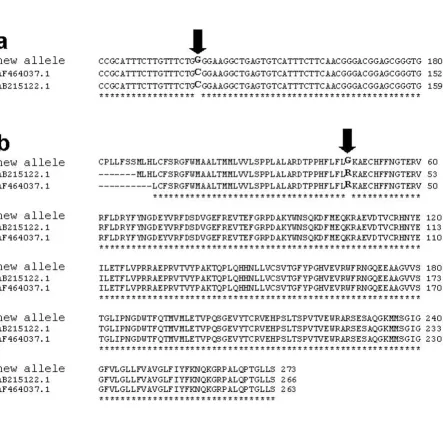
7 colonies per animals were sent for sequencing. Each allele was characterized by sequencing using both forward and reverse primers, from at least two pigs per litter. The complete coding sequence was obtained by overlapping the forward and reverse fragments. Comparison with cur-rently available sequences (GenBank and EBI-IPD-MHC, SLA section databases) was performed using BLAST [9] and ClustalW [10]. Two lines carried the SLA-DRB1*0502 and SLA-DRB1*0701 alleles respectively (Smith et al, 2005) as determined by a 100% homology between the sequences obtained from test samples and the corre-sponding published sequences. The third line had a novel allele, differing in one bp at position +118 in exon 2 with SLA-DRB1*0403. This difference corresponds to a point mutation substituting a cytosine for a guanine, which translates in the substitution of an arginine for a glycine residue in the protein encoded by this new allele (Figure 1). Sequences were submitted to GenBank [Genbank: EU087426, EU087427 and EU087428] and the EBI IPD-MHC (SLA section) which resulted in the assignment of the SLA-DRB1*04ns01 provisional name to the new allele, approved by the MHC Nomenclature Committee.
cDNA Microarray experiments
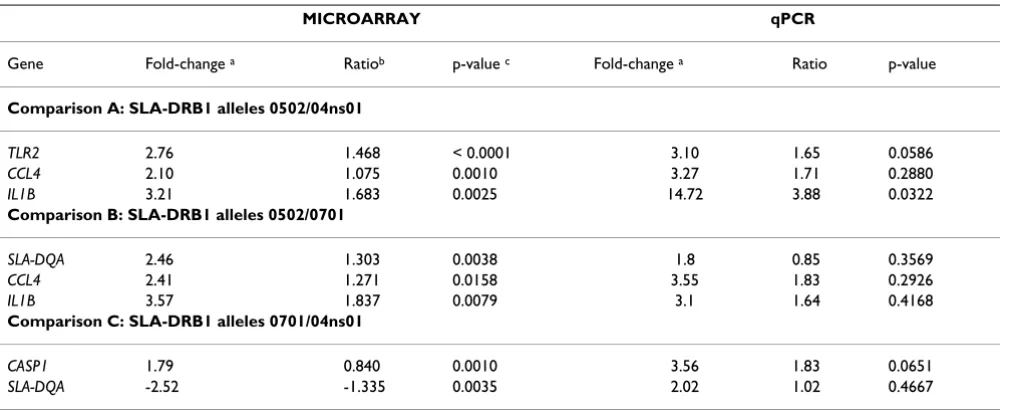
hybrid-ization does not imply that all spots will provide valid results. As previously mentioned, we performed careful filtering to ensure that only consistent data was subject to further analysis. Results from microarray data analysis are summarized in Table 1 and Figure 2. The *0502 allele group showed higher transcriptional activity for CCL4 and
IL1B in all comparisons. The *0701 allele group showed less SLA-DQA transcripts in all comparisons. Transcripts amounts for TLR2 and CASP1 were higher in the *0502 and *0701 allele groups respectively, when compared to the *04ns01 group. The small number of genes consist-ently detected as differentially expressed reflects the ten-dency of heterologous hybridization to reduce the
effective size of a given microarray. Although optimal results are obtained with homologous hybridizations, the use of heterologous microarray hybridization is still a valid approach to assess gene expression profiles given that measures are taken to preserve the quality of the data obtained [15]. In addition, results were verified using qPCR as stated in the next section.
Numerous associations have been established in swine between SLA haplotypes and features such as immune response and disease [16,17], reproduction [18] and pro-duction traits [19]. Many of these traits are not directly regulated by individual SLA genes but could rather be
[image:3.612.78.522.73.503.2]Nucleotide and protein sequence alignment of SLA-DRB1 alleles
Figure 1
under the influence of non-classical MHC genes or con-trolled by downstream pathways yet to be described. The involvement of other closely linked genes, whose variants are in linkage disequilibrium (LD) can not be discarded [20,21]. For example, it has been found that differential expression of LTB (also known as TNF beta) in MHC class II-defined B cell lines is associated with certain MHC class II haplotypes but not others. This association could be explained by LD between LTB and MHC haplotypes or by the influence of polymorphism in the MHC class II mole-cules and their interactions on the control of gene expres-sion [22]. Another example is represented by BRD2 in humans. This transcription factor, without an established immune function and located in the MHC class II region, is strongly linked to the MHC in most vertebrates [23].
Although it is not possible from the results in this study to establish a direct causal relationship between particular SLA-DRB1 alleles and differential transcription of inflam-matory genes observed, it is undeniable that there seems to be an association. These observations will be better explained by the characterization of the haplotypes linked to these alleles and further exploration of the immune response in animals with defined MHC haplotypes.
Quantitative RT-PCR
To verify differential expression observed in the microar-ray data, qPCR calibrator-normalized relative quantifica-tion with efficiency correcquantifica-tion in the LightCycler® 1.5
system and the Relative Quantification Software v. 1.0 (Roche Diagnostics, Laval, QC, Canada) were used. RPL19
Differential transcriptional activity detected by cDNA microarray hybridization and qPCR
Figure 2
Differential transcriptional activity detected by cDNA microarray hybridization and qPCR. Mean fold changes in transcript quantification obtained by cDNA microarray hybridization ( ) and qPCR (h). a) Microarray (n = 2 per group) and
was tested for variability among samples and selected as reference gene. Specific PCR conditions and primers are described in Table 2. Total RNA samples (*0502, n = 9; *0701, n = 6 and *04ns01, n = 14) were reverse tran-scribed using SuperScript III (Invitrogen). The qPCR was performed using LightCycler® FastStart DNA Master SYBR
Green I (Roche). Relative standard curves for target and reference genes were created using dilution series with six 10-fold dilutions in triplicates. One of the dilutions was used as calibrator. Replicate determinations were per-formed using independent reverse transcription reactions. Results are reported as normalized ratio of target/refer-ence concentrations. Data sets from qPCR were analyzed with a general linear model [24] using the SAS system for Windows v 9 (SAS Institute Inc., Cary NC, USA). A log transformation was used to normalize the data and
directly model the ratios of transcript quantification. The ANOVA allowed analysis with unequal variances for
[image:5.612.55.562.99.304.2]CCL4. Statistical significance was set at p = 0.05. Results from the qPCR analysis are summarized in Table 2 and Figure 2. In general, qPCR results followed the trend observed by microarray analysis, except for of SLA-DQA, which showed a pattern opposite to the one expected for the *0701/*04ns01 comparison. It appears that differ-ences were more consistent between the *04ns01 and the two other groups, with IL1B transcript quantity reaching statistical significance (p = 0.05) and TLR2 (p = 0.0586) and CASP1 (p = 0.0651) approaching statistical signifi-cance, warranting further investigation. It is worth men-tioning that lack of statistical significance does not automatically imply lack of biological significance. Anal-ysis of variance components indicated that the individual Table 1: Summary of results from cDNA microarray and qPCR data analysis
MICROARRAY qPCR
Gene Fold-change a Ratiob p-value c Fold-change a Ratio p-value
Comparison A: SLA-DRB1 alleles 0502/04ns01
TLR2 2.76 1.468 < 0.0001 3.10 1.65 0.0586
CCL4 2.10 1.075 0.0010 3.27 1.71 0.2880
IL1B 3.21 1.683 0.0025 14.72 3.88 0.0322
Comparison B: SLA-DRB1 alleles 0502/0701
SLA-DQA 2.46 1.303 0.0038 1.8 0.85 0.3569
CCL4 2.41 1.271 0.0158 3.55 1.83 0.2926
IL1B 3.57 1.837 0.0079 3.1 1.64 0.4168
Comparison C: SLA-DRB1 alleles 0701/04ns01
CASP1 1.79 0.840 0.0010 3.56 1.83 0.0651
SLA-DQA -2.52 -1.335 0.0035 2.02 1.02 0.4667
a Fold change = 2 (Log-ratio) or (-1) 2 (Log-ratio); b Median of the lowess-normalized log-ratio of intensity; c p-value with FDR correction for multiple
[image:5.612.55.550.554.711.2]comparisons.
Table 2: Gene-specific primers and PCR conditions for relative quantification in the Light Cycler system
Gene name GenBanka Primers (5'-> 3') b Prod. size (bp) c Ann. temp. (°C) d Acq. temp. (°C) e
TLR2 AB085935.1 F TGCGAATCCTGAAAATAGGC 343 59 84 R CTTGCGTCAGTGATTTCTGC
CCL4 NM_001075147 F GAAGCTCTGCGTGACTGTCC 391 59 87 R AGGAACAGGATCTGCTGAGG
IL1B NM_214055.1 F GCAGATGGTGTCTGTCATCG 444 60 84 R TTCTCCATGTCCCTCTTTGG
SLA-DQA AY191777.1 F TGTGGAGGTGAAGACATTGC 315 59 83
R CAGCATCACTGGAGACTTGG
CASP1 NM_214162.1 F GAGAAAATCTCACCGCTTCG 572 59 83
R AGTCACTCTTTCGGCAGTGG
RPL19 AV600389 F ATGAGACCAATGAAATCGCC 504 60 87
R CATGAGGATCCGCTTGTTTT
a Sequenced used for primer design; b Sequence of forward (F) and reverse (R) primers in 5' to 3' orientation; c Size of the amplified PCR product; d
pig (p = 0.05) was an important random effect in tran-script quantification. This innate variability of individual pigs is most likely behind the lack of statistical signifi-cance in spite of fold-changes higher than 3 being observed. It also points out to the importance of including as many individuals as possible for qPCR confirmation of microarray data, especially individuals that have not been used for the microarray analysis, in order to obtain results that more closely reflect the situation in the population. In the case of CCL4, even though it appeared to be signif-icantly differentially expressed in two of the comparisons (fold change > 3), the differences got lost within the high variability showed by the gene transcript quantifications in the tested groups, indicating that the differences may not be consistent at the population level. This seems to be also the case for differences observed between the *0502 and *0701 allele groups, a fact that suggests that the gene expression profiles of these two groups are not really that distinctive.
List of abbreviations
LTB, Lymphotoxin beta (TNF superfamily, member 3);
BRD2, Bromodomain containing 2; CCL4, Chemokine (C-C motif) ligand 4; IL1B, Interleukin 1 beta; SLA-DQA, SLA class II DQ alpha; TLR2, Toll-like receptor 2; CASP1, Caspase 1; RPL19, Ribosomal protein L19, EBI IPD, Euro-pean Bioinformatics Institute Immuno-Polymorphism Database; BLAST, Basic Local Alignment Search Tool; RT-PCR, Reverse transcription – polymerase chain reaction; qPCR, quantitative PCR; SLA, Swine leukocyte antigen; MHC, Major histocompatibility complex; MNCs, Blood mononuclear cells; GEO, Gene Expression Omnibus; MIAME, Minimum information about a microarray exper-iment; LOWESS, Locally weighted scatter plot smoothing algorithm; FDR, False Discovery Rate.
Competing interests
The authors declare that they have no competing interests.
Authors' contributions
MINS participated in the conception and design of the study, carried out the qPCR confirmation, participated in the SLA-DRB1 allele characterization and drafted the manuscript. RJJ carried out the cDNA microarray hybridi-zations and helped draft the manuscript. BB established the SLA-defined lines of pigs and participated in the char-acterization of SLA-DRB1 alleles. BAM participated in the design and coordination of the project and helped to draft the manuscript. All authors read and approved the final manuscript.
Acknowledgements
We wish to acknowledge the financial support of Ontario Pork Producers to BAM and the Government of Iran to RJJ. The assistance of the personnel at Arkell Research Station (University of Guelph), technical support of
Sophia Lim, and assistance in statistical analysis of William Sears are greatly appreciated.
References
1. Ando A, Chardon P: Gene organization and polymorphism of the swine major histocompatibility complex. Anim Sci J 2006, 77:127-133.
2. Kumanovics A, Takada T, Lindahl KF: Genomic organization of the mammalian MHC. Annu Rev Immunol 2003, 21:629-657. 3. Smith DM, Lunney JK, Ho CS, Martens GW, Ando A, Lee JH, Schook
L, Renard C, Chardon P: Nomenclature for factors of the swine leukocyte antigen class II system, 2005. Tissue Antigens 2005, 66:623-639.
4. Vaiman M, Chardon P, Rothschild MF: Porcine major histocom-patibility complex. Rev Sci Tech 1998, 17:95-107.
5. Ho CS, Rochelle ES, Martens GW, Schook LB, Smith DM: Charac-terization of swine leukocyte antigen polymorphism by sequence-based and PCR-SSP methods in Meishan pigs.
Immunogenetics 2006, 58:873-882.
6. Lunney JK: Advances in swine biomedical model genomics. Int J Biol Sci 2007, 3:179-184.
7. Bridle BW, Wilkie BN, Jevnikar AM, Mallard BA: Rat genotype influences quantitative and qualitative aspects of xenogeneic immune response to pig blood mononuclear cells. Xenotrans-plantation 2006, 13:299-307.
8. Bridle BW, Wilkie BN, Jevnikar AM, Mallard BA: Deviation of xeno-geneic immune response and bystander suppression in rats fed porcine blood mononuclear cells. Transpl Immunol 2007, 17:262-270.
9. Altschul SF, Gish W, Miller W, Myers EW, Lipman DJ: Basic local alignment search tool. J Mol Biol 1990, 215:403-410.
10. Thompson JD, Higgins DG, Gibson TJ: CLUSTAL W: improving the sensitivity of progressive multiple sequence alignment through sequence weighting, position-specific gap penalties and weight matrix choice. Nucleic Acids Res 1994, 22:4673-4680. 11. Brazma A, Hingamp P, Quackenbush J, Sherlock G, Spellman P, Stoeckert C, Aach J, Ansorge W, Ball CA, Causton HC, Gaasterland T, Glenisson P, Holstege FC, Kim IF, Markowitz V, Matese JC, Parkin-son H, RobinParkin-son A, Sarkans U, Schulze-Kremer S, Stewart J, Taylor R, Vilo J, Vingron M: Minimum information about a microarray experiment (MIAME)-toward standards for microarray data. Nat Genet 2001, 29:365-371.
12. Yang YH, Dudoit S, Luu P, Lin DM, Peng V, Ngai J, Speed TP: Nor-malization for cDNA microarray data: a robust composite method addressing single and multiple slide systematic vari-ation. Nucleic Acids Res 2002, 30:e15.
13. Benjamini Y, Hochberg Y: Controlling the false discovery rate: a practical and powerful approach to multiple testing. J Roy Sta-tistic Soc Ser B 1995, 57:289-300.
14. Tao W, Mallard B, Karrow N, Bridle B: Construction and applica-tion of a bovine immune-endocrine cDNA microarray. Vet Immunol Immunopathol 2004, 101:1-17.
15. Buckley BA: Comparative environmental genomics in non-model species: using heterologous hybridization to DNA-based microarrays. J Exp Biol 2007, 210:1602-1606.
16. Lumsden JS, Kennedy BW, Mallard BA, Wilkie BN: The influence of the swine major histocompatibility genes on antibody and cell-mediated immune responses to immunization with an aromatic-dependent mutant of Salmonella typhimurium.
Can J Vet Res 1993, 57:14-18.
17. Madden KB, Moeller RF Jr., Douglass LW, Goldman T, Lunney JK: Trichinella spiralis: genetic basis and kinetics of the anti-encysted muscle larval response in miniature swine. Exp Par-asitol 1993, 77:23-35.
18. Renard C, Vaiman M: Possible relationships between SLA and porcine reproduction. Reprod Nutr Dev 1989, 29:569-576. 19. Mallard BA, Kennedy BW, Wilkie BN: The effect of swine
leuko-cyte antigen haplotype on birth and weaning weights in min-iature pigs and the role of statistical analysis in this estimation. J Anim Sci 1991, 69:559-564.
Publish with BioMed Central and every scientist can read your work free of charge "BioMed Central will be the most significant development for disseminating the results of biomedical researc h in our lifetime."
Sir Paul Nurse, Cancer Research UK
Your research papers will be:
available free of charge to the entire biomedical community
peer reviewed and published immediately upon acceptance
cited in PubMed and archived on PubMed Central
yours — you keep the copyright
Submit your manuscript here:
http://www.biomedcentral.com/info/publishing_adv.asp
BioMedcentral 21. Trowsdale J: HLA genomics in the third millennium. Curr Opin
Immunol 2005, 17:498-504.
22. Guo W, Mourad W, Charron D, Al Daccak R: Ligation of MHC class II molecules differentially upregulates TNF beta gene expression in B cell lines of different MHC class II haplotypes.
Hum Immunol 1999, 60:312-322.
23. Shiina T, Inoko H, Kulski JK: An update of the HLA genomic region, locus information and disease associations: 2004. Tis-sue Antigens 2004, 64:631-649.