International Journal of Innovative Technology and Exploring Engineering (IJITEE) ISSN: 2278-3075, Volume-8 Issue-6C, April 2019
Abstract: ‘Digitization’ has restructured the auditing profession with upgraded technical skills and knowledge of auditors in India. Soft wares such as, CAATT, eaudit, DMS, Aura, on spring, Audit Board, iAuditor and larger safety culture suite assists the auditors to stay ahead with the audit process efficiently and effectively. Digitization helped the auditors to spend less time on paper work and more time lending their knowledge to other high-risk areas of the business. The present study aims at understanding the impact of Digitization on the audit profession in India by using a well-structured questionnaire of 400 respondents from auditor`s profession across India. Factor Analysis (FA) and confirmatory factor analysis (CFA) approach is exploited to generate the results. SEM has been deployed to evaluate the original and modification indices of the model, which further establishes the improvement of path analysis in SEM`s effectiveness with the help of Reliability and Validity tests. The model establishes the significant impact of Digitization on the audit profession in India. Based on results in Structural Equation Modelling, contributions of digitization on the audit profession in India is analysed. Various parameters established based on Force Field Theory (Kurt Lewin`s, 1948) [1] of driving forces and restraining forces such as, auditor`s perception, demographic, socio economic, political, environmental, technological, infrastructural and political. The outcome of the study will help the auditors and corporates practitioners to frame the guidelines to meet global challenges.
Index Terms: Auditing, Automation, Technology, Digitization, Software.
I.INTRODUCTION
The term `Digitization` is believed to be used by Wachal (1971) [2], where he has discussed the implications on the society as a consequence from digitization. Digitization is the usage of technology and digital advances, such as analytics, mobility, social media and smart embedded devices, to radically improve performance. Digitization and sweeping developments in Information Technology (IT) has stimulated the computer program designers to design the soft wares to assist Auditors in examining, testing, gathering evidence, conducting analytical tests, evaluating internal control, sampling data, documenting the audit, scheduling the audit, printing exception reports and preparing audit reports (Crutchley, C.,et al. 2007) [3]. Though this process is a topic within auditing research and theory, the auditors and the clients are exploiting and implementing digital innovations to have business efficiencies, increase customer satisfaction, increase productivity and to develop good business strategies [4]. The machines, methods and products become smarter and smarter with advancement in the technology, like ‘Sensors and Radio-frequency.
Revised Manuscript Received on December 22, 2018.
Vani Ramesh, Research Scholar, Bharathiar University
Fig1 Meaning of Digitization Source: Noble and Smith, (2015)
Fig2 Deployment of Audit Process
Source: Digitalization’s effects on the audit profession Torraco (2016)
Identification (RFID) Chips’ (Xiao Z, et al., 1997) [5]. The customers and the general public is more updated and advanced with these changes, Auditors in India are expected to cope up with these technologies to have good understanding with the clients and gain the good will.
Fig3: Digitization of Audit Profession
Source: “Too removed from the realities of practice”, Power and Gendron, (2015)
Digitization and Audit Profession
Since auditing profession is an independent and unbiased inspection, where the auditors delivers the appropriate and transparent information about the business transactions (IIFAC,2001) [6], the first and foremost goal of auditing is to bring in accountability and transparency, and this is expected only with the latest technology that can identify the flaws in the process and system (Harrison MJ, Datta P, 2007) [7] to bring in equity and integrity in operations of organizations. It is observed that, there is no specific definition of audit quality, De Anglo (1981) [8] has given a brittle definition as “Audit quality is joint probability that audit will truly present the audit findings in accounting system of its client, for the public.” In general for any auditor profession to have a sustainable quality management practices, internal and external environmental factors need to be considered, such are auditors skills and credentials, auditors qualification, audit tenure, strategic management policies, working environment, infrastructural facilities, socio-economic, cultural, political and environmental conditions, moreover the perception of auditors towards their profession and client satisfaction (Zahargier and Balasundaram ,2011; Baron and Greenbery, 2008; Elder and Davis, 2007)[9]. Countries like India, where there is a threat of corruption is high, `Digitalization of Transparency Audit System` (DTAS) will curb the corruption to the maximum extent possible (Masood and Lodhi, 2015) [10]. In India, `The Quality Review Board (QRB)` established by parliament under `The Chartered Accountants Act 1949`, is a 10-member panel, 50% of the members are from `The Institute of Chartered Accountants of India (ICAI)` (Gupta, 2008) [11]. The International Auditing and Assurance Standards Board (IAASB) has developed a frame work for `Audit Quality `, that gives a clear guideline and describes the “Input-Process-and-Output” factors that contribute to audit quality. According to IAASB, as such there is no clear definition for “Audit Quality”, however, as a term frequently used as a debate and recognised as a very complex subject in nature. For the purpose of the study, the author(s) has identified a model for the audit quality. Force Field Theory (Kurt Lewin’s, 1948) is adopted and used in this study as `investigative tool` in order to improve the understanding of the revolution that is affecting the auditing profession. It will assist in creating a simplified image to show the forces involved in it and build knowledge around the current shift of the profession. So, there is an indication that the purpose and the quality of audit is to boost the degree of confidence of intended users1. The structure of the paper follows primarily with the introduction to the “Digitization of Audit Profession”, objective of the study and hypothesis. The second section brings out related literature, third section highlights on methodology and last section on data analysis, findings and suggestions.
A. Objective of the Study
The major objective of this study is to examine conceptually the ‘Digitization on audit profession` in India, with the secondary objective (s) of,
1
https://isca.org.sg/tkc/aa/current-issues/hot-topics/audit-quality
1.
To understand if there is any positive impact of Digitization of audit profession.2.
To test empirically the factors influencing the adoption of digitization.3.
To examine the significant differences in the opinion of auditors in digitization of audit profession in satisfying the stakeholders.4.
To suggest and recommend appropriate strategies based on the empirical results.B. Hypothesis
There is positive influence of digitization on audit profession in India There is a significant relationship between internal and external environment in adopting Digitization in audit profession. Digitization of audit profession is very effective in satisfying the stakeholders in India.
II.DATACOLLECTIONTECHNIQUE ANDMETHODOLOGY
A self-developed questionnaire of five-point likert scale was employed to explore the impact of digitization on audit quality through multistage random sampling. Drop-off survey was adopted. Through multistage random sampling, 500 respondents were selected from across India. The respondents rate was 80% (400 respondents), which is fairly seems acceptable. The Factor Analysis (FA) and confirmatory factor analysis (CFA) approach is exploited to generate the results with the help of software IBM SPSS AMOS (Analysis of Moment Structures). SEM has been deployed to evaluate the original and modification indices of the model, which further establishes the improvement of path analysis in SEM`s effectiveness with the help of Reliability and Validity tests.
III.LITERATUREREVIEW
Revisit of previous studies on the `Digitization of Audit Profession` is a basis for defining this research objective(s). For the purpose of this study, a vigorous literature study is conducted to understand the implications of Digitization of audit profession and audit quality. The literature is divided in to two parts, such as, adoption of digitization and the technological advancements of digitization.
A. Literature on Software Advances and Digitization
International Journal of Innovative Technology and Exploring Engineering (IJITEE) ISSN: 2278-3075, Volume-8 Issue-6C, April 2019
(i). CAATTs (Computer-Assisted Audit Tools and Techniques): As a computer program, assists the auditors to test for a specific risk and improve the audit process. Generally CAATTs is used to refer any data extraction and analysis with the help of programs such as spread sheets, databases, SAS, Crystal Reports and business objects. The main advantage of this software for the auditors includes, the auditors are able to avoid corruption with an organised data, helps to have many specific audit routines (sampling), provides good documentation for each test performed and pivot table creation.
(ii). Onspring: Onspring is a plat for `Process Automation` and user friendly, which allows the auditors (users) to manage data, workflow and reporting. Though this software is used for the single business, it has a ability to connect multiple functions, and can be tailored to a company needs without coding. The main functions of this “Process Automation Platform” includes, audit planning and management, business intelligence, quality management, project delivery, assists the users to monitor disaster recovery and coordination.
(iii). AuditBoard: It’s a cloud-based audit software which provides SOX (Sarbanes Oxley Act). This software helps in visualising the data, analyse and control internal data where the users can export the data with the help of PowerPoint or Excel file. This software also provides a platform for creating personalised dashboards.
(iv). iAuditor: This software is designed by SafetyCulture, enables users to capture variety of information from different files digitally to have a quality and safety audits. This helps the users to conduct inspections even without internet, since the users can export the data in the form of PDF, XML, CSV and DOCX. iAuditor is compatible with iOS, Android and Windows mobile devices, and interfaces with the larger SafetyCulture suite.
(v). E-Data: Is a cloud-based audit management software. This software is used extensively in automotive, manufacturing and construction industries. This software helps the auditors to plan, schedule, complaint investigations, PPAP validation and material certification with the help of instant I-charts, R-charts, X-charts. This software is designed to work with both mobile and desktop devices.
(vi). Audit Applications: Audit Applications is an online service automating and simplifying the audit process. This software assists the auditors to monitor the transactions without any error or fraud. (vii) ACL: Access Control List is an integrated system of software which provides complete control over data access, management, analysis and presentation.
(viii).Arbutus: This software is used for `Quality Audit` and `Business Intelligence (BI)`applications such as audit analytics, continuous monitoring, fraud detection, work group collaboration …etc.
(ix). Audimation: Auditor Assistant, Audit Leverage, CaseWare, CRA Wiz, InfoZoom, MetricStream, Inc, TeamMate Audit and Controls Management, WizRule are some of the softwares that are largely adopted by the auditors to maintain the quality and transparency.
B. Literature on Digitization and Auditing
Wachal (1971) [2], is known as an innovator of the term Digitization, where he used this for understanding the implications of adopting the new technology as disruptive in nature. According to David Yang and Liming Guan (2004) [13], the evolution of Information Technology (IT) has contributed drastically for the audit profession by changing the vision of the organizations and businesses across the globe. Iqbal Khadaroo (2005) [14], in his study explored an extraordinary growth of contribution of IT to the auditing profession. Jenny Goodwin (2004) [15] in his study has compared internal audit function between organizations in the private and public sector and digitization. Jayalakshmi et al (2005) [16] has highlighted on the globalization and challenges of auditor’s profession in maintaining the trust and integrity. This is directly connected with the upgradation of technology and digitization of audit profession to be effective and efficient. Hillison et al. (1999) [17] and Roufaiel and Dorweiler (1994) [18i] followed the same opinion. Roufaiel and Dorweiler (1994) expressed that “Computer Fraud is easy to Commit but Difficult to Prevent” and therefore, the auditors should define their responsibility for computer fraud. Staciokas R, Rupsys R (2005) [19] explored the auditors approaches in utilising the audit tools, software’s and how technology evaluation affecting their practises. The author has illustrated the Internal Auditor's 10th annual software survey in discussing the issues interconnected with audit software in United States. Richard Lanza (2004) [20], Romas Staciokas and Rolandas Rupsys (2005) [21], Ruud and Bodenmann (2001) [22], Harrison and Datta (2007) [23], Kim et al., (2009) [24] are some of the important studies can refer for digitalization of audit profession.
IV.FINDINGSANDDISCUSSION
Digitization of Auditing Profession is very aggressive in increasing efficiency, productivity, improving transparency, processing transactions in real-time and facilitating global relationships among audit professionals and the stakeholders. Best audit practices are usually conducted by the well trained, qualifies, skilled auditors. Professionally managed corporates provide their audit functions with the resources and authority to effectively fulfil the customer requirements and satisfy their needs. This is possible only with the transiency and unbiased audit practices, which is possible only with the help of digitization.
Table1: KMO and Bartlett's Test Kaiser-Meyer-Olkin Measure of Sampling Adequacy.
.633
Approx. Chi-Square Bartlett's Test of Sphericity df Sig.
1243.51 8 253 .000
Source: Authors Computation Table2: Total Variance Explained
Source: Authors Computation
T-Total, V-Variance, C-Cumulative, Ct-Component
FA model is represented in figure 2 and respective factor loading values are presented in table 3 development related items shows higher loading (factor loading λ is .81), squared multiple correlation R2=0.67. R2 value is used to test reliability and the values between 0.17 and 0.7 are suitable to confirm reliability (Boolen, 1989) [25]. The Critical Ratio value (t-value) > 1.96 for a regression weight is considered
acceptable with the path is significant at the .05 level of significance. In p-value column, three asterisks (***) indicates test is significance and all the values that are smaller than .001indicates items have cleared t-test (p-value).Mahalanobis distance test result shown zero outlier.
A. Structural Equation Modelling
After getting good results of reliability, and validity of the model the researcher proceeded to do structural he factors of organizational related factors are divided in to skills and credentials, auditors qualification, audit tenure, strategic management policies, working environment, infrastructural facilities, perception of auditors and client satisfaction is supported by and it is concluded that among all the factors observed and confirmed, the p-values (***) <0.05 is supported very significantly, so, the researcher can conclude there is a positive correlation between Digitization and audit quality, performance and client satisfaction. Figure2: Confirmatory Factor Analysis (CFA)
Table3: Rotated Component Matrixa Extraction Method: Principal Component Analysis. Rotation Method: Varimax with Kaiser Normalization.
Source; Authors own computation
Sk-Skills and Credential, Aq- Auditors Qualification, At- Audit Tenure,
International Journal of Innovative Technology and Exploring Engineering (IJITEE) ISSN: 2278-3075, Volume-8 Issue-6C, April 2019
Fig4 Structural Equation Modelling
Source: Authors Computation equation modelling.
Source: Authors own Computation
[image:5.595.304.549.72.481.2]Test model is constructed based on hypothesis set in the beginning Four exogenous latent variables namely structure, control, policy, piecemeal approach is identified along with two endogenous latent various impact on stakeholders, impact of company related benefit. Path co-efficient are considered as standard form of linear regression weights that are used to assess the cause-effect association between variables and factors in structural model. The main reason for this standardization is to use regression coefficient in SEM. Path co-efficient in Table 3 are standardized regression coefficient (Beeta values) that indicates direct impact of independent items on dependent factors in any path model (Statistics Solutions 2016).
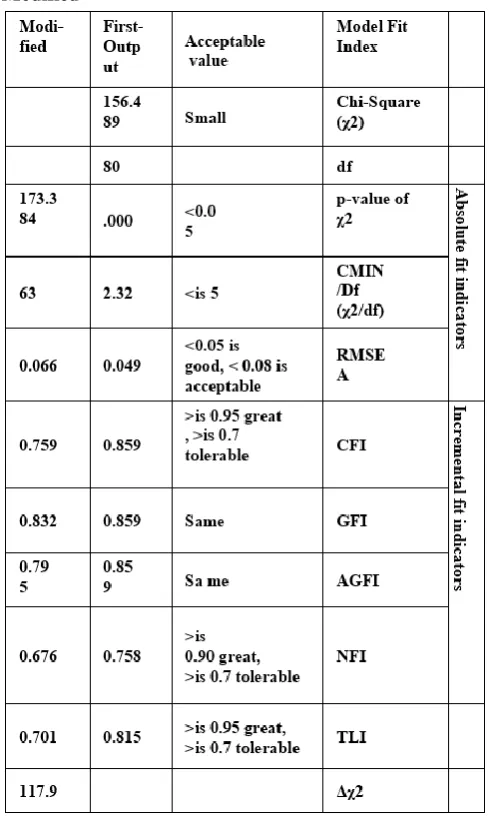
Table 4 Measurement Model Fit Indicators for First and Modified
Source: Authors own Computation
B. Model modification
Researcher modified the model with the help of modification indices after correlating certain measurement errors and received better results. The final (modified) results are represented in Table 4. We have Δχ2 (the
difference between two chi-square values).
C.Digitization related and CFA and SEM findings
The items are ascertained with the help of t-value and p-value and the first output is derived. The priori model (first output) has given acceptable model fit values (Chi-Square (χ2) = 156.489, (χ2/df) = 2.645, RMSEA = .049, CFI
=.859, GFI = .807, AGFI =.859, NFI = .758, TLI
= .815) subsequently this model is modified (Chi-Square (χ2) = 173.384,(χ2/df) = 2.14,
RMSEA = .066, CFI =.759, GFI = .832, AGFI =.759 , NFI = .676, TLI = .701) with the Δχ2 = 117.9. Assumption made for fourth objective is satisfied with acceptable model fit value in confirmatory factor analysis (CFA) values. Thus
measurement model is established with convergent validity and discriminant validity values to proceed for the next level of analysis.
D.Finding from Structural Model
For proving assumption for this objective the researcher established a hypothetical model in structural equation model (SEM). The structural model is conceptually developded with the causal relationship between the dependent and independent factors found appropriate model fit for the first output of the data gathered through questionnaire (Chi-Square (χ2) = 156.489, (χ2/df) = 2.645, RMSEA = .049, CFI =.859, GFI = .807, AGFI =.859, NFI = .758, TLI = .815) subsequently this model is modified (Chi-Square (χ2) = 173.384,(χ2/df) = 2.14, RMSEA = .066, CFI =.759, GFI = .832, AGFI =.759 , NFI = .676, TLI = .701) with the Δχ2 = 117.9. Estimation values indicates the path analysis estimates of the structural model. Digitization impact on the Audit quality and client satisfaction is supported with significant p-value (***). So, the study empirically supports Digitization can definitely improve the audit quality and client satisfaction.
V.LIMITATIONS
The present study also experienced the below mentioned limitations, which can be recommended as research gap for further study, such as, Cyber Security, data privacy, user administration, change management, IT governance, connecting with customers and clients, data management, records retention, regulatory compliance, third-party vendors, and fraud.
VI.CONTRIBUTION
A. Theoretical contributions of this study
This research explored the concept of digitalization of auditing profession. Since there is no much studies conducted in this area, it is assumed to be a preliminary one “digitization of auditing profession”. It analysed with the help of theories in order to identify past, present and futures forces that will drive the change towards digitalization of the auditing profession. By doing this, this study aimed to assist the auditing research field by providing an innovative qualitative study. By answering our research questions and applying change theories as diagnostic tools for change in regards to digitalization, this study has made a valuable theoretical contribution to the field of auditing research by building new
knowledge. It has opened the field to explore the concept of digitalization from a broad perspective, with a qualitative research that has identified driving forces for change. Furthermore, by laying down a theoretical foundation for further research on change, we as the authors of this study argue for and sincerely hope that this exploratory study inspires and increases incentives to conduct relevant future research.
B. Practical contributions of this study
International Journal of Innovative Technology and Exploring Engineering (IJITEE) ISSN: 2278-3075, Volume-8 Issue-6C, April 2019
How to attract auditors to stay longer in the profession and reasons for why the auditing industry is facing problems to maintain talented personnel. Overall there seem to be a resistance among auditors towards quantitative research, several auditors expressed that they received heaps of requests to participate in quantitative research via e-mail and it was conveyed that qualitative research, where the auditors can freely speak their mind was favoured to participate in. This indicates that further research should be of qualitative nature and address issues where opinions can be elaborated upon more, compared to in a quantitative study. Finally, an extension to our research in a future setting to further analyse the development of digitalization in relation to the auditing profession could be interesting to study.
REFERENCES
1.Kurt Lewin`s (1947), Force Field Analysis, the 1973 Annual Handbook for Group Facilitators, 111-13.
2.Wachal Robert (1971), A Personal View on Humanitiesand Computers, The North American Review (New), Spring 1971.
3.Crutchley, C., Jensen, M, and Marshall, B, (2007), Climate for Scandal: Corporate Environment that Contribute to Accounting Fraud. The Financial Review, 42,53-73.
4.Swanson D, L Tynan, D Wolstencroft, B Edmondson(2013), Communication for Business. xxiv, 431 pages: colour illustrations; 25 cm.South Melbourne, Victoria : Oxford University Press, 2013. https://trove.nla.gov.au/version/192726396
5.Xiao Z, Sangster A, Dodgson JH (1997). Therelationship between information technology and corporate financial reporting. http://www.emeraldinsight.com/Insight/Articles/0510200604.html44,56 -78.
6.IIFAC, 2001, https://www.ifac.org › About IFAC › Publications & Resource; 56,98,102. Harrison MJ, Datta P (2007). An empirical assessment of user perceptions of feature versus application level usage. Communication Assoc Inf Syst. 20: 300-321
7.DeAngelo, L. (1981), Auditor size and audit quality, Journal of Accounting and Economics, 3(3), 189–199.
8.Zahargier, M.S., and Balasundaram, N. (2011). Factorsaffecting Employees Performance in Ready-aide Garments (RMGs) Sector in Chittagong, Bangladesh. Economic Sciences series, 63(1). 9-15 9.Masood, A., & Lodhi, R.N. (2015). Factors Affecting the Success of
Government Audits: A Case Study of Pakistan. Universal Journal of Management, 3(2), 52-62.
10. Gupta, (2008) 5 Comp LJ 512 Del (Delhi High Court, 2008) Council of Institute of Chartered Accountants of India vs Praveen, 17.54(3),98.
11. Alan W. Anderson, The 13th and Final Article in a Series of “ANDERSON’S AUDIT EXPRESS”; KSCPA Skyscapes. 88-23-654(1). [13] David C Yang, Liming Guan, (2004) "The evolution of IT auditing and internal control standards in financial statement audits: The case of the United States", Managerial Auditing Journal, Vol. 19 Issue: 4, pp.544 12. M Iqbal Khadaroo. Corporate communications: An international journal 10 (1), 58-68, 2005. 110, 2005. A framework for examining accountability and value for money in the UK's private finance initiative. I Demirag. Corporate Social Responsibility, Accountability and Governance, 7792, 2017. 86, 2017.
13. Steven A. Taylor, Kevin Celuch, Stephen Goodwin, (2004) "The importance of brand equity to customer loyalty", Journal of Product & Brand Management, Vol. 13 Issue: 4, pp.217- 227, https://doi.org/10.1108/10610420410546934
14. Jayalakshmi et al. 1053. In-Vitro Evaluation of Antioxidant Activity of Five Drugs of Trinpanchmool.drg/qcs-11.1109/96/110.
15. William Hillison Carl Pacini, David Sinason, (1999) "The internal auditor as fraudbuster", Managerial Auditing Journal, Vol. 14 Issue: 7, pp.351-363, https://doi.org/10.1108/02686909910289849
16. Nazik S Roufaiel, Vernon Dorweiler, (1994) "White‐collar Computer Crimes: A Threat to Auditors and Organization", Managerial Auditing Journal, Vol. 9 Issue: 3, pp.3-12,
17. Staciokas R, Rupsys R (2005) Internal Audit and its Role in Organizational Government.
URL:http://www.ktu.lt/en/science/journals/econo/infaut038.html 18. The Need for Continuous Controls Monitoring.
URL:http://www.metagroup.com/webhost/ONLINE/739743/d2951.htm 19. Richard Lanza (2004) Payables Test Set for IDEA Effective Analyst
Series. Authors, Richard B. Lanza, Davies, N. Jill. Edition, illustrated. Publisher, Ekaros Analytical, Incorporated, 2004. ISBN,
0973181214, 9780973181210. Length, 128 pages. Export Citation, BiBTeX EndNote RefMan
20. Staciokas R, Rupsys R (2005) Internal Audit and itsRole in Organizational Government. URL: http://www.ktu.lt/en/science/journals/econo/infaut038.htm
21. Ruud, F., and J. Bodenmann, Corporate Governanceund Interne Revision. In: Der Schweizer Treuhänder, 6/7, 2001, S. 521 – 534. 22. Harrison, Michael J. and Datta, Pratim (2007) "An Empirical
Assessment of User Perceptions of Feature versus Application Level Usage," Communications of the Association for Information Systems: Vol. 20 , Article 21. Available at: http://aisel.aisnet.org/cais/vol20/iss1/21.
23. Kim M(1), Kwon KN, Lee M. Psychological characteristics of Internet dating service users: the effect of self-esteem, involvement, and sociability on the use of Internet dating services.100-45-11-90. 24. Bollen, K.A. (1989) Structural Equations with Latent Variables. John
Wiley and Sons, Inc., New York.126.76.89.110.
25. Bagozzi, R. and Yi, Y. (1988) On the Evaluation of Structural Equation Models. Journal of the Academy of Marketing Sciences, 16, 74-94.
26. Noble, H. & Smith, J. (2015). Issues of validity and
reliability in qualitative research. Evidence Based Nursing, 18(2), 34–35.
https://doi.org/10.1136/eb-2015-102054
27. Torraco, R. J. (2016). Writing Integrative Literature Reviews: Using the Past and Present to Explore the Future. Human Resource Development Review, 15(4), 404–428. https://doi.org/10.1177/1534484316671606