
Ir
Electronic Structure Studies
of
Complexes of Technetium
and
Ruthenium
A thesis submitted for the degree of Doctor of Philosophy of The Australian National University.
by
Sandra Catherine Nissen
March, 1997.Do you believe that absolutely everything can be expressed scientifically ?
Yes it would be possible. But it would make no sense. It would be description without meaning - as if you described a Beethoven symphony as a variation of wave pressure.
- Albert Einstein
Except where specific reference is made to other sources, the work presented in this thesis is the work of the author. It has not been submitted, in whole or in part, for any other degree.
J>.
Sandra Catherine Nissen
Acknowledgments
There are many people who have provided me with assistance throughout the course of my Ph.D. I would like to take this opportunity to thank them for their time, patience and valuable advice. Just some of these people are listed below, in order of how the work is presented in subsequent chapters.
On the synthetic and instrumental front, and other aspects involved in PART ONE:
• Dr John Baldas and his group at the Australian Radiation Laboratory for providing my initial training in working with technetium.
• Dr Raphael Raptis, Dr Steve Gheller and Dr Klaus Moock for their guidance and assistance with the syntheses and electrochemical analyses of technetium complexes, within the RSC. A special thank-you to Klaus for his efforts in cleaning the top-floor radiation laboratory and enduring its higher room temperatures in summer.
• Dr Keith Murray and Dr Boujemaa Moubaraki from Monash University for running the variable temperature magnetic moments and providing valuable feedback on my descriptions of same.
• Timothy Lovell, Dr John McGrady and Dr Robert Stranger from The Chemistry Faculties, ANU, for a preview of their results and valuable discussions about density -functional calculations of nonahalide dimers.
• Stephen Lee (the group technical officer) for the purification of electrochemical solvents, and all the little things which keep the place going.
• Denes Bogsanyi for running the far-IR and solid state diffuse reflectance spectra.
On the computational front I was fortunate to have two skilled and incredibly patient teachers:
• Dr John McGrady who spent time during his own Ph.D. to teach me the mysteries of the vi editor and how to run the SCF-Xa-SW package.
• Dr Stuart Macgregor who taught me how to use ADF following the loss of the Xa results in the "hard disk crash of '95".
For other contributions to PART TWO, thank-you also to:
• Pam, Nick and Graeme of the RSC Computer unit for not running away every time there was a "minor" disaster.
• Dr Brett Yeomans, Dr Dmitri Menglet and Horst Neuman for allowing me to use their experimental data for computational analyses.
For other more general contributions, I must thank:
• Dr Graham Heath, my supervisor, for his contributions to this study, for allowing me to work in his group, and for giving me the opportunity to establish so many valuable collaborations.
• Prof. Martin Bennett, Dr. Lucjan Dubicki and Dr. Robert Stranger, the members of my advisory panel, for their guidance and advice.
• Stuart, Klaus, Raphael, John, Rob and Graham for proof reading and advising on the construction of the final thesis.
Those responsible for maintenance of my sanity and relaxation:
• The members of the ANU Choral Society (SCUNA) and in particular, fellow soprani, committee and small group members, and the "RSC Mafia" (fellow choristers drawn from the RSC) Rowena, Karen, Cameron and Kristine.
• The Canberra Community Orchestra (CCO) in particular the viola section who suffered my bad tuning and wit.
Finally special mention to three people without whom this thesis may never have got to this final stage:
• Dr Robert Stranger, who supervised my honours research, inspired me to do a Ph.D. in the first place, and who remained a valuable source of computational advice and a supporting and understanding friend throughout.
• Dr Klaus Moock and Dr Stuart Macgregor who upon arrival to the group, during the last half of my Ph.D., rose above and beyond the call of duty to assist with its direction and ultimate completion, and who have considerably increased my knowledge pertaining to the benefits of double glazing in places where it gets really cold, and any minor short-comings of the Aussie cricket team.
This thesis is devoted to the study of the electronic structure of binuclear and monomeric, halide complexes of technetium and ruthenium using the techniques of voltammetry, UV-visible spectro-electrochemistry and magnetochemistry, as well as analysis based on density functional calculations. In the first part, the thesis will describe the properties of [Tc2Br9J1-. A detailed analysis of the nature of the metal-to-metal interaction in [Tc2Br9] 1- is presented and possible routes to the as yet unknown
[Tc 2C19Jn- were studied. In parallel with this study, an investigation of related
technetium monomer chemistry was performed. The purpose of the second part of the
thesis was to investigate the bonding and electronic structure of complexes containing an {MX4 } moiety (where M
=
Tc, Ru and X=
Cl, Br) for which both UV-visible spectral and electrochemical data were available. This work commences with a study of the technetium monomers [TcYX4Jn- (where X=
Cl, Br and Y=
the 7t donors 0, (n=
0, 1) and N (n = 1, 2)) discussed in the first part of the thesis. The study extends to trans-[Ru111Cl4L2J 1- (where L = MeCN, t-BuNC, aniline, PMe2Ph, PEt3) complexes where L covers a range of 1t-acceptor abilities.The introduction highlights the importance of considerations of electronic structure within the context of this thesis. A brief description of the element technetium is provided. This is followed by an outline of the electronic structure of [MX6
Jn-monomers which focuses on the information that can be derived using techniques including, density-functional calculations, magnetochemistry, voltammetry and UV-visible spectroscopy, all of which will be employed throughout this thesis . The impact of changes to donor properties of the ligand array from { X6} to { OX4}, { NX
4} and { X4L2} is introduced. A brief description of the electronic structure of [M2X8Jn- and [M2X9Jn- dimers is also provided.
PART ONE
Chapter 1.1 details the synthesis of the confacial bioctahedral dimer, [Tc2Br9] l
-and the investigation of its variable temperature magnetic moment, voltammetry and
UV-visible spectro-electrochemistry. These analyses, combined with the results of density functional calculations, indicate that the metal-to-metal interaction in d3d3 [Tc
2Br9] 1- is at best very weak and is best described as having three 4d electrons localised about each technetium atom. Comparisons with other isoelectronic [M2X9Jn- (M = transition metal and X = Cl, Br) complexes highlight the similarities of this metal-to-metal interaction to that in [Cr2X9J3- and the important differences compared to that in [Re2X9] 1-.
Chapter 1.2 describes the non-bridging, unsupported M-M bonded dimers,
[Tc2X8Jn- (X = Cl, Br and n = 2, 3), and their voltammetry and UV-visible spectro-electrochemistry, emphasising the similarities to [Re2X
8Jn- (X = Cl, Br and n = 2, 3). The chapter concludes with an analysis of unsuccessful routes to [Tc2C19Jn-.
Chapter 1.3 describes the voltammetry and UV-visible spectra of [TcX6J2
-(X = Cl, Br) recorded under the same conditions of the dimer study. It also establishes comparisons of the voltammetry of [MC16Jn- complexes along the second and third row
of the periodic table, and between related vertical (4dn, 5dn) centres. These comparisons give further insight into the investigation of [Tc2Br9] 1-.
Chapter 1.4 describes the voltammetry and UV-visible spectro-electrochemistry of [TcOX4Jn- (where X = Cl, Br and n = 0, 1), also under the same conditions as the dimer study. The analysis of these measurements was enhanced by the study of
II
1a
11 rl
lfl
11-I
Ill
II
I
11
II
1,
I,
I
I
:
IQJ!e lX
Chapter 1.5 reports the methods used in preparing the complexes described in the preceding chapters. The equipment used during electrochemical investigations and the criteria employed during analysis of the voltammetric and spectro-electrochemical results are also described.
PART TWO
Chapter 2.1 returns to the [Tc YX4
Jn-
monomers for a more in-depth analysis oftheir electronic structure. Density functional calculations are used to investigate the effects of modifications to the { X4 } moiety, { Cl4} vs { Br4}, changes to the axial ligand,
Y, (0 vs N) and changes to the oxidation state of the technetium metal centre (Tc VI vs Tc Y) on the electronic structure. Assignments for the UV-visible spectra observed for these [Tc YX4
Jn-
monomers in chapter 1.4 are proposed.Chapter 2.2 extends the investigation of complexes containing the { MX4} moiety
to another specific series, trans-[RuC14L2] 1- (where L = MeCN, t-BuNC, aniline, PMe2Ph, PEt3). The effects of changing axial ligands on the electronic structure are
analysed, and assignments for the UV-visible spectra are proposed, on the basis of the density functional calculations performed using model systems for L of = NCH, CNH, NH3, and PH3 respectively. The chapter concludes with an analysis of the relationship
between the energy of a halide-to-metal charge transfer band ( common to all the ruthenium complexes listed), with the corresponding RuIII/II reduction potential.
Chapter 2.3 gives a brief outline of the principles of density functional calculations, and describes the specific parameters used in running calculations with the Amsterdam Density Functional (ADF) package employed here.
Table of Contents
Declaration... 1
A c kn ow led g m en ts . . . 111
Ab s tr a c t . . . vii
Table of Contents... x1
Introduction... 1
1.1 Technetium ... . 2
I.2 Halide complexes of the general form [MX6Jn-... 4
1.2.1 Density functional calculations........ 4
1.2.2 Magnetochemistry... 7
1.2.3 Voltammetry... 8
1.2.4 UV-visible electronic absorption spectroscopy... 10
I.3 Variations in the nature of the ligand array... 10
I.4 Dimetallic complexes of the type [M2X9Jn- ... 11
I.5 Dimetallic complexes of the type [M2X8Jn-... 16
References: Introduction ... . 19
PART ONE Chapter
1.1:
Physicochemical studies on ditechnetium nonabromide, (TE A ) [Tc 2 B r 9 ] . . . 251.1.1 Magnetic moments of [M2X9Jn- (where X = Cl, Br; M= Tc, Re, n = 1 and M = Cr, Mo, W, n = 3)... 25
1.1.1.1 Interpretation of the magnetic moment of (TEA)[Tc2Br9]... ... 28
1.1.2 Voltammetry of [Tc2Br9
J
1-... 371.1.2.1 Comparisons of the voltammetry of
[M 2X9
Jn-
species down a column... 381.1.2.2 Comparisons of the voltammetry of
[ M 2X 9
Jn-
species along a row... 411.1.3 Spectro-electrochemistry of [Tc2Br9
J
0- (where n = 1, 2, 3)... 461.1.3.1 Comparison of the UV-visible spectra of [Tc
2IV,IVBr9
J
1 - and [Tc1VBr6J
2 -... 49 1.1.3.2 Comparison of the UV-visible spectra of[Tc
2
Br9J
1-
and [Tc2
Br9J2-...
501.1.3.3 Comparison of the UV-visible spectra of
[Tc
2
Br9J2-
and [Tc2
Br9J3-...
...
511.1.3.4 Comparison of the UV-visible spectra of
[Tc2Br9J1- and [Re2Br9JI-... 51
1.1.4 Conclusions ... . 52
Chapter 1.2: Physicochemical studies on ditechnetium octahalide
complexes, (TBA)2[T c2X 8]
1.2.1
1.2.2
1.2.3
(where X = Cl or Br)...... 55
X-ray crystallographic data ... .
Chemical reactivity ... .
Voltammetry of [Tc2X8
J
0- (n = 2, 3) ... ..1.2.3.1 Comparison of the voltammetry of
56
57
58
[Tc2X8
Jn-
and [Re2X8
Jn-
...
60 1.2.4 The UV-visible spectra of [Tc2X8J
0 - (n = 2, 3)... 61.2.4.1 Spectrum of [Tc2Cl8
J3-...
641.2.4.2 Spectrum of [Tc2Cl
8
J2- ...
651.2.5 Attempts to synthesise [Tc2Cl
I
~
""'
I
u I
Chapter 1.3: Physicochemical studies on technetium hexahalide
complexes, (TBA)2[TcX6]
(where X
=
Cl or Br) ... .1.3.1 UV-visible electronic absorption spectra of [TcX6
J
2-... . 1.3.2 Voltammetry of [TcX6J
2 -... .Qf!e Xlll
71
71
74
Chapter 1.4: Physicochemical studies of tetrahalo -oxotechnetate and
-nitridotechnetate complexes, (TBA)[TcOX4] and
(TBA)[TcNX4 ] (where X = CI or Br)...... 83
1.4.1 (TBA) [TcOX4 ].. ... . . . .. . . .. . . .. . . .. . . 85
j 1.4.1.1 UV-visible spectra of (TBA)[TcOX4]... 85
i~
I
,,
I
I:
I:
Ir!
1.4.1.2 Voltammetry of (TBA)[TcOX4
J...
891.4.1.3 Spectro-electrochemistry
of [TcOX4
Jn-
(where n = 0, 1 )... ... ... .. . .. .. . 91 1.4.2 (TBA)[TcNX4 ]... 93 1.4.2.1 Voltammetry of [TcNX4J
1-...... 941.4.2.2 Spectro-electrochemistry
of [TcNX4
Jn-
(where n = 1, 2) ... . 1.4.3 UV-visible spectrum of [TcNX4J
0 - recorded inconcentrated HCl ... .
Chapter
1.5:
Experimental. ... .1.5.1 Synthesis ... .
96
99
101
101
1.5.1.1 (TBA)[TcO4 ]...... 102 1.5.1.2 (TBA)[TcOX4 ] ... .
1.5.1.2.1 (TBA)[TcOCl4
J ... .
1.5.1.2.2 (TBA)[TcOBr 4 } ... . 1.5.1.3 [TcX6J
2 -... .103
103
103
103
1.5.1.3.3 (TBA)2[TcCl6J... 105
1.5.1.3.4 (NH4 ) 2[TcBr6} and K2[TcBr6 ]... 105
1.5.1.3.5 (TBA)2[TcBr6
J...
1051.5.1.3.6 (TEA)2[TcB r 6)... 105
1.5.1.4 [Tc2X8
Jn-...
1061.5.1.4.1 (TBAJ2[Tc2Cl8
J
(Cotton)... 1061.5.1.4.2 (TBA)2[Tc2Cl8 } (Preetz)... 107
1.5.1.4.3 (TBA)2[Tc2Br8 ]... 107
1. 5
.1.
5
[Tc2 Br 9 ] 1-... 1071.5.1.6 Attempts to synthesise [Tc2C19
Jn-...
1081.5.1.6.1 Method one: solid chlorinating agent... 108
1.5.1.6.2 Method two: bulk-electrosynthesis... 109
1.5.1.6.3 Method three: halide abstraction... 109
1.5.2 Electrochemical techniques... 110
1.5.2.1 Solvent and electrolytes... 110
1.5.2.2 Voltammetry... 110
1.5.2.2.1 Standard electrochemical cell... 111
1.5.2.2.2 Evacuable electrochemical cell... 111
1.5.2.2.3 Scanning parameters... 112
1.5.2.2.4 Bulk electrolysis... 112
1.5.2.2.5 Criteria for reversible and irreversible voltammetry. ... ... ... 112
1.5.2.3 UV-visible spectroscopy... 113
1.5.2.3.1 Spectro-electrochemistry... 113
Chapter 2.1: Density-functional calculations on tetrahalo
-oxotechnetate and -nitridotechnetate complexes,
[TcYX4 ]0
• (where X
=
Cl, Br; Y=
0, n=
0, 1and Y
=
N, n=
2, 3)... 1252.1.1 Using calculations to assign observed UV-visible absorption spectra... 125
2.1.1.1
Transition energy...
1252
.1.1.
2 Transition intensity...
...
...
1262.1.2 The calculated geometry of [Tc YX4
J
0 -... ... ... 1272.1.3 The electronic structure of [TcOCl4] 1-... 129
2.1.3.1 The electronic structure of the {Cl
4}moiety...
1322.1.4 The electronic structure of [TcOX4] 1-
vs
[TcNX4J
2-... 1342.1.5 The electronic structure of [TcOCl4] 1-
vs
[TcOC14]0 and [TcNC14 J2-vs
[TcNC14] 1- ... ... ... ... .. 1362.1.6 The electronic structure of [TcYC14
J
0 -vs
[TcYBr 4J
0 -... 1372.1.7 Computed transitions
vs
the observed UV-visible spectrum of [TcOCl4] 1-... 1392.1.8 Spectral assignments of [TcOCl4] 1-
vs
[TcOBr 4] 1-... 1412.1.9 Spectral assignments of [TcOX4] 1-
vs
[TcNX4J2- ... 1422.1.10 Spectral assignments of [TcOCl4] 1-
vs
[TcOCl4]0... 1432.1.11 Spectral assignments of [TcOCl4]0
vs
[TcNC14] 1-... ... .... 1442.1.12 Spectral assignments of [TcNC14] 1-
vs
[TcNBr 4] 1- ... 1452.1.13 Spectral assignments for [TcNX4
J
2- recorded in HCl... 1472.1.13.1 Geometry optimisation of [TcNCl
4(H
2O)J
1-... 1472.1.13.2 Proposed assignments for the UV-visible
spectrum of [TcNCl
4(H
2O)Jl-...
147Chapter 2.2: Density functional calculations on trans-[RuC14L2 ]1 ·
(where L = CNH, NCH, PH3 and NH3)... 153
2.2.1 Observed voltametric and UV-visible data for trans-[RuC14L2] 1-(where L = MeCN, t-BuNC, PMe2Ph, PEt3, and aniline)... 153
2.2.2 The calculated geometry optimisations for trans-[Ru1IICI 4L2] 1-.... 156
2.2.3 The calculated electronic structure of trans-[RuII1Cl 4(NCH)2] 1-.... 159
2.2.3.1 General description... 161
2.2.3.2 The ruthenium 4d based levels... 162
2.2.3.3 The L = NCH based levels... 162
2.2.3.4 The {Cl4 } based moiety... 163
2.2.4 Effects of changing the axial ligands, L, on the electronic structure of trans-[RuIIIc14L2Jl-... 164
2.2.4.1 The ruthenium 4d based levels... 164
2.2.4.2 The levels associated with the trans ligand, L... 165
2.2.4.3 The {Cl4 } based moiety... 166
2.2.5 Spectral assignments for trans-[RuCl4 (MeCN)2] 1-... 168
2.2.6 Spectral assignments for trans-[RuCl4(t-BuNC)2] 1-... 173
2.2.7 Spectral assignments for trans-[RuC14(PMe2Ph)2] 1-, trans-[RuCI4(PEt3)2] 1- and trans-[RuC14(aniline)2] 1-... 174
2.2.8 Conclusion... 178
Chapter 2.3: Computational method..... 183
2.3.1 Density functional methods... 183
2.3.2 ADF parameters... 188
Introduction
Chemistry is the study of the elements and how they combine to form compounds. Understanding of the bonding within such compounds is obtained by focussing attention on the electronic structure of each component ( element or group of elements) and studying how these components interact at an atomic level to determine the unique range of properties of the final compound. The depth of understanding of this electronic structure has mirrored the increasing sophistication of the techniques available with which to probe it. These techniques are both observational (for example crystal-structure analysis, magnetic studies, vibrational and electronic spectroscopy, electrochemistry) and computationally based. The computational methods are based on the quantum mechanical model of electronic structure. This model surmises that the electronic charge density of a molecule will be determined by the sum of its atomic parts, and also implies that the electronic properties of atoms are transferable between molecules. (1) Hence, the understanding of electronic structure can also be improved by the study of series of compounds with variations selected to probe the desired property (for example, systematic variations in ligands or metals such as will be described in this thesis).
This thesis will focus on the electronic structure of metal halide complexes. It is therefore illustrative to include in the introduction a consideration of the relatively well understood properties of the basic octahedral transition metal complex, [MX6
Jn
-
(X =halide), and to relate these properties to the underlying electronic structure of these species (section I.2). The coordinatively more complex, [MYX4
Jn-
,
monomeric species are then introduced (section I.3) where a planar {X4} moiety is maintained but the trans ligands, Y, are varied from 1t-donors such as O and N, to 1t-neutral species such as aniline in trans-[MX4L2]n- and further to 1t-acceptors such as MeCN, t-BuNC andi . .
[2.Qg_e 2: Introduction
phosphines in trans-[MX4L2] n-. These systems assist in assessing the impact on the
overall electronic structure of these different types of 7t interacting species within the
ligand array.
Another type of interaction (apart from metal-to-ligand) which is also of interest is
the direct metal-to-metal interaction. The metal halide dimers of the type [M2X8
J
0 -(section I.5) and [M2X9J0 - (section I. 4) provide ideal models for investigating the impactof two different types of metal-to-metal interaction on electronic structure by comparing
these dimers to the [MX6
J
0 - species. The [M2X9
J
0 - dimer can be thought of as two [MX6]0- species with three bridging halides "supporting" the metal-to-metal interaction.
In contrast, [M2X8J0- dimers possess a direct metal-to-metal interaction which is
"un-supported" by any ligand bridges.
The systems studied within the experimental and computational parts of this
thesis are predominantly technetium halide species and in addition one series of
ruthenium halide complexes has been investigated in the computational part. These
technetium and ruthenium species \Vere chosen on the basis of the experimental data
available with which to probe their electronic structure. These data were obtained using
the following techniques; magnetochemistry, voltammetry, UV-visible
spectro-electrochemistry and density functional calculations. Information available about related
complexes based on neighbouring metals has also been used to gain further insight into
the systems of interest here.
Technetium halide complexes are of special interest because their chemistry is
relatively less-explored in comparison with the amount of information which is available
for related complexes of the neighbouring transition metals, for example rhenium.
1.1 Technetium
Technetium means "artifical element" which refers to the fact that technetium was
of its isotopes are naturally occurring. It was first identified in 1937 by radiations from a
molybdenum plate which had been bombarded with deuterons. (3) Its chief source now
however, is from uranium fission products, about 6% of which are technetium. (2) The
first isotopes to be identified were 95Tc and 98Tc, but technetium has since been
identified in isotopes ranging from 90Tc to l 10Tc which have half-lives from
15.8 seconds (100Tc) to 4.2xlO6 years (98Tc). (4) The isotope on which most of the
chemistry of technetium is based (and which was employed in this thesis) is the relatively
stable, long-lived isotope 99Tc. ( 4) 99Tc is a
p
emitter (Emax = 0.29 Me V) with a half-life of 2.12x1O5 years. (2)Recent attention on technetium chemistry has been directed toward its use as a
radiopharmecutical. . This chemistry has been reviewed focussing on both the medical
applications and insights into the general chemistry of technetium complexes. (5)
Technetium can be used for imaging a variety of internal organs by radioscintigraphic
techniques. The isotope of choice is the metastable, Y-emitter, 99mTc, which can be
generated relatively inexpensively in portable molybdenum containing generators. (Sb)
99mTc has a half-life of 6 hours so it can be used to deliver a high short-term specific
activity without being a long-term hazard. (Sb) Y-rays are emitted upon decay with
sufficient energy ( 140 Ke V) to be detected through layers of tissue. (Sb) The resultant
daughter isotope of this decay, 99Tc emits less hazardous ~-radiation. (Sb) Technetium
complexes generally have a total-body biological half-life (that is, the time taken to
remove half of the technetium from the body) of 30 hours. (6)
Other recent reviews of technetium have focussed on various aspects of its
chemistry: including structures (7), cluster compounds containing Tc-Tc bonds (8),
general coordination and reaction chemistry (4,9,10,11). It has been stated that (4),
chemically, technetium resembles rhenium (its third row counterpart) but there are
significant differences, in particular associated with the redox chemistry. There are a
large number of oxidation states available to both technetium and rhenium. Complexes
have been prepared with examples of technetium in every oxidation state from Tc VII ( d0)
page 4: Introduction
H[TcO4] to Tc-1 (d8) Na[Tc(CO)
5]. (2) Rhenium has the same range of oxidation states
(12).
In
general it has been found that the higher oxidation states of technetium are moreeasily reduced than those of rhenium, while the lower oxidation states of technetium are
more labile toward substitution. ( 4) Further discussion of the differences ( and
similarities) of technetium and rhenium chemistry will appear throughout this thesis.
The following sections will briefly outline the electronic structure of [MX
6
J
0-against which the coordinatively more complex systems will be compared. Reference
will be made to the different techniques used to probe the structure and the results for
each in terms of [MX6
J
0- will be described.1.2 Halide complexes of the general form [MX
6]0 •
The electronic structure of complexes of the form [MX6
J
0 - (where Xis a halideligand) has been extensively studied using a variety of techniques. Examples of previous
studies employing the methods of interest in this thesis include; density functional
calculations (13,14), magnetic moments (15), UV-visible electronic spectroscopy (16)
and electrochemistry (17). A summary of the type of information afforded by each of
these techniques is presented in this section.
l.2.1 Density functional calculations
[MX6J0- has its six halide ligands arranged in octahedral symmetry around the
metal centre:
X
X
..
,
I ,.·
X
,~ ❖''
M
x
~
1
'
x
X
z
~:
Figure 1.1 The octahedral arrangement of the [MX6
pi-
species. The direction of the x,Under Oh symmetry the nd orbitals of the metal transform as 7t-type t2g (dxy' dxz'
dyz) and a-type eg (dx2-y2, dz2). The molecular orbitals arising from the p orbitals of the
{X6 } manifold (see figure 1.2) transform as six a-type molecular orbitals a10+e0+t1u and
b b
12 7t-type molecular orbitals t1u+t2u+t1g+t2g· (13b)
(j'
a1g eg
7t
t1g t2g
, ,
t1u
t1u
, , ,
t2u
Figure 1.2 The molecular orbitals derived from the {X6
J
halide ligand array ( 13b ).For degenerate orbitals only one orientation is shown in each case.
It can be seen from figure 1.2 that there are molecular orbitals of t1u symmetry
within both the
a
and 7t-type sets. These molecular orbitals can mix resulting in levelswhich are a combination of
a
and 7t character. Calculations using SCF-Xa-SW haveshown that in the case of [MX6
Jn-
the mixing of these levels is such that the levels are notdominated by one character over the other. (13) Such levels are marked as n/a in the
following text.
A generalised molecular orbital diagram as derived from a computational study of
a series of [MX6
Jn-
type complexes (M = Ru, Os, Pt, Pd, Rh, Ir; X = Cl, Br) (13) is [image:23.860.32.833.28.1193.2]page 6: Introduction
nd, (n+l)s and (n+l)p orbitals of the metal and the halide based molecular orbitals just
described.
(n+ 1) p
(n+ 1)
s
E
nd
M
t1u 4t1u
---3alg
a
lg----
-------
\ \eg, t2g
--
\ \ \ , \ , \ , 3eg \ ' \ \ , \ , \ , \ , \ , \ , \ , \ , , \ , \ , \.
' \ ' \ ' \ ' \ '' ,, \ \ \ \ '\ \ ' 2t2g . ' \ ' \ '---
·, \ '..
-·
'.
\ ,.
-·
',.
' ,.
-·
'.
' ,.
-·
'.
' ,-···
',.
\ ,-·
.
'.
' \,.. \ ',, \ \ tlg
• ' • \ e
' lt ' ' - -
·-====--::
g•, \, • , lg •• - - - •• - - ·',· • • - -, , •• -
_>-____
t I u ,, '', \ ' ---:::.--:--3t . - - · · · - - - - \ ,,· ---. '.. •' · · · t2u
,, ,, •
.
!Ji -----
--- ,, .,,' ' \ ---::-:---
--
, \\ \ '' \ 1 t2 , , \'' t 1 u
' ' ' ' ' • u , , • ' •
.:====;;;;;; __
t' ' ' ', ' ' 2t - - - ' - - - ' , - - - '. 2g
' , , lu - - - ' - ' a
, ' \ \ \ , ,\ \
---
lt - - -, , ,-
,--
- ------
-
,l.--- lg' \' 2g - - - ,
-\ ',, \ ''---2 ,.--,'
---"
''
a12 ~ -, ,\
2eg
[image:24.846.13.831.44.1138.2]MX6
x6
Figure 1.3 A molecular orbital diagram for [MX6
J
2-, as derived from the metal nd,(n+l)s and (n+l)p atomic orbitals and halide molecular orbitals. (13)
re cr re/cr re
re/cr re cr
The molecular orbital diagram (figure I.3) highlights the interactions between
both cr(eg) and 7t(t2g) dominated levels of the metal and the {X6} manifold. A lesser
interaction between the a1g levels is also represented. The t1u levels remain non-bonding
however (for example, less than 5% metal character was calculated (13) for the 3t1u and
2t1 u molecular orbitals in [RuX6J3-) indicating that the (n+ l)p levels of the metal play
only a small role in the bonding between the central metal and the halide { X
6} array.
The energy gap between 2t2g and 3eg, 1 0Dq, is a function of the cr and 7t donor strength of the coordinated ligands. (13,18) In particular, 7t donor strength will affect t2g energy and cr donor strength will affect the energy of eg. In the case of X = chloride vs X = bromide which is of importance throughout this thesis 1 0Dq is larger for X = Cl while the energies of the ligand based orbitals (relative to the metal based ones) are higher for X = Br than X = Cl. (13) The dependence of l0Dq on the identity of surrounding ligands has been described for a variety of ligands in the form of the spectrochemical series. (18) A selection of ligands from this series is presented in decreasing order of ligand field strength (splitting):
CN- > NH3 ~ py > H2O >OH-> F- > S2- >CI-> Br-> 1-.
1.2.2 Magnetochemistry
Much of the chemistry of [MX6
Jn-
compounds is determined by the extent of occupation of the anti-bonding, metal-dominated 2t2g and 3eg molecular orbitals. This is dependent on the identity of the central metal and its oxidation state. Three nd electrons can enter the 2t2g level successively, however for a d4 species the electron can either spin-pair in a low-spin t2g 4eg O arrangement or it can enter the eg levels and produce the high-spin t2g 3eg 1 configuration (similarly for d5 which can be t2g 5eg O or t2g 3eg 2).#Whether a complex takes on a low-spin or high-spin arrangement is determined by the relative energy required in placing an electron in the higher energy level (that is, on the size of l0Dq) vs the energy required for spin pairing of electrons in t2g and eg. (19)
[MX6
Jn-
complexes involving first row transition metals tend to show a greater propensity for high-spin arrangements than those involving second and third row transition metals. (20) The preferred electron configuration for a given [MX6Jn-
species can be investigated using magnetochemistry which provides an indication of the numberof unpaired electrons within the species. The observed magnetic moment of first and
second row transition metals can be compared against the idealised, spin-only value (table I.4) to get an indication of the number of unpaired spins.## (19) For example, the
# If octahedral symmetry is maintained, configurations of d6 and above must involve some form of spin prurmg.
[2.Q:.g_e 8: Introduction
d4 system K2[RuC16] has an observed magnetic moment of 2.70 B.M. (20) which is
more in keeping with the value expected for two unpaired electrons (a low spin
arrangement) than four (high spin). Table I.4 includes indications of the range of values
for observed magnetic moments of octahedral complexes with high spin arrangements of
the first row transition metals (21) and examples of low spin arrangements of second
row [MX6
J
0 - species (20, 22).Table 1.4 Magnetic-moment, spin-only values.
unpaired µs.o. Complex 3d electron observed
electrons (B.M.) count µeff (B.M.)
1 1.73 Ti3+ d 1 1.7 - 1.8
Mo5+ d 1 1.31
Cu2+ d9 1.9-2.1
2 2.83 y3+ d2 2.8-3.1
Ru4+ d4 2.70
Ni2+ d8 2.9 - 3.9
3 3.88 Cr3+ d3 3.7 - 3.9
Tc4+ d3 3.34 - 3.80
Co2+ d7 4.3 - 5.2
4 4.90 Cr2+, Mn3+ d4 4.8 - 4.9
Fe2+, Co3+ d6 5.0 - 5.6
5 5.92 Mn2+ Fe3+
' ct5 5.7 - 6.0
1.2.3 Voltammetry
The use of voltammetry to assess the electronic structure of [MX6
J
0- complexeshas been demonstrated by an extensive study of the redox properties of a series of
hexachlorometalates extending along both the second and third row transition metals (for
Zr to Pd and Hf to Pt respectively) (17a). The potentials for the MIV to M1II reduction
and MIV to MV oxidation were recorded for each of these species, [MX
6Jn!n-l (n = 1-,
·,
These processes correspond to progressively filling the t2g level, commencing
from do (for [ZrCI6
J2-,
[NbCI6J1-
and [TaCI6J1-)
to d6 for ([RhCI 6J3-,
[IrCI6J3-,
[PdCI6
J
2-and [PtCI6J
2-). The deviations from linearity corresponding to processesinvolving the d3/d4 electron configurations and have been previously accounted for in
SP.''"" po..,<'' n g
terms of the greater spin orbit couplittg energy contribution associated with this particular
couple.
(17a)
3.0
2.0
1.0
,-._
>
'-"
c::!
0.0
-~-1.0
-2.0
[MC16]
i-12-[MCI ]2-13 -6
-3.0,---~--r--"T--"T---•
Zr
•
Hf
Nb
Mo (Tc) Ru
Rh
Ta
W
Re
Os
Ir
Pd
Pt
Figure 1.5 A plot of E1; 2 (V) for the one electron oxidation and reduction of
[M1
VX
6Jnln-l (n = 1-, 2-)for the second_ and third row transition elements as reported in reference ( 17 a).# [image:27.860.24.837.23.1206.2]J2M_e 10: Introduction
I.2.4 UV-visible electronic absorption spectroscopy
The tendency for electronic charge to be donated by the { X6 } ligand array to the
metal in [MX6
Jn-
complexes is evident in their UV-visible electronic absorption spectrawhich are dominated by halide to metal charge transfer transitions. In general, the high
energy region is dominated by charge transfer from halide based levels with some
a
character (3t1u) into the eg acceptor levels of the metal (which are oriented
a
with respect to the metal to halide bonds) and the lower energy region is due to charge transfer fromhalide based levels with 7t-type character ( 1 t2u, 3t1 u' 1 t fj) into the lower energy t2g levels
(oriented 7t with respect to the metal to halide bonds). Under Oh symmetry d-d ligand
field transitions from ½g into eg are Laporte forbidden but they can be observed by virtue
of processes such as vibronic coupling which remove the inversion centre of the
molecule. Such absorptions will be of low intensity E = 100 dm3mol-1cm-l as compared
to E = 5000 to 50 000 dm3mol- 1cm-1 of allowed charge transfer processes.#
The exact nature of these charge transfer spectra is dependent on the electron
density about the metal centre and on the nature of the halide ligand, X.
In
comparing thespectra of the same complex in different oxidation states the charge transfer manifold
shows a general red shift with increasing oxidation state of the central metal. Such
changes can be monitored using UV-visible spectro-electrochemistry. A comparison of
the effect of X
=
chloride vs X=
bromide, shows that the energy of charge transferabsorptions is around 7000 cm-1 lower when X = Br than Cl. This is in accord with the
destabilisation of bromide based molecular orbital levels as was described earlier (section
I.2.1). (13,18) The charge transfer spectra where X = bromide also generally show
more structure than those due to X = chloride, as a result of the splitting induced by
larger spin-orbit coupling for bromide. (13,18)
1.3 Variations in the nature of the ligand array
Further information about the impact of the nature of the ligand array on
electronic structure can be assessed by systematically adjusting the identity of the
coordinated ligands. For example, a study of two series of complexes of molybdenum and tungsten aimed to investigate the effect of varying the
a-
and 1t-donor strength of the ligand array on electronic structure. (23) It was found that the relative stability of the higher oxidation states of the metals varied in accordance with increasinga
and 1t-donor strength of the total ligand array in the order { CI6}< {
Cl50}< {
Cl4N}. (23) A similar study will be described in this thesis for complexes of [Tc YX4Jn-
(where X = Cl, Br; Y = 0, n = 0, l and Y = N, n = 1, 2). These compounds possess a planar {X4} moiety with the central metal sitting just above the plane and the trans axial ligand above it, resulting in C4v symmetry for the complex. The O and N ligands are stronger 1t donorsthan Cl or Br and as such the ligand arrays { OX4 } and { NX4 } stabilise higher oxidation states of the central metal to a greater extent than previously described for [MX6
Jn-,
such that the metal centre in these [MYX4Jn-
complexes is typically stable in an MV or MVI oxidation state.In a further variation on the monomeric structures, the planar { X4} moiety is maintained but 1t-acceptor ligands are present in the trans axial sites, to contrast with the 1t-donors just described. An example series of complexes of this type which will be of interest in this thesis, trans-[RuC14L2] 1- (where L = MeCN, t-BuNC, PMePh
2, PEt3, aniline) has metal oxidation states of MIII (d5). A reduction to MII (d6) has been previously measured by voltammetry and shows a decrease in the required potential of the metal based, one electron reduction, coinciding with the increasing 1t-acceptor ability of the trans axial ligands. (24) A linear relationship between this reduction potential and the energy of a ligand to metal absorption band was also described. (24) Calculations on these complexes were performed during the course of this thesis (chapter 2.2) to determine how successful the computed electronic structure would be at modelling both the 1t-acceptor ability dependence and the linear relationship between Eo and hv.
1.4 Dimetallic complexes of the type [M
2
X
9]0 •The discussion has centred on metal-to-ligand interactions in previous sections. Since direct metal-to-metal interactions were recognised ( 1930's) their general theoretical
page 12: Introduction
importance and their significance in biological systems (for example, nitrogenases) and
catalytic processes (for example, (113-C3H5PdC12)2) have been recognised. (25,26) It is
therefore of interest to assess the impact of this different type of interaction on the
electronic structure of metal halide complexes.
Complexes of the type [M2X9
Jn-
can be thought of as two {MX
6} octahedrasharing one face such that each metal centre is surrounded by three terminal and three
bridging halides. The bridging halides are shared between two metal centres and so can
be thought of as effectively contributing only 1.5 halides to each, thus resulting in a total,
bridging halides plus terminal halides, of
{MXc
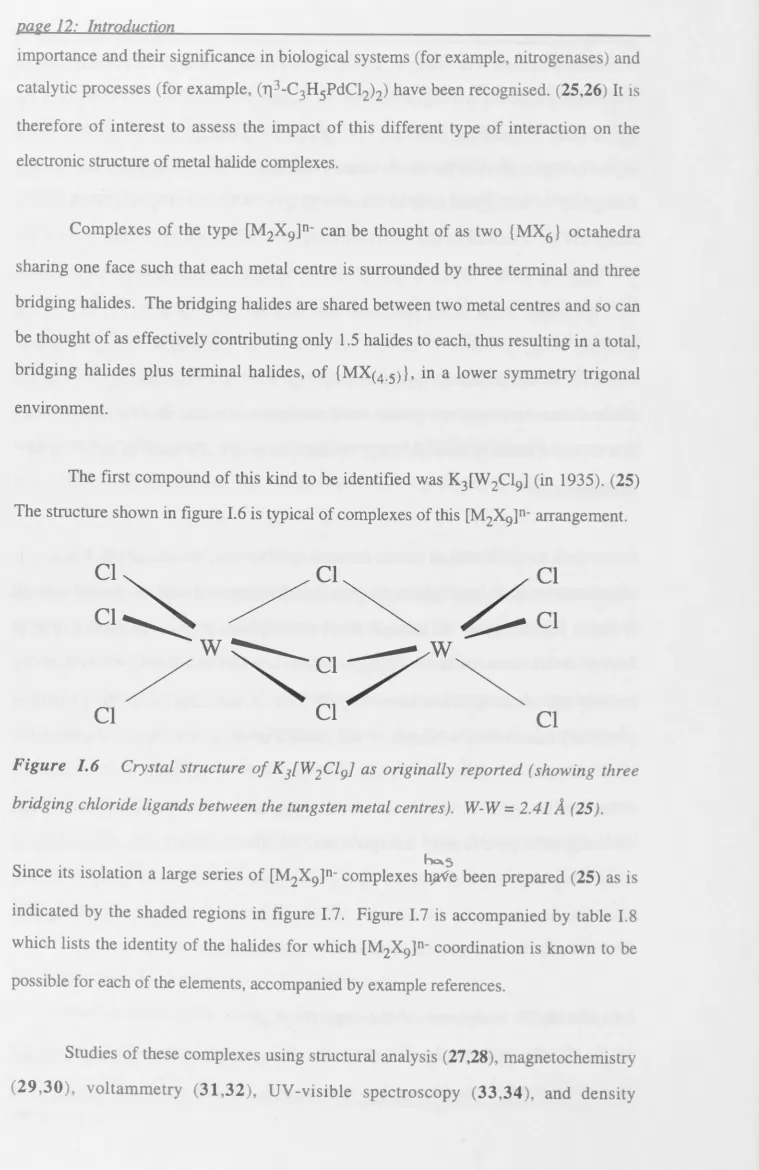
4 .5)}, in a lower symmetry trigonal environment.The first compound of this kind to be identified was K3[W 2Cl9] (in 1935). (25) The structure shown in figure I.6 is typical of complexes of this [M2X9
Jn-
arrangement.Cl,
/ C l
C l ~ /
w
/
Cl
Cl
/
Cl
C----
c1
w
~
Cl
Figure 1.6 Crystal structure of K3[W2Cl9} as originally reported ( showing three
bridging chloride ligands between the tungsten metal centres). W-W = 2.41
A
(25).ho.5
Since its isolation a large series of [M2X9
Jn
-
complexes h;we been prepared (25) as isindicated by the shaded regions in figure I. 7. Figure I. 7 is accompanied by table I. 8
which lists the identity of the halides for which [M2X9
Jn-
coordination is known to bepossible for each of the elements, accompanied by example references.
Studies of these complexes using structural analysis (27,28), magnetochemistry
[image:30.838.67.827.26.1197.2]functional calculations (13,28,33,35), have focussed on the varying degrees of
metal-to-metal interaction, which can be supported by the bridging ligands. Considerable variation is observed even between isoelectronic analogues such as the d3d3 species [M2X9
J
3- (M = Cr, Mo, W) for which the metal-to-metal interaction varies from triple bonding in [W 2X9J3- to single bonding in [Mo2X9J3- and finally to no direct metal-metal bond at all in [Cr2X9J3-. (25)
H He
Li
Be B C N 0 F NeNa Mg Al Si p
s
Cl Ar... ./:
:i ··V:••··
:}::;::;::(:: ... ·ti\
···
. /i
K
Ca•·•·
sc
2.-
Tf
·
Cr
·.:::::; Mrr Fe Co Ni Cu Zn Ga Ge As Se Br Kr... ·•·•···· .,::;.
Rb Sr
y
Zr Nb Mo Tc Ru Rh Pd Ag Cd In Sn Sb Te I Xe Cs Ba La Hf Taw
Re Os Ir Pt Au Hg 11 Pb Bi Po At RnFr Ra Ac Unq Unp Unh Uns Une
I
CeI
PrI
NdI
PmI
SmI
EuI
GdI
TbI
Dy
I
H~I
ErI
TmI
ThI
LuI
Figure I. 7 A periodic table showing the relatively large number of elements for which complexes of the type [M2X9
Jn-
are known ( as indicated by the shaded areas).The actinides have been omitted from the table because no examples from these groups
have been reported to date.
The bond order of a [M2X9
J
0- system is determined by electron counting into the schematic molecular orbital diagram which is presented as figure I. 9. A bond order of zero means that no net bond is possible whereas a bond order of three means that a triple bond is possible, given the appropriate conditions. These formal bond orders are listed with typical examples of each configuration in the table I. l 0.page 14: Introduction
Table 1.8
Com
p
lexes of [
M
2X9J
0 -.M
I
F
Cl
Br
IR
e
fer
e
n
ces
Sc
✓ ✓ 36a,by ✓ 36c
T
i
✓ ✓ 36d,eZr ✓ ✓ 36f,g
V ✓ ✓ ✓ 36e,h
Nb
✓ ✓ ✓ 36iTa
✓ 36jCr
✓ ✓ ✓ 36i,2 9Mo
✓ ✓ ✓ ✓ 27w
✓ ✓ 27Mn ✓ ✓ 361
Tc
✓ 37Re
✓ ✓ 27,38Fe
✓ ✓ ✓ 35mRu
✓ ✓ 36n,oOs ✓ ✓ 31
Rh ✓ ✓ 27
Ir ✓ ✓ 36p
Pt ✓ ✓ 36q
Tl ✓ 27
Sb
✓ ✓ ✓ ✓ 36r,sB
i
✓ 27Tb ✓ 36t
Dy ✓ 36c,t
H
o
✓ 36c,tEr ✓ 36c,t
Tm
✓ 36uYb ✓ ✓ 36c,t,v
1t8
eg
---
---
---
----
---
---
-
---
--
--
---
eg 1t8*cr* , ..
t2g
-4-
~
W (1)
,
..
,
..
,
..
,,
..
, , s::: * --- .. ..
-4-
;,,,'
--
_u! .... ...--
'4
::':: ---
~
-4-- .... : :"'::
',
-
... __----
, '-... ..
--...
s:::--
, ,",.
..
U7t , ,....
.... ......
--4--- ,'
, , ., cr .. .. , [image:33.868.13.834.27.1068.2]-4- --i-
t2g W (2)Figure 1.9 The molecular orbitals formed by interaction of the valence d levels of the metal centres in a fully delocalised system. A d3d3 occupation is shown indicating the maximum triple bond. ( 13)
It has been found that the bonding which is ultimately observed in a compound is not only dependent on the bond order but also on the extent to which the electrons from each metal centre are delocalised. This extent of delocalisation is determined by a number of factors including the identity of the metal ions and their oxidation state and the resultant degree of orbital overlap of the metal t2g based levels in particular (13).
Table 1.10 Bond Orders for example complexes of the type [M2X9Jn-.
Configuration d6d6 d5d5 d4d4 d3d3
Bond Order 0 1 2 3
Examples [Rh2X9]3- [Ru2X9]3- [Ru2X9] 1-
[Cr2X9]3-[lr2X9]3- [Os2X9]3- [Os2X9] 1-
[Mo2X9]3-[W 2X9]3 -[Re2X9] [Tc2X9]
1-The nature of the bridging and terminal ligands is also important in determining metal to metal bonding. For example, [Ru2III,nrc1
9J3- has a single bond but with the substitution of terminal phosphine ligands to form [Ru2IIIJIIc1
J2Qg_e _l 6: Introduction
Ru-Ru bond (39). In contrast, the substitution of a bridging chloride in [Mo
2Cl9Jn- by
_Me2S to form [Mo2Cl6µ-Cl2(Me2S)J0 - has been demonstrated to create a stronger
Mo-Mo bond in the latter compound. (25)
:c..
The molecular orbital arrangement given in Figure i:4. strictly only applies to a fully delocalised system. In a localised ( or partly localised) complex, the electrons
centred on each metal do not combine in molecular orbitals, but rather, remain in
localised metal based ones from which antiferromagnetic coupling of these electrons may
occur across the anion. The presence of a single, cr bond ( or lack thereof) has a larger
impact on metal-metal distance and bonding properties than does the occupation of the
brr
and
brr*
orbitals, that is, the8rr
bond is relatively weak. (13)It is a challenge for computational methods to provide accurate, quantitative
descriptions of the bonding in [M
2X9Jn- systems, (35) particularly those systems which are
not fully delocalised. For example while a standard full symmetry geometry optimisation
for [W 2Cl9
J
3- will generate a W-W distance of 2.40A
(35d,e), in keeping with0
observation of 2.45 A (29), a similar calculation will fail to accurately represent the bond
elongation observed for [Cr2Cl9
J
3- (a localised system) (Cr-Cr distance: observed 3.05-0 O
3.89 A (29), and full symmetry geometry optimistation 2.3 A (35d,e)). Methods
involving the use of broken-symmetry techniques ( 40) have been employed to more
accurately address electrons which remain localised about the metal centres while also
maintaining the ability to also account for delocalisation. (35d,e) These broken
symmetry calculations will be referred to in more detail in the discussion of
physicochemical properties of [M2X9
J
0 - complexes in chapter 1.1.1.5 Dimetallic octahalide complexes of the type [M2X 8]0 ·
Metal-to-metal interactions may be "supported" by bridging ligands as found for the [M2X9
J
0- complexes just described, or they may be "unsupported" in which the
mid-1960's several compounds containing a direct, unsupported metal-metal bond have been identified.
(a) [Re
2Cl
8]2-Cl
"'-..
2.29A
Cl
Cl>~"
7
Re
•Cl
0 ~
"""" N
.
c1-
.:e~
/
0,--
Cl
Cl
,,
"
Cl
(b)
[Tc
2Cl
8]3-Cl "'-..
2.36(4)A
Cl
Cln~"
7
Tc •Cl
0~
---
---
rri-N
I
c1-
•Tc4
/~,-.:... Cl
Cl
~
" Cl
Figure 1.11 Molecular structures of (a) [Re2Cl8
J
2- and (b) [Tc2Cl8J
3- with dbnensionsas reported in the early crystal structure determinations of (TBA)2[Re2Cl
8
J
(41)and(NH4 )3[Tc2Cl8} (25). The similarity in structures was considered strong evidence
that the metal-to-metal bonding in the two anions was also similar (25 ).
The first to be structurally characterised was (TBA)
2[Re2Cl8] ( 41). It was found to have a short Re-Re distance of 2.24
A
(figure I.1 la). The halides are arranged in an eclipsedfashion, which was thought to be particularly good evidence for the presence of a
quadruple Re-Re bond as other forms of bonding would have been expected to favour a
staggered arrangement for the eight halide ligands. (41) (NH4)
3[Tc2Cl8] was actually prepared (
42)
just prior to the understanding of the nature of the bonding within the rhenium complex. Subsequent crystal structure determinations ( 43) revealed that[Tc2Cl8 ]3- (Tc-Tc 2.13(1)
A)
(figure I.1 lb) is isostructural with [Re2C18
J
2 - and [Mo2Cl8J
4- ( 44) and so despite the different charge of the anions, similar bonding was predicted ( 43).Since the recognition of formal quadruple bonding in (TBA)
page 18: Introduction
complexes of this type have been prepared for these and a variety of other metals
including, M = Mo, W, Os with various halide (and pseudo halide) ligands (X
=
F, Cl,Br, NCS) (25,31,43,45).
Studies of these complexes have involved crystal structural analyses (25,46) (as
illustrated in figure I.11) in con junction with UV-visible absorption spectroscopic
measurements (31,47 ,48,49) as well as computational analysis (SCF-SW-Xa)
(13,47,49,50). The metal-to-metal bonding interaction has been found to be based on a
general molecular orbital configuration of arc88 *re* a*. (25) In [Tc2Cl
8
J
2- thesemolecular orbitals are occupied according to a2rc4828*rc* a* and so a quadruple Tc-Tc
bond results. (25) The impact of the addition and removal of electrons from this
arrangement (i.e. redox chemistry) has been studied and is described, along with other
previously reported results pertinent to this thesis, for example [Re2C18
J
2- , in chapter1.2.
In addition to the studies on the metal-metal bond the possibility of
interconversion between the [M2X9
Jn-
and [M2X8
Jn-
species under various conditionshas also been explored. For example, it is reported that [Re
2X9
J
1- can be formed from[Re2X8
J
2- in the presence of halide at a potential of+ 1.55 V for chloride and + 1.50 V forbromide. (32c,38) It was an aim of this thesis to attempt a similar interconversion with
the technetium species, firstly between the known [Tc2Br
8
Jn-
and [Tc2Br9Jn-
and thenstarting with [Tc2Cl8
Jn-
to form the elusive [Tc2Cl9
Jn-.
Throughout this thesis the electronic structure of metal halide complexes have
been investigated. The important effect of changes to the ligand array and the
introduction of direct metal-to-metal interactions have been probed with both
experimental and computational techniques. Results for individual complexes are
compared with those of related species which contain, for example, a neighbouring metal
or variation of the ligand array. Related monomers and dimers are also compared to
identify the similarities and differences between their electronic structure and hence
References: Introduction
1. R.F.W. Bader, Atoms in Molecules, A Quantum Theory, Oxford Science Publications, Oxford, 1990, 1.
2. R.D. Peacock, Comprehensive /norg. Chem., 1973, 3, 877.
3. (a) C. Perrier and E. Segre, J. Chem. Phys., 1937, 5, 712; (b) C. Perrier and E. Segre, Nature, 1947, 159, 24.
4. J. Baldas, Adv. lnorg. Chem., 1994, 41, 1.
5. (a) E. Deutsch and K. Libson, Comments lnorg. Chem., 1984, 3, 83; (b) M.J. Clarke and P.H. Fackler, Structure and Bonding, 1982, 50, 57; (c) E. Deutsch,
K. Libson, S. Jurisson and L.F. Lindoy, Prog. lnorg. Chem., 1983, 30, 75; (d) W.A. Volkert and S. Jurisson, Topics in Current Chem., 1996, 176, 123, (and other articles in that volume).
6. A. Seidel, Gmelin Handbook, Tc Suppl., 1982, 1, 271.
7. G. Bandoli, U. Mazzi, E. Roncari and E. Deutsch, Coord. Chem. Rev., 1982, 44, 191.
8. (a) V.I. Spitsyn, A.F. Kuzina, A.A. Obolva and S.V. Kryuchkov, Russ. Chem. Rev., 1985, 54,373; (b) S.V. Kryuchkov, Topics in Current Chem. ,
1996, 176, 189.
page 20: References
9. U. Mazzi, Polyhedron, 1989, 1683.
10. A. Davison, Technetium in Chemistry and Nuclear Medicine, eds., E. Deutsch,
M. Nicolini and H.N. Wagner, Cortina International, Verona/Raven Press, New
York, 1983, 3.
11. J. Baldas, Topics in Current Chem., 1996, 176, 37.
12. R.D. Peacock, Comprehensive Inorg. Chem., 1973, 3, 905.
13. (a) G.A. Heath and J.E. McGrady, J. Chem. Soc., Dalton Trans., 1994, 3759;
(b) J.E. McGrady, Ph.D. Thesis, The Australian National University, 1994.
14. (a) A. Goursot, H. Chermette and C.Daul, Inorg. Chem., 1984, 23, 305;
(b) J.P. Lopez and D.A. Case, J. Chem. Phys., 1984, 81, 4554.
15. E.N. Sloth and C.S. Garner, J. Chem. Phys., 1954, 22, 2064.
16. (a) C.K. J0rgensen, Mal. Phys., 1959, 2, 309; (b) C.K. J0rgensen, Acta Chem.
Scand., 1962, 16, 1048; (c) C.K. J0rgensen, Prag. Inorg. Chem., 1970, 12,
101.
17. (a) G.A. Heath, K.H. Moock, D.W.A. Sharp and L.J. Yellowlees, J. Chem.
Soc., Chem. Commun., 1985, 1503; (b) S. Brownstein, G.A. Heath,
A. Sengupta and D.W.A. Sharp, J. Chem. Soc., Chem. Commun., 1983, 669.
18. A.B.P. Lever, Inorganic Electronic Spectroscopy, Elsevier, New York,
19. A. Earnshaw, Introduction to Magnetochemistry, Academic Press, London, 1968, 32.
20. A. Earnshaw, B.N. Figgis, J. Lewis and R.D. Peacock, J. Chem. Soc., 1961, 3132.
21. A.G. Sharpe, Inorganic Chemistry, Longman, New York, 1981, 442.
22. (a) B.J. Brisdon and R.A. Walton, J. Inorg. Nucl. Chem., 1965, 27, 1101; (b) S.V. Kryuchkov, Yu. V. Rakitin, P.E. Kazin, A.I. Zhirov and N. Yu. Konstantinov, Koord. Khim., 1990, 16, 1230 (eng. trans. 660).
23. K.H. Moock, S.A. Macgregor, G.A. Heath, S. Derrick and R.T. Boen~,
J. Chem. Soc., Dalton Trans., 1996, 2067.
24. D. Menglet, Ph.D. Thesis, The Australian National University, 1996.
25. l~F.A. Cotton and R.A. Walton, Multiple Bonds Between Metal Atoms, Oxford
University Press, 1993, 2nd ed.,l. ~) C. Br-oss~ J ~ J 1'}3S, \ "'35 J 911i
26. B. Douglas, D.H. McDaniel and J.J. Alexander, Concepts and Models of
Inorganic Chemistry, John Wiley and Sons Inc., New York, 1983, 2nd ed,
647.
27. F.A. Cotton and D.A. Ucko, lnorg. Chim. Acta, 1972, 6, 161.
28. R.H. Summerville and R. Hoffmann, J. Am. Chem. Soc., 1979, 101, 3821.
29. I.E. Grey and P.W. Smith, Aust. J. Chem., 1971, 24, 73.




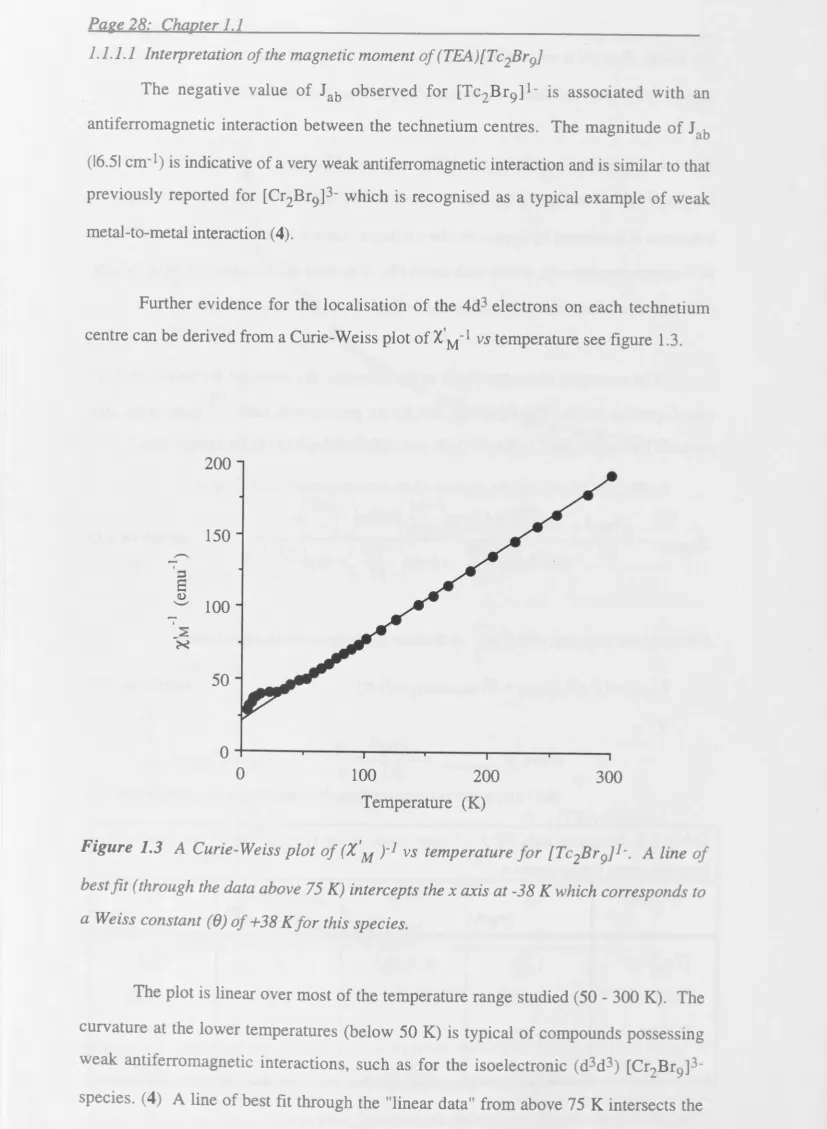

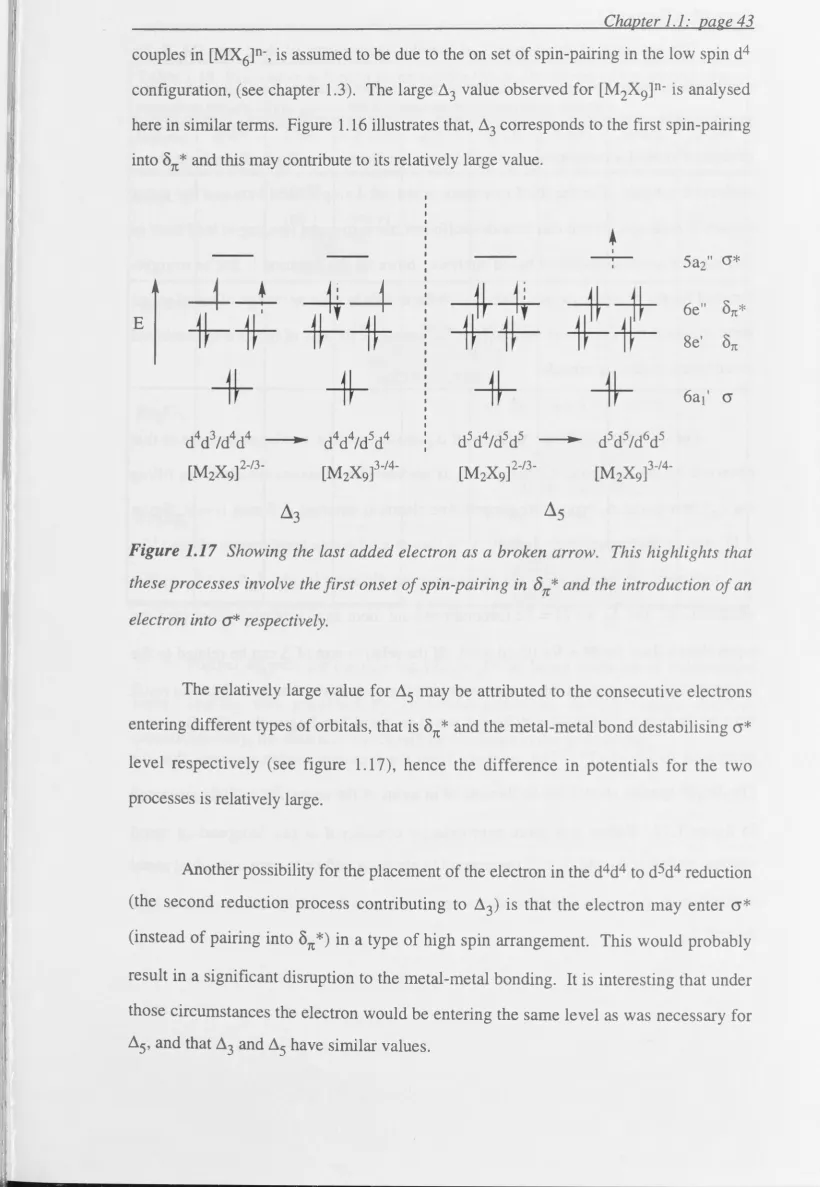
![Table 1.16 Successive reduction potentials for [M2X9] 1- species of the third row transition metals, highlighting the differences between redox couples](https://thumb-us.123doks.com/thumbv2/123dok_us/1798872.134676/62.856.18.843.23.966/successive-reduction-potentials-species-transition-highlighting-differences-couples.webp)
![Table 1.18 Successive reduction potentials for [M2X9] 1- species of the second row](https://thumb-us.123doks.com/thumbv2/123dok_us/1798872.134676/65.855.36.836.23.1136/table-successive-reduction-potentials-m-species-second-row.webp)
