This is a repository copy of Computerized adaptive test and decision trees: A unifying
approach.
White Rose Research Online URL for this paper:
http://eprints.whiterose.ac.uk/137468/
Version: Accepted Version
Article:
Delgado-Gómez, D., Laria, J.C. and Ruiz-Hernandez, D. orcid.org/0000-0001-5538-6930
(2019) Computerized adaptive test and decision trees: A unifying approach. Expert
Systems with Applications, 117. pp. 358-366. ISSN 0957-4174
https://doi.org/10.1016/j.eswa.2018.09.052
Article available under the terms of the CC-BY-NC-ND licence
(https://creativecommons.org/licenses/by-nc-nd/4.0/).
Reuse
This article is distributed under the terms of the Creative Commons Attribution-NonCommercial-NoDerivs (CC BY-NC-ND) licence. This licence only allows you to download this work and share it with others as long as you credit the authors, but you can’t change the article in any way or use it commercially. More
information and the full terms of the licence here: https://creativecommons.org/licenses/
Takedown
If you consider content in White Rose Research Online to be in breach of UK law, please notify us by
Computerized adaptive test and decision trees: a
1
unifying approach
2
David Delgado-G´omeza,∗, Juan C. Lariaa, Diego Ruiz-Hern´andezb 3
a
Universidad Carlos III de Madrid, Department of Statistics, Legan´es, Spain
4
b
University of Sheffield Management School, Sheffield, UK
5
Abstract 6
In the last few years, several articles have proposed decision trees (DTs) as an alternative to computerized adapted tests (CATs). These works have focused on showing the differences between the two methods with the aim of identifying the advantages of each of them and thus determining when it is preferable to use one method or another. In this article, Tree-CAT, a new technique for building CATs is presented. Unlike the existing work, Tree-CAT exploits the similarities between CATs and DTs. This technique allows the creation of CATs that minimise the mean square error in the estimation of the examinee’s ability level, and controls the item’s exposure rate. The decision tree is sequentially built by means of an innovative algorithmic procedure that selects the items associated with each of the tree branches by solving a linear program. In addition, our work presents further advantages over alternative item selection techniques with exposure control, such as instant item selection or simultaneous administration of the test to an unlimited number of participants. These advantages allow accurate on-line CATs to be implemented even when the item selection method is computationally costly.
Keywords: Decision trees, linear programming, computerized adaptive tests 7
1. Introduction 8
Computerized Adaptive Tests (CATs) are sophisticated tests capable of im-9
proving the accuracy of conventional tests while administering a much smaller 10
number of items (Weiss, 2004). They are based on the Item Response Theory 11
(IRT) that emerged as an alternative to the traditional pencil and paper tests 12
with the goal of obtaining comparable estimates of the participants’ abilities 13
when these are obtained with different test designed for measuring the same 14
trait (van der Linden and Glas, 2000). These characteristics have lead to mul-15
tiple applications of CATs as clinical and academical assessments (Fliege et al., 16
2005; Tseng, 2016); or personnel recruitment (Chapman and Webster, 2003), 17
among others. 18
In a standard CAT, each examinee receives a tailored test whose integrating 19
items are aimed at attaining the best fit to the participant’s actual level of 20
the trait, avoiding the presentation of non-informative items to the examinee. 21
With this aim, each of the items presented to the participant is selected from 22
an item bank taking into consideration the responses to all previously presented 23
items, as well as their characteristics (difficulty, discriminating capacity, etc.) 24
∗Corresponding author.
and those of the items that have not yet been presented. Because of this, one 25
of the core components of a CAT is the item selection criterion. 26
In this regard, the most widely used criterion isFisher Maximum
Informa-27
tion (Lord, 1980; Weiss, 1982). However, despite its widespread use, several 28
weaknesses have been pointed out. These include item selection bias, large esti-29
mation errors at the beginning of the test, high item exposure rates, and content 30
imbalance problems (Lu et al., 2012, among others). Various alternatives have 31
been proposed as attempts for addressing these problems; e.g. the minimum 32
Expected Posterior Variance (EPV) (van der Linden and Pashley, 2009), Maxi-33
mum Likelihood Weighted Information (MLWI) (Veerkamp and Berger, 1997), 34
Kullback-Leibler information (KL) (Chang and Ying, 1996) or mutual informa-35
tion (MI) (Weissman, 2007). Notwithstanding these item selection techniques 36
have solved many of the mentioned weaknesses, the computational cost of some 37
of them limits their application in practice, in particular because of the need of 38
numerical integration (Ueno and Songmuang, 2010). 39
Another well known weakness of information-based item selection methods 40
is the overexposure of items. This is a consequence of the fact that that only a 41
few items from the test bank are maximally informative over the ability range 42
(van der Linden and Veldkamp, 2007). Indeed, Veldkamp and Matteucci (2013) 43
observed that only 12 out of a 499 items bank were maximum-informative to any 44
skill level. Among the exposure control methods that have appeared in litera-45
ture (Georgiadou et al., 2007) we can mention therandomesquemethod (Kings-46
bury and Zara, 1989; Shin, 2017); the Sympson-Hetter procedure (Sympson and 47
Hetter, 1985); the elegibility method (van der Linden, 2003); the shadow test 48
(van der Linden and Veldkamp, 2005); the restricted procedure (Revuelta and 49
Ponsoda, 1998); the adaptive tests method (Armstrong and Edmonds, 2004); 50
and the progressive-restricted method (Revuelta and Ponsoda, 1998). Unfortu-51
nately the additional procedures introduced by these techniques add computa-52
tional time to the already heavy item-selection methods. Moreover some of the 53
above mentioned techniques require the recalculation of some parameters every 54
time a participant completes the test, preventing the simultaneous application 55
of the test to more than one participant. 56
In recent years, Decision Trees (DTs) have been proposed as an alternative 57
to CATs. One of the main advantages of the DTs is that the complete test 58
can be designed in advance (using a tree structure) and applied to the examinee 59
without delay, avoiding the item selection step and the associated computational 60
cost. In addition, some researchers have underlined some theoretical benefits of 61
the DTs. Ueno and Songmuang (2010) developed a DT to predict the standard-62
ised total raw test score of the respondents. Their proposal has the advantages 63
of not having to satisfy the local independence condition of traditional CATs, 64
and being capable of obtaining accurate estimates of the standardised scores 65
whilst using of a smaller number of items than CATs. Despite these benefits, 66
there are two main drawbacks to this work. The most important one is that, 67
when using total scores, the comparability property of the IRTs is lost. i.e. 68
their approach suffers from the same problem that existed in the classical test 69
theory. The second limitation is that, for the construction of the DT, a large 70
amount of data must be available for guaranteeing that each of the subsequent 71
subsets, created during the construction of the tree, has sufficient information 72
posed a related method where nodes with similar scores are merged for keeping 74
the number of nodes within reasonable limits. Notwithstanding this solves the 75
second limitation, the most important problem, the lack of comparability be-76
tween tests, which hinders the use of DTs as an alternative to CATs, remains 77
unresolved. 78
From an applied point of view, healthcare has probably been the field where 79
the most intense and fruitful debate has appeared regarding the use of CATs 80
and DTs. For example, in clinical psychology and psychiatry, several papers 81
have been published using CATs for diagnosing mental disorders. Among them, 82
Gardner et al. (2004) developed a CAT to identify individuals with major depres-83
sive episodes based on the Beck Depression Inventory scale; Moore et al. (2018) 84
developed a CAT to identify individuals with psychotic spectrum disorder. In 85
a different medical area, Leung et al. (2016) pointed out the PROMIS CAT as 86
an excellent instrument for predicting clinically significant fatigue, sleep distur-87
bance, and sleep impairment among patients who attended to a cancer research 88
centre. Despite these good results, some researchers have argued that CATs 89
are not suitable for diagnostic classification tasks. For example, Gibbons et al. 90
(2016) argued that CATs are ideal for measuring severity but not for diagnosis 91
screening, distinguishing between CATs and Computerized Adaptive Diagnosis 92
(CADs). and developed a DT based CAD for detecting major depression dis-93
order. Recently, Delgado-Gomez et al. (2016) compared the performance of a 94
DT and a CAT for identifying suicidal behaviour using the personality and life 95
events scale (Blasco-Fontecilla et al., 2012). Their results showed that a DT re-96
quired fewer items than a CAT for obtaining a similar classification rate. Those 97
works reinforce the idea that DTs, a supervised technique, are more suitable for 98
diagnostic classification, while CATs, being unsupervised, are more suitable for 99
quantifying severity. 100
As the discussion above suggests, the existing literature has mainly focused 101
on emphasising the differences between CATs and DTs. This article addresses 102
the study of these two techniques from the opposite perspective: it seeks to 103
identifying and exploiting their similarities. First, we show that a CAT can be 104
represented by a tree structure. This allows pre-computing, storing and lately 105
administering a CAT without incurring any item selection time, regardless of 106
the item selection criterion used. Second, we prove that building a DT that 107
minimises the mean square error (MSE) is equivalent to designing a CAT using 108
the minimum EPV as item selection criterion. This result provides a better 109
understanding to the EPV criterion and establishes a bridge between the DTs 110
and the CATs, providing a new perspective to the aforementioned debate on 111
the use of these techniques. Finally, we show that a CAT with exposure control 112
can be seen as a forest of DTs. This allows the development of an optimization 113
algorithm for the simultaneous construction of the trees that make up this forest. 114
The above results together enable the construction of a CAT with minimum 115
MSE and exposure control. 116
The rest of the article is structured as follows. In Section 2, we show that 117
an unconstrained CAT can be represented in a tree structure. In Section 3 we 118
show that, using DTs, it is possible to construct an unconstrained CAT that 119
minimises the MSE. In this section we also discuss some computational aspects 120
of the proposed technique. Finally, it is proved that the constructed tree is 121
Section 4, we adapt the proposed technique for controlling the item exposure 123
rate. With this aim, we first show that a CAT with controlled exposure rate 124
can be seen as the simultaneous construction of several decision trees. Section 125
5 shows the results of a study aimed at comparing our methodology with other 126
methods for creating CATs with item exposure control using simulated data. 127
Results of the application of the proposed technique on real data are discussed 128
in Section 6. Finally, the article concludes in Section 7 with a discussion of the 129
results obtained and their implications. 130
2. Representing an Unconstrained CAT in a Tree Structure 131
In this section we show that a CAT without exposure control can be repre-132
sented in a tree structure. This representation enables a fast selection (in the 133
order of milliseconds) of the items presented to the examinee. It also facilitates 134
the development of the models introduced in the following sections. The no-135
tation introduced herein will be used throughout the rest of the article and is 136
summarised in the Appendix. 137
Consider a test composed of I items that will be administered to J indi-138
viduals for assessing certain trait θ. For the sake of simplicity, and without 139
loss of generality, we assume that all items haveRpossible answers. When the 140
test is to be administered to participantj, the only information available is the 141
distribution of θin the population, given by the density function f(θ). Before 142
any item has been administered, it is frequent to assume that the value of this 143
trait for a particular examinee is given by the maximum off(θ). This value is 144
denoted by ˆθ∅.
145
The first item that is administered to this participant, ij1, is the one that 146
reaches the maximum value of a pre-established item selection criteria (FMI, 147
MEPV, KL, etc.) given ˆθ∅. We note that, when item exposure control is not
148
taken into account, the first item to be administered to all participants is the 149
same,ij1, since ˆθ∅ is identical for all participants. Once the examinee responds
150
to this item, providing the answer r(ij1) ∈ {1, ..., R}, his trait is re-assessed to 151
a new value ˆθuj
1, whereu j
1 =r(i
j
1) indicates the first item given to examinee j 152
and the answer provided. 153
This newly estimated value of the trait, ˆθuj
1, is then used to select the next
154
item to be presented to the examinee,ij2. It is important noticing that all partic-155
ipants who provide the same answer to the first item will get the same estimate 156
ˆ θuj
1, and will therefore be given the same second item. Once the examinee has
157
answered to the new item, the estimated value of the trait is updated to ˆθuj
2
158
whereuj2={r(i1j), r(ij2)}. 159
This way, subsequent items are administered iteratively until a given crite-160
rion is reached. Briefly, when examinee j has responded to the firstnitems by 161
obtaining the response pattern uj
n = {r(i j
1), . . . , r(ijn)}, a new estimate of the
162
trait, ˆθuj
n, is calculated and the next item is selected based on this value. All 163
those examinees who share the same response pattern uj
n to the first n items
164
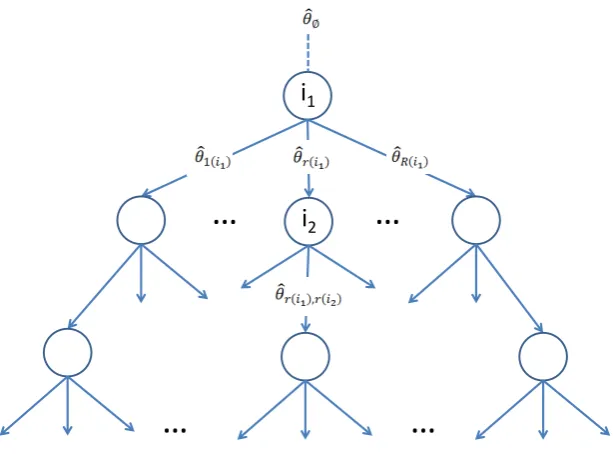
will be given the same item n+ 1. Based on this discussion, a CAT can be 165
i
1 [image:6.595.141.448.137.365.2]i
2Figure 1: Tree Representation of a CAT.
3. Building a CAT with Minimum MSE 167
DTs are supervised methods built by minimising the square error in the es-168
timation of an explanatory variable (Rokach and Maimon, 2014). As mentioned 169
above, the available research work using the DT methodology as an alternative 170
for CATs, use either the total test’s score (Yan et al., 2004; Ueno and Song-171
muang, 2010) or an external criterion as dependent variable (Delgado-Gomez 172
et al., 2016; Riley et al., 2011). In this section we present a methodology for 173
building a DT that minimises the MSE in the trait’s estimation (instead of the 174
test score used in the aforementioned works). The MSE in the estimation of the 175
trait is the most frequently used criterion for building DTs and for assessing the 176
accuracy of a CAT. 177
In the design of this CAT, we start by building the root of the tree. Take 178
an item ifrom the test battery. Let θ be the actual trait of a person, j, who 179
answers this item;pi(r|θ), the probability that this person will give the answer
180
r∈ {1, ..., R}; and ˆθr, the value of the trait estimated for each of the possible
181
answers. The MSE of this item for this person is 182
Ei(θ|∅) = R X
k=1
(θ−θˆvjk
1)
2
pi(k|θ) (1)
where the empty set in the expectation emphasises the fact that no item has 183
yet been administered; andvk
1 ={r(i) =k}. The MSE that will be obtained if 184
itemiis administered to the population is, consequently, given by 185
Ei= Z
The starting item,i1, which constitutes the root of the tree, will be the one for 186
which the valueEi is minimal.
187
Once the tree root has been defined, theRitems corresponding to its children 188
will be added as follows: if itemi6=i1 is administered after an examinee with 189
real trait θ chose ther-th answer to item i1, the MSE of this person will be 190
given by 191
Ei(θ|u1) =
R X
k=1
(θ−θˆvk
2)
2p
i(k|θ) (3)
wherev2k={u1, r(i) =k}and ˆθvk
2 is the estimated trait considering patternv k
2. 192
Therefore, the MSE of the group that gave answer rto itemi1 is given by 193
Ei= Z
Ei(θ|u1)f(θ|u1)dθ (4)
where 194
f(θ|u1) =
p(u1|θ)f(θ) p(u1)
= pR(r(i1)|θ)f(θ) p(r(i1)|θ)dθ
(5)
In general, given an individual with trait θ and response pattern un =
195
{r(i1), ..., r(in)}, the MSE obtained if unused item i is administered next can
196
be written as 197
Ei(θ|un) = R X
k=1
(θ−θˆvk n+1)
2p
i(k|θ) (6)
where vk
n+1 ={un, r(i) = k}. Then, the MSE of a group of participants that
198
has followed patternun becomes
199
Ei= Z
Ei(θ|un)f(θ|un)dθ (7)
where 200
f(θ|un) =
p(un|θ)f(θ)
p(un)
=
Qn
j=1p(r(ij)|θ)f(θ)
R Qn
j=1p(r(ij)|θ)dθ
(8)
3.1. Computational Issues
201
An important aspect that needs to be addressed is how to efficiently build the 202
tree, as the number of nodes grows exponentially when the tree expands. Below 203
we discuss three strategies aimed, the first two, at speeding-up the construction; 204
and, the last one, at keeping the number of nodes within reasonable limits. 205
Parallel programming. Nodes within the same level are constructed inde-206
pendently. Therefore, the items that constitute these nodes can be determined 207
using parallel programming. For example, if a tree developed in a personal com-208
puter with four cores was programmed in parallel, the time required to build 209
it would be reduced to 25 percent of the time required time in a single core. 210
Currently, most universities and research centres have small clusters with a few 211
thousand cores available, making the development of the proposed methodology 212
easily attainable. 213
Passing information from parent to child nodes. As seen in formula 214
(8), to calculate the posterior probability of the ability level, it is necessary to 215
already been calculated in the parent node, if this information is stored, only 217
one multiplication is required for each child node and item pair. 218
Merging branches. One way for limiting the growth in the number of 219
nodes is joining together those branches that lead to similar estimates of ability 220
level. As an example, if an accuracy of 0.001 is set –which is a quite sensible 221
bound-, and assume that the ability takes values between -4 and 4, the maximum 222
number of nodes in each of the tree’s levels will be only 8000, which is a more 223
manageable number than the Rℓ nodes that may potentially appear at levelℓ. 224
An alternative method, frequently used in DT design, for controlling the size 225
of the tree is pruning some branches. In our case this will imply stopping the 226
growth of the tree in nodes associated to improbable answer patterns. However, 227
this may in practice give raise to situations where one of these nodes is actually 228
visited, implying that an on-line selection of the remaining items in the CAT will 229
need to be conducted. This would considerably increase the duration of the test 230
if the item selection criteria used is among the most computationally expensive 231
ones. For this reason we do not consider this practice a good alternative to 232
branch merging. 233
3.2. Equivalence of Minimum MSE and Minimum EPV
234
In this section we establish an interesting result: building a DT minimis-235
ing the MSE is mathematically equivalent to building a CAT where the item 236
selection criterion is the minimum EPV. 237
As discussed around equations (6) to (8), the MSE can be written as 238
M SE =
Z
p(θ|uj−1)
R X
r=1
pi(r|θ)(θ−θˆuj) 2
dθ (9)
which becomes 239
=
Z XR
r=1
p(θ|uj−1)pi(r|θ)(θ−θˆuj)
2dθ (10)
and using Bayes theorem 240
=
Z XR
r=1
p(uj−1|θ)p(θ) p(uj−1)
pi(r|θ)(θ−θˆuj) 2
dθ (11)
using the local independence condition this equation can be simplified to 241
=
Z XR
r=1
p(uj|θ)p(θ)
p(uj−1)
(θ−θˆuj)
2dθ (12)
after multiplying and dividing bypi(r|uj−1) we get 242
=
Z XR
r=1
p(uj|θ)p(θ)pi(r|uj−1) p(uj−1)pi(r|uj−1)
(θ−θˆuj) 2
dθ (13)
=
Z XR
r=1
p(uj|θ)p(θ)pi(r|uj−1) p(uj)
(θ−θˆuj) 2
dθ (14)
using Bayes agaoin, this expression can be further simplified to 244
=
Z XR
r=1
p(θ|uj)pi(r|uj−1)(θ−θˆuj)
2dθ (15)
finally, after reordering terms we get 245
=
R X
r=1
pi(r|uj−1)
Z
p(θ|uj)(θ−θˆuj) 2
dθ=
R X
r=1
pi(r|uj−1)V ar(θ|uj) (16)
which is precisely the EPV criterion. 246
Consequently, notwithstanding the works discussed in the introduction treat 247
CATs and DTs as disjoint methods, in this section we have established the 248
equivalence between them. In practical terms, this implies that building a CAT 249
with minimal EPV is equivalent to constructing a DT minimising its standard 250
MSE criterion. This result suggests that when the objective of the CAT is 251
minimising the MSE, the most appropriate item selection criterion would be 252
EPV. 253
4. Tree-CAT: A CAT with Controlled Item Exposure Rate and Min-254
imum MSE 255
In this section, we propose a method for building a CAT that minimises 256
the MSE with controlled maximum exposure rate (proportion of the individuals 257
taking the test that receive a particular item) by building several decision trees 258
simultaneously. 259
The underlying idea stems from the so-called randomesque method. At each 260
level, this method randomly selects the next item among the K items with the 261
best selection criteria values, given the current estimated ability ˆθ. For each 262
participant, randomesque starts selecting one of the K items attaining maximal 263
values for the selection criteria at the initial trait ˆθ0. Each of these items can 264
be seen as constituting the root of one of K trees. From each root will stem 265
R branches, corresponding to the R possible answers, each of them spanning 266
K nodes. This process is repeated at each level, ℓ, of the tree. Therefore, the 267
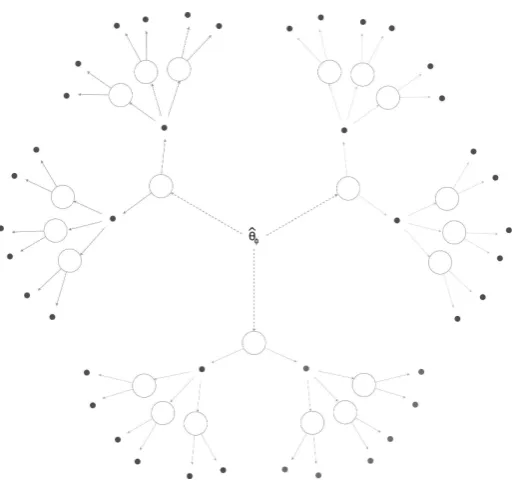
randomesque method can be visualised as a forest of K trees. This is represented 268
as a DTs forest in Figure 2 for R = 2 and K = 3. In this figure white items 269
Figure 2: Representation of randomesque method as a DTs forest.
Although this method reduces the item’s exposure, it does not prevent an 271
item from exceeding the maximum exposure rate. To address this problem, in 272
the following lines we present the Tree-CAT method. This method builds on 273
ramdomesque for generalising the method developed in the previous section. 274
Tree-CAT imposes a probabilistic bound to the maximum rate of item exposure 275
when creating the forest of trees. 276
Tree-CAT starts by selecting the K initial nodes. Let E be the vector 277
containing the items’ MSEs as computed by equation (2);D, a vector indicating 278
the items’ availability;P, a vector containing the probability of each item to be 279
administered as first item in the test; and rmax, the maximum item exposure
280
rate. Initially, each of the elements in D is set equal to the maximal exposure 281
rate. Given that 100% of the participants has to be assigned an item at the 282
beginning of the test, the algorithm utilises a capacity variable c to represent 283
the proportion of individuals that remain uncovered after each item is included. 284
Lis a very large number. The selection of the nodes and determination of their 285
number,K, is conducted as indicated in Algorithm 1. 286
The algorithm starts by selecting the itemiwith least MSE and associates 287
to this item the minimal value among its current availability,Di, and the
unas-288
signed capacity, c. This value, Pi, is then subtracted from both, the item’s
289
availability and the capacity variable. For guaranteeing that this item will not 290
be selected again, its value in vector E is replaced by a very large numberL. 291
This procedure is then repeated until c is equal to zero. The algorithm re-292
turns the set ofK=|F|initial nodes, and the administration probabilities and 293
updated availability vectors. 294
Once the K roots have been chosen, the trees spanned by each root will 295
grow jointly in an iteratively fashion. For the sake of clarity in the exposition, 296
Algorithm 1RootSpan Require: E, D
1: c:= 1
2: P:=0(I×1)
3: F:=∅
4: whilec >0 do
5: i:= argmin{E} 6: Pi:= min{c, Di}
7: c:=c−Pi
8: Di :=Di−Pi
9: F:=F ∪i
10: Ei:=L
11: end while Ensure: F, D, P
LetEbe a matrix whose elementEijis the MSE incurred if itemiwas added
to branch j, where each j is given by a different root/answer combination, i.e. j = R×(k−1) +r for k = 1, . . . , K;r = 1, . . . , R. Let C be a vector containing the proportion of participants associated with branch j, whereCj=
Pk R
P(r|θ, ik)f(θ)dθ and PjCj = 1. Let D be the available capacity vector
returned by Algorithm 1. Then, the choice of the items associated with each of the branches is done by means of the following linear program:
min X
i X
j
XijEij (17)
s.t. X
i
Xij ≤Di X
j
Xij =Cj
This simple model minimises the MSE subject to the constraints that not 298
item will exceed its availability; and that all participants must be given a sec-299
ond item during the test. Further levels of the trees are obtained by successive 300
applications of this procedure, with system (17) solved over the matrix E ob-301
tained for the corresponding item/response combination (henceforth referred to 302
as branch); the last update of vector D; and a newly obtained vectorC where 303
Cj=Pk R
P(r|θ, uk−1)f(θ)dθ. 304
Unfortunately, the number of constraints grows exponentially on the number 305
of levels, making the linear program computationally intractable. A computa-306
tionally efficient heuristic, illustrated in Algorithm 2, has been developed for 307
addressing this problem. 308
Algorithm 2 can be seen as a bi-dimensional extension of Algorithm 1. Work-309
ing with inherited vector D and matrices E and C as inputs, the Algorithm 310
returns an arrayF of sets of items for all possible branches stemming from the 311
previous level. It also returns a matrixP containing the relative probability for 312
each item to be administered to an individual in a given branch, and a vector 313
D with the updated items’ availability. 314
Algorithm 2Growing the tree Require: E, D,C
1: c:= 1
2: P:= (0)I×RK
3: F:={F1, . . . ,FRK},Fh:=∅ ∀h= 1, . . . , RK
4: whilec >0 do
5: forj≤I do
6: if Dj == 0then
7: Ej•:=L
8: end if
9: end for
10: (i, j) := argmin{E} 11: Pij:= min{Cj, Di}
12: Di :=Di−Pij
13: c:=c−Pij
14: Fj:=Fj∪i
15: Ei,j:=L
16: end while Ensure: F, D, P
assigned more than one item. The reason for this is that the best item for a 316
given node may not have the required capacity (i.e. Dj< Cj).
317
5. Numerical Experiments: Simulated Data 318
In this section we present the results of an experimental assessment of the 319
performance of the Tree-CAT method. The experiment compares our method 320
with three other available methods designed for controlling item exposure, namely, 321
restrictive (disallows the use of items that exceed the maximum rate), item eligi-322
bility (restricts the likelihood of administering an item to a given exposure rate), 323
and randomesque methods (randomly selects the next item from a subset of the 324
most informative items). In order to achieve a fair comparison between the 325
four methods, MEPV is used in all of them as the item selection criteria. This 326
choice is due to the fact that, as shown in Section 3.2, this criterion minimises 327
the MSE. 328
5.1. Data and experimental set-up
329
The experiment set-up is similar to the one used by other authors when 330
comparing item exposure control techniques in CATs (Pastor et al., 2002). In 331
detail, the item bank consists of 100 items with randomly generated parameters 332
according to Samejima’s graded response model (Samejima, 2016). Each item’s 333
discrimination parameter was generated following a log-normal distribution with 334
zero mean and standard deviation equal to 0.1225. The difficulty parameters 335
were generated following a standard normal distribution (Magis and Raˆıche, 336
2011). The maximum exposure rate was set to 0.3 with test length equal 10. 337
This length is considered to be enough for comparing the different methods 338
and it is similar to the one appearing in recent works. For example, CATs 339
(2016), for assessing different clinical conditions, used averages of 4, 5.3 and 6 341
items, respectively. Regarding the randomesque method, the number of random 342
alternatives available for each node at each level of the tree is set to six. 343
The performance of the CATs was evaluated by means of the answers of 344
500 randomly generated examinees (Magis et al., 2012). Given the random 345
nature of the item selection of three of the used procedures (randomesque, item 346
eligibility and ours), and to avoid path dependence in the results, the test was 347
repeated 25 times for each examinee and means were taken. In order to improve 348
the significance of the results, this scenario was repeated 10 times. 349
5.2. Results
350
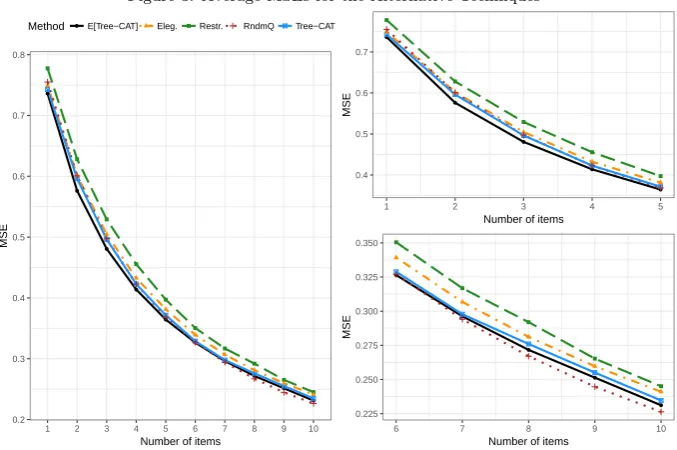
Figure 3 shows the evolution of MSE attained by each of the techniques 351
during the test execution. The large panel shows the entire execution, with 352
the two small panels being zoomed-in versions of the performance over the 353
first and last five items, respectively. The dot-dash yellow line represents the 354
eligibility method; the dash green line, the restrictive method; the dotted line, 355
the randomesque method; and the the solid blue line, the Tree-CAT method. 356
An extra line, solid black, shows the theoretical expected MSE corresponding 357
[image:13.595.128.467.382.607.2]to the Tree-CAT method. 358
Figure 3: Average MSEs for the Alternative Techniques
0.2 0.3 0.4 0.5 0.6 0.7 0.8
1 2 3 4 5 6 7 8 9 10
Number of items
MSE
Method E[Tree−CAT] Eleg. Restr. RndmQ Tree−CAT
0.4 0.5 0.6 0.7
1 2 3 4 5
Number of items
MSE
0.225 0.250 0.275 0.300 0.325 0.350
6 7 8 9 10
Number of items
MSE
The figure shows that the Tree-CAT method obtains more precise estimates 359
than the eligibility and the restricted methods in terms of MSE. This graph 360
also shows that the Tree-CAT attains a performance close to the theoretically 361
expected one. Finally, the randomesque method shows a slightly better perfor-362
mance than the Tree-CAT from the seventh item administered on. This can 363
be explained by looking at the overlap rate, which is a common measure of 364
test security defined as the percentage of common items for any two randomly 365
overlap rates are 0.268 for restrictive; 0.275 for eligibility; 0.283 for Tree-Cat; 367
whereas it reaches 0.538 for randomesque. 368
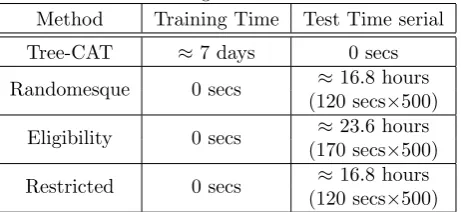
Regarding the computation time, Table 1 shows the time needed to create 369
the DT as well as the minimum time required by each of the methods to se-370
lect the 10 items for the 500 participants. It is important to note here that 371
in both, item eligibility and restricted methods, participants receive the test 372
sequentially. That is, in order to recalculate the parameters, the current par-373
ticipant must have finished the test before the next one receives it. In contrast, 374
randomesque and Tree-CAT methods are able to administer the test simulta-375
neously. Moreover, whereas the tree alternative methods select the next item 376
on-line, Tree-CAT generates the whole tree at once, which means that the time 377
required for generating the next item is, indeed, zero. The experiment was con-378
ducted using 128 cores of a cluster with a Xeon 2630 processor and 32 GB of 379
[image:14.595.183.414.318.424.2]RAM. 380
Table 1: Training and Execution Times
Method Training Time Test Time serial
Tree-CAT ≈7 days 0 secs
Randomesque 0 secs ≈16.8 hours
(120 secs×500)
Eligibility 0 secs ≈23.6 hours
(170 secs×500)
Restricted 0 secs ≈16.8 hours
(120 secs×500)
According to the table, the randomesque, restricted and eligibility methods 381
take 2 minutes for selecting the items. In practical terms this means that the ex-382
aminee will need to wait 12 seconds in average before the next item is provided. 383
These long execution times are explained, firstly, by the use of MEPV, which 384
has a high computational cost. More economical item selection methods such 385
as FMI could render better results in terms of computational times, at the cost 386
of incurring the problems highlighted in the introduction to this paper. Sec-387
ondly, those long times can also be attributed to the use of the implementation 388
catR (Magis and Raˆıche, 2011), which does not use any of the two speeding-up 389
strategies described in Section 3.1. It should be said that, even if those strate-390
gies were implemented, the eligibility and restrictive method still suffer from the 391
sequential application burden, which imposes a serious penalty in the execution 392
time (23.6 and 16.8 hours for 500 administrations of the test). 393
It is also important to mention that the cost in computational time incurred 394
by the three alternative methods discussed in this section is paid every time the 395
test is conducted. With the Tree-CAT method, in contrast, once the trees are 396
built and all the alternative sequences stored, the time between the answer and 397
the selection of the next item is –to all practical extent- zero, regardless the 398
number of participants. This feature enables the simultaneous on-line applica-399
tion of the test to an unlimited number of participants, something that is not 400
possible with the other methods. Hypothetically, this could be attained with 401
randomesque, but in this case the simultaneous application of the test to a large 402
number of people will require the availability of a server with as many nodes as 403
6. Numerical Experiments: Real Data 405
This section evaluates the proposed methodology using actual data. These 406
data have been obtained from a previous study (Rubio et al., 2007), in which a 407
psychometric scale for measuring emotional adjustment was developed. Before 408
presenting the experimental results, in the following section we describe both 409
the data set and the design of the experiment. 410
6.1. Data and experimental set-up
411
The data in this study contain the answers provided by 792 psychology stu-412
dents to the 28 items of the Emotional Adjustment Bank (Rubio et al., 2007). 413
For our experiments, it was considered that the item responses have three levels 414
(”disagree”, ”neutral” and ”agree”). For testing the unidimensionality of the 415
scale, a factor analysis in conjunction with a parallel analysis (Hayton et al., 416
2004) showed that only one factor is retained. This confirms the unidimension-417
ality and justifies the use of a graded response model. 418
In order to compare the performance of the Tree-CAT method against the 419
chosen exposure control methods (Restrictive, Eligibility, Randomesque) under 420
conditions similar to the real ones, the hold-out validation method was used. 421
Specifically, the data set was randomly divided into two disjoint subsets of equal 422
size: the training set and the test set. The training set was used to estimate 423
the different items’ parameters and to build the DT for the Tree-CAT method, 424
whereas, the test set was used for the comparisons. It was assumed that the 425
traitsθ of the participants were those obtained when the 28 items of the bank 426
were administered to them. The test length was set to 7 items. The remaining 427
parameters that define the experiment have been set to the same values as 428
those of the simulation study in Section 5. Namely, the MEPV was chosen 429
as item selection criterion; the maximum exposure rate was fixed at 0.3; and 430
the number of random alternatives for the Randomesque method was set to 431
6. As before, in order to avoid path dependence, the test was repeated 25 432
times for each examinee, and means were taken for the Tree-CAT, Elegibility 433
and Randomesque methods. In addition, to achieve more reliable results, this 434
scenario was simulated 10 times. 435
6.2. Results
436
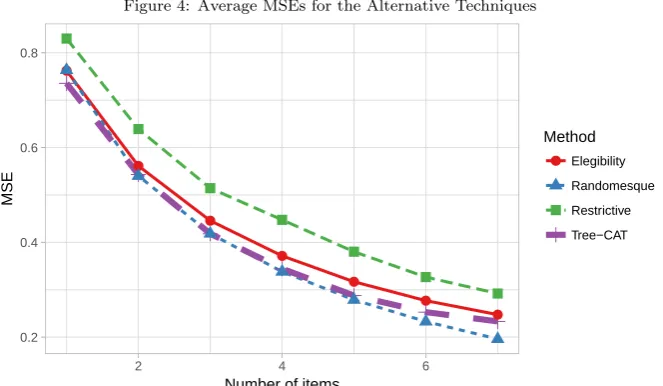
Figure 4 shows the MSE obtained by the different techniques as a func-437
tion of the number of items administered to the subjects. It can be noticed 438
that, except for the Randomesque method in the last levels, Tree-CAT is the 439
one achieving the best performance (based on the MSE). As explained in the 440
discussion to our simulated experiments, the reason why Randomesque outper-441
forms the other three methods at the last levels of the test is that it exceeds the 442
maximum exposure rate. The overlap rates of Tree-CAT, Restrictive, Eligibility 443
and Randomesque methods are 0.28, 0.28, 0.29 and 0.58, respectively. 444
Table 2 depicts the computational time used to construct the decision tree 445
for the Tree-CAT method, and the time needed to select the next item for each 446
of the four techniques. These numbers are similar to those obtained in Table 447
1 of the previous experiment on a smaller scale, as the item bank used in this 448
study is 28% the size of the previous one, and the length of the test is 7 items 449
Figure 4: Average MSEs for the Alternative Techniques
0.2 0.4 0.6 0.8
2 4 6
Number of items
MSE
Method
Elegibility
Randomesque
Restrictive
Tree−CAT
Table 2: Training and Execution Times
Method Training Time Test Time serial
Tree-CAT ≈36 min. 0 secs
Randomesque 0 secs ≈103 min.
(15.6 secs×396)
Eligibility 0 secs ≈117 min.
(17.7 secs×396)
Restricted 0 secs ≈103 min.
(15.6 secs×396)
7. Conclusion 451
In this article, we present a new method for building CATs, referred to as 452
Tree-CAT, based on the DTs methodology. The proposed method creates and 453
stores a representation of the CAT in a tree structure that allows items to be 454
selected in milliseconds. This property is especially valuable when the chosen 455
item selection method involves the calculation of integrals (e.g. when a CAT 456
uses minimal EPV for item selection). In this regard, it is demonstrated that 457
building a CAT that minimises the EPV is equivalent to building a DT that 458
minimises the MSE. 459
In the article we also show that creating a CAT with item exposure controls 460
can be understood as the simultaneous construction of several trees, and propose 461
an algorithm for performing this task. This algorithm allows the use of different 462
strategies that accelerate its construction. First, it is possible to use parallel 463
programming to calculate the MSE matrix required by the algorithm. Second, 464
the calculation of MSEs can be simplified using information obtained at the 465
previous level nodes. Finally, it seems possible to merge branches that produce 466
similar estimates of the trait level, allowing the tree to be kept within reasonable 467
dimensions. In this article we have conducted experiments taking advantage of 468
[image:16.595.180.414.361.470.2]Tree-CAT presents several advantages with respect to other existing meth-470
ods. Firstly, the results obtained experimentally show that Tree-CAT is the 471
method with the lowest MSE among those with the lowest overlap rate. An-472
other advantage is that it can potentially be administered simultaneously to an 473
unlimited number of participants. In contrast to existing methods, which calcu-474
late in real time each of the items to be presented based on previous answers, the 475
Tree-CAT selects the next item to be presented from a previously stored struc-476
ture. This allows, for practical purposes, to eliminate the time required for item 477
selection. This is especially useful when item selection criteria are computa-478
tionally expensive. These two properties, namely, simultaneous application and 479
zero time in the selection of items, make Tree-CAT an ideal candidate for the 480
simultaneous administration of on-line tests to a large number of participants. 481
One weakness of the method is the need of a small computer cluster for build-482
ing the tree within reasonable time. For example, in the experiment developed 483
in this article, 128 nodes of a cluster were used. However, the availability of a 484
larger cluster could reduce the construction time of the tree from one week –as 485
in our case- to a few hours. The importance of this limitation is further reduced 486
by the fact that, once the tree has been built, the test can be administered from 487
any personal computer. 488
Regarding this limitation, an appealing future research line consists of find-489
ing a mechanism for optimally merging the branches of the trees in order to limit 490
the size of the trees. Additional research could also be developed for address-491
ing issues like content balance, variable test length, or multidimensional-trait 492
assessment. 493
We conclude the article by stating our conviction, supported by the exper-494
imental and analytical results obtained, that the DTs approach for building 495
CATs is a promising research line that opens up several lines of research and 496
combines the knowledge of the areas of Psychology, Statistics, Operational Re-497
search and Computer Science. 498
Acknowledgments 499
Numerical experiments were conducted in Uranus, a supercomputer cluster 500
located at Universidad Carlos III de Madrid and jointly funded by EU-FEDER 501
funds and by the Spanish Government via the National Projects No. UNC313-502
4E-2361, No. ENE2009-12213- C03-03, No. 33219, No. ENE2012-503
31753 and No. ENE2015-68265-P. 504
References 505
Armstrong, R. and Edmonds, J. (2004). A study of multiple stage adaptive test 506
designs. In annual meeting of National Council of Measurement in
Educa-507
tion,(NCME), San Diego, CA. 508
Barrada, J. R., Olea, J., and Ponsoda, V. (2007). Methods for restricting 509
maximum exposure rate in computerized adaptative testing. Methodology:
510
European Journal of Research Methods for the Behavioral and Social Sciences, 511
Blasco-Fontecilla, H., Delgado-Gomez, D., Ruiz-Hernandez, D., Aguado, D., 513
Baca-Garcia, E., and Lopez-Castroman, J. (2012). Combining scales to 514
assess suicide risk. Journal of psychiatric research, 46(10):1272–1277. 515
doi:10.1016/j.jpsychires.2012.06.013. 516
Chang, H.-H. and Ying, Z. (1996). A global information approach to comput-517
erized adaptive testing. Applied Psychological Measurement, 20(3):213–229. 518
doi:10.1177/014662169602000303. 519
Chapman, D. S. and Webster, J. (2003). The use of technologies in the re-520
cruiting, screening, and selection processes for job candidates. International
521
journal of selection and assessment, 11(2-3):113–120. 522
De Beurs, D. P., de Vries, A. L., de Groot, M. H., de Keijser, J., and Kerkhof, 523
A. J. (2014). Applying computer adaptive testing to optimize online assess-524
ment of suicidal behavior: a simulation study. Journal of medical Internet
525
research, 16(9). doi:10.2196/jmir.3511. 526
Delgado-Gomez, D., Baca-Garcia, E., Aguado, D., Courtet, P., and Lopez-527
Castroman, J. (2016). Computerized adaptive test vs. decision trees: devel-528
opment of a support decision system to identify suicidal behavior. Journal of
529
affective disorders, 206:204–209. doi:10.1016/j.jad.2016.07.032. 530
Fliege, H., Becker, J., Walter, O. B., Bjorner, J. B., Klapp, B. F., and Rose, 531
M. (2005). Development of a computer-adaptive test for depression (d-cat). 532
Quality of life Research, 14(10):2277. 533
Gardner, W., Shear, K., Kelleher, K. J., Pajer, K. A., Mammen, O., Buysse, D., 534
and Frank, E. (2004). Computerized adaptive measurement of depression: a 535
simulation study. BMC psychiatry, 4(1):13. doi:10.1186/1471-244X-4-13. 536
Georgiadou, E. G., Triantafillou, E., and Economides, A. A. (2007). A review of 537
item exposure control strategies for computerized adaptive testing developed 538
from 1983 to 2005. The Journal of Technology, Learning and Assessment, 539
5(8). 540
Gibbons, R. D., Weiss, D. J., Frank, E., and Kupfer, D. (2016). Computerized 541
adaptive diagnosis and testing of mental health disorders. Annual review of
542
clinical psychology, 12. doi:10.1146/annurev-clinpsy-021815-093634. 543
Hayton, J. C., Allen, D. G., and Scarpello, V. (2004). Factor retention decisions 544
in exploratory factor analysis: A tutorial on parallel analysis. Organizational
545
research methods, 7(2):191–205. 546
Hsueh, I.-P., Chen, J.-H., Wang, C.-H., Chen, C.-T., Sheu, C.-F., Wang, W.-547
C., Hou, W.-H., and Hsieh, C.-L. (2016). Development of a computerized 548
adaptive test for assessing balance function in patients with stroke. Physical
549
therapy, 90(9):1336–1344. doi:10.2522/ptj.20090395. 550
Kingsbury, G. G. and Zara, A. R. (1989). Procedures for selecting items for 551
computerized adaptive tests. Applied measurement in education, 2(4):359– 552
Leung, Y. W., Brown, C., Cosio, A. P., Dobriyal, A., Malik, N., Pat, V., Irwin, 554
M., Tomasini, P., Liu, G., and Howell, D. (2016). Feasibility and diagnostic 555
accuracy of the patient-reported outcomes measurement information system 556
(PROMIS) item banks for routine surveillance of sleep and fatigue problems in 557
ambulatory cancer care. Cancer, 122(18):2906–2917. doi:10.1002/cncr.30134. 558
Lord, F. M. (1980). Applications of item response theory to practical testing
559
problems. Hillsdale, NJ: Lawrence Erlbaum. 560
Lu, P., Zhou, D., Qin, S., Cong, X., and Zhong, S. (2012). The study of 561
item selection method in cat. In Computational Intelligence and Intelligent
562
Systems, pages 403–415. Springer. doi:10.1007/978-3-642-34289-9 45. 563
Magis, D. and Raˆıche, G. (2011). catR: An R package for computer-564
ized adaptive testing. Applied Psychological Measurement, 35(7):576–577. 565
doi:10.1177/0146621611407482. 566
Magis, D., Raˆıche, G., et al. (2012). Random generation of response patterns 567
under computerized adaptive testing with the r package catR. Journal of
568
Statistical Software, 48(8):1–31. doi:10.18637/jss.v048.i08. 569
Moore, T. M., Calkins, M. E., Reise, S. P., Gur, R. C., and Gur, R. E. 570
(2018). Development and public release of a computerized adaptive (CAT) 571
version of the schizotypal personality questionnaire. Psychiatry research. 572
doi:10.1016/j.psychres.2018.02.022. 573
Pastor, D. A., Dodd, B. G., and Chang, H.-H. (2002). A comparison of item se-574
lection techniques and exposure control mechanisms in cats using the general-575
ized partial credit model.Applied Psychological Measurement, 26(2):147–163. 576
doi:10.1177/01421602026002003. 577
Revuelta, J. and Ponsoda, V. (1998). A comparison of item exposure control 578
methods in computerized adaptive testing. Journal of Educational
Measure-579
ment, 35(4):311–327. doi:10.1111/j.1745-3984.1998.tb00541.x. 580
Riley, B., Funk, R., Dennis, M.and Lennox, R., and Finkelman, M. (2011). The 581
use of decision trees for adaptive item selection and score estimation. In
An-582
nual Conference of the International Association for Computerized Adaptive
583
Testing. 584
Rokach, L. and Maimon, O. (2014). Data mining with decision trees: theory
585
and applications. World scientific. 586
Rubio, V. J., Aguado, D., Hontangas, P. M., and Hern´andez, J. M. (2007). 587
Psychometric properties of an emotional adjustment measure: An application 588
of the graded response model.European Journal of Psychological Assessment, 589
23(1):39–46. 590
Samejima, F. (2016). Graded response models. In Handbook of Item Response
591
Theory, Volume One, pages 123–136. Chapman and Hall/CRC. 592
Shin, C. D. (2017). Conditional randomesque method for item exposure control 593
in cat. International Journal of Intelligent Technologies & Applied Statistics, 594
Stucky, B. D., Edelen, M. O., Sherbourne, C. D., Eberhart, N. K., and Lara, 596
M. (2014). Developing an item bank and short forms that assess the im-597
pact of asthma on quality of life. Respiratory medicine, 108(2):252–263. 598
doi:10.1016/j.rmed.2013.12.008. 599
Sympson, J. and Hetter, R. (1985). Controlling item-exposure rates in com-600
puterized adaptive testing. In Proceedings of the 27th annual meeting of the
601
Military Testing Association, pages 973–977. 602
Tseng, W.-T. (2016). Measuring english vocabulary size via computerized adap-603
tive testing. Computers & Education, 97:69–85. 604
Ueno, M. and Songmuang, P. (2010). Computerized adaptive testing 605
based on decision tree. In Advanced Learning Technologies (ICALT),
606
2010 IEEE 10th International Conference on, pages 191–193. IEEE. 607
doi:10.1109/ICALT.2010.58. 608
van der Linden, W. J. (2003). Some alternatives to sympson-hetter item-609
exposure control in computerized adaptive testing. Journal of Educational
610
and Behavioral Statistics, 28(3):249–265. doi:10.3102/10769986028003249. 611
van der Linden, W. J. and Glas, C. A. (2000). Computerized adaptive testing:
612
Theory and practice. Springer. 613
van der Linden, W. J. and Pashley, P. J. (2009). Item selection and ability 614
estimation in adaptive testing. InElements of adaptive testing, pages 3–30. 615
Springer. doi:10.1007/978-0-387-85461-8 1. 616
van der Linden, W. J. and Veldkamp, B. P. (2005). Constraining item exposure
617
in computerized adaptive testing with shadow tests, volume 2. Law School 618
Admission Council. 619
van der Linden, W. J. and Veldkamp, B. P. (2007). Conditional item-620
exposure control in adaptive testing using item-ineligibility probabili-621
ties. Journal of Educational and Behavioral Statistics, 32(4):398–418. 622
doi:10.3102/1076998606298044. 623
Veerkamp, W. J. and Berger, M. P. (1997). Some new item selection criteria for 624
adaptive testing.Journal of Educational and Behavioral Statistics, 22(2):203– 625
226. doi:10.3102/10769986022002203. 626
Veldkamp, B. P. and Matteucci, M. (2013). Bayesian computerized adaptive 627
testing. Ensaio: Avalia¸c˜ao e Pol´ıticas P´ublicas em Educa¸c˜ao, 21(78):57–82. 628
doi:10.1590/S0104-40362013005000001. 629
Weiss, D. J. (1982). Improving measurement quality and efficiency 630
with adaptive testing. Applied psychological measurement, 6(4):473–492. 631
doi:10.1177/014662168200600408. 632
Weiss, D. J. (2004). Computerized adaptive testing for effective and efficient 633
measurement in counseling and education. Measurement and Evaluation in
634
Weissman, A. (2007). Mutual information item selection in adaptive classi-636
fication testing. Educational and Psychological Measurement, 67(1):41–58. 637
doi:10.1177/0013164406288164. 638
Yan, D., Lewis, C., and Stocking, M. (2004). Adaptive testing with regres-639
sion trees in the presence of multidimensionality. Journal of Educational and
640
Appendix A. Notation 642
Section 2 643
J: set of participants; 644
I: item bank; 645
ij
n: n–th itemi∈ I to be administered to participantj∈ J;
646
R: number of possible answers to an item; 647
r(ij
n): answer of individualj∈ J to item ijn, i= 1, . . . , R.
648
θ: real-valued random variable describing a trait; 649
f :R→R+ density function ofθ; 650
ˆ
θ∅: argmaxθ∈Rf(θ);
651
ujn: sequence of items and responses of individualj, withujn ={r(i j
k)}k=0,...,n
652
anduj0=∅; 653
ˆ θuj
n: estimatedθgiven patternu
j n;
654
Section 3 655
pi(un): probability of observing sequence un in a participant;
656
pi(r|θ): probability that a participant with traitθ will answerr∈ {1. . . R}to
657
itemi∈ I; 658
p(un|θ): probability that a participant with traitθwill show response sequence
659
un up to then-th item shown;
660
p(θ|un): posterior probability of traitθ given a response sequenceun;
661
vnk: sequence of items and responses if an individual with sequenceun−1chooses 662
answerk∈ {1,2. . . R}to then–th item. 663
ˆ θvj
n: estimatedθgiven patternv
j n.
664
Section 4 665
Xij: capacity of itemiassigned to branchj;
666
Eij: MSE incurred if itemi is added to branchj;
667
Di: capacity availability vector for itemi;
668
Cj: proportion of participants associated to branchj.