S U P P L E M E N T A R T I C L E
Predictors of First Recurrence of
Clostridium
dif
fi
cile
Infection: Implications for Initial
Management
David W. Eyre,1A. Sarah Walker,1,2David Wyllie,1Kate E. Dingle,1,3David Griffiths,1,2John Finney,1Lily O’Connor,1
Alison Vaughan,1,2Derrick W. Crook,1,2Mark H. Wilcox,4,5and Timothy E. A. Peto,1,2for the Infections in Oxfordshire Research Database
1
NIHR Oxford Biomedical Research Centre, John Radcliffe Hospital,2Nuffield Department of Clinical Medicine, and3Department of Clinical Laboratories Sciences, Oxford University;4Department of Microbiology, The General Infirmary, Old Medical School, and5Leeds Institute of Molecular Medicine, University of Leeds, United Kingdom
Symptomatic recurrence ofClostridium difficileinfection (CDI) occurs in approximately 20% of patients and is challenging to treat. Identifying those at high risk could allow targeted initial management and improve outcomes. Adult toxin enzyme immunoassay–positive CDI cases in a population of approximately 600 000 persons from September 2006 through December 2010 were combined with epidemiological/clinical data. The cumulative incidence of recurrence≥14 days after the diagnosis and/or onset offirst-ever CDI was esti-mated, treating death without recurrence as a competing risk, and predictors were identified from cause-specific proportional hazards regression models. A total of 1678 adults alive 14 days after theirfirst CDI were included; median age was 77 years, and 1191 (78%) were inpatients. Of these, 363 (22%) experienced a recur-rence≥14 days after theirfirst CDI, and 594 (35%) died without recurrence through March 2011. Recurrence risk was independently and significantly higher among patients admitted as emergencies, with previous gas-trointestinal ward admission(s), last discharged 4–12 weeks beforefirst diagnosis, and with CDI diagnosed at admission. Recurrence risk also increased with increasing age, previous total hours admitted, and C-reactive protein level atfirst CDI (allP< .05). The 4-month recurrence risk increased by approximately 5% (absolute) for every 1-point increase in a risk score based on these factors. Risk factors, including increasing age, initial disease severity, and hospital exposure, predict CDI recurrence and identify patients likely to benefit from enhanced initial CDI treatment.
Symptomatic recurrence of Clostridium difficile infec-tion (CDI) causes significant morbidity and can prove challenging to treat effectively [1]. It also inevitably in-creases the risk of C. difficile transmission. Reported recurrence rates vary from 5% to 50% and typically are around 20% [2].
In a meta-analysis, recurrence risk factors included older age, use of C. difficile–provocative antibiotics after CDI diagnosis, and concomitant receipt of ant-acids [3]. Other factors identified in individual studies include hospital-acquired disease [4]; comorbid con-ditions, including severe underlying illness [5] or poor quality of life scores [6]; and previous recurrent CDI [7]. However, most existing studies are relatively small and hospital based and predate the polymerase chain reaction (PCR) ribotype 027/sequence type 1 (ST1)/ North American pulsed-field gel electrophoresis type 1 (NAP-1) epidemic [3], demonstrating a need for con-temporaneous large-scale population-based studies. CDI most commonly recurs within a week [8] after treatment cessation but can recur up to 6–8 weeks later [9]. However, because most studies have followed
Correspondence: Timothy E. A. Peto, FRCP, NIHR Oxford Biomedical Research Centre, John Radcliffe Hospital, Headley Way, Oxford OX3 9DU, United Kingdom ([email protected]).
Clinical Infectious Diseases 2012;55(S2):S77–87
© The Author 2012. Published by Oxford University Press on behalf of the Infectious Diseases Society of America. All rights reserved. For Permissions, please email: [email protected]. This is an Open Access article distributed under the terms of the Creative Commons Attribution Non-Commercial License (http:// creativecommons.org/licenses/by-nc/3.0), which permits unrestricted non-commercial use, distribution, and reproduction in any medium, provided the original work is properly cited.
patients for only 1–2 months [3], the pattern of longer-term recurrence is unclear. Up to 50% of apparent relapses have been identified as new infections with a different strain [10– 13]; uncertainty about which recurrences represent reinfection hinders the assessment of risk factors for true relapse [14].
Recent guidelines [15] outline strategies for treating recurrent CDI. However, if patients at high risk could be identified earlier, relapse might be prevented by using novel therapies [1, 16]. Therefore, the objectives of this long-term population-based study were to identify independent predictors of CDI recur-rence in Oxfordshire during 2006–2010 and to confirm which predictors were related to relapses caused by the same strain by using genotyping.
METHODS
Oxford Radcliffe Hospitals (ORH) NHS Trust provides >90% of hospital care in Oxfordshire ( population, approximately 600 000) and all acute services. The ORH Microbiology Lab-oratory tests all stool samples from the county, including those from other healthcare facilities and general practitioners ( primary care). From September 2006, all unformed stools (taking the shape of the container) positive by enzyme immu-noassay (EIA) for C. difficile toxins A and B (Meridian Bio-science, Cincinnati, Ohio) and with sufficient sample remaining were routinely cultured.Clostridium difficileisolates were genotyped by multilocus sequence typing (MLST) [17], typing morphologically distinct colonies separately. Infection control policy required samples from any admitted patient with diarrhea (locally defined as≥3 unformed stools within 24 hours) to be tested forC. difficileand vancomycin treatment to be initiated empirically, continuing for 14 days if CDI is
con-firmed. From May 2007, all unformed stool samples from patients aged≥65 years were routinely tested forC. difficile ac-cording to UK Department of Health policy (a mandatory test, typically not meeting the previous diarrhea definition).
Clostridium difficileMLST data were anonymously linked to information for ORH hospital admissions and discharges from April 1997 and mortality from the Infections in Oxford-shire Research Database (IORD) [18]. Admissions to other smaller hospitals in the area (including a specialist orthopedic, a psychiatric, and several community hospitals) were not in-cluded, although samples taken at these locations were iden-tifiable. The IORD has Research Ethics Committee and UK National Information Governance Board approval.
We included thefirst CDI for each adult (aged ≥18 years) from September 2006 through December 2010 (when >99% of samples had been typed), if the patient had no previous CDI recorded since April 1997. Included cases therefore had
≥3 months of potential follow-up to the 1 April 2011 data cutoff. Neither symptom resolution nor antibiotic use is
routinely recorded electronically and, therefore, was not available for analysis. Because (1) patients received 14 days of vancomycin treatment, (2) most symptoms resolve before 14 days in successfully treated patients, and (3) UK Department of Health guidance was not to retest patients with ongoing diarrhea (ie, without resolution) for 28 days, the primary outcome was time fromfirst-ever CDI to the first new EIA-positive sample ≥14 days later. Analyses therefore were re-stricted to patients known to be alive 14 days after the first CDI. The cumulative incidence of recurrence over time was estimated using competing risks methods to account for death before recurrence. Flexible parametric models were used to estimate precisely how the unadjusted daily recurrence risk varied with time from first CDI [19]. Cause-specific pro-portional hazards (Cox) models were used to estimate effects of factors theoretically available at treatment initiation (demo-graphic characteristics, sample characteristics, previous ORH hospital exposure, and previous healthcare-associated infec-tions; details in Table1) on recurrence risk. Independent pre-dictors were identified using backward selection with the Akaike information criterion [20], including pairwise inter-actions and allowing nonlinear effects of continuous factors through fractional polynomials. Categorical effects are pre-sented for factors with significant evidence of nonlinearity. Results from regression models for the cumulative incidence subhazard for recurrence [21] (rather than the cause-specific hazard) were similar (data not shown). In all analyses, patients not known to have died were censored at their last hospital or laboratory contact.
Baseline biomarker values were defined as the closest measurement within (−3, +1) days of the stool sample. Four-teen biomarkers available for >50% of CDI cases were con-sidered (white blood cell count, neutrophil count, lymphocyte count, C-reactive protein level, hemoglobin level, platelet count, and sodium, potassium, creatinine, urea, albumin, alanine ami-notransferase, alkaline phosphatase, and bilirubin levels). To avoid bias and/or loss of power from restricting to complete cases with all biomarkers measured, associations between bio-markers and recurrence were estimated, imputing missing values in the subset of patients with at least 1 observed baseline biomarker. As recommended, chained estimating equations [22,23] were used to create 20 imputations on BoxCox trans-formed variables [24], including all cofactors listed in Table 1, allowing nonlinearity in all continuous factors with natural cubic splines (knots at 10th, 50th, and 90th percentiles [25]) and including log(recurrence time) and the censoring indicator. Standard errors were estimated across imputations using Rubin’s rules.
Stata software, version 11.2 (StataCorp, College Station, Texas), was used for all analyses, which were conducted by one of the authors (A. S. W.).
Table 1. Characteristics of FirstClostridium difficileInfection, September 2006–December 2010
Levels (for Continuous Factors, Unit Increase Corresponding to the RR in
the Regression Model)
No. (%) or Median (IQR)
Unadjusted Univariable Cause-Specific Hazard Model
Factor Overall With Recurrence RR 95% CI
GlobalP Value
CDI, No. (%) 1678 (100) 393 (22)
Demographics
Sex, No. (%) Male 711 (42) 146 (21) 1.00 .36
Female 967 (58) 217 (22) 1.10 .90–1.36
Age (y) (/10-y older) 77 (64–85) 79 (71–86) 1.23 1.14–1.32 <.0001 Previous hospital exposure
Ever previously admitted
to ORH, No. (%)a No 230 (14) 34 (15) 1.00 .11 Yes, <8-h admissions only 108 (6) 22 (20) 1.13 .74–1.75 Yes,≥1 admission for >8 h 1340 (80) 307 (23) 1.45 1.02–2.07 Last ORH admission,
No. (%)
>1 y ago/never 568 (34) 103 (18) 1.00 .01 Within the last y 1110 (66) 260 (23) 1.33 1.06–1.67 Previous dialysis/
chemotherapy at ORH, No. (%)
No 1486 (89) 323 (22) 1.00 .97
Yes 192 (11) 40 (21) 1.01 .73–1.40 Previously admitted to
ORH GI ward, No. (%)
No 1090 (65) 241 (22) 1.00 .33
Yes 588 (35) 122 (21) 0.90 .72–1.12 No. of previous
admissions >8 h
(/5 additional >8-h admissions) 2 (1–5) 3 (1–5) 1.18b 1.03–1.36 .02
Total previous h in hospital (ORH) in admissions >8 h (h)
(/doubling of total previous h in hospital)
366 (44–909) 528 (122–1180) 1.16b 1.09
–1.24 <.0001
Days since last discharged
(/additional 6 mo since last ORH discharge)
96 (23–870) 77 (22–472) 0.96 .90–1.01 .14
Discharged in last 7 d, No. (%)
No 1567 (93) 331 (21) 1.00 .07
Yes 111 (7) 32 (29) 1.41 .98–2.02 Likely source of first
infection (IDSA/SHEA), No. (%) [15]
Hospital onset, healthcare-associated 880 (52) 185 (21) 1.00 <.001 Community onset,
healthcare-associated
334 (20) 80 (24) 1.07 .82–1.39
Indeterminate 127 (8) 45 (35) 1.77 1.27–2.45 Community-associated 337 (20) 53 (16) 0.64 .47–.86 Previous MRSA, No. (%) No 1503 (90) 312 (21) 1.00 .01
Yes 175 (10) 51 (29) 1.45c 1.08 –1.95 Sample characteristics
Season, No. (%) Winter (Dec/Jan/Feb) 424 (25) 81 (19) 1.00 .35 Spring (Mar/Apr/May) 388 (23) 86 (22) 1.18 .87–1.60 Summer ( Jun/Jul/Aug) 431 (26) 98 (23) 1.31 .97–1.76 Autumn (Sep/Oct/Nov) 435 (26) 98 (23) 1.20 .89–1.61 Calendar year (/additional y) 2008 (2007–2009) 2008 (2007–2009) 0.93 .85–1.02 .11 Mandatory EIA test
(mild diarrhea), No. (%)
No (requested by clinician) 1404 (84) 316 (23) 1.00 .01 Yes (not requested) 274 (16) 47 (17) 0.68 .50–.92 Previous negative
EIA test
Ever 714 (43) 187 (26) 1.49 1.21–1.83
Never 964 (57) 176 (18) 1.00 <.0001 Previous negative
EIA test
In last 14 d 452 (27) 261 (21) 1.11 .88–1.40 Not in last 14 d 1226 (73) 102 (23) 1.00 .37 Location where first
sample taken
RESULTS
From September 2006 through December 2010, a total of 2043 adults had their first CDI (toxin EIA-positive stool sample with no previous positive). A total of 271 (13%) patients died within 0–13 days after the EIA-positive sample, and 94 (5%) had no follow-up after 13 days, leaving 1678 (82%) alive 14 days after thefirst CDI for analysis of recurrence.
Recurrence Rates
Overall, 363 of 1678 (22%) patients experienced a recurrence (new EIA-positive sample)≥14 days after theirfirst CDI, and 594 (35%) died without recurrence through March 2011.
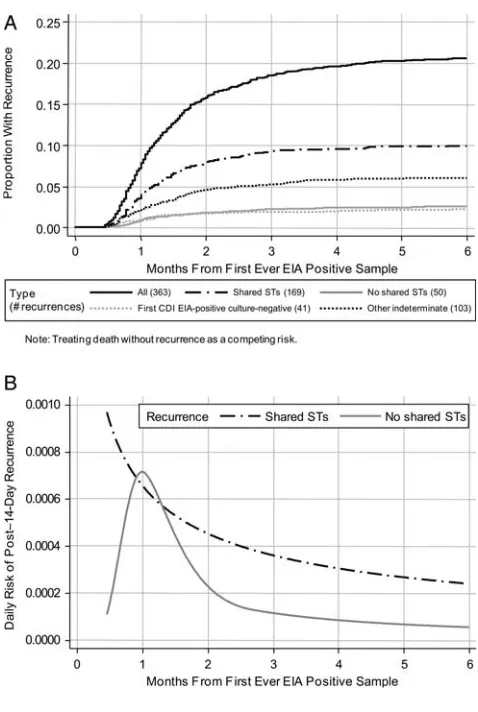
Median follow-up in those without recurrence was 11 months (interquartile range [IQR], 2–28 months). Cumulative inci-dences of recurrence increased to 7% and 16% by 1 and 2 months later, respectively (Figure1A), corresponding to rates of 7.4 cases per 100 person-months at risk and 11.3 cases per 100 person-months at risk, respectively. Thereafter, the inci-dence increased more slowly to 18% and 20% by 3 and 4 months and to 22% and 23% at 1 and 2 years, respectively. The risk for recurrence was greatest 24 days after the first CDI, 10 days after cessation of treatment (Figure1B). Of the 363 recurrences, 94 patients (26%) experienced a third CDI episode (≥14 days after the recurrence), of whom 24 had further episodes (maximum, 6) through March 2011.
Table 1 continued.
Levels (for Continuous Factors, Unit Increase Corresponding to the RR in
the Regression Model)
No. (%) or Median (IQR)
Unadjusted Univariable Cause-Specific Hazard Model
Factor Overall With Recurrence RR 95% CI
GlobalP Value
If inpatient at first CDI, admission specialty
Surgical 376 (32) 65 (17) 1.00 .03
Medical 815 (68) 195 (24) 1.37 1.11–1.68 If inpatient at first CDI,
method of admission
Elective 237 (20) 34 (14) 1.00 <.0001 Emergency 954 (80) 226 (24) 1.58 1.10–2.27
If inpatient at first CDI, d since admitted
Within 2 d of admission 311 (26) 75 (24) 1.00 .50 >2 d after admission 880 (74) 185 (21) 1.10 .84–1.43 If inpatient at first CDI,
d since admitted
Nonlinear effectd 8 (2–20) 10 (2–22)
On d of admission 128 (11) 35 (27) 1.51d .99–2.30 1–5 d after admission 351 (29) 67 (19) 1.03d .72–1.47
6–14 d after admission 311 (26) 56 (18) 1.00 .03
≥15 d after admission 401 (34) 102 (25) 1.46d 1.06–2.03 Biomarkerse
C-reactive protein (mg/L) (/120 mg/L)f 84 (33–156) 97 (44–>160) 1.69 1.31–2.18 <.0001 White blood cell count
(×109/L) (/10 × 10 9
/L)f 11.2 (7.8–16.1) 12.2 (7.9–18.3) 1.34 1.15–1.36 <.0001
Neutrophils (×109/L) (/10 × 109/L)f 8.9 (5.6
–13.4) 9.7 (5.7–15.4) 1.42 1.20–1.69 <.0001 Lymphocytes (×109/L) (/10 × 109/L)f 11.0 (7.0
–16.0) 10.0 (7.0–15.0) 0.84 .73–.97 .02 Albumin (g/L) (/10 g/L) 34 (30–38) 34 (30–37) 0.82 .68–1.00 .05 Urea (mmol/L) (/5 mmol/L)f 6.7 (4.5
–11.0) 7.3 (5.1–12.1) 1.09 1.01–1.17 .02
Abbreviations: CDI,Clostridium difficileinfection; CI, confidence interval; ED, emergency department; EIA, enzyme immunoassay; GI, gastrointestinal; IDSA, Infectious Diseases Society of America; IQR, interquartile range; MRSA, methicillin-resistantStaphylococcus aureus; ORH, Oxford Radcliffe Hospitals; RR, relative risk; SHEA, Society for Healthcare Epidemiology of America.
a
Excluding current admission if inpatient.
b
Univariable model also adjusts for ever vs never previously admitted for >8 h.
c
Approximate IQR.
d
Significant nonlinearity (P< .0001; univariable model also adjusts for current inpatient), with greatest risk for death on day of admission, then decreasing sharply and then gradually increasing. Results presented for diagnoses made on day of admission, then approximate tertiles of days from admission to first diagnosis in inpatients.
e
Imputed in the subset of 1295 (77%) patients with at least 1 of the 14 potential biomarkers available (see Methods for details). Reference ranges: C-reactive protein, 0–8 mg/L; white blood cell count, 4–11 × 109
/L (no reference range for neutrophils or lymphocytes, which are measured as a percentage of white blood cell count); albumin, 35–50 g/L; urea, 2.5–6.7 mmol/L. None of the biomarkers not shown had an effect in univariable models (P> .1).
f
Significant interaction between previous MRSA and emergency/elective admission (Table2), such that previous MRSA increases CDI recurrence risk for emergency admissions, but decreases CDI recurrence risk for elective admissions (such patients received vancomycin and gentamicin perioperatively in place of broad-spectrum penicillin-based prophylaxis).
[image:4.594.51.545.72.343.2]Risk Factors for Recurrence
As expected, the population was predominantly older (median age, 77 years), although 302 (18%) were <60 years of age at
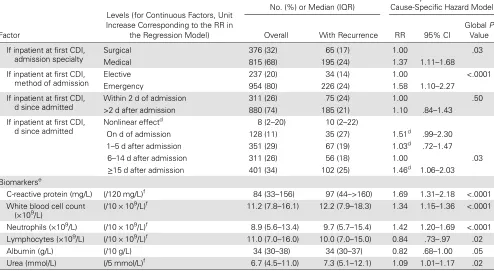
first CDI (Table1). A total of 1191 (71%) were inpatients (ad-mitted a median of 8 [IQR, 2–20] days), and most (1448; 86%) had previously been admitted to ORH facilities (66% in the past year). In a multivariable model (Table2), recurrence risk independently was significantly higher among patients ad-mitted as emergencies, those with previous gastroenterology ward admission(s), and after diagnosis on day of admission or
≥15 days after admission and also increased with age and increasing previous total hours in the hospital (all P< .05). Risks also were higher among those for whom the last inpa-tient stay was 4–12 weeks before diagnosis (P= .006). Recur-rence risk was independently lower among those with CDI diagnosed using a test that had not been clinically requested
(a mandatory test, often for mild diarrhea; P= .07). Patients without previous hospital admissions generally had fewer other risk factors, but after adjusting for these, they had higher recurrence risks. One potential explanation, not assess-able in our data, would be if such patients were more likely to be tertiary referrals with other non-ORH hospital exposure. Other factors (in particular, medical specialty, previous EIA-negative test result, number of previous admissions, and discharged in the previous 7 days) were significant in only univariable and not multivariable models (ie, were con-founded with other factors).
In this multivariable model, 5 major effect modifications (interactions) were identified (Table 2): (1) increased risk at older ages was augmented in those with previous dialysis/che-motherapy, (2) increased risks associated with emergency ad-missions were augmented in those with previous methicillin-resistant Staphylococcus aureus (MRSA) infection or dialysis/ chemotherapy, (3) recurrence risk increased less strongly with increasing previous total hours in the hospital in those ad-mitted as emergencies and/or with previous gastroenterology ward admissions, (4) risk was significantly lower in those with previous MRSA infection and CDI in an elective admission (mostly surgical specialties; such patients received vancomycin and gentamicin perioperatively in place of broad-spectrum penicillin-based prophylaxis), and (5) recurrence risks varied less over days from admission to the first CDI diagnosis in medical than in nonmedical inpatients. No other factor listed in Table1had an additional effect in this multivariable model (P> .2). There also was no evidence of a trend over calendar year (P= .37) or season (P= .24).
The multivariable model in Table 2included factors theo-retically available to clinicians at treatment initiation. Of importance, after adjusting for these, higher EIA optical density of thefirstC. difficiletest was associated with a higher risk for recurrence, comparing across absolute values (relative risk [RR], 1.20 per unit higher [95% confidence interval {CI}, 1.06–1.35];P= .003; median, 1.6 [IQR, 0.5–>2.5]) or compar-ing the 37% with optical density exceedcompar-ing the assay maximum (2.5) with other cases (RR, 1.33; 95% CI, 1.08–1.65;P= .008).
Biomarkers
One or more of the 14 potential biomarkers was available in 1295 patients (77%), imputing missing data in this subgroup. Only higher C-reactive protein level and higher neutrophil count at first CDI independently increased recurrence risk, but the effect was much larger for C-reactive protein level (RR, 1.45 per 120 mg/L [the IQR] higher [95% CI, 1.09–1.93];
[image:5.594.49.289.38.379.2]P= .01) than for neutrophil count (RR, 1.19 per 10 × 109/L higher [95% CI, .97–1.45]; P= .09). Effects of other factors listed in Table2were similar after adjusting for these baseline biomarkers.
Table 2. Predictors of Recurrence≥14 Days After FirstClostridium difficileInfection
All Recurrences Multivariable Cause-Specific Hazard Modela
Shared STs Multivariable Cause-Specific Hazard Modela
Factor
Levels (Effect in Regression
Model) RR 95% CI
Global
PValue RR 95% CI
GlobalP
Value
No. of CDI recurrences 363 169
Age (y) (/10-y older) 1.16
1.57
(if previous dialysis/ chemotherapy [interaction
P= .02])
1.07–1.26 1.23–2.00
.0004 .0003
1.29 1.71
(if previous dialysis/ chemotherapy)
1.13–1.48 1.19–2.47
.0001 .004
Total previous h in hospital (ORH) in admissions >8 h (h)
(/doubling of total previous h in hospital)
1.29
1.12 (if emergency admission [interactionP= .002]) 1.15 (if previous GI admission
[interactionP= .007])
1.17–1.42 1.03–1.22
1.04–1.28
<.0001 .008
.008
1.38
1.15 (if emergency admission) 1.24 (if previous GI
admission)
1.19–1.60 1.01–1.30
1.05–1.46
<.0001 .03
.009
Ever previously admitted to ORH
No or <8-h admissions (vs yes for >8-h admission)
1.99 1.20–3.31 .008 2.57 1.18–5.62 .02
Mandatory EIA test (mild diarrhea)
Yes (vs no) 0.74 .53–1.03 .07 0.67 .41–1.09 .11
If inpatient at first CDI, admission method
Elective emergency 1.00 2.79
5.10 (if previous MRSA [interaction
P= .0003])
4.74 (if previous dialysis/ chemotherapy [interaction
P= .04])
1.29–6.04 2.12–12.2
1.96–11.4
.006 .0003
.0005 1.00 4.85 9.52
8.79 (if previous dialysis/ chemotherapy)
1.42–16.6 2.42–37.5
2.23–34.6 .01 .001
.002
Previous MRSA Yes (vs no) 0.45 (if not emergency) .23–.88 .02 0.70 (if not emergency) .31–1.59 .39 Previous dialysis/chemotherapy
at ORH
Yes (vs no) 0.77a(if not emergency) .39
–1.52 .45 1.15a(if not emergency) .46
–2.82 .77
Previously admitted to ORH GI ward
Yes (vs no) 2.33 1.13–4.78 .02 2.10 .71–6.23 .18
If inpatient at first CDI, d since admitted
On d of admission 1.73b .52
–5.73 1.15 .21–6.31
1–5 d after admission 0.50b .21
–1.19 0.54 .18–1.65
6–14 d after admission 1.00 .006 1.00 .38
≥15 d after admission 1.84b 1.05
–3.23 1.37 .62–3.04
If inpatient at first CDI, admission specialty
Medical (vs surgical) 0.98b .34
–2.79 .97 0.90 .80–1.01 .08
Location where first CDI sample taken
Not inpatient (vs inpatient overnight)
0.58c .20–1.73 .33 0.50 .11–2.39 .39
S82
•
CID
2012:55
(Suppl
2)
•
Eyr
e
et
Strain-Specific Recurrence Risks
MLST was obtained for 1076 of 1678 (64%) first CDI cases: 418 (25%) samples did not yieldC. difficile on culture (EIA-positive culture-negative samples), and 184 (11%) were not available for culture (28% pre– vs 4% post–September 2007 when staff cover increased). A total of 685 (64%) typed isolates belonged to phylogenetic clade 1, from 56 STs, including those corresponding to PCR ribotypes 001, 002, 005, 014, 015, 020, 072, and 106 [26]. A total of 300 typed isolates (28%) belonged to clade 2 (295 of 300 PCR ribotype 027/ST1), and the remain-ing 91 (8%) belonged to clades 3, 4, and 5 (Supplementary Table 1). The crude percentages with recurrence were slightly higher after initial clade 2 CDI (90 of 300; 30%), compared with clade 1 (174 of 685; 25%;χ2P= .13). After adjusting for risk factors listed in Table2, recurrence risk appeared to be slightly higher after clade 2, compared with 1 CDI (RR, 1.17; 95% CI, .90–1.51; P= .24), but was compatible with chance. Recurrence risk was significantly lower for EIA-positive culture-negative samples (RR [vs clade 1], 0.41 [95% CI, .29–.58];P< .0001), supporting previous observations that this latter group likely represents false EIA-positive results [27,28].
Relapse Versus Reinfection
Of the 363 recurrences after thefirst CDI, 219 (60%) had STs determined from both episodes. Making comparisons on the basis of individual STs, not clade, 169 (77%) recurrences had the same ST as the initial episode and 50 (23%) had no STs in common (ie, were new infections). The risk for same-ST re-currence was highest 14 days after first EIA-positive sample (Figure2), then declined slowly during the next 2–6 months. In contrast, the risk for new ST infections peaked 30 days after the first CDI and then decreased sharply; recurrence risk among the 41 patients (11%) with EIA-positive culture-negativefirst CDI followed a similar pattern. For the other 103 recurrences (28%; STs not determined for≥1 isolate), risk was a mixture distribution (data not shown).
Predictors of the 169 recurrences with shared STs were very similar to predictors of all 363 recurrences (Table 2); with relatively small numbers, power was too low to conduct sepa-rate model selection. As expected, several factors appeared to have weaker effects on the 50 recurrences with no shared STs ( presumed reinfections; data not shown).
Risk Score for Recurrence Following First CDI
Because predictors of all CDI recurrences were similar to those for shared ST recurrences, we constructed an integer risk score (Table3) based on the multivariable model for all recurrences (Table2). The maximum possible score is 15 and minimum is−2; values of 0–13 were observed in our data set, with a median of 5 (IQR, 3–6). Models including the single risk score as a predictor provided an overallfit similar to the
[image:7.594.72.217.70.702.2]full Table 2model. Four-month recurrence risk was 6%–48% across the score (Figure 3); the absolute risk of recurrence 4 months after the first CDI increased by approximately 5% for every 1-point increase in score.
DISCUSSION
In our cohort of nearly 1700 patients surviving 2 weeks after their first CDI, 22% developed a symptomatic CDI recurrence during the 4-year study period. This is similar to commonly cited recurrence rates of approximately 20% [2] despite our con-siderably longer follow-up and robust design accounting for mortality. Most recurrences occurred within 2 months, but 4% of patients had recurrences at 2–4 months. The decrease in re-currence over time may reflect the eventual success of multiple treatment cycles [1,9] or recovery from underlying illness with consequent lower exposure to antibiotics and restoration of
more normal bowelflora able to suppressC. difficilegrowth in the colon [29]. Structural changes in bowelflora with age may impair such recovery [30]. Alternatively, because recurrence is associated with inadequate immune responses [31, 32], re-peated relapse eventually may generate effective immunity, for example, to all phase variants of the cell surface–expressed pro-teins [33].
Two possible explanations exist for symptomatic recurrence: relapse of the same infection and reinfection. These can be distin-guished, at least partially, by using strain typing data. In our study, 23% of recurrences were reinfection with a different strain, similar to the 26% reported in [14], but lower than the approxi-mately 50% found by others [10–13]. Relapse may be more common in our cohort because of older age, compared with some other studies [11,13]. Implementation of rigorous infection control measures [34] may also have reduced the incidence of re-infection. Of interest, reinfection with a different ST occurred most frequently 1 month after thefirst CDI (2–3 weeks after treat-ment cessation), possibly representing reexposure to C. difficile
after clearance of the initial infection, whereas risks for new CDI with the same ST were greatest 14 days after thefirst CDI. Similar trends have been seen in other smaller studies [10,11]. The rela-tively high prevalence of ST1/027/NAP-1, in 18% of cases, illus-trates the difficulty distinguishing reinfection and relapse using genotyping schemes, such as MLST or ribotyping, with limited discriminatory power; the number of reinfections thus may be underestimated [15]. In the future, whole-genome sequencing may distinguish same-ST relapses from reinfections with different variants of common STs. Such distinctions are complicated further by the possibility of mixed initial or subsequent CDI; this was rarely identified in our cohort [35].
[image:8.594.49.288.33.389.2]Our proposed score (Table3) provides a summary of impor-tant risk factors for recurrence that would be present in elec-tronic patient record systems. Several markers of underlying health status were either risk factors themselves or augmented the effect of other risk factors in our large unselected contem-poraneous population, including increasing age, emergency ad-mission, previous MRSA infection or colonization, and previous dialysis or chemotherapy. An initial CDI severe enough to be the probable cause of admission, to merit testing on the basis of clinical suspicion, or to increase levels of inflammatory markers, in particular, C-reactive protein, increased recurrence risk. We also found smaller risk increases with higher EIA optical density of thefirst CDI, which may reflect initial bacterial burden and/or toxin production [36]. Increasing past hospital exposure or gas-trointestinal ward admission before thefirst CDI was also associ-ated with recurrence. The increased recurrence risk after gastrointestinal admission requires confirmation in additional studies but may reflect increased CDI risk associated with inflammatory bowel disease [37,38], nasogastric tube placement, possibly gastrointestinal endoscopy [39], and gastrointestinal
Figure 2. Time to recurrence≥14 days afterfirstClostridium difficile
infection according to shared or not shared sequence types. A, Months to new enzyme immunoassay (EIA)–positive sample≥14 days afterfi rst-ever EIA-positive sample.B, Daily risk of new post–14-day EIA-positive sample. Abbreviations: CID, Clostridium difficile infection; EIA, enzyme immunoassay; ST, sequence type.
surgery [40]. The apparent protective effect against CDI recur-rence of previous MRSA infection or colonization on elective ad-missions is likely to reflect differences in the perioperative (and other) antibiotics received by this group, in particular, the
[image:9.594.47.556.58.343.2]replacement of broad-spectrum β-lactam antibiotics with glyco-peptides and aminoglycosides. Conversely, previous MRSA was associated with higher recurrence risk in emergency admissions, possibly reflecting greater comorbidity in this group of patients who were also likely to receive broad-spectrum β-lactams in addition to glycopeptides. Initial CDI occurring 4–12 weeks after hospital discharge was also independently associated with recur-rence. The delay in onset of the initial CDI in such cases may reflect prolonged susceptibility to the effects of hospital exposure (eg, mediated through failure of the immune system or change in bowelflora that also subsequently increases recurrence risk). Pre-viously proposed scores for recurrence risk have been developed on much smaller hospital populations and have incorporated clinician opinion [5]. Nevertheless, further work to validate the score proposed here is essential. Of note, our risk score was con-structed to capitalize on the types of data available in electronic patient records; we envisage that it could, for example, be incor-porated into routine reports of positive CDI test results (if vali-dated). This goal contrasts with other approaches to risk scoring for recurrence [5] and severity [41], which have been designed for use by clinicians at the bedside and often include
Table 3. Score to PredictClostridium difficileInfection (CDI) Recurrence Following First-Ever CDI Diagnosis
Factor Scoring Criteria Max Min
Patient & health status Age (y) 60–69 70–79 ≥80
Score 1 2 3 3 0
Emergency admission Any emergency admission 1
AND previous MRSA+ 1
AND/OR previous dialysis/chemotherapy
1 3 0
Severity of initial disease Stool frequency ≥3 unformed stools/da 1 Admission with CDI Sample taken on
day of inpatient admission
1
C-reactive proteinb(mg/L) <35 85–<160 ≥160
Score −1 1 2 4 −1
Past health care exposure
Type of past admission Past gastroenterology admission
No past gastroenterology admission
Total inpatient duration before admission
Any past admission >2–13 wk >13 wk
Score 1 2 3 3 0
Antibiotic selection (Elective admission OR community sample) AND previous MRSA isolatedc
−1 0 −1
Susceptibility to diarrhea several wk after hospital exposure
Primary CDI 4–12 wk after hospital discharged
Community sample or sample taken within≤2 d of inpatient admission AND patient discharged from hospital 4–12 wk previously
2 2 0
Total 15 −2
Abbreviations: CDI,Clostridium difficileinfection; Max, maximum; Min, minimum; MRSA, methicillin-resistantStaphylococcus aureus; MRSA+, MRSA positive.
a
“Mandatory”tests in our study taken to represent mild diarrhea with <3 unformed stools per day.
b
Score 0 if C-reactive protein not measured or not available at first CDI.
c
Proxy for receiving vancomycin ± gentamicin rather than co-amoxiclav or other provocative antibiotics for surgical prophylaxis or other treatment.
d
Infectious Diseases Society of America/Society for Healthcare Epidemiology of America indeterminate [15].
Figure 3. Time to recurrence ≥14 days after first Clostridium difficile
[image:9.594.49.287.498.663.2]assessments, such as temperature and endoscopy results not available in our study.
We did notfind statistical evidence to support higher recur-rence risk in clade 2 strains (almost exclusively ST1/027/NAP1), although we had low power (<40%) to detect a significant differ-ence in recurrdiffer-ence rates of 25% and 30% (as observed). More than 3 times as many cases would be needed to detect such a difference with 80% power, although it might still be clinically important, because every symptomatic recurrence reflects an additional opportunity forC. difficiletransmission. However, it also is clear that CDI virulence remains poorly understood, with the variable virulence of PCR ribotype 027 strains demonstrated in vivo [42] and in vitro [43,44], suggesting that factors at levels other than strain type may play a role.
Study limitations include the lack of prescribing data, meaning that we could not directly assess the potentially impor-tant roles of antibiotics and proton pump inhibitors [3,45]. The limited sensitivity/specificity of EIA testing [28] also has impli-cations for assessing recurrence; the reduced recurrence rate after EIA-positive culture-negative initial test results (Figure2) supports that these do not represent true CDI. Several factors included in our risk score may not translate to other healthcare systems and practices, particularly diarrhea severity. Investi-gating whether they are specific to our hospitals or reflect important underlying risk determinants is essential. Finally, the underlying electronic data sources do not capture resolution or onset of symptoms, and therefore, our assessment of recurrence is based on time since the initial diagnosis and samples that were actually submitted. A proportion of our recurrences there-fore may be persistent diarrhea. However, we are unlikely to have missed new symptomatic episodes because fecal sampling was common (500–1400 EIAs/month; median, 960) with a low clinical threshold to investigate patients with diarrhea; only 7% of samples were EIA positive. This limitation also means that we are unable to distinguish between effects of previously resolved and ongoing episodes of MRSA infection/colonization or dialysis/chemotherapy in risk models.
In summary, recurrence after CDI is an important problem. Early recurrence frequently represents relapse of the same in-fection. Risk factors, including increasing age, severity of initial disease, and hospital exposure, can predict recurrence, in particular, relapse of the same infection, and may identify patients who would benefit from enhanced treatment of an initial CDI episode. Late recurrences highlight the ongoing need for interventions to preventC. difficiletransmission.
Supplementary Data
Supplementary materials are available atClinical Infectious Diseasesonline
(http://www.oxfordjournals.org/our/_journals/cid/). Supplementary
ma-terials consist of data provided by the author that are published to benefit
the reader. The posted materials are not copyedited. The contents of all supplementary data are the sole responsibility of the authors. Questions or messages regarding errors should be addressed to the author.
Notes
Acknowledgments. We thank all the people of Oxfordshire who con-tribute to the Infections in Oxfordshire Research Database. Research Data-base Team: P. Bejon, T. Berendt, C. Bunch, D. W. Crook, J. Finney, J. Gearing (community), H. Jones, L. O’Connor, T. E. A. Peto ( principal investigator), J. Robinson (community), B. Shine, A. S. Walker, D. Waller, and D. Wyllie.
Financial support. This work was supported by the Oxford National Institute for Health and Research, NIHR Biomedical Research Centre, United Kingdom.
Supplement sponsorship. This article was published as part of a supple-ment entitled“Fidaxomicin and the Evolving Approach to the Treatment of
Clostridium difficileInfection,”sponsored by Optimer Pharmaceuticals, Inc.
Potential conflicts of interest. The institution of D. W. C. and T. E. A. P. received per-case funding from Optimer Pharmaceuticals to supportfidaxomicin trial patient expenses. D. W. C. and T. E. A. P. also received honoraria from Optimer Pharmaceuticals for participation in additional meetings related to investigative planning for fi dax-omicin. M. H. W. has received honoraria for consultancy work,financial support to attend meetings, and research funding from bioMérieux, Optimer, Novacta, Pfizer, Summit, The Medicines Company, and Viro-pharma. All other authors report no potential conflicts.
All authors have submitted the ICMJE Form for Disclosure of Potential Conflicts of Interest. Conflicts that the editors consider relevant to the content of the manuscript have been disclosed.
References
1. Johnson S. RecurrentClostridium difficileinfection: a review of risk factors, treatments, and outcomes. J Infect2009; 58:403–10.
2. Aslam S, Hamill RJ, Musher DM. Treatment ofClostridium difficile -associated disease: old therapies and new strategies. Lancet Infect Dis
2005; 5:549–57.
3. Garey KW, Sethi S, Yadav Y, DuPont HL. Meta-analysis to assess risk factors for recurrentClostridium difficileinfection. J Hosp Infect2008; 70:298–304.
4. Pepin J, Alary ME, Valiquette L, et al. Increasing risk of relapse after treatment of Clostridium difficile colitis in Quebec, Canada. Clin Infect Dis2005; 40:1591–7.
5. Hu MY, Katchar K, Kyne L, et al. Prospective derivation and vali-dation of a clinical prediction rule for recurrentClostridium difficile
infection. Gastroenterology2009; 136:1206–14.
6. McFarland LV, Surawicz CM, Rubin M, Fekety R, Elmer GW, Greenberg RN. Recurrent Clostridium difficile disease: epidemiology and clinical characteristics. Infect Control Hosp Epidemiol1999; 20: 43–50.
7. McFarland LV, Surawicz CM, Greenberg RN, et al. A randomized placebo-controlled trial of Saccharomyces boulardii in combination with standard antibiotics forClostridium difficiledisease. JAMA1994; 271:1913–8.
8. Olson MM, Shanholtzer CJ, Lee JT Jr, Gerding DN. Ten years of pro-spectiveClostridium difficile-associated disease surveillance and treat-ment at the Minneapolis VA Medical Center, 1982–1991. Infect Control Hosp Epidemiol1994; 15:371–81.
9. Bartlett JG. Narrative review: the new epidemic of Clostridium difficile-associated enteric disease. Ann Intern Med2006; 145:758–64. 10. Johnson S, Adelmann A, Clabots CR, Peterson LR, Gerding DN.
Re-currences ofClostridium difficilediarrhea not caused by the original infecting organism. J Infect Dis1989; 159:340–3.
11. Barbut F, Richard A, Hamadi K, Chomette V, Burghoffer B, Petit JC. Epidemiology of recurrences or reinfections of Clostridium difficile -associated diarrhea. J Clin Microbiol2000; 38:2386–8.
12. Wilcox MH, Fawley WN, Settle CD, Davidson A. Recurrence of symp-toms inClostridium difficileinfection—relapse or reinfection? J Hosp
Infect1998; 38:93–100.
13. O’Neill GL, Beaman MH, Riley TV. Relapse versus reinfection with
Clostridium difficile. Epidemiol Infect1991; 107:627–35.
14. van den Berg RJ, Ameen HA, Furusawa T, Claas EC, van der Vorm ER, Kuijper EJ. Coexistence of multiple PCR-ribotype strains
of Clostridium difficile in faecal samples limits epidemiological
studies. J Med Microbiol2005; 54(Pt 2):173–9.
15. Cohen SH, Gerding DN, Johnson S, et al.; Society for Healthcare Epi-demiology of America; Infectious Diseases Society of America. Clini-cal practice guidelines forClostridium difficileinfection in adults: 2010 update by the Society for Healthcare Epidemiology of America (SHEA) and the Infectious Diseases Society of America (IDSA). Infect Control Hosp Epidemiol2010; 31:431–55.
16. Louie TJ, Miller MA, Mullane KM, et al.; OPT-80-003 Clinical Study Group. Fidaxomicin versus vancomycin forClostridium difficile infec-tion. N Engl J Med2011; 364:422–31.
17. Griffiths D, Fawley W, Kachrimanidou M, et al. Multilocus sequence typing ofClostridium difficile. J Clin Microbiol2010; 48:770–8.
18. Finney JM, Walker AS, Peto TE, Wyllie DH. An efficient record linkage scheme using graphical analysis for identifier error detection. BMC Med Inform Decis Mak2011; 11:7.
19. Royston P, Parmar MK. Flexible parametric proportional-hazards and proportional-odds models for censored survival data, with application to prognostic modelling and estimation of treatment effects. Stat Med
2002; 21:2175–97.
20. Burnham KP, Anderson DR. Model selection and multimodel infer-ence. 2nd ed. New York, NY: Springer,2002.
21. Fine JP, Gray RJ. A proportional hazards model for the subdistribu-tion of a competing risk. J Am Stat Assoc1999; 94:496–509.
22. Royston P. Multiple imputation of missing values: update of ice. Stata J2005; 5:527–36.
23. van Buuren S, Boshuizen HC, Knook DL. Multiple imputation of missing blood pressure covariates in survival analysis. Stat Med1999; 18:681–94.
24. Sterne JA, White IR, Carlin JB, et al. Multiple imputation for missing data in epidemiological and clinical research: potential and pitfalls. BMJ2009; 338:b2393.
25. Hess KR. Assessing time-by-covariate interactions in proportional hazards regression models using cubic spline functions. Stat Med1994; 13:1045–62.
26. Dingle KE, Griffiths D, Didelot X, et al. ClinicalClostridium difficile: clonality and pathogenicity locus diversity. PLoS One2011; 6:e19993. 27. Eastwood K, Else P, Charlett A, Wilcox M. Comparison of nine
com-mercially availableClostridium difficiletoxin detection assays, a real-time PCR assay forC. difficiletcdB, and a glutamate dehydrogenase detection assay to cytotoxin testing and cytotoxigenic culture methods. J Clin Microbiol2009; 47:3211–7.
28. Planche T, Aghaizu A, Holliman R, et al. Diagnosis of Clostridium difficileinfection by toxin detection kits: a systematic review. Lancet Infect Dis2008; 8:777–84.
29. Rolfe RD, Helebian S, Finegold SM. Bacterial interference between
Clostridium difficile and normal fecal flora. J Infect Dis 1981; 143:
470–5.
30. Claesson MJ, Cusack S, O’Sullivan O, et al. Composition, variability, and temporal stability of the intestinal microbiota of the elderly. Proc Natl Acad Sci U S A2011; 108(Suppl 1):4586–91.
31. Kyne L, Warny M, Qamar A, Kelly CP. Association between antibody response to toxin A and protection against recurrentClostridium diffi -cilediarrhoea. Lancet2001; 357:189–93.
32. Leav BA, Blair B, Leney M, et al. Serum anti-toxin B antibody corre-lates with protection from recurrent Clostridium difficile infection (CDI). Vaccine2010; 28:965–9.
33. Emerson JE, Reynolds CB, Fagan RP, Shaw HA, Goulding D, Fairweather NF. A novel genetic switch controls phase variable expression of CwpV, aClostridium difficilecell wall protein. Mol Mi-crobiol2009; 74:541–56.
34. Vonberg R-P, Kuijper EJ, Wilcox MH, et al. Infection control measures to limit the spread ofClostridium difficile. Clin Microbiol Infect2008; 14(Suppl 5):2–20.
35. Eyre DW, Walker AS, Griffiths D, et al. Clostridiium difficile mixed infection and reinfection. J Clin Microbiol2012; 50:142–4.
36. Eastwood K, Wilcox MH. Do enzyme immunoassays (EIAs) for
Clos-tridium difficiletoxins yield higher optical densities for faecal samples
that are ribotype 027 culture-positive? [abstract D-126]. Presented at: 50th Interscience Conference on Antimicrobial Agents and Che-motherapy, 12–15 September 2010, Boston, Massachusetts.
37. Issa M, Ananthakrishnan AN, Binion DG. Clostridium difficileand inflammatory bowel disease. Inflamm Bowel Dis 2008; 14: 1432–42.
38. Kelsen JR, Kim J, Latta D, et al. Recurrence rate ofClostridium difficile
infection in hospitalized pediatric patients with inflammatory bowel disease. Inflamm Bowel Dis2011; 17:50–5.
39. Selinger CP, Greer S, Sutton CJ. Is gastrointestinal endoscopy a risk factor for Clostridium difficile associated diarrhea? Am J Infect Control2010; 38:581–2.
40. Rodrigues MA, Brady RR, Rodrigues J, Graham C, Gibb AP.
Clostridium difficileinfection in general surgery patients; identification
of high-risk populations. Int J Surg2010; 8:368–72.
41. Abou Chakra CN, Pepin J, Valiquette L. Prediction tools for unfavour-able outcomes in Clostridium difficile infection: a systematic review. PLoS One2012; 7:e30258.
42. Freeman J, Bauer MP, Baines SD, et al. The changing epidemiology
of Clostridium difficile infections. Clin Microbiol Rev 2010; 23:
529–49.
43. Burns DA, Heap JT, Minton NP. The diverse sporulation character-istics ofClostridium difficile clinical isolates are not associated with type. Anaerobe2010; 16:618–22.
44. Sirard S, Valiquette L, Fortier LC. Lack of association between clinical outcome ofClostridium difficileinfections, strain type, and virulence-associated phenotypes. J Clin Microbiol2011; 49:4040–6.