Volume 2, Issue 3, March 2013
Page 212
A
BSTRACTThe electronic properties such as energy gap, total energy, lattice constant, cohesive energy, and density of states have been studied for InAs nanocrystal, with dimension (1.17-2.32)nm. Ab-initio density functional theory (DFT) at the generalized – gradient approximation (GGA) level coupled with large unit cell (LUC) method were carried out to determine these properties. The Gaussian 03 package of restricted Hartree-Fock method is used throughout this study. The results show that the energy gap and cohesive energy decreases with the increasing of the size of nanocrystal. Also, we found the density of states to increase with increasing of number of core atoms.
Keywords: Nanocrystal, Density functional theory (DFT)
1.
I
NTRODUCTIONA considerable attention has been received in the last decades for the zinc-blend III-IV semiconductors, e.g., InP, InAs, InSb, GaAs, and GaSb, since it has been known their potential employ as basic materials for light-emitting diodes, infrared detectors, quantum dots, and quantum well applications [1-3] consequently. These types of semiconductors, due to their fundamental properties and band topologies, have been investigated theoretically as well as experimentally [4-7]. The III-V semiconductor compounds are not only profound technological importance, but the relative simplicity of their growth by molecular beam epitaxy (MBE) has also enabled many well-controlled experimental and theoretical investigations [8]. Single and multiple InAs quantum dot (QD) layers have been explored for their potential use in the implantation of GaAs-based optical devices [9-11].
In this work several properties have been calculated such as energy gap,lattice constant, electrical affinity, and cohesive energy as well as density of states.
2.
THEORYHohenberg and Kohn in 1964 proved two theorems [12]. The first theorem states that “the electron density determines the external potential (to within an additive constant)”. And the second theorem establishes a variational principle; ‘for any positive definite trial density, ρt, such that
)
1
(
)
(
)
(
r
d
r
N
then
E
tE
0t
The two theorems lead to the function statement of density functional theory;
( ( ) )} 0 (2)
] [
{E r dr N
The energy is also functional
]
[
V
]
[
V
]
[
T
]
[
E
ext
ee
(3)The interaction with the external is trivial
) 4 ( ) ( ˆ ] [ .
. V r dr
Vext
ext Ab-initio density function theory used to
studying the electronic properties of Indium
Arsenide nanocrystal
Mohammed T. Hussein1, Akram H. Taha2 and Raied K. Jamal3
Volume 2, Issue 3, March 2013
Page 213
Kohn and sham proposed an approach to approximating the kinetic energy and electron-electron functionals [13] so we can write)
5
(
]
[
]
[
]
[
]
[
]
[
T
s
V
ext.
V
H
E
xc
E
Where the exchange-correlation functional has introduced [14]
)
6
(
])
[
]
[
(
])
[
]
[
(
]
[
s
ee
H
xc
T
T
V
V
E
The large unit cell (LUC) is a supercell method that was use for the simulation of band structure of bulk material and had been adopted recently for the description of nanocrystals [15]. In this work the abinitio-DFT is used to calculate the electronic properties coupled with large unit cell method. Computer programs are prepared to perform compution using fortran as a programming language. Position and properties of atoms which compose these crystals, are extended as input data. The final LUC-AB-DFT equation are embodied in these computer routines and solved by iterative methods.
3.
R
ESULT AND DISCUSSIONGaussian 03 program package of Ab-intio-Desity function theory coupled with large unit cell method has been used to calculate the electronic structure of InAs nanocrystal [16]. The actual stoichiometries 3D repetition of ( 8 , 16 , 54 and 64) atoms LUC are In108As108, In216As216, In1458As1458 and In1728As1728 respectively [17] . These stochiometries are reached after repeating the LUC for one cell in every direction in 3D space. Note that reaching such stiochiometeries a computer time and resource demanding and challenging process in ab intio–Density function theory (DFT) calculations.
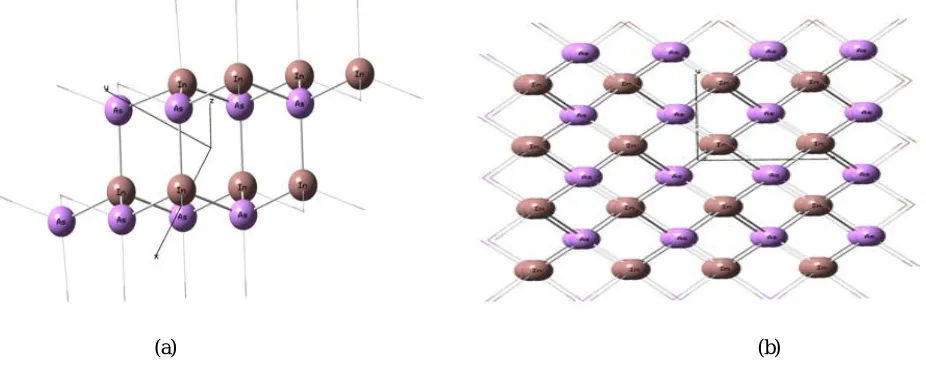
To optimize core structure only the lattice constant is needed to be obtimized , Fig.(1) shows the optimization geometry of lattice constant (a) in 16 and b) in 64 atoms core LUC respectively . Fig.(2,3) shows the total energy vs. lattice constant for core atoms 16,64 with minimum energy has been found at (0.58,0.57)nm respectively,All other optimization which are pick the minimum energy structure can drawn the following figures for the core part. Fig.(4) shows the energy gap with the variation of the number of core atoms. The 8 atom LUC energy gap is nearer to the value of 64 atom cor energy gap which is also the case between 16 atom and 54 atom core. Both 8 and 64 atom core cell are Bravais cubic multiples and both 16 and 54 atom core are primitive parallepipe cell multiples. Although this shape effect was found in previous literature [17,18,19]. Fig. (5,6) shows the cohesive energy and the total energy as a function of number of core atoms were both decrease as number of core atom increase. The cohesive energy is given by
Ecoh. = ET/n – EFree – E0 (7)
Where EFree is the free atom sp shell energy [20], the cohesive energy must be corrected to the zero-point motion of the nuclei [21], but in this work we neglect E0 due to its small rate of correction compared with the total energy value. Figure (5) shows the cohesive energy as a function of number of core atoms. The cohesive energy decreases with the increasing of core atoms.
The total energy as a function of number of core atom is shown in figure (6), the total energy decreases linearly as the number of core atoms increases [22]. Figure (7,8) shows the density of states as function of orbital energy. The degeneracty of states has maximum (5 and 35) for (16 and 64) atoms respectively. The high degenerate state seen in the core reflects the high symmetry equal bond lengths and angles in the prefect structure.
(a) (b)
Volume 2, Issue 3, March 2013
Page 214
Figure 2 Total energy Vs lattice constant for 16 atom of InAs core nanocrystal
Figure 3 Total energy Vs lattice constant for 64 atom core InAs nanocrystal
Figure 4 shows the energy gap as a function of the No. of core atoms
Figure 5 Cohesive energy versus No. of core of InAs nancrystal
Volume 2, Issue 3, March 2013
Page 215
Figure 7 The density of states for InAs nanocrystal of 16 atoms LUC where Eg = 2.55eV
Figure 8 The density of states for InAs nanocrystal of 64 atoms LUC , where Eg=2.43eV
4.
C
ONCLUSIONThe total energy at equilibrium lattice constant and cohesive energy are a comparable with the experimental result [23] with percentage error 4% in the determined lattice constant. The sesult shows that the total energy and cohesive energy decreases with the increasing of core atoms. Also the degenerate of states increases with the number of core atoms.
R
EFERENCES[1] D. E. Aspnes and A. A. Studna, “Dielectric functions and optical parameters of Si, Ge, GaP, GaAs, GaSb, InP, InAs, and InSb from 1.5 to 6.0 eV”, Pyhs. Rev. B (27), pp. 985, 1983.
[2] B. R. Bennett and R. A. Sorref. “Electrorefraction and electroabsorption in InP, GaAs. GaSb, nad InSb, ” IEEE J. Quantum Electron. (23), pp. 2159, 1987.
[3] M. Razeghi, Nature (London) 369, 631, 1994.
[4] J. R. Chelikowsky and M. L. Cohen,“Nonlocal pseudopotential calculations for the electronic structure of eleven diamond and zinc-blende semicon- ductors” Phys. Rev. B (14), pp. 556, 1976.
[5] D. J. Chadi, “Localized Defects in Semiconductors”, Pys. Rev. B (16), pp. 790, 1977. [6] L. Gorczca, N. E.Christensen, and M. Alouani, Pyhs. Rev. B (39), pp. 7705, 1989.
[7] K. J. Chang, S. Froyen, and M. L. Cohen, “Pressure coefficients of band gaps in semiconductors ”, Solid State Commun. (50), pp. 105, 1984.
[8] Frank Grosse, William Barvosa , Jenna Zinck, Matthew Wheeler, and Mark F. Gyure, “Arsenic flux dependence of island nucleation on InAs(001),” Phys. Rev let. (89), No. 11, pp. 116102, 2002.
[9] D. L. Huffaker, G. Park, Z. Zou, O. B. Shchekin, and D. G. Deppe, “1-3 μmroom-temperature GaAs-based quantum-dot laser ” Appl. Phys. Lett. (73), pp. 2564, 1998.
[10] S. Dommers, V. V. Temnov, U. Woggon, J. Gomis, J. Martinez-Pastor, M. Laemmlin, and D. Bimberg, Appl. Phys. Let., (90), pp. 3350, 2007.
[11] M. P. Lumb, P. N. stavrinou, E. M. Clarke, R. Murray, C. G. Leburn, C. Jappy, and W. Sibbett, “Dispersionless saturable absorber mirrors with large modulation depths and low saturation fluencies, ”Appl. Phys. B (97), pp. 53, 2009.
Volume 2, Issue 3, March 2013
Page 216
[13] W. Kohn, L. J. Sham, “Self-Consistent Equations Including Exchange and Correlation Effects”, Phys. Rev.(140), pp. A1133, 1965.
[14] N. M. Harrison, “ An Introduction to density functional theory”, John Wiley and sons, Inc.
[15] Evareslov R., Petrashen M. Lodovskaya E.: “the translational symmetry in the molecular models of olids,” Pys. Status Solidi b, (68), pp. 453, 1975.
[16] M.I. Frisch , G.W. Trucks , H.B. Schlegel etal Gaussian Revision B.01 , Gaussian Inc. piltsburgh , PA, 2003. [17] M. A. Abdulsattar. “Ab initio large unit cell calculations of the electronic structure of diamond nanocrystals,”
Solid State Sci. (13), pp.843, 2011.
[18] N. H. Aysa, M. A. Abdulsattar and A. M. Abdul-Lettif, “Electronic Structure of Germanium Nanocrystals Core and (001)-(1 × 1) Oxidised Surface,” Micro & Nano Letters, (6), No. 3, pp. 137, 2011.
[19] M.A. Abdulsattar , “Mesos-copic Fluctuations of Electronic Structure Properties of Boron Phosphide Nano-crystals,” Electronic Materials tters, Vol. 6, No. 3, pp 97-101 (2010).
[20] C. Allen, Astrophysical quantities, Athlone, London, 1976.
[21] W. Lambrechht and O. Anderson, Phys. Rev. B (34), pp. 2439, 1986.