overlay spectrum sharing
.
White Rose Research Online URL for this paper:
http://eprints.whiterose.ac.uk/81399/
Version: Accepted Version
Article:
Khoshkholgh, MG, Navaie, K and Yanikomeroglu, H (2014) Optimal design of the
spectrum sensing parameters in the overlay spectrum sharing. IEEE Transactions on
Mobile Computing, 13 (9). 2071 - 2095. ISSN 1536-1233
https://doi.org/10.1109/TMC.2013.83
[email protected] https://eprints.whiterose.ac.uk/
Reuse
Unless indicated otherwise, fulltext items are protected by copyright with all rights reserved. The copyright exception in section 29 of the Copyright, Designs and Patents Act 1988 allows the making of a single copy solely for the purpose of non-commercial research or private study within the limits of fair dealing. The publisher or other rights-holder may allow further reproduction and re-use of this version - refer to the White Rose Research Online record for this item. Where records identify the publisher as the copyright holder, users can verify any specific terms of use on the publisher’s website.
Takedown
If you consider content in White Rose Research Online to be in breach of UK law, please notify us by
Optimal Design of the Spectrum Sensing Parameters
in the Overlay Spectrum Sharing
Mohammad G. Khoshkholgh, Keivan Navaie,
Senior Member, IEEE
and Halim Yanikomeroglu,
Senior Member, IEEE
Abstract—In this paper, a novel approach is proposed to obtain the optimal operating point of spectrum sensing in overlay spectrum sharing systems. The objective is to maximize the secondary service achievable capacity subject to the primary service collision probability as well as the other system and service constraints. In the related literature the miss detection probability, as the main reason of collision, is often considered to model the impact of spectrum sensing on the achievable ergodic capacity of the secondary service. In this paper however we directly consider the collision probability constraint in finding the optimal ergodic capacity instead of considering the miss detection probability. We then propose a framework in which other opportunities which lie in the wireless channel fluctuation and power allocation are also extracted in favor of achieved capacity. In addition to the conventional One-Shot (O-S) scheme, we also propose four novel approaches to solve the optimization problem:Modified-One-Shot (M-O-S) scheme,Multi-Shot (M-S) scheme,Conservative-Modified-One-Shot (C-O-S) scheme, andRestricted-Modified-One-Shot (R-O-S) scheme. Our studies show that the proposed formulation results in a higher secondary service capacity even when compared to the cases with very low miss detection probability. In the proposed schemes in this paper, the main decision parameter is the average (over fading) received interference at the secondary service receiver due to the primary service transmission,I, which can be simply measurable in the secondary transmitter. Extensive numerical studies are conducted to investigate various system aspects. Our studies further suggest that for very low, moderate, and very high values ofI, the proper schemes are C-O-S, M-S, and M-O-S, respectively.
Index Terms—Ergodic capacity, inaccurate spectrum sensing, overlay spectrum access, ROC, spectrum sharing.
F
1
I
NTRODUCTIONI
N spectrum sharing, the secondary service, opportunisti-cally detects and uses under-utilized parts of the primary service’s spectrum [1]. The under-utilized spectrum is referred to as spectrum holes or white spaces. The under-utilized portions of the spectrum in a specific time and location can be considered for secondary service access [2].The secondary service may access to the under utilized spectrum adopting a variety of access strategies which are gen-erally categorized intooverlay,underlayand combined overlay underlay spectrum sharing, see, e.g., [3], [4]. In this paper, we focus on the overlay spectrum sharing. The performance of the overlay spectrum sharing is closely related to the sensing mechanism for detecting and monitoring the white spaces [5]. The spectrum sensing evaluates the spectrum status asidleor
busy. The secondary service then starts/continues transmission in the idle states, and stops in the busy states.
Various spectrum sensing techniques are proposed in the literature (see, e.g., [5] and [6]). Among them here we focus on the spectrum sensing techniques based on energy detectors. However, the presented results in this paper can simply be extended to the other sensing techniques. Energy detector based spectrum sensing is the most popular technique due to its implementation simplicity, see, e.g., [7].
In practice, spectrum sensing is not always perfect and accurate. The performance of spectrum sensing is usually modelled through the following two parameter: false alarm
Manuscript received May 30, 2011, revised July 19, 2012, February 6, 2013, and May 18, 2013. M. G. Khoshkholgh is with Simula School of Research and Innovation, Oslo, Norway. H. Yanikomeroglu is with the Department of Systems and Computer Engineering, Carleton University, Ottawa, ON, Canada. K. Navaie is with the School of Electronic and Electrical Engineering, University of Leeds, Leeds, UK LS2 9JT. This work was partly supported by the UK Engineering and Physical Sciences Research Council (EPSRC) under grant EP/K/022725/1.
andmiss detectionprobabilities. False alarm referred to the case
when the spectrum sensing evaluates the spectrum status as busy while it is actually idle. Similarly, miss detection referred to the case where the spectrum status evaluated as idle while it is in fact busy. In practice these two performance param-eters are related through the receiver operating characteristic (ROC) curve. The ROC is the fundamental characteristic of a spectrum sensing mechanism [3]. A false alarm, if happens, may result in a degrading spectral efficiency since the available idle spectrum is not utilized by the secondary service. A miss detection may also result in collision between the primary and secondary service transmissions since the spectrum status is mistakenly evaluated as idle. Collisions degrade the primary service Quality-of-Service (QoS). Therefore, the spectrum sens-ing parameters should be selected in such a way that the QoS requirements of the primary services are also satisfied.
In spectrum sharing, the main design objective is to maxi-mize the achievable capacity of the secondary service subject to the primary service QoS as well as other system and service constraints. In this paper, the QoS of the primary user is represented by a pair of parameters, (Q, ξ), where Q is the interference threshold constraint and ξ is the maximum allowable collision probability [3]. The interference threshold is the maximum allowed interference level imposed by the secondary service at the primary service receiver. Hereafter, we refer to(Q, ξ)as thecollision probability constraint. A collision is experienced if the secondary service transmission imposes an interference level higher thanQat the primary service receiver. In fact, the availability of the spectrum is subject to satisfying the collision probability constraint for the primary service.
by reducing the miss detection probability and keeping it below ξ, one can satisfy the collision probability constraint for the primary service, see, e.g., [8], [9], [10], and [11].
In the related literature, the aforementioned optimization problem is often solved in two disjoint steps. In the first step, spectrum sensing parameters are obtained, followed by the power allocation implementation in the next step. Spectrum sensing parameters are obtained based on the assumption made on the correspondence of the miss detection and the collision. This approach is widely utilized in the literature, e.g., [8], [11], [12]. We refer to this approach as the One-Shot (O-S)
scheme which is analyzed in our previous work [4].
In practice however, a miss detection does not always result in a collision. For instance, in cases where the imposed inter-ference due to the secondary transmission on a miss detected spectrum at the primary receiver is sufficiently low, a miss detection does not result in a collision. This can happen due to a deeply faded channel between the secondary transmitter and the primary receiver. This means that improving the sens-ing performance by reducsens-ing miss detection and false alarm probabilities does not necessarily result in higher achievable capacity. As a matter of fact, in addition to the spectrum sensing performance, experiencing collision in the primary receiver depends on the status of the channel fading between the secondary service transmitter and the primary service receiver as well as the secondary service power allocation. Failure to take into account the above facts can be considered as the main disadvantage of the O-S scheme.
To consider the impact of fading of the channel between the secondary service transmitter and the primary service receiver, and the secondary service power allocation, in this paper, we directly utilize the primary service collision probability constraint as a metric for spectrum availability. In other words, the spectrum is deemed available if the collision probability of the primary service is not increased due to the secondary ac-cess. Therefore, the collision probability provides a more com-prehensive perspective when compared to the miss detection probability. Considering the collision probability constraint, we expect a higher secondary service achievable capacity since we would be able to exploit wireless fading as well as the secondary service power allocation.
1.1 Contribution of The Paper
In this paper, we consider the collision probability constraint at the primary receiver as the spectrum availability criterion. The main design objective is to maximize achievable ergodic capacity of the secondary service subject to the primary service collision probability and other system and service constraints. Utilizing this optimization problem the optimal ROC operating point as well as the power allocation strategy are obtained. Since the aforementioned optimization problem is usually solved in the secondary service, we develop our formulation primarily based on the average (over fading) received interference in the secondary receiver originated from the primary network, which can be easily measured at the secondary service receiver.
Finding exact solution of the aforementioned optimization problem is rather complicated due to the probabilistic con-straint. Here we propose four different approaches to solve
the optimization problem: Modified-One-Shot (M-O-S) scheme,
Multi-Shot (M-S) scheme, Conservative-Modified-One-Shot
(C-O-S) scheme, andRestricted-Modified-One-Shot (R-O-S) scheme. The
main theme of the proposed schemes in this paper is to convert the collision probability constraint into a combination of the secondary service power allocation, and designing the spec-trum sensing parameters, i.e., the miss detection probability.
We then investigate the performance of the proposed schemes through numerical studies. It is seen that although the O-S scheme performs well for moderate values of the average (over fading) interference at the primary receiver, I, its corresponding achievable capacity is significantly degraded in cases whereIis either very low or very high. It is also seen that the proposed M-S scheme quickly converges and the M-O-S scheme overcomes the fast capacity decreasing slope which is seen in high values of I in the O-S scheme. The M-S, C-O-S, and R-O-S schemes also improve the secondary service capacity for small values of I. The C-O-S scheme suggests a peak power allocation constraint for the secondary service transmission power where it is adaptively changed through the collision probability constraint. In the contrary, the R-O-S provides an average secondary service transmission power constraint corresponding to the original collision probability constraint. In other words, our studies indicate the following rule of thumb for the appropriate scheme based on the value of
I: For very low, moderate and very highI, the proper schemes are C-O-S, M-S, and M-O-S, respectively.
1.2 Related Works
Capacity of the secondary service in overlay spectrum sharing has been widely studied, see, e.g., [9], [11], [13], [14], and [15]. In [9] an infrastructure based secondary service is considered where the base station gathers the sensing information and makes decision on the spectrum availability. However, they have assumed a fixed rate for each secondary user, i.e., the power allocation had been simply ignored. Furthermore, the achievable rate due to transmission over the miss detected spectrum has also been ignored. In this paper, we show that taking into account the power allocation as well as channel fading during the miss detection, improves the capacity per-formance. The improvement in capacity performance in cases with low received interferenceI, is rather significant.
Investigating the fundamental sensing-throughput tradeoff is the subject of [11] in which through an optimization problem the suitable sensing time for maximizing throughput of the secondary service is obtained. However, in [11] the wireless channel fading is not taken into account. Furthermore, in that paper the collision probability constraint is simply substituted with the miss detection constraint. Here, we consider channel fading through the collision probability constraint.
Sensing-based spectrum sharing was proposed in [13] and [15] for maximizing the ergodic capacity of the secondary service. In [13] and [15] a priori knowledge of the channel between the secondary service transmitter and the primary service receiver is assumed although it may not be easily applicable to the overlay strategy in practice.
miss detection constraint. However, this approach is partic-ularly designed for specific spectrum sensing parameters.
Note that there is a trend in both research community and industry to improve the accuracy of the spectrum sensing mechanisms (e.g., [5] and [6] and references therein). However, the results presented in this paper provide instances in which by adopting appropriate schemes, one can push the system performance far beyond a system with accurate spectrum sensing. In the other words, if the corresponding interference created due to inaccurate sensing at the primary receiver is tolerable, then allocating larger sensing time to improve the sensing accuracy may degrade the achievable secondary service capacity without providing higher level of protection for primary system QoS. In practice this might happen because of time varying nature of the wireless channel between the secondary transmitter and primary receiver (cross channel). Utilizing collision probability constraint, C-O-S scheme as proposed in this paper exploits such cases, thus improves the achievable system capacity far beyond a spectrum sharing system with accurate spectrum sensing.
Comparing and contrasting the Bayesian- and capacity-based spectrum sensing procedure are the subject of the study conducted in [10]. The main objective of [10] is to maximize a weighted sum ergodic capacity of the primary and secondary services to obtain the best sensing threshold level for spectrum sensing procedure. They also investigated the impact of the lo-cation information on the network performance. The obtained results indicates that capacity-based spectrum sensing is more appropriate due to the corresponding larger capacity perfor-mance. According to the results in [10], in this paper we also consider the capacity-based spectrum sensing, however our study focuses on the secondary service capacity. Furthermore, we are interested in understanding the impact of the collision probability constraint on the capacity of the secondary service.
1.3 Organization of the Paper
The rest of this paper is organized as follows. In Section 2, the general assumptions and the system model are presented. The spectrum sensing is the subject of Section 3. Impact of the spectrum sensing parameters on the ergodic capacity of the secondary service is considered in Section 4. In Section 4, we also present sub-optimal schemes to obtain the proper ROC operating point as well as the power allocation. In Section 5, we present the numerical studies. Finally, concluding remarks are presented in Section 6.
2
S
YSTEMM
ODELConsider a spectrum sharing system with a primary and a secondary transceiver denoted by Txp and Rxp, and, Txs and
Rxs, respectively (see, Fig. 1). The maximum Txs average
transmit power isPs. In each time instantn,gsp[n]and gss[n]
denote the instantaneous channel power gains from Txs to
Rxp, and Rxs, respectively. Similarly, we define gps[n] and
gpp[n] as the instantaneous channel power gains from Txp to
Rxs, and Rxp, respectively. Therefore, the received signals at
Rxsand Rxp are represented as
Ys[n] = √
gss[n]Xs[n]1s[n]+ √
gps[n]Xp[n]1p[n]+Zs[n], (1)
Yp[n] = √
gsp[n]Xs[n]1s[n]+ √
[image:4.612.373.538.54.181.2]gpp[n]Xp[n]1p[n]+Zp[n], (2)
Fig. 1. The schematic of the spectrum sharing system [4].
where Xs[n] and Xp[n] are the transmitted signals from Txs
and Txpat timen, respectively. Here, for the sake of simplicity,
we assume thatXp[n](Xs[n]) is always on and it represents the
actual transmitted signal of the primary (secondary) transmit-ter only in case that1p[n] = 1(1s[n] = 1). In (1) and (2), Zs[n]
and Zp[n] are additive white Gaussian noise at Rxs and Rxp
with variancesσ2
s, andσp2, respectively.
We further assume that σ2
s =N0B, where B is the
band-width of primary spectrum. In (1) and (2), 1s[n], and 1p[n]
are indicators which demonstrate the activity of the secondary and primary services in time instantn, respectively. Based on this notation, if 1p[n] = 1 (1p[n] = 0), the primary service is
active (inactive) or the spectrum is busy (idle). Equivalently,
if 1s[n] = 1 (1s[n] = 0), the secondary service is active
(inactive). However, in opportunistic spectrum access (OSA)
1s[n] = 1, if and only if 1p[n] = 0, otherwise, 1s[n] = 0. We
assume that {1p[n]}∞n=1 is a stationary and ergodic random
process. This on-off model has been successfully considered in the related literature, see, e.g., [16] and [4]. We also denote P{1p= 1}
∆
=pb, thusP{1p= 0}= 1−pb
∆
=pi.
Channel power gainsgss[n],gsp[n],gpp[n], andgps[n]are
as-sumed to be stationary and ergodic independent random pro-cesses with probability density (distribution) functionsfss(gss)
(Fss(gss)), fsp(gsp)(Fsp(gsp)),fpp(gpp)(Fpp(gpp)), and fps(gps)
(Fps(gps)), respectively. For brevity of expositions, hereafter,
the time indexnis dropped.
3
S
PECTRUMS
ENSINGIn overlay spectrum sharing, thespectrum sensingestimates the status of the spectrum, i.e., the value of1p. The spectrum status
is usually estimated based on the corresponding received power from the primary service at the sensors’ locations. In this paper, we focus on cases where the spectrum sensing is implemented at the secondary service receiver. This as-sumption suits the downlink communication. Note that, in the related literature authors usually assume that the sensing procedure is implemented either in the secondary transmitter or in both secondary transmitter and receiver, see, e.g., [5].
sensing in Txs is more appropriate for protecting primary
service against interference. For instance, consider a scenario in which Txs is close to Rxp but Rxs is far from Txp. In
such cases, if the only considered protection mechanism for the primary system is the spectrum sensing, then sensing at Rxs might result in an inaccurate sensing which may in
return compromise the QoS of the primary system. In our pro-posed model however, the location of sensing does not make a difference as we additionally satisfy collision probability constraint. This introduces a new degree of freedom by which we develop joint power allocation and spectrum sensing. Intu-itively, this approach is able to deal with an inaccurate sensing by opportunistic secondary service power allocation through exploiting the cross channel fluctuations. Interestingly, in this approach we only need fsp(gsp), and the instantaneous cross
channel power gains are not required. fsp(gsp) can be easily
obtained in many cases. Here we investigate this approach and show that using collision probability constraint enables us to provide robust primary service protection and achieve a higher capacity at the same time.
We further assume that energy detectors are utilized in the spectrum sensing. This approach is widely adopted in the related literature, see, e.g. [9] and references therein.
The performance of the spectrum sensing is evaluated by two important parameters, probability of false alarm, ϵ, and probability of miss detection, δ [3]. A false alarm is experi-enced in cases where the spectrum is actually idle, but the spectrum sensing mistakenly assesses the spectrum status as busy; therefore,P{1s= 0|1p= 0}
∆
=ϵ. Miss detection occurs in cases where the spectrum is busy and it is mistakenly assessed as idle; therefore,P{1s= 1|1p= 1}
∆
=δ.
In practice, however, the false alarm and miss detection probabilities are related to each other through the ROC curve, which is a fundamental attribute of each spectrum sensing procedure [3]. The ROC curve usually presents the detection probability, i.e.,1−δ, versusϵ. In other words, for a given value ofδ, utilizing ROC curve, the value ofϵis uniquely obtained. In case of miss detection, the transmission made by Txs
imposes unexpected interference at the primary receiver Rxp
(see, Fig. 1). Such unexpected interference may result in QoS degradation in the primary service. Here, the primary service QoS constraint is represented by (Q, ξ), whereQ is the max-imum tolerable interference at Rxp, i.e., interference threshold,
andξ is the maximum tolerable probability of collision at the primary service receiver, i.e., the maximum allowable collision
probability. A collision is experienced by the primary receiver, if
its received interference exceedsQ. Hereafter,(Q, ξ)is referred to as thecollision probability constraint.
Assume that the spectrum sensing is conducted in a time slotted fashion with frame duration ofT. The spectrum sens-ing is then performed within the observation interval with duration 0 ≤ τ ≪ T. Therefore, the secondary service can make transmission, if it is allowed, during the rest of the frame, i.e., T−τ seconds.
Assume that I is the average (over fading) received inter-ference at the Rxs by the primary service transmission, i.e.,
I=∆Egp[gpsPp]. The effective interference for spectrum sensing
is in fact equal to the product of I and the probability of
sensing the channel while it is in busy state
Isense = P{1p= 1}I=pbI. (3)
Generally, the ROC curve is presented by
1−δ=ROC(ϵ, τ, I), whereROC(., τ, I)returns the detection probability based on the false alarm probability for given values of τ and I. For instance, in energy detector based spectrum sensing, it is shown that [13]:
ROC(ϵ, τ, I) =Q ((
Q−1(ϵ)
√
τ ωs/2π−INsense0B ) √
τ ωs/2π Isense
N0B + 1
)
,
where ωs/2π is the sampling rate and
Q(x)= 1∆ /√2π
∞ ∫
x
e−t2/2
dt1.
Remark 1:Using ROC(ϵ, τ, I)we can obtainτ as
τ =2π
ωs
Isense
N0B Q
−1(1−δ)
Q−1(1−δ)− Q−1(ϵ)
√ Isense
N0B +1
2
.
Here we assume thatτ is smaller than coherence time of the channel. In the cases where the τ is required to be larger than the channel coherence time, the sensing output is getting inaccurate. Note that in this paper we present methods in which the impact of spectrum sensing inaccuracy on the pri-mary system performance can be managed in an optimization framework by adjusting the power allocation in the secondary service. The cost, of course, would be a decrease in the system throughput, see Section 4.
It is worth mentioning that given a bound on the miss detection probability, i.e., miss detection probability constraint,
ζ, the false alarm probability is obtained using ROC curve. Usually it is assumed that the miss detection probability constraint is equivalent to the collision probability constraint,
ξ. However, these two constraints are conceptually different. In fact, miss detection probability is a physical layer param-eter which is evaluated at Rxs; however, collision probability
is evaluated at Rxp and depends on the secondary service
resource allocation policies, e.g., power allocation.
Our treatment of the subject is to consider a combination of these two constraints in an optimization problem. Specifically, here we consider maximizing ergodic capacity of the sec-ondary service as the optimization objective to bridge between the miss detection and collision probability constraints.
The secondary service average channel utilization factor, U{1s= 1}, is obtained as
U{1s= 1} =
T−τ
T P{1p= 1}P{1s= 1|1p= 1}
+ T−τ
T P{1p= 0}P{1s= 1|1p= 0}
= T−τ
T ((1−ϵ)pi+δpb)
∆
=pi,δ. (4)
Similarly, one can show
U{1s= 0} =
τ T +
T−τ
T (ϵpi+ (1−δ)pb).
In the following, we investigate the impact of the miss de-tection and false alarm probabilities on the secondary service achievable capacity.
4
S
ECONDARYS
ERVICEA
CHIEVABLEC
APACITYThe capacity of the secondary service is
Cs(pi) =
T−τ
T (1−ϵ)piBEg
[ log
(
1 + gssPs
N0B
)]
+T−τ
T δpbBEg
[
log (
1 + gssPs
N0B+TT−τδpbgpsPp )]
=T−τ
T BEg
[
log ( (
1 + gssPs
N0B+TT−τδpbgpsPp )δpb
×
(
1 + gssPs
N0B
)(1−ϵ)pi)]
, (5)
where g = (∆ gss, gsp | {z }
gs
, gps, gpp | {z }
gp
), and Ex represents the
expecta-tion with respect to the random variable x. Here, Ps is the
transmission power of Txs which is generally a function ofg.
Similarly,Pp is the transmission power of Txp. A lower bound
on the above expression is
Cs(pi)
≥ TT−τBEg
[
log (
1 + gssPs
N0B+TT−τδpbgpsPp
)(1−ϵ)pi
×
(
1 + gssPs
N0B+TT−τδpbgpsPp )δpb]
= T−τ
T BEg
log (
1 + gssPs
N0B+T−TτδpbgpsPp
)(1−ϵ)pi+δpb
,
where utilizing (4), it can be further reduced to
Cs(pi)≥pi,δBEg
[
log (
1 + gssPs
N0B+TT−τδpbgpsPp )]
. (6)
In the spectrum sharing, the primary service adjusts its trans-mission power only based on its own channel power gain,gpp.
Note that fora≥0,b≥0, andx≥0,h(x) = log(1 + a
b+x)is a
convex function. Therefore, considering the independency of the channel power gains and employing Jensen’s inequality [17] onCs(pi)in (6), it is seen that
Cs(pi) ≥ Egs
[
pi,δBlog (
1 + gssPs
N0B+TT−τδpbI )]
, (7)
whereI=∆Egp[gpsPp].
The secondary service accesses to the spectrum using OSA. In practice the secondary service does not know the channel power gaingsp. Therefore, it is reasonable to assume that the
Txsallocates power only based on the channel power gaingss.
Thus,Cs(pi, I)is written as
Cs(pi, I)
∆
=Egss
[
pi,δBlog (
1 + gssPs
N0B+T−TτδpbI )]
. (8)
In this paper, our main objective is to maximizeCs(pi, I)2. Due
to the miss detected spectrum, the secondary service imposes interference at the Rxp, and consequently a collision incident
may occur. The collision probability is defined as
pcol = T−τ
T P{1s= 1|1p = 1}P{gspPs> Q}
= T−τ
T δpbP{gspPs> Q}. (9)
Here we show that actual primary system performance, indi-cated by the outage probability, is related to collision proba-bility. The primary service outage probability is
pout =P {
gppPp
N0B+TT−τδgspPs
< γ|1p= 1 }
1
= 1−e−γµppN0 B Pp E
gsse
−T−τ T δ
γµppgspPs Pp
2
= 1−e−
γµppN0B Pp
∫
t>0
P {
e−TT−τδ
γµppgspPs Pp > t
}
dt
= 1−e−
γµppN0B Pp
∫
0<t<1
P {
gspPs<
ln1t
T−τ
T δ
γµpp
Pp
}
dt
= 1−e−γµppN0 B Pp
+e−γµppN0 B Pp
∫
0<t<1
P {
gspPs>
ln1
t
T−τ
T δ
γµpp
Pp
}
dt
= 1−e−
γµppN0B Pp
3
+e−
γµppN0B Pp
∫
t∈Q−
P {
gspPs>
ln1t
T−τ
T δ
γµpp
Pp
}
dt
+e−γµppN0 B Pp
∫
t∈Q+
P {
gspPs>
ln1
t
T−τ
T δ
γµpp
Pp
}
dt,
where in (1) we assume that Pp is not a function of channel
power gainsgppandgsp, (2) we useEX[X] = ∫
t>0P(X > t)dt,
and in (3) we define set Q− as (0, e−
T−τ
T δµppQ], in which if t∈ Q− then Q≤
ln1
t T−τ
T δ γµpp
Pp
. We also define Q+ =Q− 3. Thus
2. This is due to the fact that obtaining Cs(pi) in (6), the value of gps is required. Estimatinggps however is far from practical; therefore, in this paper instead of maximizingCs(pi)we maximize its lower band which can be obtained based on obtainable parameters in a practical scenario. As it is also shown, using this approach, we end up providing practical algorithms and scenarios in this paper. Estimatinggpsis challenging mainly because of the fact that it requires a direct/indirect signaling between the primary and secondary systems which is not always possible in most practical cases as the two systems are usually considered to be able to act independently. An alternative would be adopting sophisticated signal processing techniques for blind channel estimation; however, the accuracy of such techniques is often an increasing function of the channel observation time. Thus an acceptable level of estimation accuracy may compromise the secondary service capacity due to longer required channel observation time.
3. In factQ−represents the time interval in which the received interference
ift∈ Q+there holdsQ > ln1
t T−τ
T δ γµpp
Pp
. Denoting∆ =e− γµppN0B
Pp ,
one can write
pout = 1−∆
+T−∆τ
T δpb
∫
t∈Q−
T −τ T δpbP
{
gspPs>
ln1
t
T−τ
T δ
γµpp
Pp
}
dt
+T−∆τ
T δpb
∫
t∈Q+
T−τ T δpbP
{
gspPs>
ln1t
T−τ
T δ
γµpp
Pp
}
dt
≤ 1−∆ + T−∆τ
T δpb
∫
t∈Q−
ξdt+ T−Bτ
T δpb
∫
t∈Q+
dt,
where we use the fact that for t∈ Q− we always have
T−τ T δpbP
{
gspPs>
ln1t
T−τ
T δ
γµpp
Pp
}
≤ξ,
and fort∈ Q+ there holds
T −τ T δpbP
{
gspPs>
ln1t
T−τ
T δ
γµpp
Pp
}
≤1.
Consequently,
pout ≤1−∆ + T−∆τ
T δpb
(
1−(1−ξ)e−TT−τδµppQ
)
. (10)
Equation (10) indicates that depending on the outage per-formance requirement of the primary service we can de-sign/obtain appropriate collision probability constraint,(Q, ξ). Note that the above outage probability upper bound increases with increasing collision probability constraint.
The primary service collision probability constraint, (Q, ξ), i.e., pcol ≤ξ sould be satisfied by the secondary service
con-sidering the secondary service power transmission constraint,
Ps. Therefore, the secondary service achievable capacity is
obtained using the following optimization problem:
ProblemO:
max Cs(pi, I), (11)
s.t. Egss[pi,δPs]≤Ps, (12)
T−τ
T δpbP{gspPs> Q} ≤ξ, (13) Ps≥0,0≤δ≤1. (14)
Remark 2: In the formulation provided above the
instan-taneous value of gsp is not required at the Txs; instead, the
assumption adopted is availability ofgspdistribution
informa-tion at the secondary service. In practice this informainforma-tion can be provided by empirical studies in the time of network design and does not require signaling between the two systems. This can be also obtained utilizing passive measurements such as kernel density de-convolution estimator [18]. Assume that Txs
frequently receives datar[n]ash[n]+z[n], whichz[n]is AWGN with known variance. The problem is to estimate the density of random variable hby measuringr. We then apply Kernel-based technique and suggest the following estimation
ˆ
f(x) = 1
nb
n ∑
j=1
K
(x
−r[j]
b
)
,
with a Kernel function K : R → R+ and a bandwidth
parameterb >0. The Fourier transform offˆ(x), is
ˆ
F(ω) = ∫
eixω 1 nb
n ∑
j=1
K
(x
−r[j]
b
)
dx= 1
n
n ∑
j=1
eir[j]ωK(bω),
whereK(ω)is Fourier transform of the Kernel function. Note
that Fˆ(ω) = ˆFh(ω)Z(ω), where Fˆh(ω) is Fourier transform
of the estimated pdf of random variable h. Applying the
inverse Fourier transform to Fˆh(ω) we can then show that
the suggested pdf for time instance nis
ˆ
fh[n](x) = 1 2π
∫
e−ixω 1 nZ(ω)
n ∑
j=1
eir[j]ωK(bω)dω
= n−1
n fˆ
[n−1]
h (x) +
1
n
1 2π
∫
e−ixω 1
Z(ω)e
ir[n]ωK(bω)dω.
Thus, in each time slot n we only need to appropriately
scale the estimated pdf in the previous time slot and add it up with new term derived from measuring r[n] on-the-fly. This technique can be used to estimate fsp(gsp) based on
the measured signal strength received from Rxp. Note that
in reality Rxp needs to transmit feedback signals to Txp
fre-quently, hence Txs can passively have access to noisy and/or
outdated version of gsp, assuming reciprocity. However, in
the overlay spectrum sharing scenarios the primary service activity may undermine the accuracy of the proposed method, as Txs only receives noise when the primary is not active. In
[19] a technique is proposed based on Markovian evolution of the spectrum occupancy joined with Bayes’s rule for correcting the estimated pdf. Coupling Kernel density de-convolution estimator with [19] it is then possible to incorporate spectrum sensing outcome in pdf estimation.
Using Problem O the power allocation in the secondary
service and the optimal value of δ are obtained so that the secondary service achievable capacity is maximized. Due to the probabilistic nature of constraint (13), obtaining the exact solutions of problem O is difficult. Furthermore, the above primal optimization problem might not be generally a convex optimization problem, thus various local subproblems can be obtained based on different approaches.
Problem O can be solved using a very simple scheme,
namely,One-Shot (O-S)scheme. In this approach, problemOis solved in two disjoint steps. In the first step, spectrum sensing parameters are obtained and then in the next step the power allocation is conducted. This scheme is widely used in the related literature, see, e.g., [8] and [11]. It is shown in Section 4.1 and Section 5 that although for moderate values ofIthe O-S scheme performs well, the achievable capacity is significantly degraded in cases whereI is either very low or very high.
To tackle the aforementioned issues, we propose four differ-ent approaches to solveO:Modified-One-Shot (M-O-S)scheme,
Multi-Shot (M-S)scheme,Conservative-Modified-One-Shot
(C-O-S) scheme, and Restricted-Modified-One-Shot (R-O-S) scheme. The main theme of the proposed approaches in this paper is to convert the collision probability constraint into a combination of the secondary service power allocation and the spectrum sensing parameter design, i.e., the miss detection probability.
Moreover, the M-S, C-O-S, and R-O-S schemes improve the secondary service capacity for small values of I. The M-S scheme solves problemOthrough an iterative fast convergent algorithm. To satisfy the collision probability constraint, the C-O-S scheme suggests a peak power allocation constraint for the secondary service transmission power which is adaptively adjusted based on the collision probability constraint. Instead of the peak power constraint, the R-O-S introduces a constraint on the average transmission power of the secondary service to satisfy the collision probability constraint. We elaborate on the above mentioned schemes in the following.
4.1 One-Shot (O-S) Scheme
In this paper, we consider One-Shot scheme as a benchmark. This scheme is presented in our previous study in [4]. In the following, the O-S scheme is briefly described for easy reference. In O-S scheme, similar to almost all spectrum sens-ing mechanism, the secondary service fixes the miss detection probability as δ = ξ. The false alarm probability is then obtained using the corresponding ROC curve [8], [11], and [4]. Then without considering the constraint in (13), the secondary service solves the following optimization problem:
ProblemOO−S:
max
Ps≥0
Egsspi,ξB
[
log (
1 + gssPs
N0B+T−TτξpbI )]
s.t. Egss[pi,ξPs]≤Ps.
In the above using (4) and the ROC curve, the value of pi,ξ
can be obtained as
pi,ξ =T−τ
T
((
1−ROC−1(1−ξ, τ, I))pi+ξpb),
where, for given τ and I, ϵ=ROC−1(1−δ, τ, I), and ROC−1(., ., .)is the inverse function of the ROC curve.
Utilizing the Lagrange multipliers approach the optimal power allocation of the secondary service is obtained as
P∗
s =
( 1
λ−
N0B+T−TτξpbI
gss
)+
, (15)
where (x)+ = max{x,0}, and parameter λ is the Lagrangian coefficient which is obtained from the following equation:
∫
gss∈Gss,ξ
( 1
λ−
N0B+T−TτξpbI
gss
)
fss(gss)dgss=
Ps
pi,ξ. (16)
In (16),Gss,ξ can be defined as
Gss,ξ= {
gss|gss≥λ (
N0B+
T−τ T ξpbI
)}
.
Substituting (15) into the objective function of optimization problem OO−S, the capacity of the secondary service is then
obtained as
CsO−S(pi, I)=pi,ξB ∫
gss∈Gss,ξ
log (
gss
λ(N0B+TT−τξpbI )
)
dFss(gss).
(17)
As it is seen in this approach, a simple solution based on water-filling is obtained and it is only required that the miss detection probability to be set equal toξ.
In the O-S scheme the secondary service has to adjust the actual miss detection probability so that it remains equal to ξ. The first issue arises for large enough values of the received interference,I; because, in the case of miss detection, a significantly high interference level is imposed at the Rxs
during the secondary service transmission period. As a result, referring to (17) we expect that for large enough values of the received interference, the achieved capacity will be signif-icantly decreased. Indeed, this expectation is verified through the numerical results in Section 5. To tackle this drawback, we propose M-O-S approach.
The second issue with the respect to the O-S scheme is observed in cases where I is very small. In such cases, the spectrum sensing procedure restricts the secondary service accessability into a fraction ofpi,ξof the whole available frame.
Moreover, during the miss detection state, Rxs experiences a
very small interference I; therefore, it might be reasonable to increase the access time of the secondary service. This opportunity is in fact ignored in the O-S scheme. It must be noted that, the Rxp is able to tolerate a collision probability
of ξ which may enable the secondary service to increase its access time. For instance, in cases where the wireless channel between the Txs and the Rxp experiences a deep fade, the
secondary service is able to access the spectrum without severely degrading the primary QoS. To exploit this issue, we propose three novel schemes: M-S, C-O-S, and R-O-S.
4.2 Modified-One-Shot (M-O-S) Scheme
In O-S scheme, the secondary service simply sets the miss de-tection probability equal to the collision probability constraint. As it is also mentioned in the above, this is the main cause of the performance degradation, especially in cases where I is high. Instead of this, one can choose the best miss detection probability that maximizes the obtained achievable capacity subject to the collision probability constraint. For this, we first maximize the secondary service achievable capacity subject to the transmission power constraint for a given miss detection probability. Then, the best miss detection probability which maximizes the obtained achievable capacity is chosen, in such a way that the collision probability constraint is satisfied. We refer to this scheme as Modified-One-Shot Scheme (M-O-S) scheme. We elaborate on this scheme in the following.
In this scheme, we setδ=δ0≤1. The optimal transmission
power of the secondary service is then obtained similar to (15) as follows:
Ps0= (
1
λ0 −
N0B+T−Tτδ0pbI
gss
)+
, (18)
whereλ0 is obtained from
∫
gss∈Gss,δ0
( 1
λ0 −
N0B+T−Tτδ0pbI
gss
)
fss(gss)dgss=
Ps
pi,δ0
, (19)
andGss,δ0 is defined as
Gss,δ0
∆
= {
gss|gss≥λ0
(
N0B+
T−τ T δ0pbI
)}
Consequently, the achievable capacity of the secondary service is obtained similar to (17) as
Cs(pi, I)=pi,δ0B ∫
gss∈Gss,δ0
log (
gss
λ(N0B+T−Tτδ0pbI )
)
dFss(gss).
(21) For given values of pi and I, Cs(pi, I) can adopt different
values when δ0 is changed. Here our objective is to find
the optimal miss detection probability δ∗ which maximizes
Cs(pi, I). In cases where Cs(pi, I) is concave, the optimal
miss detection probability can be simply obtained by taking derivation. In cases where it is not concave, numerical search methods such as bisection search can be employed to find the optimal miss detection probability. The obtained optimal miss detection probability is acceptable if and only ifδ∗
≤ξ. In cases whereδ∗ is larger thanξ, in the M-O-S scheme we simply set
δ∗=ξ. This can be formulated as
δ∗= min
{
ξ,max
δ0
Cs(pi, I) }
.
The corresponding obtained achievable capacity is denoted by CM−O−S
s (pi, I) = Cs(pi, I)|δ0=δ∗. Note that, in this case
CO−S
s (pi, I) ≤ CsM−O−S(pi, I). In fact, for small values of I
at Rxs, M-O-S scheme reduces to O-S scheme since δ∗ =
ξ. However, for large enough values of I, we have δ∗ = maxδ0Cs(pi, I) < ξ; therefore, δ
∗p
bI < ξpbI which results in
CO−S
s (pi, I)< CsM−O−S(pi, I).
4.3 Multi-Shot (M-S) Scheme
As it was mentioned, we expect that a deterministic approx-imation of the probabilistic constraint in (13) may result in a lower than optimal secondary service achievable capacity. In the following, we present a Multi-Shot (M-S) scheme to find a suboptimal solution of the problemO. In this scheme, instead of replacing the constraint in (13), we in an appropriate way check its validity using the proposed scheme. The steps of the M-S scheme are presented in the following.
1) We setδ=δ0,0≤δ0≤1, thusϵ0=ROC−1(1−δ0, τ, I).
2) The allocated power is set as
P0
s =
( 1
λ0 −
N0B+TT−τδ0pbI
gss
)+
, (22)
where λ0 is obtained from (19). 3)The collision probability
corresponding to the miss detection probabilityδ0, i.e.,Pcol,δ0,
is then obtained as
Pcol,δ0 =
T−τ T δ0pb×
∫
gss∈Gss,δ0
¯
Fsp
Q
1
λ0 −
N0B+T−Tτδ0pbI
gss
dFss(gss). (23)
For a predefined error ε, if |Pcol,δ0 −ξ| < ε, then δ0 is a
solution for the miss detection probability and the algorithm
ends; otherwise,δ¯is obtained fromPcol,δ0=ξ, i.e., the collision
probability constraint is satisfied4.
4)δ0= ¯δand the algorithm is repeated from step 2 onwards.
Through the numerical results in Section 5, it is seen that the presented algorithm quickly converges to a fixed value miss detection probability which we callsuitable miss-detection.
In the M-S scheme, we iteratively check the collision prob-ability constraint in finding the solutions (step 3). Another approach to consider the collision probability constraint is to obtain an equivalent power allocation constraint which, if holds, results in the collision probability constraint being sat-isfied. Based on this approach, in the following subsections we propose C-O-S and R-O-S schemes. Furthermore, as it will be seen when compared to the M-S Scheme, the most important advantages of C-O-S and R-O-S are that the corresponding optimal5 power allocation is obtained and then based on that the appropriate miss detection probability is calculated. We also expect that C-O-S and R-O-S schemes outperform O-S and M-O-S for some particular system parameters. This is because in C-O-S and R-O-S, the collision probability constraint is integrated into the power allocation which enables us to exploit certain fading conditions as discussed earlier.
4.4 Conservative-Modified-One-Shot (C-O-S) Scheme
Here we propose a new scheme based on a conservative interpretation of the collision probability constraint. Further-more, the proposed interpretation of the collision probability constraint converts the generally non-convex collision prob-ability constraint into a convex constraint which results in a convex optimization problem. The proper ROC point is then obtained using the new optimization problem with the convex constraint utilizing the M-O-S scheme. In the following, we present the details of the C-O-S scheme.
Assume that the miss detection probability is fixed, i.e.,
δ=δ0≤1. We also note that due to feasibility of the power
allocation strategy, TT−τδ0ξpb ≤ 1. The collision probability constraint (13) is
pcol= T−τ
T δ0pbEgss
[ P
{
gsp> Q
Ps|
gss }]
. (24)
Instead of evaluating the above constraint, we consider the following constraint on the collision probability
P {
gsp>
Q Ps
}
≤ T
T−τ ξ δ0pb
, ∀gss, (25)
in which instead of the average, each instance of the collision probability for a given value ofgss must satisfy the collision
probability constraint. As it is seen, here instead of evaluating the collision probability constraint, a conservative version of
4. In fact the collision probability constraint represents the “available re-source” for the secondary service. In the other words, the larger the collision probability constraint, the higher could be the secondary system transmission power without compromising QoS in the primary system. A higher secondary service transmit power also results in a higher achievable secondary service capacity. Therefore, as it is always done in resource allocation problems, to maximize the objective function the whole available resource is utilized. It means that in this particular case the power is allocated so that the actual collision probability becomes equal to the maximum tolerable collision probability in the primary system.
this constraint is taken to account. Therefore, (17) is equiva-lently reduced to
Fsp (
Q Ps
)
≥ 1− T
T−τ ξ δ0pb
, ∀gss. (26)
Since δ0 is set so that TT−τδ0ξpb ≤ 1, the right hand side
of (26) always adopts positive values. We also note that the probability distribution function is a monotonically increasing function, therefore (26) is equivalent to
Q Ps ≥
F−1
sp (
1− T
T −τ ξ δ0pb
)
, ∀gss,
where x = F−1
sp (y) is the reverse function of the Probability
Distribution Function y = Fsp(x). As a result, one may
interpret the collision probability constraint as a bound on the instantaneous transmission power of the secondary service as the following
Ps≤
Q
Fsp−1 (
1−TT−τ ξ δ0pb
) =∆Q(ξ), ∀gss. (27)
The obtained constraint in (27) is in fact a peak power con-straint which is a function of(Q, ξ). The optimization problem O is then reduced to
ProblemO˜0:
max
Ps≥0
Egss
[
pi,δ0Blog (
1 + gssPs
N0B+TT−τδ0pbI )]
,
s.t. Egss[pi,δ0Ps]≤Ps,
Ps≤Q(ξ), ∀gss,
which is a convex optimization problem. Using the obtained results in [20], the optimal power allocation strategy is
Ps0=
0 if gss∈G¯ss,δ0,
1
λ0 −
N0B+TT−τδ0pbI
gss if gss∈ Gss,δ0
∩ ˙
Gss,δ0,
Q(ξ) otherwise,
(28)
whereGss,δ0 is defined similar to (20), and G˙ss,δ0 is
˙
Gss,δ0 = {
gss|gss≤ λ0
1−λ0Q(ξ)
(
N0B+T−τ
T δ0pbI
)}
.
Here, G¯ss,δ0 represents the corresponding complementary set
toGss,δ0.
It is worth mentioning that only in cases where λ0 < Q1(ξ)
the power allocation strategy (28) is applicable; In other cases, for all fading realizations, P0
s = 0. This may result in the
restriction of the achievable capacity of the secondary service for a specific set of system parameters.
The Lagrangian multiplier, λ0, is obtained solving the
fol-lowing equation:
∫
gss∈Gss,δ0
∩G˙ ss,δ0
( 1
λ0 −
N0B+TT−τδ0pbI
gss
)
dFss(gss)
+Q(ξ)P{G¯˙ss,δ0 }
= Ps
pi,δ0
. (29)
Consequently, the achievable capacity of the secondary service is obtained substituting the obtained allocated powerP0
s into
the objective functionO˜0 as
Cs(pi, I) = pi,δ0B ∫
gss∈G¯˙ss,δ0 log
(
1 + Q(ξ)gss
N0B+T−Tτδ0pbI )
+pi,δ0B ∫
gss∈Gss,δ0
∩G˙ ss,δ0
log (
gss
λ(N0B+T−Tτδ0pbI) )
dFss(gss).
Now, similar to the proposed approach in Section 4.2 our objective is to find the optimal miss detection probability δ∗
which maximizes Cs(pi, I). The obtained achievable capacity
is denoted byCC−O−S
s (pi, I).
4.5 Restricted-Modified-One-Shot (R-O-S) Scheme
Here we propose another scheme which interprets the collision probability constraint as a familiar secondary service transmis-sion power constraint. Here we develop this scheme for the case of Rayleigh fading. Extending the results to other fading environments depends on the convexity of the probability distribution function of the channel power gain between Txs
and Rxp (for instance, the case of log-normal distribution
is presented in the following.). The details of the proposed scheme named as R-O-S scheme is presented in the following. Let the miss detection probability set as δ = δ0 ≤ 1.
Assume that the channel power gaingspis distributed through
an exponential distribution with mean 1/µsp. Therefore, the
collision probability constraint (13) is reduced to
Ess [
e−µspPsQ]
≤ TT −τ
ξ δ0pb
∆
= ˆξ. (30)
Our treatment of the subject is based on evaluating an upper bound on the left hand side of (30). Consider functionW(x) = exp(−ax), where x > 0 and a is a positive real number. It is
easy to verify that functionW(x)is concave forx > a2. Setting parameteraequal toµspQ, it is seen that forPs> µsp2Q,
Ess [
e−µspPsQ]
≤e−µspEssQ[Ps]. (31)
Consequently, an equivalent constraint to (30) is obtained through the following power allocation constraints
Ess[Ps] ≤ µspQ
ln(1ξˆ)
, (32)
Ps > µspQ
2 . (33)
Expression (32) suggests that, in this specific case the trans-mission power of the secondary service may be restricted more than physical constraint i.e., Ps. This is the fact that
we refer to this scheme as R-O-S. As a result, an equivalent optimization problem for allocating the transmission power of the secondary service regarding (32) and (33), can be obtained fromO as follows
ProblemOˇ0:
Cs(pi, I) = maxEgsspi,δ0B [
log (
1 + gssPs
N0B+T−Tτδ0pbI )]
,
s.t. Egss[Ps]≤min
{
Ps
pi,δ0
,µspQ
ln(1 ˆ
ξ)
}
,
Ps≥
µspQ
which is a convex optimization problem. It is easy to show that the optimal power allocation of Oˇ0 is
Ps0= {
0 ifgss ∈G¯ˆss,δ0
∪ ¯ˇ
Gss,δ0, pi,δ0
λ0 −
N0B+T−Tτδ0pbI
gss ifgss ∈
ˆ
Gss,δ0 ∩ ˇ
Gss,δ0,
(34)
where
ˆ
Gss,δ0 = {
gss|gss>
λ0
pi,δ0 (
N0B+
T −τ T δ0pbI
)}
,
ˇ
Gss,δ0 = {
gss|gss<
λ0
pi,δ0−
µspQλ0
2
(
N0B+
T−τ T δ0pbI
)}
.
Here a non-zero power is allocated to the secondary service based on (34) if the Lagrangian multiplierλ0 satisfies
λ0<
2pi,δ0
µspQ
,
otherwise no power is allocated for all fading realizations. The Lagrangian multiplier is obtained solving the following equation for λ0
∫
gss∈Gˆss,δ0
∩Gˇ ss,δ0
(
pi,δ0
λ0 −
N0B+TT−τδ0pbI
gss
)
dFss(gss)
= min {
Ps
pi,δ0
,µspQ
ln(1ξˆ) }
.
Substituting the optimal power allocation in (34) for the obtained Lagrangian multiplier into Cs(pi, I), the achievable
capacity of the secondary service for given miss detection probability is then obtained as
Cs(pi, I) = pi,δ0B ∫
gss∈Gˆss,δ0
∩Gˇ ss,δ0
log (
pi,δ0gss
λ0
(
N0B+TT−τδ0pbI )
)
dFss(gss).
In cases where Cs(pi, I) is concave, δ∗ can be simply
ob-tained by taking derivation. In cases where it is not concave, then numerical search methods such as bisection search can be adopted to findδ∗. The achieved capacity of the secondary
ser-vice utilizing R-O-S scheme, CR−O−S(p
i, I), is then obtained
by substitutingδ0 with δ∗ inCs(pi, I).
4.5.1 R-O-S Scheme for Log-Normal Distribution
Here, we investigate the impact of log-normal fading on the analysis in Section 4.5. Assume that channel power gains are drawn from a log-normal distribution. For log-normal random variable X with parameter(m, ν), the pdf is
fX(x) =
1
x√2πσ2e
−(log(x)−η)2
2σ2 1
x>0,
whereη andσare obtained through the following equations
η= log
( m2
√
υ+m2
)
, σ= √
log
( υ
1 +m2
)
.
TABLE 1 Simulation Parameters
Parameter Value
µss 10 dB
µsp 10 dB
Background noise power (N0B) 0.1Watt
Ps 1 Watt
ξ 0.2
T 1 sec
τ 0.1 sec
pb 0.7
pi 0.3
The collision probability constraint in (30) can be evaluated as
Ess
Q
ln(PQ
s
)
−ηsp
σsp
≤ T
T−τ ξ δ0pb
∆
= ˆξ. (35)
Note that, function Q(ln(
Q x)−ηsp
σsp
)
is a concave function for
x ≥ eηspQ+1. Thus, an upper bound for the left hand side of
(35) is
Q
ln(E Q
ss[Ps]
)
−ηsp
σsp
≤ξ,ˆ (36)
or,
ln (
Q
Ess[Ps] )
≥σspQ−1 (
ˆ
ξ)+ηsp. (37)
An equivalent constraint to collision probability constraint is obtained through the following power allocation constraints
Ess[Ps]≤ Q
eσspQ−1(ξˆ)+ηsp ,
Ps≥
eηsp+1 Q .
Following the same line of argument presented in Section 4.5, the corresponding optimal power allocation and appropriate miss detection probability are then obtained.
5
N
UMERICALR
ESULTSThe main objective of this section is to investigate which of the proposed schemes in Section 4 is/are the most suitable for different set of system parameters. The parameters considered in this section are presented in Table 1. For the numerical results we consider a Rayleigh fading channel. Therefore, the channel power gain between the Txs and Rxp (Rxs) is an
exponential random variable with mean value1/µsp (1/µss).
5.1 Convergence of the Multi-Shot Scheme
We investigate the convergence property of the M-S scheme. Here for different values of the imposed interference at the Rxs from the Txp, collision probability constraint, and the
0 5 10 15 0.04
0.06 0.08 0.1 0.12 0.14 0.16 0.18 0.2 0.22
Number of iterations
Collision Probability
ξ=0.05
ξ=0.1
ξ=0.15
ξ=0.2
Fig. 2. Convergence of M-S scheme: Impact of the collision probability constraint forI= 10W andQ= 0.1W.
0 2 4 6 8 10 12
0.2 0.3 0.4 0.5 0.6 0.7 0.8 0.9 1
Number of iterations
δ
ξ=0.2, I= 5, Q= 1 ξ=0.2, I= 50, Q= 5 ξ=0.2, I= 5, Q= 5 ξ=0.2, I= 1, Q= 5 ξ=0.2, I= 0.5, Q= 5
Fig. 3. Convergence of M-S scheme: Impact ofQandI.
5.1.1 Impact of the Collision Probability Constraint
As it is seen in Fig. 2, generally after 5 or 6 iterations the M-S scheme is stable and quickly converges to a fixed value. Notice that, the convergence is faster for smaller value of collision probability constraint. For small enoughξ, M-S and M-O-S schemes perform almost the same (see Fig. 8), thus the algorithm swiftly converges. However, large enoughξresults in broader search region for optimal miss detection probability which may result in a longer convergence time.
5.1.2 Impact ofQandI
Fig. 3 indicates that the proposed M-S scheme converges fast enough for different amounts of the interference threshold and received interference at Rxs. This illustration also shows that
for small enough values ofI, the secondary service manages to have access to the spectrum almost all the time, i.e., high miss detection probability. This is mainly due to the fact that the secondary service is not able to recognize between busy and idle spectrum.
0 2 4 6 8 10 12 14 16
0 0.1 0.2 0.3 0.4 0.5 0.6 0.7 0.8 0.9
Number of iterations
δ
ξ=0.05, I= 50, Q= 1, µss=10, µsp=0.1
ξ=0.05, I= 50, Q= 1, µss=10, µsp=1
[image:12.612.348.560.62.214.2]ξ=0.05, I= 50, Q= 1, µss=0.5, µsp=10
Fig. 4. Convergence of M-S scheme: Impact ofµssandµsp.
5.1.3 Impact of Channel Power Gains’ Mean Values
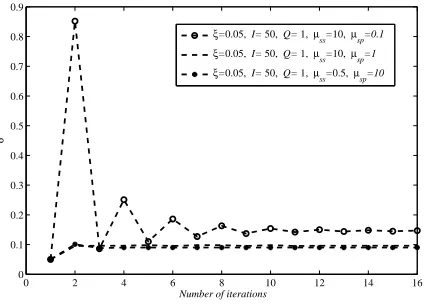
In Fig. 4 we study the impact of µss and µsp on the
conver-gence of the M-S scheme. As it can be seen, in this case again the scheme quickly converges, however, for small values ofµsp
the speed of convergence is decreased. Smaller µsp amounts
to stronger link between the Txsand Rxp which partly results
in equivalency between miss detection and collision proba-bilities. In this case, event P{gspPs > Q} happens with high
probability and does not affect collision probability.
5.2 Achievable Capacity of the Secondary Service
[image:12.612.52.272.64.249.2]5.2.1 Impact ofI
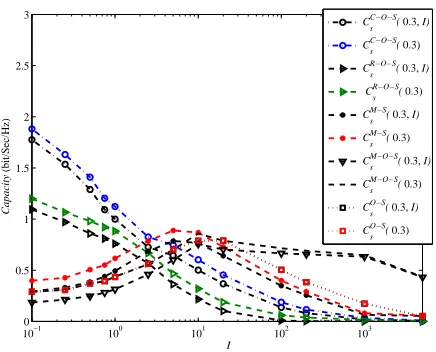
Fig. 5 indicates the achievable capacity of the secondary ser-vice in the case of O-S, M-O-S, M-S, C-O-S, and R-O-S schemes. Here we investigate the impact of the imposed interference at Rxsdue to the primary service transmissions, i.e.,I.
It is seen that the achievable capacity in the O-S has a maximum for moderate values of I. Indeed, for I ≈ 10 the spectrum sensing achieves its best performance, i.e., low false alarm probability. However, for small values of I, the sec-ondary service fails to take advantage of the actually accessible spectrum since the spectrum sensing performance is limited to
ξ. Therefore, although the imposed interference at the Rxs is
low, the secondary service is unable to access to the spectrum. For high enough values of I, O-S scheme cannot gain a reasonable performance. This is again due to the spectrum sensing. The secondary service designates the miss detection and set it equal to ξ; however, increasing I correspondingly increases the imposed interference through ξpbI thus the
achievable capacity is decreased.
[image:12.612.51.274.305.482.2]10−1 100 101 102 103 0
0.5 1 1.5 2 2.5 3
I
Capacity
(bit/Sec/Hz)
Ideal Case, pi= 1
CC−O−S s ( 0.3, I)
Ideal Case, p
i= 0.3
CR−O−S s ( 0.3, I)
CM−S s ( 0.3, I)
CM−O−S s ( 0.3, I)
[image:13.612.345.563.60.236.2]CO−S s ( 0.3, I)
Fig. 5. Secondary service achievable capacityvs.Ifor O-S, M-O-S, M-S, C-M-O-S, and R-O-S schemes, andξ= 0.05,Q=N0B.
O-S scheme. Fig. 5 also indicates that in the case of O-S, M-O-S and M-M-O-S schemes the achievable capacity of the secondary service never reaches the ideal case with p1 = 0.3, i.e., zero
miss detection and false alarm probabilities.
Surprisingly, it is also seen that in the case of C-O-S and R-O-S schemes, the achievable capacity of the secondary service outperforms the ideal case with pi = 0.3 for small enough
values of I. This is mainly due to the fact that, in low interference regime if the secondary service can appropriately access the busy part of the spectrum it can gain a meaningful performance. However, in the ideal case due to zero miss detection probability this opportunity is simply ignored. Note that both schemes cannot reach the ideal case of pi= 1.
It must be noted that C-O-S scheme outperforms R-O-S for all interference values. For moderate and high values ofI, the obtained achievable capacity in the case of C-O-S and R-O-S schemes approaches zero. This is mainly due to the inherent shortage of these schemes that is substituting actual collision probability constraint with transmit power constraint.
Based on the result presented it is concluded that the C-O-S fits for the cases with small level of interference. For moderate interference values the M-S is more appropriate. The M-O-S is also seen to outperform other schemes for high enough values of interference.
As mentioned before O maximizes Cs(pi, I) which is a
lower-bound on Cs(pi). In Fig. 6 we study the gap between
Cs(pi) and Cs(pi, I) versus I for different schemes. As it is
seen, there is gap which is getting very small for large values of I. Note that in obtaining Cs(pi, I) unlikeCs(pi), gps is not
used which makes the system much simpler.
5.2.2 Impact ofQ
Fig. 7 shows the impact of the interference threshold Q on the secondary service achievable capacity in the case of O-S, M-O-O-S, M-O-S, C-O-O-S, and R-O-S schemes. Here, we set
I = 10. It is known that, in such interference regime, the M-S scheme outperforms the others schemes. As it is seen, the obtained achievable capacity in the case of O-S and M-O-S schemes remain constant although the interference threshold
10−1 100 101 102 103
0 0.5 1 1.5 2 2.5 3
I
Capacity
(bit/Sec/Hz)
CC−O−S
s ( 0.3, I)
CC−O−S
s ( 0.3)
CR−O−S
s ( 0.3, I)
CR−O−S
s ( 0.3)
CM−S
s ( 0.3, I)
CM−S
s ( 0.3)
CM−O−S
s ( 0.3, I)
CM−O−S
s ( 0.3)
CO−S
s ( 0.3, I)
CO−S
s ( 0.3)
Fig. 6. Cs(pi, I)andCs(pi)vs.Ifor O-S, M-O-S, M-S, C-O-S,
and R-O-S schemes, andξ= 0.05,Q=N0B.
is changed. This is due to the fact that both schemes ignore the collision probability constraint.
It is also seen that the performance of the M-S scheme steadily increases as the interference threshold is increased. Furthermore, utilizing the M-S scheme, the obtained achiev-able capacity of the secondary service is almost superior comparing to the other schemes. Fig. 7 also indicates that the R-O-S scheme poorly performs in comparison with the other schemes. Considering the results of Fig. 5, we expect that for
I = 10 in the case of R-O-S scheme, the secondary service is not able to gain a proper achievable capacity. However, increasingQmakes the situation even worse. It is mainly due to the power allocation strategy in (34) in which power is not allocated to secondary service for all of the fading realizations. The obtained performance considering C-O-S scheme is higher than that of R-O-C in the case of Q <0.4. However, increasing Q beyond 0.45 tends the achievable capacity of the secondary service to zero considering the C-O-S scheme as the case. Surprisingly, for 0.05 < Q < 0.4 the achieved performance of the C-O-S scheme outperforms the O-S and M-O-S schemes.
Based on the observed results in Fig. 5, one can see that the M-S scheme achieves a higher capacity for high interference threshold. For small values of Q depending the interference regime, the M-S, C-O-S, and M-O-S schemes outperform each other for different values ofI. Since, in the practical systems usually the interference threshold Q is in the order of back-ground noise level, we can claim that if I is small enough, the C-O-S will be the appropriate scheme. For the case thatI
adopts a moderate value, the M-S is the suitable scheme, and finally in the high interference regime, the M-O-S is the most appropriate scheme.
5.2.3 Impact ofξ
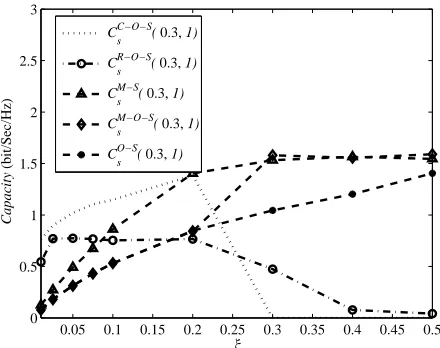
Fig. 8 demonstrates the achievable capacity of the secondary service versusξin the case of the O-S, M-O-S, M-S, C-O-S, and R-O-S schemes for a given imposed interferenceI= 1and the interference thresholdQ=N0B.
[image:13.612.59.271.62.250.2]![Fig. 1. The schematic of the spectrum sharing system [4].](https://thumb-us.123doks.com/thumbv2/123dok_us/7943034.195938/4.612.373.538.54.181/fig-schematic-spectrum-sharing.webp)