promoting access to White Rose research papers
White Rose Research Online [email protected]
Universities of Leeds, Sheffield and York
http://eprints.whiterose.ac.uk/
This is the Author's Accepted version of an article published in BMJ Open
White Rose Research Online URL for this paper:
http://eprints.whiterose.ac.uk/id/eprint/78049
Published article:
Pinkney, L, Nixon, J, Wilson, L, Coleman, S, McGinnis, E, Stubbs, N, Dealey, C, Nelson, A, Patterson, M and Keen, J (2014)Why do patients develop severe pressure ulcers? a retrospective case study. BMJ Open, 4 (1). e004303. ISSN 2044-6055
WHY DO PATIENTS DEVELOP SEVERE PRESSURE ULCERS?
A RETROSPECTIVE CASE STUDY
ABSTRACT
Background:
Severe pressure ulcers are important indicators of failures in the organisation and delivery of treatment and care. We have a good understanding of patient risk factors, but a poor understanding of the role played by the organisational context in their development. This study focuses on the ways in which the organisational context can influence the
development of severe pressure ulcers. Methods:
The study was undertaken in six sites in Yorkshire, England. A retrospective case study design was used. Data were collected from a range of sources, including interviews with individuals with severe pressure ulcers and staff, and clinical notes, and used to construct accounts of eight individuals who developed severe pressure ulcers. Sequential and iterative review, involving reviewers with different backgrounds, were used to validate the accounts and to identify explanations for the events observed.
Results:
Four accounts indicated that specific actions by clinicians contributed to the development of severe pressure ulcers. But seven of the eight accounts indicated that they developed in organisational contexts where, (i) clinicians failed to listen and respond to patients’ or carers’ observations about their risks or the quality of their treatment and care, (ii) clinicians failed to recognise and respond to clear signs that a patient had a pressure ulcer or was at risk of developing one and, (iii) services were not effectively co-ordinated.
Conclusions:
Article Summary
Strengths and limitations of this study
This study contributes to our understanding of a poorly understood process, the development of a severe pressure ulcer
Few previous studies have explicitly sought to discriminate between psychological and broader organisational explanations for adverse events in health care settings
The diversity of patients who develop severe pressure ulcers, and of the settings where they occur, raises a risk of sampling bias
INTRODUCTION
The European Pressure Ulcer Advisory Panel/ National Pressure Ulcer Advisory Panel (EPUAP/NPUAP) defines a pressure ulcer as, “localized injury to the skin and/or underlying tissue usually over a bony prominence, as a result of pressure, or pressure in combination with shear.” [1] Pressure ulcers are a significant source of pain and distress for the
individuals who develop them. [2] In recent years the importance of severe pressure ulcers as indicators of poor quality and safety of health services has been recognised. Category 2 ulcers or above, as rated on the EPUAP/NPUAP 1-4 scale, are classed as reportable incidents in official guidelines in the National Health Service (NHS) in England. [3] Category 3 and 4 ulcers (which involve injury deep into the skin, muscle or bone) are widely termed severe pressure ulcers, and have to be reported as serious untoward incidents. [4] Pressure ulcers are also one of four patient safety indicators in a new NHS monitoring tool. [5]
There are two distinct ways of thinking about patients’ risks of developing pressure ulcers. The first is based on the assumption that all PU risks are associated with patients’ health status or their behaviour. The implication is that clinicians should focus on identifying patients who are at risk, assess the nature and scale of their risks, and design clinical
interventions to reduce them. We have a good understanding of patient risk factors. [6] The second way of thinking starts from a different assumption, which is that the quality of treatment and care can also influence patients’ risks of developing pressure ulcers. Patients who are at risk are more likely to develop them in settings where quality of care is poor. The events at Mid Staffordshire NHS Foundation Trust, where at one point dozens of PUs were being reported every month, help to underline the significance of this point. [7]
We currently have a relatively poor understanding of the ways in which the wider
safety literature, which advances both psychological and sociological explanations for errors and adverse events [9].
METHODS
Severe pressure ulcers occur relatively rarely, and can develop in a wide range of settings, and it is not currently possible to predict who will develop them and who will not. [6] It was not therefore practical to study their development prospectively. If, for example, we had prospectively identified patients with category 2 ulcers, in order to evaluate differences between those that developed a category 3 or 4 ulcer and those that did not, our presence would have drawn attention to the significance of the pressure ulcers. It is likely to have prompted swift action by the local clinical team, and it seems reasonable to predict that few, or even none, of the category 2 pressure ulcers would have progressed to category 3 or 4. As a result, we would have biased our observations, possibly substantially, and could not have been confident that we had observed the whole development process, from the earliest signs and symptoms to the point where action was taken. It was, though, possible to reconstruct the events that lead to the development severe pressure ulcers
retrospectively. We undertook a retrospective case study, where severe pressure ulcers were end-points, and also indicators of adverse outcomes of treatment and care. A process tracing case study method was used, focusing on the experiences of eight individuals in Yorkshire, England. [10] Each account took, on average, four months to create, from the initial interview with an individual to the signing off of a detailed account of the
development of that individuals’ severe pressure ulcer.
Primary Data Collection
by members of the local tissue viability nurse teams. Consent to participate was obtained from patients, and where appropriate also from their main carers.
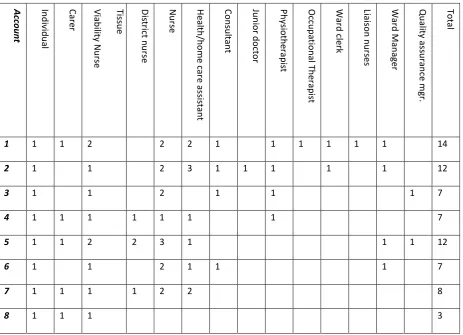
Data were collected by a field researcher with a non-clinical background from five sources, namely interviews with individuals who had developed a severe pressure ulcer (and where relevant also their main carers), interviews with clinical and other staff who had been involved in their care, clinical records, other documents relevant to the account such as critical incident reports, and relevant local policy documents, eg on assessment of risks of skin breakdown (Figure 1, Stage 1). Interviews were open-ended and in-depth, and are listed in Table 1. 70 interviews in total were conducted across the eight accounts. The site
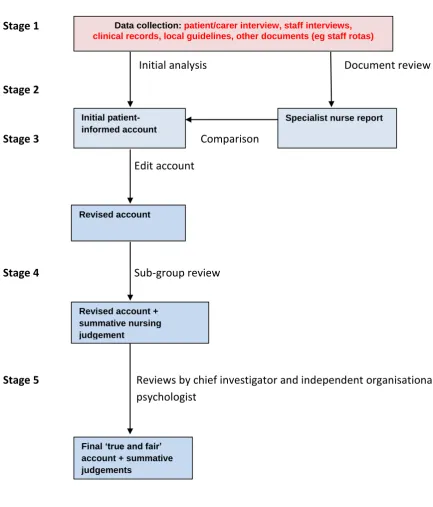
Figure 1: Analysis and Review of Individual Accounts
Stage 1
Initial analysis Document review
Stage 2
Stage 3 Comparison
Edit account
Stage 4 Sub-group review
Stage 5 Reviews by chief investigator and independent organisational psychologist
Data collection: patient/carer interview, staff interviews, clinical records, local guidelines, other documents (eg staff rotas)
Initial patient-informed account
Specialist nurse report
Revised account
Revised account + summative nursing judgement
Table 1: Number of People Interviewed by Account A cc o u n t In d iv id u al Care r Tis su e V iab ili ty N u rs e Dis trict n u rs e N u rs e H ealt h /h o m e ca re a ss is ta n t Con su lta n t Ju n ior d o cto r Ph ys iot h era p is t Occu p at ion al Th era p is t Wa rd cle rk Lia is o n n u rs e s Wa rd M an ager Qu alit y ass u ra n ce m gr. To ta l
1 1 1 2 2 2 1 1 1 1 1 1 14
2 1 1 2 3 1 1 1 1 1 12
3 1 1 2 1 1 1 7
4 1 1 1 1 1 1 1 7
5 1 1 2 2 3 1 1 1 12
6 1 1 2 1 1 1 7
7 1 1 1 1 2 2 8
8 1 1 1 3
Development of Retrospective Accounts
The initial accounts each had two components. The first consisted of verbatim passages of the patient/carer interview, which captured their explanations of the events that led to their severe pressure ulcers. Second, a Microsoft Access database was created for each account, and used to organise decisions and actions into a chronological sequence, with patient and carer data in one column, other interview data in a second and records and other
A tissue viability nurse specialist from the relevant study site undertook a parallel review, based solely on available patient records and on other available documentation, including local guidelines and critical incident reports (ie not including the patient/carer interview). The method followed the guidance for reviews of critical incidents in the NHS in England. The nurse wrote a report, identifying key decisions and actions in chronological order, including departures from local guidelines. The field researcher and tissue viability nurse specialist then met and compared their accounts, identifying consistencies and
inconsistencies, eg actions that the nurse judged as important, that were not included in the initial patient-driven account. Timelines were revised in the light of additional facts or insights generated (Stage 3).
Refinement of the Accounts
The subsequent stages of the analysis were designed to minimise some of the risks of bias known to be associated with retrospective analysis, notably hindsight bias, through review of each account by researchers with different backgrounds. The initial summaries of each account were reviewed by a sub-group of nursing members of the research team; one independent hospital-based and one independent community-based tissue viability nurse specialist, and one of the Co-Chief Investigators (Stage 4).
The accounts were analysed in two ways. First, they were used to identify any errors – in the opinion of the sub-group – made in the decisions and actions recorded in each account. The specialist nurse reports, in particular, were important in helping to identify decisions made and actions taken, and hence provided an evidential basis for identifying errors of omission or commission. Each point was checked by going back to primary data sources. This produced an account that could be deemed to be ‘true and fair’. On the basis of the account the clinical sub-group made expert judgements about departures from the
were asked to select one or more of five explanations for the events portrayed in an account. The five explanations were that a severe pressure ulcer:
1. Could not have been avoided;
2. Developed following an isolated mistake made by a clinician; 3. Developed following a sequence of unconnected errors; 4. Theorganisational context made development more likely; ; 5. Developed for another reason, not covered by the first four.
The first explanation captures a situation where clinical staff did everything that might reasonably have been expected. The second reflects the dominant assumption in the patient safety literature, and is supported by some evidence about pressure ulcer
development. [12,13] The third is a version of Reason’s ‘Swiss Cheese’ model, and again has some support in the pressure ulcer literature. [14-17] The fourth, which also has some support in the pressure ulcer literature, focuses on the role of the organisational context, highlighted in the Institute of Medicine’s report, To Err Is Human. [18-21] The implicit assumption underpinning this explanation is that sub-optimal treatment and care are
provided, compared with the overall treatment and care that an individual might reasonably expect to receive, as judged by the clinical sub-group and subsequent reviewers.The fifth explanation is a logical extension to the first four, retaining the possibility of a novel explanation.
The revised accounts and explanations were reviewed by the non-clinical Co-Chief
Investigator and then by an organisational psychologist who had not been involved in the earlier stages (Stage 5). The reviews focused on the coherence of each account, ie the extent to which the patient’s explanation and/or the nurses’ judgements made sense of the available evidence. In the final step in the analysis, the eight accounts were analysed inductively, in order to identify themes that were common across the accounts. [22]
RESULTS
evidence. The large volumes of data collected and included in the timeline appear to have minimised problems that might have arisen as a result of ‘missing data’. The iterative review process, involving reviewers with different backgrounds, appears to have minimised the risks of mis-interpretation. As we note in the Discussion, though, the results may still be subject to a number of biases.
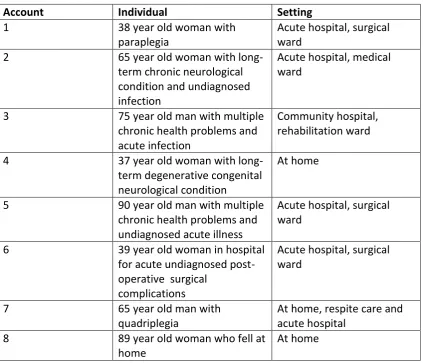
The eight individuals were selected, in part, to maximise diversity (see Table 2). There were, therefore, marked differences in their personal characteristics and in their treatment and care. They were all, though, at high risk of developing pressure ulcers, or of existing
Table 2: Individuals and settings
Account Individual Setting
1 38 year old woman with
paraplegia
Acute hospital, surgical ward
2 65 year old woman with
long-term chronic neurological condition and undiagnosed infection
Acute hospital, medical ward
3 75 year old man with multiple
chronic health problems and acute infection
Community hospital, rehabilitation ward
4 37 year old woman with
long-term degenerative congenital neurological condition
At home
5 90 year old man with multiple
chronic health problems and undiagnosed acute illness
Acute hospital, surgical ward
6 39 year old woman in hospital
for acute undiagnosed post-operative surgical
complications
Acute hospital, surgical ward
7 65 year old man with
quadriplegia
At home, respite care and acute hospital
8 89 year old woman who fell at
home
At home
Elimination of hypotheses
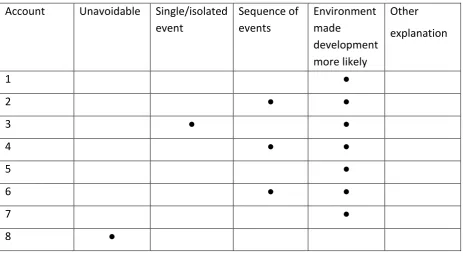
clinical sub-group and subsequent reviewers all judged that the organisational context made development of a severe pressure ulcer more likely, compared with the overall treatment and care that the individual might reasonably have expected to receive (see Table 3). None of the eight accounts, in the view of the clinical sub-group or subsequent reviewers,
Table 3: Summative judgements by account
Account Unavoidable Single/isolated event
Sequence of events
Environment made
development more likely
Other explanation
1 ●
2 ● ●
3 ● ●
4 ● ●
5 ●
6 ● ●
7 ●
8 ●
The organisational context
Second, there were failures to recognise and act on warning signs. Risk assessments were not undertaken when they should have been, in some cases only being undertaken several days after admission to an acute hospital ward. Evidence of pre-existing clinical risks in records was not acted upon in six of the seven patients where the environment was judged to have contributed to development. Action was not taken promptly when overt evidence – including the presence of a Category 2 pressure ulcer - was identified. Conversely, there was evidence of poor documentation, so that adherence with patients’ care plans was not recorded, and in some instances direct evidence of skin redness or a pressure ulcer was not recorded. Some healthcare assistants, who provided direct care, observed that they lacked the appropriate training to identify and record risks, or were not allowed to record them.
Third, there were co-ordination failures, between patients, carers and staff, staff in the same setting, between staff in different settings in the same organisation (eg two wards), and between staff in different organisations. Sometimes this was manifested as inter-professional communication failure, and in some cases there was poor communication between the same professional groups in two locations. One example of the latter came in a post-operative setting, where risks were not properly communicated between the
anaesthetic recovery unit and the post-operative ward. In other accounts records were not moved with an individual, so that key information was not available in a new setting. It would be possible to interpret these points as clear evidence of failures by individuals or teams. But there is a corollary to this point: nurses and healthcare assistants, in particular, could find themselves working in conditions where they had limited information about individuals and their risks, eg where patients had unknown diagnosis, or where records had not travelled with the patient from another location. It is possible, therefore, that individual members of staff behaved reasonably in the contexts in which they found themselves. The problems observed could be attributed to weaknesses in the overall co-ordination of treatment and care.
DISCUSSION
organisational contexts where there were failures in the overall governance of services. Specifically, they were characterised by one or more of, (i) clinicians failing to listen to patients’ or carers’ observations about their risks or the quality of their treatment and care, (ii) clinicians failing to recognise and respond to clear signs that a patient had a pressure ulcer or was at risk of developing one, and, (iii) services not being effectively co-ordinated. In four of the accounts it was possible to identify specific, or causal, precipitating events, but in each case these events occurred in organisational contexts where there were more general governance problems
As noted in the Methods section, the study was designed in significant part in order to minimise biases in the data collection and analysis in a retrospective, observational study. This study suggests that a novel method, based on tracing back the course of events retrospectively from a known outcome, can be used to reconstruct key events. The resulting accounts can be subjected to detailed review, and used to discriminate between alternative explanations for those events, and in the process preserve the ‘voices’ of the individuals affected. This said, it is important to stress that there are a number of sources of bias, starting with selection bias: while the sampling strategy maximised diversity, the eight accounts are of individuals who were willing and able to consent to participate. The initial presentation of the timelines, and the backgrounds of the analysts and reviewers, are also potential sources of bias. A study team with different clinical or disciplinary backgrounds might have arrived at different judgements: for example, a team with backgrounds in human factors psychology might have placed greater weight on single events or sequences of events. There is also a risk, using a retrospective design, of hindsight bias, particularly in reviewers assuming that staff must have known more than they actually did, and should therefore have acted differently [23]. The sequential and iterative review process has, we hope, served to minimise these biases, but we cannot say that they have been eliminated.
We can interpret our findings in the context of the patient safety literature. Reason [17] points out that investigations of accidents, across many industries, have changed
focus on causal explanations, based either on patient characteristics or errors made by individual clinicians. These were represented by the second and third explanations. Relatively few focus on the wider organisational context, represented by the fourth explanation. [11] The findings reported here only partially support the second or third explanation. Only one patient was deemed to have an unavoidable severe pressure ulcer – because service providers were unaware of a fall at home – supporting the first explanation, and there was no support for a fifth, alternative, explanation. The overall findings are, though, consistent with explanations that emphasise systems and culture.
In the literature on the role of the organisational context on patient safety, explanations tend to emphasise either systems or culture. The findings suggest that, for people who developed severe pressure ulcers, both were important. In relation to systems-based explanations, the evidence about the poor co-ordination of services is broadly consistent with the arguments in To Err Is Human, namely that many safety failures are essentially system failures. [21] Drawing on the work of Perrow and others, the Institute argued that accidents are more likely in systems that are inherently complex – having many
interconnected elements. [23] The findings in this study supported the observation that there were co-ordination failures between services that were loosely coupled with one another, ie generally run independently of one another, but needing to co-ordinate with one another. For example, there were communication failures between wards at times when there were major ward re-organisations, so that key information was not passed on. Similarly, one of the community-based accounts revealed that the individual was in receipt of a hospital service that community staff were unaware of, and hence could not take into account in risk assessment or care planning.
development of severe pressure ulcers, to one where the explanation is that prevailing norms substantially influenced the decisions and actions of individuals, which in turn led to the errors of commission and omission described above. Clinicians adopted risky work routines that were not appropriate for the vulnerable patients that were in their care. Severe pressure ulcers developed in contexts where there was normalisation of deviance, a phenomenon where risky practices become the norm in a work setting, and staff either don’t recognise the extent of the risks they are taking, or are aware of them but
Acknowledgement/Disclaimer
This paper presents independent research funded by the National Institute for Health Research (NIHR) under its Programme Grants for Applied Research Programme (RP-PG-0407-10056). The views expressed in this paper are those of the author(s) and not necessarily those of the NHS, the NIHR or the Department of Health.
Contributorship Statement
JN and JK conceived and designed the study initially. The study design was developed iteratively over a period of months by CD, JK, EM, JN, LP, NS. LP undertook primary data collection. Additional data were collected and collated by EM, NS, LW. JK drafted the article and revised it critically on the basis of comments from the other authors. All authors were formally involved in the analysis and interpretation of the findings. Co-authors will give final approval of the version to be published.
Funding
This work was supported by the NIHR Porgramme Grant
Competing
No competing interests
Data Sharing Statement
References
1. National Pressure Ulcer Advisory Panel/European Pressure Ulcer Advisory Panel. Pressure Ulcer Treatment. NPUAP/EPUAP, 2009.
2. Gorecki C, Brown JM, Nelson EA, Briggs M, Schoonhoven L, Dealey C, Defloor T and Nixon J on behalf of the European Quality of Life Pressure Ulcer Project Group. Impact of pressure ulcers on quality of life in older patients: a systematic review. JAGS vol. 57: pp. 1175-1183, 2009.
3. National Institute for Clinical Excellence. Pressure Ulcers – Prevention and Treatment. London: NICE, 2005.
4. National Patient Safety Agency. National Framework for Reporting and Learning from Serious Incidents Requiring Investigation. London: NPSA, 2010.
5. http://www.ic.nhs.uk/thermometer [accessed 07.05.2013]
6. Coleman S et al. Patient risk factors for pressure ulcer development: Systematic review. Int. J. Nurs. Stud. 2013 http://dx.doi.org/10.1016/j.ijnurstu.2012.11.019
7. Francis R (Chair). Independent Inquiry into care provided by Mid-Staffordshire NHS Foundation Trust, January 2005-March 2009. London: TSO, 2013.
8. Berlowitz, D.R., et al., Quality improvement implementation in the nursing home. Health Services Research, 2003. 38(1 Part 1): p. 65-83.
9. Waring J, Rowley E, Dingwall R, Palmer C, Murcott T. A Narrative Review of the UK's Patient Safety Research Portfolio. Journal of Health Services Research and Policy, vol. 15: pp. 26-32, 2010.
10.George A, Bennett A. Case Studies and Theory Development in the Social Sciences. Cambridge MA: MIT Press, 2005.
11.Yin R. Case Study Research: Design and Methods. London: Sage, 2008.
12.van Gaal B, Schoonhoven L, Hulscher M, Mintjes J, Borm GF, Koopmans R, et al. The design of the SAFE or SORRY? study: a cluster randomised trial on the development and testing of an
evidence based inpatient safety program for the prevention of adverse events. BMC Health Services Research 2009;9(58).
14.Chaves L, Grypdonck M, Defloor T. Pressure ulcer prevention in homecare: do Dutch homecare agencies have an evidence-based pressure ulcer protocol? Journal of Wound Ostomy Continence Nursing 2006;33(3):273-80.
15.Dopierala L, Szewczyk M, Cierzniakowska K, Cwajda J, Popow A, Wyrzykowska M. Level of preparation for preventive procedures and pressure ulcer treatment in health care units from the Kujawsko-Pomorski region. Adv Med Sci 2007;52(Suppl 1):81-4.
16.Schubert M, Clarke S, Glass T, Schaffert-Witvliet B, De Geest S. Identifying thresholds for relationships between impacts of rationing of nursing care and nurse- and patient-reported outcomes in Swiss hospitals: a correlational study. International Journal of Nursing Studies 2009;46(7):884-93.
17.Reason J. The Human Condition. Farnham: Ashgate, 2008, pp. 131-9.
18.Castle N. Administrator turnover and quality of care in nursing homes. Gerontologist 2001;41(6):757-67.
19.Kennedy M. Improving pressure ulcer prevention in a nursing home: action research. British Journal of Community Nursing 2005;10(12):S6-16.
20.Yang K. Relationships between nurse staffing and patient outcomes. Journal of Nursing Research 2003;11(3):149-58.
21.Institute of Medicine. To Err Is Human. Washington DC: IoM, 1999.