Efficient Modular NIZK Arguments
from Shift and Product
Prastudy Fauzi1, Helger Lipmaa1, and Bingsheng Zhang2 1 University of Tartu, Estonia
2
National and Kapodistrian University of Athens, Greece
Abstract. We propose a non-interactive product argument, that is more efficient than the one by Groth and Lipmaa, and a novel shift argument. We then use them to design several novel non-interactive zero-knowledge (NIZK) arguments. We obtain the first range proof with constant communication and subquadratic prover’s computation. We construct NIZK arguments for NP-complete languages,Set-Partition,Subset-SumandDecision-Knapsack, with constant com-munication, subquadratic prover’s computation and linear verifier’s computation.
Keywords: FFT, multi-exponentiation, non-interactive zero knowledge, product argument, range argument, shift argument.
1
Introduction
By using a zero knowledge proof [GMR85], a prover can prove the correctness of a statement without leaking any side information. Efficient non-interactive zero knowledge (NIZK, [BFM88]) proofs are crucial in the design of cryptographic protocols. A typical application is e-voting, where the voters must prove the correctness of encrypted ballots and the servers must prove the correctness of the tallying process. Since the voters may not be available every time when one verifies the ballots, one cannot rely on interactive zero knowledge. Moreover, it is important to have succinct (e.g., logarithmic in input size) NIZK proofs with efficient verification. For example, in e-voting, correctness proofs are collected and stored, and then verified by many independent observers.
It is well-known that NIZK proofs are impossible in the standard model without any trust assump-tions. One usually constructs NIZK proofs in the common reference string (CRS, [BFM88]) model, where all parties have access to a CRS generated by a trusted third party. (We do not consider the random oracle model, since random oracles cannot always be instantiated [CGH98,GK03].) Moreover, one can only construct succinctcomputationally sound proofs, also known as arguments [BCC88].
Only a few generic techniques of constructing succinct NIZK arguments for non-trivial languages are known, unless P = NP. In [Gro10], Groth constructed non-interactive witness-indistinguishable (and weakly sound, see [Gro10]) product and permutation arguments. He used them, together with some other arguments, to construct the first succinct NIZK argument for an NP-complete language,
Circuit-SAT. The latter argument is modular, i.e., it is in a black-box way based on a small number
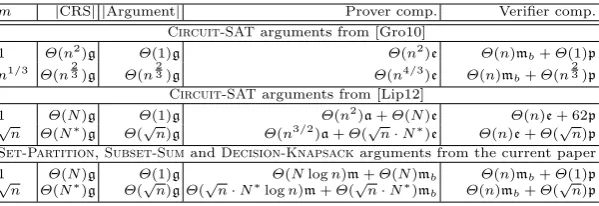
of basic arguments. Let n=|C| be the circuit size. Groth’s product and permutation arguments have CRS length and prover’s computation Θ(n2), while the communication and verifier’s computation are constant. (The communication is given in group elements, and the computation is in group operations.) HisCircuit-SATargument has the same complexity parameters, except that the verifier’s computation isΘ(n), see Table 1. (The verifier’s computation in Lipmaa’s argument in Table 1 differs from what was claimed in [Lip12]. The slightly incorrect claim from [Lip12] was also replicated in [CLZ12]. See Remark 1 on page 12.)
even more efficient. Thus, Groth’s and Lipmaa’s basic arguments offer essentially optimal communication and verifier’s computation, but they are quite inefficient in other parameters. We estimate that due to quadratic prover’s computation, they can only handle circuits of size≤210.
The basic arguments of [Gro10,Lip12] can be used to construct other modular arguments. E.g., a modular range argument was constructed in [CLZ12]. As shown in [LZ12], following the same framework, one can construct other basic arguments — for example, 1-sparsity in [LZ12] — and use them to construct efficient modular arguments (shuffle in [LZ12]). It is an important open problem to increase the library of basic arguments even further, and to investigate for which (complex) languages one can construct efficient arguments by using the basic arguments in a modular manner. Moreover, the basic arguments of Groth and Lipmaa are computationally intensive for the prover. It is desirable that the new basic arguments (that at the same time have meaningful applications) were more efficient.
We construct a more efficient variant of Lipmaa’s product argument, and we propose a new efficient shift-by-ξ argument. We then demonstrate the power of the modular approach, by using the product argument and the shift argument — together with some other, even simpler, arguments — to make the modular range argument of [CLZ12] more efficient, and then to construct efficient modular arguments for
Set-Partition, Subset-Sum and Decision-Knapsack (all NP-complete languages). All new argu-ments have constant communication, and significantly improved prover’s computation (Θ(r−31(n) logn) versusΘ(n2) in previous work). By using the same basic arguments, one can clearly construct modular NIZK arguments for other languages.
More precisely, we first modify the commitment scheme from [Lip12]. In that commitment scheme (and thus also in all related NIZK arguments), one uses a progression-free setΛof odd positive integers. When the new commitment scheme is used,Λcan be an arbitrary progression-free set. This is important conceptually, making it clear that one requires progression-freeness of Λ (and nothing else) in similar arguments.
We then construct a more efficient product argument by applying two unrelated algorithmic tech-niques to the product argument of [Lip12]. While not new, these techtech-niques help us to significantly speed up the product argument, and thus also other arguments that we build on top of it. First, we use Fast Fourier Transform (FFT, [CT65]) based polynomial multiplication [GS66] to reduce the prover’s com-putation fromΘ(n2) ton1+o(1)
Zp-multiplications. In addition, one has to evaluate twoΘ(n)-wide and
two Θ(r−31(n))-wide bilinear-group multi-exponentiations. Due to this, the new product argument has prover’s computation and CRS length n1+o(1). We note that FFT-based techniques are not applicable to optimize the arguments of Groth [Gro10], since there the largest element ofΛisΘ(n2).
Second, we use Pippenger’s [Pip80] algorithm to speed up multi-exponentiations. More precisely, the prover must performΘ(r3−1(n)) bilinear-group multiplications to evaluate twoΘ(r3−1(n))-wide bilinear-group multi-exponentiations needed in Lipmaa’s product argument. This is smaller than the number of Zp-multiplications but since bilinear-group multiplications are more expensive, we will count them
separately.
We were unable to apply FFT to the permutation argument from [Lip12]; this is since Lipmaa’s product argument has an FFT-friendly construction while the permutation argument has a more complex structure. (Thus, the idea of using FFT is not as straightforward as it may seem initially.) Instead, we propose shift-by-ξ and rotation-by-ξ arguments that have constant communication and verifier’s computation, and linear prover’s computation and CRS length. None of these complexities depends on ξ. Thus, the new shift and rotation arguments are (in some parameters)Θ(n) times more efficient than Groth’s permutation argument. As a drawback, we prove their security only by reduction to theΦ-PSDL assumption [CLZ12] (see Sect. 3), which is a generalization of theΛ-PSDL assumption from [Lip12]. To show that theΦ-PSDL assumption is reasonable, we prove that theΦ-PSDL assumption is secure in the generic group model.
We show that based on the product and shift arguments, one can build efficient modular arguments for several important languages. All our applications use an intermediate scan argument that verifies that one vector is the scan [Ble90] (or sum-of-all-prefixes) of another vector. While the scan argument can be straightforwardly constructed from the shift argument, it serves as a very useful intermediate building block.
Table 1.Comparison of modular NIZK arguments for NP-complete languages with (worst-case) sublinear ar-gument size. Here,nis the size of circuit,N =r−31(n), andN∗=r−31(√n), and mis the balancing parameter. Moreover,gcorresponds to 1 group element anda/m/mb/e/pcorrespond to 1 addition/Zp
-multiplication/bilinear-group multiplication/exponentiation/pairing.
m |CRS| |Argument| Prover comp. Verifier comp. Circuit-SATarguments from [Gro10]
1 Θ(n2)g Θ(1)g Θ(n2)e Θ(n)m
b+Θ(1)p n1/3 Θ(n23)g Θ(n23)g Θ(n4/3)e Θ(n)mb+Θ(n
2 3)p Circuit-SATarguments from [Lip12]
1 Θ(N)g Θ(1)g Θ(n2)a+Θ(N)e Θ(n)e+ 62p
√
n Θ(N∗)g Θ(√n)g Θ(n3/2)a+Θ(√n·N∗)e Θ(n)e+Θ(√n)p Set-Partition,Subset-SumandDecision-Knapsackarguments from the current paper 1 Θ(N)g Θ(1)g Θ(Nlogn)m+Θ(N)mb Θ(n)mb+Θ(1)p
√
n Θ(N∗)g Θ(√n)gΘ(√n·N∗logn)m+Θ(√n·N∗)mb Θ(n)mb+Θ(
√
n)p
come from a correct range. Construction of non-interactive range arguments has only taken off dur-ing the last few years [RKP09,CLZ12]. In [CLZ12], Chaabouni, Lipmaa and Zhang used the product and permutation arguments of [Lip12] to construct the first known constant-communication (interac-tive or non-interac(interac-tive) range argument over prime-order groups. They achieved this by combining the basic arguments of [Gro10,Lip12] with several different (and unrelated) techniques that were developed specifically for range arguments in [LAN02,CLs10].
We use the new basic arguments to optimize the range argument from [CLZ12], reducing the prover’s computation from Θ(h2) toΘ(r−1
3 (h)·logr
−1
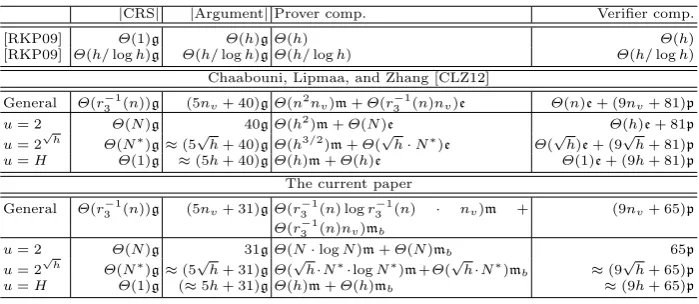
3 (h)) multiplications in Zp, and fromΘ(r−31(h)) bilinear-group exponentiations to Θ(r3−1(h)) bilinear-group multiplications. Here, h = log2(H −L). The new argument is the first range argument at all (i.e., not only in prime-order groups) that has constant-length arguments and subquadratic-in-h prover’s computation. See Sect. 6. We also note that [CLZ12] replicated the small mistake of [Lip12] (see Remark 1) and thus the computational complexity of the argument of [CLZ12] is larger than claimed in [CLZ12]. We propose another modification of the range argument of [CLZ12] to make it even more efficient. We also discuss balanced versions of the new range argument with better prover’s computation but larger communication.
We then proceed to demonstrate the power of the “shift-and-multiply” modular approach. We also construct an efficient NIZK argument for theNP-complete languageSet-Partition(the prover knows a partition of the given set of integers to two sets that have the same sum), where the communication and computation are dominated by two product arguments and one shift argument. The new argument has parameters outlined in Table 1. In this case, n denotes the cardinality of the public set. We also construct an NIZK argument for theNP-complete languageSubset-Sum(the prover knows a non-zero subset of the given set of integers that sums to 0), with parameters outlined in Table 1. In this case,n denotes the size of the input domain, that is, the public set S is known to belong to [n]. As the final example, we show that one can combine Subset-Sum and range arguments to construct an argument forDecision-Knapsack, anotherNP-complete language.
When using the balancing techniques of [Gro10,Lip12] (briefly, instead of applying the basic arguments to lengthn-vectors, apply them in parallel tomlength-(n/m) vectors), if m=√n, we obtain balanced NIZK arguments with the parameters, given in the last row of Table 1. (This means that by using the techniques of [Gro10], one can construct a perfect zap with the same complexity.)
2
Preliminaries
Let [L, H] ={L, L+ 1, . . . , H} and [H] = [1, H]. Bya, we denote the vector a= (a1, . . . , an). Since for
groupsGandH, their direct productG×H is also a group, we use freely notation like (g, h)a= (ga, ha). If y =hx, then loghy :=x. Letκ be the security parameter. We abbreviate probabilistic polynomial-time as PPT, non-uniform PPT by NUPPT. Let poly(κ)/negl(κ) be an arbitrary polynomial/negligible function.
If Λ1 andΛ2 are subsets of some additive group (Zor Zp in this paper), thenΛ1+Λ2={λ1+λ2:
λ1∈Λ1∧λ2∈Λ2}is theirsum set andΛ1−Λ2={λ1−λ2:λ1∈Λ1∧λ2∈Λ2} is theirdifference set. IfΛis a set, then kΛ={λ1+· · ·+λk :λi ∈Λ} is aniterated sumset,k·Λ={kλ:λ∈Λ} is adilation
ofΛ, and 2bΛ={λ1+λ2:λ1∈Λ∧λ2∈Λ∧λ16=λ2} ⊆Λ+Λis arestricted sumset. See [TV06]. A set Λ={λ1, . . . , λn} isprogression-free (or non-averaging, [ET36,TV06]), if no three elements of
Λ are in arithmetic progression, that is,λi+λj = 2λk only ifi=j =k. That is, 2bΛ∩2·Λ =∅. Let
r3(N) be the cardinality of the largest progression-free setΛ⊆[N]. Recently, Elkin [Elk11] proved that
r3(N) =Ω((N·log1/4N)/22
√
2 log2N
) .
Thus, for any n >0, there exists N =o(n22
√
2 log2n
), such that [N] contains ann-element progression-free subset. However, for sayN≤225, the Erd˝os-Tur´an progression-free subset [ET36], of size≈Nlog32, is larger. ForN ≤123, the optimal values ofr3(N) were recently computed in [Dyb12]. For anyN, the currently best upper bound was proven by Sanders [San11].
Polynomial factorization in Zp[X] can be done in polynomial time [LLL82,vHN10]. LetPolyFact be
an efficient polynomial factorization algorithm that on input a degree-dpolynomial f outputs alld+ 1 roots off.
Let y1, . . . , yM be monomials over the indeterminatesx1, . . ., xN. For every y = (y1, . . . , yM), let
L(y) be the minimum number of multiplications sufficient to computey1, . . . , yM from x1, . . . , xN and
the identity 1. Let L(M, N, B) denote the maximum of L(y) over all y for which the exponent of any indeterminate in any monomial is at mostB. In [Pip80], Pippenger proved that
Fact 1 Assume thath=M N·log(B+ 1)→ ∞. ThenL(M, N, B) = min{M, N}logB+h/logh·(1 + O((log logh/logh)1/2)) +O(max{M, N}).
A bilinear group generatorGbp outputs a description of a bilinear group [SOK00,Jou00,BF01]gk:=
(p,G1,G2,GT,ˆe)← Gbp(1κ), s.t.pis a κ-bit prime, G1, G2 andGT are multiplicative cyclic groups of
orderp(with identity elements denoted by 1), ˆe:G1×G2→GT is a bilinear pairing such that∀a, b∈Z,
g1 ∈G1 andg2∈G2, ˆe(g1a, gb2) = ˆe(g1, g2)ab. Ifgz generates Gz forz ∈ {1,2}, then ˆe(g1, g2) generates GT. Also, it is efficient to decide membership inG1,G2 and GT, group operations and the pairing are
efficiently computable, generators are efficiently sampleable, and the descriptions of the groups and group elements each are O(κ) bits long. An optimal Ate pairing [HSV06] over a subclass of Barreto-Naehrig curves can be implemented efficiently. Then, at security level of 128 bits, an element ofG1/G2/GT can
be represented in respectively 256/512/3072 bits.
A trapdoor commitment scheme [BCC88]Γ consists of five PPT algorithms: a randomized common reference string (CRS) generation algorithmGcom, a randomized commitment algorithmCom, a
random-ized trapdoor CRS generation algorithmGcomtd, a randomized trapdoor commitment algorithmComtd,
and a trapdoor opening algorithmOpentd. Here, (1) the CRS generation algorithmGcom(1κ) produces a
CRSck, (2) the commitment algorithmCom(ck;a;r), with a new randomizer r, outputs a commitment value A. A commitment Com(ck;a;r) is opened by revealing (a, r), (3) the trapdoor CRS generation algorithm Gcomtd(1κ) outputs a CRS cktd, which has the same distribution as Gcom(1κ), and a
trap-doortd, (4) the randomized trapdoor commitment algorithmComtd(cktd;r) takescktdand a randomizer
r as inputs, and outputs Com(cktd;0;r), and (5) the trapdoor opening algorithm Opentd(cktd,td;a;r)
outputs anrtd, such thatCom(cktd;0;r) =Com(cktd;a;rtd).
Γ iscomputationally binding, if no NUPPT adversary can open a commitment to two different values. That is, for every NUPPTA,
Pr
"
ck← Gcom(1κ),(a1, r1,a2, r2)← A(ck) :
(a1, r1)6= (a2, r2)∧ Com(ck;a1;r1) =Com(ck;a2;r2)
is negligible inκ.Γ isperfectly hiding, if the commitments of any two messages have the same distribution. That is, for any ck ∈ Gcom(1κ) and anya1,a2, the distributions Com(ck;a1;·) and Com(ck;a2;·) are
equal.
The new commitment scheme allows committing to vectors of predetermined length n. Thus, one must inputn (or a reasonable upper bound on n) as an additional parameter for the (trapdoor) CRS generation algorithms. We assume that the value ofnis implicitly obvious while committing and trapdoor opening.
Let R = {(C, w)} be an efficiently computable binary relation with |w| = poly(|C|). Here,C is a statement, and wis a witness. Let L={C : ∃w,(C, w)∈ R} be anNP-language. Let n=|C| be the input length. For fixedn, we have a relationRn and a languageLn. Anon-interactive argument forR
consists of three PPT algorithms: a common reference string (CRS) generator Gcrs, a proverP, and a
verifierV. Forcrs← Gcrs(1κ, n),P(crs;C, w) produces an argument π, and V(crs;C, π) outputs either 1
(accept) or 0 (reject).
Π isperfectly complete, if for all n= poly(κ),
Pr[crs← Gcrs(1κ, n),(C, w)← Rn :V(crs;C,P(crs;C, w)) = 1] = 1 .
Π iscomputationally sound, if for alln= poly(κ) and NUPPT A,
Pr[crs← Gcrs(1κ, n),(C, π)← A(crs) :C6∈ L ∧ V(crs;C, π) = 1] = negl(κ) .
Π isperfectly witness-indistinguishable, if for alln= poly(κ), ifcrs∈ Gcrs(1κ, n) and ((C, w0),(C, w1))∈ R2
n, then the distributionsP(crs;C, w0) andP(crs;C, w1) are equal.Πisperfectly zero-knowledge, if there
exists a PPT simulator S = (S1,S2), such that for all stateful NUPPT adversariesAand n= poly(κ) (withtdπ being thesimulation trapdoor),
Pr
crs← Gcrs(1κ, n),
(C, w)← A(crs), π← P(crs;C, w) : (C, w)∈ Rn∧ A(π) = 1
= Pr
(crs;tdπ)← S1(1κ, n), (C, w)← A(crs), π← S2(crs;C,tdπ) :
(C, w)∈ Rn∧ A(π) = 1
.
3
New Commitment Scheme
LetΛ= (λ1, . . . , λn)∈Zn andυ∈Z. Next, we define the (Λ, υ)trapdoor commitment scheme in group Gz,z∈ {1,2}. See Prot. 1. Intuitively,a= (a1, . . . , an) is committed to as g
rσυ+Pa
iσλi
z , where ris the
randomness,gz is a generator ofGz, andσ is the secret key. Groth [Gro10] proposed a variant of this
commitment scheme with Λ = [n] andυ = 0, while Lipmaa [Lip12] generalized Λ to any set Λ with 0< λi< λi+1 andλn= poly(κ) (while still lettingυ= 0).
We use the following security assumptions from [CLZ12]. Let pbe as output byGbp. LetΦ⊂Zp[X],
with d:= maxϕ∈Φdegϕ, be a set of linearly independent polynomials, such that|Φ|, all coefficients of
allϕ∈Φ, anddare polynomial inκ. Let 1 be the polynomial with 1(x) = 1 for allx∈Zp.
Definition 1. Gbp is Φ-PDL secure inGz, if for any NUPPTA,
Pr
"
gk:= (p,G1,G2,GT,eˆ)← Gbp(1κ), gz←Gz\ {1}, σ←Zp:
A(gk; (gzϕ(σ))ϕ∈{1}∪Φ) =σ
#
= negl(κ) .
Gbp is Φ-PSDL secure, if for any NUPPTA,
Pr
"
gk:= (p,G1,G2,GT,ˆe)← Gbp(1κ), g1←G1\ {1}, g2←G2\ {1}, σ←Zp:A(gk; (g
ϕ(σ) 1 , g
ϕ(σ)
2 )ϕ∈{1}∪Φ) =σ #
= negl(κ) .
A much stronger version of the P(S)DL assumption was recently used in [BCI+13].
(See App. A for a proof.) As shown in [GW11], sublinear NIZK proofs are only possible under non-standard (e.g., knowledge) assumptions. We use the following knowledge assumption from [CLZ12]. For algorithmsAandXA, we write (y;yX)←(A||XA)(σ) ifAon inputσoutputsy, and XA on the same
input (including the random tape ofA) outputsyX.
Definition 2. Let z∈ {1,2}.Gbp is Φ-PKE secure inGz if for any NUPPT Athere exists an NUPPT
extractorXA, s.t. the following probability is negligible:
Pr
gk:= (p,G1,G2,GT,ˆe)← Gbp(1κ), gz←Gz\ {1},(α, σ)←Z2p,
crs←(gk; ((gz, gαz) φ(σ))
φ∈Φ),(c,cˆ;r,(aφ)φ∈Φ)←(A||XA)(crs) :
ˆ
c=cα∧c6=grz· Y
φ∈Φ
ga`φ(σ) z
.
One can generalize the proof from [Gro10] to show that Φ-PKE holds in the generic group model. Let z= 1. Consider a CRSckthat in particular specifiesg2,gˆ2∈G2. A commitment (A,Aˆ)∈G21 isvalid, if ˆ
e(A,ˆg2) = ˆe( ˆA, g2). The casez= 2 is dual. The following theorem generalizes the corresponding results from [Gro10,Lip12].
Theorem 2. Letz∈ {1,2}. LetΛ= (λ1, . . . , λn)withλi< λi+1 andλi= poly(κ). Letυ > λn be linear
inλn−λ1. Let Γ be the(Λ, υ)knowledge commitment scheme inGz of Prot. 1. Let
ΦΓ :={Xυ} ∪ {X`}`∈Λ .
Then
(a) Γ is perfectly hiding, and computationally binding under theΦΓ-PDL assumption inGz. The
reduc-tion overhead is dominated by the time to factor a degree-(υ−λ1)polynomial in Zp[X].
(b) If ΦΓ-PKE holds in Gz, then for any NUPPT A that outputs a valid commitment C, there exists
an NUPPT extractor XA that, given the input of A together with A’s random coins, extracts the
contents ofC.
Proof. Perfect hiding:follows since the output ofCom is a random element ofG1.Computational
binding:AssumeACom is an adversary that can break the binding property with non-negligible prob-ability. We construct the following adversaryApdl, see Prot. 1, against the ΦΓ-PDL assumption in G1 that works with the same probability. Here,C is the challenger of the PDL game.
Assume that on step 1, ACom is successful with some probability εc. Thus, with probability εc,
(a, ra)6= (b, rb) and
graσυ z ·
Y
i∈[n] gaiσλi
z =g rbσυ z ·
Y
i∈[n] gbiσλi
z .
But then
g(ra−rb)σ
υ+Pn
i=1(ai−bi)σλi
z = 1 ,
and thus
(ra−rb)συ+ n X
i=1
(ai−bi)σλi ≡0 (modp) ,
or equivalently,
(ra−rb)συ−λ1+ n X
i=1
(ai−bi)σλi−λ1 ≡0 (mod p) .
System parameters: Gbp,n= poly(κ),Λ={λ1, . . . , λn}withλi< λi+1,λi= poly(κ), andυ >maxiλi;
Gcomtd(1κ, n): Setgk:= (p,G1,G2,GT,ˆe)← Gbp(1κ),gz←Gz\ {1}, (σ,αˆ)←Z2p; Fori∈[n] do: (gz,λi,gˆz,λi)← (gz, gαzˆ)σ
λi
; Set (hz,ˆhz)←(gz, gzαˆ)σ
υ
; Letck←(gk; (gz,λigˆz,λi)i∈[n], hz,ˆhz); Return (ck;td←σ);
Gcom(1κ, n): (ck;td)← Gcom(1κ); returnck;
Com(ck;a;·), a= (a1, . . . , an)∈Znp: r←Zp; return (hz,hˆz)r·Qin=1(gz,λi,gˆz,λi)
ai;
Comtd(cktd;·): r←Zp; return (hz,ˆhz)r;
Opentd(cktd,td;a, r): returnrtd←r−Pni=1aiσλi−υ;
C setsgk← Gbp(1κ),gz←Gz\ {1}, andσ←Zp;
C sends (gk; (gzσ`)`∈{υ}∪Λ) toApdl;
Apdl sets ˆα∗←Zp;
Apdl setsck←(gk; ((gz, gαˆ ∗ z )σ
`
)`∈Λ,(gz, gαˆ ∗ z )σ
υ );
1 Apdl obtains (a, ra,b, rb)← ACom(ck);
if a6∈Znp∨b6∈Znp∨ra6∈Zp∨rb6∈Zp∨(a, ra) = (b, rb)∨ Com(ck;a, ra)6=Com(ck;b, rb)then Apdl
aborts ; else
2 Apdl setsδ(X)←(ra−rb)Xυ−λ1+Pni=1(ai−bi)Xλi−λ1.
Apdl sets (t1, . . . , tυ−λ1+1)←PolyFact(δ);
3 Apdl finds by an exhaustive search a rootσ0 ∈ {ti}iυ=1−λ1+1, s.t.g
σλ1
z =g
σλ1 0
z ;
Apdl returnsσ←σ0to the challenger;
end
Algorithm 1: Adversary in Thm. 2
Sinceυ > λn, δ(X), as defined on step 2 is a degree-(υ−λ1) non-zero polynomial.
Thus, the adversary has generated a non-trivial degree-(υ−λ1) polynomialf(X) such thatf(σ)≡0 (modp). Hence,Apdlcan use polynomial factorization to find all roots ofδ, and one of those roots must
be equal toσ. On step 3, Apdl finds the correct root by an exhaustive search among all roots returned
in the previous step. Thus, clearly Apdl returns the correct value of sk (and thus violates theΦΓ-PDL
assumption) with probabilityεc. Finally, the time ofApdl is clearly dominated by the execution time of
ACom and the time to factorδ.
Extractability: By theΦΓ-PKE assumption in groupGz, for every committerAthere exists an
extractorXAthat can open the commitment in groupGz, given access toA’s inputs and random tape.
SinceΓ is computationally binding, then the extracted opening has to be the same thatAused. ut
Sometimes, we use the same commitment scheme in bothG1andG2. In such cases, we will emphasize the underlying group by having a different CRS, but we will not change the name of the commitment scheme.
Let α = ||a||∞ = maxiai, and n ≥ 2. When using Pippenger’s algorithm, the computation of
Com(ck;a;r) is dominated by L(2, n, α) = 2 log2α+ (2 +o(1))·nlog2α/log2(nlog2α) +O(n) Gz
-multiplications. In our applications, n log2α (e.g., α = 2, α = n, or even α = p given that n is reasonably large), and thus we get a simpler bound of (2 +o(1)) log2α·n/log2n+O(n) multiplica-tions. This can be compared to 3nlog2αmultiplications on average when using the square-and-multiply exponentiation algorithm.
4
Improved Hadamard Product Argument
Next, we propose a version of the product argument of [Lip12] with respect to the (Λ, υ) commitment scheme of Sect. 3. As we will see (both in this section and in Sect. 5), the value of υ depends on the construction of the argument. E.g., while the commitment scheme is binding forυ > λn, for the product
argument to be (weakly3) sound we need υ > 2λ
n −λ1. If one uses several such arguments together (e.g., to construct a range argument or aSubset-Sumargument), one has to choose a value ofυthat is secure for all basic arguments. We also show that one can use FFT and Pippenger’s multi-exponentiation algorithm to make the product argument more efficient.
Assume thatΓ is a trapdoor commitment scheme that commits toa= (a1, . . . , an)∈Znp forn≥1.
In anHadamard product argument, the prover aims to convince the verifier that given commitmentsA,B andC, he can open them asA=Com(ck;a;ra),B=Com(ck;b;rb), andC=Com(ck;c;rc), s.t.ci=aibi
fori∈[n]. A product argument hasnconstraints ci=aibi fori∈[n].
Lipmaa [Lip12] constructed a product argument for the (Λ,0) commitment scheme with communica-tion of 5 group elements, verifier’s computacommunica-tionΘ(n), prover’s computation ofΘ(n2) multiplications in
Zp, and the CRS ofΘ(r−31(n)) group elements. Prot. 2 presents a more efficient variant of this argument 3
for the (Λ, υ) commitment scheme Γ. Similarly to [Lip12], we use Γ in both G1 (to commit to a, b, and c) andG2 (to commit to band 1). Letckb be the CRS in group G1, and ckb
∗
be the dual CRS in group G2 (i.e., ckb
∗
is defined as ckb, but with g1 replaced by g2). Thus, e.g., (B,Bˆ) = Com(ckb;b;rb).
Then, logg1A=raσυ+ Pn
i=1aiσλi, logg1B=rbσ
υ+Pn
i=1biσλi, and logg1C=ciσ
υ+Pn
i=1rcσλi. The
prover also computes an elementB2, s.t. ˆe(g1, B2) = ˆe(B, g2). Thus, for (D,Dˆ) =Com(ckb
∗
;1; 0) (inG2), logeˆ(g1,g2)(ˆe(A, B2)/ˆe(C, D)) = (raσυ+
Pn
i=1aiσλi)(rbσυ+ Pn
i=1biσλi)−(rcσυ+ Pn
i=1ciσλi)( Pn
i=1σ
λi)
can be written — after substituting σ with a formal variable X — as a sum of two formal polyno-mials Fcon(X) and Fπ(X), s.t. Fcon(X) (the constraint polynomial) has one monomial per constraint
(aibi = ci) and is 0 if the prover is honest, while Fπ(X) has many more monomials. More precisely,
Fπ hasΘ(r3−1(n)) monomials, and the CRS has length Θ(r
−1
3 (n)). The honest prover has to compute (π,bπ)←(gFπ(σ)
2 ,ˆg
Fπ(σ)
2 ). The PSDL and the PKE assumptions guarantee that he cannot do it if at least one of thenconstraints is not satisfied.
In [Lip12], for soundness, one had to assume that the used setΛis a progression-free set of odd positive integers. By using suchΛ, [Lip12] proved that the polynomialsFcon(X) andFπ(X) were spanned by two
non-intersecting sets of powers ofX. From this, [Lip12] then deduced (weak) soundness.
We will show that by using the (Λ, υ) commitment scheme (for a well-chosen value of υ), one can without any loss in efficiency assume that Λ is just a progression-free set. This makes the product argument slightly more efficient. More importantly, it makes it clear that the property that Λ has to satisfy is really progression-freeness, and not say having only odd integers as its members.
For a setΛand an integer υ, define
ˆ
Λ:={2υ} ∪(υ+Λ)∪2bΛ . (1)
(In [Lip12], this definition was only given forυ= 0. Then, ˆΛ={0} ∪Λ∪2bΛ.)
Lemma 1. Assume thatΛ= (λ1, . . . , λn)with λi+1> λi, and υ >2λn−λ1.Λ is a progression-free set
if and only if 2·Λ∩Λˆ=∅.
Proof. AssumeΛis progression-free. Then 2bΛ∩2·Λ=∅. Sinceυ >2λn−λ1, ({2υ}∪(υ+Λ))∩2·Λ=∅.
(In [Lip12],υ= 0, and ({0} ∪Λ)∩2·Λ=∅ was guaranteed by assuming that every integer inΛis odd and non-zero.) Assume now that 2·Λ∩Λˆ=∅. Thus, 2·Λ∩2bΛ=∅, andΛis a progression-free set. ut
Lemma 2. For any n > 0, there exists a progression-free set Λ = {λ1, . . . , λn}, with λi < λi+1 and λn= poly(κ), and an integer υ >2λn−λ1,υ linear inλn−λ1, such that|Λˆ|=Θ(r3−1(n)).
Proof. Let Λ be the progression-free set from [Elk11], seen as a subset of [λ1, λn] (with λ1 possibly
being negative), with λn−λ1 ≈ r3−1(n). Since υ > 2λn −λ1 is linear in λn−λ1, ˆΛ ⊂ [2λ1,2υ] and
|Λˆ|=Θ(r−31(n)). ut
One can add any constant to all members ofΛandυ, so that the previous results still hold. In particular, according to the previous two lemmas, the best value (in the sense of efficiency) ofλn might be 0.
We state and prove the security of the new product argument when using the (Λ, υ) knowledge com-mitment scheme by closely following the claim and the proof from [Lip12]. The (knowledge) comcom-mitments are (A,Aˆ), (B,Bˆ) and (C,Cˆ). For efficiency (and backwards compatibility) reasons, following [Lip12], we include another elementB2 to the statement of the Hadamard product language.
Since for anyaandb, (C,Cˆ) is a commitment of (a1b1, . . . , anbn) forsome value ofrc, Prot. 2 cannot
be computationally sound (even under a knowledge assumption). Instead, as in [Gro10,Lip12], we prove a weaker version of soundness that is sufficient to achieve soundness of the more complex arguments. The last statement of Thm. 3 basically says that no efficient adversary can output an input to the product argument together with an accepting argument and openings to all commitments and all other pairs of type (y,yˆ) that are present in the argument, s.t.aibi6=cifor somei∈[n]. See App:prodsec for the proof.
Theorem 3. Let n = poly(κ). Let Λ = (λ1, . . . , λn) be a progression-free set with λi+1 > λi, λi =
poly(κ), υ > 2λn−λ1, and υ = poly(κ). LetΓ be the (Λ, υ) commitment scheme in G1. Let Φ× :=
{Xυ} ∪ {X`} `∈Λˆ.
CRS generationGcrs(1κ, n):
Setgk:= (p,G1,G2,GT,ˆe)← Gbp(1κ), (g1, g2)←(G1\ {1},G2\ {1});
Setσ,αˆ←Zp, ˆg1←g1αˆ;
For each`∈ {υ} ∪Λdo: (g1,`,g1ˆ,`)←(g1,ˆg1)σ
` ; For each`∈ {υ} ∪Λˆdo: (g2,`,ˆg2,`)←(g2, gαˆ
2)σ
` ; SetD←Qn
i=1g2,λi,ckb ←(gk; (g1,`,g1ˆ,`)`∈{υ}∪Λ); Returncrs←(ckb, g1,ˆg1,(g2,`,ˆg2,`)`∈Λˆ, D);
Argument generationP×(crs; (A,A, B,ˆ B, B2ˆ , C,Cˆ),(a, ra,b, rb,c, rc)):
DefineI1(`) :={(i, j) :i, j∈[n]∧i6=j∧λi+λj=`};
For each`∈2bΛdo:µ`← P
(i,j)∈I1(`)(aibj−ci);
(π,πˆ)←(g2,2υ,g2ˆ,2υ)rarb·Qni=1(g2,υ+λi,ˆg2,υ+λi)
rabi+rbai−rc·Q
`∈2bΛ
(g2,`,ˆg2,`)µ`;
Returnπ×←(π,ˆπ)∈G22;
VerificationV×(crs; (A,A, B,ˆ B, B2ˆ , C,Cˆ), π×):
If ˆe(A, B2)/ˆe(C, D) = ˆe(g1, π) and ˆe(g1,πˆ) = ˆe(ˆg1, π) then accept, else reject.
Protocol 2:New product argument [[(A,Aˆ)]]◦[[(B,B, B2ˆ )]] = [[(C,Cˆ)]]
2. If Gbp is Φ×-PSDL secure, then an NUPPT adversary against Prot. 2 has negligible chance, given
crs← Gcrs(1κ, n)as an input, of outputtinginp×←(A,A, B,ˆ B, Bˆ 2, C,Cˆ)and an accepting argument π× ←(π,πˆ) together with a witnessw×←(a, ra,b, rb,c, rc,(f`∗)`∈Λˆ), such that
(a) a,b,c∈Znp,ra, rb, rc∈Zp, andf`∗∈Zp for`∈Λ,ˆ
(b) (A,Aˆ) = Com(ckb;a;ra), (B,Bˆ) = Com(ckb;b;rb), B2 = g2rb,υ · Qn
i=1g
bi
2,λi, and (C,
ˆ C) =
Com(ckb;c;rc),
(c) logg2π= loggˆ2πˆ =P
`∈Λˆf`∗σ`, whereg2ˆ =g2αˆ, and (d) for some i∈[n],aibi6=ci.
The reduction overhead is dominated by the time to factor a degree-(2υ−2λ1)polynomial in Zp[X].
Next, we will show that the product argument of this section (and also the product argument of [Lip12]) is computationally much more efficient than it was claimed in [Lip12]. In [Lip12], the prover was said to require computing Θ(n2) multiplications in
Zp and Θ(r3−1(n)) exponentiations in G2. We optimize the prover’s computation so that it will require a significantly smaller number of multiplications and no exponentiations at all.
Theorem 4. The communication (argument size) of Prot. 2 is2 elements from G2. The prover’s
com-putation is dominated by Θ(r−31(n)·logr3−1(n)) multiplications in Zp and two Θ(r−31(n))-wide multi-exponentiations inG2. The verifier’s computation is dominated by5bilinear pairings and1bilinear-group multiplication. The CRS consists of Θ(r3−1(n))group elements.
Proof. By Lem. 2, the size of the CRS is Θ(|Λˆ|) = Θ(r−31(n)). From the CRS, the verifier only needs to access g1, ˆg1, and D. Since 2bΛ ⊆ Λˆ, the statement about the prover’s computation follows from Fast Fourier Transform [CT65] based polynomial multiplication [GS66] techniques. To compute all the coefficients of the polynomialµ(X) :=Pni=1Pnj=1:j6=i(aibj−ci)Xλi+λj, the prover executes Alg. 2. Here,
FFTMultdenotes an FFT-based polynomial multiplication algorithm.
Fori←0 toλndo:a†i←0,b†i ←0,c†i ←0,d†i ←0;
Fori←1 tondo:a†λ
i←ai,b †
λi←bi,c †
λi ←ci,d †
λi ←0; Denotea†(X) :=Pλn
i=0a
†
iX iandb†
(X) :=Pλn
i=0b
†
iX i;
Denotec†(X) :=Pλn
i=0c
†
iX iandd†
(X) :=Pλn
i=0d
†
iX i;
Letµ(X)←FFTMult(a†(X), b†(X)); Letν(X)←FFTMult(c†(X), d†(X)); Fori←1 tondo:µ2λi ←µ2λi−aibi;
Letµ(X)←µ(X)−ν(X);
Algorithm 2: FFT-based prover’s computation of{µ`}
After usingFFTMult to compute the initial version ofµ(X) and ν(X),µ` =P(i,j)∈[n]2:λ
i+λj=`aibj
and ν` = P(i,j)∈[n]2:λ
i+λj=`ci. Thus, after the penultimate step of Alg. 2, µ` = P
whereN =r3−1(n) is the input size, we have shown the part about the prover’s computational complexity. The verifier’s computational complexity follows from the description of the argument. ut
FFT does not help to speed up Groth’s product argument [Gro10], since there λn = Θ(n2). FFT
does also not seem to be useful in the case of the permutation argument from [Lip12]. Finally, it may be possible to speed up Alg. 2, by taking into account the fact that all a†, b†, c† and d† have only n non-zero monomials.
Next, we use efficient multi-exponentiation for additional speed-up. Let α := max(||a||∞,||b||∞,||c||∞), where the prover has committed to a and b. (See Sect. 6 for the
con-crete values of α.) The number of bilinear-group operations the prover has to perform (on top of computing the exponents by using the FFT-based polynomial multiplication) to compute π is domi-nated byL(2, n, p) +L(2, r−31(n), Θ((αn)2)). The very conservative value Θ((αn)2) follows from|µ
`|=
|P
(i,j)∈I1(`)(aibj−ci)| ≤
P
(i,j)∈I1(`)|aibj−ci| ≤
P
(i,j)∈I1(`)(α
2+α)<(n2−n)(α2+α) =Θ((αn)2). Due to Fact 1, for n = Ω(logp), L(2, n, p) = 2 log2p+ (2 +o(1))·nlog2(p+ 1)/(log2(2nlog2(p+ 1))) + O(n) = (2 + o(1)) · log2p · n/log2n, and, since in our applications, n log2Θ((αn)2), L(2, r−31(n), Θ((αn)2)) = 2 log
2(αn2)+
(2+o(1))r3−1(n) log2Θ((αn)2) (log2(2r
−1
3 (n) log2Θ((αn)2)))
+O(r−31(n)) = (2+o(1))r
−1 3 (n) (log2r
−1 3 (n))
·2 log2(αn). Thus, the prover has to compute (2 +o(1))·(logn
2n ·log2p+
r−31(n)
log2r3−1(n)·2 log2(αn)) bilinear-group mul-tiplications. We will instantiateαand other values in Sect. 6.
5
Shift And Rotation Arguments
In a right shift-by-ξ argument (resp., right rotation-by-ξ argument), the prover aims to convince the verifier that for two commitmentsAandB, he knows how to open them asA=Com(ck;a;ra) andB=
Com(ck;b;rb), such thatai=bi+ξ fori∈[n−ξ] andan−ξ+1=· · ·=an= 0 (resp.,an−ξ+1=b1, . . .an=
bξ). That is, (an, . . . , a1) = (0, . . . ,0, bn, . . . , bξ+1) (resp., (an, . . . , a1) = (bξ, . . . , b1, bn, . . . , bξ+1)). Left shift and left rotation arguments are defined dually, we omit their descriptions.
Groth [Gro10] and Lipmaa [Lip12] defined NIZK arguments for arbitrary permutation%(i.e.,a%(i)=bi
for public %). However, their permutation arguments are quite complex and computationally intensive. Moreover, many applications do not require arbitrary permutations. We give examples of the latter in Sect. 6.
We now describe the new right shift-by-ξargument rsftξ([[(A,A˜)]]) = [[(B,B˜)]], that is much simpler
and significantly more computation-efficient than the generic permutation arguments of Groth and Lip-maa. One can design a very similar rotation argument, see App. D. Let logg1A = raσ
υ+Pn i=1aiσλi
and logg
1B = rbσ
υ +Pn
i=1biσλi. We replace σ with a formal variable X. If the prover is honest
(full derivation of this is given in the proof of Thm. 5), then F(X) := Xξ ·log
g1A−logg1B =
−Pξi=1biXλi+ Pn
i=ξ+1bi(Xλi−ξ+ξ −Xλi) +raXυ+ξ −rbXυ. Thus, one can verify that A is a right
shift-by-ξ ofB by checking that ˆe(A, gσξ
2 )/eˆ(B, g2) = ˆe(g1, π), where π=g
F(σ)
2 is defined as in Prot. 3. As seen from the proof of the following theorem, the actual security proof, especially for the (weaker version of) soundness, is more complicated. Complications arise from the use of polynomials of type Xi−Xjin the verification equation; because of this we must rely on a less straightforward variant of the PSDL assumption than before. One has also to be careful in the choice of the setΛ: if sayλn−ξ+ξ=λn,
then some of the monomials ofF(X) will collapse, and the security proof will not go through.
Theorem 5. Let n= poly(κ). Let Λ = (λ1, . . . , λn) ⊂Z, s.t. λi+1 > λi, λi 6=λj+ξ for i 6=j, and
λi= poly(κ). Let υ > λn+ξbe an integer, s.t.υ= poly(κ). Let Γ be the(Λ, υ)commitment scheme in
G1.
(1) Prot. 3 is perfectly complete and perfectly witness-indistinguishable. (2) Let
Φξrsft:={Xυ, Xυ+ξ} ∪ {Xλi}iξ=1∪ {Xλi+ξ−Xλi+ξ}n−ξ i=1 . If Gbp isΦ
ξ
rsft-PSDL secure, then an NUPPT adversary against Prot. 3 has negligible chance, given
crs← Gcrs(1κ, n)as an input, of outputtinginprsft←(A,A, B,˜ B˜)and an accepting argument πrsft←
(π,π˜)together with a witness wrsft←(a, r
a,b, rb,(fφ∗)φ∈Φξrsft), such that
CRS generationGcrs(1κ, n):
Setgk:= (p,G1,G2,GT,ˆe)← Gbp(1κ),g1←G1\ {1},g2←G2\ {1},σ,α˜←Zp;
For eachz∈ {1,2}do: ˜gz ←gαz˜;
For each`∈ {υ} ∪Λdo: (g1,`,g1˜,`)←(g1,˜g1)σ
` ; Setg2,ξ←gσ
ξ
2 ;
For eachi∈ {λ1, , . . . , λξ, υ, υ+ξ}do: (g2,i,g2˜,i)←(g2,˜g2)σ
i ; For eachi∈[1, n−ξ] do: (h2,i,˜h2,i)←(g2,g2˜)σ
λi+ξ−σλi+ξ ; Setcke ←(gk; (g1,`,g1˜,`)`∈{υ}∪Λ);
Returncrs←(cke, g1,˜g1, g2, g2,ξ,(g2,i,˜g2,i)i∈{λ1,...,λξ,υ,υ+ξ},(h2,i,h2˜ ,i)i∈[1,n−ξ]); Argument generationPrsft(crs; (A,A, B,˜ B,ˆ B˜),(a, ra,b, rb)):
(π,π˜)←Qn−ξ
i=1(h2,i,h2˜ ,i)
bi+ξQξ
i=1(g2,λi,˜g2,λi) −bi(g2
,υ+ξ,˜g2,υ+ξ)ra·(g2,υ,g2˜,υ)−rb;
Returnπrsft←(π,π˜)∈G22;
VerificationVrsft(crs; (A,A, B,˜ B,ˆ B˜), πrsft):
If ˆe(A, g2,ξ)/eˆ(B, g2) = ˆe(g1, π) and ˆe(g1,π˜) = ˆe(˜g1, π) then accept, else reject;
Protocol 3:New right shift-by-ξargumentrsftξ([[(A,A˜)]]) = [[(B,B˜)]]
(b) (A,A˜) =Com(cke;a;ra),(B,B˜) =Com(cke;b;rb),
(c) logg
2π= logg˜2π˜=
P φ∈Φξrsftf
∗
φ·φ(σ), and
(d) (an, an−1, . . . , a1)= (06 , . . . ,0, bn, . . . , bξ+1).
The reduction time is dominated by the time it takes to factor a degree-(υ+ 1)polynomial inZp[X].
(See App. C for a proof.) In an upper level argument, the verifier must check that ˆe(A,g2˜ ) = ˆe( ˜A, g2), and ˆe(B,˜g2) = ˆe( ˜B, g2). A simple valid choice ofΛis the initial segment ofZξ∪(Zξ+ 2ξ)∪(Zξ+ 4ξ)∪ · · ·.
Theorem 6. Let Λ and υ be as defined in Thm. 5. Let β ← ||b||∞, β < p. Assume n > log2β. The argument size of Prot. 3 is 2 elements from G2. The prover’s computation is dominated by Θ(n) Zp-multiplications and(2 +o(1))·log2β·n/log2n+O(n)bilinear-group multiplications. The verifier’s computation is dominated by5 bilinear pairings. The CRS consists ofΘ(n)group elements.
Proof. The prover computes two multi-exponentiations in L(2, n, β) = 2 log2β + (1 + o(1)) · 2nlog2(β+1)
(log2(2nlog2(β+1))) +O(n) = (2 +o(1))·
nlog2β
log2n +O(n) bilinear-group multiplications. Other claims are
straightforward. ut
6
Applications
We will now describe how to use the new product and shift arguments to improve on the range argument of [CLZ12], and to construct newSet-Partition andSubset-Sumarguments. Then, we combine the
Subset-Sum and range arguments to construct a Decision-Knapsack argument. In all three cases,
the shift argument is mainly used to construct an intermediate scan argument. Recall that vectorb is a scan [Ble90] of vector a, if bi = Pj>iaj. As abundantly demonstrated in [Ble90], vector scan (also
known as all-prefix-sums) is a powerful operator that can be used to solve many important computational problems. In the context of zero knowledge, we will only need to be able to verify that one vector is a scan of the second vector.
In a scan argument, the prover aims to convince the verifier that given two commitments A and B, he knows how to open them as A = Com(ck;a;ra) and B = Com(ck;b;rb), s.t. bi = Pj>iaj.
A scan argument is just equal to a right shift-by-1 argument rsft1([[B]]) = [[A+B]], that proves that bi =ai+1+bi+1, fori < n, andbn = 0. Thus,bn= 0,bn−1=an, bn−2=an−1+bn−1=an−1+an, and
in general,bi=Pj>iaj.
6.1 Improved Range Argument
valuey=x−Lbelongs to the interval [0, H−L]. In what follows, we will therefore concentrate on this simpler case.
In [CLZ12], the authors proposed a range argument that is based on the product and permutation arguments from [Lip12]. Interestingly, [CLZ12] makes use of the permutation argument only to show that a vector is a scan of another vector. More precisely, they first apply a permutation argument, followed by a product argument (meant to modify a rotation to a right shift-by-1 by clearing out one of the elements). Hence, we can replace the permutation and product arguments from [Lip12] with the right shift-by-1 (or scan) and product arguments from the current paper. Thus, it suffices for Λ to be an arbitrary progression-free set. The resulting range argument is also shorter by one product argument. The security proof does not change significantly. To show that the range argument is computationally sound, one has to assume that the product argument and the right shift-by-1 argument are weakly sound (and that the PKE assumption holds).
The use of the new basic arguments will decrease the number ofZp-multiplications — except when
computing the multi-exponentiations — in the main range argument fromΘ(n2n
v), wherenv≈log2u, to Θ(r3−1(n)·logr3−1(n)·nv) =o(logH·22
√
2 log2loguH·log log
uH). By using Pippenger’s algorithm [Pip80],
the cost of the multi-exponentiation decreases to (2 +o(1))·2r3−1(n) log2(un)/log2r− 1
3 (n) bilinear-group multiplications. The communication decreases by 4 + 2 + 3 = 9 group elements, due to the replacement of the permutation argument with the right shift-by-1 argument (minus 4), having one less product argu-ment (minus 2), and also because one needs to commit to one less eleargu-ment ((Crrot,Cˆrrot,C˜rrot) in [CLZ12],
minus 3). The verifier also has to perform 7 + 5 + 4 = 16 less pairings, due to the replacement of the per-mutation argument with the right shift-by-1 argument (minus 7) and one less product argument (minus 5). Also, it is not necessary to verify the correctness of (Crrot,Cˆrrot,C˜rrot) (minus 4). One can analogously
compute the verifier’s computation, see Table 2.
Remark 1. In the permutation argument of [Lip12], the verifier also has to compute a certain triple (T∗,Tˆ∗, T2∗) by using 3 multi-exponentiations. This is not included in the comparison table (or the claims) in [Lip12], and the same mistake was replicated in [CLZ12]. Table 1 and Table 2 correct this mistake, by giving the correct complexity estimation of the arguments from [Lip12,CLZ12]. The range argument from [CLZ12] only uses the permutation argument with one fixed permutation (rotation), and thus the value (T∗,Tˆ∗, T2∗), that corresponds to this concrete permutation, can be put to the CRS. After this modification, the verifier’s computational complexity actually does not increase compared to what was claimed in [CLZ12]. Since [CLZ12] itself did not mention this, we consider it to be an additional small contribution.
Since the non-balanced range argument only uses one permutation argument, the corrected permutation argument of this paper makes the argument shorter by 4 group elements, and decreases the verifier’s workload by 7 pairings.
One can consider now several settings. The setting u = 2 minimizes the communication and the verifier’s computational complexity. The setting u = 2
√
log2H minimizes the total length of the CRS
and the argument. The setting u =H minimizes the prover’s computational complexity. See Table 2.
Here, n≈loguH,nv =blog2(u−1)c, h= log2H,N =r
−1
3 (h) =o(h2
2√2 log2h), and N∗ =r−1 3 (
√
h) =
o(√h·22
√
log2h). The rest of the notation is as in Table 1.
Theorem 7. Let Γ be the (Λ, υ) commitment scheme in group G1. Let Λ = (λ1, . . . , λn) ∈ Zn be
progression-free, s.t.λi+1> λi+ 1 andλi = poly(κ). Let
Φ:=Φ×∪Φ1rsft ={X
υ, Xυ+1, Xλ1} ∪ {Xλi−1+1−Xλi}n
i=2∪ {X
`}
`∈Λˆ . (2) Let υ > max(2λn −λ1, λn+ 1) be linear in λn−λ1. The modified range argument is complete and computationally zero knowledge. Also, ifGbp isΦ-PSDL secure and theΦ-PKE assumption holds in G1 and theΦ-PKE assumption holds inG2, then the range argument is computationally sound.
The proof is similar to [CLZ12]. Note thatλi+1> λi+ 1 guarantees that bothλi+1> λiandλj 6=λi+ 1
Table 2.Comparison of NIZK range arguments
|CRS| |Argument|Prover comp. Verifier comp.
[RKP09] Θ(1)g Θ(h)gΘ(h) Θ(h)
[RKP09] Θ(h/logh)g Θ(h/logh)gΘ(h/logh) Θ(h/logh) Chaabouni, Lipmaa, and Zhang [CLZ12]
General Θ(r3−1(n))g (5nv+ 40)gΘ(n2nv)m+Θ(r−31(n)nv)e Θ(n)e+ (9nv+ 81)p u= 2 Θ(N)g 40gΘ(h2)m+Θ(N)e Θ(h)e+ 81p
u= 2
√
h Θ(N∗)g≈(5√h+ 40)gΘ(h3/2)m+Θ(√h·N∗)e Θ(√h)e+ (9√h+ 81)p u=H Θ(1)g ≈(5h+ 40)gΘ(h)m+Θ(h)e Θ(1)e+ (9h+ 81)p
The current paper
General Θ(r3−1(n))g (5nv+ 31)gΘ(r3−1(n) logr−31(n) · nv)m +
Θ(r−31(n)nv)mb
(9nv+ 65)p
u= 2 Θ(N)g 31gΘ(N·logN)m+Θ(N)mb 65p u= 2
√
h Θ(N∗)g
≈(5√h+ 31)gΘ(√h·N∗·logN∗)m+Θ(√h·N∗)mb ≈(9
√
h+ 65)p
u=H Θ(1)g (≈5h+ 31)gΘ(h)m+Θ(h)mb ≈(9h+ 65)p
6.2 Arguments for NP-Complete Languages
Finally, we construct efficient modular arguments, that only use product and shift arguments, for some NP-complete languages. Circuit-SAT seems to require the use of permutation argu-ments [Gro10,Lip12], so we will find other problems.
Set-Partition. Let n p. Given a multiset S = (s1, . . . , sn), with si ∈ Zp, and a commitment
B, in the Set-Partition argument, the prover has to convince the verifier that he knows how to open the commitment as B =Com(ck;b;rb), such that bi ∈ {−1,1}, and
Pn
i=1bisi = 0. If we define
V ={i: bi = 1}, then Pn
i=1bisi = 0 is equivalent to Pi∈Vsi =Pi∈S\Vsi. The prover computes the Set-Partitionargument as follows.
Compute a product argumentπ1 forbi·bi= 1, showing thatbi∈ {−1,1};
Compute a product argumentπ2 forci=bi·si;
Compute a scan argumentπ3 showing thatdis the scan ofc;
Compute a restriction argumentπ4 showing the first coordinate ofc+dis 0; TheSet-Partitionargument is equal to (B, C, D, π1, . . . , π4);
Here, C commits toc= (b1s1, . . . , bnsn),S commits to s, andD commits to d, the scan ofc. That
is,di =Pj>icj, and in particular,d1=Pj>1ci andc1+d1 =Pj≥1cj. We omit the security proof of
this argument since it is similar to the proof of theSubset-Sumargument.
Subset-Sum. Another example is Subset-Sum, where the prover aims to prove that he knows a non-zero subset of the input setS that sums to 0. In aSubset-Sumargument, the prover aims to convince the verifier that given S= (s1, . . . , sn)⊆Zp,np, and a commitmentB, he knows how to open it as
B =Com(ck;b;rb), s.t.b is non-zero and Boolean, and Pn
i=1bisi = 0. That is,bi = 1 iffsi belongs to
the subset ofS that sums to 0. (As always, the committed elements belong to Zp. Thus, Pn
i=1bisi= 0
holds modulop.)
In the newSubset-Sumargument, both parties compute a commitmentStos. The prover commits to a Boolean vector b and to a vector c, s.t. ci =bisi. He computes a commitment D to the scan d
of vector c. I.e., di = Pj>icj, and in particular,d1 = Pj>1ci and c1+d1 =Pj≥1cj. The resulting Subset-Sumargument can be seen as a slight modification of theSet-Partitionargument. The main conceptual difference is that we also need to proveb6=0(not necessary in theSet-Partitionargument).
Compute a product argumentπ1 forb2
i =bi, showing thatbis Boolean;
Compute an argumentπ2 showing thatb6=0;
Compute a product argumentπ3 showing thatci=bi·si fori∈[n];
Compute a scan argumentπ4 showing thatdis the scan ofc;
Here, π5 is computed by using the restriction argument from [Gro10], which adds linear number of elements to the CRS, but has a constant complexity otherwise. The subargumentπ2 is computed as in Alg. 3.
Note that the verifier can check that ˚B is correct by checking that ˆe( ˚B, g2) = ˆe(B,˚g2). It is straight-forward to prove that the new Subset-Sum argument is complete and perfectly zero-knowledge. It is also computationally sound under appropriate assumptions. See App. E for a proof.
The resulting Subset-Sumargument is simpler than theCircuit-SATarguments of [Gro10,Lip12] that consist of ≥7 product and permutation arguments. Moreover, instead of the product and permu-tation arguments it only uses product and a more efficient right shift-by-1 argument (zero argument is trivial).
AssumeB=grb
1,υ
Q gbi
1,λi ; /* we want to show that b6=0 */
Assume that ˚g1,i=gα1i and ˚g2=g2˚αfor a secret ˚α;
Create ˚B←˚grb
1,υ·
Qn i=1˚g
bi
1,λi and a hybridB
∗←
grb
1,υ·
Q
˚gbi
1,λi;
Show ˚B/B∗= (˚g1,υ/g1,υ)rb commits to0by using the zero argument [LZ12];
Verifier checks that ˆe(B,˚g2)6= ˆe(B∗, g2);
Algorithm 3:Argumentπ2
Decision-Knapsack. In theNP-complete Decision-Knapsack problem one has to decide, given a setS, integersW andB, and a benefit valuebi and weightwi of every item ofS, whether there exists a
subsetT ⊆ S, such thatP
i∈Twi≤W andPi∈T bi≥B. One can combine a version of theSubset-Sum
argument of the current section with the range argument of Sect. 6.1 to construct aDecision-Knapsack argument, where the prover convinces the verifier that he knows such a subsetT. See Alg. 6 in App. F.
Acknowledgments. The first two authors were supported from research theme IUT2-1 and European Regional Development Fund through the Estonian Center of Excellence in Computer Science, EXCS. The third author is supported by Project FINER, Greek Secretariat of Research and Technology. The work was partially done while the third author was working in University of Tartu.
References
BCC88. Guilles Brassard, David Chaum, and Claude Cr´epeau. Minimum Disclosure Proofs of Knowledge. Journal of Computer and System Sciences, 37(2):156–189, 1988.
BCI+13. Nir Bitansky, Alessandro Chiesa, Yuval Ishai, Rafail Ostrovsky, and Omer Paneth. Succinct
Non-interactive Arguments via Linear Interactive Proofs. In Amit Sahai, editor,TCC 2013, volume 7785 ofLNCS, pages 315–333, Tokyo, Japan, March 3–6, 2013. Springer, Heidelberg.
BF01. Dan Boneh and Matthew K. Franklin. Identity-Based Encryption from the Weil Pairing. In Joe Kilian, editor,CRYPTO 2001, volume 2139 ofLNCS, pages 213–229, Santa Barbara, USA, August 19–23, 2001. Springer, Heidelberg.
BFM88. Manuel Blum, Paul Feldman, and Silvio Micali. Non-Interactive Zero-Knowledge and Its Applications. InSTOC 1988, pages 103–112, Chicago, Illinois, USA, May 2–4, 1988. ACM Press.
Ble90. Guy Blelloch. Vector Models for Data-Parallel Computing. MIT Press, 1990.
Bou00. Fabrice Boudot. Efficient Proofs That a Committed Number Lies in an Interval. In Bart Preneel, editor, EUROCRYPT 2000, volume 1807 of LNCS, pages 431–444, Bruges, Belgium, May 14–18, 2000. Springer, Heidelberg.
BSCG+13. Eli Ben-Sasson, Alessandro Chiesa, Daniel Genkin, Eran Tromer, and Madars Virza. SNARKs for C: Verifying Program Executions Succinctly and in Zero Knowledge. In Ran Canetti and Juan Garay, editors,CRYPTO (2) 2013, volume 8043 ofLNCS, pages 90–108, Santa Barbara, California, USA, August 18–22, 2013. Springer, Heidelberg.
CCs08. Jan Camenisch, Rafik Chaabouni, and abhi shelat. Efficient Protocols for Set Membership and Range Proofs. In Josef Pieprzyk, editor,ASIACRYPT 2008, volume 5350 ofLNCS, pages 234–252, Melbourne, Australia, December 7–11, 2008. Springer, Heidelberg.
CGH98. Ran Canetti, Oded Goldreich, and Shai Halevi. The Random Oracle Methodology, Revisited. In Jeffrey Scott Vitter, editor,STOC 1998, pages 209–218, Dallas, Texas, USA, May 23–26, 1998. CLs10. Rafik Chaabouni, Helger Lipmaa, and abhi shelat. Additive Combinatorics and Discrete Logarithm
CLZ12. Rafik Chaabouni, Helger Lipmaa, and Bingsheng Zhang. A Non-Interactive Range Proof with Con-stant Communication. In Angelos Keromytis, editor,FC 2012, volume 7397 ofLNCS, pages 179–199, Bonaire, The Netherlands, February 27–March 2, 2012. Springer, Heidelberg.
CT65. James W. Cooley and John W. Tukey. An Algorithm for the Machine Calculation of Complex Fourier Series.Mathematics of Computation, 19:297–301, 1965.
Dyb12. Janusz Dybizba´nski. Sequences Containing No 3-Term Arithmetic Progressions. Electron. J. of Combin., 19(2):P15, 2012.
Elk11. Michael Elkin. An Improved Construction of Progression-Free Sets. Israel J. of Math., 184:93–128, 2011.
ET36. Paul Erd˝os and Paul Tur´an. On Some Sequences of Integers. J. London Math. Soc., 11(4):261–263, 1936.
GGPR13. Rosario Gennaro, Craig Gentry, Bryan Parno, and Mariana Raykova. Quadratic Span Programs and NIZKs without PCPs. In Thomas Johansson and Phong Q. Nguyen, editors,EUROCRYPT 2013, volume 7881 ofLNCS, pages 626–645, Athens, Greece, April 26–30, 2013. Springer, Heidelberg. GK03. Shafi Goldwasser and Yael Tauman Kalai. On the (In)security of the Fiat-Shamir Paradigm. In
FOCS 2003, pages 102–113, Cambridge, MA, USA, October, 11–14 2003. IEEE, IEEE Computer Society Press.
GMR85. Shafi Goldwasser, Silvio Micali, and Charles Rackoff. The Knowledge Complexity of Interactive Proof-Systems. In Robert Sedgewick, editor,STOC 1985, pages 291–304, Providence, Rhode Island, USA, May 6–8, 1985. ACM Press.
Gro10. Jens Groth. Short Pairing-Based Non-interactive Zero-Knowledge Arguments. In Masayuki Abe, editor,ASIACRYPT 2010, volume 6477 ofLNCS, pages 321–340, Singapore, December 5–9, 2010. Springer, Heidelberg.
GS66. W. Morven Gentleman and Gordon Sande. Fast Fourier Transforms — For Fun And Profit. InFall Joint Computer Conf. AFIPS Proc., volume 29, pages 563–578, Washington, DC, USA, 1966. ACM. GW11. Craig Gentry and Daniel Wichs. Separating Succinct Non-Interactive Arguments from All Falsifiable Assumptions. In Salil Vadhan, editor,STOC 2011, pages 99–108, San Jose, California, USA, June 6–8, 2011. ACM Press.
HSV06. Florian Hess, Nigel P. Smart, and Frederik Vercauteren. The Eta Pairing Revisited. IEEE Transac-tions on Information Theory, 52(10):4595–4602, 2006.
Jou00. Antoine Joux. A One-Round Protocol for Tripartite Diffie-Hellman. In Wieb Bosma, editor,ANTS 2000, volume 1838 of LNCS, pages 385–394, Leiden, The Netherlands, 2–7 June 2000. Springer, Heidelberg.
LAN02. Helger Lipmaa, N. Asokan, and Valtteri Niemi. Secure Vickrey Auctions without Threshold Trust. In Matt Blaze, editor,FC 2002, volume 2357 ofLNCS, pages 87–101, Southhampton Beach, Bermuda, March 11–14, 2002. Springer, Heidelberg.
Lip03. Helger Lipmaa. On Diophantine Complexity and Statistical Zero-Knowledge Arguments. In Chi Sung Laih, editor,ASIACRYPT 2003, volume 2894 ofLNCS, pages 398–415, Taipei, Taiwan, November 30–December 4, 2003. Springer, Heidelberg.
Lip12. Helger Lipmaa. Progression-Free Sets and Sublinear Pairing-Based Non-Interactive Zero-Knowledge Arguments. In Ronald Cramer, editor,TCC 2012, volume 7194 ofLNCS, pages 169–189, Taormina, Italy, March 18–21, 2012. Springer, Heidelberg.
Lip13. Helger Lipmaa. Succinct Non-Interactive Zero Knowledge Arguments from Span Programs and Linear Error-Correcting Codes. In Kazue Sako and Palash Sarkar, editors,ASIACRYPT 2013, volume ? of LNCS, pages ?–?, Bangalore, India, December 1–5, 2013. Springer, Heidelberg.
LLL82. Arjen K. Lenstra, Hendrik W. Lenstra, Jr., and Laszlo Lov´asz. Factoring Polynomials with Rational Coefficients. Mathematische Annalen, 261:513–534, 1982.
LZ12. Helger Lipmaa and Bingsheng Zhang. A More Efficient Computationally Sound Non-Interactive Zero-Knowledge Shuffle Argument. In Ivan Visconti and Roberto De Prisco, editors,SCN 2012, volume 7485 ofLNCS, pages 477–502, Amalfi, Italy, September 5–7, 2012. Springer, Heidelberg. Pip80. Nicholas Pippenger. On the Evaluation of Powers and Monomials. SIAM J. Comput., 9(2):230–250,
1980.
RKP09. Alfredo Rial, Markulf Kohlweiss, and Bart Preneel. Universally Composable Adaptive Priced Obliv-ious Transfer. In Hovav Shacham and Brent Waters, editors,Pairing 2009, volume 5671 of LNCS, pages 231–247, Palo Alto, CA, USA, August 12–14, 2009. Springer, Heidelberg.
San11. Tom Sanders. On Roth’s Theorem on Progressions. Ann. of Math., 174(1):619–636, July 2011. SOK00. Ryuichi Sakai, Kiyoshi Ohgishi, and Masao Kasahara. Cryptosystems Based on Pairing. InSCIS
2000, Okinawa, Japan, 2000.
TV06. Terrence Tao and Van Vu. Additive Combinatorics. Cambridge Studies in Advanced Mathematics. Cambridge University Press, 2006.
A
Proof of Thm. 1
Proof. In the generic group model, an adversaryAonly performs generic group operations (multiplica-tions inG1,G2andGT, bilinear pairings, and equality tests). A generic adversary produces an element
ofZp, which depends only ongkand ((g1, g2)φ(σ))φ∈{1}∪Φ. The only timeAgets any information is when
an equality (collision) between two previously computed elements of either G1, G2 or GT occurs. We
prove that finding even a single collision is difficult even if Acan compute an arbitrary group element in unit time.
Assume thatAcan find a collisiony=y∗ in groupG1. Then it must be the case that y= Y
φ`∈{1}∪Φ
ga`φ`1 (σ)
and
y∗= Y
`∈{0}∪Λ
ga
∗ `φ`(σ)
1 for some known values ofa` anda∗`. But then also
X
`∈{0}∪Λ
(a`−a∗`)φ`(σ)≡0 (mod p) .
SinceAdoes not know the actual representations of the group elements, it will perform the same group operations independently of σ. Thus a` and a∗` are independent of σ. By the Schwartz-Zippel lemma
modulop, the probability that
X
`∈{0}∪Λ
(a`−a∗`)φ`(σ)≡0 (modp)
is equal to d/p for randomly chosen a` and a∗`. If A works in polynomial time τ = poly(κ), it can
generate at mostτ such group elements. The total probability that there exists a collision between any two generated group elements is thus upper bounded by τ2·d/p, and thus a successfulArequires time Ω(pp/d) to produce one collision.
A similar bound τ2
·d/p holds for collisions in G2. In the case of GT, the pairing enables A to
compute up toτ different values
y= ˆe(g1, g2) P
φ1i∈{1}∪Φ
P
φ2j∈{1}∪Φaijφ1i(σ1)φ2j(σ)
,
and thus we get an upper bound τ2·2d/p, and thus a successfulArequires timeΩ(pp/d) to produce
one collision. ut
B
Proof of Thm. 3 (Product Argument Security)
Proof. Let h← ˆe(g1, g2) and F(σ) ← logh(ˆe(A, B2)/ˆe(C, D)). Witness-Indistinguishability:since the argument π× = (π,πˆ) that satisfies the verification equations is unique, all witnesses result in the same argument, and therefore the Hadamard product argument is witness-indistinguishable.
Perfect completeness. Assume that the prover is honest. The second verification is
straightfor-ward. For the first one, note that (after replacingσwith a formal variableX)
F(X) =(raXυ+ n X
i=1
aiXλi)(rbXυ+ n X
i=1
biXλi)−(rcXυ+ n X
i=1
ciXλi)( n X
i=1 Xλi)
=rarbX2υ+ n X
i=1
(rabi+rbai−rc)Xυ+λi+ n X
i=1
n X
j=1
(aibj−ci)Xλi+λj .
Thus,F(X) =Fcon(X) +Fπ(X), where
Fcon(X) = n X
i=1
and
Fπ(X) =rarbX2υ+ n X
i=1
(rabi+rbai−rc)Xυ+λi+ n X
i=1
n X
j=1:j6=i
(aibj−ci)Xλi+λj .
Here, F(X), Fcon(X) and Fπ(X) are formal polynomials of X, andF(X) is spanned by{X`}`∈2·Λ∪Λˆ. More precisely,Fcon(X) is the constraint polynomial that has one monomial per constraintci=aibi.
If the prover is honest, then ci = aibi for i ∈ [n], and F(X) = Fπ(X) is spanned by {X`}`∈Λˆ. Denoting
π←grarb
2,υ · n Y
i=1
grabi+rbai−rc
2,υ+λi · n Y
i=1
n Y
j=1:j6=i
g2aibj,λ −ci
i+λj
=grarb
2,υ · n Y
i=1
grabi+rbai−rc
2,υ+λi · Y
`∈2bΛ
gµ`
2,` ,
whereµ`is as in Prot. 2, we have ˆe(g1, π) = ˆe(g1, g F(σ) 2 ) =h
F(σ)= ˆe(A, B2)/ˆe(C, D). Thus, the verifica-tion succeeds.
Weaker version of soundness.Assume thatA×is an adversary that can break the last statement
of the theorem. We construct the following adversary ˆAagainst theΦ×-PSDL assumption, see Prot. 4.
C formscrsas in Prot. 2;C sendscrsto ˆA; ˆAobtains (inp×, w×, π×)← A×(crs); if the conditions (2a–2d) in Thm. 3 do not hold then Aˆaborts ;
else
1 AˆexpressesF(X) as a polynomialf(X)←P
`∈Λˆ∪2·Λf`X`; 2 Aˆcomputes a polynomialf∗(X)←P
`∈Λˆf
∗
`X`;
ˆ
Aletsδ(X)←(f(X)−f∗(X))·X−2λ1;
ˆ
Asets (t1, . . . , t2(υ−λ1))←PolyFact(δ);
3 Aˆfinds by an exhaustive search a rootσ0∈(t1, . . . , t2(υ−λ1)), s.t.g
συ
2 =g
συ0
2 ;
ˆ
Areturnsσ←σ0to the challenger; end
Algorithm 4:Construction of ˆAin the security reduction of Thm. 3
Here, C is the challenger of the PSDL game. Let us analyse the advantage of ˆA. First, clearlycrstd
has the same distribution asGcrs(1κ). Thus, A× gets a correct input. She aborts with some probability
1−ε. Otherwise, with probabilityε,inp×= (A,A, B,ˆ B, B2, C,ˆ Cˆ) andw×= (a, ra,b, rb,c, rc,(f`∗)`∈Λˆ), such that the conditions (2a–2d) hold.
The steps from step 1 onwards are executed with probability ε. SinceA× succeeds and 2·Λ∩Λˆ=∅,
at least for one`∈2·Λ,f(X) has a non-zero coefficienta`b`−c`. ˆAsucceeds on step 2, since logg2π=
P
`∈Λˆf`∗σ`. All non-zero coefficients of X` in f∗(X) correspond to ` ∈ Λˆ. Since Λ is progression-free, υ >2λn−λ1, and all elements of 2·Λ are distinct, then by Lem. 1,` 6∈2·Λ. Thus, all coefficients of
f∗(X) corresponding to any X`,`∈2·Λ, are 0. Thus,
f(X) = X
`∈Λˆ∪(2·Λ) f`X`
and
f∗(X) =X
`∈Λˆ f`∗X`
C formscrsas in Prot. 3;
C sendscrsto ˜A; ˜
Aobtains (inprsft, wrsft, πrsft)← A rsft(crs);
if the conditions (2a–2d) in the statement of Thm. 5 do not hold then A˜aborts ; else
1 A˜expressesF(X) as a polynomialf(X) =P
φ∈Φπfφ·φ(X); 2 A˜computes a polynomialf∗(X) :=P
φ∈Φξrsftf
∗
φ·φ(X);
˜
Aletsδ(X)←f(X)−f∗(X); ˜
Auses a polynomial factorization algorithm inZp[X] to compute all≤(υ+ 2) roots ofδ(X);
3 A˜finds by an exhaustive search a rootσ0, such thatgσ`
1 =g
σ`0
1 ;
˜
Areturnsσ←σ0; end
Algorithm 5:Construction of ˜Ain the security reduction of Thm. 5
Therefore,δ(X) is a non-zero degree-(2υ−2λ1) polynomial, such that
δ(σ) = X
`∈( ˆΛ∪(2·Λ))−2λ1
δ`σ`= 0 .
ˆ
A uses polynomial factorization to find all ≤2(υ−λ1) roots of δ. One of the roots must be equal to σ. On step 3, ˆA finds which root is equal toσ by an exhaustive search among all roots returned in the previous step. Clearly ˆA returns the correct value of σ (and thus violates the Φ×-PSDL assumption)
with probabilityε. The execution time of ˆAis clearly dominated by the execution time ofA× and the
time to factorδ. ut
C
Proof of Thm. 5 (Shift Argument Security)
Proof. Denoteh←eˆ(g1, g2) and
F(σ) := logh(ˆe(A, g2,ξ)/eˆ(B, g2)) .
Witness-Indistinguishability:since argumentπrsft that satisfies the verification equations is unique,
all witnesses result in the same argument, and therefore the permutation argument is witness-indistinguishable.
Perfect completeness. The second verification is straightforward. For the first verification
ˆ
e(A, g2,ξ)/eˆ(B, g2) = ˆe(g1, π), consider