This is a repository copy of Interfacial Layer Properties of a Polyaromatic Compound and its Role in Stabilizing Water-in-Oil Emulsions.
White Rose Research Online URL for this paper: http://eprints.whiterose.ac.uk/91202/
Version: Accepted Version
Article:
Bi, J, Yang, F, Harbottle, D et al. (8 more authors) (2015) Interfacial Layer Properties of a Polyaromatic Compound and its Role in Stabilizing Water-in-Oil Emulsions. Langmuir, 31 (38). 10382 - 10391. ISSN 0743-7463
https://doi.org/10.1021/acs.langmuir.5b02177
[email protected] https://eprints.whiterose.ac.uk/
Reuse
Unless indicated otherwise, fulltext items are protected by copyright with all rights reserved. The copyright exception in section 29 of the Copyright, Designs and Patents Act 1988 allows the making of a single copy solely for the purpose of non-commercial research or private study within the limits of fair dealing. The publisher or other rights-holder may allow further reproduction and re-use of this version - refer to the White Rose Research Online record for this item. Where records identify the publisher as the copyright holder, users can verify any specific terms of use on the publisher’s website.
Takedown
If you consider content in White Rose Research Online to be in breach of UK law, please notify us by
Interfacial Layer Properties of a Polyaromatic Compound and its
Role in Stabilizing Water-in-Oil Emulsions
Jiebin Bia, Fan Yanga, David Harbottle a§, Erica Pensinia, Plamen Tchoukova,#, Sébastien Simonc, Johan Sjöblomc, Tadek Dabrosb, Jan Czarneckia, Qingxia Liua, Zhenghe Xua*
a Department of Chemical and Materials Engineering, University of Alberta, Edmonton,
Alberta, Canada
b CanmetENERGY, Natural Resources Canada, Devon, Alberta, Canada
c Ugelstad Laboratory, Department of Chemical Engineering, Norwegian University of
Sciences and Technology (NTNU), Trondheim, Norway
§ School of Chemical and Process Engineering, University of Leeds, Leeds, UK
ABSTRACT
Physical properties of interfacial layers formed at the water-xylene interface by the adsorption of a polyaromatic organic compound, N-(1-hexylheptyl)-N’-(5-carbonylicpentyl) perylene-3,4,9,10-tetracarboxylic bisimide (in brief C5Pe), were studied systematically. The deprotonation of the carboxylic group of C5Pe at alkaline pH made it highly interfacially active, significantly reducing the water-xylene interfacial tension. Thin liquid film experiments showed a continuous build-up of heterogeneous C5Pe interfacial layers at water-xylene interfaces, which contributed to the formation of stable W/O emulsions. Continual accumulation and rearrangement of C5Pe
aggregates at the water-xylene interface to form a thick layer was confirmed by in-situ Brewster angle microscopy (BAM) and atomic force microscopy (AFM). The rheology measurement of the interfacial layer by double wall ring interfacial rheometry under oscillatory shear showed that the interfacial layers formed from high C5Pe concentrations were substantially elastic and rigid. The presence of elastically dominant interfacial layers of C5Pe led to the formation of stable water-in-xylene emulsions.
Keywords: polyaromatic surface active compound, water-oil emulsions; thin liquid films; in-situ Brewster angle imaging; interfacial rheology
1. INTRODUCTION
The stabilization of water-in-oil (W/O) emulsions is favorable in a variety of industrial and life science applications, such as synthesis of ingredients in food processing,1 personal care and cosmetics products,2,3 and formulations of pharmaceuticals.4 Contrasting a desire to stabilize emulsions is the formation of unwanted stable emulsions such as those encountered in petroleum processing. Both the formation and breakdown of W/O emulsions call for a good understanding of the mechanisms governing the stability of these emulsions. In order to form stable emulsions, a third constituent (in addition to oil and water) known as an emulsifier or emulsifying agent is required.2,5 Surfactants, macromolecules and fine particles are principal classes of such agents.5
Surfactants and macromolecules stabilize emulsions by decreasing the interfacial tension, giving
yield “Pickering emulsions”, which stabilize droplets by physical barriers or simply put steric hindrance.6,7 Extremely stable water-in-crude oil emulsions that occur in petroleum industry are known to be stabilized by several interfacially active species containing polyaromatic rings, such as asphaltenes and resins.8-11 Such a well-established phenomenon stimulated Sjöblom and co-workers to synthesize several surface active polyaromatic organic compounds for stabilizing W/O emulsions.12 They studied interfacial properties of these compounds at water-oil interfaces and found that the compound with carboxylic (–COOH) head group, namely N-(1-hexylheptyl)-N’ -(5-carbonylicpentyl) perylene-3,4,9,10-tetracarboxylic bisimide (in brief C5Pe), could stabilize W/O
emulsions.13 Research has been conducted on C5Pe to elucidate the effect of solvent composition, pH and chemistry of the aqueous phase and C5Pe concentration on emulsion stability. The emulsions of water in C5Pe containing xylene were found to be the most stable in alkaline conditions.13 While this study provided useful insights regarding the effect of solvent type and water chemistry on stability of C5Pe-stabilized water-in-oil emulsions, the molecular mechanism of such stabilization in the context of interfacial layer properties remains to be established.
The stability of emulsions is essentially governed by the properties of thin liquid films that separate the emulsified droplets. Those films can be studied using the thin liquid film technique14 which provides information on the film thickness, drainage kinetics and surfaces forces responsible for emulsion stabilization. Most of the thin liquid film research has been conducted on foams14 and on oil-in-water films.15 Recently, this technique was applied to water-in-oil emulsion films, which bears direct relevance to problematic petroleum emulsions.16-18 While the stability of foams and oil-in-water films is generally discussed in terms of DLVO (named after Derjaguin, Landau, Verwey and Overbeek) and non-DLVO forces19-21, the molecular mechanism of stabilizing
water-in-oil films is much less well studied and understood. Steric repulsion between adsorbed polymeric surfactants22 and formation of supramolecular structures that lead to interconnected network
behavior of the thin liquid film17 were proposed as possible stabilization mechanisms of
water-in-oil emulsion films.
asphaltene-stabilized interfacial layer. Utilizing an in-house built integrated thin film drainage apparatus to study droplet stability, the authors were able to compare droplet coalescence time to the two interfacial rheological properties. Observing an increase in the droplet stability with aging time, the authors demonstrated that the shear rheological measurement is more sensitive to the changes in coalescence time, showing a gradual transition of the oil-water interface from being viscous dominant to elastic dominant, in contrast to the results of dilatational rheology measurement which showed a strong elastic nature of the interfacial layer upon its formation (aging time of ~ 10 min). This transition from a liquid to a soft-glassy behavior as measured under
shear correlated well with the ability of two droplets to coalesce (liquid-like) or remain stable (soft-glassy-like).
In this study we use the thin liquid film (TLF)18,28,29 and interfacial shear rheology techniques to probe the stability of water droplets stabilized by C5Pe. While the polyaromatic C5Pe compound has been previously designed to mimic the behavior of asphaltenes native in crude oil, it should be noted that this compound is one of several structures that are currently being considered to further understand the complex interfacial properties of asphaltenes. Whilst there are certain similarities between molecular architecture and functional groups, the C5Pe molecule represents only a subfraction of asphaltenes, and hence discussion related to asphaltene behavior has purposely been limited. The interfacial behavior of C5Pe at the oil-water interface is extensively characterized by interfacial tension, Langmuir trough ( -A isotherms) and in-situ imaging of the interfacial layer using Brewster angle microscopy (BAM) and atomic force microscopy (AFM) of Langmuir-Blodgett (LB) films transferred onto silicon wafers. Such a systematic study focusing on the oil-water interface provides a unique opportunity to correlate the mechanical properties and morphology of the interfacial layer with the stability of water-in-oil emulsion films, developing an in-depth fundamental understanding of the stabilizing mechanism for process optimization and for design of innovative emulsifiers and/or demulsifiers.
2. EXPERIMENTAL
Polyaromatic surface active compound. N-(1-hexylheptyl)-N’ -(5-carbonylicpentyl)perylene-3,4,9,10-tetracarboxylic bisimide, in brief C5Pe, was used in this study as an emulsifier for W/O emulsions. The protocol utilized to synthesize C5Pe has been described in detail elsewhere.12 The molecular weight of the compound is 689 Da and its structure is shown in the inset of Figure 1. The perylene bisimide core of C5Pe consists of four aromatic rings. An aliphatic chain with a terminal carboxylic group is attached to the core as a hydrophilic head, and a branched alkyl chain is connected to the other side of the polyaromatic core as an extension of the hydrophobic tail. As C5Pe has an acidic head group, the pH determines the degree of ionization at the water-xylene
interface. In this study, all experiments were conducted at pH 9, unless otherwise stated. With the pKa of C5Pe at approximately pH 6,30 the compound should be fully ionized at pH 9.
Xylene was used as the organic solvent in this study. Xylene (≥ 98.5%, ACS grade, Fisher Scientific, Canada) as a mixture of ortho-, meta- and para-isomers was used as received. C5Pe solutions in xylene were prepared by dissolving C5Pe in xylene and sonication for 20 min. The water used throughout the study was purified with a Millipore system and had a resistivity of 18.2 m /m (Milli-Q water). The pH of the water was adjusted to pH 9 using buffer solution (0.01 M Borax adjusted with 0.1 M HCl). The buffer was supplied by Fisher Scientific, and NaOH and HCl were supplied by Sigma-Aldrich.
2.2 Methods
2.2.1 Emulsion preparation and bottle tests
Emulsions were prepared with 20% water cut (i.e., 20:80 water-to-oil volume ratio) by mixing 16 mL of C5Pe in xylene solution and 4 mL aqueous buffer solution. Emulsions were produced by a homogenizer (PowerGen 1000, 125 W) operating at 23,000 rpm and room temperature (23 °C) for 2 min. After homogenization the emulsion was transferred into a glass test tube sealed with a rubber-lined cap. The height of free water separated after a given period of settling was recorded
to evaluate the stability of emulsions. The emulsion type was confirmed by transferring a droplet of the emulsion into oil or water to determine the continuous phase.
2.2.2 Thin liquid film (TLF) balance technique
cell. The cell and glassware were cleaned with toluene, acetone and Milli-Q water in a sonication bath. The films were formed in the center hole of 0.8 mm i.d. drilled in the porous plate when the liquid oil was slowly withdrawn through the capillary while two biconcave meniscuses approached each other. The films were observed with an inverted optical microscope (Carl Zeiss Axio Observer) in reflected light. A high-resolution digital camera (Leica DFC500) was used for image and video registration. The film thickness was determined from the intensity of the light reflected from a small film area using the formula given in reference.31 During the measurement the cell
was kept at a constant temperature of 23 ± 0.1 °C. More details on the TLF technique and
experimental setup used in this study can be found elsewhere.18 For each experiment the porous plate was presoaked in the studied C5Pe-xylene solution for 10 min and then immersed in the aqueous phase. Once the aqueous and oil phases were placed in contact with each other, the system was allowed to equilibrate for 30 min before any measurements were conducted.
2.2.3 Interfacial tension measurement
The pendant drop method (Attension Theta, Biolin Scientific, Sweden) was used to determine the interfacial tension of water droplet in C5Pe-xylene solutions. An aqueous droplet was generated at the tip of a syringe needle with inner diameter of 0.84 mm. Precisely 3 mL of C5Pe-xylene solution was added to a quartz cuvette. The cuvette was then sealed to minimize any evaporative loss. Before each experiment the syringe was thoroughly rinsed with Milli-Q water and dried using nitrogen. The cuvette was washed using the same procedure as outlined in Section 2.2.2. All measurements were conducted at room temperature (23 ± 1 ). Images were recorded and
processed at 6 frames per second. The equilibrium interfacial tension was determined once the interfacial tension-time profile plateaued (after ~ 125 min for C5Pe concentrations below 0.06 mM).
2.2.4 Interfacial shear rheology
square-edged to pin at the water-oil interface. To remove all organic contaminants, the ring was flamed before each experiment. A Delrin trough with circular channel, used as the sample holder, was attached to a Peliter plate for temperature control. The temperature was kept constant at 23 ± 0.1 . Pipetted into the cup was 19.2 mL aqueous solution as the bottom phase (subphase).
After positioning the ring at the air-aqueous solution interface, 15 mL of C5Pe in xylene solution was slowly pipetted on top of the aqueous phase. Finally, a Teflon cap was placed over the sample to prevent solvent evaporation. To study the effect of aging on viscoelastic properties of C5Pe-stabilized interfacial layers, time sweeps were conducted at an angular frequency of 0.5 Hz and 0.8% strain amplitude for 100 min. For the condition G’ G”, the liquid phases contribution to
the measurement was considered negligible as Bo 1, hence no correction for subphase drag was applied. After conducting the time sweeps, frequency sweeps were performed in the range of 0.01 to 1 Hz at a constant strain amplitude of 0.8%. To verify the linear viscoelastic region and yield
point, strain amplitude sweeps were conducted at the end of each experiment. During these sweeps, the angular frequency was fixed at 0.5 Hz and the strain amplitude changed from 0.01 to 100%.
2.2.5 Langmuir trough compressional isotherms
The compressional behavior of C5Pe layers at the xylene-water interface was studied by measuring the interfacial pressure-area isotherms using an interfacial Langmuir trough. The experiments were conducted using a computer controlled KSV trough (KSV Biolin Scientific, Sweden), with a maximum trough area of 170 cm2. The interfacial pressure was measured using a Wilhelmy plate purchased from Biolin Scientific (product id. KN 0005). In the presence of interfacially active species, the interfacial pressure (
) represents the change in interfacial tension ( ) relative to theclean interface ( 0) and is given by 0
Prior to each measurement the trough was thoroughly cleaned with xylene, acetone and Milli-Q water. The lower part of the trough was filled with 120 mL of Milli-Q water buffered to pH 9.
The trough was considered clean when the pressure sensor reading was below 0.1 mN/m, with the air-water interface being compressed to an area of 12.5 cm2. After setting the interfacial pressure
The interfacial pressure measured at a clean water-xylene interface was 11 mN/m, with a negligible (< 0.1 mN/m) dependence on the trough area (170 cm2 to 12.5 cm2). All the experiments were conducted at room temperature (~ 23 °C) and the interfacial layers were compressed at a rate of 10 mm/min for each barrier, following a previously published protocol.33
2.2.6 Langmuir-Blodgett film deposition
Langmuir-Blodgett (LB) films were deposited on silicon wafers that were first cleaned in a mixture (1:1 by volume) of toluene and acetone under sonication for 30 min, followed by soaking in 1 N
HCl solution for an additional 15 min to remove any surface contaminants. The interfacial layers of C5Pe were formed following the protocol described in Section 2.2.5. The layers were transferred onto the silicon wafer substrates after being compressed to 130 cm2 at a speed of 5 mm/min per barrier. Once the target area was reached, the wafers were pulled upwards at a speed of 1 mm/min, while keeping the interfacial pressure constant.
2.2.7 Brewster angle microscopy (BAM)
BAM was used to obtain in-situ images of C5Pe layers to probe the morphology of the interfacial layers without the need to transfer them onto a solid substrate. The advantage of using BAM is that C5Pe layers could be imaged without drying or disturbing the layer structure. In this technique the interfacial layers are illuminated by a laser at the Brewster angle, . At this angle the reflected
light to the detector is entirely s-polarized and the image visualized is representative solely of the interfacial layer (whereas the bulk phases below and above the layer do not appear in the image). Further details about this technique and its application to imaging liquid-liquid interfaces can be found elsewhere.34-36
The Brewster angle microscope (Model EP3, Accurion GmbH, Germany) used in the current study was modified by Accurion to image liquid-liquid interfaces by the addition of light guides, which were inserted into the top phase (xylene) to allow the laser beam to reach the interface and reflect back to the photodiode. The optical magnification used was 5 . Images were recorded by a CCD
camera and processed using the EP3View2.3 software (Accurion GmbH, Germany). The trough used for these experiments had a fixed interfacial area of 28 cm2, at which all images were
solution at the desired concentration was carefully added on top of the subphase. The interfacial layers were equilibrated for 30 min before recording images without compression of the interface, representing a natural state of the film. To calculate the Brewster angle, the refractive index of
xylene and buffer solution were measured. Based on Brewster’s law: tan (where
and are the refractive index of top-phase and sub-phase, respectively), the theoretical Brewster angle was determined to be 41.7° in comparison to the experimentally determined Brewster angle of 42.0° by BAM calibration. The polarizer and analyzer were automatically
adjusted to 2° and 10°, respectively.
2.2.8 Atomic force microscopy (AFM) imaging
Images of LB films transferred onto silicon wafers were obtained using an Agilent 5500 atomic force microscope (Agilent Technologies, Inc., USA) operating under AC mode in air at room temperature (~ 23 °C). The substrates were fixed by a piece of double-sided tape on a sample platform, which was magnetically held in place on the AFM stage. Silicon cantilevers (ACT-200, Applied NanoStructures Inc., USA) with a nominal resonance frequency of 200-450 kHz and nominal spring constant of 25-75 N/m were used for imaging at a scan rate of 1 Hz. Thermal tuning was used to determine the effective spring constant of each cantilever. The vendor-supplied SPM
software was used to control the probe and scan the sample. The roughness ( ) of the deposited
film was determined from AFM images using PicoImage basic v.5.1 software (Agilent
Technologies Inc.) with , where N is the number of points analyzed, Z is the
height of each point and is the average height of N points.
2.2.9 Crumpling ratio
When a rigid skin is formed at the interface, crumpling is observed during volume contraction of
the droplet. Crumpling ratio (CR)37,38 defined as CR where Af is the projected area of the
determined using the Pendant drop apparatus (Section 2.2.3.) to qualitatively evaluate the degree of skin formation. A water droplet of ~ 10 µL in 0.2 mM C5Pe xylene solution was aged from 5 min to 5 h before the droplet was slowly retracted until the whole droplet was withdrawn into the syringe. The crumpling ratio was determined by analyzing sequential droplet images using the software ImageJ.
3. RESULTS AND DISCUSSION
The interfacial behavior of C5Pe was measured under alkaline conditions to ensure that C5Pe
molecules are fully ionized and highly interfacially active.12 Experimental results are presented in the following order: (1) emulsion stability tests, (2) intervening liquid film stability, (3) interfacial layer properties including: adsorption, shear rheology, compressibility and structure (morphology).
3.1 Emulsion stability
The interfacial properties of polyaromatic compound C5Pe were studied in relation to their ability to stabilize water-in-oil emulsions. We did not conduct an extensive study on emulsion stability because similar work was previously performed by Nenningsland et al.13 However we performed a set of “bottle tests” that corresponded to the experimental conditions used in the study of intervening thin liquid films and interfacial layer properties reported in this work to better interpret the results. The percentage of free water separated was used as an indicator of emulsion stability.
0 20 40 60 800 1600
0 20 40 60 80 100
0.03mM
0.01mM
0.005mM
0.06mM
Free water (%)
Time (min)
Figure 1. Separated free water as a function of time for different concentrations of C5Pe in xylene
at pH 9. Optical microscopy images of stable droplets were obtained 24 h after emulsification (Scale bar: 200 m). Inset: molecular structure of the polyaromatic compound C5Pe.12
The effect of C5Pe concentration on emulsion stability is shown in Figure 1. At low C5Pe concentration (< 0.005 mM), the emulsion was shown to be unstable, with the emulsified water droplets collapsing almost immediately after emulsification. The water separated immediately was determined to be 37% and all the water was separated within 10 min. Increasing the C5Pe concentration to 0.01 mM significantly slowed the water separation, although all of the emulsified
water phase separated after 24 h. At 0.03 mM C5Pe in xylene, the emulsion was observed to be at the boundary of being completely stabilized with only 13% of the emulsified water being separated after 24 h. Emulsions prepared with higher C5Pe concentrations (0.06 mM and 0.2 mM) were completely stable without any measurable separation of free water after 24 h. These results are in a reasonable agreement with the previous findings of Nenningsland et al.13 who determined a critical C5Pe concentration of 0.08 mM to stabilize W/O emulsions, although the authors conducted their study at pH 8. When varying the pH of the aqueous phase, these authors measured a stable emulsion prepared using 0.06 mM CP5e in xylene at pH 9, in a good agreement with the results of current study.
Images of droplets at different concentrations of C5Pe in xylene were collected from the bottom (1 cm from base) of the column after 24 h settling. There is a clear droplet size dependence on the C5Pe concentration in xylene: decreasing the size of emulsified droplets with increasing C5Pe concentration. Using ImageJ to size 100 droplets, the 50% passing droplet size (D50) of emulsified
water droplets stabilized in 0.03, 0.06 and 0.2 mM C5Pe in xylene solutions was determined to be 48.7 m, 21.7 m and 8.4 m, respectively.
3.2 Thin liquid films
The TLF technique provides a direct way to evaluate the stability, thickness and drainage of the intervening oil films separating water droplets in W/O emulsions. The stability against coalescence
studied concentration range are shown in Figure 3, with the letters on each image (a, b, c) correspond to the concentrations indicated in Figure 2.
0.1 1
0 5 10 15 20
Film lifetime
(min)
Concentration (mmol/L) c
b
[image:13.612.198.390.132.288.2]a stable
Figure 2. Lifetime of intervening C5Pe in xylene liquid films sandwiched between the meniscuses
of the aqueous phase at pH 9 as a function of C5Pe concentration. The thin film interfaces were aged at 1mm thick layer for 30 min prior to the film lifetime measurement.
Figure 3. Typical images of water-in-xylene emulsion films at pH 9: (a) 0.06 mM C5Pe; (b) 0.2
mM C5Pe; and (c) 0.5 mM C5Pe.
[image:13.612.112.505.398.527.2]concentration of 0.2 mM in xylene, the black spots evolved, leading to the formation of a thin black film (< 10 nm) with a lifetime of ~ 10 s. The inhomogeneity in the black film (seen as bright and colored lenses) is most likely due to the presence of C5Pe aggregates in the intervening liquid film. With a further increase in C5Pe concentration to 0.5 mM in xylene, the films became thicker as indicated by the grey and white shades. A characteristic texture is seen in the film formed from 0.5 mM C5Pe in xylene solutions. Similar textures in the film were also observed for the higher C5Pe concentrations (not shown here), indicating the formation of a protective interfacial layer of linked C5Pe nanoaggregates. At these concentrations, highly stable films were formed. We
observed that before film rupture at these high C5Pe concentrations, the protective layer was fragmented and thinner areas in the film were exposed (seen as black regions in Figure 3 (c)). This observation supports the stabilization mechanism of C5Pe forming a protective interfacial layer at high concentrations. At lower C5Pe concentrations the film interfaces resembled a monolayer structure, featured by a thin emulsion film of limited stability.
It is worth highlighting the observed discrepancy in C5Pe concentration regime between the two measurement approaches that have been used to assess droplet/emulsion stability. From Figure 1 it has been shown that the critical stabilizing concentration of C5Pe in xylene is in the range of 0.03 – 0.06 mM, with complete emulsion stability being observed at 0.06 mM. However, at an equivalent concentration in this regime, the thin liquid film technique showed a system that exhibits very little resistance to the intervening liquid film drainage and rupture, as shown by the almost unmeasurable film lifetime in Figure 2 (point a). The critical stabilizing concentration of C5Pe in xylene as measured by the thin liquid film technique is much higher in the region of 0.5
– 0.725 mM. The observed concentration discrepancy between the two techniques is most likely a result of film aging mechanisms: diffusion-controlled for the thin liquid film experiment and advection-driven during emulsification. Furthermore, it is more likely that small water droplets initially created by homogenization were unstable and coalesced to form larger droplets (microscopic images in Figure 1) that decreases the interfacial areas (~ 20% reduction in the total
droplet interfacial area when two equally sized droplet coalesce).39 Due to irreversible nature of the C5Pe adsorption at the xylene-water interface (to be discussed later in Figure 7), such a
3.3 Interfacial properties
3.3.1 Interfacial tension and Langmuir compressional isotherms
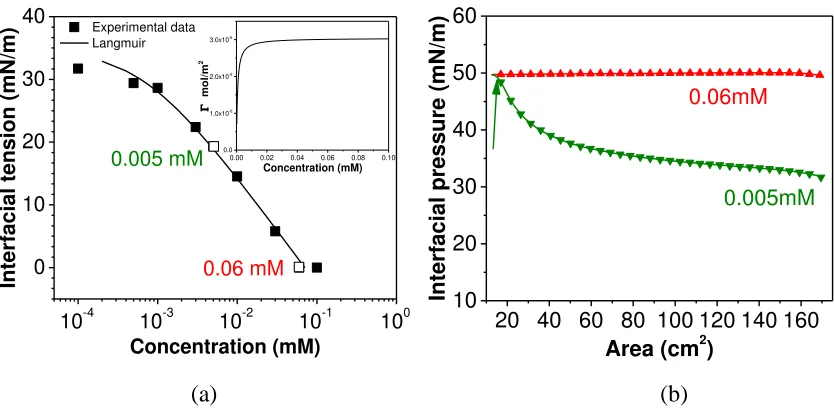
The interfacial tension of C5Pe at the xylene-water interface is shown in Figure 4 (a). The concentration of C5Pe in xylene solutions was varied from 10-4 to 0.1 mM and the aqueous phase
pH was kept constant at pH 9. The equilibrium interfacial tension values for 0.06 mM and 0.1
mM C5Pe solutions were determined by linear extrapolation from vs. (dynamic interfacial tension data).40 Interfacial tensions at higher C5Pe concentrations (above 0.1 mM) were not measured due to the extremely low interfacial tension that caused difficulties in forming a stable droplet at the needle tip. It should be noted that the interfacial tension reached a constant value within a short period of time over which the interface remained purely viscous. Hence, the effect of interface deviatoric stresses on the measured interfacial tension is negligible.41
(a) (b)
Figure 4. (a) Interfacial tension isotherm of C5Pe dissolved in xylene at the xylene-water interface
(aqueous pH=9), inset: C5Pe equilibrium adsorption isotherm; (b) Langmuir compressional isotherms obtained with 0.005 mM and 0.06 mM C5Pe in xylene at the corresponding conditions.
The linear part of the interfacial tension isotherm presented in Figure 4 (a) can be analyzed using
Gibbs equation: , to calculate the maximum adsorption of C5Pe at the
liquid-liquid interface.42 In Gibbs equation, represents the excess solute per unit area at the 20 40 60 80 100 120 140 160
10 20 30 40 50 60 0.06mM 0.005mM Interfacial p ressure (mN/m)
Area (cm2)
10-4 10-3 10-2 10-1 100 0
10 20 30 40
0.00 0.02 0.04 0.06 0.08 0.10
[image:15.612.99.516.360.567.2]interface, R is the universal gas constant, T is the temperature, is the interfacial tension, and is
the bulk concentration of C5Pe in xylene. Assuming a complete dissociation of C5Pe at pH 9, for C5Pe at water-xylene interface was determined to be 3.03×10⁻⁶ mol/m2. The area per
molecule can then be calculated using equation: ; where NA is the Avogadro’s
constant. Substitution of (3.03×10⁻⁶ mol/m2) in the above equation results in an area per
molecule of 0.55 nm2. A previous study43 reported an area per molecule of C5Pe in the flat-on arrangement (parallel to the interface) to be greater than 1.5 nm2, while = 0.6 nm2 when the molecule is in the head-on arrangement (i.e. perpendicular to the interface). The area per molecule of 0.55 nm2 is close to the actual size (0.6 nm2) of the C5Pe molecule in the perpendicular
orientation and indicates full coverage of the oil-water interface. Analysis of the experimental data
confirms Langmuir-type adsorption with the C5Pe molecule adsorption isotherm described by:
, where is the adsorption equilibrium constant. The adsorption isotherm of C5Pe
at the xylene-water interface is shown in the inset of Figure 4 (a).
The compressional behavior of C5Pe layers at the xylene-water interface was studied by an interfacial Langmuir trough. Interfacial compression imposes one mode of deformation of
molecules at the interface and has been historically used to study mechanisms of emulsion stability.33,44 The -A isotherms of C5Pe adsorption at the xylene-water interface using two
trough area the interfacial pressure equals 32 mN/m and the interfacial pressure gradually increased as the interfacial layer was compressed. As the maximum interfacial layer compression is approached (trough area equal to 15 cm2), the interfacial pressure reached 49.5 mN/m. This value (identified by the green arrow) is almost identical to the interfacial pressure measured for 0.06 mM C5Pe at the maximum trough area. It appears that the limiting pressure ~ 50 m/Nm corresponds to a fully packed C5Pe interfacial layer and any further compression will deform the interface and possibly form a multilayer structure. For 0.005 mM C5Pe in xylene solution, a ~ 90% reduction in the interfacial area is required to reach this limiting interfacial pressure. A high
compressional ratio (initial trough area to final trough area) to reach the maximum interfacial pressure confirms that the C5Pe molecules initially sparsely occupy the xylene-water interface. The total trough area reduction to reach the limiting interfacial pressure is reasonable when considering a greater than 90% difference in initial C5Pe bulk concentrations (0.005 mM and 0.06 mM) in xylene. With a low interfacial coverage of C5Pe molecules at 0.005 mM in xylene, there is little resistance to droplet-droplet coalescence and the emulsions are anticipated to rapidly dewater as observed in Figure 1. At a higher C5Pe concentration (0.06 mM C5Pe in xylene) the interface is completely covered, providing a barrier to droplet-droplet coalescence. However, reaching the maximum surface coverage is not the only property required to prevent rupture of the intervening liquid film, as will be discussed in Section 3.3.2 below.
3.3.2 Interfacial shear rheology and crumpling ratio
Interfacial shear rheology of C5Pe molecules adsorbed at the xylene-water interface was measured for different initial bulk concentrations of C5Pe in xylene (0.005 mM, 0.2 mM, 0.5 mM and 0.725 mM). For all concentrations, Figure 5 (a) shows the development in both the viscous (G”) and
elastic (G’) moduli with increasing interfacial aging. At short aging time the interface exhibits a film of viscous-dominant nature with G” > G’. Continuous accumulation of C5Pe molecules at the water-xylene interface results in an increasing viscous contribution and a slower development of elastic contribution. For all concentrations except for the lowest concentration of 0.005 mM C5Pe, the elastic modulus eventually exceeds the viscous modulus as the interfacial layer changes
dominant microstructure. Since increasing the frequency of oscillation shows only a slight
dependency on the G’:G” ratio at the condition G” G’, as shown in Figure 6a, the effect of interface aging on the transition time of the interface from viscous to elastic film was conducted at a fixed frequency of 0.5 Hz.
As shown in Figure 5 (b), increasing the initial bulk concentration of C5Pe in xylene reduced the film transition time from 47 min at 0.2 mM to 0 min at 0.725 mM C5Pe in xylene. It should be noted that the time between the sample loading and the collection of the first data point was approximately 1 to 2 min. Considering the thin liquid film lifetime shown in Figure 2 as a measure of droplet stability, there is a good agreement between the interfacial layer transition time and the stability of water droplets in C5Pe xylene solutions, as shown in Figure 5 (c). After 30 min aging at the lowest concentration of 0.005 mM CP5e, the interfacial layer remains purely viscous with no measurable shear elasticity (G’ = 0 N/m), indicating the absence of a coherent interfacial network. This observation is in good agreement with the corresponding -A isotherm shown in Figure 4 (b). The lack of a coherent interfacial barrier indicates minimal resistance of the
intervening liquid film to droplet coalescence, leading to an unmeasurable short film lifetime and hence an unstable emulsion as shown in Figure 1.
Comparing the interfacial shear rheology (Figure 5 (a)) and thin liquid film stability (Figure 2 (point b)) for water at pH = 9 in contact with 0.2 mM C5Pe in xylene solution, the thin liquid film data confirm very little resistance of the intervening liquid film to droplet coalescence and the interfacial layers remain viscous dominant. The transition time (G’ ~ G”) for the interfacial layer was measured at 48.7 5.9 min, ~ 20 min beyond the aging time used for the thin film drainage
experiments. Although the interfacial layer remains viscous dominant, there is a measurable elasticity which contributes to the slight increase in droplet stability, as compared to the purely
viscous system of 0.005 mM C5Pe in xylene where the lifetime of the intervening thin liquid film is so short that cannot be measured.
Figure 5. (a) Interfacial rheology (G’ and G”) as C5Pe molecules adsorb at the water-xylene
interface during aging; (b) Aging time for G’ = G’’ (film transition time) as a function of the initial
C5Pe bulk concentration (water pH 9); (c) Comparisons of interfacial viscoelastic properties
(G’/G”) and lifetimes of the intervening liquid films after 30 min aging as a function of the initial C5Pe bulk concentration.
For 0.5 mM C5Pe in xylene solution the thin liquid film data (Figure 2 (point c)) confirms high stability to droplet coalescence, with the intervening film eventually being ruptured after approximately ~ 5 min. After 30 min aging, the interfacial layer as measured by shear rheology
(Figure 5 (a and c)) corresponds to an elastically dominant microstructure with G’ : G” = 1.31 : 1.
At the highest concentration of 0.725 mM C5Pe in xylene solution, an elastically dominant
interfacial layer forms rapidly with G’ > G” at t = 0 min. Hence, after 30 min aging the interfacial layer is strongly elastic (G’ : G” = 2.75 : 1) and the corresponding intervening liquid film remains stable to coalescence as shown in Figure 2.
Correlating the thin liquid film stability and interfacial rheology data it becomes evident that the stability of the intervening liquid film against coalescence is strongly influenced by shear elasticity of the interfacial layer (Figure 5 (c)). For a purely viscous interfacial layer there is little resistance
0
1500
3000
4500
6000
10
-610
-510
-410
-310
-210
-1 0.005mM 0.5mM 0.725mM 0.2mMMo
duli (N/m
)
Time (s)
G' :solid symbolsG":open symbols
(a)
[image:19.612.85.535.88.322.2]to film drainage and rupture, leading to an unmeasurably short lifetime of the intervening liquid film is when the two interfacial layers are brought in contact. For elastic dominated interfacial layers the intervening film is stabilized by the formation of a coherent microstructure, preventing the thin film rupture. While measurable elasticity would confirm the formation of a coherent C5Pe interfacial layer, the data shown in Figure 5 (c) would also indicate that this coherent structure must also be elastically dominant to inhibit and prevent rupture of the intervening liquid film and droplet coalescence. The second mode of interfacial deformation, dilatation, has not been considered in the current study. Previous research has confirmed that while the interfacial
dilatational moduli are significant, the elastic contribution is dominant from short aging times,
with the ratio G’:G” showing little time dependence. Hence, the progressive time dependent increase in droplet stability cannot be suitably described by the dilatational contribution.27
Many researchers relate the shear elasticity of interfacial layers to a physically cross-linked system.26,45 Frequency sweeps are often used to determine the kinetics of network formation and degree of cross-linking.46-48 For a pre-consolidated interface, both G’ and G” show a strong
dependence on the oscillation frequency, when G’ < G”. After consolidation, G’ >G”, both moduli show weak dependence on the frequency, proportional to n, with n = 0 – 1.26 In the current study,
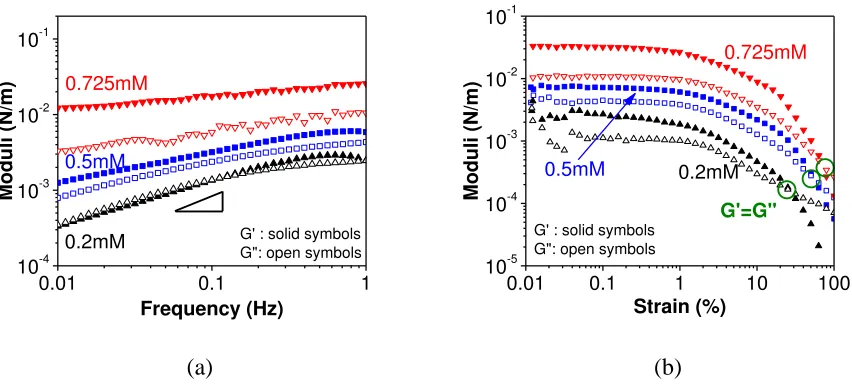
frequency sweeps at constant strain (0.8%) were performed on C5Pe interfacial layers aged for 100 min. Figure 6 (a) shows that all interfacial layers exhibit a weak dependence on the oscillation frequency with the power exponent (n) between 0 and 1 (Table 1). Concentration dependence is also observed, with higher C5Pe concentrations forming interfacial layers characteristics of a greater degree of cross-linking, thus supporting the increased interfacial elasticity and droplet stability at higher C5Pe concentrations.
To determine the effect of consolidation on the mechanical strength of the interfacial layer, strain amplitude sweeps at constant frequency (0.5 Hz) were also conducted on the aged interfacial layers, as shown in Figure 6 (b). In the linear viscoelastic region, G’ and G” are independent of strain amplitude, implying a coherent microstructure. With an increasing strain, both elastic and
and 0.725 mM, the yield point was measured at 27.3%, 55.5% and 71.7% strain, respectively (yield point identified by green circles in Figure 6 (b)), confirming the formation of stronger interfacial layers at higher C5Pe concentrations. This general trend is in good agreement with the emulsion stability and thin liquid film data discussed above.
0.01 0.1 1
10-4 10-3 10-2 10-1
G' : solid symbols G": open symbols
0.725mM 0.2mM 0.5mM Mo duli ( N/m) Frequency (Hz)
0.01 0.1 1 10 100
10-5 10-4 10-3 10-2 10-1
G' : solid symbols G": open symbols
0.725mM 0.5mM Mo duli ( N/m) Strain (%) 0.2mM G'=G"
[image:21.612.89.515.167.360.2](a) (b)
Figure 6. Interfacial shear response of xylene-water interfaces stabilized by C5Pe at different bulk
[image:21.612.186.426.492.573.2]concentrations (water pH 9): (a) Frequency sweep; and (b) Strain sweep. Both measurements were conducted after 6,000 s interfacial aging.
Table 1. G’ and G” power exponents (n)
Bulk concentration
(mM) G' G''
0.2 0.51 0.43
0.5 0.37 0.37
0.725 0.17 0.27
geometry: increasing the elasticity of the interfacial layer is matched by an increase in the droplet crumpling ratio. It is worth noticing that the crumpling ratio and G’/G” have a nearly linear relationship, as shown in the inset of Figure 7. For this particular system, the crumpling ratio at the transition condition is equal to ~ 0.65 and the crumpling ratio continues to increase as the
G’/G” ratio approaches 1.2. This crumpling ratio value confirms that the interfacial layer is able to deform first before the interfacial structure reaches a critical jamming concentration and the interfacial layer wrinkles, as also observed in the Langmuir compressional interfacial isotherms (Figure 4 (b)). However, the ability of the interfacial layer to deform is diminished as the G’/G”
[image:22.612.187.450.286.479.2]ratio increases beyond 1, thus minimizing interfacial layer mobility and creating a physical barrier that can resist droplet-droplet coalescence.
Figure 7. Measured crumpling ratios of water droplets (pH 7) in 0.2 mM C5Pe in xylene solutions
and the corresponding interfacial shear elasticity (G’) as a function of interface aging. Inset: comparison of crumpling ratio and G’/G”.
3.3.3 Imaging of interfacial layers using BAM and AFM
The interfacial layers in shear rheology and thin liquid film experiments were formed by diffusion-controlled adsorption and rearrangement of C5Pe molecules/aggregates. To better interpret the
observed changes in film lifetimes, BAM and AFM (insets in Figure 8) images of C5Pe layers collected after 30 min aging are shown in Figure 8. Initial observations indicate that the structure of the formed interfacial layer is dependent on the initial C5Pe bulk concentration.
0 50 100 150 200 250 300 0.0 0.2 0.4 0.6 0.8 1.0 Storage m odulus (N/m ) Crum pli ng rati o Time (min) 10-4 10-3 10-2 elastic
0.4 0.6 0.8 1.0 1.2 0.2 0.4 0.6 0.8 1.0 Crumpling rat io G'/G''
CR, pH 7
G', pH 7
(a) (b) (c)
Figure 8. BAM and AFM (inset, 5 5 µm) images for C5Pe layers formed at the water-xylene
interface. The aqueous phase was buffered at pH 9 and the C5Pe concentration in xylene increases in the order of (a) 0.005 mM; (b) 0.06 mM; and (c) 0.2 mM. The scale bar in BAM images is 200
m.
Observations of the interface formed in the presence of 0.005 mM C5Pe in xylene confirmed a
very mobile interfacial layer (see the video in Supporting Information). The stripes observed in Figure 8 (a) confirm the partitioning of C5Pe molecules at the xylene-water interface. Due to limited coverage of C5Pe at the interface, the image becomes distorted by moving interfacial layer. Interfacial layer mobility and the absence of a coherent interfacial microstructure would support both the results of compression isotherms and interfacial shear rheology data at the equivalent C5Pe concentration. At higher C5Pe concentration (0.06 mM), the interfacial layer is no longer mobile and appears rigid. Although not clearly visible in the image, striations in the film begin to develop. In addition, several bright dots appear in the images, which imply the formation of C5Pe aggregates at the xylene-water interface. Further investigation of this C5Pe layer by AFM confirms an interconnected network of smaller and larger spherical aggregates with a root-mean-square (rms) roughness of 8.23 nm, forming striations as observed in the inset of Figure 8 (b). The formation of interfacial striations observed here are in good agreement with observations in our previous study wherein the large hydrophobic group and the small hydrophilic head group of the C5Pe molecules prevent the formation of a uniform monolayer. Instead the C5Pe molecules preferentially form micelle-like aggregates.30,49 At 0.2 mM C5Pe in xylene, a thicker layer with readily identifiable
the increased interaction of C5Pe aggregates to form large clusters, as shown by an increased relative layer height (rms roughness ~ 20.9 nm) and ‘blurriness’ of some interfacial features as measured by AFM.
Correlating the interfacial layer structure to the intervening thin liquid film stability and shear rheology data, it becomes evident that partial and complete interfacial coverage by C5Pe molecules is not a sufficient condition to stabilize water droplets. Even though a thick interfacial layer can form (0.2 mM C5Pe xylene and ~ 30 min aging), the intervening liquid film remains unstable (film
lifetime ~ 10 s) where the interfacial shear rheology measurement confirms the viscous dominant behavior of the interfacial layers at the G’ : G” ratio equal to 1 : 1.21. Hence to prevent the coalescence of water droplets, the C5Pe interfacial layer surrounding the droplets should be composed of multiple C5Pe aggregates that are able to form an elastic dominant interfacial. The elasticity of interfacial layers is governed by the accumulation, rearrangement and cross-linking of C5Pe molecules/aggregates, with the layer elasticity depending on the C5Pe bulk concentration and aging time of interfacial layers. Previous research studying similar insoluble polyaromatic interfacial species confirmed that when in a soft-glassy state (G’ > G”), the interfacial layer exhibits a substantial shear yield stress in the order of ~ 104 N/m2. Lack of interfacial mobility and the presence of associated shear yield stress were identified as the key property to prevent droplet coalescence.27
4. CONCLUSIONS
The interfacial properties of a polyaromatic organic compound C5Pe at the xylene-water interface were studied. C5Pe concentration was shown to strongly affect the stability of corresponding emulsions and intervening thin liquid films. The intervening liquid film stability was found to correlate to the shear viscoelasticity (G’ : G”) of the C5Pe interfacial layer. At basic condition (pH 9) the emulsion stability increased with increasing initial C5Pe concentration, showing a critical
C5Pe stabilizing concentration of ~ 0.03 – 0.06 mM in xylene. A similar trend was found in the measurement of C5Pe film lifetime, although the critical stabilizing concentration was much
related to the irreversibility of C5Pe adsorption and advection-driven adsorption during emulsification.
Interfacial tension isotherm confirmed high interfacial activity of C5Pe at pH 9, which results from the deprotonation of –COOH group. The mechanical properties of C5Pe interfacial layers were evaluated by oscillatory shear experiments. The rigid nature of interfacial layers at higher C5Pe concentrations was confirmed by the interfacial layers exhibiting a high shear elasticity (G’). The time-dependent shear rheology was determined, highlighting the transition of the interfacial layer
from a viscous to an elastic dominant microstructure, with the transition condition of G’ ~ G” occurring faster at higher C5Pe concentrations. The transition to an elastic dominant interface was found to be in good agreement with the onset of increased stability of the intervening thin liquid film.
Visualization of interfacial layers by BAM and AFM confirmed complete interfacial coverage occurred only at C5Pe concentrations of 0.06 mM and higher, in good agreement with the compressional isotherm data. While these interfacial layers appeared immobile (visual assessment), they did not necessarily prevent thin liquid film drainage and droplet coalescence. Even at 0.2 mM C5Pe in xylene solution, BAM and AFM images confirmed the accumulation of many C5Pe aggregates, forming a thick interfacial layer, yet the film lifetime remained short ~ 10 s and the layer microstructure, viscous dominant after 30 min aging. These important findings confirm that the continual accumulation of C5Pe and the time-dependent rearrangement of C5Pe aggregates to form an elastically dominant interfacial microstructure is a requirement to prevent rupture of the intervening liquid film and droplet coalescence.
ACKNOWLEDGEMENTS
The authors gratefully acknowledge financial support from the Natural Sciences and Engineering
Research Council of Canada (NSERC) under Industrial Research Chair Program in Oil Sands Engineering with partial support from Alberta Innovates-Energy and Environmental Solutions,
REFERENCES:
(1) Ghosh, S.; Rousseau, D. Fat Crystals and Water-in-Oil Emulsion Stability. Curr. Opin. Colloid Interface Sci.2011, 16, 421-321.
(2) Tadros, T. F. Emulsion Science and Technology: A General Introduction. In Emulsion Science and Technology. Tadros, T. F., Eds.; Wiley-VCH Verlag GmbH and Co. KGaA: Weinheim, 2009; pp. 1-56.
(3) Yoneyama, T.; Yamaguchi, M.; Tobe, S.; Nanba, T.; Ishiwatari, M.; Toyoda, H.; Nakamura, S.; Kumano, Y.; Takata, S.; Ito, H. Water-in-Oil Emulsion Type Cosmetics. U.S. Patent 5,015,469,
May 14, 1991.
(4) Reed, S. G.; Bertholet, S.; Coler, R. N.; Friede, M. New Horizons in Adjuvants for Vaccine Development. Trends Immunol. 2009, 30, 23-32.
(5) Berg, J. C. Emulsions and Foams. An Introduction to Interfaces & Colloids: The Bridge to Nanoscience, World Scientific: Singapore ; Hackensack, NJ., 2010; pp. 643-694.
(6) Vignati, E.; Piazza, R.; Lockhart, T. P. Pickering Emulsions: Interfacial Tension, Colloidal Layer Morphology, and Trapped-Particle Motion. Langmuir 2003, 19, 6650-6656.
(7) Chevalier, Y.; Bolzinger, M.-A. Emulsions Stabilized with Solid Nanoparticles: Pickering Emulsions. Colloids Surf., A 2013, 439, 23-34.
(8) McLean, J. D.; Kilpatrick, P. K. Effects of Asphaltene Solvency on Stability of Water-in-Crude-Oil Emulsions. J. Colloid Interface Sci. 1997, 189, 242-253.
(9) Yan, Z.; Elliott, J. A. W.; Masliyah, J. H. Roles of Various Bitumen Components in the Stability of Water-in-Diluted-Bitumen Emulsions. J. Colloid Interface Sci. 1999, 220, 329-337.
(10) Wu, X. Investigating the Stability Mechanism of Water-in-Diluted Bitumen Emulsions through Isolation and Characterization of the Stabilizing Materials at the Interface. Energy Fuels
2003, 17, 179-190.
(11) Kilpatrick, P. K. Water-in-Crude Oil Emulsion Stabilization: Review and Unanswered Questions. Energy Fuels 2012, 26, 4017-4026.
(12) Nordgård, E. L.; Landsem, E.; Sj̈blom, J. Langmuir Films of Asphaltene Model Compounds and Their Fluorescent Properties. Langmuir 2008, 24, 8742-8751.
(13) Nenningsland, A. L.; Gao, B.; Simon, S.; Sjöblom, J. Comparative Study of Stabilizing Agents for Water-in-Oil Emulsions. Energy Fuels 2011, 25, 5746-5754.
(15) Exerowa, D.; Gotchev, G.; Kolarov, T.; Khristov, Khr.; Levecke, B.; Tadros, Th. Interaction Forces in Thin Liquid Films Stabilized by Hydrophobically Modified Inulin Polymeric Surfactant. 2. Emulsion Films. Langmuir 2007, 23, 1711-1715.
(16) Khristov, K. J.; Taylor, S. D.; Czarnecki, J.; Masliyah, J. Thin Liquid Film Technique —
Application to Water-Oil-Water Bitumen Emulsion Films. Colloids Surf. A 2000, 174, 183-196. (17) Tchoukov, P.; Yang, F.; Xu, Z.; Dabros, T.; Czarnecki, J.; Sj̈blom, J. Role of Asphaltenes in Stabilizing Thin Liquid Emulsion Films. Langmuir 2014, 30, 3024-3033.
(18) Tchoukov, P.; Czarnecki, J.; Dabros, T. Study of Water-in-Oil Thin Liquid Films: Implications for the Stability of Petroleum Emulsions. Colloids Surf., A 2010, 372, 15-21.
(19) Bergeron, V.; Radke C. J. Equilibrium Measurements of Oscillatory Disjoining Pressures in
Aqueous Foam Films. Langmuir 1992, 8, 3020-3026.
(20) Sedev, R.; Exerowa, D. DLVO and non-DLVO Surface Forces in Foam Films From Amphiphilic Block Copolymers. Adv. Colloid Interface Sci.1999, 83, 111-136.
(21) Stubenrauch, C.; von Klitzing, R. Disjoining Pressure in Thin Liquid Foam and Emulsion Films—New Concepts and Perspectives. J. Phys.: Condens. Matter 2003, 15, R1197-R1232. (22) Anklam, M. R.; Saville, D. A.; Prud'homme, R. K. Electric-Field-Induced Rupture of Polymer-Stabilized Oil Films. Colloid Polym. Sci. 1999, 277, 957-964.
(23) Sztukowski, D. M.; Yarranton, H. W. Rheology of Asphaltene-Toluene/Water Interfaces. Langmuir 2005, 21, 11651-11658.
(24) Dicharry, C.; Arla, D.; Sinquin, A.; Graciaa, A.; Bouriat, P. Stability of Water/Crude Oil Emulsions Based on Interfacial Dilatational Rheology. J. Colloid Interface Sci. 2006, 297, 785-791.
(25) Spiecker, P. M.; Kilpatrick, P. K. Interfacial Rheology of Petroleum Asphaltenes at the
Oil−Water Interface. Langmuir 2004, 20, 4022-4032.
(26) Verruto, V. J.; Le, R. K.; Kilpatrick, P. K. Adsorption and Molecular Rearrangement of
Amphoteric Species at Oil−Water Interfaces. J. Phys. Chem. B 2009, 113, 13788-13799.
(27) Harbottle, D.; Chen, Q.; Moorthy, K.; Wang, L.; Xu, S.; Liu, Q.; Sj̈blom, J.; Xu, Z. Problematic Stabilizing Films in Petroleum Emulsions: Shear Rheological Response of
Viscoelastic Asphaltene Films and the Effect on Drop Coalescence. Langmuir 2014, 30, 6730-6738.
(29) Platikanov, D.; Exerowa, D. Thin Liquid Films. In Fundamentals of Interface and Colloid Science, Lyklema, J., Eds. Academic Press: New York, 2005; Vol. 5, pp 1-91.
(30) Wang, J.; Lu, Q.; Harbottle, D.; Sjöblom, J.; Xu, Z.; Zeng, H. Molecular Interactions of a Polyaromatic Surfactant C5pe in Aqueous Solutions Studied by a Surface Forces Apparatus. J. Phys. Chem. B 2012, 116, 11187-11196.
(31) Scheludko, A.; Platikanowa, D. Utersuchung D̈Nner Fl̈Ssinger Schichten Auf Quecksiber Schichten Auf Quecksiber. Kolloid Z. Z. Polym. 1961, 175, 150-158.
(32) Vandebril, S.; Franck, A.; Fuller, G. G.; Moldenaers, P.; Vermant, J. A Double Wall-Ring
Geometry for Interfacial Shear Rheometry. Rheol. Acta 2009, 49, 131-144.
(33) Zhang, L. Y.; Xu, Z.; Masliyah, J. H. Characterization of Adsorbed Athabasca Asphaltene Films at Solvent-Water Interfaces Using a Langmuir Interfacial Trough. Ind. Eng. Chem. Res.
2005, 44, 1160-1174.
(34) Xu, R.; Dickinson, E.; Murray, B. S. Morphological Changes in Adsorbed Protein Films at the Oil-Water Interface Subjected to Compression, Expansion, and Heat Processing. Langmuir
2008, 24, 1979-1988.
(35) Murray, B. S.; Xu, R.; Dickinson, E. Brewster Angle Microscopy of Adsorbed Protein Films at Air–Water and Oil–Water Interfaces after Compression, Expansion and Heat Processing. Food Hydrocolloids 2009, 23, 1190-1197.
(36) Kim, F.; Cote, L. J.; Huang, J. Graphene Oxide: Surface Activity and Two-Dimensional Assembly. Adv. Mater. 2010, 22, 1954-1958.
(37) Tsamantakis, C.; Masliyah, J.; Yeung, A.; Gentzis, T. Investigation of The Interfacial Properties of Water-in-Diluted-Bitumen Emulsions Using Micropipette Techniques. J. Colloid Interface Sci. 2005, 284, 176-183.
(38) Gao, S.; Moran, K.; Xu, Z.; Masliyah, J. Role of Bitumen Components in Stabilizing Water-in-Diluted Oil Emulsions. Energy Fuels 2009, 23, 2606-2612.
(39) Yarranton, H. W.; Hussein, H.; Masliyah, J. H. Water-in-Hydrocarbon Emulsions Stabilized by Asphaltenes at Low Concentrations. J. Colloid Interface Sci. 2000, 228, 52-63.
(40) Bendure, R. L. Dynamic Surface Tension Determination with the Maximum Bubble Pressure
Method. J. Colloid Interface Sci. 1971, 35, 238-248.
(41) Yeung, A.; Dabros, T.; Masliyah, J. Dissipative Interfaces and Departures from the
(42) Barnes, G.; Gentle, I. Adsorption and the Thermodynamics of Surfaces. Interfacial Science: An Introduction, 2nd Ed.; Oxford University Press Inc: New York, 2011; pp 43-54.
(43) Nordgård, E. L.; Sørland, G.; Sjöblom, J. Behavior of Asphaltene Model Compounds at W/O Interfaces. Langmuir 2010, 26, 2352-2360.
(44) Ese, M. H.; Yang, X.; Sjöblom, J. Film Forming Properties of Asphaltenes and Resins. A Comparative Langmuir–Blodgett Study of Crude Oils from North Sea, European Continent and Venezuela. Colloid Polym. Sci. 1998, 276, 800-809.
(45) McLean, J. D.; Kilpatrick, P. K. Effects of Asphaltene Aggregation in Model Heptane–
Toluene Mixtures on Stability of Water-in-Oil Emulsions. J. Colloid Interface Sci. 1997, 196, 23-34.
(46) Sollich, P.; Lequeux, F.; Hébraud, P.; Cates, M. E. Rheology of Soft Glassy Materials. Phys. Rev. Lett. 1997, 78, 2020-2023.
(47) Srivastava, S.; Leiske, D.; Basu, J. K.; Fuller, G. G. Interfacial Shear Rheology of Highly Confined Glassy Polymers. Soft Matter 2011, 7, 1994-2000.
(48) Allen, R.; Bao, Z.; Fuller, G. G. Oriented, Polymer-Stabilized Carbon Nanotube Films: Influence of Dispersion Rheology. Nanotechnology 2013, 24, 015709.