·~
\.)Environment and Quality of Life
1987
Programme Progress Report
Industrial Hazards
Commission of the European Communities
Directorate-General for Science Research and Development Joint Research Centre, lspra Establishment
Environment and Quality of Life
1987
Programme Progress Report
Industrial Hazards
Commission of the European Communities
Directorate-General for Science Research and Development Joint Research Centre, lspra Establishment
Published by the
COMMISSION OF THE EUROPEAN COMMUNITIES
Directorate-General
Telecommunications, Information Industries and Innovation
Batiment Jean Monnet LUXEMBOURG
LEGAL NOTICE
Neither the Commission of the European Communities nor any person acting on behalf of the Commission is responsible for the use which might be made of the following information.
Cataloguing data can be found at the end of this publication.
Luxembourg: Office for Official Publications of the European Communities, 1988
© ECSC- EEC- EAEC, Brussels-Luxembourg, 1988
CONTENTS
Introduction . ...
.. ... .
Summary of Main Results
Research Activities:
1 . Safety and Reliability Assessment .
2. Management of Industrial Risk ...
3. Protection against Runaway Reactions
Explorative Studies
Emergency Planning
JRC Publications ...
Glossary ... ..
List of Authors .
3
5
.. ... 7
.. ... " 21
... 29
. 39
···
... 41
. ... 43
INTRODUCTION
The JRC* research programme "Industrial Hazards" considers the risks associated with the operation of hazardous industries, such as processing and energy and of large technological systems such as transportation. The programme is focused, at present, on risk associated with major accidents, as problems associated with diffuse risk have been considered in the JRC Environmental Protection programme.
After Flixborough, Seveso, Amoco Cadiz, Bhopal, Mexico City, Sandoz, etc. there is growing public awareness of menaces to public health and to the environment which result from sudden catastrophic events. Public authorities, therefore, are seeking greater control over major hazardous industrial undertakings. An example of this public attention is the European Community (EC) directive on "Major Accident Hazards of Certain Industrial Ac-tivities", no. 82/501. This directive requires the Member States to take the necessary measures to protect health and safety of the public and to protect the environment: safety reports, train-ing and drills, incident reporttrain-ing, emergency planntrain-ing provisions, etc.
The implementation of an adequate control of major accidents risks requires a consistent R & D effort, aiming to develop methods and to obtain data for the identification, evaluation and management of low frequency high consequences events. This R & D area is a very large indeed: it covers systems reliability, decision theory and decision support systems, behaviour of chemicals in (industrial) processes, safe pressure relief systems confined and unconfined explosions, man-systems interaction, atmospheric diffusion of toxic substances, emergency simula-tion and planning.
Many of these problems are analogous with those studied in the nuclear engineering field and the very considerable experience acquired in the assessment of nuclear plant safety can be ap
* see for the abreviations the Glossary
plied to other engineering areas.
Actions crossing the border between nuclear/non-nuclear safe-ty research are frequent and natural. We can mentioned at Euro-pean level: the COST action on «Systems of Socia-Technologies and Industrial Safety», the research on cloud explosions carried out in the framework of the Reactor Safety shared-cost pro-gramme, the activity of EuReDatA sponsored by the JRC, the collaboration of JRC with chemical industry for the development of risk analysis computer codes, etc.
The tasks of the JRC in this frame are:
- to provide scientific support to the environmental policy of the EC
- to elaborate means for the enforcement of existing Communi-ty regulations
- to pursue medium and long-term studies as necessary background information for accident prevention.
This means that the JRC activities will be carried out in close collaboration with DG XI which is responsible, in association with DG V, for the Council Directive above mentioned and for the development of the Commission policy on major industrial hazards; with the DG XII/E's shared-cost programme on Major Technological Hazards which complements and augments the JRC activities to form a coherent whole and with Member State industries and research institutes in order to assure common and relevant experiments.
SUMMARY OF MAIN RESULTS
The JRC research programme "Industrial Hazards" has been focused, over the year 1987, on the following three research ac-tivities:
Industrial Safety and Reliability Assessment (Risk Analysis), Management of Industrial Risk, and
Experiments and Theoretical Studies on Runaway Reactions.
These activities complement the shared-cost multiannual pro-gramme in th field of Major Technological Hazards and support the regulatory actions of DG XI within the frame of the EC direc-tive on "Major Accident Hazards of Certain Industrial Activities".
Moreover, JRC is exploring the possibility to start a new activity on emergency planning for industrial hazards, on which a con-ference in collaboration with DG XI has been held in november 1987 at Varese.
The results obtained during the 1987 period can be summaris-ed as fellows.
Safety and Reliability Assessment
The Benchmark Exercise on Major Hazard Analysis (BE-MHA) project, which aims to compare risk studies independently per-formed by different expert teams on a same reference subject, has been finalised. The BE-MHA aims at establishing a state-of-the-art review on procedures, methods, models and data bases for risk analysis of chemical facilities; at assessing correspon-ding uncertainties and limitations; at contributing towards com-mon approaches for risk analysis. The reference subject is an ammonia storage facility with undersea and underground pipelines connecting it to a sea terminal and to in-plant storage facilities respectively.
The project is partially funded by the shared-cost multiannual ac-tion programme on Major Technological Hazards, by DG XI (En-vironment Consumer Protection & Nuclear Safety) and by JRC. The latter is ensuring the coordination of the project and will per-form the evaluation of the results (expected by mid 1989). 13 European teams are involved in the project, represP-nting about 20 organisations from 1 0 European countries and belonging to industry, governmental bodies, research institutes and specialised consultant groups.
The MARS (Major Accident Reporting System) accident data base is now fully operational in agreement with DG XI and within the frame of the post Seveso directive. The accident notified by the Member States have been recorded and their analysis started in order to install a correct feedback from experience events for contributing to an effective prevention policy.
Whereas industrial and research bodies such as SNAM (I), ENICHEM (I), and GRS (FRG) showed interest on the informatic tools already developed by JRC for reliability analysis (e.g. SALP-PC), significant progress has been achieved towards the develop-ment of the expert system STARS (Software Tool for Advanced Reliability and Safety analysis) in collaboration with RIS¢ (DK) and of tools based on the DYLAM (Dynamic Logic Analytical Methodology) approach for incident scenario evaluation.
Promotion of collaborative actions on reliability and incident data
has been pursued: the support given to associations like ESR-RDA, ESRA and EuReDatA contributes to link JRC activities with general needs.
Management of Industrial Risk
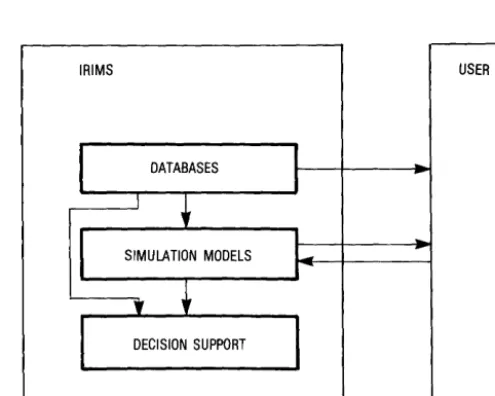
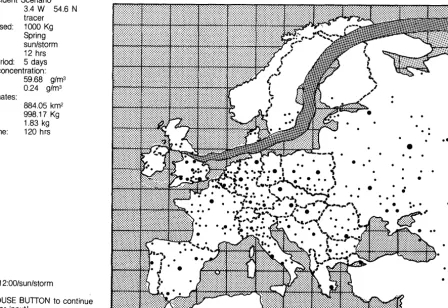
The activity «Risk Management» has been mainly focused on the use and development of the IRIMS system. The main elements of the IRIMS system are a menu-driven, mouse-actuated user interface which provides easy access to the system; an infor-mation system which contains knowledge and data bases, in-ference machine and data base management systems; and a set of simulation models. Output is primarily in graphical form, making use of high-resolution colour graphics.
At the beginning of 1987 a demonstration prototype of the I Rl MS system was operating at lspra and had been upgraded, primari-ly by adding interconnections between modules.
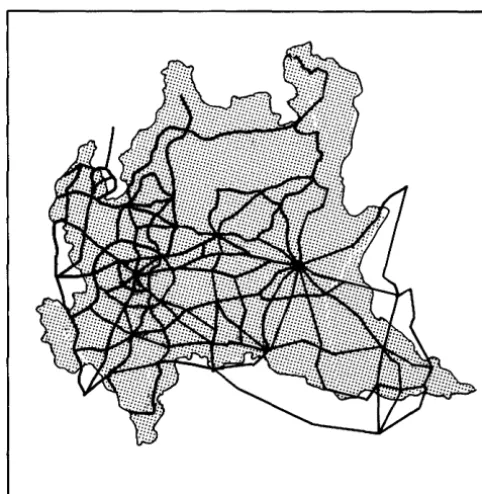
A stand-alone transportation risk system, HELP, was developed, based on transporting the HASTM transportation risk model and the DIDASS-based optimisation module from the SUN machine to an IBM PC AT. The HELP transportation module, describes the road network in terms of a graph with arcs and nodes.
In collaboration with the Dutch Ministry responsible for en-vironmental affairs, the integrated lspra Risk Management Sup-port (IRIMS) software system is being developed to produce comparative risk scenarios for the production, transport and use of cholorine in the Netherlands. The system is now including a 3-dimensional model allowing risk analysis for heavy gas diffu-sion and crisis management.
Protection against Runaway Reactions
This research activity is focused on two topics:
- chemical process dynamics in runaway conditions (characteristics of chemical processes and validation of ex-isting and possible development of suitable models) and
- the behaviour of twophase/twocomponent fluid flow in ducts, vessels, vessel/duct, as well as back pressure effects and discharge characteristics of venting systems (with safety pressure relief devices).
Complementary research in the field of multiphase-multicomponent (MPMC) fluid flow has been performed by means of the improved small scale MPMC-facility, including phenomological properties on two-phase fluid flow regimes; depressurisation tests and parametric studies to assess the ap-plication of the SAFIRE code on predicting flow behaviour in ven-ting systems.
Collaboration with the DIERS (Design Institute for Emergency Relief Systems) users group has been continued and the analysis the DIERS' SAFIRE code improved.
JRC activities on runaway reactions are discussed and review-ed by the European Contact Group on Runaway Reactions which includes industrial partners (Rhone Poulenc and Roussel UCLAF /F/, Hoechst /D/, ICI /UK/, DSM /NU) and governmental and research institutions University College Dublin IIRU, TNO /NU, ENEA-DISP and University of Pisa /1/, HSE and Polytechnic of the South Bank, London /UK/)).
Explorative studies on Emergency Planning
JRC in collaboration with DG XI has organised a "European
Con-6
terence on Emergency Planning for Industrial Hazards", which was held in Varese, on 4-5 November 1987. The conference was attended by some 200 people from 18 countries.
Papers were presented in six sessions on the following themes:
- organisations implementing emergency planning;
in and off site emergency planning design;
- exercises and auditing of emergency plans;
lessons learnt from emergency management for major ac-cidents;
information to the public prior to and during an emergency.
RESEARCH ACTIVITIES
1. Safety and Reliability Assessment
Public awareness of the risks associated with processing and storage of dangerous substances has been intensified by severe accidents having recently occurred everywhere in the world. As a result, regulatory bodies are requiring for those installations with the highest hazard potential, rigorous safety case submis-sions including to an ever increasing extent some quantification of the risks involved in normal and abnormal operation.
As far as safety analysis is concerned, in recent years many techniques have been developed for structuring the overall assessment procedures into different steps aimed at:
- hazard identification;
- systems logical modelling;
- reliability estimations;
- evaluation of frequency and consequences of significant ac-cidents.
Limitations of these techniques do still exist both in modelling (especially low probability- large consequence events, because of intrinsic large uncertainties involved, complex interactions of technical systems with human operators, identification of dependency structures, process modelling, consequence calcula-tions, etc.); and in practicability (detailed analyses still require heavy manual efforts that can strongly be reduced by improv-ing computerized aids, introduction of advanced informatic technologies is still in a very preliminary phase).
Moreover, the reporting of abnormal events is being more and more recognized as an essential feedback channel for controll-ing and improvcontroll-ing safety of industrial installations.
To this aim, the Council Directive on Major Accident Hazard of Certain Industrial Activities No. 82/501/EEC requires that the Member States inform the Commission about major accidents occurring in their countries. The Directive asks also the Com-mission to implement a register containing a summary of the major accidents which have occurred, including an analysis of the causes of such accidents, experience gained and measures taken, to enable the Member States to use this information for preventive purposes.
Objectives
Based on the described background, the main objectives of the JRC R&D activities for industrial systems safety and reliability assessment can be expressed as follows:
a. to contribute to the establishment of a common awareness in Europe about advantages, limitations und uncertainties of available models, data and procedures for safety and reliability assessment of hazardous installations; and to the elabora-tion of common procedures;
b. to contribute to the development and improvement of methodologies for safety and reliability assessment; and to facilitate their applications by industry, authorities and research organisations by implementing them in user-friendly computerised tools;
c. to give the Commission (DG XI) the necessary technical sup-port in the fulfillment of the specific duty established by the Directive through design and implementation of the Major Ac-cident Reporting System (MARS).
Results of research activities
The JRC R&D objectives are being pursued by the activities which are outlined in the following, while the principal achievements and the major projects are more detailedly described in par. 1.1 through 1 .5. The R&D activities can be grouped according to the assumed objectives, and namely:
Ref. objective:
a.
Harmonisation of procedures and cross fertilisation among dif-ferent industrial sectors is being pursued on the one hand by the launching of the major European collaborative project "Ben-mark Exercise on Major Hazard Analysis" (see par. 1.1 ), and on the other hand by participating, promoting and supporting work-ing groups and associations active in Europea on safety and reliability R&D efforts. Because of the relevance of the problems connected with safe operation and plant adequate maintenance, significant collaborations have been established with the Human Factor Working Party of the European Federation of Chemical Engineering, and with national laboratories such as RIS¢ in DK and CNR in Italy, for common research in the field of human factors. A significant support is being given to European associa-tions like ESRA (European Safety and Reliability Association), EuReDatA (European Reliability Data Bank Association) and ESR-RDA (European Safety and Reliability Research and Development Association). ESRA aims at constituting a communication net-works between national associations, researchers, training and education bodies, industrial and governmental users of safety and reliability technology. The JRC support to ESRA is essen-tially directed towards its educational programme /1 ,2/ and to the publication of the Newsletter /3/. EuReDatA /4/ is aimed at accelerating the process of harmonisation of safety and reliability data collection procedures through project groups, seminars /5,6/ and courses /7/. As EuReDatA is active in the data field, ESR-RDA has been recently created to harmonise R&D actions and results, and to promote the application of safety and reliability techniques in industries and decision making bodies. The duties of the General Secretary both of ESRRDA and EuReDatA are assured by the JRC which, therefore, finds well established discussion forums for linking its activities with possible multiple users.
Ref. objective: b.
Models and informatic tools are being developed and released to external users both for systems reliability analysis and for con-sequence analysis. In particular the user-friendly fault-tree code SALP-PC has been released (see par. 1.2), knowledge-based reliability analysis tools (see par. 1.3) are at a rather advanced state of development in collaboration with other research cen-tres (RIS¢ is already involved, whereas with other institutions collaboration agreements are being discussed), and the MARA code for heavy gas dispersion has been developed and validated with experimental results (see par. 1 .4).
In addition to the above achievements after exploratory studies for application of the DYLAM technique /8/ to process plant safety and reliability analysis /9/, a project has started for producing
an integrated software package for analysis of accident scenarios including domino effects. Results from this project are to be ex-pected by the end of 1988. /1 0/
Ref. objective: c.
The MARS data bank has been made operational, the accidents reported have been stored and the analysis work has started (see par. 1 .5).
Results of topical research activities:
1.1 BENCHMARK EXERCISE ON MAJOR HAZARD ANALYSIS
Introduction
The interest in probabilistic methods for safety and reliability analysis has grown considerably in Europe over the past decade. This is due to the fact that such methods appear to offer a systematic framework for analysis of highly complex plants or systems in different decisional processes.
At system design level, probabilistic techniques are used everywhere for improving safety in a cost-effective way, and choosing among technical alternatives, often linking reliability, availability and maintainability issues in an integrated approach . (RAM programmes).
At the political level, risk studies are being promoted as a sup-port to decisions concerning strategies (e.g. comparison of risks connected with diverse technological systems), and they are entering in public debates on the acceptability of hazardous plants (Public Inquiries).
Licensing or control authorities are confronted with the problem of examining the safety cases for the major hazard installations, which might include probabilistic assessments. In some coun-tries such as the Netherlands, acceptance of new plants is be-ing based on risk figures; some other authorities are encouragbe-ing the use of probabilistic methods as a useful piece of informa-tion in addiinforma-tion to hazard identificainforma-tion techniques. For instance, in the U.K., the Health and Safety Executive suggests in its guidance on the contents of "Safety Cases" that: "While it may be possible for manufacturers to write a safety case in qualitative terms, H&SE may find it easier to accept conclusions which are supported by quantitative arguments."
A quantitative assessment is also a convenient way of limiting the scope of the Safety Case by demonstrating either that an adverse event has a very remote possibility of occurring, or that a particular consequence is relatively minor.
Despite its increasing use it is generally recognized that pro-babilistic safety analysis (PSA) is still in a developing phase, of-fering to the decision makers a variety of approaches and methodologies, under sometimes different technologies, and presenting the results under forms which are very difficult to compare.
Whichever the decisional process should be, consistency of methods and procedures is a prerequisite indispensable for a correct use of the approach and its results. At this aim it is necessary to understand clearly:
- the advantages and limitations of the available methodologies;
8
- the uncertainties linked with the use of the methodologies and the origin of these uncertainties;
- the comparability of different analyses;
- the maturity of the models used or the lack of knowledge in certain areas;
- the cost and benefit of the different approaches;
- the tuning of analysis procedures to the various scopes of the analysis.
Since the above-mentioned problems have not yet been systematically analysed, it appears, on the one hand, that dif-ferent studies already published are not easily comparable, and, on the other, that all debates on ucertainties and usefulness of probabilistic methods are not yet based on factual elements.
As a contribution to clarify the problems connected with the use of PSA techniques, benchmark exercises have proved to be highly successful in the nuclear field. Indeed, the independent analysis of a reference object by different participating teams from industry, research institutes and authorities, has proven to be an effective tool to have an understanding of the available methods, their strength and their weaknesses, the uncertainties involved, their origin and their impact on the results.
Furthermore, benchmark exercises helped to arrive at a com-mon language and a better dialogue between the various involv-ed. It has been shown that even in the case of techniques which a priori were believed to be well established (such as the fault tree technique for reliability analysis), some very interesting lessons could be learnt /11-14/.
The increasing use of, interest in or at least movement around application of PSA in the chemical process industries, together with the positive experience with the benchmark exercise in the nuclear field, as well as some similar studies on petrochemical installations /15/, have raised a demand for organising a similar exercise for the chemical field. This demand originated from the ESRA in which delegates from industry, research institutes and authorities of the different member countries expressed their in-terest in the performance of similar exercises.
The feasibility of a European project on major hazard analysis has been assessed in a preliminary workshop which was held at lspra on 28 October 1985, which resulted in the mandate to JRC
- to assess the availability of some adequate reference plants for the study;
- to provide some rather detailed proposals with indication of objectives, terms of reference and preliminary planning of the envisaged project; and
- to explore the possibility of some financial support through the cost-shared action programme.
The actions undertaken by JRC, through contacts with plant owners, industrial organisations, experts and authorities, tributed to the establishment of a proposal on which a wide con-sensus could be expected. Based on this proposal a project was set up as agreed and decided in the launching meeting on 17-18 June at lspra.
The entire Benchmark Exercise should be concluded within 20 months by the issue of a final report.
Objectives
Guiding objectives are:
- to identify the state of the art in analysing major hazards;
which include:
- comparison of different methods, models and procedures;
- assessment of relative advantages and limitations according to some measures to be elaborated;
- state of available data bases;
- assessment of the variability of the results obtained by indepen-dent teams, and origin and nature of the uncertainties;
- identification of problem areas, possibly worth of separate in-vestigations;
- possible achievement of a common awareness on the pro-blems connected with all items mentioned above.
The study will not be limited as far as events to be included in the analysis are concerned. Significant attention will be given to the qualitative procedures for hazard identification, preliminarly to any quantitative assessment. It will then include estimation of frequencies and consequences of possible relevant incidents, and will be concluded by the determination of individual risk contours.
Reference plant
The study will be performed on an ammonia storage facility, which is located in a hypothetical site, on the base of its documentation. The facility includes the following installations:
- a sea ammonia terminal;
- an undersea pipeline to the seaside storage facility;
- a refrigerated storage tank with 15000 tons of ammonia;
- underground piping to the fertiliser plant;
- in-plant storage tanks.
Funding and participation
Most of the participating organisations are being partially fund-ed by the Commission of the European Communities either through the JRC direct research programme, or through DG-XI, or finally through the shared-cost action programme on major technological hazards. ·
The participating teams represent European countries and are formed by authorities, inspection organisations, research stitutes, consultants and engineering companies as well as in-dustries. This allows the project to take into account all points of view (see /161) and, therefore, hopefully to represent a first significant step towards a common understanding at European level of advantages and limitations of PSA in the process industry.
The participating teams are:
• Belgium: Vinc;otte - Solvay
• Denmark: RIS¢
• Finland: VTT-OTSO Insurance Company- Kemira Oy
• Federal Republic of Germany: Gesellschaft fOr Reaktor-sicherheit m.b.h. (GRS) - Battelle Institute e.V.
• Greece: NRCNS "Democritos"- University of Athens- Ministry of the Environment
• Italy: ENEA - SNAMPROGETII (ENI group) - NIER - FIAT Engineering (Civil Protection)
• The Netherlands: TNO
• The Netherlands: Ministerie van VROM
• United Kingdom: Health and Safety Executive (HSE)
• United Kingdom: Technica
• Multinational: EDRA (Engineering Design Research Analysis Sre), Italy- CEP (Contr61e et Prevention), France -IGC (lnspec-cion y Garantia de Calidad S.A.), Spain - TECHNIMONT (Montedison group), Italy - Rohm and Haas, Italy.
JRC is coordinating the project by ensuring the technical secretariat, and will compare the results of the different teams, organise the comparative and conclusive meetings, and edit the final rgport on the project.
1.2 SALP·PC, A COMPUTER PACKAGE FOR FAULT TREE
ANALYSIS ON PERSONAL COMPUTER
Main characteristics of the SALP·PC software package
The fault-tree technique is a very important tool in system reliabili-ty analysis. In the past a lot of computer codes for logical and probabilistic analysis of fault-trees have been developed on main frame computers. In the last few years the increasing perfor-mance of personal computers enabled the development of in-dependent work stations for risk assessment, dealing not only with analysis but also with model synthesis and manipulation. In this line, the JRC-Ispra has started a project aiming at pro-ducing an integrated software for fault-tree/event-tree synthesis and analysis, STARS (Software Tool for the Analysis of Reliabili-ty and SafeReliabili-ty) /17/. The SALP-PC, which represents one of the STARS modules, is an interactive package for fault-tree analysis. It has been developed on an IBM compatible personal computer and written in FORTRAN-77 to guarantee the maximum portabili-ty. The package contains some 14,000 executable statements. In the present version the data structure is defined in such a way to allow the analysis of fault-trees containing up to 200 primary events and 200 operators; the maximum number of minimal cut-sets (MCSs) is set equal to 4000 (order 10 max). The RAM memory requirement is less than 400 kb.
The SALP-PC is composed of six main programmes, implemen-ting the different phases of the fault-tree analysis procedure. The allowed logical operators are AND, OR, NOT, KIN, XOR and INH. The "enabler" event of the INH operator can also be a subtree, not necessarily independent on the subtree describing the "in-itiating" event.
Boundary conditions can also be defined to obtain fault-trees con-ditioned to the state of one or more components, without hav-ing to modify the input fault-tree description.
It is possible to restart at each step of the analysis, with modified input parameters without repeating the previous steps. The possibility to perform an on-line sensitivity analysis makes the package particularly useful for design optimisation.
The problem of developing efficient procedures for determining the minimal cut-sets (MCSs) of a large fault-tree is rather com-plex, since the running time has always to be kept within reasonable limits; this problem becomes even more complex on personal computers due to the limited resources available.
In order to face these problems, the following solutions have been adopted:
- use of cut-off criteria for determining only a subset of the MCSs (i.e. the significant MCSs);
- a new procedure for determining the MCSs, based on the analysis of the tree at different levels of detail;
- use of efficient algorithms for cut-set minimisation;
- pruning of the input tree (before determining the MCSs) when NOT operators or boundary conditions are present.
Each of these methodological aspects is briefly presented, while a complete description of the SALP-PC package is given in /8/.
Use of cut-off criteria
Theoretically, all MCSs should be identified, as each of them could produce the system failure. However, in practical cases, the identification of all MCSs can be not only very expensive because of the high running time, but also useless. Therefore, only significant MCSs can be determined. The significance is defined either on a s~ructural basis (order of a MCS) or on a pro-babilistic basis (mission time unavailability). If the aim of the analysis is to obtain the most significant MCSs, a measure of the approximation introduced (truncation error, Pe) must necessarily be determined, without actually finding all the MCSs. With the use of the probabilistic criterion (a MCS is considered to be relevant if its mission time unavailability is not less than a pre-established threshold value Pnm). this measure represents an estimate of the cumulative unavailability at the mission time of not significant MCSs. If such a measure is not determined, the probabilistic cut-off is of little value. The knowledge of Pe is fundamental to judge whether or not the chosen cut-off value Plim can be considered as appropriate; consequently, to be really useful, the estimate of Pe must be as close as possible to the exact value, without determining actually the disregarded MCSs.
In order to estimate Pe, a new method of analysis has been developed, based upon the concept of pseudo-module. The ap-plication of such a method also allows a significant reduction of computer time compared with other available methods.
Logical analysis methodology
In order to reduce the computer time, in fault-tree analysis it is of paramount importance to perform the modularisation phase, whose aim is to transform the input tree into a forest of indepen-dent simpler subtrees; generally, the larger the number of substrees, the less computer time is needed. This is why efforts have been spent in the past to set up ways of modularising a given tree as much as possible.
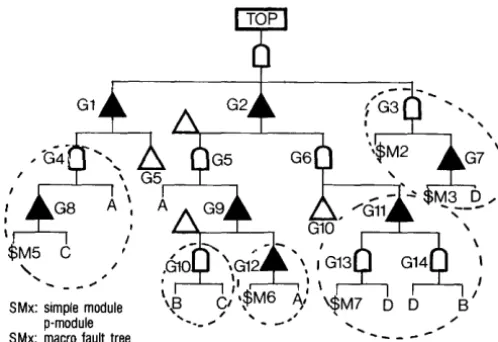
In most computer codes the modularisation is performed by determining the so-called simple modules, i.e. subtrees contain-ing only unreplicated primary events. Some codes determine also complex modules, i.e. containing all occurrences of one or more replicated primary events. In the SALP-PC approach a strong reduction of computer time has been obtained, as well as a very good estimate of the truncation error, by defining a new analysis method based on the concept of module. A pseudo-module (p-pseudo-module) is defined as a subtree in which no occur-rences of repeated subtrees appear. It has to be noticed that this definition allows replicated primary events to appear also outside the pseudo-module.
Figure 1' shows a fault-tree already modularised with indepen-dent modules. According to the definition, the p-modules -shown by dotted lines - are the subtrees G4, G1 0, G12, G11 and G3. When the p-modules are substituted in the main tree with single variables, the "Macro Fault-Tree (MFT)" is produced, as shown in Figure 1 by heavy lines. By following this approach the fault-tree, modularised with independent modules, is therefore transformed into the MFT and a forest of simpler but Dependent Substrees (DS). It can easily be realised that this approach always leads to a strong reduction of the fault-tree complexity, while this cannot be guaranteed by other methods.
The presence of DSs necessarily requires the definition of a two-stage analysis procedure.
SMx: simple module p-module SMx: macro fault tree
D D
...
_--
....Fig. 1 -Example of pseudo module and macro fault tree generation
In the first stage the MFT and all DSs are independently analys-ed without making use of any cut-off technique; the set of minimal failure combinations of the MFT are here referred to as "Macro cut-sets". In the second stage, dependencies among the elements of macro cut-sets are solved. It is at this time that the cut-off technique is applied for retaining only the significant MCSs and estimating the truncation error value. A similar algorithm is applied during the simple module expansion for determining the significant MCSs of the input tree.
Out-set minimisation procedure
The minimisation procedure plays an important role in fault-tree analysis: most of the computer time is spent in minimising cut-sets. In order to reduce the computer time it is necessary, apart from using a powerful minimisation procedure, to minimise only potentially non-minimal cuts when this is strictly necessary. in SALP-PC an efficient algorithm is applied at each gate level to determine whether its descendants are dependent or not; in case of dependence, the set of combinations is partitioned and only those containing locally repeated events are minimised.
Garbage collection procedure
A problem that arises when the number of MCSs is too large is that of insufficient working memory space. In this case it is useful to apply a garbage collection algorithm to arrange data in some way so as to prevent the programme from aborting.
During the analysis of the MFT the MCSs of repeated subtrees are to be used if necessary. In case of unavailability of working memory space, the garbage collection procedure visits the part of the tree still to be analysed, identifies the reference to repeated subtrees and deletes the MCSs of those subtrees no more necessary.
During the expansion of the simple modules the probabilistic threshold value is automatically increased (or the logical value decreased when it concerns the qualitative analysis) each time the memory space is saturated. Therefore, the new not signifi-cant MCSs are deleted and their probability added to the trun-cation error value. This guarantees, except in some particular cases, a final result even on very complex trees.
Fault-tree pruning procedures
[image:12.593.306.555.60.231.2]pro-blems and hence the algorithms for determining the minimal form of prime implicants are time-consuming. On the other hand, a fault-tree contains many variables, and negated events are defin-ed to describe the ''good'' state of components, whose probability is generally either 1 or very close to 1 .
Examples of such applications are found in the description of mutually exclusive events and in the event sequence analysis. In SALP-PC, simplified methods, applicable when these condi-tions are satisfied, have been implemented giving, as a final result, the disjunction of minimal cut-sets on which the quan-titative analysis can be applied /10/. The algorithm is based on the a priori elimination of all unreplicated negated events before the modularisation phase is applied. The remaining negated events are considered until they are no more needed or logical-ly deleting impossible combinations.
Conclusions and further development
The modular structure of the SALP-PC code has proved to be extremely interesting. This structure allows the programme to be easily implemented on various types of computers (from per-sonal to mainframe). Moreover, the various developed processors may be applied for solving other types of problems, thus mak-ing it easy to build codes for, for example, event-tree analysis and CCF analysis.
The SALP-PC code is fast in comparison with other fault-tree analysis codes, as confirmed by the experience gained so far.
A second version of the package is planned for the end of next year. Apart from a further reduction in computer time it will be possible to analyse phased mission systems and binary systems containing multistate compounds. Furthermore, the MAPLE code for fault-tree drawing /20/ will also be implemented.
1.3 STARS: A SOFTWARE TOOL FOR ADVANCED
RELIABILITY AND SAFETY ANALYSIS
Systems safety and reliability analysis consists in general of:
- a qualitative hazard analysis in which the events and scenarios relevant for the safety and/or reliability are identified and ranked on the basis of their consequences or hazard potential;
- the construction of logic system models that describe the system behaviour with respect to the above-mentionned events and scenarios either in a deductive or an inductive way; and
- the quantitative analysis of the models constructed with the aim to calculate numeric estimates and uncertainty bounds for e.g. system reliability, occurrence probability of relevant events, etc.
Various computer codes for quantitative analysis of the logic models are available. Hazard identification and the contruction of logic models are still mainly performed without or with very limited computer assistance and both require. considerable ef-fort and skill.
A need for computer assistance in modelling not only arises from the effort and cost involved, but also from the wish to reduce the analyst to analyst variability and to facilitate the scrutinising of the studies produced. These latter factors are becoming more and more important as probabilistic approaches are entering in the licensing framework /21/. Indeed, Benchmark Exercises on systems analysis /22/ and common cause failure analysis /13/ have shown that different assumptions, subjective judgement and implicit procedures used in modelling contribute significantly to the spread observed in the results and make it difficult to com-pare different analyses.
The STARS (Software Tool for the Analysis of Reliability and Safe-ty) project /17, 23/ aims at developing an integrated set of CAA (Computer Aided Analysis) tools for the various tasks involved in systems safety and reliability analysis including hazard iden-tification, qualitative analysis, logic model construction and quan-tification.
The project has developed from earlier experience of JRC in the field of fault-tree construction code like CAFTS /24, 25/ and analysis codes like SALP-PC /8/. In 1987, a collaboration was started with RIS¢ National Laboratory which also has large ex-perience in the subject from its RIKKE code.
Overall structure of STARS
The expert system technology offers the most promising perspec-tives for developing a CAA tool for hazard identification and modelling. Combined with graphics and analysis capabilities, it can provide a natural engineering-oriented environment for computer-assisted reliability and safety modelling and analysis.
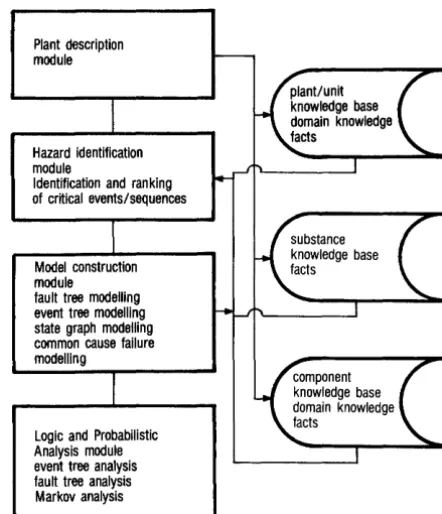
The overall structure of the STARS package is shown in Fig. 2 and contains the following main modules:
Plant description module
Hazard identification module
Identification and ranking of critical events/sequences
Model construction module fault tree modelling event tree modelling state graph modelling common cause failure modelling
[image:13.584.301.522.315.572.2]Logic and Probabilistic Analysis module event tree analysis fault tree analysis Markov analysis
Figure 2- STARS general structure
- a plant or system description module that will be used to build the facts data base containing the relevant information (topology, processes, functions ... ) about the system or plant under study in accordance with the type of analysis (hazard identification, macro fault-tree construction, refinement of macro fault-tree ... );
- a hazard identification module;
- a system model construction module: for the moment, the fault-tree modelling technique is developed but it is the inten-tion to include event tree modelling and state graphs. Moreover, the development of common cause failure identifica-tion and modelling capabilities will be considered;
- a quantitative analysis module for performing logic and pro-babilistic analysis on the system models (fault/event trees, state graphs).
The hazard identification and the model construction modules make use of three knowledge bases: on units (KB1), on substances (KB2) and on compounds (KB3).
Qualitative analysis tool
The qualitative analysis tool will be used for two purposes:
- the identification of potential hazards, events and event se-quences leading to hazards;
- the elicitation of process-specific knowledge to be used in subsequent modelling.
The approach will be to emulate the reasoning and expertise ap-plied by analysis in hazard and operability studies into an expert system.
In such studies, the plant is subdivided into systems and/or units each having well defined functions. The deviations from these normal functions and the way in which these deviations pro-pagate in the plant are then analysed.
The expert system will use three knowledge bases:
- a plant/unit knowledge base which is structured into layers: industry type, process type and unit type. The knowledge base will contain characteristics of processes and units such as:
• potential deviations of process parameters and/or functions and rules about their possible causes and effects;
• potential unit malfunctions or failures;
• generic critical events or event sequences known to be rele-vant for certain types of processes or units (possibly in com-bina_tion V1fith certain types of substances);
• checklists on potentially relevant facts to be prompted to the analyst.
- substance knowledge base structured into 5 layers: organic-inorganic, functional group, state of matter, flash point toxici-ty and toxicitoxici-ty of combustion products and completed with knowledge about possible reaction products (simplified reac-tion matrix); and
- a component knowledge base which is shared with the ex-pert system for constructing logic models in the subproject of the STARS project concerning hazard identification. The part of this knowledge base used here contains rules whether com-ponent failures or malfunctions can cause specific process parameter deviations.
For identifying relevant events or event sequences, the expert system will perform an inductive (event driven) reasoning by the following basic points:
- a first list of potentially relevant deviations/malfunctions is iden-tified by consulting the unit layer in the knowledge base, in which for each unit type a checklist with possible deviations is stored;
- the list of potentially relevant deviations is completed by con-sulting the process layer in the knowledge base, in which im-portant (from the hazard point of view) deviations, particular to specific process types, are stored;
- the list of potentially relevant deviations is reduced by screening according to the possible occurrence of causes for the devia-tions at the unit or component level: i.e. a deviation in a unit is no longer considered if there are no unit/component failures or malfunctions that could cause such deviation and there is no possibility to propagate the deviation from other units;
- the reduced list of potential deviations is further reduced by screening according to the consequences of the deviation. The substance knowledge base in consulted in this screening, the
retained relevant events and event sequences are more precisely identified in terms of underlying system malfunctions using the knowledge at the unit level.
The result is a list of ranked deviations to be considered for the plant under study and possibly to be modelled in detail using fault-trees or other logic models. To construct these fault-fault-trees, the expert system of the STARS model construction module can be . used.
Model construction module
The fault-tree construction tool will be largely inspired by the previous experience. A frame/rule based expert system will be used, in which the deductive (goal driven) reasoning and the heuristics, applied during manual fault-tree construction, will be modelled.
The knowledge base used for the fault-tree construction contains generic knowledge on components, knowledge specific for the system and process analysed as collected during the qualitative analysis, and knowledge needed to direct and control the reason-ing process ("metarules", e.g. on incompatible situations).
The knowledge is represented in frames covering component characteristics, rules to be used for construction of macro fault-trees and rules to develop the causes of the component states.
The construction will proceed in phases (as in CAFTS):
- First a macro fault-tree will be constructed on the basis of the topological information of the functional flow diagram or P&l D obtained interactively in a plant description module, and of the process information obtained through the computer-assisted qualitative analysis. The construction of the macro fault-tree will be triggered by specifying a state or some com-bination of states at some node(s) in the system diagram. It will proceed by backward chaining througth rules that describe the (local) relationships between states at input, output and internal modes of components and by consulting the meta rules that control the process. Occasionally, the user may be prompt-ed to enter information which is process-specific and which was not yet obtained by the qualitative analysis. As a typical example the user might be asked to confirm whether or not in a particular section the pressure-flow conditions are such that a reversed flow could be created under certain cir-cumstances.
As a result, a macro fault-tree containing component/sub-system modes leading to the top event, is obtained.
- Next, the macro fault-tree will be further developed on the basis of facts provided interactively by the user for the components and the connections of these components with support or ser-vice subsystems. These facts are fed to meta rules that con-trol the firing of the rules which develop the fine causes of some component/subsystem mode.
The knowledge base is organised in a hierarchical way in the form of a tree. The terminal leaves of the tree correspond to dif-ferent component types; intermediate nodes correspond to com-ponent classes. The knowledge is distributed over the tree: this means that some knowledge is stored at the level of classes. A terminal leave (component type) inheritates the knowledge stored in the path between itself and the root of the tree. In this way it is possible to avoid information duplication and redundan-cy, and to increase the maintainability of the knowledge base.
1[1=
IL---~~~~~~~~~~~~~~~~==================== tars level 1
no element to be delete~
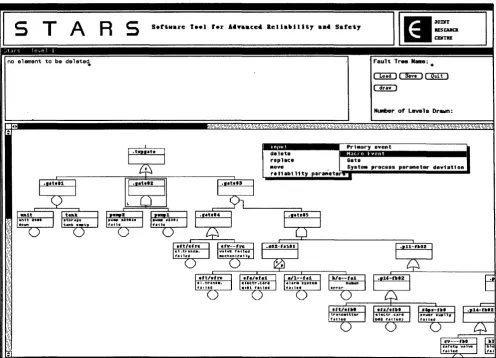
Figure 3- STARS fault-tree editor
Conclusions
The objectives and overall structure of the STARS project were specific and the choice of the hardware and software support was performed. The structure of the knowledge bases and the knowledge representation schemata (frames) for the component knowledge base were developed.
The global concept of the hazard identification module as ex-plained above was defined in collaboration with RIS¢ and VTT (Technical Research Centre of Finland). The concept will be fur-ther validated and developed as a collaboration between JRC, RIS¢ and VTT. For valdating the approach, typical examples of process plants (i.e. sulphuric acid production plant) will be used as test cases.
Concerning the model construction module, a start was made to implement a fault-tree construction and editing tool (see Fig. 3). The editing tool was partly based on a previous fault-tree plot-ting code /20/.
From the experience with CAFTS, it became apparent that func-tional or process related information needs to be considered dur-ing fault-tree construction alongside with topological information. The basic approach to adopt for considering this type of infor-mation was studied.
The feasibility of using the RIKKE knowledge base to feed the STARS component knowledge base was investigated by RIS¢.
1.4 MARA: A HEAVY GAS DISPERSION MODEL
In many safety evaluations, the hazards due to release of liquefied substances must be determined and the concentration field of
Fault Tree Ncna: •
Q2iD ( E ) (]illJ
~
Nunber of Levels Drawn:
Prh1ary event
delete
replace Gate
11ove Systu. process peraneter de¥1 at1 on
ral1ab1l1ty parameta
the gas blanket as a consequent their evaporation must be calculated in time and space.
Presently, a large effort is being made trying to simulate the dispersion of gaseous substances heavier than air, by means of ''box-models'', in which the physical variables describing the cloud are treated as constant within the cloud iteself. The box is spreading on the soil, due to the gravity force and increasing its size because of the air mixing.
The main advantage of using box-models lies in their short com-: puting time, which makes them particularly suitable for risk analysis calculations.
In the majority of cases, box-models can take into account the following phenomena:
- cloud spreading because of gravity;
- air entrainment from the cloud top and cloud edge;
- heat transfer with the ground;
- cloud advection due to the wind;
- neutral buoyancy dispersion at great dilutions.
The treatment of the heat transfer with the ground, however, has the effect of increasing the computing time of many models, as its introduction in the cloud equations does not allow their analytical solution, without improving too much the models per-formances. In fact, the heat transfer due to the mixing with the entrained air is by far the most important term of the overall heat balance.
[image:15.578.35.531.53.410.2]such as for example when releases of toxic substances occur, in which also this phase is of great importance.
Furthermore, the cloud advection is not accurately described in many existing box-models, as demonstrated by comparing the predictions of the distance travelled after a certain time with the results of the release experiments.
The MARA (Model for Analysis of Releases in the Atmosphere) computer code partly avoids these difficulties.
Code validation
The capability of the model can be shown by comparing the calculated results with some experimental data available in the literature.
The main physical assumptions can be found at Ref. /26, 27/: substantial improvements in the MARA box model have been ob-tained by treating the transport of heavy gas clouds in the wind direction.
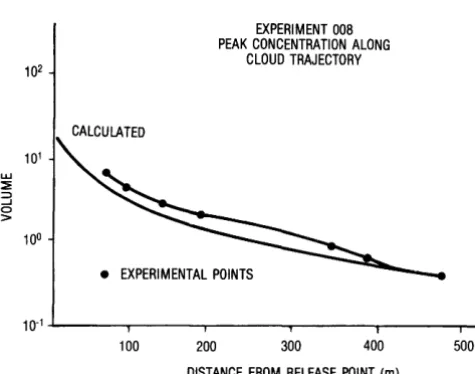
The Thomey Island trials chosen to validate MARA are those iden-tified by the numbers 008 and 018. They differ mainly by the at-mospheric turbulence, and in particular by the windspeed, which varies from a low/medium value for the first (2 m/s) to strong value (6 m/s) for the second. The atmospheric stability category was D in both cases. However, this parameter is considered less important for the results comparison as it influences only the passive phase.
[image:16.580.301.538.282.451.2]Figures 4a and 4b show the cloud peak concentration versus distance, both observed and calculated for the investigated releases. The agreement can be considered satisfactory, taking into account the fact that the experimental points have been determined from visual estimation of the cloud concentration up-per limit, which was measured by detectors at the same radial distance from the release point.
Figure 5 shows the time dependence of the average cloud con-centration, both measured and calculated for trial 008. It should again be pointed out that it is difficult to determine the average measured concentration, as the cloud is not in reality as uniform as the theoretical approach would suggest.
In Figure 6 the measured and calculated -time dependence of the cloud radius is shown for trial 008. It is possible to observe that the gas radius square root (or linear increase of the gas area) with time is respeced.
102
1Q1 L.U
:::!:: :=I
....J
0 >
10°
1Q•1
CALCULATED
EXPERIMENT 008
PEAK CONCENTRATION ALONG CLOUD TRAJECTORY
• EXPERIMENTAL POINTS
100 200 300 400
DISTANCE FROM RELEASE POINT (m)
Fig. 4a- Thomey Island- wind speed 2 m/s
14
500
L.U
:::!:: :=I
....J
0 >
102
101
100
EXPERIMENT 018 PEAK CONCENTRATION ALONG
CLOUD TRAJECTORY
• EXPERIMENTAL POINTS
1Q-1~--~---~---..,.---r---r--100 200 300 400
DISTANCE FROM RELEASE POINT
Fig. 4b - Thomey Island - wind speed 6 mls
8
~
7:z
0 ~ 6
c: ~ 5
'-' ~ 4
'-'
L.U
~ 3
L.U
:;:c 2
50
EXPERIMENT 008
...,. EXPERIMENTAL CALCULATED
100 150 200 250
TIME AFTER THE RELEASE(s)
Fig. 5- Thomey Island- wind speed 2 m/s
200
E'
-150
en :=I
i5 <( c:
Cl :=I
g 100
'-'
EXPERIMENT 008
500
300
50._~~---~---~----~--~----~
50 100 150 200 250 300
TIME AFTER THE RELEASE(s)
Fig. 6- Thomey Island- wind speed 2 m/s
In Figure 7 the distance travelled by the cloud centre is reported versus time. The good agreement between the experimental data and MARA results is noticeable, particularly if we take into ac-count the fact that the cloud advection has always been a crucial point for the simulation of this kind.
[image:16.580.43.281.589.776.2]cr: UJ t-z UJ (.) 6 (m)
g
60(.) i:D 50
Cl
~ 40
...J
~
30cr:
t-~ 20
z
~
10Ci
EXPERIMENT 008
10 20 30 40
TIME AFTER THE RELEASE(s)
Fig. 7- Thomey Island- wind speed 2 m/s
50
10
~ ______________ EX_P_ER_IM_E_N_T_00_8 ____________ __,9 8
7
~
z 6
0
i= 5
~
~ 4
(.)
8
3EXPERIMENTAL
CALCULATED
DETECTOR COORDINATES X:400 M Y:300 M Z:0.4 M
0~~~~--~~~~---~~---~
-1~-.-.--r-~-.--~r-~-.-,--r-,-~-,~
-1 0 1 3 4 5 6 7 8 9 10 11 12
TIME AFTER THE RELEASE (102 SECONDS)
Fig. 8- Thomey Island- wind speed 2 mls
EXPERIMENT 008 20
'
18
'
3 15''
16
'
T
EXPERIMENTAL'
14
'
I
CALCULATED'
12
'
I
~
'
z
10
'
I
0i=
~
cr: 08 X:300 M Y:350 M Z:0.4 M
t-z UJ (.) 06 z 0 (.) 04 02 00 - 02
-1 0 1 3 4 5 6 7 8 9 10 11
TIME AFTER THE RELEASE (102 SECONDS)
Fig. 9- Thomey Island- wind speed 2 m/s
12
~
z
0
~ cr:
t-z UJ (.) z 0 (.)
EXPERIMENT 018
10~---09
08
~ 07
~
;; 06
0 i= 05
~
~ 04
UJ
(.) ~ 03
(.)
02
01
EXPERIMENTAL
CAL9ULATED
DETECTOR COORDINATES X:600 M Y:600 M Z:0.4 M
00~~~~~~~~~~---~
-01 ""-,--.~...,.---,.--~,---r----y---,----,,--r---r-,---r---'
50 45- 40-35 30-25 20 15-10 5 0 - 5
-1 0 1 2 3 4 5 6 7 8 9 10 11 12 13
- l
TIME AFTER THE RELEASE (102 SECONDS)
EXPERIMENTAL
CALCULATED
DETECTOR COORDINATES X:400 M Y:200 M Z:0.4 M
I I I 1 I I I I I I I I
- 1 0 1 2 3 4 5 6 7 8 9 10 11
TIME AfTER THE RcLtASE (102 SECONDS)
Fig. 11 - Thomey Island - wind speed 6 mls
comparison is made, is fair, in the sense that in some of the points the agreement is pretty good and in other cases the computed values are different from the measured ones, either for the peak concentration or for its time-integral value.
In any case, examining the figures it is possible to conclude that the dispersion process is correctly simulated by the model for the purpose of safety studies.
1.5 MARS: THE MAJOR ACCIDENT REPORTING SYSTEM
Great importance is assigned by the European Council Direc-tive to the reporting of major accidents occurring in certa1n in-dustrial activities (82/501 /EEC - commonly referred to as post-Seveso Directive). Accident notification is, indeed, con-sidered to be a significant measure for an effective information policy among member states, aimed at preventing repetition of events sharing similar patterns of causes.
[image:17.578.33.266.48.222.2] [image:17.578.298.525.52.237.2] [image:17.578.35.267.332.527.2] [image:17.578.34.268.580.774.2]and shall provide it with information specified in an annex to the Directive including items such as:
- the circumstances of the accident;
- the dangerous substance involved;
- the effects on man and the environment;
- the emergency measures taken;
- the steps envisaged to alleviate the medium and long-term ef-fects of the accident; and
- the measures taken to prevent any recurrence of such an ac-cident.
''The Commission shall set up and keep at the dis~osal of the member states a register containing a summary of the major accidents which have occurred within the territory of the member states, including an analysis of causes of such accidents, ex-perience gained and measures taken, to enable the member states to use this information for prevention purposes."
To comply with the implementation of these articles, the Direc-torate General XI, responsible for the environmental policy of the Commission, asked JRC to design and implement a data bank for storing the information supplied by the member states.
Development of MARS
MARS has been developed according to the following steps:
a. promotion of a state-of-the-art review on existing incident data bases;
b. drafting of a reference classification scheme for process plants;
c. finalisation of the accident reporting collection forms;
d. design and implementation of the informatic structure.
Step a
The objective of the survey was to determine the state of the art of industrial accident data bases within the European Com-munity and the United States of America. The results of the survey summarised at ref. /28/ and more extensively in the EUR report at ref. /29/, were, on the one hand, helpful for the design of MARS, and on the other hand, enlightening the need for an accident data base designed for the main purpose of safety in-vestigations. It resulted, indeed, that the majority of incident repor-ting systems were focused on injuries and fatalities, whereas information on the cause of the incident, including technical in-formation on the various phenomena associated with the inci-dent, is rather scarce.
Step b
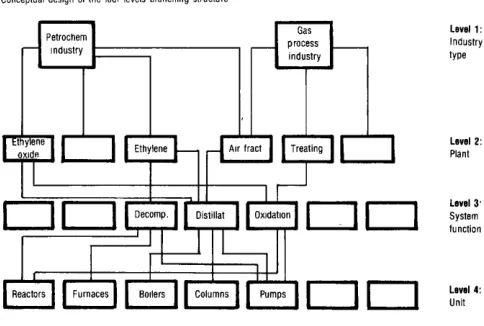
A comprehensive classification scheme for process plants has been developed as a proposal for a multi-level taxonomy of industry-type, plant-generic identification, system function and process units /30/. The work was aimed, on the one hand, at the univoquous identification of plants and systems involved in accidents by assignment of appropriated codes in MARS, and, on the other hand, it was more in general aimed at the establish-ment of some standards for collecting performance data on significant components; data which might be useful in reliabili-ty, availability and maintainability studies as well.
Fig 12 shows the main criteria on which the classification scheme has been based. The first level of the classification (industry type) has been already introduced into the MARS collection forms; whereas the other levels might be used in labelling by keywords the relevant fields of the collection forms in view of an informa-tion retrieval based on involved systems, as well as on other rele-vant keywords such as causes, casualties, etc.
16
Conceptual des1gn of the four levels branchmg structure
Fig. 12- Basic criteria for plant classification
Levell:
Industry type
Level 2:
Plant
Level 3·
System !unction
Level 4:
Unit
Before freezing the proposal and extending the scheme to cover all types of hazardous installations, the basic criteria are being reviewed with national competent bodies to achieve a general consensus aimed at uniformising accident reporting.
Step c
The information to be supplied in case of a major accident ac-cording to the Directive has been specified into detailed acci-dent collection forms /31/ which should ensure a more uniform reporting from the different authorities. The proposed collection forms have been adopted by the competent authorities after some pilot exercises to check their adequacy for the purposes of the Directive. They also found a substantial consensus in the technical community and proved to be a useful tool for the ac-cident notification. Furthermore, the reliabiltiy of the sources of information makes MARS different from other existing data bases. Indeed, because of the controlled quality of the data, MARS becomes a very useful tool for obtaining deeper insight into ac-cident sequences, useful for implementing a prevention policy. Indeed:
- the information about substances and the related involved quantities can give an important feedback to control the list of dangerous substances (and their minimum threshold) presently covered by the post-Seveso Directive;
- the knoledge of the masses released, even if subject to a cer-tain degree of uncercer-tainty, can be useful for identifying source term patterns;
- the mapping of areas affected by accidents can be used for testing consequence predictive models;
- the information on the emergency measures taken and their adequacy results in a useful data base for emergency planning;
- the identification of accident causes is the fundamental step for any prevention activity. To this aim, the primary causes of the accident can be derived both from the case history description and from other specific items, thus allowing the analyst to check the consistency of the different descriptions in order to achieve reliable indications;
- the description of the measures taken to prevent the recur-rence of similar accidents may represent a significant base for setting up specific and general recommendations for an effective loss prevention policy; and, finally,
- the analysis of the accident reports can help in identifying possible lack of knowledge or weaknesses on current prac-tices of safety assessment, completeness of check lists, ade-quacy of existing standards, etc.
[image:18.577.303.545.57.220.2]