L
1Regularized Regression for Reranking and System Combination in
Machine Translation
Ergun Bic¸ici Koc¸ University
34450 Sariyer, Istanbul, Turkey [email protected]
Deniz Yuret Koc¸ University
34450 Sariyer, Istanbul, Turkey [email protected]
Abstract
We useL1regularized transductive
regres-sion to learn mappings between source and target features of the training sets derived for each test sentence and use these mappings to rerank translation out-puts. We compare the effectiveness ofL1
regularization techniques for regression to learn mappings between features given in a sparse feature matrix. The results show the effectiveness of using L1
regulariza-tion versus L2 used in ridge regression.
We show that regression mapping is ef-fective in reranking translation outputs and in selecting the best system combinations with encouraging results on different lan-guage pairs.
1 Introduction
Regression can be used to find mappings be-tween the source and target feature sets derived from given parallel corpora. Transduction learn-ing uses a subset of the trainlearn-ing examples that are closely related to the test set without using the model induced by the full training set. In the context of SMT, we select a few training in-stances for each test instance to guide the transla-tion process. This also gives us a computatransla-tional advantage when considering the high dimension-ality of the problem. The goal in transductive regression based machine translation (TRegMT) is both reducing the computational burden of the regression approach by reducing the dimension-ality of the training set and the feature set and also improving the translation quality by using transduction. Transductive regression is shown to achieve higher accuracy thanL2regularized ridge
regression on some machine learning benchmark datasets (Chapelle et al., 1999).
In an idealized feature mapping matrix where
features are word sequences, we would like to ob-serve few target features for each source feature derived from a source sentence. In this setting, we can think of feature mappings being close to per-mutation matrices with one nonzero item for each column. L1 regularization helps us achieve
solu-tions close to the permutation matrices by increas-ing sparsity.
We show that L1 regularized regression
map-ping is effective in reranking translation outputs and present encouraging results on different lan-guage pairs in the translation task of WMT10. In the system combination task, different translation outputs of different translation systems are com-bined to find a better translation. We model system combination task as a reranking problem among the competing translation models and present en-couraging results with the TRegMT system.
Related Work: Regression techniques can be used to model the relationship between strings (Cortes et al., 2007). Wang et al. (2007) applies a string-to-string mapping approach to machine translation by using ordinary least squares regression and n-gram string kernels to a small dataset. Later they use L2 regularized
least squares regression (Wang and Shawe-Taylor, 2008). Although the translation quality they achieve is not better than Moses (Koehn et al., 2007), which is accepted to be the state-of-the-art, they show the feasibility of the approach. Ser-rano et al. (2009) use kernel regression to find translation mappings from source to target feature vectors and experiment with translating hotel front desk requests. Ueffing (2007) approaches the transductive learning problem for SMT by bootstrapping the training using the translations produced by the SMT system that have a scoring performance above some threshold as estimated by the SMT system itself.
Outline: Section 2 gives an overview of regres-sion based machine translation, which is used to find the mappings between the source and target features of the training set. In section 3 we present
L1 regularized transductive regression for
align-ment learning. Section 4 presents our experialign-ments, instance selection techniques, and results on the translation task for WMT10. In section 5, we present the results on the system combination task using reranking. The last section concludes.
2 An Overview of Regression Based Machine Translation
Let X and Y correspond to the token sets used to represent source and target strings, then a train-ing sample of m inputs can be represented as (x1,y1), . . . ,(xm,ym)∈X∗×Y∗,where(xi,yi)
corresponds to a pair of source and target language token sequences. Our goal is to find a mapping
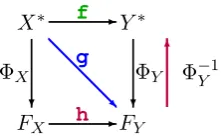
f : X∗ → Y∗ that can convert a given set of source tokens to a set of target tokens that share the same meaning in the target language.
X∗ -Y∗
? R ?
-FX FY
g
ΦX ΦY
6 Φ−1Y
f
[image:2.595.135.246.373.442.2]h
Figure 1: String-to-string mapping.
Figure 1 depicts the mappings between different representations. ΦX : X∗ → FX = RNX and
ΦY :Y∗→FY =RNY map each string sequence
to a point in high dimensional real number space wheredim(FX) =NX anddim(FY) =NY.
Let MX ∈ RNX×m andMY ∈ RNY×m such
that MX = [ΦX(x1), . . . ,ΦX(xm)] and MY =
[ΦY(y1), . . . ,ΦY(ym)]. The ridge regression
so-lution usingL2regularization is found as:
HL2= arg min
H∈RNY×NX
kMY−HMXk2F +λkHk2F .(1)
Proposition 1 Solution to the cost function given in Equation 1 is found by the following identities:
H=MYMTX(MXMTX +λINX)
−1 (primal)
H=MY(KX +λIm)−1MTX (dual)
(2)
where KX = MTXMX is the Gram matrix with
KX(i, j) = kX(xi,xj)andkX(xi,xj)is the
ker-nel function defined askX(xi,xj) =φ(xi)Tφ(xj).
The primal solution involves the inversion of the covariance matrix in the feature space (O(NX3)) and the dual solution involves the inversion of the kernel matrix in the instance space (O(m3)) and
L2 regularization term prevents the normal
equa-tions to be singular. We use the dual solution when computingHL2.
Two main challenges of the RegMT approach are learning the regression function, g : X∗ →
FY, and solving the pre-image problem, which,
given the features of the estimated target string se-quence, g(x) = ΦY(ˆy), attempts to findy ∈ Y∗:
f(x) = arg miny∈Y∗||g(x)−ΦY(y)||2. Pre-image
calculation involves a search over possible transla-tions minimizing the cost function:
f(x) = arg min
y∈Y∗ kΦY(y)−HΦX(x)k 2
= arg min
y∈Y∗ kY(y,y)−2(K y
Y) T
(KX+λIm) −1
KxX,(3)
whereKyY= [kY(y,y1), . . . , kY(y,ym)]T∈Rm×1
andKxX ∈Rm×1 is defined similarly.
We use n-spectrum weighted word ker-nel (Shawe-Taylor and Cristianini, 2004) as fea-ture mappers which consider all word sequences up to ordern:
k(x,x0) =
n X
p=1
|x|−p+1
X
i=1
|x0|−p+1
X
j=1
p I(x[i:i+p−1] =x0[j:j+p−1])
(4)
where x[i:j] denotes a substring of x with the words in the range[i, j],I(.)is the indicator func-tion, andpis the number of words in the feature.
3 L1Regularized Regression
In statistical machine translation, parallel cor-pora, which contain translations of the same doc-uments in source and target languages, are used to estimate a likely target translation for a given source sentence based on the observed transla-tions. String kernels lead to very sparse represen-tations of the feature space and we examine the ef-fectiveness ofL1regularized regression to find the
mappings between sparsely observed feature sets.
3.1 Sparsity in Translation Mappings
H e1 e2 e3 f1 1 1
f2 1
f3 1
Hereeirepresents unigram source features andfi
represent unigram target features. e1 ande3 have
unambiguous translations whereas e2 is
ambigu-ous. Even if unigram features lead to ambiguity, we expect higher order features like bigrams and trigrams to help us resolve the ambiguity. Typical
Hmatrices have thousands of features. L1
regu-larization helps us achieve solutions close to per-mutation matrices by increasing sparsity (Bishop, 2006). In contrast,L2solutions give us dense
ma-trices.
3.2 L1Regularized Regression for Learning
HL2 does not give us a sparse solution and most
of the coefficients remain non-zero. L1 norm
be-haves both as a feature selection technique and a method for reducing coefficient values.
HL1 = arg min
H∈RNY×NX
kMY −HMXkF2 +λkHk1 .(5)
Equation 5 presents the lasso (least absolute shrinkage and selection operator) (Tibshirani, 1996) solution where the regularization term is now the L1 matrix norm defined as kHk1= P
i,j|Hi,j|. Since L1 regularization cost is not
differentiable,HL1is found by optimization or
ap-proximation techniques. We briefly describe three techniques to obtainL1regularized regression
co-efficients.
Forward Stagewise Regression (FSR): We experiment with forward stagewise regression (FSR) (Hastie et al., 2006), which approximates
thelasso. The incremental forward stagewise
re-gression algorithm increases the weight of the pre-dictor variable that is most correlated with the residual by a small amount, , multiplied with the sign of the correlation at each step. As
→0, the profile of the coefficients resemble the
lasso(Hastie et al., 2009).
Quadratic Programming (QP): We also use quadratic programming (QP) to findHL1. We can
pose lasso as a QP problem as follows (Mørup
and Clemmensen, 2007). We assume that the rows of MY are independent and solve for each
rowi,Myi ∈R
1×m, using non-negative variables
h+i ,h−i ∈RNX×1such thath
i=h+i −h
−
i :
hi= arg min
h
kMyi−hMXk
2
F +λ NX X
k=1
|hk|, (6)
hi= arg min
˜
hi
1
2h˜iMgXMgX
T
˜
hi T
−h˜i(MgXMTyi−λ111), (7)
s.t. h˜i>0, MgX= »
MX
−MX –
, ˜hi= ˆ
h+i h − i
˜
.
Linear Programming (LP): L1 minimization
can also be posed as a linear programming (LP) problem by interpreting the error term as the con-straint (Chen et al., 1998) and solving for each row
i:
hi = arg min
h
khk1 subject toMyi =hMX, (8)
which can again be solved using non-negative variables. This is a slightly different optimization and the results can be different but linear program-ming solvers offer computational advantages.
3.3 Transductive Regression
Transduction uses test instances, which can some-times be accessible at training time, to learn spe-cific models tailored towards the test set. Trans-duction has computational advantages by not us-ing the full trainus-ing set and by havus-ing to satisfy a smaller set of constraints. For each test sentence, we pick a limited number of training instances de-signed to improve the coverage of correct features to build a regression model. Section 4.2 details our instance selection methods.
4 Translation Experiments
We perform experiments on the translation task of the German, German-English, English-French, English-Spanish, and English-Czech lan-guage pairs using the training corpus provided in WMT10.
4.1 Datasets and Baseline
and baseline performances for uncased output (test set BLEU, challenge test set BLEU) are given in Table 1.
Corpus # sent BLEU BLEUChallenge en-de 1609988 .1471 .1309 de-en 1609988 .1943 .1556 en-fr 1728965 .2281 .2049 en-es 1715158 .2237 .2106 en-cz 7320238 .1452 .1145
Table 1: Initial uncased performances of the trans-lation systems.
Feature mappers used are3-spectrum counting word kernels, which consider all N-grams up to order3 weighted by the number of tokens in the feature. We segment sentences using some of the punctuation for managing the feature set better and do not considerN-grams that cross segments.
We use BLEU (Papineni et al., 2001) and NIST (Doddington, 2002) evaluation metrics for measuring the performance of translations auto-matically.
4.2 Instance Selection
Proper selection of training instances plays an im-portant role to learn feature mappings with limited computational resources accurately. In previous work (Wang and Shawe-Taylor, 2008), sentence based training instances were selected usingtf-idf
retrieval. We transform test sentences to feature sets obtained by the kernel mapping before mea-suring their similarities and index the sentences based on the features. Given a source sentence of length20, its feature representation would have a total of57uni/bi/tri-gram features. If we select closest sentences from the training set, we may not have translations for all the features in this repre-sentation. But if we search for translations of each feature, then we have a higher chance of covering all the features found in the sentence we are try-ing to translate. The index acts as a dictionary of source phrases storing training set entries whose source sentence match the given source phrase.
The number of instances per feature is chosen inversely proportional to the frequency of the fea-ture determined by the following formula:
#instance(f) =n/ln(1 +idfScore(f)/9.0), (9)
where idfScore(f)sums theidf (inverse document frequency) of the tokens in feature f and n is a small number.
4.3 Addition of Brevity Penalty
Detailed analysis of the results shows TRegMT score achieves better N-gram match percentages than Moses translation but suffers from the brevity penalty due to selecting shorter translations. Due to using a cost function that minimizes the squared loss, TRegMT score tends to select shorter trans-lations when the coverage is low. We also observe that we are able to achieve higher scores for NIST, which suggests the addition of a brevity penalty to the score.
Precision based BLEU scoring dividesN-gram match counts toN-gram counts found in the lation and this gives an advantage to shorter trans-lations. Therefore, a brevity penalty (BP) is added to penalize short translations:
BP = min(1− ref-length
trans-length,0) (10)
BLEU =e(log(ngramprec)+BP) (11)
where ngramprec represent the sum of n-gram precisions. Moses rarely incurs BP as it has a word penalty parameter optimized against BLEU which penalizes translations that are too long or too short. For instance, Moses 1-best translation for en-de
system achieves.1309BLEU versus.1320BLEU without BP.
We handle short translations in two ways. We optimize the λparameter of QP, which manages the sparsity of the solution (larger λ values cor-respond to sparser solutions) against BLEU score rather than the squared loss. Optimization yields
λ=20.744. We alternatively add a BP cost to the squared loss:
BP =e
“
min(1− |ΦY(y)| |pHΦX(x)+αBPq|,0)
” (12)
f(x) = arg min
y∈Y∗ kΦY(y)−HΦX(x)k 2
+λBPBP (13)
where|.|denotes the length of the feature vector,
p.q rounds feature weights to integers, αBP is a
constant weight added to the estimation, andλBP
is the weight given for theBP cost. |pHΦX(x) +
αBPq|represents an estimate of the length of the
reference as found by the TRegMT system. This BP cost estimate is similar to the cost used in (Ser-rano et al., 2009) normalized by the length of the reference. We found αBP = 0.1316 and λBP =
en-de de-en en-fr en-es en-cz Score BLEU NIST BLEU NIST BLEU NIST BLEU NIST BLEU NIST Baseline .1309 5.1417 .1556 5.4164 .2049 6.3194 .2106 6.3611 .1145 4.5008
[image:5.595.86.508.62.145.2]Oracle .1811 6.0252 .2101 6.2103 .2683 7.2409 .2770 7.3190 .1628 5.4501 L2 .1319 5.1680 .1555 5.4344 .2044 6.3370 .2132 6.4093 .1148 4.5187 FSR .1317* 5.1639 .1559 5.4383 .2053 6.3458 .2144 6.4168 .1150 4.5172 LP .1317 5.1695 .1561 5.4304 .2048 6.3245 .2109 6.4176 .1124 4.5143 QP .1309 5.1664 .1550 5.4553 .2033 6.3354* .2121 6.4271 .1150 4.5264 Table 2: Reranking results using TRegMT, TM, and LM scores. We use approximate randomization test (Riezler and Maxwell, 2005) with 1000 repetitions to determine score difference significance: results in bold are significant with p ≤ 0.01 and italic results with (*) are significant with p ≤ .05. The difference of the remaining from the baseline are not statistically significant.
4.4 Reranking Experiments
We rerank N-best lists by using linear combina-tions of the following scoring funccombina-tions:
1. TRegMT: Transductive regression based ma-chine translation scores as found by Equa-tion 3.
2. TM: Translation model scores we obtain from the baseline SMT system that is used to generate theN-best lists.
3. LM:5-gram language model scores that the baseline SMT system uses when calculating the translation model scores.
The training set we obtain may not contain all of the features of the reference target due to low coverage. Therefore, when performing reranking, we also add the cost coming from the features of ΦY(y) that are not represented in the training set
to the squared loss as in:
kΦY(y)\FYk2 +kΦY(y)−HΦX(x)k2, (14)
whereΦY(y)\FY represent the features ofynot
represented in the training set.
We note that TRegMT score only contains or-dering information as present in the bi/tri-gram features in the training set. Therefore, the ad-dition of a 5-gram LM score as well as the TM score, which also incorporates the LM score in itself, improves the performance. We are not able to improve the BLEU score when we use TRegMT score by itself however we are able to achieve improvements in the NIST and 1-WER scores. The performance increase is important for two reasons. First of all, we are able to improve the performance using blended spectrum 3-gram features against translations obtained with5-gram language model and higher order features. Out-performing higher ordern-gram models is known
to be a difficult task (Galley and Manning, 2009). Secondly, increasing the performance with rerank-ing itself is a hard task since possible translations are already constrained by the ones observed inN -best lists. Therefore, an increase in theN-best list size may increase the score gaps.
Table 2 presents reranking results on all of the language pairs we considered, using TRegMT, TM, and LM scores with the combination weights learned in the development set. We are able to achieve better BLEU and NIST scores on all of the listed systems. We are able to see up to.38BLEU points increase for theen-espair. Oracle reranking performances are obtained by using BLEU scoring metric.
If we used only the TM and LM scores when reranking with theen-de system, then we would obtain.1309BLEU and5.1472NIST scores. We only see a minor increase in the NIST score and no change in the BLEU score with this setting when compared with the baseline given in Table 2.
Due to computational reasons, we do not use the same number of instances to train different models. In our experiments, we usedn = 3 for L2, n = 1.5 for FSR, and n = 1.2 for QP and LP solutions to select the number of instances in Equation 9. The average number of instances used per sentence in training corresponding to these choices are approximately140,74, and61. Even with these decreased number of training instances,
L1 regularized regression techniques are able to
achieve comparable scores to L2 regularized
re-gression model in Table 2.
5 System Combination Experiments
en-de de-en en-fr en-es en-cz Score BLEU NIST BLEU NIST BLEU NIST BLEU NIST BLEU NIST Random .1490 5.6555 .2088 6.4886 .2415 6.8948 .2648 7.2563 .1283 4.9238 Best model .1658 5.9610 .2408 6.9861 .2864 7.5272 .3047 7.7559 .1576 5.4480 L2 .1694 5.9974 .2336 6.9398 .2948 7.7037 .3036 7.8120 .1657 5.5654 FSR .1689 5.9638 .2357 6.9254 .2947 7.7107 .3049 7.8156 .1657 5.5632 LP .1694 5.9954 .2368 6.8850 .2928 7.7157 .3027 7.7838 .1659 5.5680 QP .1692 5.9983 .2368 6.9172 .2913 7.6949 .3040 7.8086 .1662 5.5785 Table 3: Reranking results using TRegMT, TM, and LM scores. boldcorrespond to the best score in each rectangle of scores.
corpus provided in WMT10.
5.1 Datasets
We use the training set provided in WMT10 to in-dex and select transductive instances from. The challenge split the test set for the translation task of 2489 sentences into a tuning set of 455 sen-tences and a test set with the remaining2034 sen-tences. Translation outputs for each system is given in a separate file and the number of sys-tem outputs per translation pair varies. We have tokenized and lowercased each of the system out-puts and combined these in a singleN-best file per language pair. We also segment sentences using some of the punctuation for managing the feature set better. We use theseN-best lists for TRegMT reranking to select the best translation model. Fea-ture mappers used are3-spectrum counting word kernels, which consider alln-grams up to order3 weighted by the number of tokens in the feature.
5.2 Experiments
We rerankN-best lists by using combinations of the following scoring functions:
1. TRegMT: Transductive regression based ma-chine translation scores as found by Equa-tion 3.
2. TM’: Translation model scores are obtained by measuring the average BLEU perfor-mance of each translation relative to the other translations in theN-best list.
3. LM: We calculate 5-gram language model scores for each translation using the language model trained over the target corpus provided in the translation task.
Since we do not have access to the reference translations nor to the translation model scores each system obtained for each sentence, we es-timate translation model performance (TM’) by
measuring the average BLEU performance of each translation relative to the other translations in the
N-best list. Thus, each possible translation in the
N-best list is BLEU scored against other transla-tions and the average of these scores is selected as the TM score for the sentence. Sentence level BLEU score calculation avoids singularities inn -gram precisions by taking the maximum of the match count and 2|1s
i| for|si|denoting the length
of the source sentencesias used in (Macherey and
Och, 2007).
Table 3 presents reranking results on all of the language pairs we considered, using TRegMT, TM, and LM scores with the same combination weights as above. Random model score lists the random model performance selected among the competing translations randomly and it is used as a baseline. Best model score lists the performance of the best model performance. We are able to achieve better BLEU and NIST scores in all of the listed systems except for the de-enlanguage pair when compared with the performance of the best competing translation system. The lower perfor-mance in thede-en language pair may be due to having a single best translation system that outper-forms others significantly. The difference between the best model performance and the mean as well as the variance of the scores in thede-enlanguage pair is about twice their counterparts inen-de lan-guage pair.
6 Contributions
We use transductive regression to learn mappings between source and target features of given paral-lel corpora and use these mappings to rerank trans-lation outputs. We compare the effectiveness ofL1
regularization techniques for regression. TRegMT score has a tendency to select shorter transla-tions when the coverage is low. We incorporate a brevity penalty to the squared loss and optimizeλ
parameter of QP to tackle this problem and further improve the performance of the system.
The results show the effectiveness of usingL1
regularization versusL2 used in ridge regression.
Proper selection of training instances plays an im-portant role to learn correct feature mappings with limited computational resources accurately. We plan to investigate better instance selection meth-ods for improving the translation performance. TRegMT score has a tendency to select shorter translations when the coverage is low. We incor-porate a brevity penalty to the score and optimize theλparameter of QP to tackle this problem.
Acknowledgments
The research reported here was supported in part by the Scientific and Technological Research Council of Turkey (TUBITAK).
References
Christopher M. Bishop. 2006. Pattern Recognition and Machine Learning. Springer.
Olivier Chapelle, Vladimir Vapnik, and Jason Weston. 1999. Transductive inference for estimating values of functions. InNIPS, pages 421–427.
Scott Shaobing Chen, David L. Donoho, and Michael A. Saunders. 1998. Atomic decomposition by basis pursuit. SIAM Journal on Scientific Com-puting, 20(1):33–61.
Corinna Cortes, Mehryar Mohri, and Jason Weston. 2007. A general regression framework for learn-ing strlearn-ing-to-strlearn-ing mapplearn-ings. In Gokhan H. Bakir, Thomas Hofmann, and Bernhard Sch editors, Pre-dicting Structured Data, pages 143–168. The MIT Press, September.
George Doddington. 2002. Automatic evaluation of machine translation quality using n-gram co-occurrence statistics. InProceedings of the second international conference on Human Language Tech-nology Research, pages 138–145, San Francisco, CA, USA. Morgan Kaufmann Publishers Inc.
Michel Galley and Christopher D. Manning. 2009. Quadratic-time dependency parsing for machine translation. In Proceedings of the Joint Confer-ence of the 47th Annual Meeting of the ACL and the 4th International Joint Conference on Natural Lan-guage Processing of the AFNLP, pages 773–781, Suntec, Singapore, August. Association for Compu-tational Linguistics.
Trevor Hastie, Jonathan Taylor, Robert Tibshirani, and Guenther Walther. 2006. Forward stagewise regres-sion and the monotone lasso. Electronic Journal of Statistics, 1.
Trevor Hastie, Robert Tibshirani, and Jerome Fried-man. 2009. The Elements of Statistical Learning: Data Mining, Inference and Prediction. Springer-Verlag, 2nd edition.
Philipp Koehn, Hieu Hoang, Alexandra Birch, Chris Callison-Burch, Marcello Federico, Nicola Bertoldi, Brooke Cowan, Wade Shen, Christine Moran, Richard Zens, Chris Dyer, Ondrej Bojar, Alexan-dra Constantin, and Evan Herbst. 2007. Moses: Open source toolkit for statistical machine transla-tion. In Annual Meeting of the Assoc. for Compu-tational Linguistics, pages 177–180, Prague, Czech Republic, June.
Wolfgang Macherey and Franz J. Och. 2007. An empirical study on computing consensus transla-tions from multiple machine translation systems. In
EMNLP-CoNLL, pages 986–995.
M. Mørup and L. H. Clemmensen. 2007. Multiplica-tive updates for the lasso. InMachine Learning for Signal Processing MLSP, IEEE Workshop on, pages 33 –38, Aug.
Kishore Papineni, Salim Roukos, Todd Ward, and Wei-Jing Zhu. 2001. BLEU: a method for automatic evaluation of machine translation. InACL ’02: Pro-ceedings of the 40th Annual Meeting on Associa-tion for ComputaAssocia-tional Linguistics, pages 311–318, Morristown, NJ, USA. Association for Computa-tional Linguistics.
Stefan Riezler and John T. Maxwell. 2005. On some pitfalls in automatic evaluation and significance test-ing for MT. In Proceedings of the ACL Workshop on Intrinsic and Extrinsic Evaluation Measures for Machine Translation and/or Summarization, pages 57–64, Ann Arbor, Michigan, June. Association for Computational Linguistics.
Nicolas Serrano, Jesus Andres-Ferrer, and Francisco Casacuberta. 2009. On a kernel regression approach to machine translation. In Iberian Conference on Pattern Recognition and Image Analysis, pages 394– 401.
Robert J. Tibshirani. 1996. Regression shrinkage and selection via the lasso. Journal of the Royal Statisti-cal Society, Series B, 58(1):267–288.
Nicola Ueffing, Gholamreza Haffari, and Anoop Sarkar. 2007. Transductive learning for statistical machine translation. InProceedings of the 45th An-nual Meeting of the Association of Computational Linguistics, pages 25–32, Prague, Czech Republic, June. The Association for Computer Linguistics.
Zhuoran Wang and John Shawe-Taylor. 2008. Kernel regression framework for machine translation: UCL system description for WMT 2008 shared transla-tion task. In Proceedings of the Third Workshop on Statistical Machine Translation, pages 155–158, Columbus, Ohio, June. Association for Computa-tional Linguistics.