This is a repository copy of
Human lower extremity joint moment prediction: A wavelet
neural network approach
.
White Rose Research Online URL for this paper:
http://eprints.whiterose.ac.uk/92792/
Version: Accepted Version
Article:
Ardestani, MM, Zhang, X, Wang, L et al. (5 more authors) (2014) Human lower extremity
joint moment prediction: A wavelet neural network approach. Expert Systems with
Applications, 41 (9). pp. 4422-4433. ISSN 0957-4174
https://doi.org/10.1016/j.eswa.2013.11.003
© 2014, Elsevier. Licensed under the Creative Commons
Attribution-NonCommercial-NoDerivatives 4.0 International
http://creativecommons.org/licenses/by-nc-nd/4.0/
[email protected] https://eprints.whiterose.ac.uk/
Reuse
Unless indicated otherwise, fulltext items are protected by copyright with all rights reserved. The copyright exception in section 29 of the Copyright, Designs and Patents Act 1988 allows the making of a single copy solely for the purpose of non-commercial research or private study within the limits of fair dealing. The publisher or other rights-holder may allow further reproduction and re-use of this version - refer to the White Rose Research Online record for this item. Where records identify the publisher as the copyright holder, users can verify any specific terms of use on the publisher’s website.
Takedown
If you consider content in White Rose Research Online to be in breach of UK law, please notify us by
Human lower extremity joint moment prediction: A wavelet neural network approach
Marzieh Mostafavizadeh Ardestani1, Xuan Zhang1, Ling Wang1*, Qin Lian1 ,Yaxiong Liu1, Jiankang He1, Dichen Li1 and Zhongmin Jin1,2
1State Key Laboratory for Manufacturing System Engineering, School of Mechanical Engineering, Xi’an Jiaotong University, 710049, Xi’an, Shaanxi, China
2Institute of Medical and Biological Engineering, School of Mechanical Engineering, University of Leeds, Leeds, LS2 9JT, UK
Corresponding author Tel.: +0-86-029-83395187;
E-mail: [email protected]
A R T I C L E I N F O A B S T R A C T
Article history: Received
Received in revised form Accepted
Available online
Joint moment is one of the most important factors in human gait analysis. It can be calculated using multi body dynamics but might not be straight forward. This study had two main purposes; firstly, to develop a generic multi-dimensional wavelet neural network (WNN) as a real-time surrogate model to calculate lower extremity joint moments and compare with those determined by multi body dynamics approach, secondly, to compare the calculation accuracy of WNN with feed forward artificial neural network (FFANN) as a traditional intelligent predictive structure in biomechanics.
To aim these purposes, data of four patients walked with three different conditions were obtained from the literature. A total of 10 inputs including eight electromyography (EMG) signals and two ground reaction force (GRF) components were determined as the most informative inputs for the WNN based on the mutual information technique. Prediction ability of the network was tested at two different levels of inter-subject generalization. The WNN predictions were validated against outputs from multi body dynamics method in terms of normalized root mean square error (NRMSE (%)) and cross correlation coefficient ( ).
Results showed that WNN can predict joint moments to a high level of accuracy (NRMSE<10%, >0.94) compared to FFANN (NRMSE<16%, >0.89).A generic WNN could also calculate joint moments much faster and easier than multi body dynamics approach based on GRFs and EMG signals which released the necessity of motion capture. It is therefore indicated that the WNN can be a surrogate model for real-time gait biomechanics evaluation.
Keywords:
Joint moment prediction Mutual information Wavelet neural network Artificial neural network Ground reaction force Marker trajectory Manuscript
1. Introduction
1
Human movement prediction has been one of the most interesting and challenging fields in biomechanics.
2
Predictions from such studies can be used in surgical intervention planning (Reinbolt et al., 2009, Reinbolt et al.,
3
2008), athletes training (Iyer and Sharda, 2009, Pfeiffer and Hohmann, 2012, Schmidt, 2012) and prosthesis and
4
orthosis design (Au et al., 2008, Joshi et al., 2011, Rupérez et al., 2012).In addition joint moments are important
5
factors in order to investigate joint reaction forces, which in turn affect joint functions such as tribology
6
characteristics of the joint including friction, wear and lubrication of the articulating surfaces.
7
8
9
10
11
12
13
14
15
16
17
Joint loading can be determined by instrumented prosthesis (Fregly et al., 2012) which is not feasible most of the time. It can also be calculated based on multi body dynamics method using the measured gait data in a gait laboratory equipped with 3D motion capture system and force plate. Measured kinematics and kinetics as well as
anthropometric data are then used in an inverse dynamics analysis to calculate joint moments (Robert et al., 2013). However multi body dynamics approach is generally time-consuming which prevents it from serving as a real-time
technique especially in gait retraining programs where the real-time calculation of joint moments is needed to evaluate the efficiency of the rehabilitation program. There are also some major difficulties using multi body
dynamics analysis. Such musculoskeletal models are sensitive to muscle-tendon geometry, muscle origin and insertion (Ackland et al., 2012, Carbone et al., 2012).On the other hand it is not always straight forward to validate
and verify the models. Numerical methods are also important considerations in multi body dynamics analysis which may result in the failure of solutions.
18
19
20
21
22
23
24
25
26
27
28
29
30
31
32
33
34
35
36
37
38
According to the above limitations, artificial intelligence has been recruited in this area due to its ability in pattern recognition and signal prediction. For a complete review on neural network application in biomechanics one can refer to (Schöllhorn, 2004).Especially in the field of joint moment prediction, for example, Uchiyama et al, used
a three-layer feed forward artificial neural network (FFANN) to predict the elbow joint torque using electromyography (EMG) signals , shoulder and elbow joint angles for constant muscle activation(Uchiyama et al.,
1998).Luh et al, also used a three-layer FFANN to predict elbow joint torque using EMG signals , joint angle and elbow joint angular velocity(Luh et al., 1999) .(Wang and Buchanan, 2002) proposed to calculate muscle activities
using EMG signals based on a four-layer FFANN. Predicted muscle activities were then used by a Hill-type model in order to estimate muscle forces and elbow joint torque. (Song and Tong, 2005) also investigated a recurrent
artificial neural network (RANN) for elbow torque estimation using EMG data, elbow joint angle and angular velocity. (Hahn, 2007) used a three-layer FFANN to predict isokinetic knee extensor and flexor torque based on age,
gender, height, body mass, EMG signals, joint position and joint velocity. However this study predicted only net knee flexion extension torque and did not predict other lower extremity joint moments. Liu et al, presented a FFANN
to predict lower extremity joint torques in the sagittal plane using GRFs and related parameters measured during vertical jumping(Liu et al., 2009). This study also predicted ankle, knee and hip joint moments only in the sagittal plane for vertical jump. Favre et al, proposed to use a three-layer FFANN to predict the external knee adduction
moment based on force plate data and anthropometric measurements (Favre et al., 2012). This paper also investigated only knee adduction moments and did not consider other lower extremity joint moments. In a recent
study Oh et al, also successfully predicted the three dimensional GRFs and moments based on three-layer FFANN using fourteen inputs of body parts trajectories and accelerations. This study also proved the possibility of calculating
40
41
42
43
44
All of the above studies have used traditional neural network to predict joint moments. However a major disadvantage of neural network is that local data structures are discarded in FFANN learning process (Cordova et al.,
2012). In addition, the initial weights are adjusted randomly at the beginning of the training algorithm which can slow down the training process (Haykin et al., 2009). Another disadvantage is that the network may fall in to a local minimum during the training procedure so the network output never converges to the target (Van Der Smagt and
Hirzinger, 1998).
45
46
47
48
49
50
51
52
53
54
55
In order to cope with these disadvantages, wavelet neural network (WNN) has been introduced as an
alternative method. WNN combines the theory of wavelet with ANN structure in order to benefit general approximation ability of neural networks as well as localization property of wavelets. A WNN is a three-layer
FFANN with a hidden layer in which neurons are activated by wavelets as activation functions so the local data structures are considered in both time and frequency domains. This type of intelligent networks has been used
successfully in pattern classification (Subasi et al., 2005, Subasi et al., 2006), function estimation (Zainuddin and Pauline, 2011), system identification (Billings and Wei, 2005, Wei et al., 2010), signal prediction (Chen et al., 2006,
Pourtaghi, 2012, Zhang and Wang, 2012)and especially in bankrupting and price forecasting (Chauhan et al., 2009, Mingming and Jinliang, 2012)which has significantly nonlinear dynamic patterns. According to the above studies, it
may be possible to design WNN for joints moments prediction. To the best of our knowledge WNN has not been used before in human gait biomechanics prediction.
56
57
58
59
60
61
62
63
This study had two main purposes; first to develop a generic multi-dimensional WNN as a real-time
surrogate model for joint moment prediction; second, to compare the prediction accuracy of WNN with three-layer FFANN. To aim the purposes, four subjects walked with three different conditions (normal gait as well as two
different knee rehabilitation programs) were obtained from the literature. A generic multi-dimensional WNN was designed and trained at two different levels of inter-subject generalization. To avoid time consuming procedure of
marker trajectory collection and processing, and consider the previous studies(Favre et al., 2012, Hahn, 2007, Liu et al., 2009) ,EMG and GRFs were considered as network inputs. WNN predictions were validated against inverse
dynamics analysis and compared with those predicted by a three-layer FFANN.
64
2. Materials and methods
65
2.1.Subjects
66
67
68
69
70
71
72
73
74
75
76
Four different patients unilaterally implanted with knee prostheses including three males and one female
(height: 168.25±2.63 cm; mass: 69.18±6.24kg) were taken from a previously published data base
(https://simtk.org/home/kneeloads ; accessed on, 5 September 2013). Three different sessions were considered for each subject including normal, medial thrust and walking pole patterns. In each session, five gait trials were recorded under the same walking condition. For a complete description of sessions and trials one can refer to (Fregly et al.,
2012). In brief, medial thrust pattern, a successful rehabilitation pattern for knee joint off-loading, included a slight decrease in pelvis obliquity and a slight increase in pelvis axial rotation and leg flexion compared to normal gait(Fregly et al., 2007). In addition walking pole included two lateral poles as walking aids which has been effective
to reduce knee joint loading(Willson et al., 2001). It should be pointed out that although several gait cycles were measured in each gait trial, only two complete gait cycles of each trial were used, leading to a total of 120 data sets
(four subjects * three sessions *five trials* two gait cycles).
77
2.2. Data pre-processing
78
Due to high frequency rate of GRFs and EMG signals (1000-1200 Hz) and low frequency rate of calculated
79
joint moments (100-120 Hz), data were preprocessed before using as WNN inputs. GRFs were down sampled
80
according to the calculated joint moments and then re-sampled to 100 points for a complete gait cycle using the
81
A total of 14 EMG signals were recorded including semimembranosus(semimem), biceps femuris(bifem),
83
vastus intermedius (vasmed), vastus lateralis (vaslat), rectus femoris (rf), medial gastrocnemius (medgas), lateral
84
gastrocnemius (latgas), tensor fasciae latae (tfl), tibia anterior(tibant), peroneal, soleus, adductor magnus
85
(addmagnus), gluteus maximus (gmax) and gluteus medius (gmed). In order to deal with high rate variation of EMG
86
signals, root mean square (RMS) was used as one of the most accepted techniques to represent EMG signals in time
87
domain (Staudenmann et al., 2010).EMG signals were divided in to 50msec intervals to calculate RMS features of
88
EMG signals based on the following equation:
89
2
1
( ( ))
1 N
RMS n EMG n
N
90
Where N=20 and shows the number of samples within each interval (Arslan et al., 2010). Butterworth filter of
91
order 10 with a cut off frequency of 1 Hz was also applied to RMS features. Preprocessed EMG signals were
re-92
sampled to 100 points for one complete gait cycle.
93
2.3.Input variable selection: mutual information
94
Using redundant or little informative inputs can yield to a more complicated network with a decreased level
95
of prediction ability. Therefore network inputs were chosen according to mutual information criteria which was
96
calculated based on the following equation:
97
;
, log P x y
,I X Y P x y dxdy
P x P y
98
In which X refers to input variables (GRFs and RMS features of EMG signals) and Y refers to the outputs
99
(joint moments). P(x,y) is the joint probability density function of X and Y, while p(x) and p(y) are the marginal
100
probability density functions of X and Y respectively (May et al., 2011).
101
2.4.Artificial neural network
102
Due to the successful application of three-layer feed forward artificial neural network for joint moment
103
prediction, this structure was adopted to approximate the highly nonlinear relation between GRFs and EMG features
104
as inputs and lower extremity joint moments as outputs. FFANN was implemented using the Neural Network
105
Toolbox of Matlab (v. 2009, The MathWorks, Inc., Natick, MA). Prediction ability of the network was tested at two
106
different levels of inter-subject generalization (Liu et al., 1999):
107
(i) Level 1: specific inter-subject
108
109
110
111
A three-layer FFANN with a given number of inputs (to be determined from the mutual information technique
in Section 2.3) was trained with the walking patterns of three subjects out of four walked under a given gait pattern. This network was then tested to predict the joint moments corresponding to the fourth subject for the same walking condition (specific training data space).
112
(ii) Level 2:non-specific inter subject
113
114
115
116
The network was trained with all of the available walking patterns corresponding to three subjects out of four.
The network was then tested to predict the joint moments of the fourth subject for a given walking condition (non-specific training data space). In other words, at this level network was trained based on all of the walking conditions
According to this fact that in back propagation algorithm, descent gradient may fall in to local minimum and
118
the outputs never converge to targets, this network was trained based on Levenberg-Marquardt algorithm with an
119
adaptive learning rate. Training data space was randomly divided into three parts including train (65%), validation
120
(15%) and test (15%). Train and validation parts were used to train the network and adjust the connection
121
weights/biases. The optimal number of hidden neurons and epochs were determined according to the test and
122
validation error. Increasing the number of neurons and epochs reduce the validation error however using too many
123
hidden neurons and epochs decrease the network generalization ability due to over fitting and yield to test error
124
increment. Hidden and output neurons were activated by “tansig” and “purlin” functions respectively. It should be
125
noted that the intelligent network had one output node which was used to predict one component of joint moments at
126
time in order to increase the prediction accuracy.
127
128
129
130
131
132
Training procedure was continued to achieve an error goal of 0.0001 or reach 3000 epochs. Once the network
was trained, it was employed to calculate the joints moments associated with the test data set (fourth subject) .According to (Iyer and Rhinehart, 1999) the network was trained and run 100 times for each test data set
and the average of these 100 runs was considered as the network prediction on that test data set. Network performance was investigated based on Pearson correlation coefficient ( ) and normalized root mean square error (NRMSE %).
133
2.5.Wavelet neural network
134
Taking advantage of the localization property of wavelets (Alexandridis and Zapranis, 2013) and
135
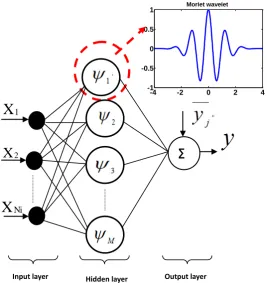
generalization ability of the neural network, a multi-dimensional WNN with Ni input nodes, No output nodes (No =1)
136
and M number of hidden neurons (wavelons) was developed in which hidden neurons were activated by wavelets as
137
activation functions (Figure 1). Each input node was related to each wavelon, with a special value of shift, scale and
138
input weight parameters. Therefore, input weights, scaling and shifting parameters formed M*Ni matrices.
139
Accordingly, each wavelon was activated by a multi-dimensional wavelet which was defined as the multiplication of
140
one-dimensional wavelets as below:
141
i
k ik ik
i 1 2 3 N
ik Ni
k=1
x w -t
x ,x ,x , . . . ,x =
1, 2, .., i; 1, 2,3, ,
k N i M
142
In which (t)is Morlet wavelet function:
143
-t22cos
t =e (5t)
144
Where Ni indicates the number of input nodes and wik ,tik and ik are the input weight ,shift and scale
145
parameters relating kth input to the ith hidden wavelon respectively. It should be pointed out that each neuron acted on
146
each input signal by a shifted and scaled version of mother wavelet (Morlet). The output of each wavelon was fed in
147
to each output neuron with a special value of weight led to a No*M output weight matrix. Consequently the output of
148
the proposed network was defined as follows:
149
j ji i 1
M
i=
2 3 Ni j
1
= , , ,
y
w x x x . . .,x +y i1, 2,....,M j; 1, 2,....,No150
Where i(x1,x2,x3, . . ,xNi) is defined in equation (3) and wji is the output weight relating i th
hidden wavelon
151
to jth output node. The yjwas also needed as a bias value to deal with nonzero mean functions (Zhang and
152
Benveniste, 1992). Due to the above equations, five groups of parameters (input weights, shift, scale, output weights
153
WNN it is important to initialize the adjustable parameters properly before training in order to guarantee that the
155
daughter wavelets (shifted and scaled versions of mother wavelet) cover the entire of the input data space.
156
Accordingly the WNN was trained in two main steps. First the adjustable parameters were initialized according to
157
(Zhang and Benveniste, 1992); second, the network was trained based on batch gradient descent algorithm since the
158
data vectors were not too large and included only 100 samples describing one complete gait cycle. The batch gradient
159
descent algorithm developed for training the WNN is presented in Appendix 1. The error goal, number of training
160
epochs and hidden neurons were determined based on the same procedure with the FFANN. All of the above analysis
161
were conducted in Matlab (v. 2009, The MathWorks, Inc., Natick, MA).
162
2.6.Inverse dynamics analysis
163
A valid three dimensional musculoskeletal model with 23 degrees of freedom (DOF) and 92 muscles was
164
recruited, available in Opensim software library (Delp et al., 2007).The model had three-DOF ball-and-socket hip joint,
165
a hinge knee joint, universal joint for ankle-subtalar complex and hinge metatarsal joint. The model was first scaled
166
using experimental marker trajectories. Scaled model was then used in the inverse kinematics (IK) analysis to
167
calculate joint angles. In order to calculate joint moments, the scaled model was first imported to reduced residual
168
analysis (RRA) in which musculoskeletal center of mass was modified so as the calculated joint angles would be in
169
consistence with experimental GRFs.
170
The modified scaled model, calculated joint angles and experimental GRFs were then imported to compute
171
muscle control (CMC) module in which muscle activities were calculated. Finally lower extremity joint moments
172
were calculated using inverse dynamics analysis (ID) based on the CMC module calculations. Calculated joint
173
moments were considered as WNN and ANN outputs to train the networks and validate the predictions.
174
3. Results
175
Prediction capability of a generic multi-dimensional WNN was investigated at two different generalization
176
levels; (i) level 1;specific inter-subject and (ii) level 2;non-specific inter-subject. WNN predictions were validated
177
against inverse dynamics calculations and compared with those obtained from a three-layer FFANN.
178
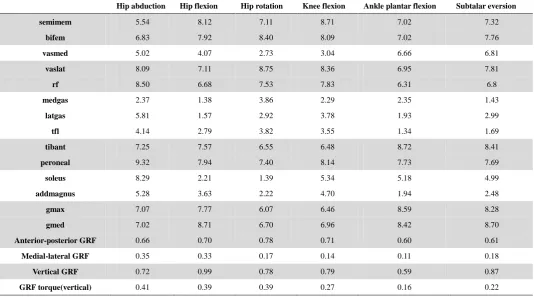
MI criterion was calculated between 18 potential inputs (three dimensional GRFs, moment of vertical GRF
179
around center of pressure and a total of 14 EMG signals represented with 14 RMS features in time domain) and six
180
joint moments outputs (hip abduction/adduction, hip flexion/extension, hip rotation, knee flexion/extension, and
181
ankle flexion/extension and subtalar eversion moments).According to the results (Table 1) eight EMG signals,
182
including semimembranosus (semimem), biceps femuris (bifem), vastuslateralis (vaslat), rectus femoris (rf), tibia
183
anterior (tibant), peroneal, gluteus maximus (gmax) and gluteus medius (gmed) as well as two ground reaction
184
components including anterior-posterior and vertical components of GRFs provided significant amount of
185
information about joint moments and were chosen as the network (WNN and FFANN) inputs.
186
3.1.Level 1: specific inter-subject
187
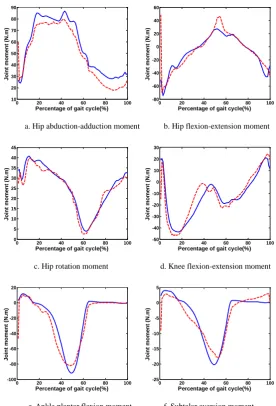
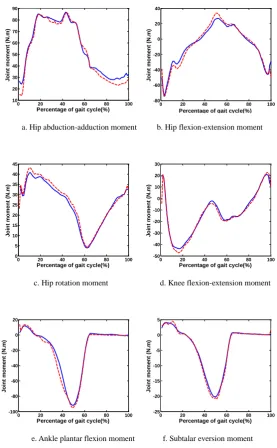
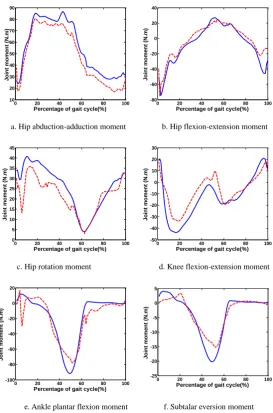
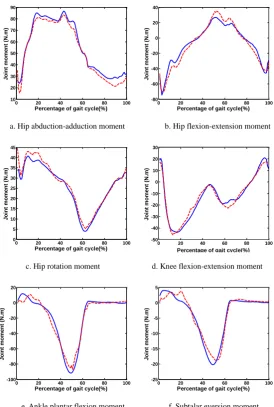
Inverse dynamics calculations are compared with FFANN predictions (Figure 2) and WNN calculations
188
(Figure 3) for medial thrust pattern of subject 4 as the test data set. According to Figure 2, a three-layer FFANN with
189
20 hidden neurons, 10 inputs and one output could predict the general pattern of lower extremity joint moments.
190
However the predicted waveforms had different maximum and minimum values compared to the reference joint
191
moments (inverse dynamics calculations). For example, FFANN output could not predict the pattern of knee
flexion-192
extension moment (NRMSE=11.01%, =0.88) (Figure 2-d). Moreover FFANN output overestimated the local
193
On the other hand according to Figure 3 the three-layer WNN network with 15 hidden neurons could predict
195
the overall pattern of lower extremity joint moments as well as local minimums and maximums on each waveform.
196
The maximum error occurred in prediction of the hip abduction moment (NRMSE =5.69%, =0.99) which was much
197
lower than the maximum error for FFANN moment prediction (hip adduction moment: NRMSE =12.72%, =0.97).
198
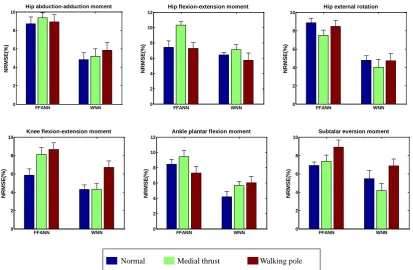
Figure 4 summarizes the accuracy of predictions for FFANN and WNN. According to the results, FFANN could
199
predict joint moments to a certain level of accuracy for normal pattern (NRMSE7.70%, =0.93) medial thrust (
200
NRMSE8.68%, =0.95) and walking pole (NRMSE8.25%, =0.94) patterns. Cross correlation values ranged
201
from =0.86 to =0.98 and all the errors (NRMSE) were less than 13%.
202
By comparison, WNN could predict the joint moments more accurately than FFANN (normal pattern:
203
NRMSE5.00%, =0.97; medial thrust: NRMSE5.10%, =0.96; and walking pole: NRMSE5.98%, =0.96). All
204
of the cross correlation coefficients were higher than the corresponding values of FFANN and all errors were also
205
lower than 10%. It is also noteworthy that the optimal WNN structure required less number of hidden neurons (15
206
wavelons) compared to the FFANN structure (20 hidden neurons) used to predict joints moments for the same test
207
data set. Detailed information about the NRMSE % and cross correlation coefficients ( ) is presented in the Appendix
208
(Table 1.A and Table 2.A) for FFANN and WNN predictions.
209
3.2.Level 2:non- specific inter-subject
210
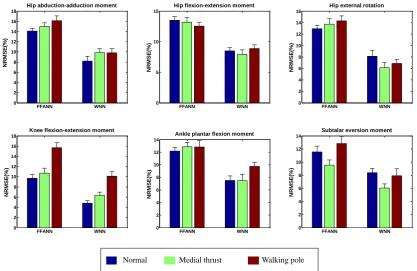
Inverse dynamics calculated joint moments are compared against FFANN predictions (Figure 5) and WNN
211
calculations (Figure 6). According to the results (Figure7) errors were slightly increased at this level compared to the
212
corresponding errors at level 1. Due to non-specific inter subject training space with higher pattern variation at this
213
level compared to level 1, the number of hidden neurons was increased .For FFANN with 25 hidden neurons, cross
214
correlation values ranged from =0.84 to =0.96 and all the NRMSE values were less than 20% (normal pattern:
215
NRMSE12.32%, =0.91; medial thrust: NRMSE12.50%, =0.91; and walking pole: NRMSE14.04%, =0.91)
216
For WNN with 19 hidden neurons, the average prediction errors were also increased compared to level 1
217
(normal pattern: NRMSE7.6%, =0.96; medial thrust: NRMSE7.30%, =0.96; and walking pole: NRMSE8.90%,
218
=0.95). However all of the cross-correlation values were still higher than those obtained from FFANN and all of
219
the errors were also lower than corresponding FFANN prediction errors.
220
Moreover it should be pointed out that although the prediction errors were increased slightly at level 2
221
compared to level 1, the error increase in WNN predictions at level 2 were still smaller than the corresponding error
222
increment in FFANN calculations (Figure 8).Compared to level 1, more hidden neurons were required for both
223
FFANN and WNN; however the number of hidden neurons in WNN were still lower than in FFANN which was
224
hired for the prediction of the same test data set. Detailed information about the NRMSE % and cross correlation
225
coefficients is presented in the Appendix (Table 3.A and Table 4.A) for FFANN and WNN predictions.
226
4. Discussion
227
228
229
230
231
232
233
234
235
This study demonstrated that a multi-dimensional wavelet neural network (WNN) trained with inter-subject data space can be employed as a real-time surrogate model to predict lower extremity joint moments associated with
different gait patterns. The present study differed from the previous researches on joint moment’s prediction using neural network in two main aspects. First, a wavelet neural network was developed for the first time in this study to
address the disadvantages of the traditional neural network .WNN predicted joint moments more accurately than feed forward artificial neural network used in the previous studies. Second, unlike previous studies, the data base adopted
in this study included two different knee rehabilitation programs (medial thrust and walking pole) as well as normal gait. Due to this fact that knee rehabilitation programs mainly aim to reduce knee joint loading, a thorough real-time
Reviewing the previous research (Favre et al., 2012, Liu et al., 2009) used GRFs and related parameters to
237
predict joint moments successfully, additionally (Hahn, 2007) employed EMG signals to predict joint moments and
238
forces using artificial intelligence. This is consistent with our study using EMG and GRFs contributions to predict
239
joint moments. Such an approach also avoids the use of marker trajectories which need special equipment and can be
240
time consuming.
241
In order to improve the prediction ability of the intelligent networks (WNN and ANN), mutual information
242
technique was recruited to measure the amount of information provided by potential inputs (RMS representations of
243
EMG signals and GRFs) about the outputs (joint moments). This technique is noise robust and insensitive to data
244
transformation. It also measures the dependency between variables without any pre-assumption about the data
245
structure which makes it suitable for nonlinear data bases(May et al., 2011). MI-based chosen EMG signals were also
246
consistent with those signals used by (Zhang et al., 2012) and (Hahn, 2007) for lower extremity joint angles and
247
moments predictions respectively.
248
At level 1(specific inter-subject), the network was tested for the walking condition that has been specifically
249
trained on it .On the other hand all of the walking patterns were included in the training data space at level
2(non-250
specific inter-subject) .By comparison, training the WNN on specific data space with fewer number of training
251
patterns led to slightly better prediction accuracy than training on non-specific gait patterns with higher number of
252
training sets.
253
Comparing the presented WNN approach with multi body dynamics, the latter needs a comprehensive data
254
base of markers as its inputs that should be provided by motion capture. However motion capture is not always
255
available in all laboratories. This approach also required musculoskeletal model to be scaled based on
subject-256
specific anthropometric characteristics. Although multi body dynamics approach can provide physics-based insights
257
into human walking and investigate casual relationships in gait analysis, such an approach is generally time
258
consuming which prevents it to serve as a real-time method.
259
260
261
262
263
264
265
266
267
Unlike inverse dynamics analysis, WNN could predict joint moments based on GRFs and a few number of EMG signals which released the necessity of motion capture. It also did not need musculoskeletal model or
subject-specific scaling of the model. Once the network was trained based on inter-subject data base it could predict joint moments for a new subject with a high level of accuracy. Consequently WNN proposed a much easier and faster
method for joint moment prediction which can serve as a real-time surrogate model for human gait analysis. Especially in gait rehabilitation where the real-time calculations of joint moments provide useful information about
the efficiency of the rehabilitation plans and unwanted moment increment that may occur in adjacent joints which is one of the major concerns in gait rehabilitation. Therefore wavelet neural network has the potential of executing of a
more effective rehabilitation program with minimum effort involved.
268
As mentioned earlier, (Liu et al., 2009) proposed a three-layer FFANN to predict sagittal lower extremity
269
joint torques associated with two different vertical jumping conditions. The network was trained based on
non-270
specific inter-subject data space similar to the level 2 of the present study; however their training data space included
271
18 data sets (9 subjects * 2 conditions). All of the NRMSE (%) values were below 10% (except for ankle moment in
272
counter movement jump with NRMSE =14.6%). Compared to their study, the present three-layer FFANN had higher
273
prediction errors since it was trained based on a smaller data base (three subjects instead of nine subjects) included
274
larger patterns variation (three different gait patterns instead of two different jumping condition).However the
275
proposed WNN could predict joints moments to a higher level of accuracy and all of the NRMSE (%) values obtained
276
from the WNN were below 11% (Table 2.A and Table 4.A).Two previous studies by (Liu et al., 2009) and (Favre et
277
al., 2012) supported this idea that a three-layer FFANN trained based on inter-subject data space is sufficient to
278
accurate to predict three dimensional joint moments using GRFs and EMG signals for a subject that was not seen by
280
the network before.
281
282
283
284
285
Although WNN could predict joint moments based on GRFs and EMG signals successfully, it did not provide physical insights of human gait since it modeled the input-output relationship as a black box. This study did
not aim to provide such understanding and should not be compared with inverse dynamics analysis in this aspect. Despite the computational cost of multi body dynamics, it is still one of the most accepted computational approaches in biomechanics due to its ability for physical modeling (Ren et al., 2008).
286
Finally it should be pointed out that there were also some limitations within the present study. One limitation
287
was that the relatively small data pool of four subjects was used. It would be valuable to test the prediction capacity
288
of multi-dimensional WNN for a larger subject pool. As another limitation, WNN was trained based on joint
289
moments which were calculated by inverse dynamics analysis. Accordingly WNN could not be more accurate than
290
inverse dynamics approach. Due to available experimental knee reaction force in the present data base, it would be
291
valuable to recruit WNN to predict experimental joint reaction force based on GRFs and EMG signals and compare
292
the results with inverse dynamics calculations.
293
294
295
296
297
298
For the future application, wavelet neural network can be employed in conjunction with inverse dynamics analysis to decrease the computational cost. Intelligent surrogate models can learn the dynamics of the patterns and
respond to a change in environment (adopt to a new subject for example) .Accordingly trained intelligent networks can release the necessity of calculation repetitions, hence intelligent surrogates can be used jointly with inverse
dynamics analysis. A recent study for example used artificial neural network to solve the static optimization equations as part of inverse dynamics calculation procedure to speed up the calculation process (van den Bogert et al.,
299
2013).
300
301
302
303
304
The generalization ability of the proposed wavelet neural network can also benefit what-if studies in which
sensitivity of joint moments would be investigated due to changes in joint kinematics. Once the intelligent network is trained based on inverse dynamics calculated joint moments, it can be used to predict joint moments in response to
kinematic variations in order to conduct sensitivity analysis and release the necessity of inverse dynamics repetitions. All these will be conducted in future studies.
305
5. Conclusion
306
307
308
309
310
311
312
313
314
This study demonstrated the feasibility of the wavelet neural network to calculate lower extremity joint
moments using ground reaction forces and electromyography signals; easier and faster than multi body dynamics and more accurate than feed forward artificial neural network. For specific inter-subject training , all of the prediction
errors were lower than 9.00% with correlation coefficients >0.89 .For non-specific inter-subject , all of the prediction errors were still lower than 11% with >0.91.Accordingly compared to the traditional feed forward neural network ,the proposed structure was more stable and robust due to large variations in input patterns. The high level
of accuracy and low computational cost at one hand, capability of joint moment calculation without marker trajectories at another hand, suggest the proposed network as a real-time surrogate model that benefit gait
Conflict of interest statement
316
The authors have no conflict of interests to be declared.
317
Acknowledgments
318
This work was supported by “the Fundamental Research Funds for the Central Universities”, National
319
Natural Science Foundation of China [E050702] the program of Xi’an Jiao Tong University [grant number
320
xjj2012108], and the program of Kaifang funding of the State Key Lab for Manufacturing Systems Engineering
321
[grand number sklms2011001]
322
References
323
ACKLAND, D. C., LIN, Y.-C. & PANDY, M. G. 2012. Sensitivity of model predictions of muscle function to changes in moment arms and
324
muscle¨Ctendon properties: A Monte-Carlo analysis. Journal of biomechanics, 45, 1463-1471.
325
ALEXANDRIDIS, A. K. & ZAPRANIS, A. D. 2013. Wavelet neural networks: A practical guide. Neural Networks.
326
ARSLAN, Y. Z., ADLI, M. A., AKAN, A. & BASLO, M. B. 2010. Prediction of externally applied forces to human hands using frequency
327
content of surface EMG signals. Computer Methods and Programs in Biomedicine, 98, 36-44.
328
AU, S., BERNIKER, M. & HERR, H. 2008. Powered ankle-foot prosthesis to assist level-ground and stair-descent gaits. Neural Networks, 21,
329
654-666.
330
BILLINGS, S. A. & WEI, H.-L. 2005. A new class of wavelet networks for nonlinear system identification. Neural Networks, IEEE
331
Transactions on, 16, 862-874.
332
CARBONE, V., VAN DER KROGT, M., KOOPMAN, H. & VERDONSCHOT, N. 2012. Sensitivity of subject-specific models to errors in
333
musculo-skeletal geometry. Journal of biomechanics.
334
CHAUHAN, N., RAVI, V. & KARTHIK CHANDRA, D. 2009. Differential evolution trained wavelet neural networks: Application to
335
bankruptcy prediction in banks. Expert Systems with Applications, 36, 7659-7665.
336
CHEN, Y., YANG, B. & DONG, J. 2006. Time-series prediction using a local linear wavelet neural network. Neurocomputing, 69, 449-465.
337
CORDOVA, J. J., YU, W. & LI, X. Haar wavelet neural networks for nonlinear system identification. Intelligent Control (ISIC), 2012 IEEE
338
International Symposium on, 2012. IEEE, 276-281.
339
DELP, S., ANDERSON, F., ARNOLD, A., LOAN, P., HABIB, A., JOHN, C., GUENDELMAN, E. & THELEN, D. 2007. OpenSim:
open-340
source software to create and analyze dynamic simulations of movement. IEEE transactions on bio-medical engineering, 54, 1940.
341
FAVRE, J., HAYOZ, M., ERHART-HLEDIK, J. C. & ANDRIACCHI, T. P. 2012. A neural network model to predict knee adduction moment
342
during walking based on ground reaction force and anthropometric measurements. Journal of biomechanics, 45, 692-698.
343
FREGLY, B. J., BESIER, T. F., LLOYD, D. G., DELP, S. L., BANKS, S. A., PANDY, M. G. & D'LIMA, D. D. 2012. Grand challenge
344
competition to predict in vivo knee loads. Journal of Orthopaedic Research, 30, 503-513.
345
FREGLY, B. J., REINBOLT, J. A., ROONEY, K. L., MITCHELL, K. H. & CHMIELEWSKI, T. L. 2007. Design of patient-specific gait
346
modifications for knee osteoarthritis rehabilitation. Biomedical Engineering, IEEE Transactions on, 54, 1687-1695.
347
HAHN, M. E. 2007. Feasibility of estimating isokinetic knee torque using a neural network model. Journal of biomechanics, 40, 1107-1114.
348
HAYKIN, S. S., HAYKIN, S. S., HAYKIN, S. S. & HAYKIN, S. S. 2009. Neural networks and learning machines, Prentice Hall New York.
349
IYER, M. S. & RHINEHART, R. R. 1999. A method to determine the required number of neural-network training repetitions. Neural
350
Networks, IEEE Transactions on, 10, 427-432.
351
IYER, S. R. & SHARDA, R. 2009. Prediction of athletes performance using neural networks: An application in cricket team selection. Expert
352
Systems with Applications, 36, 5510-5522.
353
JOSHI, D., MISHRA, A. & ANAND, S. 2011. ANFIS based knee angle prediction: An approach to design speed adaptive contra lateral
354
controlled AK prosthesis. Applied Soft Computing, 11, 4757-4765.
355
LIU, M. M., HERZOG, W. & SAVELBERG, H. H. 1999. Dynamic muscle force predictions from EMG: an artificial neural network approach.
356
LIU, Y., SHIH, S.-M., TIAN, S.-L., ZHONG, Y.-J. & LI, L. 2009. Lower extremity joint torque predicted by using artificial neural network
358
during vertical jump. Journal of biomechanics, 42, 906-911.
359
LUH, J.-J., CHANG, G.-C., CHENG, C.-K., LAI, J.-S. & KUO, T.-S. 1999. Isokinetic elbow joint torques estimation from surface EMG and
360
joint kinematic data: using an artificial neural network model. Journal of Electromyography and Kinesiology, 9, 173-183.
361
MAY, R., DANDY, G. & MAIER, H. 2011. Review of input variable selection methods for artificial neural networks. Artificial neural
362
networks—methodological advances and biomedical applications. InTech, Croatia. doi, 10, 16004.
363
MINGMING, T. & JINLIANG, Z. 2012. A multiple adaptive wavelet recurrent neural network model to analyze crude oil prices. Journal of
364
Economics and Business, 64, 275-286.
365
OH, S. E., CHOI, A. & MUN, J. H. 2013. Prediction of ground reaction forces during gait based on kinematics and a neural network model.
366
Journal of biomechanics, 46, 2372-2380.
367
PFEIFFER, M. & HOHMANN, A. 2012. Applications of neural networks in training science. Human movement science, 31, 344-359.
368
POURTAGHI, A. 2012. Wavelet Neural Network and Wavenet Performance Evaluation in Hydrodynamic Force Prediction due to Waves on
369
Vertical Cylinders. International Journal of Information and Computer Science, 1.
370
REINBOLT, J. A., FOX, M. D., SCHWARTZ, M. H. & DELP, S. L. 2009. Predicting outcomes of rectus femoris transfer surgery. Gait &
371
posture, 30, 100-105.
372
REINBOLT, J. A., HAFTKA, R. T., CHMIELEWSKI, T. L. & FREGLY, B. J. 2008. A computational framework to predict post-treatment
373
outcome for gait-related disorders. Medical engineering & physics, 30, 434-443.
374
REN, L., JONES, R. K. & HOWARD, D. 2008. Whole body inverse dynamics over a complete gait cycle based only on measured kinematics.
375
Journal of Biomechanics, 41, 2750-2759.
376
ROBERT, T., CAUSSE, J. & MONNIER, G. 2013. Estimation of external contact loads using an inverse dynamics and optimization approach:
377
General method and application to sit-to-stand maneuvers. Journal of biomechanics, 46, 2220-2227.
378
RUP REZ, M. J., MART N-GUERRERO, J., MONSERRAT, C. & ALCA IZ, M. 2012. Artificial neural networks for predicting dorsal
379
pressures on the foot surface while walking. Expert Systems with Applications, 39, 5349-5357.
380
SCH LLHORN, W. 2004. Applications of artificial neural nets in clinical biomechanics. Clinical Biomechanics, 19, 876-898.
381
SCHMIDT, A. 2012. Movement pattern recognition in basketball free-throw shooting. Human movement science, 31, 360-382.
382
SONG, R. & TONG, K. 2005. Using recurrent artificial neural network model to estimate voluntary elbow torque in dynamic situations.
383
Medical and Biological Engineering and Computing, 43, 473-480.
384
STAUDENMANN, D., ROELEVELD, K., STEGEMAN, D. F. & VAN DIE N, J. H. 2010. Methodological aspects of SEMG recordings for
385
force estimation–a tutorial and review. Journal of Electromyography and Kinesiology, 20, 375-387.
386
SUBASI, A., ALKAN, A., KOKLUKAYA, E. & KIYMIK, M. K. 2005. Wavelet neural network classification of EEG signals by using AR
387
model with MLE preprocessing. Neural Networks, 18, 985-997.
388
SUBASI, A., YILMAZ, M. & OZCALIK, H. R. 2006. Classification of EMG signals using wavelet neural network. Journal of neuroscience
389
methods, 156, 360-367.
390
UCHIYAMA, T., BESSHO, T. & AKAZAWA, K. 1998. Static torque–angle relation of human elbow joint estimated with artificial neural
391
network technique. Journal of biomechanics, 31, 545-554.
392
VAN DEN BOGERT, A. J., GEIJTENBEEK, T., EVEN-ZOHAR, O., STEENBRINK, F. & HARDIN, E. C. 2013. A real-time system for
393
biomechanical analysis of human movement and muscle function. Medical & biological engineering & computing, 1-9.
394
VAN DER SMAGT, P. & HIRZINGER, G. 1998. Solving the ill-conditioning in neural network learning. Neural Networks: Tricks of the
395
Trade. Springer.
396
WANG, L. & BUCHANAN, T. S. 2002. Prediction of joint moments using a neural network model of muscle activations from EMG signals.
397
Neural Systems and Rehabilitation Engineering, IEEE Transactions on, 10, 30-37.
398
WEI, H.-L., BILLINGS, S. A., ZHAO, Y. & GUO, L. 2010. An adaptive wavelet neural network for spatio-temporal system identification.
399
Neural Networks, 23, 1286-1299.
400
WILLSON, J., TORRY, M. R., DECKER, M. J., KERNOZEK, T. & STEADMAN, J. 2001. Effects of walking poles on lower extremity gait
401
mechanics. Medicine and science in sports and exercise, 33, 142-147.
402
ZAINUDDIN, Z. & PAULINE, O. 2011. Modified wavelet neural network in function approximation and its application in prediction of
time-403
ZHANG, F., LI, P., HOU, Z.-G., LU, Z., CHEN, Y., LI, Q. & TAN, M. 2012. sEMG-based continuous estimation of joint angles of human
405
legs by using BP neural network. Neurocomputing, 78, 139-148.
406
ZHANG, P. & WANG, H. 2012. Fuzzy Wavelet Neural Networks for City Electric Energy Consumption Forecasting. Energy Procedia, 17,
407
1332-1338.
408
ZHANG, Q. & BENVENISTE, A. 1992. Wavelet networks. Neural Networks, IEEE Transactions on, 3, 889-898.
409
Table 1 MI calculations between RMS features of EMG signals and GRFs (inputs) and lower extremity joint moments (outputs)
for subject 4 walked with normal gait pattern as an example. MI criteria measure the amount of relevancy between potential inputs and outputs; higher MI values means more informative the input is regarding to the joint moments. Muscle abbreviations have
been defined in the text.
Hip abduction Hip flexion Hip rotation Knee flexion Ankle plantar flexion Subtalar eversion
semimem 5.54 8.12 7.11 8.71 7.02 7.32
bifem 6.83 7.92 8.40 8.09 7.02 7.76
vasmed 5.02 4.07 2.73 3.04 6.66 6.81
vaslat 8.09 7.11 8.75 8.36 6.95 7.81
rf 8.50 6.68 7.53 7.83 6.31 6.8
medgas 2.37 1.38 3.86 2.29 2.35 1.43
latgas 5.81 1.57 2.92 3.78 1.93 2.99
tfl 4.14 2.79 3.82 3.55 1.34 1.69
tibant 7.25 7.57 6.55 6.48 8.72 8.41
peroneal 9.32 7.94 7.40 8.14 7.73 7.69
soleus 8.29 2.21 1.39 5.34 5.18 4.99
addmagnus 5.28 3.63 2.22 4.70 1.94 2.48
gmax 7.07 7.77 6.07 6.46 8.59 8.28
gmed 7.02 8.71 6.70 6.96 8.42 8.70
Anterior-posterior GRF 0.66 0.70 0.78 0.71 0.60 0.61
Medial-lateral GRF 0.35 0.33 0.17 0.14 0.11 0.18
Vertical GRF 0.72 0.99 0.78 0.79 0.59 0.87
GRF torque(vertical) 0.41 0.39 0.39 0.27 0.16 0.22
[image:14.595.31.566.107.404.2]Figure 1 WNN structure with Ni inputs, M hidden wavelons and one output which was used to predict each component of lower extremity joint moments.
2
X
Ni
X
Input layer Hidden layer Output layer 1
X
2
M 3
-4 -2 0 2 4
-1 -0.5 0 0.5
[image:15.595.158.426.68.352.2]a. Hip abduction-adduction moment b. Hip flexion-extension moment
c. Hip rotation moment d. Knee flexion-extension moment
e. Ankle plantar flexion moment f. Subtalar eversion moment
Figure 2 Predicted joint moments (dashed line) versus inverse dynamics calculations (solid line) using three-layer FFANN for subject 4 walked with medial thrust pattern corresponding to specific inter-subject training (level 1).
0 20 40 60 80 100
10 20 30 40 50 60 70 80 90
Percentage of gait cycle(%)
J o in t m o m e n t (N .m )
0 20 40 60 80 100
-80 -60 -40 -20 0 20 40 60
Percentage of gait cycle(%)
J o in t m o m e n t (N .m )
0 20 40 60 80 100
0 5 10 15 20 25 30 35 40 45
Percentage of gait cycle(%)
J o in t m o m e n t (N .m )
0 20 40 60 80 100
-50 -40 -30 -20 -10 0 10 20 30
Percentage of gait cycle(%)
J o in t m o m e n t (N .m )
0 20 40 60 80 100
-100 -80 -60 -40 -20 0 20
Percentage of gait cycle(%)
J o in t m o m e n t (N .m )
0 20 40 60 80 100
-25 -20 -15 -10 -5 0 5
Percentage of gait cycle(%)
[image:16.595.156.433.58.465.2]a. Hip abduction-adduction moment b. Hip flexion-extension moment
c. Hip rotation moment d. Knee flexion-extension moment
e. Ankle plantar flexion moment f. Subtalar eversion moment
Figure 3 Predicted joint moments (dashed line) versus inverse dynamics calculations (solid line) using three-layer WNN for subject 4 walked with medial thrust pattern corresponding to specific inter-subject training (level 1).
0 20 40 60 80 100
10 20 30 40 50 60 70 80 90
Percentage of gait cycle(%)
J o in t m o m e n t (N .m )
0 20 40 60 80 100
-80 -60 -40 -20 0 20 40
Percentage of gait cycle(%)
J o in t m o m e n t (N .m )
0 20 40 60 80 100
0 5 10 15 20 25 30 35 40 45
Percentage of gait cycle(%)
J o in t m o m e n t (N .m )
0 20 40 60 80 100
-50 -40 -30 -20 -10 0 10 20 30
Percentage of gait cycle(%)
J o in t m o m e n t (N .m )
0 20 40 60 80 100
-100 -80 -60 -40 -20 0 20
Percentage of gait cycle(%)
J o in t m o m e n t (N .m )
0 20 40 60 80 100
-25 -20 -15 -10 -5 0 5
Percentage of gait cycle(%)
[image:17.595.155.433.57.506.2]Figure 4 NRMSE (mean ± standard deviation) for FFANN and WNN predictions corresponding to three walking patterns as normal, medial thrust and walking pole at level 1 (specific inter-subject training).
FFANN WNN
0 2 4 6 8 10
N
R
M
S
E
(%
)
Hip abduction-adduction moment
FFANN WNN
0 2 4 6 8 10 12
N
R
M
S
E
(%
)
Hip flexion-extension moment
FFANN WNN
0 2 4 6 8 10
N
R
M
S
E
(%
)
Hip external rotation
FFANN WNN
0 2 4 6 8 10
N
R
M
S
E
(%
)
Knee flexion-extension moment
FFANN WNN
0 2 4 6 8 10 12
N
R
M
S
E
(%
)
Ankle plantar flexion moment
FFANN WNN
0 2 4 6 8 10
N
R
M
S
E
(%
)
Subtalar eversion moment
[image:18.595.88.502.54.324.2]Normal Medial thrust Walking pole
a. Hip abduction-adduction moment b. Hip flexion-extension moment
c. Hip rotation moment d. Knee flexion-extension moment
e. Ankle plantar flexion moment f. Subtalar eversion moment
Figure 5 Predicted joint moments (dashed line) versus inverse dynamics calculations (solid line) using three-layer FFANN for subject 4 walked with medial thrust pattern corresponding to non-specific inter-subject training (level 2).
0 20 40 60 80 100
10 20 30 40 50 60 70 80 90
Percentage of gait cycle(%)
J o in t m o m e n t (N .m )
0 20 40 60 80 100
-80 -60 -40 -20 0 20 40
Percentage of gait cycle(%)
J o in t m o m e n t (N .m )
0 20 40 60 80 100
0 5 10 15 20 25 30 35 40 45
Percentage of gait cycle(%)
J o in t m o m e n t (N .m )
0 20 40 60 80 100
-50 -40 -30 -20 -10 0 10 20 30
Percentage of gait cycle(%)
J o in t m o m e n t (N .m )
0 20 40 60 80 100
-100 -80 -60 -40 -20 0 20
Percentage of gait cycle(%)
J o in t m o m e n t (N .m )
0 20 40 60 80 100
-25 -20 -15 -10 -5 0 5
Percentage of gait cycle(%)
[image:19.595.158.432.42.456.2]a. Hip abduction-adduction moment b. Hip flexion-extension moment
c. Hip rotation moment d. Knee flexion-extension moment
e. Ankle plantar flexion moment f. Subtalar eversion moment
Figure 6 Predicted joint moments (dashed line) versus inverse dynamics calculations (solid line) using three-layer WNN for subject 4 walked with medial thrust pattern corresponding to non-specific inter-subject training (level 2).
0 20 40 60 80 100
10 20 30 40 50 60 70 80 90
Percentage of gait cycle(%)
J o in t m o m e n t (N .m )
0 20 40 60 80 100
-80 -60 -40 -20 0 20 40
Percentage of gait cycle(%)
J o in t m o m e n t (N .m )
0 20 40 60 80 100
0 5 10 15 20 25 30 35 40 45
Percentage of gait cycle(%)
J o in t m o m e n t (N .m )
0 20 40 60 80 100
-50 -40 -30 -20 -10 0 10 20 30
Percentage of gait cycle(%)
J o in t m o m e n t (N .m )
0 20 40 60 80 100
-100 -80 -60 -40 -20 0 20
Percentage of gait cycle(%)
J o in t m o m e n t (N .m )
0 20 40 60 80 100
-25 -20 -15 -10 -5 0 5
Percentage of gait cycle(%)
[image:20.595.157.432.58.466.2]Figure 7 NRMSE (mean ± standard deviation) for FFANN and WNN predictions corresponding to three walking patterns as normal, medial thrust and walking pole at level 2 (non-specific inter-subject training).
FFANN WNN
0 2 4 6 8 10 12 14 16 18
N
R
M
S
E
(%
)
Hip abduction-adduction moment
FFANN WNN
0 5 10 15
N
R
M
S
E
(%
)
Hip flexion-extension moment
FFANN WNN
0 2 4 6 8 10 12 14 16
N
R
M
S
E
(%
)
Hip external rotation
FFANN WNN
0 2 4 6 8 10 12 14 16 18
N
R
M
S
E
(%
)
Knee flexion-extension moment
FFANN WNN
0 2 4 6 8 10 12 14
N
R
M
S
E
(%
)
Ankle plantar flexion moment
FFANN WNN
0 2 4 6 8 10 12 14
N
R
M
S
E
(%
)
Subtalar eversion moment
Figure 8 Comparing the error increment between FFANN and WNN over level 1 (specific inter-subject) and level 2(non-specific inter-subject).At level 2 , the prediction errors were increased due to the higher variety in the training data space; however the
error increments in WNN predictions over level 1 and level 2 were generally lower than FFANN.
FFANN WNN
0 2 4 6 8 10 12 14 16
N
R
M
S
E
(%
)
Hip abduction-adduction moment
FFANN WNN
0 2 4 6 8 10 12 14
N
R
M
S
E
(%
)
Hip flexion-extension moment
FFANN WNN
0 5 10 15
N
R
M
S
E
(%
)
Hip external rotation
FFANN WNN
0 2 4 6 8 10 12 14
N
R
M
S
E
(%
)
Knee flexion-extension moment
FFANN WNN
0 2 4 6 8 10 12 14
N
R
M
S
E
(%
)
Ankle plantar flexion moment
FFANN WNN
0 2 4 6 8 10 12 14
N
R
M
S
E
(%
)
Subtalar eversion moment
[image:22.595.90.501.39.308.2]Level 1 Level 2