translation quality estimation
.
White Rose Research Online URL for this paper:
http://eprints.whiterose.ac.uk/98286/
Version: Accepted Version
Article:
Shah, K., Cohn, T. and Specia, L. orcid.org/0000-0002-5495-3128 (2015) A Bayesian
non-linear method for feature selection in machine translation quality estimation. Machine
Translation, 29 (2). pp. 101-125. ISSN 0922-6567
https://doi.org/10.1007/s10590-014-9164-x
[email protected] https://eprints.whiterose.ac.uk/ Reuse
Unless indicated otherwise, fulltext items are protected by copyright with all rights reserved. The copyright exception in section 29 of the Copyright, Designs and Patents Act 1988 allows the making of a single copy solely for the purpose of non-commercial research or private study within the limits of fair dealing. The publisher or other rights-holder may allow further reproduction and re-use of this version - refer to the White Rose Research Online record for this item. Where records identify the publisher as the copyright holder, users can verify any specific terms of use on the publisher’s website.
Takedown
If you consider content in White Rose Research Online to be in breach of UK law, please notify us by
(will be inserted by the editor)
A Bayesian non-Linear Method for Feature Selection
in Machine Translation Quality Estimation
Kashif Shah · Trevor Cohn · Lucia
Specia
Received: date / Accepted: date
Abstract We perform a systematic analysis on the effectiveness of features for
the problem of predicting the quality of machine translation at the sentence-level. Starting from a comprehensive feature set, we apply a technique based on Gaussian Processes, a Bayesian non-linear learning method, to identify features that perform well on datasets for different language pairs and text domains, with translations produced by various machine translation systems and scored for quality according to different criteria. We show that selecting features with this technique leads to significantly better performance in most datasets, as compared to using the complete feature sets or a state of the art feature selection approach. In addition, we identify a small set of features which seem to perform well across most datasets.
1 Introduction
Machine Translation (MT) systems have been increasingly adopted in recent years for different purposes, including gisting and aiding humans to produce professional quality translations. Since the quality of automatic translations tends to vary significantly across text segments, methods to predict translation quality become more and more relevant. This problem is referred to as Quality Estimation (QE). Different from standard MT evaluation metrics, QE metrics do not have access to reference (human) translations; they are aimed at MT systems in use. Applications of QE include:
– Decide which segments need revision by a human translator;
– Decide whether a reader gets a reliable gist of the text;
– Estimate how much effort it will be needed to post-edit a segment;
Kashif Shah, Trevor Cohn and Lucia Specia Department of Computer Science
University of Sheffield Sheffield, United Kingdom
– Select among alternative translations produced by different MT systems.
Work in QE started with the goal of estimating automatic metrics such as
BLEU [?] and WER [?]. However, these metrics are difficult to interpret,
par-ticularly at the sentence-level, and results proved unsuccessful. A new surge of interest in the field started recently, motivated by the widespread use of MT systems in the translation industry, as a consequence of better translation quality, more user-friendly tools, and higher demand for translation. In order to make MT maximally useful in this scenario, a quantification of the quality of translated segments similar to “fuzzy match scores” from translation mem-ory systems is needed. QE work addresses this problem by using more complex metrics that go beyond matching the source segment against previously trans-lated data. QE can also be useful for end-users reading translations for gisting, particularly those who cannot read the source language. Recent work focuses on estimating more interpretable metrics, where “quality” is defined accord-ing to the task at hand: post-editaccord-ing, gistaccord-ing, etc. A number of positive results have been reported (Section 2).
QE is generally addressed as a supervised machine learning task using algorithms to induce models from examples of translations described through a
number offeaturesand annotated for quality. One of most challenging aspects
of the task is the design of feature extractors to capture relevant aspects of quality.
A wide range of features from source and translation texts and external re-sources and tools have been used. These go from simple, language-independent features, to advanced, linguistically motivated features. They include features that rely on information from the MT system that generated the translations, and features that are oblivious to the way translations were produced. This va-riety of features plays a key role in QE, but it also introduces a few challenges. Datasets for QE are usually small because of the cost of human annotation. Therefore, large feature sets bring sparsity issues. In addition, some of these features are more costly to extract as they depend on external resources or require time-consuming computations. Finally, it is generally believed that dif-ferent datasets (i.e. language pair, MT system or specific quality annotation such as post-editing time vs translation adequacy) can benefit from different features.
Feature selection techniques can help not only select the best features
for a given dataset, but also understand which features are in general effective. While recent work has exploited selection techniques to some extent, the focus has been on improving QE performance on individual datasets (Section 2). As a result, no general conclusions can be made about the effectiveness of features across language pairs, text domains, MT systems and quality labels.
In this paper we propose to use Gaussian Processes for feature selection, a technique that has proven effective in ranking features according to their
discriminative power [?]. We benchmark with this technique on two settings:
feature sets; (i) one dataset (same language pair and quality scores) with seven feature sets produced in a completely independent fashion (by participants in a shared task on the topic) (Section 4). The experiments showed the potential of feature selection to improve overall regression results, often outperforming published results even on feature sets that had already been previously selected using other methods. They also allowed us to identify a small number of well-performing features across datasets (Section 5). We discuss the feasibility of extracting these features based on their dependence on external resources or specific languages.
2 Related work
Examples of successful cases of QE include improving post-editing efficiency by filtering out low quality segments which would require more effort or time to
correct than translating from scratch [?,?], selecting high quality segments to
be published as they are, without post-editing [?], selecting a translation from
either an MT system or a translation memory for post-editing [?], selecting the
best translation from multiple MT systems [?], and highlighting sub-segments
that need revision [?]. For an overview of various algorithms and features we
refer the reader to the WMT12-13 shared tasks on QE [?,?].
Most previous work on QE use machine learning algorithms such as Sup-port Vector Machines (SVM), which are robust to redundant/noisy features to a certain extent, and therefore feature selection is often neglected. Work using explicit feature selection methods rely mostly on forward/backward se-lection approaches, but the order in which features are added/removed is not informed by any prior knowledge. In what follows we summarise recent work using explicit feature selection methods.
[?] performed feature selection on a set of 475 sentence- and sub-sentence
level features. Principal Component Analysis and a greedy selection algorithm to iteratively create subsets of increasing size with the best-scoring individual features were exploited. Both selection methods yielded better performance than all features, with greedy selection achieving the best MAE scores with 254 features.
[?] reported positive results with a greedy backward selection algorithm
that removes 21 poor features from an initial set of 66 features based on error minimisation on a development set.
In an oracle-like experiment, [?] use a sequential forward selection method,
which starts from an empty set and adds one feature at a time as long as it de-creases the model’s error, evaluating the performance of the feature subsets on the test set directly. 37 features out of 147 are selected, and these significantly improved the overall performance.
[?] tested a few feature selection methods using both greedy stepwise and
strategy was reported to perform the best. Conversely, [?] reported no im-provements in performance in experiments with several selection methods.
Finally, [?], the winning system in the WMT12 QE shared task, used a
computationally-intensive method on a development set. For each of the official
evaluation metrics (e.g. MAE), from an initial set of 24 features, all 224
possible combinations were tested, followed by an exhaustive search to find the best combinations. The 15 features belonging to most of the top combinations were selected. Other rounds were added to deal with POS features, but the final feature sets included 14-15 features depending on the evaluation metric. This technique outperformed the complete feature set by a very large margin.
3 Gaussian Processes
Gaussian Processes (GPs; [?]) are an advanced machine learning framework
incorporating Bayesian non-parametrics and kernels, and are widely regarded
as state of the art for many regression tasks. Despite that, GPs have been
under-exploited for language applications. Most of the previous work on QE uses kernel-based Support Vector Machines for regression (SVR), based on experimental findings that non-linear models significantly outperform linear models. This is perhaps unsuprising, given the relatively small numbers of input features used and the complexity of the response variable.
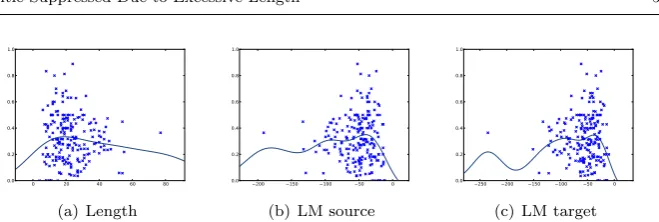
There is little reason to expect that measures of quality, such as post-editing effort, will be a linear function of the input features. To illustrate, consider how quality varies with the length of the source sentence, one of the most important feature in our arsenal. Most short inputs are easy to trans-late, and therefore we expect the translation quality to be high. In contrast medium length sentences can be much more syntactically complex, leading to much worse translations. However we do not expect that very long sentences are much worse again: in fact they may be simpler, as these sentences are often lists or other highly structured sentences which can be more easily translated. Consequently, positing a linear relationship between input length and quality is not a reasonable proposition. For this feature and many other important features, a non-linear approach is more appropriate. Fig 1 shows three exam-ples of features known to perform very well for translation quality prediction (source sentence length in 1(a), source sentence language model score in 1(b), and target sentence language model score in 1(c)) and their relationship with
post-editing distance – HTER [?], with a fittedGPto highlight the non
linear-ity of the data. The same behaviour is observed with other features and other quality labels.
Like SVMs for regression – SVRs,GPscan describe non-linear functions
us-ing kernels such as radial basis function (RBF). However in contrast, inference
inGPregression can be expressed analytically and the kernel hyper-parameters
optimised directly using gradient descent. This avoids the need for costly grid search while also allowing the use of much richer kernel functions with many
0 20 40 60 80 0.0 0.2 0.4 0.6 0.8 1.0 (a) Length
200 150 100 50 0
0.0 0.2 0.4 0.6 0.8 1.0
(b) LM source
250 200 150 100 50 0
0.0 0.2 0.4 0.6 0.8 1.0
(c) LM target
Fig. 1 Features known to perform well for translation quality prediction (source sentence length in 1(a), source sentence language model score in 1(b), and target sentence language model score in 1(c)) and their relationship with post-editing distance – HTER, with a fitted GP to highlight the non linearity of the data.
3 2 1 0 1 2 3
2 1 0 1 2
(a) posterior samples
3 2 1 0 1 2 3
1.5 1.0 0.5 0.0 0.5 1.0 1.5
(b) fitted posterior samples
3 2 1 0 1 2 3
1.5 1.0 0.5 0.0 0.5 1.0 1.5
(c) full posterior
Fig. 2 The Bayesian posterior under a GP prior, illustrated on synthetic one-dimensional data. Figs a and b show samples from the posterior (curves) over functions given several training observations (blue dots). These differ in the values of the hyperparameters, Fig a
usesσ2
f =σ
2
n=l= 1, while Fig b has learned the MLE hyper-parameters,σ
2
f = 0.7, σ
2
n=
0.02, l= 0.3. Fig c shows the full posterior for the model in b, with the shaded blue error
denoting±one confidence interval.
are probabilistic models and can be incorporated into larger graphical models. Moreover, GPs take a fully Bayesian approach by integrating out the model parameters to support posterior inference. Unlike most other Bayesian meth-ods, GP regression supports exact posterior inference and learning (see Fig 2), without the need to resort to approximation (e.g., Markov Chain Monte Carlo sampling or variational approximations).
Formulation GP regression assumes the presence of a latent function, f :
RF → R, which maps from the input space of feature vectorsx to a scalar.
Each response value is then generated from the function evaluated at the
corresponding data point,yi=f(xi) +η, whereη ∼ N(0, σ
2
n) is added
white-noise. Formallyf is drawn from a GP prior,
f(x)∼ GP(0, k(x,x′)),
which is parameterised by a mean (here, 0) and a covariance kernel function
k(x,x′). The kernel function represents the covariance (i.e., similarities in the
response) between pairs of data points. Several draws of f from a GP prior
[image:6.595.78.408.73.184.2] [image:6.595.81.400.248.339.2]3 2 1 0 1 2 3 1.5
1.0 0.5 0.0 0.5 1.0 1.5
(a)l= 0.3
3 2 1 0 1 2 3
2 1 0 1 2
(b)l= 1
3 2 1 0 1 2 3
1.5 1.0 0.5 0.0 0.5 1.0 1.5
(c)l= 4
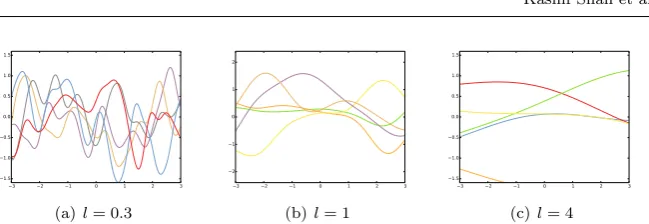
Fig. 3 Samples from a Gaussian Process prior with different length scales in an RBF kernel, showing the effect of this parameter on the smoothness of the function. We consider one
dimensional input (D= 1), setσf= 0.7 and omit the white-noise term.
Kernel (covariance) function GPsallow for many different kernels. Here
we consider the RBF with automatic relevance determination,
k(x,x′) =σ2
fexp −
1 2
D
X
i
(xi−x′i)
2
li
! ,
where thek(x,x′) is the kernel function between two data pointsx,x′ andD
is the number of features, andσf andli≥0 are the kernel hyper-parameters,
which control the covariance magnitude and the length scales of variation in
each dimension, respectively. This is closely related to the RBF kernel used with SVR, except that each feature is scaled independently from the others,
i.e., li =l for SVR, while GPsallow for a vector of independent values.
Fol-lowing standard practice we also include an additive white-noise term in the
kernel with variance σ2
s. The kernel hyper-parameters (σf, σn,l) are learned
from data using a maximum likelihood estimates.
The learned length scale hyper-parameters can be interpreted as encoding
the importance of a feature: the narrower the RBF (the smaller is li) the
more important a change in the feature value is to the model prediction. This is illustrated in Fig 3, which shows samples from a GP prior with different settings of the length scale: clearly the value of the input will be of less import for Fig 3(c), where the curves are mostly flat, versus Fig 3(a) which allows for rapid fluctuations. This effect can also be seen in the posterior, comparing Figs 2(a) and 2(b), where the latter’s shorter length scale allows more accurate fitting of the training points.
Feature selection A model trained usingGPscan be viewed as a list of features
ranked by relevance, and this information can be used for feature selection by
discarding the lowest ranked (least useful) features.GPson their own do not
[image:7.595.80.405.72.184.2]Bayesian inference Given the generative process defined above, prediction can be formulated as Bayesian inference under the posterior,
p(y∗|x∗,D) =
Z
f
p(y∗|x∗, f)p(f|D),
where x∗ is a test input and y∗ is its response value. The posterior p(f|D)
reflects our updated belief over possible functions after observing the training
setD, i.e.,f should pass close to the response values for each training instance
(but need not fit exactly due to additive noise). This is balanced against the biases (e.g., smoothness constraints) that arise from the GP prior. The
poste-rior is illustrated in Fig 2 (a, b), which shows several samples of f from the
posterior in (a,b), which are consistent with the observed training data, D.
The predictive posterior can be solved analytically, resulting in
y∗∼ N kT∗(K+σ2
nI)−
1
y, k(x∗,x∗)−k
T
∗(K+σ 2
nI)−
1
k∗
, (1)
where k∗ = [k(x∗,x1)k(x∗,x2)· · ·k(x∗,xn)]T are the kernel evaluations
be-tween the test point and the training set, and {Kij = k(xi,xj)} is the
ker-nel (gram) matrix over the training points. Note that the posterior in Eq. 1 includes not only the expected response (the mean) but also the variance, encoding the model’s uncertainty, which is important for integration into sub-sequent processing, e.g., as part of a larger probabilistic model. The posterior is illustrated in figure 2(c). Note the increasing amounts of uncertainty in the centre of the graph (wider confidence interval) where there are few nearby training instances compared to the edges where there is dense training data. This nuanced modelling of uncertainty is of great importance when combining the model into a larger probabilistic graphical model, such that uncertainty can be preserved into task based inferences.
The remaining question is how to determine the kernel hyperparameters. As stated above, these modulate the effect and strength of the GP prior, in our case determining the relative importance of each feature. The GP framework allows for kernel hyper-parameters to be learned using a maximum likelihood
estimate (type II). The marginal likelihood, p(y|X) = R
fp(y|X, f)p(f), can
be expressed analytically for GP regression (X are the training inputs), which
can be optimised with respect to the hyper-parameters for training (or model selection). Specifically, we can derive the gradient of the (log) marginal
like-lihood with respect to the model hyperparameters (i.e., σn, σf,l etc.) and
thereby find the type II maximum likelihood estimate using gradient ascent. Note that in general the marginal likelihood is non-convex in the hyperpa-rameter values, and consequently the solutions may only be locally optimal. Here we bootstrap the learning of complex models with many hyperparame-ters by initialising with the (good) solutions found for simpler models, thereby
4 Experimental settings
In our experiments, model learning is performed with an open source
imple-mentation ofGPs1for regression. This is used for our proposed feature selection
method. In what follows we describe two groups of quality estimation datasets: the first group contains various datasets for which we have extracted common
feature sets using the QuEst framework [?,?] (Section 4.1); the second group
contains a single dataset with various feature sets provided as part of the WMT12 quality estimation shared task (Section 4.2).
4.1 Datasets with QuEst features
The following datasets have a common feature set and are available for
down-load.2
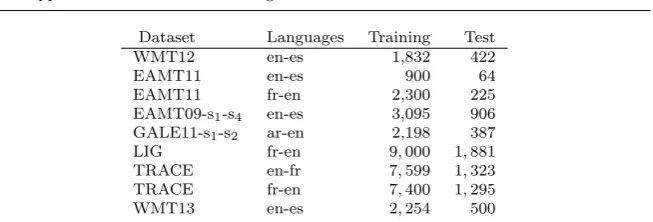
The statistics of these datasets are shown in Table 1.
WMT12 English-Spanish news sentence translations produced by a
phrase-based (PB) Moses “baseline” SMT system,3
and judged for post-editing effort in 1-5 (highest-lowest), taking a weighted average of three annotators.
EAMT11 English-Spanish en-es) and French-English
(EAMT11-fr-en) news sentence translations produced by a PB-SMT Moses baseline sys-tem and judged for post-editing effort in 1-4 (highest-lowest).
EAMT09 English sentences from the European Parliament corpus translated
by four SMT systems (two Moses-like PB-SMT systems and two fully discrim-inative training systems) into Spanish and scored for post-editing effort in 1-4
(highest-lowest). Systems are denoted by s1-s4.
GALE11 Arabic newswire sentences translated by two Moses-like PB-SMT
systems into English and scored for adequacy in 1-4 (worst-best). Systems are
denoted by s1-s2.
TRACE English-French (en-fr) and French-English (fr-en) sentence
transla-tions produced by two MT systems: a rule-based system (Reverso) and LMSI’s
statistical MT system [?]. English-French contains a mixture of data from
Ted Talks, WMT news, SemEval-2 Cross-Lingual Word Sense Disambigua-tion, and translation requests from Softissimo’s online translation portal (the Reverso system), which can be thought of as user-generated content. The French-English data contains sentences from the OWNI – a free French online newspaper, Ted Talks and translation requests from Softissimo’s online trans-lation portal. All transtrans-lations have been post-edited and the HTER scores are
1
http://sheffieldml.github.io/GPy/
2
http://www.dcs.shef.ac.uk/~lucia/resources.html 3
Dataset Languages Training Test
WMT12 en-es 1,832 422
EAMT11 en-es 900 64
EAMT11 fr-en 2,300 225
EAMT09-s1-s4 en-es 3,095 906
GALE11-s1-s2 ar-en 2,198 387
LIG fr-en 9,000 1,881
TRACE en-fr 7,599 1,323
TRACE fr-en 7,400 1,295
[image:10.595.83.410.75.186.2]WMT13 en-es 2,254 500
Table 1 Number of sentences in our datasets. Figures for EAMT09-s1-s4and GALE11-s1
-s2indicate number of sentences per MT system.
used as quality labels. For each language pair, 1,000 translations have been
post-edited by two translators independently. We simply concatenated these in our datasets.
LIG French-English sentence translations of various editions of WMT news
test sets, produced by a customised version of a PB-SMT Moses system by the
LIG group [?]. These sentences have been post-edited by a human translator,
and labelled for HTER.
WMT13 English-Spanish sentence translations of news texts produced by a
PB-SMT Moses baseline system. These were then post-edited by a professional translator and labelled for post-editing effort using HTER. This is a superset of the WMT12 dataset, with 500 additional sentences for test, and a different quality label.
4.1.1 Feature sets
The features for these datasets are extracted using the open source toolkit
QuEst.4
We differentiate betweenblack-box(BB) andglass-box(GB) features,
as only BB are available for all datasets (we did not have access to all MT systems that produced the other datasets). For the WMT12 and GALE11 datasets, we experimented with both BB and GB features. The BB feature sets are the same for all datasets, except for the Arabic-English datasets, where language-specific features supplement the initial set of features, and for the WMT13 dataset, where advanced features dependent on external resources like parsers have been exploited.
We also distinguish one special feature: thepseudo-reference(PR), as this
is not a standard feature in that it requires another MT system to be extracted. This feature consists in translating the source sentence using another MT
sys-tem (in our case, Google Translate) to obtain apseudo-reference. The
geomet-ric mean of (lambda-smoothed) 1-to-4-gram precision scores (i.e. a smoothed
4
version of BLEU to avoid 0-counts without the brevity penalty) is then com-puted between the original MT and this pseudo-reference. We note that the better the external MT system, the closer the pseudo-reference translation is to a human translation, and therefore the more reliable this feature becomes.
For each dataset we built four QE systems, each with a feature set:
– BL: 17 features that performed well across languages in previous work and
were used as baseline in the WMT12-13 QE shared tasks.
– number of tokens in the source & target sentences
– average source token length
– average number of occurrences of the target word within the target
sentence
– number of punctuation marks in source and target sentences
– language model (LM) probability of source and target sentences using
3-gram LMs built from the source/target sides of SMT training corpus
– average number of translations per source word as given by IBM 1
model thresholded such thatP(t|s)>0.2
– same as above withP(t|s)>0.01 weighted by the inverse frequency of
each word in the source side of the SMT training corpus
– percentage of unigrams, bigrams and trigrams in frequency quartiles 1
(lower frequency words) and 4 (higher frequency words) in the source side of the SMT training corpus
– percentage of unigrams in the source sentence seen in the source side
of the SMT training corpus
– AF: All features available for the dataset. This is a superset of the above,
where:
– For the experiments with BB features we have a common set of 80
features for all datasets, and additional 43 language specific features for the Arabic-English datasets, or additional advanced features for the WMT13 dataset, for which resources had been previously curated.
– For the experiments with GB features we have all MT system-dependent
features (varying according to the actual type of MT system) available
for the GALE11-s1(39), GALE11-s2 (48), and WMT12 (47) datasets.
For a comprehensive list, we refer the reader to the QuEst project website.4
– BL+PR: 17 baseline features along with a pseudo reference feature.
– AF+PR: All features available (BB, GB or BB+GB) plus the
pseudo-reference feature.
4.2 WMT12 datasets
This is exactly the same as the WMT12 dataset described above. However, as feature sets, we use those provided by all but one of the participating teams
in the WMT12 shared task on QE.5
These very diverse feature sets, with
5
These feature sets were made available by the task organisers athttp://www.dcs.shef.
features of many different natures, although some overlap with the QuEst
features exists in most cases. We denote each of these feature setAF. We note
however that in a few cases these are only a subset of the features actually used
in the shared task, e.g.UU, since the participants could not provide us with
the full feature sets. This explains the difference between the official scores
reported in [?] and our figures. This difference can also be explained by the
learning algorithms: while we used GPs, participants have used SVRs, M5P
and other algorithms. Some of these feature sets already result from feature selection techniques.
SDL [?]: 15 features selected after an exhaustive search algorithm based on all
possible combinations of features. This is the optimal set used by the winning submission. It includes many of the baseline features, the pseudo-reference feature, phrase table probabilities, and a few part-of-speech tag alignment features.
UU [?]: 82 features, a subset of those used in the shared-task as the parse tree
features (based on tree-kernels) were not provided by the participants. These are similar to the common BL and BB features presented above and include various source and target LM features, average number of translations per source word, number of tokens matching certain patterns (hyphens, ellipsis, etc.), percentage of n-grams seen in corpus, percentage of non-aligned words, etc.
UEdin [?]: 56 black-box features including source translatability, named enti-ties, LM back-off features, discriminative word-lexicon, edit distance between source sentence and the SMT source training corpus, and word-level features based on neural networks to select a subset of relevant words among all words in the corpus.
Loria [?]: 49 features including 1-5gram LM and back-off LM features, inter-lingual and cross-inter-lingual mutual information features, IBM1 model average translation probability, punctuation checks, and out-of-vocabulary rate.
TCD [?]: 43 features based on the similarity between the (source or target)
sentence and a reference set (the SMT training corpus or Google N-grams) with n-grams of different lengths, including the TF-IDF metric.
WLV-SHEF [?]: 147 features which are a superset of the common 80
UPC [?]: 56 features on top of the baseline features. Most of these features are based on different language models estimated on reference and automatic Spanish translations.
4.3 Feature selection techniques
As previously described, our proposed technique for feature selection usesGPs.
In each dataset, features are first normalised. Each feature is centred and scaled to have zero mean and unit standard deviation. For feature ranking,
the models are trained on the full training sets, except in the FS(GP-dev)
setting (below). The RBF widths, scale and noise variance are initialised with
an isotropic kernel (with a single length scale, li = l) which helps to avoid
local minima. We apply a sparse approximation method for inference, known as FITC (Fully Independent Training Conditional), which bases parameter learning on a few inducing points in the training set instead of the entire training set. This approximation technique is used to make the learning less computationally expensive and therefore faster, which is important for large training sets. The hyper-parameters are learned using gradient descent with a maximum of 100 iterations and cross-validation on the training set. A forward selection approach is then used to select features ranked from top to worst and
train models using GPswith increasing numbers of features and all available
training data.
Four variant of selection techniques were used in our experiments, all
ap-plied on the entire set of features (AF+PRfor the QuEst datasets, andAF
for the WMT12 datasets):
– FS(GP-dev): Feature selection onAF+PR for automatic ranking and
selection of top features withGPson a development set and applied to test
set.
– FS(GP-fixed): Feature selection onAF+PRfor automatic ranking and
selection of top features withGPsand a fixed number of features (threshold
pre-– FS(GP-test): Feature selection on AF+PR for automatic ranking and
selection of top features with GPsdirectly on test set (oracle selection).
– FS(RL): Feature selection with Randomized Lasso.
InFS(GP-dev), a development set is randomly selected from the training
data for each of the dataset. In each of the datasets, we extracted the same number of sentences for development as there were for the test set. The de-velopment set was then used to choose the cutoff point in the ranked set of
features generated by theGPmodel, i.e., where to stop selecting features. Once
we performed feature selection over development set, the full training set was used to train the final models.
FS(GP-fixed)is based on pre-defined threshold on number of features to
experiments, we selected 17 as fixed threshold for two reasons: it falls within this range and it allows for an interesting comparison with the intuitively selected 17 baseline features.
In FS(GP-test), the selected set is evaluated under an oracle condition,
where the optimal number of features is decided based on the best perfor-mance obtained directly on the test set. This experiment aimed to study the
upper bound in performance of the GPs-based method for feature selection.
The subset of top ranked features that minimises error in each test set is selected.
As an alternative approach to GPs, we use Randomized Lasso, FS(RL),
for feature selection. Randomised Lasso repeatedly resamples the training data and fits a Lasso regression model on each sample. A feature is selected for the final model if it is selected (i.e., assigned a non-zero weight) in at least 25% of the samples (we do this 1000 times). This strategy improves the robustness of Lasso in the presence of high dimensional and correlated inputs. It should
be noted that FS(RL) automatically selects the number of features to be
used for training. The final models are still trained usingGPson the selected
features.
4.4 Evaluation metrics
To evaluate the prediction models we use Mean Absolute Error (MAE), its squared version – Root Mean Squared Error (RMSE), plus the Relative Ab-solute Error (RAE) and its squared version – Relative Squared Error (RSE). MAE is used as the main metric on the charts for a comparative analysis. RAE provides the average error relative to a simple predictor, which is just the average of the true values. It is meant to provide some form of comparison across prediction models for different datasets.
MAE =
PN
i=1|H(si)−V(si)|
N RMSE =
s PN
i=1(H(si)−V(si)) 2
N
RAE =
n
X
i=1
|H(si)−V(si)|
n
X
i=1
|V¯(s)−V(si)|
RSE =
v u u u u u u u t
n
X
i=1
(H(si)−V(si))
2
n
X
i=1
( ¯V(s)−V(si))
2
where:
N =|S|is the number of test instances,
H(si) is the predicted score forsi,
V(si) is the true (human) score forsi,
¯
5 Results
We note that preliminary results for some of the datasets used here have been
reported in [?]. The following results include additional datasets and further
analysis.
5.1 Results on QuEst feature sets
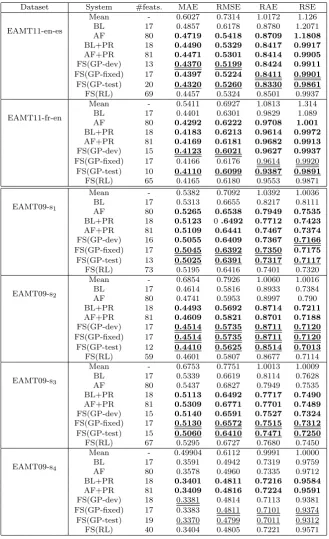
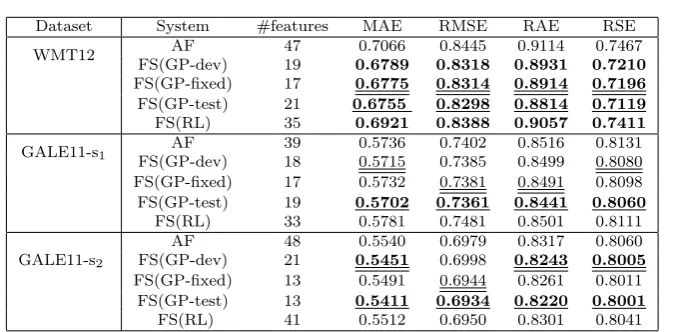
The error scores for all datasets with common (QuEst) black-box (BB) features are reported in Tables 2 and 3, while Table 4 shows the results with glass-box (GB) features for a subset of these datasets, and Table 5 the results with BB and GB features together for the latter datasets. For each Table and dataset, bold-faced figures represent results that are significantly better (paired t-test
with p≤ 0.05) with respect to the following comparisons – where available,
while underlined figures represent best results overall and double underlined figures, the second best results:
– BL vs AF;
– BL vs BL+PR;
– AF vs AF+PR; and
– Each feature selection techniques versus AF+PR.
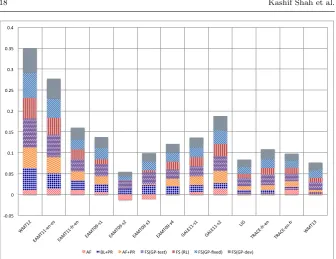
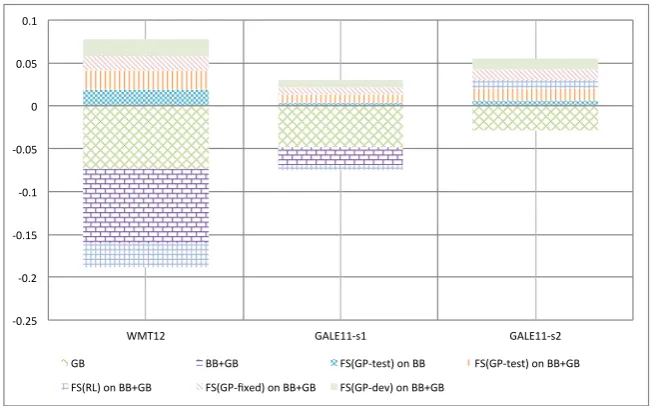
In what follows we take a closer look at some of these comparisons, as well as the difference between different types of feature selection methods. We summarise these comparisons graphically in Fig 4. This figure shows the improvements of different feature sets over the BL results. We also discuss the impact of using GB features against BB features only, showing the im-provements of various feature sets over the use of black-box features in Fig 6.
Baseline features vs all feature sets Adding more features (systemsAF)
leads to better results in most cases as compared to the baseline systemsBL,
except for some of the EAMT-09 datasets. However, these are small and in some cases not significant improvements. Adding more features may bring more relevant information, but at the same time it makes the representation more sparse and the learning prone to overfitting. Larger improvements over the baseline come from using either a pseudo-reference feature or performing feature selection, as we discuss in what follows.
Impact of the pseudo-reference feature Adding a single feature, the
pseudo-reference (systems BL+PR) to our baseline improves results in all
datasets, often by a large margin. Similar improvements are observed by adding
Dataset System #feats. MAE RMSE RAE RSE
EAMT11-en-es
Mean - 0.6027 0.7314 1.0172 1.126
BL 17 0.4857 0.6178 0.8780 1.2071
AF 80 0.4719 0.5418 0.8709 1.1808
BL+PR 18 0.4490 0.5329 0.8417 0.9917
AF+PR 81 0.4471 0.5301 0.8414 0.9905
FS(GP-dev) 13 0.4370 0.5199 0.8424 0.9911
FS(GP-fixed) 17 0.4397 0.5224 0.8411 0.9901
FS(GP-test) 20 0.4320 0.5260 0.8330 0.9861
FS(RL) 69 0.4457 0.5324 0.8501 0.9937
EAMT11-fr-en
Mean - 0.5411 0.6927 1.0813 1.314
BL 17 0.4401 0.6301 0.9829 1.089
AF 80 0.4292 0.6222 0.9708 1.001
BL+PR 18 0.4183 0.6213 0.9614 0.9972
AF+PR 81 0.4169 0.6181 0.9682 0.9913
FS(GP-dev) 15 0.4123 0.6021 0.9627 0.9937
FS(GP-fixed) 17 0.4166 0.6176 0.9614 0.9920
FS(GP-test) 10 0.4110 0.6099 0.9387 0.9891
FS(RL) 65 0.4165 0.6180 0.9553 0.9871
EAMT09-s1
Mean - 0.5382 0.7092 1.0392 1.0036
BL 17 0.5313 0.6655 0.8217 0.8111
AF 80 0.5265 0.6538 0.7949 0.7535
BL+PR 18 0.5123 0.6492 0.7712 0.7423
AF+PR 81 0.5109 0.6441 0.7467 0.7374
FS(GP-dev) 16 0.5055 0.6409 0.7367 0.7166
FS(GP-fixed) 17 0.5045 0.6392 0.7350 0.7175
FS(GP-test) 13 0.5025 0.6391 0.7317 0.7117
FS(RL) 73 0.5195 0.6416 0.7401 0.7320
EAMT09-s2
Mean - 0.6854 0.7926 1.0060 1.0016
BL 17 0.4614 0.5816 0.8933 0.7384
AF 80 0.4741 0.5953 0.8997 0.790
BL+PR 18 0.4493 0.5692 0.8714 0.7211
AF+PR 81 0.4609 0.5821 0.8701 0.7188
FS(GP-dev) 17 0.4514 0.5735 0.8711 0.7120
FS(GP-fixed) 17 0.4514 0.5735 0.8711 0.7120
FS(GP-test) 12 0.4410 0.5625 0.8514 0.7013
FS(RL) 59 0.4601 0.5807 0.8677 0.7114
EAMT09-s3
Mean - 0.6753 0.7751 1.0013 1.0009
BL 17 0.5339 0.6619 0.8114 0.7628
AF 80 0.5437 0.6827 0.7949 0.7535
BL+PR 18 0.5113 0.6492 0.7717 0.7490
AF+PR 81 0.5309 0.6771 0.7701 0.7489
FS(GP-dev) 15 0.5140 0.6591 0.7527 0.7324
FS(GP-fixed) 17 0.5130 0.6572 0.7515 0.7312
FS(GP-test) 15 0.5060 0.6410 0.7471 0.7250
FS(RL) 67 0.5295 0.6727 0.7680 0.7450
EAMT09-s4
Mean - 0.49904 0.6112 0.9991 1.0000
BL 17 0.3591 0.4942 0.7319 0.9759
AF 80 0.3578 0.4960 0.7335 0.9712
BL+PR 18 0.3401 0.4811 0.7216 0.9584
AF+PR 81 0.3409 0.4816 0.7224 0.9591
FS(GP-dev) 18 0.3381 0.4814 0.7113 0.9381
FS(GP-fixed) 17 0.3383 0.4811 0.7101 0.9374
FS(GP-test) 19 0.3370 0.4799 0.7011 0.9312
[image:16.595.76.406.87.627.2]FS(RL) 40 0.3404 0.4805 0.7221 0.9571
Dataset System #feats. MAE RMSE RAE RSE
WMT12
Mean - 0.8278 0.9898 1.0247 1.0263
BL 17 0.6821 0.8117 0.8622 0.7152
AF 80 0.6717 0.8103 0.8476 0.6954
BL+PR 18 0.6290 0.7729 0.8139 0.6678
AF+PR 81 0.6324 0.7735 0.7745 0.6699
FS(GP-dev) 15 0.6231 0.7658 0.7719 0.6651
FS(GP-fixed) 17 0.6224 0.7645 0.7701 0.6644
FS(GP-test) 19 0.6131 0.7598 0.7613 0.6586
FS(RL) 71 0.6335 0.7724 0.7755 0.6709
WMT13
Mean - 0.1438 0.1792 1.0036 1.0009
BL 17 0.1411 0.1812 0.9723 1.086
AF 114 0.1389 0.1775 0.9211 0.9713
BL +PR 18 0.1409 0.1802 0.9711 1.063
AF+PR 115 0.1367 0.1759 0.9181 0.9693
FS(GP-dev) 19 0.1217 0.1411 0.8907 0.9577
FS(GP-fixed) 17 0.1242 0.1489 0.8911 0.9581
FS(GP-test) 19 0.1207 0.1481 0.8844 0.9531
FS(RL) 101 0.1317 0.1691 0.9201 0.9709
GALE11-s1
Mean - 0.5823 0.7214 0.8533 0.8125
BL 17 0.5462 0.6885 0.8186 0.7715
AF 123 0.5399 0.6805 0.8017 0.7619
BL+PR 18 0.5301 0.6814 0.7929 0.7595
AF+PR 81 0.5249 0.6766 0.7905 0.7520
FS(GP-dev) 21 0.5220 0.6751 0.7871 0.7581
FS(GP-fixed) 17 0.5231 0.6761 0.7856 0.7577
FS(GP-test) 27 0.5210 0.6701 0.7811 0.7434
FS(RL) 56 0.5258 0.6749 0.7914 0.7530
GALE11-s2
Mean - 0.5850 0.7527 0.8573 0.8313
BL 17 0.5540 0.7117 0.8287 0.7978
AF 123 0.5401 0.6911 0.8232 0.7931
BL+PR 18 0.5401 0.7014 0.8221 0.7901
AF+PR 81 0.5249 0.6806 0.8154 0.7892
FS(GP-dev) 22 0.5197 0.6769 0.8133 0.7853
FS(GP-fixed) 17 0.5219 0.6794 0.8123 0.7841
FS(GP-test) 31 0.5194 0.6779 0.8081 0.7815
FS(RL) 54 0.5239 0.6805 0.8134 0.7899
LIG
Mean - 0.1326 0.1727 .9938 1.0245
BL 17 0.1250 0.1638 0.9369 0.9223
AF 80 0.1227 0.1631 0.9344 0.9209
BL+PR 18 0.1159 0.1527 0.9312 0.9191
AF+PR 81 0.1161 0.1534 0.9313 0.9183
FS(GP-fixed) 17 0.1087 0.1504 0.9287 0.9135
FS(GP-dev) 13 0.1077 0.1493 0.9284 0.9145
FS(GP-test) 13 0.1054 0.1489 0.9227 0.9099
FS(RL) 69 0.1154 0.1519 0.9321 0.9178
TRACE-fr-en
Mean - 0.1868 0.2470 1.0079 1.0030
BL 17 0.1807 0.2429 0.9749 0.9695
AF 80 0.1776 0.2422 0.9678 0.9611
BL+PR 18 0.1729 0.2210 0.9611 0.9554
AF+PR 81 0.1687 0.2127 0.9601 0.9521
FS(GP-dev) 18 0.1564 0.2081 0.9571 0.9499
FS(GP-fixed) 17 0.1597 0.2101 0.9565 0.9487
FS(GP-test) 19 0.1554 0.2089 0.9515 0.9421
FS(RL) 72 0.1654 0.2109 0.9589 0.9501
TRACE-en-fr
Mean - 0.1891 0.2460 1.0004 1.0021
BL 17 0.1782 0.2389 0.9315 0.9354
AF 80 0.1657 0.2279 0.9261 0.9292
BL+PR 18 0.1729 0.2210 0.9292 0.9314
AF+PR 82 0.1637 0.2127 0.9211 0.9226
FS(GP-dev) 15 0.1615 0.2133 0.9209 0.9221
FS(GP-fixed) 17 0.1612 0.2127 0.9201 0.9211
FS(GP-test) 18 0.1611 0.2131 0.9178 0.9193
[image:17.595.80.402.96.717.2]FS(RL) 71 0.1633 0.2241 0.9209 0.9220
Dataset System #features MAE RMSE RAE RSE
WMT12 AF 47 0.7066 0.8445 0.9114 0.7467
FS(GP-dev) 19 0.6789 0.8318 0.8931 0.7210
FS(GP-fixed) 17 0.6775 0.8314 0.8914 0.7196
FS(GP-test) 21 0.6755 0.8298 0.8814 0.7119
FS(RL) 35 0.6921 0.8388 0.9057 0.7411
GALE11-s1 AF 39 0.5736 0.7402 0.8516 0.8131
FS(GP-dev) 18 0.5715 0.7385 0.8499 0.8080
FS(GP-fixed) 17 0.5732 0.7381 0.8491 0.8098
FS(GP-test) 19 0.5702 0.7361 0.8441 0.8060
FS(RL) 33 0.5781 0.7481 0.8501 0.8111
GALE11-s2
AF 48 0.5540 0.6979 0.8317 0.8060
FS(GP-dev) 21 0.5451 0.6998 0.8243 0.8005
FS(GP-fixed) 13 0.5491 0.6944 0.8261 0.8011
FS(GP-test) 13 0.5411 0.6934 0.8220 0.8001
[image:18.595.74.413.81.247.2]FS(RL) 41 0.5512 0.6950 0.8301 0.8041
Table 4 Results with GB features.
Dataset System #features MAE RMSE RAE RSE
WMT12 AF 128 0.7185 0.8451 0.9137 0.7507
FS(GP-dev) 25 0.6121 0.7582 0.7692 0.6629
FS(GP-fixed) 17 0.6161 0.7591 0.7703 0.6639
FS(GP-test) 29 0.6101 0.7561 0.7679 0.6611
FS(RL) 99 0.6601 0.8098 0.7815 0.6779
GALE11-s1 AF 163 0.5455 0.6722 0.8226 0.7755
FS(GP-dev) 27 0.5162 0.6699 0.7801 0.7411
FS(GP-fixed) 17 0.5170 0.6701 0.7810 0.7421
FS(GP-test) 30 0.5150 0.6681 0.7785 0.7384
FS(RL) 132 0.5310 0.6731 0.7911 0.7501
GALE11-s2
AF 172 0.5239 0.6529 0.8177 0.7915
FS(GP-dev) 27 0.5120 0.6441 0.8094 0.7812
FS(GP-fixed) 17 0.5119 0.6451 0.8111 0.7823
FS(GP-test) 17 0.5109 0.6431 0.8063 0.7795
[image:18.595.79.404.283.441.2]FS(RL) 132 0.5155 0.6499 0.8144 0.7887
Table 5 Results with common BB & GB features.
Impact of feature selection Our experiments with feature selection using
bothGPsandRLled to significant improvements over the entire set of features.
Feature selection withGPshas shown better performance over feature selection
withRL.
For a more comprehensive overview of the results of feature selection using
GPs, we plot the MAE error scores (on the test sets) for different cut-off points
on the features in our forward selection method after features are ranked by
GPs. The plots for two of our datasets are given in Fig 5. Theyaxis shows the
MAE scores, while thexaxis shows the number of features selected. Generally,
!∀#∀∃% ∀% ∀#∀∃% ∀#&% ∀#&∃% ∀#∋% ∀#∋∃% ∀#(% ∀#(∃% ∀#)%
∗+, &∋%
−.+, &&!/
0!/1 %
−.+, &&!2
3!/0 %
−.+, ∀4!1
&%
−.+, ∀4!1
∋%
−.+, ∀4!1
(%
−.+, ∀4!1
)%
5.6 −&&!
1&%
5.6 −&&!
1∋% 675%
,8. 9−!2
3!/0 %
,8. 9−!/
0!23 %
∗+, &(%
.:% ;6<=8% .:<=8% :>?5=!≅/1≅Α% :>%?86Α% :>?5=!ΒΧ/DΑ% :>?5=!D/ΕΑ%
Fig. 4 Improvements of various feature-sets over the BL features. The height of the bar representing a feature set is proportional to the actual improvement it brings over the results with the baseline feature set.
while a very small number of features is naturally insufficient, adding features
ranked lower byGPsdegrades performance. Similar curves were observed for
all datasets with slightly different ranges for optimal numbers of features and best score. It is interesting to note that the best performance on most datasets
is observed using 10-20 top-ranked features. This explains whyFS(GP-fixed)
performs as well asFS(GP-dev)or evenFS(GP-test), in most cases. Given
thatFS(GP-dev)andFS(GP-fixed)perform equally well in most cases, the
choice between them could be guided by the size of the dataset: if enough data is available to put a development set aside, this should be preferable, while
FS(GP-fixed)should be used as a cheaper alternative approach if necessary.
Black-box versus glass-box features GB features on their own perform
worse than BB features (Fig 6), but in all three datasets the combination of GB and BB followed by feature selection resulted in significantly lower error than using only BB features with feature selection, showing that the two features sets are complementary.
5.2 Results on WMT12 datasets
[image:19.595.73.410.69.328.2]0 10 20 30 40 50 60 70 80 0.43
0.435 0.44 0.445 0.45 0.455 0.46
Number of features
M
A
E
0 10 20 30 40 50 60 70 80 0.61
0.62 0.63 0.64 0.65 0.66 0.67
Numer of features
M
A
E
Fig. 5 Error on (a) WMT12 and (b) EAMT11-en-es datasets with all BB features ranked
byGPs.
!∀#∃%& !∀#∃& !∀#∋%& !∀#∋& !∀#∀%& ∀& ∀#∀%& ∀#∋&
()∗∋∃& +,−.∋∋!/∋& +,−.∋∋!/∃&
+0& 001+0& 234+5!67/68&9:&00& 234+5!67/68&9:&001+0&
234;−8&9:&001+0&&&&& 234+5!<=7>8&9:&001+0&&&&& 234+5!>7?8&9:&001+0&&&&&
Fig. 6 Improvements of various feature sets over black-box features (AF+PR).
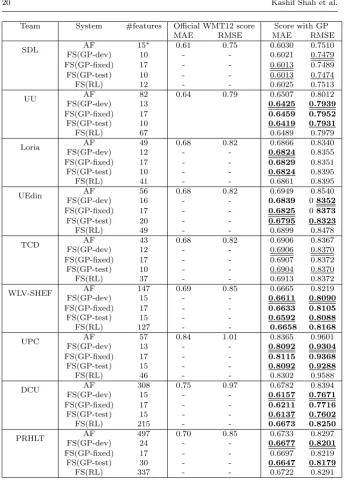
participating in the WMT12 QE shared task. These feature sets are very di-verse in terms of the types of features, resources used, and their sizes. As
shown in Table 6, we observed similar results: feature selection withGPshas
the potential to outperform models with all initial feature sets. For these
ex-periments, the significance is checked between system AF trained with GPs
versus each feature selection techniques. Improvements were observed even on feature sets which had already been produced as a result of some other fea-ture selection technique. Table 6 also shows the official results from the shared
task [?], which are often different from the results obtained withGPseven
be-fore feature selection, simply because of differences in the learning algorithms
used. In some cases results withGPsbefore feature selection are better, notably
for WLV-SHEF – which uses a large set of linguistically-motivated features,
[image:20.595.78.409.73.192.2] [image:20.595.77.404.238.441.2]Team System #features Official WMT12 score Score with GP
MAE RMSE MAE RMSE
SDL AF 15∗ 0.61 0.75 0.6030 0.7510
FS(GP-dev) 10 - - 0.6021 0.7479
FS(GP-fixed) 17 - - 0.6013 0.7489
FS(GP-test) 10 - - 0.6013 0.7474
FS(RL) 12 - - 0.6025 0.7513
UU AF 82 0.64 0.79 0.6507 0.8012
FS(GP-dev) 13 0.6425 0.7939
FS(GP-fixed) 17 0.6459 0.7952
FS(GP-test) 10 0.6419 0.7931
FS(RL) 67 0.6489 0.7979
Loria AF 49 0.68 0.82 0.6866 0.8340
FS(GP-dev) 12 - - 0.6824 0.8355
FS(GP-fixed) 17 - - 0.6829 0.8351
FS(GP-test) 10 - - 0.6824 0.8395
FS(RL) 41 - - 0.6861 0.8395
UEdin AF 56 0.68 0.82 0.6949 0.8540
FS(GP-dev) 16 - - 0.6839 08352
FS(GP-fixed) 17 - - 0.6825 08373
FS(GP-test) 20 - - 0.6795 0.8323
FS(RL) 49 - - 0.6899 0.8478
TCD AF 43 0.68 0.82 0.6906 0.8367
FS(GP-dev) 12 - - 0.6906 0.8370
FS(GP-fixed) 17 - - 0.6907 0.8372
FS(GP-test) 10 - - 0.6904 0.8370
FS(RL) 37 - - 0.6913 0.8372
WLV-SHEF AF 147 0.69 0.85 0.6665 0.8219
FS(GP-dev) 15 - - 0.6611 0.8090
FS(GP-fixed) 17 - - 0.6633 0.8105
FS(GP-test) 15 - - 0.6592 0.8088
FS(RL) 127 - - 0.6658 0.8168
UPC AF 57 0.84 1.01 0.8365 0.9601
FS(GP-dev) 13 - - 0.8092 0.9304
FS(GP-fixed) 17 - - 0.8115 0.9368
FS(GP-test) 15 - - 0.8092 0.9288
FS(RL) 46 - - 0.8302 0.9588
DCU AF 308 0.75 0.97 0.6782 0.8394
FS(GP-dev) 15 - - 0.6157 0.7671
FS(GP-fixed) 17 - - 0.6211 0.7716
FS(GP-test) 15 - - 0.6137 0.7602
FS(RL) 215 - - 0.6673 0.8250
PRHLT AF 497 0.70 0.85 0.6733 0.8297
FS(GP-dev) 24 - - 0.6677 0.8201
FS(GP-fixed) 17 - - 0.6697 0.8219
FS(GP-test) 30 - - 0.6647 0.8179
[image:21.595.70.416.69.551.2]FS(RL) 337 - - 0.6722 0.8291
Table 6 Results on WMT12 feature sets. * indicates that the initial feature sets already resulted from feature selection.
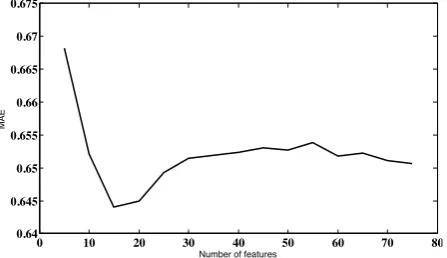
example, Fig 7 shows the Uppsala University feature set, with the lowest error score for the 15 top-ranked features.
0 10 20 30 40 50 60 70 80 0.64
0.645 0.65 0.655 0.66 0.665 0.67 0.675
Number of features
MAE
Fig. 7 Error on 82 UU dataset with all features ranked byGPs.
5.3 Commonly selected features
Next we investigate whether it is possible to identify a common subset of features which are selected for the optimal feature sets in most datasets. To do that, we took the average rank of each feature across all datasets containing common feature sets. The 10 top and bottom ranked features, along with their average rankings, are shown in Table 7.
Interestingly, not all top ranked features are among the 17 reportedly good baseline features. All of these features are language-independent. Also, most of them are simple and straightforward to extract: they either do not rely on external resources, or use resources that are easily available, such as tools for LM (e.g., SRILM), or word-alignment (e.g., GIZA++).
The same analysis on the feature sets from the WMT12 shared task is not possible, given the very little overlap in features used by the different feature sets.
6 Conclusions and future work
[image:22.595.129.353.135.264.2]Top-ranked feature Avg. rank
source sentence perplexity 9.12
number of mismatched quotation marks 11.28
source sentence perplexity without end of sentence marker 12.57
number of tokens in target 15.59
number of tokens in source 15.61
average number of translations per
source word in the sentence (threshold in giza: prob>0.1) 16.42
LM log probability of POS of the target 18.33
average number of translations per source word in the sentence
(threshold in giza: prob > 0.2) weighted by the inverse frequency
of each word in the source corpus
19.12
pseudo-reference 19.99
absolute difference between no tokens in source and target normalised by source length
20.45
Bottom-ranked features Avg. rank
absolute difference between number of commas in source and target 73.10
percentage of distinct unigrams seen in the corpus (in all quartiles) 69.13
average unigram frequency in quartile 3 of frequency (lower frequency words) in the corpus of the source sentence
65.14
absolute difference between number of : in source and target nor-malised by target length
64.19
absolute difference between number of : in source and target 62.12
percentage of tokens in the target which do not contain only a-z 61.16
number source tokens that do not contain only a-z 61.01
average number of translations per source word in the sentence
(threshold in giza: prob>0.5)
59.66
percentage of punctuation marks in target 59.11
[image:23.595.78.405.70.370.2]percentage of content words in the target 58.83
Table 7 Top and bottom ranked features based on their averageGPrank across datasets.
an empirically pre-defined set of features (17). The proposed feature selection technique has also been shown to improve the performance of all participat-ing systems in the WMT12 shared task on quality estimation. Finally, our analysis led to the identification of a set of features which perform well on av-erage across many datasets with different language pairs, machine translation systems, text domains and quality labels.
Acknowledgments