A STUDY COMPARING TWO DOSES OF ROCURONIUM [(0.6 mg/kg (2xED95) AND 0.9mg/kg (3xED95)]
WITH SUXAMETHONIUM (1.5mg/kg) FOR INTUBATION IN CHILDREN IN 60 SECONDS
Dissertation Submitted in partial fulfillment of
M.D. DEGREE EXAMINATIONBRANCH X – ANAESTHESIOLOGY
STANLEY MEDICAL COLLEGE, CHENNAI.
THE TAMILNADU DR. M.G.R. MEDICAL UNIVERSITY CHENNAI, TAMIL NADU
CERTIFICATE
This is to certify that the Dissertation “A STUDY COMPARING TWO DOSES OF
ROCURONIUM [(0.6 mg/kg (2xED95) AND 0.9mg/kg (3xED95)] WITH SUXAMETHONIUM (1.5mg/kg) FOR INTUBATION IN CHILDREN IN 60 SECONDS” presented herein by Dr.M. MUTHU SHENBAGAM, is an original work done in the Department of Anaesthesiology, Government Stanley Medical College and Hospital, Chennai for the award of Degree of M.D. (Branch
X) Anesthesiology under my guidance and supervision during the academic period of 2004-2006.
Prof.Dr.T.RAVEENDRAN, MD.,DTCD.,
DEAN
Govt. Stanley Medical College & Hospital,
Chennai.
Prof.Dr.R.MEENAKSHI, MD., DA., Professor & HOD,
Dept. of Anesthesiology,
Govt. Stanley Medical College & Hospital,
DECLARATION
I, Dr.M.Muthu Shenbagam, solemnly declare that the disseration “A STUDY COMPARING
TWO DOSES OF ROCURONIUM [(0.6 mg/kg (2xED95) AND 0.9mg/kg (3xED95)] WITH SUXAMETHONIUM (1.5mg/kg) FOR INTUBATION IN CHILDREN IN 60 SECONDS” is a bonafide work done by me in the Department of Anesthesiology, Stanley Medical College and hospital,
Chennai, under the able guidance of Prof.R.MEENAKSHI,MD., DA., Professor and HOD, Department
of Anesthesiology, Govt. Stanley Medical College and Hospital, Chennai – 1.
Place:
Date:
ACKNOWLEDGEMENT
I wish to express my sincere thanks to Dr.T.Raveendran, M.D., DTCD., Dean, Government
Stanley Medical College, Chennai for having kindly permitted me to utilize the hospital facilities.
I wish to express my grateful thanks to:
Prof.R.Meenakshi, M.D., D.A., Professor & Head of the Department of Anaesthesiology, Stanley Medical College, Chennai for her sagacious advice and constant supervision.
The patients included in the study and their relatives.
Prof.C.R.Kanyakumari, M.D., D.A., Additional Professor of Anaesthesiology for her constant encouragement.
Prof.S.Nellaikumar, M.D.,D.A., Additional Professor of Anaesthesiology for his instructions and suggestions.
Dr.R.S.Vijalakshmi, M.D., D.A., Registrar, for her valuable advice.
I thank all the Assistant Professors and Tutors for their able help and support.
Theatre Personnel for their willing co-operation and assistance.
CONTENTS
SL.NO. TITLE PAGE NO.
1 INTRODUCTION 1
2 AIM OF THE STUDY 2
3 PHYSIOLOGY OF
NEUROMUSCULAR JUNCTION
3
4 PHARMACOLOGY 11
5 REVIEW OF LITERATURE 21
6 MATERIALS AND METHODS 29
7 HAEMODYNAMIC PROFILE 38
8 OBSERVATION AND RESULTS 53
9 DISCUSSION 55
10 SUMMARY 61
11 CONCLUSION 62
12 BIBLIOGRAPHY
INTRODUCTION
Neuromuscular blocking agents are commonly used to facilitate tracheal intubation.
An ideal muscle relaxant should have rapid onset, profound relaxation of all muscles and short
duration of action so that the patient’s own respiratory function can be restored, should intubation
proved to be impossible.
These requirements are best met with Succinylcholine, an ultra short acting depolarizing muscle
relaxant. Unfortunately, succinylcholine has many undesirable side effects, some of which may be life
threatening.
Rocuronium bromide is a newer steroidal non-depolarizing neuromuscular blocker with a rapid
onset and may be a suitable alternative to succinylcholine for rapid control of airway.
There is dose dependent decrease in onset time with Rocuronium and dose of Rocuronium used
may influence the rate of onset of satisfactory intubating conditions.
Large doses of Rocuronium (more than 1mg/kg)produces ideal intubating conditions in 30-60
AIM OF THE STUDY
The aim of my study is to evaluate the intubating conditions in 60 seconds using two different
doses of Rocuronium with suxamethonium for intubation in children.
It is a study comparing two doses of Rocuronium (0.6mg/kg (2xED95) and 0.9mg/kg (3xED95)
with suxamethonium 1.5mg/kg for intubation in children in 60 seconds and
observed:-1) Intubating conditions
2) Hemodynamic changes
PHYSIOLOGY OF NEUROMUSCULAR JUNCTION
Neuromuscular Junction (NMJ) is a synapse at which an electrical impulse travelling down a
nerve is converted into muscle action potential and contraction by chemical transmitters. A motor
neuron, along with all the muscle fibres supplied by it forms a motor unit, which follows all or none
law of contraction.
PARTS OF NEUROMUSCULAR JUNCTION
To understand the physiological events occurring during neuromuscular transmission it is
essential to understand the anatomy of NMJ, which can be divided into,
1) Presynaptic nerve terminal
2) Synaptic cleft
3) Post Synaptic membrane-Acetylcholine receptors
PRESYNAPTIC NERVE TERMINAL:
Presynaptic nerve terminal contains all the apparatus necessary for the synthesis of
acetylcholine, which exists in two forms: 20% in the soluble form in the presynaptic axoplasm and
80% in vesicles, which can be further, divided into a readily available pool and a reserve pool. The
vesicles are 40-50nm in diameter each containing 1000-10000 molecules of Ach. The walls of the
vesicles contain synapsins that help in anchoring the vesicle to the cytoskeletal framework of the
axoplasm.
At the membrane facing the synaptic cleft, there is an electron dense patch, the active zone,
around which the readily available pool of Ach vesicles are arranged. Electron microscopy shows small
contains sodium and potassium channels.
The nerve endings on fast muscles are longer and more complicated than those on slow
muscles. The reason for this is unclear. These differences in the nerve endings on the muscle surfaces
may play a role in the differences in the response to muscle relaxants of fast and slow muscles.
SYNAPTIC CLEFT:
It is 20nm wide space between the nerve terminal and the muscle end plate. The nerve and
muscles are held in tight alignment by protein filaments, which span the cleft between nerve and end
plate. The muscle surface is heavily corrugated with deep invaginations of the junctional cleft, the
primary clefts and the secondary clefts, between the folds in muscle membrane. The shoulders of the
folds are densely populated with acetylcholine receptors about 5 million of them in each junction.
These receptors are spares in the depths between the folds. Instead these deep areas contain sodium
channels. These sodium channels have two component gates, voltage and time dependent gates.
POST SYNAPTIC MEMBRANE – Acetyl Choline RECEPTORS:
The Ach receptors at the NMJ are nicotinic and can be divided into pre synaptic and
postsynaptic. The latter are further divided into junctional and extrajunctional.
The Ach receptor is a pentameric transmembrane spaning protein. The 5 protein subunits are
arranged in the form of a rosette with a central ion channel. The molecular weight of the receptor is
250000-270000. The mature junctional receptor contains 2 α, β, δ and
ε
. The immature extrajunctional receptor contains 2 α, β, δ and γ which proliferate in abnormal conditions. The extracellular
CONTRACTILE APPARATUS:
The contractile apparatus of the muscle is formed by the myofilament comprising the thin actin
filaments and thick myosin filaments, along with tropomyosin, troponin I, T and C. Tropomyosin is
attached to the myosin binding site of actin.
The myofilaments combine to form myofibrils. The muscle plasma membrane, the sarcolemma
invaginates to form T-tubules which lies in close association with sarcoplasmic reticulum which is a
collection of sacs and tubules acting as a reservoir for calcium.
MECHANISM OF NEUROMUSCULAR TRANSMISSION
MECHANISM OF ACETYL CHOLINE RELEASE:
An action potential traveling down the nerve causes the sodium channels in the presynaptic
nerve terminal to open, leading to sodium influx. The change in voltage produced by such an influx
activates the calcium channels, which open up leading to calcium entry. Calcium mediated activation
of calcium-calmodulin dependent protein kinases lead to phosphorylation of synapsins in the vesicle
wall, causing the vesicles to break away from the cytoskeletal framework. The vesicles then attach to
the active zones with release of Ach molecules. Each nerve impulse causes the release of around
100-400 quanta of Ach. Activation of around 20-25% receptors is essential for impulse transmission.
BINDING OF ACETYL CHOLINE TO RECEPTOR:
The Ach molecule released into the synaptic cleft binds to the alpha subunit. Binding of Ach to
both the alpha subunits activates the receptor, leading to configurational changes in the receptor
structure and opening up of ion channels. This leads to depolarization of the muscle end plate which
sarcolemma by means of activation of the voltage dependent gates of the sodium channels in the
perijunctional zones. This depolarization wave moving down the T tubule causes release of calcium
from sarcoplasmic reticulum. Calcium so released binds to troponin C causing tropomyosin to move
and expose the myosin binding sites of actin leading to the formation of cross linkage of actin and
myosin heads. They slide over each other leading to shortening of the myofilaments and muscle
contraction.
DISSOCIATION OF ACETYL CHOLINE FROM RECEPTOR:
The Ach molecule remains attached to its receptor for a very short period of less than 1
millisecond, after which it dissociates from the receptor and is hydrolysed by the enzyme
acetylcholinesterase. It hydrolyses Ach into acetate and choline, the choline being taken up by the
presynaptic nerve terminal and used for further Ach synthesis.
MECHANISM OF NON-DEPOLARISING BLOCKAGE
Non-depolarizing muscle relaxants are drugs having an affinity for the alpha subunits of the
acetylcholine receptors mainly at the postjunctional nicotinic receptors and also at the prejunctional
sites of nerve ending. Binding of these relaxants to the alpha subunits of Ach receptors can not open
the ion channel and it also prevents further binding of Ach molecule. So an action potential is not
developed and there is no contraction of muscle fibre. This competitive blockade of Ach receptor is
termed as non-depolarising blockade.
MARGIN OF SAFETY:
Atleast 75% of receptors must be occupied before neuromuscular transmission is impaired and
CHARACTERISTIC FEATURES:
1) Slow onset to maximal effect and slow recovery compared to succinylcholine.
2) The central muscles like the diaphragm, larynx, masseter, orbicularis oculi tend to be affected earlier and recover from the block sooner than those of the peripheral muscles (adductor pollicis) probably as a result of preferential perfusion.
3) Presence of fade and post tetatnic potentiation.
4) Despite flaccid paralysis, the muscles are still able to respond to direct stimulation.
5) The muscle block is reversed pharmacologically by anticholinesterase drugs.
MECHANISM OF DEPOLARISING NEUROMUSCULAR BLOCKADE
Depolarising agents like suxamethonium cause initial depolarization of the endplate due to their
acetylcholine like actions, which is transduced into a muscle contraction, but repeated action on the
receptor leads to a persistent depolarizing voltage.
This influences the sodium channels in the vicinity of the endplate, the perijunctional area,
where the transmembrane voltage causes the voltage gates to remain open and the time gates to remain
closed, thereby preventing further ion entry through the channel. Further spread of the depolarization is
arrested, and it remains confined to the endplate only. With the progress of depolarization arrested, the
channels in the remainder of the muscle are freed of the depolarizing influence and return to their
resting state. Thus 3 discrete zones can be delineated namely.
1) Endplate – persistently depolarized.
2) Perijunctional area – Sodium channels still under the depolarizing influence are frozen
in closed state.
PHARMACOLOGY
ROCURONIUM BROMIDE
Originally synthesized and studied in the Organon Teknika Laboratories as ORG 9426.
Introduced into clinical practice in 1994.
CHEMISTRY:
Rocuronium is a steroidal muscle relaxant of intermediate duration. It is the 2 – morpholino, 3 –
hydroxy, 16-N-allyl-pyrrolidino derivative of vecuronium.
1- (2 β, 3α, 5α, 16β, 17β) - 17 - (acetyloxy) - 3 – hydroxy- 2-(4 morpholinyl ) - androstan –
16 – yl) – 1 – ( 2 - Propenyl ) pyrrolidium bromide.
PRESENTATION:
As a clear colourless solution containing 10 mg/ml of Rocuronium bromide. It is available in
5ml & 10ml Vials.
ROUTES OF ADMINISTRATION: Intravenous. Intramuscular.
Doses:-ED95 : 0.3 mg / kg
Intubation at 60 – 90 sec : 0.6 – 0.9 mg / kg
Relaxation (N2O / O2) : 03 – 04 mg / kg
Relaxation (Vapour) : 0.2 – 0.3 mg / kg
Maintenance : 0.1 – 0.15 mg / kg
Infusion : 8 – 12 microg / kg / min.
ONSET OF ACTION: 89 + / - 36.9 Seconds
DURATION OF ACTION:
2 x ED95 – 27.3 +/- 8.2 min.
3 x ED95 – 53.0 +/- 15.0 min
RECOVERY INDEX: 8 – 17 Minutes
If given by intramuscular injection into the deltoid (1 mg/kg in infants and 1.8mg/kg in
PHARMACOKINETICS:
Distribution:-The drug is 30% bound to plasma proteins.
Metabolism:-Rocuronium is eliminated primarily by the liver with a small fraction (∼ 10%) eliminated in the
urine. It is taken up into the liver by a carrier mediated active transport system. The putative
metabolites 17-desacetyl rocuronium and 16N desallylrocuronium are pharmacologicaly inactive.
TABLE – I
Pharmacokinetics of rocuronium bromide Age Group Volume of
distribution at steady state (VDss
ml/kg)
Clearance ml/Kg/
min Elimination half; life (min)
Normal Adult 207 2.89 +/- 0.25 70.9 +/- 4.7
Elderly 399 +/- 122 3.67+/-1 97+/-69.1
Children 224 2.67 46 – 55
PHARMACODYNAMICS:
Neuromuscular Junction:
It produces non-depolarising muscle paralysis by competitive antagonism of acetylcholine at
nicotinic receptors in the post synaptic membrane of the neuromuscular junction. It also has some
Non depolarizing blockade is characterized
by:-a) Depression of twitch height
b) Fade with train of four or tetanic stimulation
c) TOF ratio < 0.7
d) Post tetanic facilitation and
e) Antagonism of block by anticholinesterases.
It is 7-8 times less potent than vecuronium but has a faster onset. Paraylsis occurs first in the
well perfused fast muscles and last in the diaphragm. Onset of block is faster but less intense at the
adductor muscles of the larynx than at the adductor pollicis muscle while the diaphragm is affected
later but recovers earlier than the adductor pollicis muscle.
The action of rocuronium can be increased in the presence of hypokalemia, hypermagnesemia,
hypocalcemia, hypoproteinemia, dehydration, acidosis, hypercapnia and cachexia. Under hypothermic
conditions the neuromuscular blocking effect of rocuronium, is increased and the duration prolonged.
Cardiovascular System:
The autonomic safety ratio for vagal block (3.0 – 5.0) is about 10 times less than that of
Vecuronium. Reports of slight to moderate increases in heart rate may be due either to rocuronium
producing pain on injection or to its weak vagolytic effect. The heart rate increase may be controlled by
the prior administration of fentanyl. Rocuronium in doses upto 0.6 mg/kg has cardiovascular effects
that are negligible. At higher doses (0.9 – 1.2 mg/kg) increases in heart rate of 10 to 25% has been
Histamine Release:
Rocuronium is not associated with clinical signs of histamine release in doses upto 5XED95.
Anaphylaxis / Anaphylactoid Reactions:
In terms of allergy rocuronium appears to have a good safety profile.
Central Nervous Sytem:
No effect as it does not cross the blood-brain barrier. No effect on Intracranial pressure.
Inra Ocular Pressure:
Minimal change in intraocular pressure. Appears to be safe for use in rapid-sequence induction
of anesthesia for perforating eye injuries.
Placental Transfer:
Rocuronium does not cross the placenta in significant amounts.
Pseudocholinesterase Inhibition:
This may result in the prolongation of action of drugs that depend on cholinesterase for their
metabolism like succinylcholine and mivacurium. The anticholinesterase activity of rocuronium is less
SUCCINYL CHOLINE
It is a Depolarising muscle ideal relaxant. It is the Relaxant for intubation since it is of quick onset and short duration of action.
Chemistry:
It is composed of two molecules of Acetyl choline linked back to back through Acetate – Methyl groups.
Molecular Structure O II
Co CH2 CH2 N+ (CH3) 3
I (CH2) 2
I
Co CH2 CH2 N+ (CH3) 3
II O Presentation
As a solution, it is available in 10ml vials containing 50mg/ml and in vials containing 100mg
powder form.
Routes of administration Intravenous
Intramuscular
Dose
ED95 - 0.51 – 0.63 mg/kg
Pharmacokinetics
Brief duration of action of succinyl choline is due to its rapid hydrolysis by plasma choline esterase which is synthesized in liver. It is metabolised to succinyl mono choline which is subsequently hydrolysed into succinic acid and choline.
Plasma cholinesterase influences duration of action of succinyl choline. Plasma cholinesterase activity is decreased thereby prolonging succinyl choline effect in
1) Liver disease
2) Organophosphorus compounds poisoning
3) Neostigmine, metoclopramide co-administration
In healthy individuals, some times, action of succinyl choline is prolonged due to the presence of Atypical cholinesterase.
Dibucaine No:
It is the percentage inhibition of enzyme activity (Plasma Cholinesterase) by Dibucaine. (local anaesthetic).
Dibucaine inhibits the activity of normal cholinesterase enzyme by 80% compared with only 20% inhibition of activity with Atypical enzyme.
Pharmaco dynamics
Succinyl choline attaches to each of the alpha subunits of the nicotinic cholinergic receptor and mimics the action of Acetyl Choline thus depolarizing the post junctional membrane. Here, the hydrolysis is slow resulting in sustained depolarization (opening) of the receptor ion channels.
Phase I Blockade.
Phase II Blockade:
• Single large dose of succinyl choline (more than 2mg /kg IV)
• Repeated small doses of succinyl choline
• Prolonged continous infusion
may result in post junctional membranes that do not respond normally to Acetyl choline even when the post junctional membranes have become repolarized (desensitization blockade). Mechanism for this blockade is unknown
Adverse Effects
Cardiac Dysrhythmias
Sinus Bradycardia, Junctional Rhythm, and sinus arrest can occur following administration of succinyl choline.
Hyperkalemia
It is common in patients with 1) Muscular dystrophy 2) Third degree Burns 3) Denervation
4) UMN Lesions.
Myalgia
Post operative myalgia is common following administration of Succinyl choline.
Myoglobinuria
Increased Intra Gastric Pressure
Increased Intra Ocular Pressure-
Increased intracranial pressure
REVIEW OF LITERATURE
Rocuronium Bromide is a non deploarising muscle Relaxant with fast onset.
Dose of Rocuronium used may influence the onset and duration of action. Literature was
reviewed to compare intubating conditions with Rocuronium 0.6mg/kg and 0.9mg/kg and with
suxamethonium 1.5mg/kg
1) CALUDIA A.Y. CHENG, CINDY ST AUN compared two doses of Rocuronium (0.6mg/kg
and 0.9mg/kg) with suxamethonium 1.5mg/kg and concluded that Rocuronium 0.9mg/kg
provides similar intubating conditions to suxamethonium.
2) Madhav S.Barve, Roopa Sharma compared intubating conditions and time course of action
of Rocuronium & succinyl choline in paediatric patients and concluded that Rocuronium
may be a suitable alternative to succinyl choline for intubation in paediatric age group.
3) Mazurek A J ; Hann S. compared Rocuronium versus succinylcholine for Rapid Sequence
induction and concluded larger doses of rocuronium may be an alternative to
suxamethonium.
4) MC Donald PF, Sanisbary DA, Evaluated onset time and Intubating conditions of
rocuronium bromide in children and concluded that intubating conditions are achieved
faster with Rocuronium compared to other non depolarizing relaxants.
Rocuronium and suxamethonium and concluded that Rocuronium 0.6mg/kg produces
clinically acceptable intubating conditions at 60 seconds after induction with thiopentone
5mg/kg
6) J.D. Crul & Colleagues observed clinically acceptable intubating conditions at 45 seconds
with Rocuronium 0.6mg/kg
7) Stoddart compared intubating conditions of Rocuronium 0.6mg/kg with suxamethonium 1
mg/kg in for tonsillectomy patients and onset time was 92 seconds and 42 seconds
respectively.
8) J. Viby - Mogenson observed the average clinical duration of intubating dose is shorter in
children than adults which may be due to large volume of distribution of control
compartment in children.
9) Watanabe K, Chen K., et al (1991) described the pre and postsynaptic effects of org 9426
(Rocuronium) during the onset and recovery from neuromuscular blockade. They found that
the relaxant to have moderate potency with rapid onset time, intermediate duration of action
and rapid recovery.
10) Meistelman C., et al (1994)4 found that onset time, intensity of blockade and duration of
action were less at the larynx than at the adductor pollicis with 0.5mg/kg of rocuronium.
The onset times were 1.4+/- 0.1 and 2.4+/-0.2 minutes at the laryngeal muscles and
(P=0.01) and time to 90% recovery was 22 minutes.
11) Jean Paul Cantineau, et al (1994)5 found that the diaphragm is more resistant than the
adductor pollicis to rocuronium 0.6 mg/kg. The onset time for muscle relaxation after 0.6
mg/kg rocuronium was shorter for the adductor pollicis muscle than for the diaphragm
(80+/- 20 Vs120 +/-62 sec). Times for 10% , 25%, 75% and 90% recovery of twitch height
were 34+/- 10, 40+/-10, 56+/- 20 and 64+/-21 minutes, respectively for the adductor pollicis
and significantly shorter for the diaphragm, 17+/-10, 23+/-9, 33+/-13, and 35+/-10 minutes
respectively. The intubating dose of 0.6mg/kg is close to ED95 of 0.5mg/kg for the
diaphragm.
12) Peter M.C. Wright., et al (1994)6 studied the onset and duration of rocuronium and
succinylcholine at the adductor pollicis and laryngeal adductor muscles in anaesthetized
adults. They found that the onset of effect with succinylcholine was significantly more rapid
at the laryngeal adductors (34+/-12 sec) than at the adductor pollicis (56+/-15 sec.) Onset
times were similar at the two muscle groups with rocuronium 0.8 and 1.2mg (96+/-29 and
74+/- 36 sec. with 0.8 mg/kg and 54+/-30 and 65+/- sec with 1.2mg/kg at the laryngeal
adductors and the adductor pollicis, respectively.) Rocuronium 0.4mg/kg had a more rapid
effect at the laryngeal adductors than the adductor pollicis (92+/-29 sec. and 155+/- sec.
respectively). They concluded that the laryngeal adductors are more resistant to the action of
rocuronium than is the adductor pollicis. Onset of effect of rocuronium in doses greater than
0.8mg/kg is similar to that of succinylcholine at the adductor pollicis but is significantly
13) De Mey J.C., et al (1994)7 evaluated onset and intubating conditions of rocuronium bromide
0.5, 0.75 or 0.9mg/kg in adult patients anaesthetized with propofol 2mg/kg and alfentanil
0.5 to 1 µg/kg. They concluded that a dose of rocuronium equal to or larger than 0.6 mg/kg
provides acceptable intubations at 60 seconds after administration.
14) Previs TH, Zahn P., et al (1994) Studied the ED95 dose of rocuronium bromide and the
tracheal intubating conditions and time course of actions. They concluded the ED95 dose of
rocuronium bromide was 0.3mg/kg and duration of action was 20 minutes.
15) Mirakhur R.K. et al (1994)8 compared onset and intubating conditions of rocuronium
bromide 0.6mg/kg and suxamethonium 1mg/kg in adult patients anaesthetized with
thiopentone, N2O in oxygen and small doses of fentanyl. Intubating conditions after
rocuronium 0.6mg/kg were found to be clinically acceptable.(good or excellent)in 95% of
patients at 60 seconds and in all patients at 90 seconds and in all patients at both times after
suxamethonium. There was no significant difference in acceptable intubating conditions
between suxamethonium and rocuronium.
16) Scheiber G., et al (1996)9 Compared 0.6mg/kg rocuronium, 0.1 mg/kg vecuronium and
0.5mg/kg atracurium in children during etomidate-fentanyl-nitrous oxide anaesthesia and
found better intubating conditions at 60 seconds after rocuronium than 120 seconds after
17) K.Barclay., et al (1997)17 assessed whether low doses of rocuronium improved conditions
for tracheal intubation during induction of anaesthesia with propofol 2.5mg/kg and
alfentanil 10ug/kg. They have studied three groups. One group received saline, second
group rocuronium 0.1 mg/kg and the third group received 0.3mg/kg rocuronium and they
assessed the intubating conditions as judged by jaw opening and laryngoscopy, position of
the vocal cords and degree of straining after tracheal intubation. They concluded that
injection of rocuronium 0.3mg/kg with propofol and alfentanil provided a high proportion
of optimal intubating conditions.
18) Smith I, Saad Rs., et al (1998)14 Compared the onset of action and the intubating conditions
after rocuronium 0.6mg/kg and vecuronium 0.1mg/kg, when the timing of tracheal
intubation was determined by clinical judgement alone like ease of ventilation, jaw and
upper airway tone. They concluded that time to laryngoscopy and completion of intubation
was markedly shorter in the rocuronium group. Roucronium group also had significantly
better intubating conditions.
19) Kirkegaard – Nielsen H., et al., (1999)10 studied rapid tracheal intubation with rocuronium
using a probability based approach. 80 adult patients anaesthetized with fentanyl 2 µg/kg
and propofol 2mg/kg randomly received rocuronium 0.0, 0.4, 0.8, or 1.2 mg/kg
(n=20/dose). Laryngoscopy was initiated at 40 seconds aiming for intubation at 60 seconds.
Doses giving 90 and 95% probability of successful intubation were calculated and found to
be 0.83 and 1.04mg/kg respectively. Estimated times until first tactile train of four response
after ED50 and ED95 doses were 32 and 46 minutes respectively. They concluded that after
successful intubation at 60 seconds.
20) Andrews JI., et al (1999)15 Compared rocuronium and succinylcholine for rapid sequence
induction of anaesthesia along with propofol and anesthesia was induced using propofol
2.5mg/kg followed immediately by either rocuronium 0.6mg/kg or 1mg/kg or
succinylcholine 1mg/kg. Intubating conditions were assessed at one minute and intubation
was performed. They concluded rocuronium 1mg/kg given along with propofol in a rapid
sequence induction of anaesthesia is clinically equivalent to succinylcholine 1mg/kg.
21) Lam AM., et al (2000) 18 compared the onset and offset time and intubating condition after
1min obtained with rocuronium bromide 0.6mg/kg and succinylcholine 1mg/kg after
induction with propofol and fentanyl. They concluded that rocuronium 0.6mg/kg, when
used with propofol and fentanyl for induction, provides intubating conditions similar to
MATERIALS AND METHODS
This study was conducted at Government Stanley Medical College And Hospital, Chennai.
After institutional approval and informed consent, 60 patients were enrolled in the study.
INCLUSION
CRITERIA:-∗ Children between 2 – 10 years
∗ ASA Physical status I & II
∗ For Elective surgeries posted under G.A.
EXCLUSION
CRITERIA:-∗ Infants
∗ Known / suspected difficult Intubation
∗ H/o any neuromuscular disorder
∗ Renal / Hepatic disorder
∗ Known allergy to drugs.
∗ Surgical procedures of very short duration.
PRE OPERATIVE
EVALUATION:-In all the patients, Age, I.P.No, Body Weight, Baseline vital parameters were recorded. History
regarding previous anaesthesia, surgery, any significant medical illness, medications and allergy were
recorded.
Complete physical examination and Airway assessment was done.
Following laboratory Investigations were
done:- Haemoglobin %
Packed cell volume
Urine – Albumin and sugar
Chest X-Ray (in selective patients)
PREMEDICATION:
All children received syrup Triclofos 50mg/kg orally one hour before procedure.
INDUCTION OF ANESTHESIA:
After shifting the children to operation theatre, Intravenous line was secured using 22G Cannula
in a vein in the dorsum of hand and Isolyte-P infusion was started .
Following monitors were connected to the patients:
1) Non Invasive Blood Pressure
2) Electro Cardiogram Monitor
3) Pulse Oximeter.
4) Precordial stethoscope
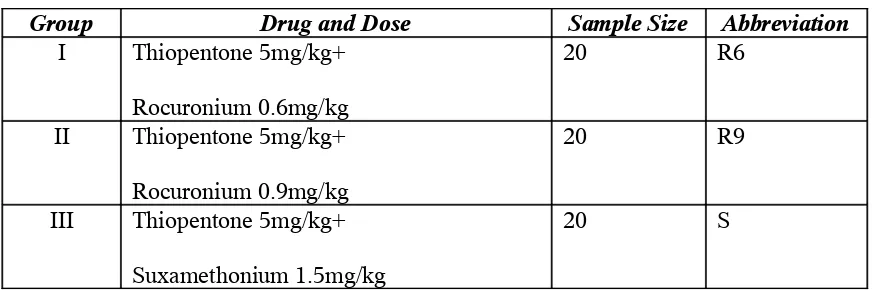
These patients were systematically randomized into three groups of twenty each.
Group – I (R6) Thiopentone 5mg/kg + Rocuronium 0.6mg/kg
Group –II (R9) Thiopentone 5mg/kg + Rocuronium 0.9mg/kg
Each patient was given Inj. Pentazocine 0.5mg/kg intravenously. After pre-oxygenating these
children for three minutes, anaesthesia was induced with Inj. Thiopentone 5mg/kg 2.5% solution given
over 15 seconds and followed
Inj. Rocuronium 0.6mg/kg (2xED95 )
Or
Inj. Rocuronium 0.9mg/kg (3xED95)
Or
Inj. Suxamethonium 1.5mg/kg
depending on the group given in less than 5 seconds. Intubation was performed in all children by an
experienced anesthetist.(who did not know which relaxant was used for Intubation).
After Intubation and observation of the Intubating conditions and hemodynamic profiles,
anesthesia was maintained with 40% oxygen and 60% Nitrous oxide using Jackson-Rees Circuit or
closed circuit system with controlled ventilation.
In both rocuronium groups, if additional dose is required Inj. Rocuronium 0.15mg/kg was used.
In suxamethonium group Inj. Atracurium 0.5mg/kg and then 0.2mg/kg doses was repeated. And at the
end of surgery, Reversal of Neuromuscular blockade was achieved with Inj. Neostigmine 50µg /kg and
Inj. Atropine 20µg/kg.
No Regional blockade was given to any of these children before surgery.
The following observations were
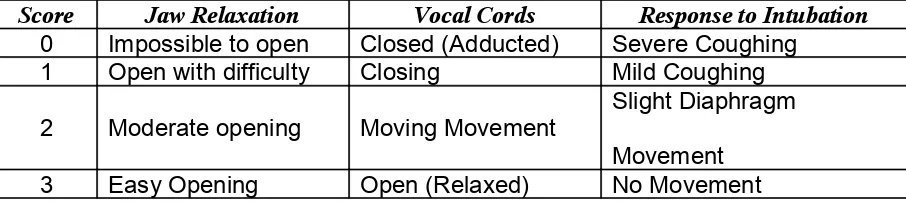
Intubating conditions were scored by a scoring system used by Mirakhar R.K., Cooper
[image:35.612.49.522.101.556.2] [image:35.612.53.506.195.296.2]A.R. and Clarke R.S.J (Table II and Table III)
TABLE –II
Scoring of Intubating Conditions
Score Jaw Relaxation Vocal Cords Response to Intubation
0 Impossible to open Closed (Adducted) Severe Coughing 1 Open with difficulty Closing Mild Coughing
2 Moderate opening Moving Movement
Slight Diaphragm
Movement 3 Easy Opening Open (Relaxed) No Movement
TABLE –III GRADING
Intubating Conditions Score
Excellent 8-9
Good 6-7
Poor 3-5
Bad 0-2
The following parameters were recorded
o Heart rate
o Systolic blood pressure
o Diastolic blood pressure
o Mean arterial pressure
before induction, during Intubation and 1 min, 3 minutes and 5 minutes after intubation and clinical
duration of the Intubating dose was recorded.
EVALUATION OF SIDE EFFECTS:
bronchospasm, and bradycardia, pain on injection, etc.
STATISTICAL ANALYSIS:
The data was computed and all values were expressed as mean +SD. The data was analysed
using one way anova test, unpaired t test, chi-square test, mann-whitney u test, and kruskal wallis test
as appropriate.
OBSERVATION AND RESULTS
The study was conducted on 60 patients randomly allotted into 3 groups as given
below:-TABLE –IV
DRUG DOSAGE AND SCHEDULE
Group Drug and Dose Sample Size Abbreviation I Thiopentone 5mg/kg+
Rocuronium 0.6mg/kg
20 R6
II Thiopentone 5mg/kg+
Rocuronium 0.9mg/kg
20 R9
III Thiopentone 5mg/kg+
Suxamethonium 1.5mg/kg
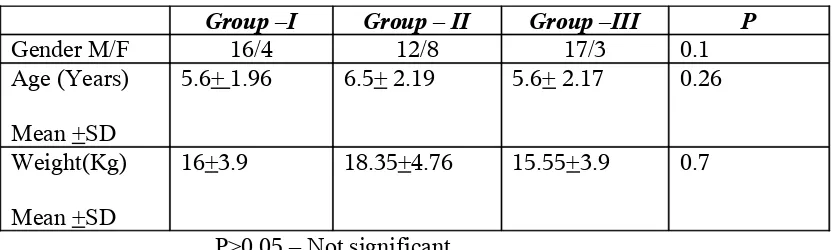
[image:36.612.50.486.384.529.2]TABLE –V
DEMOGRAPHIC PROFILE
Group –I Group – II Group –III P
Gender M/F 16/4 12/8 17/3 0.1
Age (Years)
Mean +SD
5.6+ 1.96 6.5+ 2.19 5.6+ 2.17 0.26
Weight(Kg)
Mean +SD
16+3.9 18.35+4.76 15.55+3.9 0.7
P>0.05 – Not significant
Statistical Analysis was done using chisquare test for gender and for weight and age one way
DEMOGRAPHIC PROFILE
5.6 6.5 5.7
16 18 15 0 2 4 6 8 10 12 14 16 18 20
Group - I Group - II Group - III
Age Weight GENDER 16 12 17 4 8 3 0 2 4 6 8 10 12 14 16 18
Group - I Group - II Group - III
TRACHEAL INTUBATING CONDITIONS
The scores for Jaw Relaxation, vocal cord position and response to intubation and the total scores
[image:39.612.45.488.153.597.2] [image:39.612.50.490.194.305.2]were compared between three groups.
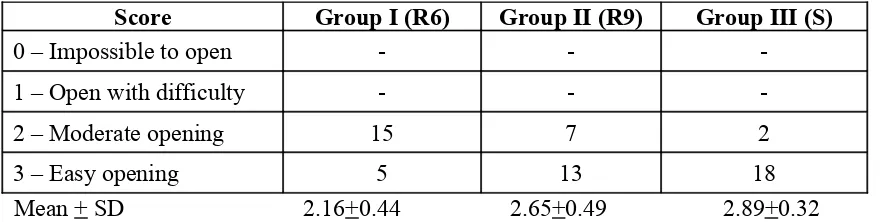
TABLE –VI
JAW RELAXATION
Score Group I (R6) Group II (R9) Group III (S)
0 – Impossible to open - -
-1 – Open with difficulty - -
-2 – Moderate opening 15 7 2
3 – Easy opening 5 13 18
Mean + SD 2.16+0.44 2.65+0.49 2.89+0.32
Statistical Analysis was done using mann whitney u test showing Group I vs Group II P=0.002 - Significant Group II vs Group III P= 0.07 – Not Significant Group I vs Group III P=<0.0001 - Significant
TABLE –VII
VOCAL CORD POSITION
Score Group I (R6) Group II (R9) Group III (S)
0 – Closed - -
-1 – Closing - -
-2 – Moving Movement 13 3 1
3 – Open (Relaxed ) 7 17 19
Mean + SD 2.35+0.49 2.85+0.37 2.95+0.20
TABLE –VIII
RESPONSE TO INTUBATION
Score Group I (R6) Group II (R9) Group III (S)
0-Severe Coughing / Bucking - -
-1 – Mild Coughing 1 -
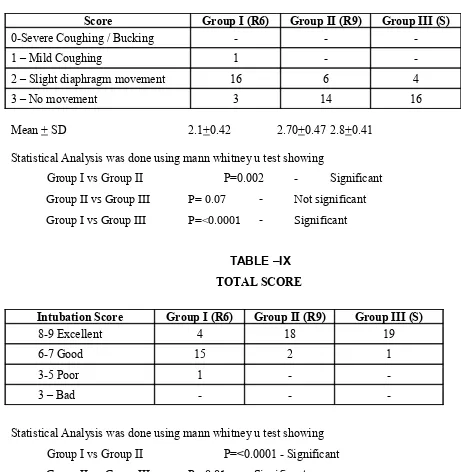
-2 – Slight diaphragm movement 16 6 4
3 – No movement 3 14 16
Mean + SD 2.1+0.42 2.70+0.47 2.8+0.41
Statistical Analysis was done using mann whitney u test showing
[image:40.612.46.507.99.571.2]Group I vs Group II P=0.002 - Significant Group II vs Group III P= 0.07 - Not significant Group I vs Group III P=<0.0001 - Significant
TABLE –IX
TOTAL SCORE
Intubation Score Group I (R6) Group II (R9) Group III (S)
8-9 Excellent 4 18 19
6-7 Good 15 2 1
3-5 Poor 1 -
-3 – Bad - -
HAEMODYNAMIC PROFILE
The heart rate, systolic pressure, diastolic blood pressure, mean arterial pressure were compared
between three groups.
Heart Rate :
Group I (R6) - Table X Group II (R9) - Table XI Group III (S) - Table XII
Systolic Blood Pressure:
Group I (R6) - Table XIII Group II (R9) - Table XIV Group III (S) - Table XV
Diastolic Blood Pressure:
Group I (R6) - Table XVI Group II (R9) - Table XVII Group III (S) - Table XVIII
Mean Arterial Pressure
Group I (R6) - Table XIX Group II (R9) - Table XX Group III (S) - Table XXI
Clinical duration of the intubation dose:
RESULTS
1) Statistical Analysis showed that there was no significant difference between distribution of
age, sex, and weight among study groups.
2) All children were succ essfully intubated in 60 seconds without need for second attempt
after administration of neuromuscular relaxant.
3) (a) Statistical analysis showed that mean score for Jaw Relaxation was significantly higher
in Group II (R9) and Group III (2.65+0.49 in Group II, 2.89+ 0.3 in Group III , and 2.16+
0.4 in Group I) .
(b) Mean score for vocal cord position was significantly higher in Group II & Group III
when compared to Group I (2.35+ 0.49, 2.85+ 0.37 2.95+ 0.22 in group I, II & III
respectively.
(c) Mean score for response to intubation was significantly higher in Group II and Group III
when compared to Group I. (2.1+ 0.44, 2.7+ 0.47, 2.8+0.41 in Group I, II & III
respectively)
(d) Mean total intubating score in Group II (R9) and Group III (S) were identical which is
significantly higher than Group I. (6.7+ 0.86, 8.2+ 0.61, 8.7+ 0.57 in Group I, II & III
respectively).
4) Acceptable Intubating Conditions (Excellent and Good Scores) are observed in almost all
the patients except in one patient in Group I (100% in Group II & Group III and 95% in
Group I).
But, Excellent Intubating Conditions were produced in most of the patients in Group II and
Group III which was significantly higher than in Group I.
5) Statistical anaylsis showed that Mean heart rate, Systolic Blood Pressure, Diastolic Blood
Group II and Group III. (123.6+9.88, 121.2+7.93, 83+5.3, 93.5+5.94 in Group I and in
Group II 120.9 +11.114, 120.1+9.7, 79+7.85, 92.4+7.65) and in Group III 106.8+15,
112+8.56, 75.6+6.28, 88.95+6.4 respectively)
6) Mean heart rate at the end of 5 minutes was higher in Group II (R9) compared to Group I
(R6) and Group III (S). (112.7+11.5, 116.64+11.5, 99.75+7.38) in Group I, II and III
respectively)
7) Clinical duration of the intubating dose was significantly lower in Group III and among
Group I & II, the duration was significantly longer in Group II. (20.35+2.08 minutes in
DISCUSSION
Succinylcholine is an ideal muscle relaxant of choice for Intubation as it is an ultra short acting
muscle relaxant producing excellent intubating conditions in seconds and effect wears off in 4-5
minutes usually. But it has got potential adverse effects such as Asystole, Bradycardia, malignant
hyperthermia, Raised Intraocular pressure, Raised Intra gastric pressure, Post operative muscle pain.
Hyperkalemia etc. and reports of sudden cardiac arrests in patients with undiagnosed muscular
dystrophy. Therefore, need exists for a non depolarizing muscle relaxant with a fast onset of action.
Rocuronium is a new steroidal non deploarising muscle relaxant with rapid onset of action and
Rapid Onset is believed to be primarily due to its low potency and duration of action is dose dependent.
It is short acting with a dose of 0.3mg/kg (1xED95) and Intermediate duration of action with 0.6-0.9mg/
kg when more than 1mg/kg is used for Intubation, onset is very quick (less than 45 seconds) but the
duration of action is prolonged (more than 1 hour).
In this study we aimed to evaluate the intubating conditions in 60 seconds using smaller doses
of Rocuronium (0.6mg/kg (2xED95 ) & 0.9mg/kg (3xED95) and compared them with the intubating
conditions after 1.5mg/kg of suxamethonium.
There have been several adult studies comparing various doses of Rocuronium with
We wanted to confirm that Rocuronium is a suitable alternative to suxamethonium even in
pediatric age group because the onset time and duration of action are some what different in children
compared with adults.
In the study conducted by R.Cooper 95% patients had developed acceptable intubating
conditions at 60 seconds with Rocuronium 0.6mg/kg when the patients were induced with Thiopentone
5mg/kg and Fentanyl 1-3 µ g/kg.
Similarly J.F crul and colleagues observed clinically acceptable intubating conditions at 45
seconds with Rocuronium 0.6mg/kg in patients induced with propofol and alfentanyl 20 µ g/kg.
In the present study. Intubating conditions were excellent with Suxamethonium group and
Rocuronium 0.9mg/kg group. When comparing with suxamethonium, Rocuronium 0.6mg/kg was
inadequate.
We did not use Atropine with induction as we wanted to observe the Intubation response and
vagolytic properties of Rocuronium and Atropine 0.1mg/ml was diluted and kept ready and
one patient in Suxamethonium group required 0.2mg bolus once.
The average clinical duration of Rocuronium in pediatric patients is shorter than in adults (26+
7 min observed by J. Viby – Moganson). It may be due to larger volume of distribution of central
compartment (V1) in pediatric population than in adults.
In our study it was 20.35 +/- 2.08 minutes for Group I and 29.35 +/- 2.64 minutes in Group II,
Shorter duration of action for both groups in our study may be due to avoidance of Inhalational
agents and potent opioids No Regional Anaesthesia like Caudal Block was given to any patients in the
beginning of surgery.
Agoston S et al (1995) studied the onset time and Intubating conditions of Rocuronium bromide
and declared that since there is no parellel correlation between adductor pollicis and laryngeal muscle
Relaxation, Neuromuscular transmission monitoring is probably obsolete in regard to intubating
conditions.
Cantineau JP, et al (1994)5 studied the neuromuscular effect of rocuronium on the diaphragm
and adductor pollicis muscles in anaesthetized patients and showed that the onset time for diaphragm is
slower than for adductor pollicis.
Wright PMC, Caldwell JE, Miller RD., et al (1994)6 studied onset and duration of rocuronium
and succinylcholine at the adductor pollicis and laryngeal adductor muscles in anaesthetized patients
and showed that onset of action of rocuronium is slower at the diaphragm than at the adductor pollicis,
but faster at the laryngeal muscles than at the adductor pollicis.
We did not monitor the development of neuromuscular block as it has been clearly shown that
there is poor correlation between onset time measured at the adductor pollicis and the quality of
intubating conditions. So, for more than 40 years authors have abandoned instrumental means to
evaluate laryngoscopy and intubating conditions and are using scales which assess clinical criteria only
to assess the quality of tracheal intubation. The scale used in the study was used originally by Cooper et
HAEMODYNAMIC CHANGES
Thiopentone causes fall in Blood Pressure and Reflex tachycardia.
Pancuronium has vagolytic property and causes hypertension and tachycardia. Vecuronium has
no such property and hence provides stable haemodynamics. Rocuronium has got vagolytic properties
with larger doses.
In our study mean heart rate, mean systolic, mean diastolic, and mean Arterial pressure at
intubation were higher in Rocuronium 0.6mg/kg group when compared to other groups, though
statistically insignificant.
Mean Increase in heart rate after 5 minutes was more in Rocuronium 0.9mg/kg Group when
ADVERSE EFFECTS
The adverse effects looked for were evidences of Histamine Release like Flushing, Wheal,
Bronchospasm and Hypotension and pain on injection.
Cooper R., et al (1992) found that there were no significant changes in heart rate or Arterial
Pressure after Rocuronium 0.6mg/kg and there was no evidence of Histame Release.
In our study, No signs of histamine release was noted in any of the patients.
One patient of suxamethonium group developed bradycardia which was corrected with bolus
SUMMARY
1) Both doses of Rocuronium 0.6mg/kg and 0.9mg/kg produced acceptable intubating
conditions (good or excellent) in one minute.
2) But, Excellent intubating conditions identical to suxamethonium was provided with
rocuronium 0.9mg/kg group.
3) Duration of action was significantly more in Rocuronium 0.9mg/kg group when compared
to suxamethonium.
4) No signs of Histamine release was observed in any of the patients.
5) Increase in Heart rate and Blood pressure at intubation was more in Rocuronium 0.6mg/kg
CONCLUSION
Rocuronium 0.9mg/kg (3xED95) can be used as an alternative ideal agent to suxamethonium
for intubation in children. But while choosing Rocuronium as an alternative to suxamethonium
factors such as intubation difficulty and surgical duration should be considered against the potential
BIBLIOGRAPHY
1) Clandia A.Y. Cheng, Cindy S.T. Aun – comparison of Rocuronium and Suxamethonium for Rapid tracheal intubation in children.
2) Sparr HJ Luga TJ, comparison of Rocurnium and suxamethonium with Thiopentone for elective cases.
3) Susan Woeltel – clinical duration of Anaesthesia.
4) Wierda J.M.K.H., De Wit A.P.M. Kuizenga K, Agoston S.
Clinical observations on the neuromuscular blocking action of org 9426, a new steroidal non-depolarizing agent.
British Journal of Anaesthesia 1990;64:521-523
5) Meilstelman C., Plaud B., Donati F.
A comparison of neuromuscular blocking effects of rocuronium bromide at the adductor pollius and laryngeal muscles.
European Journal of Anaesthesiology 1994; 11(Suppl.9) : 33-36
6) Cantineau JP, Porte F d’ Honneur G et al
Neuromuscular effect of rocuronium on the diaphragm and adductor pollucis muscles in anaesthetized patients.
Anaesthesiology, 1994;81:585-590.
7) Wright P.M.C; James E.Cardwell, Ronald D. miller
Onset and duration of rocuronium and succinylcholine at the adductor pollicis and laryngeal adductor muscles in anaesthetized humans.
Anaesthesiology 1994;81:1110-1115.
8) De Mey JC., Debrock M., RollyG
Evaluation of onset and intubation conditions of rocuronium bromide European Journal of Anaesthestology 1994; 11 (Suppl.9): 37-40
9) Mirakhur R.K., Cooper A.R. and Clarke R.S.J.
Onset and intubating conditions of rocuronium bromide compared to those of suxamethonium.
European Journal of Anaesthesiologyu 1994; (Suppl. 19): 41-43
10) Scheiber G., Ribeiro P.C., Marichal A., et al.
Intubating conditions and onset of action after rocuronium, vecuronium and atracurium in children.
Anaesth. Analg. 1996; 83:320-324.
Rapid tracheal intubation with rocuronium. Anaesthesiology 1999;91:131-136.
12) Andrews JI, Kumar N, Van den Brom RH, Oikkola KT, Roest GJ, Wright PM A large simple randomized trial of rocuronium versus succinylcholine in rapid sequence induction of anaesthesia along with propofol.
Acta Anaesthesiol Scand. 1999 Jan; 43(1): 1-8
13) K.Barclay, K.Eggers and T.Asai
Low dose rocuronium improves condition for tracheal intubation after induction of anaesthesia with propofol and alfentanil.
British Journal of Anaesthesia 199;78:92-94
14) Lam AM, Pavlin EG, Visco E and Taraday J.
Rocuronium versus succinylcholine – atracurium for tracheal intubation and maintenance relaxation during propofol anaesthesia
J Clin Anaesthesia 2000 Sep; 12(6): 449-53.
15) Agoston S.
Onset time and evaluation of intubating conditions: rocuronium in perspective European Journal of Anaethesiology 1995;12 (Suppl. 11) 31-7
16) Donati F.
Onset of action of relaxants
Canadian Journal of Anaesthesia 1988;35:552-8
17) Cooper R., Mirakur R.K. Clarke R.S.J. and Boules Z
Comparison of intubating conditions after administration of rocuronium and suxamethonium
British Journal of Anaesthesia 1992;69: 269-273
18) Cooper R, Mirakhur R.K. Maddineni V.R.
A study comparing two doses of Rocuronium with Suxamethonium for Intubation in children in 60 seconds.
PROFORMA
1. Name Age/Sex: P NO. Weight
Diagnosis: Surgery Performed:
Preop Assessment :
Investigations: O/E:
Premedication – Syrup Triclofos 50mg per kg orally one hour before procedure
Shifting to O.T. IV line Securing
Analgesia used – Inj. Pentazocine 0.5mg / kg IV Induction – Inj. Thiopentone 5mg/kg
Muscle relaxant used
Group I - Inj. Rocuronium 0.6mg/kg Group II - Inj. Rocuronium 0.9mg/kg Group III - Inj. Suxamethonium 1.5mg/kg
Intubation at 60 sec.
Intubation score - Cooper Scoring System
Score Jaw Relaxation Vocal Cards Response to Intubation
0 Impossible to Open Closed (Adducted) Severe Coughing or Bucking
2 Moderate Opening Moving Movement Slight diaphragm Movement 3 Easy Opening Open (Relaxed) No Movement
Intubation Score 8-9 - Excellent
6-7 - Good
3-5 - Fair
<3 - Poor
No. of Attempts:
Hemodynamic Response to Intubation
Time Baseline Induction Intubation 1 min. 3 min. 5 min. HR
Spo2
BP
Clinical duration of intubating dose :
Adverse Effects noted :
JAW RELAXATION 0 0 15 5 0 0 7 13 0 0 2 18 0 2 4 6 8 10 12 14 16 18 20 Impo ssibl e Ope n Mod erat e Easy Group I Group II Group III
RESPONSE TO INTUBATION
0 1 16 3 0 0 6 14 0 0 4 16 0 2 4 6 8 10 12 14 16 18
Severe Mild Slight No
VOCAL CORD POSITION 0 0 13 7 0 0 3 17
0 0 1
19 0 2 4 6 8 10 12 14 16 18 20
0 Closed 1 Closing 2 Moving 3 Open
Group I(R6) Group II (R9) Group III (S)
TOTAL SCORE 4 15 1 0 18 2 0 0 19 1 0 0 0 2 4 6 8 10 12 14 16 18 20 8-9 Exce llent 6-7 Good 3-5 Poor 3 - B
ad
HEART RATE RESPONSE 0 20 40 60 80 100 120 140 Base line Afte r Ind
uctio n
At In tuba
tion 1 M
inute 3 M
inute 5 M
inute TIME H E A R T R A T E
Group - I Group - II Group - III
SYSTOLIC BLOOD PRESSURE RESPONSE 0 20 40 60 80 100 120 140 Base line Afte r Ind
uctio n
At In tuba
tion 1 M
inute 3 M
inute 5 M
inute TIME S Y S T O L IC B L O O D P R E S S U R E
DIASTOLIC BLOOD PRESSURE RESPONSE 60 65 70 75 80 85 Base line Afte r Ind
uctio n
At In tuba
tion 1 M
inute 3 M
inute 5 M
inute TIME D IA S T O L IC B L O O D P R E S S U R E
Group - I Group - II Group - III
MEAN ARTERIAL BLOOD PRESSURE RESPONSE 70 75 80 85 90 95 Base line Afte r Ind
uctio n
At In tuba
tion 1 M
inute 3 M
inute 5 M
inute TIME M E A N A R T E R IA L B L O O D P R E S S U R E