Open Access
Short Report
Complement factor H binding by different Lyme disease and
relapsing fever
Borrelia
in animals and human
Mangesh R Bhide
1,3,4, Raquel Escudero
1, Emilio Camafeita
2, Horacio Gil
1,
Isabel Jado
1and Pedro Anda*
1Address: 1Laboratorio de Espiroquetas y Patógenos Especiales, Centro Nacional de Microbiología, Instituto de Salud Carlos III, Majadahonda,
Madrid, Spain, 2Unidad de Proteómica, Centro Nacional de Investigaciones Cardiovasculares, Instituto de Salud Carlos III, Madrid, Spain, 3Laboratory of Biomedical Microbiology and Immunology, University of Veterinary Medicine, Kosice, Slovakia and 4Neuroimmunological
Institute, Slovak Academy of Sciences (SAS), Bratislava, Slovakia
Email: Mangesh R Bhide - [email protected]; Raquel Escudero - [email protected]; Emilio Camafeita - [email protected]; Horacio Gil - [email protected]; Isabel Jado - [email protected]; Pedro Anda* - [email protected]
* Corresponding author
Abstract
Background: Borreliae employ multiple immune evasive strategies such as binding to complement regulatory proteins [factor H (fH) and factor H like-1 (FHL1)], differential regulation of surface membrane proteins, antigenic variation, and binding of plasminogen/plasmin and matrix metalloproteinases. As a complement regulatory subunit, fH serves as a cofactor for the factor I-mediated cleavage of C3b. fH binding by Borrelia has been correlated with pathogenesis as well as with host diversity. Here we show the differential binding of borrelial proteins to fH from human and animal sera.
Findings: Affinity ligand binding experiments, 2-D electrophoresis, and protein identification and peptide de novo sequencing based on mass spectrometry, revealed novel fH putative binding proteins of Lyme- and relapsing fever Borrelia. An OspA serotype-associated differential human and animal fH binding by B. garinii was also observed, which could be related with the ability of some strains from serotypes 4 and 7 to invade non-nervous system tissues. Also, the variable affinity of binding proteins expressed by different Borrelia to animal fH correlated with their host selectivity.
Conclusion: The novel animal and human putative fH binding proteins (FHBPs) in this study underscore the importance of evasion of complement in the pathogenesis of Borrelia infections.
Findings
Binding of fH on the borrelial cell surface is critical for resistance to complement-mediated killing by inhibiting the formation of the terminal complement complex [1,2]. Human fH binding has been reported and its association with the pathogenic nature of Borrelia species was pre-dicted earlier [1,3,4]. Complement resistant strains (e.g. B.
afzelii and B. hermsii) survive successfully in body com-partments where complement concentration is high, whereas it is proposed that B. garinii strains do not bind fH on their surface and thus are prone to complement-mediated killing; therefore, they would be able to invade the nervous system where complement concentration is low [5]. However, it has been reported that some OspA
Published: 15 July 2009
BMC Research Notes 2009, 2:134 doi:10.1186/1756-0500-2-134
Received: 6 February 2009 Accepted: 15 July 2009 This article is available from: http://www.biomedcentral.com/1756-0500/2/134
© 2009 Anda et al; licensee BioMed Central Ltd.
serotypes of B. garinii can infect and disseminate through the skin [6], and resist human complement mediated kill-ing [7].
The nature of human and animal fH binding ability to Borrelia is complex. To date, the majority of studies have focused on human fHBPs of B. burgdorferi s.s., B. afzelii and B. hermsii, using purified fH or recombinant proteins [3,8-10]. In contrast, here we have analyzed a wider panel of Borrelia species, as well as human and different animal sera as source of native fH. We also present how the reser-voir competence for Borrelia parallels their fH binding ability in different animal species, identifying known as well as not yet described putative fHBPs.
Materials and methods
First, the reactivity of sheep anti-human fH polyclonal antibody to fH from human and different animal species was assessed (Figure 1). Human and animal (mouse, rat, guinea pig, cattle, horse, dog and cat) serum samples, free of antibodies against B. burgdorferi, were purchased (Sigma-Aldrich), albumin depleted [11]., fractionated by non-reducing SDS-PAGE (10 μg/well/animal species) and transferred to nitrocellulose membranes. Purified human fH served as a positive control. Membranes were blocked overnight at 4°C in SuperBlock buffer (Pierce, Rockford, IL, USA) and then incubated for 2 hours (37°C with shak-ing) with sheep anti-human fH polyclonal antibody (Abcam, Cambridge, UK) diluted 1:1,500 in TTBS buffer [10 mM Tris/HCl (pH 8.3), 0.05% Tween-20 and 150 mM NaCl] with 1% skim milk. Membranes were washed 3 times with TTBS, incubated with rabbit anti-sheep HRPO antibody (Abcam) diluted to 1:400,000 in TTBS with 1% skim milk for 1 hour (37°C with shaking) and then washed 3 times as above. The reaction was developed by chemiluminescence with SuperSignal West Dura substrate (Pierce).
Subsequently, affinity ligand binding immunoblot (ALBI) assays were performed to detect fHBPs of Lyme disease and relapsing fever borreliae (Table 1). Borrelial strains were grown in BSK-II medium at 33°C, harvested, washed 5 times with PBS supplemented with 5 mM MgCL2 and then resuspended in ultra pure water containing 1% trif-luoroacetic acid (Sigma-Aldrich), 1% of nuclease mix and 1% of a protease inhibitor cocktail (GE Healthcare). Cells were sonicated and total protein concentration was meas-ured (Bradford). Proteins were fractionated by non reduc-ing SDS-PAGE, immunoblotted, and the membranes were cut in 3 mm strips, which were incubated 2 hours either with 1 ml of purified human fH (1,500 μg/ml) as a posi-tive control or human and animal sera (1:4 dilution). fH bound to borrelial proteins was detected with sheep anti-human fH antibody and rabbit anti-sheep HRPO conju-gate, as indicated above. Binding was detected by chemi-luminescence.
To isolate and identify the borrelial proteins showing human/animal fH binding ability, 2-D electrophoresis (2-DE) coupled with MALDI-TOF-TOF was employed. For that, borrelial proteins were cleaned (Bio-Rad Laborato-ries S.A., Barcelona, Spain) and solubilized in Destreak solution (GE Healthcare, Madrid, Spain). Protein solu-tions (100 μg) were loaded by rehydration on 7 cm IPG strips (pH 3-11NL or pH 4-7; GE Healthcare), and were focused for 9,142 Vhr using the IPGphor system (GE Healthcare). Strips were equilibrated and subjected to SDS-PAGE on duplicated 15% polyacrylamide gels. One gel was stained with the Silver Stain Plus Kit (Bio-Rad), and the second was subjected to ALBI assay as described above, to ascertain fHBPs. The protein spots of interest were excised from 2-DE gels and digested [12] (Proteineer, Bruker-Daltonics). Digested aliquots were mixed with α -cyano-4-hydroxycinnamic acid in 33% aqueous ace-tonitrile and 0.25% trifluoroacetic acid. This mixture was deposited onto a 600 μm AnchorChip prestructured
Binding ability of anti-factor H antibody to human and animal fH
Figure 1
MALDI probe (Bruker-Daltonics) and allowed to dry. MALDI-MS data were obtained in an automated analysis loop (Ultraflex, Bruker-Daltonics) equipped with a LIFT-MS/MS device. Spectra were acquired in the positive-ion mode at 50 Hz laser frequency, and 100 to 1000 individ-ual spectra were averaged. Automated analysis of mass
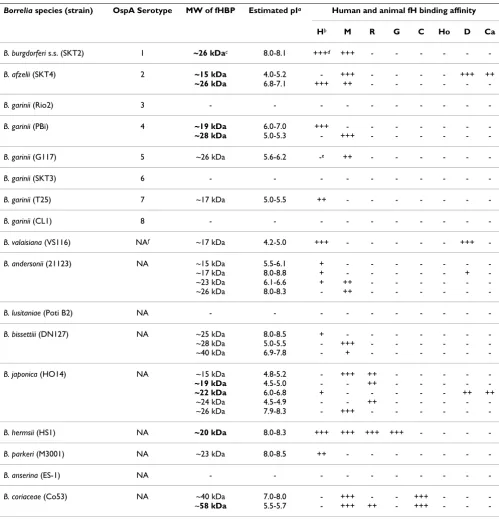
tonics). MALDI-MS and MALDI-MS/MS data were com-bined (BioTools, Bruker-Daltonics) to search a non-redundant protein database (NCBInr) using Mascot soft-ware (Matrix Science). When Mascot search failed to assign a peptide match with Borrelia proteins, manual de novo sequencing [13] was attempted based on MALDI-Table 1: fH binding proteins, binding strength, calculated molecular mass and isoelectric points estimated in 2-DE.
Borrelia species (strain) OspA Serotype MW of fHBP Estimated pIa Human and animal fH binding affinity
Hb M R G C Ho D Ca
B. burgdorferi s.s. (SKT2) 1 ~26 kDac 8.0-8.1 +++d +++ - - - - -
-B. afzelii (SKT4) 2 ~15 kDa 4.0-5.2 - +++ - - - - +++ ++
~26 kDa 6.8-7.1 +++ ++ - - -
-B. garinii (Rio2) 3 - - -
-B. garinii (PBi) 4 ~19 kDa 6.0-7.0 +++ - - -
-~28 kDa 5.0-5.3 - +++ - - -
-B. garinii (G117) 5 ~26 kDa 5.6-6.2 -e ++ - - - - -
-B. garinii (SKT3) 6 - - -
-B. garinii (T25) 7 ~17 kDa 5.0-5.5 ++ - - -
-B. garinii (CL1) 8 - - -
-B. valaisiana (VS116) NAf ~17 kDa 4.2-5.0 +++ - - - - - +++
-B. andersonii (21123) NA ~15 kDa 5.5-6.1 + - - -
-~17 kDa 8.0-8.8 + - - - + -~23 kDa 6.1-6.6 + ++ - - - -~26 kDa 8.0-8.3 - ++ - - -
-B. lusitaniae (Poti B2) NA - - -
-B. bissettiii (DN127) NA ~25 kDa 8.0-8.5 + - - -
-~28 kDa 5.0-5.5 - +++ - - - -~40 kDa 6.9-7.8 - + - - -
-B. japonica (HO14) NA ~15 kDa 4.8-5.2 - +++ ++ - - - -
-~19 kDa 4.5-5.0 - - ++ - - - -
-~22 kDa 6.0-6.8 + - - - ++ ++ ~24 kDa 4.5-4.9 - - ++ - - - - -~26 kDa 7.9-8.3 - +++ - - -
-B. hermsii (HS1) NA ~20 kDa 8.0-8.3 +++ +++ +++ +++ - - -
-B. parkeri (M3001) NA ~23 kDa 8.0-8.5 ++ - - -
-B. anserina (ES-1) NA - - -
-B. coriaceae (Co53) NA ~40 kDa ~58 kDa
7.0-8.0 5.5-5.7
-+++ +++
-++
-+++ +++
-a pI: isoelectric point; b H: human; M: mouse; R: rat; G: guinea pig; C: cattle; Ho: horse; D: dog; Ca: cat; c boldface indicate those proteins identified
by the mass spectrophotometry and related analysis in this study;d fH binding strength. +++: high; ++: medium; +: weak; -: negative; e This protein
[image:3.612.55.554.98.617.2]As coiled-coil elements were demonstrated to be involved in the presentation of the fH binding sites [14,15]., puta-tive coiled-coil formation analysis for novel sequences was performed by using PepCoil software [16]http://bio web.pasteur.fr/seqanal/interfaces/pepcoil.html. Lipopro-tein signal peptide analysis was done following the description of Setubal et al. [17].
Results
A wide repertoire of human fHBP was detected in Borrelia species
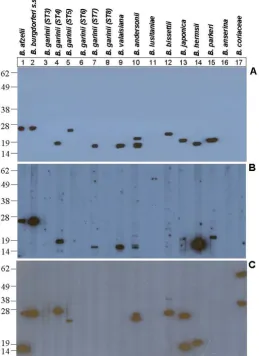
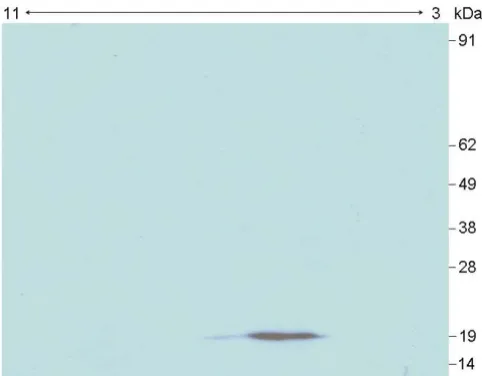
Both B. afzelii and B. burgdorferi s.s. ~26 kDa proteins bound human fH (Figure 2, panels A and B, lanes 1 and 2, respectively). A ~19 kDa protein of B. garinii serotype 4 and a ~17 kDa protein of B. garinii serotype 7 showed human fH binding ability (Figure 2, panels A and B, lanes 4 and 7, respectively; Figure 3), while other B. garinii sero-types (3, 6, and 8) did not express any human fHBP
[image:4.612.176.435.322.678.2](Fig-ure 2, panels A and B, lanes 3, 6 and 8, respectively). Also, a ~26 kDa fHBPs was observed in B. garinii serotype 5 when using purified human fH (Figure 2, Panel A, lane 5), although the corresponding band when using human serum (Figure 2, Panel B, lane 5) was not observed, prob-ably due to the lesser amount of fH present in human serum compared to the amount of purified fH used in the experiment. B. valaisiana, B. andersonii, B. bissettii and B. japonica also expressed human fHBPs (Figure 2, panels A and B, lanes 9, 10, 12 and 13, respectively), although B. bissettii binding was weaker when using human serum than purified human factor H, again probably due to the lesser amount of fH present in human serum. Conversely, B. lusitaniae did not show any human fHBP in any of the assays (Figure 2, panels A and B, lane 11). B. parkeri expressed a ~23 kDa human fHBP in our study (Table 1; Figure 2, panels A and B, lane 15). A ~20 kDa human fH putative ligand of B. hermsii was also observed in our
Affinity ligand binding (ALBI) assays
Figure 2
study (Table 1; Figure 2, panels A and B, lane 14). Consist-ent with earlier report [3], in the case of B. anserina, the causative agent of avian borreliosis, and B. coriaceae, the causative agent of epizootic bovine abortion, no human fHBPs were observed.
Animal fHBPs were also observed in different Borrelia species
Some of the murine fH putative ligands that showed no affinity to human fH in the study were ~15 kDa protein of B. afzelii, ~28 kDa protein of B. garinii serotype 4, ~28 and ~40 kDa proteins of B. bissettii, ~15 and ~26 kDa proteins of B. japonica, and ~40 and ~58 kDa proteins of B. coriaceae (Table 1; Figure 2, panel C, lanes 1, 4, 12, 13 and 17, respectively).
Amongst Lyme disease Borreliae, only B. japonica ~15 kDa, ~19 kDa and ~24 kDa proteins showed rat fH binding (Table 1), while no affinity for guinea pig fH was observed. However, B. hermsii ~20 kDa protein showed affinity for both rat and guinea pig fH (Table 1). As with mouse fH, B. coriaceae ~58 kDa protein showed affinity for rat but not for guinea pig fH (Table 1). As expected, none of the B. anserina proteins showed affinity for rodent fH.
Four Lyme disease- (B. afzelii, B. valaisiana, B. andersonii and B. japonica) and none of the relapsing fever Borrelia expressed canine fH binding proteins (Table 1). The feline fH binding pattern in the array of Borrelia studied herein was similar to that of canine fH, except in VS116 (B. valai-siana) and 21123 (B. andersonii) strains, which were
nega-Finally, none of the Borrelia species tested, except B. coriaceae (~40 and ~58 kDa proteins), bound bovine fH (Table 1). Likewise, none of the Borrelia species tested pos-sessed fHBPs that bind horse fH.
Identification of human and animal fHBPs
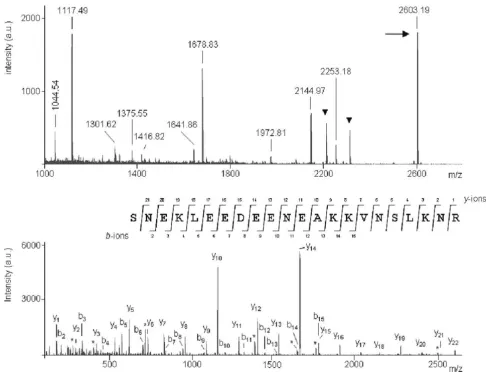
From the ALBI assays, we were able to identify some human fHBPs, not yet described as part of the comple-ment evasion system of Borrelia. Although Mascot soft-ware failed to find any significant protein hit for the ~19 kDa protein of B. garinii serotype 4 (Table 1, Figure 3), manual de novo sequencing generated the peptide sequence SNEKLEEDEENEAQQVNSLQNR (Figure 4). The short input BLAST search showed a complete sequence homology with a hypothetical protein of B. gari-nii PBi (Genbank AAU07257). Unfortunately, neither information regarding the function and topology of this hypothetical protein was available in the protein data-bases nor proofs of binding were provided to exclude the probability of a contamination, although in silico analysis indicated that there was a high probability of two coiled-coil formations near the C-terminus (120 to 147 and 118 to 152 residues with a probability of 1.00). Although coiled-coil motifs are not specific of fHBPs, their presence has been described to be required for the formation of the fH binding site [14], therefore supporting the role of this novel protein in human fH binding [14,15].
B. japonica ~22 kDa human fHBP (Table 1) was identified as OspE-related lipoprotein (GenBank-accession AAC62921), while ~26 kDa human fH binding proteins of B. burgdorferi s.s. and B. afzelii (Table 1) were identifed as CspA (cspA gene, BBA68) and BaCRASP-1 (ortholog of CspA; mmsa71 gene) respectively.
The ~15 kDa murine fH binding B. afzelii protein (Table 1) was identified as an outer membrane protein [Gen-Bank-accession YP_853823], whilst rat fH binding ~19 kDa protein of B. japonica (Table 1) was identified as OspE-related lipoprotein (GenBank-accession AAC62921). Both proteins showed acidic pIs (4.0 – 5.2) in 2-DE in agreement with their theoretical pI (data not shown). The Mascot search for mouse fH-binding ~28 kDa protein of B. garinii serotype 4 showed a significant match and pI in agreement with the recently described BgCRASP-1 (likely to be orthologous of CspA; GenBank-accession CAH10086).
We identified a ~58 kDa B. coriaceae protein (Table 1) as a member of the bacterial extracellular solute-binding protein (BESBP) family. In fact, this is a probable lipopro-tein according to the known features for lipoprolipopro-tein signal peptides in spirochaetes [17]. For the ~40 kDa bovine fHBP of this species (Table 1) no confident protein match was found. Manual de novo sequencing for ~20 kDa B.
[image:5.612.54.295.87.275.2]Example of 2D ALBI assay
Figure 3
fragmentation spectra yielded two putative sequences: TLDNLLK (815.9 Da) and YLLVIFLLLSLASCDLFLK (2185.2 Da), which revealed high homology with the ear-lier characterized FhbA [18] of B-hermsii. (GenBank-acces-sion AAY42861).
Discussion
Among the putative human fHBPs, we have found a ~19 kDa B. garinii serotype 4 protein different (only 12.3% of amino acid sequence similarity) from the earlier reported BgCRASP-1 described in this genospecies [19], as well as from the earlier cited B. burgdorferi s.s. or B. afzelii fHBPs.
It is proposed that the fHBPs of Lyme disease borreliae possess linear sequence elements involved in fH binding [20]. However, a sequence similarity of 15 to 18% between CspA and the rest of Erp related fHBPs (ErpA, ErpC and ErpP) indicates that this may not always be the case. A further detailed study has provided evidence that fH binding is rather dependant on protein conformation [5], and formation of coiled-coil motifs [10,14]. The high probability of coiled-coil formation observed in in silico analysis for this putative ~19 kDa human fHBP and its amino acid divergence from other fHBPs strengthens these findings.
[image:6.612.54.540.82.453.2]MALDI-TOF based identification and de-novo sequencing
Figure 4
MALDI-TOF based identification and de-novo sequencing. (Top) MALDI-MS spectrum from the ~19 kDa protein of B. garinii ST4 (strain PBi). Relevant mass signals employed for database searching have been labeled and known trypsin and keratin peptide signals have been marked with a black triangle. The precursor ion selected for subsequent MS/MS measurement is indi-cated by an arrow. (Bottom) MALDI-MS/MS spectrum from the above precursor ion at m/z = 2603.19. Ions ascribed to the main fragmentation series, y (C-terminal series) and b (N-terminal series) are labeled, and C-terminal fragment ions produced by the loss of ammonia (-17 amu) are indicated by an asterisk (*). The amino acid sequence obtained by manual de novo
B. garinii is the most heterogeneous species in terms of plasmid content and OspA serotype [21,22], and these differences could account for different fHBP expression and complement susceptibility. Therefore, it is not at all surprising that some of the B. garinii serotypes that bound human fH in this study (OspA serotypes 4 and 7) also resisted complement mediated killing in a previous exper-iment [7]. Human fH binding by B. valaisiana could cor-respond to its proposed ability to produce erythema migrans [23], and the absence of human fH binding by B. anserina and B. coriaceae observed in our experiments cor-relates with the fact that these species do not infect humans.
The host selectivity of different Borrelia species correlates with their complement sensitivity, and thus also with their fH binding profile [7,24,25]. We show novel murine fH putative ligands expressed by Lyme disease Borrelia and B. coriaceae. The murine fH binding ability of B. bissettii and B. japonica strengthens their survival in rodents [26,27]. Moreover, the putative murine fHBP identified herein in B. garinii OspA serotype 4 correlates with the described ability of these strains to survive in mice [28].
We and others have reported that cattle and horses are not suitable hosts for Lyme disease related Borreliae [7,24,29], which strongly correlates with the inability of borrelial proteins to bind bovine and equine fH. However, binding of bovine fH only by B. coriaceae (~40 kDa & ~58 kDa pro-teins) suggests that cattle are a primary host for this Borre-lia species. We have found a ~58 kDa protein that appears to have a bovine fH binding ability, to be a BESBP that may be an immune evasion tool of B. coriaceae in bovine. Like in other fHBPs, the ~58 kDa protein is a putative lipo-protein, as per the requirements described by Setubal et al. [17]., which suggest that it is located in the membrane.
The role of carnivores as hosts for Borrelia is probably lim-ited. In this study we have noticed canine fHBPs in B. afzelii and B. valaisiana and, although with weak signals, also in B. andersoni and B. japonica, that could account for the ability of these genospecies to infect dogs [30]. Feline fHBPs has been detected, as well, in B. afzelii and B. japonica, although neither good data regarding reservoir competence nor pathogenicity of Borrelia in these hosts is available.
In summary, the fH binding strategy employed by Borrelia species in different hosts is complex. Novel, putative human and animal fHBPs have been found in this study, which highlights the multiplicity of the immune evading arsenal that Borrelia possesses.
Competing interests
The authors declare that they have no competing interests.
Authors' contributions
MRB carried out the affinity ligand binding assays, the 2-DE electrophoresis and drafted the manuscript. RE partic-ipated in the design of the study and carried out the prep-aration of protein lysates of the Borrelia species tested. EC performed the identification of protein spots. HG and IJ also participated in the design of the study and helped in the 2-DE electrophoresis. PA conceived of the study, and participated in its design and coordination and helped to draft the manuscript. All authors read and approved the final manuscript.
Acknowledgements
Dr. Mangesh Bhide was supported by a grant from the Spanish Ministry of Education and Science (SB2004-0188). Financial support was also from Instituto de Salud Carlos III (grant EM03/06) and RETIC EBATRAG (G03/ 057).
We thank Frank M. Hodgkins for reviewing the English version of this man-uscript.
References
1. Kraiczy P, Skerka C, Kirschfink M, Zipfel PF, Brade V: Mechanism of complement resistance of pathogenic Borrelia burgdorferi isolates. Int Immunopharmacol 2001, 1:393-401.
2. Alitalo A, Meri T, Rämö L, Jokiranta TS, Heikkilä T, Seppälä IJ, Oksi J, Viljanen M, Meri S: Complement evasion by Borrelia burgdorferi: serum-resistant strains promote C3b inactivation. Infect Immun 2001, 69:3685-3691.
3. McDowell JV, Tran E, Hamilton D, Wolfgang J, Miller K, Marconi RT:
Analysis of the ability of spirochete species associated with relapsing fever, avian borreliosis, and epizootic bovine abor-tion to bind factor H and cleave c3b. J Clin Microbiol 2003,
41:3905-3910.
4. Rodríguez de Córdoba S, Esparza-Gordillo J, Goicoechea de Jorge E, Lopez-Trascasa M, Sánchez-Corral P: The human complement factor H: functional roles, genetic variations and disease associations. Mol Immunol 2004, 41:355-367.
5. Metts MS, McDowell JV, Theisen M, Hansen PR, Marconi RT: Analy-sis of the OspE determinants involved in binding of factor H and OspE-targeting antibodies elicited during Borrelia burg-dorferi infection in mice. Infect Immun 2003, 71:3587-3596. 6. Oteo JA, Backenson PB, del Mar Vitutia M, García Moncó JC,
Rodríguez I, Escudero R, Anda P: Use of the C3H/He Lyme dis-ease mouse model for the recovery of a Spanish isolate of Borrelia garinii from erythema migrans lesions. Res Microbiol 1998, 149:39-46.
7. Bhide MR, Travnicek M, Levkutova M, Curlik J, Revajova V, Levkut M:
Sensitivity of Borrelia genospecies to serum complement from different animals and human: a host-pathogen relation-ship. FEMS Immunol Med Microbiol 2005, 43:165-172.
8. McDowell JV, Wolfgang J, Tran E, Metts MS, Hamilton D, Marconi RT:
Comprehensive analysis of the factor H binding capabilities of Borrelia species associated with Lyme disease: delineation of two distinct classes of factor H binding proteins. Infect Immun 2003, 71:3597-3602.
9. Stevenson B, El-Hage N, Hines MA, Miller JC, Babb K: Differential binding of host complement inhibitor factor H by Borrelia burgdorferi Erp surface proteins: a possible mechanism underlying the expansive host range of Lyme disease spiro-chetes. Infect Immun 2002, 70:491-497.
10. Hovis KM, Jones JP, Sadlon T, Raval G, Gordon DL, Marconi RT:
Molecular analyses of the interaction of Borrelia hermsii FhbA with the complement regulatory proteins factor H and fac-tor H-like protein 1. Infect Immun 2006, 74:2007-2014.
Publish with BioMed Central and every scientist can read your work free of charge "BioMed Central will be the most significant development for disseminating the results of biomedical researc h in our lifetime."
Sir Paul Nurse, Cancer Research UK
Your research papers will be:
available free of charge to the entire biomedical community
peer reviewed and published immediately upon acceptance
cited in PubMed and archived on PubMed Central
yours — you keep the copyright
Submit your manuscript here:
http://www.biomedcentral.com/info/publishing_adv.asp
BioMedcentral
12. Shevchenko A, Tomas H, Havlis J, Olsen JV, Mann M: In-gel diges-tion for mass spectrometric characterizadiges-tion of proteins and proteomes. Nat Protoc 2006, 1:2856-2860.
13. Tannu NS, Hemby SE: De novo protein sequence analysis of Macaca mulatta. BMC Genomics 2007, 8:270.
14. McDowell JV, Harlin ME, Rogers EA, Marconi RT: Putative coiled-coil structural elements of the BBA68 protein of Lyme dis-ease spirochetes are required for formation of its factor H binding site. J Bacteriol 2005, 187:1317-1323.
15. McDowell JV, Wolfgang J, Senty L, Sundy CM, Noto MJ, Marconi RT:
Demonstration of the involvement of outer surface protein E coiled coil structural domains and higher order structural elements in the binding of infection-induced antibody and the complement-regulatory protein, factor H. J Immunol 2004,
173:7471-7480.
16. Lupas A, Van Dyke M, Stock J: Predicting coiled coils from pro-tein sequences. Science 1991, 252:1162-1164.
17. Setubal JC, Reis M, Matsunaga J, Haake DA: Lipoprotein computa-tional prediction in spirochaetal genomes. Microbiology 2006,
152:113-121.
18. Hovis KM, McDowell JV, Griffin L, Marconi RT: Identification and characterization of a linear-plasmid-encoded factor H-bind-ing protein (FhbA) of the relapsH-bind-ing fever spirochete Borrelia hermsii. J Bacteriol 2004, 186:2612-2618.
19. Wallich R, Pattathu J, Kitiratschky V, Brenner C, Zipfel PF, Brade V, Simon MM, Kraiczy P: Identification and functional characteri-zation of complement regulator-acquiring surface protein 1 of the Lyme disease spirochetes Borrelia afzelii and Borrelia garinii. Infect Immun 2005, 73:2351-2359.
20. Alitalo A, Meri T, Lankinen H, Seppälä I, Lahdenne P, Hefty PS, Akins D, Meri S: Complement inhibitor factor H binding to Lyme disease spirochetes is mediated by inducible expression of multiple plasmid-encoded outer surface protein E paralogs.
J Immunol 2002, 169:3847-3853.
21. Escudero R, Barral M, Pérez A, Vitutia MM, García-Pérez AL, Jiménez S, Sellek RE, Anda P: Molecular and pathogenic characteriza-tion of Borrelia burgdorferi sensu lato isolates from Spain. J Clin Microbiol 2000, 38:4026-4033.
22. Wilske B, Preac-Mursic V, Gobel UB, Graf B, Jauris S, Soutschek E, Schwab E, Zumstein G: An OspA serotyping system for Borrelia burgdorferi based on reactivity with monoclonal antibodies and OspA sequence analysis. J Clin Microbiol 1993, 31:340-350. 23. Rijpkema SG, Tazelaar DJ, Molkenboer MJ, Noordhoek GT, Plantinga
G, Schouls LM, Schellekens JF: Detection of Borrelia afzelii, Bor-relia burgdorferi sensu stricto, Borrelia garinii and group VS116 by PCR in skin biopsies of patients with erythema migrans and acrodermatitis chronica atrophicans. Clin Micro-biol Infect 1997, 3:109-116.
24. Kurtenbach K, Sewell HS, Ogden NH, Randolph SE, Nuttall PA:
Serum complement sensitivity as a key factor in Lyme dis-ease ecology. Infect Immun 1998, 66:1248-1251.
25. Brade V, Kleber I, Acker G: Differences of two Borrelia burgdor-feri strains in complement activation and serum resistance.
Immunobiology 1992, 185:453-465.
26. Ishii N, Isogai E, Isogai H, Kimura K, Nishikawa T, Fujii N, Nakajima H: T cell response to Borrelia garinii, Borrelia afzelii, and Bor-relia japonica in various congenic mouse strains. Microbiol Immunol 1995, 39:929-935.
27. Ishiguro F, Takada N, Yano Y, Harada M, Masuzawa T, Iida H: Prev-alence of antibodies to Borrelia spirochetes among wild small rodents in central and western Japan. Microbiol Immunol 1995,
39:419-424.
28. Huegli D, Hu CM, Humair PF, Wilske B, Gern L: Apodemus species mice are reservoir hosts of Borrelia garinii OspA serotype 4 in Switzerland. J Clin Microbiol 2002, 40:4735-4737.
29. Gern L, Estrada-Peña A, Frandsen F, Gray JS, Jaenson TG, Jongejan F, Kahl O, Korenberg E, Mehl R, Nuttall PA: European reservoir hosts of Borrelia burgdorferi sensu lato. Zentralbl Bakteriol 1998,
287:196-204.