R E S E A R C H A R T I C L E
Open Access
Disease management projects and the Chronic
Care Model in action: baseline qualitative
research
Bethany Hipple Walters
*, Samantha A Adams, Anna P Nieboer and Roland Bal
Abstract
Background:Disease management programs, especially those based on the Chronic Care Model (CCM), are increasingly common in the Netherlands. While disease management programs have been well-researched quantitatively and economically, less qualitative research has been done. The overall aim of the study is to explore how disease management programs are implemented within primary care settings in the Netherlands; this paper focuses on the early development and implementation stages of five disease management programs in the primary care setting, based on interviews with project leadership teams.
Methods:Eleven semi-structured interviews were conducted at the five selected sites with sixteen professionals interviewed; all project directors and managers were interviewed. The interviews focused on each project’s chosen chronic illness (diabetes, eating disorders, COPD, multi-morbidity, CVRM) and project plan, barriers to development and implementation, the project leaders’action and reactions, as well as their roles and responsibilities, and disease management strategies. Analysis was inductive and interpretive, based on the content of the interviews. After analysis, the results of this research on disease management programs and the Chronic Care Model are viewed from a traveling technology framework.
Results:This analysis uncovered four themes that can be mapped to disease management and the Chronic Care Model: (1) changing the health care system, (2) patient-centered care, (3) technological systems and barriers, and (4) integrating projects into the larger system. Project leaders discussed the paths, both direct and indirect, for
transforming the health care system to one that addresses chronic illness. Patient-centered care was highlighted as needed and a paradigm shift for many. Challenges with technological systems were pervasive. Project leaders managed the expenses of a traveling technology, including the social, financial, and administration involved. Conclusions:At the sites, project leaders served as travel guides, assisting and overseeing the programs as they traveled from the global plans to local actions. Project leaders, while hypothetically in control of the programs, in fact shared control of the traveling of the programs with patients, clinicians, and outside consultants. From this work, we can learn what roadblocks and expenses occur while a technology travels, from a project leader’s point of view.
Background
The diagnosis of chronic disease has increased in the devel-oped world in recent years, thought to be due to the aging population and the more successful treatment of acute illness. Many health care decision makers have been seeking methods of more efficiently and effectively treating chronic disease; frequently, these methods include the development
and implementation of disease management programs [1]. While there are many specific definitions of disease man-agement, for this article and for the projects discussed here, disease management has been defined as a“broad program-matic approach to chronic diseases, a comprehensive care chain that consists of diagnosis, treatment and support, as well as prevention, early detection, and self-management. The broad approach is set in multidisciplinary care stan-dards and is organized around the patient and his illness, where possible tailored specifically to his environment”[2].
* Correspondence:[email protected]
Institute of Health Policy and Management, Erasmus University, Rotterdam, The Netherlands
Disease management programs have been implemented in and tailored by health care providers around the world. As such, they can be understood as a‘traveling technology’; traveling technologies are programs or health care princi-ples that travel between a global (often academic) stage and the local practices and actions of health care leaders and providers. The traveling technologies also include the
“translations that occur when an object travels from one place to another”[3]. In the process of traveling from the global (a general program or model) to the local (through application at a specific practice site), the programs be-come adapted and negotiated in their local contexts by project leaders, health care managers, clinicians, and patients. When viewed as a traveling technology, the local practices of health care providers and patients are as im-portant as the global principles that frame those practices. Disease management programs are an excellent example of traveling technologies. While disease management pro-grams originate from similar ideologies of patient-centered coordinated care, the local actions vary widely, as does the implementation and in some ways, the redefinition through the actions of local actors, of the tenets of disease management.
In this paper, we have collected data from the project directors and managers of five disease management pro-grams in the Netherlands. The overall aim of the study is to explore how disease management programs are imple-mented within primary care settings in the Netherlands. For this paper, interviews done with project leadership teams conducted during the development and early imple-mentation phases of the disease management programs have been analyzed from a traveling technologies view-point. This research provides a unique perspective on trav-eling technologies by showing how project leaders are crucial in the traveling of disease management programs at many levels, as the project leaders interpret, translate, adapt, and adopt the tenets of disease management pro-grams to their local settings. This article uses the project leaders’point of view to addresses the following question:
How can disease management programs be understood as a traveling technology through the actions and reactions of project leaders?
Disease management programs and the chronic care model
One of the more popular and pervasive models for framing disease management programs is the Chronic Care Model (CCM), which has influenced and been influenced by dis-ease management programs. The Chronic Care Model
“summarizes the basic elements for improving care in
health systems at the community, organization, practice, and patient levels”[4]. The model, developed in the United States by a team led by Edward Wagner in the 1990s, is a
synthesis of many components of disease management programs [5,6]. While there are other guides for disease management programs, none are as prolific as the Chronic Care Model; as such, the elements of the CCM will be used in this paper as a definition of the elements of disease management.
Much research has been or is currently being conducted on disease management programs, including those directly guided by the CCM [7,8], yet little research has focused on the implementation of disease management programs in their early phases. As well, there is need for more research now that disease management programs are increasingly being taken up in countries outside the US, as can be seen in Germany [9], New Zealand [10], the UK [11], and the Netherlands.
Disease management programs are increasingly popular in the Netherlands, due, in part, to changes within the health care financing and delivery system. Having under-gone major reforms in 2006, the new regulated market health insurance system is continuing to adapt to the needs of insurers, health care providers, and patients [12]. Through the new system, every resident of the Netherlands is required to purchase health insurance. The cost of a basic health insurance plan, which covers preventative and essen-tial curative services, is fixed; subsidies are available for those unable to pay. In 2008, the Ministry of Health, Wel-fare, and Sport emphasized the need to develop disease management programs for those with chronic diseases [13]. This resulted in the creation, in 2009, of a research and im-plementation program to improve upon the development and execution of disease management programs by the Netherlands Organization for Health Research and Develop-ment (ZonMw). ZonMw sent out a call for proposals for projects from practice groups in the Netherlands. The call for proposals for the projects emphasized the need for dis-ease management programs that focus on self-management, co-morbidity, and/or information and communication tech-nologies (ICT) in health care.
management into every day practice. The clinicians at the project sites, under the guidance of their project leaders, selected the chronic condition that they would like to ad-dress to improve the health care of their patients. The pro-ject leaders developed propro-ject plans, often with intensive feedback from health care providers, and submitted the plans for funding to ZonMw. ZonMw funded the projects thought to be most likely to succeed and impact a large population of patients with chronic disease.
Methods
The qualitative study is part of a larger effort to understand the impact of disease management programs on clinical systems, clinician behavior, patient perception of care, health outcomes, and on the financing of treatment. The larger goal of the qualitative component of the study is to understand the impact of developing and implementing disease management program on project leaders, clinicians, and patients; this paper looks at the impact on project lea-ders, while future work will look at the clinicians and patients. The study was approved by the Review Board of Erasmus MC.
Settings/study sites
The five qualitative sites were selected as a purposeful sam-ple on the basis of maximum variation, with respect to the planned development and use of information and commu-nication technologies, interaction between primary and secondary care, type of intervention, role of the patient, and changes for professionals. They also represent a range of chronic conditions, including eating disorders, diabetes, and cardiovascular risk management.
Research participants
Each study site has a project leader or a project leadership team, including project leaders who manage small projects within the large disease management project (known in this article as mini-project leaders), to guide the work of the program and project; many of these main project lea-ders or managers have had training prior to the study (as part of a Masters or as separate certification courses in health care organizations) in health care systems or disease management, though this was not a requirement of the programs or study. While many of the project leaders have education in health care management and program leader-ship, it is unclear to what degree project leaders were cognizant of the specific literature on the Chronic Care Model. The project leaders oversee the projects, work with clinicians at each GP office or department, collaborate with the research team on the economic, qualitative, and quan-titative research, and develop and/or tailor the disease management program. Furthermore, the project leaders support projects by being contact points for ZonMw and for the two other supporting agencies, Vilans and Picasso
for COPD. The project leaders are also expected to attend Inspiration Days, one-day conferences that address themes of interest to the projects, such as eHealth programs, pro-gram leadership, and patient education. The project leaders are granted much latitude in how the projects are con-ducted, though support and education is available on request.
Design
At each of the five selected sites, semi-structured inter-views were conducted with the project leaders and mem-bers of the project leadership team. Eleven interviews were conducted at the five selected sites with sixteen health care professionals; all of the interviews were conducted by the first author. The interviews were conducted at the program site in Dutch or English and ranged from 45 minutes to 90 minutes. The interviews were recorded; equipment mal-function resulted in two interviews with missing record-ings. In all cases, in the event of equipment malfunction, the interviewer took detailed notes, including exact quotes from the interviewees, during the interviews. Interviews were transcribed verbatim. The interview quotes used in this manuscript were sent to the respondents in order to confirm use in the manuscript, as well as check any confu-sion in language. The respondents edited the quotes with minor changes and gave express permission to use the quotes in this manuscript.
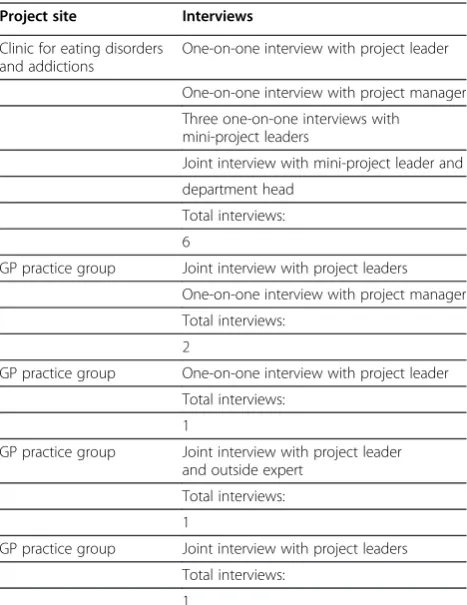
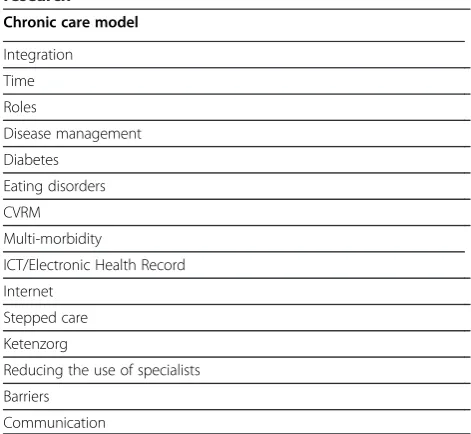
Table 1 gives an overview of the sites; Table 2 sum-marizes the interviews conducted at each site. All project leaders were interviewed about their projects, their practice settings, and the changes being made as a result of the de-velopment and implementation of the disease management project. Table 3 outlines the major themes uncovered in the data collected from the interviews, including the themes covered in this manuscript, as well as other themes that will be explored further in future articles.
developing, tailoring, and implementing the disease man-agement programs, as well as any interest or criticisms that they had heard from other professionals and clinicians involved in the disease management programs. While the answers to these questions were analyzed from a traveling technology framework, the questions themselves map back to the primary aim of the study, understanding how disease management programs are implemented in primary care in the Netherlands; Table 4 has a sample of the interview guide. From this information, the research team was able to gather information about how the disease management
programs were being implemented in the sites, as well as how the disease management programs were best understood as traveling technologies as they were implemented and altered by the project leaders.
Analytical approach
Analysis was inductive and interpretive, based on the content of the interviews; in line with the inductive analytic tradition, project leaders were frequently asked to define terms that are otherwise taken for
granted as a shared understanding, such as ‘disease
management’ [see Table 4]. The content of the
inter-views focused on the implementation of the disease management programs by the project leadership team, communication and team dynamics between members of the project leadership team, the clinicians, and the patients, and changes in health care practices, based on the diseases addressed in the programs. This method of inductive analysis allows for the develop-ment of general themes mapped back to the literature [25]. As disease management programs contain many of the aspects of a traveling technology (traveling expenditures, movement from global to local arenas), the data collected through interviews with the project leaders was most clearly understood through a travel-ing technologies framework. All research questions have been analyzed using the same method. The data was coded by the first author and verified through close reading of the quotes in their original language and their translation, when appropriate, by the second author, SA.
Results
From the empirical data, four disease management themes, as defined by the Chronic Care Model, emerged:
(1) changing the health care system, (2) patient-centered care,
[image:4.595.57.541.99.245.2](3) technological systems and barriers, and Table 1 Projects selected and interviewed for qualitative research
Project site Chronic illness Team Program
Clinic for eating disorders and addictions
Eating disorders On-site leadership team 1 project leader (MD) 1 project manager (Social worker) 4 mini-project leaders
4 fold project to reduce barriers to access to support and treatment for eating disorders
GP practice group Cardiovascular risk (CVR) management
On-site leadership team 2 project leaders (MDs) 1 project manager (RN)
Manage CVR through patient portals, patient care plans, and interdisciplinary care teams
GP practice group Diabetes Consultant leader 1 project leader (Health care consultant)
Train clinicians and other health care givers to manage diabetes in first line care
GP practice group Chronic obstructive pulmonary disease (COPD)
Consultant leader 1 project leader (Health care consultant)
Find and recommend an effective ICT system and an expert COPD training team visiting each practice
GP practice group Multi-morbidity Consultant leaders 2 project leaders (MD, RN) Develop integrated approaches for the management of co-morbidity and chronic illness
Table 2 Interviews conducted
Project site Interviews
Clinic for eating disorders and addictions
One-on-one interview with project leader
One-on-one interview with project manager
Three one-on-one interviews with mini-project leaders
Joint interview with mini-project leader and
department head
Total interviews:
6
GP practice group Joint interview with project leaders
One-on-one interview with project manager
Total interviews:
2
GP practice group One-on-one interview with project leader
Total interviews:
1
GP practice group Joint interview with project leader and outside expert
Total interviews:
1
GP practice group Joint interview with project leaders
Total interviews:
[image:4.595.57.291.426.729.2](4) integrating projects into the larger health care system.
Illustrative quotes from these themes have been selected from this article and are seen below in italics and off-set from the text. Through defining disease management through these Chronic Care Model themes, the research team was able to understand and explore how disease man-agement programs travel. This research shows how project leaders manage and interact with the members of the dis-ease management programs, and ultimately, the patients and clients impacted by the disease management programs, as well as how project leaders view the travel expenditures associated with the programs.
Changing the health care system
Project leaders and project leadership teams, including project managers and mini-project leaders, frequently tied
their disease management project work to larger efforts in health care and in their health care system’s delivery of care in specific. Project leaders sited the goals of the programs as the impetus to plan (and in the future, put in place) changes, as well as the goal of improving patient care.
The end goal is to reach more people in a better way with a continuous quality of care during the, on average, 5 to 7 year illness period. That’s the idea. That’s ambitious. Yeah, it’s very exciting because we have to change the whole way of thinking here and change the whole organizational model as well. . .So we have inner barriers to continuity in care as well. Lack of flexibility there as well, so we need to reorganize internally this year. (Interview with E, project director for the eating disorder project)
The latitude afforded to the project leaders in developing their programs means that the translation from the project plan on paper to action in practice can be done in a num-ber of ways: as a drastic reorganization, in phases, or first as a project with later spoken or unspoken plans for inte-gration into the system. It also involves translation work in relationship to stakeholders:
I have to tell [the GPs] that it’s just a project and that we will need an evaluation of the project before it comes to be common practice. (Interview with X, project leader with the CVR project)
Patient-centered care
Patient-centered care, as defined by the Chronic Care Model through the Self-Management Support element of the model, highlights“the patient’s central role in managing their health” [26]. While the majority of the project leaders did not mention the Chronic Care Model as inspiration for the changes that they plan to make, a few did and directly tied their actions to the model.
For example, that together with the patient, you look at the self-management of that patient and that you look according to the Chronic Care Model, like yeah, I have to work along with the patient on all the factors and not only give information, because that isn’t going to help that patient. That’s what is important, that I can see now in a broad perspective and then you can make the most of giving care. (Interview 1 with H, project manager with the CVR project)
[image:5.595.55.291.107.324.2]And then another thing was the Chronic Care Model is a patient-centered model. And we are not used to working [in a] patient-centered [way]. It’s becoming more and more [popular]. What’s new in our system is that we choose to work in a patient-centered way.
Table 3 Themes that emerged from the qualitative research
Chronic care model
Integration
Time
Roles
Disease management
Diabetes
Eating disorders
CVRM
Multi-morbidity
ICT/Electronic Health Record
Internet
Stepped care
Ketenzorg
Reducing the use of specialists
Barriers
Communication
Table 4 Sample from the interview guide
1 Why were the projects developed?
2 What is the need?
3 What are the barriers to implementation?
4 How does communication happen?
a As a team
5 What has feedback been to the implementation from staff?
6 How has your team helped in the creation and implementation of the project?
7 How was your team developed?
8 What does it mean to have a disease management system or project?
[image:5.595.57.291.591.735.2](Interview with X, project leader with the CVR project)
However, as noted in the quote above, working in a patient-centered way is a change within the system, a change that costs time and effort. This expenditure of time and effort is for a common goal: involving patients in their health care to improve their health.
Well and involving the patient now is one of the most important things because what we’ve discovered and what worldwide they discovered is that lifestyle change is one of the most important issues that can make a difference on the long term, but is also one of the most difficult things to realize. And the only way to do that is getting patients involved, and getting them to participate in their own disease. (Interview with B, project leader for the diabetes project)
Project leaders emphasize how becoming more patient-centered impacts the providers and how providers will need to change how care is delivered.
The two things that are the most important are the self management of the patients themselves because the patient is the main issue of gaining a long term benefit out of the system. So that’s one thing. But what’s also necessary is that the care givers, the doctors, the physicians, the nurses, they have to make a switch in not only being a health care giver but being a coach, being able to give the support to the patient that they can make their own self-management system and that they can make their own choices and that will really make a difference, instead of the choice of the health care giver.(Interview with B, project leader for the diabetes project)
Other project leaders place emphasis on the changed role of the patient and their involvement in their care process.
But it’s the process of the client, not the process of the one who’s giving the support. So the process of the client is leading. That’s a difficult part of it, but the essential part of it. Do you know what I mean? I mean. . .I can tell you what you’ve got to do to recovery, what’s good for you. But that won’t be necessarily your way.. . .I’ve got to connect with your approaches. And look together with you and support you to empower you to find your own path in recovery.
(Interview with P, mini-project leader for the eating disorder project)
Patient-centered care can be a challenge for health care providers, as it may require them to change the ways in which care is presented and delivered to patients. Health care providers must think and act in new ways, as well as
continue to alter their health care systems to sustain this new way of providing care.
The challenge is to know who needs support and who can self- manage.(Interview with H, project manager for the CVR project)
To learn to think about the client is the most difficult thing [to do]. To really think about the client. Not that I know what is best for the client. The client knows best. That’s a hell of a job.(Interview with K, project manager for the eating disorder project)
Technological systems and barriers
For the project leaders, implementing a disease man-agement program is a process of harmonizing the movement of information and actions between prac-tice sites, patients, and the project leaders. In all cases, this change to the health care system involves new communication technology. The improvement or addition of a technological system is a common way to change the mode of health care delivery and is emphasized in the call for proposals for the pro-jects. The planned changes in the projects include the development of patient portals to assist patients in self-management, patient health records, compu-terized communication systems to connect general practitioners and other health care professionals, and websites for patients/clients to connect with clini-cians and others. These changes are seen as import-ant for organizing and improving care for both patients and clinicians.
So now all general practices have their own registration and programs. And we think it’s very important that the general practices and the hospital work together and can see the registration and can communicate together. And we think that we need another program for that.(Interview 1 with AC, project leader for the COPD project)
But what is especially important and that’s where we are now spending a lot of time is to properly organize care with the GPs who work on a computer.(Interview with H, pro-ject manager for the CVR propro-ject)
However, ICT systems are also seen as a barrier, in that the development and implementation of the systems is costly in both time and effort. Project leaders must also spend time prioritizing and in some ways, limiting, the focus of the ICT system.
come so far as we are now. (Interview 1 with X, project leader with the CVR project)
The fact that the software builder couldn’t deliver what they said they would deliver [was a barrier]. And still now we do not really have the perfect system and the perfect system does not exist, I know. But there are too many things that are really what we want.
(Interview with B, project leader for the diabetes project)
And you have the program, and it’s sort of the same, and it works on the mobile phone. And E. thought that it would be a program that worked on the Internet and on the mobile phone. And there are two programs, but the content is different, so you have only
prevention on the Internet or after care on the SMS. So there were all kind of technology things that had to be discussed before we decided what to do.(Interview with M, mini-project leader for the eating disorder project)
Patients and clients, too, play a role in the develop-ment of an ICT system. Depending on the system, patients and clients will be able to interact directly with clinicians through a website or patient portal, clinicians at multiple locations will have the ability to interface with a patient’s record, and/or project leaders and clini-cians will be able to review the information of large sets of patients for patterns and quality control.
They [the patients] can choose their treatments. And all those steps we have laid out in our ICT scheme.
(Interview with X, project leader with the CVR project)
However, not all patients are expected to want to directly participate in an ICT system or have the skills to do so at this time.
Well there are patients who say“I do not want that my information is put in the software system”so we have a form that they can sign if they do not what that.(Interview with B, project leader with the diabetes project)
Integrating projects into the larger health care system
As the projects are funded for a short amount of time, the project leaders recognize the need to integrate the projects into the larger health care system if they want to make last-ing changes to the delivery of health care. This effort to integrate projects into routine care often involves the devel-opment of program plans, budgets, the hiring of new staff, and/or the training of existing staff. Some project leaders see
the projects as an opportunity to expand the scope of the projects and create a system for the management of chronic disease in general at their sites.
The third step is to make the disease management program a multi-morbidity program. These steps are further integration into chronic care. The project is a model for all future chronic care programs. We don’t believe in a system for separate projects formulti-morbidity. . .One program.(Interview with V, project leader for the multi-morbidity project)
And the second thing there is trying to make it more a disease management than only one chronic care model. For COPD and cardiovascular, we know that we are going to introduce also the chain system, so we’re trying to make the base ready for other chronic care systems.(Interview with B, project leader for the diabetes project)
Other members of the project leadership team are working with clinicians to imbed the current changes into the current health care delivery system. So they have to integrate it in their daily work. . .in their practice. That’s a very big step to get it implemented there and instruct all the other employees in the practices.(Interview with R, outside expert at the COPD project)
However, project leaders find that working with clini-cians to think beyond the project and beyond their cur-rently defined roles can be a challenge.
That’s the biggest challenge. Because we are all professionals at this moment. It’s very difficult to connect the clinic with the outpatient clinic. Ah, I think that we are, as professionals, able to want to look further than our little business. It’s the same old story with all the professionals in health care.
(Interview with K, project manager for the eating disorder project)
For the project leaders, the disease management programs are an iterative process, with ongoing efforts made to im-prove the programs and the care that they help provide.
The program is not the answer, only an answer. We have to have the courage to change again without always being on the move.(Interview with S, department head at the eating disorders project)
Discussion
traveling technology. A traveling technology refers to the translations, adaptations, and expenditures that occur when an object or program moves from one location to another; traveling is more than the translation of the disease man-agement projects, as it encompasses the translation of the disease management programs to the local setting, but fo-cuses on the travel expenditures and travel documents cre-ated in the process [27]. As a result, project leaders play an important role in this process, especially during the devel-opment and early implementation phases. It’s important to note that the traveling expenditures of the programs are much more than financial and include the social costs and changed expectations, the administrative effort, and the altered obligations for patients and staff; these traveling expenditures are often hidden and in many ways, unex-pected by the project leaders.
Through management and organizational work, the pro-ject directors serve as ‘travel guides’ for the programs, as they oversee the expenditures of the programs, help guide the travel of the disease management programs to an indi-vidual clinician’s offices, assist clinicians involved in the pro-jects in the travel of the programs to and with patients, and connect the disease management programs to a global dis-ease management community. Much of this work involves the creation and management of documents involved in each of the aspects of the disease management programs; these documents include framing documents, such as revised project plans, and communication documents, such as emails to clinicians and newsletters. Each aspect or theme of disease management (changing the health care system, patient-centered care, technological systems and barriers, and integrating projects into the larger health care system) involves the creation or management of documents or communications (including telephone and in-person communication) by the project leaders. As can be seen in the interviews, project leaders were frequently communicat-ing with the clinicians and editcommunicat-ing ICT plans to match the available computer programs. These documents travel the technology, both literally (as a newsletter moves from the project director to the clinician) and figuratively (as the documents house strategies and networks for the traveling of the programs).
While disease management programs have been widely touted as a method of reducing costs in health care deliv-ery, research shows that the implementation costs can have a large financial impact [28]. However, the costs of devel-oping and implementing a disease management program are more than money and effort. These traveling expendi-tures include the making and managing of program docu-ments, the developing and maintaining of relationships and networks, the re-shaping of roles and responsibilities of patients and clinicians, and the adapting and moving of regulations and policies [29]. In the five disease manage-ment programs, we see that project directors are aware of
these traveling expenditures. This can be seen in the pro-ject leader’s statements about the development and imple-mentation of ICT systems, as well as in discussions of clinician training. The time needed to refine and develop the programs, to manage the timeline of the programs in relation to the ICT system, and to negotiate relationships with software developers are all expenditures that the pro-ject director must manage, even when many of the expen-ditures are out of his/her control.
While it might be assumed that as‘travel guides’, the pro-ject directors are in control of the propro-jects, this is not un-varyingly true. In fact, control and traveling of the programs shifts between the project director, outside contractors, clini-cians, and patients. In some cases, the project director ac-tively moves the control, such as by working to change the role of the patient to one that is more self-managed, while in other cases, both the control of the programs and its trav-eling moves in spite of the actions and desires of the project director. This movement of control can be seen in the pro-ject directors’ statements about the development of ICT programs and in their thoughts on the challenges associated with the changed roles for clinicians in regard to patient self-management. However, while the project director may be (in title and in role) in charge of the project, the traveling of the disease management programs is also reliant on the actions (and inactions) of the local clinicians, patients, and outside contractors.
The disease management programs, in line with the ele-ments of the Chronic Care Model, are implementing some form of based health system. These computer-based health systems are designed to enable the flow of in-formation between clinicians in multiple locations, connect clinicians and patients, and organize the work of the pro-grams through communication and the posting of project plans and meeting notes. Yet computer-based health sys-tems in general are still a work in progress for the techno-logical developers and for the end-users [30]. Implementing computer-based systems is a major undertaking for health care organizations, needing support, organizational, cultural, and technical changes [31]; even when implemented, the computer-based system may not provide the improvement in care desired, but may increase mistakes in medical record documentation, medication dosing, and may, in fact, be more difficult for clinicians to use [32]. Developing and using computer-based systems to travel the program to and between health care providers, project leaders, and patients is not a simple task but is a‘mutual shaping’of expectations and goals [33]. This mutual shaping can be seen in revised project plans for ICT systems, as well as extended timelines.
Project directors work to travel, to move, both the patients
to the program (to move clients to the clinic) and the
program to the patients. In line with the traveling technol-ogy framework, project directors use movement verbs when discussing patient involvement in the disease management program, highlighting the actions that the project directors are taking to move the program to the patient. Yet, in line with literature on self-management [34], project directors see that self-management has challenges and limitations (the challenge is to know who needs support and who can self-manage). Through their understanding of these challenges and limitations, project directors work to find ways to travel the programs to the patient in a way that is appropriate and thought to be acceptable to the patients (one is to provide adequate information but not in professional language but in language that appeals to teenagers, so anecdotally, but to provide information which is at least scientifically accurate).
While traveling the programs to patients and to the clini-cians involved in the programs, project directors also see their work as connected to a larger global arena. Globalized language is apparent in the projects (all the professionals in health care, what worldwide they discovered), tying the project leaders and the projects to a larger movement in health care. The project travels from the global, as defined by the elements of the Chronic Care Model, to the local health care providers. Project leaders are aware of the in-fluence of outside models, with some referencing the chronic care or the Chronic Care Model as an influencing factor, and are cognizant of the longer term implications of the projects (The project is a model for all future chronic care programs.). This awareness leads to broader efforts when developing the programs, as well as a willingness to be influenced by larger trends within health care (look according to the Chronic Care Model). The project leaders are responsible for traveling to and from the large global sphere.
Research on disease management programs and the Chronic Care Model is increasingly relevant, as health care systems are turning to disease management programs to treat the rising number of patients with chronic diseases. While other research has focused on the implementation of the Chronic Care Model in Belgium [35], where the care of patients with chronic disease is delivered in primary care setting within a limited structure, this research focuses on the primary care setting in the Netherlands; in the Netherlands, the primary care setting is the typical setting of disease man-agement programs for the care of patients with chronic diseases, including those studied in this article. Similar to the findings in this article (I have to tell [the GPs] that it’s just a project), research conducted in one large health care organization implementing programs based on the Chronic Care Model found that physician engagement could be diffi-cult due to lack of commitment, lack of time, and change fatigue [36]. Other researchers in the US have shown that
while health care organizations using collaborative teams can make substantial changes in the delivery of care for patients with chronic diseases, these changes can be difficult to maintain at the same level of intensity [37]. As the research conducted in this article is during the planning and early implementation stages of disease management pro-grams, it will be useful to observe the evolution of the dis-ease management programs as a traveling technology over time.
This article presents information that could benefit pro-ject leaders of disease management in understanding the longer term implications of their work in both global and local arenas. This information could be especially useful to project leaders within the Netherlands or who are new to disease management programs. This data shows how pro-ject leaders adapt to and adopt new systems. The qualitative data on which this article builds give important insights into how project leaders, especially project leaders who are new to disease management programs, struggle with and overcome challenges involved in interacting with a traveling technology such as the Chronic Care Model. Understand-ing how project leaders struggle with and overcome these challenges will help facilitate the development of better supportive structures for disease management projects, as well as the development of more comprehensive project plans and budgets.
However, the paper is limited by the number of inter-views. As the interviews were conducted in the early stages of the programs, only 11 interviews are available. In the case of the eating disorders project, where multiple mini-projects are being conducted as part of the larger disease management project, each mini-project leader was inter-viewed. As this research follows the project leaders and programs over time, this will be improved in future papers and will show not only how project leaders work with and through the Chronic Care Model, but will also reveal how GPs and other clinicians adapt and adopt to the project lea-der’s guidance. While the limited number of interviews may impact the conclusions, the use of these interviews is still relevant; the mini-project leaders serve a similar role as the project leaders at other sites, overseeing the projects, the project staff, the timeline, communication with patients and/or other clinicians, and the content of the mini-project.
Conclusion
management, but more importantly, the programs travel within the network of the project teams: from the project plan to implementation, from the project leader to the clini-cians, from the clinicians to the patients.
As ‘travel guides’, project leaders should be aware that the impact of their work is both deeper and broader than they may realize, as the disease management programs are traveling throughout their project teams. In many ways, project leaders set the overall tone of the project – the focus and the sentiments behind the disease management program. Their work not only guides the overall project, but impacts the interaction of one clinician with one pa-tient, as well as traveling to the broader disease manage-ment arena through participation in research, through the development of care consortiums, and through the honing of standards and protocols within the Dutch health care system.
Understanding the beginning stages of implementing a disease management program (at the project leader level, as well as at the health systems level) can be helpful for other programs and health systems. Other health care clin-icians can benefit from this work by understanding that the development and implementation of disease manage-ment programs is also the implemanage-mentation and develop-ment of a traveling technology, with associated traveling expenditures and roadblocks. Through this, other project leaders can understand their work has broader implications both within their own program and as part of a larger dis-ease management community. Much can be done at the project development phase to aim for smoother implemen-tation, though every project will still face travel expendi-tures. Project leaders should pay more attention to the lasting effects of their work in all of the arenas it touches. This attention can come through more forethought on the implications of their project as a traveling technology, more research on the various elements involved in the ject, such as ICT systems, and more funding allocated to pro-ject leadership and propro-ject leadership development during the development and early implementation phases of the project. Project plans can allow for more hours for project leadership, as well as a more flexible timeline to allow for overcoming roadblocks and overseeing traveling expenditures.
Competing interests
The authors declare that they have no competing interests.
Authors’contributions
BHW conducted the interviews. BHW, SA, and RB analyzed the quotes. All authors contributed to the introduction, discussion, and the use of the literature in the paper. All authors have read and approved the final manuscript.
Acknowledgements
The authors would like to acknowledge Rik Wehrens and Tineke Broer for their reading of the paper and the research project team members Jane Murray Cramm, Apostolos Tsiachristas, Robbert Huijsman, and Maureen Rutten for their work on the quantitative and economic aspects of the project. The authors would like to thank ZonMw for their funding of the
disease management programs and for the funding of this (and future) analysis of those programs (ZonMw project number 300030201). The authors are also grateful to the project leaders for their time, their participation in interviews, and their enthusiasm for the project.
Received: 22 March 2011 Accepted: 4 April 2012 Published: 11 May 2012
References
1. Ellrodt G, Cook DJ, Lee J, Cho M, Hunt D, Weingarten S:Evidence-based disease management.JAMA1997,278(20):1687–1692.
2. Ministerie van Volksgezondheid, Welzijn en Sport. Programmavoorstel diseasemanagement chronische ziekten. 30 November 2007.
3. Nielsen AJ: Traveling technologies and transformations in health care.PhD thesisCopenhagen Business School; 2010.
4. Improving Chronic Illness Care: About ICIC and Our Work. [http://www. improvingchroniccare.org/index.php?p=About_US&s=6] Accessed on 2/2/2011. 5. Wagner EH:Chronic disease management: what will it take to improve
care for chronic illness?Effective Clin Pract1998,1(1):2–4.
6. Bodenheimer T, Wagner EH, Grumbach K:Improving primary care for patients with chronic illness.JAMA2002,288(15):1909–1914.
7. Glasgow RE, Orleans CT, Wagner EH:Does the chronic care model serve also as a template for improving prevention?Milbank Q2001,79(4): 579–612. iv-v.
8. Coleman K, Austin BT, Brach C, Wagner EH:Evidence on the Chronic Care Model in the new millennium.Health Aff2009,28(1):75–85.
9. Szecsenyi J, Rosemann T, Joos S, Peters-Klimm F, Miksch A:German diabetes disease management programs are appropriate for restructuring care according to the chronic care model.Diabetes Care 2008,31:1150–1154.
10. Rea H, Kenealy T, Wellingham J, Moffitt A, Sinclair G, McAuley S, Goodman S, Arcus K:Chronic care management evolves towards integrated care in counties Manukau. New Zealand.J New Zealand Med Assoc2007,
120:1252.
11. Lewis R, Dixon J:Rethinking management of chronic diseases.BMJ2004 328:220.
12. Schäfer W, Kroneman M, Boerma W, van den Berg M, Westert G, Devillé W, van Ginneken E:The Netherlands: health system review.Health Syst Transit 2010,12(1):1–229.
13. Schäfer W, Kroneman M, Boerma W, van den Berg M, Westert G, Devillé W, van Ginneken E:The Netherlands: health system review.Health Syst Transit 2010,12(1):1–229.
14. Lemmens KM, Rutten-Van Molken MP, Cramm JM, Huijsman R, Bal R, Nieboer AP:Evaluation of a large scale implementation of disease management programmes in various Dutch regions: a study protocol.
BMC Health Serv Res2011,11(1):6.
15. Ellrodt G, Cook DJ, Lee J, Cho M, Hunt D, Weingarten S:Evidence- based disease management.JAMA1997,278(20):1687–1692.
16. Weingarten SR, Henning JM, Badamgarav E, Knight K, Hasselblad V, Gano A Jr, Ofman JJ:Interventions used in disease management programmes for patients with chronic illness—which ones work? Metaanalysis of published reports.BMJ2002,325(7370):925.
17. Wagner EH, Austin BT, Davis C, Hindmarsh M, Schaefer J, Bonomi A:
Improving chronic illness care: translating evidence into action.Health Aff2001,20(6):64–78.
18. Oprea L, Braunack-Mayer A, Rogers WA, Stocks N:An ethical justification for the chronic care model.Health Expect2010,13(1):55–64.
19. Pearson ML, Wu S, Schaefer J, Bonomi AE, Shortell SM, Mendel PJ, Marsteller JA, Louis TA, Rosen M, Keeler EB:Assessing the implementation of the chronic care model in quality improvement collaboratives.Health Serv Res2005,40(4):978–996.
20. de la Rie SM, Noordenbos G, van Furth EM:Quality of life and eating disorders.Qual Life Res2005,14:1511–1522.
21. Adams S, Smith PK, Allan PF, Anzueto A, Pugh JA, Cornell JE:Systematic review of the chronic care model in chronic obstructive pulmonary disease prevention and management.Arch Intern Med2007,167(6):551–561. 22. Norris SL, Nichols PJ, Caspersen CJ, Glasgow RE, Engelgau MM, Jack L, Isham
G, Snyder SR, Carande-Kulis VG, Garfield S, Briss P, McCulloch D:The effectiveness of disease and case management for people with diabetes.
23. Peters-Klimm F, Olbort R, Campbell S, Mahler C, Miksch A, Baldauf A, Szecsenyi J:Physicians’view of primary care-based case management for patients with heart failure: a qualitative study.Int J Qual Health Care2009,
21(5):363–371.
24. Moser A, van der Bruggen H, Widdershoven G, Spreeuwenberg C:
Self-management of type 2 diabetes mellitus: a qualitative investigation from the perspective of participants in a nurse-led, shared-care programme in the Netherlands.BMC Publ Health2008,18(8):91. 25. Creswell JW:Research Design: qualitative, quantitative and mixed method
approaches. Thousand Oaks CA: Sage Publications; 2003.
26. Improving Chronic Illness Care: The Chronic Care Model Self Management Support. [http://www.improvingchroniccare.org/index.php?p=Self-Management_Support&s=22] Accessed on 2/2/2011
27. Nielsen AJ. Traveling technologies and transformations in health care.PhD thesis.Copenhagen Business School; 2010.
28. Gandjour A:A model to predict the cost-effectiveness of disease management programs.Health Economics2010,19(6):697–715. 29. Nielsen AJ. Traveling technologies and transformations in health care.PhD
thesis.Copenhagen Business School; 2010
30. Wears RL, Berg M:Computer technology and clinical work: still waiting for godot.JAMA2005,293(10):1261–1263.
31. Pirnejad H, Bal R, Berg M:Building an inter-organizational communication network and challenges for preserving interoperability.Int J Med Inform 2008,77(12):818–827.
32. Ash JS, Berg M, Coiera E:Some unintended consequences of information technology in health care: the nature of patient care information system-related errors.J Am Med Inform Assoc2004,11(2):104–112. 33. Aarts J, Doorewaard H, Berg M:Understanding implementation: the case
of a computerized physician order entry system in a large Dutch university medical center.J Am Med Inform Assoc2004,11(3):207–216. 34. Rogers A, Kennedy A, Nelson E, Robinson A:Uncovering the limits of
patient-centeredness: implementing a self-management trial for chronic illness.Qual Health Res2005,15:224–239.
35. Sunaert P, Bastiaens H, Feyen L, Snauwaert B, Nobels F, Wens J, Vermeire E, Van Royen P, De Maeseneer J, De Sutter A, Willems S:Implementation of a program for type 2 diabetes based on the Chronic Care Model in a hospital-centered health care system:“the Belgian experience”.BMC Heal Serv Res2009,9:152.
36. Hroscikoski MC, Solberg LI, Sperl-Hillen JM, Harper PG, McGrail MP, Crabtree BF:Challenges of change: a qualitative study of chronic care model implementation.Ann Fam Med2006,4(4):317–326.
37. Pearson ML, Wu S, Schaefer J, Bonomi AE, Shortell SM, Mendel PJ,et al:
Assessing the implementation of the chronic care model in quality improvement collaboratives.Heal Serv Res2005,40(4):978–996.
doi:10.1186/1472-6963-12-114
Cite this article as:Walterset al.:Disease management projects and the Chronic Care Model in action: baseline qualitative research.BMC Health Services Research201212:114.
Submit your next manuscript to BioMed Central and take full advantage of:
• Convenient online submission
• Thorough peer review
• No space constraints or color figure charges
• Immediate publication on acceptance
• Inclusion in PubMed, CAS, Scopus and Google Scholar
• Research which is freely available for redistribution