Howell et al.BMC Infectious Diseases 2010, 10:94 http://www.biomedcentral.com/1471-2334/10/94
Open Access
R E S E A R C H A R T I C L E
Bio
Med
Central
© 2010 Howell et al; licensee BioMed Central Ltd. This is an Open Access article distributed under the terms of the Creative CommonsAttribution License (http://creativecommons.org/licenses/by/2.0), which permits unrestricted use, distribution, and reproduction in any medium, provided the original work is properly cited.Research article
Dosage effect on uropathogenic Escherichia coli
anti-adhesion activity in urine following
consumption of cranberry powder standardized
for proanthocyanidin content: a multicentric
randomized double blind study
Amy B Howell
1, Henry Botto
2, Christophe Combescure
3, Anne-Béatrice Blanc-Potard
4, Lluis Gausa
5,
Tetsuro Matsumoto
6, Peter Tenke
7, Albert Sotto
4and Jean-Philippe Lavigne*
4,8Abstract
Background: Ingestion of cranberry (Vaccinium macrocarpon Ait.) has traditionally been utilized for prevention of urinary tract infections. The proanthocyanidins (PACs) in cranberry, in particular the A-type linkages have been
implicated as important inhibitors of primarily P-fimbriated E. coli adhesion to uroepithelial cells. Additional
experiments were required to investigate the persistence in urine samples over a broader time period, to determine the most effective dose per day and to determine if the urinary anti-adhesion effect following cranberry is detected within volunteers of different origins.
Methods: Two separate bioassays (a mannose-resistant hemagglutination assay and an original new human T24 epithelial cell-line assay) have assessed the ex-vivo urinary bacterial anti-adhesion activity on urines samples collected
from 32 volunteers from Japan, Hungary, Spain and France in a randomized, double-blind versus placebo study. An in
vivo Caenorhabditis elegans model was used to evaluate the influence of cranberry regimen on the virulence of E. coli strain.
Results: The results indicated a significant bacterial anti-adhesion activity in urine samples collected from volunteers that consumed cranberry powder compared to placebo (p < 0.001). This inhibition was clearly dose-dependent, prolonged (until 24 h with 72 mg of PAC) and increasing with the amount of PAC equivalents consumed in each
cranberry powder regimen. An in vivo Caenorhabditis elegans model showed that cranberry acted against bacterial
virulence: E. coli strain presented a reduced ability to kill worms after a growth in urines samples of patients who took
cranberry capsules. This effect is particularly important with the regimen of 72 mg of PAC.
Conclusions: Administration of PAC-standardized cranberry powder at dosages containing 72 mg of PAC per day may offer some protection against bacterial adhesion and virulence in the urinary tract. This effect may offer a nyctohemeral protection.
Background
Ingestion of cranberry (Vaccinium macrocarpon Ait.) has traditionally been utilized for prevention of urinary tract infections (UTI). A recent systematic review concluded
that there is some positive clinical evidence that con-sumption of cranberry juice can reduce the number of symptomatic UTIs in women over a 12-month period [1]. Research suggests that consuming cranberry products may prevent adhesion of certain Escherichia coli strains to the uroepithelium [2-4], interfering with this impor-tant initial step in the infection process [5]. The proan-thocyanidins (PACs) in cranberry, in particular the A-* Correspondence: [email protected]
4 Institut National de la Santé et de la Recherche Médicale, Espri26, Université
Montpellier 1, Nîmes, France
Howell et al.BMC Infectious Diseases 2010, 10:94 http://www.biomedcentral.com/1471-2334/10/94
Page 2 of 11
type linkages have been implicated as important inhibi-tors of primarily P-fimbriated E. coli adhesion to uroepi-thelial cells in vitro [6-9] and ex vivo [10]. Cranberry PAC extracts inhibited adhesion of E. coli in a linear, dose-dependent fashion over a PAC concentration range of 75 to 5 μg/mL [9]. The PACs in cranberry contain unusual double A-type linkages which may be important struc-tural features in the anti-adhesion process [7]. In one study, other food sources of PAC that contain only B-type linkages (chocolate, grape, apple and green tea) were con-sumed. However, they did not elicit ex vivo bacterial anti-adhesion activity. Only cranberry juice with A-type PACs prevented bacterial adhesion [11].
Several assays have been successfully utilized to detect bacterial anti-adhesion activity of cranberry, including mannose-resistant hemagglutination (MRHA) [3,7,9,12], Gal-Gal receptor bead agglutination [3,6], bladder epithe-lial cell adherence [2,3,9,12,13] and microplate-turbidity [14]. Utilizing a bioassay to detect in vitro anti-adhesion activity of whole cranberry products and isolated PACs is useful for determining product integrity, however it does not assess in vivo activity of the post-ingested cranberry metabolites. Urinary bacterial anti-adhesion activity may be a more biologically relevant marker for cranberry ingestion as well as the effectiveness of consuming cran-berry for prevention of UTI. A number of studies have demonstrated an ex vivo bacterial anti-adhesion effect in human urine following consumption of different cran-berry products [11-13,15-17].
The current recommended daily dosage of cranberry for UTI prevention is based on the efficacious levels that have been administered in human intervention trials. A commonly recommended amount of cranberry for UTI prevention is daily consumption of 300 mL of cranberry juice cocktail containing 36 mg proanthocyanidins mea-sured by DMAC method, which clinically reduced bacte-riuria and pyuria [18]. Formulations of cranberry in powder form like tablets and capsules have demonstrated activity in vitro [9], ex vivo [19] and in vivo [20,21]. How-ever, additional human studies are needed to more com-prehensibly establish the effective dose response range for cranberry, utilizing products standardized for PAC content. Standardization is important to establish prod-uct integrity and shelf-life, and to formulate accurate test materials for use in research studies. Criticism of early studies on cranberry often cited lack of use of appropriate standardized material, making conclusions and compari-sons to other studies difficult [1]. Research indicates that processing of cranberry into various products can impact the PAC composition, which is very heterogeneous [22]. Molecular weight and location of the A-type linkages in cranberry PACs could potentially impact the bacterial anti-adhesion activity [23]. Thus, proper standardization of cranberry products for PAC content and correlation of
the PAC level with anti-adhesion bioactivity may be important to ensure that particular cranberry products contain PACs that are efficacious.
A first double-blind, randomized, placebo-controlled study of our team indicated a dose-dependent effect in ex vivo urinary bacterial anti-adhesion activity after con-sumption of a PAC-standardized commercial cranberry powder [12]. Anti-adhesion activity was measured in urines 12 h after treatment regimes. Following these results, additional experiments were required to investi-gate the persistence in urine over a broader time period, and to determine the most effective dose of PAC equiva-lents per day. Further studies are also needed to deter-mine if the urinary anti-adhesion effect following cranberry is universal within the population or is specific to certain ethnicities, dietary regimes, locations, etc. To address these issues, we conducted the present multi-location randomized, double-blind versus placebo study to evaluate additional dosage regimes and collection time-periods following ingestion of the same PAC-stan-dardized cranberry powder.
Methods
blue-Howell et al.BMC Infectious Diseases 2010, 10:94 http://www.biomedcentral.com/1471-2334/10/94
Page 3 of 11
berry), and V. vitis-ideae (lingonberry). In addition, vol-unteers were instructed to limit consumption of chocolate, tea, grape and wine. All medications taken during the study were reported to the doctor responsible for following the study at each center.
The study was carried out using commercially available capsules of cranberry powder (Urell®/Ellura™ Pharmatoka,
Rueil Malmaison, France) and capsules of placebo com-posed of colloidal silica, magnesium stearate, cellulose and gelatin. Capsules were opaque to conceal the color of the contents. The PACs in the cranberry powder were quantified by Brunswick Laboratories (Norton, MA) using a colorimetric assay, an updated dimethylamino-cinnamaldehyde method (DMAC method), taking advan-tage of the selective colorimetric reaction between PACs and DMAC after open column gel chromatography on Sephadex® LH-20 (Amersham). The capsule dosages were
standardized to deliver 18 or 36 mg of PAC equivalents in the cranberry powder.
The volunteers in Japan and Hungary received 0, 36 or 72 mg PAC equivalents per day and those in France and Spain received 0, 18 or 36 mg PAC equivalents per day. Each volunteer received successively three regimens (always 2 capsules) distributed in random order, consist-ing of: (1) cranberry (2 PAC dosage levels), or (2) placebo, or (3) 1 capsule of cranberry at each PAC dosage and 1 capsule of placebo, with a washout period of at least one week between each regimen. Volunteers consumed the capsules in the morning at 8:00 AM. The first urines were collected from 9:00 AM-2:00 PM following capsule con-sumption, and pooled. The second collections were made the following morning (8:00 AM). Pre-cranberry con-sumption urines collections (0 h) were obtained at the beginning of the study in each volunteer. Various biologi-cal and physicochemibiologi-cal parameters of the urine samples (collected at each regimen) were measured using the Multistix® (Bayer) system. Urines with an abundance of
leukocytes and nitrites were excluded. Remaining sam-ples were centrifuged at 4000 g for 15 minutes, sterilized by filtration (0.45 μm), separated in 3 aliquots and stored at -20°C.
A uropathogenic E. coli strain previously isolated from a patient with UTI (NECS978323) [12], with P-fimbriae papG and type-1 pili was utilized. To allow the direct observation of adherent bacteria by fluorescence micros-copy, NECS978323 was genetically modified to express green fluorescent protein (GFP) using a pBBR-derived non-mobilizable plasmid carrying a GFP expression cas-sette [24]. Bacteria were grown in trypticase soy broth (bioMerieux, Marnes La Coquette, France) or coloniza-tion factor antigen agar for 16 h at 37°C to enhance expression of P-fimbriae.
To insure product potency, the PAC-standardized cran-berry powder was tested for in vitro uropathogenic
bacte-rial anti-adhesion activity prior to consumption by the volunteers, utilizing a MRHA, to detect anti-adhesion activity in uropathogenic P-fimbriated E. coli [11]. Briefly, the anti-adhesion bioactivity of the powder was tested by measuring the ability of the fractions to suppress aggluti-nation of human red blood cells (HRBC) (A1, Rh+) fol-lowing incubation with uropathogenic P-fimbriated E. coli. Bacteria were suspended in phosphate-buffered saline (PBS) solution at pH 7.0 at a concentration of 5 × 10⁸ bacteria/mL. The powder was dissolved in PBS at a
starting concentration of 60 mg/mL, and the pH adjusted to neutrality with NaOH. A serial 2-fold dilution was pre-pared, and each dilution (30 mL) was incubated with 10 mL of bacterial suspension on a 24-well polystyrene plate for 10 min at room temperature on a rotary shaker. A 3% v/v suspension of HRBCs in PBS was prepared, and 10 mL of the diluted blood was added to the test suspension. The suspension was incubated for 20 min on a rotary shaker at 21C and evaluated microscopically for the abil-ity to prevent agglutination. The final dilution concentra-tion was recorded at which agglutinaconcentra-tion suppression by the cranberry fraction occurred. Wells containing bacte-ria plus PBS, HRBC plus PBS, bactebacte-ria plus test fraction, and HRBC plus test fraction served as negative controls for agglutination, and wells containing bacteria plus HRBC served as a positive control for agglutination. Assays were performed in triplicates.
Urines were tested ex vivo for anti-adhesion activity before and after the treatment regimes, utilizing two sep-arate assays. The MRHA assay described above was mod-ified by substituting urine for a cranberry solution. Briefly, a 30-μL drop of each urine was incubated with 10 μL of the bacterial suspension on a 24-well polystyrene plate for 10 min at 21C on a rotary shaker. The HRBCs were added to the urines, incubated for 20 min on a rotary shaker at 21C and evaluated microscopically for the ability to prevent agglutination. If no agglutination was observed, the urine was considered to contain anti-adhesion metabolites and was recorded as possessing Anti-Adhesion Activity (AAA). The results were expressed as a percentage of anti-adhesion activity (0% MRHA = 100% AAA, 50% MRHA = 50% AAA and 100% MRHA = 0% AAA). Assays were repeated 4 times on trip-licate urine samples and the standard error calculated.
Howell et al.BMC Infectious Diseases 2010, 10:94 http://www.biomedcentral.com/1471-2334/10/94
Page 4 of 11
Luria broth. Bacterial were harvested by centrifugation, resuspended at DO600 0.1 in McCoy's medium, added to
the tissue culture and incubated for 2.5 h at 37°C. After washes with PBS, the cells were fixed with 4% paraform-aldehyde, incubated 20 min at room temperature, and examined under a fluorescent microscope. An adhesion index (AI) corresponding to the mean number of adher-ent bacteria per cell for 100 cells was calculated. This index was expressed as the mean of at least three inde-pendent assays.
C. elegans has been used to develop an easy model sys-tem of host-pathogen interactions to identify basic evolu-tionarily conserved pathways associated with microbial pathogenesis. This test is based upon the capacity of E. coli to be ingested by C. elegans nematodes leading to infection and ultimately involving the killing death of the worms [25]. Percentage of killed nematodes in presence of the E. coli strain is an indirect marker of virulence potential of this strain. The C. elegans infection assay was carried out as described by Lavigne et al. [25] using Fer-15 mutant line, which has a temperature sensitive fertility defect. Fer-15 was provided by the Caenorhabditis Genetics Center, which is funded by the NIH National Center for Research Resources (NCRR). Briefly to syn-chronize the growth of worms, eggs were collected using the hypochlorite method. E. coli strain was grown for overnight in human urine containing 5% (v/v) nematode growth medium (NGM). Bacteria cells were harvested by centrifugation, washed once and suspended in phosphate buffered saline solution (PBS) at pH 7.0 at a concentra-tion of 105 CFU/ml. NGM agar plates were inoculated
with 10 μl of strain and incubated at 37°C for 8-10 h. Plates were allowed to cool to room temperature and seeded with L4 stage worms (20-30 per plate). Plates were then incubated at 25°C and scored each day for live worms under a stereomicroscope (Leica MS5). At least three replicates repeated 5 times were performed for each selected clone. A worm was considered dead when it no longer responded to touch. Worms that died as a result of becoming stuck to the wall of the plate were excluded from the analysis. Lethal Time 50% (LT50) and death (LT100) corresponded to time (in hours) required to kill 50% and 100% of the nematode population, respectively. OP50 is an avirulent E. coli strain, an international stan-dard food for nematodes used as control. The number of bacteria within the C. elegans digestive tract was carried out as described by Garsin et al. [26]. Five C. elegans were picked at 72 h, and the surface bacteria were removed by washing the worms twice in 4 μl drops of M9 medium on a NGM agar plate containing 25 μg/ml gentamicin. The nematodes were placed in a 1.5 ml Eppendorf tube con-taining 20 μl of M9 medium with 1% Triton X-100 and were mechanically disrupted by using a pestle. The vol-ume was adjusted to 50 μl with M9 medium containing
1% Triton X-100 which was diluted and plated on Luria-Bertani agar containing 50 μg/ml ampicillin. At least three replicates were performed for each assay.
The quantitative variables were described by the median values, the range and the mean, and standard deviation. The qualitative variables were described by fig-ures and percentages. The 95% confidence intervals were assessed by the exact method of Clopper-Pearson. Fre-quencies between AAA = 0% and AAA > 0% were com-pared according to the criteria using a Fisher exact test and the index values were compared using a Kruskal-Wallis test. The index value was modelled by the hours, the country and the dose using a Generalized Estimating Equation model. Survival curves of the worms were explored in a univariate analysis (Kaplan-Meier curves). The median values of survival times were given. The sur-vival curves were compared using log-rank test. A multi-variate survival analysis was then performed (Cox model). No procedure of variables selection was per-formed. The assumptions of proportional hazards were checked. A value of p ≤ 0.05 given by the SAS®/ETS
soft-ware (version 8.1) (SAS Institute Inc, Cary, NC, USA) was considered statistically significant.
Results
In vitro anti-adhesion activity of cranberry powder
Bacterial anti-adhesion activity of the whole Urell®/
Ellura™ cranberry powder (measured by MRHA activity) was 0.47 mg/mL (data not shown).
Effects detected by ex vivo assays
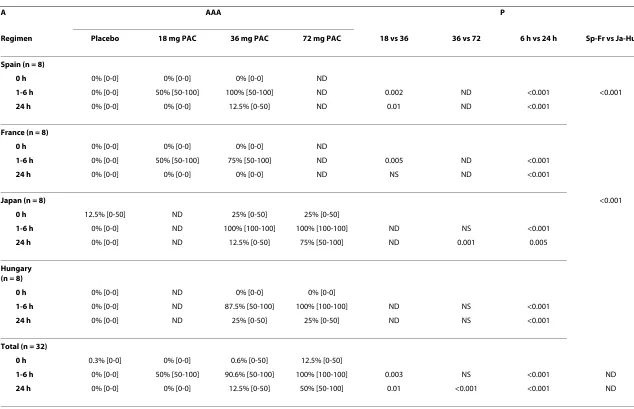
MRHA results indicated significant anti-adhesion activity (AAA) in urines collected from volunteers that consumed cranberry powder compared to placebo (p < 0.001) (Table 1). This inhibition was clearly dose-dependent, increasing with the amount of PAC equivalents consumed in each cranberry powder regimen. A peak of AAA was deter-mined over the time course of the experiment. In urines samples collected at 6 h, there was a significant difference between the cranberry dosages containing 18 mg PAC and those with either 36 or 72 mg PAC (p = 0.002); how-ever, no statistical difference was detected between 36 and 72 mg PAC. In urine samples collected at 24 h, there was a significant difference between the AAA of urines belonging to patients who had consumed cranberry dos-ages containing 72 mg of PAC (50% AAA) and the AAA of urines belonging to patients who had consumed 18 or 36 mg of PAC (0 and 12% AAA, respectively) (p = 0.002) (Table 1). In each country, similar results and trends were detected (Table 1).
How
e
ll
et a
l.
BMC Infe
ctious
Disease
s
201
0,
10
:9
4
htt
p://ww
w.biom
edcentral.com/147
1-23
34/1
0/94
Pa
g
e
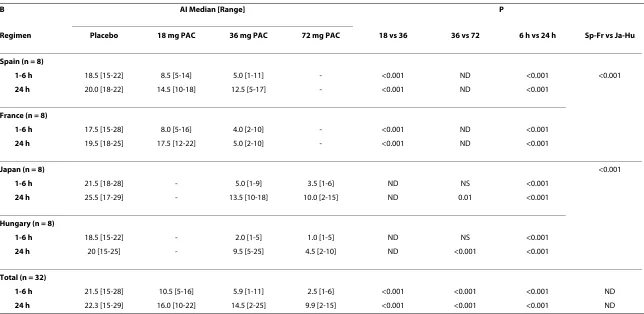
5 of 11 Table 1: Urinary bacterial Anti-Adhesion Activity (AAA) detected with Mannose-resistant Hemagglutination (MRHA) assay (A) and urinary bacterial adhesion to T24 cells (B) expressed as Adhesion Index (AI) following consumption of increasing doses of cranberry powder standardized for 18, 36 or 72 mg of proanthocyanidins (PAC) vs placebo by participants in the 4 countries.
A AAA P
Regimen Placebo 18 mg PAC 36 mg PAC 72 mg PAC 18 vs 36 36 vs 72 6 h vs 24 h Sp-Fr vs Ja-Hu
Spain (n = 8)
0 h 0% [0-0] 0% [0-0] 0% [0-0] ND
1-6 h 0% [0-0] 50% [50-100] 100% [50-100] ND 0.002 ND <0.001 <0.001
24 h 0% [0-0] 0% [0-0] 12.5% [0-50] ND 0.01 ND <0.001
France (n = 8)
0 h 0% [0-0] 0% [0-0] 0% [0-0] ND
1-6 h 0% [0-0] 50% [50-100] 75% [50-100] ND 0.005 ND <0.001
24 h 0% [0-0] 0% [0-0] 0% [0-0] ND NS ND <0.001
Japan (n = 8) <0.001
0 h 12.5% [0-50] ND 25% [0-50] 25% [0-50]
1-6 h 0% [0-0] ND 100% [100-100] 100% [100-100] ND NS <0.001
24 h 0% [0-0] ND 12.5% [0-50] 75% [50-100] ND 0.001 0.005
Hungary (n = 8)
0 h 0% [0-0] ND 0% [0-0] 0% [0-0]
1-6 h 0% [0-0] ND 87.5% [50-100] 100% [100-100] ND NS <0.001
24 h 0% [0-0] ND 25% [0-50] 25% [0-50] ND NS <0.001
Total (n = 32)
0 h 0.3% [0-0] 0% [0-0] 0.6% [0-50] 12.5% [0-50]
1-6 h 0% [0-0] 50% [50-100] 90.6% [50-100] 100% [100-100] 0.003 NS <0.001 ND
[image:5.794.100.734.102.511.2]How
e
ll
et a
l.
BMC Infe
ctious
Disease
s
201
0,
10
:9
4
htt
p://ww
w.biom
edcentral.com/147
1-23
34/1
0/94
Pa
g
e
6 of 11
B AI Median [Range] P
Regimen Placebo 18 mg PAC 36 mg PAC 72 mg PAC 18 vs 36 36 vs 72 6 h vs 24 h Sp-Fr vs Ja-Hu
Spain (n = 8)
1-6 h 18.5 [15-22] 8.5 [5-14] 5.0 [1-11] - <0.001 ND <0.001 <0.001
24 h 20.0 [18-22] 14.5 [10-18] 12.5 [5-17] - <0.001 ND <0.001
France (n = 8)
1-6 h 17.5 [15-28] 8.0 [5-16] 4.0 [2-10] - <0.001 ND <0.001
24 h 19.5 [18-25] 17.5 [12-22] 5.0 [2-10] - <0.001 ND <0.001
Japan (n = 8) <0.001
1-6 h 21.5 [18-28] - 5.0 [1-9] 3.5 [1-6] ND NS <0.001
24 h 25.5 [17-29] - 13.5 [10-18] 10.0 [2-15] ND 0.01 <0.001
Hungary (n = 8)
1-6 h 18.5 [15-22] - 2.0 [1-5] 1.0 [1-5] ND NS <0.001
24 h 20 [15-25] - 9.5 [5-25] 4.5 [2-10] ND <0.001 <0.001
Total (n = 32)
1-6 h 21.5 [15-28] 10.5 [5-16] 5.9 [1-11] 2.5 [1-6] <0.001 <0.001 <0.001 ND
24 h 22.3 [15-29] 16.0 [10-22] 14.5 [2-25] 9.9 [2-15] <0.001 <0.001 <0.001 ND
[image:6.794.101.745.93.407.2]The results are representative of at least three independent trials. NS, not significant; ND, not determined. 0 h, pre-cranberry consumption collection
Howell et al.BMC Infectious Diseases 2010, 10:94 http://www.biomedcentral.com/1471-2334/10/94
Page 7 of 11
72 mg of PAC (Table 1, Figure 1). There was a dose-dependent decrease in bacterial adhesion with cranberry intake. The Adhesion Index (AI) of bacteria grown in urine samples collected after consumption of cranberry with 36 or 72 mg PAC was significantly lower than the AI following the dose with 18 mg PAC (p < 0.001). The mul-tivariate analysis clearly confirmed a dosage effect for
each cranberry regimen vs placebo (p < 0.001) (Table 2). AI of bacteria in urines collected at 6 h and at 24 h were significantly different following all cranberry regimens (p < 0.001). Interestingly, the AI at 24 h after cranberry intake of 72 mg PAC equivalents remained significantly low (AI median <10) compared to the other regimens (p < 0.001). The multivariate analysis confirmed a time depen-dent-effect with the maximum effect at 6 h compared to 24 h (p < 0.001). The multivariate analysis demonstrated an effect of patients' origin. When the data were adjusted by hour and dose, results from Japan were significantly different compared to the three other countries, with higher AI (p < 0.001) (Table 2).
At 6 h for the 3 PAC equivalency doses, a significant correlation between AAA results and AI results was noted (p = 0.01, 0.04 and 0.04 for 18, 36 and 72 mg PAC). This trend was not observed at 24 h for the 3 doses (p = non significant, 0.94 and 0.10 for 18, 36 and 72 mg PAC).
Reduction of E. coli virulence
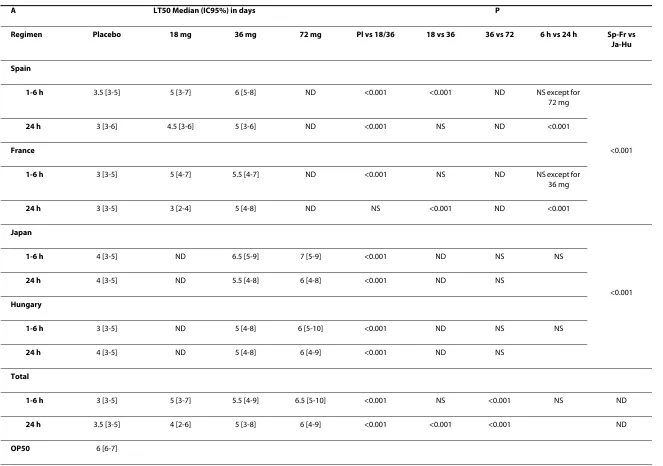
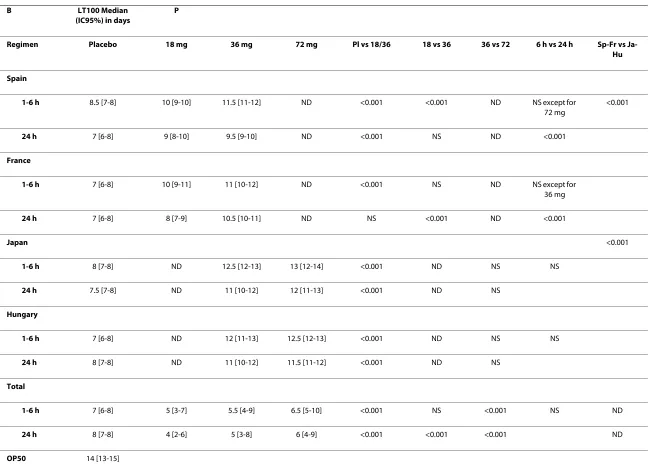
We evaluated the virulence potential of E. coli strain in presence of different urines following consumption of cranberry powder. The mean survival time (LT50) for worms was significantly increased to 5-6 days with E. coli grown in urine samples collected after cranberry intake compared to LT50 for strain grown in urine samples col-lected after placebo intake (3 days) (p < 0.001) (Table 3). In urines collected after 6 h, no difference can be detected between the virulence of E. coli strain grown in urines collected after consumption of PAC.
[image:7.595.59.289.97.288.2]In multivariate analysis, there was a significant effect of PAC dose influencing the virulence of E. coli (HR = 1 for placebo to HR = 0.32 for 72 mg): there was an inverse
Table 2: Multivariate analysis of results obtained to urinary bacterial adhesion to T24 cells expressed as adhesion index.
Parameters SD IC95% p p globale
inf sup
Countries France . . . <0.001
Spain -1.649 1.4478 -4.487 1.188 0.26
Japan 3.127 1.6099 -0.028 6.283 0.05
Hungary 0.332 1.7194 -3.038 3.702 0.85
Hours 1-6 H . . . .
24 H 7.089 0.7367 5.645 8.533 <0.001
Dose Placebo . . . . <0.001
36 mg -9.236 1.1482 -11.487 -6.986 <0.001
72 mg -16.595 0.6769 -17.921 -15.268 <0.001
144 mg -20.929 0.9071 -22.0707 -19.151 <0.001
[image:7.595.56.539.520.738.2]The index value was modelled by the hours, the country and the dose using a Generalized Estimating Equation model.
How
e
ll
et a
l.
BMC Infe
ctious
Disease
s
201
0,
10
:9
4
htt
p://ww
w.biom
edcentral.com/147
1-23
34/1
0/94
Pa
g
e
8 of 11 Table 3: vivo kinetics of killing of C. elegans infected by E. coli grown in urine samples after consumption of the different proanthocyanidins regimens.
A LT50 Median (IC95%) in days P
Regimen Placebo 18 mg 36 mg 72 mg Pl vs 18/36 18 vs 36 36 vs 72 6 h vs 24 h Sp-Fr vs
Ja-Hu
Spain
1-6 h 3.5 [3-5] 5 [3-7] 6 [5-8] ND <0.001 <0.001 ND NS except for
72 mg
24 h 3 [3-6] 4.5 [3-6] 5 [3-6] ND <0.001 NS ND <0.001
France <0.001
1-6 h 3 [3-5] 5 [4-7] 5.5 [4-7] ND <0.001 NS ND NS except for
36 mg
24 h 3 [3-5] 3 [2-4] 5 [4-8] ND NS <0.001 ND <0.001
Japan
1-6 h 4 [3-5] ND 6.5 [5-9] 7 [5-9] <0.001 ND NS NS
24 h 4 [3-5] ND 5.5 [4-8] 6 [4-8] <0.001 ND NS
<0.001
Hungary
1-6 h 3 [3-5] ND 5 [4-8] 6 [5-10] <0.001 ND NS NS
24 h 4 [3-5] ND 5 [4-8] 6 [4-9] <0.001 ND NS
Total
1-6 h 3 [3-5] 5 [3-7] 5.5 [4-9] 6.5 [5-10] <0.001 NS <0.001 NS ND
24 h 3.5 [3-5] 4 [2-6] 5 [3-8] 6 [4-9] <0.001 <0.001 <0.001 ND
[image:8.794.96.759.81.547.2]How
e
ll
et a
l.
BMC Infe
ctious
Disease
s
201
0,
10
:9
4
htt
p://ww
w.biom
edcentral.com/147
1-23
34/1
0/94
Pa
g
e
9 of 11 B LT100 Median
(IC95%) in days
P
Regimen Placebo 18 mg 36 mg 72 mg Pl vs 18/36 18 vs 36 36 vs 72 6 h vs 24 h Sp-Fr vs
Ja-Hu
Spain
1-6 h 8.5 [7-8] 10 [9-10] 11.5 [11-12] ND <0.001 <0.001 ND NS except for
72 mg
<0.001
24 h 7 [6-8] 9 [8-10] 9.5 [9-10] ND <0.001 NS ND <0.001
France
1-6 h 7 [6-8] 10 [9-11] 11 [10-12] ND <0.001 NS ND NS except for
36 mg
24 h 7 [6-8] 8 [7-9] 10.5 [10-11] ND NS <0.001 ND <0.001
Japan <0.001
1-6 h 8 [7-8] ND 12.5 [12-13] 13 [12-14] <0.001 ND NS NS
24 h 7.5 [7-8] ND 11 [10-12] 12 [11-13] <0.001 ND NS
Hungary
1-6 h 7 [6-8] ND 12 [11-13] 12.5 [12-13] <0.001 ND NS NS
24 h 8 [7-8] ND 11 [10-12] 11.5 [11-12] <0.001 ND NS
Total
1-6 h 7 [6-8] 5 [3-7] 5.5 [4-9] 6.5 [5-10] <0.001 NS <0.001 NS ND
24 h 8 [7-8] 4 [2-6] 5 [3-8] 6 [4-9] <0.001 <0.001 <0.001 ND
OP50 14 [13-15]
[image:9.794.100.749.69.533.2](A) Determination of LT50 Median; (B) Determination of LT100 Median.
Howell et al.BMC Infectious Diseases 2010, 10:94 http://www.biomedcentral.com/1471-2334/10/94
Page 10 of 11
relationship between consumed PAC and the virulence of E. coli observed (P < 0.001) (Table 2). So, the effect of PAC was "protective" for the worms. Moreover there was an effect of hour on the virulence of E. coli. The virulence of E. coli against worms was increased to 32% with urines collected at 24 h compared to urines collected at 6 h (P < 0.001).
The number of E. coli CFU within the nematode gut varied around 106 bacteria per worm for each strain 72 h
after ingestion without statistical difference (data not shown) confirming the ingestion and proliferation of E. coli isolates in the C. elegans intestine.
Discussion
In this study, two experimental assays were optimized successfully to demonstrate bacterial anti-adhesion activ-ity in human urines following cranberry powder con-sumption. Two collection periods were chosen: 1-6 h corresponding to the most important elimination period of PAC in urines as previously demonstrated by Howell et al. [11] and 24 h, the residual period of PAC elimination in urines. Results for the MRHA assay were inversely cor-related with the epithelial cell adhesion assay for the first urines collected from 1-6 h after ingestion of the various dosages of cranberry PAC equivalents (e.g. AI decreased when anti-adhesion activity determined by MRHA increased). However this correlation was not noted at 24 h, implying that the epithelial cell adhesion assay may be more sensitive to detecting activity in urines when the active metabolites are less concentrated. Our results sug-gest that both the MRHA and the epithelial cell adhesion assays could potentially be utilized to screen for urinary anti-adhesion activity, especially in the first 6 h following cranberry ingestion.
Adaptation of the cell adhesion assay using a fluores-cent E. coli strain eliminates false positives observed in previous experiments using Giemsa to stain bacteria [12,13]. In the experimental protocol used in the present study, the analysis is faster and easier than with Giemsa, providing an improvement in quantification of bacterial adhesion.
This multi-location randomized, double-blind versus placebo study revealed a dose-dependent and time-dependent effect in two different ex vivo models of E. coli adherence to bladder epithelial cells. We demonstrated a peak of urinary anti-adhesion activity 6 h after ingestion of the PAC-standardized cranberry powder, with a reduc-tion in activity at 24 h. There was a linear increase in uri-nary anti-adhesion activity with increasing dosages of PAC equivalents at both 6 h and 24 h. Interestingly a residual anti-adhesion effect was shown 24 h after con-sumption of 36 mg of PAC equivalents, with a more pro-found effect after 72 mg. This effect was evident in urines from all volunteers, regardless of country location. These
results highlighted for the first time that to achieve a bac-terial anti-adhesion effect in urine, 36 mg of cranberry PAC equivalents per day is effective, but 72 mg may offer a nyctohemeral protection. The kinetic data indicate that activity is highest after 6 h for both 36 and 72 mg, but decreases significantly after 24 h, suggesting that it may be beneficial to consume cranberry in two split doses of 36 mg in the morning and evening. With 72 mg of PAC, the different metabolites of PAC (notably different antho-cyanins [27]) are always present and efficient 24 h after cranberry consumption. Further human trials are needed to correlate the level of ex vivo anti-adhesion activity with prevention of clinical UTI.
The pre-study background urines of several of the Japa-nese volunteers exhibited anti-adhesion activity. This phenomenon could be due to the production of endoge-nous adhesion inhibitors (such as Tamm-Horsfall glyco-protein) that are produced by some people. These inhibitors are known to be transitory and can be induced by a number of factors, dietary (on salt and water bal-ance) and environmental. However, the AI in this popula-tion was significantly higher compared to other populations in multivariate analysis (p < 0.001). As the influence of dosage and hour was suppressed in this anal-ysis, this difference could be explained by the effect of diets between the Asian and European lifestyles.
The PAC contained in cranberry inhibit E. coli adhesins notably against P-fimbriae [3,7]. Adhesion is the first step of bacterial virulence, to ensure the survival and establish its replication. To demonstrate the effect of PAC on bac-terial virulence, we used an in vivo killing nematode model validated by different teams [12,25,26,28,29]. We determined that the reduced ability of E. coli strain to kill worms correlates with the consumption of cranberry cap-sules. Bacteria grown in the urine of individuals consum-ing the cranberry capsule are not able to adhere to the worms and thus exhibit reduced killing of the worms in spite of the presence and proliferation of E. coli strain in the C. elegans intestine. E. coli were localized within the nematode gut but could not exert any virulent effect because they can establish any infection and loss of viru-lence.
Conclusions
Administration of PAC-standardized cranberry powder at dosages containing 72 mg of PAC per day may offer a nyctohemeral protection against bacterial adhesion and virulence in the urinary tract. Since bacterial adhesion is the primary step in initiation of UTI, consumption of cranberry may offer an additional means to help prevent infections.
Abbreviations
Howell et al.BMC Infectious Diseases 2010, 10:94 http://www.biomedcentral.com/1471-2334/10/94
Page 11 of 11
Competing interests
HB and TM have participated in trials organized by Pharmatoka. ABH, CC, ABBP, LG, PT, AS and JPL have declared that no competing interests exist. Pharmatoka had no role in the study design, data collection and analysis, decision to pub-lish or preparation of the manuscript.
Authors' contributions
ABH, JPL and AS conceived of the study, participated in its design and coordi-nation, carried out the assays and drafted the manuscript. HB participated in the design of the study and coordination, enrolled the volunteers, and helped to draft the manuscript. CC performed statistical analysis and helped to draft the manuscript. ABBP carried out the assays on urothelial cells and helped to draft the manuscript. LG, TM, PT enrolled the volunteers in each country, fol-lowed the study and helped to draft the manuscript. All authors read and approved the final manuscript.
Acknowledgements
We thank Pharmatoka France for the commercial capsule (Urell®/Ellura™).
INSERM Espri 26 is supported by Université de Montpellier 1, La Ville de Nîmes, Le CHU de Nîmes, and La Région Languedoc Roussillon.
Author Details
1Marucci Center for Blueberry and Cranberry Research and Extension, Rutgers,
The State University of New Jersey, Chatsworth, NJ, USA, 2Service d'Urologie,
Hôpital Foch, Suresnes, France, 3Faculté de Médecine, Université de Genève,
Genève, Switzerland, 4Institut National de la Santé et de la Recherche Médicale,
Espri26, Université Montpellier 1, Nîmes, France, 5Fundació Puigvert, Barcelona,
Spain, 6Department of Urology, Graduate School of Medical Sciences, Kyushu
University, Kitakyushu, Japan, 7Department of Urology, South-Pest Hospital,
Budapest, Hungary and 8Laboratoire de Bactériologie, Virologie, Parasitologie,
University Hospital Carémeau, Nîmes, France
References
1. Jepson RG, Craig JC: Cranberries for preventing urinary tract infections.
Cochrane Database of Syst Rev 2008, 1:CD001321.
2. Sobota AE: Inhibition of bacterial adherence by cranberry juice: potential use for the treatment of urinary tract infections. J Urol 1984,
131:1013-1016.
3. Zafriri D, Ofek I, Adar R, Pocino M, Sharon N: Inhibitory activity of cranberry juice on adherence of type I and type P fimbriated
Escherichia coli to eucaryotic cells. Antimicrob Agents Chemother 1989,
33:92-98.
4. Ofek I, Goldhar J, Zafriri D, Lis H, Adar R, Sharon N: Anti-Escherichia coli
adhesin activity of cranberry and blueberry juices. N Engl J Med 1991,
324:1599.
5. Beachey EH: Bacterial adherence: Adhesin-receptor interactions mediating the attachment of bacteria to mucosal surface. J Infect Dis
1981, 143:325-345.
6. Howell AB, Vorsa N, Der Marderosian A, Foo LY: Inhibition of adherence of P-fimbriated Escherichia coli to uroepithelial-cell surfaces by proanthocyanidin extracts from cranberries. N Engl J Med 1998,
339:1085-1086.
7. Foo LY, Lu Y, Howell AB, Vorsa N: A-type proanthocyanidin trimers from cranberry that inhibit adherence of uropathogenic P-fimbriated
Escherichia coli . J Nat Prod 2000, 63:1225-1228.
8. Liu Y, Black MA, Caron L, Camesano TA: Role of cranberry juice on molecular-scale surface characteristics and adhesion behavior of
Escherichia coli . Biotechnol Bioeng 2006, 93:297-305.
9. Gupta K, Chou MY, Howell A, Wobbe C, Grady R, Stapelton AE: Cranberry products inhibit adherence of uropathogenic Escherichia coli to primary cultured bladder and vaginal epithelial cells. J Urol 2007,
177:2357-2360.
10. Howell AB, Leahy MM, Kurowska E, Guthrie N: In vivo evidence that cranberry proanthocyanidins inhibit adherence of P-fimbriated E. coli
bacteria to uroepithelial cells. FASEB J 2001, 15:A284.
11. Howell AB, Reed JD, Krueger CG, Winterbottom R, Cunningham DG, Leahy M: A-type cranberry proanthocyanidins and uropathogenic bacterial anti-adhesion activity. Phytochemistry 2005, 66:2281-2291.
12. Lavigne JP, Bourg G, Combescure C, Botto H, Sotto A: In-vitro and in-vivo evidence of dose-dependent decrease of uropathogenic Escherichia coli virulence after consumption of commercial Vaccinium macrocarpon (cranberry) capsules. Clin Microbiol Infect 2008,
14:350-355.
13. Di Martino P, Agniel R, David K, Templer C, Gaillard JL, Denys P, Botto H:
Reduction of Escherichia coli adherence to uroepithelial bladder cells after consumption of cranberry juice: a double-blind randomized placebo-controlled cross-over trial. World J Urol 2006, 24:21-27. 14. Turner A, Chen SN, Joike MK, Pendland SL, Pauli GF, Famsworth NR:
Inhibition of uropathogenic Escherichia coli by cranberry juice: A new antiadherence assay. J Agric Food Chem 2005, 53:8940-8947. 15. Howell AB, Foxman B: Cranberry juice and adhesion of
antibiotic-resistant uropathogens. JAMA 2002, 287:3082-3083.
16. Greenberg JA, Newman SJ, Howell AB: Consumption of sweetened dried cranberries versus unsweetened raisins for inhibition of uropathogenic
Escherichia coli in human urine: A pilot study. J Altern Complem Med
2005, 11:875-878.
17. Valentova K, Stejskal D, Bednar P, Vostalova J, Cihalik C, Vecerova R, Koukalova D, Kolar M, Reichenbach R, Sknouril L, Ulrichova J, Simanek V:
Biosafety, antioxidant status, and metabolites in urine after consumption of dried cranberry juice in healthy women: A pilot double-blind placebo-controlled trial. J Agric Food Chem 2007,
55:3217-3224.
18. Avorn J, Monane M, Gurwitz JH, Glynn RJ, Choodnovskiy I, Lipsitz LA:
Reduction of bacteriuria and pyruria after ingestion of cranberry juice.
JAMA 1994, 271:751-754.
19. Howell AB: Cranberry capsule ingestion and bacterial anti-adhesion activity of urine. FASEB J 2006, 20:LB454.
20. Walker EB, Barney DP, Mickelsen JN, Walton RJ, Mickelsen RA Jr: Cranberry concentrate: UTI prophylaxis. J Fam Practice 1997, 45:167-168. 21. Stothers L: A randomized trial to evaluate effectiveness and cost
effectiveness of naturopathic cranberry products as prophylaxis against urinary tract infection in women. Can J Urol 2002, 9:1558-1562. 22. Prior RL, Lazarus SA, Cao G, Muccitelli H, Hammerstone JF: Identification
of procyanidins and anthocyanins in blueberries and cranberries (Vaccinium spp.) using high-performance liquid chromatography/mass spectrometry. J Agric Food Chem 2001, 49:1270-1276.
23. Howell AB: Bioactive compounds in cranberries and their role in prevention of urinary tract infections. Mol Nutr Food Res 2007,
51:732-737.
24. Amalric J, Mutin PH, Guerrero G, Ponche A, Sotto A, Lavigne JP:
Phosphonate monolayers functionalized by silver thiolate species as antibacterial nanocoatings on titanium and stainless steel. J Mater Chem 2009, 19:141-149.
25. Lavigne JP, Blanc-Potard AB, Blossier G, Moreau J, Chanal C, Bouziges N, O'Callaghan D, Sotto A: Virulence genotype and nematode killing properties of extraintestinal Escherichia coli producing CTX-M β-lactamases. Clin Microbiol Inf 2006, 12:1199-1206.
26. Garsin DA, Sifri CD, Mylonakis E, Qin X, Singh KV, Murray BE, Calderwood SB, Ausubel FM: A simple model host for identifying Gram-positive virulence factors. Proc Natl Acad Sci USA 2001, 98:10892-10897. 27. Ohnishi R, Ito H, Kasajima N, Kaneda M, Kariyama R, Kumon H, hatano T,
Yoshida T: Urniary excretion of anthocyanins in humans after cranberry juice ingestion. Biosci Biotechnol Biochem 2006, 70:1681-1687. 28. Sifri CD, Begun J, Ausubel FM: The worm has turned--microbial virulence
modeled in Caenorhabditis elegans . Trends Microbiol 2005, 13:119-127. 29. Diard M, Baeriswyl S, Clermont O, Gouriou S, Picard B, Taddei F, Denamur
E, Matic I: Caenorhabditis elegans as a simple model to study phenotypic and genetic virulence determinants of extraintestinal pathogenic Escherichia coli. Microbes Infect 2007, 9:214-223.
Pre-publication history
The pre-publication history for this paper can be accessed here: http://www.biomedcentral.com/1471-2334/10/94/prepub
doi: 10.1186/1471-2334-10-94
Cite this article as: Howell et al., Dosage effect on uropathogenic Escheri-chia coli anti-adhesion activity in urine following consumption of cranberry powder standardized for proanthocyanidin content: a multicentric random-ized double blind study BMC Infectious Diseases 2010, 10:94
Received: 17 November 2009 Accepted: 14 April 2010 Published: 14 April 2010
This article is available from: http://www.biomedcentral.com/1471-2334/10/94 © 2010 Howell et al; licensee BioMed Central Ltd.
This is an Open Access article distributed under the terms of the Creative Commons Attribution License (http://creativecommons.org/licenses/by/2.0), which permits unrestricted use, distribution, and reproduction in any medium, provided the original work is properly cited.