METHODOLOGY
Implementing population-based mass
drug administration for malaria: experience
from a high transmission setting in North
Eastern Uganda
Ronald Mulebeke
1,3*, Humphrey Wanzira
1, Fred Bukenya
1, Thomas Eganyu
1, Kathryn Collborn
4,
Richard Elliot
5, Jean‑Pierre Van Geertruyden
3, Dorothy Echodu
1and Adoke Yeka
2Abstract
Background: Mass drug administration (MDA) is a suggested mean to accelerate efforts towards elimination and attainment of malaria‑free status. There is limited evidence of suitable methods of implementing MDA programme to achieve a high coverage and compliance in low‑income countries. The objective of this paper is to assess the impact of this MDA delivery strategy while using coverage measured as effective population in the community and popula‑ tion available.
Methods: Population‑based MDA was implemented as a part of a larger program in a high transmission setting in Uganda. Four rounds of interventions were implemented over a period of 2 years at an interval of 6 to 8 months. A housing and population census was conducted to establish the eligible population. A team of 19 personnel con‑ ducted MDA at established village meeting points as distribution sites at every village. The first dose of dihydroarte‑ misinin–piperaquine (DHA‑PQ) was administered via a fixed site distribution strategy by directly observed treatment on site, the remaining doses were taken at home and a door‑to‑door follow up strategy was implemented by com‑ munity health workers to monitor adherence to the second and third doses.
Results: Based on number of individuals who turned up at the distribution site, for each round of MDA, effective cov‑ erage was 80.1%, 81.2%, 80.0% and 80% for the 1st, 2nd, 3rd and 4th rounds respectively. However, coverage based on available population at the time of implementing MDA was 80.1%, 83.2%, 82.4% and 82.9% for rounds 1, 2, 3 and 4, respectively. Intense community mobilization using community structures and mass media facilitated community participation and adherence to MDA.
Conclusion: A hybrid of fixed site distribution and door‑to‑door follow up strategy of MDA delivery achieved a high coverage and compliance and seemed feasible. This model can be considered in resource‑limited settings.
Keywords: Malaria, Mass drug administration, High transmission setting, Uganda
© The Author(s) 2019. This article is distributed under the terms of the Creative Commons Attribution 4.0 International License (http://creativecommons.org/licenses/by/4.0/), which permits unrestricted use, distribution, and reproduction in any medium, provided you give appropriate credit to the original author(s) and the source, provide a link to the Creative Commons license, and indicate if changes were made. The Creative Commons Public Domain Dedication waiver (http://creativecommons.org/ publicdomain/zero/1.0/) applies to the data made available in this article, unless otherwise stated.
Open Access
*Correspondence: [email protected]
Background
Although the malaria burden is declining in several countries [1, 2], malaria-related morbidity and mortal-ity remains high in sub-Saharan African countries, such as Uganda [1–6]. In the 2018 World Malaria Report, the sub-Saharan region contributed 92% of the global 219 million cases, with Uganda accounting for 4% of these cases. There are numerous efforts by the Uganda National Malaria Control Programme (UNMCP) to scale up recommended malaria control interventions includ-ing long-lastinclud-ing insecticidal nets (LLINs), indoor resid-ual spraying (IRS), intermittent preventive treatment in pregnancy (IPTp) and case management using arte-misinin-based combination therapy (ACT). In spite of all the effort, malaria reports indicate a raising incidence in Uganda [7, 8].
Uganda, as a stably endemic, high burden country with pockets of extremely high malaria transmission faces the challenge of charting a rapid and safe route from a high malaria transmission zone towards pre-elimination phase via an intermediate low transmission state. In this regard there is a renewed interest in using malaria mass drug administration (MDA) to rapidly reduce the malaria burden and hasten the path to pre-elimination [9–11]. Whereas the WHO recommends use of MDA in low transmission settings [12], in the context of this study, MDA was used in combination with indoor resid-ual spraying (IRS) to test how to accelerate reduction of malaria transmission. The impact of MDA on malaria burden will be reported elsewhere.
To impact on transmission, MDA requires high cover-age of the target population which, in turn, demands a high level of community participation and engagement. MDA aims to provide therapeutic concentrations of anti-malarial drugs to a proportion of the population as large as possible in order to cure asymptomatic infections and to prevent re-infection during the period of post-treat-ment prophylaxis. MDA should be conducted in a coordi-nated manner, so that the drug is taken at approximately the same time by the whole population at risk, often at repeated intervals [13]. The current recommended MDA delivery strategies are door-to-door strategy and central-ized, fixed site strategy [13]. Uganda has implemented MDA for river blindness, intestinal worms and oncho-cerciasis in communities and schools employing door-to-door strategy for the past 8 years [14]. In all these, MDA is delivered by village health team (VHT) and the drugs distributed are single doses not based on weight. MDA for malaria with a three-day weight-based regimen poses logistical challenges of ensuring appropriate dosing and completion. The choice of strategy may majorly depend on the local circumstances and should be defined bear-ing in mind the context for each area in country. The
objective of this paper is to assess the impact of the MDA delivery strategy while using coverage measured as a pro-portion of the effective population and population avail-able at the time of implementing MDA.
Methods
MDA for malaria was administered in the frame-work of a clinical trial assessing the additional popula-tion impact of adding MDA to an IRS intervenpopula-tion in a high malaria transmission setting in Uganda (PACTR 201807166695568). Consent to participate was obtained from all participants prior to taking MDA. The study was approved by the Makerere University School of Pub-lic Health Higher Degrees Research Ethics Committee (MUSPH-HDREC) protocol reference number 327 and the Uganda National Council for Science and Technology (UNCST).
Study setting
The study was conducted in Kapujan sub-county, Katakwi district, in North-Eastern Uganda. Kapujan sub-county lies along the shores of Lake Bisina, a fingerling of Lake Kyoga. The malaria prevalence in the area occurs all the year round. MDA was implemented in a study assessing the impact of population-based MDA given in combina-tion with IRS or IRS alone. Four rounds of intervencombina-tions were implemented over a period of 2 years. The first round was implemented in November–December 2016, the second in August 2017 the third from April–May 2018 and the fourth from November–December 2018.
Study area and population
Farming is the main economic activity with occasional fishing. The area has 18 villages and each village has on average 5 to 6 village health team members (VHT). The VHTs serve to improve timely access to health care par-ticularly for children under 5 years and pregnant moth-ers. The area has one health centre-III, and 2 heath centres IIs which are second and first line health units in the health care service delivery structure, respectively. The sub-county had universal mass distribution of LLINs in 2017 in addition to the study interventions.
MDA implementation
Community engagement
were sensitized on the study objectives, interventions and the expected role of the community. Sensitization meetings were further held with sub county and village leaders. Community members were sensitized in village meetings. Information was provided about malaria pre-vention methods with a focus on MDA and its imple-mentation. The rational of giving drugs to healthy people during MDA for prevention of malaria was emphasized. Community members were further informed on how to take the medicine, importance of completing the full dose, the expected drug reactions and the need to report these to the study team. During these meetings, study objectives, procedures, benefits and risks were compre-hensively discussed and community members were given a chance to ask questions to which responses were made by the study team. Other mobilization strategies included radio announcements, radio spots, and use of mobile mega microphones. Interpersonal communication by the Local Council leaders (LCs) and VHTs continued throughout the implementation period.
Hiring and training study staff
A total of 108 VHTs, who are part of the existing health system structure, were recruited to help with commu-nity mobilization effort. In addition, 60 study staff were hired to work at distribution sites during implementa-tion of MDA. Of these, 30 were data officers and 30 were health workers with variable training (nursing assistants, registered nurses, midwives, laboratory technicians and clinical officers). All were trained on performance of their roles at the distribution sites, conduct of the door-to-door follow up, and the study standard operating proce-dures (SOPs). All staff had a 4 days certified good clinical practice (GCP) training. The training included a pilot dry run. A team of 19 people conducted the exercise per village.
Enumeration of households
All households in the study area were mapped using hand held global positioning system (GPS) devices. House-hold members enumerated using hand held computers uploaded with Survey be software version (EDI-group, version 8, UK). Data was retrieved each day and stored on a central computer at the study office. Households and household members were assigned a unique identifier using a barcode system. Each individual’s barcode was attached to an individual card that is presented at the dis-tribution site for individual verification. Individuals were screened to ascertain study eligibility. Children below 6 months and pregnant women were excluded as well as adults with history of chronic conditions like kidney and livers diseases. Consent to participate in the study was obtained from all potential study participants prior to
implementation of MDA. Assent was obtained from chil-dren aged 8 to 17 years. Due to the dynamic nature of the study population, the enumeration database was updated before each round of the exercise. New households were mapped and members enumerated and screened. Old households were checked to update information in case some individuals left, died or new ones came in the study area and to update the eligibility of all household members.
Logistics and supplies
Team leaders ensured that all logistical supplies were available. A checklist was used to organize, issue and account for equipment and supplies designated for each fixed point. Each team was assigned a vehicle, 3 comput-ers, 2 barcode scanncomput-ers, 12 chairs and 6 tables, 3 Jerry-cans, disposable cups and spoons, study drugs, stationery and laboratory supplies. The study drug was pre-packed according to weight-based doses and stored in a secure temperature controlled place.
MDA coordination
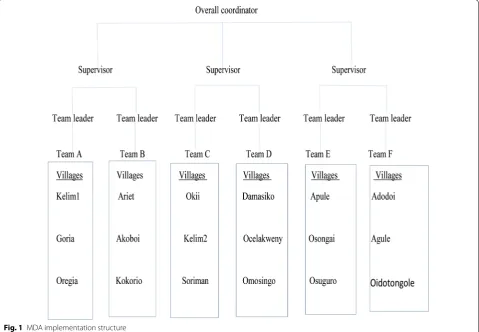
The team comprised of an overall coordinator, sector supervisors, team leaders, health workers, data officers and VHTs (Fig. 1). A total of six teams were deployed to cover 18 villages over a period of 15 days. Each team had 19 personnel comprising a team leader, 5 health workers, 4 data officers and 9 VHTs. MDA was conducted by one team in each village over a period of 5 days. One sector supervisor was assigned to oversee 2 teams and ensured adequate supply of logistics and adherence to standard operating procedures (SOPs). Teams were systematically deployed in sequence. Each sector supervisor initiates one team at a time, after the second day of distribution, the second team would commence work in the next vil-lage. Once a team completes work over the 5 days, they would move to another village.
Fixed site distribution
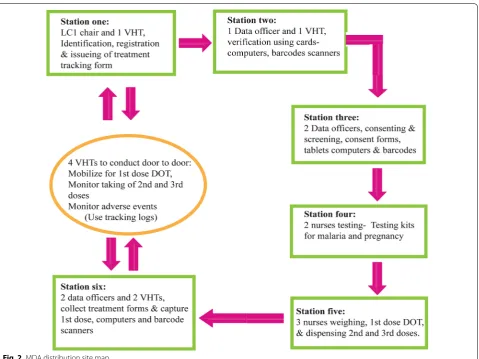
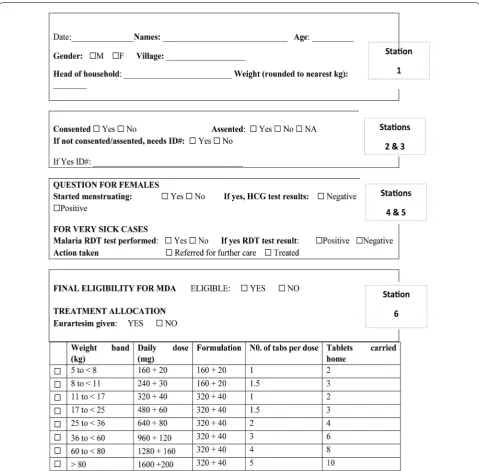
Fixed site delivery was implemented at established village meeting points in the study area for directly observed therapy (DOT) of the first dose. Village meeting points were known places for routine meetings in a village. At these meeting points, all eligible household members were mobilized to go for 1st DOT dose and to receive the 2nd and 3rd doses. Each static point had 6 stations num-bered 1 to 6 and each had specific tasks (Figs. 2, 3).
Station one was the registration point where partici-pants were registered. Following registration, MDA treat-ment tracking forms were issued to each participant and the participant’s particulars were written on the form.
identification card holding a unique barcode for verifi-cation. Two data officers, using barcode scanners and a computer verify each participant in the database, and confirm whether they were screened for eligibility crite-ria and had provided consent to participate in the study. On completion of the validating process, a mark was put on each participant’s card to indicate, the individual had reported to the distribution site. Those who had not con-sented during the enumeration exercise, were directed to station three to obtain informed consent, all information is recorded in the tracking form.
Station three was the point for seeking informed con-sent to participate in the study. Two study staff screened participants and sought for informed consent, for those who missed it during enumeration. The MDA treatment tracking form was updated accordingly.
At station four; two study nurses screened for preg-nancy in every female participant of reproductive age (14–49 years). Urine samples were collected in urine containers and tested using HCG kits. Any participant who had a reactive pregnancy test was advised not to take the study drug and referred to attend antenatal care. The result was recorded on the MDA treatment tracking
form. Participants whose HCG test was not reactive con-tinued to station five to receive the study drug. Partici-pants who had symptoms of malaria, were tested with a malaria RDT. The results (positive and negative) were recorded on the MDA treatment tracking form and all continued to station five.
At station five, three study nurses checked the eligibil-ity of participants to take the study drug before dispens-ing the drugs. The study nurses checked for consent or assent to participate in MDA and results for urine HCG and malaria RDT tests where applicable. Those having a positive malaria RDT test received artemether–lumefan-trine, the first-line treatment for uncomplicated malaria in Uganda, the rest received the study drug. Participant’s weight was taken and the study drug dispensed according to weight-based dosing. The first dose of treatment was given as DOT for each participant. The second and third doses were given to the participants with instructions to take the drugs at home.
[image:4.595.59.539.89.421.2]instantly and provided information on real time coverage for 1st dose DOT. At the end of each day, a list of those who needed follow up to monitor adherence for the 2nd and 3rd doses was generated as well as those who still needed to be mobilized to come for the 1st dose.
MDA was conducted between 8th and 22rd December 2016 for round one, between 14th and 29th August 2017 for round two and 27th April to 10th May 2018 for round three and 27th November to 12th December for round 4.
Door‑to‑door follow up
On the second day of distribution in a village, about 4 VHTs started door-to-door monitoring for treatment adherence for the 2nd and 3rd dose and inquiring about any adverse events in each village. VHTs also mobilized individuals who did not turn up at the treatment points and encouraged them to report for treatment within the 4 days of distribution. They provided household mem-bers with telephone nummem-bers to call without paying (hot lines), for communicating to the study team doc-tors in case of any symptoms after taking the study drug.
Adherence was monitored by checking for empty drug blister packs. Tracking logs indicating participant’s com-pletion of 2nd and 3rd doses were filled for each partici-pant in a village. Participartici-pants were followed up in each village for extra 2 days to record the taking the 2nd and 3rd doses.
Management of adverse events
[image:5.595.60.540.85.444.2]facility. Both health facility staff and the study team doc-tors worked together to manage adverse events All com-plaints were documented using a standard adverse event reporting form from the study drug manufacturer (Sigma Tau) and the institutional review board (IRB). All adverse events were managed following the standard of care and were followed until they resolved. Prior to implementing interventions, health facility staffs were trained in man-agement of possible adverse events and complications of the study drugs that were likely to be reported. Drugs and
other supplies were fully stocked to ensure appropriate case management according to the country’s treatment guidelines.
Results
Enumeration of study participants
[image:6.595.58.538.86.557.2]area has 2490 households with average house occupancy of 5.5 persons per household.
MDA coverage
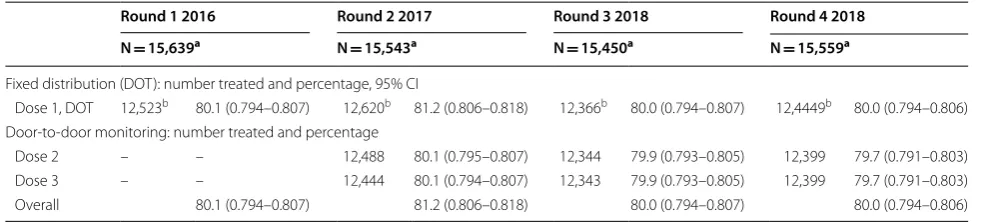
MDA coverage was estimated based on enumeration updates, which were conducted before commencement of interventions. Success of this delivery strategy was measured by using effective coverage (coverage based on all individuals who lived in the in past 6 months and plan to live in the same community in the next 6 months.) and coverage based on population available during the imple-mentation of MDA. For effective coverage, MDA cover-age was 80.1%, 81.2%, 80.0% and 80% for first, second, third and fourth rounds of MDA respectively (Table 1). Whereas coverage based on population available was 80.1%, 83.2%, 82.4% and 82.9% % for first, second, third and fourth rounds, respectively. Coverage for each round was based on number of individuals who turned up at the distribution sites against number of individuals enumer-ated in the study area. Coverage at village level and fac-tors affecting uptake of MDA in this setting is described elsewhere. Adherence for round one was not monitored as the implementation had an adaptive approach to try and find a strategy that would adequately yield satisfac-tory results. For instance, the process was improved by introducing monitoring of uptake of 2nd and 3rd doses using tracking logs. Consequently, adherence to subse-quent rounds was over 80% for second and third doses. Lessons learn from round one were used to improve sub-sequent rounds.
Lessons learnt
Engaging the leadership at all levels provided commu-nity acceptance and improved willingness to participate in MDA. Using VHTs, and local council leaders, in com-munity mobilization, built confidence in the comcom-munity about MDA. Interpersonal communication by door-to-door mobilization conducted by local council leaders and
VHTs was very effective in mobilizing the community to participate in the exercise.
Hiring local staff who knew the local language, facili-tated effective communication between study staff and study participants. Training study staff equipped them with the necessary knowledge and acceptable practices for handling study participants. Working with the com-munity promoted ownership as everyone desired to achieve a high coverage in their area.
Preparing logistics in time before commencement of field activities was very important. Teams assigned to vil-lages ensured high turn up at distribution sites and sat-isfactory follow up of 2nd and 3rd doses. This approach did not only improve monitoring MDA activities but pro-vided an opportunity for team work within each team. Team work resulted in commitment by the study team, local leadership and VHTs to ensure coverage is high in villages which were assigned to them. It provided for ade-quate accountability for study drugs as well as logistical supplies.
Fixed site distribution and door-to-door follow up was effective in achieving a high MDA population coverage. It facilitated close supervision to ensure adherence to SOPs and participant safety. The delivery of drugs, test kits, weighing scales, computers, scanners, treatment forms and other supplies to the distribution sites was logisti-cally feasible compared to when study staff would move door-to-door with all these items. It is a logistically fea-sible approach for delivering MDA because of employ-ing fewer personnel and minimal transport needs. This approach both accommodated our resource constraints and served as a knowledge sharing and capacity building process within the research team.
Challenges
Additionally, implementing MDA during the rainy sea-son is challenging because most community mem-bers were busy in their gardens. Inadequate duration
Table 1 Mass drug administration coverage in Kapujan sub-county, Katakwi district
a Number of individuals living in the study area at the time of interventions b Number of individuals eligible to receive the study drug
Round 1 2016 Round 2 2017 Round 3 2018 Round 4 2018
N = 15,639a N
= 15,543a N
= 15,450a N
= 15,559a
Fixed distribution (DOT): number treated and percentage, 95% CI
Dose 1, DOT 12,523b 80.1 (0.794–0.807) 12,620b 81.2 (0.806–0.818) 12,366b 80.0 (0.794–0.807) 12,4449b 80.0 (0.794–0.806) Door‑to‑door monitoring: number treated and percentage
[image:7.595.54.546.593.704.2]of engagement with the community before and during implementation of MDA. This approach needed a large amount of investment put in mobilizing the community.
Discussion
Population-based MDA was implemented using dihy-droartemisinin-piperaquine (DHA-PQ) delivered by fixed point distribution for the first dose and door-to-door follow up for the second and third doses in Kapujan sub-county, an area of high malaria transmission in North Eastern Uganda. Of the eligible persons at each round of intervention, MDA coverage was 80.1%, 81.2%, 80.0% and 80% for the 1st, 2nd 3rd and 4th rounds, respectively. Treatment adherence to all three doses in round one, was not captured but for subsequent rounds was over 80% for second and third doses. Intense community mobilization using community structures and mass media facilitated community participation and adherence to MDA.
Community engagement was very critical during the implementation process of MDA. Engaging the com-munity about the importance of the project prior to implementation of MDA increased participation among the local leadership and the community members. Find-ings are similar to that in the Gambia, where sensitizing the community increased participation in MDA project [15]. Use of a collaborative approach to mobilize the community by the study team in partnership with the local leadership ensured community participation and commitment to MDA implementation. This similarly reported in Cambodia, [16] where community health workers, community leaders and political leaders took a central role in community mobilization for a successful MDA implementation. Active community engagement, as recommended by the WHO, is essential for any MDA implementation plan.
Updating the household and population database before each round of MDA provided an accurate popu-lation size to target for each round of MDA and ena-bled a more accurate estimate of MDA coverage in the community. A literature review of other studies reports unclear and inconsistent methods for estimating cover-age [17]. Furthermore, screening for MDA eligibility and getting participant consent during the enumeration pro-cess improved efficiency of the exercise. This exercise was closely monitored by the study internal systems to ensure that the information obtained about participants was accurate and that there was no coercion to participate.
To carry out an organized MDA across all distribution sites, a structure was developed to facilitate quick access to logistics, close supervision and accountability of study supplies. With little documentation of similar struc-tures in other MDA settings, this structure may provide
a working framework for organizing MDA distribution sites in comparable settings in low-income countries.
A framework was created to allow consistent MDA implementation at the distribution sites from station 1 to 6. This allowed MDA implementation in a consist-ent manner across all distribution sites. In the literature reviewed, it was not possible to find any study with such a flow plan, but the algorithm created was significant in ensuring consistency in methodology and standardiza-tion of activities at distribustandardiza-tion sites. Door-to-door fol-low up by VHTs was key in ensuring adherence to the 2nd and 3rd doses. The door-to-door follow up process provided continuous contact between the individual par-ticipants and study team post 1st dose DOT. The collec-tion of blister packs after each individual has taken their 2nd and 3rd doses was in some way to validate the num-ber of doses given out and those taken.
and door-to-door follow up strategy is recommended for population-based MDA especially in countries with a similar setting.
As much as guidelines or recommendations men-tion about pharmacovigilance in MDA, how to practi-cally implement it is not well documented. In this study, a field medical team in collaboration with health work-ers from health centres in the study area managed the adverse events (AE). A study by Landier et al. reported use of a medical team with a mobile clinic for monitor-ing and management of adverse events [22] during MDA. In this study, hot lines for reporting adverse events to the medical team were used. Management of adverse events was carried out at the health facilities where drugs were stocked, health workers were trained on management of adverse events and proper documentation of adverse events was done. This provided a logistically feasible and an efficient surveillance system for monitoring adverse events as existing structures in the health system were used.
Timing for MDA implementation should target school holidays and before the rainy season starts when the community is less mobile [23]. Round one and round four of MDA implementation was during the December dry season and when school children were back home for holidays, a high coverage was attained during these rounds. A similar observation was made in The Gambia [15] and they recommend that MDA activities be under-taken just before the rainy season.
The logistical complexities for implementing MDA may need to change from place to place and from time to time. The tools for MDA implementation need to allow for sufficient flexibility to be adapted by all users in vary-ing settvary-ings. With the dynamics of the population, there will always be new challenges and new ways of coping.
Limitations
Although, MDA implementation was a success, several limitations exist. In 2 out of the 3 rounds of implemen-tation, MDA activities were conducted during the school term, making it difficult to reach school children. At the same time, the community was mobile due to activities associated with the rainy season. LLIN and IRS campaign conducted in the area could have influenced compliance to MDA as the community could feel protected. This could have also introduced intervention fatigue in the community. Lack of capacity to closely monitor migration of the population in and out of the study area may have resulted into underestimation or overestimation of MDA coverage. Managing perceptions of drug side effects was complex as it was difficult to get everyone understand the
difference between side effects and adverse events. It was difficult to explain malaria transmission in relation to the need to take drugs for a person who is not sick.
Conclusion
Using community structures for community sensitiza-tion and mobilizasensitiza-tion facilitates high participasensitiza-tion in MDA. Updates of mapping and enumeration database before each round of interventions is essential for accu-rate estimate of coverage. Screening and consenting during each round is key for identification of eligible participants. Organizing teams based on number of vil-lages and available resources helps to manage logistical issues and supervision of processes. Fixed site distribu-tion design, built on existing resources allows MDA site distribution to be implemented in a consistent and stand-ard manner across all distribution sites for 1st dose under DOT. Door-to-door follow up by VHTs is key in ensuring adherence to 2nd and 3rd doses and timely identification and management of adverse events. A hybrid (Box 1) of fixed site distribution for 1st dose under DOT and door-to-door monitoring promotes and simultaneously allows assessment of adherence to and safety of the 3 days ACT regimen.
Fixed site distribution Organizing the site prior to
distribution
Verifying eligibility to take MDA Screening of women of reproduc‑
tive age for pregnancy Registration of individuals receiv‑
ing the study drug
Distribution of blisters with 1st dose under DOT
Tally sheet completed after medi‑ cine has been dispensed Monitoring for serious adverse
events or Adverse events for at least 30 min and
Referral of all ill people to the nearest health facility
Door‑to‑door distribution Verification of household
members
Explaining of objectives for the campaign
Obtained consent/assent Checking for eligibility Screening for pregnancy
among women of reproduc‑ tive age
Distribution of blisters appropri‑ ate for the age category Give instruction for taking the
remaining Doses on days two and three
Mark the tally sheet
Mark the completed house hold Mix of two approaches
Organizing the sites to have facilities like, pit latrines, tables, chairs, drinking water, shelter or waiting shades
Identification and verification of village members Consenting and/or assenting
Screening for eligibility Testing for pregnancy Dispensing of drugs
All ill people referred to health facilities
Door‑to‑door follow up using tracking logs to identify people who should be mobilized To go to the site for day 1 dose under DOT Monitored the taking of 2nd or 3rd doses
Inquired about adverse events
Abbreviations
ACT : artemisinin‑based combination therapy; AE: adverse event; BCC: Behaviour Change and Communication; DOT: direct observation therapy; GCP: good clinical practice; IEC: information education & communication; IPTp: intermittent preventive treatment in pregnancy; IRS: indoor residual spraying; LC1: local council 1; LLIN: long‑lasting insecticide treated net; MDA: mass drug administration; MOH: Ministry of Health; RDT: rapid diagnostic test; SAE: serious adverse event; SOP: standard operating procedure; SPH‑HDREC: School of Public Health Higher Degrees Research & Ethics Committee; UNCST: Uganda National Council of Science & Technology; UNMCP: Uganda National Malaria Control Programme; VHT: village health team; WHO: World Health Organization.
Acknowledgements
The authors wish to acknowledge the support provided by study field staff and supervisors including the administrative at Pilgrim Africa who made it possible for a successful implementation of this strategy. Special thanks to the Katakwi district leadership and the community in Kapujan subcounty who participated in study activities.
Authors’ contributions
Conceptualization: RM, HW, DE, AY. Data curation: RM, HW, FB, TE. Formal analysis: RM. Funding acquisition: DE. Investigation: RM, WH, DE, AY. Meth‑ odology: RM, HW, FB, TE, DE, AY. Project administration: RM, HW, FB, DE, AY. Resources: RM, DE, AY. Supervision: RM, HW, FB, TE, DE, AY. Software: RM, TE, HW. Validation: RM, HW, FB, AY. Visualization: RM, AY. Writing‑original draft: RM. Writing‑review and editing: RM, HW, DE, VG, AY. All authors read and approved the final manuscript.
Funding
Funding for this study was from; Pilgrim Africa, Rotary Malaria Partners, Bill and Melinda Gates Foundation.
Availability of data and materials
Dataset used for this manuscript are submitted.
Ethics approval and consent to participate
This is already included in the text.
Consent for publication
This is not applicable as this manuscript uses aggregated data.
Competing interests
The authors declare that they have no competing interests.
Author details
1 Pilgrim Africa, Kampala, Uganda. 2 Makerere University School of Public Health, Kampala, Uganda. 3 Global Health Institute, University of Antwerp, Antwerp, Belgium. 4 University of Colorado Denver, Colorado, CO, USA. 5 Boise State University, Boise, CO, USA.
Received: 29 April 2019 Accepted: 2 August 2019
References
1. Mukonka VM, Chanda E, Haque U, Kamuliwo M, Mushinge G, Chileshe J, et al. High burden of malaria following scale‑up of control interventions in Nchelenge District, Luapula Province, Zambia. Malar J. 2014;13:153. 2. Assele V, Ndoh GE, Nkoghe D, Fandeur T. No evidence of decline in
malaria burden from 2006 to 2013 in a rural Province of Gabon: implica‑ tions for public health policy. BMC Public Health. 2015;15:81.
3. Ashley EA, Pyae Phyo A, Woodrow CJ. Malaria. Lancet. 2018;391:1608–21. 4. Okiro EA, Kazembe LN, Kabaria CW, Ligomeka J, Noor AM, Ali D, et al.
Childhood malaria admission rates to four hospitals in Malawi between 2000 and 2010. PLoS One. 2013;8:e62214.
5. Jagannathan P, Muhindo MK, Kakuru A, Arinaitwe E, Greenhouse B, Tappero J, et al. Increasing incidence of malaria in children despite insecticide‑treated bed nets and prompt anti‑malarial therapy in Tororo, Uganda. Malar J. 2012;11:435.
6. Okiro EA, Bitira D, Mbabazi G, Mpimbaza A, Alegana VA, Talisuna AO, et al. Increasing malaria hospital admissions in Uganda between 1999 and 2009. BMC Med. 2011;9:37.
7. WHO. World malaria report 2017. Geneva: World Health Organization; 2017.
8. WHO. World malaria report. Geneva: World Health Organization; 2018. 9. Gosling RD, Okell L, Mosha J, Chandramohan D. The role of antima‑
larial treatment in the elimination of malaria. Clin Microbiol Infect. 2011;17:1617–23.
10. Achan J, Mwesigwa J, Edwin CP, D’Alessandro U. Malaria medicines to address drug resistance and support malaria elimination efforts. Expert Rev Clin Pharmacol. 2018;11:61–70.
11. Nosten F. Elimination in South‑East Asia? The role of antimalarial drugs (in French). Bull Acad Natl Med. 2016;200:467–75.
12. Bosman A. Mass drug administration: WHO policy update. Bogota: World Health Organization, World Malaria Programme, 3–5 May 2016. 13. WHO. Mass drug administration for falciparum malaria: a practical field
manual. Geneva: World Health Organization; 2017.
14. Katabarwa MN, Griswold E, Habomugisha P, Eyamba A, Byamukama E, Nwane P, et al. Comparison of reported and survey‑based coverage in onchocerciasis programs over a period of 8 years in Cameroon and Uganda. Am J Trop Med Hyg. 2019;100:1208–15.
15. Dial NJ, Ceesay SJ, Gosling RD, D’Alessandro U, Baltzell KA. A qualitative study to assess community barriers to malaria mass drug administration trials in The Gambia. Malar J. 2014;13:47.
16. Peto TJ, Tripura R, Davoeung C, Nguon C, Nou S, Heng C, et al. Reflec‑ tions on a community engagement strategy for mass antimalarial drug administration in Cambodia. Am J Trop Med Hyg. 2018;98:100–4. 17. Adhikari B, James N, Newby G, von Seidlein L, White NJ, Day NP, et al.
Community engagement and population coverage in mass anti‑malarial administrations: a systematic literature review. Malar J. 2016;15:523. 18. Kuehne A, Tiffany A, Lasry E, Janssens M, Besse C, Okonta C, et al. Impact
and lessons learned from mass drug administrations of malaria chemo‑ prevention during the Ebola outbreak in Monrovia, Liberia, 2014. PLoS One. 2016;11:e0161311.
19. Landier J, Kajeechiwa L, Thwin MM, Parker DM, Chaumeau V, Wilad‑ phaingern J, et al. Safety and effectiveness of mass drug administration to accelerate elimination of artemisinin‑resistant falciparum malaria: a pilot trial in four villages of Eastern Myanmar. Wellcome Open Res. 2017;2:81. 20. Aregawi M, Smith SJ, Sillah‑Kanu M, Seppeh J, Kamara AR, Williams RO,
et al. Impact of the Mass Drug Administration for malaria in response to the Ebola outbreak in Sierra Leone. Malar J. 2016;15:480.
21. Ali AS, Thawer NG, Khatib B, Amier HH, Shija J, Msellem M, et al. Arte‑ misinin combination therapy mass drug administration in a setting of low malaria endemicity: programmatic coverage and adherence during an observational study in Zanzibar. Malar J. 2017;16:332.
22. Landier J, Parker DM, Thu AM, Lwin KM, Delmas G, Nosten FH. Effect of generalised access to early diagnosis and treatment and targeted mass drug administration on Plasmodium falciparum malaria in Eastern Myan‑ mar: an observational study of a regional elimination programme. Lancet. 2018;391:1916–26.
23. Gerardin J, Bertozzi‑Villa A, Eckhoff PA, Wenger EA. Impact of mass drug administration campaigns depends on interaction with seasonal human movement. Int Health. 2018;10:252–7.
Publisher’s Note