I/O-Efficient Dynamic Planar Range Skyline Queries
Casper Kejlberg-Rasmussen
MADALGO
∗Department of Computer Science
Aarhus University, Denmark
[email protected]
Konstantinos Tsakalidis
Computer Engineering and
Informatics Department
University of Patras, Greece
[email protected]
Kostas Tsichlas
Computer Science Department
Aristotle University
of Thessaloniki, Greece
[email protected]
Abstract
We present the first fully dynamic worst case I/O-efficient data structures that support planar orthogonal
3-sided range skyline reporting queriesinO(log2Bn+B1t−) I/Os and updates inO(log2Bn) I/Os, using
O( n
B1−) blocks of space, forninput planar points,treported points, and parameter 0≤≤1. We obtain
the result by extending Sundar’s priority queues with attrition to support the operations DeleteMin
and CatenateAndAttrite in O(1) worst case I/Os, and in O(1/B) amortized I/Os given that a constant number of blocks is already loaded in main memory. Finally, we show that any pointer-based static data structure that supportsdominated maxima reporting queries, namely the difficult special case of 4-sided skyline queries, inO(logO(1)
n+t) worst case time must occupy Ω(nlog loglognn) space, by adapting a similar lower bounding argument for planar 4-sided range reporting queries.
1
Introduction
We study the problem of maintaining a set of planar points in external memory subject to insertions and deletions of points in order to support planar orthogonal 3-sided range skyline reporting queries efficiently in the worst case. For two pointsp, q∈Rd, we say that pdominates q, if and only if all the coordinates ofp
are greater than those ofq. Theskyline of a pointsetP consists of the maximal points ofP, which are the points inP that are not dominated by any other point inP. Planar 3-sided range skyline reporting queries
that report the maximal points among the points that lie
Skyline computation has been receiving increasing attention in the field of databases since the introduction of the skyline operator for SQL [3]. Skyline points correspond to the“interesting” entries of a relational database as they are optimal simultaneously over all attributes. The considered variant of planar skyline queries adds the capability of reporting the interesting entries among those input entries whose attribute values belong to a given 3-sided range. Databases used in practical applications usually process massive amounts of data in dynamic environments, where the data can be modified by update operations. Therefore we analyze our algorithms in theI/O model[1], which is commonly used to capture the complexity of massive data computation. It assumes that the input data resides in the disk (external memory) divided in blocks ofB consecutive words, and that computation occurs for free in the internal memory of sizeM words. An
I/O-operation (I/O)reads a block of data from the disk into the internal memory, or writes a block of data
∗Center for Massive Data Algorithmics - a Center of the Danish National Research Foundation
to the disk. Time complexity is expressed in number of I/Os, and space complexity in the number of blocks that the input data occupies on the disk.
Previous Results Different approaches have been proposed for maintaining the d-dimensional skyline in external memory under update operations, assuming for example offline updates over data streams [19, 13], only online deletions [20], online average case updates [16], arbitrary online updates [8] and online updates over moving input points [9]. The efficiency of all previous approaches is measured experimentally in terms of disk usage over average case data. However, even for the planar case, no I/O-efficient structure exists that supports both arbitrary insertions and deletions in sublinear worst case I/Os. Regarding internal memory, Brodal and Tsakalidis [4] present two linear space dynamic data structures that support 3-sided range skyline reporting queries inO(logn+t) andO( logn
log logn+t) worst case time, and updates inO(logn) andO( logn log logn)
worst case time in the pointer machine and the RAM model, respectively, wherenis the input size andtis the output size. They also present anO(nlogn) space dynamic pointer-based data structure that supports 4-sided range skyline reporting queries inO(log2n+t) worst case time and updates inO(log2n) worst case time. Adapting these structures to the I/O model attains O(logOB(1)n+t) query I/Os, which is undesired
sinceO(1) I/Os are spent per reported point.
Regarding the static variant of the problem, Sheng and Tao [17] obtain an I/O-efficient algorithm that computes the skyline of a static d-dimensional pointset inO(n
Blog d−2
M B
n
B) worst case I/Os, for d ≥ 3, by
adapting the internal memory algorithms of [12, 2] to external memory. O(n BlogMB
n
B) I/Os can be achieved
for the planar case. There exist twoO(nlogn) andO(nlog loglognn) space static data structures that support planar 4-sided range skyline reporting queries in O(logn+t) and O(log loglognn +t) worst case time, for the pointer machine and the RAM, respectively [10, 7].
Our Results In Section 3 we present the basic building block of the structures for dynamic planar range skyline reporting queries that we present in Section 4. That is pointer-basedI/O-efficient catenable priority
queues with attrition (I/O-CPQAs) that support the operationsDeleteMinand CatenateAndAttrite
inO(1/B) amortized I/Os and inO(1) worst case I/Os, usingO(n−m
B ) disk blocks, afterncalls to
Catenate-AndAttrite andm calls to DeleteMin. The result is obtained by modifying appropriately a proposed
implementation for priority queues with attrition of Sundar [18].
In Section 4 we present our main result, namely I/O-efficient dynamic data structures that support 3-sided range skyline reporting queries inO(log2Bn+B1t−) worst case I/Os and updates inO(log2Bn) worst case I/Os, usingO( n
B1−) blocks, for a parameter 0≤≤1. These are the first fully dynamic skyline data structures for external memory that support all operations in polylogarithmic worst case time. The results are obtained by following the approach of Overmars and van Leeuwen [14] for planar skyline maintainance and utilizing confluently persistent I/O-CPQAs (implemented with functional catenable deques [11]). Applying the same methodology to internal memory pointer-based CPQAs yields alternative implementations for dynamic 3-sided reporting in the pointer machine in the same bounds as in [4].
Finally, in Section 5 we prove that any pointer-based static data structure that supports reporting the maximal points among the points that are dominated by a given query point in O(logO(1)n) worst case time must occupy Ω(nlog loglognn) space, by adapting the similar lower bounding argument of Chazelle [5] for planar 4-sided range reporting queries to the considered dominated skyline reporting queries. These queries are termed as dominating minima reporting queries. The symmetric case ofdominated maxima reporting queries is equivalent and comprises a special case of rectangular visibilty queries [15] and 4-sided range skyline reporting queries [4, 10]. The result shows that the space usage of the pointer-based structures in [15, 4, 10] is optimal within aO(log logn) factor, for the attained query time.
2
Preliminaries
order: DeleteMin deletes and returns the minimum element from the PQA, andInsertAndAttrite(e)
inserts elementeinto the PQA and removes all elements larger thanefrom the PQA. PQAs use space linear to the number of inserted elements minus the number of elements removed byDeleteMin.
Functional Catenable Deques A dynamic data structure is persistent when it maintains its previous versions as update operations are performed on it. It is fully persistent when it permits accessing and updating the previous versions. In turn, it is called confluently persistent when it is fully persistent, and moreover it allows for two versions to be combined into a new version, by use of an update operation that merges the two versions. In this case, the versions form a directed acyclic version graph. A catenable deque is a list that stores a set of elements from a total order, and supports the operations PushandInjectthat
insert an element to the head and tail of the list respectively, PopandEjectthat remove the element from
the head and tail of the list respectively, andCatenatethat concatenates two lists into one. Kaplan and
Tarjan [11] presentpurely functional catenable deques that are confluently persistent and support the above operations inO(1) worst case time.
Searching Lower Bound in the Pointer Machine In the pointer machine model a data structure that stores a data set S and supports range reporting queries for a query set Q, can be modelled as a directed graph G of bounded out-degree. In particular, every node in Gmay be assigned an element of S or may contain some other useful information. For a query rangeQi∈ Q, the algorithm navigates over the edges of
Gin order to locate all nodes that contain the answer to the query. The algorithm may also traverse other nodes. The time complexity of reporting the output ofQi is at least equal to the number of nodes accessed
in graphGforQi. To prove a lower bound we need to construct hard instances with particular properties,
as discussed by Chazelle and Liu [5, 6]. In particular, they define the graph G to be (α, ω)-effective, if a query is supported in α(t+ω) time, where t is the output size,αis a multiplicative factor for the output size (α=O(1) for our purposes) and ωis the additive factor. They also define a query set Qto be (m, ω
)-favorable for a data setS, if |S∩Qi| ≥ω,∀Qi ∈ Q and |S∩Qi1 ∩ · · · ∩Qim| =O(1),∀i1 < i2· · · < im. Intuitively, the first part of this property requires that the size of the output is large enough (at leastω) so that it dominates the additive factor of ω in the time complexity. The second part requires that the query outputs have minimum overlap, in order to forceGto be large without many nodes containing the output of many queries. The following lemma exploits these properties to provide a lower bound on the minimum size ofG.
Lemma 2.1. [6, Lemma 2.3] For an(m, ω)-favorable graphGfor the data setS, and for an (α, ω)-effective set of queries Q,GcontainsΩ(|Q|ω/m)nodes, for constantαand for any large enough ω.
3
I/O-Efficient Catenable Priority Queues with Attrition
In this Section, we present I/O-efficient catenable priority queues with attrition (I/O-CPQAs) that store a set of elements from a total order in external memory, and support the following operations:
FindMin(Q) returns the minimum element in I/O-CPQAQ.
DeleteMin(Q) removes the minimum element efrom I/O-CPQA Qand returns element eand the new
I/O-CPQA Q0 =Q\{e}.
CatenateAndAttrite(Q1, Q2) concatenates I/O-CPQA Q2 to the end of I/O-CPQA Q1, removes all
elements in Q1 that are larger than the minimum element in Q2, and returns a new I/O-CPQA Q01={e∈Q1|e <min(Q2)} ∪Q2. We say that the removed elements have beenattrited.
All operations takeO(1) worst case I/Os andO(1/b) amortized I/Os, given that a constant number of blocks is already loaded into main memory, for a parameter 1≤b≤B. To achieve the result, we modify an implementation for the PQAs of Sundar [18].
An I/O-CPQAQconsists ofkQ+2 deques of records, called the clean dequeC(Q), the buffer dequeB(Q)
and the dirty dequesD1(Q), . . . , DkQ(Q), wherekQ ≥0. Arecord r= (l, p) consists of a buffer l of [b,4b] elements of strictly increasing value and a pointerpto an I/O-CPQA. The ordering ofris; first all elements ofland then all elements of the I/O-CPQA pointed to byp. We define the queue order ofQto beC(Q),B(Q) andD1(Q), . . . , DkQ(Q). A record issimple when its pointerpisnull. The clean deque and the buffer deque only contains simple records. See Figure 1 for an overview of the structure.
. . .
C(Q)
. . .
B(Q)
. . .
D1(Q)
. . .
DkQ−1(Q)
. . .
DkQ(Q)
[image:4.612.83.541.185.234.2]. . .
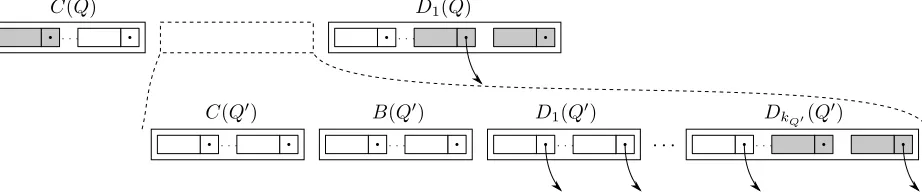
Figure 1: A I/O CPQAQconsists ofkQ+2 deques of records;C(Q), B(Q), D1(Q), . . . , DkQ(Q). The records inC(Q) andB(Q) are simple, the records ofD1(Q), . . . , DkQ(Q) may contain pointers to other I/O CPQA’s. Gray recordsare always loaded in memory.
Given a recordr= (l, p) the minimum and maximum elements in the buffers ofr, are denoted by min(r) = min(l) and max(r) = max(l), respectively. They appear respectively first and last in the queue order of l, since the buffer ofris sorted by value. Henceforth, we do not distinguish between an element and its value. Given a deque q the first and the last record is denoted by first(q) and last(q), respectively. Also rest(q) denotes all records of the deque q excluding the record first(q). Similarly, front(q) denotes all records for the dequeqexcluding the record last(q). The size|r|of a recordris defined to be the number of elements in its buffer. The size |q| of a dequeq is defined to be the number of records it contains. The size |Q| of the I/O-CPQAQis defined to be the number of elements thatQcontains. For an I/O-CPQAQwe denote by first(Q) and last(Q), the first and last of the records in C(Q), B(Q), D1(Q), . . . , DkQ(Q) that exists, respectively. By middle(Q) we denote all records in Q and the records in the I/O-CPQAs pointed by Q, except for records first(Q) and last(Q) and the I/O-CPQAs they point to. We call an I/O-CPQA Qlarge
if |Q| ≥ b and small otherwise. The minimum value of all elements stored in the I/O-CPQAQ is denote by min(Q). For an I/O-CPQA Qwe maintain the following invariants:
I.1) For every recordr= (l, p) where pointerppoints to I/O-CPQA Q0, max(l)<min(Q0) holds.
I.2) In all deques ofQ, where recordr1= (l1, p1) precedes recordr2= (l2, p2), max(l1)<min(l2) holds.
I.3) For the deques C(Q), B(Q) and D1(Q), max(last(C(Q))) < min(first(B(Q))) < min(first(D1(Q)))
holds.
I.4) Element min(first(D1(Q))) has the minimum value among all the elements in the dirty dequesD1(Q), . . . , Dk(Q).
I.5) All records in the dequesC(Q) andB(Q) are simple.
I.6) |C(Q)| ≥PkQ
i=1|Di(Q)|+kQ−1.
I.7) |first(C(Q))|< b holds, if and only if|Q|< b holds.
I.8) |last(DkQ(Q))|< b holds, if and only if record last(DkQ(Q)) is simple. In this case|r| ∈[b,5b] holds. From Invariants I.2, I.3 and I.4, we have that the minimum element min(Q) stored in the I/O-CPQAQis element min(first(C(Q))). We say that an operationimproves oraggravates by a parametercthe inequality of invariant I.6 for I/O-CPQAQ, when the operation increases or decreases ∆(Q) =|C(Q)|−PkQ
i=1|Di(Q)|−
functions for large and small I/O-CPQAs. In particular, for large I/O-CPQAs Q, the potential Φ(Q) is defined as
Φ(Q) = ΦF(|first(Q)|) +|middle(Q)|+ ΦL(|last(Q)|),
where
ΦF(x) =
3−x
b, b≤x <2b
1, 2b≤x <3b 2x
b −5, 3b≤x≤4b
and ΦL(x) =
0, 0≤x <4b 3x
b −12, 4b≤x≤5b
For small I/O-CPQAsQ, the potential Φ(Q) is defined as
Φ(Q) =3|Q|
b
The total potential ΦT is defined as
ΦT =
X
Q
Φ(Q) + X
Q|b≤|Q|
1,
where the first sum is over all I/O-CPQAsQand the second sum is only over all large I/O-CPQAsQ.
3.1
Operations
In the following, we describe the algorithms that implement the operations supported by the I/O-CPQAQ. The operations call the auxiliary operationBias(Q), which will be described last, that improves the inequality
of invariant I.6 for Q by at least 1. All operations take O(1) worst case I/Os. We also show that every operation takesO(1/b) amortized I/Os, where 1≤b≤B.
FindMin(Q) returns the value min(first(C(Q))).
DeleteMin(Q) removes elemente= min(first(C(Q))) from record (l, p) = first(C(Q)). After the removal, if|l|< b and|Q| ≥b hold, we do the following. If b≤ |first(rest(C(Q)))| ≤2b, then we merge first(C(Q)) with first(rest(C(Q))) into one record which is the new first record. Else if 2b < |first(rest(C(Q)))| ≤ 3b
then we take b elements out of first(rest(C(Q))) and put them into first(C(Q)). Else we have that 3b <
|first(rest(C(Q)))|, and as a result we take 2belements out of first(rest(C(Q))) and put them into first(C(Q)). If the inequality forQis aggravated by 1 we callBias(Q) once. Finally, elementeis returned.
Amortization: Only if the size of first(C(Q)) becomes|first(C(Q))|=b−1 do we incur any I/Os. In this caser= first(Q) has a potential of ΦF(|r|) = 2, and since we increase the number of elements inrbybto 2b
elements, the potential ofr will then only be ΦF(|r|) = 1. Thus, the total potential decreases by 1, which
also pays for any I/Os including those incurred if Bias(Q) is invoked.
CatenateAndAttrite(Q1, Q2) concatenatesQ2 to the end ofQ1 and removes the elements fromQ1with
value larger than min(Q2). To do so, it creates a new I/O-CPQA Q01 by modifying Q1 and Q2, and by
calling Bias(Q01) andBias(Q2).
If|Q1|< b, thenQ1 is only one record (l1,·), and so we prepend it into the first record (l2,·) = first(Q2)
ofQ2. Letl01be the non-attrited elements ofl1. We perform the prepend as follows. If|l01|+|l2| ≤4b, then
we prependl10 into l2. Else, we take 2b− |l01|elements out ofl2, and make them along withl01the new first
record ofQ2.
Amortization: If we simply prependl10 into l2, then the potential ΦS(|l1|) pays for the increase in potential
of ΦF(|first(C(Q2))|). Else, we take 2b− |l01|elements out ofl2, and these elements along withl01become the
new first record ofQ2of size 2b. Thus, ΦF(2b) = 1 and the potential drops by 1, which is enough to pay for
the I/Os used to flush the old first record ofC(Q2) to disk.
If|Q2|< b, thenQ2only consists of one record. We have two cases, depending on how much ofQ1is attrited
r1, then we just pick the appropriate case among (1–4) below. Else ifeattrites partiallyr1, but not all of it,
then we deleter2 and we merger1 andQ2 into the new last record ofQ1, which cannot be larger than 5b.
Otherwise if eattrites partiallyr2, but not all of it, then we simply append the single record ofQ2 intor2,
which will be the new last record ofQ1and it cannot be larger than 5b.
Amortization: Ife attrites all of r1, then we release at least 1 in potential, so all costs in any of the cases
(1–4) are paid for. If e attrites partially r1, then the new record cannot contain more than 5b elements,
and thus any increase in potential is paid for by the potential ofQ2. Thus, the I/O cost is covered by the
decrease of 1 in potential, caused byr1. Ifeattrites partiallyr2, any increase in potential is paid for by the
potential ofQ2.
We have now dealt with the case whereQ1is a small queue, so in the following we assume thatQ1is large.
Lete= min(Q2).
1) Ife≤min(first(C(Q1))), we discard I/O-CPQAQ1 and setQ01=Q2.
2) Else if e ≤ max(last(C(Q1))), we remove the simple record (l,·) = first(C(Q2)) from C(Q2), we set C(Q01) =∅,B(Q01) =C(Q1) andD1(Q01) = (l, p), where ppoints to Q2, if it exists. This aggravates the
inequality forQ2by at most 1, and gives ∆(Q01) =−1. Thus, we callBias(Q2) once andBias(Q01) once.
3) Else if e ≤ min(first(B(Q1))) or e ≤ min(first(D1(Q1))) holds, we remove the simple record (l,·) =
first(C(Q2)) fromC(Q2), setD1(Q10) = (l, p), and makeppoint toQ2, if it exists. Ife≤min(first(B(Q1))),
we set B(Q01) = ∅. This aggravates the inequality for Q2 by at most 1, and aggravates the inequality
forQ1 by at most 1. Thus, we callBias(Q2) once andBias(Q01) once.
4) Else, let (l1,·) = last(DkQ1). We remove (l2,·) = first(C(Q2)) from C(Q2). If |l1| < b, then remove
the record (l1,·) from DkQ1. Let l
0
1 be the non-attrited elements under attrition by e = min(l2). If
|l10|+|l2| ≤ 4b, then we prepend l01 into l2 of record r2 = (l2, p2), where p2 points to Q2. Otherwise.
we make a new simple recordr1 withl01 and 2b elements taken out ofr2= (l2, p2). Finally, we put the
resulting one or two records r1 and r2 into a new deque DkQ1+1(Q1). This aggravates the inequality forQ2 by at most 1, and the inequality forQ1 by at most 2. Thus, we callBias(Q2) once andBias(Q01)
twice.
Amortization: In all the cases (1–4) bothQ1andQ2are large, hence when we concatenate them we decrease
the potential by at least 1, as the number of large I/O-CPQA’s decrease by one which is enough to pay for anyBiasoperations.
InsertAndAttrite(Q,e) inserts an elementeinto I/O-CPQAQand attrites the elements inQwith value larger thane. This is a special case of operationCatenateAndAttrite(Q1,Q2), whereQ1=QandQ2is
an I/O-CPQA that only contains one record with the single elemente.
Amortization: Since creating a new I/O-CPQA with only one element and callingCatenateAndAttrite
only costsO(1/b) I/Os amortized, the operationInsertAndAttritealso costsO(1/b) I/Os amortized.
. . .
C(Q)
. . .
D1(Q)
. . .
C(Q0)
. . .
B(Q0)
. . .
D1(Q0)
. . .
[image:6.612.76.537.535.633.2]DkQ0(Q0) . . .
Figure 2: In the case of Bias(Q), whereB(Q) =∅ andkQ = 1, we need to follow the pointer pof (l, p) =
first(D1(Q)) that may point to an I/O-CPQA Q0. If so, we merge it into Q, taking into account attrition
Bias(Q) improves the inequality in I.6 forQby at least 1.
Amortization: Since all I/Os incurred byBias(Q) are already paid for by the operation that calledBias(Q), we only need to argue that the potential of Q does not increase due to the changes thatBias(Q) makes
toQ.
1) |B(Q)| >0: We remove the first record first(B(Q)) = (l1,·) fromB(Q) and let (l2, p2) = first(D1(Q)).
Letl01 be the non-attrited elements ofl1 under attrition frome= min(l2).
1) 0 ≤ |l10| < b: If |l2| ≤ 2b, then we just prepend l10 onto l2. Else, we take b elements out of l2 and
append them tol01.
2) b ≤ |l01| < 2b: If |l2| ≤ 2b, and if furthermore |l10|+|l2| ≤ 3b holds, then we merge l10 and l2.
Else|l01|+|l2|>3b holds, so we take 2b elements out ofl01 and l2 and put them into l10, leaving the
rest inl2.
Else|l2|>2b holds, so we takebelements out ofl2 and put them intol10.
If we did not prependl10 ontol2, we insertl10 along with any elements taken out ofl2at the end ofC(Q)
instead. If |l10| <|l1|, we setB(Q) = ∅. Else, we did prepend l01 onto l2, and then we just recursively
callBias. Since|B(Q)|= 0 we will not end up in this case again. As a result, in all cases the inequality
ofQis improved by 1.
Amortization: If l1 = first(Q), then after callingBias we ensure that 2b ≤ |first(Q)| ≤ 3b, and so the
that potential ofQdoes not increase.
2) |B(Q)|= 0: When|B(Q)|= 0 holds, we have two cases depending on the number of dirty queues, namely caseskQ>1 andkQ = 1.
1) kQ > 1: Let e = min(first(DkQ(Q))). If e ≤ min(last(DkQ−1(Q))) holds, we remove the record last(DkQ−1(Q)) fromDkQ−1(Q). This improves the inequality ofQby 1.
Else, if min(last(DkQ−1(Q))) < e ≤ max(last(DkQ−1(Q))) holds, we remove record r1 = (l1, p1) = last(DkQ−1(Q)) fromDkQ−1(Q) and letr2 = (l2, p2) = first(DkQ(Q)). We delete any elements in l1 that are attrited bye, and letl01denote the non-attrited elements.
1) 0≤ |l01|< b: If|l2| ≤2b, then we just prepend l01ontol2. Otherwise, we take belements out of l2
and append them tol01.
2) Ifb≤ |l0
1|<2b: If|l2| ≤2band|l10|+|l2| ≤3b, then we mergel10 andl2. Else,|l01|+|l2|>3bholds,
so we take 2b elements out ofl01 andl2 and put them intol10, leaving the rest inl2.
Else|l2|>2b, so we takeb elements out ofl2and put them intol01.
Ifr1 still exists, we insert it in the front ofDkQ(Q). Finally, we concatenateDkQ−1(Q) andDkQ(Q) into one deque. This improves the inequality ofQby at least 1.
Else max(last(DkQ−1(Q))) < e holds, and we just concatenate the deques DkQ−1(Q) and DkQ(Q), which improves the inequality forQby 1.
Amortization: If not all ofl1is attrited then we ensure that its recordr1 has size between 2band 3b.
Thus, ifr1= first(Q) holds, we will not have increased the potential of Q. In the cases where all or
none ofl1is attrited, the potential ofQcan only be decreased by at least 0.
2) kQ = 1: In this case Qcontains only deques C(Q) and D1(Q). We remove the record r = (l, p) =
first(D1(Q)) and insert l into a new record at the end of C(Q). This improves the inequality ofQ
by at least 1. If r is not simple, let r’s pointer ppoint to I/O-CPQA Q0. We restore I.5 forQ by merging I/O-CPQAsQandQ0 into one I/O-CPQA. See Figure 2 for this case of operation
Bias. In
particular, lete= min(first(D1(Q))), we now proceed as follows:
Ife≤min(Q0), we discardQ0. The inequality forQremains unaffected.
Else if max(last(C(Q0))< e≤min(first(D1(Q0))), we concatenate the dequeC(Q0) at the end ofC(Q).
If moreover min(first(B(Q0))) < e holds, we setB(Q) = B(Q0). Finally, we discard the rest of Q0. This improves the inequality forQby|C(Q0)|.
Else min(first(D1(Q0)))< eholds. We concatenate the dequeC(Q0) at the end ofC(Q), we setB(Q) = B(Q0), we set D1(Q0), . . . , DkQ0(Q
0) as the firstk
Q0 dirty queues of Qand we setD1(Q) as the last
dirty queue ofQ. This improves the inequality forQby ∆(Q0)≥0, sinceQ0 satisfied I.6 before the operation.
Ifr= first(Q) and |l| ≤2b, then we remove r and run Biasrecursively. Letr0 = (l0, p0) = first(Q).
If|l|+|l0|>3b, then we take the 2b first elements out and make them the new first record ofC(Q). Else we mergel intol0, so thatris removed andr0 is now first(Q).
Amortization: Since first(Q) is either untouched or left with 2b to 3b elements, in which case its potential is 1, and since all other changes decrease the potential by at least 0, we have thatBiasdoes
not increase the potential ofQ.
Theorem 3.1. A set of`I/O-CPQA’s can be maintained supporting the operationsFindMin,DeleteMin,
CatenateAndAttriteand InsertAndAttriteinO(1/b)I/Os amortized andO(1)worst case I/Os per operation. The space usage is O(n−m
b ) blocks after calling CatenateAndAttrite and
InsertAndAt-tritentimes and DeleteMin m times, respectively. We require thatM ≥`bfor1≤b≤B, where M is
the main memory size andB is the block size.
Proof. The correctness follows by closely noticing that we maintain invariants I.1–I.8, and from those we have thatDeleteMin(Q) andFindMin(Q) always returns the minimum element ofQ.
The worst case I/O bound ofO(1) is trivial as every operation only touchesO(1) records. AlthoughBias
is recursive, we notice that in the case where|B(Q)|>0,Biasonly calls itself after making|B(Q)|= 0, so
it will not end up in this case again. Similarly, if |B(Q)|= 0 and kQ >1 there might also be a recursive
call toBias. However, before the call at leastb elements have been taken out ofQ, and thus the following
recursive call toBiaswill ensure at leastbmore are taken out. This is enough to stop the recursion, which
will have depth at most 3.
TheO(1/b) amortized I/O bounds, follows from the potential analysis made throughout the description of each operation.
3.2
Concatenating a Sequence of I/O-CPQAs
We describe how toCatenateAndAttrite I/O-CPQAsQ1, Q2, . . . , Q` into a single I/O-CPQA in O(1)
worst case I/Os, given that DeleteMin is not called in the sequence of operations. We moreover
im-pose two more assumptions. In particular, we say that I/O-CPQA Q is in state x ∈ Z, if |C(Q)| = PkQ
i=1|Di(Q)|+kQ−1 +xholds. Positiveximplies that Bias(Q) will be called after the inequality forQ
is aggravated byx+ 1. Negativeximplies that Bias(Q) need to be called x operations times in order to
restore inequality for Q. So, we moreover assume that I/O-CPQAs Qi, i∈ [1, `] are at state at least +2,
unless Qi contains only one record in which case it may be in state +1. We call a recordr = (l, p) in an
I/O-CPQAQicritical, ifris accessed at some time during the sequence of operations. In particular, the
criti-cal records forQiare first(C(Qi)),first(rest(C(Qi))),last(C(Qi)),first(B(Qi)),first(D1(Qi)),last(DkQi(Qi)),
and last(front(DkQi(Qi))) if it exists. Otherwise, record last(DkQi−1(Qi)) is critical. So, we moreover assume
that the critical records for I/O-CPQAsQi, i∈[1, `] are loaded into memory.
The algorithm considers I/O-CPQAs Qi in decreasing index i(from right to left). It setsQi =Q` and
constructs the temporary I/O-CPQA Qi−1 by calling
CatenateAndAttrite(Qi−1,Qi). This yields the
final I/O-CPQAQ1.
Lemma 3.1. I/O-CPQAs Qi, i∈[1, `] can be CatenateAndAttrited into a single I/O-CPQA without any access to external memory, provided that:
2. all critical records of allQi reside in main memory.
Proof. To avoid any I/Os during the sequence of CatenateAndAttrites, we ensure that Bias is not
called, and that the critical records are sufficient, and thus no more records need to be loaded into memory. To avoid calling Bias we prove by induction the invariant that the temporary I/O-CPQAsQi, i∈[1, `] constructed during the sequence are in state at least +1. Let the invariant hold of Qi+1 and let Qi be constructed by CatenateAndAttrite(Qi,Qi+1). If Qi contains at most two records, which both reside
in dequeue C(Qi), we only need to access record first(C(Qi+1)) and the at most two records ofQi. The
invariant holds forQi, since it holds inductively forQi+1 and the new records were added atC(Qi+1). As a
result, the inequality of I.6 forQi+1 can only be improved. If Qi+1 consists of only one record, then either
one of the following cases apply or we follow the steps described in operation CatenateAndAttrite. In
the second case, there is no aggravation for the inequality of 6 and only critical records are used.
In the following, we can safely assume that Qi has at least three records and its state is at least +2. We
parse the cases of theCatenateAndAttrite algorithm assumming thate= min(Qi+1).
Case 1 The invariant holds trivially sinceQi is discarded and no change happens toQi =Qi+1. Biasis not
called.
Cases 2,3 The algorithm checks whether the first two records ofC(Qi) are attrited by e. If this is the case, we
continue as denoted at the start of this proof. Otherwise, case 2 of CatenateAndAttriteis applied
as is. Qi+1 is in state 0 after the concatenation andQi is in state +1. Thus the invariant holds, and
Biasis not. Note that all changes take place at the critical records ofQi andQi+1.
Case 4 The algorithm works exactly as in case 4 ofCatenateAndAttrite, with the following exception. At
the end,Qiwill be in state 0, since we added the dequeDkQi+1+1with a new record and the inequality
of I.6 is aggrevated by 2. To restore the invariant we apply case 2(1) of Bias. This step requires access
to records last(DkQi−1) and first(DkQi). These records are both critical, since the former corresponds
to last(DkQi+1) and the latter to firstC(Q
i+1). In addition,
Bias(Qi+1) need not be called, since by
the invariant, Qi+1 was in state +1 before the removal of firstC(Qi+1). In this way, we improve the
inequality for Qi by 1 and invariant holds.
4
Dynamic Planar Range Skyline Reporting
In this Section we present dynamic I/O-efficient data structures that support 3-sided planar orthogonal range skyline reporting queries.
3-Sided Skyline Reporting We describe how to utilize I/O-CPQAs in order to obtain dynamic data structures that support 3-sided range skyline reporting queries and arbitrary insertions and deletions of points, by modifying the approach of [14] for the pointer machine model. In particular, letP be a set ofn
points in the plane, sorted byx-coordinate. To access the points, we store theirx-coordinates in an (a,2a )-tree T with branching parameter a ≥ 2 and leaf parameter k ≥ 1. In particular, every node has degree within [a,2a] and every leaf contains at mostk consecutive by x-coordinate input points. Every internal nodeuofT is associated with an I/O-CPQA whose non-attrited elements correspond to the maximal points among the points stored in the subtree ofu. Moreover, ucontains arepresentative block with the critical records of condition 2 in Lemma 3.1 for the I/O-CPQAs associated with its children nodes.
To construct the structure, we proceed in a bottom up manner. First, we compute the maximal points among the points contained in every leaf ofT. In particular for every leaf, we initialize an I/O-CPQA Q. We consider the points (px, py) stored in the block in increasing x-coordinate, and call InsertAndAt-trite(Q,−py). In this way, a point pin the block that is dominated by another point q in the block, is
inserted beforeq inQ and has value−py >−qy. Therefore, the dominated points in the block correspond
We construct the I/O-CPQA for an internal node u of T by concatenating the already constructed I/O-CPQAs Qi at its children nodesui ofu, for i∈[1, a] in Section 3. Then we callBias to the resulting
I/O-CPQA appropriately many times in order to satisfy condition 1 in Lemma 3.1. The procedure ends when the I/O-CPQA is constructed for the root of T. Notice that the order of concatenations follows implicitly the structure of the treeT. To insert (resp. delete) a pointp= (px, py) to the structure, we first insert (resp.
delete) px to T. This identifies the leaf with the I/O-CPQA that containsp. We discard all I/O-CPQAs
from the leaf to the root ofT, and recompute them in a bottom up manner, as described above.
To report the skyline among the points that lie within a given 3-sided query rectangle [x`, xr]×[yb,+∞),
it is necessary to obtain the maximal points in a subtree of a nodeuofT by querying the I/O-CPQA stored inu. Notice, however, that computing the I/O-CPQA of an internal node ofT modifies the I/O-CPQAs of its children nodes. Therefore, we can only report the skyline of all points stored inT, by callingDeleteMin
at the I/O-CPQA stored in the root ofT. The rest of the I/O-CPQAs inT are not queriable in this way, since the corresponding nodes do not contain the version of their I/O-CPQA, before it is modified by the construction of the I/O-CPQA for their parent nodes. For this reason we render the involved I/O-CPQAs confluently persistent, by implementing their clean, buffer and dirty deques as purely functional catenable deques [11]. In fact,T encodes implicity the directed acyclic version graph of the confluently persistent I/O-CPQAs, by associating every node ofT with the version of the I/O-CPQA at the time of its construction. Every internal node of T stores a representative block with the critical records for the versions of the I/O-CPQAs associated with its children nodes. Finally, the update operation discards the I/O-CPQA of a node in T, by performing in reverse the operations on the purely functional catenable deques involved in the construction of the I/O-CPQA (undo operation).
With the above modification it suffices for the query operation to identify the two paths p`, pr from the
root to the leaves ofT that contain thex-successor point ofx`and thex-predecessor point ofxr, respectively.
LetRbe the children nodes of the nodes on the pathsp`andprthat do not belong to the paths themselves,
and also lie within the query x-range. The subtrees of R divide the queryx-range into disjoint x-ranges. We consider the nodes ofR from left to right. In particular, for every non-leaf node inp`∪pr, we load into
memory the representative blocks of the versions of the I/O-CPQAs in its children nodes that belong to
R. We call CatenateAndAttriteon the loaded I/O-CPQAs and on the resulting I/O-CPQAs for every
node in p`∪pr, as decribed in Section 3. The non-attrited elements in the resulting auxiliary I/O-CPQA
correspond to the skyline of the points in the queryx-range, that are not stored in the leaves ofp`andpr. To
report the output points of the query in increasingx-coordinate, we first report the maximal points within the query range among the points stored in the leaf ofp`. Then we callDeleteMinto the auxiliary
I/O-CPQA that returns the maximal points in increasingx-coordinate, and thus also in decreasingy-coordinate, and thus we terminate the reporting as soon as a skyline point withy-coordinate smaller thanybis returned.
If the reporting has not terminated, we also report the rest of the maximal points within the query range that are contained in the leaf ofpr.
Theorem 4.1. There exist I/O-efficient dynamic data structures that store a set of n planar points and support reporting the t skyline points within a given 3-sided orthogonal range unbounded by the positive y-dimension in O(log2Bn+t/B1−) worst case I/Os, and updates in O(log2Bn) worst case I/Os,
us-ingO(n/B1−)disk blocks, for a parameter0≤≤1.
Proof. We set the buffer size parameterb of the I/O-CPQAs equal to the leaf parameterkofT, and we set the parametersa= 2B andk=B1−for 0≤≤1. In this way, for a node ofT, the representative blocks for all of its children nodes can be loaded into memory inO(1) I/Os. Since every operation supported by an I/O-CPQA involves aO(1) number of deque operations, I/O-CPQAs can be made confluently persistent without deteriorating their I/O and space complexity. Moreover, the undo operation takesO(1) worst case I/Os, since the purely functional catenable deques are worst case efficient.
Therefore by Theorem 3.1, an update operation takes O(log2BB1n−) = O(log2Bn) worst case I/Os. Lemma 3.1 takes O(1) I/Os to construct the temporary I/O-CPQAs for every node in the search paths, since they satisfy both of its conditions. Moreover, by Theorem 3.1, it takes O(log2Bn
in total. Moreover, it takesO(1 +t/B1−) worst case I/Os to report the output points. There areO( n B1−) internal nodes inT, and every internal node containsO(1) blocks.
4-Sided Skyline Reporting Dynamic I/O-efficient data structures for 4-sided range skyline reporting queries can be obtained by following the approach of Overmars and Wood for dynamic rectangular visibility queries [15]. In particular, 4-sided range skyline reporting queries are supported inO(logaaloglog 22nB+t/B
1−)
worst case I/Os, usingO( n
B1−logan) blocks, by employing our structure for 3-sided range skyline reporting
as a secondary structure on a dynamic range tree with branching parametera, built over they-dimension. Updates are supported in O(loglogalog 22nB) worst case I/Os, since the secondary structures can be split or merged inO(log2Bn) worst case I/Os.
Remark 4.1. In the pointer machine, the above constructions attains the same complexities as the existing structures for dynamic 3-sided and 4-sided range maxima reporting [4], by setting the buffer size, branching and leaf parameter to O(1).
5
Lower Bound for Dominating Minima Reporting
Let S be a set of n points in R2. Let Q ={Qi} be a set ofm orthogonal 2-sided query ranges Qi ∈R2.
RangeQi is the subspace ofR2 that dominates a given pointqi∈R2in the positivex- andy- direction (the
“upper-right” quadrant defined byqi). LetSi=S∩Qibe the set of all points inSthat lie in the rangeQi.
Adominating minima reporting query Qi contains the points min(Si)∈Si that do not dominate any other
point inSi. In this section we prove that any pointer-based data structure that supports dominating minima
queries in O(logO(1)n+t) time, must use superlinear space. This separates the problem from the easier problem of supporting dominating maxima queries and the more general 3-sided range skyline reporting queries. The same trade-off also holds for the symmetricdominated maxima reporting queries that are the simplest special case of 4-sided range skyline reporting queries that demands superlinear space. Moreover, the lower bound holds trivially for the I/O model, if no address arithmetic is being used. In particular, for a query time ofO(logO(1)n
B +
t
B) the data structure must definitely use Ω( n B
logn
log logn) blocks of space. In the
following, we prove the lower bound for the dominating minima reporting queries.
Henceforth, we use the terminology presented in Section 2. Without loss of generality, we assume that
n=ωλ, since this restriction generates a countably infinite number of inputs and thus the lower bound is
general. In our case,ω= logγnholds for someγ0,m= 2 andλ=j1+γloglog logn nk. Let ρω(i) be the integer
obtained by writing 0 ≤i < n usingλ digits in baseω, by first reversing the digits and then taking their complement with respect toω. In particular, ifi=i(0ω)i1(ω). . . i(λω−)1 holds, then
ρω(i) = (ω−i (ω)
λ−1−1)(ω−i (ω)
λ−2−1). . .(ω−i (ω)
1 −1)(ω−i (ω) 0 −1)
wherei(jω)is thej-th digit of numberiin baseω. We define the points ofSto be the set{(i, ρω(i))|0≤i < n}.
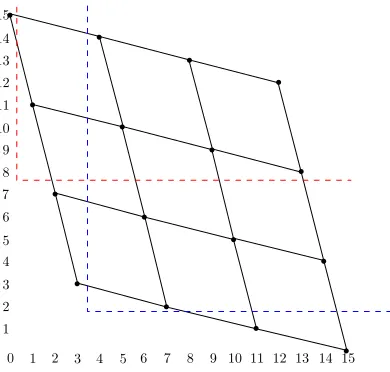
Figure 3 shows an example withω= 4,λ= 2.
To define the query setQ, we encode the set of points{ρω(i)|0≤i < n}in a full trie structure of depthλ.
Recall thatn=ωλ. Notice that the trie structure is implicit and it is used only for presentation purposes.
Input points correspond to the leaves of the trie and their y value is their label at the edges of the trie. Letv be an internal node at depthd(namely,v hasdancestors), whose prefix v0, v1, . . . , vd−1 corresponds
to the path from v to the rootr of the trie. We take all points in its subtree and sort them by y. From this sorted list we construct groups of size ω by always picking each ωλ−d−1-th element starting from the
smallest non-picked element. Each such group corresponds to the output of each query. See Figure 3 for an example. In this case, we say that the query isassociated to nodev.
A node of with depthdhas n
ωd points in its subtree and thus it defines at most
n
1
0 2 3 4 5 6 7 8 9 10 11 12 13 14 15 2
[image:12.612.209.404.70.256.2]1 3 4 5 6 7 8 9 10 11 12 13 14 15
Figure 3: An example forω= 4 andλ= 2. Two examples of queries are shown, out of the 8 possible queries with different output. Connecting lines represent points whose L1 distance isωk,1≤k≤λ. All 8 possible
queries can be generated by translating the blue lines horizontally so that the answers of all 4 queries are disjoint. Similarly for the red lines with the exception that we translate them vertically.
total number of queries is:
|Q|=
λ−1
X
d=0 ωd n
ωd+1 = λ−1
X
d=0 n
ω =
λn ω
This means that the total number of queries is
|Q|=λn
ω =
logn
1 +γlog logn
1 logγnn=
n
logγ−1n(1 +γlog logn)
The following lemma states thatQis appropriate for our purposes.
Lemma 5.1. Q is(2,logγn)-favorable.
Proof. First we prove that we can construct the queries so that they have output sizeω = logγn. Assume that we take a group ofω consecutive points in the sorted order of points with respect to the y-coordinate at the subtree of node v at depth d. These have common prefix of length d. Let the y-coordinates of these points beρω(i1), ρω(i2), . . . , ρω(iω) in increasing order, where ρω(ij)−ρω(ij−1) =ωλ−d−1,1< j≤ω.
This means that these numbers differ only at the λ−d−1-th digit. This is because they have a common prefix of length d since all points lie in the subtree ofv. At the same time they have a common suffix of length λ−d−1 because of the property that ρω(ij)−ρω(ij−1) = ωλ−d−1,1 < j ≤ ω which comes as a
result from the way we chose these points. By inversing the procedure to construct these y-coordinates, the corresponding x-coordinates ij,1 ≤j ≤ ω are determined. By complementing we take the increasing
sequence ¯ρω(iω), . . . ,ρ¯ω(i2),ρ¯ω(i1), where ¯ρω(ij) =ωλ−ρω(ij)−1 and ¯ρω(ij−1)−ρ¯ω(ij) =ωλ−d−1,1< j≤ω.
By reversing the digits we finally get the increasing sequence ofx-coordinatesiω, . . . , i2, i1, since the numbers
differ at only one digit. Thus, the group of ω points are decreasing as the x-coordinates increase, and as a result a query qwhose horizontal line is just below ρω(i1) and the vertical line just to the left of ρω(iω)
will certainly contain this set of points in the query. In addition, there cannot be any other points between this sequence and the horizontal or vertical lines defining queryq. This is because all points in the subtree ofv have been sorted with respect toy, while the horizontal line is positioned just belowρω(i1), so that no
other element lies in between. In the same manner, no points to the left ofρω(iω) exist, when positioning
It is enough to prove that for any two query rangesp, q∈ Q,|S∩q∩p| ≤1 holds. Assume thatpandq
are associated to nodesv andu, respectively, and that their subtrees are disjoint. That is,uis not a proper ancestor or descendant ofv. In this case,pandqshare no common point, since each point is used only once in the trie. For the other case, assume without loss of generality thatu is a proper ancestor ofv (u6=v). By the discussion in the previous paragraph, each query containsω numbers that differ at one and only one digit. Sinceuis a proper ancestor ofv, the corresponding digits will be different for the queries defined inu
and for the queries defined inv. This implies that there can be at most one common point between these sequences, since the digit that changes for one query range is always set to a particular value for the other query range. The lemma follows.
Lemma 5.1 allows us to apply Lemma 2.1, and thus the query time of O(logγn+t), for output sizet, can only be achieved at a space cost of Ωnlog loglognn. The following theorem summarizes the result of this section.
Theorem 5.1. The dominating minima reporting problem can be solved withΩnlog loglognnspace, if the query is supported inO(logγn+t)time, where t is the size of the answer to the query and parameter γ=O(1).
6
Conclusion
We presented the first dynamic I/O-efficient data structures for 3-sided planar orthogonal range skyline reporting queries with worst case polylogarithmic update and query complexity. We also showed that the space usage of the existing structures for 4-sided range skyline reporting in pointer machine is optimal within doubly logarithmic factors.
It remains open to devise a dynamic I/O-efficient data structure that supports reporting all m planar skyline points in O(m/B) worst case I/Os and updatess in O(logBn) worst case I/Os. It seems that the
hardness for reporting the skyline in optimal time is derived from the fact that the problem is dynamic. The dynamic indexability model of Yi [21] may be useful to prove a lower bound towards the direction of rendering our structure for 3-sided range skyline reporting I/O-optimal, as defined by Papadias et al.[16]. Finally it remains open to obtain aO(n
BlogBn) space dynamic I/O-efficient data structures for 4-sided range
skyline reporting with O(log2Bn) worst case query and update I/Os, regardless of the I/O-complexity per
References
[1] Alok Aggarwal and S. Vitter, Jeffrey. The input/output complexity of sorting and related problems.
Commun. ACM, 31(9):1116–1127, 1988.
[2] Jon Louis Bentley. Multidimensional divide-and-conquer. Commun. ACM, 23(4):214–229, April 1980.
[3] Stephan B¨orzs¨onyi, Donald Kossmann, and Konrad Stocker. The skyline operator. In ICDE, pages 421–430, 2001.
[4] Gerth Brodal and Konstantinos Tsakalidis. Dynamic planar range maxima queries. In Luca Aceto, Monika Henzinger, and Jir Sgall, editors, Automata, Languages and Programming, volume 6755 of
Lecture Notes in Computer Science, pages 256–267. Springer Berlin / Heidelberg, 2011. 10.1007/978-3-642-22006-7 22.
[5] Bernard Chazelle. Lower bounds for orthogonal range searching: I. the reporting case. J. ACM, 37(2):200–212, April 1990.
[6] Bernard Chazelle and Ding Liu. Lower bounds for intersection searching and fractional cascading in higher dimension. Journal of Computer and System Sciences, 68(2):269 – 284, 2004. ¡ce:title¿Special Issue on STOC 2001¡/ce:title¿.
[7] Ananda Das, Prosenjit Gupta, Anil Kalavagattu, Jatin Agarwal, Kannan Srinathan, and Kishore Kotha-palli. Range aggregate maximal points in the plane. In Md. Rahman and Shin-ichi Nakano, editors,
WALCOM: Algorithms and Computation, volume 7157 of Lecture Notes in Computer Science, pages
52–63. Springer Berlin / Heidelberg, 2012. 10.1007/978-3-642-28076-4 8.
[8] Yu-Ling Hsueh, Roger Zimmermann, and Wei-Shinn Ku. Efficient updates for continuous skyline com-putations. InDEXA, pages 419–433, 2008.
[9] Zhiyong Huang, Hua Lu, Beng Chin Ooi, and Anthony K. H. Tung. Continuous skyline queries for moving objects. IEEE Trans. Knowl. Data Eng., 18(12):1645–1658, 2006.
[10] Anil Kishore Kalavagattu, Ananda Swarup Das, Kishore Kothapalli, and Kannan Srinathan. On finding skyline points for range queries in plane. InCCCG, 2011.
[11] Haim Kaplan and Robert E. Tarjan. Purely functional, real-time deques with catenation. J. ACM, 46(5):577–603, September 1999.
[12] H. T. Kung, Fabrizio Luccio, and Franco P. Preparata. On finding the maxima of a set of vectors. J. ACM, 22(4):469–476, 1975.
[13] Michael D. Morse, Jignesh M. Patel, and William I. Grosky. Efficient continuous skyline computation.
Inf. Sci., 177(17):3411–3437, 2007.
[14] Mark H. Overmars and Jan van Leeuwen. Maintenance of configurations in the plane. Journal of Computer and System Sciences, 23(2):166 – 204, 1981.
[15] Mark H. Overmars and Derick Wood. On rectangular visibility.J. Algorithms, 9(3):372–390, September 1988.
[16] Dimitris Papadias, Yufei Tao, Greg Fu, and Bernhard Seeger. Progressive skyline computation in database systems. ACM Trans. Database Syst., 30(1):41–82, 2005.
[17] Cheng Sheng and Yufei Tao. On finding skylines in external memory. InProceedings of the thirtieth ACM
SIGMOD-SIGACT-SIGART symposium on Principles of database systems, PODS ’11, pages 107–116,
[18] Rajamani Sundar. Worst-case data structures for the priority queue with attrition. Inf. Process. Lett., 31:69–75, April 1989.
[19] Yufei Tao and Dimitris Papadias. Maintaining sliding window skylines on data streams. IEEE Trans. on Knowl. and Data Eng., 18(3):377–391, 2006.
[20] Ping Wu, Divyakant Agrawal, ¨Omer Egecioglu, and Amr El Abbadi. Deltasky: Optimal maintenance of skyline deletions without exclusive dominance region generation. InICDE, pages 486–495, 2007.
[21] Ke Yi. Dynamic indexability and lower bounds for dynamic one-dimensional range query indexes. In Pro-ceedings of the twenty-eighth ACM SIGMOD-SIGACT-SIGART symposium on Principles of database