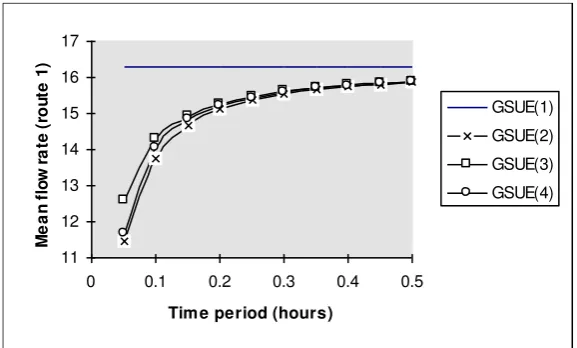
This is a repository copy of A second order stochastic network equilibrium model. I: theoretical foundation..
White Rose Research Online URL for this paper: http://eprints.whiterose.ac.uk/84666/
Version: Accepted Version Article:
Watling, DP (2002) A second order stochastic network equilibrium model. I: theoretical foundation. Transportation Science, 36 (2). 149 - 166. ISSN 0041-1655
https://doi.org/10.1287/trsc.36.2.149.560
[email protected] Reuse
Unless indicated otherwise, fulltext items are protected by copyright with all rights reserved. The copyright exception in section 29 of the Copyright, Designs and Patents Act 1988 allows the making of a single copy solely for the purpose of non-commercial research or private study within the limits of fair dealing. The publisher or other rights-holder may allow further reproduction and re-use of this version - refer to the White Rose Research Online record for this item. Where records identify the publisher as the copyright holder, users can verify any specific terms of use on the publisher’s website.
Takedown
If you consider content in White Rose Research Online to be in breach of UK law, please notify us by
A SECOND ORDER STOCHASTIC NETWORK EQUILIBRIUM MODEL
I: THEORETICAL FOUNDATION
David Watling
Institute for Transport Studies, University of Leeds, Woodhouse Lane, Leeds LS2 9JT, U.K.
Abstract – Existing models of stochastic network equilibrium route choice in transport networks are able to represent exogenously-specified variations in drivers’ actual or perceived travel costs, but assume
throughout that flows are deterministic. In this paper, a new notion of equilibrium is presented based on
stochastic flow variables, in which the impact of variable flows on the variability in travel costs is
endogenously handled. Firstly, a very general notion of equilibrium is deduced as a fixed point condition
on the joint probability distribution of network flows. Then, an approximation to this condition is derived,
which operates by equilibrating moments of order n and below of the joint flow probability distribution,
and is termed a Generalised Stochastic User Equilibrium of order n, being denoted GSUE(n). The
GSUE(1) model is seen to be a conventional Stochastic User Equilibrium. The paper goes on to focus on
the second order model, GSUE(2). Conditions are presented to guarantee the existence of GSUE(2)
solutions. Conditions are deduced to guarantee (a) uniqueness of solutions in networks with a single
inter-zonal movement, and (b) proximity of solutions in networks with multiple inter-inter-zonal movements. Finally,
a simple example is presented.
INTRODUCTION
The conventional stochastic network equilibrium problem is concerned with predicting link flows and
travel times/costs over a network, corresponding to a fixed point solution to a problem in which:
(a) actual link travel times/costs are dependent on the link flows, and
(b) drivers' route choices are made according to a random utility model, their perceptual differences in
evaluating cost (=utility) represented by a known probability distribution.
Daganzo & Sheffi (1977) appear to be the first to have formally proposed the term Stochastic User Equilibrium (SUE) to describe such a fixed point solution, the word ‘user’ intended to emphasise the non -cooperative behaviour of individuals in their route selection. The properties of this model have been
An important point to note about the SUE approach is that the flow variableswhether link or route
flowsare assumed to be deterministic quantities. Provided this assumption is considered reasonable, then
this paper makes no dispute about the appropriateness of the SUE model. In reality, however, it is
well-known that the flows on roads may vary considerably from day-to-day, and so it is not difficult to make a
case that flows are more appropriately represented as stochastic variables. In such a setting, it is reasonable
to ask whether the SUE model still characterises some useful feature of long-term behaviour.
An apparently reasonable, intuitive argument in support of the SUE model runs thus. The choice
probabilities corresponding to the random utility component of an SUE model (component (b) above)
describe the aggregate proportions of drivers on each inter-zonal movement that will use the alternative
routes available at given mean cost levels. Let us suppose that this description of deterministic,
aggregate-level behaviour may be extended to characterise a particular form of stochastic, disaggregate-aggregate-level
behaviour, where individuals independently and at random choose between the alternative routes with
common probabilities equal to the choice proportions of the random utility model. Intuition suggests that
as, in the disaggregate model, individuals are choosing at random with common probabilities, then the
aggregate stochastic behaviour of route flows on each inter-zonal movement will be characterised by a
multinomial probability distribution. Therefore, following this reasoning, the link with the aggregate
deterministic behaviour of the SUE model is that this latter is simply representing the mean aggregate
flows from such a multinomial distribution.
In the special case in which actual travel times/costs are independent of flow and deterministic (the
so-called Stochastic Network Loading Problem), the reasoning above is well-founded (Daganzo, 1977). In this
case, the coincidence with multinomial mean flows is exact, and such mean route flowsonce
derivedmay be used to compute higher order moments such as variances and covariances, through
standard properties of the multinomial distribution.
However, with a weakening of these assumptions to permit actual costs that are flow-dependent, the
justification for assuming SUE to represent mean flows is no longer clear. Indeed, there are strong
theoretical arguments to suggest that it will be a systematically biased estimator of mean conditions, and
that this bias will produce different effects on different parts of the network. In brief, there are two reasons
Firstly, if flows are stochastic then actual costs will also be stochastic (through the link performance
functions), regardless of any additional perceptual differences between drivers. Since it is reasonable to
assume drivers form their own estimates of actual cost from experience, then these estimates will also be
stochastic, and so therefore will the choice probabilities. Thus, although there is a case for aggregate choice
behaviour conditional upon experienced costs to be multinomially distributed, the unconditional
probability distribution of choices/flows (which must surely underlie any notion of equilibrium in this
setting) will not in general be multinomial, since the choice probabilities are not fixed.
Secondly, even if drivers’ experience of the network is sufficiently long that the mean of their experiences approximates the long run expected costs, thenfor networks with non-linear link cost-flow performance
functionsthe SUE flows and costs will not represent the appropriate long-run expectations under the
model assumed (as noted previously by Cascetta, 1989). Since, even if SUE link flows were the
appropriate mean flows, then the SUE costs (which are obtained by substituting these flows in the
cost-flow relationships) would represent the costs at mean cost-flows, which for non-linear cost-cost-flow functions are
different from the mean costs. Conversely, if the appropriate mean costs were used in the SUE choice
model, the flows arising would not be the appropriate mean flows. The cost bias will not, in general,
balance out when taking route cost differences (as one does in a random utility model), since the magnitude
of the bias in estimating the mean costs by SUE costs is dependent on the form of the cost-flow
relationships, which varies across the network.
Therefore, the objective of this paper is to formulate a generalised version of SUE, in which stochastic
variation in both flow and actual cost variables is represented, with the stochasticity endogenous to the
equilibration process. Although previous authors have incorporated the effect of stochastic actual costs
(Mirchandani and Soroush, 1987), or of stochastic capacities that affect the actual costs (Arnott et al, 1991;
Van Berkum & Van der Mede, 1993; and Emmerink et al, 1995), these random elements were all assumed
to be exogenously specified, and no relationship was made between the variability in actual costs and the
variability in flows (the latter being assumed deterministic). Bell (1991), in an unpublished note, studied
the use of independent Poisson distributions to represent the variability in link/route flows in a network
with two parallel routes, and used a second order approximation to approximate the effect of this variability
on mean costs. He did not, however, operationalise this approach for general networks; in particular, it does
not seem possible with this approach to address the issue of covariances in flows between links that
logically arises because of links that are part of the same route (positive correlation) or part of alternative
consistent account of flow and cost variability for general networks, but at the expense of deviating from
fixed point notions of static network equilibrium. They formulated their model as a discrete time stochastic process, with the corresponding “equilibrium” behaviour now a rather more complex condition on the dynamics of sequences of stochastic choices. Such an approach must therefore be regarded as an alternative
to, rather than an extension of, SUE; in general, little is known of the relationship between stochastic
process and SUE approaches.
The paper is structured as follows. Following basic notation and definitions (section 1), in section 2
equilibrium conditions (i.e. fixed point conditions for the joint probability distribution of network flows)
are deduced for a generalised version of SUE in which flows are stochastic. A generalised concept of
stochastic equilibrium, denoted GSUE(n), is subsequently introduced in section 3, based on an
approximation to these conditions in which the order n and lower moments of the joint flow probability
distribution are equilibrated. The remainder of the paper is devoted to studying a particular member of this
family, GSUE(2), detailed attention being paid to the existence (section 4) and uniqueness (section 5) of
GSUE(2) solutions. Finally, a simple illustrative example is given, and paths for further research identified.
1. NOTATION
A network is considered as a directed graph consisting of A links indexed a=1,2,...,A, and W inter- zonal
(origin-destination) movements indexed k=1,2,…,W. The N possible routes that pass through a link at most
once, across all such inter-zonal movements, are indexed by the set {1,2,...,N}, in such a way that the
subset of Nk routes relating to inter-zonal movement k are indexed by the set
Rk r Nj r Nk
j k
: 1 2
1 1
, ,..., .
The demand rates for each of the W inter-zonal movements are held in the column vector q of dimension
W, with elements qk (k=1,2,...,W). Without loss of generality, we assume throughout that all qk 0 , since
any inter-zonal movement with zero demand could be removed from the problem without effect. The units
of qk will be referred to as vehicles per hour, although more generally they could be equivalent passenger
car units per hour. For notational purposes, it will on occasion be convenient to express these demand rates
in an alternative form. This is obtained by defining to be an NWpath-movement incidence matrix
with elements
1 if router Rk, themovement krouteset rk
Then diag(q is an N) Ndiagonal matrix such that each row relates to a route, and the diagonal entry
for that row is the inter-zonal demand appropriate to that route.
The column vector f of dimension N denotes an assignment of flow to each of the possible routes, with the
convex set of demand-feasible non-negative route flow rates denoted by 1
fN :Tf q
, whereN
denotes N-dimensional non-negative real space, and T
A denotes the transpose of the matrix A. The
convex set of demand feasible link flow rates is 2
vA : v wheref f 1
, where is anA N link-path incidence matrix with elements:
ar a r
1 0
if link is part of route
otherwise (a=1,2,...,A; r=1,2,...,N).
The cost of travelling along link a at a given link flow vector v is denoted by ta(v). These functions may
also themselves be arranged in a column vector, t(v). These link performance functions imply
corresponding route cost-flow performance functions, c(f)Tt(f).
Suppose further that for each movement k,
pr( )u : r Rk
is a route choice model describing thefraction of drivers on inter-zonal movement k that would choose each of the alternative routes in R when k
the perceived route costs (averaged across the driver population) are u. Let p(u) denote the vector of these
functions across all movements, arranged in a column vector of dimension N. We may then state the
following well-known definition (Sheffi, 1985):
Definition The route flow vector f 1 is a stochastic user equilibrium (SUE) if and only if
f diag(q p c f). ( ( )) (1.1)
Alternatively, the link flow vector v2 is termed a SUE if and only if
)) ( ( ). diag
. q p Tt v
v ( . (1.2)
Typically, for each movement k, it is assumed that
pr( )u : r Rk
is a random utility model. This isachieved by modelling drivers' perceptual differences in evaluating travel cost by a probability distribution
of perceived route costs U rr( Rk), with
Ur ur er (r Rk; k1 2, ,...,W)
where E[Ur]=ur, and where e
er : r Rk; k 1 2, ,...,W
follows some given joint probabilitypr( )u Pr(ur er uses , s Rk , sr) (r Rk; k1 2, ,...,W). (1.3)
For example, underlying the logit model is the assumption that the er are independent Gumbel random
variables. More plausibly, it is often assumed that the route cost perceptual errors are formed from link cost
perceptual errors (thereby implicitly taking account of correlations between overlapping routes). For
example, if the link errors are independent Normal random variables, then e will follow a multivariate
Normal distribution, as underlies the probit choice model (Sheffi, 1985).
It will later prove useful to also define corresponding absolute flow variables, rather than flow rates, with
the inter-zonal demands denoted by the vector ~q , with elements in the discrete (integer) units of “vehicles” or “drivers”. These demands relate to a particular period of the day, of duration hours. That is
to say, q1q~ . The demand-feasible absolute route and link flows are denoted respectively
1
~
~f ZN :T~f ~q
and ~2
~vZA : ~v wheref~ ~f ~1
, where ZN is the N-dimensionalspace of non-negative integers. Capitalised versions of v,f,~vand~f namely V,F,V~and F~will
denote vector random variables of the relevant flow/cost measures.
2. EQUILIBRIUM CONDITIONS UNDER STOCHASTIC FLOWS
The first step in the development of the proposed new model is the generalisation of the SUE model to
permit random variation in the route and link flows, while taking account of the effect of flow variability on the variation in actual costs. The first question to answer is: what do we mean by “equilibrium” conditions in this more general setting? In conventional (deterministic flow) problems, the concept of an economic equilibrium is used to define a “self-consistency” condition between demand (some behavioural rule describing the demand for alternative routes depending on the travel costs) and supply (generalised travel
costs of the alternatives as a function of the aggregate numbers using each alternative, represented by the
link performance functions). For example, underlying the SUE model (1.1), the hypothesis is that f is in
equilibrium if the route proportions given by the route choice model p( ) at costs c f( ) are consistent with
flows f.
Once we permit the flows instead to be stochastic, a natural measure to equilibrate is then some kind of
absolute stochastic link flow vector V , and its probability distribution ~
Pr(V~ ~) ~ ~v : v2
. This has theadvantage of dimensionality over route-based formulations, since in typical real-life networks, there are
many more possible routes than there are links.
Suppose first, then, that the underlying probability distribution of V were known. Suppose that drivers ~
base their choices on a finite collection of the actual link costs experienced in their trips on days in the past,
in such a way that the flows
V~( )1 ,V~( )2 ,...,V~( )m
on the m days concerned can be assumed to represent asample of independent, identically distributed (i.i.d.) random variables drawn from the distribution of V , ~
with corresponding link costs
t(1V~( )1 ), (t 1V~( )2 ),..., (t 1V~( )m)
. Now introduce the vector randomvariable Y t V
1 1 1 m j j m
( ~( )) of dimension A to denote the driver population-average estimate of actual
link costs based on this sample of days. Let m denote the space of demand-feasible Y:
m m j
j m j j m
y : y 1 t 1v and v
1 2
1 2
( ~( )) ~( ) ( , ,..., ) . (2.1)
Then, by the i.i.d. property,
Pr( ) Pr(~ ~( )) )
( ~ ,~ ,...,~ ) ~
( ~ )
( ( ) ( ) ( )
Y y V v y
v v v
t v y
( . such that j j m m m m m i i m 1 1 1) 2 2 1 1 (2.2)
On the other hand, suppose that we did not know the underlying distribution ofV . Then, ~
Pr(~ ~) ~ ~ (~ ~) ~ ~ )
~ ~
V v F f v
f f v
such that Pr (
1 2
(2.3)
and then by standard laws of conditional probabilities we may write:
Pr(~ ~) (~ ~ ) Pr( ) ~ ~ )
~ ~ ~ ~
V v F f Y y Y y v
y
f f v m
such that Pr (
2
1
. (2.4)
Now, define the following partitions by inter-zonal movement:
~ ~ ~ ~ [ ] [ ] [ ] F F F F 1 2 W
and p u
p u p u p u ( ) ( ) ( ) ( ) [ ] [ ] [ ] 1 2 W
. (2.5)
Suppose that, conditionally on Y = y, for each inter-zonal movement k=1,2,…,W independently, each of
y
T
is the vector of corresponding route costs. Here, p(u) is the route choice model given a special and
rather different interpretation to that in conventional SUE analyses, as a disaggregate probability rather
than an aggregate choice fraction (recall the discussion in the introduction section). Then:
~ ~
]
[ Y y
Fk Multinomial (q~k,p[k](Ty)) (independently for k1,2,...,W). (2.6)
That is to say, the conditional probabilities in (2.4), relating to the distribution of F Y~ , are known values
based on the model assumptions. (They are multinomial probabilities since, conditional on Y, the fixed
number of drivers are independently making choices according to fixed probabilities.) On the other hand,
the unconditional distribution of Y may be related to the probability distribution of V by (2.2). ~
Substituting (2.2) into (2.4) therefore gives a consistency (equilibrium) condition for the probability
distribution of V . ~
Therefore, (2.2)/(2.4) together give an equilibrium condition for any given value of m. We shall focus
specifically on what happens to these conditions as m . Letting the number of experiences become
large is intuitively consistent with the assumption underlying conventional network equilibrium theory, that
the drivers represent a population of well-informed, experienced travellers.
Lemma 1 Suppose that drivers form estimates of actual costs from a random sample
T( )1 ,T( )2 ,...,T( )m
of the link costs from their previous travel experiences, where m is given,T( )j t(1V( )j ) ( j 1 2, ,..., )m , and
V~( )1 ,V~( )2 ,...,V~( )m
is a sample of independent, identicallydistributed, demand-feasible link flow vectors. Suppose further that the functions ta(1~)v (a=1,2,…,A)
are bounded for v~2. Then as m , var 1 ( )
1
0
m a
j
j m
T
(a=1,2,…,A).
Proof The result is a trivial consequence of assuming
V~( )1 ,V~( )2 ,...,V~( )m
to be i.i.d., since then
T( )1 ,T( )2 ,...,T( )m
are too, and so (for each a=1,2,…,A) are
Ta( )1 ,Ta( )2 ,...,Ta( )m
, being drawn from acommon marginal distribution with variance a2, say. Hence, var 1 ( )
1
2
m a
j
j m
a
T
m
(a=1,2,…,A). Since
virtue of V being a bounded random variable by the demand-feasibility constraints, and t~ a( ) by
hypothesis being a bounded function. Letting m , the required result follows.
The result means that for each a=1,2,…,A, as m increases the probability distribution of the random
variable Ya m ta j
j m
1 1
1
( V~( )) becomes increasingly centred on E[ta(1V ~)] (‘centred’ since Ya, being a
mean of i.i.d. variables, will clearly be asymptotically normally distributed). This result leads finally to the
equilibrium conditions, following one further piece of additional notation. In particular, let denote the
column vector of probabilities
Pr(V~ ~) ~ ~v : v2
, with dimension equal to the cardinality ~2 of ~2.This distribution is related to the route flow probability distribution (a column vector of probabilities
Pr(F~ ~f) : ~f ~1
of dimension ~1 ), by , where is a ~2 ~1 matrix with elementsi j
1
0
if the route flow referred to by "corresponds" to the link flow
referred to by , in the sense that
otherwise
~ ~
~ ~
f v
v f
j
i . (2.7)
That is to say, is a vector representation of (2.3).
Theorem (Asymptotic equilibrium condition) Suppose that the hypotheses of Lemma 1 are met, and
suppose that subsequently, conditionally on the driver population-average estimated actual link costs y, for
each inter-zonal movement k=1,2,…,W independently, each of the ~qk drivers independently chooses
between the available routes with probabilities p[k](Ty). Then asymptotically, as m , the link flow
probability distribution satisfies the equilibrium condition:
( ) (2.8)
where ( ) is a vector of dimension ~1 with elements the probabilities
Pr( F~ ~f Y E~[ (t V~)] V
1
where V~ ~ () ~f ~1) (2.9)
Proof Now, Pr(F~ ~f) Pr
F~ ~f Y y
Pr
Y y
y
m
(~f ~1). Lemma 1 tells us that as m ,
an increasingly good approximation to the probability distribution of Y will be that distribution which puts
all the probability mass at its long-run expected value, yielding:
Pr(F~~f)Pr(F~ ~f Y EV~[ (t 1V~) where V~ ~] ) . (2.10)
The equilibrium conditions are obtained by noting that the left-hand side of this expression also defines the
elements of , with this latter vector related to by .
A number of crucial statistical assumptions underlie this equilibrium condition, notably that the flows
~
,~ ,...,~
( ) ( ) ( )
V1 V 2 V m which generate drivers’ estimates of actual cost (a) are identically distributed; (b) are
statistically independent; and (c) represent a large sample (i.e. m is large). Systematic, seasonal changes in
travel demand (e.g. due to school semesters/vacations) or activities specific to particular days of the week
(e.g. days of major shopping activity) may bring assumption (a) into question. Stochastic variation in the
demand q may, however, be incorporated by an extension of the proposed model, discussed elsewhere
(Watling, 1998). Assumption (b) might be questioned from the viewpoint of internal model consistency, in
the sense that the dependence of V on~
V~( )1 ,V~( )2 ,...,V~( )m
in the equilibrium definition might be said toinferassuming the sampled experiences are time-ordered that V~( )j depends on
~
,~ ,...,~
( ) ( ) ( )
V 1 V 2 V j1 for 1 j m. This feature certainly distinguishes it from the stochastic process
approach reviewed in section 1, where the equilibrium flows are auto-correlated across time epochs.
Finally, assumption (c) is critical for the multinomial distribution to be a valid approximation for the
unconditional flows.
3. GENERALISED SUE OF ORDER n
In the previous section, equilibrium conditions on the probability distribution of the network link flow
vector were presented. However, solving conditions (2.8)/(2.9) for is unlikely to be feasible for
networks of a size of practical interest. One particular difficulty is the dimension of the problem, as
determined by the number of possible (demand-feasible) integer link flow states. In the present section, a
For any positive integer k, define the following sub-space of A-dimensional non-negative integers:
k m A a k m Z k M A a a a A 1 and ) ,..., 2 , 1 ( 0 , : )( m m . (3.1)
Now consider the vector random variable V of dimension A, which contains the network link flow rates.
For given k (k=1,2,…), the order k moments of V are given by the expectations:
) ( ,... 3 , 2 for E E 1 for E ) , ( 1 1 a k M k V V k V k A a m a a A a m a a mm . (3.2)
Furthermore, define the following as column vectors of the appropriate dimension:
( , ) : ( )
( 1,2,3,...). )(k m k mM k k
(3.3)
Thus, for example, the order 1 moments are the link flow means, contained in the vector (1), and the
order 2 moments are the link flow variances and covariances, contained in the vector (2).
These moments will now be used to make an approximation to the expected link cost vector that is part of
(2.9). This will be achieved by first making an nth order Taylor series approximation to the cost-flow
function for link a, ta( )v , in the neighbourhood of v v (for some given v ):
n k A a m a a k M m A m m a k A a a aA v v
v v v t m m m t t
1 ( ) 1! 2!... ! 1 2 ... 1
1 ) ( ) ( 2 1 v v m v
v . (3.4)
Substituting the vector random variable V for v, the expectation E V for
v , and then taking expectations throughout with respect to V yields:
n k A a m a a k M m A m m a k A a a aA V V
v v v t m m m t t 1 1 E )
( 1 2 1 2
] [ E E ... ! !... ! 1 E ) ( E 2 1 V v m
V V V .
(3.5)
Since for any a 1 2, ,..., ,A E
Va E
Va
0 , the terms in the summation over k in (3.5) correspondingto k = 1 are zero, since exactly one ma 1 for each m corresponding to k = 1. Simplifying and using
notation (3.2)/(3.3), then (3.5) may be written
nk Mk
m A m m a k A a a k v v v t m m m t t A
2 ( ) 1 2 1 2 (1)
) , ( ... ! !... ! 1 (1) ) ( E 2 1 m V v m V
Hence, for a given positive integer n, expression (3.6) represents an approximation to the expected link
costs, as a function of the moments of V of order n and below. It is noted in passing that the general
technique for approximating the expectation of a non-linear function of a random variable (by the expectation of that function’s Taylor series expansion about the variable’s mean) is sometimes called the “method of statistical differentials” (e.g. Ben-Akiva and Lerman, 1985, pp 140-142). Such an approximation has the following trivially-proven but significant propertynamely, that by taking a
sufficiently large n, any vector polynomial cost function may be approximated to an arbitrary accuracy:
Lemma 2 Suppose that t( )v is an order r vector polynomial:
) ..., 2 , 1 (
where )
(
1
0 1
I i
r r v
t
A
a a i I
i
A
a r a i
a i
v (3.7)
where the powers ra i (a1,2,...,A;i1,2,...,I) are given non-negative integers, and the coefficients
i (i 1 2, ,..., )I are given real-valued numbers. Then if nr, (3.6) gives the exact expectations (i.e. no
approximation is involved).
The expectations (3.6) represent the effect of a given stochastic flow distribution on the “supply-side” of our network problem. We now turn attention to the process by which drivers choose routes conditional on
their perceived costs. The equilibrium conditions (2.8)/(2.9) are based on a multinomial route flow
allocation for each inter-zonal movement, according to (2.5)/(2.6). Now, since the absolute link flows V ~
are related to the link flow rates by V1V~, it follows that the order n moments of V are ~
n(n)
n( ,n) : M(n)
m
m . In turn, as the link flows V are a linear combination of the route ~
flows ~F , then the order n moments of V are a linear combination of the order n moments of ~ F , since: ~
E V~a EV~a m E F~ E F~ E F~ E F~
a A
ar r r
N
ar r r
N m
a A
ar r r
r
N m
a A
a a a
1 1 1 1 1 1
(3.8)
and multiplying out the product over a gives a linear combination of nth order moments of F , where the ~
coefficients are a function of the path-link incidence matrix . Now, according to (2.6), we shall suppose
that route flows on different inter-zonal movements are statistically independent, and so we need not
consider such cross-moments. Therefore, based on the partition (2.5), we suppose that for each
k 1 2, ,...,W, the nth order moments of F~[ ]k are collected (in a similar way to those of V ) in a vector
of a partition of the vector ( )n of dimension (Nk)n
k W
1
. The linear relationship between moments of the
link flow rates n(n), and moments of the absolute route flows ( )n , is then denoted:
n
,...) 2 , 1 ( ) ( ) ( )
(n n n n
(3.9)
where (for each n1 2, ,...) ( )n is an An Nk n
k W
1( )
constant matrix that is a known function of n and
the path-link incidence matrix .
Now, if we know the choice probabilities p[k](Ty) in (2.6), then for given n we can compute the
moments [ ]k ( )j (k1 2, ,...,W j; 1 2, ,..., )n by known properties of the multinomial distribution, and
hence from (3.8) can compute the moments (j) (j1,2,...,n). Then the only unknown in p[ ]k (y) is
y, which in equilibrium, by (2.9), is given by yEV~
t(1V~)
EV
t V( )
, and in (3.6) we have shownhow this expectation may in turn be approximated by the moments (j) (j1,2,...,n). This leads us to
the following definition.
Definition (Generalised SUE of order n) For a given positive integer n, consider a network with n
times differentiable cost-flow functions t(v). The collection of link flow moments
(1),(2),...,(n)
given by (3.3) is termed a Generalised Stochastic User Equilibrium of order n (and denoted GSUE(n)) if
and only if ( j) j ( )j ( ) (j j 1 2, ,..., )n , where ( )j is a coefficient matrix defined in (3.9),
and wherewith [ ]k ( )j (k1 2, ,...,W) representing the components of a partition of the vector
( )j the vector [ ]k ( )j contains the jth order moments of the multinomial route flow vector ~F[ ]k with
parameters ~qk(the inter-zonal demand) and probabilities p[ ]k (y), where y EV
t V( ) and is
approximated by the moments
(1),(2),...,(n)
according to (3.6).Effectively, the only difference between the GSUE(n) condition and the moments of an equilibrium
probability distribution satisfying (2.8)/(2.9), is that the expected costs upon which choices are based are in
the former case approximated using only the first n moments of the distribution, rather than the full
distribution. The first point to note is that one member of the GSUE family is a familiar model.
Proof Suppose that v is a GSUE(1). Then from (3.6) with n=1, EV
ta( )V
ta(v), the multinomialprobabilities of the GSUE model are then p[k](Tt(vˆ)), and the first order moments of the route flows for
inter-zonal movement k (k 1 2, ,...,W)are E
F~[k] q~k p[k](Tt(vˆ)), a partition of E
~F . Now,
E V~ E F~ EF~ (that is to say, in terms of (3.9), ( )1 ). With notation defined earlier (see
(1.1)/(1.2)), we may combine these results as E
V~ . diag(~q). p(Tt(vˆ)). But by (3.9),
~
v E V 1E V , and we obtain the SUE condition (1.2) on v by noting that
diag(q) 1diag( ~)q . The “only if” part of the proof arises by reversing this logical argument.
A corollary to Lemmas 2 and 3 is that if t(v) is linear in v, then for any n1 the mean GSUE(n) flows
) 1 (
will be SUE flows (see also Cascetta, 1989); in practice, however, t(v) will invariably be non-linear.
It is notable that Lemma 3 makes no reference to the magnitude of the demand flows, and so is not a
limiting, large population relationship (in contrast with Davis & Nihan, 1993). A limiting relationship does,
however, exist for general GSUE(n) models, as established in the results below.
Lemma 4 Suppose the m-vector random variable X follows a multinomial distribution with parameters q
(the fixed sum of the elements of X) and p (the probabilities of the m alternatives). Then for any
non-negative integers ni (i1 2, ,..., )m with ni n i m 1 2,
0 E Elim 1
n m i n i i q q X X i .
Proof Expanding,
m i n i i i X 1
E
i i m i i i n r r r r m i r n i m i r i X 0 such that ) ,..., , (
1 2 1 1
E . Then, with i npi,
m i i n n 1
and
m i i r r 1
, we obtain
m i n i i i X 1
E
i i m i i i n r r r r m i r n i r n r n m i r
i q p
X 0 such that ) ,..., , (
1 2 1 1
) 1 (
E . But
from the multinomial moment generating function
q m
j j j
t p p 2
1 exp( )
)
(t (see, e.g., Stuart & Ord,
1987), it is straightforward to show that E o( )
1 1 r m i r i r m i r
i q p q
X i i
, where o( )
r
q in general denotes
an arbitrary function for which lim o( ) 0
m
i
n i i
i X
1
E
i i m
i
n r r r r
n m
i n i n r n
q p
q
0 such that
) ,..., , (
1 2 1
) ( o (-1)
and the lemma is proven by noting that the summation over the first term is a summation over 2 terms n
which are identical except that half have a negative and half a positive sign, and so cancel.
Theorem (Large Sample Approximation Theorem) For fixed, non-zero demand rates q considered
over a period of duration , in the limit as , if
(1),(2),...,(n)
is a GSUE(n), then all components of (j) (j2,3,...,n) approach zero, and (1) is a SUE.Proof Denote the components of the movement k route flow moment vector [ ]k ( )j (defined above
(3.9)) by i[k](j). Then by Lemma 4, for each j2 , (~qk)ji[k](j)0 as q~k where ~qk qk
(the absolute demand). Hence for j2 , since all qk 0 by hypothesis, then for fixed qk, replacing q~k
by qk, then j i k[ ]( )j 0 as . Hence, for j2 all the components of
) ( j
j
( )j ( )j tend to zero as . In that case (in the limit), from (3.6), EV[t(V)](1). The same logic used in the proof of Lemma 3 may then be applied to establish that (1) is a SUE.
The Theorem above constitutes a “large sample” result, since as for fixed q, the absolute number of travellers on each inter-zonal movement will also approach infinity. It is therefore the absolute demand
that is critical hereit is not sufficient that the demand rates be “large”, if the time interval is short. It is
interesting to note that the predominant methodological development in equilibrium approaches over the
last ten years has been the attempt to model simultaneously a number of shorter time periods. The move to such “dynamic equilibrium” approaches therefore weakens the justification for SUE as an approximation to mean flows.
4. EXISTENCE OF SOLUTIONS AND THE SECOND ORDER MODEL, GSUE(2)
In the remainder of the paper, the focus will be on one particular member of the GSUE(n) family, namely
the GSUE(2) model. This gives a major advantage in terms of allowing more transparent notation, as
introduced in the Lemma below. Moreover, it would reasonably be expected that in most practical cases, a
local quadratic approximation to the link cost-flow functions would be satisfactory.
Lemma 5 Consider a network with twice-differentiable link cost-flow functions t(v), choice probability
model p(u) and demands q. Then the mean A-vector and A A covariance matrix , as a pair ( , ) ,
is a GSUE(2) if and only if:
.
1
(4.1b) .
))) , ( ( , ( .
(4.1a) )) , ( ( . ) ( diag
T T
T
t p q
t p q
where t(,) is an A-vector with elements
) ,..., 2 , 1 ( ),
( )
( ) ,
( t 21 a A
ta a Ha
(4.2)
where Ha(v) is the A A Hessian matrix of ta(v), where the scalar product of twomnmatrices is
m
i n
j ij ij
Y X
1 1
, Y
X (X,Ymn) (4.3)
and where ( , )q p is a function whose result is an NN block diagonal matrix, with blocks (based on
the partition (2.5) of p) the matrices of dimension Nk Nk:
diag( )
),
( [ ] [ ] [ ] [ ]T
]
[k qk p k qk p k pk pk
(k1 2, ,...,W). (4.4)
Proof With ( , ) replacing ((1),(2)) in (3.3), and (4.2) corresponding to (3.6), the mean of the
absolute route flows F (from (3.7)) is ~ (1)diag(q~).p(Tt(,)), noting the use of ~,q not . The q
second order moments of each F~[ ]k (represented in (3.7) as a vector [ ]k ( )2 ) are contained in the matrix
))) , ( ( , ~
( [ ] T
]
[
k qk p k t where [ ]k ( ) is given by (4.4)again noting the use of ~qk rather than qk.
Similarly, in (3.7), ( )1 , and ( ) ( )2 2 corresponds to T in the new notation. The conditions
(4.1) are finally obtained by replacing ~q by q.
The existence of GSUE(2) solutions may then be established, using techniques that mirror those used for
conventional deterministic user equilibrium (Smith, 1979) and SUE (Cantarella & Cascetta, 1995).
Existence Theorem Consider a network with demand rates q over time period , with cost functions t(v)
that for all v2 are continuous, twice differentiable, and have all second derivatives continuous.
Suppose further that the route choice function p(u) is continuous for all uN, this being a choice
probability function in the sense that
pr pr r Rk k W
r R
N
( )u ( )u ( ) ( , ,..., ; u )
Then at least one GSUE(2) exists.
Proof Since we assume without loss of generality that all qk 0 (see section 2), then the inverse matrix
diag q
1exists. Now consider the mapping G(f) of the N-vector f given by
T 1 1 T
) )) ( diag ( , ( ,
. ) diag( )
(f q p t f q q f
G (f 1) (4.6)
where the elements of t( , ) are given by (4.2), and ( , ) is given by (4.4). By construction, under (4.5),
diag(q p u). ( ) maps to the feasible route flow rate space 1 for any uN. That is to say,
1 1
:
G . As noted previously by Smith (1979), 1 is a closed, bounded, convex subset of N.
Now under the hypotheses on t( ) , the modified cost functions t( , ) given by (4.2) are continuous in
( , ) . Since given by (4.4) is clearly continuous, and p( ) is continuous by hypothesis, it follows that
G( ) given by (4.6) is continuous, being a continuous composition of continuous functions. Hence, G( )
satisfies all the conditions of Brouwer’s fixed point theorem (e.g. Baiocchi and Capelo, 1984), establishing
that there exists at least one f* 1 such that f* G f( *).
For one such fixed point f*of G, let:
* *
*
f 1 ( ,(q diag(q))1f*) . (4.7)
Now,
( , ( ,(diag( )) ) )
) ( diag )
( * T * 1 1 * T
*
f q q
f t p q f
G
f (4.8)
and substituting for the arguments of t( , ) in (4.8) from (4.7), we obtain
( , )
)(
diag T * *
*
t p q
f . (4.9)
Substituting then for f* in (4.7) from (4.9), we obtain the GSUE(2) conditions (4.1). That is to say, we
have shown that a pair (*,*) exists that satisfies the GSUE(2) conditions.
In fact, the result above may be extended to the case of the general GSUE(n) model (n2 , where )
existence of solutions is guaranteed under continuity of p, t and all derivatives of the n times differentiable
function t of order n and below. The proof is again based on applying Brouwer’s fixed point theorem to a
function of the mean route flow rates f, of the form
( ,{ (~,(diag( )) ): 2,3,..., })
) ( diag )
(f q p Tt f j (j)H(j) q q 1f j n
where H( )j (~, )q is a vector of j order moments (of the absolute route flows) of W independent th
Multinomial(~ ,qk [ ]k ) variables, and the coefficient matrices ( )j (j2 3, ,..., )n are given by (3.7).
5. UNIQUENESS OF GSUE(2) SOLUTIONS
An important question for any forecasting model is whether it will produce a single unique output for given
fixed input data. A special case of the GSUE(2) model is considered here, as defined below.
Corollary 1 Consider a network with twice-differentiable costs t(), choice probability model p(), and
demands q, and suppose additionally that the Jacobian of t(v) is diagonal for all demand-feasible v2
(that is to say, ta(v) fa(va) for some function fa(), for a 1,2,...,A). Then the active GSUE(2)
conditions are those on and the diagonal elements of (denoted by the A-vector of link flow variances
). These active conditions may be written:
( , ) q (5.1a)
a a ak k
W
1
1
( ( ( , )) 2 qk ) (a=1,2,…,A) (5.1b)
where ( , ) is an A W matrix that depends on ( , ) (with elements ak ( , ) representing the
proportion of the demand flow on movement k that uses link a), given by
diag( ( ( ,diag( )))) )
,
( T
p t . (5.2)
Proof As the Jacobian of t(v) is diagonal, we may replace t( , ) in (4.1)/(4.2) with t( , diag( )) .
Then, (5.1a) is established by noting that (dropping arguments)
diag (q p) diag ( )p q q . Decomposing the diagonal terms (variances) of (4.1b) into
a sum of terms over the different inter-zonal movements:
a k ar r
r R r R s R ar as r s k
W
k ar r as s
s R r R
k W
q p p p q p p
k k k k k
1
1
1
1
1
. (5.3)
Since if p , then ak ar r
r R
p
k
and the result is proven by writing expression (5.3) as:
W
k k ak a
W
k k ak ak
W
k k ak r R ar r W
k kr R ar r ak
a q p q p q q
k
k 1
2 1
1 1
1 1
1 1
) 1 ( )
1 ( )
1
(
Note that having solved (5.1), the GSUE(2) off-diagonal terms (covariances) in are given by:
1 T T
. )))) ( diag , ( ( , (
.
q p t . (5.4)
In corollary 1, we replace t( , ) with t( , diag( )) since on the supply-side (i.e. link performance side)
of our traffic assignment problem, the cross-link flow covariances have no effect. However, this is not the
same as assuming that these covariances are zero, and indeed from the demand-side (i.e. from the choices
of drivers between alternative routes) there will in general be link flow correlations between different links
through (5.4), due to the fact that link flows are formed from route flows.
The conditions (5.1) are rather attractive in their simplicity, and their form motivates us to consider a
problem related to the GSUE(2) problem. In particular, we shall consider a fixed point problem cast in
the form of an A W matrix of disaggregated link flows , with elements ak denoting the flow on
inter-zonal movement k that uses link a (a=1,2,…,A; k=1,2,…,W):
( ( ))
diag( ) diagp Tt q
( 3) (5.5)
where the convex set of demand-feasible disaggregated link flows 3 A Wis given by
3 { : ak r ar
r R
f a A k W
k
( 1 2, ,..., ; 1 2, ,..., ) where f 1 } (5.6)
and where t( ) is given by
t( ) t g( ( ), diag(h( ))) (5.7)
where t( , ) is given by (4.2), and the elements of g( ) and h( ) are (recalling that all qk 0):
ga( ) ak
k W
1
ha( )
1
2
1 ak ak
k k
W
q (a=1,2,…,A). (5.8)
This problem will be of particular interest due to the relationships established in the two Lemmas
below between fixed points of (5.5) and those of the GSUE(2) problem (5.1).
Lemma 6 Suppose the hypotheses of Corollary 1 are met, and that the vector pair( *, *)satisfies the
active GSUE(2) conditions (5.1). Then * given by
* * *
( , ) ( )
diag q (5.9)
where ( , ) is given by (5.2), is a solution to the fixed point problem (5.5).
Proof Consider * given by (5.9), then in view of (5.8) (and, for the last equality, (5.1a)):
Similarly, since by (5.9), ak* ak ( *, *)qk (a 1 2, ,..., ;A k1 2, ,...,W), then (5.8) implies:
ha( *)
1
2
1
1 2
1 ak
ak k k
W
ak k ak k
k W
q q q
*
*
* * * *
( )
( , ) ( ( , )) (5.11)
and by the GSUE(2) conditions (5.1) we obtain
ha( *)
1 2
1
a ak k
k W
a
q
* * * *
( ( , )) . (5.12)
Hence, t(*)t g( (*),diag( (h *)))t( *, *). But then this * is a solution of (5.5), since:
diag(p(Tt(*)))diag(q) = diag(p(Tt(*,diag(*))))diag(q)
= ( *, *)diag q( ) * .
Lemma 7 Suppose the hypotheses of Corollary 1 hold, and that ( *, *)( , )are two solutions
to the active GSUE(2) conditions (5.1). Suppose that * and denote the corresponding solutions to
(5.5), constructed (by Lemma 6) through (5.9). Then * .
Proof From (5.10) and (5.12) in the proof of Lemma 6, it follows that g(*)*, h(*)*,
g() , h(). Hence,
t g( (*),diag( (h *))) t(*,diag(*)). (5.13)
Now, let us suppose conversely that * , and aim for a contradiction. Then,
t g( (*),diag( (h*))) t g( (),diag( (h))) t(,diag()). (5.14)
Then, (5.13) and (5.14) together imply that t(*,diag(*))t(,diag()). Hence, by (5.2),
( *, *) ( , ). Hence, by substitution for in the right hand sides of (5.1),
( *, *)( , ), contradicting the original hypothesis, and thus establishing the lemma.
The fixed point problem (5.5) effectively works by embedding part of the probabilistic choice
mechanism (i.e. multinomial route split conditional on predicted costs) within a modified kind of
expected link cost function (5.7)/(5.8). Turning attention, then, to the choice process, we introduce some
additional terminology, motivated by that of Cantarella and Cascetta (1995). The route demand map is a
function ( ) ( :u N 1 N) relating a vector of route flows to given route costs u:
( )u diag(q p u) ( ) (5.15)
) ( ) ( diag )
(y q p Ty
. (5.16)
Denoting (for positive integers m and n) m(n)
Xm n:Xx1nT andxm
, where 1 is an n n-vector of 1’s, we define finally the disaggregated link demand map :A(W)3 as the relationshipbetween the matrix of disaggregated link flows and the matrix of disaggregated link costs Y, the latter
formed from W identical copies of an A-vector of common link costs y (i.e. Yy 1WT): )
( )
(Y y1WT
diag(p(Ty))diag(q) (YA(W)). (5.17)
In addition, adopting notation (4.3), a real-valued vector mapping (.)(:XY) will be termed
monotonically increasing over X if and only if
( )x (x), x x 0 x x, X (x x )
and monotonically non-increasing if the > is replaced by . By a slight abuse, the same notation will be
used both whenx,xand:XYare matrices (X,Ymn), and vectors (X,Ym).
Lemma 8 Suppose the route demand map in (5.15) is monotonically non-increasing over N . Then
the disaggregated link demand map in (5.17) is monotonically non-increasing overA(W).
Proof Now under (5.17), for Yy 1WT A(W), Y 1W y1W 1W
T
) ( )
( diag(p(Ty))diag(q)1W
q y p
diag( ( T ))
(since diag(q) 1W = q )
) ( ) diag(q p Ty
(for n-vectors a and b, diag(a b) diag(b a) )
( )y (given by (5.16)) . (5.18)
Then, (Y)(Y),YY
A
a W
k
a a a k
a k y y
1 1
) ( )
(Y Y
A
a
W
k a k W
k a k a
a y
y
1 1 1
) ( )
(Y Y
(y)(y),yy (5.19)
by (5.18). Hence, if the link demand map (.) is monotonically non-increasing over A, then (.)will be
monotonically non-increasing over A(W). But by hypothesis, the route demand map is monotonically
non-increasing over N andas proven in Cantarella & Cascetta (1995, p. 314)this is a sufficient
The relevance of Lemma 8 derives from the fact that it is satisfied by common forms of choice probability
model p(u) used in practice. Following Daganzo (1979), we define p(u) to be a regular random utility
model if it is of the form (1.3) and the probability distribution of perceptual differences e is independent of
measured utility/cost. The logit model satisfies this condition, as does the probit provided the covariance
matrix is constant. If p(u) is a regular random utility model, then the route demand map (5.15) is
monotonically non-increasing over N (Cantarella & Casetta, 1995, p 315).
Having dealt with the choice-side assumptions of our problem, we turn attention to the modified expected
cost functions (5.7), and introduce a corresponding monotonicity-like condition. In particular, for any
3
, the monotone complement of is defined as the set M 3 given by:
*3: ( ) ( *), * 0
( 3)
W W
M t t 1 1 . (5.20)
Note that (5.20) is not in fact a monotonicity condition over some subset of 3, since 1W appears rather
than the functional argument . The intepretation of M shall be explored shortly, below. Before that,
however, a general condition is established on the “proximity” of GSUE(2) solutions.
Theorem (Proximity Theorem) Consider a problem satisfying the hypotheses of Corollary 1, with a
route demand map (5.15) that is monotonically non-increasing over N . Suppose that GSUE(2) solutions
exist, and that (*,*) is one such solution, inducing a corresponding * through (5.9). Then no other
GSUE(2) solution exists that has an induced in the monotone complement M of *
* .
Proof Suppose the hypotheses of the theorem hold, yet conversely there exists a second GSUE(2)
solutiondenoted (,) and inducing through (5.9)such that M*
. By Lemma 7,
*
. Now by (5.17) we can write the fixed point problem (5.5) as:
( )
) ) (
(
T
1
t W
where () t()1WT
. (5.21)
Denoting * ( *) and ( ) , then as * and are fixed points of (5.21), we have also
that * (*) and ( ). Then, on the one hand,
0 ),
( ) (
, * * *
*
by virtue of the fact that under the hypotheses of the theorem, (.) is monotonically non-increasing (using
Lemma 8). On the other hand,
* , *
A a W k a k a k a k a k 1 1 * * ) )( (
A a W k a k a k 1 1 * )( (ta(*)ta())
A a a a t t 1 * )) ( ) ( (
W k a k W k a k 1 1 * 0 ), ( ) ( * * W W 1 1 tt
(5.23)
where the last line holds since M*
, by definition (5.20). Expressions (5.22) and (5.23) taken
together give a contradiction, thus establishing the theorem.
The value of the Proximity Theorem therefore rests on the usefulness of the monotone complement
concept. This is demonstrated in the two corollaries below, the first addressing the case of networks
with a single inter-zonal movement, the second addressing the general case of multiple movements.
Corollary 2 Consider a problem satisfying the hypotheses of the Proximity Theorem, with a single
inter-zonal movement with demand q . Suppose t(v) is three times continuously differentiable for all v1 2,
with the Jacobian of t(v) diagonal for all v2. Denoting the derivatives
t v t v t v a a a a a a , , 2 2 3
3 as a
function of v by respectively ta( ),v ta( ),v and ta( )v , suppose further that
ta( )v 0 v 2 where va > 0 (a 1 2, ,..., )A (5.24)
and that for each link a 1 2, ,...,A, either
ta( )v 0 v 2 (5.25)
or the following three conditions hold:
ta( )v 0 v 2 where va 0 (5.26)
ta ( )v 0 v 2 (5.27)
2 1 ) ( ) ( v v v q t t v a a
a . (5.28)