This is a repository copy of
Second harmonic generation at the quantum-interference
induced transparency in semiconductor quantum wells: The influence of permanent dipole
moments
.
White Rose Research Online URL for this paper:
http://eprints.whiterose.ac.uk/715/
Article:
Kocinac, S., Ikonic, Z. and Milanovic, V. (2001) Second harmonic generation at the
quantum-interference induced transparency in semiconductor quantum wells: The
influence of permanent dipole moments. IEEE Journal of Quantum Electronics, 37 (7). pp.
873-876. ISSN 0018-9197
https://doi.org/10.1109/3.929586
[email protected] https://eprints.whiterose.ac.uk/
Reuse See Attached
Takedown
If you consider content in White Rose Research Online to be in breach of UK law, please notify us by
Second Harmonic Generation at the
Quantum-Interference Induced Transparency
in Semiconductor Quantum Wells: The Influence
of Permanent Dipole Moments
Sa˘sa Ko˘cinac, Zoran Ikonic´, and Vitomir Milanovic´
Abstract—The influence of permanent dipole moments of
quan-tized states on intersubband second harmonic generation based on quantum-interference induced transparency in semiconductor quantum wells is explored using the harmonic balance method. The permanent moments are found to be quite important: they af-fect the transparency condition, especially at larger pump intensi-ties. Hence, both the conversion efficiency and the optimal interac-tion path length change significantly when accounting for the per-manent moments, and the conversion efficiency is reduced.
Index Terms—Fano-interference, quantum interference,
trans-parency.
I. INTRODUCTION
T
HE USE of quantum interference of lifetime-broadened resonances for obtaining radiation amplification without inversion, initially proposed in [1], has been the subject of nu-merous papers on this topic, including the proposals of potential devices using this effect (see, e.g., [2] for a recent review). In a situation of having two close, strongly coupled upper states, which decay to the same continuum, the existence of different interaction paths leading from the initial state to the continuum induces the asymmetry in the absorption-emission profile due to Fano-type interference. States coupling via the electromag-netic field in a four-level atomic system was suggested for ob-taining high conversion efficiencies in four-wave mixing, by resonantly enhanced third-order susceptibility, while simulta-neously meeting the condition for transparency of the medium at the generated frequency [3]. Second-harmonic generation in atomic hydrogen with reduced absorption, by using this scheme, has been reported [4]. Among more recent proposals for utiliza-tion of quantum interference in free atoms, we menutiliza-tion photonic switching [5], parametric self-oscillation [6], and a huge reduc-tion of the speed of light [7].In contrast to optical control schemes (commonly used in atomic systems for nonlinear optical effects) which usually em-ploy one or more coherent light sources to control the transition
Manuscript received December 19, 2000; revised March 12, 2001. S. Ko˘cinac is with the Faculty of Technology and Metallurgy, University of Belgrade, 11000 Belgrade, Yugoslavia.
Z. Ikonic´ is with the School of Electronic and Electrical Engineering, Uni-versity of Leeds, Leeds LS2 9JT, U.K.
V. Milanovic´ is with the Faculty of Electrical Engineering, University of Bel-grade, 11000 BelBel-grade, Yugoslavia.
Publisher Item Identifier S 0018-9197(01)05159-4.
rates from the initial to the final state, in semiconductor quantum well (QW) systems it is the states coupling via tunneling or phonon scattering which may bring about useful effects. QW systems are particularly attractive since the parameters of in-terest (dipole-matrix elements, dephasing and lifetime broad-ening rates, having essentially fixed values in free atoms) can be readily controlled by an appropriate choice of growth parame-ters. Together with rather large values of dipole matrix elements, all this makes QWs generally suitable candidates for observing quantum interference effects. To obtain the Fano-type interfer-ence, however, one needs two close interaction paths with about equal probability amplitudes, and achieving this in semicon-ductor QWs requires quite some care in their design, due to separation of initial and resonance states from the continuum via the potential barrier [8]. Furthermore, the nonlifetime-re-lated mechanisms of line broadening, adversely influencing the quantum intererence, are much more prominent in QWs than in gases, and a considerable effort is necessary to produce ap-propriate high-quality QWs. For these reasons, the advances to-ward observing and using quantum interference based effects in QWs lagged somewhat behind those in gases. Quantum inter-ference has first been experimentally verified in interband tran-sitions [9], while the reduced intersubband absorption feature has been demonstrated in three-level asymmetric or symmetric QWs [10]–[12], and was given detailed theoretical considera-tion in [13]. Among the quantum interference related effects in QWs, we further note reduced-absorption second-harmonic generation [14], photonic switching [15], and probe beam am-plification [16].
In this paper, we discuss the impact of permanent dipole mo-ments of quantized states on the transparency enhanced inter-subband second harmonic generation (SHG) in three-level semi-conductor QWs. The idea of using the resonant enhancement of the nonlinear susceptibility while simultaneously eliminating the absorption in quantum interference based semiconductor structures was exploited in [14]. We have previously considered the influence of permanent moments in resonant SHG [17], but only in classical (i.e., not transparency based) structures. There are two ways in which the permanent moments influence op-tical processes in QWs. The electrostatic aspect of this influ-ence is the effect of levels shifting due to charge redistribution, related to the permanent moments, and has been rather thor-oughly studied in the literature. There is, however, another
874 IEEE JOURNAL OF QUANTUM ELECTRONICS, VOL. 37, NO. 7, JULY 2001
pect: the direct interaction of permanent moments with the op-tical field(s). Here we show that this may be quite important, especially when high conversion efficiency is required, i.e., at large pump intensities. The permanent moments degrade the ef-ficiency, as a consequence of the fact that the transparency con-dition becomes dependent on the pump and harmonic fields in-tensities, i.e., the full transparency cannot be achieved along the whole interaction path.
II. THEORETICALCONSIDERATIONS
We consider a three-level asymmetric semiconductor QW, with the energy spacing between the two upper states much smaller than the LO phonon energy. The coupling of these states occurs via tunneling and/or the the emission/reabsorption of LO phonons, with the ground state as the intermediate state. The equations used to describe the system dynamics are obtained from the density-matrix approach. Accounting for the perma-nent dipole moments, we arrive to a somewhat extended set of equations used in [18]
(1)
Here, and denote the diagonal, and the off-diagonal relaxation times
and
are the effective Rabi frequences, dependent on the transition dipole moments, which take into account all possible inter-mediate states since the pump photon energy is assumed to
be far from the resonance. and are the complex am-plitudes of the pump and harmonic fields, respectively, which become coordinate-dependent when considering propagation. are the permanent-moment analogs of Rabi frequencies, proportional to the differences of permanent dipole moments ( ). Finally, the important coupling term, , is defined as , where and are the lifetime broadening relaxation rates of states 2 and 3. Total relaxation rates of states 2 and 3 are given as , where is the dephasing rate, and
To get insight into the way the permanent dipole moments affect the transparency condition, given by
[14], we make some simple algebraic manipulations, assuming that the pump field is weak and that all electrons reside in state 1 only (no depletion limit). In the steady state [ in (1)], we find
(2)
where and are the pump and harmonic frequen-cies. Neglecting the terms proportional to ( ) on the right-hand side and setting , solving for and yields the equations for linear and nonlinear susceptibilities at harmonic frequency as given in [14]. In that case, the coefficients on the left-hand side of (2) depend only on the system parameters but not on the field intensity. Therefore, by adjusting the parameters appropriately, one obtains the transparency condition which (in the limit of no dephasing) has a simple form [14]
(3)
Due to strong fields involved in the interaction, we choose the harmonic-balance method for solving (1). The following com-ponents of the density matrix are taken: and (and their complex conjugates) are assumed to have a dc component (to account for ), a component oscillating at pump frequency , and a component oscillating at the generated harmonic fre-quency . The ( ) and diagonal elements of the density matrix are taken to have only the dc term, but, since this assumption is not quite justified at large fields, we also add terms at both the pump and harmonic frequency for very strong pumps. Upon substituting these in (1), and equating the terms at appropriate frequencies, we obtain a system of equations which is solved numerically. The polarization components are calcu-lated from , and the evolution of fields follows from Maxwell’s equations.
III. NUMERICALRESULTS ANDDISCUSSION
For numerical calculations we have designed the following AlGaAs based QW, matched for the CO laser as the pump source: 55 Å/35 Å/55 Å Al Ga As/Al Ga As/GaAs, in bulk Al Ga As. The central region of the shallow well was doped (sheet density cm ) and an external electric field (47 kV/cm) was applied across the structure to pro-vide favorable alignment of levels, and enable strong coupling of levels 2 and 3 ( meV). The dipole moments were calculated using the self-consistent procedure [19], and amount
to Å, , , ,
. An average electron concentration is taken to
be cm .
The quantities of prime importance for the efficiency of SHG are the states’ relaxation rates. These were investigated in detail in [20]. For quantum interference to be observed, it was found necessary to have the dephasing rates 3–4 times smaller than the lifetime broadening rates. Indeed, the numerical calculations we performed show an increasing conversion efficiency as the diagonal and off-diagonal relaxation times become comparable. The smallest reported value of the total linewidth [21] of 2.5 meV (full width) was used in the calculations (and
is assumed). Since the coupling of levels 2 and 3 depends on , and hence on lifetime broadening rates, two values of the diagonal relaxation time, also assumed to be the same for states 2 and 3, were used ( ps and ps) to demonstrate the influence of lifetime broadening. It follows from (3) that, with the stated values of parameters, the transparency will occur at the harmonic photon energy very close to .
[image:4.612.326.524.63.213.2]In Fig. 1, we show the conversion efficiency as it depends on the pump wavelength for two different values of , with perma-nent dipole moments neglected or accounted for. The permaperma-nent moments are clearly very important in this system, reducing the conversion efficiency by almost a factor of 2, as a consequence of the light intensity (and therefore the coordinate)-dependent transparency condition. The pump photon energy which delivers the maximum conversion will vary somewhat with the the pump intensity (by 2 meV for the intensities in the tens of megawatts per cm range). In fact, the system is very sensitive to the precise tuning of the pump wavelength to achieve transparency, a prop-erty itself not related to the existence of permanent moments,
Fig. 1. The conversion efficiency versus the pump photon energy dependence for two values of the diagonal relaxation timeT = 1 ps and T = 2 ps, with the permanent moments included (solid lines) or neglected (dashed lines). The maximum conversion is reduced and takes place at lower photon energies if the permanent moments are accounted for.
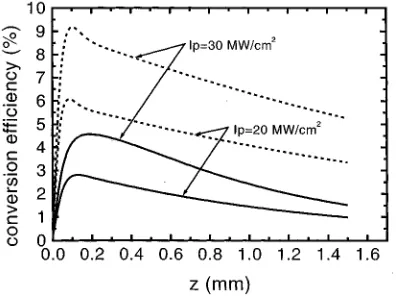
Fig. 2. Intensity of the harmonic (arbitrary units) along the interaction path at different pump intensities. In a case when the permanent moments are neglected (dashed lines), both curves are obtained for the photon energy 113.8 meV. With the permanent moments included, the upper solid line is obtained for the photon energy 111.8 meV, and the lower solid line for 112.2 meV. With increasing the pump intensity the optimal photon energy (i.e., necessary for the maximal conversion) decreases.
but which clearly translates into the intensity-specific optimal pump wavelength.
Examples of the harmonic field propagation through the medium are given in Fig. 2, as calculated for different pump intensities and with the permanent dipole moments neglected or accounted for. The pump is not displayed because it is almost constant (less than 10% drop along the interaction path), since it is far off resonance. Clearly, the permanent moments affect the optimal conversion length, though not so drastically as the conversion efficiency. We may also note the increase of the optimal conversion length with increasing pump intensity, a feature also known in conventional resonant SHG, and not specific to the existence of permanent moments. What is different, however, is a long interaction path of 1.5 mm, obtained under the best-matched-to-transparency conditions.
IV. CONCLUSION
[image:4.612.328.526.286.435.2]876 IEEE JOURNAL OF QUANTUM ELECTRONICS, VOL. 37, NO. 7, JULY 2001
the quantum-interference induced transparency was explored. The analytical model describing the intersubband transitions at large pump intensities was expanded to account for permanent moments. It is shown that the permanent moments induce a shift of the pump photon energy at which the conversion efficiency is maximum. Since this shift depends on the pump and harmonic fields, it cannot be maintained constant along the interaction path, hence the efficiency has to be lower than would be the case if permanent moments were neglected. Due to a high sensitivity of transparency on photon frequency, a considerable drop in efficiency is found in realistic structures.
REFERENCES
[1] S. E. Harris, “Lasers without inversion: Interference of lifetime-broad-ened resonances,” Phys. Rev. Lett., vol. 62, pp. 1033–1036, 1989. [2] J. Mompart and R. Corbalán, “Lasing without inversion,” J. Optics B,
vol. 2, pp. R7–R24, 2000.
[3] S. E. Harris, J. E. Field, and A. Imamoglu, “Nonlinear optical processes using electromagnetically induced transparency,” Phys. Rev. Lett., vol. 64, pp. 1107–1110, 1990.
[4] L. Marmet, K. Hakuta, and B. P. Stoicheff, “2nd-harmonic generation in atomic-hydrogen induced by a charge-separation field,” J. Opt. Soc.
Amer. B, vol. 9, pp. 1038–1046, 1992.
[5] S. E. Harris and Y. Yamamoto, “Photon switching by quantum interfer-ence,” Phys. Rev. Lett., vol. 81, pp. 3611–3614, 1998.
[6] A. S. Zibrov, M. D. Lukin, and M. O. Scully, “Nondegenerate parametric self-oscillation via multiwave mixing in coherent atomic media,” Phys.
Rev. Lett., vol. 83, pp. 4049–4052, 1999.
[7] L. V. Han, S. E. Harris, Z. Dutton, and C. H. Behroozi, “Light speed reduction to 17 meters per second in an ultracold atomic gas,” Nature, vol. 397, pp. 594–598, 1999.
[8] W. Potz, “Structural control of Fano resonances in semiconductor het-erostructures,” Superlatt. Microstruct., vol. 26, pp. 141–156, 1999. [9] D. Y. Oberli, G. Böhm, G. Weimann, and J. A. Brum, “Fano resonances
in the excitation-spectra of semiconductor quantum wells,” Phys. Rev.
B, vol. 49, pp. 5757–5760, 1994.
[10] H. Schmidt, K. L. Campman, A. C. Gossard, and A. Imamoglu, “Tun-neling induced transparency: Fano interference in intersubband transi-tions,” Appl. Phys. Lett., vol. 70, pp. 3455–3457, 1997.
[11] J. Faist, F. Capasso, C. Sirtori, K. W. West, and L. N. Pfeiffer, “Control-ling the sign of quantum interference by tunne“Control-ling from quantum wells,”
Nature, vol. 390, pp. 589–591, 1997.
[12] G. B. Serapiglia, E. Paspalakis, C. Sirtori, K. L. Vodopyanov, and C. C. Phillips, “Laser-induced quantum coherence in a semiconductor quantum well,” Phys. Rev. Lett., vol. 84, pp. 1019–1022, 2000. [13] S. M. Sadeghi, S. R. Leffler, and J. Mejer, “Quantum interference and
nonlinear optical processes in the conduction bands of infrared-coupled quantum wells,” Phys. Rev. B, vol. 59, pp. 15 388–15394, 1999. [14] H. Schmidt and A. Imamoglu, “Nonlinear optical devices based
on a transparency in semiconductor intersubband transitions,” Opt.
Commun., vol. 131, pp. 333–338, 1996.
[15] X.-M. Su and J.-Y. Gao, “Optical switching based on transparency in a semiconductor double-quantum well,” Phys. Lett. A, vol. 264, pp. 346–349, 2000.
[16] D. H. Huang and D. A. Cardimona, “Intersubband laser coupled three-level asymmetric quantum wells: New dynamics of quantum interfer-ence,” J. Opt. Soc. Amer. B, vol. 15, pp. 1578–1584, 1998.
[17] S. Ko˘cinac, Z. Ikonic´, and V. Milanovic´, “The influence of permanent dipole moments on second harmonic generation in asymmetric semicon-ductor quantum wells,” Opt. Commun., vol. 140, pp. 89–92, 1997. [18] S. Y. Zhu and E. E. Fill, “Nonlinear theory of lasers without inversion
with two upper lasing levels,” Phys. Rev. A, vol. 42, pp. 5684–5688, 1990.
[19] Z. Ikonic´, V. Milanovic´, and D. Tjapkin, “Resonant second harmonic generation by a semiconductor quantum well in electric field,” IEEE J.
Quantum Electron., vol. 25, pp. 54–60, 1989.
[20] K. L. Campman, K. D. Maranowski, H. Schmidt, A. Imamoglu, and A. C. Gossard, “Quantum interference of intersubband transitions in cou-pled quantum wells,” Physica E, vol. 5, pp. 16–26, 1999.
[21] K. L. Campman, H. Schmidt, A. Imamoglu, and A. C. Gossard, “Inter-face roughness and alloy-disorder scattering contributions to intersub-band transition linewidths,” Appl. Phys. Lett., vol. 69, pp. 2554–2556, 1996.
Sa˘sa Ko˘cinac was born in Priˇstina, Yugoslavia, in 1967. He received the B.Sc.
and M.Sc. degrees in electrical engineering from University of Belgrade, Bel-grade, Yugoslavia, in 1993 and 1996, respectively.
He is currently a Research Assistant at the Faculty of Technology and Metal-lurgy, University of Belgrade. His research interests include optical properties of QWs and superlattices.
Zoran Ikonic´ was born in Belgrade, Yugoslavia, in 1956. He received the B.Sc.,
M.Sc., and Ph.D. degrees in electrical engineering from the University of Bel-grade, BelBel-grade, Yugoslavia, in 1980, 1984, and 1987, respectively.
He is a Full Professor at the Faculty of Electrical Engineering, University of Belgrade, currently on leave at the University of Leeds, Leeds, U.K. His research interests include band structure calculations and nonlinear optics of quantum wells and superlattices.
Vitomir Milanovic´ was born in Svetozarevo, Yugoslavia, in 1947. He received
the B.Sc., M.Sc., and Ph.D. degrees in electrical engineering from the University of Belgrade, Belgrade, Yugoslavia, in 1971, 1977, and 1983, respectively.