White Rose Research Online URL for this paper:
http://eprints.whiterose.ac.uk/722/
Article:
Abbas, Z., Pollard, R.D. and Kelsall, R.W. (2001) Complex permittivity measurements at
Ka-Band using rectangular dielectric waveguide. IEEE Transactions on Instrumentation
and Measurement, 50 (5). pp. 1334-1342. ISSN 0018-9456
https://doi.org/10.1109/19.963207
[email protected] https://eprints.whiterose.ac.uk/ Reuse
See Attached
Takedown
If you consider content in White Rose Research Online to be in breach of UK law, please notify us by
terials at Ka-Band. The effect of the uncertainty in the measured sample thickness is presented.
Index Terms—Calibration, complex permittivity, dielectric measurement, dielectric waveguide, microwave measurements, optimization method, permittivity measurement.
I. INTRODUCTION
M
EASUREMENTS of the complex permittivity of mate-rials at high microwave frequencies are usually made in free space because of the difficulty of machining a sample with negligible air gaps in a closed-waveguide or coaxial fixture. A comprehensive review and comparison of various free-space techniques can be found in [1], [2], and [3], respectively.The most common free-space technique is based on far-field measurements of an antenna system. However, it requires sam-ples of large transverse dimensions to minimize the perimeter diffraction effect. Alternatively, a spot focusing horn lens an-tenna [2], [4] may be used to measure samples of smaller trans-verse dimensions. Unfortunately, complete calibration of a fo-cused system is difficult to achieve due to the uncertainty in es-tablishing the reference plane, where even a small shift from the focal plane of the antenna may result in a significantly altered amplitude distribution. An excellent treatment of free-space cal-ibration techniques can be found in [5].
Recently, a rectangular dielectric waveguide (RDWG) tech-nique [6]–[8] has been proposed in conjunction with a TRL cal-ibration technique [9], [10] to determine the dielectric constant of materials of various thicknesses and cross sections at the Q and W bands. Dielectric measurements on samples with cross sections as small as that of the RDWG are difficult to realize, without positioning problems, using other microwave measure-ment techniques, but can be accomplished fast and efficiently using the RDWG technique. In a similar manner to the cylin-drical dielectric waveguide bridge technique [2], [11], a
par-Manuscript received May 30, 1996; revised April 3, 2001. This work was supported by Universiti Putra Malaysia and Hewlett Packard, Santa Rosa, CA. Z. Abbas is with the Physics Department, Universiti Putra Malaysia, Serdang, Malaysia.
R. D. Pollard is with the School of Electronic and Electrical Engineering, University of Leeds, Leeds, U.K.
R. W. Kelsall is with the Institute of Microwaves and Photonics, University of Leeds, Leeds, U.K.
Publisher Item Identifier S 0018-9456(01)08106-2.
for the values of the dielectric constant of materials at the Q and W bands. However, low loss tangent measurements are difficult in the RDWG technique due to the open discon-tinuity problem, i.e, between the RDWG and sample. This is further complicated when using the combined transmission–re-flection method [12]–[14] where the relative uncertainty in the loss factor is large for low loss materials with [14] even for a coaxial line technique.
This paper presents a method for obtaining the dielectric con-stant , , and thickness of a sample using the RDWG technique with a constrained optimization method. The param-eters can be determined by fitting the values obtained from the theoretical complex transmission coefficient to the measured values, with , loss factor , and as the arguments.
II. THEORETICALDESCRIPTION
A. Rectangular Dielectric Waveguide
The solution to propagation characteristics in RDWG and its derivatives has been a subject of research for nearly 30 years. Fortunately it is well known that the solution of each mode lies between two extreme formulations given by Marcatili’s method [15] and the conventional effective index method [16]. For the latter, the propagation constant of the mode (where the electric field is polarized along the direction with subscripts and indicating the number of extrema of the electric field in the and directions, respectively) can be found by solving the following equations: (1) (2) (3) where (4) (5) (6) (7)
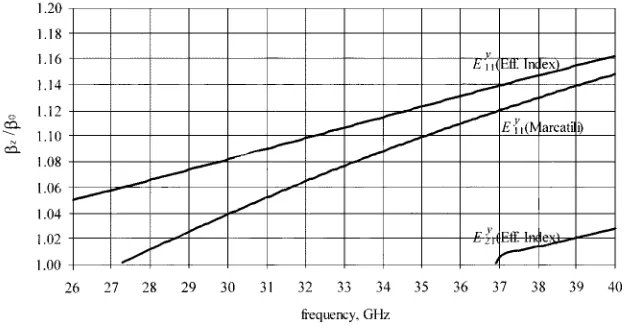
Fig. 1. Variation in = with frequency for E and E modes for PTFE.
The effective index method reduces to Marcatili’s method if (7) is replaced with . Fig. 1 shows the dispersion relation for and modes for RDWG made of Teflon with dimensions equal to the Ka-band (WR-28) waveguide. It can be seen that according to the Mar-catili’s method, the modes do not appear in the RDWG over the Ka-band frequency range. However, when using the effec-tive index method, the cutoff frequency for the mode is approximately 37 GHz. The latter is used as the condition for single-mode propagation in RDWG.
B. Calculation of Dielectric Constant and Loss Tangent
The calculation of the dielectric constant from effective re-fractive index measurements using -parameter data has been detailed in [6]–[8] where the effective complex permittivity was calculated using the Nicholson–Ross and Weir Method [12], [13]; i.e.
(8)
where is the complex transmission coefficient obtained from -parameter measurement data. This method is designated the NRW method to avoid confusion with the optimization method used in the later sections. It is assumed that the sample has a homogeneous material composition and is nonmagnetic, linear and isotropic. Further, we assumed that only the single mode propagates in the RDWG and the sample. The effective complex refractive index of the sample is defined as
(9)
where
(10)
(11)
with and , respectively, representing the real and imag-inary parts of the effective complex permittivity. The true di-electric constant can be recovered iteratively from the
effec-tive refraceffec-tive index by using the effective index method or any solution to the wave equation. Conversely, the effective index method can be used to calculate for given values of the cross section of a sample and , at a specified frequency. Therefore, a more accurate way to determine the true dielectric constant is by means of an optimization procedure, from which the loss factor (and hence, the loss tangent) and accurate sample thickness can be determined by using a suitable objective func-tion. Our effective index model [6]–[8] allows the reflection and transmission coefficients to be expressed in simpler forms com-pared to other solutions to the discontinuity problem in an open dielectric waveguide, i.e.
(12)
(13)
The following objective function was found to be the most efficient to determine , , and for 201 frequency points
in the range of 0–1. The estimated thickness was measured with a digital caliper. A computer program based on [18] was used to calculate the objective function. The iteration process is stopped when either the error function (i.e., the difference be-tween the new and previous ) is less than 10 or the iteration loop count is over 10 000.
III. EXPERIMENT
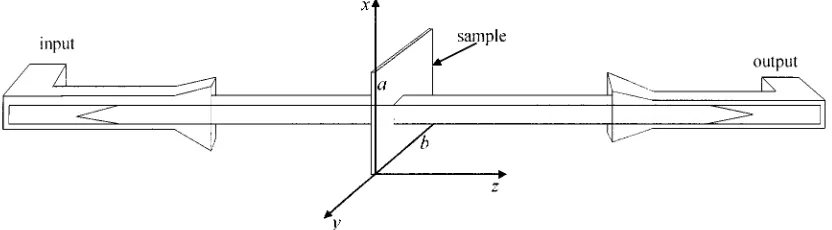
Fig. 2 illustrates the measurement setup using the RDWG combined transmission–reflection method. The RDWG and its one-quarter wavelength spacer (line standard for TRL calibra-tion) have cross-sectional dimensions equal to the WR-28 stan-dard waveguide dimension to a close tolerance of 10 m. PTFE was chosen as the RDWG material because of its ease of fabrication, very low loss and low dielectric constant. The low dielectric constant of PTFE provides a wide coverage of single-mode propagation in the RDWG at Ka-band. On the other hand, the low loss factor is an important criterion for direct ap-plication of the effective index method that assumes lossless ma-terial. The length of the RDWG beyond the horn aperture was chosen such that the surface wave has a phase shift of rad more than an ordinary endfire source . This length was approximately [7], [19]. The RDWG was tapered only at the feed section to reduce the reflection coefficient between the RDWG and the standard WR-28 waveguide. Only the -plane of the RDWG was tapered to allow a natural transition from the LSE mode to the , i.e., from center-loaded, partially dielectric-filled to completely dielectric-filled waveguide. The minimum taper length was obtained by an approximate calcula-tion using Hecken’s method [20]. For PTFE material, the min-imum taper length was approximately 36 mm long to obtain a return loss not lower than 40 dB (i.e., the reflection coefficient should not be greater than 0.01) when using the WR-28 wave-guide. In this paper, the taper length was set to 40 mm. An extra 2 cm length of PTFE is further allocated within the waveguide to form a tight fit to the metal walls as well as providing support to the suspended RDWG at the waveguide opening. The length of the RDWG within the horn section is determined by the horn length. A metal waveguide horn was employed to launch the mode into the RDWG, as well as serving as a mechanical support. According to [21], the maximum launching efficiency can be achieved if the horn gradually flares out from the throat but curves back to a smaller flare angle at the mouth. In general,
it is proposed that the transverse dimension of the mouth of the horn should correspond to the inverse of the transverse propa-gation constants in the and directions, i.e., and at the lowest operating frequency where field extension is widest. For easy fabrication, the dimensions of the mouth were chosen as 10.5 mm 7.6 mm, and the length of the horn was 25.9 mm. All the samples used in this paper were machined from commercial planar sheets in the transverse dimension only, to a close tolerance of 10 m, while the thicknesses were left undisturbed. The thicknesses of the samples were measured using a digital caliper. All calibrations and measurements were made using the HP8510C Network Analyzer in stepped CW mode. The two-port calibration was performed for 201 frequency points in the Ka-band by employing the TRL method [9], [10]; and the details of its application to the RDWG technique have been presented elsewhere [6]–[8].
IV. RESULTS
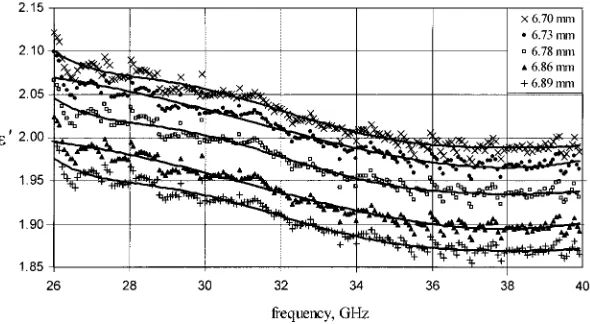
Our previous results [8] suggest increased accuracy in de-termination of can be obtained by using thick samples. The samples used in this work were PTFE (unsintered), polystyrene and nylon. All the samples were obtained from Polypenco Engi-neering Plastics Ltd., U.K. The profile of for the PTFE sample with 50 mm 50 mm cross section and measured thickness of 6.86 mm is shown in Fig. 3 together with the polynomial curve fitting line. Also, Fig. 3 shows the effect of sample thickness on if the actual thickness is between 6.7 mm and 6.9 mm, which could result in an uncertainty as high as 7% in if the measured thickness was assumed to be accurate. The profiles of are not shown as they overlapped (when using similar thicknesses used in Fig. 3), indicating a requirement for a tight tolerance in the sample thickness.
[image:4.612.90.506.65.180.2]Fig. 3. Variation in the dielectric constant" of a PTFE sample (50 mm 2 50 mm) with frequency for an unknown thickness in a range of 6.7 mm–6.89 mm.
are kept within 0.5 mm. Furthermore, variation of and increases not only the processing time, but also the number of alternative minima.
Several sets of starting values were used to account for the unimodality assumption used in the optimization procedure to obtain the possible solutions for , , and . The measured thickness (6.86 mm) was used as the initial thickness estimate for both sets, within an allowed range from 6.7 mm to 6.9 mm. The initial estimate for for the first set was 1.91, increased by 0.01 in the following sets up to 2.09. The lower and upper bounds limits of were set to 1.9 and 2.1, respectively. The op-timization program was run twice, first with and then but each was allowed to vary between 0 and 1. It was found that the optimum values of , , and hence , can be obtained when the calculated thickness is 6.835 mm (repre-senting only 0.025 mm deviation from the measured thickness)
with , , and . On the other
hand, a lower objective value can be found for a calculated thickness of 6.718 mm, giving a similar value but with . However, the deviation from the measured thickness was 0.142 mm, which is unusually high when using a digital caliper. Several sets of data were processed with different values of and to search for alternative solutions. However, the results indicate that lower objective values can be obtained only at the expense of higher deviation between the calculated and measured thicknesses.
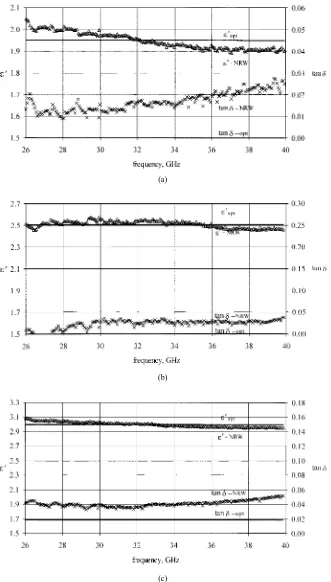
Comparisons between the optimization method
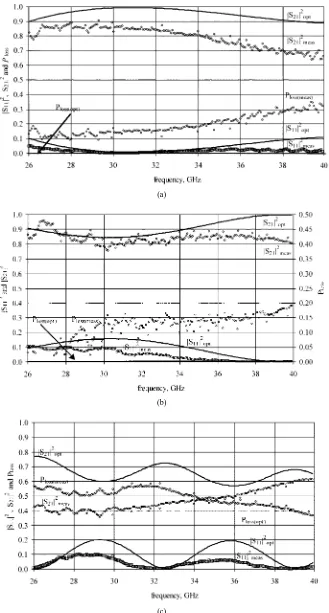
mm and the NRW method mm for both and are shown in Fig. 4(a). Also, Fig. 5(a) compares both the real and imaginary parts of and , which in turn, were used to produce Fig. 6(a), where represents the apparent power loss obtained from the relationship: . It can be clearly seen that the profile of -NRW in Fig. 4(a) closely follows the profile of in Fig. 6(a). The high was the main cause of the lower values of , which explains the unexpectedly high values of -NRW given that PTFE is a low-loss material. The permittivity model assumes single-mode propagation in a low loss medium, and the measured power loss can be attributed to scattering of some of the energy to other higher order modes. This is taken into account
by (14) that minimizes the power loss to remove its effect on both and , as shown in Fig. 4(a).
The second sample was polystyrene with a measured thick-ness of 4.92 mm and a cross section with mm and
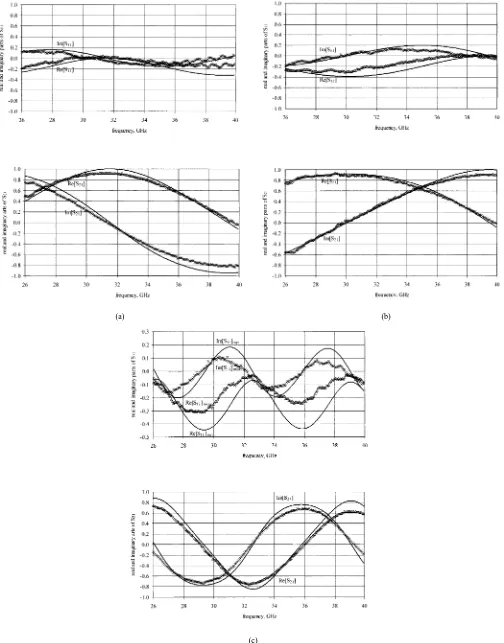
mm. The measured thickness of 4.92 mm was chosen as the estimated thickness within 0.03 mm tolerance. The values of were allowed to vary in the range of 2.4–2.65 while be-tween 0 and 1. The initial value of was chosen to be 0.9. Un-fortunately, all sets converge to which coincides with the lower boundary of the sample thickness, i.e., 4.89 mm. However, a good solution with can be found by se-lecting the calculated thickness of 4.915 mm, as it differs by only 0.005 mm from the measured thickness. In this case, the devia-tion in is less than 1%, and agrees to at least the third decimal digit when compared to the final objective values for a thickness of 4.89 mm. Fig. 4(b) shows good agreement in be-tween the optimization method mm and the NRW method mm especially below 36 GHz. As expected, the values of the NRW method show a large deviation from those obtained using the optimization method, in spite of only a 0.005 mm difference between the measured and calculated thick-ness. This large deviation could not be directly interpreted just by comparing the measured and optimized -parameters shown in Fig. 5(b) but can be explained easily by Fig. 6(b) which suggests a large deviation between and .
calcu-(a)
(b)
[image:6.612.134.465.60.642.2](c)
Fig. 4. Dielectric constant and loss tangent for (a) PTFE, (b) polystyrene, and (c) nylon samples in the Ka-band by using NRW method and optimization solution.
lated thickness of 13.289 mm. The importance of accurate measurement of the sample thickness is especially obvious if the measured thickness was 13.30 mm (instead of 13.31 mm), where a lower objective value can be obtained by choosing a calculated thickness of 13.296 mm. Fig. 4(c) compares the re-sults obtained for both and between the optimization
method mm and NRW method mm .
(a) (b)
[image:7.612.46.550.62.705.2](c)
Fig. 5. Comparison between measured and predicted values of the real and imaginary parts ofS and S for (a) PTFE, (b) polystyrene, and (c) nylon.
Further comparisons between Fig. 4(a), (b), and (c) suggest that the profiles obtained from the NRW method for all the
(a)
(b)
[image:8.612.135.464.61.674.2](c)
Fig. 6. Comparison between measured and predicted values ofjS j , jS j , and P for (a) PTFE, (b) polystyrene, and (c) nylon.
other samples but with small peaks near 38.5 GHz that was slightly higher than predicted by the effective index theory. Fi-nally, Table II provides a listing of the values of and
TABLE I
OPTIMIZATIONRESULTS FORNYLON WITHMEASUREDTHICKNESSEQUAL TO13.31 mmINESTIMATED" RANGE BETWEEN2.9AND3.1
TABLE II
COMPARISON BETWEENNRW, OPTIMIZATION,ANDOTHERTECHNIQUES
both and with the published data while the NRW method agrees reasonably only with the values.
V. CONCLUSIONS
We have demonstrated the use of an optimization method for RDWG dielectric measurements at the Ka-band. The technique is nondestructive, quick, and simple. Good results are obtained for the complex permittivity of a range of materials, and the issues of sensitivity and measurement errors related to sample thickness have been addressed.
ACKNOWLEDGMENT
The authors wish to thank J. Shipman, N. Banting, and R. Hawkes for assistance in the construction of the dielectric waveguides.
REFERENCES
[1] M. N. Afsar, J. R. Birch, and R. N. Clarke, “The measurement of the properties of materials,” Proc. IEEE, vol. 74, pp. 183–199, Jan. 1986. [2] J. Musil and F. Zacek, Microwave Measurements of Complex
Permit-tivity by Free Space Methods and Their Applications. Amsterdam, The Netherlands: Elsevier, 1986.
[3] J. R. Birch et al., “An intercomparison of measurement techniques for the determination of the dielectric properties of solids at near millimeter wavelengths,” IEEE Trans. Microwave Theory Tech., vol. 42, pp. 956–965, June 1994.
[4] D. K. Ghodgaonkar, V. V. Varadan, and V. K. Varadan, “A free space method for measurement of dielectric constants and loss tangents at microwave frequencies,” IEEE Trans. Instrum. Meas., vol. 38, pp. 789–793, June 1989.
[5] F. C. Smith, B. Chambers, and J. C. Benett, “Methodology for accu-rate free-space characterization of radar absorbing materials,” Proc. Inst.
Elect. Eng., Sci. Meas. Technol., vol. 141, no. 6, pp. 538–546, 1994.
[6] Z. Abbas, R. D. Pollard, and R. W. Kelsall, “Further extensions to rect-angular dielectric waveguide technique for dielectric measurements,” in
Proc. IEEE IMTC, vol. 1, Ottawa, ON, Canada, May 19–21, 1997, pp.
44–46.
[7] , “Determination of the dielectric constant of samples from effec-tive refraceffec-tive index measurements,” IEEE Trans. Instrum. Meas., vol. 47, pp. 148–152, Feb. 1998.
[8] , “A rectangular dielectric waveguide technique for determination of permittivity of materials at W-band,” IEEE Trans. Microwave Theory
Tech., vol. 46, pp. 2011–2015, Nov. 1998.
[9] G. F. Engen and C. A. Hoer, “Thru-reflect-line: an improved technique for calibrating the dual 6-port automatic network analyzer,” IEEE Trans.
Microwave Theory Tech., vol. MTT-27, pp. 983–987, Dec. 1979.
[10] “Applying TRL Calibration to Noncoaxial Measurements,” Hewlett Packard, Product Note 8510-8a, 1988.
[18] J. L. Kuester and J. Mize, Optimization Techniques with Fortran. New York: McGraw-Hill, 1973.
[19] T. N. Trinh, J. A. G. Malberbe, and R. Mittra, “A metal-to-dielectric waveguide transition with applications to millimeter-wave integrated circuits,” in IEEE MTT-S Int. Microwave Symp., 1980, pp. 205–207. [20] R. P. Hecken, “A near optimum matching section without
discontinu-ities,” IEEE Trans. Microwave Theory Tech., vol. MTT-20, pp. 734–739, Nov. 1972.
[21] W. Schlosser and H. G. Unger, “Partially filled waveguides and surface waveguides of rectangular cross section,” in Advances in
Microwaves. New York: Academic, 1966, pp. 319–387.
[22] R. G. Jones, “Precise dielectric measurements at 35 GHz using an open microwave resonator,” Proc. Inst. Elect. Eng., vol. 123, pp. 285–290, Apr. 1976.
[23] Von Hippel, Dielectric Materials and Applications. New York: Wiley, 1954.
Zulkifly Abbas was born in Alur Setar, Malaysia, in 1962. He received the
B.Sc. degree (with honors) from the University of Malaya, Serdang, Malaysia, in 1986, the M.Sc. degree from the Universiti Putra Malaysia, Serdang, in 1994, and the Ph.D. degree from the University of Leeds, Leeds, U.K., in 2000.
He is currently a Lecturer in the Department of Physics, University of Malaya, where he has been a faculty member since 1987.
Engineers (U.K.), and a Fellow of the IEEE “for contributions to the devel-opment of microwave and millimeter-wave measurements, and active device characterization.” He is an active IEEE volunteer, as an elected member of the Administrative Committee and 1998 President of the IEEE Microwave Theory and Techniques Society and, as Chair of the Products Committee, a member of the IEEE Technical Activities Board. He is a member of the Editorial Board of IEEE TRANSACTIONS OFMICROWAVETHEORY ANDTECHNIQUESand has been on the Technical Program Committee for the IEEE MTT-S International crowave Symposium since 1986. He also edits the book series on RF &
Mi-crowave Technology, (Piscataway, NJ: IEEE Press).
Robert W. Kelsall was born in Rotherham, U.K., in 1964. He received the B.Sc.
(with honors) and Ph.D. degrees from the University of Durham, Durham, U.K., in 1985 and 1989, respectively. His doctoral research involved studies of elec-tronic transport in GaAs quantum wells.
From 1989 to 1993, he was a Research Assistant at the University of Durham and the University of Newcastle-upon-Tyne, developing Monte Carlo simula-tions of MOSFETs and HEMTs. In 1993, he joined the University of Leeds, Leeds, U.K., as a Lecturer in the School of Electronic and Electrical Engi-neering. He currently with the recently formed Institute of Microwaves and Pho-tonics at the University of Leeds, where he is conducting research in the theory and simulation of advanced technology microwave and optoelectronic semicon-ductor devices.