Article
A Combined Fuzzy Goal Programming and Big-Bang
Big-Crunch Algorithm for Workforce Optimisation
with Facility Layout Consideration
Desmond E. Ighravwe
aand Sunday Ayoola Oke
b,*
Department of Mechanical Engineering, Faculty of Engineering, University of Lagos, Akoka-Yaba, Lagos, Nigeria
E-mail: a[email protected], b[email protected] (Corresponding author)
Abstract. Small scale enterprises constitute an important subset of manufacturing
economy and the contribution of facility redesign in bridging the performance gaps in small-scale enterprises is necessary for enterprise growth and stability. In this paper, a bi-objective programming-based facility layout design problem is formulated. We minimise workforce costs and maximise efficiency improvement in a layout. We utilised fuzzy goal programming and big-bang big-crunch algorithm in generating a Pareto solution. The model was tested using a small-scale sachet water production enterprise data. Increase in finished goods area was 66.55 % while reduction in total annual distance travelled in the facility was 48.22 % when the proposed layout was compared with the existing one. A reduction in annual cost of labour was 16.2 %. The possibility of using work-centres with high number of interrelationships was confirmed using the quality function deployment and Hurwicz’s criterion. The optimal workforce size was found to be 14 workers against the existing workforce strength of 18 workers. The study provides a framework upon which small-scale sachet water production factories can be designed for optimum performance.
Keywords: Workforce, facility layout, fuzzy goal programming, big-bang big-crunch,
small-scale enterprises
ENGINEERING JOURNAL Volume 19 Issue 2
Received 17 June 2014 Accepted 22 September 2014 Published 30 April 2015
1.
Introduction
Small business enterprises are an important sector of economies worldwide and the application of scientific tools and business models towards improved management decisions and operational performance is growing. Facility layout design and its implementation is a central issue that could significantly improve small business enterprises’ performance. In this work, the focus is on facility design and planning and the adoption of scientific tools to enhance business performance, particularly for small water packaging firms in developing countries.
Facility layout design is one of the manufacturing management models employed by contemporary organisations world-wide to achieve competitive performance in business activities [1, 2, 3]. There are several studies on facility layout design that claimed to have reduced material handling [4], improved workers’ motivation [5], made energy efficiency possible [6] and generally improved production systems [1, 2, 3, 7, 8]. Although facility layout design models have been extensively implemented in large organisations with successes, very sparse information exists on its developments and applications in small-scale enterprises, particularly water producing factories. Most existing papers on facility layout design are usually targeted at large-scale manufacturing industries [9] and not on problems in the small-scale enterprises. This creates a research gap that has to be bridged; there is need for its pursuit in small-water producing factories, particularly in the face of stringent economic conditions worldwide. Such a model and its implementation could be targeted at optimising movements of materials and workforce and it is a worthwhile investment of efforts in a quest for performance improvement in small-scale water producing factories in developing countries. For many small-scale water sachet producing factories in developing countries, the business owner needs to accurately determine whether the business can be sustained, downsized or expanded.
Water factory business managers do not generally have sufficient information about planning for the factory [10]. Bowden and Brounce [11] argue that little integration of information between the production control task and the design of manufacturing facilities exists. Bhutta et al. [12], Temtune et al. [13] and Gnanaraj et al. [14] all state that the problem of paucity of scientific decision data is a deficiency prevailing in small- and medium-scale enterprises. More precisely, full knowledge about forecasting and analysis of financial issues concerning the water packaging businesses, manpower determination, raw material estimation, customer orders, delivery of orders and associated issues are not within the reach of the business owners. Also, the business owner may be new to water production business with little experience. However, since most small-scale business are informally handled worldwide, the informal handling of business by owners permits very little scientific enquiries; business owners base their decisions majorly on intuition rather than scientifically laid-down approaches and principles. The fact is that small-scale enterprises are then beseted by problems that linger for long periods. Poor management skills and poor educational level of employees were claimed to be responsible for some of the problems of small businesses [15, 16, 17, 18].
small-scale businesses in general. To be precise, a case is drawn from Lagos, Nigeria to demonstrate the applicability of the proposed model as an example of a real-life situation in a developing country.
This paper seeks to apply an optimisation model in which the big-bang big-crunch algorithm is coupled with quality function deployment, Chung’s and Muther’s models in obtaining optimal workforce and annual distance travelled. In view of the shortcomings of water producing factories in developing countries in general and specifically, the case studied, the aim of the current work is to develop an improved layout for the water producing factory and also determine the optimal number of personnel that will be required to manage the facility for different production periods. This study appears to be a pioneering documentation and should be beneficial to business managers in water sachet producing factories. Stated differently, the aim of this paper is to redesign the layout of an existing water sachet producing factory so as to improve the productivity [5] and space utilisation of the system [19] while minimising the workforce requirements. The remaining sections in this paper are organised as follows. Section 2 deals with the review of literature and Section 3 presents the research methodology. The model application, including discussion of results, is presented in a case study in Section 4. The conclusions of this paper are in Section 5.
2.
Literature Review
The desire to arrange and manage manufacturing facility layouts to suit business purposes at optimal levels is sought by business owners across various manufacturing set-ups [9, 11]. This desire has led to the emergence of several studies, which sought to provide solutions to facility layout problems (FLPs). Keeping in mind the objective of the current study, there is need for a closer review of the following topics: (i) facility layout problems; and (ii) small-scale enterprises. Consequently, a literature review exercise was carried out to understand and evaluate the current status of knowledge in these two areas. The next two sub-sections provide details about this review.
2.1. Facility Layout Problems
FLPs have been formulated and solved using mathematical models in order to obtain optimal layouts [20, 21]. Ioannou [4] formulates an integer programming model for addressing the problem of concurrent layout and material handling in radar antennas companies and solves it using simulated annealing (SA). Other authors have use SA in optimising FLPs [20, 22]. The study by Bowden and Browne [11] as well as Taghari and Murat [23] consider the problem of facility design and flow of products in manufacturing systems. Bowden and Browne [11] establish a relationship between facility design and product flow using modular architecture for a factory while Taghari and Murat [23] consider product flow in a factory as an assignment problem and solve it using a heuristic algorithm that incorporates facility layout design and assignment problems, leading to the emergence of a non-linear mixed-integer model. Chae and Peters [2] use memetic algorithm in solving mixed-integer programming problems relating to FLPs. Genetic algorithms (GAs) have also gained wide acceptance in solving the various FLPs when formulated as optimisation problems. Gomez et al. [24] apply GAs in solving the FLP where there are aisles. Hicks [25] propose the use of GAs in optimising cellular/functional layouts for capital goods industries. Mak et al. [26] develop an optimisation model for flow- and job-shops in manufacturing industries and solve it using GAs. Other studies which apply GA as global optimisers are El-Baz [27] and Sadrzadeh [28].
layouts for manufacturing systems with the ANN learning from examples of past data from a system using if-then fuzzy rule in adjusting the weights formed during training of the network.
From the literature review, it is noticed that facility layout design concepts enhance the performance of manufacturing systems. However, it is increasingly desirable to apply facility layout design concepts in various situations to improve resource management from the viewpoint of staff’s motivation and its relationship to facility layout [5]. This is an example and a variant from the traditional application of facility design principles. Further, the case of determining the optimal workforce of workers is another variance from the classical facility layout literature and is pursued in this work.
2.2. Small-Scale Enterprises
Available literature information suggests that several aspects of small-scale enterprises have been studied to a large extent [17, 34, 35], but facility layout design has been investigated to a very limited extent. Lefebure and Lefebure [36], Nassimbeni [37] and Freel [38] all study innovation and relate it to CEO’s characteristics, technology, finance and external networking of small firms. However, in their work, no information is provided on how facility layout design could be influenced under these conditions. Thus, a study of this effect could provide a good understanding of the effective positioning of facilities for improved productivity and system performance in small-scale industries.
The application of advanced manufacturing technologies in SMEs was investigated by Koc and Bozdag [39]. This observation is consistent with the work of Tether and Storey [40], which acknowledges that high technology leads to the growth of SMEs. They observe that local area network (LAN), computer-aided design and computer-aided manufacturing technologies are widely used in SMEs. Nassimbeni [37] observe that the ability of SMEs to increase their export quota depends less on storage technologies, while product innovation is more influential in achieving export objectives. The less dependence on storage technologies in SMEs was also identified by Koc and Bozdag [39]. Furthermore, export quota expansion was linked to spatial level by Freel [41] while export propensity was identified to depend on firm characteristic by Javalgi et al. [42]. Generally, some of these characteristics, which also appeared in Chang et al. [43] and Avermaete et al. [44] are the skills of the workforce, firm investments in know-how, business strategy and the use of external sources of information. A combination of these characteristics depends on operational challenges and manufacturing flexibility of firms in different environments [44]. However, such combinations are crucial to business success [38].
North and Smallbone [18] raise the question of labour productivity and how it has been affected by labour skills in SMEs. However, an exhaustive study on the ways of improving labour productivity was not carried out in their study. Consequently, the current study attempts to provide quantitative details on labour productivity in small-scale enterprises. Since Soderbom and Teal [46] point out that observable skills has less impacts on productivity. Our interest in this study is on reduction of the annual distance travelled by the workforce in a layout and this has a direct effect on labour productivity through reduction in the distance travelled and traffic within a facility. For holistic improvements in productivity and quality of outputs from SMEs, Chetty et al. [47] study how SMEs can increase their market shares at the international level through the use of business network process. The study observes that foreign business opportunities can be explored through synergy with external partners. Abdul-Nour [48] recommends the use of just-in-time philosophy and Kanban technique as ways of improving SMEs performance. They further note that the external partnership of SMEs is usually difficult to achieve due to high cost of acquiring technical advice on such synergies. However, their study points out that establishing technical, marketing and manufacturing relationship with larger firms will reduce technical cost and create more room for innovations in SMEs. Robbins and Pearce [49] observe that controlling the cost of operating SMEs is essential to their survival than a constant pursuit of business growth (expansion), which is the focus of most SMEs.
travel frequency of workers as well as labour and other variables has not received the required attention in literature till date. In addition, no study has been documented on the integration of the frequency of workers’ travels between work-centres and the level of workforce employed in the water sachet production system for optimum performance from the viewpoint of customer orientation.
At present, despite several innovative features introduced by several researchers on facility layout designs, the idea of customer orientation, which takes inputs from the users or potential users of facilities, has not been documented in the literature; this is a critical practical concern that must be addressed and is reported in the current study. This product-oriented idea is brought into the analysis in this work to make the proposed optimisation model robust. Solving this problem will serve as contribution to facility layout literature in enhancing the performance of the water sachet production system while providing proper planning information.
3.
Research Methodology
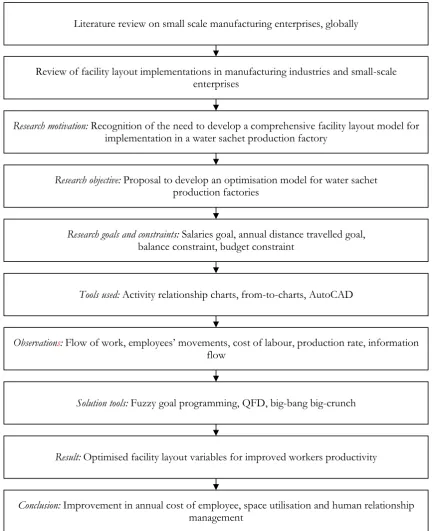
This section constitutes the methodological aspect of the work, incorporating the optimisation model utilised in the problem formulation, a solution approach (fuzzy goal programming cum big-bang big-crunch algorithm) and a flowchart for the flow of work. The methodology followed in carrying out this study is pictorially depicted in Fig. 1. As reported during the review of literature on small-scale enterprises, Jayawarna et al. [56], Berggren and Silver [57], Gnanaraj et al. [14], Lin et al. [58] and Nicholas et al. [59] believe that the wealth of societies are influenced by the contributions of small manufacturing enterprises. This fact calls for the management of small manufacturing enterprises at optimal levels. To achieve this goal in small-scaled water sachet production factories, a pilot study was conducted on a small-scale water sachet production factory layout that is located in Lagos, Nigeria, in order to redesign its layout for optimal operations. The pilot study was carried out by observing the flow of information, frequency of trips in the facility, the number of employees and the production rate in the small-scale enterprise studied. The activities relationship charts as well as from-to-chart were employed in order to eliminate excessive movement of employees and material handling in the factory. Fuzzy goal programming and bang big-crunch were then utilised in determining the optimal amount of workforce and the actual distance travelled in the factory. This results in improved workers’ productivity and space utilisation in the factory.
3.1. Quality Function Deployment (QFD)
The algorithm 1 below (see Han et al. [60]) gives the procedures used in applying QFD in this study.
Algorithm
Step I Identify the water factory business needs (customer needs)
Step II Identify the various work-centres in the water factory (design needs)
Step III Collect relevant information through the use of questionnaire and other means
Step IV Select a rating scale for computing the correlations of the needs for the water factory, work-centres and the correlations with the entire business
Fig. 1. Research methodology.
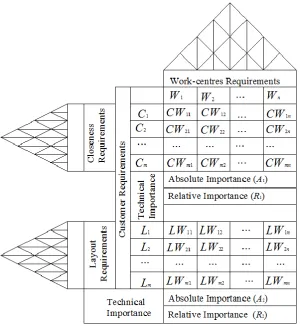
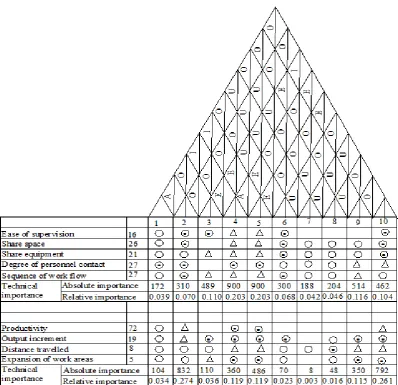
The 5-point scale used in this study is presented in Table 1 while the framework for implementing QFD using HOQ matrix [61] is shown in Fig. 2.
Table 1. A five-point scale.
Point 1 2 3 4 5
Importance Unimportant Ordinary Important Especially important Absolutely important Review of facility layout implementations in manufacturing industries and small-scale
enterprises
Literature review on small scale manufacturing enterprises, globally
Research motivation: Recognition of the need to develop a comprehensive facility layout model for implementation in a water sachet production factory
Research objective: Proposal to develop an optimisation model for water sachet production factories
Research goals and constraints: Salaries goal, annual distance travelled goal, balance constraint, budget constraint
Tools used: Activity relationship charts, from-to-charts, AutoCAD
Observations: Flow of work, employees’ movements, cost of labour, production rate, information flow
Solution tools: Fuzzy goal programming, QFD, big-bang big-crunch
Result: Optimised facility layout variables for improved workers productivity
[image:6.595.81.515.86.618.2]Fig. 2. House of quality for facility layout design.
Eqs. (1) and (2) show how to calculate the absolute and relative importance [60, 64, 65]. These are given as:
1 2
1 1
, ,
m n j j ij i
i j
A A C W
(1)and 2
1 2
2 1
,
,
ij j j j n
ij j j
A A
R R
A A
, (2)where 1, ...,
1, ..., .
i m
j n
3.2. Mathematical Model
In this study, the following nomenclature is used in formulating the proposed optimisation model and their definitions are different from similar nomenclature in other sections of this study:
Parameters
Cit Unit cost of worker at work-centre i in period t
fijt Average number of trips from work-centre i to work-centre j per period(t) Edij Existing distance between work-centre i and work-centre j (m)
Ui Maximum value attainable for goal i gi Minimum value attainable for goal i
mi,ave Average weight of a worker at work-centre i (kg) wi Relative importance of weight i
[image:7.595.135.436.78.405.2]it
Actual time workers in work-centre i at period t are available (h)it
ˆ
Target time workers in work-centre i at period t are available (h)it
p
Actual performance of workers in work-centre i at period tit
p
ˆ
Target performance of workers i in work-centre i at period tit
q
Actual quality of service workers in work-centre i at period tit
q
ˆ
Target quality of service expected from workers in work-centre i at period t Tp Total distance in the proposed layoutTe Total distance in the existing layout it
The average number of trips expected to be made by a worker in work-centre i per period (t)g
Acceleration due to gravity (m/s)h
it Unit cost of hiring a worker in work-centre i in period tfh
it Unit cost of firing a worker in work-centre i in period tWE
The expected overall workers’ effectivenessDecision Variables
xit Number of workers at work-centre i in period t zit Number of workers hired in work-centre i in period t yit Number of workers fired in work-centre i in period t
Pdij Optimised distance travelled between work-centre i to work-center j Si Walking speed of worker i (m/h)
αi Attainment level of goal i µi Membership function for goal i Indices
i,j Work-centre t Planning period
M Number of work centres in a facility T Total planning period
Granted that the whole workforce consists of a secretary, a manager, supervisors, baggers and loaders, the interest of the proposed optimisation model is to reduce the amount of baggars and loaders in the factory. The reason for not reducing the number associated with the secretary, manager and supervisors is that the pilot study conducted indicated that the existing number of these personnel is sufficient. Also, a small-scale enterprise needs at least one secretary and a manager to function properly. Furthermore, because the nature of the company’s operations, two supervisors are required to coordinate day and night shifts. The above discussion implies that the annual number of these personnel cannot be altered. Thus, the objective of the proposed optimisation model is to minimise the annual amount of money spent on baggers and loaders’ salaries as well as the annual distance travelled. To achieve this, the current structure of baggers and loaders needs to be altered. This section is develops an expression for the problem being studied (i.e. objective functions and constraints). We also present a goal programming model and a big-bang big-crunch algorithm for handling the developed non-linear model in this study. Some of the assumptions made before developing the proposed bi-objective model are as follows. Notice that points (i) to (5) are known in advance:
i. Amount of energy used in moving from one work-centre to another; ii. Limits of walking speed of workers at each work-centre are the same; iii. Average trips made by all workers at the same work-centre is the same iv. Rate of workers’ turnover;
v. Hiring and firing of workers’ cost;
vi. Subcontracting of operations is not allowed; and
The optimisation model in this study is formulated in this section; we start by presenting the objective functions and then the model constraints.
3.2.1. Objective functions
In most facility layout optimisation models, a single objective function is often pursued unfortunately, a single objective function model does not provide enough information when compared with a multi-objective model during a decision making process. Hence, the need to capture as much information as possible has motivated the use of bi-objective in the current work. The two objectives considered in this study are presented as follows:
Maximisation of layout efficiency (G1)
As in many sachet water producing factories, the various employees in the factory move from one work-centre to another during the course of their daily activities. Thus, the minimisation of these distances travelled reduces the time taken to travel among related work-centres in the factory. Such a minimisation will reduce the amounts of workforce required to carry out the available work in the factory when compared with a situation where distances are not optimised. This effort to reduce the total distance travelled will improve the performance of the factory [9]. This reduction in annual distance travelled has been addressed in this study using Muther’s and Chung’s approaches. However, adjusting the workforce in each work-centre has an impact on the total annual distance travelled. Efforts at reducing the annual distance will result in an improved layout efficiency. Thus, we formulate a layout efficiency improvement model as a maximisation problem by comparing the existing and optimised layouts in terms of the annual distance covered by the workers. Eq. (3) presents this objective.
1
1 1 1 1
G :1 /
M M M M ij ij i j i j
Max Pd Ed
(3)Minimisation of annual workforce cost (G2)
Maintaining a system with an optimised layout helps in controlling the employees’ and material transportation costs. This benefit is more pronounced in facilities like sachet water producing factories. In some systems, joint improvements in these two variables may not be attainable since there is the possibility that the average distance travelled from one work-centre to another might increase due to the reduction in the number of workers at a work-centre. On the long-run, the benefit of a reduced annual cost of workers will supercede an increment in the average annual distance travelled within a work-centre. The minimisation of the annual workforce cost is represented as Eq. (4).
) (
: G
1 1
2 it it it it
M
i T
t
it
itx h y fh z c
Min
(4)
3.2.2. Model constraints
There exists an interrelationship among distance, time and speed (walking speed) in traditional mechanic analysis. This concept was borrowed and used in this study for formulating a constraint that restrains the value of the numbers of workers required to make various trips from a particular work-centre to another. We consider the distance travelled as a function of the numbers of trips and distance travelled from a particular work-centre. Given that the walking speed of workers lies between a certain limits, Eq. (5) was used to represent the above mentioned interrelationship.
1 1
( ) 0
M N
ijt ij it i i j
f Pd x S
(5)When a worker moves from one work-centre to another, energy is dispensed. An optimised layout should minimise the amount of energy that workers use in moving from one work-centre to another when compared with the non-optimised layout. The difference between an optimised and non-optimised layouts are captured by Eq. (6).
, ,
1 1 1 1
M M M M
i ave ij it i ave ij it i j i j
m gPd x m gEd x t T
The distances in the existing layout (Edij) were measured using the shortest travelling distance (STD)
when there exists more than one possible way of connecting two work-centres that have an interrelationship. Also, the centre-to-centre (CTC) approach was used when taking measurements between two work-centres. The CTC approach gives approximately the same result as when the average measurements of front and back distances of two work-centres are used. The STD approach was further enhanced through observations of information and workflow in the facility.
Using Eqs. (5) and (6) in controlling the number of workers in the proposed layout implies that the total optimised distance within the layout should lie between the existing distance and the proposed distance, as depicted in Eq. (7).
1 1
M M
p ij e i j
T Pd T
(7)In an optimised layout, the number of trips made from one work-centre to another may be less when compared with a layout that is not optimised. The amount of trips made by workers at a particular work-centre should be equal to the average number of trips travelled by a worker multiplied by the total number of workers in the work-centre. This relationship restrains the number of workers in a particular work-centre, as expressed in Eq. (8).
1 1
0
M M
ijt it it i j
f x
,tT (8)A change in the workforce level from one planning period to another in small-scale industries is often stochastic in nature; this is due to the variation in product demand [66]. Since the level of production affects the number of trips made by workers from one work-centre to another, we consider change in the workforce level by extending Belmokaddem et al’s workforce level constraint to include workers’ turnover rate (see Eq. 9).
1
(1 ) 0 ;
it i it it it
x L x y z i M t T (9)
In order to restrain the number of workers in a planning period, we considered the expected overall workers’ effectiveness. The overall workers’ effectiveness used in this study is dependent on availability, quality of service offered and performance [67]. Fixing the overall workers effectiveness, Eq. (10) was formulated as another constraint in this study:
1 1 1
1 1 1
0
ˆ ˆ ˆ
M M M it it it it it it i i i M M M
it it it it it it i i i
x p x q x
WE t T
x p x q x
(10)3.3. Solution Methods
When dealing with the multi-objective optimisation model, the approach used in solving it affects the quality of results that will be obtained. This problem then becomes more challenging if such a model contains non-linear interrelationship among the decision variables. The application of traditional optimisation methods (simplex method, big-M methods and gradient descent) as solution methods for these non-linear models is not often suitable since to the solutions will be trapped in local optimal regions. In view of this, the current paper applies BB-BC algorithm as a solution method for the proposed non-linear multi-objective model in this study.
3.3.1. Fuzzy goal programming model
The problem being studied involves searching for the optimal values for xit, Pdij, Sit, yit, zit and µi. Due to the
conflicting objectives in the proposed model, we utilise FGP in obtaining the Pareto solutions for the decision variables. The procedure involved in using the fuzzy goal programming approach for obtaining the optimal values for the various decision variables in the formulated multi-objective workforce problem are as follows:
1 if ( ) ( )
( )
( ) if ( ) ) ( )
( )
0 if ( ) ( )
l l l l
l l
G X U X
U G X
μ f g X G(X U X
U g X
G X U X
(11)
1 if ( ) ( )
( )
) if ( ) ( ( )
( )
0 if ( ) ( )
l l l l
l l
G X U X
U G X
μ (f g X G X) U X
U g X
G X U X
(12)
ii. Set priority for each objective function in the proposed multi-objective model and develop an expression which is now the new objective function to be maximised. In this study, we assume an equal weight for each objective function
2
1
( ) : l l
l
Max f X w
(13)iii. Convert each objective function into soft constraint.
1 1 1 1 1 0 G g U g (14) 2 2 2 2 2 0 U G U g (15)
iv. Attainment level for each µl is set based on decision maker’s opinion. Mathematically, this can be expressed as Eq. (16).
l l
(16)
v. Reformulate the optimising model and solve using suitable solution algorithm. Our proposed FGP model is presented as follows:
2
1
( ) : l l
l
Max f X w
Subject to: 1 1 1 1 1 1( ) G g 0
g X U g 2 2 2 2 2 2
( ) U G 0
g X
U g
1 1 1
1 1 1
0
ˆ ˆ ˆ
M M M it it it it it it i i i
M M M it it it it it it i i i
a x p x q x
WE t T
a x p x q x
4 , 1 1( ) ( ) 0
M M
i ave ij ij it i j
g X m a Pd Ed x t T
5 1 1 ( ) M Np ij e i j
g X T Pd T
6
1 1
( ) ( ) 0
M M
it it it i j
g X x f t T
7
1 1
( ) ( ) 0
M M
ij ij it i i j
g X f Pd x S t T
8 it (1 i) it 1 it it 0 ;
g x L x y z i M t T
9( ) 1 1 0
g X
10( ) 2 2 0
g X
11( ) it 1; Integer
g X x
The lower and upper bounds for decision variables xit, sit and Pdij are as follows:
,min ,max
i it i
x x x (17)
,min ,max
i it i
S S S (18)
,min ,max
ij ij ij
d Pd d (19)
3.3.2. The big-bang big-crunch algorithm
The BB-BC algorithm is a meta-heuristic which utilises stochastic search and the population of particles in generating high quality solutions to optimisation problems at low computational times and CPU memory. Successful applications of this algorithm have been documented in literature. The desire to replicate the performance of BB-BC algorithm in workforce and facility layout design problems prompted its application in this study. The operation of BB-BC algorithm involves big-crunch and big-bang stages. The big-crunch stage involves the determination of the centre of mass, which is a function of the quality of solution and the value of decision variables. Azad et al. [68] and Tabrizian et al. [69] express the centre of mass as Eq. (20). It is possible to use global solution as the centre of mass. The effect of this is that it will reduce the computation time of the BB-BC algorithm.
1
1
1
pop p p p c
i pop p p
x
f x
f
(20)In the big-crunch stage, new values for decision variables are generated using the centre of mass, normal random generate number (ri), limit on decision variables, iteration step and a constant (α). Erol and
Eksin [70] calculate the new values of design variables at each iteration in BB-BC algorithm using Eq. (21).
,max ,min
( )
i i i new c
i i
r x x
x x
K
(21)
4.
Case Study
This study is motivated by the need of the management of a sachet water producing factory that is located in Lagos, Nigeria. The intention is to solve the problem of space utilisation while reducing the total annual cost of labour in the factory and determining the minimum required workforce in the enterprise. The problem of cost of labour stems from the stochastic nature of the business. During the dry seasons (i.e. November to March), the demand for the factory’s sachet water packs is usually between 1750-2500 bags per day while during the wet seasons (i.e. April-October), the minimum demand made for the factory’s products is 1250 bags of sachet water per day. The company operates one and two shifts during wet and dry seasons, respectively. However, the current change in climate conditions across the globe has affected the structure of demand of the company’s products in both seasons; uncertainties in climatic predictions pose great challenges to the manager in making employment decisions. This has placed undue pressure on the management of the company as it now keeps excessive staff in its payroll on order to maintain and expand its market share in their environment and beyond.
Fig. 3. Flow of information within the facility.
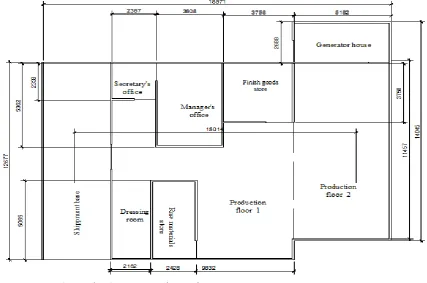
The problem of space utilisation arises as the company usually stocks its finished products in production floors and other un-assigned areas within the factory premises. This is unacceptable as such stockings of finished goods on the factory floor cause obstructions against the free-flow of in-process materials and human beings. This results from the fact that the existing storage area for finished products is not enough. Also, the distance travelled from one work-centre to another was found to be large but with possibility for improvement by reducing it. Thus, the management is interested in correcting these anomalies as it desires the rearrangement of the existing layout at the minimum cost. The various work-centres in the existing layout of the factory are as follows: Secretary’s office, manager’s office, finished goods store, raw materials store, production floor 1, production floor 2, dressing room, generator’s house and shipment base. The area occupied by each of the work-centres is presented in Fig. 4. All dimensions in this figure are in metres. Also, subsequent layouts presented in this work are in metres.
[image:13.595.76.516.89.272.2]The number of personnel in the enterprise and their salaries are contained in Table 2.
Table 2. Number and salaries of employees.
Personnel Number Salary/staff (N) Cost/month(N)
Secretary 1 18140 18140
Manager 1 65702 65702
Loaders 8 13500 108000
Baggers 6 24400 144000
Supervisors 2 37500 75000
[image:13.595.154.427.476.565.2]Fig. 4. Existing layout for the water producing factory.
The salaries are the basic salaries without allowances. They do not include incentives paid to staff for meeting production targets and also excludes other remunerations such as overtime. From the pilot study, the following problems were observed.
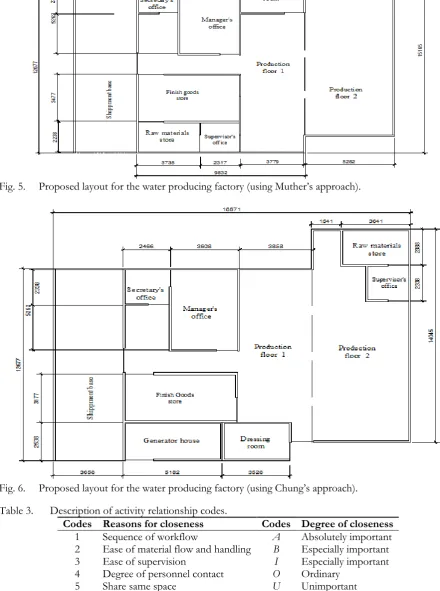
Problem 1. There is no office for supervisors in the factory. They usually hang around at the office of the company’s secretary. When calculating the distance travelled by supervisors, their reference point in the existing layout (i.e. Fig. 4) to related work-centres is measured from the secretary’s office. In order to address this problem, an office was created for supervisors in the proposed redesigned layouts (Fig. 5 and 6).
Problem 2. The existing layout is not properly ventilated; this problem is addressed by ensuring cross-ventilation in the proposed layouts. However, the impact of improved cross-ventilation on the performance of the company’s employees will not be explored in this paper. Other problems with the existing layout have been highlighted in previous sections in this paper. Movement (trips) within the various interrelated work-centres were observed, the frequency of movement (number of trips) of personnel from one work-centre to another per day is presented in Fig. 7. To account for the movement of supervisors in the factory, their positions are represented with 10 in Fig. 7.
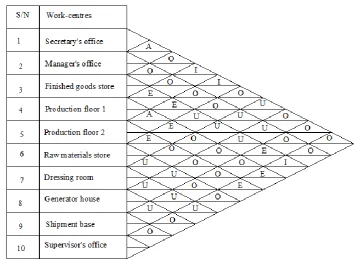
Fig. 8 shows the activity-relationship diagram for the sachet water producing factory using Muther’s approach. This inter-relationship was used in generating the proposed layout in Fig. 5. Definitions of the notations used in describing the relationships among work-centres that are contained in Fig. 8 are given in Table 3.
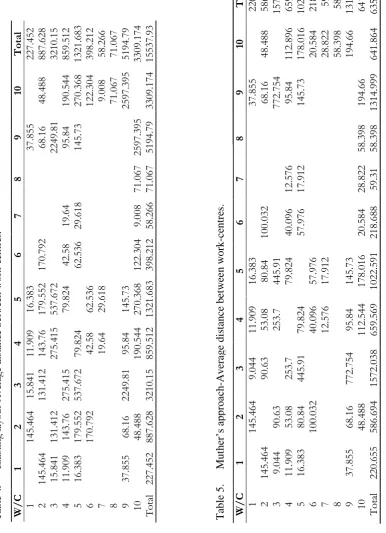
Table 4 shows the average distance between two work-centres with interrelationships. These distances were obtained using CTC and STD in the existing layout; values obtained for the two proposed layouts are given in Tables 5 and 8, respectively. The cumulative distance (CD) travelled per day is given as
[image:14.595.83.511.81.364.2]Fig. 5. Proposed layout for the water producing factory (using Muther’s approach).
Fig. 6. Proposed layout for the water producing factory (using Chung’s approach).
Table 3. Description of activity relationship codes.
Codes Reasons for closeness Codes Degree of closeness
1 Sequence of workflow A Absolutely important 2 Ease of material flow and handling B Especially important 3 Ease of supervision I Especially important 4 Degree of personnel contact O Ordinary
5 Share same space U Unimportant
[image:15.595.103.500.79.319.2] [image:15.595.69.510.142.734.2]From/To 1 2 3 4 5 6 7 8 9 10
1 - 24 1 1 1 - - - 5 -
2 24 - 6 8 8 - - 5 8
3 1 6 - 43 43 - - - 157 -
4 1 8 43 - 16 4 2 - - 16
5 1 8 43 16 - 4 2 - - 16
6 - 8 - 4 4 - - - - 8
7 - - - 2 2 - - - - -
8 - - - 3
9 5 5 157 - - - 8
10 - 8 - 16 16 8 - 3 8 -
Fig. 7. From-to chart for frequency of movement per day among work-centres (No/day).
Fig. 8. Work-centres in the sachet water system.
The importance of estimating the CD is to provide a platform for evaluating the performance of the proposed layout. In order to redesign the existing layout, the relationships among the work-centres were established using activity relationship chart. The effect of this increment will translate to the amount wasted on excessive movements. To be precise, the company losses that amount of money and the time spent in making this extra movement. The money could have been invested in a more productive work. From the management perspective, the success in reducing the number of travels made by employees in the water sachet producing company should be encouraged. It also has an advantage on the productivity side since the input, in terms of the distance travelled (translated to cost) is reduced while output (the number of communicated assignments by the secretary) is the same.
[image:16.595.59.539.78.218.2] [image:16.595.117.472.240.504.2]Adopting the Chung’s method in establishing relationships, referred to as pattern relationships, which have a distinct advantage of identifying centres (activities) that are critical. It is also able to detect work-centres that will not affect the performance of the layouts significantly, Fig. 9
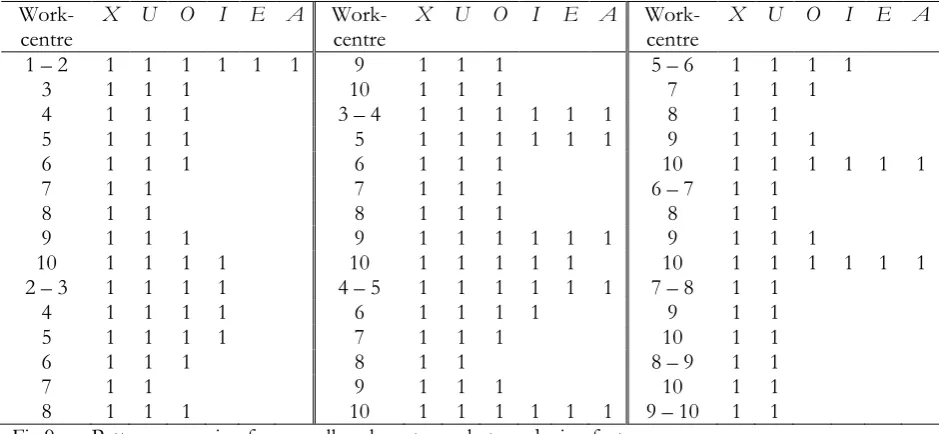
The steps involved in arriving at the proposed layout using the Chung’s approach are as follows. By following Fig. 9, we first show the pattern relationship among the various work-centres in the water sachet producing factory that was used as case study in this paper. The amount of “ones” represents the degrees of closeness among related work-centres. For instance, the numbers of “ones” between work-centre 1 (secretary’s office) and work-centre 2 (manager’s office) is 6. This implies that bringing the work-centres closer to each other is absolutely important. The amount of “ones” between work-centre 7 (dressing room) and work-centre 8 (generator’s house) is 2; this implies that bringing them closer together is unimportant. To convert these pattern relationships into layout, this study observe work-centres that have the highest numbers of “ones” in forming a seed (starting point) as “ones” depicted in the pair-wise comparison in Fig. 9. This helped in generating the new layout in Fig. 6. From Fig. 10, work-centre 3 serves as the seed for redesigning the facility been studied.
Work-centre X U O I E A Work-centre X U O I E A Work-centre X U O I E A
1 – 2 1 1 1 1 1 1 9 1 1 1 5 – 6 1 1 1 1
3 1 1 1 10 1 1 1 7 1 1 1
4 1 1 1 3 – 4 1 1 1 1 1 1 8 1 1
5 1 1 1 5 1 1 1 1 1 1 9 1 1 1
6 1 1 1 6 1 1 1 10 1 1 1 1 1 1
7 1 1 7 1 1 1 6 – 7 1 1
8 1 1 8 1 1 1 8 1 1
9 1 1 1 9 1 1 1 1 1 1 9 1 1 1
10 1 1 1 1 10 1 1 1 1 1 10 1 1 1 1 1 1
2 – 3 1 1 1 1 4 – 5 1 1 1 1 1 1 7 – 8 1 1
4 1 1 1 1 6 1 1 1 1 9 1 1
5 1 1 1 1 7 1 1 1 10 1 1
6 1 1 1 8 1 1 8 – 9 1 1
7 1 1 9 1 1 1 10 1 1
[image:18.595.62.532.277.494.2]8 1 1 1 10 1 1 1 1 1 1 9 – 10 1 1
Fig.9. Patterns mapping for a small-scale water sachet producing factory.
Fig. 10. One-to-one and one-to-many mappings for a facility layout design.
[image:18.595.207.386.516.660.2]the layout. However, effort was made in placing them in the most appropriate locations using the information in Fig. 10. This unimportant mapping identification helped in reducing the redesigning problem to a manageable size. Rearranging patterns 2 and 3 makes it easy for pattern 1 to key into pattern 10. By observing the relationships among work-centres 4, 5, 7 and 8 as relevant, it is appropriate to place work-centre 7 closer to work-centres 4 and 5. The reason is that ordinary relationships exist among them as against an unimportant relationship with work-centre 8. The final pattern for the layout is given in Fig. 11.
Fig. 11. Proposed pattern using Chung’s pattern approach.
Table 6. Work-centre definition.
Key Work-centre Key Work-centre
1 Secretary’s office 6 Raw material store 2 Manager’s office 7 Dressing room 3 Finished goods store 8 Generator house 4 Production floor 1 9 Shipment base 5 Production floor 2 10 Supervisor’s office
The assumption that work-centres with the highest number of “ones” serve as the seed to the development of a layout, as mentioned previously, necessitated the use of quality function development (QFD) in verifying the above assumption. By adopting the QFD framework into Chung’s method, the relative importance ratings (RIRs) of customer needs (business needs) reflects the needs perceived by the customers, which are usually expressed and measured through a nine-point scale [63]. The desire of facilities owners in conducting business activities that suit the characteristics of their business needs in a facility can be adequately addressed by engineers and facility designers by applying QFD [65]. With knowledge from house of quality (HOQ), the work-centres that need to be arranged in the manner that the optimal performance is enhanced is identified. An examination of the HOQ matrix shows that design correlations (work-centre correlations) have similar characteristics as activity and pattern relationship charts used in redesigning the layout for the case study. This implies that the technical importance in the HOQ matrix can be harnessed in proposing a facility layout that accounts for business needs. The problem in applying the HOQ matrix to facility layout is that the degree of closeness and objectives of design a facility layout must be considered simultaneously when proposing a layout. This study applies Hurwicz’s criterion [71], as presented in Eq. (22), in establishing compromise among the various businesses needs. Guinta and Pruizter’s [62] nine-point scale and the approach used in Lyman’s [72] study in establishing the technical importance of design needs was also adopted in this study. The developed HOQ matrix for the small-scale water sachet producing factory is presented in Fig. 12. The results obtained from applying the above criterion are presented in Table 7.
Hurwicz’s criterion =
TImax + (1-
) TImin (22)where
is a constant. TImax represents the maximum technical importance and a TImin is the minimumtechnical importance.
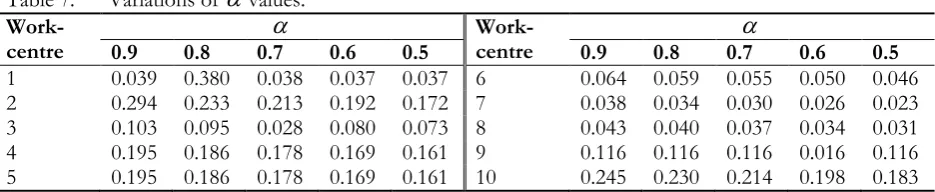
Table 7. Variations of
values.Work-centre 0.9 0.8 0.7
0.6 0.5 Work-centre 0.9 0.8 0.7
0.6 0.5 [image:19.595.65.533.654.750.2]Fig. 12. House of quality for a facility layout.
The problem of searching for recommended values for α was done using 0.5≤α≤0.9 and the results obtained are presented in Table 7. We observe that at α = 0.9 and 0.8, the most critical work-centre was manager’s office followed by supervisor’s office. This prompts us to search-downward. The results obtained show that at 0.5≤α≤0.7 the most critical work-centre was the supervisor’s office. This is consistent with our assumption that patterns with more cluster work-centres using one-many mapping is the most critical work-centre. Thus, we recommend the use of 0.5≤α≤0.7 when using QFD to determine the most critical work-centre as a complementary tool to Chung’s method, as applied in this study for Hurwicz’s selection criterion. The developed layout that was obtained is in Fig. 6 while the distances travelled are presented in Table 8.
[image:20.595.100.499.89.474.2]Table 9. Analysis of from-to-chart.
Work
centre Existing layout Approach Muther's approach Chung's
Improvement in distance travelled using Muther's approach
Improvement in distance travelled using Chung's approach
Secretary 69827.76 67741.09 67741.09 2086.67 2086.67
Manager 272501.8 180115.1 211416.8 92386.7 61085
Operators 1 985516.1 482615.7 482615.7 502900.4 502900.4
Operators 2 263870.2 202595.7 198572.2 61274.5 65298
Loader 405756.7 313935.4 308091.4 91821.3 97665.3
Supervisors 1015916 196944.2 216325.4 818971.8 799590.6
This shows that Muther’s and Chung’s approaches used in redesigning the layout performed better than the existing layout. Muther’s and Chung’s approaches gave almost the same results. Thus, any of the two methods can be used in designing the layout. This is a subjective statement. To quantitatively and objectively decide whether either of the methods can complement each other to determine whether a significant difference exists between Chung’s and Muther’s approaches, correlation analysis was carried on the results obtained using Microsoft Excel spreadsheet. The coefficient of correlation was 0.995. Thus, we conclude that any of the methods (Chung’s and Muther’s approaches) can be used in redesigning the layout. Chung’s approach has the feature of identifying critical work-centres, which may be of help to management in deciding which work-centres can be relocated when partial redesign programme is considered in order to reduce the annual distance in a factory. This characteristic gives Chung’s approach an edge over Muther’s approach.
4.1. Application of Optimisation Model
The optimisation model presented in this study was solved using the BB-BC algorithm based on the information in Tables 4 and 5 as well as Fig. 7. Other information required for testing the proposed model was obtained through direct interaction with the business manager and workers. Furthermore, the application of the proposed model was enhanced by first reducing the number of decision variables to a manageable size. This was achieved through experts’ decision by considering work-centres that can be operated by a certain number of workers. For instance, the number of secretaries, supervisors and managers for small-sized enterprises the like sachet water producing factories are in the ratio of 1:2:1. By removing these variables, our problem is reduced to obtaining the optimal values for the number of workers in production floors (1) and (2) as well as the total distances travelled in each work centres.
The data presented in Table 9 was used in determining the total annual distance travelled in the work centres (i.e. production floors (1) and (2), secretary’s office, manager’s office, supervisor’s office and finished goods store). The minimum and maximum numbers of workers in the facility were determined by using an expert opinion of one of the authors. Other parameters used in applying the proposed model were obtained from the case study. The results obtained when the proposed optimisation model was applied and solved with the BB-BC algorithm for the optimal workforce distributions for six different periods are presented in Table 10. The values for optimal distance between the work-centres of interest in the current study are depicted in Table 11 while the average distance the workers are expected to cover in a day for the six different periods considered in this study is presented in Fig. 13.
Table 10. Optimal workforce distributions for different periods.
Period (t) x Current workers Hired workers Fired workers
1t x2t x3t z1t z2t z3t y1t y2t y3t
1 6 4 11 1 2 1 2 2 2
2 4 6 10 2 2 1 1 2 2
3 3 3 11 1 3 2 1 2 2
4 5 3 10 2 1 2 1 2 1
5 6 6 9 3 3 2 2 1 1
[image:22.595.68.530.646.748.2]Table 11. Optimal distance travelled by workers.
J 1 2 3 4 5 6 7 8 9 10
Pd1j 11.91 95.14 270.99 0 79.82 41.87 20.42 0 95.84 133.94 Pd2j 16.38 154.22 529.13 79.824 0 59.66 21.55 0 145.73 270.72 Pd3j 37.86 68.16 1120.48 95.84 145.73 0 0 0 0 2801.43
Fig. 13. Optimal average distance travelled per hour in a month.
4.2. Discussion of Results
Based on the results presented in Tables 10 and 11 as well as Fig. 11, the attainment levels for the two fuzzy goals that were considered in this study are 87.60 and 81.2 % for the maximisation of layout efficiency and minimisation of annual workforce cost objectives, respectively. It should be noted that an equal weight was used during the testing of the proposed model. An attempt to use unequal weights for these fuzzy goals may affect the quality of solution for the each of the fuzzy goals. From these results, it can be deduced that the implementations of the proposed layouts in Fig. 5 and 8 with little modifications will result in improved levels of activities within the facility when compared with the existing layout. With such modifications, the workforce level within the facility will vary from one period to another (Table 11). This variation will also affect the energy gained and the expected amounts of average distance covered per day (see Fig. 11).
A comparison of the distances among work-centres in Tables 4 and 11 shows that there is reduction in the distance travelled by workers in work-centres 4, 5 and 9. On a daily basis, these reductions in average distances travelled by workers in work-centres 4, 5 and 9 will be approximately 12.75, 3.36 and 17.81 %, respectively. The overall improvement in the distances travelled using Eq. (3) was 38.68 %. The implication of this improvement on business process is that the duration which is required, for completing a cycle of a particular batch of product will be reduced and this will improve the company’s capacity to meet the demands for its products. It will also encourage market penetration. At this point, two immediate benefits to employees are obvious: Increase in daily pays when considering systems where payments are a function of the level of employees’ activities per day.
The second benefit is directly associated with the among of energy required to carry out assigned tasks within the facility. This can be estimated using Eq. (6). For instance, using an average worker’s mass of loaders of 62 kg and acceleration due to gravity as 9.8 m/s, it can be inferred that the reduction in the amount of energy saved per day by loader will be approximately 5622 kJ in period 1. This value was obtained for 10 (11+1-2) loaders using information in Table 1. Likewise, the bonus scheme can be designed for the sachet water producing plant where bags of sachet water can be used in the designing bonus scheme for workers.
In general, it can be said that reduction in the amount of energy required for travelling from one work-centre to other work-work-centre can be considered as improvement in energy efficiency of the workers in the system. Alternatively, it can be viewed as less energy, more work done. Furthermore, a reduction in the distance travelled has a direct implication on material handling cost. It also minimises the traffic within a facility. An implementation of such a scheme will not only improve the output of workers, but also the reduce amount of wastage within the system. This will result in the reduction of supervision rate while increasing the overall workers’ effectiveness and productivity of the system. These increments can be
0 10 20 30 40 50 60 70 80 90
0 1 2 3 4 5 6 0
Months
A
ve
ra
ge
di
st
anc
e
cov
er
pe
r
ho
ur
(m
/h) s1
[image:23.595.67.507.86.319.2]further improved upon through skill enhancement programmes for workers within the system. There is a high tendency that any organisation which practices periodic skill enhancement programmes and redesigning of its layout will boost their competitiveness in its business domain. In addition, an integration of just-in-time philosophy and Kanban technique in water producing business alongside with an optimal layout design will improve the profitability margin and target delay problem during variations in climatic changes. This improvement will emerge from materials and human controls within a facility.
The associated amount of average distance that will be covered by a loader within the facility in period 1 will be approximately 48.3 m per hour (see Fig. 11). Optimal values for the average distance to be covered by the three categories of workers considered in this study are not evenly distributed (see Fig. 11). For instance, the average amount of distance that will be covered by a worker within the six periods considered in this study for work-centres 4, 5 and 6 will be approximately 14.87, 22.32 and 59.34 m/h, respectively. Since workers are not paid based on distance covered, these results does not affect the quality of solutions obtained using the BB-BC algorithm. This discrepancy in values is associated with level of demand in each of the periods considered in this study. However, the distributions of the average distance to be covered by workers in work-centres 4 and 5 is slightly stable. This is as a result that workers in these work-centres carrying out assigned tasks within their work-centre (they make lesser number of trips than loaders).
The total amount of workers which are expected to be in the system during each period will be approximately 117 workers (see Table 10). Out of this value, approximately 50.42 % will be loaders. Since the cost for retaining loaders in the facility is cheaper when compared with operators, this result is satisfactory. One reason for considering this as being result satisfactory is that when there is less work for loaders. They can be deployed to assist operators in the company’s production floor. This practice is common in small-scale businesses. Further decisions on whether to accept the results obtained from the proposed model can be analysed using the cost of hiring and firing of workers within the facility. Our model shows that the total number of workers that should be hired during the six months planning periods should be 12, 12 and 9 for production floors 1 and 2 as well as shipment base, respectively. In terms of the number of workers that should be relieved of their jobs, a total of 27 workers should be concerned (see Table 11). Since the cost of hiring and firing workers for loaders is cheaper than operators, such a control is important to business survival [49]. With these optimal results, we can conclude that the performance of the proposed model is satisfactory.
With hiring and firing information, business owners can readily budget certain fractions of their operating capital on workers salaries while utilising the rest for other key business operations. In addition, the results in Table 11 can be utilised in making decisions on whether a company should sustain, downsize or expand its current workforce level. It should be noted that such decision is often influenced by the available funds for workforce expenses and also the level of production activities within the facility.
5.
Conclusions
This study has succeeded in addressing the problem of space utilisation while optimising the workforce allocation in a sachet water production factory. This aim was achieved by redesigning an existing facility layout of a small-scale factory in a developing country with a specific case drawn from an enterprise located in Lagos, Nigeria. This has resulted in an improved space and workforce utilisation, which will led to improved firm performance [39]. Activity relationship charts, from-to-chart, Chung’s method, Hurwitz’s decision criterion, and quality function deployment were utilised for the study. The principles of shortest travelling path and centre-to-centre between two work-centres with interrelationship were applied based on the aforementioned tools. This paper obtains the optimal annual distances travelled and total annual costs of labour in the factory by formulating a bi-objective programming model that was solved using the big-bang big-crunch algorithm.
The results obtained show that the workforce structure for the facility varies from one period to another; we also observe variations in the expected average travelling speeds for each class of workers. The contribution of this study to facility layout literature is that the framework presented was able to improve both the flow of workers within the facility and generates an optimum workforce for the best performance of the small business considered. Within the limits of the study presented herein, this is the first time such an approach will be applied successfully to a water producing enterprise in a developing country.
Since we are dealing with small-scale business enterprises in this study, time series models (exponential smoothening, moving average, Box-Jerkins) can be provide useful insights on production activities with a facility. Sensitivity analysis of the cost improvement as a result of the implementation of the procedure is also suggested as a future study. The effects of motivation scheme and other factors like lighting, colour of factory walls and room temperature of the factory were not considered in this paper as they affect the productivity of workforce in the water sachet enterprise; this can be investigated as further study. The parameters used in this study during testing of the proposed optimisation model were considered to be deterministic; a study that investigates the performance of the proposed model under stochastic condition can be pursued as a further study. Finally, the application of the various methods applied in the case study considered here could be made in other small- and medium-enterprises and this will be an interesting study that will further extend the applicability of the methods in the study.
Acknowledgements
The authors acknowledge the anonymous reviewers of this manuscript for their valuable critique of this manuscript. This has improved the quality and readability of this manuscript.
References
[1] M. Bazergan-Lari, “Layout designs in cellular manufacturing,” European Journal of Operational Research, vol. 112, no. 2, pp. 258–272, 1999.
[2] J. Chae and B. A. Peters. 2006, “Layout design of multi-bay facilities with limited bay flexibility,” Journal of Manufacturing Systems, vol. 25, no. 1, pp. 1–11, 2006.
[3] N. Shariatzadeh, G. Sivard and D. Chen. 2012, “Software evaluation criteria for rapid factory layout planning design and simulation,” Procedia GRP, vol. 3, 229–304.
[4] G. Ioannou, “An integrated model and decomposition-based approach for concurrent layout and material handling system design,” Computer and Industrial Engineering, vol. 52, no. 4, pp. 459–485, 2007. [5] P. Soltantabor, A. Farsijani, and M. Bazazi, “Main HRM aspects of different layout designs and its
impacts on staff motivation,” Procedia–Social and Behavioural Science, vol. 25, pp. 25–35, 2011.
[6] L. Yang and J. Deuse, “Multiple-attribute decision making for an energy efficient facility layout design,” Procedia CIRP, vol. 3, pp. 149–154, 2012.
[7] P. Kouelis, W.-C. Chiang, and A.S. Kiran, “A survey of layout issues in flexible manufacturing systems,” Omega, vol. 20, no. 3, pp. 375–390, 1992.
[8] F. Castillo and B. A. Peters, “Integrating design and production planning considerations in multi-bay manufacturing facility layout,” European Journal of Operation Research, vol. 157, pp. 671–687, 2004. [9] A. Drira, H. Pierreval, and S. Hajri-Gabouj, “Facility layout problems: A Survey,” Annual Reviews in
Control, vol. 31, no. 1, pp. 255–267, 2007.
[10] Y. Taghari and T. Tabe, “An approach on developing an advice system for starting a new business: The case of a supermarket,”Advances in Human Factors/Ergonomics, vol. 20, pp. 633–638, 1995.
[11] R. Bowden and J. Browne, “Approach to production environment design task within facility coordination,” Computer Integrated Manufacturing Systems, vol. 4, no. 1, pp. 42–50, 1991.
[12] M. K. S. Bhutta, A. I. Rana, and U. Asad, “Owners’ characteristics and health of SMEs in Pakistan,” Journal of Small Business and Enterprises Development, vol. 5, no. 1, pp. 130–149, 2008.
[13] Z. T. Temtune, S. V. Chinyoka, and J. P. W. Shunda, “Toward strategic use of IT in SMEs developing country perspective, information,” Management and Computer Security, vol. 11, no. 5, pp. 230–237, 2003. [14] S. M. Gnanaraj, S. R. Devadasan and P. R. Shalij, “Current state maps on the implementation of lean
and six-sigma paradigms an exclusive model for deploying lean six-sigma in SMEs,” International Journal of Productivity and Quality Management, vol. 5, no. 3, pp. 286–309, 2010.
[15] J. Pansiri and Z. T. Temtune, “Assessing managerial skills in SMEs for capacity building,” Journal of Management Development, vol. 27, no. 2, pp. 251–260, 2008.
[16] T. H. Tambunan, “Export-oriented small- and medium-industry clusters in Indonesia,” Journal of Enterprising Communities: People and Places in the Global Economy, vol. 13, no. 1, pp. 25–58, 2009.