Novel Efficiency Estimation Technique for
In-Service Motor Using Exchange Market Algorithm
V.P. Sakthivel
Assistant Professor
Department of Electrical and Electronics Engineering Government College of Engineering, Dharmapuri – 636704, India.
Abstract : This article presents a new evolutionary optimization approach named Exchange Market Algorithm (EMA), which is based on the intelligent behavior of shareholders in the share market, for the in-field efficiency determination of three-phase cage induction motor (EDIM). The proposed method exploits the measuring data of stator voltage, stator current, power factor, input power, stator resistance and rotor speed of the in-field three-phase induction motor. The EMA algorithm is employed to estimate the motor equivalent circuit parameters by minimizing the error between the measured and estimated data instead of using no-load and locked rotor tests. Then, the efficiency of the in-field induction motor is estimated by using modified equivalent circuit model which cogitates stray load losses. Since EMA algorithm expends double exploration and exploitation characteristics in each iteration, it affords high solution quality and fast computational time. The proposed algorithm is implemented and tested on 5 HP motor. The results ratify the potential and effectiveness of the proposed algorithm compared to torque cage method, equivalent circuit method (ECM) and Particle Swarm Optimization (PSO) method.
IndexTerms - Efficiency estimation; Evolutionary algorithm; Exchange Market Algorithm; Induction motor; Modified equivalent circuit model.
NOMENCLATURE
r1 stator resistance (Ω)
x1 stator leakage reactance (Ω)
r2 rotor resistance referred to stator (Ω )
x2 rotor leakage reactance referred to stator (Ω)
rm core loss resistance (Ω )
xm magnetizing reactance (Ω)
rst stray loss resistance (Ω )
S slip
V1 stator voltage (V)
I1 stator current (A)
I2 rotor current (A)
Im magnetizing current (A)
pf power factor Pin input power (W)
Pout output power (W)
Pfw friction and windage losses (W)
η efficiency of the motor ni nth person of the first group
nj nth person of the second group
r random number within [0, 1]
jth member of the second group
members of the first group
members of the second group r1 and r2 random numbers
nk nth member of the third group
kth member of the third group and
Sk share variation of the kth member of the third group
share value added randomly to some shares
total shares of member t
shares of the tth member
information of exchange market
) 2 ( group j
pop
) 1 ( group
,i 1
pop
) 1 ( group
,i 2
pop
) 3 ( group k
pop
1 t
n
1 t
n
y t
S
risk level for each member of the second group
number of the tth member in exchange market
number of the last member in exchange market, l is a constant coefficient for each member
g1 common market risk amount
Itermax maximum iteration number
, maximum and minimum values of risk in market respectively
share value added randomly to some shares
random number between -0.5 and 0.5
market variable risk in third group
I.INTRODUCTION
Induction motor efficiency determination empowers the energy savings in industry. Owing to the uninterrupted characteristic of industrial process, traditional methods defined in IEEE Std-112 cannot be used. Nonintrusive motor efficiency estimation methods have to be developed for in-situ motor testing. The least intrusive categories of induction motor efficiency estimation methods are equivalent circuit-based methods. Over the years, many efficiency estimation methods have been developed based on induction motor equivalent circuit. The IEEE Std-112 F method is the typical equivalent circuit method [1]. Although this method is expected to be quite accurate, the required no-load, variable voltage, removed – rotor, and reverse rotation tests make it impossible to be used in in-situ testing. Subsequently, the standard 112-F method is modified by eliminating the variable voltage test [2]. However, a no-load test and a full no-load test both under rated voltage are still required. In [3], the authors surveyed over twenty methods for evaluating the efficiency of induction motors and proposed least intrusive methods for efficiency estimation. Shaft torque measurement is the most direct method for efficiency determination, by using the ratio of motor output power to the input power. However, all methods utilizing dynamometer measurement are not practical in the field [4]. A new method [5] for the identification of induction motor equivalent circuit parameters using the single-phase test instead of the locked-rotor test was proposed. However, the no load test remains a major problem especially when the motor cannot operate at no-load since its shaft is permanently connected to its load.
The no-load and locked rotor tests are used for estimating the parameters of equivalent circuit model. The no-load test is conducted at normal no load voltage and the locked rotor test is performed by locking the rotor mechanically, and applying reduced voltage and frequency. Since no-load and locked rotor tests are highly intrusive, evolutionary algorithms are used for equivalent circuit parameter estimation by minimizing the error between the measured and estimated data.
Genetic algorithm (GA) [6] [7], adaptive GA [8] evolutionary algorithm (EA) [9], PSO [10] Bacterial Foraging algorithm [11] have also been used for parameter identification and efficiency estimation. Thus, the evolutionary algorithms provide non-intrusive method to determine efficiency which requires input values of the motor.
However, some of these heuristic methods may have poor performance on different set of problems. Some algorithms perform local exploitation at the mature stage of the search and global exploratory search at the early stages of the evolutionary process.
Few of the aforementioned methods have excellent global search capabilities but, they have some imitations in their local search ability. Some of the techniques have premature convergence. To overcome premature convergence and speed up the search process a more powerful heuristic algorithm is needed.
Recently, a newly developed meta-heuristic algorithm, exchange market algorithm (EMA) has been proposed [12]. The algorithm imitates the human behavior of shareholders in exchange market and provides better solution quality and convergence speed than the other evolutionary algorithms.
In this research work, a non-intrusive method for in-field efficient estimation of three-phase induction motor based on the EMA is proposed. The better optimum solutions with lower computation burden can be found in EMA compared to the PSO search technique. To justify the effectiveness of the proposed method, the proposed EMA approach is tested on a 5 HP motor.
II.PROBLEM FORMULATION
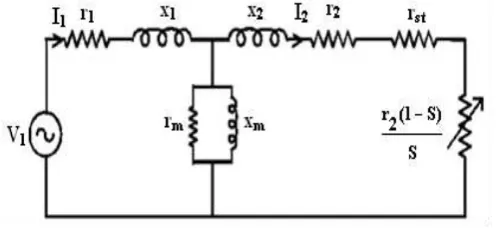
EDIM is formulated as an optimization problem. The proposed efficiency estimation method incorporates the loss segregation method, the equivalent circuit method and the EMA, as a technique for solving nonlinear equation. An equivalent stray-load resistor is added in serious with the rotor circuit as shown in Fig. 1. The aim is to reach a parameter set, which yields minimal squared error when compared to the measured data.
The stray load resistance is given by
fl S
) fl S (1 2 0.018r st
r (1)
1
pop
t
pop
n
max , 1
g
g
2,max3 t
n
s
r
2
Fig. 1. Modified equivalent circuits of an induction motor
The admittance of each branch of the equivalent circuit can be calculated as follows:
2 jx st r /S 2 r 1 2 Y (2) 1 jx 1 r 1.0 1 Y (3)
The stator, rotor and magnetizing currents, power factor, input and output powers and efficiency of the motor can be calculated using the following equations.
m Y 2 Y 1 Y ) m Y 2 (Y 1 Y 1 V 1 I e 1 I
(4)
m Y 2 Y 1 Y 2 Y 1 Y 1 V e 2 I
(5)
) m Y 2 Y 1 Y ( m r 1 Y 1 V e m I
. (6)
e 1 I 1 I ( e
pf ) (7)
rst I2merm S 2 r 2 e 2 I 1 r 2 e 1 I 3 e in
P (8)
fw P S S 1 2 r 2 e 2 3I e out
P (9)
100 e in P e out p (%) e
η (10)
The objective function is written as:
2 2 m in P m in P c in P 2 m 1 I m 1 I c 1 I F(X) m pf m pf c pf (11)
III.EXCHANGE MARKET ALGORITHM
EMA is a new population-based meta-heuristic algorithm proposed by Ghorbani and Babaei [12]. The algorithm imitates the human behavior of stock market in which shareholders trade shares under balanced and oscillated market situations. This algorithm uses two searcher and absorbent operators in normal and oscillation modes respectively. In EMA, optimum solution is regarded as one that is searched out by a shareholder population. Each individual of this population is called a shareholder. The individuals of searcher group and absorbent group are responsible for improving the exploration and exploitation abilities of the algorithm.
In normal condition of the exchange market, the shareholders try to maximize their profit using elite shareholders experience. In the population, each shareholder is ranked according to the fitness function.
3.1.1. Shareholders with High Ranks
These shareholders do not change their shares without performing any risk and trade to maintain their ranks. This group of shareholders composes 10 – 30% of the population.
3.1.2. Shareholders with Average Ranks
This group of shareholders composes 20–50% of the population. The members of this group use the experiences of elite stockbrokers and take the least possible risk in changing their shares.
(12)
and
3.1.3.Shareholders with Weak Ranks
This group of shareholders composes 20–50% of the population. The members of this group utilize the differences of share values of elite and medium shareholders with their share values. The population of this group is given in the following equation.
(13)
(14)
3.2.Exchange Market in Oscillation Mode
In this mode, the shareholders perform intelligent risks according to their own rank among other members to gain the maximum possible profit. The shareholders can be divided into three different groups based on their performances.
3.2.1. Shareholders with High Ranks
This group allocates 10-30% of the market population known as elite members, which do not participate in the market exchange.
3.2.2. Shareholders with Medium Ranks
The market share of the second group is changed in such a way that the whole share values of the group are constant. The share values of the individuals can be updated as
1
1 t 1
t
n
2
r
n
(15) pop popn
t
(16)
n 1 y y t 1t
(
S
)
n
n
...,
,
3
,
2
,
1
y
(17)1 1 t
1
g
(18)k Iter g g g g max min , max , max ,
k 1 1
1
1 (19)
In order to maintain the shares remain constant, each shareholder randomly sells some of the shares equal to the shares purchased. Hence, each shareholder reduces the share values which are given as follows.
(20)
Where, nt2is the total share value of tth member after employing share variations
3.3.Shareholders with Weak Ranks
The shareholders can either purchase or sell the shares. Hence, the total share value is variable. The share values of the individuals can be updated as
(21) (22) (23) ) 1 ( group ,i 2 ) 1 ( group ,i 1 ) 2 ( group
j
r
pop
(
1
r)
pop
pop
i
n
...
,
3
,
2
,
1
i
j
1
,
2
,
3
,
....
n
j
group(3)
k ) 1 ( group 1 , i 1
k 2 r pop pop
S
group(3)
k ) 1 ( group 1 , i
2 pop pop
r
2
k ) 3 ( group k new ) 3 ( group
k
r
pop
0
.
8
S
pop
k
n
...
,
3
,
2
,
1
k
n
t,2n
t,22 s
3 ,
t
4
r
n
rand
5
.
0
r
s
1 1 t
1
g
(24)
IV.EMAAPPLIED TO EDIMPROBLEM
The different steps of EMA for solving EDIM problem are described below.
Step 1. Input data for market operation
The total shareholders in the market (m), shares (n), lower and upper limits of each shares (equivalent circuit parameters), maximum iteration number, risk factors (g1 and g2) and EMA constants are initialized.
Step 2. Initialization of shareholders
Since the decision variables for EDIM problems are equivalent circuit parameters of in-field induction motor, they are used to form the shares of shareholders. The ith shareholder for n equivalent circuit parameters is represented as
(25) Each share of the shareholder matrix is initialized using a uniform probability distribution function in the range ( 0 – 1 ) and located between the maximum and minimum limits of the equivalent circuit parameters.
The shareholder can be represented below:
(26)
Step 3. Evaluation of shareholders’ cost
The shareholders cost is evaluated by using Eq. (11)
Step 4. Ranking and allocation of shareholders
The shareholders are sorted in ascending order and are divided into three different groups. The 30%, 40% and 30% of population are allocated for elite, medium and weak shareholders respectively.
Step 5. Updating the shares of medium and weak shareholders in normal market condition
The share values of medium and weak ranking shareholders are updated using Eqs. (12) and (13) respectively.
Step 6. Reevaluation, ranking and allocation of shareholders
The medium and weak shareholders’ costs are reevaluated using Eq. (11). Subsequently, the shareholders are repositioned and separated into three different groups.
Step 7. Updating the shares of medium and weak shareholders in oscillated market condition
The share values of medium and weak ranking shareholders in oscillated market situation are updated using Eqs.(15) and (21) respectively.
Step 8. Stopping Criteria
If the maximum iteration number is reached, then the EMA is terminated and the optimal equivalent circuit parameters are obtained. Otherwise, the procedure is repeated from Step 3.
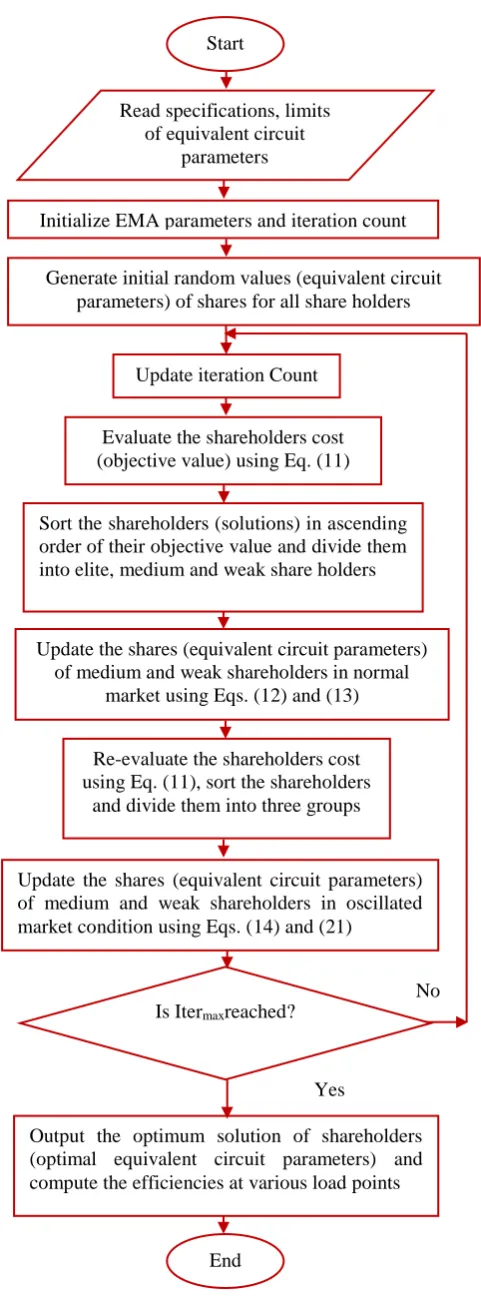
The flowchart of EMA based EDIM problem is depicted in Fig. 2
V.RESULTS AND DISCUSSIONS
In this article, to evaluate the effectiveness of the recently developed EMA algorithm, it is implemented to solve EDIM problem considering modified equivalent circuit model. MATLAB 7.1 Software is used to simulate EDIM problems and tested on 2 GHz Pentium IV, 1 GB RAM personal computer. The shareholders (population size) and the maximum iteration number are taken as 20 and 100 respectively.
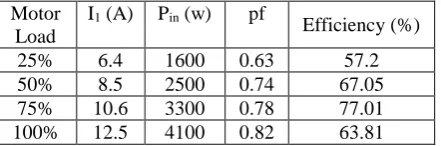
The results of the torque gauge method are depicted in Table 1. The two methods of experiments are conducted on a 5 HP motor whose specifications is given in Appendix and the simulation results of the proposed method are compared with ECM and PSO.
Table 1.
Load test data of three-phase induction motor
Motor Load
I1 (A) Pin (w) pf
Efficiency (%)
25% 6.4 1600 0.63 57.2 50% 8.5 2500 0.74 67.05 75% 10.6 3300 0.78 77.01 100% 12.5 4100 0.82 63.81
k
Iter
g
g
g
g
max min , 1 max , 1 max , 1 k
1
i1, i2, im
i
x
x
...,
x
x
jmax jmin
minj j
i
x
rand
x
x
Fig. 2. Flowchart of EMA based EDIM problem
Test Case 1: Initially, full load experimental data is considered for equivalent circuit parameter estimation. Test Case 2: Secondly, each load experimental data is considered for equivalent circuit parameter estimation.
Start
Read specifications, limits of equivalent circuit
parameters
Initialize EMA parameters and iteration count
Generate initial random values (equivalent circuit parameters) of shares for all share holders
Update iteration Count
Evaluate the shareholders cost (objective value) using Eq. (11)
Sort the shareholders (solutions) in ascending order of their objective value and divide them into elite, medium and weak share holders
Update the shares (equivalent circuit parameters) of medium and weak shareholders in normal
market using Eqs. (12) and (13)
Update the shares (equivalent circuit parameters) of medium and weak shareholders in oscillated market condition using Eqs. (14) and (21)
Re-evaluate the shareholders cost using Eq. (11), sort the shareholders
and divide them into three groups
Is Itermaxreached?
Output the optimum solution of shareholders (optimal equivalent circuit parameters) and compute the efficiencies at various load points
End
Yes
5.1.Test Case 1
In this test case, only full load experimental data are used for motor parameter determination. The equivalent circuit parameters, X1, R2, Xm, and Rm are randomly generated by EMA method. Then these values are used to compute the stator line
current, power factor, input power, output power, and the corresponding efficiencies at different load points. The calculated values are compared with the measured experimental data. The error is the difference in the percentage efficiency obtained from MOEAs and the measured data at each load point.
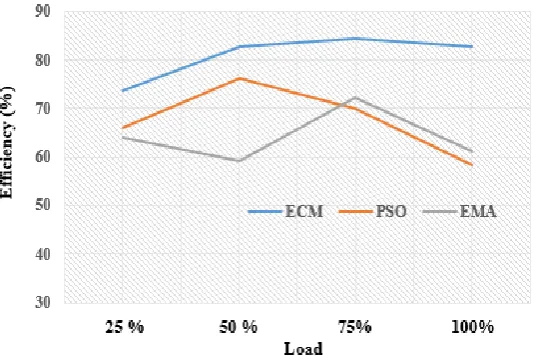
The comparative results for test case 1 are summarized in Table 2. Figs. 3 and 4 show the errors and efficiencies obtained by various approaches for this test case respectively. The results show that the error produced by EMA is less when compared with PSO which emphasizing its better solution quality. Moreover, it is observed from Table II that average simulation time of the proposed EMA approach is significantly less than that of PSO.
Table 2
Comparison of ECM, PSO and EMA results for test case 1
Motor Load
ECM PSO EMA
Efficiency (%)
Error (%)
Efficiency (%)
Error (%)
Efficiency (%)
Error (%) 25% 73.57 16.37 66.08 8.88 64.12 6.92 50% 82.56 15.51 76.24 9.1 59.28 -5.77 75% 84.25 7.24 69.98 -7.03 72.21 -4.81 100% 82.65 18.84 58.32 -5.49 61.08 -2.73 CPU Time
(sec) - 5.23 4.78
Fig. 3. Magnitude of errors in percentage efficiency for test case 1
Fig.4. Comparison of various methods for test case 1
5.2.Test Case 2
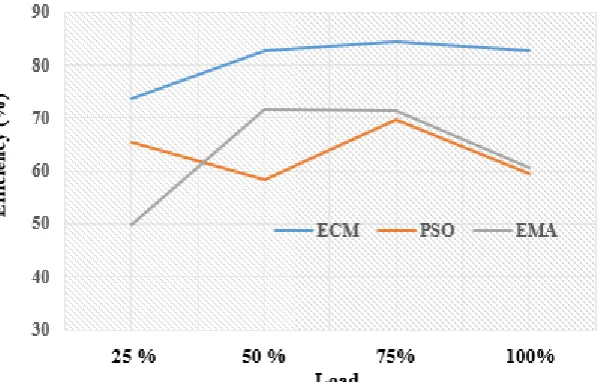
In this test case, each load point experimental data is used for motor parameter and efficiency determination. The comparison of PSO and EMA based EDIM problem for test case 2 is summarized in Table 3, and shown in Figs. 5 and 6.
approach in terms of quality of solution. Furthermore, heuristic algorithms using test case 2 provides better results than the test case1.
Table 3
Comparison of ECM, PSO and EMA results for test case 2
Motor Load
ECM PSO EMA
Efficiency (%)
Error (%)
Efficiency (%)
Error (%)
Efficiency (%)
Error (%) 25% 73.57 16.37 65.51 8.31 49.77 -5.43 50% 82.56 15.51 58.43 -8.62 71.77 4.72 75% 84.25 7.24 69.58 -7.43 71.40 -3.61 100% 82.65 18.84 59.44 -4.37 60.60 -1.21 CPU Time
(sec) - 6.62 5.34
Fig. 5. Magnitude of errors in percentage efficiency for test case 1
Fig.6. Comparison of various methods for test case 2
VI.CONCLUSION
Appendix
Specifications of 5 HP motor
Specifications Value Capacity 5 HP
Voltage 230 V Current 12.5 A Speed 1450 rpm
REFERENCES
[1]
IEEE Power Engineering Society, “IEEE Standard test procedure for polyphase induction motors and generators,” IEEE Std. 112 – 1991.[2]
Ontario Hydro Report TSDD – 90 – 043, “Inplant electric motor loading and efficiency techniques,”1990.[3]
B. Lu, T.G. Habetler, and R.G. Harley, “A survey of efficiency estimation methods of in- service induction motors with considerations of condition monitoring,” in Proc. 2005 International Electric Machine and drive conference, pp.1365 – 1372, 2005.[4]
A.V. Gumaste, and I. Tsal, “Apparatus for measuring torque to a shaft,” Caterpillar Inc., Pat. No. 4899598, 1990.[5]
Gaspli, M. Takeshita, , and N. Matsui, “An automated equivalent circuit parameter measurements of an induction motor using a V/ f PWM inverter’, Proceedings of the 1990 International Power Electronics Conference, Japan, vol.2, pp.659 – 666, 1990.[6]
P. Pillai, R. Nolan, and T. Haque, “Application of genetic algorithms to motor parameter determination for transient torque calculations,” IEEE Transactions on Industry Applications, vol. 33, no.5, pp.1273 – 1281, 1997.[7]
F. Alonge, F. Dlppolito, G. Ferrante, and F.M. Raimondi, “Parameter identification of induction motor model using genetic algorithm,” IEE Proceedings on Control Theory Applications, vol. 145, no. 6, pp. 587-593, 1998.[8]
Abdelhadi, A. Benoudjit, and N. Nait Said, “Identification of induction machine parameters using a new adaptive genetic algorithm,”Electric Power Components and Systems, vol.32, pp. 767-784, 2004.[9]
S. Subramanian, and R. Bhuvaneswari, “Evolutionary programming-based determination of induction motor efficiency,”Electric Power Components and Systems, vol. 34, pp. 565-576, 2006.