White Rose Research Online URL for this paper:
http://eprints.whiterose.ac.uk/1454/
Article:
Wellings, A orcid.org/0000-0002-3338-0623 and Burns, A orcid.org/0000-0001-5621-8816
(1997) Implementing atomic actions in Ada 95. IEEE Transactions on Software
Engineering. pp. 107-123. ISSN 0098-5589
https://doi.org/10.1109/32.585500
[email protected] https://eprints.whiterose.ac.uk/ Reuse
Items deposited in White Rose Research Online are protected by copyright, with all rights reserved unless indicated otherwise. They may be downloaded and/or printed for private study, or other acts as permitted by national copyright laws. The publisher or other rights holders may allow further reproduction and re-use of the full text version. This is indicated by the licence information on the White Rose Research Online record for the item.
Takedown
If you consider content in White Rose Research Online to be in breach of UK law, please notify us by
Implementing Atomic Actions in Ada 95
Andy Wellings and Alan Burns, Member, IEEE Computer Society
Abstract—Atomic actions are an important dynamic structuring technique that aid the construction of fault-tolerant concurrent systems. Although they were developed some years ago, none of the well-known commercially-available programming languages directly support their use. This paper summarizes software fault tolerance techniques for concurrent systems, evaluates the Ada 95 programming language from the perspective of its support for software fault tolerance, and shows how Ada 95 can be used to implement software fault tolerance techniques. In particular, it shows how packages, protected objects, requeue, exceptions, asynchronous transfer of control, tagged types, and controlled types can be used as building blocks from which to construct atomic actions with forward and backward error recovery, which are resilient to deserter tasks and task abortion.
Index Terms—Software fault tolerance, atomic actions, Ada 95, exception handling, recovery blocks, conversations.
—————————— ✦ ——————————
1 I
NTRODUCTIONECHNIQUES for tolerating software faults are often clas-sified according to whether they are static (masking) or dynamic. With static redundancy, several versions of a software component are written and each version executes in response to all requests; voting is performed on the out-put to determine which result to use. It is static because each version of the software has a fixed relationship with every other version and the voter; and because it operates whether or not faults have occurred. With dynamic redun-dancy, the redundant components only come into operation when an error has been detected.
Dynamic fault tolerance has four constituent phases [1]. 1) Error detection. Faults of significance will eventually
manifest themselves in the form of errors; no fault tol-erance schemes can be utilized until errors are detected. 2) Damage confinement and assessment. When an error has been detected, a decision must be made on the extent to which the system has been corrupted; the delay between a fault occurring and the manifestation of the associated error means that erroneous information could have spread throughout the system.
3) Error recovery. Error recovery techniques aim to trans-form a corrupted system into a state from which it can continue its normal operation (perhaps with de-graded functionality).
4) Fault treatment and continued service. An error is a symptom of a fault; although the damage may have been repaired, the fault may still exist and, therefore, the error may recur unless some form of maintenance is undertaken.
This paper is primarily concerned with dynamic redun-dancy techniques and, in particular, damage confinement and error recovery. For sequential systems, damage
con-finement is well understood; techniques such as modular programming and object-oriented encapsulation (within the context of a strongly typed programming language) enable faults to be confined. Judicious placement of accep-tance tests or assertions allow errors to be detected before damage can be propagated. Similarly, techniques such as exception handling [2] (forward error recovery) and recov-ery blocks [3] (backward error recover) allow error recovrecov-ery to be performed according to whether the fault was antici-pated or not.
For concurrent systems, the position is not so clear cut. Although techniques such as conversations [4] and atomic actions [5] were developed some time ago, few of the main-stream languages or operating systems provide direct sup-port [6]. Instead, languages such as Concurrent Pascal have been used as the basis for experimentation [7], or a set of procedural extensions or object extensions have been pro-duced. For example, Arjuna uses the latter approach to provide a transaction-based toolkit for C++ [8].
Arguably, high-level support is not needed and the re-quired functionality can be programmed with lower-level primitives. For example, some attempts have been made to program conversations in Ada 83 [9], [10], [11]; however, these were severely hampered by the lack of suitable lan-guage support. For instance, Romanovsky and Strigini [11] only allow parallelism to exist inside a conversation; the ap-proach is not appropriate if a collection of pre-existing tasks wish to participate collectively in a conversation. None of these attempts address how to structure atomic actions with both forward and backward error recovery in Ada 95.
The goals of this paper are to:
• summarize software fault tolerance techniques for concurrent systems
• evaluate the Ada 95 programming language [12] from the perspective of its support for software fault tolerance
• show how Ada 95 can be used to implement software fault tolerance techniques.
Section 2 reviews the requirements for atomic action and Section 3 briefly describes how forward and backward er-ror recovery can be undertaken. Section 4 describes the new
0098-5589/97/$10.00 © 1997 IEEE
————————————————
• A. Wellings and A. Burns are with the Real-Time Systems Research Group, Department of Computer Science, University of York, Heslington, York YO1 5DD UK. E-mail: {andy, burns}@minster.york.ac.uk. Manuscript received Dec. 6, 1996; revised Feb. 12, 1997.
Recommended for acceptance by J.C. Knight.
For information on obtaining reprints of this article, please send e-mail to: [email protected], and reference IEEECS Log Number S95104.
features of Ada 95 that are required to implement atomic actions. Section 5 then shows how these features can be used to program: simple actions, actions with backward error recovery, actions with forward error recovery, actions which are resilient to deserters, nested actions, and reusable actions. Section 6 gives a simple example, while Conclu-sions are presented in Section 7.
2 A
TOMICA
CTIONSOne of the main motivations for introducing concurrent processes into a system is that they enable parallelism in the real world to be reflected in application programs. This en-ables such programs to be expressed in a more natural way and leads to the production of more reliable and maintain-able systems. However, concurrent processes create many new problems which do not exist in the purely sequential program. In particular, consideration has to be given to the way in which groups of cooperating concurrent processes should be structured in order to coordinate their activities. For example, withdrawal from a bank account may involve a ledger process and a payment process in a sequence of communications to authenticate the drawer, check the bal-ance and pay the money. Furthermore, it may be necessary for more than two processes to interact in this way to per-form the required action. In all such situations, it is impera-tive that the processes involved see a consistent system state. With concurrent processes, it is all too easy for groups of processes to interfere with one another.
An atomic action has been proposed as a dynamic mechanism for controlling the joint execution of a group of processes such that their combined operation appears as an indivisible action.
There are several almost equivalent ways of expressing the properties of an atomic action [5], [13].
1) An action is atomic if the processes performing it are not aware of the existence of any other active process, and no other active process is aware of the activity of the processes during the time the processes are per-forming the action.
2) An action is atomic if the processes performing it do not communicate with other processes while the ac-tion is being performed.
3) An action is atomic if the processes performing it can detect no state change except those performed by themselves, and if they do not reveal their state changes until the action is complete.
4) Actions are atomic if they can be considered, so far as other processes are concerned, to be indivisible and instantaneous, such that the effects on the system are as if they were interleaved as opposed to concurrent. Although an atomic action is viewed as being indivisible, it can have an internal structure. To allow modular de-composition of atomic actions, the notion of a nested atomic action is introduced. The processes involved in a nested action must be a subset of those involved in the outer level of the action. If this were not the case, a nested action could smuggle information concerning the outer-level action to an external process. The outer-outer-level action would then no longer be indivisible.
2.1 Requirements for Atomic Actions
The implementation requirements for atomic actions are independent of the notion of a process and the form of in-terprocess communication provided by a language [14]. They are:
1) Well-defined boundaries. Each atomic action should have a start, end and a side boundary. The start boundary is the location in each process involved in the atomic action where the action is deemed to start. The end boundary is the location in each process in-volved in the atomic action where the action is deemed to end. The side boundary separates those processes involved in the atomic action from those in the rest of the system.
2) Indivisibility. An atomic action must not allow the ex-change of any information between the processes ac-tive inside the action and those outside (resource managers excluded). If two atomic actions do share data then the value of that data after the atomic ac-tions is determined by the strict sequencing of the two actions in some order.
There is no implied synchronization at the start of an atomic action. Processes can enter at different times. However, there is an implied synchronization at the end of an atomic action; processes are not al-lowed to leave the atomic action until all processes are willing and able to leave.
3) Nesting. Atomic actions may be nested as long as they do not overlap with other atomic actions. Conse-quently only strict nesting is allowed.
4) Concurrency. It should be possible to execute different atomic actions concurrently. One way to enforce indi-visibility is to run atomic actions sequentially. How-ever, this could seriously impair the performance of the overall system and therefore should be avoided. Nevertheless, the overall effect of running a collection of atomic actions concurrently must be the same as that which would be obtained from serializing their executions.
5) Recovery. As it is the intention that atomic actions should form the basis of damage confinement, they must allow recovery procedures to be programmed. Executing an atomic action requires the participating proc-esses to coordinate their activities. The imposed synchroni-zation on the action is as follows. Processes entering the action are not blocked. A process is only blocked inside the action if it has to wait for a resource to be allocated, or if it attempts to communicate with another process inside the action and that process is either: active in the action but not in a position to accept the communication, or is not, as yet, active in the action.
3 R
ECOVERABLEA
TOMICA
CTIONSThis section considers atomic actions with either backward or forward error recovery. Backward error recovery relies on restoring the system to a safe state previous to that in which the error occurred. In contrast, forward error recov-ery attempts to continue from an erroneous state by making selective corrections to the system state.
3.1 Atomic Actions and Backward Error Recovery
When backward error recovery is applied to groups of com-municating processes, it is possible for all the processes to be rolled back to the start of their execution. This is the so called domino effect. The problem occurs if there is no consistent set of recovery points or a recovery line. An atomic action pro-vides that recovery line automatically. If an error occurs in-side an atomic action then the processes involved can be rolled back to the start of the action and alternative algo-rithms executed; the atomic action ensures that processes have not passed any erroneous values through communica-tion with processes outside the accommunica-tion. When atomic accommunica-tions are used in this way they are called conversations [15].
With conversations, each action statement contains a re-covery block. For example, the following illustrates a com-ponent of a three process conversation. This comcom-ponent will be executed by process P1; P2 and P3 will execute simi-lar structures:
action A with (P2, P3) do ensure <acceptance test> by
-- primary module else by
-– alternative module else by
-– alternative module else error
end A;
The basic semantics of a conversation can be summarized as follows:
• On entry to the conversation, the state of a process is saved. The set of entry points forms the recovery line.
• While inside the conversation, a process is only al-lowed to communicate with other processes active in the conversation and general resource managers. As conversations are built from atomic actions, this property is inherited.
• In order to leave the conversation, all processes active in the conversation must have passed their acceptance test. If this is the case then the conversation is finished and all recovery points are discarded.
• If any process fails its acceptance test, all processes have their state restored to that saved at the start of the conver-sation and they execute their alternative modules. It is, therefore, assumed that any error recovery to be per-formed inside a conversation must be performed by all processes taking part in the conversation.
• Conversations can be nested, but only strict nesting is allowed.
• If all alternatives in the conversation fail then recov-ery must be performed at a higher level.
It should be noted that in conversations, as defined by Randell [15], all processes taking part in the conversation must have entered the conversation before any of the other processes can leave. This differs from the semantics de-scribed here. If a process does not enter into a conversation, either because of tardiness or because it has failed, then as long as the other processes active in the conversation do not wish to communicate with it then the conversation can complete successfully. If a process does attempt to commu-nicate with a missing process then it can either block and wait for the process to arrive or it can wait for a defined time interval and then continue. Adopting this approach has two benefits [16]:
1) It allows conversations to be specified where partici-pation is not compulsory.
2) It allows processes with deadlines to leave the con-versation, continue, and if necessary take some alter-native action.
Conversations have been discussed by Kim [7] in the context of extensions to Concurrent Pascal and Tyrrell and Holding [17], and Jalote and Campbell [18], [19] in the con-text of CSP.
Although conversations allow groups of processes to co-ordinate their recovery, they have been criticized. One im-portant point is that when a conversation fails, all the proc-esses are restored and all enter their alternative modules. This forces the same processes to communicate again to achieve the desired effect; a process cannot break out of the conversation. This may not be what is required. Gregory and Knight [16] point out that in practice when one process fails to achieve its goal in a primary module through com-munication with one group of processes, it may wish to communicate with a completely new group of processes in its secondary module. Furthermore, the acceptance test for this secondary module may be quite different. There is no way to express these requirements using conversations. To overcome some of the problems associated with conversa-tions, Gregory and Knight [16] have proposed an alterna-tive approach to backward error recovery with concurrent processes.
3.2 Atomic Actions and Forward Error Recovery
Although backward error recovery enables recovery from unanticipated errors, it is difficult to undo any operation that may have been performed in the environment in which the system operates. Consequently, forward error recovery and exception handling must also be considered. In this section, exception handling between the concurrent proc-esses involved in an atomic action is discussed.
action A with (P2, P3) do --the action
exception
when exception_Y =>
-– sequence of statements when exception_Z =>
-– sequence of statements when others =>
raise atomic_action_failure; end A;
With the termination model of exception handling, if all processes active in the action have a handler and all handle the exception without raising any further exception, then the atomic action completes normally. If a resumption model is used, once the exception has been handled, the processes active in the atomic action resume their execution at the point where the exception was raised.
With either model, if there is no exception handler in any one of the processes active in the action or one of the handlers fails then the atomic action fails with a standard exception atomic_action_failure. This exception is raised in all the in-volved processes.
There are two issues which must be considered when exception handling is added to atomic actions: resolution of concurrently raised exceptions and exceptions in nested actions [4]. These are now briefly reviewed.
3.2.1 Resolution of Concurrently Raised Exceptions
It is possible for more than one process active in an atomic action to raise different exceptions at the same time. As Campbell and Randell [4] point out, this event is likely if the errors resulting from some fault cannot be uniquely identified by the error detection facility provided by each component of the atomic action. If two exceptions are si-multaneously raised in an atomic action then there may be two separate exception handlers in each process. It may be difficult to decide which one should be chosen. Further-more, the two exceptions in conjunction constitute a third exception which is the exception which indicates that both the other two exceptional conditions have occurred.
In order to resolve concurrently raised exceptions, Campbell and Randell propose the use of an exception tree. If several exceptions are raised concurrently then the ex-ception used to identify the handler is that at the root of the smallest subtree that contains all the exceptions (although it is not clear how to combine any parameters associated with this exception). Each atomic action component can declare its own exception tree; the different processes involved in an atomic action may well have different exception trees.
3.2.2 Exceptions and Internal Atomic Actions
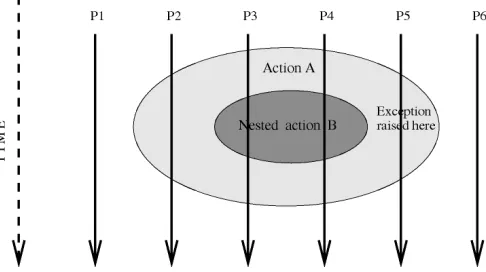
Where atomic actions are nested, it is possible for one proc-ess active in an action to raise an exception when other processes in the same action are involved in a nested action. Fig. 1 illustrates the problem.
[image:5.571.290.533.63.199.2]When the exception is raised, all processes involved must participate in the recovery action. Unfortunately, the internal action, by definition, is indivisible. To raise the ex-ception in that action would potentially compromise that indivisibility. Furthermore, the internal action may have no knowledge of the possible exception that can be raised.
Fig. 1. An exception in a nested atomic actions.
Campbell and Randell [4] have discussed two possible solutions to this problem. The first solution is to hold back the raising of the exception until the internal action has fin-ished. This they reject because:
• In a real-time system the exception being raised may be associated with the missing of a deadline. To hold back the recovery procedure may seriously place in jeopardy the action’s timely response.
• The error condition detected may indicate that the internal action may never terminate because some deadlock condition has arisen.
For these reasons, Campbell and Randell allow internal actions to have a predefined abortion exception. This ex-ception is raised to indicate to the action that an exex-ception has been raised in a surrounding action and that the pre-conditions under which the action was invoked are no longer valid. If such an exception is raised, the internal ac-tion should invoke fault-tolerance measures to abort itself. Once the action has been aborted, the containing action can handle the original exception.
If the internal action cannot abort itself then it must sig-nal an atomic action failure exception. This may then be combined with the outstanding exception so as to affect the choice of recovery to be performed by the surrounding ac-tion. If no abortion exception is defined, the surrounding action must wait for the internal action to complete. Alter-natively, a default handler could be provided which would raise the atomic action failure exception.
4 A
DA95
Ada 83, along with most concurrent programming lan-guages, was unable to support the full functionality of atomic actions [9] in a usable manner. Ada 95 does not support atomic actions directly but does provide a rich supply of language primitives which potentially can be used to implement the same functionality. In particular: packages. Provide encapsulation and information hiding. exceptions. Provide a basic termination model of exception
handling.
protected objects. Provide a monitor-like communication mechanism.
tagged types. Provide the framework from within which ob-ject-oriented programming can be performed.
controlled types. Provide the mechanism by which finaliza-tion code can be associated with objects.
Packages and exceptions were available in Ada 83 and, therefore, will not be discussed further. However, protected objects, ATC, tagged types and controlled types are new and will be briefly described. For a full discussion on these aspects of Ada 95, see Burns and Wellings [20].
4.1 Protected Objects
A protected object in Ada 95 is similar in concept to a con-ditional critical region [21], [22] and a monitor [23], [24]. Data which is to be accessed with mutual exclusion is en-capsulated in a protected object. This data can only be ac-cessed by subprograms and entries also declared in the protected object. Execution of a procedure or an entry re-quires mutual exclusive access over the object. As with tasks in Ada, protected objects may be declared as instances of a type, or a single one-off protected object (of an anony-mous type). For example, the following protected object is a single instance of an anonymous protected type which al-lows mutually exclusive access to shared data.
protected Shared_Data is
-- operations on the shared data procedure Write(D : Data); procedure Read(D: out Data);
private
The_Data : Data := Some_Initial_Value; -- the encapsulated data
end Shared_Data;
protected body Shared_Data is
procedure Write(D : Data) is begin
The_Data := D; end Write;
procedure Read(D : out Data) is begin
D := The_Data; end Read;
end Shared_Data;
The difference between a procedure and an entry in a pro-tected object is as follows. A procedure simply provides mutual exclusive access to the data. If there is no other task active in the protected object, a call on the procedure will gain immediate access to the data. An entry has an associ-ated guard (called a barrier). A call to a guarded entry will only be allowed if the guard evaluates to true and there is no other task active in the protected object. If the guard is false, the task will be placed on a queue associated with the entry. The following shows the above reader/writer exam-ple when a write must initialize the data before it is read.
protected Shared_Data is
procedure Write(D : Data); entry Read(D: out Data);
private
The_Data : Data;
Data_Available : Boolean := False;
end Shared_Data;
protected body Shared_Data is
procedure Write(D : Data) is begin
The_Data := D;
Data_Available := True;
-- indicate that the data is available end Write;
entry Read(D : out Data) when Data_Available is begin
D := The_Data; end Read;
end Shared_Data;
Inside a protected entry, the call can be requeued back onto the same entry or another entry of the same (or different) protected object.
4.2 ATC
The Ada 83 selective entry call facility is extended in Ada 95 to allow a task to execute a section of code whilst it is waiting for the entry (or timeout) to occur. If the code fin-ishes before the entry call is accepted (or the timeout ex-pires) then the call (or timeout) is cancelled. If the call is accepted (or timeout expires) before the section of code fin-ishes then the execution of the code is aborted.
The following illustrates the syntax:
...
select
Trigger.Event; –- trigger is a protected object -- optional sequence of statements to be -- executed after the event has been received
then abort
-– abortable sequence of statements
end select;
4.3 Tagged Types and Object-Oriented Programming
Ada supports object-oriented programming through two complimentary mechanisms which provide type extensions and dynamic polymorphism: tagged types and class-wide types.
In Ada, a new type can be created from an old type and some of the properties of the type changed using derived types. For example, the following declares a new type called Setting which has the same properties as the Inte-ger type but a restricted range. Setting and Integer are distinct and cannot be interchanged:
type Setting is new Integer range 1 .. 100;
New operations manipulating Setting can be defined; however no new components can be added. Tagged types remove this restriction and allow extra components to be added to a type. Any type that might potentially be ex-tended in this way must be declared as a tagged type. Be-cause extending the type inevitably leads to the type be-coming a record, only record types (or private types which are implemented as records) can be tagged.
hi-erarchy for their own purposes without being too con-cerned which member of the hierarchy it is processing at any one time. Ada is a strongly typed language and, there-fore, a mechanism is needed by which an object from any member of the hierarchy can be passed as a parameter.
Class-wide programming is the technique which enables programs to be written which manipulate families of types. Associated with each tagged type, T, there is a type
T'Class which comprises all the types which are in the family of types starting at T. If an operation is called with a parameter whose type is class-wide, then run-time dis-patching occurs to the appropriate operation for the associ-ated actual type.
An object is typically defined by means of a package containing a tagged type and its primitive operations.
package Objects is
type Obj_Type is tagged limited private;
procedure Op1(O : in out Obj_Type); procedure Op2(O : in out Obj_Type);
procedure Class_Wide_Op(O : in Obj_Type’Class);
private
type Obj_Type is tagged limited record
... end record;
end Objects;
The object can be extended (possibly by a child library package—which allows access to the private part in the parent’s declaration).
package Objects.Extended is
type Extended_Type is new Obj_Type with private;
procedure Op1(O : in out Extended_Type); procedure Op2(O : in out Extended_Type);
private
type Extended_Type is new Obj_Type with record
... end record;
end Objects.Extended;
4.4 Controlled Types
Further support for object-oriented programming is pro-vided by controlled types. With these types it is possible to define subprograms that are called (automatically) when objects of the type:
• are created—initialize;
• cease to exist—finalize;
• are assigned a new value—adjust.
To gain access to these features, the type must be de-rived from Controlled, a predefined type declared in the library package Ada.Finalization; that is, it must be part of the Controlled class hierarchy. The package
Ada.Finalization defines procedures for Initialize,
Finalize, and Adjust. When a type is derived from Con-trolled these procedure may be overridden. As objects typically cease to exist when they go out of scope, the exit-ing of a block may involve a number of calls of Finalize. A more restricted type Limited_Controlled provides initialization and finalization only.
5 R
EPRESENTINGR
ECOVERABLEA
TOMICA
CTIONS INA
DA95
In Section 2.1, the requirements for atomic actions were defined. These are now briefly reviewed to evaluate Ada 95 as a potential language for implementing software fault tolerance techniques.
1) Well-defined boundaries. Each atomic action can be en-capsulated in one or more Ada packages and hence the side boundaries of each action are well-defined. Subprograms (procedures and functions) in the pack-age interfaces can be used to provide the start and end points for each task.
2) Indivisibility. Protected objects provide the mecha-nisms with which the indivisibility property of an ac-tion can be implemented. Protected entries can be used to provide the required synchronization on exit from the action.
3) Nesting. Nested actions can be supported by imple-menting the actions as abstract data types.
4) Concurrency. Concurrency between the execution of atomic actions is provided by the concurrency be-tween tasks. Groups of tasks which do not share an action will automatically execute concurrently. 5) Recovery. Backward and forward recovery can be
pro-grammed using a combination of protected objects, ATC, and exceptions.
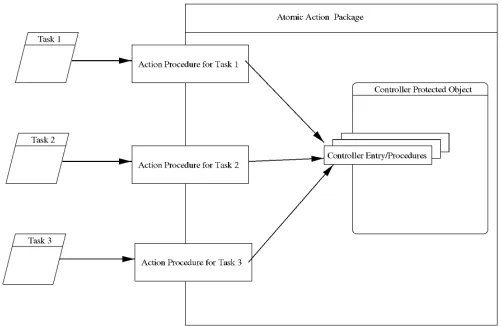
[image:7.571.286.537.439.602.2]The above points suggest that Ada 95 does have the appro-priate mechanisms to facilitate the implementation of soft-ware fault tolerance techniques. The remainder of this sec-tion explores in detail how these mechanisms can be used. The overall approach is illustrated in Fig. 2.
Fig. 2. An Ada 95 framework for implementing atomic actions.
5.1 Simple Actions
package Simple_Action is
procedure T1(Params : Param); -– called by -- Task 1 procedure T2(Params : Param); -– called by -- Task 2 procedure T3(Params : Param); -– called by -- Task 3
end Simple_Action;
The body of the package automatically provides the well-defined boundary, so all that is required is to provide the indivisibility. A protected object, Action_Controller, can be used for this purpose (it provides a similar function to the Coordinated Atomic Action manager introduced by Randell et al. [25], [26]). The package’s visible procedures call the appropriate entries in the protected object. Four entries are sufficient. Each component of the action calls its own individual entry to indicate that it has arrived. On fin-ishing its component, it calls the Finished entry.
package body Simple_Action is
protected Action_Controller is entry First; -– called by T1 entry Second; -– called by T2 entry Third; -– called by T3
entry Finished; -– called by all tasks private
First_Here : Boolean := False; Second_Here : Boolean := False; Third_Here : Boolean := False; Release : Boolean := False; end Action_Controller;
-- definition of local protected objects for -– controlling resources
protected body Action_Controller is separate;
procedure T1(Params) is begin
Action_Controller.First; -- acquire resources
-- the action itself, communicates with tasks -- executing T2
–- and T3 via resources Action_Controller.Finished; –- release resources
end T1;
-- similar for second and third task
begin
-- any initialization of local resources
end Simple_Action;
The implementation of Action_Controller is given below.
separate(Simple_Action)
protected body Action_Controller is
entry First when not First_Here is begin
First_Here := True; end First;
entry Second when not Second_Here is begin
Second_Here := True; end Second;
entry Third when not Third_Here is
begin
Third_Here := True; end Third;
entry Finished when Release or Finished’Count = 3 is
begin
if Finished’Count = 0 then Release := False;
First_Here := False; Second_Here := False; Third_Here := False; else
Release := True;
end if;
end Finished;
end Action_Controller;
The barriers of the entries First, Second, and Third
ensure that only three tasks can be active in the action at any one time. Only when all three tasks have called the
Finished entry is the barrier lowered and all tasks re-leased. The Boolean Release is used to program the re-quired release conditions on Finished. The first two calls on Finished will be blocked as both parts of the barrier expression are false. When the third call comes, the Count
attribute will become three; the barrier comes down and one task will execute the entry body. The Release variable ensures that the other two tasks are both released. The last task to exit must ensure that the barrier is raised again.
Note that Ada’s task identifiers can be used if it is neces-sary to validate the identity of each task performing the action components.
In the following sections, it will be assumed that only those tasks participating in the action use the package im-plementing the action and that each task will only call its associated operation (and no other).
5.2 Backward Error Recovery
In this section, the Ada ATC facility and exception handling are used to implement backward error recovery. Any scheme based on backward error recovery requires the use of some form of recovery cache. This section assumes the existence of the following generic package for saving and restoring a task’s variables. It is assumed that the underly-ing Ada implementation and run-time are fault free, and therefore the strong typing provided by Ada will ensure that the Ada program itself remains viable.
generic
type Data is private;
package Recovery_Cache is
procedure Save(D : in Data); procedure Restore(D : out Data);
end Recovery_Cache;
Consider three Ada tasks which wish to enter into a recov-erable atomic action. Each will call their appropriate proce-dure in the package given below.
package Conversation is
procedure T1(Params : Param); –- called by
-- task 1
procedure T2(Params : Param); –- called by
procedure T3(Params : Param); –- called by -- task 3
Atomic_Action_Failure : exception;
end Conversation;
The body of the package encapsulates the action and en-sures that only communication between the three tasks is allowed during the conversation.1 The Controller pro-tected object is responsible for propagating any error con-dition noticed in one task to all tasks, saving and restoring any persistent data in the recovery cache, and ensuring that all tasks leave the action at the same time. It contains three protected entries and a protected procedure.
• The Wait_Abort entry represents the asynchronous event on which the tasks will wait whilst performing their part of the action (the first call, indicates the start of a new action and ensures that the Controller
saves any persistent data in the recovery cache—the requeue facility is used to place the first task back on the queue). The entry is also responsible for restoring any persistent data (defined within the package body).
• Each task calls Done if it has finished its component of the action without error. Only when all three tasks have called Done will they be allowed to leave.
• Similarly, each task calls Cleanup if it has had to per-form any recovery.
• If any task recognizes an error condition (either be-cause of a raised exception or the failure of the ac-ceptance test), it will call Signal_Abort. This will set the flag Killed to true, indicating that the tasks must be recovered.
Note, that as backward error recovery will be performed, the tasks are not concerned with the actual cause of the er-ror. When Killed becomes true, all tasks in the action re-ceive the asynchronous event. Once the event has been handled, all task must wait on the Cleanup entry so that they all can terminate the conversation module together.
with Recovery_Cache;
package body Conversation is
Primary_Failure, Secondary_Failure, Tertiary_Failure: exception;
type Module is (Primary, Secondary, Tertiary);
package Persistent_Cache is new Recovery_Cache (...);
-- for any persistent data to be retained -- between conversations
protected Controller is
entry Wait_Abort; entry Done; entry Cleanup;
procedure Signal_Abort;
private
Killed : Boolean := False;
Releasing_Done : Boolean := False;
1. In practice, this might be difficult to ensure because of Ada’s scope rules. One way of increasing the security would be to require that the Con-versation package is at the library level and its body only references pure (state free) packages.
Releasing_Cleanup : Boolean := False; Informed : Integer := 0;
New_Conversation : Boolean := True;
end Controller;
-- any local protected objects for communication -- between actions
protected body Controller is
entry Wait_Abort when Killed or New_Conversation is
begin
if New_Conversation then
-- save any persistent data in the recovery -- cache
Persistent_Cache.Save(...); New_Conversation := False; requeue Wait_Abort with abort; --no return to here
end if;
-- only executed when Killed = True Informed := Informed + 1;
if Informed = 3 then Killed := False; Informed := 0;
Persistent_Cache.Restore(...); –- restore any persistent data end if;
end Wait_Abort;
procedure Signal_Abort is begin
Killed := True; end Signal_Abort;
entry Done when Done’Count = 3 or Releasing_Done is
begin
if Done’Count > 0 then Releasing_Done := True; else
Releasing_Done := False; New_Conversation := True; end if;
end Done;
entry Cleanup when Cleanup’Count = 3 or Releasing_Cleanup is
begin
if Cleanup’Count > 0 then Releasing_Cleanup := True; else
Releasing_Cleanup := False; New_Conversation := True; end if;
end Cleanup;
end Controller;
procedure T1(Params : Param) is separate; procedure T2(Params : Param) is separate; procedure T3(Params : Param) is separate;
end Conversation;
state (if the attempt fails). Each attempt is encapsulated in a separate local procedure (T1_Primary, etc.), which con-tains a single ‘select and then abort’ statement to perform the required protocol with the controller. The recovery cache is used by each task to save its local data.
separate Conversation)
procedure T1(Params : Param) is procedure T1Primary is
begin select
Controller.Wait_Abort; -– triggering event Controller.Cleanup; -– wait for all to finish
raise Primary_Failure;
then abort begin
-- code to implement atomic action, -- the acceptance test might raise -- an exception
if Accept_Test = Failed then
Controller.Signal_Abort;
else
Controller.Done; -– signal completion
end if; exception
when others =>
Controller.Signal_Abort;
end; end select; end T1_Primary;
procedure T1_Secondary is ... ; procedure T1_Tertiary is ... ;
package My_Cache is new Recovery_Cache(..);
-– for local data
begin
My_Cache.Save(..); for Try in Module loop begin
case Try is
when Primary => T1_Primary; exit; when Secondary => T1_Secondary; exit; when Tertiary => T1_Tertiary;
end case; exception
when Primary_Failure => My_Cache.Restore(..); when Secondary_Failure => My_Cache.Restore(..); when Tertiary_Failure => My_Cache.Restore(..);
raise Atomic_Action_Failure; when others =>
My_Cache.Restore(..);
raise Atomic_Action_Failure; end;
end loop; end T1;
[image:10.571.292.542.60.293.2]-– similarly for T2 and T3
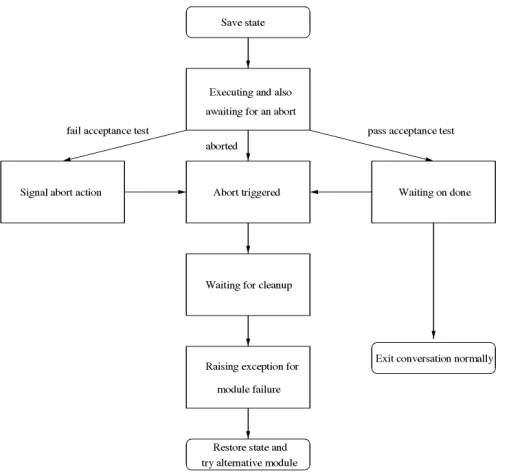
Fig. 3. illustrates a simple state transition diagram for a participating task in an Ada 95-based conversation.
Fig. 3. Simple state transition diagram for a conversation.
5.3 Forward Error Recovery
Ada’s ATC facility can be used with exceptions to implement atomic actions with forward error recovery between concur-rently executing tasks. Consider again the following package for implementing an atomic action between three tasks.
package Action is
procedure T1(Params : Param); -– called by -- task 1 procedure T2(Params : Param); -– called by -- task 2 procedure T3(Params : Param); -– called by -- task 3
Atomic_Action_Failure : exception;
end Action;
As with backward error recover, the body of the package encapsulates the action and ensures that only communica-tions between the three tasks are allowed. The Controller
protected object is responsible for propagating any excep-tion raised in one task to all tasks, and for ensuring that all leave the action at the same time.
with Ada.Exceptions; use Ada.Exceptions; package body Action is
type Vote_T is(Commit, Aborted); protected Controller is
entry Wait_Abort(E: out Exception_Id); entry Done;
entry Cleanup (Vote: Vote_T; Result : out Vote_T);
procedure Signal_Abort(E: Exception_Id);
private
entry Wait_Cleanup(Vote: Vote_T; Result :
out Vote_T);
Killed : Boolean := False;
[image:10.571.31.537.83.738.2]Releasing_Done : Boolean := False; Reason : Exception_Id;
Final_Result : Vote_T := Commit; Informed : Integer := 0;
end Controller;
-- any local protected objects for -- communication between actions
protected body Controller is
entry Wait_Abort(E: out Exception_Id) when
Killed is
begin
E := Reason;
Informed := Informed + 1; if Informed = 3 then Killed := False; Informed := 0; end if;
end Wait_Abort;
entry Done when done’Count = 3 or Releasing_Done is
begin
if Done’Count > 0 then Releasing_Done := True; else
Releasing_Done := False; end if;
end Done;
entry Cleanup (Vote: Vote_T; Result: out Vote_T) when True is begin
if Vote = Aborted then Final_Result := Aborted; end if;
requeue Wait_Cleanup with abort; end Cleanup;
procedure Signal_Abort(E: Exception_Id) is
begin
Killed := True; Reason := E; end Signal_Abort;
entry Wait_Cleanup (Vote: Vote_T; Result: out Vote_T)
when Wait_Cleanup’Count = 3 or Releasing_Cleanup is begin
Result := Final_Result;
if Wait_Cleanup’Count > 0 then Releasing_Cleanup := True; else
Releasing_Cleanup := False; Final_Result := Commit; end if;
end Wait_Cleanup;
end Controller;
procedure T1(Params: Param) is
X : Exception_Id; Decision : Vote_T; begin
select
Controller.Wait_Abort(X); -– triggering event Raise_Exception(X);
-– raise common exception
then abort
begin
-- code to implement atomic action Controller.Done; -– signal completion exception
when E: others =>
Controller.Signal_Abort
(Exception_Identity(E)); end;
end select; exception
-- if any exception is raised during the -- action
-- all tasks must participate in the recovery when E: others =>
-- Exception_Identity(E) has been raised -- in all tasks
-- handle exception if Handled_Ok then
Controller.Cleanup(Commit, Decision); else
Controller.Cleanup(Aborted, Decision); end if;
if Decision = Aborted then raise Atomic_Action_Failure; end if;
end T1;
procedure T2(Params : Param) is ...;
procedure T3(Params : Param) is ...;
end Action;
Each component of the action (T1, T2, and T3) has identical structure. The component executes a select state-ment with an abortable part. The triggering event is sig-naled by the Controller protected object if any compo-nent indicates that an exception has been raised and not handled locally in one of the components. The abortable part contains the actual code of the component. If this code executes without incident, the Controller is informed that this component is ready to commit the action. If any excep-tions are raised during the abortable part, the Controller
is informed and the identity of the exception passed. Note that, unlike backward error recovery (given in the previous section), here the cause of the error must be communicated.
If the Controller has received notification of an un-handled exception, it releases all tasks waiting on the
Wait_Abort triggering event (any task late in arriving will
[image:11.571.288.533.59.377.2]receive the event immediately it tries to enter into its select statement). The tasks have their abortable parts aborted (if started), and the exception is raised in each task by the statement after the entry call to the controller. If the excep-tion is successfully handled by the component, the task in-dicates that it is prepared to commit the action. If not, then it indicates that the action must be aborted. If any task indi-cates that the action is to be aborted, then all tasks will raise the exception Atomic_Action_Failure. Fig. 4 shows the approach using a simply state transition diagram.
of exceptions, as any further exception raised in an abort-able part is lost when it is aborted.
Fig. 4. Simple state transition diagram illustrating forward error recovery.
5.4 The Deserter Problem and Task Aborts
So far, it has been assumed that all expected tasks arrive and leave the action. If a task fails to arrive, all tasks will be blocked trying to leave. To solve the deserter problem, it is necessary to know how many tasks have entered the action. When all the tasks that have entered are ready to leave, the action can complete. A simple modification to the action controller protected object allows for this:
protected Controller is
entry Wait_Abort(E: out Exception_Id); entry Done;
entry Cleanup (Vote: Vote_T; Result : out Vote_T);
procedure Signal_Abort(E: Exception_Id);
private
entry Entered(E: out Exception_Id); entry Wait_Cleanup(Vote: Vote_T; Result : out Vote_T);
Killed : Boolean := False;
Releasing_Done : Boolean := False; Releasing_Cleanup : Boolean := False; Reason : Exception_Id;
Final_Result : Vote_T := Commit; Active : Integer := 0;
end Controller;
A new private entry is provided called Entered and a count, Active, of the number of tasks active in the action. When a task calls the Wait_Abort entry as part of the ATC statement, the call is immediately accepted. The count in-cremented, and the call requeued on the Entered entry.
Entry Wait_Abort(E: out Exception_Id) when
True is
begin
Active := Active + 1; requeue Entered with abort;
end Wait_Abort;
entry Entered(E: out Exception_Id) when Killed is begin
E := Reason;
end Entered;
The guards on the Done and Wait_Cleanup entry are now simply changed to include Active, which is reset to zero when all tasks have finally finished the action:
entry Done when Done’Count = Active or
Releasing_Done is
begin
if Done’Count > 0 then Releasing_Done := True; else
Releasing_Done := False; Active := 0;
end if ;
end Done;
entry Wait_Cleanup (Vote: Vote_T;
Result :out Vote_T)
when Wait_Cleanup’Count = Active or Releasing_Cleanup is
begin
Result := Final_Result;
if Wait_Cleanup’Count > 0 then Releasing_Cleanup := True; else
Releasing_Cleanup := False; Final_Result := Commit; Active := 0;
Killed := False; end if ;
end Wait_Cleanup;
All that is now required is for the Action itself to contain timeouts on any synchronous communication which might block if a cooperating task is absent. If the communication was essential to the action, then an exception can be raised if the timeout expires.
One final problem to address is what happens if a task executing an atomic action is aborted by another task out-side the action. To facilitate recovery in the action, it is nec-essary to use another Ada 95 facility called Controlled
types. Objects of a controlled type can have (amongst other things) finalization routines defined. Hence, each action procedure has the following extra components:
type Abort_Recovery is new
Finalization.Limited_Controlled with null record;
procedure Finalize;
Where, finalization is used to signal to the action controller that the action is to be finalized:
procedure Finalize is begin
Controller.Deregister;
end Finalize; procedure T1 is
...
Ar : Abort_Recovery;
begin
...
If the caller of T1 is aborted, the Ar controlled variable goes out of scope. However, before this can happen, the finalization procedure is called. Note that the Finalize
routine is called every time the variable goes out of scope – irrespective of whether the action was aborted or not! Hence, the Controller itself must recognize when the action is being finalized prematurely:
protected body Controller is
...
procedure Deregister is
begin
if Active /= 0 then –- premature finalization
Killed := True;
Releasing_Done := True; Releasing_Cleanup := True;
Reason := Atomic_Action_Failure’Identity; Final_Result := Aborted;
end if; end Deregister; ...
end Controller;
If controlled types are used, it is possible to optimize the solution to the deserter problem by defining an Initial-ize procedure which calls the Controller to register its arrival. Furthermore, it is possible to use the Deregister
procedure to establish the correct post conditions and hence simplify Done and Wait_Cleanup. This approach is illus-trated in Section 5.6;
5.5 Nested Actions
Implementing nested actions in Ada 95 requires extensions to the above algorithms. The first is to convert the basic approach so that each atomic action is a type and, therefore, more than one instance can be created. This can easily be achieved by introducing the notion of an action identifier. For example, consider the implementation of actions with forward error recovery given in the previous section. The package specification now becomes:
package Action is
type Action_Id is private;
function New_Action return Action_Id;
procedure T1(A : Action_Id, Other Params : Param);
procedure T2(A : Action_Id, Other Params : Param);
procedure T3(A : Action_Id, OtherParams : Param);
Atomic_Action_Failure : exception;
private
type Action T;
type Action_Id is access Action T;
end Action;
As Action_Id is private, assignment and comparison are available. The implementation of the Action_T type is a record containing an instance of the Controller (which becomes a protected type) and instances of any persistent data and their controlling access protocols:
type Action_T is record
C : Controller; ...
end record;
The function New_Action creates a new instance of the
Action_T and hence creates a new Controller.
The interface procedures use the Action_Id to generate the call to the correct controller. For example, if A is of type
Action_Id:
A.C.Wait_Abort;
Once action types have been introduced then nested ac-tion can be called within the body of an acac-tion. This will pro-duce the following Ada structure (where Nested_Action is a package implementing another atomic action and, there-fore, contains its own Action_Id):
with Nested_Action; package body Action
N : Nested_Action.Action_Id := Nested_Action.New_Action;
procedure T1(A: Action_Id, OtherParams :
Param) is X : Exception_Id; Decision : Vote_T;
begin
select
A.C.Wait_Abort(X); RaiseException(X); then abort
begin
-- code to implement atomic action -- including
Nested_Action.T1(N,...);
-– nested action call
A.C.Done; -– completion of outer action
exception
when E: others =>
A.C.Signal_Abort(Exception_Identity(E));
end;
end select; exception
when E: others =>
-- Exception_Identity(E) has been raised -- in all tasks
-- handle exception if Handled_Ok then
A.C.Cleanup(Commit, Decision); else
A.C.Cleanup(Aborted, Decision); end if;
if Decision = Aborted then raise Atomic_Action_Failure; end if;
end T1; ...
end Action;
If this code is expanded (to remove the explicit procedure
Nested_Action.T1), then the following equivalent struc-ture is obtained:
select
A.C.Wait_Abort(...); Raise_Exception(...);
begin
-- code to implement atomic action -- including
select
N.C.Wait_Abort(..); Raise_Exception(..); then abort
begin
-- code to implement inner atomic action N.C.Done; -- signal completion
exception
when E: others =>
N.C.Signal_Abort(Exception_Identity (E));
end; end select;
A.C.Done; -- signal completion
exception
when E: others =>
A.C.Signal_Abort(Exception_Identity (E));
end;
end select;
When the outer action has an exception signalled, the outer ‘then abort’ sequence of code is aborted. This in turn will cause the inner action to be aborted and the finalization recovery (introduced in the previous section) will be in-voked. Of course, a parameter needs to be added to the
Abort_Recovery type to allow the correct controller to be called:
type Abort_Recovery(N : Action_Id) is new Finalization.Limited Controlled with null record;
procedure Finalize(Ar : in out Abort Recovery) is begin
Ar.N.C.Deregister; end Finalize;
5.6 Object-Oriented Programming and Reusability
The action systems developed so far can easily be rewritten to make them extensible. Once written and debugged, they can be used in new systems.
For example, consider a basic package which provides only the action controller supporting forward error recov-ery. If the Controller protected type is placed in the pri-vate part of the package, the child packages can be written which will implement atomic actions for particular systems. The code is, therefore, reused.
with Ada.Exceptions; use Ada.Exceptions; with Ada.Finalization; use Ada.Finalization; package Atomic_Action_Support is
type Action_T is abstract tagged limited private;
Atomic_Action_Failure : exception;
private
type Vote_T is(Commit, Aborted);
protected type Controller is
entry Wait_Abort(E: out Exception_Id); entry Done;
entry Cleanup (Vote: Vote_T; Result : out Vote_T);
procedure Signal_Abort(E: Exception_Id); entry Register;
procedure Deregister; private
entry Wait_Cleanup(Vote: Vote_T; Result : out Vote_T);
Killed : Boolean := False;
Releasing_Cleanup : Boolean := False; Releasing_Done : Boolean := False; Reason : Exception_Id;
Final_Result : Vote_T := Commit; Active : Integer := 0;
New_Action : Boolean := True;
Normal_Termination : Boolean := False; end Controller;
type Action_T is abstract tagged limited record
C : Controller; end record;
end Atomic_Action_Support;
Notice in this example, that the Action_T is now a tagged type. This allows the type to be extended by the child pack-ages.
The body of the package simply contains the body of the
Controller. Actions can now be created by extending the
Action_T type. An example of this is given in the next Section. The full package is given as an appendix.
6 A
NE
XAMPLEA
CTIONS
YSTEMConsider an example of controlling the position of a three axis robot. The software consists of several tasks including a coordinate manager and three tasks controlling the robot itself (one for each axis). The coordinate manager task in-forms the other three tasks when a new position is required. The act of moving from one position to another is an atomic action; the rest of the system should only see the robot in one position or another.
The action support for the robot is a child package of the
Atomic_Action_Support given in the previous section.
The Action_T is extended to include a protected type used to communicate and synchronize between the four tasks. Only when the coordinate manager task has written a new position can the other tasks acquire it. The routines are added for each task.
package Atomic_Action_Support.Robot is
type My_Action_T is new ActionT with private;
type Coordinate is range 0 .. 180; type Coordinates is record
X : Coordinate; Y : Coordinate; Z : Coordinate; end record;
procedure Coord_Manager(A : access My_Action_T; New_Pos : Coordinates); procedure X_Coord(A : access My_Action_T); procedure Y_Coord(A : access My_Action_T); procedure Z_Coord(A : access My_Action_T);
private
procedure Write_Coords(NewPos: Coordinates);
entry Read_X(X : out Coordinate); entry Read_Y(Y : out Coordinate); entry Read_Z(Z : out Coordinate); private
Next_Pos : Coordinates; New_Value : Boolean := False; X_Got : Boolean := False; Y_Got : Boolean := False; Z_Got : Boolean := False; end Shared_Coord;
type My_Action_T is new Action_T with record
Sc : Shared_Coord end record;
type Abort_Recovery(N : access My_Action_T) is new
Limited_Controlled with null record;
procedure Finalize(Ar : in out Abort_Recovery); procedure Initialize(Ar :in out Abort_Recovery);
end Atomic_Action_Support.Robot;
Note, here Ada 95’s access parameters are used. This avoids having to allocate the action’s data dynamically, and allows run-time dispatching of operations to be used should the action be further extended.
The body of the package is given below. The structure of each interface procedure is similar to that given in previous sections.
package body Atomic_ActionSupport.Robot is
procedure Finalize(Ar : in out Abort_Recovery) is begin
Ar.N.C.Deregister; end Finalize;
procedure Initialize(Ar : in out Abort_Recovery) is begin
Ar.N.C.Register; end Initialize;
protected body Shared_Coord is separate;
procedure X_Coord(A : access My_Action_T) is X : Exception_Id;
Decision : Vote_T; Next : Coordinate; Ar : Abort_Recovery(A); begin
select
A.C.Wait_Abort(X); RaiseException(X); then abort
begin
-- code to implement atomic action -- including
A.Sc.Read_X(Next); -- move to new position
A.C.Done; -–signal completion exception
when E: others =>
A.C.Signal_Abort(Exception_Identity (E));
end; end select; exception
when E: others =>
-- move back to the origin A.C.Cleanup(Aborted, Decision); raise Atomic_Action_Failure; end X_Coord;
-- similarly for Y_Coord and Z_Coord
procedure Coord_Manager(A : access My_Action_T;
New_Pos : Coordinates) is X : Exception_Id;
Decision : Vote_T; Ar : Abort_Recovery(A); begin
select
A.C.Wait_Abort(X); Raise_Exception(X); then abort
begin
–- code to implement atomic action -- including
A.Sc.Write_Coords(New_Pos); A.C.Done; –- signal completion exception
when E: others =>
A.C.Signal_Abort(Exception_Identity (E));
end; end select; exception
when E: others =>
A.C.Cleanup(Aborted, Decision); raise Atomic_Action_Failure end Coord_Manager;
end Atomic_Action_Support.Robot;
The body of the Shared_Coord protected object is
separate Atomic_Action_Support.Robot) protected body Shared_Coord is
procedure Write_Coords(New_Pos: Coordinates) is
begin
Next_Pos := New_Pos;
New_Value := True; end Write_Coords;
entry Read_X(X : out Coordinate) when
New_Value is
begin
X := Next_Pos.X; X_Got := True;
if Y_Got and Z_Got then
X_Got := False; Y_Got := False; Z_Got := False; New_Value := False; end if;
end Read_X;
-- similarly for Read_Y and Read_Z
end Shared_Coord;
with Atomic_Action_Support.Robot; use Atomic_Action_Support.Robot; procedure Main is
Robot_Action : aliased My_Action_T; -- the action, all four tasks must enter -- before any can leave
type Dimension is(X, Y, Z);
task Control;
task type Axis(A : Dimension);
X_D : Axis(X); –- the three Axis controller -- tasks
Y_D : Axis(Y); Z_D : Axis(Z);
task body Control is
Start : Coordinates := (0,0,0); Next : Coordinates;
begin
Coord_Manager(Robot_Action’Access, Start); loop
-- determine next position
Coord_Manager(Robot_Action’Access, Next);
end loop; exception
when Atomic_Action_Failure => ...
end Control;
task body Axis is begin
loop
case(A) is
when X => X_Coord(Robot_Action’Access); when Y => Y_Coord(Robot_Action’Access); when Z => Z_Coord(Robot_Action’Access); end case;
-- perform any required operation at the -- new position
end loop; exception{
when AtomicActionFailure =>
...
end Axis;
begin null; end Main;
One criticism of this approach is that the actions under-taken by the clients involve a complex communication protocol with the controller. This protocol can, however, be abstracted out of the application code and put in the
Atomic_Action_Support package [27].
7 C
ONCLUSIONAtomic actions are a powerful dynamic structuring tech-nique that allow software fault-tolerant systems to be im-plemented. However, it is not clear how a programming language or operating system should support their appli-cation. No commercial programming language or operating system provides direct support. The Ada 95 programming language does, however, provide a rich set of mechanisms to aid the programming of concurrent and real-time
sys-tems. This paper has shown how these facilities can be used to implement all aspects of atomic actions.
The Ada facilities are impressive because each defines support for particular functionality:
• encapsulation,
• communication and synchronization,
• exceptions,
• asynchronous transfer of control,
• object-oriented programming
• finalization.
These are the fundamental building blocks which allow resuable atomic actions to be constructed. The ability to program atomic actions in Ada should lead to their increase use in the engineering of high integrity applications.
A
PPENDIXIn this appendix the full code for the final Atomic_Action_ Support package is given.
with Ada.Exceptions; use Ada.Exceptions; with Ada.Finalization; use Ada.Finalization; package Atomic_Action_Support is
type Action_T is abstract tagged limited private;
Atomic_Action_Failure : exception;
private
type Vote_T is(Commit, Aborted);
protected type Controller is
entry Wait_Abort(E: out Exception_Id); entry Done;
entry Cleanup (Vote: Vote_T; Result : out
Vote_T);
procedure Signal_Abort(E: Exception_Id); entry Register;
procedure Deregister; private
entry Wait_Cleanup(Vote: Vote_T; Result : out
Vote_T);
Killed : Boolean := False;
Releasing_Cleanup : Boolean := False; Releasing_Done : Boolean := False; Reason : Exception_Id;
Final_Result : Vote_T := Commit; Active : Integer := 0;
New_Action : Boolean := True;
Normal_Termination : Boolean := False;
end Controller;
type Action_T is abstract tagged limited
record
C : Controller;
end record;
end Atomic_Action_Support; with Ada.Exceptions; use Ada.Exceptions;
package body Atomic_Action_Support is
-- any local protected objects for -- communication between actions
protected body Controller is