This is a repository copy of Algorithms for 3PC(.,.)-free Berge graphs.
White Rose Research Online URL for this paper:
http://eprints.whiterose.ac.uk/74355/
Article:
Maffray, F, Trotignon, N and Vuskovic, K (2005) Algorithms for 3PC(.,.)-free Berge graphs.
Electronic Notes in Discrete Mathematics, 22. 73 - 77 . ISSN 1571-0653
https://doi.org/10.1016/j.endm.2005.06.013
Reuse
See Attached
Takedown
If you consider content in White Rose Research Online to be in breach of UK law, please notify us by
Algorithms for square-3
P C
(
·
,
·
)-free Berge graphs
Fr´ed´eric Maffray ∗
Nicolas Trotignon †
Kristina Vuˇskovi´c‡
June 28, 2007
Abstract
We consider the class of graphs containing no odd hole, no odd antihole, and no configuration consisting of three paths between two nodes such that any two of the paths induce a hole, and at least two of the paths are of length 2. This class generalizes claw-free Berge graphs and square-claw-free Berge graphs. We give a combinatorial algorithm of complexityO(n7
) to find a clique of maximum weight in such a graph. We also consider several subgraph-detection problems related to this class.
AMS classification: 68R10, 68Q25, 05C85, 05C17, 90C27.
Keywords: recognition algorithm, maximum weight clique algorithm, combinatorial algorithms, perfect graphs, star decompositions.
1
Introduction
A graph G is perfect if every induced subgraph G′ of G satisfies χ(G′) = ω(G′), where χ
denotes the chromatic number andω the size of a maximum clique. We say that a graphG
containsa graph H, if H is isomorphic to an induced subgraph ofG. A graphGisH-freeif it does not containH. Aholeis a chordless cycle of length at least four. Asquareis a hole of length 4. A graph is said to beBerge if it does not contain an odd hole nor the complement of an odd hole.
Berge conjectured in 1960 that a graph is Berge if and only if it is perfect. This was proved by Chudnovsky, Robertson, Seymour and Thomas [8] in 2002. Later, Chudnovsky, Cornu´ejols, Liu, Seymour and Vuˇskovi´c [7] gave a polynomial time algorithm that recognizes Berge graphs. In the 1980’s, Gr¨ostchel, Lov´asz and Schrijver [16], [17] gave a polynomial time algorithm that for any perfect graph computes an optimal coloring, and a clique of maximum
∗C.N.R.S., Laboratoire Leibniz-IMAG, 46 Avenue F´elix Viallet, 38031 Grenoble Cedex, France. E-mail:
†Universit´e Paris I, Centre d’Economie de la Sorbonne, 106–112 boulevard de l’Hˆopital, 75647 Paris cedex
13, France, [email protected]. Partially supported by ADONET network, a Marie Curie training network of the European Community.
‡School of Computing, University of Leeds, Leeds LS2 9JT, UK. E-mail: [email protected].
size. This algorithm uses the ellipsoid method and a polynomial time separation algorithm for a certain class of positive semidefinite matrices related to Lov´asz’s upper bound on the Shannon capacity of a graph [20]. The question remains whether these optimization problems can be solved by purely combinatorial polynomial time algorithms, avoiding the numerical instability of the ellipsoid method. The aim of this paper is to give such an algorithm for finding a clique of maximum weight in a subclass of perfect graphs that generalizes claw-free perfect graphs and square-free perfect graphs.
3P C(·,·)’s: A 3P C(x, y) is a graph induced by three chordless paths that have the same endnodesx and y and such that the union of any two of them induce a hole. We say that a graph G contains a 3P C(·,·) if it contains a 3P C(x, y) for some x, y ∈V(G). It is easy to see that in a 3P C(x, y), each of the three paths must have length at least 2. In literature 3P C(·,·)’s are also known as thetas in [9]. A square-3P C(·,·) is a 3P C(·,·) that has at least two paths of length 2.
In this paper we give a combinatorial algorithm, with time complexity O(n7), that com-putes a maximum weight clique in every square-3P C(·,·)-free Berge graph. We will show that every square-3P C(·,·)-free Berge graph has a node whose neighborhood has no long hole (where a long hole is a hole of length greater than 4). This yields a linear-size decom-position tree into square-3P C(·,·)-free Berge graphs that have no long hole, and then these graphs are further decomposed into co-bipartite graphs, resulting in the total decomposition tree of sizeO(n4).
Recall that there is an O(n9) recognition algorithm for the class of Berge graphs [7]. Detecting square-3P C(·,·)’s in a graphG can be done easily: it suffices to check, for every square a1, a2, a3, a4, a1, whether a1 and a3 are in the same connected component of G\ ((N(a2)∪N(a4))\{a1, a3}). This takes timeO(n6). In Section 4, we deal with the complexity of several subgraph-detection problems related to this class.
Aclaw is a graph on nodesu, a, b, cwith three edgesua, ub, uc. It is easy to see that every 3P C(·,·) contains a claw. So 3P C(·,·)-free graphs generalize claw-free graphs. 3P C(·,·)-free Berge graphs were first studied by Aossey and Vuˇskovi´c [2, 3] in the context of proving the Strong Perfect Graph Conjecture for this class. The conjecture was proved by decomposing 3P C(·,·)-free Berge graphs into claw-free graphs using star cutsets, homogeneous pairs and 6-joins (a new edge cutset introduced in that paper).
Clearly square-3P C(·,·) graphs generalize square-free graphs. In [12] square-free Berge graphs are decomposed by 2-joins and star cutsets into bipartite graphs and line graphs of bipartite graphs (hence proving the Strong Perfect Graph Conjecture for this class).
Square-3P C(·,·)-free Berge graphs contain both claw-free Berge graphs and square-free Berge graphs, and it is likely that one might be able to obtain a similar decomposition theorem that uses star cutsets and some of the other mentioned cutsets. And of course all Berge graphs have been decomposed in [8] (thus proving the Strong Perfect Graph Conjecture), into basic classes by skew cutsets, 2-joins and their complements, see also [6].
mentioned above.
Finding a maximum weight clique in a claw-free Berge graph is not difficult. Indeed in such a graph Gthe neighborhood of every node induces a co-bipartite graph (first observed in [18], see also [19]), so the problem reduces to n instances of the maximum weight stable set problem in a bipartite graph, which can be reduced to a maximum flow problem and can be done in time O(n3), see [19].
For a graph Glet k denote the number of maximal cliques in G, nthe number of nodes in G and m the number of edges of G. Farber [14] and independently Alekseev [1] showed that there areO(n2) maximal cliques in any square-free graph. Tsukiyama, Ide, Ariyoshi and Shirakawa [27] gave anO(nmk) algorithm for generating all maximal cliques of a graph, and Chiba and Nishizeki [5] improved this complexity to O(√m+n mk). So one can generate all the maximal cliques of a square-free graph in timeO(√m+n mn2).
For square-free Berge graphs one can obtain a slightly better algorithm by using the following characterization obtained by Parfenoff, Roussel and Rusu [24]: Every square-free Berge graph has a node whose neighborhood is triangulated.
We conclude this section by defining two more types of 3-path-configurations (3P C’s) and wheels.
3P C(∆,∆)’s: Letx1, x2, x3, y1, y2, y3 be six distinct nodes ofGsuch that{x1, x2, x3}and
{y1, y2, y3}both induce triangles. A 3P C(x1x2x3, y1y2y3) is a graph induced by three chord-less paths P1 =x1· · ·y1,P2=x2· · ·y2 and P3 =x3· · ·y3, such that any two of them induce a hole. We say that a graphGcontains a 3P C(∆,∆) if it contains a 3P C(x1x2x3, y1y2y3) for somex1, x2, x3, y1, y2, y3∈V(G). Such graphs are also known as prisms in [8] and stretchers in [13].
3P C(∆,·)’s: Let x1, x2, x3, y be four distinct nodes ofG such that{x1, x2, x3} induces a triangle. We call 3P C(x1x2x3, y) any graph induced by three chordless paths P1 =x1· · ·y,
P2 =x2· · ·y and P3=x3· · ·y, such that the union of any two of them induces a hole. Note
that at least two of three paths must have length at least 2. We say that a graphGcontains a 3P C(∆,·) if it contains a 3P C(x1x2x3, y) for some x1, x2, x3, y ∈ V(G). Such graphs are called pyramids in [8].
Wheels: A wheel (H, x) is a graph induced by a hole H and a node x 6∈V(H) that has at least three neighbors inH. Node xis the center of the wheel. A subpath of H, of length at least 1, whose endnodes are adjacent to x, and no intermediate node is adjacent to x, is called a sector of (H, x). Ashort sector is a sector of length 1, and along sector is a sector of length greater than 1. A wheel isodd if it contains an odd number of short sectors.
It is easy to see that every odd wheel and every 3P C(∆,·) contains an odd hole, so Berge graphs cannot contain these two structures. These facts will be used repeatedly in the proofs.
2
Finding a maximum weight clique in a square-
3
P C
(
·
,
·
)
-free
Berge graph
by ωf(G). The next theorem will help us solve this problem.
For x ∈ V(G), N(x) denotes the set of nodes of G that are adjacent to x, and N[x] =
N(x)∪{x}. ForA⊆V(G),G[A] denotes the subgraph ofGinduced by the node setA. G\A
denotes the subgraph ofGobtainbed by removing the node set A, i.e. G\A=G[V(G)\A].
Theorem 2.1 Let G be a square-3P C(·,·)-free Berge graph. Let x be a node of Gsuch that
N(x)contains a long hole H, and letC be any connected component ofG\N[x]. Then some node of H has no neighbor in C.
The proof of this theorem is long and technical, and we leave it for Section 3. Here we give a corollary of Theorem 2.1 and show how to use it in an algorithm for the maximum clique problem.
Let F be a class of graphs. We say that a graphGis F-free ifGdoes not contain any of the graphs from F.
A classF of graphs satisfiesproperty (*) w.r.t. a graph Gif the following holds: for every node x of G such that G\N[x]6= ∅, and for every connected component C of G\N[x], if
F ∈ F is contained inN(x), then there exists a node ofF that has no neighbor in C. In a graph G, for any node x, let C1, . . . , Ck be the components ofG\N[x], with |C1| ≥
|C2| ≥ · · · ≥ |Ck|, and let the numerical vector (|C1|, . . . ,|Ck|) be associated with x. The
nodes of G can thus be ordered according to the lexicographical ordering of the numerical vectors associated with them. Say that a nodex islex-maximal if the associated numerical vector is lexicographically maximal over all nodes ofG.
Theorem 2.2 LetF be a class of graphs such that for everyF ∈ F, no node ofF is adjacent to all the other nodes ofF. IfF satisfies property (*) w.r.t. a graphGandxis a lex-maximal node of G, then N(x) isF-free.
Proof. Let F be a class of graphs such that for every F ∈ F, no node ofF is adjacent to all the other nodes of F. Assume that F satisfies property (*) w.r.t.G.
Let xbe a lex-maximal node ofGand suppose thatN(x) is notF-free. ThenGis not a clique, and hence, sincex is lex-maximal, G\N[x]6=∅.
Let C1, . . . , Ck be the connected components of G\N[x], with |C1| ≥ |C2| ≥ · · · ≥ |Ck|.
LetN =N(x) and fori= 1, . . . , k, let Ni =N(x)∩N(Ci).
Claim 1: N1 ⊆N2 ⊆ · · · ⊆Nk and for everyi= 1, . . . , k, every node of (N \Ni)∪(Ci+1∪
· · · ∪Ck) is adjacent to every node ofNi.
Proof of Claim 1: We argue by induction. First we show that every node of (N\N1)∪(C2∪
· · · ∪Ck) is adjacent to every node ofN1. Assume not and lety∈(N\N1)∪(C2∪ · · · ∪Ck)
be such that it is not adjacent to z ∈N1. Clearly y has no neighbor in C1, but z does. So
G\N[y] contains a connected component that contains C1∪z, contradicting the choice ofx. Now leti >1 and assume thatN1⊆ · · · ⊆Ni−1and every node of (N\Ni−1)∪(Ci∪· · ·∪Ck)
is adjacent to every node of Ni−1. Since every node ofCi is adjacent to every node ofNi−1, it follows thatNi−1⊆Ni. Suppose that there exists a nodey∈(N \Ni)∪(Ci+1∪ · · · ∪Ck)
that is not adjacent to a nodez∈Ni. Thenz∈Ni\Ni−1 and zhas a neighbor in Ci. Also
components of G\ N[y], C1y, . . . , Cly such that C1 = C1y, . . . , Ci−1 = Ciy−1 and Ci ∪z is
contained inCiy. This contradicts the choice ofx. This completes the proof of Claim 1.
Since G[N] is not F-free, it contains F ∈ F. By property (*), a node y of F has no neighbor in Ck. By Claim 1, y is adjacent to every node ofNk, and no node of N \Nk has
a neighbor in C = C1 ∪. . .∪Ck. So (since every node of F has a non-neighbor in F) F
must contain another nodez∈N\Nk, nonadjacent toy. But thenC1, . . . , Ckare connected
components of G\N[y] andz is contained in (G\N[y])\C, so y contradicts the choice of
x. 2
Theorem 2.3 Let Gbe a square-3P C(·,·)-free Berge graph. Let x be a lex-maximal node in
G. Then the neighborhood of x in G contains no long hole.
Proof. Let G be a square-3P C(·,·)-free Berge graph and let x be a lex-maximal node of G. Let F be the set of all long holes of G. By Theorem 2.1, F satisfies property (*) w.r.t. G. So by Theorem 2.2,N(x) isF-free, i.e. long-hole-free. 2
LetFbe the class of square-3P C(·,·)-free Berge graphs that contain no long hole. Suppose that we have an algorithmAthat computes a clique of maximum weight for every graph inF
in timeO(nt). Then we can compute a clique of maximum weight for every square-3P C(·,·
)-free Berge graphGas follows. By Theorem 2.3,Ghas a nodexwhose neighborhood contains no long hole. Let G0 be the subgraph of Ginduced by N(x). SoG0 is inF. Clearly, since every clique ofGeither containsxor not, we haveωf(G) = max{f(x)+ωf(G0), ωf(G\{x})}.
Thus, in order to computeωf(G), we need only computeωf(G0) andωf(G\{x}). The former
can be done by Algorithm A, and the latter can be done recursively. Note that computing the numerical vector associated with a node takes time O(n2), and so we can find a lex-maximal node in time O(n3). So we can find in time O(n4) an ordering x
1, . . . , xn of the
nodes of G such that, for eachi= 1, . . . , n, nodexi is lex-maximal in the subgraph induced
by xi, . . . , xn. Thus we can compute ωf(G) for every square-3P C(·,·)-free Berge graphGin
timeO(n4+nt+1). Now we describe such an algorithm A. For this purpose we will use the following definition.
Full star decomposition: For x ∈ V(G) such that x is not adjacent to every node of
G\ {x}, letC1, . . . , Cm be the connected components ofG\N[x]. Note that N[x] need not
be a cutset, i.e. possibly m = 1. The blocks of the full star decomposition at x are the graphsG0, G1, . . . , Gm defined as follows: G0 is the subgraph ofGinduced byN(x) and, for
i = 1, . . . , m, Gi is the subgraph of G induced by Ci∪Ni, where Ni is the set of nodes of
N(x) that have a neighbor inCi.
Remark 2.4 From the construction of the blocks of full star decomposition of G it follows easily that ωf(G) = max{f(x) +ωf(G0), ωf(G1), . . . , ωf(Gm)}.
• Stage 1: A decomposition tree T is constructed, where each leaf node is co-bipartite (i.e. complement of a bipartite graph), and for each non-leaf nodeF, the children ofF
inT represent the blocks of a full star decomposition of F.
• Stage 2: A maximum weight clique is computed for each of the leaf nodes, and then the algorithm backtracks alongT to find a maximum weight clique forGusing Remark 2.4.
Finding a maximum weight clique in a co-bipartite graph is equivalent to finding a max-imum weight stable set in a bipartite graph, and it is well-known that this problem can be reduced to a maximum flow in a directed network associated with the bipartite graph, see [19]. From them it is easy to deduce an algorithm (henceforth the “co-bipartite maximum weight clique algorithm”) that computes a maximum weight clique in a co-bipartite graphGin time
O(n3). So if the size of the decomposition tree is polynomial, then Stage 2 of the algorithm can be performed in polynomial time. The key difficulty is to construct T in polynomial time. To perform Stage 1, we decompose using a full star centered at a node contained in an independent set of size 3. Note that when a Berge graph does not contain any independent set of size 3, then it is co-bipartite. The following lemma implies that the decomposition tree so constructed has polynomial size.
Lemma 2.5 Let Gbe a square-3P C(·,·)-free Berge graph that contains no long hole, and let
G0, G1, . . . , Gm be the blocks of a full star decomposition at some node x of G. Then the
following hold:
(1) No independent set of G of size2 is contained in both Gi and Gj for any 1≤i6=j≤m.
(2) No independent set of Gof size 3 is contained in both G0 andGi for any 1≤i≤m.
Proof. Note that in a long-hole-free graph every 3P C(·,·) is a square-3P C(·,·). To prove (1), suppose that{a, b}is an independent set of Gcontained in both Gi and Gj with 1≤i6=j≤
m. Then{a, b} ⊆N(x), and bothaandbhave neighbors in bothCi and Cj. But then there
exists a chordlessa, b-path Pi (resp. Pj) whose intermediate nodes are in Ci (resp. Cj), and
hence Pi∪Pj∪x induces a 3P C(a, b), a contradiction.
To prove (2), suppose that there exists an independent set {a, b, c} that is contained in bothG0 and G1. Then{a, b, c} ⊆N(x) and every node of{a, b, c} has a neighbor inC1. Let
u, v, t be neighbors of a, b, c respectively in C1. Then there is a path P in C1 from u to v. W.l.o.g. u, v, P are chosen so thatP is minimal. ThenP∪ {x, a, b}induces a hole, and since this hole cannot be long, u =v. Ift =u then {x, a, b, c, u} induces a 3P C(x, u). So t6=u. Let Q be a shortest path from t to u in C1. W.l.o.g. no node of Q\ {t} is adjacent to c. Since the graph induced by Q∪ {x, a, c} cannot contain a long hole, a is adjacent tot. By symmetry, bis also adjacent to t, and hence{x, a, b, c, t} induces a 3P C(x, t). 2
Algorithm 2.6
Input: A square-3P C(·,·)-free Berge graphGwith no long hole, and a weight functionf on
V(G).
Output: A maximum weight clique ofG.
Step 2. If L = ∅, then go to Step 3. Otherwise, remove a graph F from L. If F
does not contain an independent set of size 3, then placeF inL′ and return to Step 2.
Otherwise, let {x, y, z} be an independent set of F. Decompose F using the full star decomposition centered atx. Place the blocks of the decomposition inL, add the blocks of the decomposition toT as children of F, and return to Step 2.
Step 3. For every F ∈ L′, find a maximum weight clique of F using the co-bipartite
maximum weight clique algorithm. Note that the leaves of T are precisely the graphs inL′. Using Remark 2.4, backtrack along T to a maximum weight clique of G.
Complexity: O(n6).
Proof. By the definition of Step 2, the graphs in L′ (that represent the leaves of T) do not
contain any independent set of size 3. Since G is Berge, these graphs are co-bipartite. So Step 3 correctly finds a maximum weight clique.
Now we determine the complexity of the algorithm. Consider the tree T obtained at the end of Step 2. We show that the number of non-leaf nodes inT isO(n3). LetF be a non-leaf node of T. Let {x, y, z} be an independent set ofF from Step 2 such that F is decomposed by the full star centered at x. We view {x, y, z} as the label of F. By Lemma 2.5 and the fact thatxis not contained in any of the blocks of decomposition ofF, no two non-leaf nodes of T have the same label. So the number of non-leaf nodes of T is at most n3.
We now show that the number of leaf nodes ofT is alsoO(n3). For a nodeF ofT, define a measure τ(F) as follows: if F is a non-leaf node of T, then let τ(F) be the number of independent sets of size 3 in F; if F is a leaf node and F has at least three siblings in the decomposition tree, then τ(F) = 1; otherwise, τ(F) = 0. Let F be a non-leaf node of T. Suppose thatF is decomposed by a full star centered atx. LetC1, . . . , Cm be the connected
components ofF \N[x], and let F0, . . . , Fm be the blocks of decomposition. We claim that
the following inequality holds:
τ(F)≥τ(F0) +τ(F1) +· · ·+τ(Fm). (1)
Indeed, by Lemma 2.5, no independent set of F of size 3 is contained in more than one block of the decomposition. So if m < 3, then (1) clearly holds. Suppose that m ≥ 3. To show (1), it is enough to show that the number of independent sets of F of size 3 that are not contained in any of the blocks is ≥ m+ 1. For i = 1, . . . , m, let ci be a node of Ci.
The number of sets that contain x and two nodes from {c1, . . . , cm} is m2
. The number of sets that contain three nodes from {c1, . . . , cm} is m3
. Note that all these sets of size 3 are independent sets of F that are not contained in any of the blocks of the decomposition. So the number of independent sets of size 3 of F that are not contained in any of the blocks is at least m2
+ m3
. Sincem≥3, m2 + m3
≥m+ 1. Therefore, (1) holds. By repeated applications of (1) we get the inequality: τ(G)≥P
{τ(F)|F leaf ofT}. So the number of leavesF ofT such thatτ(F) = 1 isO(n3). By the definition of τ, the number of leaves F of T such that τ(F) = 0 is at most 3 times the number of internal nodes of T. Hence, the number of leaves F of T such that τ(F) = 0 is O(n3). Therefore the number of leaves of T isO(n3).
So the size of T isO(n3). When the algorithm examines a non-leaf node ofT, it looks for an independent set of size 3. Since F is Berge, it suffices to check whether its complement
this method will produce an independent set of size 3 whenever F is not bipartite). So the complexity of constructingT isO(n5), and the total complexity of Step 3 isO(n6). Therefore, the overall complexity of the algorithm is O(n6). 2
This implies that we can compute ωf(G) for every square-3P C(·,·)-free Berge graph G
in time O(n7). In fact this algorithm can be turned into a robust algorithm (in Spinrad’s sense [25]). We would not need to know that the input graphGto the algorithm is a square-3P C(·,·)-free Berge graph. The algorithm would then either correctly computeωf(G) (in all
cases whenG is a square-3P C(·,·)-free Berge graph, and in some cases when it is not) or it would identify G as not being a square-3P C(·,·)-free Berge graph. As in the algorithm we have just given, we would start by looking for a lex-maximal vertex x. We would then check whether N(x) is long-hole-free. If it is not, we would terminate the algorithm, outputing that G is not a square-3P C(·,·)-free Berge graph (by Theorem 2.3). In the second part of the algorithm where we decompose graphs with no long hole, at each decomposition we would verify that (1) and (2) of Lemma 2.5 hold (which can easily be done). If one of those conditions fails, we would again terminate the algorithm, outputing that Gis not a square-3P C(·,·)-free Berge graph. Otherwise, we would end up with an O(n3) decomposition tree as before. We would now just have to check whether the leaves are co-bipartite. If they are not, we would again terminate, outputing thatGis not a square-3P C(·,·)-free Berge graph.
3
Proof of Theorem 2.1
To prove Theorem 2.1 we prove the following stronger result. We sign a graph by assigning 0,1 weights to its edges in such a way that, for every triangle in the graph, the sum of the weights of its edges is odd. A graphGiseven-signableif there is a signing of its edges so that for every hole in G, the sum of the weights of its edges is even. Clearly, every odd-hole-free graph is even-signable (assign weight 1 to all its edges). The following theorem is an easy consequence of a theorem of Truemper [26].
Theorem 3.1 (Conforti et al. [10, 11]) A graph is even-signable if and only if it does not contain an odd wheel nor a 3P C(∆,·).
The fact that even-signable graphs do not contain odd wheels and 3P C(∆,·)’s will be used throughout the proof of the next theorem.
Remark: Even though Theorem 3.2 below implies that every square-3P C(·,·) even-signable graph has a node whose neighborhood is long-hole-free, finding a largest clique in a claw-free odd-hole-free graph (and hence in a square-3P C(·,·)-free even-signable graph) is NP-hard. Indeed it is proved in [22] that it is NP-hard to find a largest independent set in a graph with no cycle of length 3, 4, or 5, and so it is NP-hard to find a largest clique in a graph with no stable set of size 3 and no hole of length 5.
Theorem 3.2 Let G be a square-3P C(·,·)-free even-signable graph. Let x be a node of G
Proof. Assume that every node of H has a neighbor inC. We will show that this leads to a contradiction. Let n be the length of H, and let H =h1h2· · ·hnh1. Note that since (H, x) cannot be an odd wheel, H must be of even length, son≥6. For any nodeu, we denote by
NH(u) the set N(u)∩V(H).
Claim 1 Every node u of C that has a neighbor in H is one of the following five types:
• Type i, i= 1,2,3: u has exactly ineighbors in H, and they are consecutive along H.
• Type 4: u has exactly four neighbors hi, hi+1, hj, hj+1 in H (that appear in this order
when traversing H clockwise), where i, j have different parities.
• Type 5: u has exactly two neighbors hi and hj in H,iandj are of the same parity and
the two subpaths of H from hi to hj are of length greater than 2.
Proof. Lets=|NH(u)|. Note that ifuhas three pairwise non-adjacent neighborsa, b, cinH,
then {x, u, a, b, c} induces a square-3P C(x, u), a contradiction. Therefore NH(u) is covered
by at most two cliques of H and s≤4. If s= 1 then u is of Type 1. Suppose s= 2 and u
is not of Type 2. Let hi and hj be the two neighbors ofu inH. LetH′ be a subpath of H
whose one endnode ishi and the other is hj. Ifi and j are not of the same parity, H′ is of
odd length greater than one and hence H′ ∪ {u, x} induces an odd wheel with center x. If
H′ is of length 2, thenH∪uinduces a square-3P C(h
i, hj). Sou must be of Type 5. Ifs= 3
and u is not of Type 3, then (H, u) is an odd wheel. Supposes= 4 andu is not of Type 4. Then u has four neighborshi, hi+1, hj, hj+1 inH wherei, j have the same parity. Let H′ be a subpath of H from hi+1 to hj. H′ cannot be of length one, since then (H, u) is an odd
wheel. So H′ is of odd length greater than one, and henceH′∪ {u, x} induces an odd wheel
with center x. This proves the claim. 2
Claim 2 Let P =p1· · ·pk be a chordless path in C such that k ≥2, nodes p1 and pk both
have neighbors in H, and no node ofP\ {p1, pk} has a neighbor inH. If NH(p1)6⊆NH(pk)
and NH(pk)6⊆NH(p1), then one of the following holds:
(i) NH(p1) ={a}, NH(pk) ={b} and either abis an edge or the two subpaths ofH\ {a, b}
are both of even length.
(ii) NH(p1) = {a, b}, NH(pk) = {c, d}, ab and cd are edges, and the subpaths of H \
{a, b, c, d} are of even length.
(iii) For some i∈ {1, . . . , n}, NH(p1) ={hi, hi+1, hi+2}, indices taken modulo n, N(pk)∩
{hi, hi+1, hi+2}=hi, and pk is of Type 3 or 5.
(iv) Nodes p1 and pk are both of Type 5 and they have a common neighbor in H.
Proof. Consider the following property S3: there are three pairwise non-adjacent nodes
hr, hs, ht of H such thatp1 is adjacent to hr and hs (and thus not to ht) and pk is adjacent
to ht and not to hr, hs. Note that S3 does not hold, for otherwise P ∪ {hr, hs, ht, x}induces
a square-3P C(p1, x). By Claim 1, p1 and pk are of Type 1, 2, 3, 4 or 5. This leads, up to
First suppose that p1 is of Type 4, with NH(p1) ={h1, h2, ht, ht+1} witht even, 4≤t≤
n−2. If pk is of Type 1, 2 or 5, then S3 holds. If pk is of Type 3 then either S3 holds, or NH(pk) = {h1, h2, h3}, and in this case either k = 2 and {p1, p2, h1, h3, ht+1, x} induces a 3P C(h1p1p2, x) or k >2 and (H\ {h2})∪ {p1, pk} induces an odd wheel with center p1. If pk is of Type 4, then either S3 holds; or NH(pk) = {h1, h2, hs, hs+1} with s even and 4≤s≤t−2< t≤n−2, and in this case eitherk= 2 and{p1, p2, h1, hs+1, ht+1, x}induces a 3P C(h1p1p2, x), or k >2 and {hs+1, . . . , hn, h1, p1, pk} induces an odd wheel with center
p1; or NH(pk) ={h2, h3, ht+1, ht+2}, and in this case either k= 2 and {x, h1, h2, h3, p1, p2} induces an odd wheel with center h2 or k > 2 and {x, h2, ht+1, p1, pk} induces a
square-3PC(h2, ht+1).
Now suppose that p1 is of Type 3, with NH(p1) = {h1, h2, h3}. If pk is of Type 1, 2
or 3, then either Property S3 holds, or we have outcome (iii), or pk is adjacent to h4 and
NH(pk) ⊆ {h2, h3, h4}, and in this case (H \ {h2, h3})∪P ∪x induces an odd wheel with center x. Ifpk is of Type 5 then eitherS3 holds, or we have outcome (iii).
Now suppose that p1 is of Type 5, with NH(p1) = {h1, ht} and t odd, 5≤t ≤n−3. If
pk is of Type 1 or 2 then either S3 holds, orpk is adjacent toh2 andNH(pk)⊆ {h1, h2}, and in this case P ∪ {x, h2, . . . , ht} induces an odd wheel with center x. If pk is of Type 5 then
either S3 holds, or we have outcome (iv), or NH(pk) ={h2, hs} with s =t±1, and in this
case P∪ {x, h1, h2, ht}induces a 3PC(xh1h2, p1).
Finally, if p1, pk are both of Type 1, sayNH(p1) =hi and NH(pk) =hj withi < j, then
either we have outcome (i), orP∪ {hi, . . . , hj, x}induces an odd wheel with centerx. If one
of p1, pk is of Type 1 and the other is of Type 2, then H∪P induces a 3P C(∆,·). If p1, pk
are both of Type 2, then either we have outcome (ii), or there is a subpath H′ = h
i· · ·hj
of H such that N(p1)∩H′ = {hi}, N(pk)∩H′ = {hj} and H′ is of odd length, and then
P∪H′∪ {x}induces an odd wheel with center x. This proves the claim.
2
Claim 3 C does not contain a path P =p1· · ·pk such that either k= 1 and p1 is of Type 4
or k≥2 and H∪P induces a3P C(∆,∆).
Proof. Suppose that there is such a path. Without loss of generality we have eitherk= 1 and
NH(p1) ={h1, h2, ht, ht+1}, or k≥2,NH(p1) ={h1, h2} and NH(pk) ={ht, ht+1}. Then by Claims 1 and 2, t is even. In particular, h2ht and ht+1h1 are not edges. Since every node of H has a neighbor in C, there exists a chordless path Q = q1· · ·ql in C such that q1 is adjacent to a node ofH\ {h1, h2, ht, ht+1}and ql is adjacent to a node ofP. We may assume
that such pathsP and Q are chosen so that |V(P)∪V(Q)| is minimized. Thus no node of
Q\ {ql}has a neighbor in P, and the only nodes of H that can have a neighbor in Q\ {q1} areh1, h2, ht, ht+1.
First suppose thatk= 1. W.l.o.g. q1 has a neighborhi inh3· · ·ht−1. Some node qj ofQ
must be adjacent to one ofh1, ht+1, elseQ∪ {p1, h1, ht+1, hi, x}induces a square-3P C(x, p1). Let j be the smallest such index; say qj is adjacent to h1. Then qj is not adjacent to ht+1, else{q1, . . . , qj, x, h1, hi, ht+1}induces a square-3PC(x, qj). By the choice ofj, nodeq1 is not adjacent to ht+1. Then j < l, else {q1, . . . , qj, p1, h1, hi, ht+1, x} induces a 3PC(h1p1qj, x).
Then q1 has a neighbor in ht+2· · ·hn, else {p1, q1, . . . , qj} ∪H \ {h2, . . . , hi−1} contains a 3P C(htht+1p1, h1). It follows thatq1 is either of Type 4, or of Type 5 not adjacent to any of
and we choose the smallest suchs. By Claim 2 applied toq1· · ·qs, we haveNH(qs)⊆NH(q1), which is possible only if q1 is of Type 4 with a neighbor in {h1, h2, ht, ht+1}; so, up to symmetry,NH(q1) ={hn, h1, hi, hi+1}, 2< i < t. Let Rbe the shortest path fromq1 toht+1 in the subgraph induced byQ∪ {p1, ht+1}. Ifn > t+ 2, thenR∪ {ht+2, . . . , hn, x}induces an
odd wheel with centerx, while ifn=t+ 2 thenR∪ {hn, x, hi}induces a 3P C(xht+1ht+2, q1), a contradiction. Therefore we must havek≥2, andp1 and pk are of Type 2.
Now we show that either p1 or pk is the only neighbor of ql in P. For suppose the
contrary. Let a, b be respectively the smallest and largest integers such that ql is adjacent
to nodes pa and pb of P. So either a 6= b or 1 < a = b < k. Let j be the largest integer
such that qj has a neighbor in H. We can apply Claim 2 to paths Pa=p1· · ·paql· · ·qj and
Pb = pk· · ·pbql· · ·qj. Since NH(qj) cannot be a subset of both NH(p1) and NH(pk), this
implies that either NH(qj) = {h1, h2, ht, ht+1} or NH(qj) = {hi, hi+1} for some i. In the first case, {q1, . . . , qj} contradicts the minimality of P ∪Q. So we have the second case. If
i= 1, then {pb, . . . , pk} ∪Q contradicts the minimality of P ∪Q. Ifi=twe have a similar
contradiction. If i /∈ {1, t}, then the parity condition of Claim 2 (ii) is violated by one of
Pa, Pb. Therefore, and up to symmetry, we may assume that pk is the only neighbor of ql in
P.
Put pk = ql+1. Let r be the largest index such that a node qr of Q has a neighbor in
H\ {ht, ht+1}. Along the path qr+1· · ·ql+1, let s be the smallest index such that qs has a
neighbor in H. By the choice of qr, we have NH(qs) ⊆ {ht, ht+1}, and qs is of Type 1 or 2.
W.l.o.g., qs is adjacent to ht. By Claim 2 applied to path qr· · ·qs, we have either case (a)
nodesqr, qsare both of Type 1, or (b) nodesqr, qsare both of Type 2, or (c)NH(qs)⊆NH(qr).
More precisely:
In case (a), we have NH(qs) = {ht} and NH(qr) = {hi} for some even i 6= t. Suppose
t+ 2 ≤i ≤n. So r = 1. If s= l, then P ∪Q∪ {x, h2, ht, hi} induces a 3PC(pkqlht, x). If
s < lthenP∪ {q1, . . . , qs} ∪ {ht, . . . , hn, h1}induces a 3PC(pkhtht+1, hi). Thus 2≤i≤t−2.
In case (b), we have NH(qs) = {ht, ht+1} and NH(qr) ={hi, hi+1} for some oddi. If i= 1, then r > 1 and {q1, q2, . . . , qs} contradicts the minimality of P ∪Q. Thus we may assume
w.l.o.g. that 3≤i≤t−1.
In case (c), we have either case (c1) nodeqr is of Type 2 or 3 adjacent toht−1 andht, or (c2)
node qr is of Type 4 with NH(qr) ={hi, hi+1, ht, ht+1} for some oddi with 3≤i≤t−3, or (c3) node qr is of Type 4 and not adjacent to one of ht, ht+1, or (c4) node qr is of Type 5
adjacent to ht and hi for some even i 6= t−2, t, t+ 2. In case (c3), {qr, . . . , ql, pk}
con-tradicts the minimality of P ∪Q. In case (c4), suppose t+ 2 ≤ i ≤ n. If r = l, then
P∪ {qr, x, h2, ht, hi} induces a 3PC(pkqlht, x), while ifr < l thenP∪ {qr} ∪ {ht, . . . , hn, h1} induces a 3PC(pkhtht+1, hi). Thus 2≤i≤t−2.
So we have cases (a), (b), (c1), (c2) or (c4), and in either case there is an index i, with 2 ≤ i ≤ t −1, such that qr is adjacent to hi and NH(qr) ⊆ {hi, . . . , ht+1}. Now, if
ht+1 has no neighbor in qr· · ·ql, then P ∪ (H \ {hi+1, . . . , ht}) ∪ {qr, . . . , ql} induces a
3P C(h1h2p1, pk). If ht+1 has a neighbor in qr· · ·ql−1, then P ∪ (H \ {hi+1, . . . , ht}) ∪
{qr, . . . , ql−1} contains a 3P C(h1h2p1, ht+1). Soql is the unique neighbor of ht+1 inqr· · ·ql.
If i = 2, then P ∪ {qr, . . . , ql, x, h2, ht+1} induces a 3P C(ht+1pkql, h2). If i > 2, then
For i= 1, . . . , n, letHi be the set of Type 3 nodes ofC adjacent tohi, hi+1, hi+2 (indices taken modulo n). Note that Hi induces a clique, for if a, b ∈ Hi are not adjacent, then
{a, b, x, hi, hi+2} induces a square-3P C(hi, hi+2).
Claim 4 Leths, htbe non-adjacent nodes of H andP =y· · ·z be a chordless path inC such
that yis the only neighbor of hs inP and zis the only neighbor ofhtin P. If bothhs−1, hs+1
have a neighbor inP, then NH(y) ={hs−1, hs, hs+1}.
Proof. We may assume up to symmetry that s= 2 and t 6= 4. Let H′ be the hole induced
byP∪ {x, h2, ht}. Since (H′, h3) cannot be an odd wheel, (H′\ {x})∪ {h3}must contain an odd number of triangles. Let R be any long sector of (H′, h
1). If R∪ {h3} contains an odd number of triangles andR contains at least three neighbors ofh3, thenR∪ {h1, h3}induces an odd wheel with center h3. If R contains only two adjacent neighbors a, b of h3, then R cannot contain x and ht; and then, if R does not contain h2 then R∪ {h1, h3, x} induces a 3PC(h3ab, h1), while if R contains h2 then {a, b} = {h2, y} and R∪ {h1, h3, x} induces an odd wheel with centerh2. ThusR∪ {h3}contains an even number of triangles for every long sector R of (H′, h
1). It follows that some edge of H′ \ {x} is a short sector of both (H′, h1) and (H′, h
3), and thus some node ofP is adjacent to h1 and h3; by Claims 1 and 3, such a node is of Type 3 adjacent toh1, h2, h3 and so it can only bey. This proves the claim. 2
Claim 5 Let u be a node of C that has a neighbor in h4· · ·hn. Let P =p1· · ·pk be a path
of C such that pk =u, p1 ∈H1 and no node of P \ {p1} belongs to H1. Then exactly one
node of h1, h3 has a neighbor in P\ {p1}, say h1 does. Node h1 must in fact have a neighbor
in P \ {p1, p2}, and so k≥3. Furthermore, if Q=q1· · ·ql is any other path of C such that
ql =u, q1 ∈H1 and no node of Q\ {q1} belongs to H1, then h1 has a neighbor in Q\ {q1}.
Proof. For lethi be any neighbor of u inh4· · ·hn, and letj be the smallest index such that
hi is adjacent topj. Suppose that neither h1 norh3 has a neighbor in p2· · ·pj. Ifi /∈ {4, n},
then {p1, . . . , pj, h1, h3, hi, x} induces a square-3P C(p1, x). Otherwise, w.l.o.g. i = 4, and hence the same node set induces a 3P C(h3h4x, p1). Thereforeh1 orh3 must have a neighbor inP\ {p1}.
Suppose that bothh1 andh3 have a neighbor inP\ {p1}. If they both have a neighbor in
P\ {p1, p2}, then there is a shortest subpathP′ ofP\ {p1, p2}whose one endnode is adjacent toh1 and the other toh3, and henceP′∪ {p1, x, h1, h3}induces a square-3P C(h1, h3). So we may assume w.l.o.g. that p2 is the unique neighbor of h1 inP \ {p1}. Let pt be the node of
P with lowest index adjacent to h3. Ift= 2, then Claim 1 impliesp2∈H1, a contradiction. Sot >2, and hence{p1, . . . , pt, h1, h3, x}induces a 3P C(p1p2h1, h3). Therefore, not bothh1 and h3 can have a neighbor in P\ {p1}.
Assume w.l.o.g. thath1has a neighbor inP\{p1}. Suppose thatp2is the unique neighbor ofh1 inP\{p1}. If a nodeht, 4< t < n, has a neighbor inP, thenP∪{h1, h3, ht, x}contains
a 3P C(h1p1p2, x). So no node of h5· · ·hn−1 has a neighbor in P. Ifhn has no neighbor in
p1· · ·pj, then i = 4 and hence {p1, . . . , pj, x} ∪(H\ {h2, h3}) induces an odd wheel with
center x. Sohnhas a neighbor in p1· · ·pj. Letptbe such a neighbor with smallest index. If
t < j or t= j and pj is not adjacent to h4, then {p1, . . . , pt, x} ∪(H\ {h1, h2}) induces an odd wheel with center x. So t=j and pj is adjacent to h4. Hence {p1, . . . , pj, h3, h4, hn, x}
Now suppose thath1 does not have a neighbor inQ\{q1}. Thenh3 must have a neighbor inQ\ {q1, q2}, and hence (P \ {p1, p2})∪(Q\ {q1, q2})∪ {h1, h3} contains a chordless path
R from h1 to h3. If p1 does not have a neighbor in Q\ {q1, q2}, then R∪ {p1, x} induces a square-3P C(h1, h3). Sop1 has a neighbor in Q\ {q1, q2}. Let Q′ be the shortest path from
p1 to u whose vertices are contained in (Q\ {q1, q2})∪ {p1}. Now apply the same argument to P and Q′. This proves the claim.
2
Suppose that H1 6= ∅. Let u be any node of C that has a neighbor in h4· · ·hn. Then
there exists a path P = p1· · ·pk in C such that pk =u, p1 ∈H1, and no node of P \ {p1} belongs toH1. By Claim 5, exactly one of h1, h3 has a neighbor inP \ {p1}. Ifh1 does then we say that u is labeled 1 w.r.t. H1, and otherwise u is labeled 3 w.r.t. H1. Note that by Claim 5 this label is unique.
Claim 6 If H1 6= ∅, every node of C adjacent to h4 must be labeled 3 w.r.t. H1, and every
node of C adjacent to hn must be labeled 1 w.r.t. H1.
Proof. Suppose, up to symmetry, that some nodeuofCadjacent toh4is labeled 1 w.r.t.H1.
LetP =p1· · ·pk be a path ofC such thatp1 ∈H1,pk=u, and no node ofP\ {p1} belongs
to H1. Then h3 has no neighbor in P \ {p1}. Let pj be the node of P with lowest index
adjacent to h4. By Claim 5, we have j ≥ 3 and h1 has a neighbor in p3· · ·pj. But then
{p1, p3, . . . , pj, h1, h3, h4, x} contains a 3P C(h3h4x, h1). This proves the claim. 2
Claim 7 No node of C is of Type 3.
Proof. Assume the contrary. W.l.o.g. H16=∅.
Suppose that H3=∅. LetP =p1· · ·pk be a shortest path in C from a nodep1 ofH1 to a nodepk adjacent to h4. So no node ofP \ {p1} belongs to H1, and no node of P\ {pk} is
adjacent to h4. By Claims 5 and 6, we have k≥ 3, nodeh3 has a neighbor in P \ {p1, p2}, node h1 has no neighbor in P \ {p1}, and so, by Claim 6 again, hn has no neighbor in P.
Thenh5 has no neighbor inP, else by Claim 4, applied toh4 andP, we should havepk∈H3. Some node of h6, . . . , hn−1 must have a neighbor inP, elseP ∪(H\ {h2, h3})∪ {x}induces an odd wheel with center x. Let hi be such a node with smallest index. If i is odd, then
P∪ {h4, . . . , hi, x} contains an odd wheel with centerx. Soiis even. Ifhi has a neighbor in
P\ {pk}, then (P\ {pk})∪ {h3, . . . , hi, x}contains an odd wheel with center x. So pk is the
only neighbor of hi in P. By Claims 1 and 3, node h3 cannot be adjacent topk. But then
P∪ {h3, h4, hi, x} contains a 3PC(xh3h4, pk), a contradiction. So H36=∅. Repeating this argument, we obtain thatHi 6=∅ for each oddi.
Lety· · ·z be any shortest path inC from a nodeyof H1 to a nodez ofH3. By Claim 6,
z is labeled 3 w.r.t. H1, and y is labeled 3 w.r.t. H3. So there exists a largest odd integer i such thatC contains a chordless pathP =p1· · ·pkfrom a nodep1 of H1 to a nodepk ofHi,
with no intermediate nodes inH1∪Hi, such thatpkis labeled 3 w.r.t.H1 andp1 is labeledi w.r.t.Hi. In particular, by Claim 5, we have k≥3, nodehi has a neighbor inP\ {pk, pk−1} and hi+2 has no neighbor in P \ {pk}. Also since pk is labeled 3 w.r.t. H1, and since by Claim 6 all nodes ofHn−1 are labeled 1 w.r.t.H1, it follows that i < n−1. Since Hi+26=∅, there exists a shortest pathQ=q1· · ·qlinCsuch thatq1 ∈Hi+2 andql has a neighbor inP.
Suppose that ql is not adjacent to pk. If ql has a neighbor in P \ {pk, pk−1}, then (P \
{pk−1})∪Q∪ {hi, hi+2, x} contains a square-3P C(hi, hi+2). So N(ql)∩P = {pk−1}. Let
Q′ = q′
1· · ·qt′ be the path induced by (P \ {pk})∪Q, where q′1 =q1 and qt′ = p1. Suppose
that q1 is labeled 1 w.r.t. H1. By Claim 5 applied to Q′, this is possible only if pk is the
only neighbor of h3 in P, so i= 3, and h1 has a neighbor in Q. Thenk = 3, for otherwise
Q∪ {x, h1, h3, p1, pk−1, pk} contains a square-3P C(h1, h3). But then {x, h3, h6} ∪ P ∪Q contains a square-3P C(h3, p2). Soq1 is labeled 3 w.r.t.H1. Ifp1 is labeledi+ 2 w.r.t.Hi+2, the maximality ofiis contradicted. Hencep1 is labeledi+ 4 w.r.t.Hi+2, and by Claim 5, we havet≥3, nodehi+4 has a neighbor inQ′\ {q′1, q′2}, andhi+2 has no neighbor inQ′\ {q1′}. If
l >1, then (Q′\ {q′
2})∪ {pk, hi+2, hi+4, x} contains a square-3P C(hi+2, hi+4). Sol= 1. But thenP∪ {q1, h2, hi+2, x} contains a square-3P C(pk−1, hi+2). Therefore,ql must be adjacent
to pk. Thusl≥2.
Letpj be the node of P with smallest index adjacent toql. LetQ′=q1′ · · ·qt′ be the path
induced byQ∪ {p1, . . . , pj}, whereq′1=q1 andq′t=p1. Note thath1 cannot have a neighbor
inQ, since otherwise (P\ {p2})∪Q∪ {h1, h3, x} contains a square-3P C(h1, h3). So node q′1 must be labeled 3 w.r.t. H1. Nodeqt′ must be labeled i+ 4 w.r.t. Hi+2, else the maximality ofiis contradicted. So, by Claim 5, we havet≥3, nodehi+4 has a neighbor inQ′\ {q′1, q2′}, and hi+2 has no neighbor in Q′\ {q1′}. But thenP ∪(Q\ {q2})∪ {hi+2, hi+4, x} contains a square-3P C(hi+2, hi+4). This proves the claim. 2
By Claims 1, 3 and 7, the nodes of C that have a neighbor in H are of Type 1, 2 or 5. Let C′ be a minimal connected induced subgraph of C such that for some s, t ∈ {1, . . . , n}
nodeht is not adjacent tohs norhs+1, and each of hs, hs+1, hthas a neighbor inC′. W.l.o.g.
s= 1. LetP =p1· · ·pk be a shortest path inC′ such thath1 is adjacent top1 andh2 to pk.
Suppose that k = 1. So p1 is of Type 2. Let Q= q1· · ·ql be a path in C′ such that q1 has a neighbor in H\ {hn, h1, h2, h3} and ql is adjacent to p1. Thus C′ =Q∪ {p1}, and no node ofQ\ {q1}has a neighbor in H\ {hn, h1, h2, h3}. If bothh1, h2 have a neighbor in Q, then Q contradicts the minimality ofC′. So we may assume that h
1 has no neighbor in Q. Then hn has no neighbor inQ∪ {p1}, for otherwise a subpath of Q∪ {p1} violates Claim 2 or 3. Ifh2 too has no neighbor inQ, then similarlyh3 has no neighbor inQ∪ {p1}, and then by Claim 2, H∪Q∪p1 induces a 3P C(∆,∆), contradicting Claim 3. So h2 has a neighbor in Q. Let ht be the node of H \ {hn, h1, h2, h3} with highest index adjacent to q1. Then
Q∪ {ht, . . . , hn, h1, h2}and Q∪ {h1, h2, ht, x}induce two wheels with centerh2, one of which is odd, a contradiction. So k >1.
LetQ=q0· · ·ql be a shortest path such thatq0 ∈H\ {hn, h1, h2, h3},Q\ {q0} ⊆C′, and
ql has a neighbor inP (possiblyl= 0). So ifl >0, no node ofP∪Q\ {q0, q1}has a neighbor inH\ {hn, h1, h2, h3}. Note that C′ =P∪Q\ {q0}.
Suppose that h1 has a neighbor in Q. So l >0. Let ht be the node of h4· · ·hn−1 with smallest index adjacent to q1. Then, by the minimality of C′,N(ql)∩P ={p1} and h2 has no neighbor inQ. If h3 has no neighbor in P∪Q, then P ∪(Q\ {q0})∪ {h1, h2, . . . , ht} or
P∪(Q\ {q0})∪ {x, h1, h2, ht} induces an odd wheel with centerh1. Soh3 has a neighbor in
P∪Q. Then Claim 4, applied toh2 and P∪Q, implies thatpkis of Type 3, a contradiction.
Thereforeh1 cannot have a neighbor in Q, and similarly neither canh2.
Ifqlhas exactly one neighborpainP, thenP∪Q∪{h1, h2, x}induces a 3P C(h1h2x, pa). If
So N(ql)∩P ={pa, pa+1}. Nodeh3 must have a neighbor inP, else P∪Q∪ {h1, h2, . . . , q0} contains a 3P C(qlpapa+1, h2). By Claim 1, h3 cannot be adjacent to p1. Now h2, h3, q0 all have a neighbor inC′\ {p
1}, which is connected, and so the minimality ofC′ impliesq0 =h4. Then N(h3)∩P = {pk}, else h1, h3, h4 all have a neighbor in C′ \ {pk}, contradicting the
minimality of C′. But then P ∪ {h
1, h2, h3, x} induces an odd wheel with center h2. This
completes the proof of the theorem. 2
4
On the complexity of several detection problems
4.1 Detecting a 3P C(·,·) or a 3P C(∆,·)
Chudnovsky and Seymour gave an O(n11) to decide if a graph contains a 3P C(·,·) [9] and an O(n9) algorithm to decide if a graph contains a 3P C(∆,·) [7]. Here we give an O(n7) algorithm that decides whether a given graph has either a 3P C(·,·) or a 3P C(∆,·). Say that a 3P C(∆,·) is long if its three paths have length at least 2. Otherwise, exactly one of its paths has length 1, and we say it is short. Here is a sufficient condition for a graph to have a 3P C(·,·) or a long 3P C(∆,·).
Lemma 4.1 LetGbe a graph with four nodes u, a, b, cand a setW ⊆V(G)\{u, a, b, c} such that:
• {u, a, b, c} induces a claw centered at u;
• W induces a connected subgraph of G;
• u has no neighbour in W;
• Every node in{a, b, c} has exactely one neighbour inW. Then, Gcontains a 3P C(·,·) or a long 3P C(∆,·).
Proof. Leta′, b′, c′ be the neighbours ofa, b, cinW. Ifa′ =b′ =c′, then{u, a, b, c, a′}induces
a 3P C(u, a′). Now we may assume a′ 6=b′. ThenG[W] contains a path with endsa′ and b′,
and we letP be a shortest such path. LetQ=c′, . . . , v be a path in G[W] such that v has
a neighbour in P and no node of Q\v has a neighbor in P. Such a Q exists becauseW is connected (possibly c′ =v). Let d(respectively e) be the neighbour of v in P closest to a′
(respectively to b′). LetT be the graph induced byP∪Q∪ {u, a, b, c}. If d=e, thenT is a
3P C(d, u). If d, e are distinct and adjacent thenT is a long 3P C(vde, u). Ifd, e are distinct and non-adjacent thenT contains a 3P C(v, u). 2
Now we can give an O(n6) algorithm for the detection of non-square-3P C(·,·)’s or long 3P C(∆,·)’s, very similar to an O(n5) algorithm by Maffray and Trotignon [21] that detects 3P C(∆,∆)’s or 3P C(∆,·)’s:
Input: A graphG.
Method: For every claw{u, b1, b2, b3} centered at u do:
Step 1. Compute the set X1 of those nodes of V(G) that are adjacent to b1 and not adjacent to u, b2 or b3, and the similar sets X2, X3, and compute the set X of those nodes of V(G) that are not adjacent to any of u, b1, b2, b3. Compute the connected components ofX inG. For each component H of X, and for i= 1,2,3, if some node of H has a neighbour inXi then mark H with label i.
Step 2. For every componentH ofX that has received labeli∈ {1,2,3}, and for every nodex ofXi that has a neighbour inH, assign to xthe other labels ofH (if any). For
eachi= 1,2,3 and for every node xofXi that has a neighbour inXj withj∈ {1,2,3}
and j6=i, assign label j to x.
Step 3. If some node of X1 ∪X2 ∪X3 gets two different labels, return the positive answer and stop.
If the positive answer has not been returned at step 3, return the negative answer.
Complexity: O(n6).
Proof of correctness. Suppose that G contains a non-square-3P C(·,·) or a long 3P C(∆,·), say K. Letu, b1, b2, b3 be the four nodes of a u-centered claw of K, and for i= 1,2,3 let ci
be the neighbour of bi in K\ {u, b1, b2, b3}. Let us observe what the algorithm will do when it examines the 4-tuple {u, b1, b2, b3}. The algorithm will place the three nodes c1, c2, c3 in the setsX1, X2, X3 respectively.
First suppose that K is neither a 3P C(·,·) with one of the paths of length 2 nor a 3P C(∆,·) with all three paths of length 2. Then K \ {u, b1, b2, b3, c1, c2, c3} is contained in a connected component H of X, and all three nodes c1, c2, c3 have a neighbor in H, i.e.
H gets assigned all three labels 1, 2 and 3. So c1 gets labels 2 and 3, and hence step 3 returns the positive answer. IfK is a 3P C(∆,·) with all three paths of length 2, thenK is a 3P C(c1c2c3, u), so by step 2 c1 gets labels 2 and 3, and hence step 3 returns the positive answer. Finally assume that K is a 3P C(·,·) with one of the paths of length 2. W.l.o.g. K
is a 3P C(u, c1). LetH2 (resp.H3) be the connected component ofK\ {u, b1, b2, b3, c1, c2, c3} in which both c1 and c2 (resp. c1 and c3) have a neighbor. Since c1 has a neighbor in both
H2 and H3, in step 2c1 gets labels 2 and 3, and hence step 3 returns the positive answer. Conversely, suppose that the algorithm returns the positive answer when it is examining a u-centered claw {x, b1, b2, b3}. So (up to symmetry) some node c1 ∈X1 gets labels 2 and 3 at step 2. This means that for j = 2,3, there exists a path Rj from c1 to a node of Xj
such that the interior nodes of Rj (if any) lie in X. We can apply Lemma 4.1 to the to the
claw {u, b1, b2, b3} and the set W =V(R2)∪V(R3), which implies that this subgraph (and thus G itself) contains a long 3P C(∆,·) or a 3P C(·,·) (that is non-square because the ci’s
are pairwise distinct). This completes the proof of correctness.
Finding all 4-tuples takes timeO(n4). For each 4-tuple, computing the setsX
1, X2, X3, X takes timeO(n2). Finding the components ofX takes timeO(n2). Marking the components at the end of step 1 can be done as follows: for each edge uv of G, ifu is in a component H
of X and v is in some Xi then mark H with label i. This takes time O(n2). Marking the
nodes ofX1∪X2∪X3 at step 2 can be done similarly. Thus the overall complexity isO(n6).
Detecting square-3P C(·,·)’s is easy to do in time O(n6) as noted in the introduction. So, in order to detect 3P C(·,·)’s or 3P C(∆,·)’s, we are left with the problem of deciding whether a graph has a short 3P C(∆,·). This is an NP-complete problem (proved in the next section) but we can solve it assuming that the graph has no 3P C(·,·) and no long 3P C(∆,·). This could be done in timeO(n9) using the algorithm of Chudnovsky and Seymour [7] that detects 3P C(∆,·). We propose here something faster and simpler but based on the same ideas.
If K is a short 3P C(bde, u) such that u sees b,a is the neighbour ofu along the path of
K fromu tod, andcis the neighbour ofualong the path ofK fromuto e, then we say that (u, a, b, c, d, e) is a frame of K.
Lemma 4.2 Let Gbe a graph with no 3P C(·,·) and no long3P C(∆,·). LetK be a smallest short 3P C(∆,·) of Gwith frame (u, a, b, c, d, e). Let P be the path of K\ {u} between aand
d. Let R be a shortest path of G between a and d such that the interior nodes of R are not adjacent to b, c, e. Then the graph induced by(K\P)∪R induces a smallest short 3P C(∆,·) of G.
Proof. Note that G has no 3P C(∆,·) smaller that K, because it has no long 3P C(∆,·) at all, and because K is a smallest short 3P C(∆,·). Let us denote by r1 = a, . . . , rk = dthe
nodes of R. Let rs the neighbour of u inR with greatest index. Note thatrs exists because
r1 is a neighbor ofu.
We claim that the graph induced by (K \P)∪ {rs, . . . , rk} induces a short 3P C(∆,·).
Indeed, letQbe the path ofK\{u}with end-nodescande. Let us denote byq1 =c, . . . , ql=e
the nodes of Q. If no node of rs. . . rk−1 has neighbours in Q, then the claim holds. So, we may assume that there is a node rt in rs. . . rk−1 that has a neighbour in the interior of Q, and we choose t maximum. Note that t > 1. Let i be the smallest index and j be the greatest index such that qi, qj are neighbors of rt. If t = s, then {rt, . . . , rk, qj, . . . , ql, u, b}
induces a 3P C(bde, rt) that is smaller than K, a contradiction. So t > s. If i = j then
Q∪{rt, . . . , rk, u, b}induces a 3P C(bde, qj) that is smaller thanK, a contradiction. Ifj > i+1
then {rt, . . . , rk, q1, . . . , qi, qj, . . . , ql, u, b} induces a 3P C(bde, rt) that is smaller than K, a
contradiction. Soj =i+ 1. There is a shortest pathS with end-nodesrtand ain the graph
induced byP ∪ {rt. . . , rk}. If d /∈V(S), then Q∪S∪ {u, b} induces a long 3P C(rtqiqj, u),
a contradiction. Ifd∈V(S) then S∪ {q1, . . . , qi, b, u} induces a 3P C(d, u), a contradiction.
This proves the claim.
We proved that K′ = (K\P)∪ {r
s. . . rk} induces a 3P C(∆,·). If s > 1, then K′ is a
3P C(∆,·) smaller thanK, a contradiction. So,s= 1 proving the lemma. 2
Now we can give an algorithm for the detection of short 3P C(∆,·)’s in graphs with no 3P C(·,·) and no long 3P C(∆,·):
Input: A graphG with no 3P C(·,·) and no long 3P C(∆,·).
Output: The positive answer “G contains a short 3P C(∆,·)” if it does; else the negative answer “G contains no short 3P C(∆,·).”
Method:
Step 1. Compute inV(G)\(N(b)∪N(c)∪N(e)) a shortest pathP fromatod(if any). Compute inV(G)\(N(b)∪N(a)∪N(d)) a shortest path Qfrom cto e(if any). If at least one of the paths does not exist, go to the next 5-tuple.
Step 2. Check if the edge-set ofG[V(P)∪V(Q)∪{a, b, c, d, e}] is exactlyE(P)∪E(Q)∪
{bd, be, de}. If it does not, go to the next 5-tuple.
Step 3. For every node u of G, check if ua, ub and uc are the only edges from u to
V(P)∪V(Q)∪ {a, b, c, d, e}. If it is the case, return the positive answer and stop. Else, go to the next 5-tuple.
If after checking every 5-tuple, the positive answer has not been returned, return the negative answer.
Complexity: O(n7).
Proof. If the algorithm gives the positive answer, let us consider the 5-tuple (a, b, c, d, e), the paths P, Q, and the node u that make the algorithm stop. It is clear by the method that V(P)∪V(Q)∪ {a, b, c, d, e} induces a short 3P C(∆,·). Conversely, if G has a short 3P C(∆,·)Kwith frame (u, a, b, c, d, e), then let us examine what the algorithm will do when checking the 5-tuple (a, b, c, d, e). By two applications of lemma 4.2, we see that the two paths computed by the algorithm can take the place of the corresponding paths ofK, to give another short 3P C(∆,·) K′ (possibly notK) with apexu. So, since u exists, the algotithm will find a node that has same neighbourhood that u (in K′) and give the positive answer.
This proves the correctness of the algorithm. Checking every 5-uple takes O(n5), compute shortest paths takes O(n2), checking every possible edge at step 2 takes O(n)2, checking every u at step 3 take O(n), and checking every neighbour of u takes O(n). So the overall
complexity is O(n7). 2
By the algorithms above, we obtain:
Theorem 4.3 There is anO(n7)-time algorithm that decides whether a graph has a3P C(·,·) or a 3P C(∆,·).
4.2 NP-completeness results
Let us call problem Π the decision problem whose input is a graph Gand two non-adjacent nodes a, b of G of degree 2 and whose question is: “Does Ghave a hole that contains both
a, b?” Bienstock [4] proved that this problem is NP-complete. Adapting Bienstock’s proof, Maffray and Trotignon [21] remarked that the problem remains NP-complete for triangle-free graphs. Here is an easy consequence:
Theorem 4.4 The problem of deciding whether a graph has an odd wheel is NP-complete. The problem of deciding whether a graph has a short 3P C(∆,·) is NP-complete.
Proof. Suppose there is a polynomial time algorithm A for the detection of short 3P C(∆,·)’s or an algorithmA′ for the detection of odd wheels. LetG, a, b be an instance of
Π. Letb′, b′′ be the neighbours ofbinG. Build a graphH by adding toGnodesc
1, c2, c3, c4,
3P C(∆,·) inH has apexa. So there is a short 3P C(∆,·) in H if and only if there is a hole passing through a and b in G. Similarly, there is an odd wheel in H if and only if there is a hole passing through aand b in G. Thus, Algorithm A (or A′) yields a polynomial time
algorithm that solves the NP-complete problem Π. 2
When k ≥2, akP C(∆,·) is a graph induced byk chordless paths P1, . . . , Pk, such that
each pathPi is from a nodexto a nodeyi6=x, the nodesy1, . . . , ykare distinct and pairwise
adjacent, and the union of any two pathsPi, Pj induces a hole. Note that this latter condition
implies that at most one of the paths P1, . . . , Pk can have length 1.
When k ≥ 2, a kP C(·,·) is a graph induced by k chordless paths P1, . . . , Pk, such that
they all have the same endnodes, and the union of any two pathsPi, Pj induces a hole.
For any integer n ≥ 1, let K1,n denote the graph on n+ 1 nodes with n edges and a
node of degree n. Adapting the proof of Bienstock, we prove that Π remains NP-complete forK1,4-free graphs. Before presenting the proof of this result, we point out that Problem Π is polynomial forK1,3-free graphs. To see this, consider an instance (G, a, b) of Π whereGis
K1,3-free. Consider the graph G′ obtained from G by adding a node c of degree 2 adjacent to a and b. It is easy to see that G contains a hole going through a and b if and only if
G′ contains a 3P C(·,·). Since this last problem is polynomial [9], Π is polynomial when
restricted to K1,3-free graphs.
Theorem 4.5 Problem Π is NP-complete for K1,4-free graphs.
Proof. Let us give a polynomial reduction from the problem 3-Satisfiability of Boolean functions to problem Π restricted to K1,4-free graphs. Recall that a Boolean function with
n variables is a mapping f from {0,1}n to {0,1}. A Boolean vector ξ ∈ {0,1}n is a truth
assignment for f if f(ξ) = 1. For any Boolean variable z on {0,1}, we write z := 1−z, and each of z, z is called a literal. An instance of 3-Satisfiability is a Boolean function
f given as a product of clauses, each clause being the Boolean sum ∨ of three literals; the question is whetherf admits a truth assignment. The NP-completeness of 3-Satisfiability is a fundamental result in complexity theory, see [15].
Let f be an instance of 3-Satisfiability, consisting ofm clauses C1, . . . , Cm on n vari-ablesz1, . . . , zn. Let us build a graphGf with two specialized nodesa, b, such that there will
be a hole containing aand bin Gif and only if there exists a truth assignment forf. For each variable zi (i= 1, . . . , n), make a graphG(zi) with four nodes ai, bi, a′i, b′i, and
4(3(m+ 1)) nodes ti,j, fi,j, t′i,j, fi,j′ , with j ∈ {0, . . . ,3m+ 2}. Add edges so that the four
sets {ai, ti,0, ti,1, . . . , ti,3m+2, bi}, {ai, fi,0, fi,1, . . . , fi,3m+2, bi}, {a′i, t′i,0, t′i,1, . . . , t′i,3m+2, b′i},
{a′
i, fi,′0, fi,′1, . . . , fi,′3m+2, b′i} all induce paths (and the nodes appear in this order along these
paths). Fork= 0, . . . , m, add every possible edges between{ti,3k, ti,3k+1}and{fi,3k, fi,3k+1}, between{fi,3k, fi,3k+1}and{t′i,3k, t′i,3k+1}, between{t′i,3k, t′i,3k+1}and{fi,′3k, fi,′3k+1}, between
{fi,′3k, fi,′3k+1} and {ti,3k, ti,3k+1}. See Figure 1.
For each clause Cj (j = 1, . . . , m), with Cj = yj1 ∨y2j ∨ yj3, where each y p j (p =
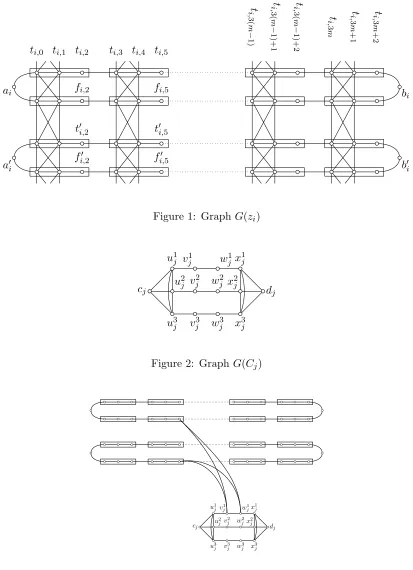
1,2,3) is a literal from {z1, . . . , zn, z1, . . . , zn}, make a graph G(Cj) with fourteen
nodes cj, dj, u1j, vj1, wj1, x1j, u2j, vj2, w2j, x2j, u3j, v3j, w3j, x3j. Add edges so that the three sets
ti,0 ti,1 ti,2 ti,3 ti,4 ti,5
fi,2
t′
i,2
f′
i,2
fi,5
[image:21.612.85.498.67.637.2]t′ i,5 f′ i,5 t i, 3 ( m − 1 ) t i, 3 ( m − 1 )+ 1 t i, 3 ( m − 1 )+ 2 t i, 3 m t i, 3 m + 1 t i, 3 m + 2 ai a′ i bi b′ i
Figure 1: Graph G(zi)
cj dj
u1j v1
j w1j x 1 j
u2 j v
2
j wj2x2j
u3
[image:21.612.91.497.74.260.2]j vj3 wj3 x3j
Figure 2: Graph G(Cj)
cj dj
u1
j vj1 wj1x1j
u2
jv
2
j w2jx2j
u3
j v3j w3j x3j
a b
Figure 4: GraphGf
nodes appear in this order along these paths). Add six more edges so that {u1
j, u2j, u3j},
{x1j, x2j, x3j} induce two triangles. See Figure 2.
The graph Gf is obtained from the disjoint union of the G(zi)’s and the G(Cj)’s as
follows. For i = 1, . . . , n −1, add edges biai+1 and b′ia′i+1. Add an edge b′nc1. For
j = 1, . . . , m−1, add an edge djcj+1. Introduce the two special nodes a, b and add edges
aa1, aa′1 and bdm, bbn. See Figure 4. For p = 1,2,3, if yjp = zi, then add four edges
vpjfi,3j−1, vpjfi,′3j−1,w p
jfi,3j−1, wjpfi,′3j−1, while ify p
j =zithen add four edgesvjpti,3j−1, vpjt′i,3j−1,
wpjti,3j−1, wjpt′i,3j−1. See Figure 3. Clearly the size of Gf is polynomial (actually quadratic)
in the size n+m of f. Moreover, it is a routine matter to check that Gf contains no K1,4, and thata, b are non-adjacent and both have degree two.
Suppose that f admits a truth assignment ξ ∈ {0,1}n. We can build a hole in G by
selecting nodes as follows. Select a, b. For i = 1, . . . , n, select ai, bi, a′i, b′i. If ξi = 1 select
ti,j, t′i,j where j ∈ {0, . . . ,3m+ 2}. If ξi = 0 select fi,j, fi,j′ where j ∈ {0, . . . ,3m+ 2}. For
j = 1, . . . , m, since ξ is a truth assignment for f, at least one of the three literals of Cj is
equal to 1, say yjp = 1 for some p ∈ {1,2,3}. Then select cj, dj and upj, vpj, wjp, xpj. Now it
is a routine matter to check that the selected nodes induce a cycle Z that contains a, b, and that Z is chordless, so it is a hole. The main point is that there is no chord in Z between some subgraphG(Cj) and some subgraphG(zi), for that would be either an edge ti,3j−1vjp
(or similarly t′
i,3j−1v p
j, ti,3j−1w p
j, t′i,3j−1w p
j) with y p
j = zi and ξi = 1, or, symmetrically, an
edge fi,3j−1vjp (or similarly fi,′3j−1v p
j, fi,3j−1wjp, fi,′3j−1w p
j) with y p
j = zi and ξi = 0, and in
either case this would contradict the way the nodes of Z were selected.
Conversely, suppose that Gf admits a holeZ that contains a, b. ClearlyZ containsa1, a′1 since these are the only neighbours of ainGf.
Claim 1 For i = 1, . . . , n, Z contains exactly 6m+ 10 nodes of G(zi): four of these are
ai, a′i, bi, b′i, and the others are either the ti,q, t′i,q’s or the fi,q, fi,q′ ’s whereq ∈ {0, . . . ,3m+ 2}.
Proof. First we prove the claim for i = 1. Since a, a1 are in Z and a1 has only three neighbours a, t1,0, f1,0, exactly one of t1,0, f1,0 is in Z. Likewise exactly one of t′1,0, f1′,0 is in Z. If t1,0, f1′,0 are in Z then the nodes a, a1, a′1, t1,0, f1′,0 are all in Z and they induce a hole that does not contain b, a contradiction. Likewise we do not have both t′
1,0, f1,0 in Z. Therefore, up to symmetry we may assume that t1,0, t′1,0 are inZ andf1,0, f1′,0 are not. This implies t1,1, t′1,1∈Z.
Suppose that for some j ∈ {1, . . . , m+ 1} and k∈ {0,1,2} one oft1,3(j−1)+k,t′1,3(j−1)+k
is not in Z. Let 3(j −1) +k be minimum with that property and assume up to a sym-metry that t1,3(j−1)+k is not in Z. If k = 0 or k = 1, then Z contains up to a symmetry
f1,3(j−1)+k that is adjacent to t1′,3(j−1)+k, so Z cannot contain a, b, a contradiction. So,
k = 2, t1,3(j−1)+k is in Z and one of vjp, w p