Learning to Manage:
A Substantive Grounded Theory of
Large Bodied Women’s Interactions
with Medical Professionals
Danielle Williams, RN, BN (Hons)
Submitted in fulfilment of the requirements for the
Degree of Doctor of Philosophy
University of Tasmania
ii
Statement of Originality
This thesis contains no material which has been accepted for a degree or diploma by the
University or any other institution, except by way of background information and these are
duly acknowledged in the thesis. To the best of my knowledge and belief, no material
previously published or written by another person is included in this work, except where
due acknowledgement is made in the text of this thesis. Nor does the thesis contain any
material that infringes copyright.
Name: Danielle Maree Williams
Signed:
Date:
Statement of Authority of Access
This thesis may be made available for loan and limited copying in accordance with the
Copyright Act 1968.
Name: Danielle Maree Williams
Signed:
iii
Statement of Ethical Conduct
The research associated with this thesis abides by the International and Australian codes on
human and animal experimentation, the guidelines by the Australian Government’s Office
of the Gene Technology Regulator and the rulings of the Safety, Ethics and Institutional
Biosafety Committees of the University.
Name: Danielle Maree Williams
Signed:
iv
Abstract
A qualitative research approach using constructivist grounded theory methodology was
used to further understanding and generate dialogue about the experiences of overweight
and obese female healthcare consumers. Participants included 22 women, all of whom
identified as large bodied. Data was collected from two major sources: semi structured
interviews with participants and current literature. The value of this study lies in the
documentation of a substantive theory which elucidates the issues facing overweight and
obese female healthcare consumers, and the strategies they employ to manage these issues.
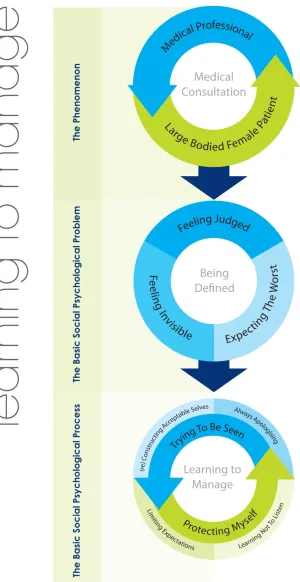
The substantive grounded theory of ‘Learning to Manage’ details what large bodied
women viewed as the salient concerns that face them as healthcare consumers, and how
they resolve these issues. They identified their interactions with medical practitioners,
specifically with general practitioners (GPs) as the most challenging. The women in this
study felt extremely vulnerable when they became healthcare consumers. They believed
they were negatively branded by their body size which worked to create a one dimensional
identity – that of an overweight or obese patient. Once they were labelled their weight
became the central focus of the consultation, often obscuring the reason they had sought
help. Consequently, the shared social problem of women was identified as ‘being defined’.
Feeling like ‘just a fat body’ (as described by participants) was common to all participants,
and left women battling feelings of invisibility, shame, guilt, responsibility and fear. For
large bodied female patients, being defined by their size was something which had
significant ramifications both on the women themselves and on the clinical interaction.
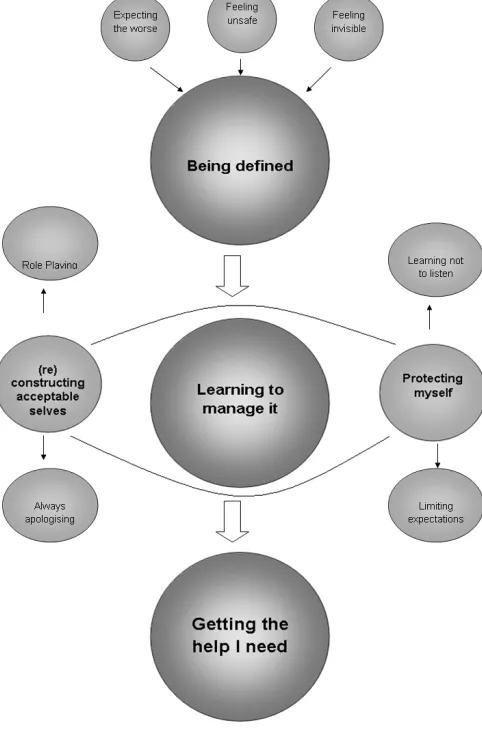
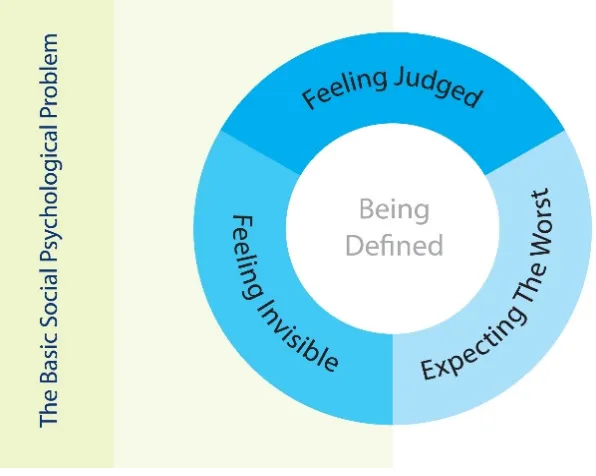
Being defined was comprised of three categories – ‘feeling invisible’, ‘expecting the
worst’ and ‘feeling judged’.
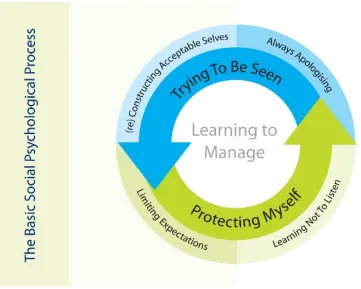
In order to manage or counteract the issues and feelings associated with ‘being defined’
participants developed a range of strategies which have been conceptualised as the basic
social psychological process ‘Learning to Manage’. Women believed that the weight
commentary from medical professionals was usually inappropriate and frequently hurtful;
however they felt they had limited recourse because of the power held by medical
professionals. Subsequently they learnt to manage their interactions with medical
v
identity of an obese patient without having to overtly challenge their doctor. They believed
that if they openly challenged their doctor they risked further sullying their already marked
identity. Logically women knew that they could not be refused what they needed, however
they felt that it was easier to manage from an emotional perspective if they engaged in
strategies which pretended compliance or apology for their fat bodies.
This research adds to the limited body of health science literature which has investigated
weight through a framework which is cognisant of the multilayered meanings attached to
fat female bodies. It also adds to the ever increasing research which recognises the impact
vi
Works Arising from this Thesis
The publications listed below were works developed from this thesis:
Williams, D.M. (2009) ‘I am more than an obese body’: overweight and obese women talk
about their experience of general practice’, General Practice and Primary Health Research Conference, Melbourne Australia.
Williams, D. M. (2008) ‘(Re)examining the multilayered meanings of being fat:
developing 'new' strategies for working with overweight and obese female consumers of
primary healthcare’, 2008 General Practice and Primary Health Research Conference, Hobart, Australia.
Williams, D.M. (2007) ‘Learning not to listen: large bodied women talk about their
experiences of healthcare’. Australian College of Midwives Biennial Conference 2007, Canberra, Australia.
Williams, D.M. (2007)‘Learning not to listen’ – overweight and obese women talk about
their experiences of General Practice’, General Practice and Primary Health Research Conference, Sydney, Australia.
Williams, D.M. (2006) ‘Constructing New ‘Truths’: grounded theory research with large
bodied women’.Thinking Qualitatively Workshop Conference, The International Institute for Qualitative Methodology, Canada.
Williams, D.M. (2006) ‘Healthcare - one size does not fit all: creating healthcare that 'fits' large bodied women’. 5th Australian Women’s Health Conference, The Australian
vii
Acknowledgements
This research has been a journey of faith. My thesis represents an epic academic
undertaking, and seven years of my life. It has left no stone unturned, something which has been challenging, difficult, at times painful, and immensely rewarding. . At times, when I felt overwhelmed, I know that the faith of others has carried me – urging and dragging me to the finish line. I am glad that I have had the opportunity to write this story, and I take this opportunity to thank the following people:
Thanks to my supervisors Dr Judy Sankey and Dr Mary Fitzgerald.
To the women who participated in this research – I never expected that this journey would change me so much, and I am forever grateful to you all for sharing your stories with me.
To my PhD girls, Karen and Helen – thank you for the support, laughter and friendship. You both made this journey so much better. And to Brendan, who came along quite late in the process, you helped cajole me toward the end – sometimes with force, and other times with chocolate and coffee. You have no idea how thankful I am.
To my beautiful circle of friends – thank you all for your support and faith in me. To Allison Mills, thank you for being my tell anything friend and for coming back to me. To Tunnie, thank you for being there long before any of this started and for still being here now. Thank you to Emily Hansen, for everything. You have been my colleague, my mentor, and my gorgeous friend. To Libby, thank you for weekly coffees and for being one of my favourite people in the world. To Eric, I met you at an important time in my life and you have no idea the change you brought about – thank you for this. To Gibbo, my activist sister ‘saving lives’ on the front line, thank you for all the tears you helped mop up during this thesis, in coffee shops all over Hobart. I will never forget it. To my amazingly brave friend Sharon Rose, thank you for listening, and talking, and amazing chats. To Alex, thank you for love when I needed it, and for making me laugh – our friendship is a brilliant thing. To Laurie Bourke, thank you for being my ‘critical friend’ throughout this academic undertaking, and for rides home, mirth and black dogs. To David G, Suse L, Faline and Jen H – we became friends during the course of this thesis, and I adore you all. To Nat, Tess, and Claire ‘Chipper’ Young – you are my ‘lovely, luscious ladies’ and I thank each one of you for your friendship To Miss H, you are one of my favourite
teenagers on the planet, and I thank you for being fabulous, wonderful you! To Jen Mac – thank you for your friendship and our shared love of ‘The Saints’ and box sets. Thanks also to Soph, Matt, and Bren – out of sight, but never out of mind.
Special thanks to Ju Ju and Nanna Peg for the love, the coffees, the meals and the
viii
for being a part of our family and for inspiring me with your own academic achievements. And to my brother in law, Shane, thank you for gifting me the entire Beatles catalogue – it made the long hours at the computer so much easier.
To my Dad, Rodney Williams, thank you for always demanding that I see the best in myself, and for instilling in me the sense that I could achieve anything that I set my mind to. To believe that nothing is out of your reach is a powerful feeling and I thank you for this.
To my little brother Troy, thanks for footy and fun and your friendship To my sister-in-law Michelle, thank you for constant love and support and for always asking how I was going. And to our newest family member, baby Louie, I can’t wait to finish this and spend time with you!
To my Mum, Jenni Williams, thank you for encouraging me the whole way, for being you, and for setting the example of courage when it mattered. I thought I knew everything there was to know about you, but during your journey of healing I have seen things in you that I never knew were there. Your courage, strength and positivity amaze me, and will stay with me for the rest of my life.
To my dear friend and sister Hayley, thank you for the ‘critical’ conversations and debates, and for your awareness and refusal to accept the status quo. Mostly, thank you for
understanding that this journey was deep and difficult, and the hardest thing I have ever done.
To my niece Ruby, thank you for the absolute joy and love you have brought to my life. Your existence has changed my life forever – in the best possible way.
ix
In the words and pictures of both Lennon & McCartney
and
my seven year old niece Ruby, ‘All you need is love’.
x
Contents
STATEMENT OF ORIGINALITY ... II STATEMENT OF AUTHORITY OF ACCESS ... II STATEMENT OF ETHICAL CONDUCT ... III ABSTRACT ... IV WORKS ARISING FROM THIS THESIS ... VI ACKNOWLEDGEMENTS ... VII DEDICATION ... IX CONTENTS ... X LIST OF FIGURES AND TABLES ... XIV
PART ONE ... 0
PROLOGUE ... 1
CHAPTER 1: INTRODUCTION ... 5
BACKGROUND ... 5
ANORMAL WEIGHT ... 6
THE OBESITY ‘EPIDEMIC’ ... 7
RESEARCH RATIONALE ... 12
THE RESEARCH QUESTION ... 14
RESEARCH AIMS ... 15
QUALITATIVE RESEARCH ... 15
STRUCTURE OF THESIS ... 17
CONCLUSION ... 19
CHAPTER 2: SETTING THE SCENE ... 20
INTRODUCTION ... 20
REVIEWING THE LITERATURE ... 20
CONSIDERED BODIES ... 21
WOMEN AND WEIGHT ... 23
xi
QUESTIONING THE ‘EPIDEMIC’ ... 32
RECOMMENDATIONS FROM PREVIOUS RESEARCH ... 36
CONCLUSION ... 39
CHAPTER 3: METHODOLOGY ... 40
INTRODUCTION ... 40
GROUNDED THEORY ... 40
THE EVOLUTION OF GROUNDED THEORY ... 42
CONSTRUCTIVISM ... 44
KATHY CHARMAZ AND CONSTRUCTIVIST GROUNDED THEORY ... 46
SYMBOLIC INTERACTIONISM ... 49
METHODOLOGICAL CONSIDERATIONS AND THE CURRENT RESEARCH ... 51
SUMMARY ... 54
CHAPTER 4: METHODS ... 56
INTRODUCTION ... 56
THE RESEARCH QUESTION ... 56
THE PARTICIPANTS ... 57
RECRUITMENT AND PARTICIPANT SELECTION ... 58
THEORETICAL SAMPLING ... 62
DATA MANAGEMENT ... 63
INTERVIEWING ... 64
DATA ANALYSIS ... 67
CONSTANT COMPARATIVE ANALYSIS ... 68
GROUNDED THEORY GUIDELINES ... 69
Coding ... 69
Line by Line Coding ... 71
Focused Coding ... 72
Memo writing and diagramming ... 72
RIGOUR ... 76
EVALUATING GROUNDED THEORY ... 80
ETHICAL CONCERNS AND PROTECTING PARTICIPANTS ... 82
SUMMARY ... 84
xii
CHAPTER 5: THE SUBSTANTIVE GROUNDED THEORY ... 86
INTRODUCTION ... 86
THE SUBSTANTIVE GROUNDED THEORY ... 86
THE PHENOMENON ... 89
THE BASIC SOCIAL PSYCHOLOGICAL PROBLEM ... 89
THE BASIC SOCIAL PSYCHOLOGICAL PROCESS ... 91
TALKING ABOUT WEIGHT ... 93
SUMMARY ... 97
CHAPTER 6: BEING DEFINED ... 98
INTRODUCTION ... 98
BEING DEFINED ... 99
Feeling Invisible ... 106
Feeling Judged ... 111
Expecting the Worst ... 120
SUMMARY ... 126
CHAPTER 7: LEARNING TO MANAGE ... 128
INTRODUCTION ... 128
LEARNING TO MANAGE ... 129
Trying to be Seen ... 134
Always Apologising ... 137
(re)Constructing Acceptable Selves ... 140
Protecting Myself ... 147
Learning not to Listen ... 149
Limiting Expectations ... 152
SUMMARY ... 155
CHAPTER 8: DISCUSSION ... 157
INTRODUCTION ... 157
BIOMEDICINE AND THE MEDICAL INTERACTION ... 159
GENERAL PRACTICE ... 161
BEING DEFINED ... 164
Stigma ... 171
xiii
Attitudes toward overweight and obese patients ... 183
LEARNING TO MANAGE ... 191
ADDRESSING HEALTH AND WEIGHT-RELATED STIGMA ... 208
SUMMARY ... 210
CHAPTER 9: CONCLUSION ... 212
INTRODUCTION ... 212
ACHIEVEMENT OF STUDY AIMS ... 212
THE VALUE OF A CONSTRUCTIVIST APPROACH TO GROUNDED THEORY ... 213
EVALUATING GROUNDED THEORY ... 214
Credibility ... 215
Originality ... 216
Resonance ... 216
Usefulness ... 217
RECOMMENDATIONS ... 219
SUMMARY ... 224
RESEARCHER MUSINGS ... 226
REFERENCES ... 231
APPENDIX A ... 252
APPENDIX B ... 253
APPENDIX C ... 255
xiv
List of Figures and Tables
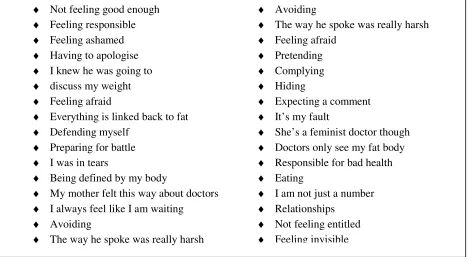
Figure 1. Participant Language ... 71
Figure 2. Research Diagram ... 75
Figure 3. Research Diagram ... 76
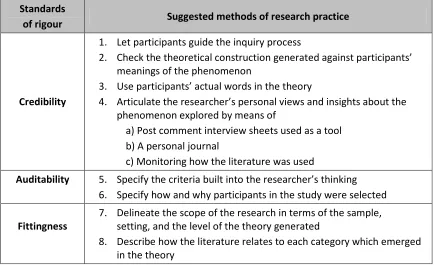
Figure 4. Standards of Rigour... 78
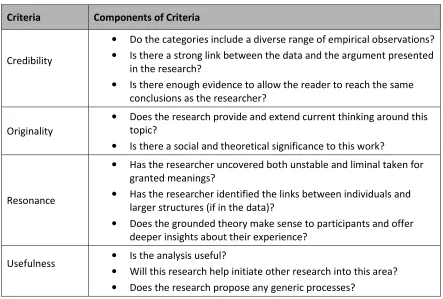
Table 1. Charmaz’s Ground Theory Evaluation Criteria ... 81
Figure 5. The conceptual model of ‘Learning to Manage’ ... 87
Figure 6. The basic social psychological problem: Being Defined ... 105
Figure 7. The basic social psychological process: Learning to Manage ... 134
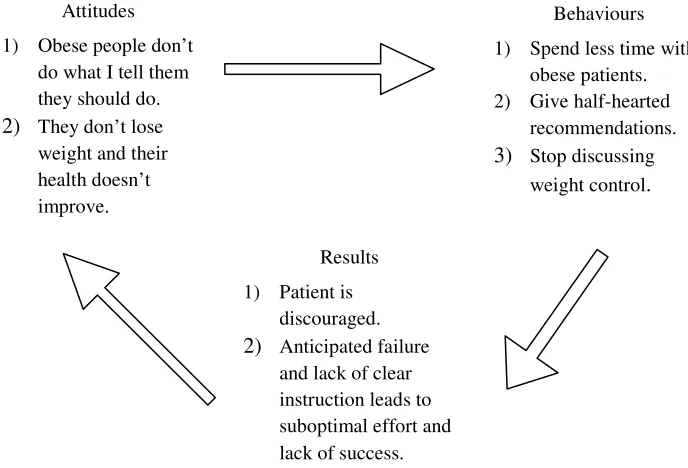
Figure 8. A self-perpetuating cycle of negative attitudes ... 175
Figure 9. An identity-threat model of stigma ... 204
Table 1. Charmaz’s Ground Theory Evaluation Criteria ... 81
1
Prologue
Making the researcher’s identity visible
“It’s a funny thing, fat. Even though it is obvious to everyone you meet and may in fact be the only thing people remember about you, admitting that you are heavy or out-and-out obese is often the hardest thing in the world to do” - Shawna Vogel, 2000
My interest in the health experiences of large bodied women began to emerge when I
started nursing, and it was during my early years as a registered nurse that several things
happened that significantly affected me, and ultimately influenced my decision to
undertake this project. The first event occurred whilst I was working in an acute setting, as
I helped to care for a woman who was having surgery. She was required to have her height
and weight recorded before her procedure; however when I went to weigh her I discovered
that the ward scales were not going to accommodate her body weight. I was then
instructed to take this patient to a set of antiquated scales used by kitchen and storeroom
staff, situated outside the public dining room frequented by staff and members of the
public, which can accommodate 300 kilograms. The patient was taken to be weighed by an
orderly and when she returned to the ward she was crying. When I asked her what was
wrong she said that she was humiliated. When I asked her why, she looked at me and said
“you know why” and grabbed her stomach. I didn’t have an answer because I knew what
she was saying was true.
Some weeks after that I was looking after a room of patients: three males and one female
patient. After the consultant had conducted morning rounds, he rang back to check a detail
and by chance I answered the phone.
‘What is the name of that big fat woman’, he asked.
‘Which big fat woman’ I replied.
‘That big fat woman in room 14’.
‘Do you mean the only woman in room 14’ I said.
2
This is an extreme example, and the bigotry was not always so blatant. However, it did
open my eyes to events and attitudes that seemed to pervade the fabric of that environment.
Around the time of this event I also read a book by Charlotte Cooper (1998, 26) who
suggested that fat people are vulnerable as targets and super-visible because they deviate
from an assumed norm, which in this case is slenderness. This idea caught my attention,
and has stayed with me ever since because it resonated within me. Society places high
value on physical sameness, and fat is vilified ironically not because it deviates from a
large percentage of the populace, but because it deviates from the idealised populace. And
to my eyes, this was being echoed within the medical community. What I saw was large
patients being treated in a way that labelled them as different and somehow not deserving
of the same consideration as thinner patients. It was during those early months that my
interest broadened beyond the social experience of fatness, to the experiences of large
bodied women as patients. Schreiber (2001) discusses the notion of sensitizing concepts,
suggesting that these are ideas that the researcher has in her head before she starts the
research. Charmaz (2006) also comments on sensitising concepts, arguing that for
grounded theorists they provide a starting point, and that if they do not emerge in the data
then we (grounded theorists) discard them. At the beginning of this project, I was
sensitised to issues of difference and fat embodiment within the hospital setting as well as
to the experiences of discrimination that large people experience in their social worlds.
However I used these ideas, as Charmaz suggested, as a departure point through which to
look at the data and guide my analytical thinking (2006).
My intent in introducing myself as the researcher is not to create an indulgent space where
I air my own views and opinions. Rather, it is my attempt at creating a transparent
dialogue about my own place in the research process – and the impact that this has had on
the subsequent generation of theory. Early in this project, it was suggested to me that I was
undertaking this project because I was unhappy with treatment I had received, somehow
implying that the purpose of this research was to gather together a lot of large bodied
women who were also unhappy with their treatment from medical professionals. In fact the
exact opposite was true. The aim of this research was to call for large bodied women to
discuss their experiences of healthcare, in order to begin to create a dialogue in an area that
until recently has been largely dominated by discussions of obese bodies as the site of
3
I share membership of the group that I research, and because of my own knowledge and
experience of the subject matter, I do feel a connection to the women who participated in
this research. Because of this shared membership, women disclosed that they shared stories
with me that they would not have shared with a researcher who did not also inhabit a large
body. However it was my sameness that also caused comment and repeated questioning as
to whether I would be able to manage a project where I was interviewing my ‘own’ people
(as described by one participant), without imposing my own stories and opinions onto the
findings. Initially, I found warnings about bias and subjectivity to be condescending
because it was my understanding that researchers are often drawn to investigate areas that
interest them personally. However, as the project progressed, the comments actually
worked to create an invaluable inner dialogue that helped create awareness of my own
story. These questions have helped me make visible my own meanings and understandings
of health and weight and largeness, and through this I have been able to listen more clearly
to the stories and experiences of participants, identifying them as unique stories separate to
that of my own. I have spent a significant amount of time engaged in a critical reflection
regarding why I feel compelled to make visible my own identity. Webb (1992) suggests
that whilst all research involves social interaction, researchers using an interpretivist
approach both invest and share themselves in the research process (p749). She also
advised that researchers should acknowledge both their involvement and inseparability
from the research (p37).
As a researcher whose thinking and practice is both informed and shaped by constructivist
and feminist thought, it is accepted that the stories and experiences of the researcher are
part of the research process. Indeed, they shape and influence the construction of the end
research product. That being the case, I have still struggled with my need to declare my
own identity. In hindsight, I think that the struggle has been linked to questions from
individuals who have questioned whether my identity somehow detracts from the
legitimacy of findings. So despite this struggle, I chose to share myself with readers. I
acknowledge that my views of overweight and obesity have been shaped by my experience
as a health professional, and my own gendered experience of being large. I don’t wish to
hide the fact that my current research was partly borne from my own experience as a large
bodied woman. I consider that it was my own experiences that initially opened my eyes to
4
Being a researcher for a project in which my own journey is intrinsically linked to those of
participants is complex and thought provoking. Being large bodied is a significant personal
journey – however it is one that is very visible in the public gaze. I acknowledge the
inevitability of my own life influencing what I hear and see and eventually write about. I
acknowledge that being large bodied has informed thinking behind the conception of this
project, and that I have experiences common to those of participants. However, whilst
experiences may have threads of sameness, we are not a homogeneous group – and each
participant’s story has been unique and valued. I wish to make sure that the story I tell
reflects the story of the participants; however I don’t necessarily think I need to do this
declaring my own personal identity. I do this through rigorous application of methods and
a well-documented decision trail. I do this by encouraging participants to share in the
creation of theory.
I have chosen to reveal my identity, to out my own fatness, because I think it adds to the richness of this research. Mills, Bonner and Francis (2006a, p9) state that
Explicating the place from which the researcher starts provokes a need to reflect upon his
or her underlying assumptions and heightens his or her awareness of listening to and
analysing participants’ stories as openly as possible. As well, it provides the reader with a
sense of the analytical lenses through which the researcher gazes at the data.
5
Chapter 1: Introduction
Background
This chapter will introduce the concept of weight and provide an overview of current
reporting on obesity. It will also provide a rationale for this research, including why a
qualitative approach was used, the research question and aims of this research. The chapter
will conclude by presenting the structure of this thesis.
The term ‘obesity’ is of Latin origin, meaning having eaten (Cooper, 1998) and it is the
very meaning of this oft-used term that exposes the beliefs and causes that people attach to
large bodied people. The terms overweight, obesity and fat have considerable meaning
attached to them, acting as an umbrella term for many meanings including sickness,
deviance, laziness and unattractiveness. Kulick and Meneley (2005) posit that fat is
anything but straightforward, suggesting that fat is a three letter word “larded with
meaning”. Obese individuals face issues and circumstances comparable to other
disadvantaged groups who both identify and are identifiable as members of a clearly
different community (Komesaroff & Thomas, 2007). These groups experience issues
which are impacted by the social and cultural structures, added to which the quality of
healthcare they receive is also affected. The difference between the obese as a
disadvantaged community and other groups, however, is that obesity does not engender the
same public compassion or respect drawn by other groups (Komesaroff & Thomas, 2007).
The terminology used to describe excess body weight varies between disciplines; however
the terms overweight and obesity is the most common language used to describe excess
weight within health science research. This research does not delineate between
overweight and obese, and I have primarily used the term obesity when referring to all
bodies that are classified as over the accepted medical norm of a healthy weight. Gard and
Wright (2005) make reference to this fact, suggesting that overweight and obesity are often
used interchangeably when in fact they are regarded as two different classifications of
largeness. As the researcher and someone who also identified as a member of the group
6
words that individual participants used, something that I worked out as I developed rapport
with participants during interviewing. ‘Obese’ or ‘obesity’ was not a term that I generally
employed whilst interviewing participants, however I did use it when searching for
literature and when writing, particularly in the discussion chapter of this thesis.
Participants, however, rarely referred to themselves as obese, usually using the word
overweight when describing themselves, particularly if they were talking about their
experiences of weight in healthcare contexts. One participant described her feeling around
the word obese:
I hate it because of the connotations of it. It’s almost used like a dirty word. For some reason I would almost rather be called fat than I would obese, because fat is my word that I have reclaimed for myself. And in saying that, there is almost a certain level of pride that I can say that I am a fat woman and I am ok with that. (Stella)
The participants used a number of terms to describe their bodies, referring to themselves as
chubby, fat, large, overweight, and big. I prefer the term large bodied however within the
majority of literature I reviewed as part of this study the terms overweight and obese were
used. Thus, given the diversity of the language used by participants and within the
literature, my use of terminology to describe weight throughout this thesis is also varied.
A Normal Weight
A Belgian astronomer in the 1830’s was the first to define a normal weight, after
measuring the most common weight for height of British and French army conscripts
(Staley 2008, p27). Since then normal weight has largely become measured by the Body
Mass Index, a tool initially used by Life Insurance companies in the 1940’s which relied
on data from 25 year old insurance applicants to generate ‘ideal weights’ (Brown, 1990;
Stanley, 2008). Contemporarily, the biomedical classification of normal weight is largely
reliant upon the Body Mass Index classification which is calculated by dividing weight in
kilograms by the square of the height in metres. Obesity is usually defined in adults as
BMI above 30, whilst overweight is categorised as a BMI in excess of 25 (World Health
7
The body is not ahistorical; its shape and weight through time illustrate the social and
cultural trends of the time (Lawler, 1991). Being overweight or obese has not always held
the negative connotations that it does in contemporary society. Etcoff (1999) echoes this
sentiment suggesting that there is no evolutionary precedent for the slim ideal. Throughout
history maintaining an above average body weight has been viewed as a symbol of wealth
or affluence, or good health. Johnson (2004) suggests that the notion of body size as a
marker of the moral character of an individual emerged in the 1940’s and 50’s from a
range of developments in medicine, psychology and fashion. Prior to this period, large
bodied individuals were regarded amongst other things as cheerful and prosperous,
whereas after this time largeness became a signal of lack of control over “voracious
appetites” (p480).
Casswell (1995) and Philipson (2001) have both commented on body size in the nineteenth
century suggesting that fatness was a signal of prosperity and stout women were
considered both attractive and sexy (2001, p2). Simpson (2002), however, contradicts this
by suggesting that the nineteenth century was the period during which thinness and
fragility became feminine ideals. Sontag (1978) also emphasises that the nineteenth
century saw the popular emergence of the tubercular look, which emphasised thinness and
attached glamour to a sickly appearance. Wolf (1990) also suggests that the thin ideal has
only emerged over the last century. She argues that the preoccupation with thinness started
when women received the vote in the 1920’s, suggesting that female emancipation via law
is connected to the rapid change in the representations of women at that time. Wolf clearly
states that the “great weight shift must be understood as one of the major historical
developments of the [twentieth] century”, a phenomenon which has emerged as an answer
to the issues raised by the women’s movement, including the economic and reproductive
freedom (p187).
The Obesity ‘Epidemic’
The World Health Organisation (WHO, 2006) defines obesity as the “abnormal or
excessive fat accumulation that may impair health” and cite it as one of the five leading
health risks for mortality in the world (WHO, 2009). According to a WHO estimate in
2005 there were more than 300 million obese people in the world, and this estimate is
8
global population now live in countries where overweight and obesity kill more than
underweight (WHO, 2009).Given the global increase in body weight, it is little wonder
that the weight of populations has now become part of our global consciousness.
Obesity is considered a risk factor for both non-industrialised and industrialised nations.
Obesity has been depicted as an epidemic facing modernity in both industrialised and
non-industrialised countries, and has been described as a “time bomb” in the rising incidence of
diabetes and related circulatory disease (Phillips, 2002). Stewart, Tikellis, Carrington,
Walker and O’Dea (2008) describe the health implications of the increasing rates of
overweight and obesity as a potential ‘fat bomb’ facing Australians. Wellman and
Friedberg (2002) suggest that obesity was identified as an American epidemic twenty years
ago, however Crawford and Ball (2002) posit that it is only since the late 1990’s that
obesity has been recognised as endemic within Australian populations.
There is a mounting body of medical and scientific reporting that links obesity to
significant increases in morbidity, cardiovascular disease and related disorders, and a
myriad of other pathologies. The World Health Organisation (2003) indicates that
morbidity rates increase with body mass index (BMI) increases, as does the amount of
people with one or more co-morbidities. Research also suggests that excess body weight
impacts on general health, recovery and disease. Obesity is said to increase the risk of
coronary heart disease, type 2 diabetes, ischemic stroke, hypertension, depression, cancers
(including breast and gynaecological), and polycystic ovary syndrome (Bray, 2002;
O’Brien, Brown and Dixon, 2005; Peters, 2002; WHO, 2009). The presence of obesity has
also been said to increase the risk to mother and baby during pregnancy (Nankervis, Conn
and Knight, 2006) as well as impairing fertility (Pasquali, Patton, & Gambineri 2007).
Stewart et al (2008) suggest that reducing weight, measured by a reduction in BMI, can
reduce the risk of developing depression, certain cancers, high blood pressure, high blood
cholesterol, and Type 2 diabetes
National data indicates that the last 20 years have seen a dramatic increase in the weight of
Australians, with large bodied women constituting an increasing proportion of all obese
individuals (Crawford & Ball: 2002; Gill, 2002). Filozof, Gonzalez, Sereda, Mazza and
Braguinsky (2001) also indicate that women have a higher incidence of obesity than men.
9
particularly among women (Catford & Caterson, 2003). In Australia, the rates of
overweight and obesity have increased by almost 50% in both adults and children (Healthy
Weight 2008 – Australia’s Future, 2003). In 2001 self-reported data estimated that
approximately 2.4 million Australian adults were obese, and 4.9 million overweight
(AIHW, 2003). Measured data between 1980 and 2000 showed that the incidence of
obesity in women had increased by 50%, from 8% to 20%. Between 1989 and 1999-2000
the prevalence of abdominal obesity in women increased from 16% to 28% (AIHW: 2003).
Australian sources suggest that the number of obese Australian women increased from
27% to 43% between 1980 and 1995 (Crawford & Ball, 2002). Gill (2002) draws on
recently published Australian data from the AusDiab study 1999 - 2000, which revealed
that 60% of women between the ages 45 and 64 were either overweight or obese, a figure
which has almost doubled in the last two decades.
In 2002, the Australian government initiated a national response to overweight and obesity,
which saw the construction of the National Obesity Taskforce whose aim it was to develop
a national public health strategy to tackle overweight and obesity, largely concentrating on
young people and their families (Healthy Weight 2008 – Australia’s Future, 2003). The
report made brief mention of the fact that being obese can lead to social discrimination and
can destroy self-esteem, as well as including the reduction of stigma and blame in the
guiding principles for action. However, in the pages of strategies, collaborative activities
and planned outcomes that followed no mention was made of any activity that would work
to decrease stigma and improve the self-esteem of young people and adults living in
overweight or obese bodies. This appears to be a critical oversight in many such
interventions into addressing the rising trend of overweight and obesity.
In 2008 obesity was identified as a National Health Priority by the Australian government
(Valenti, 2009). In response to this, a Preventive Health Taskforce was appointed and
charged with developing a national strategy which addresses, among other issues, obesity.
The Taskforce (2009) suggests that obesity, along with alcohol and tobacco, account for a
significant proportion of the disparity in health status between advantaged and
disadvantaged Australians, and between city dwellers and rural and remote Australians.
The Bettering the Evaluation And Care of Health (BEACH) program is an ongoing
10
the most comprehensive of data relating to General Practice in Australian history. The
BEACH study includes new samples of approximately 1,000 GPs per year, each of whom
provide details for 100 consecutive GP-patient encounters (Britt & Miller, 2009). In 2009,
in a report which included BEACH data collected between April 1998 and March 2008,
analysis revealed that whilst male patients are more likely to be overweight or obese;
women are more likely to be severely obese. Consultations with those classified as obese
were significantly longer than those with patients who were classified as normal or
overweight. In line with international reporting, the collection of data over a ten year
period also demonstrates a rise in the prevalence of overweight (from 33% to 35%) and
obesity (from 19% to 24%) in adult general practice patients (Britt and Miller 2009, p5).
Many authors point toward the cultural transformations as reasons why obesity has become
a global problem. Steinbeck (2002) and Peters (2002) discuss obesity as a social problem
delineating the various changes in society, such as an increased diversity and availability
of foodstuffs. Peters (2002) suggests that these changes have led to what he describes as
the ‘obesigenic’ environment that has unintentionally promoted a lifestyle that is low in
physical activity and high in food and energy consumption. Holm et al (2001) also discuss
the global changes in lifestyle, which have led to an increase in the prevalence of
overweight and obesity. They suggest that the obesity dilemma extends “beyond the
individual” into a global environment which actively promotes a sedentary lifestyle and
overeating. Clugston and Smith (2002, p105) concur, and posit that the increased
prevalence of obesity is a consequence of “fundamental changes in the world’s social
structure”. Gill, Antipatis, and James (1999) comment on the first World Health
Organisation consultation on obesity where it was concluded that “the global epidemic [of
obesity] is an unintended consequence of modernization, economic development,
urbanization and other societal changes” (p75).Catford (2000) also suggests that
mechanisation and labour saving devices have decreased the amount of incidental exercise,
which has seen levels of overweight and obesity increase. Clugston and Smith (2002) also
comment on the globalisation of the human diet, which has seen the introduction and ready
accessibility of a more diverse diet, coupled with a preference for readily available fast
foods and a decrease in activity. Allman-Farinelli, King, Bonfiglioli, and Bauman (2006)
also suggest that in the past 30 years, great availability and range of foodstuffs combined
with a decrease in physical activity has worked to produce an obesegenic environment in
11
line is that we need to consume less energy and expend more” (p310). This seems a very
simplistic solution to a very complex issue.
Philipson (2001) infers that whilst obesity is often viewed as both a public health concern
and an issue of individual attractiveness, it is foremost an economic issue. Obesity is seen
as a major contributor to disease and disability, thus the economic costs are considerable.
Peters (2002) surmises that the augmented incidences of obesity and obesity related
chronic disease have generated considerable social costs. Wellman and Friedberg (2002)
indicate that obesity is problematic within the health care setting, citing US obesity and
overweight budget estimates for the year 2000 as $117 billion. These figures included
both direct and indirect costs. Hughes and Martin (1999) also suggest that obesity creates
social and economic problems in that there is a correlation between increased sick leave
and early retirement, secondary to health problems. Conversely, whilst commenting on the
financial costs of diabetes, Dixon et al (2000) discuss multiple cost accountings within
studies that address hospital costing. They suggest that it is problematic to attribute cost to
a particular admission diagnosis when patients also have numerous pathologies, such as
obesity.
Hospital care, which is linked to hospital spending, of obese individuals is also receiving
increased attention. Hauck and Hollingsworth (2010) estimated differences in hospital
length of stay between obese and severely obese patients. Their sample included 435,147
inpatient episodes during 2005/2006 with patients over 17 years of age who had stayed one
night or more in hospital. Their findings suggested that there are vast differences in the
length of stay for severely obese patients, and this is divided between medical and surgical
specialities. Hauck and Hollingsworth (2010) suggest that this may be due to the disparity
in management of obese and non-obese in patients. One explanation for this is the
suggestion that hospitals may transfer patients to another facility post-surgery as a way to
shift both the costs and risks associated with managing the complex requirements of obese
surgical patients. They suggest that obese surgical patients have a higher turnover than
non-obese patients, which could influence the continuity and quality of care.
Rightly or wrongly, the obesity epidemic has now garnered global attention. Current
medical and economic reporting paint a very persuasive argument about the dangers and
12
implemented in order to try and combat the increasing weight of Australians. Likewise,
other countries around the world have also identified obesity as a threat to individuals, the
healthcare system and society as a whole.
Research Rationale
This work is one of very few studies conducted within the health sciences that illuminate
the voices of a marginalised group such as large bodied women. This work extends
thinking around several issues. Firstly, this research explores and documents the interplay
between medical professional and overweight and obese from the perspective of the
consumer which remains quite rare in the field of obesity research. Secondly, this research
has been conducted using a qualitative approach which remains rare within the health
sciences. A significant amount of research that has been conducted has tended to favour
quantitative methods, whilst the qualitative studies which have investigated weight stigma
and the experiences of women have not been conducted within a health science framework.
Much of the contemporary literature around overweight and obesity has been viewed
primarily through two lenses; the biomedical lens, which focuses purely on obesity as a
disease, and the social lens. There isa considerable body of work on the medical
consequences of obesity, the physiological and psychological effects of stigma and
negative body image, and overweight and obesity as a global epidemic.A review of
material published in medical journal articles in the last decade revealed that the majority
of weight related articles concentrate on weight management, weight reduction or the
medical consequences of obesity. Increasingly, the literature now includes a focus on
bariatric and weight loss procedures, particularly laparoscopic adjustable gastric banding.
Bariatric surgery is becoming the preferred treatment of patients who are significantly
obese (Tweddle, Woods & Blamey, 2004) and the research reflects this.
There is a paucity of research that addresses the effect that being fat identified, and
recognised, has on women’s experiences of healthcare and other services that promote
wellness, and on their actual engagement with health services. Excess weight influences
the provision and experience of healthcare. It can impact whether individuals fit into
hospital gowns; it dictates the use of specialised equipment, and in order to access certain
13
in large bodies are subject to judgement and negative stereotyping based on their
appearance. However to date there has been minimal exploration of large bodied
individuals as patients or consumers of healthcare services that are cognisant of the
multiple meanings attached to the obese body. Given the increasing urgency to address the
obesity crisis, it is timely to endeavour to understand healthcare consumers living in large
bodies. Also, given the gendered nature of both health and bodies, it is appropriate to
explore being large bodied from a single perspective, which in this research is women. It
is critical that researchers be at the forefront of investigating effective ways in which to
provide healthcare for large bodied female consumers, as well as identifying ways through
which to encourage healthy weight practices.
Women’s health is not a new area of inquiry, particularly for nurses, however there has
been little investigation into how the social understandings of fat and fat bodies interface
with the medical constructions of fat, and what this means for healthcare consumers who
are large bodied. There is also little investigation into how large bodied women
understand their interactions with healthcare providers. As obesity has now become the
domain of biomedicine, as well as a sociocultural phenomenon, it is essential that a new
body of work is produced, one which recognises the impact that being fat identified (and
recognised) has on an individual’s experience and ability to get the healthcare they need
and are entitled to. Lawler (1991) indicates that for women, the principal message that she
receives from society is that she must remain, among other things, slim. Although men
also experience body scrutiny and subsequent judgement, evidence suggests that women
are subject to stricter governance in regard to their appearance. Wellman and Friedberg
(2002) argue that obesity is not gender specific; however it is indisputable that the
experience of living in larger bodies is. There is little denying the fact that women are held
to different standards regarding their body size and appearance.
Women have been objectified and judged by their appearance throughout history, and in
this society the pressure to be thin is immense (Casswell, 1995). Large bodied women can
be and are viewed as persons who are refusing to comply with the social norms regarding
thinness, especially women and thinness. Within the westernised world, to be fat and
female is not generally regarded as desirous. Lawler (1991) suggests that society is
bombarded with messages that promote the ideal body, a projection that for the majority of
14
are subjected to very different pressures than those of men, particularly in regard to their
bodies. Lawler (1991, p97) states that “historically women’s bodies have always been
targeted, technologised, pathologised and medicalised much more so than have men’s
bodies”. Based on Lawler’s notion, I believe that women’s experiences are vastly
different, and thus worthy of individual examination.
The Research Question
Consistent with grounded theory, the initial research problem commenced with a broad
area of inquiry. Initially, the research question was ‘what is the process of engaging with
the healthcare system for large bodied women?’
The idea was to seek out participants who were both large bodied and female in order to
develop a substantive theory about their engagement with healthcare. As with other
grounded theorists, I initially set out to work with participants to draw out their stories, and
in doing so identify what they considered to be significant. This included a focus on what
women considered to be the issues facing them within this context, and the strategies that
they used to manage these issues. As data collection progressed and participants revealed
what they considered to be important, the questions became more focused. As participant
accounts revealed that their main concern was being defined by their largeness, data
collection became more focused. The questions sought to understand more about what
women considered to be the salient issues facing them as healthcare consumers when they
were defined by something negative, what influenced and shaped these problems, and the
process through which participants managed the problems they shared.
As is well documented within grounded theory literature, the study was directed by
emergent data, so ultimately the research questions were:
• How do large bodied women get the healthcare they need when they feel defined by their large body?
15
Research Aims
This research aimed to add to current obesity research, with the intention of generating
dialogue about overweight and obese healthcare consumers. Despite the global focus on
obesity, and the increasing population of large bodied individuals, the current social and
cultural norms surrounding obesity mean large bodied women remain a marginalised
population, and at risk of being underrepresented in research.
It was the objective of the research to expand on current understandings of large bodied
women as healthcare consumers, through explicating and interpreting women’s
understandings of their individual health experiences. The study aims were to:
♦ Gain insight into large bodied women as healthcare consumers.
♦ Develop an understanding of the shared social problem experienced by large bodied female healthcare consumers.
♦ Detail the basic social psychological processes used by large bodied female healthcare consumers which details the strategies they use to resolve the shared
basic social problem.
Qualitative Research
Despite the surfeit of research that has investigated overweight and obesity, few studies
have illuminated the healthcare experiences of large bodied female consumers. Most
studies which have investigated obesity, particularly the lived experiences of obese
individuals, have used quantitative approaches. Thus, it is important to generate new
knowledge which is qualitative in nature. Grounded theory, informed by symbolic
interactionism and shaped by constructivism is extremely relevant and suited to this nature
of inquiry. The symbolic interactionist underpinning urged me to focus on meaning and the
creation of meaning through interaction with others, which I believed was central to the
nature of this inquiry. Given my understanding of grounded theory, both methodologically
and as a method, I felt that it was the appropriate tool to employ in order to generate rich
new information where the focus was on the understandings and perspectives of the
women involved. Grounded theory has been extensively used in research with women, is a
means of generating new knowledge that is situated both within the context of the field and
16
Grounded theory methodology is concerned with “the processes and meaning people use to
manage their worlds” (Pursely-Crotteau, Bunting & Draucker 2001, p194). Eaves (2001)
suggests that grounded theory inquiry is directed by the discovery of social and social
psychological processes, commenting that this is an assumption inherent in both the work
of Glaser, Strauss and others. Grounded theory was appropriate as it offered a method
through which to approach the phenomenon broadly, allowing participants to identify what
was important to them, namely the problems acknowledged and shared by participants in
the phenomenon under investigation. The ability to study human behaviour within a social
context is a widely acknowledged strength of grounded theory (Morse, 2001), which also
made grounded theory an appropriate methodology to use in order to explicate participant
understandings of their social worlds.
This research was concerned with large bodied women as healthcare consumers,
particularly how they managed their interactions with medical professionals. Schreiber and
Stern (2001, pxvii) believe that grounded theory was “designed to reveal the human characteristic of change in response to various life circumstances”. They posit that a
fundamental element of this is to capture how people understand and manage what is
happening to them over time. Morse (2001, p12) also comments on the characteristics of
grounded theorists, suggesting that researchers using this method are more interested in
how people “create and respond” to experiences than how they “perceive their world”.
Crooks (2001) also concurs with this, stating that “grounded theory gives us a picture of
what people do, what their prime concerns are, and how they deal with these concerns”
need page number.
Crooks (2001, p17) states that:
grounded theory methods allow the researcher to see women as full members of their social, political, economic worlds; to understand the lives and activities of women; to understand women’s experiences from their own particular points of view; and, finally, to
17
Further to this she adds that grounded theory researchers, in choosing this perspective,
“give voice to the thoughts and actions of women and establish the importance of women
from a woman centred perspective” (Crooks 2001, p19).
Structure of Thesis
This thesis is divided into two parts, and presented over nine chapters. Part 1 of the thesis
contains a prologue and four chapters. The prologue provides the reader with insight into
the position and background of the researcher.
Chapter 1 provides a brief context for the research, as well as outlining the research aims
and research problem. It also includes a brief explanation of why qualitative research was
selected as the appropriate paradigm for this research, as well as
Chapter 2 commences with a brief explanation of the use of literature review in this
grounded theory study, and will progress to present issues relating to overweight and
obesity, large female bodies, the medicalisation of obesity and the new body of literature
that questions the obesity ‘epidemic’. Also included are the contextual factors in which the
large female body is embedded, including the sociocultural and medical constructions of
obesity and how this intersects with gender.
Chapter 3 details the approach to grounded theory that has been used in this research in
order to construct the substantive grounded theory of large bodied female healthcare
consumers. An overview and evolution of grounded theory methodology is presented,
followed by a discussion of symbolic interactionism. Constructivism, which is the
theoretical approach that shaped this grounded theory, will also be discussed particularly
focussing on the grounded theory approach of Kathy Charmaz, the scholar whose work
this thesis draws upon.
Chapter 4 presents the methods that were used in this study, including recruitment and
participant selection, theoretical sampling, interviewing and data analysis. Also included is
a discussion of rigour, evaluating grounded theory and lastly the ethical concerns that were
18
Part 2 of the thesis includes four chapters and an epilogue. Chapter 5 introduces and
provides an explanation of the substantive grounded theory of ‘Learning to Manage’,
which provides explanation of how large bodied women understood and manage their
interactions with healthcare providers. The substantive theory of ‘Learning to Manage’
discusses how large bodied women engage in the basic social psychological process of
‘Learning to Manage’ in order to address and resolve the basic social psychological
problem of ‘Being Defined’.
Chapter 6 presents and discusses the analysis of participant data relating to the basic social
psychological problem of ‘Being Defined’. The basic social psychological problem has
three categories, which will be discussed throughout this chapter as the sub categories of
‘feeling invisible’, ‘feeling judged’ and ‘expecting the worst’. Excerpts of participant data
will be used throughout to demonstrate how the problem of ‘Being Defined’ and the sub
categories of ‘feeling judged’, ‘expecting the worst’ and ‘feeling invisible’ were reached.
Chapter 7 describes the basic social psychological process of ‘Learning to Manage’,
namely the patterns of behaviour used by participants in order to resolve the basic social
psychological problem. ‘Learning to Manage’ encompasses a range of behaviours used by
large bodied women to manage the basic social psychological problem of ‘being defined’.
The sub-processes of ‘Learning to Manage’ which have been identified as ‘Trying to be
Seen’ and ‘Protecting Myself’, explain the strategies used by participants to deal with the
challenges which faced them as large bodied healthcare consumers will also be presented.
Findings will be supported by participant data which emerged through interviewing.
Chapter 8 presents a discussion of the research findings in relation to current research. The
literature that was consulted as part of data collection and analysis will be presented in the
discussion chapter, and will situate this research within the broader structure of
biomedicine, as well as examining the medical interaction. The basic social psychological
problem and the basic social psychological process will be discussed with reference to
relevant literature. Stigma, and health and weight related discrimination, which underpins
the findings of this study, will be explored. Literature relating to the strategies that
19
Chapter 9 provides a concluding discussion which includes the achievement of study aims
and the value of using a constructivist grounded theory approach for the current research.
It also presents an evaluation of this grounded theory, as well as the limitations of the
current research. Lastly, recommendations for healthcare providers, education and research
will be presented.
Conclusion
This chapter has introduced the research topic, and provided an overview of the present
research. The research aims; question and rationale have been presented, as well as a
justification for using grounded theory methods. An overview of the structure of this thesis
20
Chapter 2: Setting the Scene
Providing a Context
Introduction
The purpose of this chapter is to present the contextual factors in which the large female
body is embedded, including the sociocultural and medical constructions of obesity and
how this intersects with gender. This chapter commences with a brief explanation of the
use of literature review in this grounded theory study, and will progress to present issues
relating to overweight and obesity, large female bodies, the medicalisation of obesity and
the new body of literature that questions the obesity ‘epidemic’. The chapter concludes
with a presentation and synthesis of recommendations drawn from current research relating
to this research.
Reviewing the literature
The literature review in grounded theory has and continues to generate discussion. Glaser
and Strauss’s seminal work Discovery of Grounded Theory recommended that literature not be reviewed; for fear that it would influence the emergent theory (Glaser & Strauss:
1967). In the ensuing years, the debate has continued with many authors utilising
grounded theory methods commenting on the timing of the literature review.
Underpinning most qualitative research is the belief that pre-existing theoretical
frameworks and ideas should not be imposed on a research investigation (Heath, 2006).
Rather, focused reading should occur when emergent theory is well formulated (Heath,
2006).
I elected to undertake a preliminary literature review both to familiarise myself with the
work currently being investigated, as well as to meet the requirements of my doctoral
program. A preliminary literature review helped to contextualise the issues for
clarification of thought and ideas, as well as to identify current gaps in knowledge. I
21
in the area that was proposed for investigation, in order to avoid potential duplication of
work. The initial literature review was also a means of providing a theoretical context for
the issues which play a role in the framework of this study. A more in-depth discussion
and critique of the research, politics and debates central to obesity and obesity research
were explored as part of the discussion chapter.
The preliminary literature review for this research was carried out with particular
boundaries in place. For instance, while there is a small amount of research that suggests
that overweight and obese women experience shame and discomfort during consultations
with health professionals this was not a topic that I searched for during the preliminary
review. I endeavoured to avoid issues such as stigma, discrimination and healthcare
avoidance, as I suspected that some of these may arise during data collection. The reason
for this was that whilst I was sensitised to this issue, I did not wish to approach participants
with notions of shame and bias fresh in my mind. Once these studies were identified, I
read the abstract, but did not conduct any further reading at that time. During the initial
review, I looked for research relevant to my area of interest, namely women as healthcare
consumers, overweight and obese women as healthcare consumers, and obesity as a
medical and cultural phenomenon. As indicated above, this literature was used to
contextualise the study, and will be presented in this chapter. Research that I found which I
believed may be of use during data collection and analysis was set aside. The second
phase of literature reviewing, which was targeted and in-depth, began when I started data
collection. The literature accessed as part of the second phase has been incorporated into
the discussion chapter of this thesis.
Considered Bodies
Women and men are not socialised in the same way regarding their bodies, thus how one
then lives in a body that falls outside the social norm dictates experience. McDonald and
McIntyre (2002) comment on women who ‘… construct their lives or whose lives get
constructed outside of societal norms…’ suggesting that for these women experiences of
health are “lived in a complex interplay of their social reality and society’s discourse
surrounding their reality” (2002, p 262). Kern (1975, px) indicates that the “object body”
acts as a determinant for how we experiences our lives, and that physical size is one feature
22
Lawler (1991) echoes Kern’s outlook, suggesting that physical form shapes the experience
of social life. It is for marginalised women, such as those living in larger bodies, that
strong messages are conveyed regarding worth and value.
Consistent with the symbolic interactionist underpinnings of this research, fat bodies have
meaning ascribed to them. In other words, bodies house symbolic meanings and are the site
for values which reflect the values held by our culture. So whilst being obese is currently
being tabled primarily as a medical concern, the social implications of fatness are also just
as legitimate. Murray (2009) suggests that in the secular western society "bodily
maintenance” has become the most visible marker of morality and an ethical lifestyle. The
healthy body, which is usually represented as a thin body within public health discourses
conveys the individuals’ ability to self-control (Murray, 2009). Maurer and Sobal (1999)
suggest that social institutions such as professions, industries and organisations play a
significant role in shaping the social responses to issues such as weight. According to these
authors society “deals with weight not just as a physiological condition, but also as a set of
social meanings” (p7).
Grounded theory, particularly that which is undertaken with a constructivist bent, pays
attention to the impact that broader social structures has on the phenomenon. A feature of a
‘contextualised’ grounded theory as noted by Charmaz (2006), and of particular interest
and note to me as the researcher, is the ability to include notions such as power and
difference as sensitising concepts, and to then progress to a inductively derived analysis
which theorises the connection between the local world of the participant and larger social
structure (p133). I think aiming to construct a ‘contextualised’ grounded theory has
allowed me as the writer the ability to take into account gender, the social norms regarding
female bodies, and the socio-medical construction of obesity when writing this story. In
this case, the combination of the social implications of fatness and the medical
connotations of overweight and obesity are in itself critical factors in the problems faced
by participants, so it was imperative to identify and examine these issues.
The importance of looking at the broader context of the lives and bodies of women in this
study are important features of both a contextualised grounded theory and a grounded
theory which is informed by a social theory such as symbolic interactionism. Willis et al
23
a problem. Social theory, such as the symbolic interactionist perspective underpinning the
current study, looks at “the social context of human actions” and is built on the premise
that what we believe and how we act as individuals are constructed both by interaction
with each other and other social groups as well as by social structure (Willis et al. p439).
With this in mind, I considered it important to examine the context of large bodies within
society in the current health and social climate, as well as looking at issues such as power
and gender.
Women and Weight
Fatness is something which elicits strong opinions, particularly in contemporary societies.
Fatism is almost an accepted part of our culture, a socially accepted form of discrimination.
Currently, the majority of reporting on overweight/obesity, including medical and lay
reporting, all point toward the fact that fatness is a significant risk to the health of women.
Fat people are depicted as comedians, deviants, sloths, and generally as people who defy
norms about how bodies ‘should’ look. Overweight and obese women are rendered as
abnormal, with women who inhabit large bodies living at the margins of a culturally
enforced and medically endorsed ideal of body weight.
Davis (1995) states:
We live in a world of norms. Each of us endeavours to be normal or else deliberately tries to avoid that state. We consider what the average person does, thinks, earns, or consumes. We rank our
intelligence, our cholesterol level, our weight, height, sex drive, bodily dimensions along some conceptual line from subnormal to above-average (p23).
Murray (p363) also argues that ‘normative thinness constitutes the ‘universally feminine’
suggesting that this perception becomes part of the backdrop of normalcy in relation to
body types. In this way, slender bodies are normal are fat bodies are abhorrent.
Many authors point toward the evidence which demonstrates our cultural fear of fat.
Kipnis (1998, p199) sums up the social, cultural and medical fixation with fat, stating:
Fat. Few topics excite as much interest, emotion, or capital