Bridging Gaps Between
Learning and Understanding
By
Douglas Colbeck
B.InfoSys (Hons), B.Comp
School of Computing and Information Systems University of Tasmania
P/o Box 1214, Launceston, Tasmania, Australia, 7250
A dissertation submitted in fulfilment of the requirements for the degree of
Doctor of Philosophy
Declaration
This thesis contains no material which has been accepted for the award of any other degree or diploma in any tertiary institution, and to my knowledge and belief, the thesis contains no material previously published or written by another person except where due reference is made in the text of the thesis.
……….
Douglas Colbeck
28th January 2009
Authority of Access
This document may be made available for loan and limited copying in accordance with the Copyright Act 1968.
……….
Douglas Colbeck
Abstract
"We can understand almost anything, but we can't understand how we understand!"
Albert Einstein (1879-1955)
As part of trying to understand the world around us, we all engage in the classification and assimilation of new information and knowledge, sometimes with the intention of enhancing our understanding, other times as an attempt to try and rationalise how and where we fit in this often complex world around us. This process of how we discover, qualify and justify differing forms of information and then integrate new information into our pre-existing personal beliefs, redefines our unique personal knowledge database, enabling us to learn new things.
This research is an investigative study into previously unseen personal epistemological belief structures as maintained by clusters of tertiary level undergraduate learners. This study also stands as an exemplar for the methodologies that were developed and utilised in the data harvesting, computational analysis and graphical illustrations of these revealing structures.
The data for this study was harvested using a purposively designed survey instrument. Much deliberation and calculation went into its construction, deployment and subsequent analysis of the response data.
The harvested data was then subjected several differing trial analysis processes before a final three phase analytical methodological approach was determined. The first phase comprised a quantitative multivariate factor analysis utilising Principal Factor Analysis which was also augmented by obliquely rotating the dataset within Euclidean space to calculate meaningful and appropriate factor loadings.
Finally, a qualitative overlay codified data analysis founded on grounded analysis techniques was applied to the factor statement groupings in order to enhance as well as offer rich detail to the data being observed.
This mixed-method stance of quantitative and qualitative analysis is gaining greater global acceptance within the field of social research by not only offering greater insight into the data being observed, but also by providing more meaningful interpretation and conclusions from the entire analysis process.
Some of the conclusions reached within this research include the provision of evidence toward: -
• That there are indeed contextually unique, quantifiably founded, hierarchical structures of epistemological beliefs being maintained by clusters of learners. • That these beliefs are not more or less independent as previously
hypothesised, but do in fact appear reciprocally connected within the context of each of the epistemological belief structures observed.
• That these belief structures were also observed to differ when segregated into meta-domain representations of Gender, Domain and Nationality based criterion. The observed structures did however remain somewhat domain dependent, with learners within similar courses of study demonstrating comparable belief constructs.
By understanding epistemic belief structures and using them to develop new strategies aimed at positively influencing learners’ personal epistemological beliefs, learners will become more active, higher level, independent thinkers by improving their own personal literacy development, thus allowing them to span the gap between their own learning and understanding.
Acknowledgments
I wish to express my gratitude to my Chief Supervisor and former long standing Head of the School of Computing, Professor Young Choi for his continued support and guidance.
My personal appreciation also goes to my Associate Supervisor, Dr. Daniel Rolf, for keeping me on track while inspiring me, over the many cups of coffee we shared, to think even further “out of the box”. I appreciate both of their influence and advice over the course of my candidature.
I also wish to express thanks to the many colleagues both here in Australia, and internationally for their continued patient advice as we all stumbled inadvertently along an unknown path toward an unrealised but exciting destination.
I am also very grateful to my family for all of the help and support they have given me over the course of this project. It would have been impossible without all of their help. Special recognition, and heartfelt appreciation, go to my loving but long-suffering partner, Susan. Without her understanding and compassion as well as her countless dogged hours of proofreading, I feel sure this study would not be in the form it is now.
Table of Contents
DECLARATION ...1-II
AUTHORITY OF ACCESS...1-II
ABSTRACT ...III
ACKNOWLEDGMENTS ... V
TABLE OF CONTENTS...VI
TABLES... X EQUATIONS... XI
CHAPTER 1: RESEARCH PROJECT INTRODUCTION ... 12
1.1 CHAPTER INTRODUCTION... 12
1.2 REASONS BEHIND THE RESEARCH... 13
1.3 RESEARCH QUESTIONS... 13
1.4 RESEARCH JUSTIFICATION... 13
1.5 PROJECT RATIONALE... 14
1.6 CHAPTER SUMMARY... 15
1.7 THESIS OUTLINE... 15
CHAPTER 2: LITERATURE REVIEW... 18
2.1 CHAPTER INTRODUCTION... 18
2.2 KNOWLEDGE GENESIS ~ONE THEORY... 19
2.3 KNOWLEDGE GENESIS ~CONSTRUCTIVISM THEORY... 19
2.3.1 Knowledge Construction... 20
2.3.2 Implications for Educational Methodologies ... 21
2.3.3 The Educational Paradigm ... 22
2.3.4 Constructivist Epistemological Paradigm... 23
2.3.5 Implications for this Research ... 24
2.4 EPISTEMOLOGY – AN OVERVIEW... 25
2.5 EPISTEMOLOGICAL POSITIONS... 26
2.5.1 Positivism ... 27
2.5.2 Interpretivism ... 27
2.5.3 Critical Social Science ... 28
2.5.4 Research Epistemological Stance... 30
2.6 EPISTEMOLOGICAL RESEARCH REVIEWED... 30
2.6.1 Main Issues Addressed Within the Literature ... 31
2.7 EPISTEMOLOGICAL METHODOLOGIES AND INSTRUMENTS... 32
2.7.1 Perry's Scheme of Intellectual and Ethical Development ... 33
2.7.2 Women's Ways of Knowing ... 36
2.7.3 Epistemological Reflection Model ... 39
2.7.4 Reflective Judgment ... 43
2.7.5 Argumentative Reasoning ... 48
2.7.6 Epistemological Beliefs... 51
2.8 CHAPTER SUMMARY... 60
CHAPTER 3: METHODOLOGY... 61
3.1 CHAPTER INTRODUCTION... 61
3.2 RESEARCH METHODOLOGY SYNOPSIS... 62
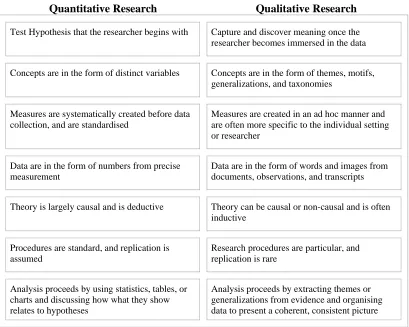
3.3 QUANTITATIVE VERSUS QUALITATIVE... 62
3.4 QUANTITATIVE RESEARCH METHOD... 63
3.4.1 Ontological Stance ... 64
3.4.2 Research Ontology ... 65
3.5 QUALITATIVE RESEARCH METHOD... 66
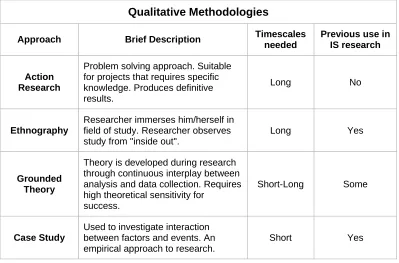
3.5.1 Qualitative Research Approaches Used ... 67
3.6 QUANTITATIVE SAMPLING TECHNIQUES... 72
3.6.1 Probabilistic Samples ... 73
3.6.2 Non-Probabilistic Samples ... 74
3.6.3 Quantitative Data Sampling Technique Adopted... 74
3.7 QUALITATIVE SAMPLING TECHNIQUES... 75
3.7.1 Purposive Judgemental Sampling... 75
3.8 PARTICIPATORY INVOLVEMENT PROCESS... 78
3.8.1 Selection of Participatory Clusters... 78
3.8.2 Selection of Participatory Sites... 79
3.9 DATA COLLECTION... 80
3.9.1 EBS Participant Acceptance ... 80
3.10 ETHICS PROCEDURES... 81
3.11 QUANTITATIVE DATA ANALYSIS... 81
3.11.1 Multivariate Factor Analysis ... 82
3.11.2 Methods of Extraction of Initial Factors ... 83
3.11.3 Determination of the Required Number of Factors... 84
3.11.4 Rotation of the Extracted Factors... 89
3.11.5 Adopted Factor Extraction Methodology ... 91
3.12 QUALITATIVE DATA ANALYSIS... 92
3.12.1 Qualitative Data Analysis ... 92
3.12.2 Open Coding... 93
3.12.3 Axial Coding... 94
3.12.4 Selective Coding ... 95
3.13 RELIABILITY AND VALIDITY... 95
3.13.1 Reliability ... 95
3.13.2 Validity ... 96
3.13.3 Validity and the Generalisation of Findings ... 98
3.14 METHODOLOGICAL CONCLUSION... 98
3.14.1 Adopted Research Sampling Strategy... 99
3.15 RESEARCH LIMITATIONS... 99
3.16 CHAPTER SUMMARY... 100
CHAPTER 4: VALIDATING THE EBS INSTRUMENT ... 101
4.1 INTRODUCTION... 101
4.2 RATIONALE BEHIND THE RESEARCH DECISIONS... 102
4.3 CONSIDERATIONS DURING CONSTRUCTION OF THE EBS ... 104
4.3.1 Vocabulary Review... 104
4.3.2 EBS Acceptance ... 105
4.3.3 Maintaining a Measurable Indicator... 106
4.4 THE EBSDESIGN... 106
4.4.1 Statement Construction ... 106
4.4.2 Statement Valences... 107
4.4.3 The EBS Final Form ... 109
4.5 CONFIRMATORY REPLICATION ANALYSIS... 110
4.5.1 Application of Multivariate Factor Analysis... 110
4.5.2 Results and Evaluations of the Confirmatory Analysis... 113
4.6 CORRELATIONAL RELATIONSHIP ANALYSIS... 114
4.6.1 EBS Correlational Relationship Model ... 115
4.6.2 Understanding the models ... 116
4.7 COMMENTS ON THE EBSPILOT ANALYSES... 118
4.8 CHAPTER SUMMARY... 119
CHAPTER 5: EBS EXPLORATORY ANALYSIS ... 120
5.1 CHAPTER INTRODUCTION... 120
5.2 EXPLORATORY ANALYSIS;COMPARING PCA AND PAFANALYSIS... 121
5.2.1 First Pass: PCA/Varimax Exploratory Analysis ... 121
5.2.2 Second Pass: PCA/Varimax Exploratory Analysis ... 122
5.2.3 PCA/Varimax Correlational Relationship Analysis... 125
5.2.4 First Pass: PAF/Oblimin Exploratory Analysis ... 126
5.3 PAF/OBLIMIN CORRELATIONAL RELATIONSHIP ANALYSIS... 130
5.4 PAF/OBLIMIN CONSTRUCTED MODELS... 130
5.4.1 PAF/Oblimin Three Factor Model ... 131
5.4.2 PAF/Oblimin Five Factor Model... 132
5.4.3 PCA/PAF Methodological Comparisons and Comments ... 133
5.5 CHAPTER SUMMARY... 134
CHAPTER 6: ANALYSIS AND FINDINGS ... 136
6.1 CHAPTER INTRODUCTION... 136
6.2 GENDER BASED COMPARISON AND ANALYSIS... 136
6.2.1 Female Gender Analysis: First Pass ... 138
6.2.2 Female Gender Analysis: Second Pass ... 139
6.2.3 Female Gender Correlational Relationship Analysis ... 140
6.2.4 Female Gender Model Annotations... 141
6.2.5 Male Gender Analysis: First Pass ... 145
6.2.6 First Pass: Statistical Validity ... 145
6.2.7 Male Gender Analysis: Second Pass ... 145
6.2.8 Second Pass: Statistical Validity ... 146
6.2.9 Male Gender Correlational Relationship Analysis ... 147
6.2.10 Male Gender Analysis Annotations ... 147
6.2.11 Gender Analysis: Comparisons and Comments ... 152
6.3 DOMAIN BASED COMPARISON AND ANALYSIS... 153
6.3.1 Science Domain Analysis: First Pass ... 154
6.3.2 Science Domain Analysis: Second Pass ... 155
6.3.3 Science Domain Correlational Relationship Analysis ... 157
6.3.4 Science Domain Model Annotations... 157
6.3.5 Health Domain Analysis: First Pass ... 160
6.3.6 Health Domain Analysis: Second Pass ... 161
6.3.7 Health Domain Correlational Relationship Analysis ... 162
6.3.8 Health Domain Model Annotations ... 163
6.3.9 Domain Analysis: Comparisons and Comments ... 166
6.4 NATIONALITY BASED DATASET ANALYSIS... 167
6.4.1 International Dataset Analysis Overview... 168
6.5 AUSTRALIAN DATASET ANALYSIS... 169
6.5.1 Australian based Analysis Annotations ... 170
6.6 UNITED STATES OF AMERICA DATASET ANALYSIS... 172
6.6.1 U.S.A. Participant Demographics ... 172
6.6.2 U.S.A. Based Analysis: First Pass ... 172
6.6.3 U.S.A. Based Analysis: Second Pass ... 173
6.6.4 U.S.A. Based Correlational Relationship Analysis ... 175
6.6.5 U.S.A. Based Model Annotations... 176
6.7 PEOPLES REPUBLIC OF CHINA DATASET ANALYSIS... 178
6.7.1 P.R.C. Participant Demographics ... 178
6.7.2 P.R.C. Based Analysis: First Pass... 179
6.7.3 P.R.C. Based Analysis: Second Pass ... 180
6.7.4 P.R.C. Based Correlational Relationship Analysis... 181
6.7.5 P.R.C. Based Model Annotations... 182
6.7.6 Nationality Based Analysis: Comparisons and Comments... 186
6.8 CHAPTER SUMMARY... 187
CHAPTER 7: CONCLUSIONS AND RECOMMENDATIONS ... 188
7.1 CHAPTER INTRODUCTION... 188
7.2 FINDINGS LIMITATIONS... 188
7.3 FINDINGS IN RELATION TO THE INITIAL INVESTIGATIONS... 189
7.4 UNEXPECTED FINDINGS... 193
7.5 IMPLICATIONS FOR FUTURE RESEARCH... 194
7.5.1 The Importance of Epistemological Beliefs... 195
7.6 IMPLICATIONS FOR EDUCATIONAL STAKEHOLDERS... 195
7.6.1 The Role of Educators... 196
7.6.3 The Role of Epistemological Beliefs ... 197
7.7 CHAPTER SUMMARY... 198
REFERENCES ... 199
APPENDIX A: EBS STATEMENT STRUCTURE ... 214
APPENDIX B: PARTICIPANT FORMS... 215
APPENDIX C: EXPLORATORY CORRELATION ANALYSIS TABLES... 218
APPENDIX D: CONFIRMATORY ANALYSIS SPSS DATA... 221
APPENDIX E: EXPLORATORY ANALYSIS SPSS DATA ... 232
APPENDIX F: GENDER ANALYSIS SPSS DATA... 251
ANALYSIS ON THE FEMALE GENDER DATASET... 251
ANALYSIS ON THE MALE GENDER DATASET... 272
APPENDIX G: DOMAIN ANALYSIS SPSS DATA... 292
ANALYSIS ON THE SCIENCE DOMAIN DATASET... 292
ANALYSIS ON THE HEALTH DOMAIN DATASET... 313
APPENDIX H: NATIONALITY BASED ANALYSIS SPSS DATA ... 334
ANALYSIS ON THE AUSTRALIAN NATIONALITY BASED DATASET... 334
ANALYSIS OF THE U.S.A.NATIONALITY BASED DATASET... 335
Tables
TABLE 1:PERRY’S MODEL OF EPISTEMOLOGICAL DEVELOPMENT... 34
TABLE 2:BELENKY'S EPISTEMOLOGICAL PERSPECTIVES... 38
TABLE 3:EPISTEMOLOGICAL REFLECTION MODEL... 41
TABLE 4:REFLECTIVE JUDGMENT MODEL... 45
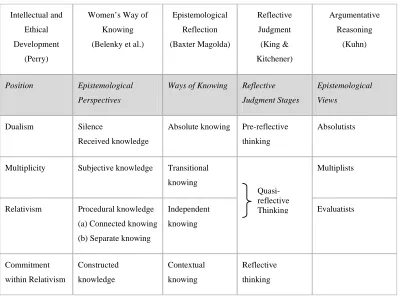
TABLE 5:ARGUMENTATIVE REASONING MODEL... 50
TABLE 6:FACTOR LOADINGS FOR THE SCHOMMER INSTRUMENT... 55
TABLE 7:METHODOLOGY DESIGN COMPARISON... 63
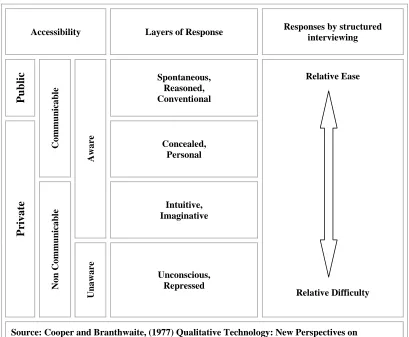
TABLE 8:THE COOPER AND BRANTHWAITE MODEL... 67
TABLE 9:QUALITATIVE ANALYSIS METHODOLOGIES... 68
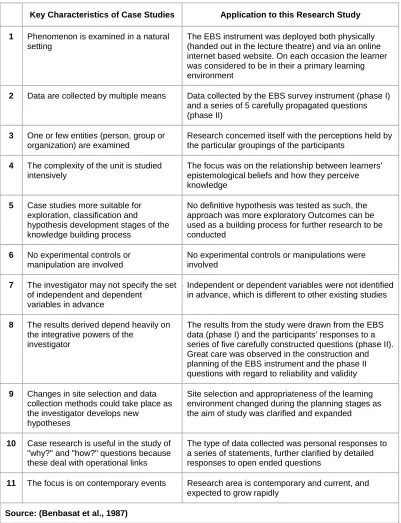
TABLE 10:KEY CHARACTERISTICS OF THE CASE STUDY METHODOLOGY... 71
TABLE 11:TYPES OF NON-PROBABILITY SAMPLE METHODS... 76
TABLE 12:TYPES OF QUALITATIVE SAMPLING STRATEGIES... 77
TABLE 13:EXAMPLE EIGENVALUES... 87
TABLE 14:BASIC FRAME OF GENERIC RELATIONSHIPS... 94
TABLE 15:PARTICIPANT DEMOGRAPHICS... 105
TABLE 16:EBS STATEMENT ALLOCATIONS... 108
TABLE 17:PREDEFINED SUBSET GROUPINGS... 109
TABLE 18:CONFIRMATORY ANALYSIS ROTATED COMPONENT MATRIX... 113
TABLE 19:CONFIRMATORY ANALYSIS CORRELATION MATRIX... 115
TABLE 20:EXPLORATORY PCASTATEMENT LOADINGS... 122
TABLE 21:EXPLORATORY PCAANALYSIS -ROTATED COMPONENT MATRIX... 124
TABLE 22:PCA/VARIMAX -CORRELATION MATRIX... 125
TABLE 23:EXPLORATORY PAFSTATEMENT LOADINGS... 127
TABLE 24:EXPLORATORY PAFANALYSIS PATTERN MATRIX... 129
TABLE 25:PAF/OBLIMIN -CORRELATION MATRIX... 130
TABLE 26:GENDER BASED DEMOGRAPHICS... 137
TABLE 27:FEMALE GENDER STATEMENT LOADINGS... 138
TABLE 28:FEMALE GENDER PATTERN MATRIX... 139
TABLE 29:FEMALE GENDER CORRELATION MATRIX... 140
TABLE 30:MALE GENDER STATEMENT LOADINGS... 145
TABLE 31:MALE GENDER PATTERN MATRIX... 146
TABLE 32:MALE GENDER CORRELATION MATRIX... 147
TABLE 33:SCIENCE DOMAIN STATEMENT LOADINGS... 155
TABLE 34:SCIENCE DOMAIN PATTERN MATRIX... 156
TABLE 35:SCIENCE DOMAIN CORRELATION MATRIX... 157
TABLE 36:HEALTH DOMAIN STATEMENT LOADINGS... 161
TABLE 37:HEALTH DOMAIN PATTERN MATRIX... 162
TABLE 38:HEALTH DOMAIN CORRELATION MATRIX... 163
TABLE 39:U.S.A.DATASET DEMOGRAPHICS... 172
TABLE 40:U.S.A.BASED STATEMENT LOADINGS... 173
TABLE 41:U.S.A. BASED PATTERN MATRIX... 174
TABLE 42:U.S.A.BASED CORRELATION MATRIX... 175
TABLE 43:P.R.C.DATASET DEMOGRAPHICS... 178
TABLE 44:P.R.C. BASED STATEMENT LOADINGS... 179
TABLE 45:P.R.C.BASED PATTERN MATRIX... 180
Figures
FIGURE 1:DEFINITION OF EPISTEMOLOGY... 25
FIGURE 2:EPISTEMOLOGICAL RELATIONSHIPS... 26
FIGURE 3:SCREE PLOT EXAMPLE... 86
FIGURE 4:NAIVE RECODING EFFECTS... 109
FIGURE 5:PROXIMITY GROUPINGS WITHIN EUCLIDEAN SPACE... 112
FIGURE 6:CONFIRMATORY ANALYSIS; CORRELATIONAL RELATIONSHIP MODEL... 118
FIGURE 7:PCA/VARIMAX SCREE PLOT... 123
FIGURE 8:EXPLORATORY PCA/VARIMAX MODEL... 126
FIGURE 9:PAF/OBLIMIN SCREE PLOT... 128
FIGURE 10:EXPLORATORY PAF/OBLIMIN (3FACTORS)MODEL... 131
FIGURE 11:EXPLORATORY PAF/OBLIMIN (5FACTORS)MODEL... 133
FIGURE 12:OBSERVED GENDER DISCREPANCIES WITHIN THE RAW DATA... 137
FIGURE 13:FEMALE GENDER BELIEF VALUES... 141
FIGURE 14:FEMALE GENDER BELIEF STRUCTURE MODEL... 144
FIGURE 15:MALE GENDER BELIEF VALUES... 148
FIGURE 16:MALE GENDER BELIEF STRUCTURE MODEL... 151
FIGURE 17:DOMAIN BASED DEMOGRAPHICS... 153
FIGURE 18:OBSERVED DOMAIN DISCREPANCIES WITHIN THE RAW DATA... 154
FIGURE 19:SCIENCE DOMAIN BELIEF VALUES... 158
FIGURE 20:SCIENCE DOMAIN BELIEF STRUCTURE MODEL... 160
FIGURE 21:HEALTH DOMAIN BELIEF VALUES... 164
FIGURE 22:HEALTH DOMAIN BELIEF STRUCTURE MODEL... 166
FIGURE 23:OBSERVED NATIONALITY BASED DISCREPANCIES... 168
FIGURE 24:RECALCULATED NATIONAL BASED DISCREPANCIES... 169
FIGURE 25:AUSTRALIAN (SCIENCE)EPISTEMOLOGICAL BELIEFS MODEL... 171
FIGURE 26:USABASED BELIEF VALUES... 176
FIGURE 27:U.S.A.BASED BELIEF STRUCTURE MODEL... 177
FIGURE 28:P.R.C.BASED BELIEF VALUES... 182
FIGURE 29:P.R.C.BASED BELIEF STRUCTURE MODEL... 185
[image:11.612.149.532.99.425.2]Chapter 1: Research Project Introduction
"The learning and knowledge that we have, is, at the most, but little compared with that of which we are ignorant." - Plato
1.1 Chapter Introduction
It is human nature to try and explain what we observe occurring around us, a process that people engaged in long before physical, biological or social sciences were established as disciplines (Black, 1999). As part of this understanding of the world around us, we engage in varying forms of classification and assimilation of new information and knowledge, sometimes with the intent of enhancing our understanding, other times as an attempt to try and rationalise how and where we fit in this often complex world around us (Marton, 1981).
Why do we unflinchingly support a favourite football team? What makes a particular sporting team our favourite in the first place? Why do we prefer one brand of car over another when each will transport us to our required destination?
How we discover, qualify and accept differing forms of information, integrating this information into already existing personal belief structures, redefines our existing knowledge, enabling us to learn new things and allowing us to make informed decisions. This then allows us as individuals to select and then defend the myriad of choices and decisions we make in real life.
1.2 Reasons behind the Research
Most educators today, coming as they do from all differing forms of current educational disciplines, realise that learners come as a unique package complete with their own unique variety of learning styles and experiences. Prior knowledge, understanding and personal epistemological beliefs play critical roles in how students understand and philosophise concepts within their personal educational environment.
The reason behind this study was to investigate currently held personal epistemological beliefs as maintained by a cluster of learners. This would be instigated by extending existing studies from the literature in order to establish and develop quantitative and qualitative methodologies to expose how and why beliefs are held and maintained by the participants and then to look at what form or structure these factors may possibly adopt.
The end results would enable this researcher to dynamically reproduce the epistemological beliefs structures held by the participants in order to offer clarification and support of key educational philosophies that would better support the development of life long learning skills in students regardless of gender, domain of study or even nationality.
1.3 Research Questions
The questions that guided this study were the following;
1. Can epistemological beliefs be exposed and then reliably reproduced to quantitatively demonstrate varying datasets?
2. Are epistemological beliefs distinguishable across gender, domain or national boundaries?
3. What form or structure can epistemological beliefs adopt in comparison with current ideology within the literature?
4. Can these epistemological belief structures provide insightful dialogue on how learners construct and rationalise their unique forms of knowledge genesis?
1.4 Research Justification
position. Personal epistemology is now influential in many aspects of today’s learning environment, areas such as comprehension, literacy, perseverance, and commitment. Personal epistemological development is seen to be developing within multidimensional phases that adjoin what is perceived to be a sequence of progressively complicated beliefs.
Accordingly, the significance of epistemological beliefs is now being recognised more and more as a critical accomplishment within educating today’s aspiring learners, and the development of student learning in general. This is in direct contradiction to the level of research currently being conducted on how today’s learning environments influence such learners development (Avramides, 2005, Prosser and Trigwell, 2004).
Findings within the current literature suggest that the learner’s learning environment does have a major influence on the maintenance of their epistemological beliefs. Tolhurst (2004), released a set of findings based on an investigation into how “changing the structure of an undergraduate course made students more active learners and also influenced their epistemological development”.
Tolhurst (2004) goes on to say that “by understanding these beliefs, and the creation of strategies positively influencing the construction and adaptation of their beliefs, it should be possible to encourage learners to become more active, independent and lifelong learners/thinkers, but much more research is clearly needed” (Tolhurst, 2004).
1.5 Project Rationale
The topic of epistemological beliefs is important and recognised globally as a critical factor in future educational planning (Avramides, 2005, Jehng et al., 1993, Qian and Alvermann, 1995, Schommer, 1994a). This factor cannot be ignored, if instructional design methodologies are intended to try and keep pace with our advancing society.
bridge the gap between what they see as learning compared to what they feel they are really understanding.
1.6 Chapter Summary
This chapter establishes, however briefly, an introduction to this research, the justification and the reasons behind the need for research projects such as this, and finally, the research questions that will be fundamentally explored and answered.
As a result, this project was commenced with a view to hopefully achieve the projected outcomes set by this researcher.
Studies of epistemological beliefs and beliefs structures are still very much at the embryonic stage, but by developing research doctrine within studies such as this, researchers could expose much easier methods of obtaining more fluid understandings of human knowledge genesis processes.
1.7 Thesis Outline
The physical layout of this dissertation is described in detail below.
Chapter one outlines the purpose, drive and aims of the study by providing justification and insight into this research project.
Chapter two reviews the existing literature, especially surrounding the topic of “Constructivism Theory” as well as background information pertaining to currently postulated epistemological models and related theories.
Chapter three details the adopted research methodology as well as the approaches developed and used by this researcher. This research was based on an initial cluster of four hundred and thirty five (435) Australian learners and their responses to the EBS instrument. This dataset was then later expanded to include an American participatory cluster of fifty one (51) learner responses as well as a Chinese participatory cluster of one hundred and four (104) learner responses. This made for a grand total of 590 responses.
and robustness by ensuring a multifarious and non-insular collection of participatory clusters would be included within the final analysis.
Chapter 4 validates the concepts, reasoning, and confirmatory strategies behind the decisions taken when constructing the Epistemological Beliefs Sampler (EBS) instrument, and discusses how this versioned tool assisted in observing and understanding the beliefs as maintained by the participatory clusters.
Chapter 5 presents the detailed analyses conducted on the datasets harvested by the EBS instrument. General background information is also provided in order to assist in understanding the adopted analysis strategies used by this researcher in an attempt to prove or disprove existing hypotheses concerning epistemological beliefs. There is also discussion surrounding the core categories and sub-themes that surfaced from the data analysis process.
The resultant observed relationships between the emergent categories and prevalent sub-themes will also be described as well as graphically presented. This has been done to add clarification to the results and findings of the overall analysis strategy that was conducted on the dataset(s).
Chapter 6 highlights the extended analysis conducted on all the datasets harvested by the EBS instrument. The entire dataset was portioned off into fields as diverse as Gender, Domain and Nationality based data subsets. The findings from these separate analyses are presented, giving an intensity of insight into how dynamic and diverse each cluster’s structure is.
Chapter 7 discusses the main conclusions derived from the data analysis process. Discussed also are the findings relating to the observed epistemological belief structures, with the aim of comparing and contrasting these findings against the current literature. In doing so, the findings within this study may assist in extending the current body of knowledge regarding research into personal epistemological beliefs.
Finally this study’s main limitations are also discussed.
The Reference section presents the alphabetically listed source of all works of significance used and cited within this dissertation.
Finally, the Appendices at the end of this document contain:-
• A complete listing of the statements used within the EBS instrument • A copy of the original request for research participants
• A copy of the original research participants consent form
Chapter 2: Literature Review
“In recent years, metacognitive research and, more specifically, the interest in so-called `epistemological beliefs' have grown. Research interest in these beliefs is based on the theoretical assumption that;
(a) Learners do have identifiable conceptions and beliefs about the nature (and development) of knowledge, and
(b) These conceptions and beliefs actually affect the interpretation of learning tasks, the engagement in particular learning activities, and even more
strongly, epistemological beliefs affect comprehension in important ways” (Schommer, 1990b)
2.1 Chapter Introduction
This chapter illustrates and examines in detail the underlying forces and philosophy that have promoted both investigation and discussion of personal epistemological belief construction.
Presented as fundamental to this discussion is the theory of Constructivism and the effect on pedagogical strategies that utilise this methodology. To further assist understanding, a comparison between the accepted Educational Paradigm and the Constructivist Epistemological Paradigm is presented for reflection.
Epistemology, being the cornerstone of this entire project is presented on all its views. The three dominant forces in the field of epistemological research are discussed, as well as a discussion on the justification for the stance taken by this researcher.
2.2 Knowledge Genesis ~ One Theory
The traditionally reliant epistemologically related empiricist view of educational services includes such lavish theories as; the educator dispenses wisdom, and the learner soaks it up, filling them with not only boundless truthful knowledge, but also associated skills such as social manners, etiquette, etc (Fitzgerald and Cunningham, 2002).
“The students are empty receptacles, or, if not, what we tell them is so shiny and new that it will undoubtedly replace all of those childish notions that they brought with them” (Powers and Powers, 2000).
Unfortunately this praxis still holds for many current educators and institutions as well as the parents of those unfortunate students. One theory that contradicts this notion is the Theory of Constructivism.
2.3 Knowledge Genesis ~ Constructivism Theory
For the past two decades, or even longer, educators and psychologists alike have used constructivism theory in their efforts to explain learning and the gaining of truth (Glynn et al., 1991, Woo, 2001). Powers and Powers (2000) ask “Can we as researchers ever know the real truth?” Apparently not, as according to the theory of constructivism, none of us really can. Constructivism according to Powers and Powers (2000), maintains that “while there is a physical reality, we can never say that what we know is the truth because all of our knowledge has been constructed from our own personal experiences and social interactions in a particular cultural setting rather than merely passively receiving and storing knowledge as proffered by educators or even as read from textbooks, lecture notes or other similar written sources” (Powers and Powers, 2000).
2.3.1
Knowledge Construction
The theory of constructivism has promoted more successful teaching strategies than those originating within traditional techniques, because the inevitable processes within knowledge construction are explicitly addressed (Ben Ari, 2001, Biggs, 1995, Biggs, 2003, Marton et al., 2004).
According to constructivism theory, an educator cannot overlook the existing knowledge base maintained by their learners, instead, the educator must enter into meaningful discussions with the learner in an attempt to appreciate how the learner understands, or views the understanding process, and only then endeavour to facilitate the learners progress into what is seen as an acceptable and/or correct framework or theory, as understood by the educator (Marton et al., 1984, Powers and Powers, 2000). A term that is commonly used for such views is “alternative frameworks”, denoting that the students maintain consistent personal models, but that they just happen to be a variation of the currently accepted concepts (Mackay, 1997, Steffe and Gale, 1995, von Glaserseld, 1995).
Similarly, von Glaserseld (1995) would never state that the learner’s view of knowledge is wrong, but would argue that “the concepts as understood by the learner are viable provided that they prove adequate in the contexts in which they were created”. Many researchers are of similar opinions that this “alternative framework” or “misconception”, forms the fundamentally essential, prior knowledge critical to the construction of new knowledge (von Glaserseld, 1995). These misconceptions are not considered mistakes, but as a logical construction based on consistent, though non-standard concepts or perceptions as maintained by the learner (Powers and Powers, 2000, Smith et al., 1993).
confront these erroneous assumptions, preferably before the learner dismisses them (Ben Ari, 2001, Driver and Tiberghien, 1985, Powers and Powers, 2000, Steffe and Gale, 1995).
Finally, Powers and Powers (2000) declare, that “knowledge is perceived to be constructed in a social setting influenced by the educator. Within this setting learners must be provided with an opportunity to form new knowledge in cooperation and interaction with their peers”.
2.3.2
Implications for Educational Methodologies
Within the theory of constructivism there are contained many critical connotations for current teaching methods. As has already been highlighted within the literature, the knowledge base that learners maintain is founded on unique life experiences that the learner has been exposed to. When confronted with teaching techniques that have little or no basis in reality, the learner will tend to ignore or reject any new information and therefore will tend to not alter their existing personal data base. Understandably, educators need to ensure that their methodologies are based on experiential processes if they are to have any measure of success (Powers and Powers, 2000, Steffe and Gale, 1995, von Glaserseld, 1995)
The importance of teaching strategies that use experiential, hands-on learning methodologies is well documented, and these strategies are usually well accepted when carefully integrated within the curricula. Powers and Powers (2000) enlighten us further by clarifying; “the principle of experiential learning also provides theoretical support for a number of formal teaching methods. For example, “discovery learning” is a broadly applied term that has been used to describe any activity in which the learners are free to make there own discoveries about a certain phenomenon” (Biggs, 1995, Powers and Powers, 2000).
to supply an almost unceasing array of problems for the learners to ponder and then attempt to solve.
Of the other implications for teaching, the importance of social interaction is also well recognized (Atherton, 2005). In particular, team based work projects or assignments are an important part of the modern educational experience, gaining increased support and use within nearly all levels within the Australian Schooling System. Previously, one of the main criticisms of the Australian educational system was the inability of our learners to work effectively as competent team members (Biggs, 2002, Tarricone and Luca, 2002).
However, as Powers and Powers (2000) inform us, “This recognition is based on the importance of the activity as an end, not as a means to an end. According to the constructivist approach, learners must assimilate new scientific knowledge into their existing frameworks in order to effectively form and express their own opinions, and engage their peers in discussion. The social interaction is the catalyst for acquiring new knowledge; it is not the knowledge itself” (Atherton, 2005, Powers and Powers, 2000).
2.3.3
The Educational Paradigm
“Globalisation and competition, together with a new type of student who place higher value on learning and gaining knowledge rather than credentials, is causing a paradigm shift in higher education” (Aldred, 2003, Hawkins, 2008)
Steffe and Gale (1995) describe an educational paradigm, which can best be described as a construct comprising four components;
1. An ontology which is a theory of existence.
2. An epistemology which is a theory of knowledge, both of knowledge specific to an individual, and of shared human knowledge.
3. A methodology for acquiring and validating knowledge. 4. A pedagogy which is a theory of teaching.
There is an ontological reality.
a. The Newtonian model of absolute space and time is the model of reality we use in practice, and we are Platonists who hold that mathematics has an independent existence.
2. Epistemology is foundational.
a. The truth is out there. Through empirical experiences we can discover absolutely true foundations, and use valid forms of logical deduction to expand true knowledge.
3. The mind is a clean slate that can be filled with transmitted knowledge. 4. Listening to lectures and reading books are the primary means of knowledge
transmission. Repetition will ensure that the knowledge is retained (Ben Ari, 2001).
2.3.4
Constructivist Epistemological Paradigm
Ben Ari (2001) then proposes that the constructivist epistemologically based paradigm is dramatically different; he suggests the following educational model.
1. “Ontological reality is at best irrelevant. Since we can never truly ‘know’ anything, ontology cannot influence our educational paradigm.”
2. “The epistemology of constructivism is non-foundationalist and fallible. Absolute truth is unattainable, so there is no foundation of truth on which to build. Knowledge is constructed by each individual and thus necessarily fallible.”
3. “Knowledge is acquired recursively: sensory data is combined with existing knowledge to create new cognitive structures which are in turn the basis for further construction. Knowledge is also created cognitively by reflecting on existing knowledge.”
The task of the educator is significantly more difficult in this model than in the conventional educational paradigm described above, because the guidance must be based on, the understanding of each learner’s currently existing personal cognitive structure(s). If the learner does not yet have the personal experiences critical to formulating these necessary structures, then the capacity of the learner to bring preconceived models to their educational environment is minimal. The educator must then ensure that an initial feasible ranking structure is constructed and subsequently developed as learning is undertaken (Ben Ari, 2001).
2.3.5
Implications for this Research
Constructivism as a theory, significantly informs us about the task of the educator, the role of peers, of formative assessment within educational domains. This theory also adds a layer of rich information regarding the well documented social difficulties faced by learners in the classroom (Ben Ari, 2001, Biggs, 2002, Biggs, 2003, Marton et al., 2004).
2.4 Epistemology – an Overview
The Macquarie Concise Dictionary defines Epistemology as: -
Figure 1: Definition of Epistemology
According to Hofer and Pintrich (1997), “Epistemology is an area of philosophy concerned with the nature and justification of human knowledge. A growing area of interest for psychologists and educators is that of personal epistemological development and epistemological beliefs: how individuals come to know, the theories and beliefs they hold about knowing, and the manner in which such epistemological premises are a part of, and an influence on, the cognitive processes of thinking and reasoning”.
Over the course of the past two decades, there have been a number of research programs that have investigated students’ thinking as well as their beliefs about the nature of knowledge and knowing. Some of the areas under investigation include definitions of knowledge, how knowledge is constructed, and even how knowledge is evaluated. However, each of these research programs has used differing conceptual frameworks as well as relatively diverse methodologies to examine students’ epistemological beliefs and thinking.
Hofer and Pintrich (1997) go on to state that; “Epistemology is the study of theories of knowledge or ways of knowing, particularly in the context of the limits or validity and how we come to understand the various ways of knowing and learning”.
The definition of the term “learning” as used in this discussion by Hofer and Pintrich (1997) relate to the perspectives of human and social constructivist paradigms as presented by Mintzes et al. (2000) and Mintzes (2006).
Bransford et al. (1999) supports this position by adding “from these perspectives it is considered that learners build knowledge and understanding for themselves through their personal, social and culturally mediated experiences”. Bransford et al. (1999) / / noun the branch of philosophy that deals with the origin, nature, methods, and limits of human knowledge. [Greek: knowledge]
also defines learning as “being viewed as both a process and a product that encompasses several dimensions including, socio-cultural, cognitive, aesthetic, motivational, and collaborative” (Bransford et al., 1999, Mintzes, 2006, Mintzes et al., 2000).
Learning is perceived as being ongoing, developed by stages, and contextually bound where alteration, justification and assimilation of new knowledge is produced through personal experience or successive experiences, which, as Woo (2001) states, “are interpreted in the light of prior understanding”. It should therefore be considered that every learner’s personal knowledge base and unique understanding is continually transforming, almost in a perpetual state of creation and maintenance, as new experiences are encountered, interpreted and finally assimilated by the learner (Anderson and Piscitelli, 2002, Woo, 2001).
2.5 Epistemological Positions
As Anderson and Piscitelli (2002) explain;“To these ends we see learning as any change that occurs in the person's knowledge, understanding, and/or disposition.”
The three main epistemological positions in currently defined within the literature are shown in Figure 2: Epistemological Relationships, and are discussed in further detail below.
2.5.1
Positivism
Positivism holds the position that the ambition of attaining knowledge is to basically describe all phenomena that we experience. The function of science is to simply maintain a position relating directly to what can be observed and measured. Trochim (2002), reinforces this position by stating that “Knowledge of anything beyond that, a positivist would hold, is impossible!” (Trochim, 2002).
Positivists also generally assume that “reality is objectively given and can be described by measurable properties, which are independent of the observer (researcher) and their instruments”. Trochim (2002) also states that “positivist studies generally attempt to test theory, in an attempt to increase the predictive understanding of phenomena”.
In the positivist view of the world, as seen by Trochim (2002), science is maintained as the principle mechanism that allows us access to all forms of truth. Science is also seen as a means to understand the world around us in an effort to actually try and control it by predicting what it (the world) is capable of and deploying already conceived contingency plans. Trochim (2002) states that “the world and the universe are considered deterministic; they both operate by laws of cause and effect that could be discerned if the unique approach of the scientific method is applied” (Trochim, 2002).
Deductive reasoning can be used therefore to postulate and test theories. Armed with the results of these tests we may well conceive that a proposed theory just doesn’t fit with what we know to be the facts, and may need to be recalculated in order to better envisage reality with the facts that we have. Positivists also believe in empiricism, this maintains the position that observation and measurement of a phenomena is the critical heart of acceptable scientific enterprise. The accepted core approach of the scientific method consists of the experiment, which is an endeavour to discern natural laws through direct manipulation and observation in our attempts to predict and control the future (Hammersley, 1999, Trochim, 2002).
2.5.2
Interpretivism
hermeneutics and phenomenology (Bleicher, 1980, Boland and Day, 1991, Neuman, 2003).
Interpretive studies try to understand phenomena through the meanings that people assign to them. This view is directly opposite to the Positivist stance in which science must be objective, by claiming that all observations are affected by a large array of higher involving issues such as personal viewpoints and past experiences of the researcher (Darke and Shanks, 1997, Wood-Harper, 1992).
Interpretive researchers also recognise and support that language and semantics may contain different meanings for each unique individual and only by a deep understanding of the phenomena holistically, can insightful knowledge be gained (Myers, 1997b, Myers and Walsham, 1998).
Consequently, unlike Positivist research activities, the results of interpretive research are not generally repeatable, nor are they generally applicable to a wide range of situations and scenarios. Nevertheless the results are extremely significant for the related scenario and participants as well as the researcher, and can be influential in similar situations that closely resemble the original research (Bernstein, 1983, Butler, 1998, Myers, 1997b).
2.5.3
Critical Social Science
Critical social science is defined by Fay (1987) as “a practical social science that can inspire people to become socially active in order to correct their socio-economic and political circumstances so that they might satisfy their basic life needs”. Fay (1987) then goes on to discuss three core ideas of critical social science: being enlightenment, empowerment and emancipation (Fay, 1987).
2.5.3.1 Enlightenment
Enlightenment attempts to inform people about their unique and difficult situation and expose their latent capability to modify their current situation in an attempt to meet or exceed their perceived needs. Enlightenment is seen as being accomplished through matters of reflection, discussion (social and personal communication) and resolution of so-called “quasi-causes” of their unique and difficult socially related circumstance (Fay, 1984, Fay, 1987, Klein and Myers, 1999).
of society, thereby ensuring proper discussion. Participants within these discussions must also try and agree to mutually acceptable definitions regarding the meanings directly relating to words, gestures and symbols used within all communication processes. True communication is universally accepted as being founded on collective acceptance of the language form used to convey any forms communication between correlated parties within any discourse (Klein and Myers, 1999).
2.5.3.2 Empowerment
Empowerment is, according to Fay (1987); “considered a practical force which stimulates a people to take action, which is meant to improve their social condition”. Susman (1983) adds to this by stating “the recipients of an expected positive result take the social actions. It is not the ‘expert’ who decides the action to be taken to improve others’ quality of life. It is the recipient of the service that makes the determination” (Fay, 1987, Susman, 1983).
2.5.3.3 Emancipation
Emancipation can therefore be seen as a form of liberation directly resulting from the nature of social action. Consequently, people may become self-emancipated as a result of their own form of reflection and as a result of their own social action(s), from what can be seen and understood to be an oppressive, problematic, social situation (Bernstein, 1983, Habermas, 1984).
According to Fay (1987), “Critical researchers assume that social reality is historically constituted and that it is produced and reproduced by people. Although people can consciously act to change their social and economic circumstances, critical researchers recognize that their ability to do so is constrained by various forms of social, cultural and political domination” (Fay, 1987).
2.5.4
Research Epistemological Stance
This research focuses upon uncovering existing epistemological beliefs and belief structures maintained by the participants. This research is also exploring how the participants perceive, justify and assimilate new information in their attempt to not only learn new knowledge, but to understand and gain new wisdom.
Critical Social Science epistemology is viewed as inappropriate as the researcher was not inserted into the educational environment to alter, inspire, or make any differences, but to merely observe and understand the data as it emerges from an intensive analysis process.
Within the selected participatory clusters there are bound to be differing cultural and ethnographic backgrounds combined with differing levels of experience and chronological maturity of the learners. This conundrum alone will give credence, depth and validity to the research by adding a rich, layer of personal experiences as proffered by the participants.
As the aims of this research could also be considered mainly objective, so a positivist epistemology was regarded as being the most appropriate approach for this researcher.
2.6 Epistemological Research Reviewed
What follows is a somewhat chronologically based discussion on the advancements within epistemological research.
William G. Perry (Jnr) is generally credited with being the founding figure of most epistemological research development, where in Perry (1970), he attempts to understand how students’ interpreted pluralistic educational experiences had led to a theory of epistemological development in college students (Perry, 1970).
2.6.1
Main Issues Addressed Within the Literature
In Hofer and Pintrich (2002), current developmental research on epistemological beliefs and reasoning is acknowledged as having addressed six general issues:
1) Refining and extending Perry's developmental sequence (King and Kitchener, 1994, King et al., 1983, Kitchener, 1986).
2) Developing more simplified measurement tools for assessing such development (Baxter Magolda and Porterfield, 1985, Knefelkamp, 1974, Moore, 1989, Widick, 1975).
3) Exploring gender-related patterns in knowing (Baxter Magolda, 1992, Belenky et al., 1986).
4) Examining how epistemological awareness is a part of thinking and reasoning processes (King and Kitchener, 1994, Kuhn, 1991).
5) Identifying dimensions of epistemological beliefs (Schommer, 1990a, Schommer, 1994b); and, most recently,
6) Assessing how these beliefs link to other cognitive and motivational processes (Butler and Winne, 1995, Hofer, 1994, Ryan, 1984a, Ryan, 1984b, Schommer, 1990a, Schommer, 1993a, Schommer et al., 1992, Schutz et al., 1993).
2.7 Epistemological Methodologies and Instruments
As mentioned earlier, psychological research on epistemological development began during the mid 1950s, and since that inception there has been three distinct, yet interwoven paths of research, all of which discuss and define the six main issues identified and presented above.
Inspired by the original work of Perry (1970), Baxter Magolda (1987, 1992); Belenky et al., (1986); and Perry (1970, 1981) have all posited models that are to some degree structural, developmental sequences. This group has been largely interested in how individual learners interpret their educational experiences.
Perry instigated research into this domain by using participatory sampling that was almost entirely male. Belenky et al. (1986) investigated the feminine side of this domain utilising an exclusively female participatory sample. Baxter Magolda (1987, 1992) however, investigated the concepts of gender implications by accepting both male and female participatory samples into her research.
King & Kitchener (1994), Kitchener & King (1981), Kitchener, et al., (1989), and Kitchener, et al., (1993) comprise a second group of researchers that have been investigating “how epistemological assumptions influence thinking and reasoning processes, focusing on reflective judgment and skills of argumentation” (Kuhn, 1991, Kuhn, 1993). Slight differences can be observed within the theories and models that are offered from this group, but this is also influenced by the level of investigation of the inquiry as well as the participatory cluster population being studied, facts not lost on this researcher. There has been some concurrence in terms as to “what individuals believe knowledge is and how it is they know” (Hofer and Pintrich, 2002, Hofer and Pintrich, 1997).
A third and more recent line of research undertaken by Ryan (1984a, 1984b) and Schommer (1990, 1994), has taken a tangent approach that epistemological ideas are a system of more or less independent beliefs rather than reflecting any coherent developmental structure. It is hypothesised that these beliefs may also influence comprehension and cognition applicable to academic tasks.
2.7.1
Perry's Scheme of Intellectual and Ethical Development
Nearly all existing research on epistemological beliefs can trace its lineage back to two longitudinal studies undertaken by William Perry that began in the early 1950s at Harvard’s Bureau of Study Counsel (Hofer and Pintrich, 1997). His work culminated in a developmental scheme of abstract structural aspects of knowing and valuing as held by his college students (Perry, 1970).
Perry was interested in the responses of students when faced with the intellectual and social environment of the university. He developed an instrument that he called the Check-list of Educational Values (CLEV). Perry based the CLEV on the authoritarian personality research undertaken by Adorno, Frenkel-Brunswik, Levinson, & Sanford, (1950) and Stern's (1953) “Instrument of Beliefs”. Perry was operating on a prevailing mental model of the time that differences in student responses to the relativistic world they encountered in college were largely attributable to each individual’s personality (Adorno et al., 1950, Stern, 1953) in (Hofer and Pintrich, 1997).
2.7.1.1 The Check-list of Educational Values (CLEV)
Perry administered the CLEV to a random sample of 313 first year college students in 1954 – 1955, and then invited thirty one students (twenty seven men and four women) for annual follow-up interviews. After reviewing the transcripts of these interviews, Perry and his staff concluded that there was not so much a matter of personality evident in the manner in which the students made meaning of their environment, rather there was more compelling evidence toward a logically coherent, cognitive developmental process.
2.7.1.2 Perry’s Model
Perry's scheme of intellectual and ethical development suggests that the learner constantly adjusts and evaluates their thought processes when attaching meaning and/or relevance to their experiences. Within Perry’s scheme the defined levels are described as positions of development rather than formal developmental stages, all of which share constructs similar to other Piagetian-type developmental schemes. These positions as proposed by Perry appear to represent an invariant sequence of hierarchically integrated structures. Changes in acceptance or the making of meaning is brought about through cognitive disequilibrium. By interacting within their educational environment and responding to new situations or challenges the individual learner is faced with either assimilating the new experience within their own existing knowledge constructs, or accepting the new experience as a totally new construct.
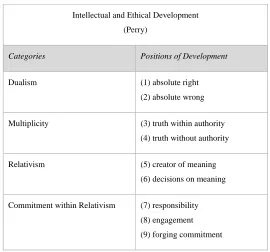
The nine positions of the Perry’s scheme have typically been clustered into four sequential categories (Knefelkamp and Slepitza, 1978, Kurfiss, 1988, Moore, 1994). See Table 1: Perry’s Model of Epistemological Development, from (Hofer and Pintrich, 1997).
Intellectual and Ethical Development (Perry)
Categories Positions of Development
Dualism (1) absolute right (2) absolute wrong
Multiplicity (3) truth within authority (4) truth without authority
Relativism (5) creator of meaning (6) decisions on meaning
[image:34.612.204.474.435.687.2]Commitment within Relativism (7) responsibility (8) engagement (9) forging commitment
Dualism
Positions 1 and 2 are characterized by a dualistic, absolutist right and-wrong view of the world. Within this world, Authorities are expected to know what the truth is and are able to convey it to the learner.
Multiplicity
Position 3 represents a somewhat minor modification of dualism, with the beginning of the recognition of diversity and uncertainty. Authorities who disagree haven't yet found the right answer, but truth is still knowable. By Position 4, dualism is modified again; areas in which there are no absolute answers are outside the realm of authority. An individual at this position is inclined to believe that all views are equally valid and that each person has an intrinsic right to his or her own opinion.
Relativism
Position 5 is the watershed of the scheme, as individuals make the shift from a dualistic view of the world to a view of contextual relativism that will continue, with modifications, through the upper stages. A major shift is in the perception of self as an active maker of meaning. At Position 6 individuals perceive knowledge as relative, contingent, and contextual and begin to realize the need to choose and affirm one’s own commitments.
Commitment within Relativism
The final positions, 7 through 9, reflect a focus on responsibility, engagement, and the forging of commitment within relativism. Individuals make and affirm commitments to values, careers, relationships, and personal identity. Developments in the upper positions are described by Perry as more qualitative than structural, and are not marked by formative change. Although proposed as part of the scheme, these positions were not commonly found among college students.
2.7.1.3
Perry’s Model (Conclusion)
Perry was the first to postulate that students made sense of their educational experience, not by way of a reflection of personality but, by an evolving developmental process.
A core principal of his scheme has been the manifestation of the dualistic, multiplistic, and relativistic points of view that characterized the epistemological outlook of many college students.
Perry also accepted that his research had several notable limitations which included; • Participants were student volunteers from a single college.
• Investigators who abstracted the scheme also served as the interviewers. • Validation was conducted in relation to the data from which the scheme itself
was derived.
• The sample was largely composed of White, elite, male college students educated at Harvard during the 1950s (Perry, 1970).
Notwithstanding these self expressed limitations of his original study, Perry’s work laid the foundations for many research projects that followed this seminal work, and much of the research today can trace its lineage back to his original thoughts and hypotheses.
2.7.2
Women's Ways of Knowing
During the 1970’s, the limitations residing within Perry’s work came under scrutiny, particularly where Perry had tried to generalise his findings to a larger general population base from an elite male sample cluster (Gilligan, 1982). By providing a purely male sample, Perry’s theory was challenged by Gilligan (1982), on the basis that a purely male sample could only provide a normative view of psychological theories derived only from male experience.
Theories based on gender exclusive data often provide a model for human development against which the excluded gender (in this case, female) is judged deficient. It was therefore postulated that this theory only contained traditionally masculine attributes and values.
then developed a model that drew on five different perspectives “from which women view reality and draw conclusions about truth, knowledge, and authority” (Belenky et al., 1986).
2.7.2.1 Epistemological Perspectives
Belenky et al. (1986) used an interview-case study approach where they interviewed one hundred and thirty five women, of whom ninety were enrolled, or recently enrolled, in one of six diverse academic institutions and forty five were involved in human service agencies.
Because of the resolve of the researchers to use a similar approach to Perry’s earlier methodology, they were committed to a similar phenomenological approach when conducting their interviews with the participants. Each interview lasted from two to five hours in total.
Independent scoring during the analyses of the interview transcriptions was applied to any material pertaining to the work of Gilligan, Kohlberg, or Perry. The preliminary attempts by the researchers to classify the data using Perry's scheme met with mixed results due to the lack of fit with Perry’s model. This led to the development of a new classification scheme of five epistemological perspectives (Belenky et al., 1986, Hofer and Pintrich, 1997).
2.7.2.2 The Epistemological Perspectives Model
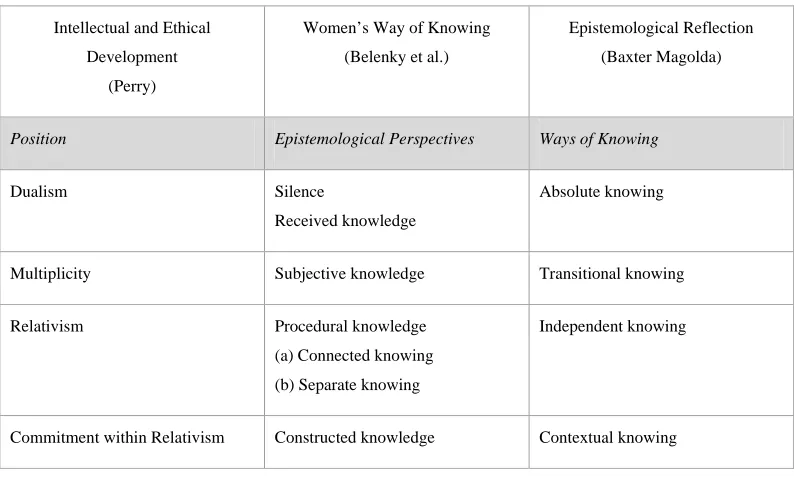
Belenky et al. (1986) proposed model that provided for “five differing epistemological perspectives from which women know and view the world”. Like Perry’s research, these are also not described as stages, but there is some discussion and speculation on possible developmental constructs within the model (Hofer and Pintrich, 1997). In Table 2: Belenky's Epistemological Perspectives, the epistemological perspectives model is compared with the relevant positions within Perry's model.
true or false”. All the women in this position see knowing as originating outside of themselves.
Subjective knowledge still maintains a multiplicity within its dualistic nature, but the source of truth and information is realised as being within oneself. Belenky et al. (1986) describe the male as having the right to assert their own opinion, where the female sees truth as something more intuitive and personally experienced.
The position of procedural knowledge is described by Belenky et al. (1986) as having two forms or epistemological orientations. Separate knowing is impersonal and detached but evident within critical thinking. Connected knowing is still considered procedural where truth develops more contextually and within a capacity for empathically founded experience. The mode of knowing is personal and emphasizes understanding over judgment. These epistemological orientations are not described as gender specific but as possibly gender related (Belenky et al., 1986). See Table 2: Belenky's Epistemological Perspectives.
Intellectual and Ethical Development
(Perry)
Women’s Way of Knowing (Belenky et al.)
Position Epistemological Perspectives
Dualism Silence Received knowledge
Multiplicity Subjective knowledge
Relativism Procedural knowledge (a) Connected knowing
(b) Separate knowing
[image:38.612.205.473.378.617.2]Commitment within Relativism Constructed knowledge
Table 2: Belenky's Epistemological Perspectives
2.7.2.3 Epistemological Perspectives Model (Conclusion)
Belenky et al. (1986) expanded and enhanced Perry’s original research by extending the framework to include female perspectives. By doing this they also offered themselves up for similar gender exclusivity criticisms as also experienced by Perry in his earlier study. Criticisms were also raised as to the ordering of the interview stages, as questions and concepts used earlier within the interview process may have had some effect on later responses.
Other criticisms arose that centred on the use of participants that were past members of the institutions approached, and in fact were not even currently enrolled at the institution at the time. Similarly less educated women received shorter questions in sharp contrast to longer questions offered to the more educated female participants, on the role of expertise in their own learning. This caused a variance in the interview protocols creating some difficulties in drawing meaningful conclusions from the two populations which resulted in a difference of epistemological perspectives.
One of the major conceptual differences with Perry’s work is that Perry's positions are descriptive of the nature of knowledge and truth, while Belenky et al. (1986) focused more on the source of knowledge and truth.
Considerable use has been made of the “women's ways of knowing” model by educators, particularly at the tertiary level. The most useful heuristic seems to have been the distinction between separate knowing and connected knowing, which has served as a means for understanding gender-related approaches to learning, in (Hofer and Pintrich, 1997)
2.7.3
Epistemological Reflection Model
In 1986, Marcia Baxter Magolda began a five year study of one hundred and one randomly selected students (fifty one female, fifty male) from Miami University in Ohio. Baxter Magolda's study initially intended to quantify the learner’s way of thinking as presented by Perry (1970) by developing and validating her Measure of Epistemological Reflection (MER) instrument (Baxter Magolda, 1987, Baxter Magolda and Porterfield, 1985).
2.7.3.1 The Measure of Epistemological Reflections (MER)
and graduate students. Baxter Magolda was confronted with patterns of responses that did not neatly fit the then current epistemological scheme and was intrigued by the discrepancies in findings between the men in Perry's study and the women in the study of Belenky et al. (1986).
Baxter Magolda then also became interested in possible gender-related implications. Accordingly, she then designed a longitudinal study of epistemological development and how epistemological assumptions affect interpretation of educational experiences (Baxter Magolda, 1992, Baxter Magolda and Porterfield, 1985, Hofer, 1994, Hofer and Pintrich, 1997).
In 1986 Baxter Magolda began her research. She conducted annual open-ended interviews and gave participants the Measure of Epistemological Reflections (MER), to be completed and returned later. Seventy complete longitudinal sets were interpreted in the development of the epistemological reflection model (Baxter Magolda, 1992).
The first-year interviews were designed to address six areas of epistemological development:
1. The role of the learner, 2. The role of the instructor, 3. The role of the peers,
4. The role of evaluation in learning, 5. The nature of knowledge, and 6. Decision making.
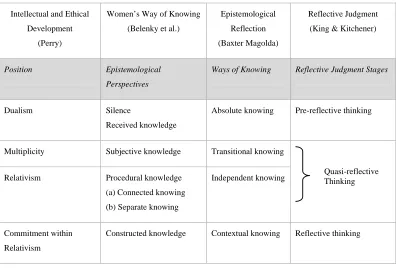
Intellectual and Ethical Development
(Perry)
Women’s Way of Knowing (Belenky et al.)
Epistemological Reflection (Baxter Magolda)
Position Epistemological Perspectives Ways of Knowing
Dualism Silence Received knowledge
Absolute knowing
Multiplicity Subjective knowledge Transitional knowing
Relativism Procedural knowledge (a) Connected knowing
(b) Separate knowing
Independent knowing
[image:41.612.141.538.64.303.2]Commitment within Relativism Constructed knowledge Contextual knowing
Table 3: Epistemological Reflection Model
Baxter Magolda (1992) reports that each of her four qualitatively different "ways of knowing," leads to "particular expectations of the learner, peers, and educator in an educational environment. The definition of epistemology that emerges from these categories is focused more on the nature of learning as situated in the college classroom context and less on assumptions about knowledge itself (Baxter Magolda, 1992, Hofer and Pintrich, 1997).
Within the Baxter Magolda model, the following stances are described,
• ‘Absolute knowers’ view knowledge as certain and believe that authorities have all the answers.
• ‘Transitional knowers’ discover that authorities are not necessarily all-knowing and so begin to accept the notion recounting an uncertainty of knowledge.
• Those who are ‘independent knowers’ begin to question any authoritative source as the only basis of gaining knowledge and begin to embrace the thought that their own opinions and judgements are equally valid.
Expertise itself is subjected to evaluation. Knowledge evolves, and appears to be continually reconstructed on the basis of new evidence and new contexts (Baxter Magolda, 1992).
By co-joining previous primarily single gender research with an overlay of a more naturalistic and qualitative methodology, Baxter Magolda was able to build on the previous studies which enabled her to report findings that were associated with gender-related reasoning patterns that demonstrated some familiar ground across the first three ways of knowing.
These are described as representing a continuum of differences in how students justify epistemic assumptions within each of the ways of knowing.
• Within absolute knowing, the two patterns are;
o Receiving, used more often by females than by males in the study, and o Mastery, a pattern more common to the males.
• The patterns for transitional knowers are;
o Interpersonal (more likely among females), and o Impersonal (more likely among male).
• Patterns for independent knowers are;
o Inter-individual (more likely among females), and o Individual (more likely among male).
Baxter Magolda further hypothesizes that the patterns may converge within contextual knowing (Baxter Magolda, 1992, Hofer and Pintrich, 2002, Hofer and Pintrich, 1997).
2.7.3.2 Epistemological Reflection Model (Conclusion)