Netml – A Language and Website for Collaborative Work on
Networks and their Algorithms
Ron Addie, Stephen Braithwaite and Abdulla Zareer
Department of Mathematics and Computing
University of Southern Queensland
Toowoomba, QLD, Australia
August 19, 2006
Abstract
This paper describes a language, Netml, for describing networks, a web site which provides a collaborative work-ing environment for use and development of network data files and software for networks. The language, Netml, is based on XML. An XML schema for this language has been developed. Algorithms for availability analysis, loss analysis, routing, traffic flow analysis, and link dimen-sioning have also been made available on the Netml web site and are described in outline in this paper.
A repository of networks has also being set up and is described here. In addition to the algorithms for network analysis and design, scripts for converting dia files to
Netml, and for generating postscript fromNetmlhave also been developed. The software and the web site are particularly directed to educational purposes and enable students of network analysis and design to specify net-works and apply an increasing range of algorithms to these networks in the course of their studies.
1
Introduction
Communication networks are of increasing importance to every aspect of modern life. The design, planning, anal-ysis and management of networks is therefore of increas-ing interest. Fortunately, many modern communication networks are quite robust, readily adapt to a great range of conditions, and therefore do not require detailed deci-sion making to keep costs low while delivering
satisfac-tory performance. However, it would be premature to sug-gest that our networks are so good at adapting to current conditions that we do not need to understand how they perform and how to manage their performance at all.
We therefore need to continue to develop, refine, and apply mathematical techniques for analysis and design of our communication networks, and to teach these tech-niques to students.
This paper is not about developing new techniques for design and analysis of networks but rather about a frame-work within such frame-work can be conducted efficiently and with effective collaboration between interested parties.
The purpose of the web site is to make network plan-ning tools available that work with Netml, to provide a central registry for example networks and to link to other related resources. The site is implemented using Java Server Page technology. This site can be found athttp://cs.sci.usq.edu.au/netml2. In this paper we first describe the Netml language that we have developed using XML schema language, then we describe the network analysis tools which have been implemented in the Java and XSLT languages and made available on the web site. Next we present the repository of networks. Finally, we present concluding remarks and future work.
2
Netml – An XML Language for
Networks
A network description is a static representation of the net-work. The principal elements in a network are nodes and links. The nodes carry out routing, switching and/or pro-cessing on messages or signals. Traffic streams are an-other important element in the description of networks. Traffic streams are used to describe in general the statis-tics of the messages and/or signals which the network will carry.
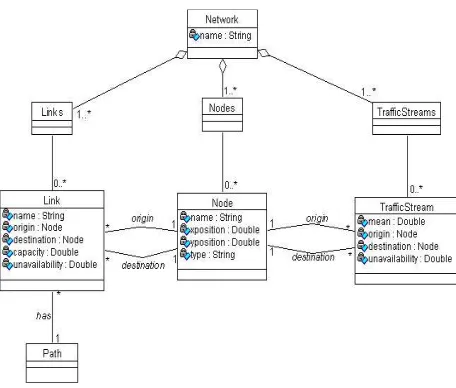
[image:2.612.311.539.120.314.2]Figure 1 is a UML class diagram showing how its ele-ments are related and how together with other eleele-ments, they form a network object. A network is made of a col-lection of nodes, links and traffic streams. Nodes are iden-tified by a name and have other attributes as shown in the diagram. Nodes are interconnected by links. A node does not necessarily correspond only to a router or an end-system, but may also represent an autonomous system. A node can have many links originating or terminating at it-self. A link is also identified by a name and has one origin and one destination node. A link can be a point-to-point or multipoint link. The traffic stream object identifies the traffic flow information from an origin node to a destina-tion node. A path is composed of a list of links. This is an object which is expected to be useful for describing rout-ing and in algorithms for network design, but up to this point we have not made use of paths.
Figure 1: UML class diagram for network
2.1
Netml Schema
The syntax of the Netml language has been specified by means of the XML schema language [5]. To develop the Netml language an XML document was derived from the UML class diagram shown in Figure 1. Figure 2 shows the definition for Netml root element. Inside the root element definitions for all other objects of the network namely nodes, links and trafficStreams are provided. Also the definition for displaySetting is defined. The Netml schema document also contain namespace related infor-mation such as default namespace, target namespace, etc. The grammar for the complete Netml schema is availabe on the website.
2.2
Netml Example
<schema xmlns="http://www.w3.org/2001/XMLSchema" targetNamespace="http://cs.sci.usq.edu.au/netml" xmlns:netml=
"http://cs.sci.usq.edu.au/netml/netml"> <!-- Description of Network -->
<element name="network"> <complexType>
<all>
<element name="nodes" minOccurs="1" maxOccurs="1">
<complexType> <sequence>
<element name="node" type="netml:nodeType" minOccurs="0"
maxOccurs="unbounded" /> </sequence>
</complexType> </element>
<element name="links" minOccurs="1" maxOccurs="1">
<complexType> <sequence>
<element name="link" type="netml:linkType" minOccurs="0"
maxOccurs="unbounded" /> </sequence>
</complexType> </element>
<element name="trafficStreams" minOccurs="1" maxOccurs="1">
<complexType> <sequence>
<element name="traffic" type="netml:trafficType" minOccurs="0"
maxOccurs="unbounded" /> </sequence>
</complexType> </element>
<element name="displaySetting" type="netml:displaySettingType"
minOccurs="0" maxOccurs="1" /> </all>
</complexType> .
</element>
Figure 2: Netml schema root element
3
Analysis and Design Tools
3.1
Availability Tool
In this section we explain a network planning algorithm we have implemented which makes use of the Netml markup language. We have chosen and implemented the availability calculation algorithm that was presented in [7]. The implementation reads a network described using the Netml language and calculates the total probabilities of all states considered and also the unavailability of each Origin-Destination(O−D) pair of the network.
Based on the method explained in [7] theO−D avail-ability can be calculated to a desired degree of accuracy
G I B
K D
M F
H
A
J C
L E
[image:3.612.330.517.123.281.2]N
Figure 3: Example Network (source : [6])
<netml:network xsi:schemaLocation="..."> <nodes>
<node>
<name>A</name>
<xposition>70</xposition> <yposition>150</yposition> </node>
<node>
<name>B</name>
<xposition>50</xposition> <yposition>320</yposition> </node>
... <links>
<link>
<name>link1</name> <origin>A</origin>
<destination>B</destination> <capacity>200</capacity>
<unavailability>0.01</unavailability> </link>
...
by enumerating the states of the network in “alphabetical order”, and terminating when the sum of probabilities is close to 1 or when the number of failures have reached the maximum number of failures specified.
of the objects and their relationships for the system we developed to implement the algorithm. The implemented system mainly performs four basic process. That is:
1. It reads in a network specified in Netml, parses it creating a Document Object Model(DOM).
2. Converts the DOM document to an internal data structure to be used by the system.
3. Calculates the availability of network using the in-ternal data structure which is optimised for this pur-pose.
4. Store the end-to-end availabilities in the DOM object of the XML document.
[image:4.612.89.286.352.533.2]5. Show the results, and produce an xml file from the DOM object which now includes the results.
Figure 4: UML class diagram of the system
As shown in the Figure 4 there are four classes im-plemented in this system Avail, AvailDOM, NetNode and
NetLink. The Avail class is the main class responsible for
creating other objects and implements various methods for the calculation of unavailability. The causeFail() is a recursive function which implements the core algorithm. This function is responsible for enumerating all the possi-ble states of the network and accumulating the probabili-ties. During the calculation of probabilities to determine
whether there is a path or not between eachO−Dpair, the Floyd [8] algorithm is implemented. Since we need to consider every O-D pair, this is more efficient than using Dijkstra’s algorithm.
The AvailDOM class implements a DOM parser us-ing the Xerces2 Java XML parser [9] based on the JAXP specification [10]. This class is responsible for creating a DOM tree of the XML network, converts the nodes in DOM object to the internal data structures used in the sys-tem. This class has methods to update the DOM object and also to write the modified DOM tree to a file in XML format. The internal data structures NetNode and NetLink are used to improve the efficiency of the system.
3.2
Traffic Analysis and Dimensioning
The website includes traffic analysis tools which carry out the following functions:
(a) routing tables are calculated, in accordance with the traditional philosophy of using the shortest path; these routing tables are stored in the nodes of the net-work;
(b) the mean and variance of the aggregate traffic on each link is calculated from the mean and variance of the traffic streams;
(c) the loss which would be experienced by traffic flows, on each’ link, are calculated and stored as a parameter of each link.
(d) The capacity which would be required on each link in order that the network should be able to carry all the traffic even when one link hsa failed is calculated and stored in the capacity element of the links.
4
XSLT Scripts
4.1
Making Pictures
4.1.1 Display Settings
The way that nodes, links and traffic are displayed is con-trolled by display attributes within the XML. The colour, width, labels of lines, shape of nodes, whether hidden and the labels may be controlled by the display settings. These display settings occur in two places. Display settings may be set globally for the entire network, and also locally for any individual node, link or traffic object.
Netml uses a flexible mechanism to decide whether to draw using a local setting or to draw using a global setting. Global and local display settings all have a priority setting and the display tool always uses the setting with highest priority.
This mechanism is more flexible than the mechanism of always having local settings override global ones. We can, for example, have a network with links of varying de-grees of importance, and control whether the more minor links are displayed varying only the priority attribute of the global hidden setting.
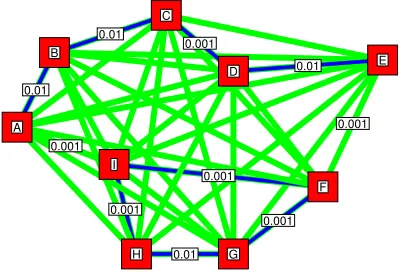
Figure 5 shows an example settings of the
displaySet-ting object which can be defined in the XML network.
Only links that have a higher priority for the hidden set-ting than the one in the global display object are dis-played. Figure 6 shows the output network created by the XSLT system developed based on the display setting shown in Figure 5.
<displaySetting> <nodeSetting>
<shape priority="5">box</shape> <size priority="5">40</size> <colour priority="5">red</colour> </nodeSetting>
<linkSetting>
<hidden priority="5">yes</hidden>
<label priority="2">unavailability</label> <width priority="1">5</width>
<colour priority="2">blue</colour> </linkSetting>
<trafficSetting>
<hidden priority="3">no</hidden> <label priority="3"></label> <width priority="2">8</width> <colour priority="2">green</colour> </trafficSetting>
</displaySetting>
Figure 5: Display Setting
0.001
0.001
0.001
0.01
0.01 0.001
0.01
0.001 0.001 0.01
G I
B
D
F
H A
C
[image:5.612.325.527.125.262.2]E
Figure 6: Network based on settings in display setting
4.1.2 Design of the Display Tool
To develop the system we have first created the postscript which is needed to draw a network. The postscript gen-erated by the display tool includes a postscript header in which there are quite a number of definitions. These defi-nitions effectively extend the postscript language, adding functions which will draw a node, link, traffic, box, circle and write a label. Once the postscript has been designed several XSLT transformation rules were created to trans-form XML networks described in Netml to postscript. In these rules we have used XPath expressions [12] to gain access to various parameters in the network.
The root template defines the postscript header includ-ing the definitions of all the functions used in the subse-quent postscript. Also it has code to invoke the templates for nodes, links and trafficstreams and then writing labels and drawing the nodes. The node template, link template and traffic template define details to process each node, link and traffic of the network.
4.2
Dia to Netml translation
4.3
Contributed Scripts
User contribution of XSLT scripts has recently been im-plemented. At first sight XSLT does not seem to be a nat-ural language for analysing and designing communication networks. However, if additional functions are provided, from a library written in Java (e.g. functions for finding shortest paths), it turns out that many tasks which have previously been regarded as complex (e.g. deciding on the capacity all links) are quite easy to do.
An example of the use ofXSLTfor a network task is shown in Figure 7.
5
The Repository
5.1
A Database of Networks
The Netml Repository is an important feature of the Netml website. Users may select an existing network rather than create a new one from scratch. Tools may be applied directly to networks in the repository, or alterna-tively, a network from the repository may be download and edited before applying the tools.
Users may submit their own networks for inclusion into the repository. When a network file is submitted, it will be validated against the Netml schema before it is being accepted. Users may view the network as a picture once it is submitted.
5.2
A Database of Algorithms
It is also possible to submit software to the repository. The existence of a standard language for describing networks is essential to allow sharing of software. The characteris-tics of XML, as a data language, increases the benefits of sharing because of the easy access to data which it pro-vides, and in particular because we can use the very pow-erful document transformation language, XSLT, to encode these algorithms.
The Netml web site already uses XSLT as the language for implementation of several algorithms already, namely the algorithms for conversion to postscript, the algorithm for conversion of dia files to netml files, a simple algo-rithm for costing a network, and an algoalgo-rithm for adding traffic streams to a network.
For encoding simple scripts which carry out useful functions, XSLT is ideal. As an example, Figure 7 shows the key fragment of a script, available for use on the web site, which adds a complete collection of traffic streams to a network:
<trafficStreams>
<xsl:for-each select="/nml:network/nodes/node"> <xsl:variable name="origin" select="name"/>
<xsl:for-each
select="/nml:network/nodes/node"> <xsl:variable name="destination"
select="name"/>
<xsl:if test="$origin != $destination"> <trafficstream>
<name>
t_<xsl:value-of select="$origin"/> _<xsl:value-of select="$destination"/> </name>
<origin>
<xsl:value-of select="$origin"/> </origin>
<destination>
<xsl:value-of select="$destination"/> </destination>
<mean>1</mean> </trafficstream> </xsl:if>
</xsl:for-each> </xsl:for-each> </trafficStreams>
Figure 7: XSLT code for adding traffic streams to a net-work
6
Concluding Remarks
Acknowledgements
The authors would like to acknowledge the contribution of Peter Salmon in the development of the tool for trans-latingnetmlinto postscript.
References
[1] Aixcom. Network planning, network design and op-timisation, 2003. http://www.aixcom.com.
[2] Comsof. WDMNetDesign - A tool to De-sign and Evaluate WDM networks, 2003. http://www.comsof.com.
[3] WANDL. Network Planning and Analysis Tool, 2003. http://www.wandl.com.
[4] J. Frings. Designing ATM Networks Using LINDA.
European Conference on Networks and Optical Communications, Antwer, January 1996.
[5] W3C Consortium. XML Schema.
W3C Recommendation, 2 May 2001. http://www.w3.org/TR/xmlschema-0/.
[6] M. Tornatore and G. Maier and A. Pattavina. WDM network optimization by ILP based on source for-mulation, 2002.
[7] R. Taylor and R. Addie. An Algorithm for Cal-culating the Availability and Mean Time to Re-store for Communication Through a Network. In N.M. Van Dijk, P. Gerrand, W.T. Henderson, R.E. Warfield and R.G. Addie, editor, Traffic Theories
for New Telecommunication Services, pages 109
– 114. North-Holland Elsevier Science Publishers B.V., 1990.
[8] R. W. Floyd. Algorithm 97: Shortest path.
Commu-nications of the ACM, 5(6):345, 1962.
[9] The Apache Software Foundation. Xerces2 Java Parser, 2002. http://xml.apache.org/xerces2-j/index.html.
[10] JAXP. Java API for XML processing. http://java.sun.com/xml/jaxp.
[11] W3C Consortium. XSL Transformation (XSLT) Version 1.0. W3C Recommendation, 16 November 1999. http://www.w3.org/TR/xslt/.
![Figure 3: Example Network (source : [6])](https://thumb-us.123doks.com/thumbv2/123dok_us/295925.62117/3.612.330.517.123.281/figure-example-network-source.webp)