XtraGen —
A Natural Language Generation System
Using XML- and Java-Technologies
Holger Stenzhorn XtraMind Technologies GmbH
Stuhlsatzenhausweg 3 66123 Saarbr¨ucken, Germany
Abstract
In this paper we present XtraGen, a XML- and Java-based software system for the flexible, real-time generation of natural language that is easily inte-grated and used in real-world applications. We de-scribe its grammar formalism and implementation in detail, depict the context of how the system was evaluated and finally provide an outlook on future work with the system.
1 Introduction
In this paper we present XtraGen, a recently de-veloped software system for the flexible, real-time generation of natural language that can be easily in-tegrated into real-world, industrial application en-vironments through its open XML- and Java-based implementation and interfaces.
Our motivation for developing a completely new generation system started when we made the same observation as stated in the following quote:
There are thousands, if not millions, of application programs in everyday use that automatically generate texts; but proba-bly fewer than ten of these programs use the linguistic and knowledge-based tech-niques that have been studied by the natu-ral language generation community. (Re-iter, 1995)
The goal of our company is to develop state-of-the-art software and hence we wanted to change the portrayed situation at least in our environment for the applications we create.
Therefore we started to experiment with XSL (World Wide Web Consortium, 2001) to generate natural language as suggested in (Cawsey, 2000) and (Wilcock, 2001). But we figured out fairly soon that XSL did not satisfy our needs and desires be-cause with this mechanism
• we were not able to appropriately handle the issue of morphology,
• we could not parameterize the generation pro-cess at the desired level and
• we had no possibility to generate alternatives or recover from dead ends during generation since XSL is lacking a backtracking mecha-nism.
Therefore we decided to develop our own natural language generation system that incorporates on the one hand many ideas found in XSL but on the other hand tries to give a solution the above described problems.
2 Generation Grammars
2.1 Formalism
The grammar formalism conceived for the XtraGen system has been developed from an application-oriented point of view. This means that from our standpoint real-world applications hardly ever re-quire a full and complete linguistic coverage which is striven for by linguistically motivated generation systems. Therefore our formalism is based on ex-tended templates that allow the inclusion of pre-defined and dynamically retrieved text, constraint-based inflection and a context-free selection mech-anism. The development of this formalism was strongly influenced by the ideas found in the (Lisp-based) formalism of the TG/2 system (Busemann, 1996; Wein, 1996) and the YAG system (Chan-narukul, 1999).
A template has the overall form as depicted in the Backus-Naur Form in figure 2.1. Each part of the template will be elaborated below.
2.2 Conditions
<template id="String"
category="String"> <conditions>
Condition*
</conditions> <parameters>
Parameter*
</parameters> <actions>
Action+
</actions> <constraints>
Constraint*
[image:2.595.326.528.68.291.2]</constraints> </template>
Figure 1: Overview of a XtraGen template in Backus-Naur Form
of conditions: Simple-Conditions and Complex-Conditions. They in turn are the supertypes for more specific conditions:
Simple-Condition They form the actual tests that are applied to the input structure. A set of com-monly used conditions is already predefined such as ones that test for equality or that test whether certain information is existent in the input structure. If there is a need for some very specific conditional testing that cannot be re-alized with the existing means a developer is free to implement and add its own conditional types.
Complex-Condition This type of condition makes it possible to combine several conditions into a more complex one. Three prede-fined Complex-Conditions exist: the And-Condition, the Or-Condition and the Not-Condition. Additional Complex-Conditions can also be added by providing an implemen-tation for them.
2.3 Parameterization
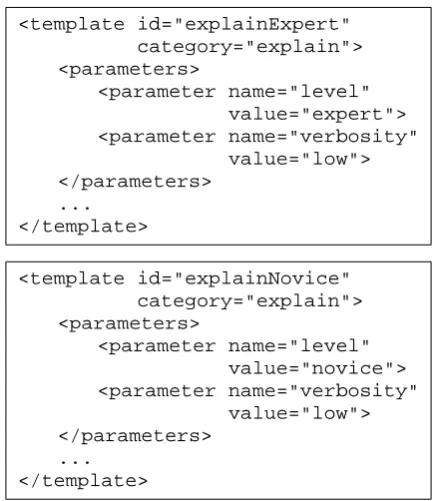
Parameterization is an easy and flexible means to guide and control the generation process with re-gard to different linguistic preferences such as mat-ters of style or rhetorical structures. Parameteriza-tion works by introducing a preference mechanism that provides the possibility of dynamically sorting the application of templates according to a given set of parameters.
<conditions> <or>
<and>
<condition type="equal"> <get path="/recall"/> <value>95</value> </condition>
<condition type="less"> <get path="/accuracy"/> <value>90</value>
</condition> </and>
<not>
<condition type="exist"> <get path="/exception"/> </condition>
</not> </or>
[image:2.595.100.270.71.246.2]</conditions>
Figure 2: Example of some complex interleaved conditions
The way parametrization works in our system is a two-step process:
Adding of parameters to templates During the design of a generation grammar the writer adds one or more parameters to some templates as in the example in figure 3.
Here the upper template is intended to be used during the generation of text targeted at experts and the lower one in case text is to be pro-duced for novices (level is expert in one template and novice in the other). Both of the templates are preferably used when a low verbosity level is desired (verbosityislow in both cases).
Setting of the parameters at runtime At runtime the parameters corresponding to the ones de-fined in the grammar are set to the desired val-ues. To continue our example, we now set the value of the parameterleveltoexpert(see figure 4) and hence the template in the upper box would be selected.
the result is further sorted according to the level of expertise.
<template id="explainExpert" category="explain"> <parameters>
<parameter name="level" value="expert"> <parameter name="verbosity"
value="low"> </parameters>
... </template>
<template id="explainNovice" category="explain"> <parameters>
<parameter name="level" value="novice"> <parameter name="verbosity"
value="low"> </parameters>
[image:3.595.75.296.104.355.2]... </template>
Figure 3: Example of using parameters on the level of generation grammars
generator.addParameter("level", "expert");
Figure 4: Example of using parameters on the level of programming code
generator.addParameter("level", "novice", 0.75);
generator.addParameter("verbosity", "low",
0.5);
Figure 5: Example of using parameters with a weight specified on the level of programming code
2.4 Actions
In the case that all conditions of a given template have been tested successfully (see section 2.2) the actions contained in the actions-part of the template are executed.
There are four different types of actions that can appear: String-Action, Getter-Action,
Inflection-Action and Selection-Inflection-Action. The actual purpose of each of them is quite different but all of them return a result string when executed successfully.
String-Action This type of action simply returns a statically specified string as a result — a so-called canned text.
Getter-Action With a Getter-Action it is possible to directly access and retrieve data from the en-tered input structure. The syntax used for spec-ifying the path to the data conforms to the syn-tax of XPath (World Wide Web Consortium, 1999). There is no additional processing done on the returned data.
<get path="/values/startTime"/>
Inflection-Action This action inflects a stem ac-cording to the defined morphological con-straints and returns the result.
The stem can be stated statically in the gram-mar as in case (a) or can be dynamically re-trieved from the input structure as in case (b).
The needed morphological constraints are fur-nished by the constraints-part of the template to which the given label provides a link (con-fer to section 2.5 below for details).
(a) <inflect stem="bring" label="X0"/>
(b) <inflect path="/action" label="X0"/>
Selection-Action The Selection-Action can actu-ally be seen as the most important of the actions since it accounts for the context-free backbone of the system.
It allows to select another template directly via a specified identifier as in case (a) or via a given category as in case (b). In the second case several templates might have the given category and hence backtracking might be in-voked at his point. (see section 5.1)
(a) <select id="top"/>
(b) <select category="top" optional="true"/>
2.5 Constraints and Morphology
The treatment of morphology is naturally one of the major issues in the context of a complete nat-ural language generation especially when working with morphologically rich languages such as Ger-man, Russian or Finnish. Therefore we took great care to design and develop a morphological subsys-tem that is powerful and flexible yet easy to under-stand and use. The actual realization of the compo-nent is based on a constraint-based inheritance algo-rithm that follows the example of PATR-II (Shieber et al., 1989).
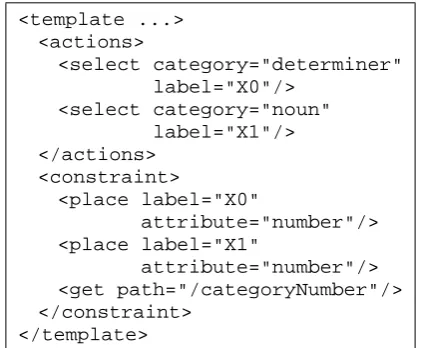
In the (overly simplified) example in figure 6 one can get a glimpse on how the morphology works: There are two Selection-Actions, the first one la-belled X0, the second one labelledX1. The given constraint now tells that the attributenumberofX0 is the same as the attributenumberofX1and sets it dynamically to the value retrieved by the Getter-Action.
<template ...> <actions>
<select category="determiner" label="X0"/>
<select category="noun" label="X1"/> </actions>
<constraint>
<place label="X0"
attribute="number"/> <place label="X1"
attribute="number"/> <get path="/categoryNumber"/> </constraint>
[image:4.595.79.290.338.512.2]</template>
Figure 6: Example of using constraints
2.6 Compilation
In order to be able to work with a generation gram-mar the generation engine requires the gramgram-mar (and its templates) to exist in the form of a Java ob-ject. But since the original format of the grammar is plain XML this format must be transformed through a compilation process into the internally needed rep-resentation. Our system is capable to perform such a compilation in two different ways:
Just-in-time Compilation With this technique the required templates are compiled from their
XML source into their corresponding Java ob-jects at runtime of the generation engine, i.e. during the actual generation process. This type of compilation is advised only for smaller grammars or during the development and test-ing of a new grammar since the constant in-terleaving of compilation on the one hand and the actual generation process on the other leads to some quite noticeable overhead. This over-head is naturally not acceptable when XtraGen is used in real-time applications.
Pre-Compilation This type of compilation allows to compile the whole grammar before its actual deployment during the generation process. The pre-compilation of grammars can improve the performance of the generator-engine tremen-dously and is therefore to be preferred in most situations. (The pre-compilation of generation grammars is very similar to the Translets ap-proach in XSL (Apache XML Project, 2002) where XSL stylesheets are compiled in ad-vance into Java objects.)
3 Input
In contrast to other generation systems that require their input to adhere to some particular (and most of the time proprietary) encoding format the core engine of our system only demands its input to be a valid XML structure.
The actual restrictions on the input are imposed only at the level of the generation grammars in terms of their access to the input (see section 2.4 on Getter-Actions and Inflection-Actions). This can obviously lead to a severe drawback: In case that either the generation grammar or the input structure changes heavily there might emerge a complete mis-match between the XPath specified in the actions and the actual structure of the input.
Under circumstances when it is not feasible to change either the input structure or the grammar, we propose to introduce an additional mapping layer between input and generator that is based on a XSL stylesheet and that dynamically maps the input in the way that is needed by the grammar.
4 Editor
track of all the templates and especially of the rela-tions between them (e.g. relarela-tions on the level of morphological constraints) Common XML editors are of no help at this point since they cannot show such relations at all.
Therefore the development of egram, a Java-based graphical editor for generation grammars is on its way at the site of our cooperation partner DFKI (German Research Center for Artificial Intel-ligence). After the completion of its development this tool will allow to comfortably edit all aspects of generation grammars and templates. Among many other things the editor will be able to depict the whole generation grammar and process in a graphi-cal tree format in which dependencies between tem-plates are shown in an intuitive way.
5 Implementation
The realization and implementation of the XtraGen system is based entirely on the two cornerstones Java and XML.
XML was chosen because it has become the de-facto standard language in many (if not most) sce-narios where information transfer takes place. This in turn is caused by its unique capabilities to encode information in a way that is easy to read, process, and generate (even for human beings as in the case of our formalism).
Java was chosen because it provides many mech-anism to bolster the productivity of a programmer during the development of new software with such things as an extensive programming interface or automatic memory management for example. An additional advantage of Java is the availability of many free and readily usable open-source packages that provide a host of diverse functionalities. The most important ones in our project were the differ-ent XML packages and in particular the XML parser Xerces or the XSLT engine Xalan (Apache XML Project, 2002).
5.1 Backtracking
During the generation process it is possible that two different templates are applicable at the same time (i.e. they have the same category and all of their conditions are satisfied). Now if one of the tem-plates is selected this leads to one of two different results:
• The application of the template was success-ful which means that all of its actions could
be successfully executed and a result was re-turned.
• The application of the template failed because the execution of one or more of its actions was not successful.
But the failure of a template described above does not mean that there exist no solution at all. There-fore we backtrack to the point where the unsuccess-ful template was selected and apply another tem-plate. This procedure is repeated until there are no more templates at this backtrack point.
The underlying implementation of the backtrack-ing mechanism is quite elaborated since it has to take several important issues into account, the most important ones are:
Performance issues We implemented several dif-ferent mechanisms that help to tremendously enhance the performance during the backtrack-ing phase such as the memorization of partial solution.
Constraint issues We had to take great care of the constraint inheritance mechanism during the backtracking implementation so that an invo-cation of backtracking does not lead to a mis-guided percolation of constraints and hence a corrupted morphology.
5.2 Programming Interface
So far we have talked about the deployment of Xtra-Gen only on the level of generation grammars and their XML-based formalism. Now we turn to the description of the tasks that have to be undertaken on the level of programming code to make the sys-tem run.
The following shows the individual steps that are be taken to generate some output with XtraGen:
Creating a new generator-engine The very first thing to do in order to get the whole system running is to create a newGeneratorobject which represents the core generation engine: Generator generator =
new Generator();
Setting the start-category or -id The generation engine needs to know which template it should start from. This is done by specifying either a start-category as in case (a) or a start-identifier as in case (b).
(a) generator.setStartCategory( String category);
(b) generator.setStartId(String id);
Setting the grammar Without a generation gram-mar it would naturally be impossible to gener-ate any output at all. There are two different possibilities to pass a grammar to the genera-tion engine:
(a) generator.setGrammarDocument( Document grammar);
(b) generator.setGrammar(
Grammar grammar);
In the first case a Document object (World Wide Web Consortium, 2000) that contains the grammar in parsed XML-format is passed, in the second case a pre-compiledGrammar ob-ject is passed. (see section 2.6)
Setting the input In addition to the grammar the generation engine needs an input structure to generate from. This can be set as follows:
generator.setInputDocument(
Document input);
Again, the parameter passed is a Document object that contains the input in parsed XML format. The input can be reassigned between two calls to the generation engine.
Setting parameters In subsection 2.3 we talked about the use of parameters to control and guide the generation process. The way param-eterization works is explained in detail there. To set parameters at runtime one has to add the following methods:
(a) generator.addParameter(
String name, String value);
(b) generator.addParameter(
String name, String value, double weight);
This step is only needed if parameterization is desired. Otherwise these methods can be omit-ted and parameterization is turned automati-cally off.
Run the generation process To now actually start the generation process and get some output, one of the following calls can be used:
(a) String result =
generator.generate();
(b) Document result =
generator.generateDocument();
The difference between the two calls is that in case (a) a simpleString containing the result is returned whereas in the case (b) aDocument ob-ject is passed back.
6 Evaluation
At the end of a software development phase any newly created system must proof in an evaluation phase whether it reaches its predefined goals. (Mel-lish and Dale, 1998) This is especially true in an industrial context with commercial applications as in our case.
The context for the evaluation of XtraGen was provided by X-Booster (Beauregard et al., 2002) which is another project at our site that was con-currently developed with our system. This system is an optimized implementation of Slipper (Cohen and Singer, 1999), a binary classifier that induces rules via boosting and combines a set of those clas-sifiers to solve multi-class problems. It was the goal to successfully integrate XtraGen into this system.
The motivation behind this is based on the fact that common classification systems are quite non-transparent in regard to their inner workings. There-fore it becomes rather difficult to understand how and why certain classification decisions are made by those systems.
We departed at exactly this point: XtraGen was to be used to automatically generate texts that explain the learning phase of the X-Booster and hence make the classification more transparent. As an additional “gadget” we wanted to create the explanations in all the languages that are spoken at our company site: English, German, French, Italian, Russian, Bulgar-ian and Turkish.
6.1 Integration Tasks
novice users. The format chosen for the final output was HTML.
Now we needed to adapt the code of X-Booster slightly to make the meta data about the learning phase accessible from the outside. To do so we wrote some small methods that simply returned in XML format the meta data which were only stored in internal variables up to this point.
The next step was to add to X-Booster’s own code the code for calling the generation engine and for transforming the result into the final output-format. This was done as described in section 5.2.
Finally (and most importantly) the generation grammars for the different languages were devel-oped. This happened in the way that we first set-up a prototypical grammar for English which we tested extensively. Then in a second step the grammars for the other languages were modelled according to this exemplary one. For this we worked together with different native-speaking colleagues that translated the original English grammar into their language.
6.2 Sample Template and Output
Figure 7 below shows a small portion of the output returned after running X-Booster together with the integrated XtraGen on a given training set. This re-sult was produced by using the English generation grammar and the parameters set for producing texts targeted at novice users.
The number of documents is 37, divided into 2 different categories. The results have been produced using 3 fold-cross-validation which means that the data-set is divided into 1/3 test-set and 2/3 training-set.
The learner is trained on the training-data only and evaluated on the test-set which has not been presented before. We repeat this process 3 times on non-intersecting test-data.
The overall result is then computed finally as the average of all performed tests. The average accuracy reaches 100.0% which is achieved by applying 5 rules.
Figure 7: Sample output from X-Booster
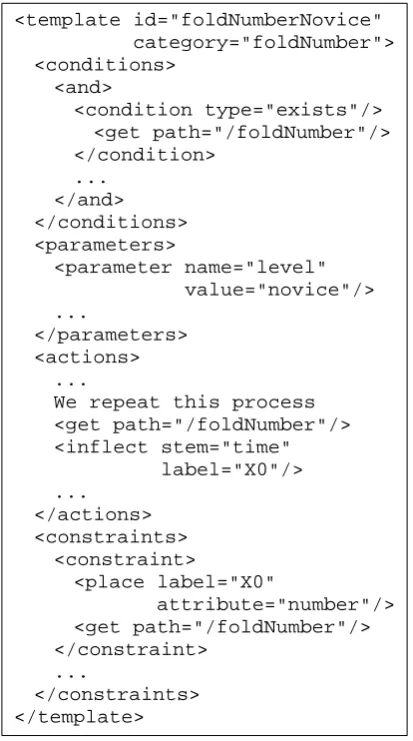
Figure 8 shows parts of the template that pro-duced the second paragraph of this sample output. The template is complete in the sense that all dif-ferent aspects of a template are exposed and it is
only simplified in the respect that similar parts of the template are left out.
<template id="foldNumberNovice" category="foldNumber"> <conditions>
<and>
<condition type="exists"/> <get path="/foldNumber"/> </condition>
... </and> </conditions> <parameters>
<parameter name="level" value="novice"/> ...
</parameters> <actions>
...
We repeat this process <get path="/foldNumber"/> <inflect stem="time"
label="X0"/> ...
</actions> <constraints>
<constraint>
<place label="X0"
attribute="number"/> <get path="/foldNumber"/> </constraint>
...
[image:7.595.325.532.105.476.2]</constraints> </template>
Figure 8: Sample template from X-Booster
7 Outlook and Future Work
in particular cellular phones. For the last of those media we are exploring the possibility of producing voice-enabled output with a dedicated voice server that is based on VoiceXML (World Wide Web Con-sortium, 2002) or JSML (Sun Microsystems, 1999). We are experimenting at the moment with the differ-ent possible outputs and on how these outputs can be encoded in a generation grammar enriched with VoiceXML or JSML tags.
8 Conclusion
In this contribution we presented XtraGen, a real-time, template-based natural language generation system designed for real-world applications and based on standard XML- and Java-technologies. We described in detail the different aspects of its gen-eration grammars with an emphasis on their for-malism. Then we covered architectural and imple-mentational issues of the system. After depicting the evaluation done for XtraGen we concluded with presenting a new project where the system is used and where new ideas are experimented with.
Acknowledgements
We are grateful to Sven Schmeier, Huiyan Huang and Oliver Plaehn for their collaboration on X-Booster and the Mietta-II project and especially to Stephan Busemann for many fruitful discussions on TG/2. This work was carried out in the Mietta-II project funded by the European Commission under the Fifth Framework Programme IST-2000-30161.
References
Apache XML Project. 2002. Apache XML Project Website. http://xml.apache.org/, June. St´ephane Beauregard, Huiyan Huang, Karsten Kon-rad, and Sven Schmeier. 2002. Industrial-Strength Text Classifiers. In Proceedings of the Fifth International Conference on Business Infor-mation Systems (BIS2002), Pozna´n, Poland. Stephan Busemann. 1996. Best-first surface
re-alization. In Proceedings of the 8th. Interna-tional Workshop on Natural Language Genera-tion (INLG ’96), pages 101–110, Herstmonceux, England, June.
Alison Cawsey. 2000. Presenting tailored resource descriptions: will XSLT do the job? In Pro-ceedings of the Ninth World-Wide Web confer-ence (WWW9).
Songsak Channarukul. 1999. YAG: A Natural Lan-guage Generator for Real-Time Systems.
Mas-ter’s thesis, Department of Electrical Engineering and Computer Science, University of Wisconsin-Milwaukee, December.
William W. Cohen and Yoram Singer. 1999. A Simple, Fast, and Effective Rule Learner. In Pro-ceedings of the Annual Conference of the Ameri-can Association for Artificial Intelligence (AAAI-99), pages 335–342.
Chris Mellish and Robert Dale. 1998. Evaluation in the Context of Natural Language Generation. Computer Speech and Language, 12(1):349–373. Ehud Reiter. 1995. NLG vs. Templates. In Pro-ceedings of the Fifth European Workshop on Nat-ural Language Generation, pages 95–105, Lei-den, The Netherlands, May. Faculty of Social and Behavioural Sciences, University of Leiden. Stuart M. Shieber, Gertjan van Noord, Robert C.
Moore, and Fernando C. N. Pereira. 1989. A Semantic-Head-Driven Generation Algorithm for Unification-Based Formalisms. In Meeting of the Association for Computational Linguistics, pages 7–17.
Sun Microsystems. 1999. Java Speech API Markup Language Specification . http://java. sun.com/products/java-media/ speech/forDevelopers/JSML/, October. Michael Wein. 1996. Eine parametrisierbare Generierungskomponente mit generischem Backtracking. Diploma thesis, Department of Computer Science, University of the Saarland, Saarbr¨ucken.
Graham Wilcock. 2001. Pipelines, Templates and Transformations: XML for Natural Language Generation. In Proceedings of the first NLP and XML Workshop; Workshop session of the 6th Nat-ural Language Processing Pacific Rim Sympo-sium, Tokyo, November.
World Wide Web Consortium. 1999. XML Path Language (XPath) Version 1.0. http://www. w3.org/TR/xpath, November.
World Wide Web Consortium. 2000. Document Object Model (DOM) Level 2 Core Specifica-tion Version 1.0. http://www.w3.org/TR/ DOM-Level-2-Core/, November.
World Wide Web Consortium. 2001. Extensible Stylesheet Language (XSL) Version 1.0. http: //www.w3.org/TR/xsl, October.