
Developing a track model for testing the road pavement under repeated moving surface loads
10
0
0
Full text
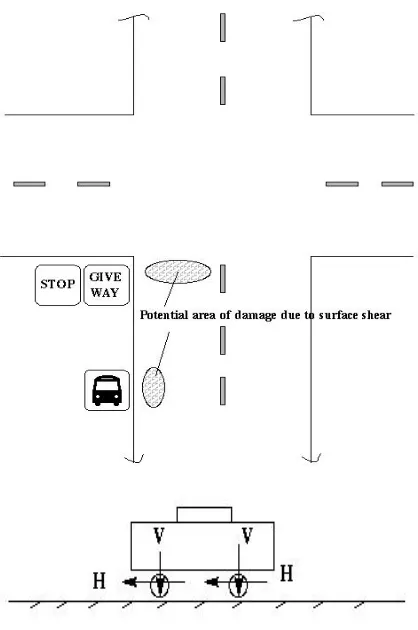
(2) Figure 1: Potential failures of road pavement due to surface shear.. SHAKEDOWN CONCEPT When a road pavement is overloaded by a heavy vehicle repeatedly moving in a single direction, it leads to plastic (irrecoverable) deformations on the road surface. A redistribution of stress in the road pavement, which we cannot see, thus occurs. The stress present in the road pavement following unloading is known as a "residual stress". It can be shown theoretically that there is a load magnitude below which a protective residual stress will develop in the road, and above which the pavement will undergo an incremental failure. Provided that subsequent loads are less than a certain limit load experienced by the road pavement, this residual stress in the road pavement offers protection against further accumulation of plastic deformations, that is, against further rutting. This load is known as the ‘shakedown limit load’ and the protective residual stresses associated with this shakedown limit load are the optimal residual stresses for the life of the structure. In shakedown theory, it is assumed that a structure, when subjected to long term repeated loading, may respond in two distinct ways: either an incremental collapse or elastic shakedown. The former implies continuous accumulation of permanent deformations with subsequent load cycles while the latter indicates an elastic shakedown behaviour with some initial permanent deformation. Ideally, the road pavements will eventually shakedown if a load limit is set for the vehicles on a particular road. Together with that shakedown phenomenon is a permanent deformation. Interestingly this does reflect most of the real pavement situation under long term repeated loading condition. Indeed, the failure of a pavement is the consequence of repeated loadings.
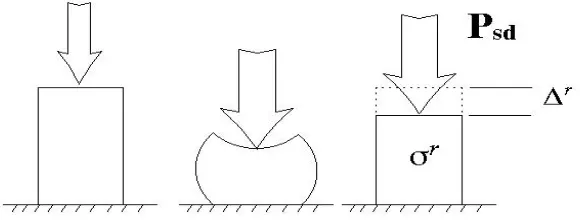
(3) and plastic deformations, a more realistic investigation of system behaviour, such as shakedown approach, is needed in the study of road pavement performance.. Figure 2: Simple illustration of shakedown concept. Figure 2 shows a simple shakedown illustration. If the body shakes down after a number of variable repeated loadings, the associated shakedown quantities such as shakedown limit load, residual stresses, and permanent deformations are of concern. Numerically speaking, the term “shakedown analysis” is used for the safety load assessment of elastoplastic structures subjected to variable repeated loadings. Based on the work of Melan (1936), Johnson (1968), Sharp and Booker (1984), and Sloan (1988), Shiau et al. (2000 and 2001) have recently proposed a lower bound shakedown analysis using finite elements and mathematical programming to study the long term behaviour of layered pavements under repeated moving surface loads. The lower bound shakedown analysis provides a simple alternative for estimating the “safe” shakedown limit load and the associated residual stress fields when the exact loading history is not available. In road pavement practice, it is expected that the shakedown analysis can be used as a vehicle to compare the performance among various pavement materials. The lower bound shakedown theory states that "if any time-independent distribution of residual stresses can be found which, together with the elastic stresses due to the load, constitutes a system of stresses within the elastic limit, then the system will shakedown". In other word, the elastic stresses associated with the maximum load, together with any distribution of residual stress, which just touches the yield surface will give a lower bound to the shakedown limit.. Figure 3: Finite element application of Melan's static shakedown theorem..
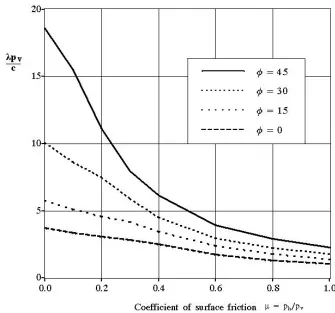
(4) Figure 3 shows conceptually an application of lower bound shakedown analysis using finite element and mathematical programming. As shown in Figure 3, both elastic stress fields and residual stress fields required by the shakedown theorem can be assumed to be linearly distributed across the continua by making use of the displacement and stress finite elements respectively. By insisting that combined stresses do not violate the Mohr-Coulomb yield condition in the mesh, the calculation of shakedown limits are then considered as a large mathematical programming problem: maximisation of the shakedown load factor subject to the constraints due to: (1) Element equilibrium; (2) Discontinuity equilibrium; (3) Stress boundary condition; and (4) Mohr-Coulomb yield constraint. A recent shakedown study by Shiau (2001 & 2004) has been performed for the effect of surface tractions due to vehicle decelerations and accelerations. The main purpose of the study is to show the degree to which the shakedown limit can be reduced by including a tangential shear stress to the pavement surface. The study was for a c-ø drained analysis and results are presented in Figure 4 which plots the normalised dimensionless shakedown limit against the coefficient of surface friction mu for various soil friction angles. It was found that the dimensionless shakedown limit decreases significantly with the increase in the coefficient of surface friction for all values of ø. This may imply that the horizontal force has substantial influence on the shakedown limits through the elastic shear stresses. Figure 4 also shows that higher shakedown capacity can be obtained for large soil frictional angle.. Figure 4: Effect of coefficient of surface friction upon dimensionless shakedown limits for various soil frictional angles. Based on the shakedown study presented above, it is felt that an experimental program that can take into account the shakedown concept in the pavement study would be valuable and should be developed in the near future. What is particular interested in the development is the capability to simulate the sudden deceleration of vehicles. The following will discuss the design of such an experimental program..
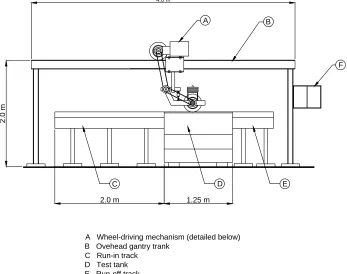
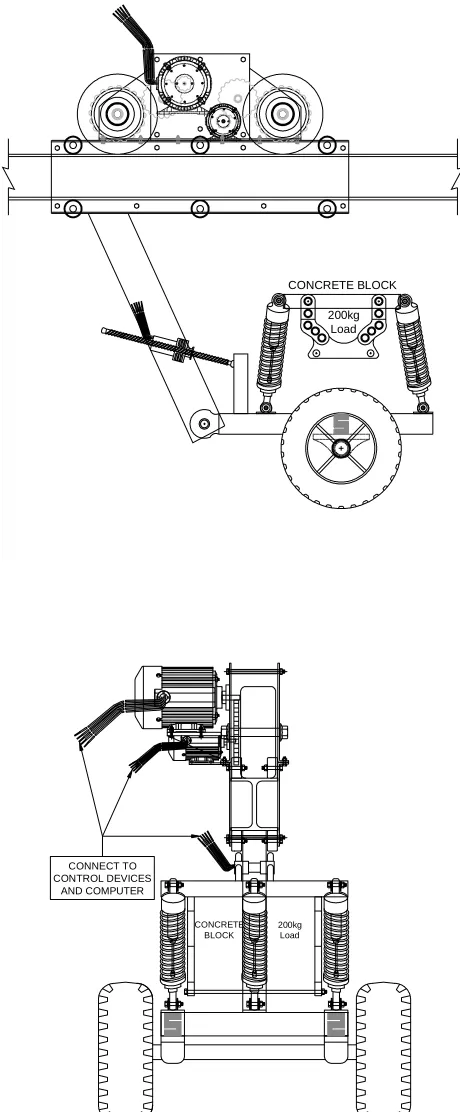
(5) CONCEPTUAL DESIGN OF USQ TRACK MODEL A general description of the test tracks developed for pavement studies in various countries has been given in Shackel and Arora (1978). Most of these test facilities are either circular or oval tracks. A major disadvantage of these tracks is that a large area is required to accommodate the facility. Moreover, the deceleration and acceleration of a wheel cannot be easily simulated using these tracks. Therefore it is proposed to develop a small linear track which allows a test wheel to repeatedly travel over the test pavement surface. A schematic diagram showing the concept of simulating the repeated surface tractions is shown in Figure 5. The wheel would initially travel at a constant speed, and then decelerate to a stop, and then the wheel would be lifted and returned to its original position for the next cycle to begin. Although a complete process of acceleration and deceleration of a vehicle could be simulated instead of just a deceleration simulation, this would require a more elaborate mechanical.. 4.0 m. A. B. 2.0 m. F. D. C 2.0 m. A B C D E F. E. 1.25 m. Wheel-driving mechanism (detailed below) Ovehead gantry trank Run-in track Test tank Run-off track Communications/Electronics Cabinet - containing Computer. Figure 5: A conceptual diagram showing the testing rig.. After extensive meetings and discussions within the group and other industry suppliers, a detailed design has been completed and some of the drawings are shown in Figure 6. The facility to be developed consists of a laboratory-scale driven wheel that is guided by an overhead guide-rail system. Power is supplied to the motor, which drives the wheel to move forward over the test tank and then to reverse when reaching the end of the pavement section. The process allows acceleration of the wheel carriage, then decelerating it to a complete stop and then lifting up the wheel, and finally moving it back to the original starting position. This forward-emergency stop-reverse procedure accounts for one load cycle and is managed by a control device, a software program and a personal computer. Typically, the total number of load cycles required for a pavement specimen is expected to be more than 5,000..
(6) CONCRETE BLOCK 200kg Load. CONNECT TO CONTROL DEVICES AND COMPUTER CONCRETE BLOCK. 200kg Load. Figure 6: Initial design of the driving mechanism..
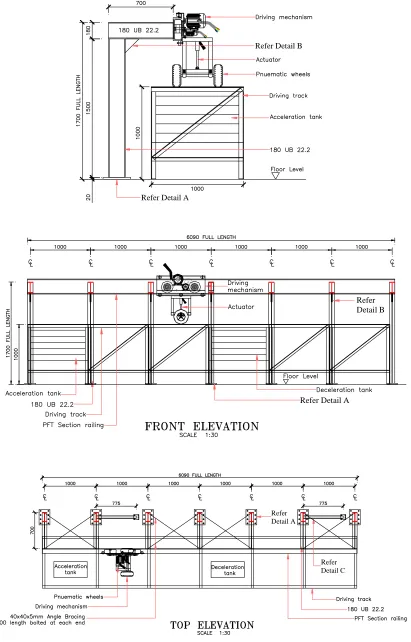
(7) Refer Detail B. Refer Detail A. Refer Detail B. Refer Detail A. Refer Detail A. Refer Detail C. Figure 7: The second design of the driving mechanism..
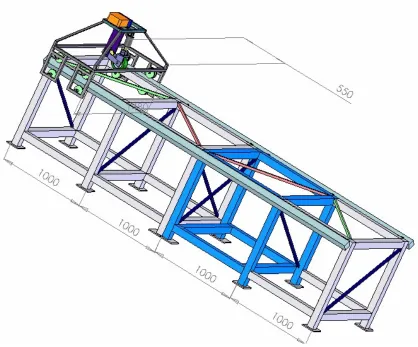
(8) Figure 8: The third design of the driving mechanism.. Further feasibility study has also been carried out using different structural configurations. They are graphically shown in Figures 7 and 8. A load cell is attached to each wheel, giving information on the actual load transferred from the dead load and the inertia force due to an emergency stopping of the vehicle. This information is important when it is compared with results from theoretical analyses. The subsurface deformation will be measured by a transducer (LVDT: Linear Voltage Displacement Transducer) and an analog-to-digital signal converter will be used to transmit data from the LVTD back to the computer. The surface settlement can be measured by using a novel laser displacement sensor. A lever rammer is required to prepare the pavement specimen. The experimental investigation will consist of repeated loading tests on various model pavement configurations and pavement materials. The experimental variables consist of important parameters such as the applied vertical and horizontal loads on the pavement surface, the pavement layer thickness, the sub grade soil condition and the temperature. A big challenge in such a system test is the preparation of testing specimen and the associated scale effects. These aspects need to be carefully considered in the testing program. It is expected that results obtained from the experimental studies will be compared with those from theoretical shakedown approach using lower bound shakedown analysis. In a longer term, a theory of pavement failure under surface traction forces will be developed which will be of assistance to practising road pavement design engineers..
(9) CONCLUSION This paper has described an experimental program that is being developed at USQ to study the effect of decelerations and accelerations of heavy vehicles near signalised intersection. This project has a lot of practical importance and, in the longer term, it is hoped that the work will lead to the development of new testing facility to incorporate shakedown concept in the design of road pavements. The progress of this project can be viewed at http://www.usq.edu.au/jimshiau/.. ACKNOWLEDGEMENTS The authors would like to acknowledge the support provided by the technicians at Faculty of Engineering and Surveying of University of Southern Queensland.. REFERENCES Brown, S. F. 1996, ‘36th Rankine Lecture: Soil Mechanics in Pavement Engineering’, Géotechnique, 46(3), 383-426. Johnson, K. L. 1962, ‘A shakedown limit in rolling contact’, in Proc. 4th Natl. Conf. on Applied Mechanics, Berkeley, CA, 971-975. Melan, E. 1936, ‘Theorie Statisch Unbestmmter Systeme aus Ideal-Plastischen Baustoff’, Sitzungsber Akad. der Wissenschaften in Wein. IIa, pp 145-195. Moghaddas-Nejad, F. & Small, J. C. 1996, ‘Effect of geogrid reinforcement in model track tests on pavements’, Journal of Transportation Engineering, ASCE, 122(6), 468-474. Shackel, B. & Arora, M.G. 1978, ‘The application of a full-scale road simulator to the study of highway pavements’, Australian Road Research, 8(2), 17-31. Sharp, R.W. & Booker, J.R. 1984, ‘Shakedown of Pavements Under Moving Surface Loads’, Journal of Transportation Engineering, Vol 110, pp 1-14. Shiau, J. S. & Yu, H. S. 2000, ‘Load and displacement prediction for shakedown analysis of layered pavements’, Transportation Research Board, No 1730, 117-124. Shiau, J. S. 2001, Numerical Methods for Shakedown Analysis of Pavements under Moving Surface Loads, Ph.D. Thesis, University of Newcastle, NSW, Australia. Shiau, J. S., Lyamin, A. V. and Sloan, S. W. 2003, ‘Bearing capacity of a sand layer on clay by finite element limit analysis’, Cannadian Geotechnical Journal, 40:900-915. Shiau, J. S. 2004, ‘Investigation of pavement failures under repeated surface tractions’, Early Career Research Program, University of Southern Queensland, Australia. Shiau, J. S. 2005, ‘The development of a model track under repeated moving loadings’, Research Infrastructure Program, University of Southern Queensland, Australia. Shiau, J. S. 2005, ‘Shakedown Theory and Pavement Design’, Geotechnical Mini-symposium, Queensland Department of Main Roads, November. Queensland, Australia. Shiau, J. S., Selvan, P. & Ayers, R. 2006, ‘Developing physical models for geotechnical teaching and research’, International Conference on Physical Modelling in Geotechnics, Hong Kong. Shiau, J. S. 2006, ‘New thoughts on pavement design’, Lecture Series and Workshops on Geotechnical Engineering in Practice. Centre for Infrastructure Engineering and Management and School of Engineering, Griffith University Gold Coast campus, February, QLD, Australia.
(10) Sloan, S. W. 1988, ‘Lower bound limit analysis using finite elements and linear programming’, International Journal for Numerical and Analytical Methods in Geomechanics, 12, 61-67. Wijeyakulasuriya, V. Ramanujam, J., Reynolds, P., Ezeajugh, L. & Creagh, M. 2004, ‘Characterisation of some crushed rock base materials from Queensland’, Proceedings of the 9th ANZ Geomechanics Conf, Auckland, NZ. NZ Geotechnical Society Inc. and the Australian Geomechanics Society. Editors: G. Farquhar, P. Kelsey, J. Marsh and D. Fellows. ISBN: 086869-123-2. Vol. 1, pp. 246-252. Wong, H. K. W. & Small, J. C. 1994, ‘Effect of orientation of approach slabs on pavement deformation’, Journal of Transportation Engineering, ASCE, 120(4), 590-602..
(11)
Figure
+4
Related documents
Given that MeCP2 is expressed in all CNS cell types, we extended earlier studies exploring the relationship between gene size and fold change expression within cell type-specific
Background: In this study, we have examined local non-viral gene delivery, transfection, and therapeutic efficacy of endothelial nitric oxide synthase (eNOS) encoding plasmid
DNA was extracted from 123 samples representing 96 species and 11 genera of stipoid grasses ( Achnatherum, Ane- manthele, Anisopogon, Austrostipa, Hesperostipa, Jarava,
The change is due to the increasingly significant risks associated with Chugach’s wholesale generation business, high capital requirements and uncertainty regarding long-term
(2016) "Interprofessional Research, Training and Outreach: The ETSU Prescription Drug Abuse/Misuse Working Group," International Journal of Health Sciences Education,
The first case study explores the on-going efforts to reform the high-cost consumer credit (i.e. payday and doorstep lending) industry and how the problems of this industry are
The EHEA developed a novel hierarchical microstructure featured by fine lamellar regions consisting of FCC lamellae filled with ultrafine FCC grains (average size ~200–250 nm) and B2
