THE USE OF WEB-BASED MULTIMEDIA
TECHNOLOGY IN TEACHING AND LEARNING
MATHEMATICAL PROGRAMMING
Mehryar Nooriafshar
1Faculty of Business
University of Southern Queensland Toowoomba, Queensland
Australia
Author‟s final accepted version of: Nooriafshar, Mehryar (2002) Use of web-based multimedia technology in teaching and learning mathematical programming. Journal of Computers in
Mathematics and Science Teaching, 21 (4). pp. 331-349. ISSN 0731-9258
1 Dr Mehryar Nooriafshar is a Senior lecturer in Logistics and Operations Management at the Faculty of
Business of the University of Southern Queensland, Australia. Mehryar is actively involved in the design and delivery of web-based multimedia teaching and learning materials. He was the winner of USQ's inaugural Award for Excellence in the Design and Delivery of Teaching Materials.
Address: Faculty of Business, University of Southern Queensland, Toowoomba, Queensland, AUSTRALIA, 4350
E-mail: [email protected]
URL: http://www.usq.edu.au/users/mehryar Phone: +61 7 46311278
Abstract
The web-based interactive multimedia system presented in this paper is based on a generic approach developed by the author for formulating and solving Dynamic Programming problems. The approach has proven to be an easy to learn and easy to use practical method.
The web-based multimedia system based on the author's algorithm was designed and developed as part of a research project funded by the Faculty of Business, University of Southern Queensland, Australia, in 1997. The system utilises the mBED technology to invoke animation and sound and allow the user to interact with the animations and simulations.
The main objective of this project was to provide supplementary and additional components, which would enhance and complement the existing material and teaching methods in dynamic programming.
Keywords: Multimedia, Web-Based, Interactive, Animations, Total Technology Approach, dynamic programming, recursive
An Introduction to Dynamic Programming
This section provides a foundation to the dynamic programming concepts adopted in the multimedia system.
Dynamic programming2 is a sequential or multistage approach to formulating and solving mathematical programming problems. It is closely associated with Bellmann (1957). Dynamic programming is sometimes the only feasible optimisation approach applicable to management and decision making problems. The fact however, that no general formulation of dynamic programming has been available and each problem must be solved uniquely, has made this technique rather less attractive for practitioners to use. As suggested by Moores (1986, pp 967-969), “dynamic programming is considered an intellectually appealing way of formulating a problem, but not a very useful way for solving it.”
Hence, a generic approach to formulating and solving dynamic programming problems will help the practically oriented person to adopt and apply the technique to appropriate problems.
The method adopted in this multimedia system is based on using a generalised recursive formula and a general-purpose table (Nooriafshar 1992).
2
The general-purpose table contains information for every stage of the following variables:
the input states
the possible decisions for the stage and their values
the resulting output states associated with each possible decision
the optimal decision for the stage and its value
The recursive relationship is generalised and expanded as follows:
The value of the optimal decision for state i at stage n is the optimum (minimum or maximum) value of the decision resulting from leaving state i and entering state j separated by an appropriate operand (ie. +, x, -, @, etc, let us denote it by an asterisk), depending on the problem, from the value of the optimal decision for state j at stage n+1. It should be noted that state i is at stage n and state j is at stage n + 1.
The Main Features of The System and How the Students Use it
One of the main features of this multimedia system
(http://www.usq.edu.au/users/mehryar/51349/dp/) is its ability to facilitate the teaching of complex concepts of dynamic programming via specially designed animations and simulations. This feature enables all students, regardless of their geographical location or means of interaction with the University, to enjoy that extra level of explanation, which is usually conveyed during a traditional face-to-face lecture or tutorial situation.
Various illustrations, quizzes and reminders are used throughout this interactive learning tool.
The user requires the mBED plugin for the browser to fully experience this learning package. It is best to do so when first viewing the material. The mBED plugin will install on the user's current browser automatically and the user is then able to interact with the mBED content. Alternatively, the plugin may be installed from the disk provided, by simply running the setup program in the plugins directory.
Illustrative examples use the mBED technology to invoke animation and sound. Animated labels with numbers on them illustrate the sequence of calculations in the solution tables.
Clicking on the checklist button displays a list of procedures used to complete the dynamic programming problems. Once displayed, the checklist window can remain open so that students can refer to these steps when completing the questions and quizzes.
Students are able to interact with the animations and investigate different situations. Hypertext links to explanations and links between various sections of the material are also amongst the features of the system.
Using the System: An Example
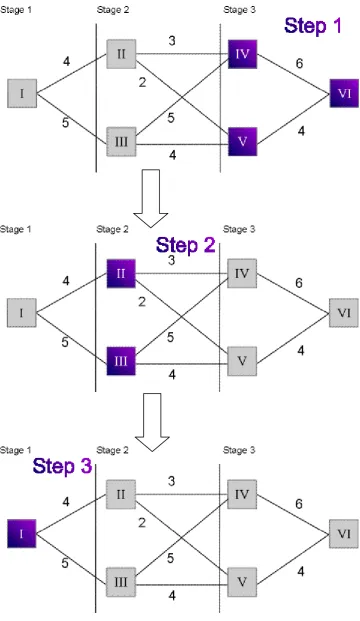
Let us demonstrate how the shortest route problem can be formulated and solved using the Web-based Multimedia system.
A transport company has to carry cargo from city I to city VI. They can pass through a number of intermediate cities (II, III, IV and V). Each portion of the route between any two cities has a cost associated with it. The image shown as Figure 1 illustrates the problem graphically in three stages of Step 1, Step 2 and Step 3. The image is animated at: http://www.usq.edu.au/users/mehryar/51349/dp/general.htm
Formulation and Solution:
The Stages, States, Decision and the Recursive Relationship are formulated as follows:
Stages: The three decision points (1,2 and 3)
States: Cities (I, II, III, IV, V and VI)
Decision: Which route to take (for instance, II (2) to IV (4) or II (2) to V(5) if in city II (2) at Stage 2)
Recursive Relationship: Value of Optimal Decisionn (i) = Min {Value of
optimal decisionn (ij) + value of optimal decisionn+1 (j)}
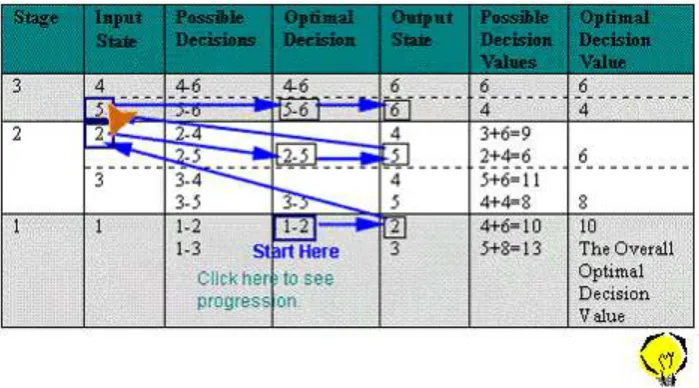
[image:6.595.123.473.291.485.2]The problem is solved, using the General Purpose Table as follows:
Figure 2 - Interacting with the System
As the table in Figure 2 shows, the optimal (lowest cost) solution for the entire route (city I to city VI) is 10. This is shown under the „Optimal Decision Value column‟ in the table. In order to determine which route from city I to city VI incurs this (lowest) cost of 10, the user may interact with the table as shown in Figure 2.
For instance, by placing the cursor on 1-2 (Start Here), an animated pointer moves towards 2 and then reaches 2-5 at stage 2. By placing the cursor on 2-5, the pointer shows the final portion of the overall route at stage 1. Hence, the route 1-2; 2-5; and 5-6 (1-2-5-6) with a cost of 10 would be the optimal solution.
Educational Basis
These media (audio, text with links, video/animation) make the lifeless text and images alive (a living book). Hence, those students who are studying in the distance mode and cannot take advantage of the teacher/student interaction will benefit from the system.
Most importantly, multimedia learning can offer all students the same opportunity, with added features such as the ability to allow learners to sit behind the driving wheel and steer their way towards the goals they wish to set.
Interrelated Technologies
As explained earlier, in delivering the course materials to both internal and distance education students, various Web related technologies interlink with each other. Therefore, this multimedia system is placed at the heart of the interrelated teaching technologies, which the author has labelled as the „Total Technology approach to Teaching‟ (TTAT).
In addition to its learning applications, the system is also adopted in face-to-face teaching. This is achieved in a lecture theatre which is equipped with a multimedia computer, multiscan projector and a large screen. This way of conducting lectures has had many benefits, which includes:
instant access to the right pieces of information via hypertext links;
enhanced presentation of material with supplemented sound, graphics and interactive animations; and
students‟ exposure to more efficient ways of navigating the system.
Under the constructivist belief, students construct their own knowledge, with guidance from teachers. Many teachers are now offering students resources which encourage their independent exploration of the materials provided (Berge and Collins, 1995). Jedege (1992) claims that constructivism (as it is termed as) does not view knowledge as a fixed entity and recognises that it is not transferred from one knower to another. It is therefore important that learners be actively engaged with the instructional materials to construct their own meanings through an “interpretive process, which unravels their world in a personally meaningful way.”
If Jedege is correct, then the more opportunities there are for students to interact with the study materials and the multimedia package, the more likely it becomes that students will construct their own knowledge of a subject.
In order to enhance students‟ learning, in accordance with constructivist guidelines, interactive quizzes are incorporated into the package. Therefore, students receive instant feedback which encourages and helps them to gain a better understanding.
Student Feedback and Evaluation of the Effectiveness of the System
Students were encouraged and invited to submit their feedback on the system by completing a survey form. The importance of feedback from the users was recognised mainly for the following reasons:
making improvements
correcting both technical and typographical errors gauging the effectiveness of the system
About twenty-two students participated in the survey by completing and submitting the feedback form.
Most (88%) of these students indicated that they thought the enhanced study materials were better than the material in the other courses and that the multimedia package helped them to understand the content of the material better. A large proportion (77%) of the surveyed students believed that the multimedia system helped sustain interest in the materials.
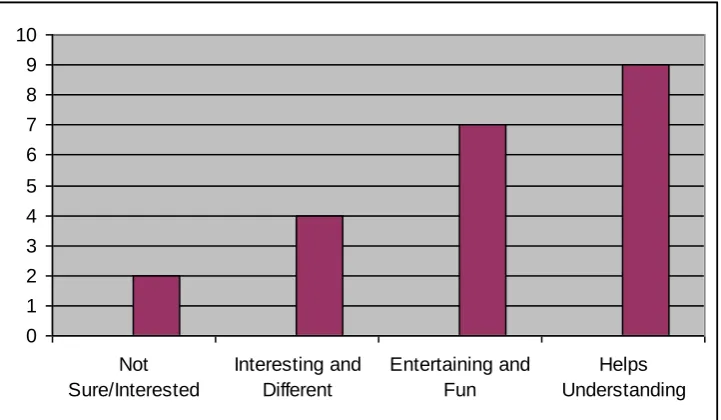
When asked for their views on the multimedia package, a reasonably large proportion (around 41%) found it to help them to understand the concepts better (see Figure 3). The vertical axis represents numbers.
[image:8.595.107.468.392.602.2]0 1 2 3 4 5 6 7 8 9 10 Not Sure/Interested Interesting and Different Entertaining and Fun Helps Understanding
Figure 3 – Students‟ Perception of the System in their Learning
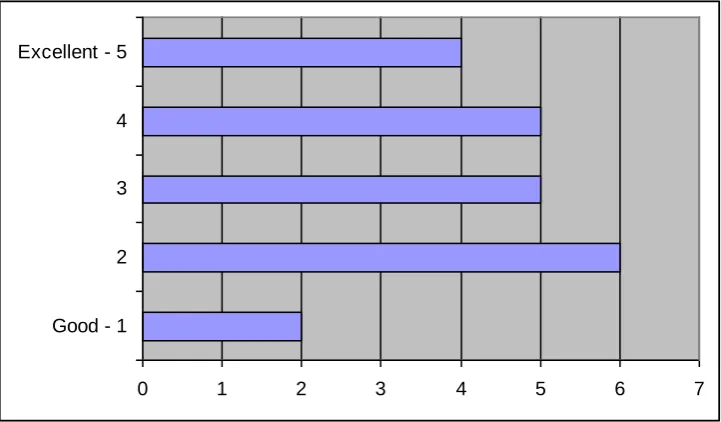
0 1 2 3 4 5 6 7 Good - 1
[image:9.595.106.467.75.286.2]2 3 4 Excellent - 5
Figure 4 – Students Perception of the Navigational Features
The most interesting and, certainly satisfying, outcome was the performance of students in the assessments. In 1998 when the system was used for the first time, 100% of the students participated in all assessments and 100% passed the subject. Cutoffs for grades were about 10 to 15 percent higher than the previous years.
These achievements and performances support the fact that the use of web-based interactive multimedia can make a significant contribution enhancing students‟ learning and performance. In addition to providing technological features, implementation on the Web has made the distribution of the multimedia system to external students a cost-effective exercise.
It is planned to utilise the technologies offered by Flash Macromedia (http://www.macromedia.com/software/flash) in the future updates of this Web-based interactive system.
References
Bellmann, R.E. (1957), Dynamic Programming, Princeton University Press, Princeton, N.J.
Bellmann, R.E., & Dreyfus, S.E. (1962), Applied Dynamic Programming, Princeton University Press, Princeton, N.J.
Berge, Z. and Collins, M. (1995), „Computer-Mediated Communication and the Online Classroom in Distance Learning‟, Computer-Mediated Communication Magazine 2(4), Website: http://sunsite.unc.edu/cmc/mag/1995/apr/berge.html
Jegede, O. (1992), Constructivist epistemology and its implications for contemporary research in distance learning in Evans, T. and Juler, P. Research in Distance Education 2 ; (pp. 21-29). Geelong: Deakin University Press.
Management, Academic Press, New York.
Moores, B. (1986), „Dynamic Programming in Transformer Design‟, Journal of Operational Research Society (UK), vol.37, no. 10, pp.967-9.
Nooriafshar, M. (1992), „Towards Non-Algorithmic Optimization: A Practical and General Purpose Method of Formulating and Solving Dynamic Programming Problems‟, Proceedings of International Conference on Optimization: Techniques and Applications (ICOTA'92), National University of Singapore.
Norman, J. M. (1972), Heuristic Procedures in Dynamic Programming, Manchester University Press, Manchester.
Perraton, H. (1988), „A theory for distance educatio‟ In Sewart, D., Keegan, D. and Holmberg, B. (Ed), Distance education: International perspectives, pp.34-45. New York: Routledge.
Prawat, R. and Floden, R.E. (1994), „Philosophical perspectives on constructivist views of learning‟, Educational Psychology, 29(1), pp37-48.