This is a repository copy of Continuous Effector CD8+ T Cell Production in a Controlled Persistent Infection Is Sustained by a Proliferative Intermediate Population.
White Rose Research Online URL for this paper: http://eprints.whiterose.ac.uk/99028/
Version: Accepted Version
Article:
Hamlet Chu, H, Wei-Chan, S, Gosling, JP et al. (6 more authors) (2016) Continuous Effector CD8+ T Cell Production in a Controlled Persistent Infection Is Sustained by a Proliferative Intermediate Population. Immunity, 45 (1). pp. 159-171. ISSN 1074-7613 https://doi.org/10.1016/j.immuni.2016.06.013
© 2016 Elsevier Inc. This is an author produced version of a paper published in Immunity. Uploaded in accordance with the publisher's self-archiving policy. This version licensed under the Creative Commons Attribution-NonCommercial-NoDerivatives 4.0 International (http://creativecommons.org/licenses/by-nc-nd/4.0/).
[email protected] https://eprints.whiterose.ac.uk/
Reuse
Unless indicated otherwise, fulltext items are protected by copyright with all rights reserved. The copyright exception in section 29 of the Copyright, Designs and Patents Act 1988 allows the making of a single copy solely for the purpose of non-commercial research or private study within the limits of fair dealing. The publisher or other rights-holder may allow further reproduction and re-use of this version - refer to the White Rose Research Online record for this item. Where records identify the publisher as the copyright holder, users can verify any specific terms of use on the publisher’s website.
Takedown
If you consider content in White Rose Research Online to be in breach of UK law, please notify us by
Continuous effector T cell production by an amplifying intermediate in a controlled persistent infection
H. Hamlet Chu1,5, Shiao-Wei Chan1, John Paul Gosling2, Nicolas Blanchard3, Alexandra Tsitsiklis1, Grant Lythe4, Nilabh Shastri1, Carmen Molina-París4, and
Ellen A. Robey1,5
1Division of Immunology and Pathogenesis, Department of Molecular and Cell
Biology, University of California Berkeley, Berkeley, CA 94720, USA.
2Departments of Statistics, and 4Applied Mathematics, School of Mathematics,
University of Leeds, Leeds, UK.
3Center of Pathophysiology of Toulouse-Purpan, INSERM UMR1043-CNRS UMR5282, University of Toulouse, 31024 Toulouse Cedex 3, France.
5Correspondence to: [email protected] (H.H.C.) or
[email protected] (E.A.R.)
SUMMARY
Polyfunctional CD8+ effector T cells (Teff) can persist in large quantities in
mice and humans with controlled, persistent intracellular infections; however, the
cellular mechanisms that maintain ongoing effector responses are unclear. Here
we describe a mouse model in which an immunodominant CD8+ T cell response
exerts tight control over a persistent intracellular parasitic infection: a scenario
that is reminiscent of anti-HIV T cell responses in rare individuals who control the
infection. We show that the continuous production of large numbers of
short-lived Teff cells is maintained via a proliferative, antigen-sensitive intermediate
population (Tint) with a memory/effector hybrid phenotype. Our data highlight the
importance of a Tint amplifying population to optimize memory/effector
homeostasis during persistent infection. Targeting the Tint subset may serve as
INTRODUCTION
CD8+ T cells provide protection against intracellular pathogens through a
division of labor involving antigen-experienced effector and memory T cells. This
process has been extensively examined in models of acute infection, in which
pathogen-specific naïve CD8+ T cells rapidly expand and differentiate in
response to signals from antigen and other environmental cues (Arens and
Schoenberger, 2010; Jameson and Masopust, 2009; Rohr et al., 2014). Upon
pathogen clearance, short-lived effector T cells (Teff) die from apoptosis and a
long-lived population of memory T cells (Tmem) remains (Joshi et al., 2007; Zehn
et al., 2009). Long-lasting memory following acute infection is mediated by a
stem cell-like population within the Tmem compartment that can self-renew or
differentiate to generate new Teff upon secondary challenge (Gattinoni et al.,
2011; Graef et al., 2014; Luckey et al., 2006).
While the generation of Tmem cells has been a major focus of vaccine
strategies, emerging evidence highlights the important protective function of an
on-going CD8+ Teff response (Masopust and Picker, 2012). For example, strong
immune protection induced by a heterologous prime and boost strategy is due to
a persistent Teff response (Jabbari and Harty, 2006; Masopust et al., 2006; Olson
et al., 2013). Likewise, a prolonged Teff response is associated with protection in
a promising cytomegalovirus (CMV) vector-based vaccine for simian
immunodeficiency virus (SIV) (Hansen et al., 2011; Hansen et al., 2009; Watkins
et al., 2008). These long-lasting Teff are generally maintained by ongoing
settings, persistent antigen leads to T cell exhaustion. Indeed, much of our
knowledge regarding T cell responses to persistent infections comes from
models in which pathogen control is incomplete and T cells become functionally
impaired over time (Virgin et al., 2009; Wherry, 2011). Therefore, the cellular
mechanisms that maintain long-lasting effective control of persistent pathogens
are not well understood.
Mouse cytomegalovirus (MCMV) infection is an important experimental
model for understanding ongoing CD8+ Teff responses. Studies of MCMV
infection in mice revealed continuous generation of Teff cells from an
antigen-experienced progenitor population with a memory-like phenotype (Snyder et al.,
2008) and a requirement for ongoing antigen presentation to maintain the CD8+
effector response (Snyder et al., 2011; Torti et al., 2011). One complicating
feature of the MCMV infection model is the late expansion of certain CD8+ T cell
specificities, a phenomenon termed “memory inflation” (Karrer et al., 2003). An
additional complexity is the dominant protective role of NK cells in the C57BL/6
(B6) strain of mice (Vidal and Lanier, 2006). As a result, this model has not
allowed for dissection of the developmental pathway that leads to continuous
CD8+ effector generation in vivo. Hence, there is a pressing need for new mouse infection models to investigate the mechanism of CD8+ effector
maintenance during controlled persistent infection.
A key to maintaining effective CD8+ T cell control of persistent intracellular
pathogens is the allelic form of the host major histocompatibility complex (MHC)
human immunodeficiency virus (HIV) is strongly linked to MHC-class I (MHC-I)
polymorphisms that affect peptide binding (International et al., 2010; Kosmrlj et
al., 2010). Moreover, HIV “elite controllers”, individuals who remain disease free
without anti-viral therapy, often harbor polyfunctional CD8+ T cells specific for
viral peptides presented by protective allelic forms of MHC-I (Almeida et al.,
2007; Horton et al., 2006). Thus, an ideal experimental model for effective control
of persistent infection may rely on particular combinations of host MHC-I and
pathogen-derived antigenic peptides that can elicit unusually long lasting CD8+ T
cell responses, along with a pathogen that has evolved to persist in the face of
immune control.
We considered that infection of a resistant mouse strain by the
intracellular protozoan parasite, Toxoplasma gondii, might provide such an ideal experimental model. Toxoplasma parasites can induce a strong CD8+ T cell response, typically establish life-long persistence in their mammalian hosts, and
often produce asymptomatic infections. Moreover, mice harboring the MHC-I
molecule Ld exhibit particularly effective control of the parasite, due to an
immunodominant CD8+ T cell response directed against the parasite protein,
GRA6 (Blanchard et al., 2008; Brown et al., 1995). In contrast, infected mice
without the protective Ld MHC-I molecule develop a chronic progressive infection
associated with dysfunctional T cell responses (Bhadra et al., 2011).
Interestingly, both mouse MHC-I Ld, and certain human MHC-I alleles associated
with elite HIV control, share key polymorphic amino acids in the peptide binding
and Kranz, 2013). Thus, parasite infection in resistant mice shares a number of
features of HIV elite control, including an atypical MHC-I allele that confers strong
protection, a robust ongoing CD8+ Teff response, and persistent but
asymptomatic infection.
In the current study, we examine the anti-T. gondii CD8+ T cell response in genetically resistant mice to gain insight into the maintenance of highly
effective T cell responses. We show that low-level persisting antigen
presentation drives continuous production of polyfunctional Teff without a notable
contraction phase. Using a combination of the effector marker KLRG1, and the
chemokine receptor CXCR3, we identify three subsets of antigen-experienced
CD8+ T cells whose numbers are maintained over time by balanced proliferation,
differentiation, and cell death. In addition to a relatively quiescent, memory like
population, and a terminally differentiated Teff population, we also identify a
metabolically active intermediate population, which has a hybrid memory/effector
phenotype, and is strongly dependent on persistent antigen for its survival,
proliferation and Teff differentiation. Our results reveal that highly effective CD8 T
cell control of a persistent pathogen is maintained by a division of labor in which
a Tint subset allows for efficient and flexible generation of Teff in response to
changing antigen levels, while a Tmem population provides for long-term
maintenance of the response.
The CD8+ T cell response to T. gondii in genetically resistant mice exhibits
immunodominance, and a long-lasting polyfunctional effector response.
Strong immune protection against the persistent intracellular protozoan
parasite Toxoplasma gondii in genetically resistant mice is linked to the MHC-I allele Ld and presentation of a single antigenic peptide derived from the parasite
dense granule protein, GRA6 (Blanchard et al., 2008). We compared the
anti-GRA6:Ld response to subdominant CD8+ GRA4:Ld- and ROP5:Db-specific T cell
responses (Frickel et al., 2008; Grover et al., 2014) using F1 (H-2bxd) mice orally
infected with tissue cysts generated from the type II T. gondii strain, Prugniaud
(Pru). The number of infected cells in both the draining mesenteric lymph nodes
(MLN) and spleen peaked at 7 days after infection and then declined to
undetectable levels by day 21. We detected a low but persistent level of T. gondii
DNA in the brain beginning 11 days after oral infection (Figure 1A), reflecting the
ability of T. gondii to establish chronic infection by encysting in the brain (Ferguson et al., 1989). In spite of parasite persistence, infected hosts did not
show any sign of illness at >6 months post infection (data not shown), confirming
the resistance of mice expressing the Ld allele of MHC-I (Brown et al., 1995).
To compare multiple CD8+ T cell populations in the same animal, we used
fluorochrome-labeled peptide-MHC-I (pMHC-I) tetramers to detect T. gondii -specific T cells ex vivo by flow cytometry. At day 21 after infection, GRA6:Ld
-specific CD8+ T cells represented ~20% of total CD8+ T cells, and were 100-fold
more abundant than the subdominant GRA4:Ld- and ROP5:Db-specific T cells
relative to their numbers at day 3, whereas splenic GRA6:Ld-specific T cells
expanded ~10,000 fold to ~5x10⁵ cells/spleen during the same time period, and
continued to expand to reach the peak of ~106 cells/spleen at 21 days post
infection (Figure 1C). Anti-GRA6:Ld-specific T cells peaked at day 21 in the brain
and persisted to at least day 200 after infection, while the subdominant T cells
were 100-fold less numerous (Figure 1C). The majority of brain GRA6:Ld-specific
T cells were not labeled by intravenous injection of CD45.1 antibody, indicating
they resided in the brain parenchyma, and exhibited a phenotype consistent with
tissue-resident memory T cells (Figure S1A and S1B) (Wakim et al., 2010).
Intriguingly, the number of T. gondii-specific T cells in the spleen was maintained near peak levels throughout the chronic phase of infection in spite of the sharp
decline in parasite load (Figure 1A and 1C). Hence, the T. gondii-specific CD8+ T cell response in resistant mice is characterized by rapid expansion of a single T
cell specificity, and maintenance of large parasite-specific T cell population
without a contraction phase.
While the loss of T cell effector function, termed T cell exhaustion, is
observed in many chronic infections (Virgin et al., 2009), GRA6:Ld-specific T cells
from chronically infected mice exhibited potent in vivo killing activity and produced high levels of IFN and TNF simultaneously upon brief ex vivo
restimulation (Figure 1D and 1E). T cells specific for subdominant parasite
antigens, in addition to their reduced numbers, produced lower levels of IFN and
the majority failed to co-express TNF (Figure 1E). GRA6:Ld-specific T cells also
expression of the memory marker CD62L compared to the subdominant T cell
responses (Figure 1F). T. gondii-specific T cells also lacked expression of the T cell exhaustion marker PD-1 during the chronic phase of infection, expressing it
only transiently during the expansion phase (Figure 1F). Thus, the CD8+
GRA6:Ld-specific T cell response is characterized by a large, polyfunctional
effector population that persists throughout chronic infection.
Persistent antigen presentation correlates with GRA6:Ld-specific T cell
proliferation during the chronic phase of infection.
The lack of a contraction phase and persistent effector function suggested
that a low level of antigen presentation during the chronic phase of infection
might drive the continuous generation of new Teff cells. To measure antigen
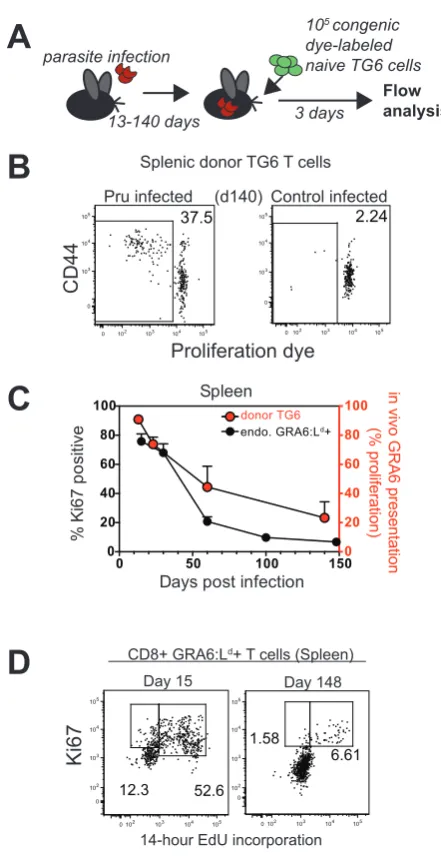
presentation in vivo, we transferred naïve GRA6:Ld-specific transgenic T cells
(TG6) (Figure S2) into previously infected mice and assessed their proliferation 3
days after transfer (Figure 2A). Substantial proliferation was observed when
naïve TG6 T cells were transferred into mice that had been infected 140 days
earlier with Pru strain parasites, but not in mice infected with a parasite strain that
lacks the GRA6 epitope (Figure 2B). Thus, in spite of parasite clearance from
secondary lymphoid organs (Figure 1A), GRA6 antigen presentation persisted
late into chronic infection.
We also observed that 5-10% of total GRA6:Ld-specific cells in chronically
infected mice were in cell cycle, based on expression of the proliferation marker
2D). Interestingly, the decline of antigen presentation after initial infection
correlated with the gradual reduction in the proportion of GRA6:Ld-specific T cells
in cycle (Figure 2C). Together, these data suggest that persistent GRA6 antigen
presentation drives the proliferation of a subset of GRA6:Ld-specific T cells during
chronic infection.
GRA6:Ld-specific T cell immunodominance correlates with the
predominance and persistence of a CXCR3+KLRG1+ population.
Ongoing proliferation within the numerically stable GRA6:Ld-specific T cell
population implies that the population size is maintained dynamically by
continuous production of new cells balanced by cell loss. To investigate these
population dynamics, we examined the composition of the dividing and
non-dividing GRA6:Ld-specific T cell populations in more detail.
The GRA6:Ld-specific T cell response did not appear to be maintained by
precursor population with a classic central memory phenotype (Sallusto et al.,
1999), since antigen experienced GRA6:Ld specific T cells were uniformly CCR7-
CD62L- (Figure S3A). In addition, while the combination of markers often used
to distinguish effectors from memory precursors (KLRG1 and CD127)(Joshi et
al., 2007) divided the population into three subsets, the proliferating population
was equally distributed between these subsets (Figure S3B and S3C). In
contrast, the combination of KLRG1 and CXCR3 revealed a KLRG1+CXCR3+
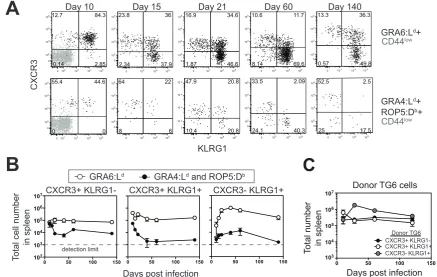
We also noted that the antigen experienced T cell subsets defined by
CXCR3 and KLRG1 differ in their proportions between dominant GRA6 and
subdominant GRA4/ROP5 specificities (Figure 3A). In particular, the GRA6:Ld
-specific T cells consistently contained a higher proportion of CXCR3+KLRG1+
cells compared to the GRA4:Ld/ROP5:Db-specific T cells (Figure 3A and 3B).
Moreover, the CXCR3+KLRG1+ subset of the GRA6:Ld-specific population
persisted throughout infection, whereas the CXCR3+KLRG1+ subset in the
GRA4:Ld/ROP5:Db-specific T cells exhibited a marked decline between days
10-42 of infection and became barely detectable by day 60 after infection (Figure 3A
and 3B). Thus, GRA6:Ld-specific T cell immunodominance correlates with the
predominance and stability of the CXCR3+KLRG1+ population.
Recent thymic emigrants (RTEs) were reported to contribute to the
stability of the antigen-specific CD8+ T responses in some persistent infections
(Snyder et al., 2008; Vezys et al., 2006). To examine the role of RTEs in
maintaining the GRA6-specific T cell population, we transferred a small number
of naïve TG6 T cells into congenic recipients before oral infection, and
enumerated TG6 cells over the course of infection. All three CXCR3/KLRG1
subsets in donor TG6 T cells demonstrated similar kinetics to the endogenous
GRA6:Ld-specific T cells, highlighted by maintenance of the near-peak numbers
and the lack of contraction (Figure 3C). These data indicate that a stable
GRA6-Ld-specific T cell population can be maintained over time without contribution
The CXCR3+KLRG1+ subset has both memory and effector cell
characteristics
To better understand the relationship of the CXCR3/KLRG1 populations to
previously defined memory and effector T cells, we performed additional flow
cytometric analysis of GRA6:Ld-specific CD8+ T cells from chronically infected
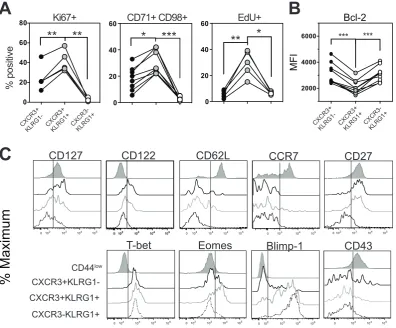
mice. As expected based on Ki67 staining (Figure 4A, Figure S2B and S2C),
CXCR3+KLRG1+ cells incorporated the highest level of the thymidine analog
EdU after an overnight labeling (Figure 4A), confirming that most proliferating
cells are found within this subset. CXCR3+KLRG1+ cells also had the highest
levels of the nutrient update receptors, CD71 and CD98 (Figure 4A) implying that
they are more metabolically active. CXCR3+KLRG1+ subset expressed relatively
low levels of the anti-apoptotic molecule Bcl-2 (Figure 4B) and high levels of the
effector marker Blimp-1, but also expressed a memory associated phenotype of
CD122+, CD27hiCD43lo (Hikono et al., 2007), and Eomeshi (Banerjee et al., 2010)
(Figure 4C). In vitro cytotoxicity assays on sorted CXCR3/KLRG1 populations (Figure S3D to S3E) demonstrated that the CXCR3-KLRG1+ subset harbored
the strongest cytotoxicity, followed by the CXCR3+KLRG1+ subset, while the
CXCR3+KLRG1- subset exhibited minimal killing capacity (Figure S3F). Thus,
the CXCR3/KLRG1 gating strategy subdivided anti-T. gondii CD8+ T cells into three subsets of distinct functions and phenotypes, and identified a proliferative
Lineage relationship and antigen dependence of the CXCR3/KLRG1
subsets.
To explore the developmental relationship among the CXCR3/KLRG1
subsets, we sorted GRA6:Ld-specific CXCR3/KLRG1 subsets from infected mice
and followed their fates upon transfer into congenically marked infected
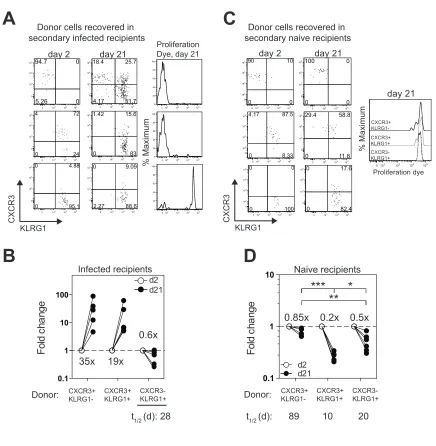
recipients (Figure S4A). GRA6:Ld-specific CXCR3+KLRG1- and
CXCR3+KLRG1+ cells proliferated and expanded 35 and 19 fold respectively
between days 2 and 21 after transfer, whereas majority of the CXCR3-KLRG1+
cells did not proliferate, and their numbers declined with a half-life of 28 days
(Figure 5A and 5B). Interestingly, CXCR3+KLRG1- cells gave rise to all three
subsets after transfer, whereas CXCR3+KLRG1+ cells gave rise only to
CXCR3+KLRG1+ and CXCR3-KLRG1+ cells, and finally, CXCR3-KLRG1+ cells
maintained their phenotype (Figure 5B). Similar CXCR3/KLRG1 profiles were
obtained upon transfer of CXCR3/KLRG1 subsets into T and B cell deficient (rag -/-) mice during acute infection, although both donor CXCR3+ subsets underwent
greater expansion compared to transfer into wild type recipients (Figure S4B). In
summary, these experiments support the lineage relationship of CXCR3+KLRG1-
CXCR3+KLRG1+ CXCR3-KLRG1+, and confirm that CXCR3-KLRG1+
cells are terminally differentiated.
To examine the role of antigen in the differentiation and survival of the
CXCR3/KLRG1 subsets, we transferred sorted populations into naïve recipients.
Twenty-one days after transfer all donor CXCR3/KLRG1 subsets maintained
recovery of donor cells at day 2 and day 21 post transfer, CXCR3+KLRG1- cells
showed the greatest survival with a half-live of 89 days, whereas
CXCR3+KLRG1+ and CXCR3-KLRG1+ subsets displayed half-lives of 10 and 20
days respectively (Figure 5D). These relative half-lives are consistent with the
expression of anti-apoptotic protein Bcl-2, which is lowest in the short-lived
CXCR3+KLRG1+ population (Figure 4B). These data suggest that antigen is
required for differentiation and proliferation of both CXCR3 expressing subsets.
Based on their developmental order, phenotype and functional properties, we
hereafter refer to CXCR3+KLRG1- cells as Tmem, CXCR+KLRG1+ cells as Tint,
and CXCR3-KLRG1+ cells as Teff.
Persistent antigen presentation prevents T cell contraction by sustaining
the amplifying Tint population.
The results from cell transfer experiments and the strong
antigen-dependence of the Tint population imply that maintenance of this population by
residual antigen is key to preventing T cell contraction following activation and
expansion. To further test this idea, we examined the GRA6:Ld specific response
to irradiated parasites, which can invade host cells and trigger a CD8+ T cell
response, but fail to establish chronic infection in vivo (Hiramoto et al., 2002). To allow for a similar infection in the acute phase, we used an intraperitoneal (i.p.)
route of infection with either 106 irradiated parasites or 105 live parasites. Initial
levels of GRA6 antigen presentation and early T cell expansion were comparable
while antigen levels remained high 42 days after infection of mice with live
parasites, antigen levels in mice injected with irradiated parasites were markedly
reduced by day 12 and undetectable at day 42 post-infection (Figure 6A).
Transient antigen presentation in mice infected with irradiated parasites
correlated with a 80% loss of total GRA6:Ld-specific T cells between day 12 and
day 21 (Figure 6B) and a sharp reduction in the proportion of Ki67+ cells (Figure
6C). In contrast, mice infected i.p. with live parasites exhibited little or no
contraction phase (Figure 6b), and ongoing proliferation within Tmem and Tint
subsets (Figure 6C), similar to the results obtained from orally infected mice
(Figure 3). Interestingly, while all CXCR3/KLRG1 subsets declined during the
contraction phase, the greatest reduction in cell number occurred in the Tint
subset (Figure 6D and 6E). These data are consistent with the relative half-lives
of the 3 populations following transfer into naïve mice (Figure 5D), and confirm
that the Tint subset is particularly dependent on persistent antigen for its survival
and proliferation.
We considered that a decline in presentation of the subdominant antigens
could help to explain the loss of the Tint population amongst T cells responding to
these antigens (Figure 3A and 3B). To test this idea, we examined the in vivo
kinetics of presentation of the subdominant antigen ROP5, by transferring naïve
T cells from ROP5:Db-specific TCR transgenic mice (termed TR5 mice, Figure
S5) into infected mice. Unlike the gradual reduction observed for the GRA6
antigen (Figure 6F and Figure 2C), presentation of the ROP5 antigen dropped
tetramer+ Tint T cells (Figure 6F). These data further support the importance of
persistent antigen and the Tint population in maintaining an ongoing T cell
response, and also help to explain the immunodominance of the GRA6:Ld
-specific T cell population.
Mathematical modeling illustrates the role of the amplifying Tint subset in
sustaining a robust Teff response.
The ability of the Tmem, but not the Tint population, to replenish all 3
subsets and survive in the absence of antigen implies that the Tmem population
supports the long-term maintenance of the GRA6:Ld-specific effector response,
while Tint cells provide short-term amplification of the response. Consistent with
this notion, Tint in chronically infected mice exhibit a relatively high proliferation
rate, whereas Tmem are relatively quiescent (Figure 4A).
To further explore the roles of Tmem and Tint subsets in maintaining the Teff
response, we considered two alternative models. In one model, Tmem can divide
to either produce another Tmem cell (self-renewal) or differentiate directly into a
non-dividing Teff cell (Figure 7A). A second model includes a Tint population that
can divide to produce another Tint cell (amplification) or can differentiate into a
non-dividing Teff (Figure 7B and Figure 5A, see also Experimental Procedures).
In both models, we assumed that Teff disappear with a constant death rate of
0.027 cells/day (i.e. 2.7% of total Teff die each day) based on the cell transfer
We first used model 1 to explore the range of Tmem self-renewal and
differentiation rates that would allow for the observed overall rate of Teff
production of 2.5x10⁶ Teff from 105 Tmem at steady state (Figure 3B). By varying
Tmem self-renewal and differentiation rates (1 and 1, respectively), we found
that the self-renewal rate 1 had to be greater than 0.3 cells/day to generate
2.5x10⁶ T
eff at steady state (Figure 7C). This value is incompatible with the
observed low rate of proliferation within the Tmem population (i.e. 6% of the Tmem
population was labeled with EdU in every 14 hours, or 0.1 cells/day, see also
Figure 4A). Moreover, increasing the differentiation rate to approach the
self-renewal rate led to a sharp decline in the number of effectors, due to the
depletion of the Tmem population (Figure 7C and data not shown).
To evaluate the plausibility of model 2, we varied the Tint amplification and
differentiation rates (2 and 2, respectively) while leaving the remaining
parameters set at control values estimated from available experimental data
(Table S1A, see also Experimental Procedures), and calculated the number of
Teff at steady state (Figure 7D). We observed that an amplification rate (2) of
0.5 cells/day or greater would allow for the generation of 2.5x10⁶ T
eff at steady
state (Figure 7D). This value is in line with observed rate of proliferation within
the Tint population (i.e. 29% EdU-labeled cells in 14 hours, or 0.5 cells/day, see
also Figure 4A). Moreover, unlike model 1, in which increasing the differentiation
rate led to a precipitous drop in Teff production (Figure 7C), increasing the
differentiation rate 2 for model 2 led to a gradual decline in Teff numbers and
that the theoretical time course generated using model 2 and control parameters
(Table S1A) correlated well with the experimental data derived from both the
steady state cell number and cell transfer experiments (Figure 7E, Figure 3, and
Figure 5A). These data suggest how the Tint population can allow for rapid
high-level production of Teff cells (Figure S6), and can modulate the rate of
differentiation of Teff without depleting a key progenitor population needed to
sustain the response over the long-term.
DISCUSSION
An ongoing T cell effector response is key to protective T-cell based
vaccines, as well as natural resistance to persistent intracellular pathogens such
as HIV (Masopust and Picker, 2012). However, the mechanisms that maintain
robust T cell effector responses are largely unknown, due in part to the lack of
appropriate mouse infection models. Here we show that persistent,
asymptomatic T. gondii-infection in genetically resistant (H-2d) mice gives rise to
a robust immunodominant CD8+ effector response that is maintained over time
without a contraction phase, and without any signs of functional exhaustion. We
investigated the cellular mechanisms that maintain this effector response,
revealing a division of labor in which a relatively quiescent and long-lived
memory population (Tmem) gives rise to terminally differentiated effector cells (Teff)
via a proliferative, antigen-sensitive intermediate population (Tint). Our data
provide novel insight into the cellular dynamics that maintain robust ongoing
population to generate adequate numbers of new Teff in response to changing
pathogen levels, while preserving a long-lived Tmem population.
Achieving a stable, asymptomatic standoff between an intracellular
pathogen and an ongoing Teff response requires both a pathogen that is able to
occupy a long-term niche in the host, and a T cell response with appropriate
specificity to provide highly effective immune control. With regard to the latter, it
is intriguing to note that MHC-I variants associated with HIV elite control, and the
MHC-I molecule Ld that presents the immunodominant parasite antigen GRA6,
share structural features including atypical peptide binding properties
(International et al., 2010; Kosmrlj et al., 2010; Narayanan and Kranz, 2013). For
the GRA6 antigen, a number of other factors contribute to efficient antigen
presentation, including the secretion pattern of the antigenic protein within the
invaded host cell, and the location of the epitope within the precursor protein
(Feliu et al., 2013; Grover et al., 2014; Lopez et al., 2015). Thus, both features of
a particular antigenic protein and presentation by an atypical MHC-I molecule
may contribute to generating an unusually protective CD8+ T cell response.
In addition to the protective pressure exerted by T cells, the ability of
certain pathogens to adopt a relatively latent form in the host also contributes to
the stable standoff between pathogen and host immune response. We showed
that continued presence of the parasite, leading to persistent low-level antigen
presentation, is required to prevent T cell contraction and maintain robust Teff
and Liesenfeld, 2004). Likewise the ability of -herpesvirues, including
cytomegalovirus (CMV), to adopt a latent form in mammalian host cells, likely
provides a continuous source of antigen, which may explain the remarkable
potency and longevity of Teff responses elicited by a CMV-based vaccine against
SIV in non-human primates (Hansen et al., 2011; Hansen et al., 2009).
Interestingly, heterologous prime-boost vaccination strategies can generate long
lived effector responses without persistent infection (Jabbari and Harty, 2006;
Masopust et al., 2006; Olson et al., 2013). However, there can be sustained
antigen presentation after acute viral infection (Turner et al., 2007), in part due to
formation of immune-complexes (Leon et al., 2014).
A large body of literature using acute infection models has subdivided
antigen-experienced CD8+ T cells into effector and memory populations based
on cell surface markers including CCR7, CD62L, CD127 (IL7R), and KLRG1
(Joshi et al., 2007; Sallusto et al., 1999; Wherry et al., 2003). Interestingly, the
distinction between central memory (CCR7+CD62L+) and effector memory
(CCR7-CD62L-) (Sallusto et al., 1999; Wherry et al., 2003) does not appear to be
relevant in this infection model, since antigen experienced GRA6:Ld-specific
CD8+ T cells were uniformly low for CCR7 and CD62L. This included the
CXCR3+KLRG1- population that could give rise to all other subsets and was
long-lived in the absence of antigen, and thus resembled a memory population.
Moreover, CD127, which has been used in conjunction with the effector marker
KLRG1 to distinguish memory precursor versus short-lived effectors (Joshi et al.,
transition from CXCR3+KLRG1+ Tint to CXCR3-KLRG1+ Teff phenotype
correlated with the loss of proliferation and terminal differentiation of effector
cells. Interestingly, Yap and colleagues observed cycling T cells of
CXCR3+KLRG1+ phenotype in an acute T. gondii vaccination model, and found that Teff terminal differentiation correlated with CXCR3 downregulation in an IL-12
and IFN dependent manner (Kohlmeier et al., 2011; Kurachi et al., 2011; Shah
et al., 2015). Together with our results, these findings suggest that the precise
timing of TCR and cytokine/chemokine signals may be important for regulating T
cell amplification and effector differentiation during infection by modulating the
CXCR3+KLRG1+ Tint subset.
Our modeling studies point to the role of Tint cells in maintaining an
ongoing Teff response. Without the Tint population, Tmem cells would need to
proliferate extensively to keep up with the demand for new Teff cell output.
Moreover, if increasing antigen levels were to drive more rapid differentiation into
Teff, this would lead to the depletion of the Tmem population and eventually the
collapse of the T cell response. Hence the presence of the Tint population allows
for rapid production of new Teff, while maintaining a relatively quiescent Tmem
population when antigen levels remain constant, and provides extra capacity for
increasing Teff differentiation in response to increasing antigen levels.
One interesting feature of the Tint population is high expression of the
T-box transcription factor Eomes. Eomes, and the related transcription factor T-bet
play partially redundant roles in CD8+ T cells, although Eomes also plays unique
2010; Intlekofer et al., 2005; Paley et al., 2012). Interestingly, high Eomes
expression is also associated with a proliferative subset of CD8+ T cells found
some HIV-infected individuals, which correlates with effective viral control
(Simonetta et al., 2014). Moreover, Eomes is expressed at high levels in
intermediate neural progenitor cells, where it is required for the maintenance of
the intermediate population and ongoing neurogenesis (Hodge et al., 2008;
Hodge et al., 2012). Understanding the precise role of Eomes in maintaining
robust CD8+ T cell effector responses during persistent infection is an important
area for future investigation.
In summary, we used a controlled persistent T. gondii infection model to delineate the cellular mechanism that sustains a long-term CD8+ Teff response.
We identified a novel T cell intermediate subset that provides for efficient effector
cell output, and is responsive to antigen levels. Approaches to manipulate the
size of the Tint subset, perhaps via regulated release of antigen, may improve the
efficacy of current vaccine regimens by sustaining robust Teff responses (Beura
et al., 2014; Demento et al., 2012), while preserving a stable Tmem population.
EXPERIMENTAL PROCEDURES
Animals
B6 (C57BL/6), B6 Rag2-/- (B6-Cg-Rag2tm1.1Cgn/J), B6.C (B6.C-H2d/bByJ), BALB/c,
BALB/c Rag2-/- (C.B6(Cg)-Rag2tm1.1Cgn/J), CBA, CD45.1+ congenic B6 (B6.SJL-Ptprca Pep3b/BoyJ), B6 Blimp1-YFP reporter (B6.Cg-Tg Prdm1-EYFP 1Mnz/J)
were obtained from The Jackson Laboratory (Bar Harbor, ME) or The Charles River Laboratory (Wilmington, MA). In order to monitor multiple T. gondii
epitopes, F1 mice (B6xB6.C or B6xBALB/c) expressing both the H-2b and H-2d
MHC class I molecules were used for all experiments. For adoptive transfer experiments, only B6xB6.C F1 mice were used. This included the GRA6:Ld
-specific and the ROP5:Db-specific TCR transgenic (TG6 and TR5, respectively)
six to ten week-old. For all infection and adoptive transfer experiments, sex- and age-matched genetically homogeneous mice were used, therefore no randomization was required. Mice bred in UC Berkeley animal facility and were used with the approval of the Animal Care and Use Committee of the University of California.
Infection
Mice were orally fed 70-80 cysts or injected intraperitoneally (i.p.) with 1×10⁵ live
tachyzoites from the type II Prugniuad-tomato-OVA strain (Pru)(Chtanova et al., 2008). This strain harbors immunogenic T cell epitopes derived from the parasite proteins, GRA6 (Blanchard et al., 2008), GRA4 (Frickel et al., 2008), and ROP5 (Grover et al., 2014), and is engineered to express red fluorescent protein (RFP), allowing for tracking infected cells by flow cytometry. In some experiments, mice were immunized i.p. with 1x10⁶ irradiated Pru tachyzoites (14,000 rads). In other
experiments, tachyzoites from type III CEP strain parasites were used for infection. CEP expresses an allelic version of GRA6 that lacks the T cell-stimulatory epitope (Grover et al., 2014), and is used here as a negative control. Cysts were obtained from brains of CBA mice infected for 3–5 weeks i.p. with 400 live Pru tachyzoites. Parasite loads in spleen and lymph nodes was analyzed by flow cytometry and parasite load in the brain was analyzed by semi-quantitative PCR (Grover et al., 2014).
Generation of the T. gondii GRA6:Ld -specific (TG6) and ROP5:Db-specific
(TR5) TCR transgenic mice
The TCR alpha and beta chain sequences of the GRA6:Ld-specific CTgEZ.4 T
cell hybridoma (Blanchard et al., 2008) were determined according to Kraig et al (Kraig et al., 1996). The GRA6:Ld-specific and ROP5:Db-specific TCRs
corresponded to TRAV6-7/DV9*01, TRAJ52*01. Then, both TCR chains were cloned and amplified from the genomic DNA of the CTgEZ.4 cell line by using
forward primer specific for TRAV6-7/DV9 (5’
-TCTCCCGGGGTCTAAAGATGAACTCTTCTCCAGG) and reverse primer for
TRAJ52 (5’-TAAGCGGCCGCTGAGCGC AGTAAAGATT CTAGC); forward
primer specific for TRBV1*01 (5’-TCT CTCGAG
TCTCAGAGATGTGGCAGTTTTGC) and reverse primer for TRBJ2-1 (5’-TAAG CCGCGG TCCTGGAAATGCTGGCACAAACC). Similarly, the ROP5:Db-specific
TCR alpha and beta chains were cloned and amplified from the genomic DNA of the BTg45Z cell line (Grover et al., 2014) by using forward primer specific for
TRAV10 (5’- TCT CCC GGG GGA AGA ATG ATG AAG ACA TCC CTT CAC AC) and reverse primer for TRAJ49 (5’- TAA GCG GCC GCG TCT TGG TGA GTG AGC AAG ACA GAA G); forward primer specific for TRBV13-3 (5’- TCT CTC GAG TTCTGAG ATG GGC TCC AGA CTC TTC) and reverse primer for TRBJ2-5 (5’- TAAG CCG CGG CGC CCA CTG CAG CCC AAT CCC GCT GAG).
vector in Xhol and SacII sites, according to Kouskoff et al (Kouskoff et al., 1995). The ampicillin resistance gene was cut out with Sal I in pTa vectors and Kpn I in pTb vector before DNA injection. The TG6 transgenic mice were generated on the B6 background in the Cancer Research Laboratory Gene-Targeting Facility at UC Berkeley under standard procedures. The TR5 transgenic mice were generated on the B6 background in UC Davis Mouse Biology Program under standard procedures. Founders were identified by flow cytometry and PCR genotyping of tail genomic DNA using primers mentioned above. The TG6 and TR5 mice used in all experiments were bred with B6.C mice to generate F1 (H-2bxd) background.
Flow cytometry
All antibodies were from eBioscience (San Diego, CA), Biolegend (San Diego, CA) or Tonbo Biosciences (San Diego, CA), except for FITC-labeled anti-mouse T-bet antibody (Santa Cruz Biotech. Inc., Santa Cruz, CA). The GRA6:Ld,
GRA4:Ld, and ROP5:Db tetramers were made by conjugating the biotin-labeled
monomers (NIH tetramer facility, Atlanta, GA) with PE-labeled or APC-labeled streptavidin (Prozyme, Hayward, CA) according to protocols from the NIH tetramer facility. Brain samples were perfused and digested by collagenase before leukocytes isolation by 70%:30% percoll gradient (GE Heathcare, Pittsburgh, PA) (Grover et al., 2014). In some experiments, 3µg of FITC-labeled anti-CD45.1 (A20) antibody was injected intravenously into chronically infected mice 2 minutes before sacrifice and organ harvest (Anderson et al., 2014). In all experiments, cell suspension from the brain, lymph nodes and the spleens was incubated with tetramers and surface antibodies against mouse CD8 (53-6.7), B220 (RA3-6B2), CD27 (LG.7F9), CD44 (IM7), CD45.1 (A20), CD49d (R1-2), CD62L (MEL-14), CD122 (TM-1), CD127 (A7R34), CXCR3 (CXCR3-173), PD-1 (RMP1-30) and/or KLRG1 (2F1) for 1 hour at 4oC. For EdU labeling experiments,
previously infected mice were injected intraperitoneally with 2mg EdU
(5-ethynyl-2’-deoxyuridine) for 14 hours before sacrifice. Cell suspensions were then stained with APC-labeled tetramers and other surface markers before EdU detection procedure during the Click-iT EdU Alexa-Fluor 488 Flow Cytometry Kit
(Invitrogen, Carlsbad, CA) according to manufacturer’s instruction. For all intracellular staining, samples stained with surface antibodies were fixed with Cytofix/Cytoperm kit (BD Pharmingen, San Diego, CA) or Transcription Factor Staining Buffer Set (eBioscience), followed by antibodies staining of intracellular TNF (A20)IFN (XMG1.2)T-bet (4B10), Eomes (Dan11mag), Ki67 (SolA15) and Bcl2 (10C4). All flow cytometry data were acquired by BD LSRFortessa analyzers (BD Biosciences) and were analyzed with FlowJo software (Tree Star, Ashland, OR). Fluorescent AccuCheck counting beads (Invitrogen) were used to calculate total numbers of live lymphocytes from all samples.
ex vivo cytokine production assay
then harvested for surface and intracellular antibody staining before flow cytometry analysis.
GRA6 and ROP5 antigen presentation detection in vivo
To provide a sensitive method to detect ongoing antigen presentation, we adopted a detection method in Turner et al (Turner et al., 2007). In brief, we harvested from lymph nodes (LNs) and spleen of CD45.2+ TG6 or TR5 mice H2bxd background, labeled with the cell proliferation dye eFluor 450 (eBioscience,
San Diego, CA), transferred cells containing 105 TG6 or TR5 cells into previously
CD45.1+ infected mice, and examined proliferation dye dilution 3 days later as a measure of GRA6 or ROP5 antigen presentation. Relative antigen levels are expressed as the % of donor TG6 or TR5 cells that have diluted proliferation dye (proliferation dyelow) 3 days after transfer.
Adoptive transfer
To expand TG6 cells in vivo, cells were harvested from lymph nodes (LNs) and spleen of CD45.2+ TG6 mice on H2bxd background and transferred into CD45.1+
naïve F1 recipients at 10,000-100,000 CD8+ TG6 cells/mouse one day before infection. For FACS sorting, pooled LNs and spleen cells from multiple recipients
≥day 21 post infection were subjected to CD4+ T cell and B cell depletion by PE-labeled anti-CD4 and anti-B220 antibodies and anti-PE magnetic beads (Miltenyi
Biotec. Inc., San Diego, CA) according to the manufacturer’s instruction, followed by eFluor450 proliferation dye labeling. CXCR3+KLRG1-, CXCR3+KLRG1+, and CXCR3-KLRG1+ CD8+ TG6 cells were then sorted at ≥ 92% purity by a BD influx cell sorter (BD Biosciences). Each sorted subset was then transferred to naïve or >day 21 post-infected secondary recipients at 105 cells/mouse. Donor
TG6 cells were harvested between day 2 to day 21 post transfer for flow cytometry analysis. In some experiments, sorted TG6 cells were transferred to F1 rag-/- mice that were infected 1 day before transfer. Donor cells were
harvested 8 days after transfer for flow cytometry analysis.
In vitro cytotoxicity assay
Sorted subsets of CXCR3+KLRG1-, CXCR3+KLRG1+, and CXCR3-KLRG1+ CD8+ TG6 cell subsets were obtained from infected mice as described above for adoptive transfer. Each subset was cultured with GRA6-peptide-pulsed and PBS-pulsed splenocytes from congenically marked naïve F1 mice at 1:5:5 ratio. The GRA6-peptide-pulsed and PBS-pulsed splenocytes were distinguished by different intensity of CFSE labeling (5-(and-6)-Carboxyfluorescein Diacetate, Succinimidyl Ester, Invitrogen). Cytotoxicity was assessed by the loss of the GRA6-peptide-pulsed splenocytes relative to the PBS-pulsed control after 18 hours of culture.
In vivo cytotoxicity assay
hour at 37oC. Pulsed cells were then washed twice and mixed at 1:1:1:1 ratio
with 106 cells from each population. Cell mixture was injected intravenously into
chronically infected mice and harvested 18 hours later.
Mathematical modeling and Bayesian statistical analysis
To construct the mathematical models for Figure 7, we made the following assumptions: 1a) Model 1 follows the linear order: Tmem (CXCR3+KLRG1-, called
x1) Teff (CXCR3-KLRG1+, called x3); 1b) Model 2 follows the linear order:
Tmem (CXCR3+KLRG1-, called x1) Tint (CXCR3+KLRG1+, called x2) Teff
(CXCR3-KLRG1+, called x3); 2) Teff do not proliferate or further differentiate, and
eventually die (death rate, 3). 3) Populations x1 and x2 are characterized by an intrinsic carrying capacity of the population, related to the resources available, designated 1 and 2, respectively. 4) For the sake of simplicity, death rates for populations x1 and x2 in the presence of antigen are assumed to be zero. However, we note that if substantial death does occur in these populations, this would be reflected in lower values for 1 and 2, and would not affect our overall conclusions.
The equations for the mathematical models that describes the populations are:
Model 1:
(i)
(ii)
Model 2:
(iii) ,
(iv) ,
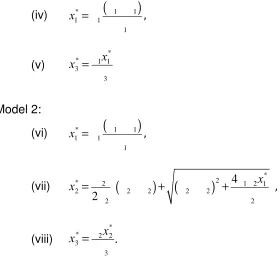
(v) .
The steady state of interest for the populations described above can be described by the following equations:
Model 1:
dx1
( )
tdt =l 1x1
( )
t 1-x1
( )
tk 1
æ
è
ç ö
ø
÷- x 1x1
( )
tdx3
( )
tdt = - m 3x3
( )
t +x 1x1( )
tdx1
( )
tdt =l 1x1
( )
t 1-x1
( )
tk 1
æ
è
ç ö
ø
÷- x 1x1
( )
tdx2
( )
tdt =l 2x2
( )
t 1-x2
( )
tk 2
æ
è
ç ö
ø
÷+x 1x1
( )
t - x 2x2( )
tdx3
( )
t(iv) ,
(v)
Model 2:
(vi) ,
(vii) ,
(viii) .
We then determined a set of control parameters for the model (Table S1A). For the death rate of Teff (3) we used 0.027 cells/day, based on the half-life of the
population upon transfer into infected mice: (Figure 5B and 5D). We
used the EdU incorporation data (Figure 4A) to estimate 1 (self-renewal rate) and2 (amplification rate). (6% EdU labeling of the Tmem population x 24/14
hours = 0.1 cells/day for 1 and 29% labeled x 24/14 hours = 0.5 cells/day for
2). We set 1 slightly lower than 1, and 2 slightly lower than 2, to provide for stable x1 and x2 populations over time. We calculated the carrying capacities 1 and 2, based on the steady state equations (vi-viiii), the control parameters for and and the mean number of x1 and x2 cells from day >40 infected mice from Figure 3. Figure 7C and 7D were generated in Mathematica (Wolfram, Champagne, IL) as a function of 1 and 1 (Figure 7C) or 2 and 2 (Figure 7D). Figure 7E was generated in Python (PSF, Beaverton, OR).
To obtain a measure of the plausibility of the model and the control parameters, we performed a Bayesian statistical calibration of the model using the available data (steady state spleen T cell numbers and cell transfer data in Figure 3 and Figure 5). For the prior distributions, we used a combination of independent uniform and normal distributions that covered a wide range of possible parameter values.
To set the likelihood structure and the level of approximation, we used the following Approximate Bayesian Computation (ABC) technique (Wilkinson,
x1*=k 1
(
l 1- x 1)
l 1
x3* =x 1x1
*
m 3
x1*=k 1
(
l 1- x 1)
l 1
x2*= k 2
2l 2
(
l 2- x 2)
+(
l 2- x 2)
2
+4x 1l 2x1 *
k 2
é
ë
ê
ê
ù
û
ú
ú
x3* =x 2x2
*
m 3
m 3=
ln 2
( )
[image:28.612.95.375.88.344.2]2013): 1) Randomly draw from the prior distributions for the parameters; 2) Use the chosen parameter set to simulate data from the model so we have a model prediction for every observed data point; 3) Compare the simulated data with the observed data, and retain the set of parameters if they are similar enough; 4) Repeat steps 1 to 3 until the number of retained parameter sets is large.
To compare the observed and simulated datasets, we used the following distance measure:
(ix) Distance (Data, Simulated Data) =
(
Data - Simulated Data)
2
Data2
Data
å
which is a Euclidean distance that has been scaled by the magnitude of the observed data. We say that the observed and simulated datasets are similar enough if this distance is less than 30. The resulting median values and probability functions show that the control parameters fall well within the 95% probability limits (Table S1B). Analysis was performed in Matlab (Mathworks, Natick, MA).
Code Availability
The mathematical equations for the number of cells of population x3 at steady state (Figure 7C and 7D), as a function of (model 1) 1 and 1 and of (model 2)
2 and 2 are provided as a Mathematica code in Supplementary File. The mathematical model to obtain the time course for the dynamics of the three populations (model 2 and Figure 7E) is provided as a numerical Python code in Supplementary File. Source code used for Bayesian statistical analysis is available upon request.
Additional Statistical Analysis for Experimental Data
All p-values were calculated using the two-tailed, unpaired Student’s t test or one-way analysis of variance with Tukey’s post-test according to instructions in Prism (GraphPad, La Jolla, CA). A p-value < 0.05 was considered to be statistically significant. All data met the assumptions of the test (i.e. Gaussian distribution and similar variances between groups of data being compared). Sample size in all experiments was consistent with previous experience and similar studies. No samples or animals were excluded from the analysis. The investigators were not blinded to group assessment.
AUTHOR CONTRIBUTIONS
ACKNOWLEDGEMENTS
We thank C. Kang for generating TG6 transgenic mice, K. Taylor and I. Chou for expert technical assistance, the NIH Tetramer Core for peptide-MHC tetramers, H. Nolla and A. Valero for cell sorting, M. Jenkins (U of Minnesota), M. Prlic (Fred Hutchson Cancer Research Center), and members of the Robey Lab for helpful comments. This work was supported by grants from the American National Institutes of Health P01 AI065831 (E.A.R. and N.S.), R01 AI065537 and AI093132 (E.A.R.); the American Heart Association and the California Institute for Regenerative Medicine (H.H.C.); the Human Frontier Science Program (N.B.);
the UK’s National Centre for Replacement, Refinement and Reduction of Animals in Research NC/K001280/1 (J.P.G.), the Leeds Fund for International Research Collaborations (G.L. and C.M-P.), the Biotechnology and Biological Sciences Research Council BB/F003811/1 (G.L. and C.M-P.) and BB/G023395/1 (C.M-P).
All authors have no competing financial interest.
REFERENCES
FIGURE LEGENDS
Figure 1: CD8+ GRA6:Ld-specific T cell response to T.gondii in genetically
resistant mice exhibits immunodominance, lack of a contraction phase,
and a persistent polyfunctional effector response. (A) Kinetics of parasite
burden in F1 H2bxd mice after oral infection with Pru strain parasites expressing
RFP. Parasite loads in the mesenteric lymph node (MLN, filled circles) and in the
spleen (open circles) are shown as numbers of RFP+ infected cells. Parasite
loads in the brain were determined by semi-quantitative PCR. Each time point is
displayed as number of parasite genomes per 1µg of brain genomic DNA (red
triangles). (B) Representative flow cytometry plots showing GRA4:Ld-, ROP5:Db-,
or GRA6:Ld-tetramer expression on gated CD8+ T cells from the spleens of F1
mice day 21 after infection. Numbers represent the percent of tetramer+ cells out
-(blue circles), or GRA6:Ld-(red circles)-tetramer-specific CD8+ T cells in the
spleens (top) and the brains (bottom) of infected F1 mice at the indicated time
points. (D)In vivo cytotoxicity of anti-T. gondii CD8+ T cells. Representative histograms showing the percent of each of each target cell populations
pre-transfer, or 18 hours after transfer into day 90 chronically infected mice. Target
cells were individually pulsed with 1M of indicated peptides and labeled with a
different concentration of fluorescent dye, then mixed at 1:1:1:1 ratio just prior to
injection into mice. Values are the percent of each donor population before and
after transfer. (E) Left panel shows representative flow cytometry plots showing
IFN and TNF production of splenic CD8+ T cells from day 140 chronically
infected F1 mice after ex vivo stimulation with indicated peptides for 4 hours. Values are the percent of IFN positive cells out of total CD8+ T cells. Right
panel shows the percentage of TNF producing cells amongst IFN +CD8+ T
cells following stimulation with a serial dilution of GRA6 (red) or a mixture of
GRA4 and ROP5 peptides (black). (F) Kinetics of surface KLRG1, CD62L, and
PD-1 expression. Values are the percent positive cells out of each of the splenic
GRA4:Ld-(black circles), ROP5:Db- (blue circles), and GRA6:Ld- (red circles)
tetramer+ CD8+ T cell population from mice between day 0 and day 200 post
infection. Graph in (A-C, F) are summary of 3-5 independent experiments with
total N equal to 4-10 mice at each time point. (D, E) are representative of 3
independent experiments with total N=5 mice 2-4 months post infection. Graphs
Figure 2. Kinetics of antigen presentation in vivo correlates with GRA6:Ld
-specific T cell proliferation during the chronic phase. (A) Strategy for
quantification of in vivo GRA6 antigen levels in infected mice. (See also
Experimental Procedures). (B) Representative flow cytometry plots of donor TG6
T cells recovered 3 days after injection into day 140 post infection mice. Control
infected mice were infected with CEP strain parasites, which express an allelic
form of GRA6 that lacks the relevant T cell epitope. (C) Compiled data showing
GRA6 antigen presentation in vivo as measured by the proliferation of TG6 T cells recovered 3 days after transfer into mice that had been previously infected
for the indicated times (red circles). Percentage of Ki67+ cells out of total
endogenous splenic GRA6:Ld-tetramer+ CD8+ T cells in orally infected mice
(black circles) are shown for comparison. (D) Representative flow cytometry plots
showing Ki67 expression and 14-hour in vivo EdU labeling by gated splenic GRA6:Ld-specific CD8+ splenic T cells at day 15 or day 148 after infection.
Panels in (B and D) are representative of 3 independent experiments with total
N=5-6 mice per group. Graph in (C) is summary of 3 independent experiments
with total N equal to 4-5 mice at each time point. Values are percent of cells in
the indicated gates or quadrants.
Figure 3: GRA6:Ld-specific T cell immunodominance correlates with the
predominance and stability of the CXCR3+KLRG1+ population. (A)
Representative flow cytometry plots showing CXCR3 vs. KLRG-1 expression of
indicated times after infection. Naïve CD44low CD8+ T cells are shown in grey for
reference. (B) Total numbers of splenic CXCR3+KLRG1-, CXCR3+KLRG1+ and
CXCR3-KLRG1+ cells within the GRA6:Ld- (open circles) or GRA4:Ld/ROP5:Db
-(filled circles) tetramer+ CD8+ T cells over time after infection. The dashed line
indicates the detection limit of this assay at 103 cell/spleen. (C) Kinetic of total
splenic donor TG6 cells (left) and number of splenic donor TG6
CXCR3+KLRG1-, CXCR3+KLRG1+ and CXCR3-KLRG1+ cells (right) after infection. Panels in (A)
are representative of 3-6 independent experiments with total N=5-8 mice at each
time point. Graphs in (B and C) are summary of 3-5 independent experiments
with total N equal to 3-8 mice at each time point, except in (B), day 140 post
infection (2 independent experiment with total N equal to 2 mice). Graphs in (B
and C) display mean±S.E.M.
Figure 4: The CXCR3+KLRG1+ subset is enriched with proliferating cells
and has characteristics of both memory and effector cells. (A) Compiled
scattered plots showing the percentages of Ki67+ (left), CD71+CD98+ (middle)
and EdU+ (right) cells in each of the splenic GRA6:Ld-specific CXCR3/KLRG-1
subsets 60 days after infection. (B) Compiled scattered plot showing the mean
fluorescent intensity (MFI) of Bcl-2 staining in each of the splenic GRA6:Ld
-tetramer+ CXCR3/KLRG1 subsets at ≥ 40 days after infection. Data points from
the same animal are indicated by connecting lines. Each symbol indicates value
from individual recipients. (C) Representative histograms showing expression of
Blimp-1, Eomes, and T-bet in each of the splenic GRA6:Ld-specific
CXCR3/KLRG-1 subsets 60 days after infection. All panels are summary of 3-6
independent experiments per group. *P < 0.05, **P < 0.01, and ***P < 0.001 (one-way ANOVA with Tukey’s post test).
Figure 5: Lineage relationship and antigen dependence of the
CXCR3/KLRG1 subsets. (A) Representative flow cytometry plots showing the
CXCR3/KLRG1 phenotype and proliferation dye profile of each of the sorted
donor TG6 subsets 2 days or 21 days after transfer into ≥ day 21 infected
recipients. (B) Fold change in the number of the indicated CXCR3/KLRG1
donor-derived subsets between 2-21 days after transfer into infected recipients. Each
filled circle represents the value from an individual recipient at day 21 normalized
to the mean value of day 2 post transfer for that subset from all experiments.
Numbers inside the graphs indicate the mean fold change for each subset
between day 2 and day 21. (C) Representative flow cytometry plots showing the
CXCR3/KLRG1 phenotype and proliferation dye profile of each of the donor TG6
subsets 2 days or 21 days after transfer of the indicated sorted subsets into
naïve F1 recipient mice. (D) Fold change in the number of the indicated
CXCR3/KLRG1 donor-derived subsets between 2-21 days after transfer into
naive recipients. Each filled circle represents the value from an individual
recipient at day 21 normalized to the mean value of day 2 post transfer for that
subset from all experiments. Numbers inside the graphs indicate the mean fold
***P < 0.001 (one-way ANOVA with Tukey’s post test). All panels are representative of 3-4 independent experiments. Total N of each panel is
indicated in the corresponding scattered plots. (B, D) Half-lives of each subset
(t1/2) were calculated by: , N = donor TG6 cell
number recovered at day 2 or day 21 post transfer.
Figure 6: Persistent antigen presentation prevents T cell contraction by
sustaining the Tint population. (A-B) Kinetics of splenic GRA6 antigen
presentation in vivo, as measured by proliferation of naïve TG6 T cells 3 days after transfer into infected mice (see also Figure 2A) (A), and splenic GRA6:Ld
-tetramer+ CD8+ T cell number (B) in mice infected with either 105 live (filled
circles) or 106 irradiated (open circles) T. gondii intraperitoneally. (C)
Representative histograms showing Ki67 expression of each of the splenic
GRA6:Ld-specific CXCR3/KLRG1 subsets in mice infected with 105 live or 106
irradiated T. gondii intraperitoneally at 12 or 21 days post infection. (D)
Representative flow cytometry plots showing CXCR3/KLRG1 profiles of splenic
GRA6:Ld-tetramer+ CD8+ T cells from mice infected with 105 live or 106
irradiated T. gondii intraperitoneally at 7, 12, or 21 days post infection. (E) (left) Kinetics of each of the splenic GRA6:Ld-tetramer+ CD8+ CXCR3/KLRG1 subsets
from mice infected with 105 live (filled circles) or 106 irradiated (open circles) T.
gondii intraperitoneally. (right) Histogram indicated the fold reduction of cell numbers in each T cell group between day 12 and 21 in mice infected with 106
circles), as measured by proliferation of naïve ROP5:Db T cells from TR5 TCR
transgenic mice 3 days after transfer into orally infected mice (see also Figure
2A.) Numbers of splenic GRA4:Ld/ROP5:Db-specific CXCR3+KLRG1+ cells
(black circle) from Figure 3B are shown for comparison. Right panel shows
comparable data for splenic GRA6 antigen presentation in vivo and numbers of splenic GRA6:Ld-specific CXCR3+KLRG1+ T cells. GRA6 antigen presentation
data is also displayed in Figure 2C, and is included here for comparison. Graph
in (A) is summary of 2 independent experiments with total N equal to 3-4 mice at
each time point. Each symbol indicates value from individual recipients. Graph in
(B), *P = 0.043 and **P = 0.003 (unpaired, two-tailed student t-test); Graph in (E), *P = 0.02 (one-way ANOVA with Tukey’s post test). Graphs in (B and E) are summary of 3-4 independent experiments with total N equal to 4-7 mice at each
time point. Panels in (C, D, and F) are representative of 3 independent
experiments with total N=3-5 mice at each time point. Graphs in (A, B, E and F)
display mean±S.E.M.
Figure 7: Mathematical modeling illustrates the role of the amplifying Tint
subset in maintaining a robust Teff response. Mathematical models describing
the population dynamics of the GRA6:Ld response with (A) or without (B) the T int
susbet. See also Experimental Procedures for details. (C) Graph showing
dependence of Teff cell numbers at steady state on the values of Tmem
self-renewal rate 1 and differentiation rate 1, according to model 1 in panel (A).