EUROPEAN PARLIAMENT
,JJirectorqte General for Resea.rc.h
WORKING PAPERS
ECONOMIC INTERDEPENDENCE·
NEW POLICY CHALLENGES
PROCEEDINGS OF THE PUBLIC HEARING HELD BY
THE COMMITTEE ON EXTERNAL ECONOMIC RELATIONS
BRUSSELS, 28 SEPTEMBER 1993.
External Economic Relations Series
W-7 __ _
Tms PUBLICATION IS ONLY AVAILABLE IN ENGLISH.
IN TilE EXTERNAL ECONOMIC RELATIONS SERIES HAVE ALREADY BEEN PUBLISHED TilE FOLLOWING TITLES:
No.1
No.2
No. W 1
No. W2
No.W3
No.W4
No.W5
No. W6
(1011989): EUROPEAN FREE TRADE AsSOCIATION (EFT A) AND THE COMMUNITY'S
INTERNAL MARKET. DE/EN/FR
(1011990): TIIIRD WORLD DEBT- ANALYSIS. ALL LANGUAGES.
(1/1992): STRUCTURAL ADJUSTMENT IN TilE ACP COUNTRIES AND EUROPEAN
COMMUNITY INTERVENTION- SITUATION AND PROSPECTS: ALL LANGUAGES.
(3/1992): TRADE OF TilE NEW GERMAN LANDER WITH TilE FORMER COMECON
COUNTRIES. DEVELOPMENT, PROBLEMS, PROSPECTS. DE/EN/FR
( 11/1993): STIMULATING EcONOMIC' GROWTH: TilE RECOVERY PROGRAMMES IN TilE
EUROPEAN COMMlJNffY, JAPAN AND TilE UNITED STATES. EN
(9/1993): AGREEMENT ON TilE EUROPEAN ECONOMIC AREA- BACKGROUND AND
CoNTENTS. EN
(1011993): LE TRANSrERT INTERNATIONAL DE TECHNOLOGIES A DOUBLE
USAGE-LE COCOM ET LA COMMUNAUTE EUROI'EENNE. FR (EN TRANSLATION FORESEEN).
(1211993): TIIC EUROPEAN COMMUNITY AND lliE AssOCIATION OF SOUTII-EAST
ASIAN NAliONS (ASEAN). EN
THE CONTENTS OF THIS PUBLICATION DO NOT NECESSARILY REFLECT THE VIEWS
OF THE EUROPEAN PARLIAMENT.
PUBLISHER: THE EUROPEAN PARLIAMENT
DIRECTORATE GENERAL FOR RESEARCH
DIRECTORATE A: EXTERNAL ECONOMIC' RELATIONS DIVISION
L - 2929 LUXEMBOURG.
TEL: (00352) 4300-1
EUROPEAN PARLIAMENT
Directorate General or ·Research
WORKING PAPERS
ECONOMIC INTERDEPENDENCE·
NEW POLICY CHALLENGES
PROCEEDINGS OF THE PUBLIC HEARING HELD BY
THE COMMITTEE ON EXTERNAL ECONOMIC RELATIONS
UNDER THE CHAIRMANSHIP OF MR. WILLY DECLERCQ
PRESIDENT OF THE COMMITTEE
BRUSSELS, 28 SEPTEMBER 1993.
,
Ex t e r n a l E c o
11o m
i c R e I a
fi·o
11s S e r
i
e s
On 25 January 1993 the European Parliament's Committee on External Economic Relations decided to organise a Public Hearing with the aim of improving its understanding of the ongoing process of economic interdependence in the world and its consequences for the European Union's economy and trade policy. The information gathered should help the Committee in setting out its future policy lines. The hearing was held in Brussels on 28 September 1993. In order to provide the Members with valuable background material and to serve as a reference for future debate on the issues involved, the Directorate General for Research has been requested to publish the proceedings of the hearing.
The present document includes the papers of experts and policy makers on the basis of which the discussions were organised. It consists of the following parts: (I) An introduction, in which the Chairman of the Committee sets out the purpose and the framework of the Hearing, and introduces speakers and discussants invited to the meeting; (II) A discussion paper prepared by the Commission taking stock of the issue and presenting its views on policy implications for the European Union; (III) The proceedings of the Hearing, including the presentations of speakers and the interventions by discussants and Members; (IV) Submissions by representatives of interests groups.
It should be noted that, due to technical problems during the afternoon session, not all parts of the discussion could be reproduced.
DIRECTORATE GENERAL FOR RESEARCH
CONTE!r.rS
PAGE
• . 5
X. .
;OORoi>UcTION
II_,.
1 •
2.
3.
par Honsieur De Clercq, President de la Commission des relations econOID.iques exterieures • • • . • • • • • • • 1 1
:~ATIOHAL
ECONOMIC. INTERDEPENDENCE
Discussion Paper; eoai.ssi~ of the EUropean Community,
Directorate General for EXternal Economic Relations, Hay 1993
EXECUTIVE SUMMARY
INTRODUCTION
(i) (ii)
Towards a global economy Policy Interdependence
ASPECTS OF INTERDEPENDENCE
(i) (ii) (iii) (iv) (v) (vi)
Foreign trade
Foreign direct investment
Globalisation of technology '· .
Transnational information flows and networks Economic networks
Financial markets
POLICY IMPLICATIONS
(i) (ii)
(iii)
(iv)
(v)
A stable and open world economy
The need to address global imbalances
Towards a more global and comprehensive regulatory framework
The policy issues The next moves
A. PROCEEDINGS OF THE HORNING SESSION
"ToWARDS A GLOBAL ECONOMY?"
Discussion moderator: If. HINDLEY, lfEP
Papers:
1. THE EC AND GLOBAL ECONOMIC INTERDEPENDENCE
Professor L. TSOUKALIS, University of Athens, Director of Economic Studies, College of Europe, Bruges . • . • •
(i)
(ii)
(iii)
The EC in the international division of labour Characteristics of EC policies . . • . • . • . Issues and policy options for the future
References Graph Table
2. EUROPEAN INTERNATIONAL ECONOMIC POLICY ISSUES
Professor R. DORNBUSCH, Massachusetts Institute of Technology,
PAGE 59 61 61 63 66 68 69 70
cambridge (lfass.) . • • . • • • . • . • . 71
1. 2. 3. (i )· Ciil (iii) (iv) (v) (vi) (vii) (viii)
What concept of Europe? . . . • . . World trade at the cross roads . . . • . . North Atlantic Free Trade
World Trade Organisation
EMS? • • • • • • •
capital controls? Asian appreciation What to do about Japan?
References Graph
Primary Discussants:
If. ALBERT, President of Assurances Generales de France, Paris (France) • • • • • • • • • • • • • . • • • • . • •
G. SINCLAIR, Deputy Permanent Secretary of Sistema,
Econ6mico Latinoamericano (SELA), caracas (Venezuela)
H. CHO, Chairman of the Board of NARA Corporation, Seoul (South Korea) • . • . . . • • . . • •
Concluding remarks of the morning session: If. HINDLEY, lfEP
1.
2.
3.
B. PROCEEDINGS OF THE AFTERNOON SESSION
"A NEW APPROACH TO ECONOMIC MANAGEMENT"
Discussion moderator: II.A. FERNANDEZ ORDONEZ, President of the Tribunal of Defence of Competition, lladrid
Speech:
INTERNATIONAL ECONOMIC RELATIONS AND GLOBAL MARKETS
The Rt. Hon. Sir Leon BRITTAN, QC, Vice President of the Coll1111ission of the European Communi ties for External Economic Relations
(i)
(ii)
(iii)
(iv)
(v)
Introduction
Economic globalisation: Key changes
(a) (b) (c) (d)
Trade
Asia . . • • . . . Foreign investment Financial markets
Consequences of globalisation: Recipes for success
Coordinating policies
Conclusion
Primary discussants:
Drs. T.J. van HEESCH, Director of Philips International BV, Eindhoven ( NL} • • • • . . . . . _ • . • • • • • •
K. CHIBA, Counsellor of llitsui & Co. Ltd., Tokyo (Japon}, Ex-Ambassador of Japan to the United Kingdom . • . .
D. llacSHANE, Secretary of the International lletal Workers Federation, Geneva (Switzerland} • . . • • • • • •
PAGE
101
101 101
102 102 102 103
103
105
107
108
111
sirBMisstONs
1 • mADE AND THE THIRD WORLD - PRIORITIES FOR THE EUROPEAN COIIHUNITY
C. AID, Oxfam, the catholic Institute for International
Relations World Development Movement . . • . (i)
(ii) (iii) (iv)
Introduction
The Third World and Maastricht Summary of recommendations
Trade and the Third World: Priorities for the EC
(a) Common tariff policy
PAGE
121
123
123 123 124 126
126
(b) Textiles policy: the Multi-Fibre Arrangement 127
(c) Common Agricultural Policy
1. 2. 3.
Beef sector Sugar sector Cereals sector
(d) Conclusion
2. BUREAU EUROPEEN DES UNIONS DE CONSOMMATEURS'S SUBMISSION TO THE COMMITTEE ON EXTERNAL ECONOMIC RELATIONS OF THE EUROPEAN PARLIAMENT ON THE COMMISSION'S DISCUSSION PAPER "INTERNATIONAL
128
129 130 132
134
ECONOMIC INTERDEPENDENCE", May 1993 135
3.
(i) (ii)
( i i i ) (iv) (v)
Introduction
International trade and the consumer Concentration and the consumer
Financial markets and the consumer Conclusion
UNICE COMMENTS ON COMMUNITY COMMERCIAL POLICY AND ITS INSTRUMENTS, September 1993 . . . .
135 135
136 137
137
I.
INTRODUCTION
BY MR WILLY DE CLERCQ, CHAIRMAN OF THE COMMITTEE ON EXTERNAL
It may be asked why there should be a public hearing on the globalization of the economy. During this legislature, our committee, which is responsible for the Community's external economic relations, has dealt with the different aspects of this phenomenon from various angles, inter alia as part of the parliamentary proceedings relating to the Uruguay Round multilateral trade negotiations in the GATT, textiles, commerce, the environment, social clauses-and anti-dumping policy clauses-and the implementation of the common trade policy. All the reports drawn up by our colleagues on these subjects deal with the problems of economic interdependence and its repercussions on trade policy, but none of them has made an overall detailed analysis of the globalization of the economy.
Our committee therefore decided to hold this hearing in order to sound out the views of leading academics and politicians on this subject which affects trade policy as a whole. Given the quality of the experts among us today, I am sure that our debates and discussions will enable us to have a greater understanding of this subject. Naturally, it will be up to the Members of the European Parliament elected for the next legislature who will be able to act upon this information. Nevertheless, the European Parliament must draw conclusions therefrom in the form of an own-initiative report by the REX committee which will be debated in plenary sitting.
What is economic interdependence or, to use another term, the globalization of the economy? Initially, our answer can be based on the following facts: since the second world war, the growth rate of international trade has been consistently higher than the GDP growth rate of the industrialized countries through trade in goods. Direct foreign investment has been constantly on the increase. More recently, strong links have been forged between undertakings established in different countries as a result of growing trade. Multinational companies have been set up and today there is a real network criss-crossing the whole world or at least all the older and newly
industrialized countries and a number of developing countries.
This trend has been encouraged or at least made possible by the opening up of markets between the different countries under the multilateral trading system established by GATT. In the course of successive rounds of multilateral negotiations customs duties, the main obstacle to ~rade in the post-war period, have been substantially reduced. Over the last two decades, this strategy of opening up the markets has proved to be both increasingly insufficient and also unadapted to circumstances - insufficient in that it does not take account of other obstacles to trade and investment and unadapted to circumstances because the political consequences of opening up markets without any accompanying policy have sometimes been open to criticism, particularly the adverse effects of unfair competition, whether real or imagined.
do not comply with the environmental protection standards used in the importing countries. A tendency towards protectionism is apparent almost everywhere.
The guests on our first panel, in particular the first two speakers, Professor TSOUKALIS, Professor of Economics at the University of Athens and the College of Europe in Bruges, and Professor DORNBUSCH, Ford International Professor of Economics at the Massachusetts Institute of Technology, (Cambridge, United States) who, despite his university commitments, has agreed to come to Europe for several hours and give us his views on the globalization of the economy, will lead us straight to the heart of the matter, as viewed from a European and an American perspective respectively.
After we have heard these two speeches, the next speakers will be:
Mr Michel ALBERT, Executive Chairman of Assurances Generales de France in Paris, who will comment on these two controversial speeches from the standpoint of a European businessman;
Mr Noel G. SINCLAIR, Deputy Permanent Secretary of the Sistema Econ6mico Latinoamericana (SELA) in Caracas (Venezuela), who will analyze the two positions from the standpoint of the developing Latin American countries;
Mr Hai-Hyung CHO, Executive Chairman of Nara Corporation, Seoul (South Korea), who will comment in his capacity as a businessman from a newly industrialized country in the most dynamic region of the world.
What are the policy consequences of economic interdependence? The increasing globalisation of economic activities has made traditional concepts of national economic policy more and more obsolete. Governments which were slow or reluctant to recognise these facts have nowadays a common responsibility to promote the interest of their populations and to pursue their objectives in a way which does not undermine the interests of their neighbours. Globalisation has thus placed severe limitations on the effectiveness of national policies and regulations. This holds true as well for the Community even though among Member States the relevant part of legislation has been harmonised. But an economic entity as big as the EC cannot rely exclusively on its own. It is embedded into the wider transglobal economic context. The active role the EC is playing in the negotiations of the Uruguay Round is a proof that EC policy makers are very much aware of these facts.
growth is no longer possible for anyone. It is, therefore, increasingly urgent to develop more effective mechanismn for macroeconomic policy coordination than those currently available.
Such a cooperation is still lagging behind the pace of economic development while substantial steps had been taken in developing a multilateral trade regime which should be further enhanced when the Uruguay Round negotiations, as we all hope, will be completed by the end of this year. We are still far from establishing a multilateral framework for international policy coordination which would be adequate to today's economic reality. Therefore, the development of multilateral rules for the other forms of international economic activity must be envisaged as the next step before us. They concern more convergent competition policy rules, a comprehensive regime for foreign direct investments, as well as trade related and environmental measures.
The process of globalisation calls for a radical adjustment of thinking and policies on the part of decision makers. A more collaborative, less adversarial approach to multilateral activities is required for a successful management of an increasingly interdependent world economic system.
On this question the contribution of Vice-President Sir Leon BRITTAN who will speak to us this afternoon will be focussed. The comments of our primary discussants will deal with this problem from the point of view of
a european industrialist: Mr Ton VAN HEESCH, Managing Director of PHILIPS, Eindhoven (NL);
a representative of the most successful exporting country, namely Japan, Mr Kazuo CHIBA, former Ambassador of his country to the U.K. and Counsellor of Mitsui
&
Co. Ltd., Tokyo;:I.I :.
INTERNATIONAL
·ECONOMIC:.
. . . .
INTERDEPENDENCE
. .DISCUSSION PAPER, COMMISSION OF THE EUROPEAN COMMUNITY, DIRECTORATE GENERAL
EXECUTIVE SUMMARY
In today's increasingly multipolar world, economic issues are ga1n1ng in relative significance. It is important, therefore, to understand the radical changes which are occurring in the world economy. Economic interdependence has always existed to a certain degree. However, the technological advances of the last forty years or so and the ensuing increasingly global nature of production have resulted in a quantitative and qualitative change in the degree and nature of this interdependence. Sustained economic growth has become increasingly dependent on freedom to engage in economic exchange and other activities across
national boundaries. ·
Foreign direct investment and the emergence of multinational and, increasingly, global private enterprises have played a key role in these developments. The trend has also been reinforced by the proliferation of other, often more complex, forms of international alliances and link-ups between economic operators seeking to reduce costs, customise their products and spread the risks of producing goods or providing services in a rapidly changing technological and economic environment. This type of "networking" can be expected to gain in momentum with the further evolution of computer aided production techniques and of communications and information transfer systems. It is suggested that there is a need for a deeper examination of the significance of newer forms of transnational economic activity based on various forms of networking and the implications of these developments in policy terms, both for the Community and at the international level.
Foreign trade has also developed rapidly over the last few decades, at a higher rate than the growth of world output, contributing to and reflecting the self-reinforcing process of globalisation. Its structure has undergone substantial changes. Trade in manufactured intermediate goods represents an important part of the trade of industrialised countries, illustrating the increasing internationalism of production. Furthermore, a large part of world trade now consists of trade within multinational companies.
The increasing globalisation of economic activity has, in practice, invalidated traditional concepts of national interest, a fact that governments have been slow or reluctant to recognise. Governments increasingly have a shared responsibility to promote the interests they have in common and pursue their objectives in a way which does not undermine the latter. Globalisation has also placed severe limitations on the effectiveness of national policies and regulations. Moreover, traditional policy delimitations are becoming increasingly meaningless as the forms of activity undertaken by economic operators and the motives underlying these become more complex. Thus trade or industrial policy decisions, for example, which fail to take account of the fact that foreign direct investment often replaces trade or that networking arrangements can be a substitute for both forms of activity, are unlikely to prove effective. Equally, trade or investment related decisions can be overwhelmed by international monetary developments, and so on.
partners. It is, therefore, increasingly urgent to develop more effective mechanisms for macroeconomic policy coordination than those currently available.
The case for broad based economic liberalisation and for developing multilateral cooperation in the face of the de facto changes, brought about largely by private sector activity, is overwhelming. Yet such cooperation has tended to lag behind the pace of developments. While substantial steps have been taken in developing a multilateral trade regime, which should be further enhanced when the current Uruguay Round negotiations are completed, we are still far from establishing a multilateral/international framework equal to the requirements of today' s economic reality. The development of multilateral rules governing the other rapidly growing forms of economic activity is the next step in the process. In particular, this paper suggests that competition policy rules, a rationalised and comprehensive regime for foreign direct investment, as well as trade-related environmental measures are the three priori ties for the post-Uruguay Round agenda.
The development of a global financial market of massive proportions has further intensified economic interdependence. Many aspects of interdependence are largely restricted to the western industrialised world. Although the group of industrial countries has been enlarged with the emergence of new dynamic economies, particularly in S.E. Asia, a substantial part of the third world remains marginalised, in absolute or relative terms. Similarly, the centrally planned economies, former and actual, have been cut off from the developments in the rest of the industrialised world. However, other forms of interdependence, economic, political, environmental etc., link the industrialised and the developing economies. This disequilibrium in the world economy prevents the realisation of its full potential, as well as engendering political and social instability. The industrialised countries, therefore, have an interest in promoting the economic growth in these countries and their full integration into the world economic system.
I. INTRODUCTION
(i.) Towards a Global Economy
The end of the cold war put an end to the bi-polar world of the super powers. It has become commonplace to speak of the new world order, even if few people would still define this new order in the same optimistic spirit in which the phrase was originally coined. Nevertheless, few would contest that an important feature of the new order is its multipolarity. The observed parallel trend towards greater political and economic multipolarity calls for a reassessment of concepts, policies and institutions, which developed in earlier and substantially different conditions. In the new context, economic issues have gained in relative importance as traditional geopolitical and security concerns have receded. It is, therefore, particularly important that we recognise and understand the changes that are occurring in the world economy and, hence, develop appropriate policies which will assure global stability and economic prosperity.
Economic interdependence between states is not a new phenomenon. Differences in terms of factor endowments, particularly natural resources, and other comparative advantages have always meant that individual economies have been dependent, to a greater or lesser extent, on international trade. However, in the course of the last forty years this interdependence has undergone a qualitative change and reached an unprecedented level, largely driven by the steady progress of scientific knowledge and the ensuing technology.
The technological advances of recent decades years have revolutionised telecommunications and transport and have opened up new possibilities with respect to distribution of goods and factors of production, handling of data, automation, etc., which have attenuated or even severed the links between location of production and markets or sources of raw materials, and have resulted in a complete revision of traditional notions of economies of scale, of business organisation and delimitation of markets. Even more important, they have resulted in the rapid expansion of service-related activities, based on the expansion of information networks, whose contribution to the national economies of the industrially advanced countries has become predominant. These trends are set to continue and even intensify.
Sustainable growth has, accordingly, become increasingly dependent on access to an expanding and, ultimately, a global, albeit non-uniform, market. This period has seen a steady increase in international economic exchange, in a self-reinforcing process of transnational interlinkage and interdependence between economies. Not only has there been a steady increase in the volume of goods and services traded on an international level but flows of short-term capital and direct investment have come to be directed with decreasing regard to national boundaries. The development of an international financial market, and the rapid growth of international portfolio investment, as well as the spread of multinational or transnational -companies, have been instrumental in deepening and extending the linkages and dependencies between countries.
type of activity, often referred to as "economic networking," is particularly prevalent in services {banking, transport etc.) as well as in certain high-tech industries. The introduction of computer-aided design, production, marketing and maintenance systems can be expected to promote the spread of economic networking into more traditional areas. It is clear, therefore, that the expansion of transnational economic activity, which is becoming increasingly globalised, has created a substantial and growing degree of interdependence between economies. Moreover, the forms of interdependence have become more complex and often more intangible and less easy to quantify than in the past.
(ii) Policy Interdependence
Private initiative has, generally, been at the forefront of the above changes, which have taken place despite the existence of various barriers to international economic activity. Governments have in general been slower to recognise and respond to the new reality. They have tended to cling to traditional notions of national interest and to yiela to pressure from specific interests groups threatened by change. Understandably enough, they have been unwilling to admit that their freedom of action with respect to macroeconomic policy making has been eroded. They have also been slow to recognise that most of the global challenges which they have to face if their prosperity, political stability and ecological equilibrium are to be maintained cannot be addressed by any single government, however rich and powerful.
Although valuable efforts have been made to co-ordinate macroeconomic policies and substantial steps have been taken to multilateralise rules and regulations in some areas of international activity, most notably trade, these have tended to lag behind the rapid pace of the new deve,lopments. Furthermore, the rationale for these efforts has still in large measure been based on a "national" concept of interest which is becoming less relevant as globalisation proceeds. Consequently, the institutional means available for managing international economic activity, for addressing its social, environmental and other consequences and for assuring the international cooperation, public and private, necessary to make the most of the new possibilities offered by scientific and technological progress, are not in general adequate to the task.
2. ASPECTS OF INTERDEPENDENCE
(i) Foreign Trade
General trends
Foreign trade is the oldest manifestation of international economic interdependence. However, the rapid expansion of world trade in recent decades, at a rate higher than that of world output growth, and the changes in its relative composition and geographic distribution have contributed to and reflect the qualitative difference in the nature and degree of interdependence which has occurred over this period.
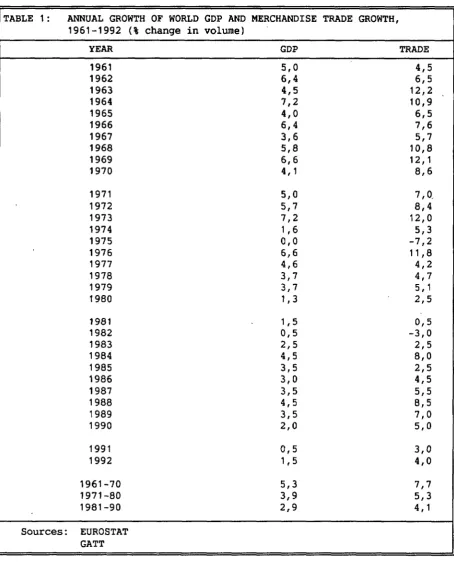
According to GATT estimates, world trade increased by 67% in volume terms during the seventies and by a further 49% during the following decade, against 48 and 34% in world production respectively (Table 1). This was accompanied by an increase in the number of countries engaged in world trade. Shifts also occurred in the international division of labour as production of labour intensive products increasingly moved from the industrialised to the developing countries, particularly the newly industrialised economies. Thus, the share in world trade of manufactured products exports from the developing countries (including the NIEs) rose steadily in value terms, from 5.4% in 1970 to 15.7% in 1990. However, the share of total developing country exports in world trade (including energy products) has, after a short lived upsurge in the period 1979-84 remained at around 20% throughout most of the last three decades.
For their part, the industrialised countries continue to dominate international trade activity, accounting for more than two thirds of world trade, while trade among the group represents around half of the total. The bulk (two thirds) of developing countries' exports continues to be directed towards the industrialised countries, although trade among the former has increased in the two decades in question, accounting for 5.8% of world trade in 1990, as against 3.5% in 1970 (with some fluctuations in between).
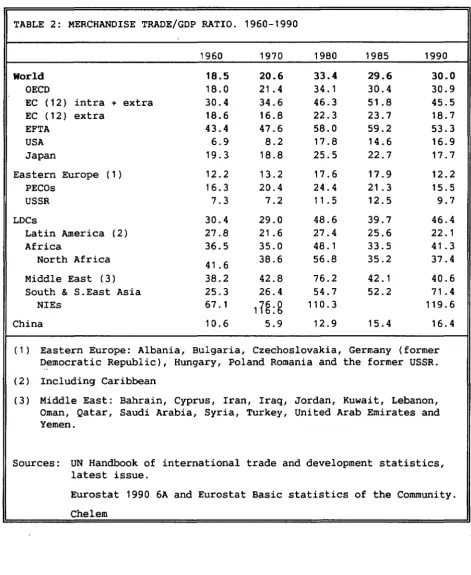
Merchandise trade now represents 30% of world GOP as against 19% in 1960 (Table 2). If services are included, the corresponding figures are nearly 40% today compared to 20% in 1960.
Trade in intermediate manufactured goods
Perhaps the most significant development in interdependence terms is the growth of intra-industry trade and trade in intermediate products (parts and semi-finished products) in general. This phenomenon, which characterises trade between the industrialised countries, reveals the high degree of internationalisation of production through foreign direct investment and economic networking operations.
A recent OECD study1 shows that direct imports of manufactured intermediate inputs accounts for between 50-70% of all manufactured imports into the five countries examined (Canada, France, Germany, the UK and the US), and the rate of growth of these intermediate imports as higher than the rate of growth of domestic sourcing over the period early seventies to mid eighties. The ratio of foreign to domestic sourcing in these countries ranged from 50% (Canada) to 7% (Japan). The use (direct and indirect) of imported intermediate inputs was found to be particularly high in petroleum refining, textiles, clothing and footwear, motor vehicles, computers, aerospace, communication equipment and semiconductors.
EC trade flows with Japan and the US also confirm the growing interdependence between the production processes of the Triad countries and similar links with other important economic partners. Approximately one-third of EC imports and over 40% of EC exports from and to the US, Japan and EFTA consist of intermediate manufactured goods.
A large part of trade in intermediate products is the result of intra-company movements of such inputs within multinational enterprises. It is estimated that intra-firm trade accounts for around 30% of exports and up to 40-50% of imports of the US, Japan and the UK2• Overall, the share of intra-firm trade in world trade is estimated at 25%3. The role of multinationals in promoting the expansion of trade is seen to be even greater if one looks at the total trade generated by these companies. The same sources estimate that multinationals generate exports accounting for at least 50% of exports from the US, 40% of Japanese exports and as much as 80% of UK exports. Overall, multinationals generate at least 40% of all world trade. At the same time, however, to the extent that their target is local market sales, they are also substituting potential trade flows by local production. Thus, it has been estimated that local sales of us subsidiaries in some of its major trading partners are greater (up to four or five times as great) than US exports to these countries. Similarly local sales of foreign subsidiaries in the US are 1.5 times higher than total US imports.
The above developments highlight the limitations of an approach to trade policy which is too compartmentalised and which relies too heavily on traditional, overall tr:ade balance considerations and ignores the structure of trade and other important economic indicators.
2
The International Sourc1ng of Intermed1ate Inputs: By Canada, France Germany, Japan, The
UK and the US, DSTI/STII/IND(92)1/Rev(1), OECD, March 1992.
C.MICHALET, The Activities of Mu1t1nat1ona1 Enterprises and their Effects on Internat1ona1 Trade, OECD, July 1991, TD/TC/WP9(91)43.
3
World Investment Report 1992, Transnat1ona1 Corporations as Eng1nes of Growth- United
(ii) Foreign Direct Investment
A ~otor of globalisation
Foreign direct investment ( FDI) has become an increasingly important activity over the last twenty years or so. World.FDI outflows in the previous decade-grew at an annual average rate of almost 30%1, more than three times the rate of world exports and four times as fast as world gross domestic product. This trend, which will almost certainly be maintained, has led to a situation where annual direct investment flows in 1989 stood at $196 bn as compared to a level of world exports of $3039 billion. Furthermore, i f one takes into account the contribution to world trade of multinational companies described in the preceding section, the importance of this form of international activity becomes even more evident. To quote the u~'s World Investment Report 1991 " ... in much the same way that burgeoning trade linkages drove international economic growth and integration in the 1950s and 1960s, FDI is fuelling growth and integration in the 1990s."
The motivation behind corporate decisions to undertake foreign investment is diverse but can be grouped under the two broad categories of cost and/or market considerations, including trade substitution and import barrier evasion. Foreign investment decisions in the period in question were founded on both types of motivation. The economic growth of the eighties, coupled with the trend towards greater liberalisation and deregulation, particularly in the services sector, gave FDI an additional impulse. As with other forms of international exchange, the bulk of FDI activity occurs among the industrialised countries.
The main actors
Japan, the UK, the United States, France and Germany are the main source of foreign investment. In the period 1986~1990 this group accounted for 70% of the world average outflow. Developed countri_es in total accounted for 96.8%. One interesting recent development is the entry of the newly industrialised economies, notably the Asian NIEs, on the FDI scene. As a result, FDI flows from developing countries have increased more than sevenfold in the space of five years although they still represent only 3% of world FDI outflows.
As host countries also, the developed economies attract the lion's share of FDI inflows- more than 80% of the total in 1990 (Table 4}. For their part, the developing countries·have lost ground, with their share falling from 25% of world inflows in the early eighties to 17% by the end of the decade. More than half of this subtotal is directed to South and South-East Asia, a third to Latin America and the Caribbean, while Africa attracts less than a tenth. The econo-mic marginalisation of much of the developing world is reflected in these figu-res. For others, chiefly the NIEs of S.E Asia and certain Latin American coun-tries, foreign investment, motivated by global strategy rather than local sales considerations, has been instrumental in promoting their export-led development.
This and most other figures in this section are from:
World Investment Report: the Triad in Foreign Direct Investment, United Nations, 1991
The rapid advance of Japanese FDI outflows means that Japan is fast increasing its share of the total stock of foreign investment. While Europe (i.e. UK, F, D, NL and I), has maintained its share at around 36% (largely through the rapid expansion of intra-EC investment), Japan's part has grown from just under 1% in 1960 to 16.9% in 1988 and the US share has slipped from 47% to 30.3% over the same period.
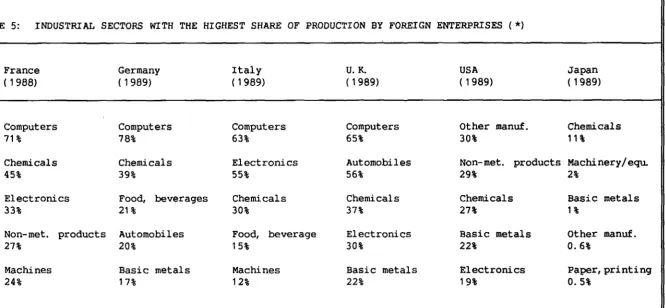
Foreign direct investment has become particularly important in the services sector. Although in earlier decades FDI was concentrated in raw materials and other primary products, today the main sectors are services and technology-intensive manufacturing (Table 5). More than 70% of Japanese foreign investment, and around 60% of US investment are in services. For Community countries, the share of services is generally lower and chemicals and energy account for more than half of foreign investment (with the exception of Germany for which the share of services is over 60%).
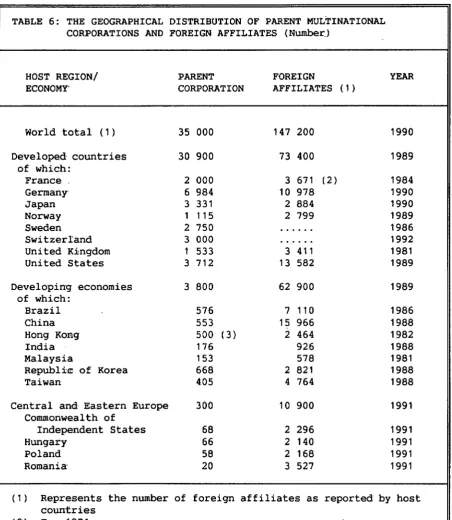
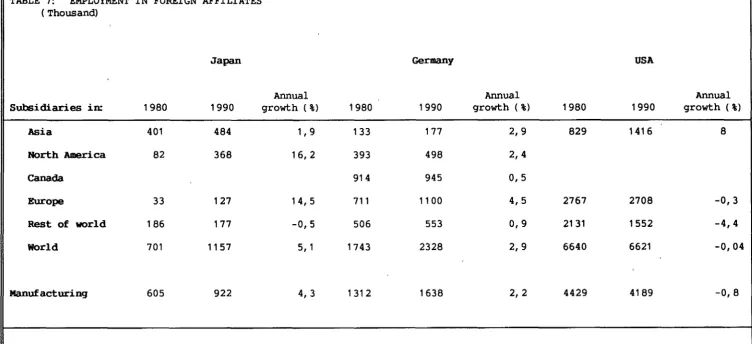
Multinational corporations (MNCs) are a major source of FDI flows, by which foreign affiliates are set up or acquired. The UN estimates the present total number of MNCs at (at least) 35,000, with some 148,000 foreign affiliates (Table 6). Nearly 90% of MNCs are based in developed countries, and the links with developing economies are mainly through foreign affiliates, with more than 40% of affiliates located in the latter. Most MNCs are small or medium-sized. A small number of MNCs account for the majority of outward FDI in individual countries. For example, in France, 350 MNCs accounted for 80% of all outflows in 1981-1984. The employment offered by foreign affiliates is considerable. For subsidiaries linked with companies in Japan, Germany and the US, it totals 10m jobs in 1990 (Table 7).
Increasing multilateral cooperation
The above developments have taken place against a very varied regulatory background. Multilateral cooperation initiatives have been undertaken in this area in the OECD and more recently in the GATT and the TRIMS (Trade Related Investment Measures) negotiations. In addition, UN agencies and the World Bank have also addressed various issues of relevance to FDI. However, the issues involved have generally been dealt with in a fragmented fashion. Bilateral agreements to address concerns with respect to host country treatment of investment, particularly in the developing world, have also proliferated.
A consensus of opinion is gradually emerging in favour of an agreement on a rationalised and more comprehensive multilateral framework for foreign direct investment. This is discussed in greater detail in Chapter III, section iv) below.
(iii) Globalisation of Technology
Growing interdependence
R&D activities, particularly in applied research, in order to facilitate the customisation of production to fit the needs of local markets and to take advantage of local human and technological resources.
FDI and Mergers and Acquisitions (M&As)
Foreign direct investment can take place through acquisitions of existing firms or through the creation of new firms and production facilities ("green-field" investment). The input and output structure of production tends to remain largely unaltered when existing firms change hands, at least not in the short run. The creation of new production facilities, however, is more likely to entail new international input-output patterns.
In the US, acquisitions accounted for nearly 85% of foreign investment outlays in the last decade, while in the EC around 60% of recent foreign direct investment occurred through acquisitions. These acquisitions were
for a large part concentrated in process industries, where there are im-portant economies of scale in production, marketing and/or possibilities of spreading the costs of high R&D (e.g. chemicals).
Cross-border mergers and acquisitions in Europe totalled ECU 45.3 bn in 1989, and ECU 30.4 bn in the first half of 1990, with the US as the main single acquiring nation and the EC clearly the largest acquiring entity. By far the most important "target" was the EC itself, accounting for around 90% of these flows (Table 8).
Apart from FDI, other forms of cross-border business linkages have also grown rapidly. Cross-border minority holdings and joint ventures in the EC both in industry and services accounted for more than half of all EC minority acquisitions and joint ventures taking place in the second half of the eighties (Tables 9-10).
Sources:
OECD, Industrial Policy in OECD Countries, annual review 1992, Paris 1992. CEC, Panorama of EC Industries 1991-1992, Luxembourg, 1992.
CEC, XXIst Report on Competition Policy, Brussels, 1992.
International collaboration
At the same time, although most inter-firm agreements in this area still take place within the same country or region, cross-border collaboration between companies in industrial R&D and innovation has come to play an important role in certain industries such as semiconductors, computers, automation, telecom-munications, biotechnology, as well as in a number of more traditional areas such as chemicals and automobiles.
between them, and to reduce the innovation time span or product development time. This makes it increasingly difficult for a single company, no matter how big, to cover the areas of research required for its strategic development and leads in turn to collaboration between companies with both related and comple-mentary technology.
Empirical research on the motives for inter-firm cooperation in general indicates that cooperation agreements related to technology complementarity and reduction of innovation time span have become as important as those related to market access considerations, which were the main motive force in the seventies. Thus, one recent study found 31% of the inter-company agreements examined were motivated by technology complementarity, 28% by the wish to reduce the innova-tion time span and 32% by market considerainnova-tions. Not surprisingly, the techno-logy related considerations were particularly strong in the high-tech sectors, while for traditional sectors the tendency was for market motivations to be stronger. Similar findings could be expected from an analysis limited only to international inter-firm alliances.
International cooperation in government sponsored R&D and innovation activities is much less widespread, although the advantages of sharing costs, particularly in expensive basic research, are beginning to make an impact on government attitudes. Nevertheless, many restrictions on such cooperation, often justified in national security grounds, remain in force.
As for cooperation between industry and university or other research establishments, this still is largely confined within countries or regions. It is, however, expected that the general trend for greater cross-border cooperation will eventually extend to this area also.
The contradiction between traditional government policies with respect to technology related issues and the reality of growing international interdepen-dence in this area mirrors the general lack of adaptation by national/community decision makers to the prevailing conditions governing economic activity. A re-evaluation of the presumptions on which these policies are based, particularly with respect to national security, would seem necessary. In this context, the importance of technology transfer in the effort to bring about the fuller integration of the less developed parts of the world in the global economic system should be highlighted.
(iv) Transnational Information Flows and Networks
A booming sector
At present, international communications represent barely 2% of the total communications volume on the telephone network. In particular, data communi-cations via this network do not even reach a significant volume, largely because of the system's real or perceived poor performance and inappropriate pricing schemes. The further development of tele data processing and information services is linked to the development of communication facilities and services.
The conversion of the old analog telephone system to the ISDN, a process which will be completed before the end of the decade in most western countries, will alter the situation dramatically. One immediate outcome will be that many services currently supported by other transmission means, will be transformed to ISDN. These services, will include features such as high quality facsimile, graphic data transmission, high speed information transfers, multilateral video conference (more exotic services such as TV
a
la carte, video telephone and many others will probably not become widely available until the next century).The rapid expansion of these new services can be expected to outstrip the growth of voice communications and, in the long run, they could become more important in absolute economic terms. Their most visible effect will be the creation of new markets to the detriment of some existing ones: multilateral video conference will significantly reduce business trips, reliable high quality facsimile will undoubtedly have a negative impact on traditional mail, while fast and reliable data transfer is likely to change radically our practices in administration, commerce and data exchange. In practice, these developments will result in a growing convergence of public and private communication networks and will call for international rule-making. The new data transfer possibilities will certainly give an added boost to the process of economic globalisation.
Repercussions for the developing world
The spread of data communication services and networks will, inevitably continue to be concentrated in the first instance, in the industrialised world. The question arises, whether this will act as a disincentive to foreign investment in the developing countries and hinder their fuller integration into the world economy.
In the absence of positive action to promote the necessary public and private expenditure, there is a very real danger that the poorer of the developing countries will be unable to undertake the substantial infrastructure costs involved. Although a number of third world economies, such as India, are making intense efforts to introduce new technologies, notably satellite and mobile communications networks, others are unable to mobilise the necessary funds and human and technological resources to follow suit and thus run the risk of becoming even more peripheral than at present.
(v) Economic Networking
The developments outlined in the preceding section have been instrumental in promoting the spread of new forms of corporate strategies at the
int~rnational level. These strategies are based concurrently on cooperation and
Convergence of Public and Private Networks
One of the most 1mportant practical outcomes of the ISDN 1s the blending of voice, data and
video transm1ssion both at the national and 1nternational level. In fact, once ISDN becomes
fully operational, it w1ll be v1rtually impossible for the carr1er compan1es to split vo1ce and data services as at present and harder for governments to 1mplement restr1ct1ve pol1c1es 1n this sector. Deregulation, spurred on by the new technology, will 1ntens1fy and private carriers w1ll be able to use the public ISDN infrastructure adding services to the network, Value Added Networks or VANS, in competition w1th the trad1t1onal monopolies in activit1es other than voice transm1ss1on.
So far, public and private carriers have carried out vertical 1ntegration policies: the carrier in most cases owns both the phys1cal infrastructure and provides the services offered
to the customers. In the case of public carriers, vert1cal integrat1on has often gone much
further to include the manufacture and d1stribut1on of network and term1nal equ1pment,
telecommunication computers, phone sets, modems, etc. Deregulation is 11 kely to cut the
present vertical sectors into horizontal layers. The telecommunicat1ons infrastructure w1ll
be owned by public and pr1vate carriers while pr1vate and public companies w1ll develop and offer Value Added Network services on top of the prev1ous layer.
In overall terms, therefore, corporate network1ng 1s mov1ng towards 1ncreased util1sat1on of publlc facilit1es and, 1ncreasingly, pubhc infrastructure 1s be1ng used as an 1ntegral part
of the private infrastructure. Th1 s trend should be further reinforced, as the costs,
coverage and reliab1l1ty of publ1c networks 1mprove and as 1nternat1onal standard1sation and deregulation proceed, even if certa1n sectors such as banking and some sensit1ve defence related 1ndustr1es cont1nue to ma1ntain the1r ex1st1ng closed networks.
The future landscape of internat1onal commun1cations 1s l1kely to be one in which many pr1vate compan1es offering value added services over networks w1th 1nternat1onal coverage, compete for
the prov1sion of these serv1ces with publ1c carr1ers. Transnat1onal J01nt ventures can also
be expected to increase. Already such J01nt proJects, notably between European, Japanese and
US carriers and users, are be1 ng set up 1 n the face of the h1 gh 1 nvestment costs of
1~troduc1ng the new technolog1es.
The economic potent1al of these developments 1s enormous. It 1s estimated that 80% of
1nternat1onal data 1nterchange relates to trade, transport and admimstrative activ1t1es. Only a small proport1on of this is currently transm1tted by electron1c means, and much of the electronic data 1nterchange wh1ch does take place 1s v1a pr1vate 1nfrastructures and uses
non-standard message formats. The sav1ngs 1n adm1mstrat1ve 1nfrastructure wh1ch could accrue
from the 1ntroduction of electron1c standard message transfers could, accord1ng to estimates
of some private compan1es, be as h1gh as 40%. Thus add1ng substant1al cost benef1ts to the
advantages of greater rap1dity and accuracy of transm1ss1on.
A clear 1nd1cat1on of the degree of 1nternat1onal 1nterdependence in this area 1s the
development of the UN 1n1tiative on Electronic Data Inter- Interchange for Admin1stration,
Commerce and Trade (EDIFACT). The EDIFACT regional boards, are respons1ble for the
elaboration of standard messages for internat1onal information interchange. It is expected
that, by the end of the century, standard formats will have been developed for most messages, thus enabling interlocutors across the world to overcome lingu1st1c as well as geographic barr1ers and to interchange orders, 1nvo1ces, data etc. qu1ckly and eff1c1ently.
In addition, for the new services described above to become fully operational and widely accepted various legal and security problems have to be solved, for example, electron1c
signatures, data privacy, and Intellectual Property protect1on. The pressure will grow for
greater 1nternat1onal cooperat1on among governments to rat1onal1se and 1mprove the ex1sting regulatory framework.
The above developments raise issues concerning the social aspects of telecommun1cat1ons. The
provis1on of certain m1n1mum services have to be assured for soc1al reasons (e.g. 1n
unprof1table rural or other remote regions). These cons1derat1ons apply pr1mar1ly to bas1c
vo1ce commun1cations, the so-called "reserved" services. A degree of policy 1ntervention will inevitably rema1n not only for social reasons but, equally, because of national secunty considerat1ons.
Of even greater long-term importance are the social and cultural changes impl 1ed by the
changes 1n working practices brought about by the new commumcation possibillt1es. A
These relationships include: simple exchange of information via electronic data interchange (EDI) systems; more advanced types of corporate alliances such as cross-licensing arrangements, R&D consortia or joint ventures and other forms of co-production; as well as alliances for moulding the
environment within which the companies in question operate, for example by developing common norms or by influencing the regulatory framework.
Networking is most prevalent in the services sector. Such economic linkages are particularly advanced in the area of professional services while financial services are increasingly relying on networking arrangements to develop their business in foreign markets as an alternative to cross-border provision of services or of direct investment. However, similar arrangements are also becoming more widespread in the manufacturing industry, particularly in the high tech areas of microelectronics, computers etc. Networking arrangements can cover activities ranging from the research and development stage through to the production and marketing phases. This introduces a greater element of flexibility in the operation of companies, which in turn, permits them to adapt their output to the specific needs of differentiated and variable markets and cope more effectively with competition, short product life cycles and rapid technological change.
Chemical companies and more traditional sectors such as automobiles are also discovering the benefits of competitive cooperation, particularly in data exchange. This trend can be expected to continue and to spread to cooperation in production and distribution as modern production and control technology, such as computer-aided design, manufacturing and marketing, becomes more widespread in a greater range of industrial sectors.
Assessing the total volume of current economic activity covered by networking is not easy, and few if any estimates have been published. It is equally difficult to evaluate the policy ramifications. What is clear is that it increases the complexity of international linkages and erodes further the effectiveness of national policies and regulation. The impact on competition, to name but one area, can be positive or negative depending on the specific circumstances. On the one hand, networking arrangements can increase the risk of cartelisation. On the other hand, such arrangements can raise the prospects of survival for small firms who might otherwise be unable to compete.
This is an area which merits deeper examination in order to assess the implications in terms of policies and priorities.
(vi) Financial Markets
derivatives in 1991 stood at $8.6 trillion, corresponding to 40% of world GDP1,
while "international" bank lending (cross-border lending plus domestic lending denominated in foreign currency) rose from $324 billion in 1980 to $7.5 trillion in 1990. With pension funds, which are the major institutional investors, also increasingly entering the international financial markets, many of these trends will be reinforced. Currently, only 5% of the total assets held by US pensions funds of $3.3 trillion is invested outside the country, and only 8% of Japanese pension funds of $2.2 trillion. The equivalent figure for European funds is hig-her, about 20%. These percentages are expected to double for the US and Japan within the next few years as asset diversification increases and legal obstacles
~o cross-border investments are lowered. This is likely to give a substantial further impulse to international financial markets.
This unprecedented mobility of capital has its positive and negative aspects. On the one hand it can help to assure the most efficient utilisation of capital at world level. On the other hand, it does hold potential dangers, particularly in the present institutional set-up.
The globalisation of financial markets has had a profound effect on the extent and degree of macroeconomic interdependence. As a result of the sheer volume of funds involved and the speed with which markets can respond to events, the impact of market developments can be both massive and immediate. Hence, the effects of changes in policy variables which influence the financial markets in one country, can be transmitted very rapidly to others. The total non-gold reserves of all industrial countries in 1992 stood at around $550 billion, or 40% less than the daily turnover in foreign exchange markets. Action by mone-tary authorities to influence exchange rates, which is deemed to be unwise can, therefore, be quickly swamped by the response of the markets.
Global financial markets, therefore, exercise a powerful discipline on national governments and limit the extent to which they can pursue a genuinely independent policy course. As long as market behaviour reflects real economic fundamentals, the effect of market discipline should be beneficial. However, it is also true that the potentially destabilising effects of simple speculation are now much greater. In addition, the complexity and extent of interlinkages between financial systems can in themselves generate new risks of breakdown and other malfunctioning permeating throughout the system. Apart from this system-risk, the complex interlinkages can also facilitate misuse of the system (e.g. money-laundering).
3. POLICY IMPLICATIONS
(i),~~ A Stable and Open World Economy
The various forms of international economic activity described in the preceding chapter make up an intensive and complex system of global interdependence. The interlinkages between individual economies are too strong
and the momentum of globalisation too great for the process to be reversed. In such a system, where wealth-creating activities are increasingly transnational, it makes sense to facilitate these activities by providing an open and stable world economic environment. It also makes sense to provide an international regulatory framework. The effort required to achieve the latter is likely to be far less than the cost of non-cooperation at the multilateral level.
Managing a global economy
A stable macroeconomic environment implies effective policy co-ordination between governments, at least of those economies whose size is such that they can have a significant impact on the global economy. The need for this is intensified by the increasing multipolarity of the world economic system. No single economy is large enough to assure the stability of the system or act as its engine of growth. The stability and predictability of the international economic environment can only be achieved through concertation among the main economies.
The economic welfare of the citizens of any country or entity like the European Community is intricately bound up with the prosperity of other economies. All economies are involved in the same self-reinforcing dynamic process which can, in the right circumstances, lead to higher growth and welfare for everyone or, in the wrong circumstances, can spiral down into recession. Moreover, because of the stronger and more numerous links between economies, as well as the rapidity with which effects are transmitted, the positive or negative trends are likely to be stronger than in the past. Recent experience with the world recession seems to indicate that even the richest and biggest economies are finding it harder to insulate themselves from international developments or to reverse their situation in isolation.
The drive by individual countries to increase their economic competitiveness is, therefore, not necessarily a zero-sum game. A competitive edge for one economy leading to more efficient production and increasing standards of living will not necessary occur at the expense of other economies, even though it may cause difficulties for specific sectors within the latter. In fact, given the right conditions of openness and competition, it is equally likely to have the opposite effect in a dynamic, self-reinforcing process of growth, especially in the medium to long term. The greater the interlinkages between economies, the stronger this effect.
Direct Economic Costs of Non-Liberalisation
The econom1c costs of inadequate liberalisation are widely recogmsed. The benef1cial hnk
between trade and econom1c growth has been demonstrated in practice, s1milarly other forms of
1nternational exchange have a favourable impact on growth. A fa1lure on the part of
governments to fac1 1 itate these activit1es w1thin an appropriate multi lateral regulatory framework and to introduce the necessary adjustment policies to reduce the short term dislo-catlon which can cause opposition to liberalisation, would prevent the realisat1on of the full
potent1al benef1ts and prevent a more opt1mal allocat1on of resources. While attempts to
quant1fy these effects may yield varying results, they do at least agree on the adverse nature and significance of the impact.
The absence of a su1table framework for international econom1c act1vity may hinder but w1ll
not stop the latter. What 1t w1ll do is to decrease further the capab1l1ty of governments to
manage the1r econom1c environment and to assure the best poss1ble condit1ons for econom1c
growth, domestically and internat1onally. Even in the most extreme case of a fa1lure of the
Uruguay Round and a regress1on 1nto protection1sm, the trend may be slowed but not reversed. Th1s means that the costs of non-cooperation at the multilateral level will 1ncrease further with time.
One recent French study est1mates that in the extreme case where the major trading blocs (EC+EFTA, NAFTA, and Japan+Asian NIE's) apply protection1st measures on 1nter-bloc trade, world manufacturing product1on would be 15% lower by the year 2000 than 1t would be, ceteris par1bus, on the bas1s of current trends, as a result of a reduction of 1nter-bloc trade and higher than otherw1se 1nflat1on rates brought about by a less effic1ent allocat1on of resources. It is interest1ng to note that the same model, which assumes, 1nter alia, a more
dec1sive apphcat1on of protect1on1st tools by the Un1ted States than by the Commun1ty,
y1elds substant1al reg1onal var1ations in the cost of protect1on1sm. The hardest hit are the
industrial1sed As1an countr1es (-23%), who are assumed to be the primary targets of EC and US protection1st measures, these are followed by Afr1ca and the M1ddle East (-16.5%), Eastern
Europe (-14%), and the rest of Asia (-13.5%). Product1on 1n Western Europe 1s expected to be
almost 13% down, while the US and Lat1n America are expected to be the least affected w1th a fall of around 7.5%.
In contrast to this, a s1mulat1on us1ng the same model, based on the assumption of accelerated market l1beralisation which leads to a rate of growth of world trade wh1ch exceeds present trends, f1nds that world manufacturing product1on would be 20% h1gher by the year 2000 than it would be if the present trade growth rate were cont1nued.
Another study, based on game theory analys1s. 1nd1cates that, wh1le the EC and the U.S. may stand to lose less than others from a tr1lateral EC/US/ Japan trade war, nevertheless all countries are sign1f1cantly better off 1n a world l1beralisat1on scenar1o.
Models such as this 1nevitably oversimpl1fy reality and the1r results have to be v1ewed w1th
caut1on. For example, 1n the first simulation account is not taken of alternat1ves to trade
whose development could be spurred further by a more restr1ct1ve trading env1ronment. Nevertheless, 1ndependent qual1tative analys1s would lead to sim1lar conclus1ons, regarding the 1mpact of protect1on1sm or of l1beral1sation, even 1f the magn1tude of the effects and the1r distribution are open to discuss1on.
The above studies relate spec1f1cally to trade in goods. The cost of 1nadequate cooperation
at the mult1lateral level, and hence the pers1stence of current difficult1es, both for pr1vate business and for governments seeklng to regulate, could be expected to be at least as substantial in services, as well as investment and other forms of 1nternational collaborat1on between economic operators.
References:
Economie mondia7e 1990-2000: 1'1mperat1f de cro1ssance.
d'Informations Internationales, Ed. Econom1ca, 1992.
Centre d'Etudes Prospectives et