Int. J. Electrochem. Sci., 11 (2016) 2177 - 2184
International Journal of
ELECTROCHEMICAL
SCIENCE
www.electrochemsci.org
Short Communication
Synthesis and Electrochemical Study of Spinel LiCu
0.05Mn
1.95O
4via a Solution Combustion Method as a Cathode Material for
Lithium Ion Batteries
Hongli Bai1,2, Wangqiong Xu1,2, Qiling Li1,2, Junming Guo1,2,*, Changwei Su1,2
1
Key Laboratory of Resource Clean Conversion in Ethnic Regions, Education Department of Yunnan, Yunnan Minzu University, Kunming 650500, PR China
2
Key Laboratory of Comprehensive Utilization of Mineral Resources in Ethnic Regions, Yunnan Minzu University, Kunming 650500, PR China
*
E-mail: [email protected]
Received: 10 December 2015 / Accepted: 4 January 2015 / Published: 1 February 2016
Single-phase LiCuxMn2-xO4 (x = 0 and 0.05) particles were synthesized by a solution combustion
method at 600 °C for 3 h. Scanning electron microscopy revealed that the agglomeration of the sample decreased with Cu doped. The electrochemical properties of LiCuxMn2-xO4 (x = 0 and 0.05) as a
cathode material for rechargeable lithium-ion batteries was characterized by galvanostatic charge-discharge experiments, cyclic voltammetry and electrochemical impedance spectroscopy. Cu-substituted LiCu0.05Mn1.95O4 exhibited excellent cycling stability with a capacity retention of 77.1% at
a discharge rate of 1 C (1 C =148 mAh g−1) after 500 cycles. LiCu0.05Mn1.95O4 spinel had a high rate
capability and reversible cycling performance, revealing that doping LiMn2O4 with Cu improves its
electrochemical performance for use as a cathode in lithium-ion batteries.
Keywords: solution combustion method; Cu-doping; LiMn2O4;cathode materials; Lithium-ion
batteries
1. INTRODUCTION
[4], improved electrochemical performance was achieved. Spinel LiMn2O4 has been widely
investigated as a promising cathode material for use in LIBs for EVs and HEVs because of its low cost, non-toxicity, and high safety and power density. However, an important issue restricting practical application of LiMn2O4 is rapid capacity fading, which is mainly caused by structural distortion via the
Jahn-Teller effect. To suppress capacity fading in LiMn2O4, substitution of the Mn3+ ions with other
ions such as Mg2+ [5], Ni2+ [6], Sn4+ [7], Al3+ [8], Fe2+ [9], Cu2+ [10] and F- [11] has been studied. The results showed that ion doping is an effective way to improve the structural stability and electrochemical performance of LiMn2O4 as a cathode material. Among these materials, the Cu
substitution spinel LiMn2O4 were studied only by a few researchers [12-19]. It was found that the
structural stability and cycling performance of spinel LiMn2O4 can be enhanced by using of lesser Cu
substitution, which can be ascribed to the stronger bond of Cu-O than that of Mn-O [14, 18]. Murali et al. [17] reported that LiCuxMn2-xO4 (0<x<0.5) samples were synthesized by a sol-gel process.
“Li/LiMnCu0.1Mn1.9O4” cells show an initial discharge capacity of 105 mAh g-1 with 90.48% capacity
retention after 60 cycles. Ebin et al synthesized nanocrystalline LiCuxMn2-xO4 (x=0.2-0.6) particles by
ultrasonic spray pyrolysis method and showed that the initial discharge capacities of LiCu0.2Mn1.8O4
was 122 mAh g-1, and the capacity retention was 55.74% after 50 cycles at 0.5 C [13]. Huang et al prepared Single-phase LiCuxMn2-xO4 (x≤ 0.10) cathode materials by a molten-salt combustion method
and LiCu0.05Mn1.95O4 demonstrated that initial discharge specific capacity of 119.0 mAh g-1 with
95.0% capacity retention after 100 cycles at 0.5 C [19]. These results demonstrate that the Cu-doping can effectively improve the electrochemical performance of the LiMn2O4 material. However, the
desired capacity retention and rate performance did not achieve.
In this paper, spinel LiCuxMn2-xO4 (x = 0 and 0.05) particles were synthesized by a solution
combustion method. Crystal structure, morphology, electrochemical properties and rate performance of the LiCuxMn2-xO4 cathode materials for LIBs were investigated in detail.
2. EXPERIMENTAL
LiMn2O4 andCu-substituted LiCu0.05Mn1.95O4 were prepared by a solution combustion method.
LiNO3 (AR, Aladdin) was used as lithium resource, Mn(CH3COO)24H2O (AR, Aladdin) acted as
manganese resource and Cu(CH3COO)2H2O (AR, Tianjin Kemiou) was dopant, which were weighted
according to a stoichiometric ratio of 1:1.95:0.05 (Li:Mn:Cu) with a total mixture mass of 4 g and
placed into a 300-mL crucible. Then, the 9 mol L-1 nitric acid were added to the mixture. Finally, the
mixture was heated in a muffle furnace at 600 °C for 3 h. LiCuxMn2-xO4 powders were obtained after
cooling to room temperature. Cathodes for LIBs were prepared with a weight ratio of 80% active
The structures of the materials were studied by powder X-ray diffraction (XRD, D/max-TTRIII, Rigaku, Japan) using Cu Kα radiation. Lattice parameters were obtained using Jade 5.0 software. The
morphology of the samples were observed by scanning electron microscopy (SEM; Quanta-200, FEI, Hillsboro, OR, USA).Galvanostatic charge-discharge experiments were performed using a Land electric test system (CT2001A; Wuhan Jinnuo Electronics Co., Ltd., China) at a current density of 1 C between 3.0 and 4.5 V (vs. Li/Li+). Cyclic voltammetry (CV) was carried out using an electrochemical workstation (IM6ex; Zahner Elektrik GmbH & Co. KG, Germany) from 3.60 to 4.50 V (vs. Li/Li+). Electrochemical impedance spectroscopy (EIS) of cells was measured using the same electrochemical workstation by applying an AC voltage of 5 mV in the frequency range of 0.1 Hz to 100 KHz.
3. RESULTS AND DISCUSSION
3.1 X-ray diffraction analysis
10 20 30 40 50 60 70
Mn
2O
3(5
3
1
)
(4
4
0
)
(5
1
1
)
(3
3
1
)
(4
0
0
)
(2
2
2
)
(3
1
1
)
(1
1
1
)
In
te
n
si
ty
(
a
.u
)
2
(
°
)
LiMn2O4 LiCu
[image:3.596.148.442.341.565.2]0.05Mn1.95O4
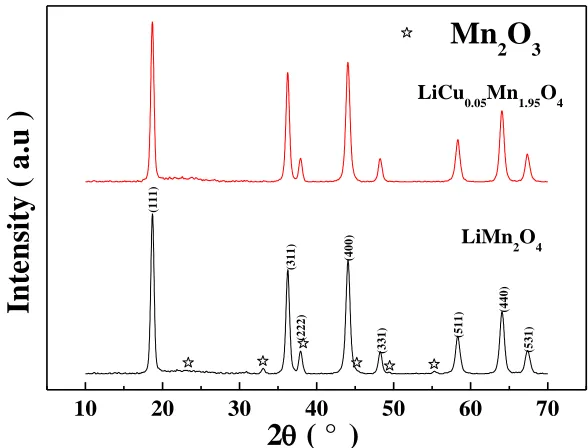
Figure 1. XRD patterns of LiMn2O4 and Cu-substituted LiCu0.05Mn1.95O4.
The XRD patterns of LiMn2O4 and Cu-substituted LiCu0.05Mn1.95O4 presented in Fig. 1 exhibit
the characteristic diffraction peaks of cubic spinel LiMn2O4 with the Fd3m space group (JCPDS,
PDF35-0782) corresponding to the eight crystal planes of (111), (311), (222), (400), (331), (511), (440), and (531). There is no marked difference in the crystal structure after Cu substitution. This indicates the addition of Cu does not change the spinel structure of LiMn2O4. The XRD pattern of
detected in the pattern of LiMn2O4, and can be identified as Mn2O3. The lattice parameters and unit
cell volumes of the materials are summarized in Table 1.
Table 1. Lattice parameters of LiMn2O4 and LiCu0.05Mn1.95O4 cathode materials
Cathode material Lattice parameter (Å) unit cell volume (Å)3
LiMn2O4 8.2142 554.3
LiCu0.05Mn1.95O4 8.2219 555.8
The lattice parameter increased from 8.2142 to 8.2219 Å after doping with Cu, which is because Mn3+ ions (0.0645 nm) are substituted by larger Cu2+ ions (0.087 nm) in LiCu0.05Mn1.95O4.
The expansion of the lattice crystal could provide more space for Li intercalation and deintercalation. The presence of Cu2+ could prevent the lattice from shrinking during the deintercalation process because of the large volume of the Cu-doped crystals [20, 21].
3.2 Surface morphology
Figure 2. SEM images of LiCuxMn2-xO4 (a: x = 0, b: x = 0.05).
Fig. 2(a and b) represents the typical SEM images of pristine LiMn2O4 and Cu substituted
LiCu0.05Mn1.95O4 and the size distribution ranges are from 40 to 400nm. Comparing these two
micrographs of the samples, obvious difference of the particle morphology could be observed. As shown in Fig. 2, LiMn2O4 product agglomerated seriously while the agglomeration of the sample
decreased and the particle sizes decreased with Cu doped. The results indicate that the Cu doping can restrain the agglomeration. On the other hand, the smaller particle sizes of materials may increase the
[image:4.596.113.485.395.554.2]
electrode-electrolyte contact area and reduce lithium-ion-diffusion distances, and then improve the electrochemical performance of cathode materials [1].
3.3 Galvanostatic charge-discharge studies
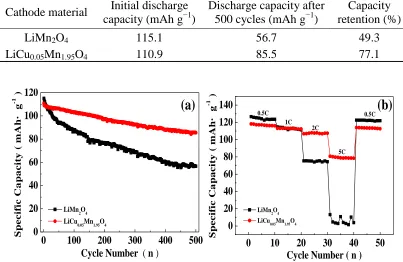
The discharge capacities and capacity retention of the LiMn2O4 and LiCu0.05Mn1.95O4 cathode
materials were measured; the results are shown in Fig. 3(a) and Table 2. LiMn2O4 exhibited an initial
capacity of 115.1 mAh g−1 and capacity retention of 49.3% after 500 cycles. In contrast, LiCu0.05Mn1.95O4 exhibited an initial capacity of 110.9 mAh g−1 and capacity retention after 500 cycles
of 77.1%. Fig. 2(b) shows the C-rate capabilities of the LiMn2O4 and LiCu0.05Mn1.95O4 cathode
materials.
For both compounds, the discharge capacity decreased with increasing C-rate, which is caused by the low diffusion rate of the Li ions in the LiMn2O4 particles. At 5 C, LiCu0.05Mn1.95O4 retained a
discharge capacity of 80 mAh g−1, while LiMn2O4 hardly discharges. These results indicate that doping
LiMn2O4 with Cu has a remarkable effect on its cyclic behavior. This is because Cu doping can limit
[image:5.596.96.499.431.693.2]the Jahn-Teller effect as well as increasing structural stability as Cu-O bonds are stronger than Mn-O bonds [13].
Table 2. Discharge capacities and capacity retention of LiMn2O4 and LiCu0.05Mn1.95O4 cathode
materials
Cathode material Initial discharge capacity (mAh g−1)
Discharge capacity after 500 cycles (mAh g−1)
Capacity retention (%)
LiMn2O4 115.1 56.7 49.3
LiCu0.05Mn1.95O4 110.9 85.5 77.1
0 100 200 300 400 500
0 20 40 60 80 100 120 S p e c if ic C a p a c it y ( m A h · g -1 )
Cycle Number ( n )
LiMn2O4
LiCu0.05Mn1.95O4
(a)
0 10 20 30 40 50
0 20 40 60 80 100 120 140 S p e c if ic C a p a c it y ( m A h · g -1 )
Cycle Number( n )
LiMn2O4
LiCu0.05Mn1.95O4
0.5C 1C
2C
5C
0.5C
(b)
3.4 Cyclic voltammetric studies and Electrochemical impedance spectroscopy (EIS)
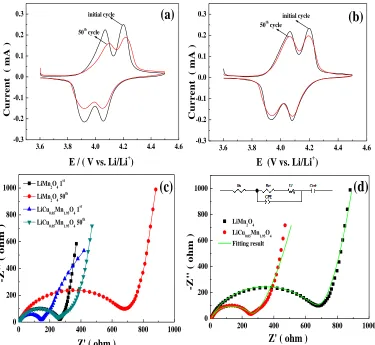
Typical CVs of LiMn2O4 and Cu-substituted LiCu0.05Mn1.95O4 electrodes in the potential range
of 3.6-4.5 V at a scan rate of 0.05 mV s−1 are depicted in Fig. 4(a) and (b), respectively. The electrochemical behavior of Li/LiMn2O4 and Li/LiCu0.05Mn1.95O4 cells was tested before the cells were
used for galvanostatic charge-discharge studies at various current rates in the range of 0.5-5 C. CVs of both cells were also measured after the completion of 50 cycles at various current rates in the range of 0.5-5 C. For LiMn2O4, in the first cycle, the two redox peaks are well separated and narrow. However,
after 50 cycles, both anodic and cathodic peaks are broader and closer to each other with weaker peak intensity compared with in the first cycle, which is ascribed to possible Jahn-Teller distortion. In contrast, LiCu0.05Mn1.95O4 after 50 charge-discharge cycles at different rates showed peaks similar to
the initial ones, indicating less polarization and better reversibility. Based on these results, doping LiMn2O4 with Cu could markedly improve its reversibility and electrochemical performance [20].
3.6 3.8 4.0 4.2 4.4 4.6
-0.3 -0.2 -0.1 0.0 0.1 0.2 0.3
(a)
C u r r e n t ( m A )E / ( V vs. Li/Li+) initial cycle
50th cycle
3.6 3.8 4.0 4.2 4.4 4.6
-0.3 -0.2 -0.1 0.0 0.1 0.2
0.3 initial cycle
(b)
50th cycle
C u r r e n t ( m A )
E (V vs. Li/Li+)
0 200 400 600 800 1000 0 200 400 600 800 1000
(c)
-Z " ( o h m )Z' ( ohm )
LiMn2O4 1st
LiMn2O4 50th
LiCu 0.05Mn1.95O4 1
st
LiCu0.05Mn1.95O4 50th
0 200 400 600 800 1000 0 200 400 600 800 1000
(d)
-Z " ( o h m )Z' ( ohm ) LiMn
2O4 LiCu
0.05Mn1.95O4 Fitting result
Figure 4. Typical CV curves of initial and 50th cycles for (a) LiMn2O4 and (b) LiCu0.05Mn1.95O4. (c)
Nyquist plots of initial and 50th cycles for LiMn2O4 and LiCu0.05Mn1.95O4. (d) Nyquist plots of
50th cycles for LiMn2O4 and LiCu0.05Mn1.95O4. Inset is the equivalent circuit used to fit the EIS
[image:6.596.112.487.304.649.2]
EIS of the LiMn2O4 and Cu-doped LiCu0.05Mn1.95O4 cathode materials was performed to help
rationalize their cycle life and rate capability characteristics. Nyquist plots of LiMn2O4 and
LiCu0.05Mn1.95O4 after 50 charge-discharge cycles at different rates are shown in Fig. 4(c). The charge
transfer resistance (Rct) of LiMn2O4 increased considerably after 50 charge-discharge cycles at
different rates, whereas that of LiCu0.05Mn1.95O4 increased only slightly. This means charge transfer
occurs more easily in LiCu0.05Mn1.95O4 than in LiMn2O4, which is consistent with the high rate
[image:7.596.102.490.251.332.2]capability and good cyclability of LiCu0.05Mn1.95O4 illustrated above.
Table 3. Fitting values of electrochemical parameters obtained from EIS data
Parameter
Cathode material
LiMn2O4 LiCu0.05Mn1.95O4
Rs (Ω) 6.073 7.156
Rct (Ω) 653.2 247
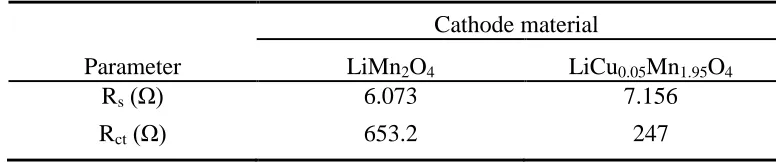
The EIS data were analyzed using the equivalent circuit given in the inset of Fig. 4(d) and the respective parameters are shown in Table 3. LiCu0.05Mn1.95O4 exhibited an Rct of 247 Ω, which is
lower than that of LiMn2O4 (653.2 Ω). This indicates that Cu doping could effectively enhance the
ability of Li ions to diffuse in the spinel during the charge-discharge process.
This result suggests that Cu-doped LiCu0.05Mn1.95O4 should show high rate capability, as
observed in Fig. 3.
4. CONCLUSIONS
Single-phase LiCu0.05Mn1.95O4 spinel was synthesized using a solution combustion method.
LiCu0.05Mn1.95O4 produced by this method exhibited a capacity retention of 77.1% at a discharge rate
of 1 C (1C=148 mA g−1) after 500 cycles, showing excellent cycling stability. LiCu0.05Mn1.95O4
showed good reversibility and a high peak current in electrochemical studies, which are favorable for electrodes in LIBs. EIS analysis suggested LiCu0.05Mn1.95O4 had improved cycling performance with
smaller charge transfer resistance compared with those of LiMn2O4, resulting in high rate capability.
ACKNOWLEDGEMENTS
References
1. S. Lee, Y. Cho, H. Song, K.T, Lee J. Cho, Angew. Chem., 124 (2012), 8878-8882. 2. K. Kang, Y.S. Meng, J. Breger, C.P. Grey, G. Ceder, Science, 311 (2006) 977-980.
3. Z. Ma, G. Shao, X. Qin, Y. Fan, G. Wang, J. Song, T. Liu, J. Power Sources, 269 (2014) 194-202. 4. H. Wang, H. Xia, M.O. Lai, L. Lu, Electrochemistry Communications, 11 (2009) 1539-1542. 5. M.W. Xiang, C.W. Su, L.L. Feng, M.L. Yuan, J.M. Guo, Electrochim. Acta, 125 (2014) 524-529. 6. M.A. Kebede, N. Kunjuzwa, C.J. Jafta, M.k. Mathe, K.I. Ozoemena, Electrochim. Acta, 128 (2014)
172-177.
7. H. Yin, W.Y. Kong, S. Yoon, S. Nahm, H.W. Jang, Y. Sung, J. Ha, A.V. Davydov, J. Choi, Electrochemistry Communications, 43 (2014) 36-39.
8. A.B. Yuan, L. Tian, W.M. Xu, Y.Q. Wang, J. Power Sources, 195 (2010) 5032-5038.
9. Y.S. Shi, S.M. Zhu, C.L. Zhu, Y. Li, Z.X. Chen, D. Zhang, Electrochim. Acta, 154 (2015) 17-23. 10.Y. Ein-Eli, W.F. Howard, S.H. Lu, S. Mukerjee, J. McBreen, J. T. Vaughey, M. M. Thackeray, J.
Electrochem Soc., 145 (1998) 1238-1244.
11.J.T. Son, H.G. Kim, J. Power Sources, 147 (2005) 220-226.
12.Y. Ein‐ Eli, J.T. Vaughey, M.M. Thackeray, S. Mukerjee, X.Q. Yang, J.McBreen, J. Electrochem Soc., 146 (1999) 908-913.
13.B. Ebin, S. Gürmen, G. Lindbergh, Materials Chemistry and Physics, 136 (2012) 424-430. 14.R.H. Zeng, W.S. Li, D.S. Lü, Q.M. Huang, L.Z. Zhao, Trans. Nonferrous Met. Soc., 17 (2007)
1312-1318.
15.G.T-K. Fey, C-Z. Lu, T.P. Kumar, J. Power Sources, 115 (2003) 332-345.
16.A. Milewska, Ł. Kondracki, M. Molenda, M. Bakierska, J. Molenda, Solid State Ionics, 267 (2014) 27-31.
17.K. R. Murali, T. Saravanan, M. Jayachandran, J. Mater. Sci.: Mater. Electron., 19 (2008) 533-537. 18.R.Thirunakaran, B.R. Babu, N. Kalaiselvi, P. Periasamy, T.P. Kumar, N.G. Renganathan, M.
Raghavan, N.Muniyandi, Bull. Mater., Sci., 24 (2001) 51-55.
19.J.J. Huang, Q.L. Li, H.L. Bai, W.Q. Xu, Y.H. He, C.W. Su, J.H. Peng, J.M. Guo, Int. J. Electrochem. Sci., 10 (2015) 4596-4603.
20.D. Arumugam, G.P. Kalaignan, K. Vediappan, C.W. Lee, Electrochim. Acta, 55 (2010) 8439-8444. 21.B. Ebin, S. Gürmen, G. Lindbergh, Ceram. Int., 40 (2014) 1019-102.